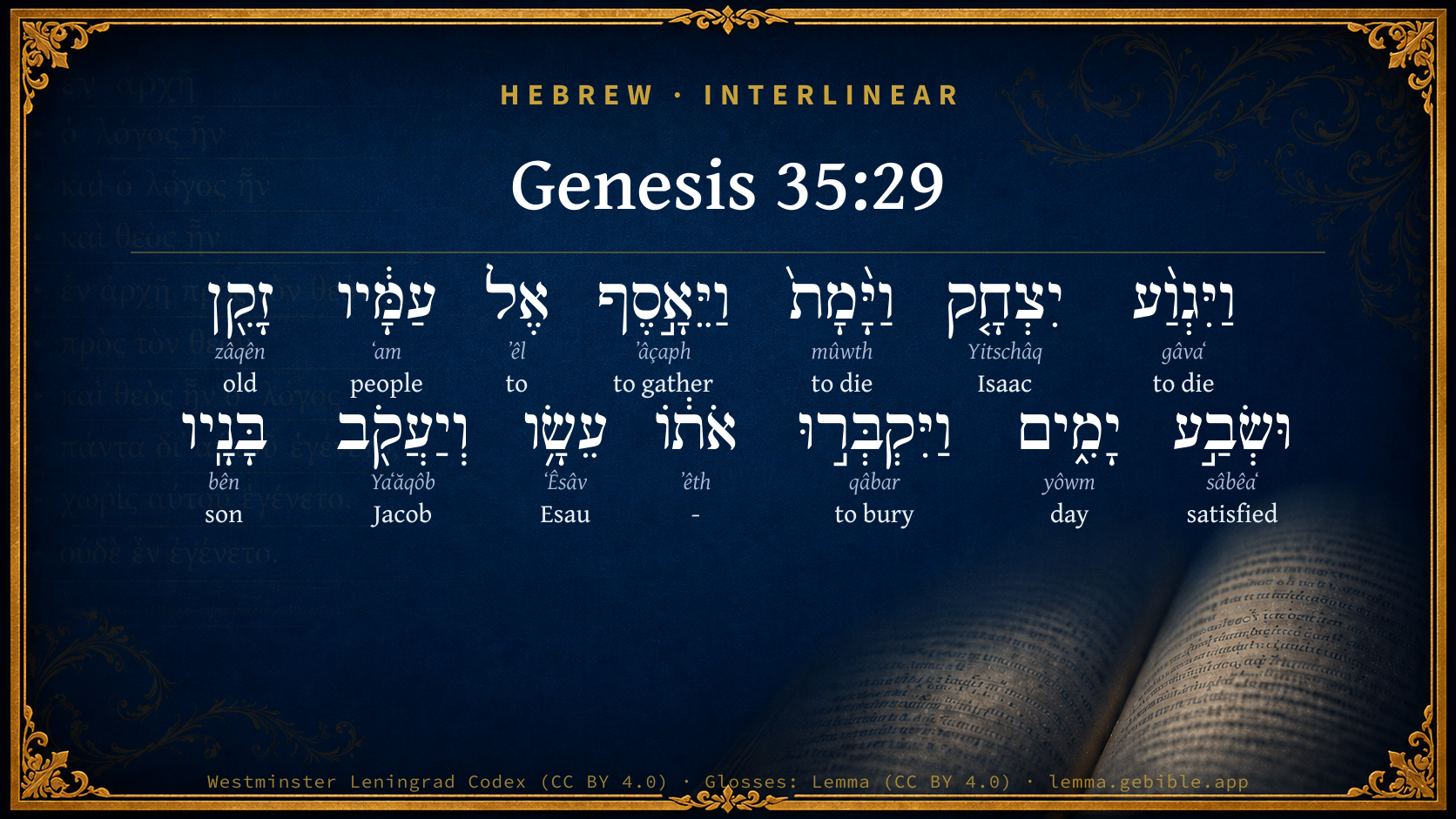
Genesis 35:29

Hebrew (Westminster Leningrad Codex) Genesis 35:29 appears in the Hebrew Old Testament. The text above is from the Westminster Leningrad Codex. Each word links to its Strong’s number, a concise gloss, and parsing drawn from the Open Scriptures Hebrew Bible morphology. Click any word for its full Brown-Driver-Briggs (BDB) entry.
Download image
Cite this verse

Genesis 35:29 (World English Bible). Public Domain. Lemma interlinear Bible study tool, https://lemma.gebible.app/v/genesis/35/29.

Show BibTeX & RIS
BibTeX
RIS
English Translation
Isaac gave up the spirit, and died, and was gathered to his people, old and full of days. Esau and Jacob, his sons, buried him.
World English Bible · Public Domain
Download a study sheet

One document with this verse’s original text, its word-by-word gloss line, the meaning frame, cross-references with their text, attributed commentary, and full source and license credits — printable, and it pastes into notes with its structure intact.

This verse Autodidact and up

Study sheet (.html) Plain text (.txt)

A passage Seminary Student

Up to 50 verses in one chapter. A passage sheet keeps up to 6 commentary sources and 12 cross-references per verse, in the order this page ranks them, and says so on the sheet whenever that leaves anything out. Ask for a single verse and you get the Autodidact verse sheet above.

Everything on this page stays free to read, with no account — the sheet is a download of what is already on screen, not access to it.

Want to remove ads? Support Godless Engineer
Compare translations 3

The same verse in 3 English versions, stacked beneath the original-language interlinear above. Click any original word for its lexicon entry.

Each is an independent rendering of the whole verse — the interlinear is not word-aligned to these translations.

Highlighted words mark where these versions differ — a whole-verse word diff, not a word-by-word alignment.

  • World English Bible Public Domain
    Isaac gave up the spirit, and died, and was gathered to his people, old and full of days. Esau and Jacob, his sons, buried him.
  • King James Version Public Domain
    And Isaac gave up the ghost, and died, and was gathered unto his people, being old and full of days: and his sons Esau and Jacob buried him.
  • unfoldingWord Literal Text CC BY-SA 4.0
    Then Isaac exhaled and died, and he was gathered to his people, old and full of days. And Esau and Jacob, his sons, buried him.

unfoldingWord Literal Text — © unfoldingWord, licensed CC BY-SA 4.0. Word-aligned USFM3 via Door43 (git.door43.org/unfoldingWord/en_ult).

Versions to compare (up to 4)

3 of 4 selected

Show all 18 translations

Every available English version of this verse, each an independent rendering of the whole verse.

  • World English Bible Public Domain
    Isaac gave up the spirit, and died, and was gathered to his people, old and full of days. Esau and Jacob, his sons, buried him.
  • Berean Standard Bible Public Domain
    Then he breathed his last and died and was gathered to his people, old and full of years. And his sons Esau and Jacob buried him.
  • Majority Standard Bible Public Domain
    Then he breathed his last and died and was gathered to his people, old and full of years. And his sons Esau and Jacob buried him.
  • King James Version Public Domain
    And Isaac gave up the ghost, and died, and was gathered unto his people, being old and full of days: and his sons Esau and Jacob buried him.
  • American Standard Version (1901) Public Domain
    And Isaac gave up the ghost, and died, and was gathered unto his people, old and full of days: and Esau and Jacob his sons buried him.
  • Revised Version (1885) Public Domain
    And Isaac gave up the ghost, and died, and was gathered unto his people, old and full of days: and Esau and Jacob his sons buried him.
  • Geneva Bible (1599) Public Domain
    And Izhak gaue vp the ghost and died, and was gathered vnto his people, being olde and full of daies: and his sonnes Esau and Iaakob buried him.
  • Douay-Rheims (1899) Public Domain
    And being spent with age he died, and was gathered to his people, being old and full of days: and his sons Esau and Jacob buried him.
  • Young's Literal Translation Public Domain
    and Isaac expireth, and dieth, and is gathered unto his people, aged and satisfied with days; and bury him do Esau and Jacob his sons.
  • Literal Standard Version CC BY-SA 4.0
    and Isaac expires, and dies, and is gathered to his people, aged and satisfied with days; and his sons Esau and Jacob bury him.
  • Unlocked Literal Bible CC BY-SA 4.0
    Isaac breathed his last and died, and was gathered to his ancestors, an old man full of days. Esau and Jacob, his sons, buried him.
  • unfoldingWord Literal Text CC BY-SA 4.0
    Then Isaac exhaled and died, and he was gathered to his people, old and full of days. And Esau and Jacob, his sons, buried him.
  • Darby Bible Public Domain
    And Isaac expired and died, and was gathered to his peoples, old and full of days. And his sons Esau and Jacob buried him.
  • World Messianic Bible Public Domain
    Isaac gave up the spirit and died, and was gathered to his people, old and full of days. Esau and Jacob, his sons, buried him.
  • Webster's Bible Public Domain
    And Isaac expired and died, and was gathered to his people, being old and full of days; and his sons Esau and Jacob buried him.
  • Free Bible Version CC BY-SA 4.0
    when he breathed his last and died at an old age. He had lived a full life, and now he joined his forefathers in death. His sons Esau and Jacob buried him.
  • Bible in Basic English Public Domain
    Then Isaac came to his end and was put to rest with his father's people, an old man after a long life: and Jacob and Esau, his sons, put him in his last resting-place.
  • JPS Tanakh (1917) Public Domain
    And Isaac expired, and died, and was gathered unto his people, old and full of days; and Esau and Jacob his sons buried him.

Literal Standard Version (2020), Covenant Press — licensed CC BY-SA 4.0. Text via the HelloAO Bible API (eBible.org). Unlocked Literal Bible (unfoldingWord) — licensed CC BY-SA 4.0. Text via the HelloAO Bible API (eBible.org). unfoldingWord Literal Text — © unfoldingWord, licensed CC BY-SA 4.0. Word-aligned USFM3 via Door43 (git.door43.org/unfoldingWord/en_ult). Free Bible Version, Dr. Jonathan Gallagher — licensed CC BY-SA 4.0. Text via the HelloAO Bible API (eBible.org).

Word by word

More ways to search: Search by grammar → Find every occurrence → Compare this word →

Practice this passage: Drill this verse → Learn its vocabulary →

וּשְׂבַ֣ע
sâbêaʻ
H7649
“and · satisfied of”
Conjunction + Adjective, Adjective, Masculine, Singular, Construct
Part of Speech
Conjunction + Adjective
Type
Adjective
Gender
Masculine
Number
Singular
State
Construct
Full BDB Definition

Origin: from H7646

TWOT: 2231d

sated, satisfied, surfeited - sated, abounding, satisfied - surfeited (bad sense)
  1. וַיִּגְוַ֨ע gâvaʻ H1478 “and · to die” Conjunction + Verb, Qal, Sequential Imperfect, 3rd Person, Masculine, Singular
  2. יִצְחָ֤ק Yitschâq H3327 “Isaac” Noun, Proper
  3. וַיָּ֨מָת֙ mûwth H4191 “and · to die” Conjunction + Verb, Qal, Sequential Imperfect, 3rd Person, Masculine, Singular
  4. וַיֵּאָ֣סֶף ʼâçaph H622 “and · to gather” Conjunction + Verb, Niphal, Sequential Imperfect, 3rd Person, Masculine, Singular
  5. אֶל ʼêl H413 “to” Preposition
  6. עַמָּ֔יו ʻam H5971 “peoples · his” Noun, Common, Masculine, Plural, Construct + Suffix, Personal, 3rd Person, Masculine, Singular
  7. זָקֵ֖ן zâqên H2205 “old” Adjective, Adjective, Masculine, Singular, Absolute
  8. יָמִ֑ים yôwm H3117 “days” Noun, Common, Masculine, Plural, Absolute
  9. וַיִּקְבְּר֣וּ qâbar H6912 “and · to bury” Conjunction + Verb, Qal, Sequential Imperfect, 3rd Person, Masculine, Plural
  10. אֹת֔וֹ ʼêth H853 “- · him” Particle, Direct Object + Suffix, Personal, 3rd Person, Masculine, Singular
  11. עֵשָׂ֥ו ʻÊsâv H6215 “Esau” Noun, Proper
  12. וְיַעֲקֹ֖ב Yaʻăqôb H3290 “and · Jacob” Conjunction + Noun, Proper
  13. בָּנָֽיו bên H1121 “sons · his” Noun, Common, Masculine, Plural, Construct + Suffix, Personal, 3rd Person, Masculine, Singular

About this verse

These counts appear in no published source. They are computed here, from the morphology-tagged text and Lemma’s own curated glosses. What Lemma adds →

14
words
14
distinct lemmas
Pentateuch
section

Notable vocabulary

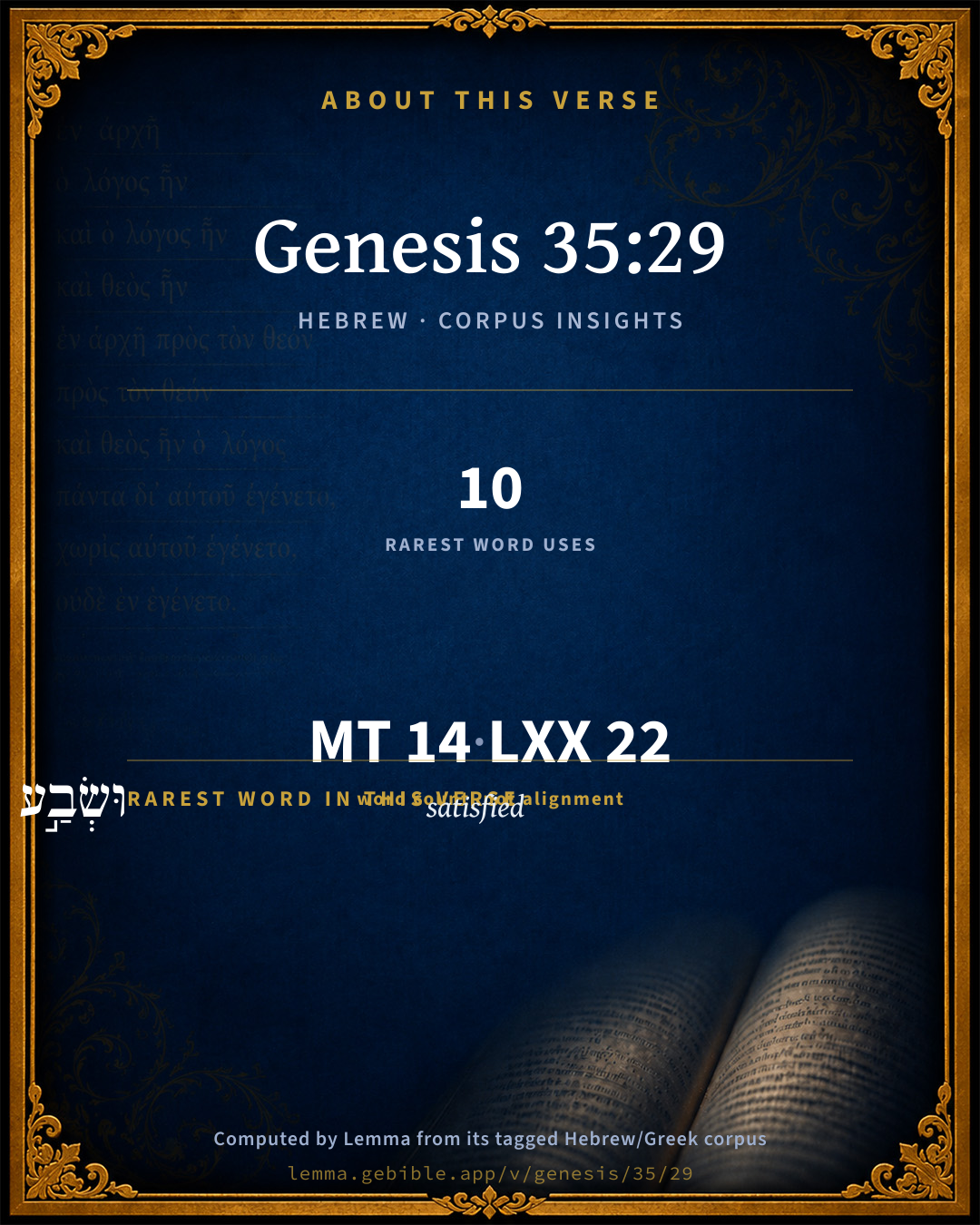
The rarest word here is וּשְׂבַ֣ע satisfied H7649 — appearing just 10 times in the whole Hebrew Bible.

Shared distinctive vocabulary

וּשְׂבַ֣ע satisfied H7649 occurs in 10 verses of the Hebrew Bible. Also found in:

Grammatical profile

  • 4 verbs
  • 6 nouns
  • 2 adjectives
  • 1 preposition
  • 1 particle

Verb forms

  • וַיִּגְוַ֨ע Qal · Sequential Imperfect
  • וַיָּ֨מָת֙ Qal · Sequential Imperfect
  • וַיֵּאָ֣סֶף Niphal · Sequential Imperfect
  • וַיִּקְבְּר֣וּ Qal · Sequential Imperfect

Hebrew & Septuagint length

In English translation the verse runs 25 words from the Hebrew and 27 from the Septuagint (LXX English) — closely comparable.

A rough comparison of the two English renderings, which tokenize alike — not a word-level alignment.

Word counts can differ between the Hebrew and the Greek without any difference in meaning — e.g. the Hebrew direct-object marker אֵת has no separate Greek word, and Greek often adds the article ὁ.

In the original languages it is 14 Hebrew tokens and 22 Greek tokens — but the two are counted differently (Hebrew bundles its prefixes and suffixes into one token; the Greek is in lemma form), so that isn’t a like-for-like length.

Cross-references

11

Topical passages linked to Genesis 35:29 in the Treasury of Scripture Knowledge — connected by theme and wording, ordered by reader-vote popularity; previews shown in the World English Bible.

  • Genesis 15:15 But you will go to your fathers in peace. You will be buried in a good old age.
  • Genesis 49:33 When Jacob made an end of charging his sons, he gathered up his feet into the bed, and yielded up the spirit, and was gathered to his people.
  • Genesis 49:31 There they buried Abraham and Sarah, his wife. There they buried Isaac and Rebekah, his wife, and there I buried Leah:
  • Genesis 3:19 By the sweat of your face will you eat bread until you return to the ground, for out of it you were taken. For you are dust, and to dust you shall return."
  • Genesis 23:19–20 After this, Abraham buried Sarah his wife in the cave of the field of Machpelah before Mamre (the same is Hebron), in the land of Canaan.
  • Genesis 25:7–9 These are the days of the years of Abraham's life which he lived: one hundred seventy-five years.
  • Genesis 25:17 These are the years of the life of Ishmael: one hundred thirty-seven years. He gave up the spirit and died, and was gathered to his people.
  • Genesis 27:41 Esau hated Jacob because of the blessing with which his father blessed him. Esau said in his heart, "The days of mourning for my father are at hand. Then I will kill my brother Jacob."
  • Job 5:26 You shall come to your grave in a full age, Like a shock of grain comes in its season.
  • Genesis 27:1–2 It happened, that when Isaac was old, and his eyes were dim, so that he could not see, he called Esau his elder son, and said to him, "My son?" He said to him, "Here I am."
  • Ecclesiastes 12:5–7 Yes, they shall be afraid of heights, And terrors will be in the way; And the almond tree shall blossom, And the grasshopper shall be a burden, And desire shall fail; Because man goes to his everlasting home, And the mourners go about the streets:

Cross-references courtesy of OpenBible.info (CC BY 4.0).

Hebrew and Greek witnesses Masoretic Hebrew ↔ Greek Septuagint

The same verse in the two great witnesses to the Old Testament, shown verse-for-verse.

These are two independent witnesses, not word-aligned to each other, and the Septuagint is shown in lemma (dictionary) form.

Hebrew Genesis 35:29 Masoretic · Westminster Leningrad Codex

וַיִּגְוַ֨ע יִצְחָ֤ק וַיָּ֨מָת֙ וַיֵּאָ֣סֶף אֶל עַמָּ֔יו זָקֵ֖ן וּשְׂבַ֣ע יָמִ֑ים וַיִּקְבְּר֣וּ אֹת֔וֹ עֵשָׂ֥ו וְיַעֲקֹ֖ב בָּנָֽיו

Isaac gave up the spirit, and died, and was gathered to his people, old and full of days. Esau and Jacob, his sons, buried him.

World English Bible · Public Domain

Greek LXX Genesis 35:29 Septuagint · lemma form

καί ἐκλείπω ἀποθνήσκω καί προςτίθημι πρός ὁ γένος αὐτός πρεσβύτερος καί πλήρης ἡμέρα καί θάπτω αὐτός ησαυ καί ἰακώβ ὁ υἱός αὐτός

And Isaac gave up the ghost and died, and was laid to his family, old and full of days; and Esau and Jacob his sons buried him.

LXX2012 (modern English Septuagint) · Public Domain

Hebrew: Westminster Leningrad Codex (CC BY 4.0). Greek: Septuagint (public domain); English from LXX2012 (modern English Septuagint) (Public Domain). How the Septuagint differs from the Hebrew →

Targum (Aramaic paraphrase)

2

The Targum is the ancient Jewish Aramaic paraphrase of the Hebrew Scriptures — an interpretive translation, not the Hebrew text itself. Onkelos (literal) and Pseudo-Jonathan (expansive) render the Torah, and Jonathan the Prophets. Coverage is partial: where no permissively-licensed English translation exists for a verse, only the Aramaic is shown. This is verse-level text, not a word-by-word alignment to the Hebrew.

  1. Targum Onkelos Torah (Genesis–Deuteronomy)
    וְאִתְנְגִיד יִצְחָק וּמִית וְאִתְכְּנִישׁ לְעַמֵהּ סִיב וּשְׂבַע יוֹמִין וּקְבָרוּ יָתֵהּ עֵשָׂו וְיַעֲקֹב בְּנוֹהִי

    (no public-domain English translation for this verse)

    Targum Onkelos — Aramaic: “Onkelos Genesis” (public domain); “Onkelos Exodus” (public domain); “Onkelos Leviticus” (public domain); “Onkelos Numbers” (public domain); “Onkelos Deuteronomy” (public domain). English: “Sefaria Community Translation” (CC0 1.0 (public-domain dedication)); “J.W. Etheridge. The Targums of Onkelos and Jonathan Ben Uzziel on the Pentateuch. London: Longmans, Green, 1862” (public domain). Text via Sefaria.

  2. Targum Pseudo-Jonathan Torah (Genesis–Deuteronomy)
    וְאִתְנְגִיד יִצְחָק וְאִתְכְּנַשׁ לְעַמֵיהּ סִיב וּשְבַע יוֹמִין וּקְבָרוּ יָתֵיהּ עֵשָו וְיַעֲקב בְּנוֹי

    And Izhak expired and died and was gathered to his people, old and full of days, and Esau and Jakob his sons buried him.

    Targum Pseudo-Jonathan — Aramaic: “Targum Jonathan on Genesis” (public domain); “Targum Jonathan on Exodus” (public domain); “Targum Jonathan on Leviticus” (public domain); “Targum Jonathan on Numbers” (public domain); “Targum Jonathan on Deuteronomy” (public domain). English: “The Targum of Jonathan ben Uzziel, trans. J. W. Etheridge, London, 1862” (public domain). Text via Sefaria.

Commentary

Notes on Genesis 35:29 from classic Christian and Jewish commentators (each source and its license shown beneath its notes). The classic Christian expositions comment on the surrounding passage and are grouped to its opening verse, so a note may address several verses; the Jewish commentaries on the Tanakh (Rashi and others) are per-verse, so they appear only where the commentator wrote on this verse.

Lemma curates 59 commentaries, every one of them public domain or Creative Commons licensed, each selected and text-cleaned for this edition rather than reprinted as found. About our sources →

Jamieson, Fausset & Brown

Robert Jamieson, A. R. Fausset & David Brown

DEATH OF ISAAC. (Gen 35:28-29)

Isaac gave up the ghost--The death of this venerable patriarch is here recorded by anticipation for it did not take place till fifteen years after Joseph's disappearance. Feeble and blind though he was, he lived to a very advanced age; and it is a pleasing evidence of the permanent reconciliation between Esau and Jacob that they met at Mamre to perform the funeral rites of their common father.

Next: Genesis Chapter 36

Jamieson, Fausset & Brown — Commentary Critical and Explanatory on the Whole Bible (1871) — public domain (CC PDM 1.0). Text via the HelloAO Bible API.

Adam Clarke's Commentary

Verse 29. Isaac gave up the ghost - and was gathered unto his people] See Clarke on Ge 25:8.

Esau and Jacob buried him.] See Ge 25:9. Esau, as we have seen chap. xxxiii., was thoroughly reconciled to his brother Jacob, and now they both join in fraternal and filial affection to do the last kind office to their amiable father. It is generally allowed that the death of Isaac is mentioned here out of its chronological order, as several of the transactions mentioned in the succeeding chapters, especially xxxvii. and xxxviii., must have happened during his life; but that the history of Joseph might not be disturbed, his death is anticipated in this place. It is supposed that he lived at least twelve years after Joseph was sold into Egypt.

THIS chapter contains several subjects which are well worthy of the reader's most serious attention.

1. That such a family as that of Jacob should have had false gods in it, is a matter not less astonishing than real: and suppose that we allow, as is very probable, that their images and rings were got from strangers, the Syrians and the Shechemites, yet their being tolerated in the family, though it is probable this was for a very short time, cannot be easily accounted for. It is true the LAW was not then given, and the unity of God not so particularly taught as it was afterwards. Besides, we have already seen that certain superstitions were compatible in those early times with general sincerity and attachment to the truth; those times and acts of ignorance were winked at, till superior light shone upon the world. Between many of the practices of Laban's family and those of the surrounding heathenish tribes, there might have been but little difference; and this was probably the reason why Dinah could so readily mix with the daughters of the land, Ge 34:1, which led to the fatal consequences already reviewed. Sin is like the letting out of water - when once a breach is made in the dyke, the stream becomes determined to a wrong course, and its progress is soon irresistible. Had not Jacob put away these strange gods, the whole family might have been infected with idolatry. This saying of one of the ancients is good, Vitia transmittit ad posteros, qui praesentibus culpis ignoscit. - SENECA. "He who is indulgent to present offences, transmits sin to posterity." The first motions of it should be firmly resisted; after struggles are too often fruitless.

2. The doctrine of a particular and especial providence has another proof in this chapter. After the sanguinary conduct of Jacob's sons, is it not surprising that the neighbouring tribes did not join together and extirpate the whole family? And so they certainly would, had not the terror of God fallen upon them, Ge 35:5. Jacob and the major part of his family were innocent of this great transgression; and on the preservation of their lives, the accomplishment of great events depended: therefore God watches over them, and shields them from the hands of their enemies.

3. The impatience and fate of the amiable Rachel, who can read of without deploring? Give me children, said she, or else I die, Ge 30:1. Her desire was granted, and her death was the consequence! God's way is ever best. We know not what we ask, nor what we ought to ask, and therefore often ask amiss when we petition for such secular things as belong to the dispensations of God's providence. For things of this kind we have no revealed directory; and when we ask for them, it should be with the deepest submission to the Divine will, as God alone knows what is best for us. With respect to the soul, every thing is clearly revealed, so that we may ask and receive, and have a fulness of joy; but as to our bodies, there is much reason to fear that the answer of our petitions would be, in numerous cases, our inevitable destruction. How many prayers does God in mercy shut out!

4. The transgression of Reuben, of whatsoever kind, was marked, not only by the displeasure of his father, but by that of God also; see Ge 49:4. It brought a curse upon him, and he forfeited thereby the right of primogeniture and the priesthood: the first was given to Judah, the second to Levi. Is it not in reference to this that our Lord addresses these solemn words to the angel of the Church of Philadelphia: Behold, I come quickly; hold that fast which thou hast, that NO MAN TAKE THY CROWN? A man, by sowing a grain of forbidden sweets, may reap an abundant harvest of eternal wretchedness. Reader, let not sin rob thee of the kingdom of God.

5. Here we have the death of Isaac recorded: most that can be said of his character has been already anticipated, see chap. xxii., &c. He appears to have been generally pious, deeply submissive and obedient. He was rather an amiable and good, than a great and useful, man. If compared with his son Jacob, in the early part of their lives, he appears to great advantage, as possessing more sincerity and more personal piety. But if compared with his father Abraham, O, what a falling off is here! Abraham is the most perfect character under the Old Testament, and even under the New he has no parallel but St. Paul. Isaac, though falling far short of his father's excellences, will ever remain a pattern of piety and filial obedience.

Adam Clarke's Commentary on the Bible (1810–1826) — public domain. Text from a community e-Sword/MySword module.

Ellicott's Commentary for English Readers

(29) Esau and Jacob buried him.—Esau, who apparently still dwelt at Hebron until his father’s death, takes here the precedence as his natural right. But having in previous expeditions learnt the physical advantages of the land of Seir, and the powerlessness of the Horites to resist him, he gives up Hebron to his brother, and migrates with his large wealth to that country.

A Bible Commentary for English Readers, edited by Charles John Ellicott (1878–1897) — public domain. Text from a community e-Sword module.

The Cambridge Bible for Schools and Colleges

gen. ed. J. J. S. Perowne

29. gave up the ghost, &c.] Cf. the same phrase in Gen_25:8, Gen_49:33.

Esau and Jacob] According to P, Esau and Jacob meet at the burial of Isaac, just as Ishmael and Isaac met to bury Abraham, Gen_25:9.

The Book of Jubilees (chs. 37, 38) relates that, after Isaac’s death, Esau was stirred up by his sons to attack Jacob with an army; and that Esau said: “If the boar can change its skin, and make its bristles as soft as wool … then will I observe the tie of brotherhood with thee, &c.” Whereupon Jacob, listening to the advice of Judah his son, “bent his bow and sent forth the arrow and struck Esau his brother on the right breast and slew him.”

The Cambridge Bible for Schools and Colleges (gen. ed. J. J. S. Perowne; Cambridge University Press, 1878–1918) — public domain. Text from a community e-Sword module.

Haydock's Catholic Bible Commentary

Spent. He lived 42 years, after he had blessed Jacob. --- His people, in the bosom of Abraham, in limbo. --- Full of days, quite satisfied. Cedat uti conviva satur. (Hor.[Horace?] Sat. i. 1.) He was one of the brightest figures of Jesus Christ, on account of him miraculous birth, name, willingness to be sacrificed, marriage with a woman sought at a great distance, &c. (Calmet) --- Esau, who had always shewn a great regard for his father, joins his brother in rendering to him the last rites of burial. (Haydock) --- Rebecca was probably dead. (Menochius) --- The death of Isaac is mentioned out of its place, that the history of Joseph may not be interrupted, as it happened when Joseph was in prison, in the year of the world 2288. (Calmet)

George Leo Haydock (1774–1849), Haydock's Catholic Family Bible and Commentary, 1859 edition — public domain. Excludes Psalms (Douay-Rheims chapter numbering differs from Protestant) and Deuterocanonical books (Catholic canon only).

Matthew Poole's English Annotations

1715

Was gathered unto his people; either to the society of the dead, or to the congregation of the just. See Gen 15:15; 25:8.

Matthew Poole's English Annotations on the Holy Bible (1683–1685) — public domain. Text from a community e-Sword/MySword module.

Whedon's Commentary on the Bible

Daniel D. Whedon

29. Esau and Jacob buried him — Again the brothers (like Isaac and Ishmael, Gen_25:9) come together, both bound by tender affection for their venerated father. Esau had, probably long before this, removed his household and possessions unto Mount Seir. See Gen_36:6-8. Here ends the section of the generations of Isaac, which began with Gen_25:19.

Daniel D. Whedon (gen. ed.), Commentary on the Old and New Testaments (1874–1909) — public domain. Text from a community e-Sword module.

The Pulpit Commentary

And Isaac gave up the ghost, and died, and was gathered unto hit people, cf. the account of Abraham"s death (Gen_25:8) being old and full of days (literally, satisfied with days. In Gen_25:8 the shorter expression satisfied is used): and his sons Esau and Jacob buried him Esau arriving from Mount Seir to pay the last service due to his deceased parent, and Jacob according to him that precedence which had once belonged to him as Isaac"s firstborn.

The Pulpit Commentary (1880–1919), ed. H.D.M. Spence-Jones & Joseph S. Exell — public domain. Text from a community e-Sword module.

Rashi

Rabbi Shlomo Yitzchaki (Rashi)

ויגוע יצחק AND ISAAC EXPIRED — There is no such thing as “earlier’’ or “later” (chronological order) in the narratives of the Torah (Pesachim 6b), and the sale of Joseph preceded Isaac’s death by twelve years. Thus: at Jacob’s birth Isaac was sixty years old — as it is said (25:26) “And Isaac was sixty years old [when he bore them]” (Esau and Jacob). Isaac died when Jacob was 120, for if you deduct 60 from 180 (Isaac’s age when he died), you have left 120. Joseph was 17 years old when he was sold, and that year was the one hundred and eighth of Jacob’s life. How is this? Jacob was 63 when he received the blessing of his father; 14 years he hid himself in Eber’s School — making 77 — and 14 years “he served for his wives” (Rashi borrows a phrase from Hosea 12:13 “And Israel served for a wife”; but he means for both wives), and at the expiration of these 14 years Joseph was born as it is said (30:25) “and it came to pass when Rachel had born Joseph” (that Jacob wished to return home and he would not have desired to do this if his fourteen years of service were not completed) making 91. Add to this the seventeen years of Joseph’s life before he was sold, and you have 108. This may also be derived more directly from Scripture thus: from the time when Joseph was sold until the time when Jacob came to Egypt was 22 years, for it is said (41:46) “And Joseph was 30 years old [when he stood before Pharaoh]” (and therefore he had been in Egypt 13 years, as he was 17 when he was sold) and the seven years of plenty and two of famine had elapsed before Jacob came to Egypt (cf. 45:6), making 22 years. And as it is written (47:9) that Jacob on his arrival in Egypt said to Pharaoh “The days of the years of my sojournings are a hundred and thirty years”, it follows that at the time when Joseph was sold Jacob was one hundred and eight years old.

Rashi on the Tanakh — English translations: “The Judaica Press complete Tanach with Rashi, translated by A. J. Rosenberg” (CC BY 4.0); “Pentateuch with Rashi's commentary by M. Rosenbaum and A.M. Silbermann, 1929-1934” (public domain); “The Metsudah Tanach series, Lakewood, N.J” (CC BY 4.0); and “The Book of Joshua, Metsudah Publications, 1997” (CC BY 4.0). Text via Sefaria.

Radak

Rabbi David Kimhi (Radak)

ויגוע...עשו ויעקב, Esau is mentioned first, seeing that he was the firstborn although he had sold his birthright to Yaakov. Moreover, Yaakov had been in the habit of according the honour due to a firstborn to Esau, ever since the two had made peace between themselves. On the other hand, when describing the funreal of Avraham, the Torah names Yitzchok first, seeing that Yitzchok had been the son by the major wife of Avraham, Sarah, whereas Yishmael had only been the son of the servant maid (25,9)

Radak on the Tanakh — English translations: “Sefaria Community Translation” (CC0 1.0 (public-domain dedication)); “Eliyahu Munk, HaChut Hameshulash” (CC BY 4.0); “Rabbi Mike Feuer, Jerusalem Anthology” (CC BY 4.0); and “R. David Kimhi on the first book of Psalms, Translated by R.G. Finch, London, 1919” (public domain). Text via Sefaria.

Lesson kit

Teaching starters — assembled from the data on this page, not authored interpretation. Every prompt links to the verse data it draws on. Edit before teaching.

Genesis, in the Pentateuch, opens this verse with 14 words (14 distinct Hebrew lemmas). Its most distinctive word is sâbêaʻ (“satisfied”). A historical commentator’s framing appears above. Read the whole chapter for the surrounding context.

Discussion questions

  1. How does “satisfied” (sâbêaʻ) shape what this verse is saying?
  2. How does Genesis 25:8, which shares the word «satisfied», read alongside this verse?
  3. These translations render this verse differently. What is at stake in choosing one wording over another?
  4. «וַיִּגְוַ֨ע» is a Qal Sequential Imperfect verb. How does that grammatical form shape the action described?
  5. Compare how Jamieson, Fausset & Brown and Adam Clarke's Commentary read this verse. Where do they agree or differ?

Things to notice

Reading settings

Reading text

Shown beneath each verse's original-language words.

Old Testament
Old Testament edition

Read the OT as the Masoretic Hebrew (MT) or the Greek Septuagint (LXX).

English shown for the Greek Septuagint (in the Hebrew ↔ Greek comparison).

Comparing translations? Open the Compare panel on any verse page to stack up to four side by side.