Exodus 7:18

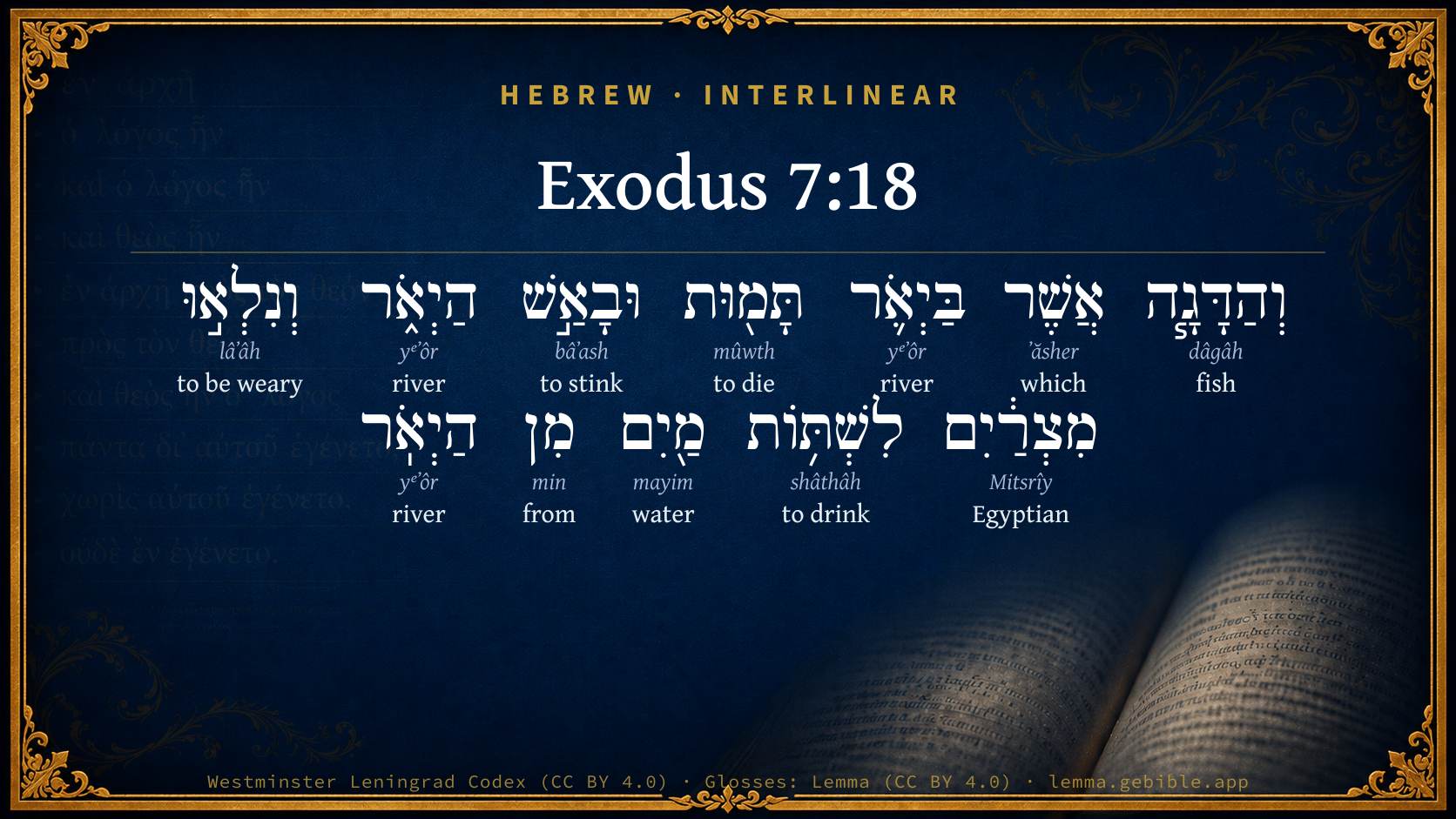
Hebrew (Westminster Leningrad Codex) Exodus 7:18 appears in the Hebrew Old Testament. The text above is from the Westminster Leningrad Codex. Each word links to its Strong’s number, a concise gloss, and parsing drawn from the Open Scriptures Hebrew Bible morphology. Click any word for its full Brown-Driver-Briggs (BDB) entry.
Download image
Cite this verse

Exodus 7:18 (World English Bible). Public Domain. Lemma interlinear Bible study tool, https://lemma.gebible.app/v/exodus/7/18.

Show BibTeX & RIS
BibTeX
RIS
English Translation
The fish that are in the river shall die, and the river shall become foul; and the Egyptians shall loathe to drink water from the river."'"
World English Bible · Public Domain
Download a study sheet

One document with this verse’s original text, its word-by-word gloss line, the meaning frame, cross-references with their text, attributed commentary, and full source and license credits — printable, and it pastes into notes with its structure intact.

This verse Autodidact and up

Study sheet (.html) Plain text (.txt)

A passage Seminary Student

Up to 50 verses in one chapter. A passage sheet keeps up to 6 commentary sources and 12 cross-references per verse, in the order this page ranks them, and says so on the sheet whenever that leaves anything out. Ask for a single verse and you get the Autodidact verse sheet above.

Everything on this page stays free to read, with no account — the sheet is a download of what is already on screen, not access to it.

Want to remove ads? Support Godless Engineer
Compare translations 3

The same verse in 3 English versions, stacked beneath the original-language interlinear above. Click any original word for its lexicon entry.

Each is an independent rendering of the whole verse — the interlinear is not word-aligned to these translations.

Highlighted words mark where these versions differ — a whole-verse word diff, not a word-by-word alignment.

  • World English Bible Public Domain
    The fish that are in the river shall die, and the river shall become foul; and the Egyptians shall loathe to drink water from the river."'"
  • King James Version Public Domain
    And the fish that is in the river shall die, and the river shall stink; and the Egyptians shall loathe to drink of the water of the river.
  • unfoldingWord Literal Text CC BY-SA 4.0
    And the fish that are in the river will die, and the river will stink. And the Egyptians will exhaust themselves to drink water from the river.”’”

unfoldingWord Literal Text — © unfoldingWord, licensed CC BY-SA 4.0. Word-aligned USFM3 via Door43 (git.door43.org/unfoldingWord/en_ult).

Versions to compare (up to 4)

3 of 4 selected

Show all 18 translations

Every available English version of this verse, each an independent rendering of the whole verse.

  • World English Bible Public Domain
    The fish that are in the river shall die, and the river shall become foul; and the Egyptians shall loathe to drink water from the river."'"
  • Berean Standard Bible Public Domain
    The fish in the Nile will die, the river will stink, and the Egyptians will be unable to drink its water.’”
  • Majority Standard Bible Public Domain
    The fish in the Nile will die, the river will stink, and the Egyptians will be unable to drink its water.’”
  • King James Version Public Domain
    And the fish that is in the river shall die, and the river shall stink; and the Egyptians shall loathe to drink of the water of the river.
  • American Standard Version (1901) Public Domain
    And the fish that are in the river shall die, and the river shall become foul; and the Egyptians shall loathe to drink water from the river.
  • Revised Version (1885) Public Domain
    And the fish that is in the river shall die, and the river shall stink; and the Egyptians shall loathe to drink water from the river.
  • Geneva Bible (1599) Public Domain
    And the fish that is in the riuer shall dye, and the riuer shall stinke, and it shall grieue the Egyptians to drinke of the water of the riuer.
  • Douay-Rheims (1899) Public Domain
    And the fishes that are in the river shall die, and the waters shall be corrupted, and the Egyptians shall be afflicted when they drink the water of the river.
  • Young's Literal Translation Public Domain
    and the fish that `are' in the River die, and the River hath stank, and the Egyptians have been wearied of drinking waters from the River.'
  • Literal Standard Version CC BY-SA 4.0
    and the fish that [are] in the River die, and the River has stunk, and the Egyptians have been wearied of drinking waters from the River.”
  • Unlocked Literal Bible CC BY-SA 4.0
    The fish that are in the river will die, and the river will stink. The Egyptians will not be able to drink water from the river.”'”
  • unfoldingWord Literal Text CC BY-SA 4.0
    And the fish that are in the river will die, and the river will stink. And the Egyptians will exhaust themselves to drink water from the river.”’”
  • Darby Bible Public Domain
    And the fish that is in the river shall die; and the river shall stink; and the Egyptians shall loathe to drink the water out of the river.
  • World Messianic Bible Public Domain
    The fish that are in the river will die and the river will become foul. The Egyptians will loathe to drink water from the river.”’”
  • Webster's Bible Public Domain
    And the fish that is in the river shall die, and the river shall be offensive in smell; and the Egyptians shall lothe to drink of the water of the river.
  • Free Bible Version CC BY-SA 4.0
    The fish in the Nile will die, the river will smell, and the Egyptians won't be able to drink any of its water.”
  • Bible in Basic English Public Domain
    And the fish in the Nile will come to destruction, and the river will send up a bad smell, and the Egyptians will not be able, for disgust, to make use of the water of the Nile for drinking.
  • JPS Tanakh (1917) Public Domain
    And the fish that are in the river shall die, and the river shall become foul; and the Egyptians shall loathe to drink water from the river.'

Literal Standard Version (2020), Covenant Press — licensed CC BY-SA 4.0. Text via the HelloAO Bible API (eBible.org). Unlocked Literal Bible (unfoldingWord) — licensed CC BY-SA 4.0. Text via the HelloAO Bible API (eBible.org). unfoldingWord Literal Text — © unfoldingWord, licensed CC BY-SA 4.0. Word-aligned USFM3 via Door43 (git.door43.org/unfoldingWord/en_ult). Free Bible Version, Dr. Jonathan Gallagher — licensed CC BY-SA 4.0. Text via the HelloAO Bible API (eBible.org).

Word by word

More ways to search: Search by grammar → Find every occurrence → Compare this word →

Practice this passage: Drill this verse → Learn its vocabulary →

וְהַדָּגָ֧ה
dâgâh
H1710
“and · the · fish”
Conjunction + Particle, Definite Article + Noun, Common, Feminine, Singular, Absolute
Part of Speech
Conjunction + Particle + Noun
Type
Common
Gender
Feminine
Number
Singular
State
Absolute
Full BDB Definition

Origin: from H1709

TWOT: 401b

fish
  1. אֲשֶׁר ʼăsher H834 “which” Particle, Relative
  2. בַּיְאֹ֛ר yᵉʼôr H2975 “in/at the · river” Preposition, Determined + Noun, Proper
  3. תָּמ֖וּת mûwth H4191 “to die” Verb, Qal, Imperfect, 3rd Person, Feminine, Singular
  4. וּבָאַ֣שׁ bâʼash H887 “and · to stink” Conjunction + Verb, Qal, Sequential Perfect, 3rd Person, Masculine, Singular
  5. הַיְאֹ֑ר yᵉʼôr H2975 “the · river” Particle, Definite Article + Noun, Proper
  6. וְנִלְא֣וּ lâʼâh H3811 “and · to be weary” Conjunction + Verb, Niphal, Sequential Perfect, 3rd Person, Common, Plural
  7. מִצְרַ֔יִם Mitsrîy H4713 “Egyptian” Noun, Proper
  8. לִשְׁתּ֥וֹת shâthâh H8354 “to drink” Preposition + Verb, Qal, Infinitive Construct
  9. מַ֖יִם mayim H4325 “water(s)” Noun, Common, Masculine, Plural, Absolute
  10. מִן min H4480 “from” Preposition
  11. הַיְאֹֽר yᵉʼôr H2975 “the · river” Particle, Definite Article + Noun, Proper

About this verse

These counts appear in no published source. They are computed here, from the morphology-tagged text and Lemma’s own curated glosses. What Lemma adds →

12
words
10
distinct lemmas
Pentateuch
section

Notable vocabulary

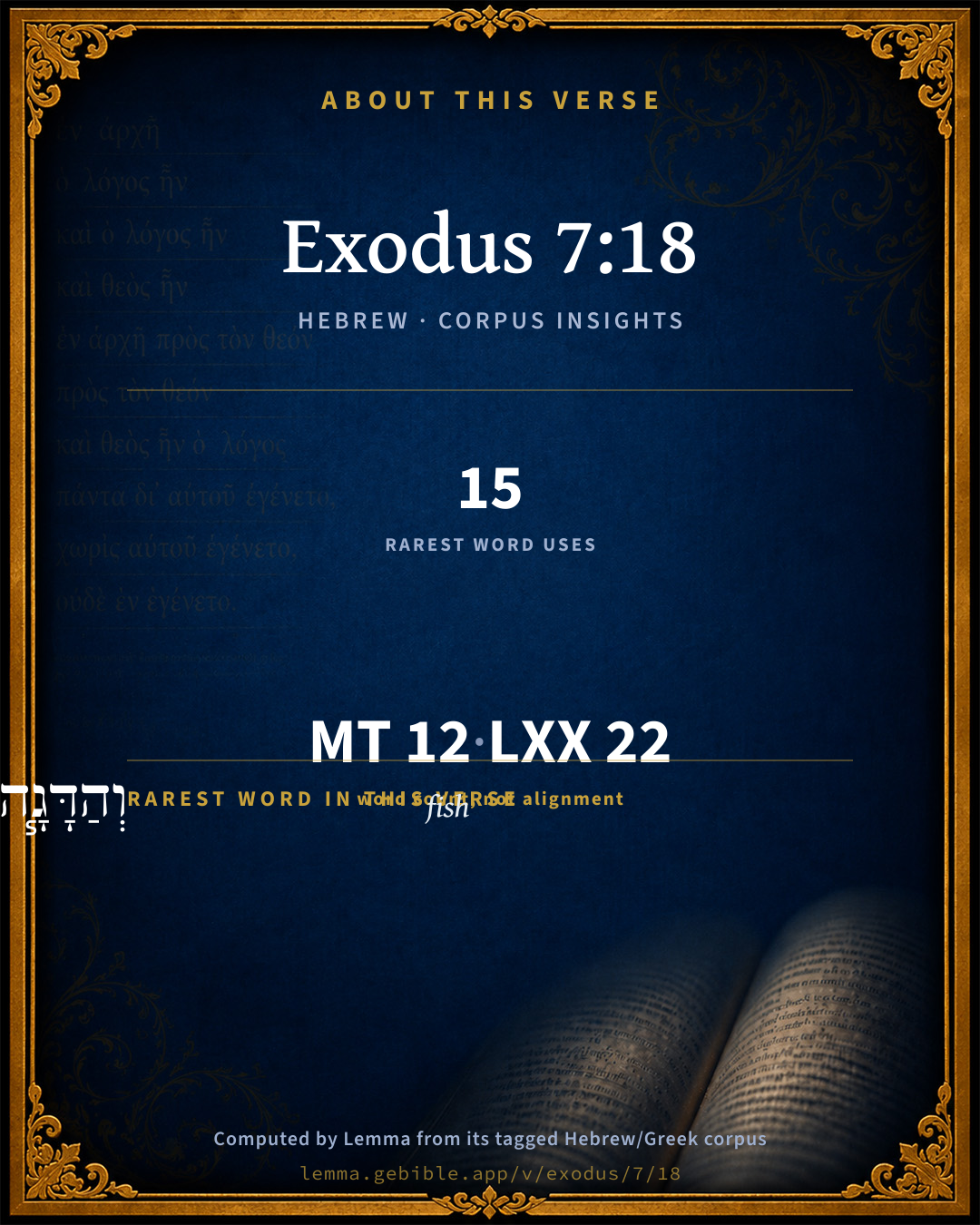
The rarest word here is וְהַדָּגָ֧ה fish H1710 — appearing just 15 times in the whole Hebrew Bible.

Shared distinctive vocabulary

וְהַדָּגָ֧ה fish H1710 occurs in 13 verses of the Hebrew Bible. Also found in:

Grammatical profile

  • 4 verbs
  • 6 nouns
  • 1 preposition
  • 1 particle

Verb forms

  • תָּמ֖וּת Qal · Imperfect
  • וּבָאַ֣שׁ Qal · Sequential Perfect
  • וְנִלְא֣וּ Niphal · Sequential Perfect
  • לִשְׁתּ֥וֹת Qal · Infinitive Construct

Repetition

A word recurs within this verse — often emphatic in Hebrew:

  • בַּיְאֹ֛ר river H2975 ×3

Hebrew & Septuagint length

In English translation the verse runs 26 words from the Hebrew and 29 from the Septuagint (LXX English) — closely comparable.

A rough comparison of the two English renderings, which tokenize alike — not a word-level alignment.

Word counts can differ between the Hebrew and the Greek without any difference in meaning — e.g. the Hebrew direct-object marker אֵת has no separate Greek word, and Greek often adds the article ὁ.

In the original languages it is 12 Hebrew tokens and 22 Greek tokens — but the two are counted differently (Hebrew bundles its prefixes and suffixes into one token; the Greek is in lemma form), so that isn’t a like-for-like length.

Cross-references

4

Topical passages linked to Exodus 7:18 in the Treasury of Scripture Knowledge — connected by theme and wording, ordered by reader-vote popularity; previews shown in the World English Bible.

  • Exodus 7:24 All the Egyptians dug round about the river for water to drink; for they couldn't drink of the water of the river.
  • Exodus 7:21 The fish that were in the river died; and the river became foul, and the Egyptians couldn't drink water from the river; and the blood was throughout all the land of Egypt.
  • Numbers 11:20 but a whole month, until it come out at your nostrils, and it be loathsome to you; because that you have rejected Yahweh who is among you, and have wept before him, saying, Why came we forth out of Egypt?
  • Numbers 21:5 The people spoke against God, and against Moses, Why have you brought us up out of Egypt to die in the wilderness? for there is no bread, and there is no water; and our soul loathes this light bread.

Cross-references courtesy of OpenBible.info (CC BY 4.0).

Hebrew and Greek witnesses Masoretic Hebrew ↔ Greek Septuagint

The same verse in the two great witnesses to the Old Testament, shown verse-for-verse.

These are two independent witnesses, not word-aligned to each other, and the Septuagint is shown in lemma (dictionary) form.

Hebrew Exodus 7:18 Masoretic · Westminster Leningrad Codex

וְהַדָּגָ֧ה אֲשֶׁר בַּיְאֹ֛ר תָּמ֖וּת וּבָאַ֣שׁ הַיְאֹ֑ר וְנִלְא֣וּ מִצְרַ֔יִם לִשְׁתּ֥וֹת מַ֖יִם מִן הַיְאֹֽר

The fish that are in the river shall die, and the river shall become foul; and the Egyptians shall loathe to drink water from the river."'"

World English Bible · Public Domain

Greek LXX Exodus 7:18 Septuagint · lemma form

καί ὁ ἰχθύς ὁ ἐν ὁ ποταμός τελευτάω καί ἐπιὄζω ὁ ποταμός καί οὐ δύναμαι ὁ αἰγύπτιος πίνω ὕδωρ ἀπό ὁ ποταμός

And the fish that are in the river shall die, and the river shall stink thereupon, and the Egyptians shall not be able to drink water from the river.

LXX2012 (modern English Septuagint) · Public Domain

Hebrew: Westminster Leningrad Codex (CC BY 4.0). Greek: Septuagint (public domain); English from LXX2012 (modern English Septuagint) (Public Domain). How the Septuagint differs from the Hebrew →

Targum (Aramaic paraphrase)

2

The Targum is the ancient Jewish Aramaic paraphrase of the Hebrew Scriptures — an interpretive translation, not the Hebrew text itself. Onkelos (literal) and Pseudo-Jonathan (expansive) render the Torah, and Jonathan the Prophets. Coverage is partial: where no permissively-licensed English translation exists for a verse, only the Aramaic is shown. This is verse-level text, not a word-by-word alignment to the Hebrew.

  1. Targum Onkelos Torah (Genesis–Deuteronomy)
    וְנוּנֵי דִי בְנַהֲרָא תְּמוּת וּסְרִי נַהֲרָא וְיִלְאוּן מִצְרָאֵי לְמִשְׁתֵּי מַיָא מִן נַהֲרָא:

    (no public-domain English translation for this verse)

    Targum Onkelos — Aramaic: “Onkelos Genesis” (public domain); “Onkelos Exodus” (public domain); “Onkelos Leviticus” (public domain); “Onkelos Numbers” (public domain); “Onkelos Deuteronomy” (public domain). English: “Sefaria Community Translation” (CC0 1.0 (public-domain dedication)); “J.W. Etheridge. The Targums of Onkelos and Jonathan Ben Uzziel on the Pentateuch. London: Longmans, Green, 1862” (public domain). Text via Sefaria.

  2. Targum Pseudo-Jonathan Torah (Genesis–Deuteronomy)
    וְנוּנֵי דִבְנַהֲרָא יְמוּתִין וְיִסְרֵי נַהֲרָא וְיִשְׁתַּלְהוֹן מִצְרָאֵי לְמִשְׁתֵּי מוֹי מִן נַהֲרָא

    And the fish that are in the river shall die, and the river become foul, and the Mizraee shall desist from drinking water from the river.

    Targum Pseudo-Jonathan — Aramaic: “Targum Jonathan on Genesis” (public domain); “Targum Jonathan on Exodus” (public domain); “Targum Jonathan on Leviticus” (public domain); “Targum Jonathan on Numbers” (public domain); “Targum Jonathan on Deuteronomy” (public domain). English: “The Targum of Jonathan ben Uzziel, trans. J. W. Etheridge, London, 1862” (public domain). Text via Sefaria.

Commentary

Notes on Exodus 7:18 from classic Christian and Jewish commentators (each source and its license shown beneath its notes). The classic Christian expositions comment on the surrounding passage and are grouped to its opening verse, so a note may address several verses; the Jewish commentaries on the Tanakh (Rashi and others) are per-verse, so they appear only where the commentator wrote on this verse.

Lemma curates 59 commentaries, every one of them public domain or Creative Commons licensed, each selected and text-cleaned for this edition rather than reprinted as found. About our sources →

Trapp's Complete Commentary

John Trapp

Exo 7:18 And the fish that [is] in the river shall die, and the river shall stink; and the Egyptians shall lothe to drink of the water of the river.

Ver. 18. Shall loathe to drink of the river.] Nile. God will confute them in their confidences. The Egyptians used to brag of their river, and in mockery to tell the Grecians that if God should forget to rain, they might chance to perish for it. The rain, they thought, was of God, but not the river. He therefore threateneth to dry it up, and here to bereave them of all comfortable use of it. {Eze 29:3; Eze 29:9 Isa 19:5-6}

John Trapp, A Commentary or Exposition upon All the Books of the Old and New Testament (1647–1656) — public domain. Text from a community e-Sword module.

Joseph Benson's Commentary

Exo 7:18. The Egyptians shall loathe to drink of the water — “There are a few wells,” says Harmer, “in Egypt, but their waters are not drunk, being unpleasant and unwholesome. The water of the Nile is what they universally make use of in this country, which is looked upon to be extraordinarily wholesome, and at the same time extremely delicious.” And he refers to Maillett and another author, as affirming that the Egyptians have been wont to excite thirst artificially, that they might drink the more of it. He then quotes, the Abbot Mascrier (let. 1, pp. 15, 16) in the following words: “The water of Egypt is so delicious that one would not wish the heat should be less, nor to be delivered from the sensation of thirst. The Turks find it so exquisitely charming that they excite themselves to drink of it by eating salt. It is a common saying among them, that if Mohammed had drunk of it he would have begged of God not to have died, that he might always have done it.” On these facts Harmer remarks as follows: “A person that never before heard of this delicacy of the water of the Nile, and of the large quantities which on that account are drunk of it, will, I am sure, find an energy in those words of Moses to Pharaoh, which he never observed before, The Egyptians shall loathe to drink of the river. They shall loathe to drink of that water which they used to prefer to all the waters in the universe — that which they had been wont eagerly to long for; and will rather drink of well-water, which in their country is detestable.” — Harmer, vol. 2. p. 295.

Joseph Benson's Commentary on the Old and New Testaments (1811–1818) — public domain. Text from a community e-Sword module.

Geneva Bible (1599)

Geneva Bible translators

Or, they shall be weary, and abhor to drink.

Geneva Bible (1599) marginal notes — public domain. Text via Bolls.life.

Adam Clarke's Commentary

Verse 18. The Egyptians shall loathe to drink of the water] The force of this expression cannot be well felt without taking into consideration the peculiar pleasantness and great salubrity of the waters of the Nile. "The water of Egypt," says the Abbe Mascrier, "is so delicious, that one would not wish the heat to be less, or to be delivered from the sensation of thirst. The Turks find it so exquisite that they excite themselves to drink of it by eating salt. It is a common saying among them, that if Mohammed had drank of it he would have besought God that he might never die, in order to have had this continual gratification. When the Egyptians undertake the pilgrimage of Mecca, or go out of their country on any other account, they speak of nothing but the pleasure they shall have at their return in drinking of the waters of the Nile. There is no gratification to be compared to this; it surpasses, in their esteem, that of seeing their relations and families. All those who have tasted of this water allow that they never met with the like in any other place. When a person drinks of it for the first time he can scarcely be persuaded that it is not a water prepared by art; for it has something in it inexpressibly agreeable and pleasing to the taste; and it should have the same rank among waters that champaign has among wines. But its most valuable quality is, that it is exceedingly salutary. It never incommodes, let it be drank in what quantity it may: this is so true that it is no uncommon thing to see some persons drink three buckets of it in a day without the least inconvenience! When I pass such encomiums on the water of Egypt it is right to observe that I speak only of that of the Nile, which indeed is the only water drinkable, for their well water is detestable and unwholesome. Fountains are so rare that they are a kind of prodigy in that country; and as to rain water, that is out of the question, as scarcely any falls in Egypt."

"A person," says Mr. Harmer, "who never before heard of the deliciousness of the Nile water, and of the large quantities which on that account are drank of it, will, I am sure, find an energy in those words of Moses to Pharaoh, The Egyptians shall loathe to drink of the water of the river, which he never observed before. They will loathe to drink of that water which they used to prefer to all the waters of the universe; loathe to drink of that for which they had been accustomed to long, and will rather choose to drink of well water, which in their country is detestable!" - Observations, vol. iii., p. 564.

Adam Clarke's Commentary on the Bible (1810–1826) — public domain. Text from a community e-Sword/MySword module.

Ellicott's Commentary for English Readers

(18) The fish that is in the river shall die.—The natural discoloration of the Nile, whether by red earth or by Cryptogams and Infusoriæ, has no pernicious effect at all upon the fish, nor is the water rendered by these discolorations at all unfit for use. The Nile naturally abounds with fish of various kinds; and though to Europeans they have, most of them, an insipid taste, yet, both in ancient and in modern times, the subsistence of the natives has been largely drawn from this source. It was a severe punishment to the Egyptians to be deprived of their fish supply. It was also implied contempt in regard of their religious worship, since at least three species of the Nile fish were sacred—the oxyrhineus, the lepidotus, and the phagrus, or eel. (Herod. ii. 72; Plut. De Ibid. et Osir. vii. 18, 22.)

The river shall stink.—The Nile is said to have sometimes an offensive odour naturally; but the phenomenon is not marked, and can scarcely be that which is here alluded to, when the blood-like waters, laden with the bodies of putrid fish, caused a disgust and horror that were unspeakable.

A Bible Commentary for English Readers, edited by Charles John Ellicott (1878–1897) — public domain. Text from a community e-Sword module.

The Cambridge Bible for Schools and Colleges

gen. ed. J. J. S. Perowne

18. Fish was one of the principal articles of food in ancient Egypt (Erman, p. 239), so that the death of the fish in the Nile would be serious calamity.

loathe] weary themselves (Gen_19:11 al.) in the vain effort to obtain drinkable water.

The Cambridge Bible for Schools and Colleges (gen. ed. J. J. S. Perowne; Cambridge University Press, 1878–1918) — public domain. Text from a community e-Sword module.

John Gill's Exposition

And the fish that is in the river shall die,.... Their element being changed, and they not able to live in any other but water:

and the river shall stink; with the blood, into which it should be congealed, and with the putrefied bodies of fishes floating in it:

and the Egyptians shall loath to drink of the water of the river; the very colour of it, looking like blood, would set them against it, and create a nausea in them; or "shall be weary" (h), tired of drinking it in a little time, through the loathsomeness of it; or be weary in digging about it, Exo 7:24 to get some clear water to drink of; or in seeking to find out ways and methods to cure the waters, that so they might be fit to drink of, as Jarchi interprets it.

(h) "delassabuntur", Tigurine version, Vatablus. "Defatigabuntur", Cartwright.

John Gill's Exposition of the Whole Bible (1746–1763) — public domain (CC PDM 1.0). Text via the HelloAO Bible API.

Albert Barnes' Notes on the Bible

Shall lothe - The water of the Nile has always been regarded by the Egyptians as a blessing unique to their land. It is the only pure and wholesome water in their country, since the water in wells and cisterns is unwholesome, while rain water seldom falls, and fountains are extremely rare.

Albert Barnes' Notes on the Bible (1834–1885) — public domain. Text from a community e-Sword/MySword module.

Haydock's Catholic Bible Commentary

River. The Samaritan copy repeats here the very words of God to Pharao, as the other speeches are also twice put at length. "Moses and Aaron went to meet Pharao, and said to him, ’The Lord,’" &c., as ver. 16, 18. See chap. xi. 7. (Calmet) --- This is very agreeable to the style of Homer; and Kennicott believes that the repetitions have been omitted in the Hebrew for brevity’s sake, (Diss. 1 Chron. p. 383,) and that before the Greek version had been made. (Haydock)

George Leo Haydock (1774–1849), Haydock's Catholic Family Bible and Commentary, 1859 edition — public domain. Excludes Psalms (Douay-Rheims chapter numbering differs from Protestant) and Deuterocanonical books (Catholic canon only).

Matthew Poole's English Annotations

Therefore the Israelites were free from this plague, and those branches of Nilus which they used were uncorrupted, when all others were turned into blood.

Shall lothe, or, shall weary themselves, in running hither and thither in hopes of finding water in some parts or branches of the river.

Matthew Poole's English Annotations on the Holy Bible (1683–1685) — public domain. Text from a community e-Sword/MySword module.

The Pulpit Commentary

The fish shall die. This would increase the greatness of the calamity, for the Egyptians lived to a very large extent upon fish (Birch, "Egypt from the Earliest Times," p. 45), which was taken in the Nile, in the canals, and the Lake Morris (Heb 2:149). The river shall stink. As Keil and Delitzsch observe, "this seems to indicate putrefaction." The Egyptians shall loathe to drink. The expression is stronger in verse 24, where we find that "they could not drink." We may presume that at first, not supposing that the fluid could really be blood, they tried to drink it, took it into their mouths, and possibly swallowed some, but that very soon they found they could not continue to do so.

The Pulpit Commentary (1880–1919), ed. H.D.M. Spence-Jones & Joseph S. Exell — public domain. Text from a community e-Sword module.

Rashi

Rabbi Shlomo Yitzchaki (Rashi)

ונלאו מצרים THE EGYPTIANS SHALL WEARY THEMSELVES in seeking a cure for the waters of the river that they may become fitted for drinking.

Rashi on the Tanakh — English translations: “The Judaica Press complete Tanach with Rashi, translated by A. J. Rosenberg” (CC BY 4.0); “Pentateuch with Rashi's commentary by M. Rosenbaum and A.M. Silbermann, 1929-1934” (public domain); “The Metsudah Tanach series, Lakewood, N.J” (CC BY 4.0); and “The Book of Joshua, Metsudah Publications, 1997” (CC BY 4.0). Text via Sefaria.

Lesson kit

Teaching starters — assembled from the data on this page, not authored interpretation. Every prompt links to the verse data it draws on. Edit before teaching.

Exodus, in the Pentateuch, opens this verse with 12 words (10 distinct Hebrew lemmas). Its most distinctive word is dâgâh (“fish”). A historical commentator’s framing appears above. Read the whole chapter for the surrounding context.

Discussion questions

  1. How does “fish” (dâgâh) shape what this verse is saying?
  2. Genesis 1:26 shares the word «fish» with this verse. How do the two illuminate each other?
  3. “river” occurs 3× in this one verse. What is the effect of the repetition?
  4. These translations render this verse differently; the difference is in the English rendering, not the original. What questions does that raise?
  5. The verb «תָּמ֖וּת» is Qal Imperfect. How does its form color the action?
  6. Reading how Trapp's Complete Commentary and Joseph Benson's Commentary read this verse, where do the two commentators agree and where do they part?

Things to notice

Reading settings

Reading text

Shown beneath each verse's original-language words.

Old Testament
Old Testament edition

Read the OT as the Masoretic Hebrew (MT) or the Greek Septuagint (LXX).

English shown for the Greek Septuagint (in the Hebrew ↔ Greek comparison).

Comparing translations? Open the Compare panel on any verse page to stack up to four side by side.