
Leviticus 19:20

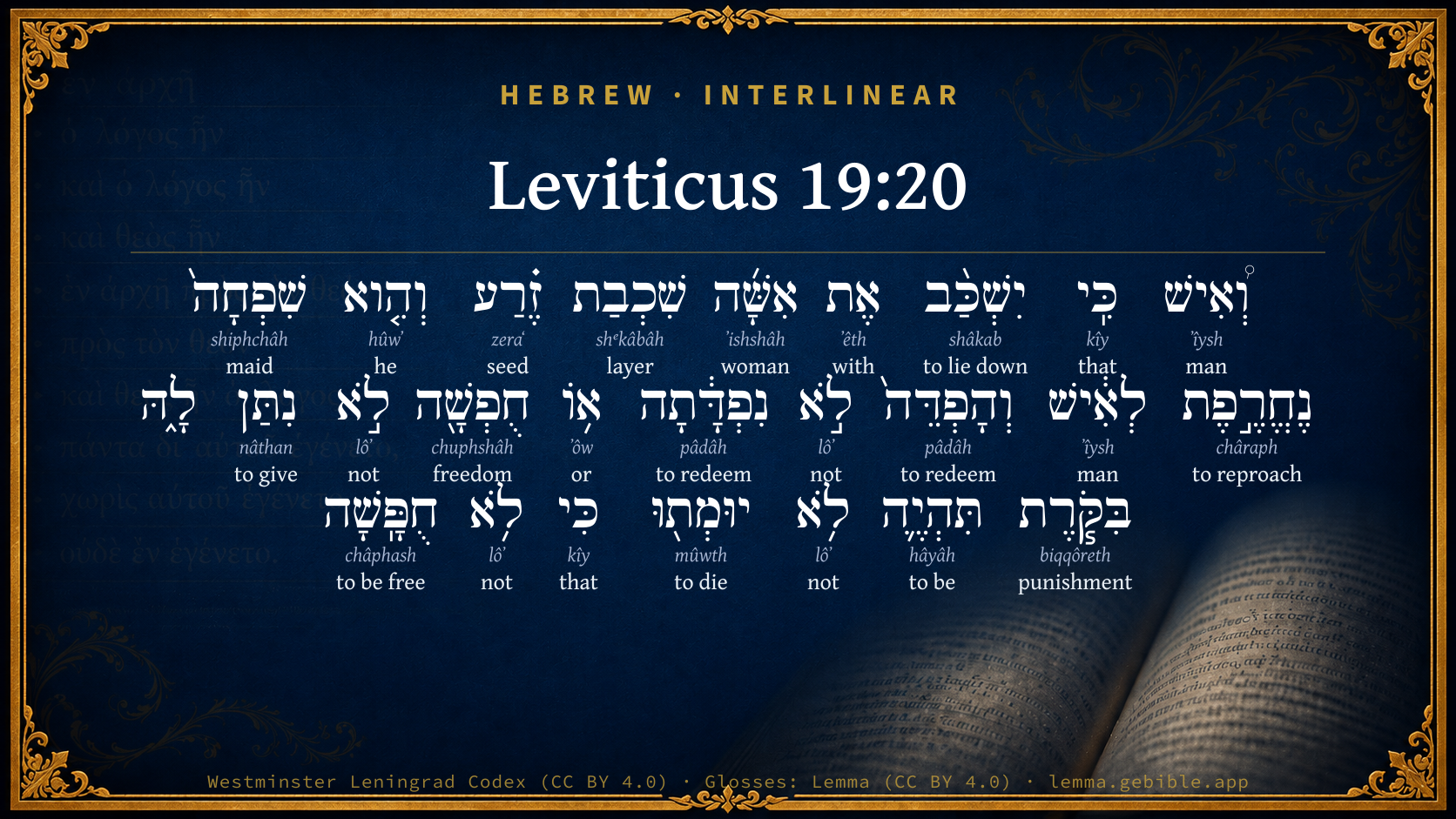
Hebrew (Westminster Leningrad Codex) Leviticus 19:20 appears in the Hebrew Old Testament. The text above is from the Westminster Leningrad Codex. Each word links to its Strong’s number, a concise gloss, and parsing drawn from the Open Scriptures Hebrew Bible morphology. Click any word for its full Brown-Driver-Briggs (BDB) entry.
Download image
Cite this verse

Leviticus 19:20 (World English Bible). Public Domain. Lemma interlinear Bible study tool, https://lemma.gebible.app/v/leviticus/19/20.

Show BibTeX & RIS
BibTeX
RIS
English Translation
"'If a man lies carnally with a woman who is a slave girl, pledged to be married to another man, and not ransomed, or given her freedom; they shall be punished. They shall not be put to death, because she was not free.
World English Bible · Public Domain
Highlights
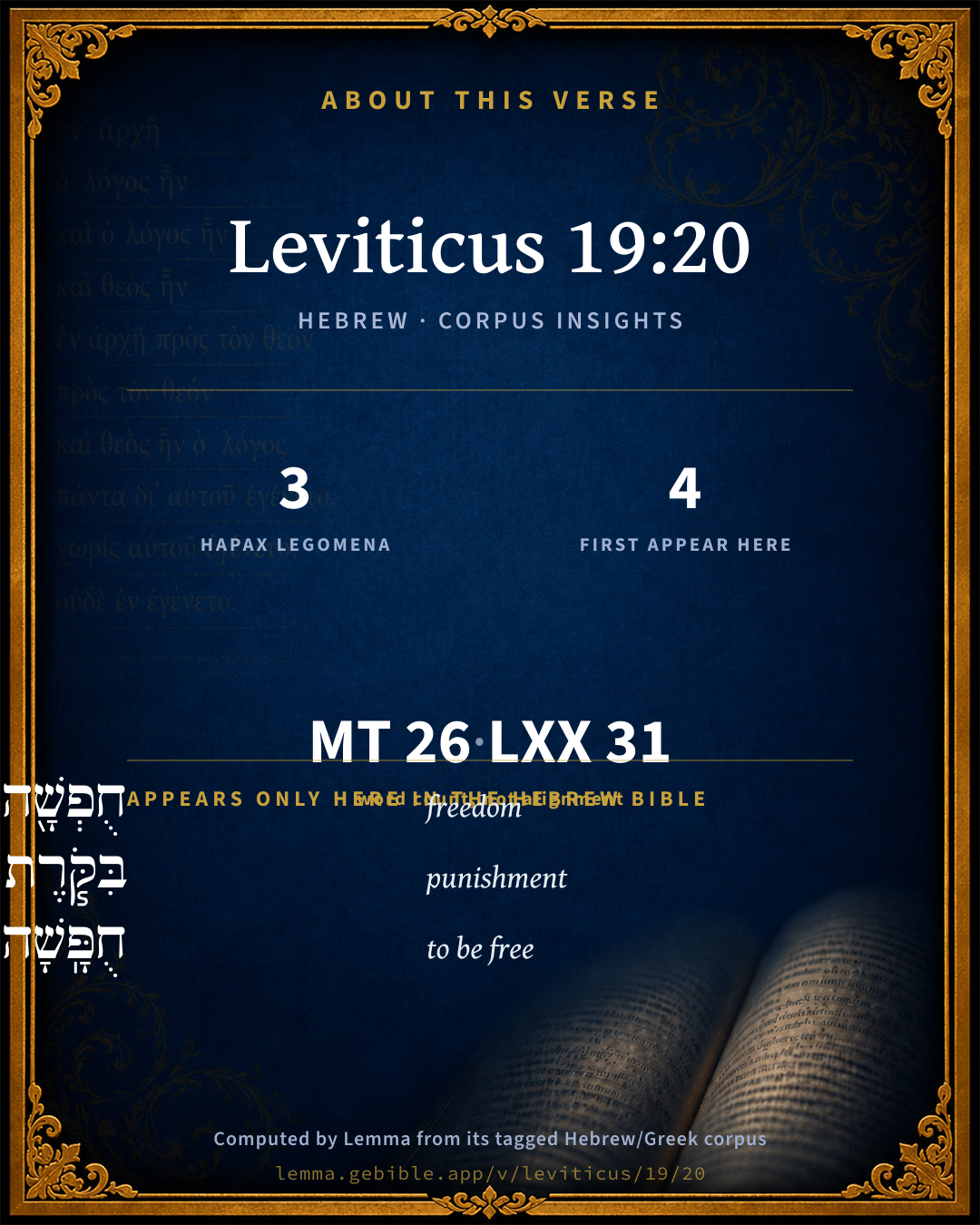
  • 3 hapax legomena — only here in the Hebrew Bible
  • 4 first appearances in the Hebrew Bible
Full analysis ↓
Download a study sheet

One document with this verse’s original text, its word-by-word gloss line, the meaning frame, cross-references with their text, attributed commentary, and full source and license credits — printable, and it pastes into notes with its structure intact.

This verse Autodidact and up

Study sheet (.html) Plain text (.txt)

A passage Seminary Student

Up to 50 verses in one chapter. A passage sheet keeps up to 6 commentary sources and 12 cross-references per verse, in the order this page ranks them, and says so on the sheet whenever that leaves anything out. Ask for a single verse and you get the Autodidact verse sheet above.

Everything on this page stays free to read, with no account — the sheet is a download of what is already on screen, not access to it.

Want to remove ads? Support Godless Engineer
Compare translations 3

The same verse in 3 English versions, stacked beneath the original-language interlinear above. Click any original word for its lexicon entry.

Each is an independent rendering of the whole verse — the interlinear is not word-aligned to these translations.

Highlighted words mark where these versions differ — a whole-verse word diff, not a word-by-word alignment.

  • World English Bible Public Domain
    "'If a man lies carnally with a woman who is a slave girl, pledged to be married to another man, and not ransomed, or given her freedom; they shall be punished. They shall not be put to death, because she was not free.
  • King James Version Public Domain
    And whosoever lieth carnally with a woman, that is a bondmaid, betrothed to an husband, and not at all redeemed, nor freedom given her; she shall be scourged; they shall not be put to death, because she was not free.
  • unfoldingWord Literal Text CC BY-SA 4.0
    And a man, when he lies with a woman, a lying of seed, but she is a slave, a being assigned to a man, but, being redeemed, she has not been redeemed or freedom has not been given to her, recompense shall occur. They shall not be executed because she had not been freed.

unfoldingWord Literal Text — © unfoldingWord, licensed CC BY-SA 4.0. Word-aligned USFM3 via Door43 (git.door43.org/unfoldingWord/en_ult).

Versions to compare (up to 4)

3 of 4 selected

Show all 18 translations

Every available English version of this verse, each an independent rendering of the whole verse.

  • World English Bible Public Domain
    "'If a man lies carnally with a woman who is a slave girl, pledged to be married to another man, and not ransomed, or given her freedom; they shall be punished. They shall not be put to death, because she was not free.
  • Berean Standard Bible Public Domain
    If a man lies carnally with a slave girl promised to another man but who has not been redeemed or given her freedom, there must be due punishment. But they are not to be put to death, because she had not been freed.
  • Majority Standard Bible Public Domain
    If a man lies carnally with a slave girl promised to another man but who has not been redeemed or given her freedom, there must be due punishment. But they are not to be put to death, because she had not been freed.
  • King James Version Public Domain
    And whosoever lieth carnally with a woman, that is a bondmaid, betrothed to an husband, and not at all redeemed, nor freedom given her; she shall be scourged; they shall not be put to death, because she was not free.
  • American Standard Version (1901) Public Domain
    And whosoever lieth carnally with a woman, that is a bondmaid, betrothed to a husband, and not at all redeemed, nor freedom given her; they shall be punished; they shall not be put to death, because she was not free.
  • Revised Version (1885) Public Domain
    And whosoever lieth carnally with a woman, that is a bondmaid, betrothed to an husband, and not at all redeemed, nor freedom given her; they shall be punished; they shall not be put to death, because she was not free.
  • Geneva Bible (1599) Public Domain
    Whosoeuer also lyeth and medleth with a woman that is a bonde mayde, affianced to a husband, and not redeemed, nor freedome giuen her, she shalbe scourged, but they shall not die, because she is not made free.
  • Douay-Rheims (1899) Public Domain
    If a man carnally lie with a woman that is a bondservant and marriageable, and yet not redeemed with a price, nor made free: they both shall be scourged, and they shall not be put to death, because she was not a free woman.
  • Young's Literal Translation Public Domain
    `And when a man lieth with a woman with seed of copulation, and she a maid-servant, betrothed to a man, and not really ransomed, or freedom hath not been given to her, an investigation there is; they are not put to death, for she `is' not free.
  • Literal Standard Version CC BY-SA 4.0
    And when a man lies with a woman with seed [from] intercourse, and she [is] a maidservant, betrothed to a man, and not really ransomed, or freedom has not been given to her, there is an investigation; they are not put to death, for she [is] not free.
  • Unlocked Literal Bible CC BY-SA 4.0
    Whoever sleeps with a slave girl who is promised to a husband, but who has not been ransomed or given her freedom, they must be punished. They must not be put to death because she was not free.
  • unfoldingWord Literal Text CC BY-SA 4.0
    And a man, when he lies with a woman, a lying of seed, but she is a slave, a being assigned to a man, but, being redeemed, she has not been redeemed or freedom has not been given to her, recompense shall occur. They shall not be executed because she had not been freed.
  • Darby Bible Public Domain
    And if a man lie with a woman for copulation, and she is a bondwoman betrothed to a husband, but not at all ransomed, nor hath freedom been given to her, there shall be a chastisement: they shall not be put to death, for she was not free.
  • World Messianic Bible Public Domain
    “‘If a man lies carnally with a woman who is a slave girl, pledged to be married to another man, and not ransomed or given her freedom; they shall be punished. They shall not be put to death, because she was not free.
  • Webster's Bible Public Domain
    And whoever lieth carnally with a woman that is a bond-maid betrothed to a husband, and not at all redeemed, nor freedom given her; she shall be scourged: they shall not be put to death, because she was not free.
  • Free Bible Version CC BY-SA 4.0
    If a man has sex with a servant girl promised to become another man's wife, but who hasn't yet been bought or set free, then compensation has to be paid. However, they are not to be killed, because she hadn't been set free.
  • Bible in Basic English Public Domain
    If any man has sex relations with a servant-woman who has given her word to be married to a man, and has not been made free for a price or in any other way, the thing will be looked into; but they will not be put to death because she was not a free woman.
  • JPS Tanakh (1917) Public Domain
    And whosoever lieth carnally with a woman, that is a bondmaid, designated for a man, and not at all redeemed, nor was freedom given her; there shall be inquisition; they shall not be put to death, because she was not free.

Literal Standard Version (2020), Covenant Press — licensed CC BY-SA 4.0. Text via the HelloAO Bible API (eBible.org). Unlocked Literal Bible (unfoldingWord) — licensed CC BY-SA 4.0. Text via the HelloAO Bible API (eBible.org). unfoldingWord Literal Text — © unfoldingWord, licensed CC BY-SA 4.0. Word-aligned USFM3 via Door43 (git.door43.org/unfoldingWord/en_ult). Free Bible Version, Dr. Jonathan Gallagher — licensed CC BY-SA 4.0. Text via the HelloAO Bible API (eBible.org).

Word by word

More ways to search: Search by grammar → Find every occurrence → Compare this word →

Practice this passage: Drill this verse → Learn its vocabulary →

חֻפְשָׁ֖ה
chuphshâh
H2668
“freedom”
Noun, Common, Feminine, Singular, Absolute
Part of Speech
Noun
Type
Common
Gender
Feminine
Number
Singular
State
Absolute
Full BDB Definition

Origin: from H2666

TWOT: 717b

freedom
  1. וְ֠אִישׁ ʼîysh H376 “and · man” Conjunction + Noun, Common, Masculine, Singular, Absolute
  2. כִּֽי kîy H3588 “that” Conjunction
  3. יִשְׁכַּ֨ב shâkab H7901 “to lie down” Verb, Qal, Imperfect, 3rd Person, Masculine, Singular
  4. אֶת ʼêth H854 “with” Preposition
  5. אִשָּׁ֜ה ʼishshâh H802 “woman” Noun, Common, Feminine, Singular, Absolute
  6. שִׁכְבַת shᵉkâbâh H7902 “layer of” Noun, Common, Feminine, Singular, Construct
  7. זֶ֗רַע zeraʻ H2233 “seed” Noun, Common, Masculine, Singular, Absolute
  8. וְהִ֤וא hûwʼ H1931 “and · he” Conjunction + Pronoun, Personal, 3rd Person, Feminine, Singular
  9. שִׁפְחָה֙ shiphchâh H8198 “maid” Noun, Common, Feminine, Singular, Absolute
  10. נֶחֱרֶ֣פֶת châraph H2778 “reproaching” Verb, Niphal, Participle Active, Feminine, Singular, Absolute
  11. לְאִ֔ישׁ ʼîysh H376 “to/for · man” Preposition + Noun, Common, Masculine, Singular, Absolute
  12. וְהָפְדֵּה֙ pâdâh H6299 “and · to redeem” Conjunction + Verb, Hophal, Infinitive Absolute
  13. לֹ֣א lôʼ H3808 “not” Particle, Negative
  14. נִפְדָּ֔תָה pâdâh H6299 “to redeem” Verb, Niphal, Perfect, 3rd Person, Feminine, Singular
  15. א֥וֹ ʼôw H176 “or” Conjunction
  16. לֹ֣א lôʼ H3808 “not” Particle, Negative
  17. נִתַּן nâthan H5414 “to give” Verb, Niphal, Perfect, 3rd Person, Masculine, Singular
  18. בִּקֹּ֧רֶת biqqôreth H1244 “punishment” Noun, Common, Feminine, Singular, Absolute
  19. תִּהְיֶ֛ה hâyâh H1961 “to be” Verb, Qal, Imperfect, 3rd Person, Feminine, Singular
  20. לֹ֥א lôʼ H3808 “not” Particle, Negative
  21. יוּמְת֖וּ mûwth H4191 “to die” Verb, Hophal, Imperfect, 3rd Person, Masculine, Plural
  22. כִּי kîy H3588 “that” Conjunction
  23. לֹ֥א lôʼ H3808 “not” Particle, Negative
  24. חֻפָּֽשָׁה châphash H2666 “to be free” Verb, Pual, Perfect, 3rd Person, Feminine, Singular

About this verse

These counts appear in no published source. They are computed here, from the morphology-tagged text and Lemma’s own curated glosses. What Lemma adds →

26
words
19
distinct lemmas
Pentateuch
section

Notable vocabulary

3 hapax legomena — words that appear only here in the entire Hebrew Bible:

  • חֻפְשָׁ֖ה freedom H2668
  • בִּקֹּ֧רֶת punishment H1244
  • חֻפָּֽשָׁה to be free H2666

First appearance in Scripture

These words make their first canonical appearance in the Hebrew Bible here:

  • נֶחֱרֶ֣פֶת to reproach H2778
  • חֻפְשָׁ֖ה freedom H2668
  • בִּקֹּ֧רֶת punishment H1244
  • חֻפָּֽשָׁה to be free H2666

Shared distinctive vocabulary

שִׁכְבַת layer H7902 occurs in 9 verses of the Hebrew Bible. Also found in:

Grammatical profile

  • 8 verbs
  • 8 nouns
  • 1 pronoun
  • 2 prepositions
  • 3 conjunctions
  • 4 particles

Verb forms

  • יִשְׁכַּ֨ב Qal · Imperfect
  • נֶחֱרֶ֣פֶת Niphal · Participle Active
  • וְהָפְדֵּה֙ Hophal · Infinitive Absolute
  • נִפְדָּ֔תָה Niphal · Perfect
  • נִתַּן Niphal · Perfect
  • תִּהְיֶ֛ה Qal · Imperfect
  • יוּמְת֖וּ Hophal · Imperfect
  • חֻפָּֽשָׁה Pual · Perfect

Repetition

Words recur within this verse — often emphatic in Hebrew:

  • וְ֠אִישׁ man H376 ×2
  • וְהָפְדֵּה֙ to redeem H6299 ×2
  • לֹ֣א not H3808 ×4
  • כִּֽי that H3588 ×2

Hebrew & Septuagint length

In English translation the verse runs 43 words from the Hebrew and 52 from the Septuagint (LXX English) — closely comparable.

A rough comparison of the two English renderings, which tokenize alike — not a word-level alignment.

Word counts can differ between the Hebrew and the Greek without any difference in meaning — e.g. the Hebrew direct-object marker אֵת has no separate Greek word, and Greek often adds the article ὁ.

In the original languages it is 26 Hebrew tokens and 31 Greek tokens — but the two are counted differently (Hebrew bundles its prefixes and suffixes into one token; the Greek is in lemma form), so that isn’t a like-for-like length.

Cross-references

2

Topical passages linked to Leviticus 19:20 in the Treasury of Scripture Knowledge — connected by theme and wording, ordered by reader-vote popularity; previews shown in the World English Bible.

  • Deuteronomy 22:23–24 If there be a young lady who is a virgin pledged to be married to a husband, and a man find her in the city, and lie with her;
  • Exodus 21:20–21 "If a man strikes his servant or his maid with a rod, and he dies under his hand, he shall surely be punished.

Cross-references courtesy of OpenBible.info (CC BY 4.0).

Hebrew and Greek witnesses Masoretic Hebrew ↔ Greek Septuagint

The same verse in the two great witnesses to the Old Testament, shown verse-for-verse.

These are two independent witnesses, not word-aligned to each other, and the Septuagint is shown in lemma (dictionary) form.

Hebrew Leviticus 19:20 Masoretic · Westminster Leningrad Codex

וְ֠אִישׁ כִּֽי יִשְׁכַּ֨ב אֶת אִשָּׁ֜ה שִׁכְבַת זֶ֗רַע וְהִ֤וא שִׁפְחָה֙ נֶחֱרֶ֣פֶת לְאִ֔ישׁ וְהָפְדֵּה֙ לֹ֣א נִפְדָּ֔תָה א֥וֹ חֻפְשָׁ֖ה לֹ֣א נִתַּן לָ֑הּ בִּקֹּ֧רֶת תִּהְיֶ֛ה לֹ֥א יוּמְת֖וּ כִּי לֹ֥א חֻפָּֽשָׁה

"'If a man lies carnally with a woman who is a slave girl, pledged to be married to another man, and not ransomed, or given her freedom; they shall be punished. They shall not be put to death, because she was not free.

World English Bible · Public Domain

Greek LXX Leviticus 19:20 Septuagint · lemma form

καί ἐάν τις κοιμάω μετά γυνή κοίτη σπέρμα καί αὐτός οἰκέτις διαφυλάσσω ἄνθρωπος καί αὐτός λύτρον οὐ λυτρόω ἤ ἐλευθερία οὐ δίδωμι αὐτός ἐπισκοπή εἰμί αὐτός οὐ ἀποθνήσκω ὅτι οὐ ἀποἐλευθερόω

And if any one lie carnally with a woman, and she should be a home-servant kept for a man, and she has not been ransomed, and her freedom has not been given to her, they shall be visited with punishment; but they shall not die, because she was not set at liberty.

LXX2012 (modern English Septuagint) · Public Domain

On this verse, Haydock's Catholic Bible Commentary discusses the Septuagint’s reading. Read the note in Commentary ↓

Hebrew: Westminster Leningrad Codex (CC BY 4.0). Greek: Septuagint (public domain); English from LXX2012 (modern English Septuagint) (Public Domain). How the Septuagint differs from the Hebrew →

Targum (Aramaic paraphrase)

2

The Targum is the ancient Jewish Aramaic paraphrase of the Hebrew Scriptures — an interpretive translation, not the Hebrew text itself. Onkelos (literal) and Pseudo-Jonathan (expansive) render the Torah, and Jonathan the Prophets. Coverage is partial: where no permissively-licensed English translation exists for a verse, only the Aramaic is shown. This is verse-level text, not a word-by-word alignment to the Hebrew.

  1. Targum Onkelos Torah (Genesis–Deuteronomy)
    וּגְבַר אֲרֵי יִשְׁכּוּב עִם אִתְּתָא שִׁכְבַת זַרְעָא וְהִיא אַמְתָא אֲחִידָא לִגְבַר וְאִתְפְּרָקָא לָא אִתְפְּרִיקַת בְּכַסְפָּא אוֹ חֵרוּתָא לָא אִתְיְהִיבַת לַהּ בִּשְׁטָר בִּקֻּרְתָּא תְהֵי לָא יוּמְתוּן אֲרֵי לָא אִתְחָרָרַת

    (no public-domain English translation for this verse)

    Targum Onkelos — Aramaic: “Onkelos Genesis” (public domain); “Onkelos Exodus” (public domain); “Onkelos Leviticus” (public domain); “Onkelos Numbers” (public domain); “Onkelos Deuteronomy” (public domain). English: “Sefaria Community Translation” (CC0 1.0 (public-domain dedication)); “J.W. Etheridge. The Targums of Onkelos and Jonathan Ben Uzziel on the Pentateuch. London: Longmans, Green, 1862” (public domain). Text via Sefaria.

  2. Targum Pseudo-Jonathan Torah (Genesis–Deuteronomy)
    וּגְבַר אֲרוּם יִשְׁכּוֹב עִם אִיתָא תַּשְׁמִישׁ זַרְעָא וְהִיא אַמְתָא וְחָרָתָא מִתְאַרְסָא לִגְבַר חָרֵי וּמִתְפַּרְקָא כוֹלָא עַד כְּדוֹן לָא אִיתְפְּרִיקָאַת בְּכַסְפָּא אוֹ שְׁטַר שִׁיחְרוּרָהּ לָא אִיתְיְהֵיב לָהּ פִּשְׁפּוּשׁ יֶהֱוֵי בְּדִינָהּ לְמִילְקֵי הוּא מְחַיְיבָא וְלָא [הִיא] (הֲוָה) בְּרַם סֵדֶר קְטוֹלִין לֵית הִינוּן חֲשִׁיבִין אֲרוּם לָא אִיתְחָרָת כּוֹלָא

    And if a man lie carnally with a woman, and she be an (Israelitish) handmaid (about to be) made free, and betrothed to a free man, but her redemption not altogether completed by (the payment of) the money, or the written instrument of liberation not having been given to her, let inquisition be made for judgment: she is liable to be chastised, but he is not. But it shall not be considered a matter of putting to death, because she was not altogether free. (Deut. xxii. 22-24.)

    Targum Pseudo-Jonathan — Aramaic: “Targum Jonathan on Genesis” (public domain); “Targum Jonathan on Exodus” (public domain); “Targum Jonathan on Leviticus” (public domain); “Targum Jonathan on Numbers” (public domain); “Targum Jonathan on Deuteronomy” (public domain). English: “The Targum of Jonathan ben Uzziel, trans. J. W. Etheridge, London, 1862” (public domain). Text via Sefaria.

Commentary

Notes on Leviticus 19:20 from classic Christian and Jewish commentators (each source and its license shown beneath its notes). The classic Christian expositions comment on the surrounding passage and are grouped to its opening verse, so a note may address several verses; the Jewish commentaries on the Tanakh (Rashi and others) are per-verse, so they appear only where the commentator wrote on this verse.

Lemma curates 59 commentaries, every one of them public domain or Creative Commons licensed, each selected and text-cleaned for this edition rather than reprinted as found. About our sources →

Trapp's Complete Commentary

John Trapp

Lev 19:20 And whosoever lieth carnally with a woman, that [is] a bondmaid, betrothed to an husband, and not at all redeemed, nor freedom given her; she shall be scourged; they shall not be put to death, because she was not free.

Ver. 20. She shall be scourged.] Thus still, saith a grave interpreter, the Lord debaseth bond servants, to teach his children to hate the bondage of sin.

John Trapp, A Commentary or Exposition upon All the Books of the Old and New Testament (1647–1656) — public domain. Text from a community e-Sword module.

The Biblical Illustrator

Joseph S. Exell

Lev_19:20-22

A bondmaid betrothed.

Divine toleration of defective morality

It will be said, and truly, that by this law slavery and concubinage are to a certain extent recognised by the law; and upon this fact has been raised an objection bearing on the holiness of the lawgiver, and, by consequence, on the Divine origin and inspiration of the law. Is it conceivable that the holy God should have given a law for the regulation of two so evil institutions? The answer has been furnished us, in principle, by our Lord (Mat_19:8), in that which He said concerning the analogous case of the law of Moses touching divorce; which law, He tells us, although not according to the perfect ideal of right, was yet given because of the hardness of mens hearts. That is, although it was not the best law ideally, it was the best practically, in view of the low moral tone of the people to whom it was given. Precisely so it was in this case. Abstractly, one might say that the case was in nothing different from the case of a free woman, mentioned Deu_22:23-24, for which death was the appointed punishment; bat practically, in a community where slavery and concubinage were long-settled institutions, and the moral standard was still low, the cases were not parallel. A law which would carry with it the moral support of the people in the one case, and which it would thus be possible to carry into effect, would not be in like manner supported and carried into effect in the other; so that the result of greater strictness in theory would, in actual practice, be the removal thereby of all restriction on license. On the other hand, by thus appointing herein a penalty for both the guilty parties such as the public conscience would approve, God taught the Hebrews the fundamental lesson that a slave-girl is not regarded by God as a mere chattel; and that if, because of the hardness of their hearts, concubinage was tolerated for a time, still the slave-girl must not be treated as a thing, but as a person, and indiscriminate license could not be permitted. And thus, it is of greatest moment to observe, a principle was introduced into the legislation, which in its ultimate logical application would require and effect--as in due time it has--the total abolition of slavery wherever the authority of the living God is truly recognised. The principle of the Divine government which is here illustrated is one of exceeding practical importance as a model for us. We live in an age when, everywhere in Christendom, the cry is Reform; and there are many who think that if once it be proved that a thing is wrong, it follows by necessary consequence that the immediate and unqualified legal prohibition of that wrong, under such penalty as the wrong may deserve, is the only thing that any Christian man has a right to think of. And yet, according to the principle illustrated in this legislation, this conclusion in such cases can by no means be taken for granted. That is not always the best law practically which is the best law abstractly. That law is the best which shall be most effective in diminishing a given evil, under the existing moral condition of the community; and it is often a matter of such exceeding difficulty to determine what legislation against admitted sins and evils may be the most productive of good in a community whose moral sense is dull concerning them, that it is not strange that the best men are often found to differ. Remembering this, we may well commend the duty of a more charitable judgment, in such eases, than one often hears from such radical reformers, who seem to imagine that in order to remove an evil all that is necessary is to pass a law at once and for ever prohibiting it; and who, therefore, hold up to obloquy all who doubt as to the wisdom and duty of so doing, as the enemies of truth and of righteousness. (S. H. Kellogg, D. D.)

The Biblical Illustrator, edited by Joseph S. Exell (c. 1880s–1900s) — public domain. Text from a community e-Sword module.

Joseph Benson's Commentary

Lev 19:20. She shall be scourged — Hebrew, There shall be a scourging, which probably may belong to both of them; for, 1st, Both were guilty; 2d, It follows, they shall not be punished with death, which may seem to imply that they were to be punished by some other common and considerable punishment, which scourging indeed was; but the paying of a ram was a small penalty, and very unsuitable to the greatness of the offence. And the offering of the ram, as a trespass-offering for the sin against God, is not inconsistent with making satisfaction other ways for the injury done to men, but only added here as a further punishment to the man, either because he only could do this, and not the woman, who being a bond- woman had nothing of her own to offer; or because his sex and his freedom aggravated his sin. Not put to death — Which they should have been, had she been free, Deu 22:23-24. The reason of this difference is not from any respect which God gives to persons, for bond and free are alike to him, but because bond-women were scarcely wives, and their marriages were scarcely true marriages, being neither made by their choice, but their masters’ authority, nor continued beyond the year of release, but at their masters’ or husbands’ pleasure.

Joseph Benson's Commentary on the Old and New Testaments (1811–1818) — public domain. Text from a community e-Sword module.

Tyndale Open Study Notes

Tyndale Open Resources

19:20-22 Betrothal in the biblical world was considered equivalent to marriage. Sexual relations with a betrothed or engaged woman who was not a slave merited death, the same punishment as for adultery (Deut 22:22; see Lev 18:20). However, the situation was less clear when the woman was a slave who might be unable to refuse. While slaves in Israel had considerably more rights than those in Mesopotamia or Egypt, they were still not free. Because a slave girl could not be punished, the man was also left unpunished. Still, he was guilty in God’s sight and had to sacrifice a ram for his sin.

Tyndale Open Study Notes — © Tyndale Open Resources, licensed CC BY-SA 4.0. Text via the HelloAO Bible API.

Geneva Bible (1599)

Geneva Bible translators

Hebrew, a beating shall be, some read, they shall be beaten.

Geneva Bible (1599) marginal notes — public domain. Text via Bolls.life.

Adam Clarke's Commentary

Verse 20. A woman that is a bondmaid] Had she been free, the law required that she should be put to death; (see De 22:24;) but as she was a slave, she is supposed to have less self-command, and therefore less guilt: but as it is taken for granted she did not make resistance, or did consent, she is to be scourged, and the man is to bring a ram for a trespass-offering.

Adam Clarke's Commentary on the Bible (1810–1826) — public domain. Text from a community e-Sword/MySword module.

Ellicott's Commentary for English Readers

(20) And whosoever lieth.—Better, If a man lie, as the same phrase is translated in the Authorised Version, Lev_22:14; Lev_24:19; Lev_25:29; Lev_27:14.

Betrothed to an husband.—Better, betrothed to a man. From the law about the mixed seeds the Lawgiver passes to heterogeneous alliances. The case here legislated for is that of seducing a bondwoman who is espoused to another man. This bondwoman might be either one of an intermediate kind, that is, one whose redemption money had been partially paid, or belong to that class who had no prospect of a free discharge. According to the administrators of the law during the second Temple, the case before us is that of a Canaanitish maid, partly free and partly servile, whom her master had espoused to a Hebrew slave. (See Exo_21:4.)

And not at all redeemed.—Better, not fully or entirely redeemed, that is, only part of her redemption money had been paid, so that she was partly free and partly slave. According to the law which obtained during the second Temple, the espousal of such a woman was not legally complete, and hence she is not properly a married woman or the wife of another man.

Nor freedom given her.—That is, the legal document that she is a free woman and has ceased to be a slave. This was done upon payment of the full money, or of her master’s free choice without redemption money at all. In either case, however, she was then only legally free when she received the bill of freedom. Hence the ancient Chaldee Version translates this clause, “Nor has freedom been given her by a bill of dismission.”

She shall be scourged.—Literally, there shall be visitation or inquisition; then, as is frequently the case, the effect of this visitation or requisition, i.e., punishment, which, according to the administrators of the law during the second Temple, consisted in giving the woman forty stripes with the thong of an ox-hide. This punishment, however, she only received when it was proved that she was a consenting party to the sin. Hence the rendering in the Authorised Version, “she shall be scourged.” The Marginal rendering,” they shall be scourged,” though supported by some ancient Versions, is contrary to the legislation during the second Temple. The punishment prescribed in this clause is for the woman alone, the man’s punishment follows in the next verse.

They shall not be put to death.—As she was a slave, and her espousals were illegal, the punishment of death, which was ordinarily inflicted in cases of adultery or seduction of a free woman betrothed to a man (see Lev_20:10; Deu_22:23), was not inflicted on them.

A Bible Commentary for English Readers, edited by Charles John Ellicott (1878–1897) — public domain. Text from a community e-Sword module.

The Cambridge Bible for Schools and Colleges

gen. ed. J. J. S. Perowne

20. Inasmuch as the woman here referred to, though betrothed to a husband, is still a slave, it is no ordinary case of adultery, which is punishable by death (Lev_20:10), and so the penalty is to be less severe, but is nevertheless demanded, on the ground that she is the husband’s property.

bondmaid] The Hebrew word used here in place of the term ordinarily employed is found nowhere else in a legal enactment.

they shall be punished] The mg. is the literal rendering of the Heb., but it is implied that the ‘inquisition’ is with a view to punishment.

The Cambridge Bible for Schools and Colleges (gen. ed. J. J. S. Perowne; Cambridge University Press, 1878–1918) — public domain. Text from a community e-Sword module.

John Gill's Exposition

And whosoever lieth carnally with a woman,.... Has carnal knowledge of her: a man and woman are expressed, signifying those that are of age, Aben Ezra observes, that according to the mystical exposition of these words, this same carnally lying is as of divers kinds, of a free man with a bondwoman, and so follows upon the above law and in connection with it: the woman is described as one

that is a bondmaid; either meaning a Canaanitish maid, as Jarchi, or an Israelitish one, as Aben Ezra, whom her father had sold, Exo 21:7,

betrothed to her husband: to an Hebrew servant, as Jarchi, or who was promised marriage, either by her master or his son, as Aben Ezra, Exo 21:8,

and not at all redeemed, nor freedom given her: or redeemed and not redeemed, as Jarchi; or, as the Targum of Jonathan, not yet redeemed with an entire redemption (or wholly redeemed) with silver, nor a writing of her freedom given her, part of the redemption price being paid, but not the whole; so that she was, as Jarchi and Ben Gersom express it, half a bondmaid and half free:

she shall be scourged; and not he, as the Targum of Jonathan and Jarchi remark, though the Vulgate Latin version renders it, "both shall be beaten"; and the original text does not clearly determine it whether one or both should be scourged, since it may be rendered, "there shall be a scourging" (o); and seeing both were guilty of sin, it is reasonable to suppose that both should be scourged, but this is contrary to the sense of the Jewish writers; so Kimchi (p) observes, the word is in the singular number and feminine gender, and not in the plural; wherefore, according to the simple sense, she is to be beaten, and not he to be beaten; and this was done with the thong of an ox's hide, as is the sense of the word used, according to Gaon, and so some in Aben Ezra; and so it is remarked in the Misnah (q), all the uncleannesses, whether of a man or woman, are alike as to stripes and sacrifice, but with respect to a bondmaid, he (i.e. God) hath not made the man equal to the woman as to stripes, nor the woman to the man as to sacrifice:

they shall not be put to death, because she was not free; otherwise adultery was punished with death of both parties, when committed with a woman married to an husband, Deu 22:22; and she a free woman, but this not being so, were not guilty of death, because, as Jarchi says, her espousals were no espousals, whereas they would had she been free, and so have been guilty of death: this difference the law made between a bond and free woman, but in Christ Jesus and under the Gospel dispensation there is no difference, Gal 3:28.

(o) "vapulatio erit", Fagius, Vatablus, Ainsworth; "flagellatio adhibetor"; Junius & Tremellius, Piscator. (p) Sepher Shorash. rad. (q) Ceritot, c. 2. sect. 4.

John Gill's Exposition of the Whole Bible (1746–1763) — public domain (CC PDM 1.0). Text via the HelloAO Bible API.

Albert Barnes' Notes on the Bible

Betrothed to an husband - Rather, who has been betrothed to a man. The reference appears to be to a bondwoman who has been betrothed to a fellow-servant by her master. Death was the punishment for unfaithfulness in a betrothed woman in other cases. Compare Deu 22:23-24.

She shall be scourged - Or, They shall be chastized (see the margin). The trespass-offering was especially due from the man as having not only sinned with the woman, but inflicted an injury on the rights of the master.

Albert Barnes' Notes on the Bible (1834–1885) — public domain. Text from a community e-Sword/MySword module.

Haydock's Catholic Bible Commentary

Marriageable. Hebrew, "promised, or given in marriage." Septuagint, "reserved for another....she shall," &c. Onkelos and the Arabic version suppose also, that the woman alone was to be scourged with leather thongs; a punishment to which the Samaritan copy condemns only the man. The Rabbins agree with the Septuagint. Others translate, "there shall be an enquiry made, or they shall be set free, and shall not die."

George Leo Haydock (1774–1849), Haydock's Catholic Family Bible and Commentary, 1859 edition — public domain. Excludes Psalms (Douay-Rheims chapter numbering differs from Protestant) and Deuterocanonical books (Catholic canon only).

Matthew Poole's English Annotations

Betrothed to an husband; or, reproached or despised, and therefore forsaken, of her husband. For as his continuance with her in his and her master’s family and service is mentioned as an evidence that he loved her, Exo 21:5,6 so on the contrary, his forsaking of her was a reproach to her, and a sign of contempt.

She shall be scourged, Heb. there shall be a scourging, which may belong, either,

1. To her alone, as the Jews understand it, for the man’s punishment follows, Lev 19:21,22. Or,

2. To both of them; for,

1. Both were guilty.

2. It follows, they shall not be punished with death, which may seem to imply that they were to be punished by some other common and considerable punishment, which scourging indeed was, but the paying of a ram was a small penalty, and very unsuitable to the greatness of the offence. And the offering of the ram as a trespass-offering for the sin against God, is not inconsistent with making satisfaction other ways for the injury done to men, as we may see Lev 6:4-6, but only added here as a further punishment to the man; either because he only could do this, and not the woman, who being a bond-woman had nothing of her own to offer; or because his sex and his freedom aggravated his sin.

They shall not be put to death, which they should have been, had she been free, Deu 22:23,24.

Because she was not free: the reason of this difference is not from any respect which God gives to persons, for bond and free are alike to him, but because bond-women were scarce wives, and their marriages were scarce true marriages, being neither made by their choice, but by their master’s authority, nor continued beyond the year of release, but at her master’s or husband’s pleasure; of which see Exo 21:4, &c.

Matthew Poole's English Annotations on the Holy Bible (1683–1685) — public domain. Text from a community e-Sword/MySword module.

Whedon's Commentary on the Bible

Daniel D. Whedon

20. A bondmaid — In ancient wars there were but two ways of dealing with the captives, namely, putting them to death or reducing them to slavery. The latter, as the milder of these alternatives, was recognised and greatly mitigated by the Mosaic law. But when Christianity came, whose first evangel was peace on earth, the death blow was given to war and slavery, its hideous progeny.

Betrothed to a husband — Rather, to a man, probably a fellow-servant. Unfaithfulness in a free betrothed woman was a capital offence. Deu_22:23-24.

Not… redeemed — The rabbins specify four modes of redemption: 1.) by money, 2.) by a ticket of freedom, 3.) by testamentary disposition, or, 4.) by an act implying manumission, such as making the slave one’s heir.

Freedom — This Hebrew word, chuphshah, occurs nowhere else in the Bible. It probably signifies “free papers,” or a certificate of freedom.

She shall be scourged — Hebrew, there shall be a chastisement inflicted, evidently upon both parties. Thus read the Seventy, Vulgate, Syriac, and the Revised Version, and thus says the moral sense of universal humanity. The Authorized Version, which limits the scourging to the weaker criminal — to the tempted — and lets the tempter off with the fine of a ram, is an unpardonable blunder, and a foul blot needlessly cast upon the law of Moses.

Not free — There was property invested in the woman, and probably in the man also, which would be destroyed by putting them to death.

Daniel D. Whedon (gen. ed.), Commentary on the Old and New Testaments (1874–1909) — public domain. Text from a community e-Sword module.

The Pulpit Commentary

Vers. 20-22. A distinction is drawn between adultery with a free woman, or a betrothed free virgin, which was punishable with death, (Lev_20:20 Deu_22:23) and with a slave betrothed to another man (probably a slave also). In the latter ease a lesser punishment, no doubt that of scourging (according to the Mishna to the extent of forty stripes), was to be inflicted on one or both, according to the circumstances of the ease. The words, she shall he scourged, should be translated, there shall be investigation, followed, presumably, by the punishment of scourging, for both parties if both were guilty, for one if the woman was unwilling. The man is afterwards to offer a trespass offering. As the offense has been a wrong as well as a sin, his offering is to be a trespass offering. (see on Lev_5:14) In this case the fine of one-fifth could not be inflicted, as the wrong done could not be estimated by money, and the cost of the ram seems to be regarded as the required satisfaction. No mention is made of damages to be paid to the man to whom the slave-girl was betrothed, probably because he was himself a slave, and had not juridical rights against a freeman.

The Pulpit Commentary (1880–1919), ed. H.D.M. Spence-Jones & Joseph S. Exell — public domain. Text from a community e-Sword module.

John Wesley's Explanatory Notes

She shall be scourged - Hebrew. There shall be a scourging, which probably may belong to both of them, for

1. Both were guilty.

2. It follows, they shall not be punished with death, which may seem to imply that they were to be punished by some other common and considerable punishment, which scourging indeed was, but the paying of a ram was a small penalty and very unsuitable to the greatness of the offense. And the offering of the ram as a trespass offering for the sin against God, is not inconsistent with making satisfaction other ways for the injury done to men, but only added here as farther punishment to the man, either because he only could do this, and not the woman, who being a bondwoman had nothing of her own to offer. Or because his sex and his freedom aggravated his sin. Not put to death - Which they should have been, had she been free, Deut. xxii, 23, 24. The reason of this difference is not from any respect which God gives to persons, for bond and free are alike to him, but because bond-women were scarce wives, and their marriages were scarce true-marriages, being neither made by their choice, but their masters authority, nor continued beyond the year of release, but at her master's or husband's pleasure.

John Wesley, Explanatory Notes Upon the Whole Bible (1754–1765) — public domain. Text via the GEBible commentary corpus.

unfoldingWord translationNotes

Door43 World Missions Community

who is promised to a husband

This can be translated in active form. AT: "who is engaged to marry another man" (See: Active or Passive)

but who has not been ransomed or given her freedom

This can be translated in active form. AT: "but whom her future husband has not ransomed or given her freedom" (See: Active or Passive)

they must be punished

This can be translated in active form. AT: "you must punish the slave girl and the man who slept with her" (See: Active or Passive)

They must not be put to death

This can be translated in active form. AT: "You must not kill them" (See: Active or Passive)

A man must bring his guilt offering to Yahweh to the entrance to the tent of meeting—a ram as a guilt offering

"A man must bring a ram as a guilt offering to Yahweh to the entrance of the tent of meeting"

the sin which he has committed will be forgiven

This can be translated in active form. AT: "Yahweh will forgive the sin which he has committed" (See: Active or Passive)

translationWords

had relations with

ransom

free

punish

die

tent of meeting

ewe

priest

atonement

forgive

unfoldingWord translationNotes — © Distant Shores Media and the Door43 World Missions Community, licensed CC BY-SA 4.0. Source: git.door43.org/Door43/en_tn.

Rashi

Rabbi Shlomo Yitzchaki (Rashi)

נחרפת לאיש [AND WHOSOEVER LIETH CARNALLY WITH A WOMAN THAT IS A HANDMAID] GIVEN OVER TO A MAN — נחרפת signifies: destined and designated to a man. I do not know of any similar use of it (the root חרף) in Scripture. — And it is of a Canaanitish handmaid who is partly a שפחה and partly a free-woman and who is betrothed to a Hebrew servant who is permitted to marry a שפחה, that Scripture is here speaking (Sifra, Kedoshim, Chapter 5 2; Keritot 11a).

והפדה לא נפדתה means, she is redeemed (הפדה) and not redeemed (לא נפדתה) (i. c. she is partly redeemed, but not fully redeemed; cf. Keritot 11a). An expression derived from the verb פדה, unless it be more closely defined, means redemption by money.

או חפשה NOR FREEDOM [WAS GIVEN HER] through a document of release (שטר שחרור) (Sifra, Kedoshim, Chapter 5 3).

בקרת תהיה INVESTIGATION SHALL BE MADE CONCERNING HER — she shall be punished with lashes but not he. It is for the court to investigate the matter (to discover that she is really not free) so that they should not make her liable to death (which would be the punishment of a free woman who committed adultery), כי לא חפשה BECAUSE SHE WAS NOT FREE and her marriage with the Hebrew slave was no marriage. Our Rabbis, however, (taking the word בקרת as though it were בקריאת “by reading”) learned from here that whoever is subject to lashes (the מלקות punishment) shall be subject to the recitation (קריאה) of Biblical verses — that the judges who pronounce the sentence of lashes shall recite, whilst standing by him who is lashed the verses (Deuteronomy 28:58, 59): "If thou wilt not observe to do [all the words of the law] etc… Then the Lord will distinguish thy plagues (מכותך which also implies thy "lashes") etc." (cf. Keritot 11a)

כי לא חופשה BECAUSE SHE WAS NOT FREE therefore he, also, is not liable to death because of her, since her marriage was no marriage. It follows therefore that if she were free her marriage would have been a marriage and he would be liable to the death penalty (Sifra, Kedoshim, Chapter 5 5).

Rashi on the Tanakh — English translations: “The Judaica Press complete Tanach with Rashi, translated by A. J. Rosenberg” (CC BY 4.0); “Pentateuch with Rashi's commentary by M. Rosenbaum and A.M. Silbermann, 1929-1934” (public domain); “The Metsudah Tanach series, Lakewood, N.J” (CC BY 4.0); and “The Book of Joshua, Metsudah Publications, 1997” (CC BY 4.0). Text via Sefaria.

Ramban (Nachmanides)

Rabbi Moshe ben Nachman (Ramban / Nachmanides)

AND WHOSOEVER LIETH CARNALLY WITH A WOMAN THAT IS A BONDMAID, ‘NECHEREPHETH’ FOR A MAN — “‘Destined’ for a man. I know not of a similar usage of this root [choraph] in Scripture.” This is Rashi’s language. It appears to me that it is associated with the expression, as I was in the days of ‘chorpi,’ meaning, in the days of my youth. Similarly, my heart shall not ‘yecheraph’ me so long as I live, 27:6. meaning that I will not have the heart of a youth [who has not yet matured in wisdom]. The days of youth are called “the days of choreph” [a term which means “winter”], since the winter is at the beginning of the year, while the days of old age correspond to the summer which are the days of gathering in. Scripture, then, is stating here that she is a bondmaid, a young girl designated for a certain man, for a concubine who ministers to a man and with whom she has sexual relations, is called “his maiden,” just as every ministering person is also called [the master’s] lad. It is very common in the language of the Sages to say of a woman who has sexual relations with a man, that she is “an attendant to him.” And it is this [relationship that is here called] necherepheth, meaning that she has become a maiden [— attendant] to a man, and is known to him, called in the vernacular [i.e., in Spanish] mancipada (designated to a man). In the language of the Sages likewise we find the expression: “that slave’s girl” [assigned to him by his master]. Thus the meaning thereof is that she is not completely as his wife, but he has betrothed her and she is to him a maiden-attendant.

BIKORETH’ (AN INVESTIGATION) SHALL BE MADE. “It is for the court to investigate the matter in order not to make him liable to death [that is to say, if she were a free woman betrothed to a man, and she had committed adultery, the punishment would be death, but this is not the case in this instance]. BECAUSE SHE WAS NOT FREE, and her betrothal was not complete.” This is Rashi’s language, and so did all the commentators. interpret the verse. And if so, Scripture then is warning the court to make this investigation because she is like a married woman, and they might [easily] make a mistake [in deciding his punishment]. But their interpretation does not please me, for it is a fact that is self-understood that the matter will be investigated, and that the court will not kill a person in vain. For they do such an investigation in all cases involving the death penalty!Now it is my opinion that this [word bikoreth] is a unique one in Scripture, but it is a common term in the Aramaic language and in the expressions of our Rabbis, namely, the word hefkeir [“ownerless” — with the letter beth in bikoreth and the letter fei in hefkeir interchanging]. For the word is essentially hevkeir [with the letter veth, which is equivalent to the beth in bikoreth], just as the Rabbis have said [in a Mishnah]: “The School of Shammai say: Hevkeir [produce that is proclaimed ownerless] for the benefit of the poor [only], is deemed hevkeir [and therefore the produce is free from the obligation to give tithes, since ownerless produce is exempt from tithes]. [with the letter veth] instead of hefkeir [with the letter fei]. And the School of Hillel say: [It is not valid] unless the owner makes it equally free for the rich, just as in the Sabbatical year” [when the produce of the field is free for poor and rich alike, and is exempt from tithes]. And again we have been taught [in a Mishnah]: “One may eat [produce of the Sabbatical year] which has been brought into the house al hamuvkar instead of hamufkar. In our text of the Mishnah the latter usage is found. [only as long as similar produce is still found ‘free’ in the field as food for the animals], but not as long as it is still found watched over in private ownership.” Yonathan ben Uziel also translated, vain and light fellows as “idlers uvakrin,” — “and ‘free’ men” [i.e., men defying the law]. By their lies and ‘by their wantonness’ [Yonathan ben Uziel translated] uvakrithon [uvakrithon] instead of the fei [ufakrithon — “and their irreverence”]. (“and by their irresponsibility”). They also say that the expression, and the seventh year thou shalt let it rest ‘u’n'tashta’, the Jerusalem Targum renders as uthevakarno [“and thou shalt renounce ownership thereof,” thus also using the root hefkeir in the form of hevkeir]. Similarly throughout the Mishnah [the term hefkeir] is written with a veth [i.e., hevkeir]. But in the Gemara they became used to saying hefkeir [with a fei], as these letters [the veth and the fei] were used interchangeably by them, just as from the expression the grains ‘ovshu’ (shrivel), they used the word ‘ofshu’ (musty). This is likewise found in many places in the Scriptures, as I have mentioned on the verse Thou didst blow with Thy wind. And the interpretation of this verse [before us] is as follows: He says concerning this bondmaid that “although she is ‘attending’ this man, she is not considered his wife because she is to him bikoreth, that is to say, she is treated by him as a loose person, and therefore they are not to be put to death as is the law of the adulterer and the adulteress when the woman is [properly] married; for freedom has not been given to her [from her status as a bondmaid] to be his real wife [and therefore he who lies carnally with her is not to be put to death], but instead he is to bring a guilt-offering because she is designated for a man.” And Onkelos who translated ‘bikoreth’ shall be made as “bikurto shall be made,” uses a language similar to that of Yonathan ben Uziel, in his rendition [of the Hebrew ufochazim (and light follows)] as uvakrin (men defying the Law). as bikurto is thus similar to Yonathan’s rendition of the Hebrew ufochazim as uvakrin, which is of the root hevkeir, or in its later form hefkeir, which denotes something ownerless, loose, etc. It thus corroborates Ramban’s interpretation that the word bikoreth in the verse before us is of the term hefkeir, as explained in the text.

Ramban (Nachmanides) on the Tanakh — English translation: “Commentary on the Torah by Ramban (Nachmanides). Translated and annotated by Charles B. Chavel. New York, Shilo Pub. House, 1971-1976” (CC BY 4.0). Text via Sefaria.

Ibn Ezra

Rabbi Abraham ibn Ezra

And she is a maid-servant. Some say that this is not referring to a Jewish woman, but what appears correct according to the plain meaning is that she is the Hebrew maid servant mentioned in the verse, “Now if a man sells his daughter as a maidservant” (Shemos 21:7), and she is an Israelite. The master was supposed to designate her, to take her as a wife for himself or his son, but she is not engaged. This is the meaning of the phrase, “and her freedom was not given to her,” for she will not be free [from servitude] until she is engaged like the law of [Jewish] daughters.

Ibn Ezra on the Tanakh — English translations: “Sefaria Community Translation” (CC0 1.0 (public-domain dedication)); “Yalkut, Sifsei Chachomim Chumash, Metsudah Publications, 2009” (CC BY 4.0); and “Commentary of Ibn Ezra on Isaiah - trans. by M. Friedlander, 1873” (public domain). Text via Sefaria.

Lesson kit

Teaching starters — assembled from the data on this page, not authored interpretation. Every prompt links to the verse data it draws on. Edit before teaching.

Leviticus, in the Pentateuch, opens this verse with 26 words (19 distinct Hebrew lemmas). Its most distinctive word is chuphshâh (“freedom”). A historical commentator’s framing appears above. Read the whole chapter for the surrounding context.

Discussion questions

  1. How does “freedom” (chuphshâh) shape what this verse is saying?
  2. This verse holds 3 words here found nowhere else in the Hebrew Bible. What might the rare words draw attention to?
  3. 4 words here appear for the first time in Scripture. What is being introduced at this debut?
  4. Exodus 16:13 shares the word «layer» with this verse. How do the two illuminate each other?
  5. “man” occurs 2× in this one verse. What is the effect of the repetition?
  6. These translations render this verse differently; the difference is in the English rendering, not the original. What questions does that raise?
  7. The verb «יִשְׁכַּ֨ב» is Qal Imperfect. How does its form color the action?
  8. Reading how Trapp's Complete Commentary and The Biblical Illustrator read this verse, where do the two commentators agree and where do they part?

Things to notice

  • 3 words in this verse appear nowhere else in the Hebrew Bible.
  • 4 words make their first canonical appearance in Scripture here.
  • This verse counts 26 Hebrew ↔ 31 Greek words.
  • These translations choose different wording for 34 words in this verse.
  • “man” occurs 2× in this single verse.

Reading settings

Reading text

Shown beneath each verse's original-language words.

Old Testament
Old Testament edition

Read the OT as the Masoretic Hebrew (MT) or the Greek Septuagint (LXX).

English shown for the Greek Septuagint (in the Hebrew ↔ Greek comparison).

Comparing translations? Open the Compare panel on any verse page to stack up to four side by side.