
Deuteronomy 18:11

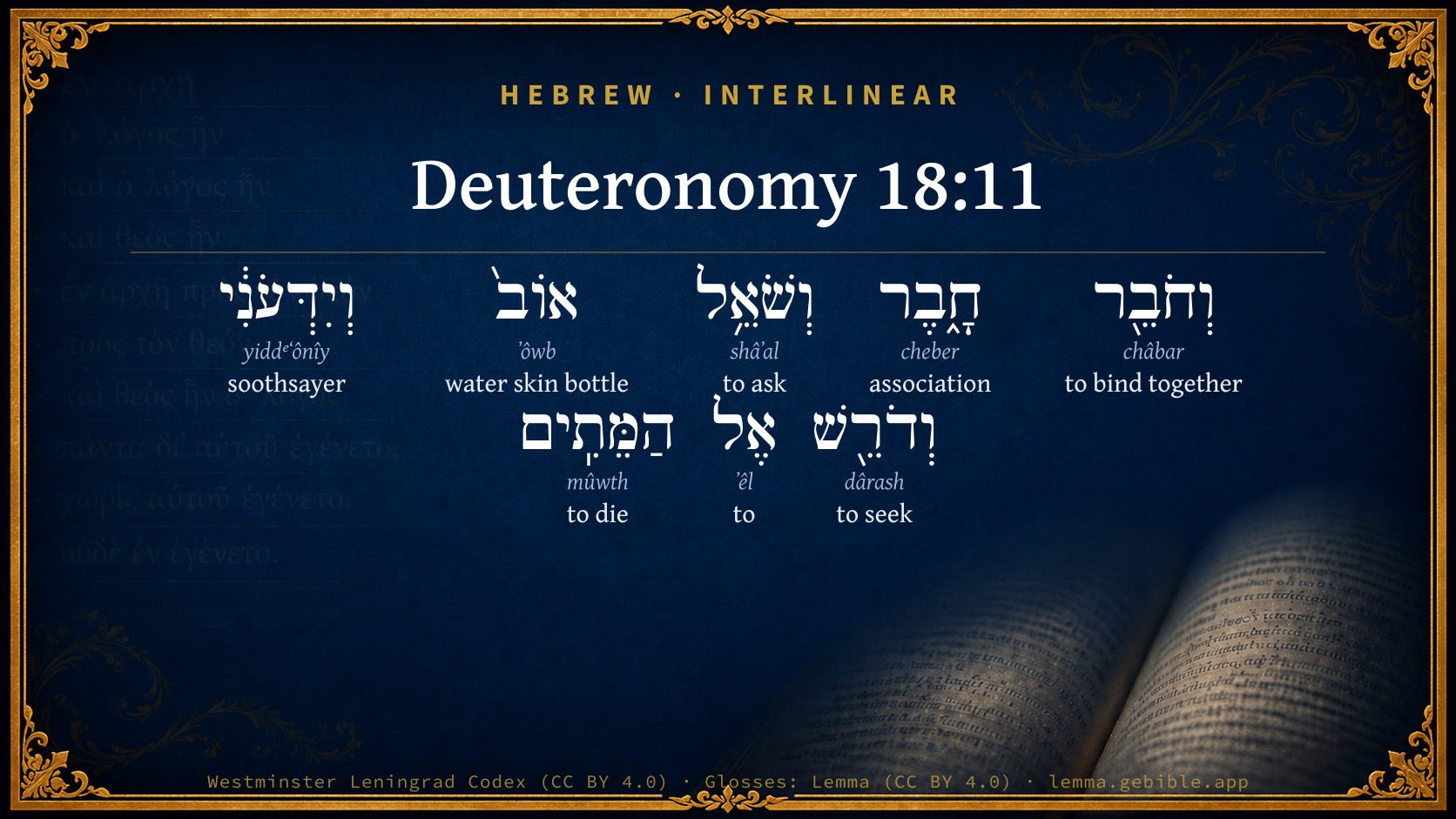
Hebrew (Westminster Leningrad Codex) Deuteronomy 18:11 appears in the Hebrew Old Testament. The text above is from the Westminster Leningrad Codex. Each word links to its Strong’s number, a concise gloss, and parsing drawn from the Open Scriptures Hebrew Bible morphology. Click any word for its full Brown-Driver-Briggs (BDB) entry.
Download image
Cite this verse

Deuteronomy 18:11 (World English Bible). Public Domain. Lemma interlinear Bible study tool, https://lemma.gebible.app/v/deuteronomy/18/11.

Show BibTeX & RIS
BibTeX
RIS
English Translation
or a charmer, or a consulter with a familiar spirit, or a wizard, or a necromancer.
World English Bible · Public Domain
Highlights
  • 1 first appearance in the Hebrew Bible
Full analysis ↓
Download a study sheet

One document with this verse’s original text, its word-by-word gloss line, the meaning frame, cross-references with their text, attributed commentary, and full source and license credits — printable, and it pastes into notes with its structure intact.

This verse Autodidact and up

Study sheet (.html) Plain text (.txt)

A passage Seminary Student

Up to 50 verses in one chapter. A passage sheet keeps up to 6 commentary sources and 12 cross-references per verse, in the order this page ranks them, and says so on the sheet whenever that leaves anything out. Ask for a single verse and you get the Autodidact verse sheet above.

Everything on this page stays free to read, with no account — the sheet is a download of what is already on screen, not access to it.

Want to remove ads? Support Godless Engineer
Compare translations 3

The same verse in 3 English versions, stacked beneath the original-language interlinear above. Click any original word for its lexicon entry.

Each is an independent rendering of the whole verse — the interlinear is not word-aligned to these translations.

Highlighted words mark where these versions differ — a whole-verse word diff, not a word-by-word alignment.

  • World English Bible Public Domain
    or a charmer, or a consulter with a familiar spirit, or a wizard, or a necromancer.
  • King James Version Public Domain
    Or a charmer, or a consulter with familiar spirits, or a wizard, or a necromancer.
  • unfoldingWord Literal Text CC BY-SA 4.0
    or a maker of charms or a questioner of mediums or a conjurer of spirits or a seeker of the dead.

unfoldingWord Literal Text — © unfoldingWord, licensed CC BY-SA 4.0. Word-aligned USFM3 via Door43 (git.door43.org/unfoldingWord/en_ult).

Versions to compare (up to 4)

3 of 4 selected

Show all 18 translations

Every available English version of this verse, each an independent rendering of the whole verse.

  • World English Bible Public Domain
    or a charmer, or a consulter with a familiar spirit, or a wizard, or a necromancer.
  • Berean Standard Bible Public Domain
    casts spells, consults a medium or spiritist, or inquires of the dead.
  • Majority Standard Bible Public Domain
    casts spells, consults a medium or spiritist, or inquires of the dead.
  • King James Version Public Domain
    Or a charmer, or a consulter with familiar spirits, or a wizard, or a necromancer.
  • American Standard Version (1901) Public Domain
    or a charmer, or a consulter with a familiar spirit, or a wizard, or a necromancer.
  • Revised Version (1885) Public Domain
    or a charmer, or a consulter with a familiar spirit, or a wizard, or a necromancer.
  • Geneva Bible (1599) Public Domain
    Or a charmer, or that counselleth with spirits, or a soothsaier, or that asketh counsel at ye dead.
  • Douay-Rheims (1899) Public Domain
    Nor charmer, nor any one that consulteth pythonic spirits, or fortune tellers, or that seeketh the truth from the dead.
  • Young's Literal Translation Public Domain
    and a charmer, and one asking at a familiar spirit, and a wizard, and one seeking unto the dead.
  • Literal Standard Version CC BY-SA 4.0
    and a charmer, and one inquiring from a familiar spirit, and a wizard, and one seeking to the dead.
  • Unlocked Literal Bible CC BY-SA 4.0
    any charmer, anyone who conjurs up spirits, or one who casts spells, or who talks with spirits of the dead.
  • unfoldingWord Literal Text CC BY-SA 4.0
    or a maker of charms or a questioner of mediums or a conjurer of spirits or a seeker of the dead.
  • Darby Bible Public Domain
    or a charmer, or one that inquireth of a spirit of Python, or a soothsayer, or one that consulteth the dead.
  • World Messianic Bible Public Domain
    or a charmer, or someone who consults with a familiar spirit, or a wizard, or a necromancer.
  • Webster's Bible Public Domain
    Or a charmer, or a consulter with familiar spirits, or a wizard, or a necromancer.
  • Free Bible Version CC BY-SA 4.0
    practice witchcraft, visit a medium or spiritist, or communicate with the dead. Anyone who does such things offends the Lord.
  • Bible in Basic English Public Domain
    Or anyone using secret force on people, or putting questions to a spirit, or having secret knowledge, or going to the dead for directions.
  • JPS Tanakh (1917) Public Domain
    or a charmer, or one that consulteth a ghost or a familiar spirit, or a necromancer.

Literal Standard Version (2020), Covenant Press — licensed CC BY-SA 4.0. Text via the HelloAO Bible API (eBible.org). Unlocked Literal Bible (unfoldingWord) — licensed CC BY-SA 4.0. Text via the HelloAO Bible API (eBible.org). unfoldingWord Literal Text — © unfoldingWord, licensed CC BY-SA 4.0. Word-aligned USFM3 via Door43 (git.door43.org/unfoldingWord/en_ult). Free Bible Version, Dr. Jonathan Gallagher — licensed CC BY-SA 4.0. Text via the HelloAO Bible API (eBible.org).

Word by word

More ways to search: Search by grammar → Find every occurrence → Compare this word →

Practice this passage: Drill this verse → Learn its vocabulary →

About this verse

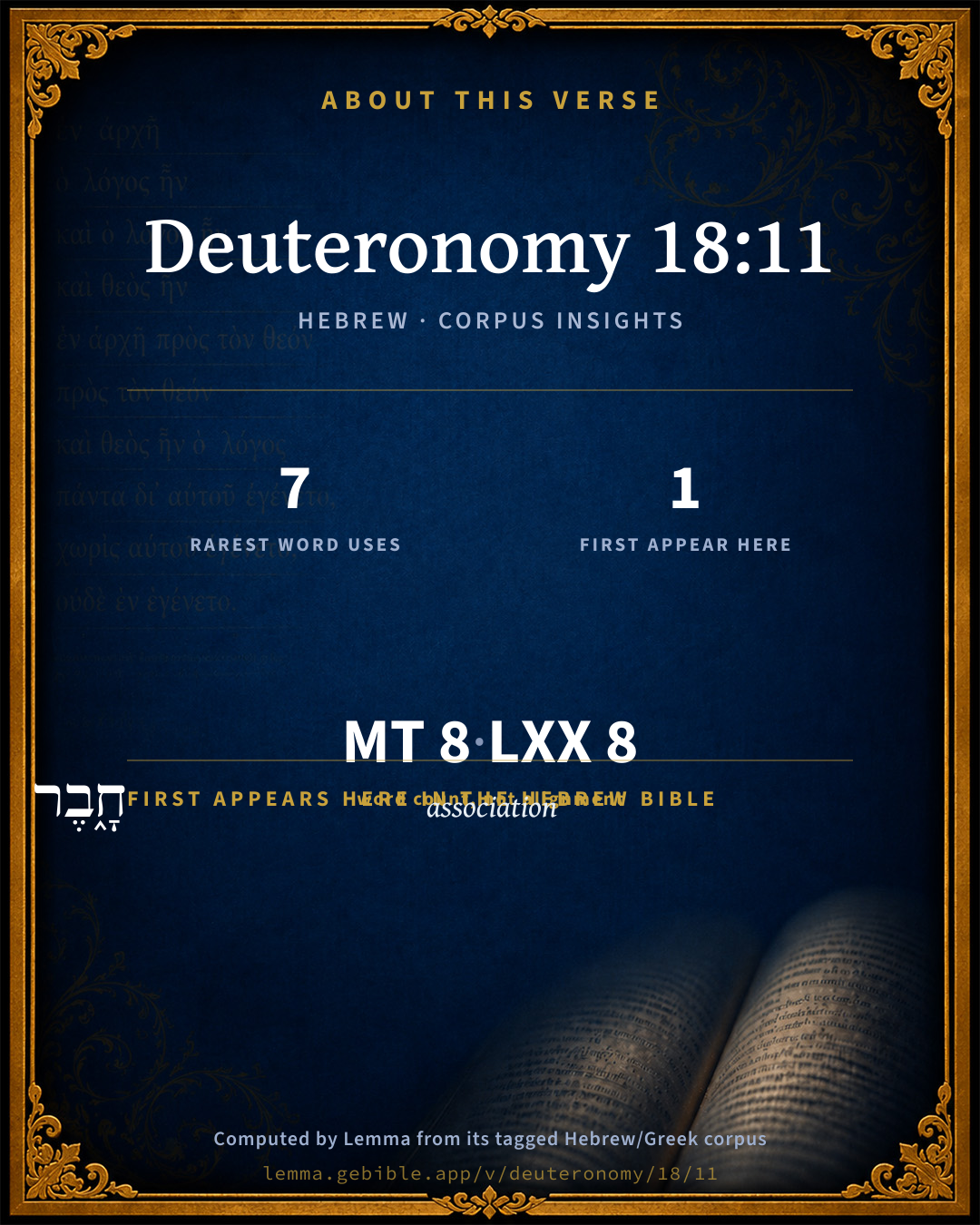
These counts appear in no published source. They are computed here, from the morphology-tagged text and Lemma’s own curated glosses. What Lemma adds →

8
words
8
distinct lemmas
Pentateuch
section

Notable vocabulary

The rarest word here is חָ֑בֶר association H2267 — appearing just 7 times in the whole Hebrew Bible.

First appearance in Scripture

This word makes its first canonical appearance in the Hebrew Bible here:

  • חָ֑בֶר association H2267

Shared distinctive vocabulary

חָ֑בֶר association H2267 occurs in 7 verses of the Hebrew Bible. Also found in:

Grammatical profile

  • 4 verbs
  • 3 nouns
  • 1 preposition

Verb forms

  • וְחֹבֵ֖ר Qal · Participle Active
  • וְשֹׁאֵ֥ל Qal · Participle Active
  • וְדֹרֵ֖שׁ Qal · Participle Active
  • הַמֵּתִֽים Qal · Participle Active

Hebrew & Septuagint length

In English translation the verse runs 16 words from the Hebrew and 19 from the Septuagint (LXX English) — closely comparable.

A rough comparison of the two English renderings, which tokenize alike — not a word-level alignment.

Word counts can differ between the Hebrew and the Greek without any difference in meaning — e.g. the Hebrew direct-object marker אֵת has no separate Greek word, and Greek often adds the article ὁ.

In the original languages it is 8 Hebrew tokens and 8 Greek tokens — but the two are counted differently (Hebrew bundles its prefixes and suffixes into one token; the Greek is in lemma form), so that isn’t a like-for-like length.

Cross-references

2

Topical passages linked to Deuteronomy 18:11 in the Treasury of Scripture Knowledge — connected by theme and wording, ordered by reader-vote popularity; previews shown in the World English Bible.

  • Leviticus 19:31 "'Don't turn to those who are mediums, nor to the wizards. Don't seek them out, to be defiled by them. I am Yahweh your God.
  • 1 Samuel 28:11–14 Then said the woman, Whom shall I bring up to you? He said, Bring me up Samuel.

Cross-references courtesy of OpenBible.info (CC BY 4.0).

Hebrew and Greek witnesses Masoretic Hebrew ↔ Greek Septuagint

The same verse in the two great witnesses to the Old Testament, shown verse-for-verse.

These are two independent witnesses, not word-aligned to each other, and the Septuagint is shown in lemma (dictionary) form.

Hebrew Deuteronomy 18:11 Masoretic · Westminster Leningrad Codex

וְחֹבֵ֖ר חָ֑בֶר וְשֹׁאֵ֥ל אוֹב֙ וְיִדְּעֹנִ֔י וְדֹרֵ֖שׁ אֶל הַמֵּתִֽים

or a charmer, or a consulter with a familiar spirit, or a wizard, or a necromancer.

World English Bible · Public Domain

Greek LXX Deuteronomy 18:11 Septuagint · lemma form

ἐπαείδω ἐπαοιδή ἐγγαστρίμυθος καί τερατοσκόπος ἐπιἐρωτάω ὁ νεκρός

a sorcerer employing incantation, one who has in him a divining spirit, an observer of signs, questioning the dead.

LXX2012 (modern English Septuagint) · Public Domain

On this verse, The Cambridge Bible for Schools and Colleges discusses the Septuagint’s reading. Read the note in Commentary ↓

Hebrew: Westminster Leningrad Codex (CC BY 4.0). Greek: Septuagint (public domain); English from LXX2012 (modern English Septuagint) (Public Domain). How the Septuagint differs from the Hebrew →

Targum (Aramaic paraphrase)

2

The Targum is the ancient Jewish Aramaic paraphrase of the Hebrew Scriptures — an interpretive translation, not the Hebrew text itself. Onkelos (literal) and Pseudo-Jonathan (expansive) render the Torah, and Jonathan the Prophets. Coverage is partial: where no permissively-licensed English translation exists for a verse, only the Aramaic is shown. This is verse-level text, not a word-by-word alignment to the Hebrew.

  1. Targum Onkelos Torah (Genesis–Deuteronomy)
    וְרָטִין רְטָן וְשָׁאֵל בִּדִין וּדְכוּרוּ וְתָבַע מִן מֵתַיָא

    (no public-domain English translation for this verse)

    Targum Onkelos — Aramaic: “Onkelos Genesis” (public domain); “Onkelos Exodus” (public domain); “Onkelos Leviticus” (public domain); “Onkelos Numbers” (public domain); “Onkelos Deuteronomy” (public domain). English: “Sefaria Community Translation” (CC0 1.0 (public-domain dedication)); “J.W. Etheridge. The Targums of Onkelos and Jonathan Ben Uzziel on the Pentateuch. London: Longmans, Green, 1862” (public domain). Text via Sefaria.

  2. Targum Pseudo-Jonathan Torah (Genesis–Deuteronomy)
    וּמְחַבְּרִין וְאַסְרִין חֵיוִין וְעַקְרַבִּין וְכָל מִינֵי רַחֲשִׁין וְשַׁאֲלִין אִיבָא טַמְיָא וּגְרַם יָדוּעַ וּתְבַע מִן מֵיתַיָא

    or make (magical) knots and bindings of serpents and scorpions or any kind of reptile, or who consult the oba, the bones of the dead or the bone Jadua, or who inquire of the manes.

    Targum Pseudo-Jonathan — Aramaic: “Targum Jonathan on Genesis” (public domain); “Targum Jonathan on Exodus” (public domain); “Targum Jonathan on Leviticus” (public domain); “Targum Jonathan on Numbers” (public domain); “Targum Jonathan on Deuteronomy” (public domain). English: “The Targum of Jonathan ben Uzziel, trans. J. W. Etheridge, London, 1862” (public domain). Text via Sefaria.

Commentary

Notes on Deuteronomy 18:11 from classic Christian and Jewish commentators (each source and its license shown beneath its notes). The classic Christian expositions comment on the surrounding passage and are grouped to its opening verse, so a note may address several verses; the Jewish commentaries on the Tanakh (Rashi and others) are per-verse, so they appear only where the commentator wrote on this verse.

Lemma curates 59 commentaries, every one of them public domain or Creative Commons licensed, each selected and text-cleaned for this edition rather than reprinted as found. About our sources →

Trapp's Complete Commentary

John Trapp

Deu 18:11 Or a charmer, or a consulter with familiar spirits, or a wizard, or a necromancer.

Ver. 11. Or a necromancer.] Bellarmine and other Papists play the necromancers, when they would prove a Purgatory from the apparitions of spirits, that tell of themselves or others there tormented.

John Trapp, A Commentary or Exposition upon All the Books of the Old and New Testament (1647–1656) — public domain. Text from a community e-Sword module.

Joseph Benson's Commentary

Deu 18:11. Or a charmer — One that charmeth serpents or other creatures. Or rather, as the Hebrew חבר חבר, chober chaber, seems to mean, an astrologer, or such as, by the conjunction of the planets, pretended to foretel the events of men’s lives, or other future things. It must be observed that the eastern people were much addicted to divination of all kinds, and undertook no enterprise of importance without consulting their soothsayers; and therefore Moses uses these sundry expressions that he might prohibit it in all its forms. A consulter with familiar spirits — The original words שׁאל אוב, shoel ob, are here rendered by the Seventy, εγγαστριμυθος, one that speaks out of his belly: but literally, it is one that consults or inquires of Ob. This word originally means a bottle, and was the name which the Hebrews gave to the spirit which was supposed to agitate these ventriloquists, because their bodies were violently distended, like leather bottles full of wine and ready to burst. See Doddridge on Act 16:16, where both St. Paul and St. Luke evidently consider the girl spoken of as being really possessed by what is there termed πνευμα πυθωνος, a spirit of python, or divination, because the Greeks supposed it to be an inspiration from their god Apollo, whom they termed Pythius.

A wizard — Hebrew, A knowing man; who by any forbidden ways undertakes the revelation of secret things. The Seventy render the word τερατοσκοπος, an observer of prodigies. A necromancer — Hebrew, One that seeketh unto the dead; that calleth up and inquires of them, as the witch of Endor is represented to have done. Dr. Waterland, after the Seventy, renders it, very properly, one that consults the dead. Their manner of doing this is stated to have been by visiting their graves in the night, and there lying down and muttering certain words with a low voice, by which means they pretended to have communion with them by dreams, or by the dead appearing to them. To this Isaiah has been thought to allude, Deu 8:19; Deu 29:4.

Joseph Benson's Commentary on the Old and New Testaments (1811–1818) — public domain. Text from a community e-Sword module.

Tyndale Open Study Notes

Tyndale Open Resources

18:11 cast spells: These incantations wereto destroy or injure others by invoking curses on them. The false prophet Balaam was hired for this purpose against Israel (Num 22:2-6). • Mediums and psychics were especially adept at conjuring up and communicating with the spirits of the dead (see 1 Sam 28:3-25).

Tyndale Open Study Notes — © Tyndale Open Resources, licensed CC BY-SA 4.0. Text via the HelloAO Bible API.

Adam Clarke's Commentary

Verse 11. A charmer] חבר חבר chober chaber, one who uses spells; a peculiar conjunction, as the term implies, of words, or things, tying knots, c., for the purposes of divination. This was a custom among the heathen, as we learn from the following verses: -

Necte TRIBUS NODIS ternos, Amarylli, colores:

Necte, Amarylli, modo et Veneris, dic, vincula necto.

Virg. Ecl. viii., ver. 77.

"Knit with three KNOTS the fillets, knit them straight;

Then say, these KNOTS to love I consecrate."

DRYDEN.

A consulter with familiar spirits] שאל אוב shoel ob, a Pythoness, one who inquires by the means of one spirit to get oracular answers from another of a superior order. See Clarke on Le 19:31.

A wizard] ידעני yiddeoni, a wise one, a knowing one. Wizard was formerly considered as the masculine of witch, both practising divination by similar means. See Clarke on Ex 22:13, and See Clarke on Le 19:31.

Or a necromancer.] דרש אל המתים doresh el hammethim, one who seeks from or inquires of the dead. Such as the witch at Endor, who professed to evoke the dead, in order to get them to disclose the secrets of the spiritual world.

Adam Clarke's Commentary on the Bible (1810–1826) — public domain. Text from a community e-Sword/MySword module.

Ellicott's Commentary for English Readers

(11) Charmer.—Literally one who ties knots, used here for the first time in Old Testament.

Consulter with familiar spirits.—Literally, one who consulteth ôb (see Lev_19:31).

A Wizard.—One who knows or pretends to know the secrets of the unseen world. (See Lev_19:31.)

Necromancer.—One who inquires of the dead. Four of the above practices are ascribed to king Manasseh in 2Ch_33:6. It is hardly possible that all of them were mere imposture and deceit.

A Bible Commentary for English Readers, edited by Charles John Ellicott (1878–1897) — public domain. Text from a community e-Sword module.

The Cambridge Bible for Schools and Colleges

gen. ed. J. J. S. Perowne

11. a charmer] With Sam. LXX omit or: the name is in apposition to the preceding. Heb. ḥober heber, weaving spells, spell-binder; either of the tying of knots as malignant charms, common among Semites and other races (Campbell Thompson, Sem. Magic 162–173, Frazer, Golden Bough i. 394 ff.; mentioned in the Korân, Sur. cxiii, ‘the mischief of women blowing on knots’; also practised in Europe, cp. the French ‘nouer l’éguillette’), or of the weaving of incantations and spells (W. R. Smith), so LXX ἐπαείδων ἐπαοιδήν. In Psa_58:5 (6) of charming serpents. For spell-makers in Arabia, see Doughty i. 258, 333, 464 f.

a consulter with a ghost or familiar spirit] Heb. sho’el’ôb weyiddeonî; ’ôb was the spirit of a dead person, also applied to the medium, whose body it inhabited, speaking out from this in a chirping, twittering voice (probably imitated from the sound of bats haunting sepulchres), LXX ἐνγαστρίμυθος; see Lev_20:27, 1Sa_28:3; 1Sa_28:7; 1Sa_28:9, Isa_8:19; Isa_29:4, 2Ki_22:6; 2Ki_23:24. Yiddeonî means either instructor (the form may be causative) or knower (cp. Scot. wise = with powers of magic, wise-wife = witch, wise-folk = fairies) or acquaintance, familiar (W. R. Smith). LXX, τερατοσκόπος.

a necromancer] Heb. enquirer of, or resorter to (doresh, see on seek, Deu_12:5), the dead: a general description of the consulter of ghosts and familiar spirits. With Sam. LXX omit or.

The Cambridge Bible for Schools and Colleges (gen. ed. J. J. S. Perowne; Cambridge University Press, 1878–1918) — public domain. Text from a community e-Sword module.

John Gill's Exposition

Or a charmer,.... That pretends to cure diseases by charms, or a charmer of serpents; according to Jarchi, one that gathers together serpents and scorpions, and other animals, into one place; with which agree the Targums of Jonathan and Jerusalem,"which bind serpents and scorpions, and all kind of creeping things;''but, according to Aben Ezra, one that says certain words to gather demons together:

or a consulter with familiar spirits; or the inquirer of "Ob", or the bottle, which the Jews interpret of Python, or one that has the spirit of Python; see Act 16:16, a ventriloquist, one that spoke or seemed to speak out of his belly, or from under his armpits; so it is said in the Misnah (h) of Ob, this is Python, one that speaks out of his arm holes; agreeably to which, Jarchi says, this is that sort of witchcraft which is called Python, and he speaks from his arm holes, and brings up the dead thither: of Baal Ob, or the master of the bottle, say some Jewish writers, one way he uses is, he takes the skull of a dead man, the flesh of which is consumed from it, and he hides it and burns incense to it, and mutters words by it, and hears from it, as if from a dead man (k): or a wizard: a knowing one, as the word signifies, such an one as we call a cunning man; See Gill on Lev 19:31.

or a necromancer that inquiries of the dead, or seeks instruction from them, as the Targum of Jerusalem. Aben Ezra describes him as one that goes to burying grounds, and takes the bone of a dead man, and because of his wild imagination there appears to him the likeness of forms; or as Maimonides (l), better still, he is one that fasts and sleeps in graveyards, and utters words; and, according to his imagination, sees future things in dreams.

(h) Misn. Sanhedrin, c. 7. sect. 7. (k) Maimon. & Bartenora in ib. (l) In ib.

John Gill's Exposition of the Whole Bible (1746–1763) — public domain (CC PDM 1.0). Text via the HelloAO Bible API.

Albert Barnes' Notes on the Bible

A charmer - i. e., one who fascinates and subdues noxious animals or men, such as the famous serpent-charmers of the East Psa 58:4-5.

A consulter with familiar spirits ... a wizard - Compare Lev 19:31 note.

Recromancer - literally, “one who interrogates the dead.” The purpose of the text is obviously to group together all the known words belonging to the practices in question. Compare 2Ch 33:6.

Albert Barnes' Notes on the Bible (1834–1885) — public domain. Text from a community e-Sword/MySword module.

Haydock's Catholic Bible Commentary

Charmer of serpents, Psalm lvii. 6. One who makes a compact with the devil. --- Spirits. Python was the name of the serpent which Apollo slew. It might be derived from the Hebrew patah, "to seduce," because a serpent seduced Eve, and dealers with the devil generally deceived those who consult them. Septuagint, "a belly talker," as these impostors muttered some sounds, imitating that a spirit gave answers from their belly, See Isaias xxix. 4. --- Tellers. Hebrew, "wise men." (Haydock) --- Those who promise great knowledge from the secrets of the caballa, or magic. --- Dead. Necromancy was already very common. Thus the witch of Endor made the ghost of Samuel appear to Saul, 1 Kings xxviii. 7. The Rabbins say that the person took a bone, or the skull of the dead, when he intended to enquire into futurity. (Drusius)

George Leo Haydock (1774–1849), Haydock's Catholic Family Bible and Commentary, 1859 edition — public domain. Excludes Psalms (Douay-Rheims chapter numbering differs from Protestant) and Deuterocanonical books (Catholic canon only).

Matthew Poole's English Annotations

A charmer; one that charmeth serpents or other cattle, Psa 58:5; or, a

fortune-teller, that foretelleth the events of men’s lives by the conjunctions of the stars, &c. See Poole "Lev 19:31"; See Poole "Lev 20:6".

A consulter with familiar spirits, whom they call upon by certain words or rites to engage them in evil designs.

A wizard, Heb. a knowing or cunning man, who by any superstitious or forbidden ways undertakes the revelation of secret things:

A necromancer; one that calleth up and inquireth of the dead, 1Sa 28:8; Isa 8:19.

Matthew Poole's English Annotations on the Holy Bible (1683–1685) — public domain. Text from a community e-Sword/MySword module.

Whedon's Commentary on the Bible

Daniel D. Whedon

11. A charmer — Hebrew, spell-binder, one who binds by incantations, pretends to subdue some dreadful enemy. In Psa_58:5, the word is applied to the serpent charmer.

A consulter with familiar spirits — שׁאל אוב, one who consults a sorcerer. אוב properly denotes a leathern bottle for carrying water or wine: then it was applied to the “hollow belly of conjurers,” in which the conjuring spirit, πυθων, resides, and speaks hollow, as if out of the earth; then it was used for this spirit which was interrogated for enchantment, and sometimes for the enchanter himself. The Septuagint usually renders אוב by εγγαστριμυθος, ventriloquist. In Act_16:16, the woman who had a pythonic spirit was regarded by the heathen inhabitants of Philippi as inspired by Apollo; in later times, a pythonic spirit was considered the same as a ventriloquist, εγγαστριμυθος. Augustine, indeed, calls this female slave ventriloqua femina. Comp. Lev_19:31; Lev_20:27.

A wizard — A knowing one. The meaning of the word must be, one who claims extraordinary wisdom and foresight.

A necromancer — One who makes inquiry of the dead, referring to those who pretended to have power to secure answers from the spirits of the departed. All these are only species of the same genus.

They are false prophets. They pretend to possess supernatural powers, to foresee the future, to protect from evil, to have communion with deity.*

[*In Thomson’s The Land and The Book, (vol. i, p. 214, et seq.,) may be found a long account of the modern pretenders to supernatural powers, “clumsy imitators of these ancient adepts.”]

Daniel D. Whedon (gen. ed.), Commentary on the Old and New Testaments (1874–1909) — public domain. Text from a community e-Sword module.

John Wesley's Explanatory Notes

A charmer - One that charmeth serpents or other cattle. Or, a fortune-teller, that foretelleth the events of men's lives by the conjunctions of the stars. Spirits - Whom they call upon by certain words or rites. A wizard - Hebrew. a knowing man, who by any forbidden way's undertakes the Revelation of secret things. A necromancer - One that calleth up and inquireth of the dead.

John Wesley, Explanatory Notes Upon the Whole Bible (1754–1765) — public domain. Text via the GEBible commentary corpus.

Rashi

Rabbi Shlomo Yitzchaki (Rashi)

וחבר חבר OR A CHARMER — One who charms snakes or scorpions or other creatures into one spot (חבר = “an assembly”) (Sifrei Devarim 172:1).

ושאל אוב OR A CONSULTER OF THE SPIRIT אוב — This is a kind of sorcery brought about by a spirit whose name is פיתום (in Greek: πύξον) who speaks out of his (the charmer’s) arm-pit, having raised a corpse beneath his arm-pit (Sifrei Devarim 172:2).

וידעני is one who puts a bone of an animal, the name of which is יִדּוֹעַ, into his mouth and the bone speaks by way of sorcery (Sanhedrin 65a; cf. Rashi on Leviticus 19:31 and Note thereon).

ודרש אל המתים OR A NECROMANCER — as, for instance, one who raises a corpse, placing it on his genitals, or who consults a skull (Sifrei Devarim 172:4; cf. Sanhedrin 65b).

Rashi on the Tanakh — English translations: “The Judaica Press complete Tanach with Rashi, translated by A. J. Rosenberg” (CC BY 4.0); “Pentateuch with Rashi's commentary by M. Rosenbaum and A.M. Silbermann, 1929-1934” (public domain); “The Metsudah Tanach series, Lakewood, N.J” (CC BY 4.0); and “The Book of Joshua, Metsudah Publications, 1997” (CC BY 4.0). Text via Sefaria.

Lesson kit

Teaching starters — assembled from the data on this page, not authored interpretation. Every prompt links to the verse data it draws on. Edit before teaching.

Deuteronomy, in the Pentateuch, opens this verse with 8 words (8 distinct Hebrew lemmas). Its most distinctive word is cheber (“association”). A historical commentator’s framing appears above. Read the whole chapter for the surrounding context.

Discussion questions

  1. How does “association” (cheber) shape what this verse is saying?
  2. The word “association” first appears here in Scripture. What is being introduced at this debut?
  3. Psalms 58:5 shares the word «association» with this verse. How do the two illuminate each other?
  4. These translations render this verse differently; the difference is in the English rendering, not the original. What questions does that raise?
  5. The verb «וְחֹבֵ֖ר» is Qal Participle Active. How does its form color the action?
  6. Reading how Trapp's Complete Commentary and Joseph Benson's Commentary read this verse, where do the two commentators agree and where do they part?

Things to notice

Reading settings

Reading text

Shown beneath each verse's original-language words.

Old Testament
Old Testament edition

Read the OT as the Masoretic Hebrew (MT) or the Greek Septuagint (LXX).

English shown for the Greek Septuagint (in the Hebrew ↔ Greek comparison).

Comparing translations? Open the Compare panel on any verse page to stack up to four side by side.