Genesis 1:31

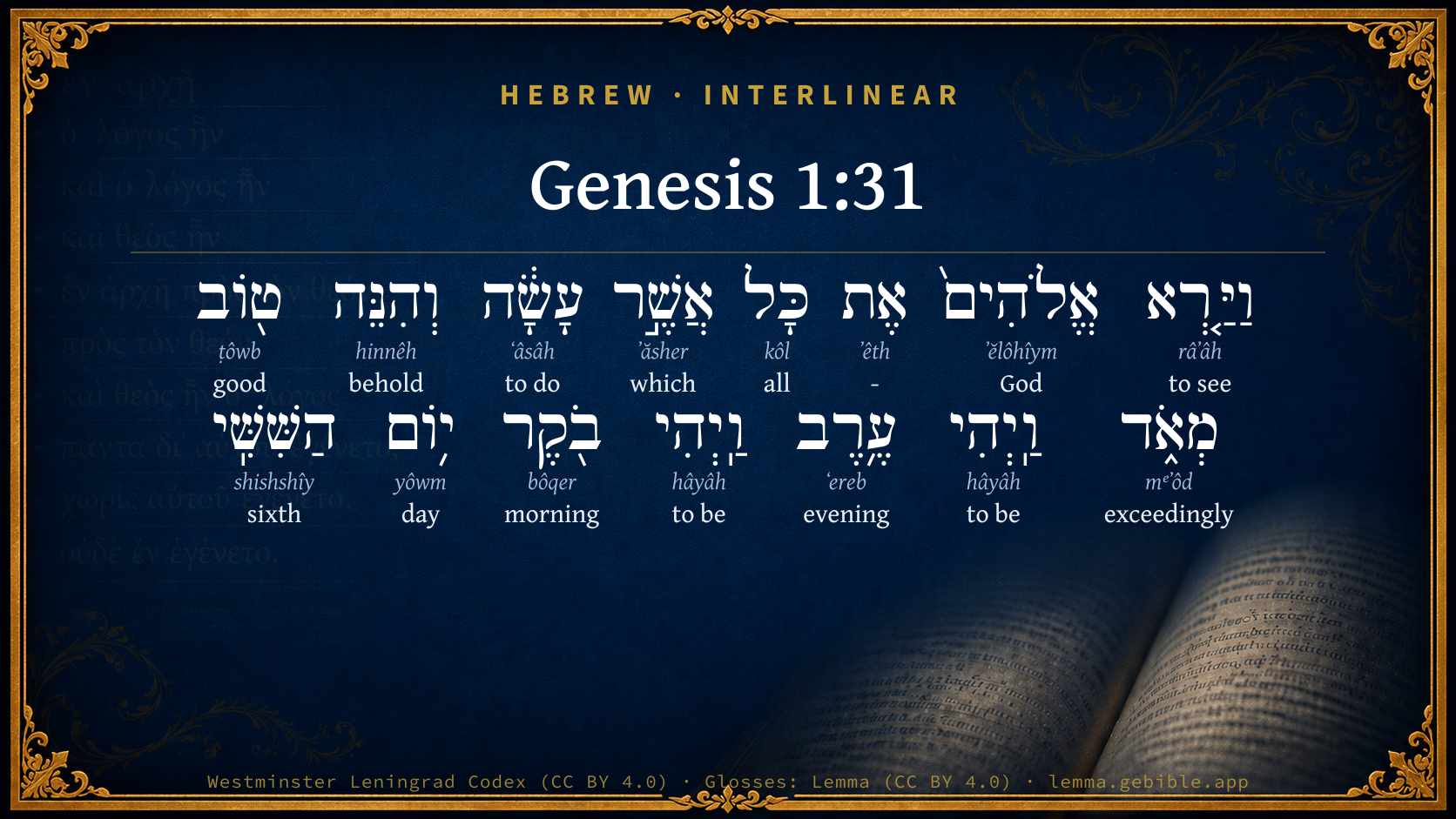
Hebrew (Westminster Leningrad Codex) Genesis 1:31 appears in the Hebrew Old Testament. The text above is from the Westminster Leningrad Codex. Each word links to its Strong’s number, a concise gloss, and parsing drawn from the Open Scriptures Hebrew Bible morphology. Click any word for its full Brown-Driver-Briggs (BDB) entry.
Download image
Cite this verse

Genesis 1:31 (World English Bible). Public Domain. Lemma interlinear Bible study tool, https://lemma.gebible.app/v/genesis/1/31.

Show BibTeX & RIS
BibTeX
RIS
English Translation
God saw everything that he had made, and, behold, it was very good. There was evening and there was morning, the sixth day.
World English Bible · Public Domain
Highlights
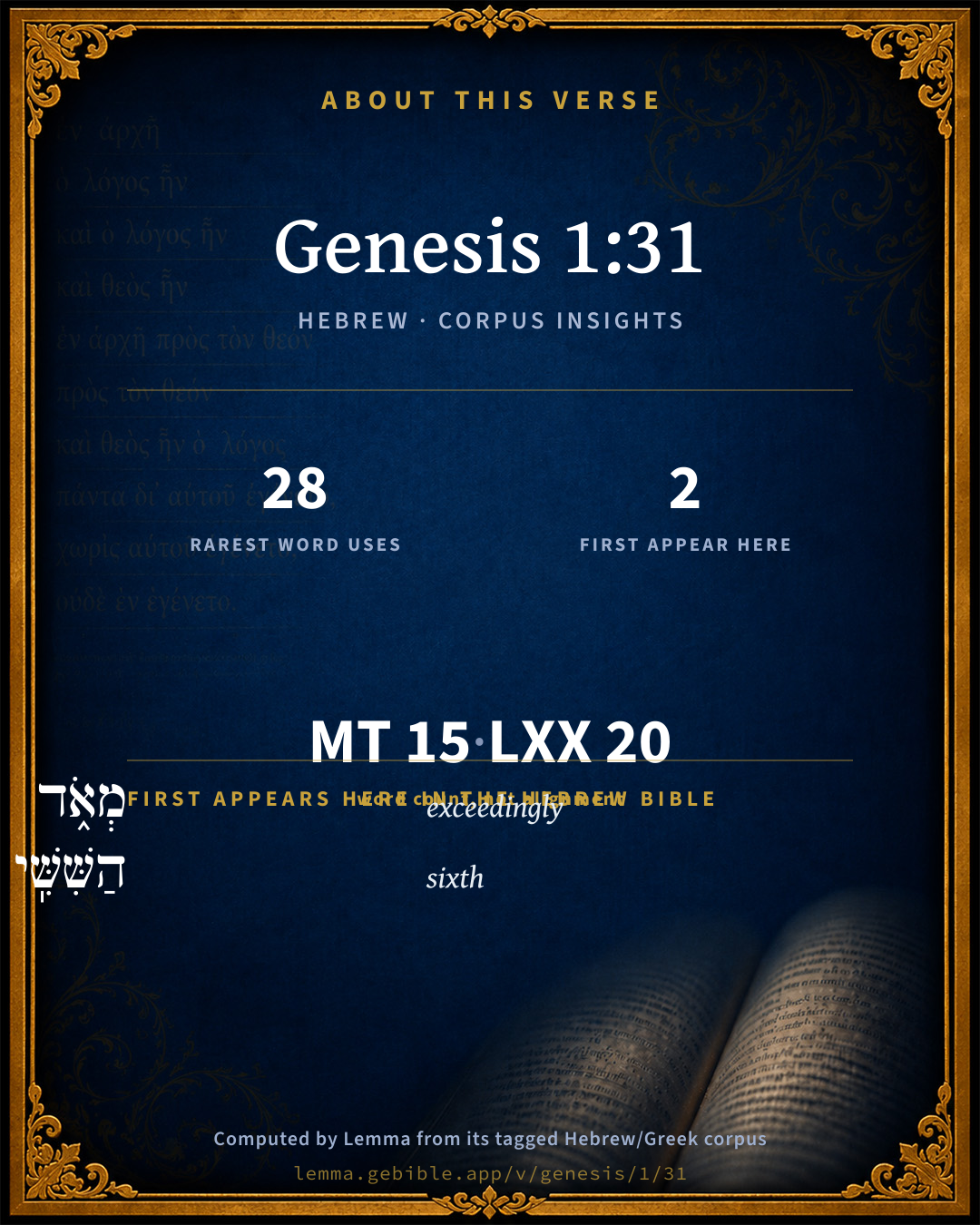
  • 2 first appearances in the Hebrew Bible
Full analysis ↓
Download a study sheet

One document with this verse’s original text, its word-by-word gloss line, the meaning frame, cross-references with their text, attributed commentary, and full source and license credits — printable, and it pastes into notes with its structure intact.

This verse Autodidact and up

Study sheet (.html) Plain text (.txt)

A passage Seminary Student

Up to 50 verses in one chapter. A passage sheet keeps up to 6 commentary sources and 12 cross-references per verse, in the order this page ranks them, and says so on the sheet whenever that leaves anything out. Ask for a single verse and you get the Autodidact verse sheet above.

Everything on this page stays free to read, with no account — the sheet is a download of what is already on screen, not access to it.

Want to remove ads? Support Godless Engineer
Compare translations 3

The same verse in 3 English versions, stacked beneath the original-language interlinear above. Click any original word for its lexicon entry.

Each is an independent rendering of the whole verse — the interlinear is not word-aligned to these translations.

Highlighted words mark where these versions differ — a whole-verse word diff, not a word-by-word alignment.

  • World English Bible Public Domain
    God saw everything that he had made, and, behold, it was very good. There was evening and there was morning, the sixth day.
  • King James Version Public Domain
    And God saw every thing that he had made, and, behold, it was very good. And the evening and the morning were the sixth day.
  • unfoldingWord Literal Text CC BY-SA 4.0
    Then God saw all that he had made, and behold, very good. Then there was evening, and there was morning, the sixth day.

unfoldingWord Literal Text — © unfoldingWord, licensed CC BY-SA 4.0. Word-aligned USFM3 via Door43 (git.door43.org/unfoldingWord/en_ult).

Versions to compare (up to 4)

3 of 4 selected

Show all 18 translations

Every available English version of this verse, each an independent rendering of the whole verse.

  • World English Bible Public Domain
    God saw everything that he had made, and, behold, it was very good. There was evening and there was morning, the sixth day.
  • Berean Standard Bible Public Domain
    And God looked upon all that He had made, and indeed, it was very good. And there was evening, and there was morning—the sixth day.
  • Majority Standard Bible Public Domain
    And God looked upon all that He had made, and indeed, it was very good. And there was evening, and there was morning—the sixth day.
  • King James Version Public Domain
    And God saw every thing that he had made, and, behold, it was very good. And the evening and the morning were the sixth day.
  • American Standard Version (1901) Public Domain
    And God saw everything that he had made, and, behold, it was very good. And there was evening and there was morning, the sixth day.
  • Revised Version (1885) Public Domain
    And God saw every thing that he had made, and, behold, it was very good. And there was evening and there was morning, the sixth day.
  • Geneva Bible (1599) Public Domain
    And God sawe all that he had made, and loe, it was very good. So the euening and the morning were the sixt day.
  • Douay-Rheims (1899) Public Domain
    And God saw all the things that he had made, and they were very good. And the evening and morning were the sixth day.
  • Young's Literal Translation Public Domain
    And God seeth all that He hath done, and lo, very good; and there is an evening, and there is a morning -- day the sixth.
  • Literal Standard Version CC BY-SA 4.0
    And God sees all that He has done, and behold, [it is] very good; and there is an evening, and there is a morning—the sixth day.
  • Unlocked Literal Bible CC BY-SA 4.0
    God saw everything that he had made. Behold, it was very good. This was evening and morning, the sixth day.
  • unfoldingWord Literal Text CC BY-SA 4.0
    Then God saw all that he had made, and behold, very good. Then there was evening, and there was morning, the sixth day.
  • Darby Bible Public Domain
    And God saw everything that he had made, and behold it was very good. And there was evening, and there was morning -- the sixth day.
  • World Messianic Bible Public Domain
    God saw everything that he had made, and, behold, it was very good. There was evening and there was morning, a sixth day.
  • Webster's Bible Public Domain
    And God saw every thing that he had made, and behold, it was very good. And the evening and the morning were the sixth day.
  • Free Bible Version CC BY-SA 4.0
    God saw everything that he had created, and yes, it was very good. So there was evening, and then the morning, making day six.
  • Bible in Basic English Public Domain
    And God saw everything which he had made and it was very good. And there was evening and there was morning, the sixth day.
  • JPS Tanakh (1917) Public Domain
    And God saw every thing that He had made, and, behold, it was very good. And there was evening and there was morning, the sixth day.

Literal Standard Version (2020), Covenant Press — licensed CC BY-SA 4.0. Text via the HelloAO Bible API (eBible.org). Unlocked Literal Bible (unfoldingWord) — licensed CC BY-SA 4.0. Text via the HelloAO Bible API (eBible.org). unfoldingWord Literal Text — © unfoldingWord, licensed CC BY-SA 4.0. Word-aligned USFM3 via Door43 (git.door43.org/unfoldingWord/en_ult). Free Bible Version, Dr. Jonathan Gallagher — licensed CC BY-SA 4.0. Text via the HelloAO Bible API (eBible.org).

Word by word

More ways to search: Search by grammar → Find every occurrence → Compare this word →

Practice this passage: Drill this verse → Learn its vocabulary →

הַשִּׁשִּֽׁי
shishshîy
H8345
“the · sixth”
Particle, Definite Article + Adjective, Ordinal number, Masculine, Singular, Absolute
Part of Speech
Particle + Adjective
Type
Ordinal number
Gender
Masculine
Number
Singular
State
Absolute
Full BDB Definition

Origin: from H8337

TWOT: 2336b

sixth - sixth (ordinal number) - sixth (as fraction)
  1. וַיַּ֤רְא râʼâh H7200 “and · to see” Conjunction + Verb, Qal, Sequential Imperfect, 3rd Person, Masculine, Singular
  2. אֱלֹהִים֙ ʼĕlôhîym H430 “God(s)” Noun, Common, Masculine, Plural, Absolute
  3. אֶת ʼêth H853 “-” Particle, Direct Object
  4. כָּל kôl H3605 “all of” Noun, Common, Masculine, Singular, Construct
  5. אֲשֶׁ֣ר ʼăsher H834 “which” Particle, Relative
  6. עָשָׂ֔ה ʻâsâh H6213 “to do” Verb, Qal, Perfect, 3rd Person, Masculine, Singular
  7. וְהִנֵּה hinnêh H2009 “and · behold” Conjunction + Particle, Demonstrative
  8. ט֖וֹב ṭôwb H2896 “good” Adjective, Adjective, Masculine, Singular, Absolute
  9. מְאֹ֑ד mᵉʼôd H3966 “exceedingly” Adverb
  10. וַֽיְהִי hâyâh H1961 “and · to be” Conjunction + Verb, Qal, Sequential Imperfect, 3rd Person, Masculine, Singular
  11. עֶ֥רֶב ʻereb H6153 “evening” Noun, Common, Masculine, Singular, Absolute
  12. וַֽיְהִי hâyâh H1961 “and · to be” Conjunction + Verb, Qal, Sequential Imperfect, 3rd Person, Masculine, Singular
  13. בֹ֖קֶר bôqer H1242 “morning” Noun, Common, Masculine, Singular, Absolute
  14. י֥וֹם yôwm H3117 “day of” Noun, Common, Masculine, Singular, Construct

About this verse

These counts appear in no published source. They are computed here, from the morphology-tagged text and Lemma’s own curated glosses. What Lemma adds →

15
words
14
distinct lemmas
Pentateuch
section

First appearance in Scripture

These words make their first canonical appearance in the Hebrew Bible here:

  • מְאֹ֑ד exceedingly H3966
  • הַשִּׁשִּֽׁי sixth H8345

Shared distinctive vocabulary

הַשִּׁשִּֽׁי sixth H8345 occurs in 26 verses of the Hebrew Bible. Also found in:

Grammatical profile

  • 4 verbs
  • 5 nouns
  • 2 adjectives
  • 1 adverb
  • 3 particles

Verb forms

  • וַיַּ֤רְא Qal · Sequential Imperfect
  • עָשָׂ֔ה Qal · Perfect
  • וַֽיְהִי Qal · Sequential Imperfect
  • וַֽיְהִי Qal · Sequential Imperfect

Repetition

A word recurs within this verse — often emphatic in Hebrew:

  • וַֽיְהִי to be H1961 ×2

Hebrew & Septuagint length

In English translation the verse runs 23 words from the Hebrew and 27 from the Septuagint (LXX English) — closely comparable.

A rough comparison of the two English renderings, which tokenize alike — not a word-level alignment.

Word counts can differ between the Hebrew and the Greek without any difference in meaning — e.g. the Hebrew direct-object marker אֵת has no separate Greek word, and Greek often adds the article ὁ.

In the original languages it is 15 Hebrew tokens and 20 Greek tokens — but the two are counted differently (Hebrew bundles its prefixes and suffixes into one token; the Greek is in lemma form), so that isn’t a like-for-like length.

Cross-references

13

Topical passages linked to Genesis 1:31 in the Treasury of Scripture Knowledge — connected by theme and wording, ordered by reader-vote popularity; previews shown in the World English Bible.

  • 1 Timothy 4:4 For every creature of God is good, and nothing is to be rejected, if it is received with thanksgiving.
  • Psalms 104:24 Yahweh, how many are your works! In wisdom have you made them all. The earth is full of your riches.
  • Psalms 19:1–2 The heavens declare the glory of God. The expanse shows his handiwork.
  • Exodus 20:11 for in six days Yahweh made heaven and earth, the sea, and all that is in them, and rested the seventh day; therefore Yahweh blessed the Sabbath day, and made it holy.
  • Psalms 104:31 Let the glory of Yahweh endure forever. Let Yahweh rejoice in his works.
  • Lamentations 3:38 Doesn't evil and good come out of the mouth of the Most High?
  • Genesis 2:2 On the seventh day God finished his work which he had made; and he rested on the seventh day from all his work which he had made.
  • Job 38:7 When the morning stars sang together, And all the sons of God shouted for joy?
  • Genesis 1:23 There was evening and there was morning, a fifth day.
  • Genesis 1:5 God called the light Day, and the darkness he called Night. There was evening and there was morning, one day.
  • Genesis 1:8 God called the expanse sky. There was evening and there was morning, a second day.
  • Genesis 1:19 There was evening and there was morning, a fourth day.
  • Genesis 1:13 There was evening and there was morning, a third day.

Cross-references courtesy of OpenBible.info (CC BY 4.0).

Hebrew and Greek witnesses Masoretic Hebrew ↔ Greek Septuagint

The same verse in the two great witnesses to the Old Testament, shown verse-for-verse.

These are two independent witnesses, not word-aligned to each other, and the Septuagint is shown in lemma (dictionary) form.

Hebrew Genesis 1:31 Masoretic · Westminster Leningrad Codex

וַיַּ֤רְא אֱלֹהִים֙ אֶת כָּל אֲשֶׁ֣ר עָשָׂ֔ה וְהִנֵּה ט֖וֹב מְאֹ֑ד וַֽיְהִי עֶ֥רֶב וַֽיְהִי בֹ֖קֶר י֥וֹם הַשִּׁשִּֽׁי

God saw everything that he had made, and, behold, it was very good. There was evening and there was morning, the sixth day.

World English Bible · Public Domain

Greek LXX Genesis 1:31 Septuagint · lemma form

καί ὁράω ὁ θεός ὁ πᾶς ὅσος ποιέω καί ἰδού καλός λίαν καί γίγνομαι ἑσπέρα καί γίγνομαι πρωΐ ἡμέρα ἕκτος

And God saw all the things that he had made, and, behold, they were very good. And there was evening and there was morning, the sixth day.

LXX2012 (modern English Septuagint) · Public Domain

On this verse, The Cambridge Bible for Schools and Colleges discusses the Septuagint’s reading. Read the note in Commentary ↓

Hebrew: Westminster Leningrad Codex (CC BY 4.0). Greek: Septuagint (public domain); English from LXX2012 (modern English Septuagint) (Public Domain). How the Septuagint differs from the Hebrew →

Targum (Aramaic paraphrase)

2

The Targum is the ancient Jewish Aramaic paraphrase of the Hebrew Scriptures — an interpretive translation, not the Hebrew text itself. Onkelos (literal) and Pseudo-Jonathan (expansive) render the Torah, and Jonathan the Prophets. Coverage is partial: where no permissively-licensed English translation exists for a verse, only the Aramaic is shown. This is verse-level text, not a word-by-word alignment to the Hebrew.

  1. Targum Onkelos Torah (Genesis–Deuteronomy)
    וַחֲזָא יְיָ יָת כָּל דִּי עֲבַד וְהָא תַקִּין לַחֲדָא וַהֲוָה רְמַשׁ וַהֲוָה צְפַר יוֹם שְׁתִיתָאִי

    (no public-domain English translation for this verse)

    Targum Onkelos — Aramaic: “Onkelos Genesis” (public domain); “Onkelos Exodus” (public domain); “Onkelos Leviticus” (public domain); “Onkelos Numbers” (public domain); “Onkelos Deuteronomy” (public domain). English: “Sefaria Community Translation” (CC0 1.0 (public-domain dedication)); “J.W. Etheridge. The Targums of Onkelos and Jonathan Ben Uzziel on the Pentateuch. London: Longmans, Green, 1862” (public domain). Text via Sefaria.

  2. Targum Pseudo-Jonathan Torah (Genesis–Deuteronomy)
    וַחֲזָא יְיָ יַת כָּל דְעָבַד וַהֲוָה טַב לַחֲדָא וַהֲוָה רְמַשׁ וַהֲוָה צְפַר יוֹם שְׁתִיתָאֵי

    And the Lord beheld every thing He had made, and it was very good. And it was evening, and it was morning, the Sixth Day.

    Targum Pseudo-Jonathan — Aramaic: “Targum Jonathan on Genesis” (public domain); “Targum Jonathan on Exodus” (public domain); “Targum Jonathan on Leviticus” (public domain); “Targum Jonathan on Numbers” (public domain); “Targum Jonathan on Deuteronomy” (public domain). English: “The Targum of Jonathan ben Uzziel, trans. J. W. Etheridge, London, 1862” (public domain). Text via Sefaria.

Commentary

Notes on Genesis 1:31 from classic Christian and Jewish commentators (each source and its license shown beneath its notes). The classic Christian expositions comment on the surrounding passage and are grouped to its opening verse, so a note may address several verses; the Jewish commentaries on the Tanakh (Rashi and others) are per-verse, so they appear only where the commentator wrote on this verse.

Lemma curates 59 commentaries, every one of them public domain or Creative Commons licensed, each selected and text-cleaned for this edition rather than reprinted as found. About our sources →

Trapp's Complete Commentary

John Trapp

Gen 1:31 And God saw every thing that he had made, and, behold, [it was] very good. And the evening and the morning were the sixth day.

Ver. 31. Behold it was very good.] Or, extreme good, pleasant and profitable, a curious and glorious frame, full of admirable variety and skill, such as caused delight and complacency in God, and commands contemplation and admiration from us, like as a great garden, stored with fruits and flowers, calls our eyes on every side. Wherefore else hath God given us a reasonable soul, and a Sabbath day, and a countenance bent upward, and, as they say, {a} peculiar nerves in the eyes, to pull them up toward the seat of their rest? Besides a nature carried with delight after plays, pageants, masks, strange shows, and rare sights, which oft are sinful or vain, or, at best, imperfect and unsatisfactory? Surely those that "regard not the works of the Lord, nor the operation of his hands, God shall destroy, and not build them up"; {Psa 28:5} which to prevent, good is the counsel of the prophet Amos; and that upon this very ground, "Prepare to meet thy God, O Israel: for lo, he that formeth the mountains, and createth the wind," &c. {Amo 4:12-13} When he had made man, he made an end of making anything more, because he meant to rest in man, to delight in him, to communicate himself unto him, and to be enjoyed by him throughout all eternity. And notwithstanding the fall, he hath "found a ransom," {Job 33:24} and "creating us in Christ Jesus unto good works," {Eph 2:10} he "rejoiceth over" his new workmanship "with joy"; yea, he "rests in his love," and wilt seek no further {Zep 3:17} But what a mouth of madness did Alfonso {b} the Wise open, when he said openly, that if he had been of God’s counsel at the creation, some things should have been better made and marshalled! Prodigious blasphemy!

{a} Bodin. Theat. Naturae.

{b} Roderit. Santii. Hist. Hisp. p. 4. c. 5. ex antiq. Annanlib.

John Trapp, A Commentary or Exposition upon All the Books of the Old and New Testament (1647–1656) — public domain. Text from a community e-Sword module.

The Biblical Illustrator

Joseph S. Exell

Gen_1:31

And God saw everything that He had made, and, behold, it was very good

Creation very good

I.

Why was it very good?

1. It was the offspring of infinite wisdom and power and love.

2. Because guided into existence by Jesus.

3. Because there was no evil in it.

4. Because it was like God.

II. WHAT was very good? Everything which He had made.

III. How are they very good? In themselves--in their purposes--in their arrangements.

IV. IS EVERYTHING VERY GOOD STILL? God is fetching very good things out of the apparent frustration of His plan. He is restoring what is now very bad to be very good. (J. Bolton.)

The good creation

No one can prove to us that God made the world; but faith, which is stronger than all arguments, makes us certain of it.

1. All which God has made is good, as He is, and, therefore, if anything in the world seems to be bad, one of two things must be true of it.

(1) Either it is not bad, though it seems so to us, and God will bring good out of it in His own good time; or

(2) if the thing is really bad, then God did not make it. It must be a disease, a mistake, a failure of mans malting, or of some persons making, but not of Gods making. For all that He has made He sees eternally, and, behold, it is very good.

2. God created each of us good in His own mind, else He would not have created us at all. Why does Gods thought of us, Gods purpose about us, seem to have failed? We do not know, and we need not know. Whatever sin we inherited from Adam, God looks on us now, not as we are in Adam, but as we are in Christ. God looks not on the old corrupt nature which we inherited from Adam, but on the new and good grace which God has meant for us from all eternity, which Christ has given us now.

III. That which is good in us God has made; He will take care of what He haw made, for He loves it. All which is bad in us God has not made, and therefore He will destroy it; for He hates all that He has not made, and will not suffer it in His world. Before all worlds, from eternity itself, God said, Let Us make man in Our likeness, and nothing can hinder Gods word but the man himself. If a man loves his fallen nature better than the noble, just, loving grace of God, and gives himself willingly up to the likeness of the beasts that perish, then only can Gods purpose towards him become of none effect. (C. Kingsley, M. A.)

God in nature; or, spring lessons

I. GLIMPSES OF THE DIVINE NATURE.

1. The ceaseless and infinite energy of God.

2. The blessedness and beauty of God.

II. LESSONS CONCERNING HUMAN LIFE. It is an old, but true comparison of this life to the seasons of the year. Spring has always suggested the refreshing, promising, transient, and changeable nature of lifes early days. But notice, especially, the improvability of life. Spring, the cultivating season. Conditional. Spring neglected, autumn shows barren fields. Precarious. Buds, etc. may be blighted. Need for watching, etc.

III. SUGGESTIONS CONCERNING HUMAN DESTINY. In spring all things become new. To be young again has been the dream of all ages. The distinct proof of immortal youth beyond the grave is given only by Christ The First-begotten of the dead. (J. Foster, B. A.)

I. THE NATURAL TRUTHS ASSERTED.

Gods approbation of His works

1. The true origin of all things.

2. The original perfection of all things.

(1) Very good, as being well adapted to answer its particular intention.

(2) Very good, as being well calculated to promote the glory of its Maker.

(3) Very good, as being conducive to the perfection and welfare of the whole

3. Gods approbation of His works.

II. THE MORAL TRUTHS SUGGESTED.

1. Seeing that God had done for man the utmost that his case admitted, both as respected himself, and as respected the world around him, the blessings of which were given him richly to enjoy, it follows that man was under the greatest obligations possible, in his then present circumstances.

2. Sin is at once the vilest injustice and the basest ingratitude imaginable Isa_1:2; Mal_1:6).

3. A continuance in sin is the most daring imprudence. According to that constitution of things which was very good, holiness and happiness went together. Sin, by violating that constitution, brought death into the world with all our woe.

4. Reformation is well-pleasing to God. He approved of things in their original state. He is unchangeable.

5. The text suggests a lesson of humility. How is the gold become dim! the Divine image effaced I Humility becomes every rational creature, on account of its debt and its dependence.

6. The text furnishes ground of hope and encouragement. It proclaims the goodness of Him with whom we have to do; and therefore encourages us to hope in His mercy. Let us remember, however, that it is to the gospel we are indebted for improving hope into assurance (Rom_8:32). (Sketches of Sermons.)

Gods approbation of His works

Let us consider--

I. The natural truths asserted by our text. Among these are--

1. The true origin of all things--God saw everything that He had made.

2. The original perfection of all things very good, very good, as being--

(1) Well adapted to answer their particular intention.

(2) Conducive to the perfection of the whole.

(3) Well calculated to promote the Creators glory.

3. Gods approbation of His work. He saw it very good.

II. The moral truths suggested.

1. Gratitude.

2. Hatred of sin.

3. The discontinuing of all evil.

4. Reformation and return to virtue.

5. Humility.

6. A ground of hope and encouragement.

Everything in species made perfect at one and the same time in the creation

All artists, in what they do, have their second thoughts (and those usually are the best); as, for example, a watchmaker sets upon a piece of work (it being the first time that ever men were wont to carry a pastime in their pockets), but, having better considered of it, he makes another, and a third, some oval, some round, some square, everyone adding lustre and perfection to the first invention, whereas, heretofore, they were rather like warming pans, to weary us, than warning pieces, to admonish us how the time passed. The like may be said of the famous art of printing, painting, and the like, all of them outdoing the first copies they were set to go by. But it was not so with God in the creation of the several species of nature; He made them all perfect, simul et semel, at one and the same time, everything pondere et mensura, so just, so proportionate in the parts, such an elementary harmony, such a symmetry in the bodies of animals, such a correspondency of vegetals, that nothing is defective, neither can anything be added to the perfection thereof. (J. Spencer.)

The love of beauty: in nature

In these most simple and mysterious words we are plainly told that in the beginning the Creator of this world delighted in the beauty of its outward form. He approved it not only as fit for the material development which He had designed for it, fit for the ages of change, the course of history which should be enacted on it: but also as outwardly delightful. He saw His work, and, behold, to sight it was very good. Apart from all the uses it would serve, its outward aspect was in harmony with a certain Divine law: and for this Almighty God judged that it was very good. If men would only look frankly at the first chapter of Genesis, without either timidity or injustice, it would surely seem very strange to find this simple and complete anticipation of a thought which, though it has been astir in the world for many centuries, has only in the last few years received its due emphasis and its logical force. I mean the thought that our delight in the visible beauty of this world can only be explained by the belief that the world has in some way been made to give us this delight by a Being who Himself knows what beauty is: and that the beauty of Nature is a real communication made to us concerning the mind and will that is behind Nature . . . We have then a right to say that the quality or character which can thus speak and appeal to our spirit must have been engendered in this visible world by a spiritual Being able and willing to enter into communion with us, and knowing what would affect and raise our thoughts. When we receive and read a letter, we are sure it has come from someone who knew our language and could write it. When we listen to a beautiful piece of music we are sure that the composer had either a theoretic or at least a practical acquaintance with the laws and the effects of harmony. And when at the sight of a great landscape, rich and quiet in the chaste glory of the autumn, or glad with the bright promise, the fearless freedom of the spring, our whole heart is filled with happiness, and every sense seems touched with something of a pleasure that was meant for it, and all words are utterly too poor to praise the sight--then surely, by as good an argument, we must say that, through whatever ways and means, the world received its outward aspect by the will of some being who knew the law and truth of beauty. It does not matter, so far as this inference is concerned, how the result has been attained, or how many ages and thousands of secondary causes are traced between the beginning of the work and its present aspect: it is beautiful now: it now speaks to us in a language which our spirits understand: and, however long ago, and in whatever way, only a spiritual being could have taught it so to speak. Whatever creation means, the world was created by One who could delight in beauty: whenever its Author looked out upon His work He must have seen that it was very good Lastly, but above all, if we are to receive from the visible beauty of the world all that it can reveal to us concerning Him who made and praised it, we must draw near to it with watchful obedience to His own condition for so great a blessing: Blessed are the pure in heart, for they shall see God. It was nobly said by the founder of inductive science, that for entrance into the kingdom of knowledge as for entrance into the kingdom of heaven, men must become as little children. They must draw near with free and humble hearts if they are to enter into the mysteries of natural science: they must not dictate to Nature, or assert themselves in her presence: they must come to her with affectionate attention to wait upon her self-revealing. (F. Paget, D. D.)

Admiration of completed work

The Lord rejoices in His works. What a wonderful sentence that is! That man must have been inspired when he said that God rested from His labours, and looked upon His works, and pronounced them good. Of all joys, that is the grandest and sublimest, to review ones own work and pronounce it good. There is no passage in English much more beautiful than that which describes the author of that great work on Falling Rome (Gibbon) when he had just come to the conclusion of his task. Walking there under the trees of Lausanne, he, like a true artist, drew back and admired his finished work. And he was right. For there are times when a man may look upon his work, and say, That is genius! When Swift was beginning to doat, he took down from a shelf one of his own works, and exclaimed, What a genius I must have had when I did that! (G. Dawson.)

Perfection of nature

I have seen the back of a splendid painting, and there, on the dusty canvas, were blotches and daubs of colour--the experiments of the painters brush. There is nothing answering to that in the works of God! I have seen the end of a piece of costly velvet; and though man had in it fairly imitated the bloom of the fruit and the velvet of the flowers, there was a common, unwrought, worthless selvage--a coarse, unsightly selvage. There is no selvage in the works of God! (H. Wonnacott.)

A pretty world

I once, writes Joaquin Miller, strolled through a miserable Mexican village. The shadows were creeping over the cabins, where women came and went in silence, and men sat smoking at the cabin doors, while children played in swarms by the water. The air was like a breath of God, and all nature seemed as sacred as rest to a weary man. A black, bent, old negro woman, all patches from head to foot, frosty-headed and half blind, came crooning forth with a broken pot tied together, in which she had planted a flower to grow by her door. I stopped, watched her set it down and arrange it; and then, not wishing to stare rudely at this bent old creature, I said--Good evening, auntie; its a fine evening. She slowly straightened up, looked at me, looked away at the fading sunlight on the hills, and said softly, Oh, its a pretty world, massa! The old woman was a poetess--a prophetess. She had a soul to see the beauty, the poetry about her. Oh, its a pretty world, massa! She had no other form of expression, but that was enough. Hers was the password to nature. And God saw every, thing that He had made, and, behold it was very good..

The Biblical Illustrator, edited by Joseph S. Exell (c. 1880s–1900s) — public domain. Text from a community e-Sword module.

Joseph Benson's Commentary

Gen 1:31. Behold, it was very good — It had been said of each day’s work, except the second, that it was good, but now, of every thing, that it was very good. For man, the master-piece of God’s works, and his visible image and deputy here on earth, was now formed and constituted the head and governor of the whole. And all these wonderful works being connected together and dependant one on another, till the last link of the chain was made and added to the rest, some defect and imperfection must of necessity be attached to them all: but this being now finished, the whole was complete, and very good. The evening and the morning were the sixth day — No doubt, God could as easily have made the world and all things therein in an instant, as in six days: but he chose to form it in this gradual way, partly, perhaps, that his wisdom, power, and goodness, manifested in each part, might be more distinctly viewed and considered; and that he might show us how great things might rise from small beginnings, and be gradually accomplished; as also that he might set us an example of working six days, and resting on the seventh.

Joseph Benson's Commentary on the Old and New Testaments (1811–1818) — public domain. Text from a community e-Sword module.

Tyndale Open Study Notes

Tyndale Open Resources

1:31 The Creator declares his work good seven times in ch 1; following the creation of human beings, God declares it all very good.

Tyndale Open Study Notes — © Tyndale Open Resources, licensed CC BY-SA 4.0. Text via the HelloAO Bible API.

Matthew Henry's Commentary

We have here the approbation and conclusion of the whole work of creation. As for God, his work is perfect; and if he begin he will also make an end, in providence and grace, as well as here in creation. Observe,

I. The review God took of his work: He saw every thing that he had made. So he does still; all the works of his hands are under his eye. He that made all sees all; he that made us sees us, Ps. 139:1-16. Omniscience cannot be separated from omnipotence. Known unto God are all his works, Act 15:18. But this was the Eternal Mind's solemn reflection upon the copies of its own wisdom and the products of its own power. God has hereby set us an example of reviewing our works. Having given us a power of reflection, he expects we should use that power, see our way (Jer 2:23), and think of it, Psa 119:59. When we have finished a day's work, and are entering upon the rest of the night, we should commune with our own hearts about what we have been doing that day; so likewise when we have finished a week's work, and are entering upon the sabbath-rest, we should thus prepare to meet our God; and when we are finishing our life's work, and are entering upon our rest in the grave, that is a time to bring to remembrance, that we may die repenting, and so take leave of it.

II. The complacency God took in his work. When we come to review our works we find, to our shame, that much has been very bad; but, when God reviewed his, all was very good. He did not pronounce it good till he had seen it so, to teach us not to answer a matter before we hear it. The work of creation was a very good work. All that God made was well-made, and there was no flaw nor defect in it. 1. It was good. Good, for it is all agreeable to the mind of the Creator, just as he would have it to be; when the transcript came to be compared with the great original, it was found to be exact, no errata in it, not one misplaced stroke. Good, for it answers the end of its creation, and is fit for the purpose for which it was designed. Good, for it is serviceable to man, whom God had appointed lord of the visible creation. Good, for it is all for God's glory; there is that in the whole visible creation which is a demonstration of God's being and perfections, and which tends to beget, in the soul of man, a religious regard to him and veneration of him. 2. It was very good. Of each day's work (except the second) it was said that it was good, but now, it is very good. For, (1.) Now man was made, who was the chief of the ways of God, who was designed to be the visible image of the Creator's glory and the mouth of the creation in his praises. (2.) Now all was made; every part was good, but all together very good. The glory and goodness, the beauty and harmony, of God's works, both of providence and grace, as this of creation, will best appear when they are perfected. When the top-stone is brought forth we shall cry, Grace, grace, unto it, Zac 4:7. Therefore judge nothing before the time.

III. The time when this work was concluded: The evening and the morning were the sixth day; so that in six days God made the world. We are not to think but that God could have made the world in an instant. He said that, Let there be light, and there was light, could have said, "Let there be a world," and there would have been a world, in a moment, in the twinkling of an eye, as at the resurrection, Co1 15:52. But he did it in six days, that he might show himself a free-agent, doing his own work both in his own way and in his own time, - that his wisdom, power, and goodness, might appear to us, and be meditated upon by us, the more distinctly, - and that he might set us an example of working six days and resting the seventh; it is therefore made the reason of the fourth commandment. So much would the sabbath conduce to the keeping up of religion in the world that God had an eye to it in the timing of his creation. And now, as God reviewed his work, let us review our meditations upon it, and we shall find them very lame and defective, and our praises low and flat; let us therefore stir up ourselves, and all that is within us, to worship him that made the heaven, earth, and sea, and the fountains of waters, according to the tenour of the everlasting gospel, which is preached to every nation, Rev 14:6, Rev 14:7. All his works, in all places of his dominion, do bless him; and, therefore, bless thou the Lord, O my soul!

Matthew Henry's Commentary on the Whole Bible (1708–1710) — public domain (CC PDM 1.0). Text via the HelloAO Bible API.

Adam Clarke's Commentary

Verse 31. And, behold, it was very good.] טוב מאד tob meod, Superlatively, or only good; as good as they could be. The plan wise, the work well executed, the different parts properly arranged; their nature, limits, mode of existence, manner of propagation, habits, mode of sustenance, c., c., properly and permanently established and secured for every thing was formed to the utmost perfection of its nature, so that nothing could be added or diminished without encumbering the operations of matter and spirit on the one hand, or rendering them inefficient to the end proposed on the other and God has so done all these marvellous works as to be glorified in all, by all, and through all.

And the evening and the morning were the sixth day.] The word ערב ereb, which we translate evening, comes from the root ערב arab, to mingle; and properly signifies that state in which neither absolute darkness nor full light prevails. It has nearly the same grammatical signification with our twilight, the time that elapses from the setting of the sun till he is eighteen degrees below the horizon and the last eighteen degrees before he arises. Thus we have the morning and evening twilight, or mixture of light and darkness, in which neither prevails, because, while the sun is within eighteen degrees of the horizon, either after his setting or before his rising, the atmosphere has power to refract the rays of light, and send them back on the earth. The Hebrews extended the meaning of this term to the whole duration of night, because it was ever a mingled state, the moon, the planets, or the stars, tempering the darkness with some rays of light. From the ereb of Moses came the ερεβος Erebus, of Hesiod, Aristophanes, and other heathens, which they deified and made, with Nox or night, the parent of all things.

The morning - בקר boker; From בקר bakar, he looked out; a beautiful figure which represents the morning as looking out at the east, and illuminating the whole of the upper hemisphere.

The evening and the morning were the sixth day. - It is somewhat remarkable that through the whole of this chapter, whenever the division of days is made, the evening always precedes the morning. The reason of this may perhaps be, that darkness was pre-existent to light, (Ge 1:2, And darkness was upon the face of the deep,) and therefore time is reckoned from the first act of God towards the creation of the world, which took place before light was called forth into existence. It is very likely for this same reason, that the Jews began their day at six o'clock in the evening in imitation of Moses's division of time in this chapter. Caesar in his Commentaries makes mention of the same peculiarity existing among the Gauls: Galli se omnes ab Dite patre prognatas praedicant: idque ab Druidibus proditum dicunt: ab eam causam spatia omnis temporis, non numero dierum, sed noctium, finiunt; et dies natales, et mensium et annorum initia sic observant, ut noctem dies subsequatur; De Bell. Gall. lib. vi. Tacitus likewise records the same of the Germans: Nec dierum numerum, ut nos, sed noctium computant: sic constituent, sic condicunt, nox ducere diem videtur; De Mor. Germ. sec. ii. And there are to this day some remains of the same custom in England, as for instance in the word se'nnight and fortnight. See also Aeschyl. Agamem. ver. 273, 287.

Thus ends a chapter containing the most extensive, most profound, and most sublime truths that can possibly come within the reach of the human intellect. How unspeakably are we indebted to God for giving us a revelation of his WILL and of his WORKS! Is it possible to know the mind of God but from himself? It is impossible. Can those things and services which are worthy of and pleasing to an infinitely pure, perfect, and holy Spirit, be ever found out by reasoning and conjecture? Never! for the Spirit of God alone can know the mind of God; and by this Spirit he has revealed himself to man; and in this revelation has taught him, not only to know the glories and perfections of the Creator, but also his own origin, duty, and interest. Thus far it was essentially necessary that God should reveal his WILL; but if he had not given a revelation of his WORKS, the origin, constitution, and nature of the universe could never have been adequately known. The world by wisdom knew not God; this is demonstrated by the writings of the most learned and intelligent heathens. They had no just, no rational notion of the origin and design of the universe. Moses alone, of all ancient writers, gives a consistent and rational account of the creation; an account which has been confirmed by the investigation of the most accurate philosophers. But where did he learn this? "In Egypt." That is impossible; for the Egyptians themselves were destitute of this knowledge. The remains we have of their old historians, all posterior to the time of Moses, are egregious for their contradictions and absurdity; and the most learned of the Greeks who borrowed from them have not been able to make out, from their conjoint stock, any consistent and credible account. Moses has revealed the mystery that lay hid from all preceding ages, because he was taught it by the inspiration of the Almighty. READER, thou hast now before thee the most ancient and most authentic history in the world; a history that contains the first written discovery that God has made of himself to man-kind; a discovery of his own being, in his wisdom, power, and goodness, in which thou and the whole human race are so intimately concerned. How much thou art indebted to him for this discovery he alone can teach thee, and cause thy heart to feel its obligations to his wisdom and mercy. Read so as to understand, for these things were written for thy learning; therefore mark what thou readest, and inwardly digest - deeply and seriously meditate on, what thou hast marked, and pray to the Father of lights that he may open thy understanding, that thou mayest know these holy Scriptures, which are able to make thee wise unto salvation.

God made thee and the universe, and governs all things according to the counsel of his will; that will is infinite goodness, that counsel is unerring wisdom. While under the direction of this counsel, thou canst not err; while under the influence of this will, thou canst not be wretched. Give thyself up to his teaching, and submit to his authority; and, after guiding thee here by his counsel, he will at last bring thee to his glory. Every object that meets thy eye should teach thee reverence, submission, and gratitude. The earth and its productions were made for thee; and the providence of thy heavenly Father, infinitely diversified in its operations, watches over and provides for thee. Behold the firmament of his power, the sun, moon, planets, and stars, which he has formed, not for himself, for he needs none of these things, but for his intelligent offspring. What endless gratification has he designed thee in placing within thy reach these astonishing effects of his wisdom and power, and in rendering thee capable of searching out their wonderful relations and connections, and of knowing himself, the source of all perfection, by having made thee in his own image, and in his own likeness! It is true thou art fallen; but he has found out a ransom. God so loved thee in conjunction with the world that he gave his only-begotten Son, that whosoever believeth on him should not perish, but have everlasting life. Believe on HIM; through him alone cometh salvation; and the fair and holy image of God in which thou wast created shall be again restored; he will build thee up as at the first, restore thy judges and counsellors as at the beginning, and in thy second creation, as in thy first, will pronounce thee to be very good, and thou shalt show forth the virtues of him by whom thou art created anew in Christ Jesus. Amen.

Adam Clarke's Commentary on the Bible (1810–1826) — public domain. Text from a community e-Sword/MySword module.

John Calvin's Commentaries

31. And God saw everything Once more, at the conclusion of the creation, Moses declares that God approved of everything which he had made. In speaking of God as seeing, he does it after the manner of men; for the Lord designed this his judgment to be as a rule and example to us; that no one should dare to think or speak otherwise of his works. For it is not lawful for us to dispute whether that ought to be approved or not which God has already approved; but it rather becomes us to acquiesce without controversy. The repetition also denotes how wanton is the temerity of man: otherwise it would have been enough to have said, once for all, that God approved of his works. But God six times inculcates the same thing, that he may restrain, as with so many bridles, our restless audacity. But Moses expresses more than before; for he adds מאד, (meod,) that is, very. On each of the days, simple approbation was given. But now, after the workmanship of the world was complete in all its parts, and had received, if I may so speak, the last finishing touch, he pronounces it perfectly good; that we may know that there is in the symmetry of God’s works the highest perfection, to which nothing can be added.

John Calvin's Commentaries (1540-1563) — public domain. Text from the Calvin Translation Society English edition (1840s-50s) via the Christian Classics Ethereal Library (ccel.org). Calvin's coverage is partial (roughly two-thirds of the Bible); uncommented books and verses are honest gaps, never fabricated. The 19th-century editor's footnotes and remarks are omitted so the notes are faithfully Calvin's own voice.

Ellicott's Commentary for English Readers

(31) Behold, it was very good.—This final blessing of God’s completed work on the Friday must be compared with the final words of Christ spoken of the second creation, upon the same day of the week, when He said “It is finished.” Next we must notice that this world was only good until man was placed upon it, but then became very good. This verdict, too, had respect to man as a species, and is not therefore annulled by the fall. In spite, therefore, of the serious responsibilities attendant upon the bestowal of freewill on man, we believe that the world is still for purposes of mercy, and that God not only rejoiced at first, but “shall rejoice in His works” (Psa_104:31). (Comp. Psa_85:10; Rom_5:15, &c.)

A Bible Commentary for English Readers, edited by Charles John Ellicott (1878–1897) — public domain. Text from a community e-Sword module.

The Cambridge Bible for Schools and Colleges

gen. ed. J. J. S. Perowne

31. and, behold, it was very good] The work of the six days’ Creation having been completed, God, as it were, contemplates the universe both in its details and in its entirety. That which He saw to be “good,” on each separate day, was but a fragment; that which He sees to be “very good,” on the sixth day, is the vast ordered whole, in which the separate parts are combined. The Divine approval of the material universe constitutes one of the most instructive traits of the Hebrew cosmogony. According to it, matter is not something hostile to God, independent of Him, or inherently evil, but made by Him, ordered by Him, good in itself, and good in its relation to the purpose and plan of the Creator. The adjective “good” should not therefore be limited in meaning to the sense of “suitable,” or “fitting.” There is nothing “evil” in the Divinely-created universe: it is “very good” (LXX καλὰ λίαν: Lat. valde bona).

The Cambridge Bible for Schools and Colleges (gen. ed. J. J. S. Perowne; Cambridge University Press, 1878–1918) — public domain. Text from a community e-Sword module.

John Gill's Exposition

And God saw everything that he had made,.... Either all that he had made on the several six days of the creation, he took a survey of them, looked over them again, as workmen do when they have finished their work, to see if anything is amiss or wanting; not that anything of this nature can be supposed in the works of God, but such a survey is attributed to him after the manner of men, to show the completeness of his works, and the excellency of them. Picherellus (q) limits this to what had been done on this day, with respect to man, who alone, as he thinks, was the subject of this day's work; and so it respects the creation of man after the image and likeness of God; the forming of the woman out of his rib, and so providing a suitable helper for him; giving them dominion over all the creatures, and suitable food for the support of the animal life; and God reflected on this, and foresaw it would be good in the issue, as it was in itself,

And behold, it was very good; it had been said of everything else, at the close of each day's work, excepting the second, that it was good; but here the expression is stronger upon the creation of man, the chief and principal work of God, that it was "very good"; he being made upright and holy, bearing the image of his Creator upon him, and in such circumstances as to be happy and comfortable himself, and to glorify God: the phrase may be expressive not only of the goodness of everything God had made, as it was in itself, and in its use; but of his complacency, and delight therein, every thing being made for himself and for, his pleasure, Rev 4:11.

and the evening and the morning were the sixth day; by that time all these works on this day were finished; the sun had gone round the earth, or the earth about that, for the space of twenty four hours, which completed the sixth day, within which term of time God had determined to finish all his works, as he did. This day, according to Capellus, was the twenty third of April, and, according, to Archbishop Usher, the twenty eighth of October, or, as others, the sixth of September. Mr. Whiston, as has been before observed, is of opinion, that the six days of the creation were equal to six years: and the Persians have a tradition, which they pretend to have received from Zoroastres, that God created the world, not in six natural days, but in six times or spaces of different length, called in their tongue "Ghahan barha". The first of these spaces, in which the heavens were created, was a space of forty five days; the second, in which the waters were created, sixty days; the third, in which the earth was created, seventy five days; the fourth, in which grass and trees were created, thirty days; the fifth, in which all creatures were made, eighty days; the sixth, in which man was created, seventy five days; in all three hundred sixty five days, or a full year (r). The first of the six principal good works they are taught to do is to observe the times of the creation (s). And the ancient Tuscans or Etrurians allot six thousand years to the creation; the order of which, with them, is much the same with the Mosaic account, only making a day a thousand years: in the first thousand, they say, God made the heaven and the earth; in the next, the firmament, which appears to us, calling it heaven; in the third, the sea, and all the waters that are in the earth; in the fourth, the great lights, the sun and moon, and also the stars; in the fifth, every volatile, reptile, and four footed animal, in the air, earth and water, (which agrees with Picherellus); see Gill on Gen 1:25, and in the sixth, man; and whereas they say God employed twelve thousand years in all his creation, and the first six being passed at the creation of man, it seems, according to them, that mankind are to continue for the other six thousand years (t). And it is a notion that obtains among the Jews, that, answerable to the six days of creation, the world will continue six thousand years. It is a tradition of Elias (u), an ancient Jewish doctor, that

"the world shall stand six thousand years, two thousand void, two thousand under the law, and two thousand, the days of the Messiah.''

And Baal Hatturim (w) observes, there are six "alephs" in the first verse of this chapter, answerable to the six thousand years the world is to continue: and R. Gedaliah says (x), at the end of the sixth millennium the world shall return without form and void, (to its former condition, "tohu" and "bohu",) and the whole shall be a sabbath: and very particular is another writer (y) of theirs concerning these six days of the creation, who having spoken of the day of judgment, the resurrection of the dead, and the world to come, observes, that the six days' work is an intimation and sign of these things: on the sixth day man was created, and the work was perfected on the seventh; so the kings of the nations shall be in the world five thousand years, answerable to the five days in which the fowls, and creeping things of the waters, and the rest, were created; and the holding of their kingdoms will be a little within the sixth millennium, answerable to the creation of cattle and beasts, who were now created on the beginning of it, the "sixth day"; and the kingdom of the house of David will be in the sixth millennium, answerable to the creation of man, who knew his Creator, and ruled over them all; and at the end of that millennium will be the day of judgment, answerable to man's being judged at the end of it, "the sixth day; and the seventh millennium will be the sabbath". And a like notion obtains among the Persian Magi; it is said that Zerdusht, or Zoroastres, was born in the middle age of the world, so it was told him from the age of Keiomaras (the first man) unto thy age are 3000 years, and from this thy age unto the resurrection are 3000 years (z).

(q) In Cosmopoeiam, p. 2841. (r) Hyde Hist. Relig. vet. Pers. p. 164, 166, 168, 483, 484. (s) Lib. Sad-der, port. 6. 94. apud Hyde, ib. p. 439, 483. (t) See Universal History, vol. 1. p. 64. (u) T. Bab. Sanhedrin, fol. 97. 1. Avoda Zara, fol. 9. 1. (w) Comment. in Gen. i. 1. (x) Shalshelet Hakabala, fol. 36. 1. (y) Comment. in Maimon. Hilch. Teshuva, c. 9. sect. 2. (z) Lib. Sad-der, port. 11. Vid. Hyde, ut supra, (Hist. Relig. vet. Pers. p. 481.)

Next: Genesis Chapter 2

John Gill's Exposition of the Whole Bible (1746–1763) — public domain (CC PDM 1.0). Text via the HelloAO Bible API.

The Pulpit Commentary

And God saw every thing that he had made, and, behold, it was very good. Literally, lo! good very! Not simply good, but good exceedingly. It is not man alone that God surveys, but the completed cosmos, with man as its crown and glory, decu, set tutamen. "It is not merely a benediction which he utters, but an expression of admiration, as we may say without any fear of the anthropomorphism Euge, bone proclare!" (T. Lewis). And the evening and the morning were the sixth day. It seems unnecessary to add that this clay corresponds to the Cainozoic or tertiary era of geology, the Palaeontological remains of which sufficiently attest the truth of the Divine record in asserting that animals were anterior to man in their appearance on the earth, and that man is of comparatively recent origin. The alleged evidence of prehistoric man is too fragmentary and hypothetical to be accepted as conclusive; and yet, so far as the cosmogony of the present chapter is concerned, there is nothing to prevent the belief that man is of a much more remote antiquity than 6000 years. As of the other days, so of this the Chaldean tablets preserve an interesting monument. The saventh in the creation series, of which a fragment was discovered in one of the trenches at Konyunjik, runs:

1. When the gods in their assembly had created....

2. Were delightful the strong monsters

3. They caused to be living creatures...

1. Cattle of the field, beasts of the field, and creeping things of the

2. field ....

3. They fixed for the living creatures

4. Cattle and creeping thing of the city they fixed....

And the god Nin-si-ku (the lord of noble face) caused to be two in which it is not difficult to trace an account of the creation of the animal kingdom, and of the first pair of human beings.

Perfection.

The first chapter closes with a review of the whole work of the six days. God saw it. Behold, it was very good!

I The SATISFACTION was in the completion of the earthly order in man, the highest earthly being. For God s good is not, like man s good" a compromise, too often, between the really good and the really evil, but the attainment of the highest the fulfillment of his Divine idea, the top-stone placed upon the temple with shoutings: "Grace, grace unto it.

II "The evening and the morning were the sixth day." OUT OF THE NIGHT OF "THE INFINITE PAST CAME FORTH THE DAWN OF THE INTELLECTUAL AND SPIRITUAL WORLD. And when God saw that, then he said, It is very good. So let us let our faces towards that light of heaven on earth, the day of Divine revelation, Divine intercourse with man, the pure and perfect bliss of an everlasting paradise, in which God and man shall find unbroken rest and joy in one another. R.

The Pulpit Commentary (1880–1919), ed. H.D.M. Spence-Jones & Joseph S. Exell — public domain. Text from a community e-Sword module.

John Wesley's Explanatory Notes

We have here the approbation and conclusion of the whole work of creation. Observe,

1. The review God took of his work, he saw every thing that he had made - So he doth still; all the works of his hands are under his eye; he that made all sees all.

2. The complacency God took in his work. When we come to review our works we find to our shame, that much has been very bad; but when God reviewed his, all was very good.

1. It was good. Good, for it is all agreeable to the mind of the creator. Good, for it answers the end of its creation. Good, for it is serviceable to man, whom God had appointed Lord of the visible creation. Good, for it is all for God's glory; there is that in the whole visible creation which is a demonstration of God's being and perfections, and which tends to beget in the soul of man a religious regard to him.

2. It was very good - Of each day's work (except the second) it was said that it was good, but now it is very good. For,

1. Now man was made, who was the chief of the ways of God, the visible image of the Creator's glory,

2. Now All was made, every part was good, but all together very good. The glory and goodness, the beauty and harmony of God's works both of providence and grace, as this of creation, will best appear when they are perfected.

3. The time when this work was concluded. The evening and the morning were the sixth day - So that in six days God made the world. We are not to think but that God could have made the world in an instant: but he did it in six days, that he might shew himself a free agent, doing his own work, both in his own way, and in his own time; that his wisdom, power and goodness, might appear to us, and be meditated upon by us, the more distinctly; and that he might set us an example of working six days, and resting the seventh. And now as God reviewed his work, let us review our meditations upon it; let us stir up ourselves, and all that is within us, to worship him that made the, heaven, earth, and sea, and the fountains of waters. All his works in all places of his dominion bless him, and therefore bless thou the Lord, O my soul.

John Wesley, Explanatory Notes Upon the Whole Bible (1754–1765) — public domain. Text via the GEBible commentary corpus.

Rashi

Rabbi Shlomo Yitzchaki (Rashi)

יום הששי THE SIXTH DAY — The letter ה, the numerical value of which is 5, is added to the word ששי when the work of Creation was complete, to imply that He made a stipulation with them that it endures only upon condition that Israel should accept the five books of the Torah (Shabbat 88a). Another interpretation of יום הששי THE SIXTH DAY — The whole Creation (the Universe) stood in a state of suspense (moral imperfection) until the sixth day — that is, the sixth day of Sivan which was destined to be the day when the Torah would be given to Israel (Avodah Zara 3a).

Rashi on the Tanakh — English translations: “The Judaica Press complete Tanach with Rashi, translated by A. J. Rosenberg” (CC BY 4.0); “Pentateuch with Rashi's commentary by M. Rosenbaum and A.M. Silbermann, 1929-1934” (public domain); “The Metsudah Tanach series, Lakewood, N.J” (CC BY 4.0); and “The Book of Joshua, Metsudah Publications, 1997” (CC BY 4.0). Text via Sefaria.

Ramban (Nachmanides)

Rabbi Moshe ben Nachman (Ramban / Nachmanides)

AND, BEHOLD, IT WAS VERY GOOD. This signifies their permanent existence, as I have explained. The meaning of the word me’od (very) is “mostly.” On this sixth day He added this word because he is speaking of creation in general which contains evil in some part of it. Thus He said that it was very good, meaning its me’od is good [thus conveying the thought that even the small part of it which is evil is basically also good, as is explained further on]. It is this thought which is the basis of the saying of the Rabbis in Bereshith Rabbah: “And, behold, it was very good. And, behold, it was good — this refers to death.” Similarly the Rabbis mentioned, “This means the evil inclination in man,”, 9. “Were it not for the evil inclination, no one would build a house or marry a woman.” and, “This means the dispensation of punishment.” “He considers well how to mete it out” so as to cause a minimum of suffering. Onkelos also intended to convey this thought for he said here, “And, behold, it was very orderly,” meaning that the order was very properly arranged since the evil is needed for the preservation of the good, just as it is said, To every thing there is a season, and a time to every purpose under the heaven. Some Rabbis explain that on account of the superiority of man, He added special praise on his formation, i.e., that he is “very good.”

Ramban (Nachmanides) on the Tanakh — English translation: “Commentary on the Torah by Ramban (Nachmanides). Translated and annotated by Charles B. Chavel. New York, Shilo Pub. House, 1971-1976” (CC BY 4.0). Text via Sefaria.

Radak

Rabbi David Kimhi (Radak)

וירא אלוקים, in this verse G’d includes His assessment of the creation of man with that of His overall assessment of all He had done previously. The word טוב applies to all of G’d’s creative activities. This judgment had been withheld until after the creation of man, as it might have been conceivable that with the appearance of man previously created matter would appear in a different light. The verse tells us that in G’d’s judgment, and looking at it after execution of His plan, it appeared just as good as it had during each of the stages the Torah had reported on. Having found confirmation of the success of His blueprint for the universe, the Torah added the word מאד, “very much.” Up until that moment the perfection of G’d’s handiwork was not yet complete. Even though, as a result of these six “days” of G’d’s creative endeavour, something had been lost forever, i.e. the אפס, the absolute nothingness which had preceded creation of the universe, silence this very “nothingness” had now become inextricably interwoven with the “something,” all the phenomena which G’d had called into existence, G’d described the sum total as good. Maimonides, in commenting on the words והנה טוב מאד, (Moreh 3,10) writes: “even death, which appears to constitute a return to אפס to nothingness, G’d considered as something positive, constructive, seeing it is only a prelude to rebirth, albeit sometimes in a different guise than that the previous incarnation. Death is perceived as the result of the ‘nothingness’ which had preceded the universe having become an integral part of this universe. Hence it had become a necessary phenomenon. [these words are mine, I am not sure that I could literally translate the words of Maimonides, themselves a translation, rendered differently by different super-commentaries, such as Crescas, Shem Tov, and Afudi, as well as Abravanel. Ed.] Having all these considerations in mind, we can now understand the meaning of the Midrash claiming Rabbi Meir (Bereshit Rabbah 9,5) as saying that in his version of the Torah instead of the word מאד there appeared the word מות, “death.” [a brilliant explanation of this by Rabbi Zeev Wolf Einhorn is that the key here is the word והנה, which is altogether extraneous, and especially the prefix ו in that word. Ed.] (author speaking): “I have found (Midrash Bereshit Rabbati, Albeck edition page 209) that in a hidden archive in Rome there has been found a Torah scroll in a church by Severus (a Roman Biblical, scholar) in which actually (not just figuratively speaking) the word מות had been substituted for the word מאד in our verse. In Bereshit Rabbah 9,7 there is also a view expressed that the words והנה טוכ refer to the יצר טוב, the urge in man which prompts him to do good, whereas the words והנה טוב מאד refer to the opposite, to man’s urge to do evil, to rebel against dictates by the Creator limiting his freedom of action. The reason why this evil urge is considered good, -astounding as the concept sounds at first- is that without it man would not possess initiative, would not engage in building anything, in mastering the potential contained in our earth but waiting for man to harness it. Without this “evil urge” man would not even marry, raise a family, etc. King Solomon in Kohelet 4,4 also describes the evil urge as responsible for man’s competitive spirit. Rav Hunna understands the words והנה טוב as a reference to the יצר טוב, whereas the words והנה טוב מאד he understands as a reference to the יצר הרע, in the sense of it being responsible for man suffering afflictions during his life. To the question how suffering afflictions could be considered as something “very good,” he explains that the repentance which is triggered by man suffering afflictions and examining what he done to deserve them, ultimately assures him of eternal life in the hereafter. Such an approach is also taken by Solomon in Proverbs 6,23 where he invites the reader to examine which route leads to eternal life and concludes by singling out תוכחות מוסר as one of them. Rabbi Zei-ra understands the words והנה טוב as a reference to Gan Eden, and the words והנה טוב מאד as a reference to Gehinnom. Is it then conceivable that Gehinnom is something qualifying for the adjective “very good?” You have to understand this with the help of a parable. A king owned an orchard, allowing labourers to enter into it because he was building a treasure house at its entrance. He announced that any of the labourers who performed their work to his satisfaction would be allowed into this treasure chamber. Those who would be found remiss in their performance record would not be allowed into this treasure chamber. Similarly, G’d announced that all those who would perform the laws of the Torah both vis a vis G’d and vis a vis man, would be allowed into Gan Eden, whereas those who failed to do this would not be allowed entry. Denial of entry to Gan Eden means remaining in “Gehinnom.” In other words, the conditions offered man in Gan Eden are so wonderful that anyone who does not experience them must consider himself as being in Gehinnom. This is the meaning of the words in Psalms 5,5 לא יגורך רע, “evil cannot abide with You.” [not being allowed to dwell in G’d’s proximity, Gan Eden, is equivalent to residing in an evil place. Ed.] There are still other explanations offered in the Midrash on our verse.

ויהי בקר, יום הששי. Seeing that on this day the creative work of G’d was completed and He had created man on this day, the importance of the day is reflected in the prefix ה. In other words, this significant day had now arrived. In Bereshit Rabbah 9,14 Rabbi Yudan interprets the additional letter ה at the beginning of the word הששי as referring to the additional hour which we add to the holy Sabbath and thereby shorten the number of hours of the sixth day. It is during this hour that the universe received it finishing touches.

Radak on the Tanakh — English translations: “Sefaria Community Translation” (CC0 1.0 (public-domain dedication)); “Eliyahu Munk, HaChut Hameshulash” (CC BY 4.0); “Rabbi Mike Feuer, Jerusalem Anthology” (CC BY 4.0); and “R. David Kimhi on the first book of Psalms, Translated by R.G. Finch, London, 1919” (public domain). Text via Sefaria.

Lesson kit

Teaching starters — assembled from the data on this page, not authored interpretation. Every prompt links to the verse data it draws on. Edit before teaching.

Genesis, in the Pentateuch, opens this verse with 15 words (14 distinct Hebrew lemmas). Its most distinctive word is shishshîy (“sixth”). A historical commentator’s framing appears above. Read the whole chapter for the surrounding context.

Discussion questions

  1. The word shishshîy carries the sense “sixth.” How does it shape the verse?
  2. 2 words make their first appearance in Scripture here. What does this debut establish?
  3. How does Genesis 30:19, which shares the word «sixth», read alongside this verse?
  4. What does the repetition of “to be” (2× in this one verse) do in this verse?
  5. These translations render this verse differently. What is at stake in choosing one wording over another?
  6. «וַיַּ֤רְא» is a Qal Sequential Imperfect verb. How does that grammatical form shape the action described?
  7. Compare how Trapp's Complete Commentary and The Biblical Illustrator read this verse. Where do they agree or differ?

Things to notice

Reading settings

Reading text

Shown beneath each verse's original-language words.

Old Testament
Old Testament edition

Read the OT as the Masoretic Hebrew (MT) or the Greek Septuagint (LXX).

English shown for the Greek Septuagint (in the Hebrew ↔ Greek comparison).

Comparing translations? Open the Compare panel on any verse page to stack up to four side by side.