
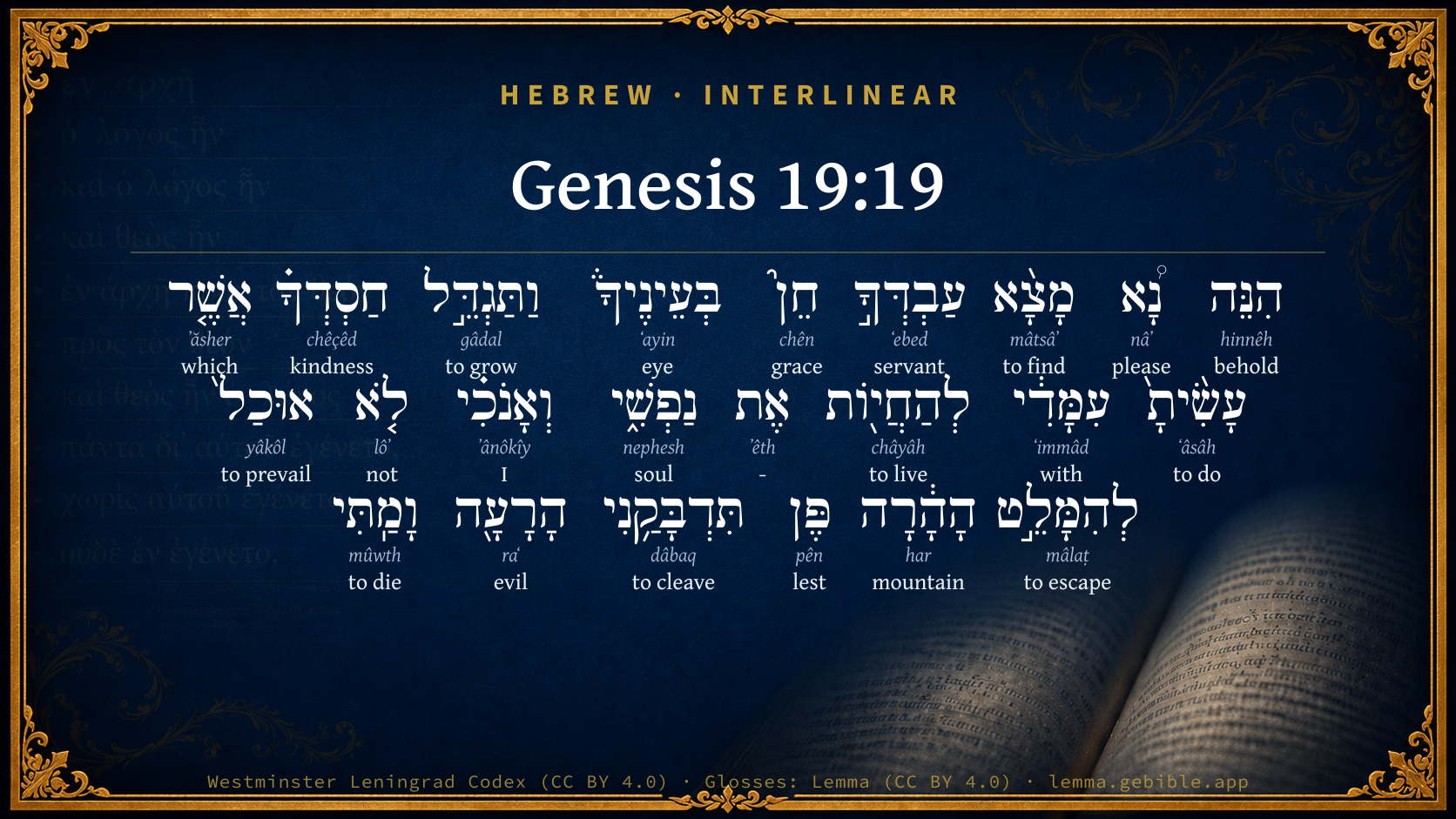
Genesis 19:19

Hebrew (Westminster Leningrad Codex) Genesis 19:19 appears in the Hebrew Old Testament. The text above is from the Westminster Leningrad Codex. Each word links to its Strong’s number, a concise gloss, and parsing drawn from the Open Scriptures Hebrew Bible morphology. Click any word for its full Brown-Driver-Briggs (BDB) entry.
Download image
Cite this verse

Genesis 19:19 (World English Bible). Public Domain. Lemma interlinear Bible study tool, https://lemma.gebible.app/v/genesis/19/19.

Show BibTeX & RIS
BibTeX
RIS
English Translation
See now, your servant has found favor in your sight, and you have magnified your loving kindness, which you have shown to me in saving my life. I can't escape to the mountain, lest evil overtake me, and I die.
World English Bible · Public Domain
Highlights
  • 1 first appearance in the Hebrew Bible
Full analysis ↓
Download a study sheet

One document with this verse’s original text, its word-by-word gloss line, the meaning frame, cross-references with their text, attributed commentary, and full source and license credits — printable, and it pastes into notes with its structure intact.

This verse Autodidact and up

Study sheet (.html) Plain text (.txt)

A passage Seminary Student

Up to 50 verses in one chapter. A passage sheet keeps up to 6 commentary sources and 12 cross-references per verse, in the order this page ranks them, and says so on the sheet whenever that leaves anything out. Ask for a single verse and you get the Autodidact verse sheet above.

Everything on this page stays free to read, with no account — the sheet is a download of what is already on screen, not access to it.

Want to remove ads? Support Godless Engineer
Compare translations 3

The same verse in 3 English versions, stacked beneath the original-language interlinear above. Click any original word for its lexicon entry.

Each is an independent rendering of the whole verse — the interlinear is not word-aligned to these translations.

Highlighted words mark where these versions differ — a whole-verse word diff, not a word-by-word alignment.

  • World English Bible Public Domain
    See now, your servant has found favor in your sight, and you have magnified your loving kindness, which you have shown to me in saving my life. I can't escape to the mountain, lest evil overtake me, and I die.
  • King James Version Public Domain
    Behold now, thy servant hath found grace in thy sight, and thou hast magnified thy mercy, which thou hast showed unto me in saving my life; and I cannot escape to the mountain, lest some evil take me, and I die:
  • unfoldingWord Literal Text CC BY-SA 4.0
    Behold, please: Your servant has found favor in your eyes, and you have magnified your mercy that you have shown to me by saving my life. But I am not able to escape to the mountain, because the disaster will overtake me and I will die.

unfoldingWord Literal Text — © unfoldingWord, licensed CC BY-SA 4.0. Word-aligned USFM3 via Door43 (git.door43.org/unfoldingWord/en_ult).

Versions to compare (up to 4)

3 of 4 selected

Show all 18 translations

Every available English version of this verse, each an independent rendering of the whole verse.

  • World English Bible Public Domain
    See now, your servant has found favor in your sight, and you have magnified your loving kindness, which you have shown to me in saving my life. I can't escape to the mountain, lest evil overtake me, and I die.
  • Berean Standard Bible Public Domain
    Your servant has indeed found favor in your sight, and you have shown me great kindness by sparing my life. But I cannot run to the mountains; the disaster will overtake me, and I will die.
  • Majority Standard Bible Public Domain
    Your servant has indeed found favor in your sight, and you have shown me great kindness by sparing my life. But I cannot run to the mountains; the disaster will overtake me, and I will die.
  • King James Version Public Domain
    Behold now, thy servant hath found grace in thy sight, and thou hast magnified thy mercy, which thou hast showed unto me in saving my life; and I cannot escape to the mountain, lest some evil take me, and I die:
  • American Standard Version (1901) Public Domain
    behold now, thy servant hath found favor in thy sight, and thou hast magnified thy lovingkindness, which thou hast showed unto me in saving my life; and I cannot escape to the mountain, lest evil overtake me, and I die:
  • Revised Version (1885) Public Domain
    behold now, thy servant hath found grace in thy sight, and thou hast magnified thy mercy, which thou hast shewed unto me in saving my life; and I cannot escape to the mountain, lest evil overtake me, and I die:
  • Geneva Bible (1599) Public Domain
    Behold now, thy seruant hath found grace in thy sight, and thou hast magnified thy mercie, which thou hast shewed vnto me in sauing my life: and I cannot escape in the mountaine, least some euill take me, and I die.
  • Douay-Rheims (1899) Public Domain
    Because thy servant hath found grace before thee, and thou hast magnified thy mercy, which thou hast shewn to me, in saving my life, and I cannot escape to the mountain, lest some evil seize me, and I die:
  • Young's Literal Translation Public Domain
    lo, I pray thee, thy servant hath found grace in thine eyes, and thou dost make great thy kindness which thou hast done with me by saving my life, and I am unable to escape to the mountain, lest the evil cleave `to' me, and I have died;
  • Literal Standard Version CC BY-SA 4.0
    now behold, your servant has found grace in your eyes, and you make great your kindness which you have done with me by saving my life, and I am unable to escape to the mountain, lest the evil cleave [to] me and I have died;
  • Unlocked Literal Bible CC BY-SA 4.0
    Your servant has found favor in your eyes, and you have shown me great kindness in saving my life, but I cannot escape to the mountains, because the disaster will overtake me, and I will die.
  • unfoldingWord Literal Text CC BY-SA 4.0
    Behold, please: Your servant has found favor in your eyes, and you have magnified your mercy that you have shown to me by saving my life. But I am not able to escape to the mountain, because the disaster will overtake me and I will die.
  • Darby Bible Public Domain
    behold now, thy servant has found favour in thine eyes, and thou hast magnified thy goodness, which thou hast shewn to me in preserving my soul alive; but I cannot escape to the mountain, lest calamity lay hold on me, that I die.
  • World Messianic Bible Public Domain
    See now, your servant has found favor in your sight, and you have magnified your loving kindness, which you have shown to me in saving my life. I can’t escape to the mountain, lest evil overtake me, and I die.
  • Webster's Bible Public Domain
    Behold now, thy servant hath found grace in thy sight, and thou hast magnified thy mercy, which thou hast shown to me in saving my life: and I cannot escape to the mountain, lest some evil should take me, and I die:
  • Free Bible Version CC BY-SA 4.0
    “If you don't mind, since you have already been so kind to me by saving my life, don't make me run to the mountains—I just can't make it. The destruction will overtake me and I'll die!
  • Bible in Basic English Public Domain
    See now, your servant has had grace in your eyes and great is your mercy in keeping my life from destruction, but I am not able to get as far as the mountain before evil overtakes me and death;
  • JPS Tanakh (1917) Public Domain
    behold now, thy servant hath found grace in thy sight, and thou hast magnified thy mercy, which thou hast shown unto me in saving my life; and I cannot escape to the mountain, lest the evil overtake me, and I die.

Literal Standard Version (2020), Covenant Press — licensed CC BY-SA 4.0. Text via the HelloAO Bible API (eBible.org). Unlocked Literal Bible (unfoldingWord) — licensed CC BY-SA 4.0. Text via the HelloAO Bible API (eBible.org). unfoldingWord Literal Text — © unfoldingWord, licensed CC BY-SA 4.0. Word-aligned USFM3 via Door43 (git.door43.org/unfoldingWord/en_ult). Free Bible Version, Dr. Jonathan Gallagher — licensed CC BY-SA 4.0. Text via the HelloAO Bible API (eBible.org).

Word by word

More ways to search: Search by grammar → Find every occurrence → Compare this word →

Practice this passage: Drill this verse → Learn its vocabulary →

עִמָּדִ֔י
ʻimmâd
H5978
“with · me”
Preposition + Suffix, Personal, 1st Person, Common, Singular
Part of Speech
Preposition
Full BDB Definition

Origin: prol for H5973

TWOT: 1640b

with
  1. הִנֵּה hinnêh H2009 “behold” Particle, Demonstrative
  2. נָ֠א nâʼ H4994 “please” Particle, Exhortation
  3. מָצָ֨א mâtsâʼ H4672 “to find” Verb, Qal, Perfect, 3rd Person, Masculine, Singular
  4. עַבְדְּךָ֣ ʻebed H5650 “servant · your” Noun, Common, Masculine, Singular, Construct + Suffix, Personal, 2nd Person, Masculine, Singular
  5. חֵן֮ chên H2580 “grace” Noun, Common, Masculine, Singular, Absolute
  6. בְּעֵינֶיךָ֒ ʻayin H5869 “in/at · eyes · your” Preposition + Noun, Common, Both, Dual, Construct + Suffix, Personal, 2nd Person, Masculine, Singular
  7. וַתַּגְדֵּ֣ל gâdal H1431 “and · to grow” Conjunction + Verb, Hiphil, Sequential Imperfect, 2nd Person, Masculine, Singular
  8. חַסְדְּךָ֗ chêçêd H2617 “kindness · your” Noun, Common, Masculine, Singular, Construct + Suffix, Personal, 2nd Person, Masculine, Singular
  9. אֲשֶׁ֤ר ʼăsher H834 “which” Particle, Relative
  10. עָשִׂ֨יתָ֙ ʻâsâh H6213 “to do” Verb, Qal, Perfect, 2nd Person, Masculine, Singular
  11. לְהַחֲי֖וֹת châyâh H2421 “to live” Preposition + Verb, Hiphil, Infinitive Construct
  12. אֶת ʼêth H853 “-” Particle, Direct Object
  13. נַפְשִׁ֑י nephesh H5315 “soul · my” Noun, Common, Both, Singular, Construct + Suffix, Personal, 1st Person, Common, Singular
  14. וְאָנֹכִ֗י ʼânôkîy H595 “and · I” Conjunction + Pronoun, Personal, 1st Person, Common, Singular
  15. לֹ֤א lôʼ H3808 “not” Particle, Negative
  16. אוּכַל֙ yâkôl H3201 “to prevail” Verb, Qal, Imperfect, 1st Person, Common, Singular
  17. לְהִמָּלֵ֣ט mâlaṭ H4422 “to escape” Preposition + Verb, Niphal, Infinitive Construct
  18. הָהָ֔רָה har H2022 “the · mountain · toward” Particle, Definite Article + Noun, Common, Masculine, Singular, Absolute + Suffix, Demonstrative
  19. פֶּן pên H6435 “lest” Conjunction
  20. תִּדְבָּקַ֥נִי dâbaq H1692 “to cleave · me” Verb, Qal, Imperfect, 3rd Person, Feminine, Singular + Suffix, Personal, 1st Person, Common, Singular
  21. הָרָעָ֖ה raʻ H7451 “the · evil” Particle, Definite Article + Noun, Common, Feminine, Singular, Absolute
  22. וָמַֽתִּי mûwth H4191 “and · to die” Conjunction + Verb, Qal, Perfect, 1st Person, Common, Singular

About this verse

These counts appear in no published source. They are computed here, from the morphology-tagged text and Lemma’s own curated glosses. What Lemma adds →

23
words
23
distinct lemmas
Pentateuch
section

First appearance in Scripture

This word makes its first canonical appearance in the Hebrew Bible here:

  • חַסְדְּךָ֗ kindness H2617

Shared distinctive vocabulary

עִמָּדִ֔י with H5978 occurs in 44 verses of the Hebrew Bible. Also found in:

Grammatical profile

  • 8 verbs
  • 7 nouns
  • 1 pronoun
  • 1 preposition
  • 1 conjunction
  • 5 particles

Verb forms

  • מָצָ֨א Qal · Perfect
  • וַתַּגְדֵּ֣ל Hiphil · Sequential Imperfect
  • עָשִׂ֨יתָ֙ Qal · Perfect
  • לְהַחֲי֖וֹת Hiphil · Infinitive Construct
  • אוּכַל֙ Qal · Imperfect
  • לְהִמָּלֵ֣ט Niphal · Infinitive Construct
  • תִּדְבָּקַ֥נִי Qal · Imperfect
  • וָמַֽתִּי Qal · Perfect

Hebrew & Septuagint length

In English translation the verse runs 40 words from the Hebrew and 45 from the Septuagint (LXX English) — closely comparable.

A rough comparison of the two English renderings, which tokenize alike — not a word-level alignment.

Word counts can differ between the Hebrew and the Greek without any difference in meaning — e.g. the Hebrew direct-object marker אֵת has no separate Greek word, and Greek often adds the article ὁ.

In the original languages it is 23 Hebrew tokens and 37 Greek tokens — but the two are counted differently (Hebrew bundles its prefixes and suffixes into one token; the Greek is in lemma form), so that isn’t a like-for-like length.

Cross-references

14

Topical passages linked to Genesis 19:19 in the Treasury of Scripture Knowledge — connected by theme and wording, ordered by reader-vote popularity; previews shown in the World English Bible.

  • Genesis 12:13 Please say that you are my sister, that it may be well with me for your sake, and that my soul may live because of you."
  • Deuteronomy 31:17 Then my anger shall be kindled against them in that day, and I will forsake them, and I will hide my face from them, and they shall be devoured, and many evils and troubles shall come on them; so that they will say in that day, Haven't these evils come on us because our God is not among us?
  • 1 Samuel 27:1 David said in his heart, I shall now perish one day by the hand of Saul: there is nothing better for me than that I should escape into the land of the Philistines; and Saul will despair of me, to seek me any more in all the borders of Israel: so shall I escape out of his hand.
  • 1 Kings 9:9 and they shall answer, Because they forsook Yahweh their God, who brought forth their fathers out of the land of Egypt, and laid hold on other gods, and worshiped them, and served them: therefore has Yahweh brought all this evil on them.
  • Psalms 18:1–50 I love you, Yahweh, my strength.
  • Psalms 40:1–17 I waited patiently for Yahweh. He turned to me, and heard my cry.
  • Psalms 77:7–11 "Will the Lord reject us forever? Will he be favorable no more?
  • Psalms 103:1–22 Praise Yahweh, my soul! All that is within me, praise his holy name!
  • Psalms 106:1–48 Praise Yahweh! Give thanks to Yahweh, for he is good, For his loving kindness endures forever.
  • Psalms 116:1–19 I love Yahweh, because he listens to my voice, And my cries for mercy.
  • Matthew 8:25–26 They came to him, and woke him up, saying, "Save us, Lord! We are dying!"
  • 1 Timothy 1:14–16 The grace of our Lord abounded exceedingly with faith and love which is in Christ Jesus.
  • Mark 9:19 He answered him, "Unbelieving generation, how long shall I be with you? How long shall I bear with you? Bring him to me."
  • Romans 8:31 What then shall we say about these things? If God is for us, who can be against us?

Cross-references courtesy of OpenBible.info (CC BY 4.0).

Hebrew and Greek witnesses Masoretic Hebrew ↔ Greek Septuagint

The same verse in the two great witnesses to the Old Testament, shown verse-for-verse.

These are two independent witnesses, not word-aligned to each other, and the Septuagint is shown in lemma (dictionary) form.

Hebrew Genesis 19:19 Masoretic · Westminster Leningrad Codex

הִנֵּה נָ֠א מָצָ֨א עַבְדְּךָ֣ חֵן֮ בְּעֵינֶיךָ֒ וַתַּגְדֵּ֣ל חַסְדְּךָ֗ אֲשֶׁ֤ר עָשִׂ֨יתָ֙ עִמָּדִ֔י לְהַחֲי֖וֹת אֶת נַפְשִׁ֑י וְאָנֹכִ֗י לֹ֤א אוּכַל֙ לְהִמָּלֵ֣ט הָהָ֔רָה פֶּן תִּדְבָּקַ֥נִי הָרָעָ֖ה וָמַֽתִּי

See now, your servant has found favor in your sight, and you have magnified your loving kindness, which you have shown to me in saving my life. I can't escape to the mountain, lest evil overtake me, and I die.

World English Bible · Public Domain

Greek LXX Genesis 19:19 Septuagint · lemma form

ἐπειδή εὑρίσκω ὁ παῖς σύ ἔλεος ἐναντίον σύ καί μεγαλύνω ὁ δικαιοσύνη σύ ὅς ποιέω ἐπί ἐγώ ὁ ζάω ὁ ψυχή ἐγώ ἐγώ δέ οὐ δύναμαι διασώζω εἰς ὁ ὄρος μή καταλαμβάνω ἐγώ ὁ κακός καί ἀποθνήσκω

since your servant has found mercy before you, and you have magnified your righteousness, in what you do towards me that my soul may live, —but I shall not be able to escape to the mountain, lest perhaps the calamity overtake me and I die.

LXX2012 (modern English Septuagint) · Public Domain

On this verse, The Cambridge Bible for Schools and Colleges discusses the Septuagint’s reading. Read the note in Commentary ↓

Hebrew: Westminster Leningrad Codex (CC BY 4.0). Greek: Septuagint (public domain); English from LXX2012 (modern English Septuagint) (Public Domain). How the Septuagint differs from the Hebrew →

Targum (Aramaic paraphrase)

2

The Targum is the ancient Jewish Aramaic paraphrase of the Hebrew Scriptures — an interpretive translation, not the Hebrew text itself. Onkelos (literal) and Pseudo-Jonathan (expansive) render the Torah, and Jonathan the Prophets. Coverage is partial: where no permissively-licensed English translation exists for a verse, only the Aramaic is shown. This is verse-level text, not a word-by-word alignment to the Hebrew.

  1. Targum Onkelos Torah (Genesis–Deuteronomy)
    הָא כְעַן אַשְׁכַּח עַבְדָךְ רַחֲמִין קֳדָמָךְ וְאַסְגֵּיתָא טֵיבוּתָךְ דִּי עֲבַדְתָּ עִמִּי לְקַיָּמָא יָת נַפְשִׁי וַאֲנָא לֵית אֲנָא יָכִיל לְאִשְׁתֵּזָבָא לְטּוּרָא דִּילְמָא תְעַרְעִנַּנִי בִשְׁתָּא וְאֵימוּת

    (no public-domain English translation for this verse)

    Targum Onkelos — Aramaic: “Onkelos Genesis” (public domain); “Onkelos Exodus” (public domain); “Onkelos Leviticus” (public domain); “Onkelos Numbers” (public domain); “Onkelos Deuteronomy” (public domain). English: “Sefaria Community Translation” (CC0 1.0 (public-domain dedication)); “J.W. Etheridge. The Targums of Onkelos and Jonathan Ben Uzziel on the Pentateuch. London: Longmans, Green, 1862” (public domain). Text via Sefaria.

  2. Targum Pseudo-Jonathan Torah (Genesis–Deuteronomy)
    הָא כְּדוֹן אַשְׁכַּח עַבְדָךְ רַחֲמִין קָדָמָךְ וְאַסְגֵיתָא טֵיבוּתָךְ דְעַבַדְתָּא עִמִי לְקַיְימָא יַת נַפְשִׁי וַאֲנָא לָא יְכִילְנָא לְאֵישְׁתֵּזְבָא לְטַוְורָא דִלְמָא תִירְעִינַנִי בִּישְׁתָּא וְאֵימוּת

    Behold, now, thy servant hath found mercy before Thee, and Thou hast multiplied the kindness Thou hast done me in saving my life, and I am not able to escape to the mountain, lest evil overtake me, and I die.

    Targum Pseudo-Jonathan — Aramaic: “Targum Jonathan on Genesis” (public domain); “Targum Jonathan on Exodus” (public domain); “Targum Jonathan on Leviticus” (public domain); “Targum Jonathan on Numbers” (public domain); “Targum Jonathan on Deuteronomy” (public domain). English: “The Targum of Jonathan ben Uzziel, trans. J. W. Etheridge, London, 1862” (public domain). Text via Sefaria.

Commentary

Notes on Genesis 19:19 from classic Christian and Jewish commentators (each source and its license shown beneath its notes). The classic Christian expositions comment on the surrounding passage and are grouped to its opening verse, so a note may address several verses; the Jewish commentaries on the Tanakh (Rashi and others) are per-verse, so they appear only where the commentator wrote on this verse.

Lemma curates 59 commentaries, every one of them public domain or Creative Commons licensed, each selected and text-cleaned for this edition rather than reprinted as found. About our sources →

Trapp's Complete Commentary

John Trapp

Gen 19:19 Behold now, thy servant hath found grace in thy sight, and thou hast magnified thy mercy, which thou hast shewed unto me in saving my life; and I cannot escape to the mountain, lest some evil take me, and I die:

Ver. 19. Behold now, thy servant, &c.] We can receive and commend God’s favours, but be backward enough to obey him.

John Trapp, A Commentary or Exposition upon All the Books of the Old and New Testament (1647–1656) — public domain. Text from a community e-Sword module.

Adam Clarke's Commentary

Verse 19. I cannot escape to the mountain] He saw the destruction so near, that he imagined he should not have time sufficient to reach the mountain before it arrived. He did not consider that God could give no command to his creatures that it would be impossible for them to fulfil; but the hurry and perturbation of his mind will at once account for and excuse this gross oversight.

Adam Clarke's Commentary on the Bible (1810–1826) — public domain. Text from a community e-Sword/MySword module.

John Calvin's Commentaries

19. Behold now, they servant has found grace in thy sight. Though Lot saw two persons, he yet directs his discourse to one. Whence we infer, that he did not rely upon the angels; because he was well convinced that they had no authority of their own, and that his salvation was not placed in their hands. He uses therefore their presence in no other way than as a mirror, in which the face of God may be contemplated. Besides, Lot commemorates the kindness of God, not so much for the sake of testifying his gratitude, as of acquiring thence greater confidence in asking for more. For since the goodness of God is neither exhausted, nor wearied, by bestowing; the more ready we find him to give, the more confident does it become us to be, in hoping for what is good. And this truly is the property of faith, to take encouragement for the future, from the experience of past favor. And Lot does not err on this point; but he acts rashly in going beyond the word for the sake of self-gratification. Therefore I have said, that his prayer, though it flowed from the fountain of faith, yet drew something turbid from the mire of carnal affection. Let us then, relying upon the mercy of God, not hesitate to expect all things from him; especially those which he himself has promised, and which he permits us to choose.

I cannot escape to the mountain. He does not indeed rage against God, with determined malice as the wicked are wont to do; yet, because he rests not upon the word of God, he slides, and almost falls away. For why does he fear destruction in the mountain, where he was to be protected by the hand of God, and yet expect to find a safe abode in that place, which is both near to Sodom, and obnoxious to similar vengeance, on account of its impure and wicked inhabitants? But this verily is the nature of men, that they choose to seek their safety in hell itself, rather than in heaven, whenever they follow their own reason. We see, then, how greatly Lot errs, in seeing from, and entertaining suspicions of, a mountain infected with no contagion of iniquity and choosing a city which, overflowing with crimes, could not but be hateful to God. He pretends that it is a little one, in order that he may the more easily obtain his request. As if he had said, that he only wanted a corner where he might be safely sheltered. This would have been right, if he had not declined the asylum divinely granted to him and rashly contrived another for himself.

John Calvin's Commentaries (1540-1563) — public domain. Text from the Calvin Translation Society English edition (1840s-50s) via the Christian Classics Ethereal Library (ccel.org). Calvin's coverage is partial (roughly two-thirds of the Bible); uncommented books and verses are honest gaps, never fabricated. The 19th-century editor's footnotes and remarks are omitted so the notes are faithfully Calvin's own voice.

Ellicott's Commentary for English Readers

(19) Lest some evil.—Heb., lest the evil, lest the threatened calamity overtake me and I die.

A Bible Commentary for English Readers, edited by Charles John Ellicott (1878–1897) — public domain. Text from a community e-Sword module.

The Cambridge Bible for Schools and Colleges

gen. ed. J. J. S. Perowne

19. found grace] Cf. Gen_6:8 (J).

thy mercy] Lat. misericordiam tuam. The LXX rendering, τὴν δικαιοσύνην, is a good illustration of the latitude given to “righteousness” as embodying compassion. Cf. Mat_6:1.

I cannot escape to the mountain] Lot speaks as if he were too old (cf. Gen_19:31) and weak for flight over rough ground. He fears he could not find refuge in the mountains in time.

evil] Better, as R.V. marg., the evil. The evil means the doom of impending catastrophe.

The Cambridge Bible for Schools and Colleges (gen. ed. J. J. S. Perowne; Cambridge University Press, 1878–1918) — public domain. Text from a community e-Sword module.

John Gill's Exposition

Behold, now thy servant hath found grace in thy sight,.... In sending two of his angels to him, to inform him of the approaching destruction of Sodom; to pluck him out of it as a brand out of the burning, and to place him without the city, and in directing and encouraging him to escape for his life:

and thou hast magnified thy mercy which thou hast showed unto me in saving my life; he owns it was owing to the mercy of this illustrious Person, whom he knew and acknowledges, by what he says, to be a divine one, that his life was saved; and that this appeared exceeding great in it, that he should spare him and his family, when such multitudes of souls would perish; and he might have perished with the rest, if he had not had timely notice in such a gracious manner:

and I cannot, or, "but now (x), I cannot"

escape to the mountain; it is too far for me; he signifies that his strength would not hold out through the fatigues of the night past, and want of sleep and rest; but this was owing more to the infirmity of his mind than of his body, for he could go to this same mountain afterwards:

lest some evil take me, and I die; or "that evil" (y), the burning of Sodom, and the cities of the plain, lest that should overtake him before he got to the mountain: thus he began to distrust the power of God to strengthen him to go thither, who had appeared so wonderfully for him in his present deliverance; and he might have assured himself, that he that brought him out of Sodom would never suffer him to perish in the destruction of it.

(x) "jam vero ego non-potero", Schmidt. (y) "malum hoc", Tigurine version; some in Drusius, Piscator, Schmidt.

John Gill's Exposition of the Whole Bible (1746–1763) — public domain (CC PDM 1.0). Text via the HelloAO Bible API.

Haydock's Catholic Bible Commentary

The mountain above Segor. He is faint-hearted, and does not comply with readiness and exactitude; though, when he had obtained leave to remain in Segor, he still fears, and flees to the mountain, ver. 30, (Haydock) on the south-east of the dead sea. (Calmet)

George Leo Haydock (1774–1849), Haydock's Catholic Family Bible and Commentary, 1859 edition — public domain. Excludes Psalms (Douay-Rheims chapter numbering differs from Protestant) and Deuterocanonical books (Catholic canon only).

Matthew Poole's English Annotations

I cannot escape to the mountain, because of the infirmity of my age, and the fainting of my spirits. Thus he showeth an unworthy and unreasonable distrust of God’s power and goodness, which he had now experienced and acknowledged.

Matthew Poole's English Annotations on the Holy Bible (1683–1685) — public domain. Text from a community e-Sword/MySword module.

The Pulpit Commentary

Behold now, thy servant hath found grace in thy sight, (cf. Gen_18:3) and thou hast magnified thy mercy (language inappropriate to be addressed to the angels, though exactly suitable if applied by Lot to Jehovah), which thou hast showed unto me in saving my life; and I cannot escape to the mountain, lest some evil (more correctly, the evil, i.e. the destruction threatened upon Sodom) take me, and I die.

The Pulpit Commentary (1880–1919), ed. H.D.M. Spence-Jones & Joseph S. Exell — public domain. Text from a community e-Sword module.

Rashi

Rabbi Shlomo Yitzchaki (Rashi)

פן תדבקני הרעה [I CANNOT ESCAPE TO THE MOUNTAIN,] LEST SOME EVIL CLEAVE UNTO ME — Whilst I was with the people of Sodom the Holy One, blessed be He, compared my deeds with the deeds of the people of my city and I seemed to be righteous and deserving to be saved. When, however, I come to the righteous man (i.e. Abraham whom Rashi v. 17 stated to be dwelling in the mountain) I must be regarded as wicked. Thus, too, did the woman of Zarefath say to Elijah, (1 Kings 17:18) “Art thou come to bring my sin in remembrance?” Before you came to me the Holy One, blessed be He, compared my doings with the doings of my people and I was regarded as a righteous woman amongst them, but now that you have come to me, in comparison with your deeds, I am wicked (Genesis Rabbah 50:11).

Rashi on the Tanakh — English translations: “The Judaica Press complete Tanach with Rashi, translated by A. J. Rosenberg” (CC BY 4.0); “Pentateuch with Rashi's commentary by M. Rosenbaum and A.M. Silbermann, 1929-1934” (public domain); “The Metsudah Tanach series, Lakewood, N.J” (CC BY 4.0); and “The Book of Joshua, Metsudah Publications, 1997” (CC BY 4.0). Text via Sefaria.

Radak

Rabbi David Kimhi (Radak)

הנה נא מצא עבדך חן בעיניך, seeing that the angel had told him המלט על נפשך, “save yourself,” it had become clear that the angel’s mission was to save him. Actually, both angels were on a mission of both saving Lot and destroying Sodom. The one who was speaking did so only because he was the senior of the two. The one who tried to save Lot said לבלתי הפכי את העיר, “I cannot yet overturn the city.” (verse 21) He also admitted that he was unable to destroy the town until Lot had been saved (verse 22).

תדבקני, the vowel patach under the letter ק is in lieu of the vowel tzeyre.

Radak on the Tanakh — English translations: “Sefaria Community Translation” (CC0 1.0 (public-domain dedication)); “Eliyahu Munk, HaChut Hameshulash” (CC BY 4.0); “Rabbi Mike Feuer, Jerusalem Anthology” (CC BY 4.0); and “R. David Kimhi on the first book of Psalms, Translated by R.G. Finch, London, 1919” (public domain). Text via Sefaria.

Lesson kit

Teaching starters — assembled from the data on this page, not authored interpretation. Every prompt links to the verse data it draws on. Edit before teaching.

Genesis, in the Pentateuch, opens this verse with 23 words (23 distinct Hebrew lemmas). Its most distinctive word is ʻimmâd (“with”). A historical commentator’s framing appears above. Read the whole chapter for the surrounding context.

Discussion questions

  1. How does “with” (ʻimmâd) shape what this verse is saying?
  2. The word “kindness” first appears here in Scripture. What is being introduced at this debut?
  3. Genesis 3:12 shares the word «with» with this verse. How do the two illuminate each other?
  4. The translations on this page render this verse differently — a whole-verse word diff, not a word-by-word alignment. What might account for the different wordings?
  5. The verb «מָצָ֨א» is Qal Perfect. How does its form color the action?
  6. Reading how Trapp's Complete Commentary and Adam Clarke's Commentary read this verse, where do the two commentators agree and where do they part?

Things to notice

Reading settings

Reading text

Shown beneath each verse's original-language words.

Old Testament
Old Testament edition

Read the OT as the Masoretic Hebrew (MT) or the Greek Septuagint (LXX).

English shown for the Greek Septuagint (in the Hebrew ↔ Greek comparison).

Comparing translations? Open the Compare panel on any verse page to stack up to four side by side.