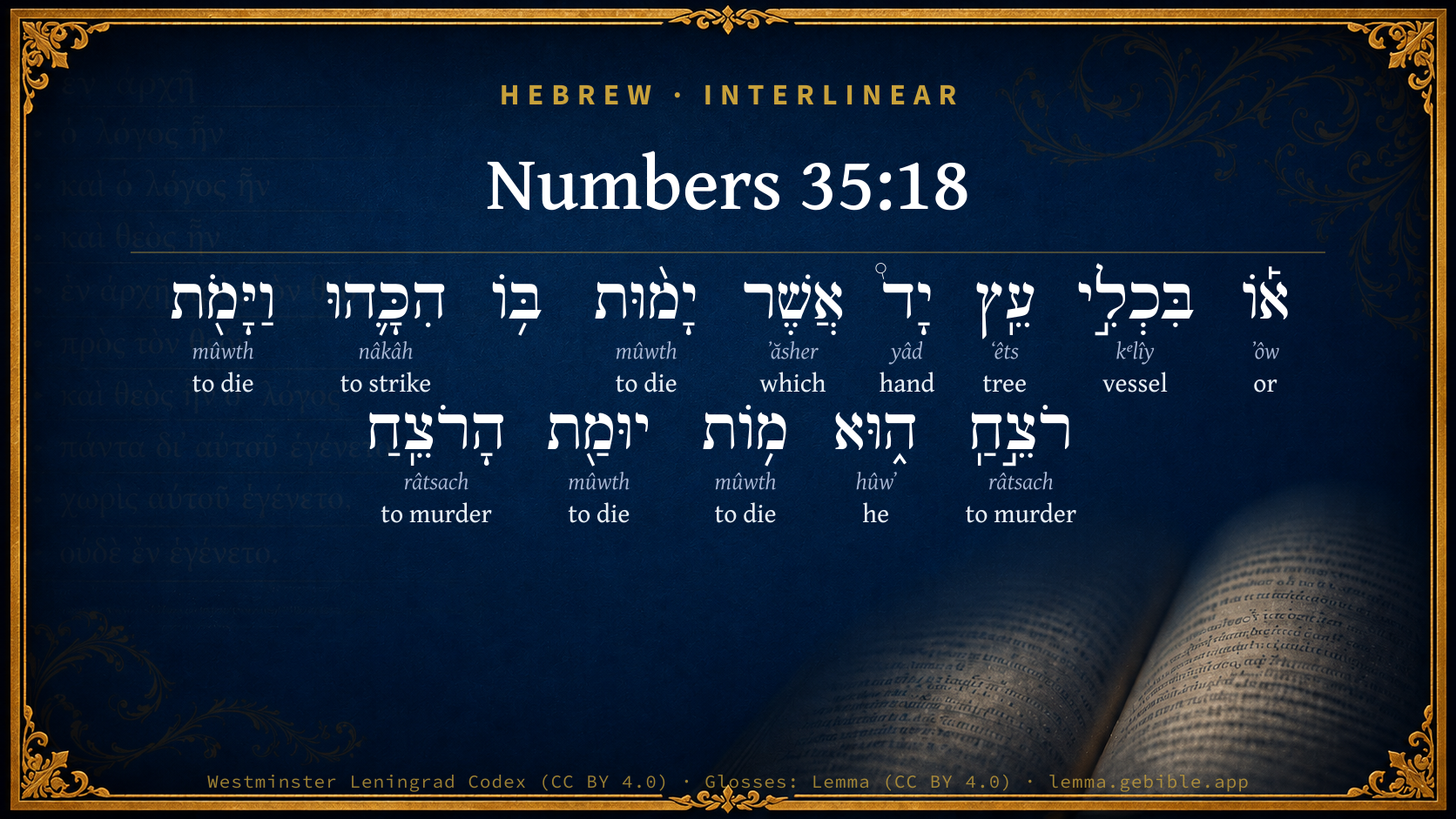
Numbers 35:18

Hebrew (Westminster Leningrad Codex) Numbers 35:18 appears in the Hebrew Old Testament. The text above is from the Westminster Leningrad Codex. Each word links to its Strong’s number, a concise gloss, and parsing drawn from the Open Scriptures Hebrew Bible morphology. Click any word for its full Brown-Driver-Briggs (BDB) entry.
Download image
Cite this verse

Numbers 35:18 (World English Bible). Public Domain. Lemma interlinear Bible study tool, https://lemma.gebible.app/v/numbers/35/18.

Show BibTeX & RIS
BibTeX
RIS
English Translation
Or if he struck him with a weapon of wood in the hand, by which a man may die, and he died, he is a murderer: the murderer shall surely be put to death.
World English Bible · Public Domain
Download a study sheet

One document with this verse’s original text, its word-by-word gloss line, the meaning frame, cross-references with their text, attributed commentary, and full source and license credits — printable, and it pastes into notes with its structure intact.

This verse Autodidact and up

Study sheet (.html) Plain text (.txt)

A passage Seminary Student

Up to 50 verses in one chapter. A passage sheet keeps up to 6 commentary sources and 12 cross-references per verse, in the order this page ranks them, and says so on the sheet whenever that leaves anything out. Ask for a single verse and you get the Autodidact verse sheet above.

Everything on this page stays free to read, with no account — the sheet is a download of what is already on screen, not access to it.

Want to remove ads? Support Godless Engineer
Compare translations 3

The same verse in 3 English versions, stacked beneath the original-language interlinear above. Click any original word for its lexicon entry.

Each is an independent rendering of the whole verse — the interlinear is not word-aligned to these translations.

Highlighted words mark where these versions differ — a whole-verse word diff, not a word-by-word alignment.

  • World English Bible Public Domain
    Or if he struck him with a weapon of wood in the hand, by which a man may die, and he died, he is a murderer: the murderer shall surely be put to death.
  • King James Version Public Domain
    Or if he smite him with an hand weapon of wood, wherewith he may die, and he die, he is a murderer: the murderer shall surely be put to death.
  • unfoldingWord Literal Text CC BY-SA 4.0
    Or if he struck him down with an object of wood in hand by which one could die and he died, he is one who murders. The one who murders shall certainly be put to death.

unfoldingWord Literal Text — © unfoldingWord, licensed CC BY-SA 4.0. Word-aligned USFM3 via Door43 (git.door43.org/unfoldingWord/en_ult).

Versions to compare (up to 4)

3 of 4 selected

Show all 18 translations

Every available English version of this verse, each an independent rendering of the whole verse.

  • World English Bible Public Domain
    Or if he struck him with a weapon of wood in the hand, by which a man may die, and he died, he is a murderer: the murderer shall surely be put to death.
  • Berean Standard Bible Public Domain
    If anyone has in his hand a deadly object of wood, and he strikes and kills another, he is a murderer; the murderer must surely be put to death.
  • Majority Standard Bible Public Domain
    If anyone has in his hand a deadly object of wood, and he strikes and kills another, he is a murderer; the murderer must surely be put to death.
  • King James Version Public Domain
    Or if he smite him with an hand weapon of wood, wherewith he may die, and he die, he is a murderer: the murderer shall surely be put to death.
  • American Standard Version (1901) Public Domain
    Or if he smote him with a weapon of wood in the hand, whereby a man may die, and he died, he is a murderer: the murderer shall surely be put to death.
  • Revised Version (1885) Public Domain
    Or if he smote him with a weapon of wood in the hand, whereby a man may die, and he died, he is a manslayer: the manslayer shall surely be put to death.
  • Geneva Bible (1599) Public Domain
    Or if he smite him with an hand weapon of wood, wherewith he may be slaine, if he die, he is a murtherer, and the murtherer shall die the death.
  • Douay-Rheims (1899) Public Domain
    If he that is struck with wood die: he shall be revenged by the blood of him that struck him.
  • Young's Literal Translation Public Domain
    `Or with a wooden instrument `in' the hand, wherewith he dieth, he hath smitten him, and he dieth, he `is' a murderer: the murderer is certainly put to death.
  • Literal Standard Version CC BY-SA 4.0
    Or [if] he has struck him with a wooden instrument [in] the hand, with which he could die, and he dies, he [is] a murderer: the murderer is certainly put to death.
  • Unlocked Literal Bible CC BY-SA 4.0
    If an accused man has struck his victim with a wooden weapon that might kill the victim, and if the victim dies, then the accused is indeed a murderer. He must certainly be put to death.
  • unfoldingWord Literal Text CC BY-SA 4.0
    Or if he struck him down with an object of wood in hand by which one could die and he died, he is one who murders. The one who murders shall certainly be put to death.
  • Darby Bible Public Domain
    Or if he have smitten him with an instrument of wood, in the hand, wherewith one may die, and he die, he is a murderer: the murderer shall certainly be put to death;
  • World Messianic Bible Public Domain
    Or if he struck him with a weapon of wood in the hand, by which a man may die, and he died, he is a murderer. The murderer shall surely be put to death.
  • Webster's Bible Public Domain
    Or if he shall smite him with a hand-weapon of wood, with which he may die, and he shall die, he is a murderer: the murderer shall surely be put to death.
  • Free Bible Version CC BY-SA 4.0
    If anyone picks up something made of wood that could be used as a weapon and hits someone with it, and kills them, that person is a murderer and must be executed.
  • Bible in Basic English Public Domain
    Or if he gave him blows with a wood instrument in his hands, causing his death, he is a taker of life and is certainly to be put to death.
  • JPS Tanakh (1917) Public Domain
    Or if he smote him with a weapon of wood in the hand, whereby a man may die, and he died, he is a murderer; the murderer shall surely be put to death.

Literal Standard Version (2020), Covenant Press — licensed CC BY-SA 4.0. Text via the HelloAO Bible API (eBible.org). Unlocked Literal Bible (unfoldingWord) — licensed CC BY-SA 4.0. Text via the HelloAO Bible API (eBible.org). unfoldingWord Literal Text — © unfoldingWord, licensed CC BY-SA 4.0. Word-aligned USFM3 via Door43 (git.door43.org/unfoldingWord/en_ult). Free Bible Version, Dr. Jonathan Gallagher — licensed CC BY-SA 4.0. Text via the HelloAO Bible API (eBible.org).

Word by word

More ways to search: Search by grammar → Find every occurrence → Compare this word →

Practice this passage: Drill this verse → Learn its vocabulary →

רֹצֵ֣חַֽ
râtsach
H7523
“murdering”
Verb, Qal, Participle Active, Masculine, Singular, Absolute
Part of Speech
Verb
Stem
Qal
Form
Participle Active
Gender
Masculine
Number
Singular
State
Absolute
Full BDB Definition

Origin: a primitive root

TWOT: 2208

to murder, slay, kill - (Qal) to murder, slay - premeditated - accidental - as avenger - slayer (intentional) (participle) - (Niphal) to be slain - (Piel) - to murder, assassinate - murderer, assassin (participle) (substantive) - (Pual) to be killed
  1. א֡וֹ ʼôw H176 “or” Conjunction
  2. בִּכְלִ֣י kᵉlîy H3627 “in/at · vessel of” Preposition + Noun, Common, Masculine, Singular, Construct
  3. עֵֽץ ʻêts H6086 “tree” Noun, Common, Masculine, Singular, Absolute
  4. יָד֩ yâd H3027 “hand” Noun, Common, Both, Singular, Absolute
  5. אֲשֶׁר ʼăsher H834 “which” Particle, Relative
  6. יָמ֨וּת mûwth H4191 “to die” Verb, Qal, Imperfect, 3rd Person, Masculine, Singular
  7. הִכָּ֛הוּ nâkâh H5221 “to strike · him” Verb, Hiphil, Perfect, 3rd Person, Masculine, Singular + Suffix, Personal, 3rd Person, Masculine, Singular
  8. וַיָּמֹ֖ת mûwth H4191 “and · to die” Conjunction + Verb, Qal, Sequential Imperfect, 3rd Person, Masculine, Singular
  9. ה֑וּא hûwʼ H1931 “he” Pronoun, Personal, 3rd Person, Masculine, Singular
  10. מ֥וֹת mûwth H4191 “to die” Verb, Qal, Infinitive Absolute
  11. יוּמַ֖ת mûwth H4191 “to die” Verb, Hophal, Imperfect, 3rd Person, Masculine, Singular
  12. הָרֹצֵֽחַ râtsach H7523 “the · murdering” Particle, Definite Article + Verb, Qal, Participle Active, Masculine, Singular, Absolute

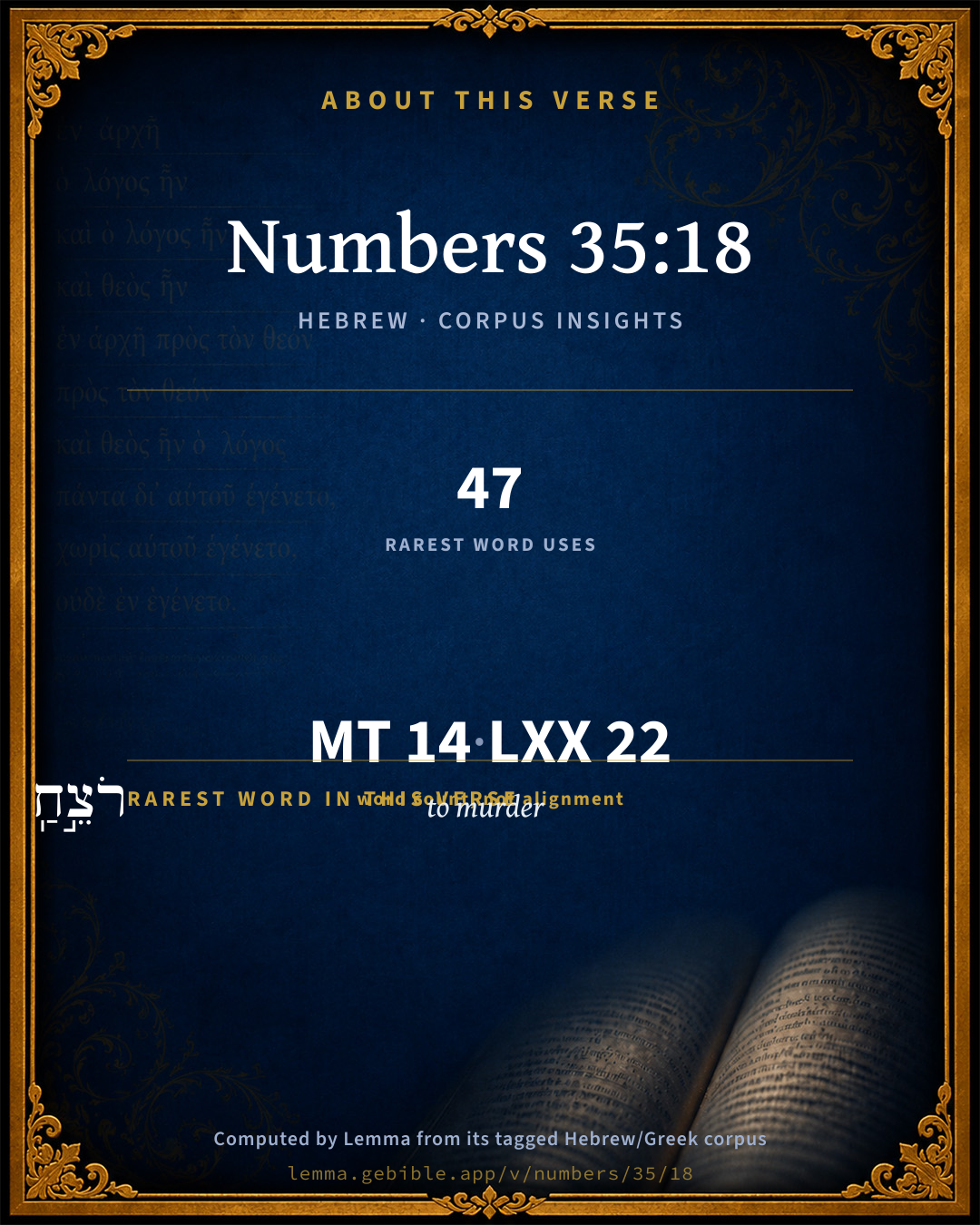
About this verse

These counts appear in no published source. They are computed here, from the morphology-tagged text and Lemma’s own curated glosses. What Lemma adds →

14
words
9
distinct lemmas
Pentateuch
section

Shared distinctive vocabulary

רֹצֵ֣חַֽ to murder H7523 occurs in 40 verses of the Hebrew Bible. Also found in:

Grammatical profile

  • 7 verbs
  • 3 nouns
  • 1 pronoun
  • 1 preposition
  • 1 conjunction
  • 1 particle

Verb forms

  • יָמ֨וּת Qal · Imperfect
  • הִכָּ֛הוּ Hiphil · Perfect
  • וַיָּמֹ֖ת Qal · Sequential Imperfect
  • רֹצֵ֣חַֽ Qal · Participle Active
  • מ֥וֹת Qal · Infinitive Absolute
  • יוּמַ֖ת Hophal · Imperfect
  • הָרֹצֵֽחַ Qal · Participle Active

Repetition

Words recur within this verse — often emphatic in Hebrew:

  • יָמ֨וּת to die H4191 ×4
  • רֹצֵ֣חַֽ to murder H7523 ×2

Hebrew & Septuagint length

In English translation the verse runs 34 words from the Hebrew and 36 from the Septuagint (LXX English) — closely comparable.

A rough comparison of the two English renderings, which tokenize alike — not a word-level alignment.

Word counts can differ between the Hebrew and the Greek without any difference in meaning — e.g. the Hebrew direct-object marker אֵת has no separate Greek word, and Greek often adds the article ὁ.

In the original languages it is 14 Hebrew tokens and 22 Greek tokens — but the two are counted differently (Hebrew bundles its prefixes and suffixes into one token; the Greek is in lemma form), so that isn’t a like-for-like length.

Hebrew and Greek witnesses Masoretic Hebrew ↔ Greek Septuagint

The same verse in the two great witnesses to the Old Testament, shown verse-for-verse.

These are two independent witnesses, not word-aligned to each other, and the Septuagint is shown in lemma (dictionary) form.

Hebrew Numbers 35:18 Masoretic · Westminster Leningrad Codex

א֡וֹ בִּכְלִ֣י עֵֽץ יָד֩ אֲשֶׁר יָמ֨וּת בּ֥וֹ הִכָּ֛הוּ וַיָּמֹ֖ת רֹצֵ֣חַֽ ה֑וּא מ֥וֹת יוּמַ֖ת הָרֹצֵֽחַ

Or if he struck him with a weapon of wood in the hand, by which a man may die, and he died, he is a murderer: the murderer shall surely be put to death.

World English Bible · Public Domain

Greek LXX Numbers 35:18 Septuagint · lemma form

ἐάν δέ ἐν σκεῦος ξύλινος ἐκ χείρ ἐκ ὅς ἀποθνήσκω ἐν αὐτός πατάσσω αὐτός καί ἀποθνήσκω φονευτής εἰμί θάνατος θανατόω ὁ φονευτής

And if he should strike him with an instrument of wood from his hand, whereby he may die, and he thus die, he is a murderer; let the murderer by all means be put to death.

LXX2012 (modern English Septuagint) · Public Domain

Hebrew: Westminster Leningrad Codex (CC BY 4.0). Greek: Septuagint (public domain); English from LXX2012 (modern English Septuagint) (Public Domain). How the Septuagint differs from the Hebrew →

Targum (Aramaic paraphrase)

2

The Targum is the ancient Jewish Aramaic paraphrase of the Hebrew Scriptures — an interpretive translation, not the Hebrew text itself. Onkelos (literal) and Pseudo-Jonathan (expansive) render the Torah, and Jonathan the Prophets. Coverage is partial: where no permissively-licensed English translation exists for a verse, only the Aramaic is shown. This is verse-level text, not a word-by-word alignment to the Hebrew.

  1. Targum Onkelos Torah (Genesis–Deuteronomy)
    אוֹ בְּמָאן דְעָא דְמִתְנָסֵב בִּידָא דְהִיא כְמִסַת דִי יְמוּת בֵּה מְחָהִי וְקַטְּלֵהּ קָטוֹלָא הוּא אִתְקְטָלָא יִתְקְטַל קָטוֹלָא

    (no public-domain English translation for this verse)

    Targum Onkelos — Aramaic: “Onkelos Genesis” (public domain); “Onkelos Exodus” (public domain); “Onkelos Leviticus” (public domain); “Onkelos Numbers” (public domain); “Onkelos Deuteronomy” (public domain). English: “Sefaria Community Translation” (CC0 1.0 (public-domain dedication)); “J.W. Etheridge. The Targums of Onkelos and Jonathan Ben Uzziel on the Pentateuch. London: Longmans, Green, 1862” (public domain). Text via Sefaria.

  2. Targum Pseudo-Jonathan Torah (Genesis–Deuteronomy)
    אוֹ בְמָנָא דְקֵיסָא מְלוֹי יְדָא דִי כְמֵיסַת דִימוּת בָּהּ מְחוֹהִי וְקַטְלֵיהּ קָטוֹלָא הוּא אִתְקְטָלָא יִתְקְטֵיל קָטוֹלָא

    Or if, filling his hand with an instrument of wood sufficient to kill any one, he struck him, and killed him, he is a murderer; the murderer shall be put to death.

    Targum Pseudo-Jonathan — Aramaic: “Targum Jonathan on Genesis” (public domain); “Targum Jonathan on Exodus” (public domain); “Targum Jonathan on Leviticus” (public domain); “Targum Jonathan on Numbers” (public domain); “Targum Jonathan on Deuteronomy” (public domain). English: “The Targum of Jonathan ben Uzziel, trans. J. W. Etheridge, London, 1862” (public domain). Text via Sefaria.

Commentary

Notes on Numbers 35:18 from classic Christian and Jewish commentators (each source and its license shown beneath its notes). The classic Christian expositions comment on the surrounding passage and are grouped to its opening verse, so a note may address several verses; the Jewish commentaries on the Tanakh (Rashi and others) are per-verse, so they appear only where the commentator wrote on this verse.

Lemma curates 59 commentaries, every one of them public domain or Creative Commons licensed, each selected and text-cleaned for this edition rather than reprinted as found. About our sources →

Trapp's Complete Commentary

John Trapp

Num 35:18 Or [if] he smite him with an hand weapon of wood, wherewith he may die, and he die, he [is] a murderer: the murderer shall surely be put to death.

Ver. 18. The murderer shall surely be put to death.] This is ius gentium. The Turks’ justice in this case will rather cut off two innocent men, than let one offender escape. The Persians punish theft and manslaughter so severely, that in an age a man shall hardly hear either of the one or the other. {a} A severity fit for Italy, where they blaspheme oftener than swear, and murder more than revile or slander {b} (like the dogs of Congo, which, they say, {c} bite, but bark not): and no less fit for France, where within ten years six thousand gentlemen have been slain, as it appears by the king’s pardons. {d} Byron, Lord high-Marshal of France, and Governor of Burgundy, slew a certain judge for putting to death a malefactor, whom he had commanded to be spared; for this he sued a pardon, and had it: but not long after he turned traitor to his prince that had pardoned him, and was justly executed. {e}

{a} Cartwr., Travels.

{b} Spec. Europ.

{c} Purchas.

{d} Les ombres des defunde sieurs de Villemor.

{e} Epitome Hist. Gall., p. 275.

John Trapp, A Commentary or Exposition upon All the Books of the Old and New Testament (1647–1656) — public domain. Text from a community e-Sword module.

Joseph Benson's Commentary

Num 35:18. With a hand-weapon — It made no difference with what kind of weapon he was killed, whether it was of iron, wood, or stone. If he was killed wittingly and knowingly, it was murder, and the guilty person was to die for it. For though perhaps he had no intention to kill the person, yet he ought to have moderated his passion, and could not be ignorant that such an instrument was capable of inflicting a deadly wound.

Joseph Benson's Commentary on the Old and New Testaments (1811–1818) — public domain. Text from a community e-Sword module.

John Gill's Exposition

Or if he smote him with an hand weapon of wood,.... A stick, or staff, or club:

wherewith he may die, and he die; which is sufficient to kill a man, as the same Targum explains it; and a man dies with the blow that is given him by it:

he is a murderer, and the murderer shall surely be put to death; no pardon given him, or the benefit of the city of refuge allowed him.

John Gill's Exposition of the Whole Bible (1746–1763) — public domain (CC PDM 1.0). Text via the HelloAO Bible API.

Haydock's Catholic Bible Commentary

If, &c. Hebrew, "or he smite him with a wooden weapon, (wherewith he may die,) and he die, he is a murderer: the murderer shall surely be put to death." The two former verses are expressed in the same awful manner, intimating that the weapon must be of such a nature that it might easily give a mortal wound, and also that the effect really followed. In these cases, if the person could not clear himself, no refuge or reprieve was allowed. (Haydock) --- But the deceased must have been killed upon the spot, otherwise the person who struck him could only be required to pay a fine, Exodus xxi. 19. (Menochius)

George Leo Haydock (1774–1849), Haydock's Catholic Family Bible and Commentary, 1859 edition — public domain. Excludes Psalms (Douay-Rheims chapter numbering differs from Protestant) and Deuterocanonical books (Catholic canon only).

The Pulpit Commentary

A hand weapon of wood. A club, or other such formidable instrument.

The Pulpit Commentary (1880–1919), ed. H.D.M. Spence-Jones & Joseph S. Exell — public domain. Text from a community e-Sword module.

Rashi

Rabbi Shlomo Yitzchaki (Rashi)

או בכלי עץ יד OR [IF HE SMITE HIM] WITH A WEAPON OF WOOD IN HIS HAND — Because it has been stated, (Exodus 21:20) “And if a man smite his bondman or his bondwoman with a rod”, one might think that it means whatever size it may be! Therefore it states here of the wooden instrument אשר ימות בה — meaning that it must have a size sufficient to cause death (Sifrei Bamidbar 160:4).

Rashi on the Tanakh — English translations: “The Judaica Press complete Tanach with Rashi, translated by A. J. Rosenberg” (CC BY 4.0); “Pentateuch with Rashi's commentary by M. Rosenbaum and A.M. Silbermann, 1929-1934” (public domain); “The Metsudah Tanach series, Lakewood, N.J” (CC BY 4.0); and “The Book of Joshua, Metsudah Publications, 1997” (CC BY 4.0). Text via Sefaria.

Lesson kit

Teaching starters — assembled from the data on this page, not authored interpretation. Every prompt links to the verse data it draws on. Edit before teaching.

Numbers, in the Pentateuch, opens this verse with 14 words (9 distinct Hebrew lemmas). Its most distinctive word is râtsach (“to murder”). A historical commentator’s framing appears above. Read the whole chapter for the surrounding context.

Discussion questions

  1. How does “to murder” (râtsach) shape what this verse is saying?
  2. How does Exodus 20:13, which shares the word «to murder», read alongside this verse?
  3. What does the repetition of “to die” (4× in this one verse) do in this verse?
  4. The translations on this page render this verse differently — a whole-verse word diff, not a word-by-word alignment. What might account for the different wordings?
  5. «יָמ֨וּת» is a Qal Imperfect verb. How does that grammatical form shape the action described?
  6. Compare how Trapp's Complete Commentary and Joseph Benson's Commentary read this verse. Where do they agree or differ?

Things to notice

Reading settings

Reading text

Shown beneath each verse's original-language words.

Old Testament
Old Testament edition

Read the OT as the Masoretic Hebrew (MT) or the Greek Septuagint (LXX).

English shown for the Greek Septuagint (in the Hebrew ↔ Greek comparison).

Comparing translations? Open the Compare panel on any verse page to stack up to four side by side.