Genesis 46:12

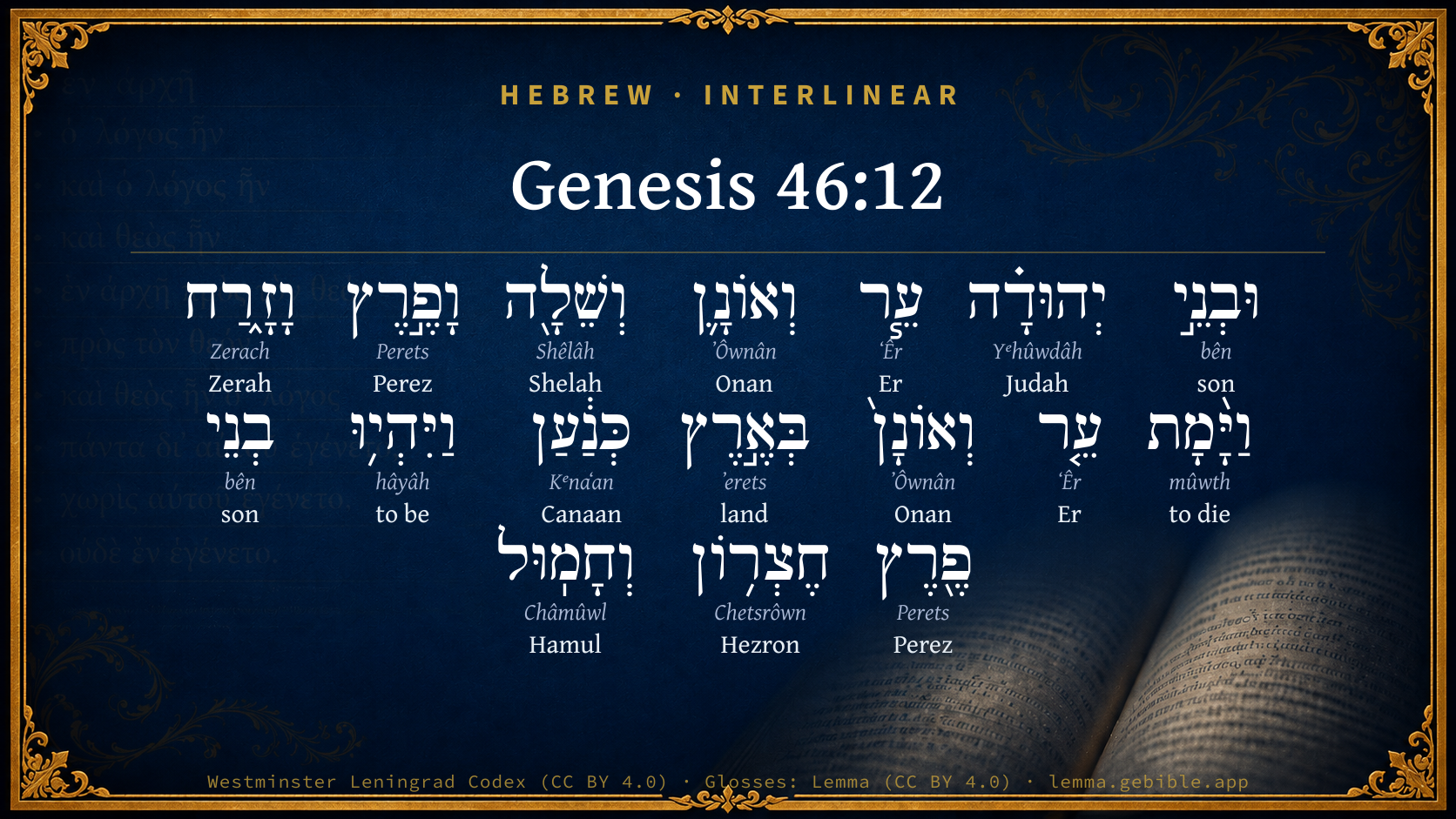
Hebrew (Westminster Leningrad Codex) Genesis 46:12 appears in the Hebrew Old Testament. The text above is from the Westminster Leningrad Codex. Each word links to its Strong’s number, a concise gloss, and parsing drawn from the Open Scriptures Hebrew Bible morphology. Click any word for its full Brown-Driver-Briggs (BDB) entry.
Download image
Cite this verse

Genesis 46:12 (World English Bible). Public Domain. Lemma interlinear Bible study tool, https://lemma.gebible.app/v/genesis/46/12.

Show BibTeX & RIS
BibTeX
RIS
English Translation
The sons of Judah: Er, Onan, Shelah, Perez, and Zerah; but Er and Onan died in the land of Canaan. The sons of Perez were Hezron and Hamul.
World English Bible · Public Domain
Highlights
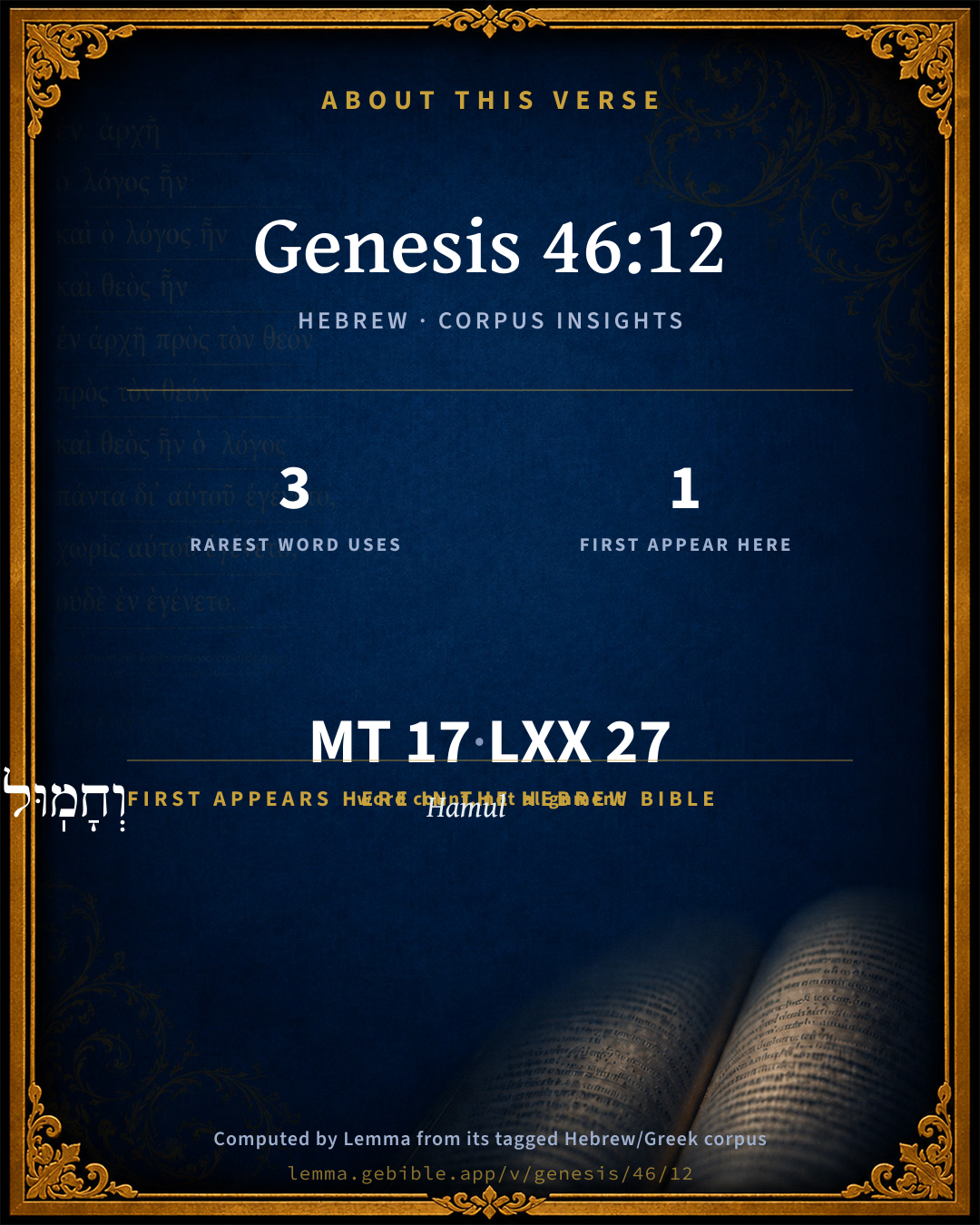
  • 1 first appearance in the Hebrew Bible
Full analysis ↓
Download a study sheet

One document with this verse’s original text, its word-by-word gloss line, the meaning frame, cross-references with their text, attributed commentary, and full source and license credits — printable, and it pastes into notes with its structure intact.

This verse Autodidact and up

Study sheet (.html) Plain text (.txt)

A passage Seminary Student

Up to 50 verses in one chapter. A passage sheet keeps up to 6 commentary sources and 12 cross-references per verse, in the order this page ranks them, and says so on the sheet whenever that leaves anything out. Ask for a single verse and you get the Autodidact verse sheet above.

Everything on this page stays free to read, with no account — the sheet is a download of what is already on screen, not access to it.

Want to remove ads? Support Godless Engineer
Compare translations 3

The same verse in 3 English versions, stacked beneath the original-language interlinear above. Click any original word for its lexicon entry.

Each is an independent rendering of the whole verse — the interlinear is not word-aligned to these translations.

Highlighted words mark where these versions differ — a whole-verse word diff, not a word-by-word alignment.

  • World English Bible Public Domain
    The sons of Judah: Er, Onan, Shelah, Perez, and Zerah; but Er and Onan died in the land of Canaan. The sons of Perez were Hezron and Hamul.
  • King James Version Public Domain
    And the sons of Judah; Er, and Onan, and Shelah, and Pharez, and Zarah: but Er and Onan died in the land of Canaan. And the sons of Pharez were Hezron and Hamul.
  • unfoldingWord Literal Text CC BY-SA 4.0
    And the sons of Judah Er and Onan and Shelah and Perez and Zerah, but Er and Onan had died in the land of Canaan. And the sons of Perez were Hezron and Hamul.

unfoldingWord Literal Text — © unfoldingWord, licensed CC BY-SA 4.0. Word-aligned USFM3 via Door43 (git.door43.org/unfoldingWord/en_ult).

Versions to compare (up to 4)

3 of 4 selected

Show all 18 translations

Every available English version of this verse, each an independent rendering of the whole verse.

  • World English Bible Public Domain
    The sons of Judah: Er, Onan, Shelah, Perez, and Zerah; but Er and Onan died in the land of Canaan. The sons of Perez were Hezron and Hamul.
  • Berean Standard Bible Public Domain
    The sons of Judah: Er, Onan, Shelah, Perez, and Zerah; but Er and Onan died in the land of Canaan. The sons of Perez: Hezron and Hamul.
  • Majority Standard Bible Public Domain
    The sons of Judah: Er, Onan, Shelah, Perez, and Zerah; but Er and Onan died in the land of Canaan. The sons of Perez: Hezron and Hamul.
  • King James Version Public Domain
    And the sons of Judah; Er, and Onan, and Shelah, and Pharez, and Zarah: but Er and Onan died in the land of Canaan. And the sons of Pharez were Hezron and Hamul.
  • American Standard Version (1901) Public Domain
    And the sons of Judah: Er, and Onan, and Shelah, and Perez, and Zerah; but Er and Onan died in the land of Canaan. And the sons of Perez were Hezron and Hamul.
  • Revised Version (1885) Public Domain
    And the sons of Judah; Er, and Onan, and Shelah, and Perez, and Zerah: but Er and Onan died in the land of Canaan. And the sons of Perez were Hezron and Hamul.
  • Geneva Bible (1599) Public Domain
    Also the sonnes of Iudah: Er, and Onan, and Shelah, and Pharez, and Zerah: (but Er and Onan died in ye land of Canaan) And the sonnes of Pharez were Hezron and Hamul.
  • Douay-Rheims (1899) Public Domain
    The sons of Juda: Her and Onan and Sela and Phares and Zara. And Her and Onan died in the land of Chanaan. And sons were born to Phares: Hesron and Hamul.
  • Young's Literal Translation Public Domain
    And sons of Judah: Er, and Onan, and Shelah, and Pharez, and Zarah, (and Er and Onan die in the land of Canaan.) And sons of Pharez are Hezron and Hamul.
  • Literal Standard Version CC BY-SA 4.0
    And sons of Judah: Er, and Onan, and Shelah, and Perez, and Zerah (and Er and Onan die in the land of Canaan). And sons of Perez are Hezron and Hamul.
  • Unlocked Literal Bible CC BY-SA 4.0
    The sons of Judah were Er, Onan, Shelah, Perez, and Zerah, (but Er and Onan had died in the land of Canaan). The sons of Perez were Hezron and Hamul.
  • unfoldingWord Literal Text CC BY-SA 4.0
    And the sons of Judah Er and Onan and Shelah and Perez and Zerah, but Er and Onan had died in the land of Canaan. And the sons of Perez were Hezron and Hamul.
  • Darby Bible Public Domain
    -- And the sons of Judah: Er, and Onan, and Shelah, and Pherez, and Zerah; but Er and Onan died in the land of Canaan. And the sons of Pherez were Hezron and Hamul.
  • World Messianic Bible Public Domain
    The sons of Judah: Er, Onan, Shelah, Perez, and Zerah; but Er and Onan died in the land of Canaan. The sons of Perez were Hezron and Hamul.
  • Webster's Bible Public Domain
    And the sons of Judah; Er, and Onan, and Shelah, and Pharez, and Zerah: but Er and Onan died in the land of Canaan. And the sons of Pharez were Hezron, and Hamul.
  • Free Bible Version CC BY-SA 4.0
    The sons of Judah: Er, Onan, Shelah, Perez, and Zerah. However, Er and Onan died in Canaan. The sons of Perez: Hezron and Hamul.
  • Bible in Basic English Public Domain
    And the sons of Judah: Er and Onan and Shelah and Perez and Zerah: but Er and Onan had come to their death in the land of Canaan; and the sons of Perez were Hezron and Hamul.
  • JPS Tanakh (1917) Public Domain
    And the sons of Judah: Er, and Onan, and Shelah, and Perez, and Zerah; but Er and Onan died in the land of Canaan. And the sons of Perez were Hezron and Hamul.

Literal Standard Version (2020), Covenant Press — licensed CC BY-SA 4.0. Text via the HelloAO Bible API (eBible.org). Unlocked Literal Bible (unfoldingWord) — licensed CC BY-SA 4.0. Text via the HelloAO Bible API (eBible.org). unfoldingWord Literal Text — © unfoldingWord, licensed CC BY-SA 4.0. Word-aligned USFM3 via Door43 (git.door43.org/unfoldingWord/en_ult). Free Bible Version, Dr. Jonathan Gallagher — licensed CC BY-SA 4.0. Text via the HelloAO Bible API (eBible.org).

Word by word

More ways to search: Search by grammar → Find every occurrence → Compare this word →

Practice this passage: Drill this verse → Learn its vocabulary →

וְחָמֽוּל
Châmûwl
H2538
“and · Hamul”
Conjunction + Noun, Proper
Part of Speech
Conjunction + Noun
Type
Proper
Full BDB Definition

Origin: from H2550

TWOT: None

Hamul = "spared" - the younger son of Pharez, Judah's son by Tamar
  1. וּבְנֵ֣י bên H1121 “and · sons of” Conjunction + Noun, Common, Masculine, Plural, Construct
  2. יְהוּדָ֗ה Yᵉhûwdâh H3063 “Judah” Noun, Proper
  3. עֵ֧ר ʻÊr H6147 “Er” Noun, Proper
  4. וְאוֹנָ֛ן ʼÔwnân H209 “and · Onan” Conjunction + Noun, Proper
  5. וְשֵׁלָ֖ה Shêlâh H7956 “and · Shelah” Conjunction + Noun, Proper
  6. וָפֶ֣רֶץ Perets H6557 “and · Perez” Conjunction + Noun, Proper
  7. וָזָ֑רַח Zerach H2226 “and · Zerah” Conjunction + Noun, Proper
  8. וַיָּ֨מָת mûwth H4191 “and · to die” Conjunction + Verb, Qal, Sequential Imperfect, 3rd Person, Masculine, Singular
  9. עֵ֤ר ʻÊr H6147 “Er” Noun, Proper
  10. וְאוֹנָן֙ ʼÔwnân H209 “and · Onan” Conjunction + Noun, Proper
  11. בְּאֶ֣רֶץ ʼerets H776 “in/at · land of” Preposition + Noun, Common, Both, Singular, Construct
  12. כְּנַ֔עַן Kᵉnaʻan H3667 “Canaan” Noun, Proper
  13. וַיִּהְי֥וּ hâyâh H1961 “and · to be” Conjunction + Verb, Qal, Sequential Imperfect, 3rd Person, Masculine, Plural
  14. בְנֵי bên H1121 “sons of” Noun, Common, Masculine, Plural, Construct
  15. פֶ֖רֶץ Perets H6557 “Perez” Noun, Proper
  16. חֶצְר֥וֹן Chetsrôwn H2696 “Hezron” Noun, Proper

About this verse

These counts appear in no published source. They are computed here, from the morphology-tagged text and Lemma’s own curated glosses. What Lemma adds →

17
words
13
distinct lemmas
Pentateuch
section

Notable vocabulary

The rarest word here is וְחָמֽוּל Hamul H2538 — appearing just 3 times in the whole Hebrew Bible.

First appearance in Scripture

This word makes its first canonical appearance in the Hebrew Bible here:

  • וְחָמֽוּל Hamul H2538

Shared distinctive vocabulary

וְחָמֽוּל Hamul H2538 occurs in 3 verses of the Hebrew Bible. Also found in:

Grammatical profile

  • 2 verbs
  • 15 nouns

Verb forms

  • וַיָּ֨מָת Qal · Sequential Imperfect
  • וַיִּהְי֥וּ Qal · Sequential Imperfect

Repetition

Words recur within this verse — often emphatic in Hebrew:

  • וּבְנֵ֣י son H1121 ×2
  • עֵ֧ר Er H6147 ×2
  • וְאוֹנָ֛ן Onan H209 ×2
  • וָפֶ֣רֶץ Perez H6557 ×2

Hebrew & Septuagint length

In English translation the verse runs 28 words from the Hebrew and 24 from the Septuagint (LXX English) — closely comparable.

A rough comparison of the two English renderings, which tokenize alike — not a word-level alignment.

Word counts can differ between the Hebrew and the Greek without any difference in meaning — e.g. the Hebrew direct-object marker אֵת has no separate Greek word, and Greek often adds the article ὁ.

In the original languages it is 17 Hebrew tokens and 27 Greek tokens — but the two are counted differently (Hebrew bundles its prefixes and suffixes into one token; the Greek is in lemma form), so that isn’t a like-for-like length.

Cross-references

20

Topical passages linked to Genesis 46:12 in the Treasury of Scripture Knowledge — connected by theme and wording, ordered by reader-vote popularity; previews shown in the World English Bible.

  • Genesis 29:35 She conceived again, and bare a son. She said, "This time will I praise Yahweh." Therefore she named him Judah. Then she stopped bearing.
  • Genesis 38:7 Er, Judah's firstborn, was wicked in the sight of Yahweh. Yahweh killed him.
  • Genesis 38:10 The thing which he did was evil in the sight of Yahweh, and he killed him also.
  • 1 Chronicles 4:21 The sons of Shelah the son of Judah: Er the father of Lecah, and Laadah the father of Mareshah, and the families of the house of those who worked fine linen, of the house of Ashbea;
  • Genesis 38:1–3 It happened at that time, that Judah went down from his brothers, and visited a certain Adullamite, whose name was Hirah.
  • Genesis 38:24–30 It happened about three months later, that it was told Judah, saying, "Tamar, your daughter-in-law, has played the prostitute; and moreover, behold, she is with child by prostitution." Judah said, "Bring her forth, and let her be burnt."
  • Genesis 49:8–12 "Judah, your brothers will praise you: Your hand will be on the neck of your enemies; Your father's sons will bow down before you.
  • Numbers 1:7 Of Judah: Nahshon the son of Amminadab.
  • Numbers 1:26–27 Of the children of Judah, their generations, by their families, by their fathers' houses, according to the number of the names, from twenty years old and upward, all who were able to go out to war;
  • Numbers 26:19–21 The sons of Judah: Er and Onan; and Er and Onan died in the land of Canaan.
  • Deuteronomy 33:7 This is [the blessing] of Judah: and he said, Hear, Yahweh, the voice of Judah, Bring him in to his people. With his hands he contended for himself; You shall be a help against his adversaries.
  • Judges 1:2 Yahweh said, Judah shall go up: behold, I have delivered the land into his hand.
  • 1 Chronicles 2:1 These are the sons of Israel: Reuben, Simeon, Levi, and Judah, Issachar, and Zebulun,
  • 1 Chronicles 2:3–5 The sons of Judah: Er, and Onan, and Shelah; which three were born to him of Shua's daughter the Canaanitess. Er, Judah's firstborn, was wicked in the sight of Yahweh; and he killed him.
  • 1 Chronicles 3:1–4:1 Now these were the sons of David, who were born to him in Hebron: the firstborn, Amnon, of Ahinoam the Jezreelitess; the second, Daniel, of Abigail the Carmelitess;
  • 1 Chronicles 5:2 For Judah prevailed above his brothers, and of him came the prince; but the birthright was Joseph's:)
  • Psalms 78:68 But chose the tribe of Judah, Mount Zion which he loved.
  • Matthew 1:1–3 The book of the generation of Jesus Christ, the son of David, the son of Abraham.
  • Hebrews 7:14 For it is evident that our Lord has sprung out of Judah, about which tribe Moses spoke nothing concerning priesthood.
  • Revelation 5:5 One of the elders said to me, "Don't weep. Behold, the Lion who is of the tribe of Judah, the Root of David, has overcome; he who opens the book and its seven seals."

Cross-references courtesy of OpenBible.info (CC BY 4.0).

Hebrew and Greek witnesses Masoretic Hebrew ↔ Greek Septuagint

The same verse in the two great witnesses to the Old Testament, shown verse-for-verse.

These are two independent witnesses, not word-aligned to each other, and the Septuagint is shown in lemma (dictionary) form.

Hebrew Genesis 46:12 Masoretic · Westminster Leningrad Codex

וּבְנֵ֣י יְהוּדָ֗ה עֵ֧ר וְאוֹנָ֛ן וְשֵׁלָ֖ה וָפֶ֣רֶץ וָזָ֑רַח וַיָּ֨מָת עֵ֤ר וְאוֹנָן֙ בְּאֶ֣רֶץ כְּנַ֔עַן וַיִּהְי֥וּ בְנֵי פֶ֖רֶץ חֶצְר֥וֹן וְחָמֽוּל

The sons of Judah: Er, Onan, Shelah, Perez, and Zerah; but Er and Onan died in the land of Canaan. The sons of Perez were Hezron and Hamul.

World English Bible · Public Domain

Greek LXX Genesis 46:12 Septuagint · lemma form

υἱός δέ ιουδα ηρ καί αυναν καί σηλωμ καί φαρες καί ζαρα ἀποθνήσκω δέ ηρ καί αυναν ἐν γῆ χανααν γίγνομαι δέ υἱός φαρες ασρων καί ιεμουηλ

And the sons of Judas; Er, and Aunan, and Selom, and Phares, and Zara: and Er and Aunan died in the land of Chanaan.

LXX2012 (modern English Septuagint) · Public Domain

Hebrew: Westminster Leningrad Codex (CC BY 4.0). Greek: Septuagint (public domain); English from LXX2012 (modern English Septuagint) (Public Domain). How the Septuagint differs from the Hebrew →

Targum (Aramaic paraphrase)

2

The Targum is the ancient Jewish Aramaic paraphrase of the Hebrew Scriptures — an interpretive translation, not the Hebrew text itself. Onkelos (literal) and Pseudo-Jonathan (expansive) render the Torah, and Jonathan the Prophets. Coverage is partial: where no permissively-licensed English translation exists for a verse, only the Aramaic is shown. This is verse-level text, not a word-by-word alignment to the Hebrew.

  1. Targum Onkelos Torah (Genesis–Deuteronomy)
    וּבְנֵי יְהוּדָה עֵר וְאוֹנָן וְשֵׁלָה וָפֶרֶץ וָזָרַח וּמִית עֵר וְאוֹנָן בְּאַרְעָא דִּכְנַעַן וַהֲווֹ בְנֵי פֶרֶץ חֶצְרֹן וְחָמוּל

    (no public-domain English translation for this verse)

    Targum Onkelos — Aramaic: “Onkelos Genesis” (public domain); “Onkelos Exodus” (public domain); “Onkelos Leviticus” (public domain); “Onkelos Numbers” (public domain); “Onkelos Deuteronomy” (public domain). English: “Sefaria Community Translation” (CC0 1.0 (public-domain dedication)); “J.W. Etheridge. The Targums of Onkelos and Jonathan Ben Uzziel on the Pentateuch. London: Longmans, Green, 1862” (public domain). Text via Sefaria.

  2. Targum Pseudo-Jonathan Torah (Genesis–Deuteronomy)
    וּבְנוֹי דִיהוּדָה עֵר וְאוֹנָן וְשֵׁלָה וָפֶרֶץ וָזָרַח וּמִית עֵר וְאוֹנָן עַל עֵיסַק עוֹבַדְהוֹן בִּישַׁיָיא בְּאַרְעָא דִכְנָעַן וְשֵׁלָה וְזֶרַח לָא אוֹלִידוּ בְּנִין בְּאַרְעָא דִכְנָעַן וַהֲווֹ בְנֵי פֶרֶץ דְנַחְתוּ לְמִצְרַיִם חֶצְרוֹן וְחָמוּל

    The sons of Jehuda, Er, Onan, Shelah, Pherets, and Zarach. But Er and Onan died, on account of their evil work in the land of Kenaan; and Shelah and Zarach had no children in the land of Kenaan; but the sons of Pherets who went down to Mizraim were Hetsron and Chamul.

    Targum Pseudo-Jonathan — Aramaic: “Targum Jonathan on Genesis” (public domain); “Targum Jonathan on Exodus” (public domain); “Targum Jonathan on Leviticus” (public domain); “Targum Jonathan on Numbers” (public domain); “Targum Jonathan on Deuteronomy” (public domain). English: “The Targum of Jonathan ben Uzziel, trans. J. W. Etheridge, London, 1862” (public domain). Text via Sefaria.

Commentary

Notes on Genesis 46:12 from classic Christian and Jewish commentators (each source and its license shown beneath its notes). The classic Christian expositions comment on the surrounding passage and are grouped to its opening verse, so a note may address several verses; the Jewish commentaries on the Tanakh (Rashi and others) are per-verse, so they appear only where the commentator wrote on this verse.

Lemma curates 59 commentaries, every one of them public domain or Creative Commons licensed, each selected and text-cleaned for this edition rather than reprinted as found. About our sources →

Trapp's Complete Commentary

John Trapp

Gen 46:12 And the sons of Judah; Er, and Onan, and Shelah, and Pharez, and Zerah: but Er and Onan died in the land of Canaan. And the sons of Pharez were Hezron and Hamul.

Ver. 12. And the sons of Pharez were Hezron.] Hezron and Hamul, not yet born, are reckoned instead of Er and Onan, who were dead before the descent into Egypt. See Funccius’s Chronolog. Comment., A.M. 2273.

John Trapp, A Commentary or Exposition upon All the Books of the Old and New Testament (1647–1656) — public domain. Text from a community e-Sword module.

Adam Clarke's Commentary

Verse 12. The sons of Pharez were Hezron and Hamul.] It is not likely that Pharez was more than ten years of age when he came into Egypt, and if so he could not have had children; therefore it is necessary to consider Hezron and Hamul as being born during the seventeen years that Jacob sojourned in Egypt, See Clarke on Ge 46:8: and it appears necessary, for several reasons, to take these seventeen years into the account, as it is very probable that what is called the going down into Egypt includes the seventeen years which Jacob spent there.

Adam Clarke's Commentary on the Bible (1810–1826) — public domain. Text from a community e-Sword/MySword module.

Ellicott's Commentary for English Readers

(12) Judan has five sons, of whom Er and Onan die prematurely. The names of the other three are Shelah. Pharez, and Zarah (spelt correctly Zerah in Num_26:20; 1Ch_2:4). So also the right spelling is Pherez, and not Pharez. In 1Ch_4:1 Judah has five sons: Pharez, Hezron, Carini, Hur, and Shobal, and Shelah is also mentioned there in Gen_46:21, but see Note there.

A Bible Commentary for English Readers, edited by Charles John Ellicott (1878–1897) — public domain. Text from a community e-Sword module.

The Cambridge Bible for Schools and Colleges

gen. ed. J. J. S. Perowne

12. As Num_26:20 f.

Er … Onan] See Gen_38:3-10. The note, in this verse, on their death is probably a later insertion for the purpose of harmonizing the numerical computation in Gen_46:15.

Shelah] See Gen_38:5.

Perez … Zerah] See Gen_38:29-30.

Hezron] See note on Gen_46:9.

The Cambridge Bible for Schools and Colleges (gen. ed. J. J. S. Perowne; Cambridge University Press, 1878–1918) — public domain. Text from a community e-Sword module.

John Gill's Exposition

These are the sons of Leah, which she bare unto Jacob in Padanaram,.... Which must be restrained to the six sons only, who were properly Leah's, and not to their sons' sons, for they were not born in Padanaram, but in Canaan:

with his daughter Dinah; who also was by Leah:

all the souls of his sons and daughters were thirty and three; that is, together with himself, or otherwise it will be difficult to give the exact number; if all before mentioned are to be reckoned there will be thirty four, wherefore some are for excluding Dinah; but she is not only expressly mentioned, but is the only one intended by his daughters here, the plural being put for the singular; and there is as much reason for retaining her here, as Sarah the daughter of Asher hereafter: some think Er and Onan are to be excluded, as indeed they are, because they died in the land of Canaan, and then there will be but thirty two; wherefore some are for adding Jochebed the daughter of Levi, but she is neither mentioned in the genealogy, nor did she go with Jacob into Egypt, but was born in Egypt long after: it seems best therefore to take Jacob himself into the account, as several Jewish writers do (w), and who is expressly named and set at the head of this account, Gen 46:8, which will make thirty three.

(w) Aben Ezra, Gersom, & Abarbinel.

John Gill's Exposition of the Whole Bible (1746–1763) — public domain (CC PDM 1.0). Text via the HelloAO Bible API.

Haydock's Catholic Bible Commentary

Were born, afterwards. (Menochius)

George Leo Haydock (1774–1849), Haydock's Catholic Family Bible and Commentary, 1859 edition — public domain. Excludes Psalms (Douay-Rheims chapter numbering differs from Protestant) and Deuterocanonical books (Catholic canon only).

Matthew Poole's English Annotations

Er and Onan died in the land of Canaan, and therefore are not contained in the following number, Gen 46:15.

Hezron and Hamul, though they seem to have been born in Egypt, yet are here set down amongst those who came into Egypt, because they came thither in their father’s loins, as Levi is said to pay tithes in Abraham, Heb 7:9. And the children may as well be said to come thither in their parents, as their father Jacob is said to return from thence, Gen 46:4, in his children.

Object. If this be the sense, why should these two be mentioned rather than the grandchildren of the other brethren, who came into Egypt in the same manner?

Answ. This may be done either,

1. From some special excellency or eminency in them above the rest, as Hezron was eminent for being the progenitor of the Messiah, and Hamul might be so for some other cause, though unknown to us. Or,

2. Because they were the first grandchildren that were born in Egypt, and it may be all that were born whilst Jacob lived there, and therefore are not unfitly named with Jacob, and allotted to him; as Joseph’s two eldest sons, Ephraim and Manasseh, were by Jacob appropriated to himself, and reckoned as his immediate sons, when all the rest of Joseph’s sons were excluded from that privilege, Gen 48:5,6. And the like may be said of the other two grandchildren mentioned Gen 46:17.

Matthew Poole's English Annotations on the Holy Bible (1683–1685) — public domain. Text from a community e-Sword/MySword module.

Whedon's Commentary on the Bible

Daniel D. Whedon

12. Hezron and Hamul — The probable reason for reckoning these among the seventy (Gen_46:27) was, that they were adopted by Judah in place of the deceased Er and Onan, who died in the land of Canaan. This appears from the fact that in the later registers (Numbers xxvi and 1 Chronicles ii) they appear as permanent heads of families in Judah. Heber and Malchiel, grandsons of Asher, (Gen_46:17,) are also reckoned among the seventy, and probably for the reason that they were born before the migration into Egypt. They also appear in the later lists as heads of families in Israel.

Daniel D. Whedon (gen. ed.), Commentary on the Old and New Testaments (1874–1909) — public domain. Text from a community e-Sword module.

The Pulpit Commentary

And the sons of Judah; Er, and Onan, and Shelah, (vide Gen_38:3) and Pharos, and Zarah (Gen_38:29; 1Ch_2:4) but Er and Onan died in the land of Canaan (Gen_8:7, Gen_8:10) And the sons of Pharez were Hezron (vide on ver. 9) and Hamul, who has experienced mercy" (Gesenius).

The Pulpit Commentary (1880–1919), ed. H.D.M. Spence-Jones & Joseph S. Exell — public domain. Text from a community e-Sword module.

unfoldingWord translationNotes

Door43 World Missions Community

Er, Onan, Shelah

These were the sons of Judah by his wife, Shua. See how you translated these names in Genesis 38:3-5.

Perez, and Zerah

These were the sons of Judah by his daughter-in-law, Tamar. See how you translated these names in Genesis 38:29-30.

Hezron ... Hamul ... Tola, Puah, Lob ... Shimron ... Sered, Elon ... Jahleel

These are all names of men. (See: How to Translate Names)

Dinah

This is the name of Leah's daughter. See how you translated this name in Genesis 30:21. (See: How to Translate Names)

His sons and his daughters numbered thirty-three

Here "sons" and "daughters" refer to Jacob's sons, daughters, and grandchildren related to Leah. AT: "Altogether he had 33 sons, daughters, and grandchildren" (See: Numbers)

translationWords

son

Judah

Issachar

Zebulun

Leah

Jacob

Paddan Aram

unfoldingWord translationNotes — © Distant Shores Media and the Door43 World Missions Community, licensed CC BY-SA 4.0. Source: git.door43.org/Door43/en_tn.

Lesson kit

Teaching starters — assembled from the data on this page, not authored interpretation. Every prompt links to the verse data it draws on. Edit before teaching.

Genesis, in the Pentateuch, opens this verse with 17 words (13 distinct Hebrew lemmas). Its most distinctive word is Châmûwl (“Hamul”). A historical commentator’s framing appears above. Read the whole chapter for the surrounding context.

Discussion questions

  1. The word Châmûwl carries the sense “Hamul.” How does it shape the verse?
  2. This is the first place “Hamul” appears in Scripture (first appears here). What does its debut here establish?
  3. How does Numbers 26:21, which shares the word «Hamul», read alongside this verse?
  4. What does the repetition of “son” (2× in this one verse) do in this verse?
  5. The translations on this page render this verse differently — a whole-verse word diff, not a word-by-word alignment. What might account for the different wordings?
  6. «וַיָּ֨מָת» is a Qal Sequential Imperfect verb. How does that grammatical form shape the action described?
  7. Compare how Trapp's Complete Commentary and Adam Clarke's Commentary read this verse. Where do they agree or differ?

Things to notice

Reading settings

Reading text

Shown beneath each verse's original-language words.

Old Testament
Old Testament edition

Read the OT as the Masoretic Hebrew (MT) or the Greek Septuagint (LXX).

English shown for the Greek Septuagint (in the Hebrew ↔ Greek comparison).

Comparing translations? Open the Compare panel on any verse page to stack up to four side by side.