
Genesis 36:39

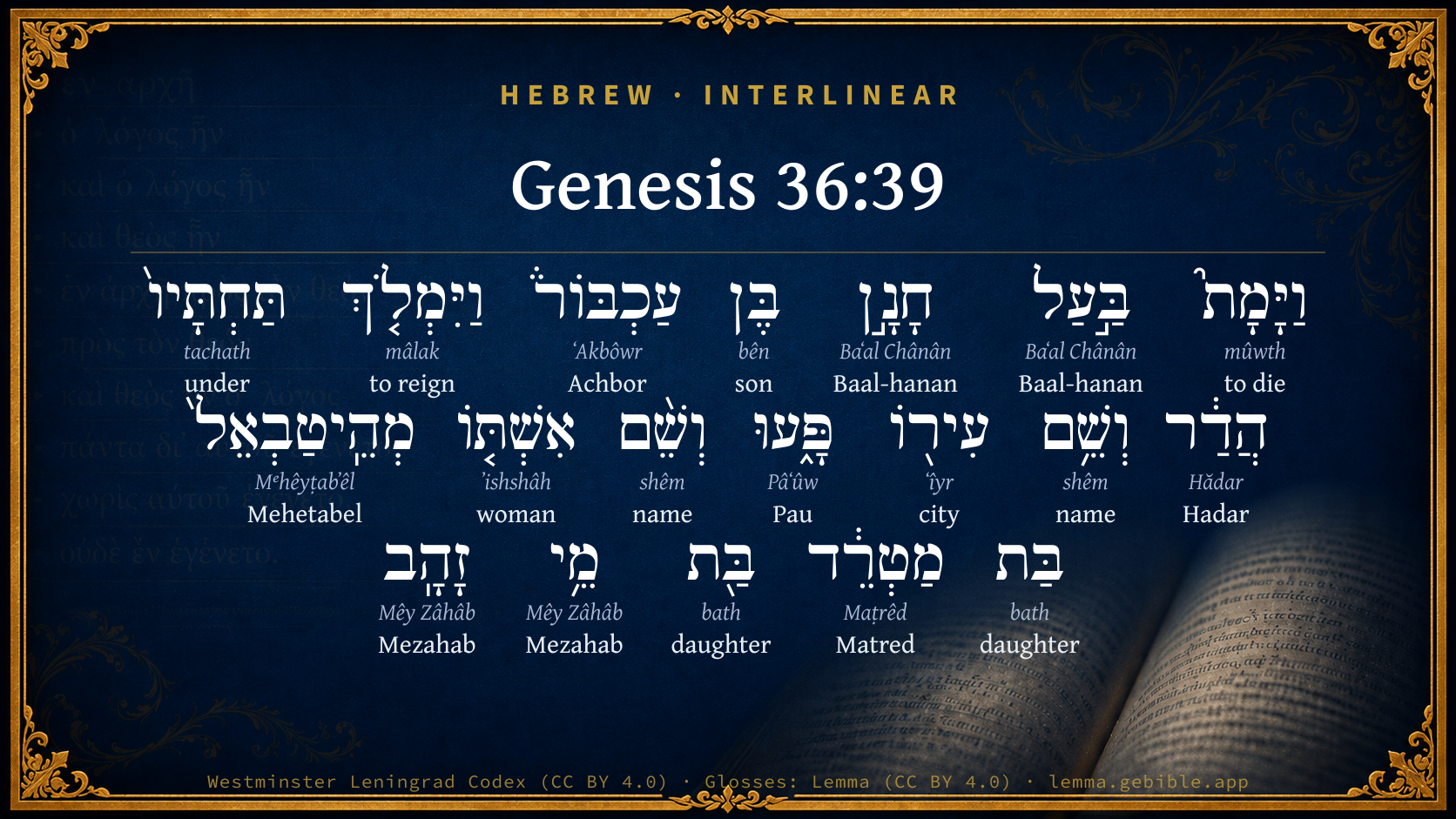
Hebrew (Westminster Leningrad Codex) Genesis 36:39 appears in the Hebrew Old Testament. The text above is from the Westminster Leningrad Codex. Each word links to its Strong’s number, a concise gloss, and parsing drawn from the Open Scriptures Hebrew Bible morphology. Click any word for its full Brown-Driver-Briggs (BDB) entry.
Download image
Cite this verse

Genesis 36:39 (World English Bible). Public Domain. Lemma interlinear Bible study tool, https://lemma.gebible.app/v/genesis/36/39.

Show BibTeX & RIS
BibTeX
RIS
English Translation
Baal Hanan the son of Achbor died, and Hadar reigned in his place. The name of his city was Pau. His wife's name was Mehetabel, the daughter of Matred, the daughter of Me-zahab.
World English Bible · Public Domain
Highlights
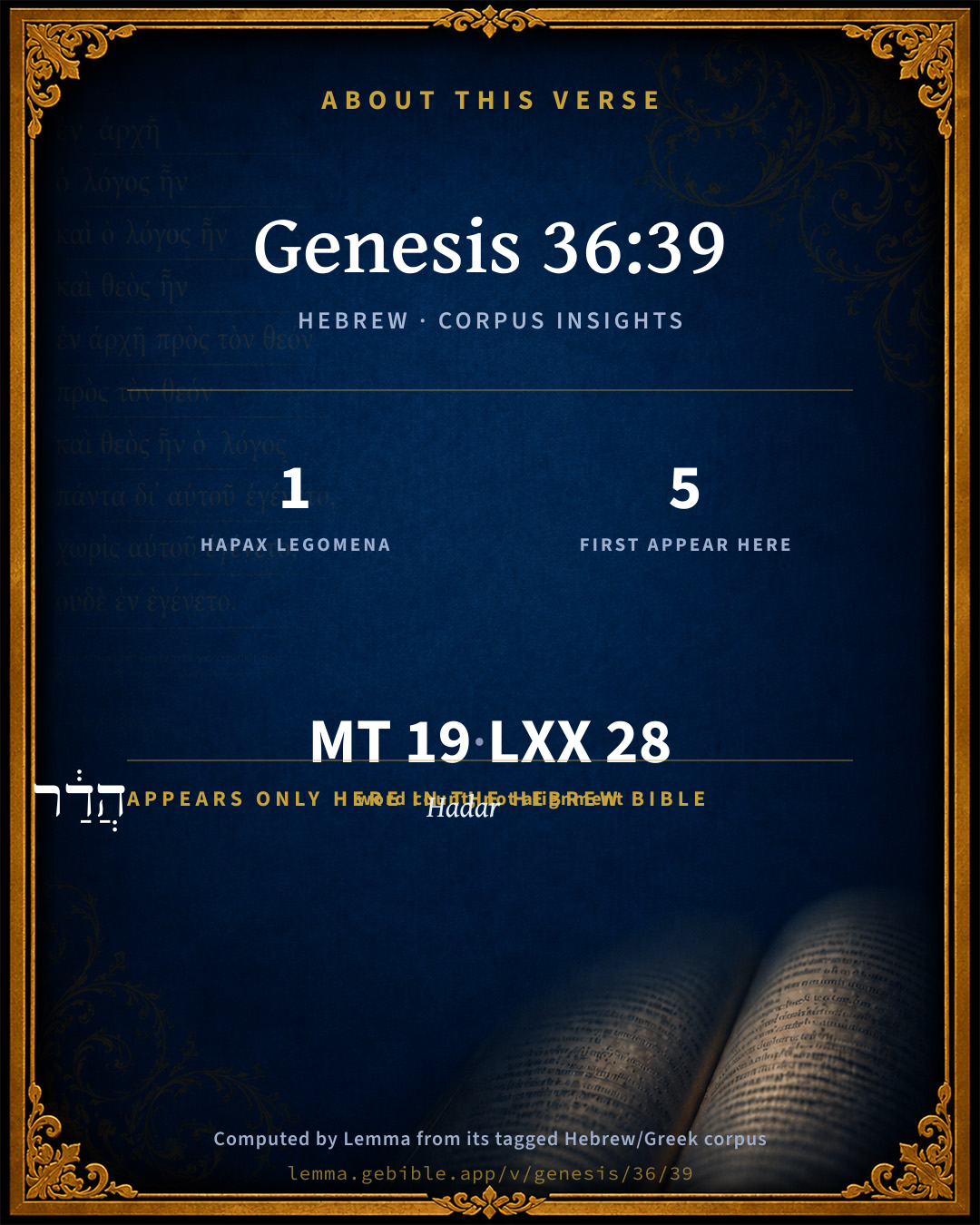
  • 1 hapax legomenon — only here in the Hebrew Bible
  • 5 first appearances in the Hebrew Bible
Full analysis ↓
Download a study sheet

One document with this verse’s original text, its word-by-word gloss line, the meaning frame, cross-references with their text, attributed commentary, and full source and license credits — printable, and it pastes into notes with its structure intact.

This verse Autodidact and up

Study sheet (.html) Plain text (.txt)

A passage Seminary Student

Up to 50 verses in one chapter. A passage sheet keeps up to 6 commentary sources and 12 cross-references per verse, in the order this page ranks them, and says so on the sheet whenever that leaves anything out. Ask for a single verse and you get the Autodidact verse sheet above.

Everything on this page stays free to read, with no account — the sheet is a download of what is already on screen, not access to it.

Want to remove ads? Support Godless Engineer
Compare translations 3

The same verse in 3 English versions, stacked beneath the original-language interlinear above. Click any original word for its lexicon entry.

Each is an independent rendering of the whole verse — the interlinear is not word-aligned to these translations.

Highlighted words mark where these versions differ — a whole-verse word diff, not a word-by-word alignment.

  • World English Bible Public Domain
    Baal Hanan the son of Achbor died, and Hadar reigned in his place. The name of his city was Pau. His wife's name was Mehetabel, the daughter of Matred, the daughter of Me-zahab.
  • King James Version Public Domain
    And Baalhanan the son of Achbor died, and Hadar reigned in his stead: and the name of his city was Pau; and his wife's name was Mehetabel, the daughter of Matred, the daughter of Mezahab.
  • unfoldingWord Literal Text CC BY-SA 4.0
    Then Baal-Hanan the son of Acbor died, and Hadar reigned in his place, and the name of his city Pau. And the name of his wife Mehetabel, the daughter of Matred the granddaughter of Me-Zahab.

unfoldingWord Literal Text — © unfoldingWord, licensed CC BY-SA 4.0. Word-aligned USFM3 via Door43 (git.door43.org/unfoldingWord/en_ult).

Versions to compare (up to 4)

3 of 4 selected

Show all 18 translations

Every available English version of this verse, each an independent rendering of the whole verse.

  • World English Bible Public Domain
    Baal Hanan the son of Achbor died, and Hadar reigned in his place. The name of his city was Pau. His wife's name was Mehetabel, the daughter of Matred, the daughter of Me-zahab.
  • Berean Standard Bible Public Domain
    When Baal-hanan son of Achbor died, Hadad reigned in his place. His city was named Pau, and his wife’s name was Mehetabel daughter of Matred, the daughter of Me-zahab.
  • Majority Standard Bible Public Domain
    When Baal-hanan son of Achbor died, Hadad reigned in his place. His city was named Pau, and his wife’s name was Mehetabel daughter of Matred, the daughter of Me-zahab.
  • King James Version Public Domain
    And Baalhanan the son of Achbor died, and Hadar reigned in his stead: and the name of his city was Pau; and his wife's name was Mehetabel, the daughter of Matred, the daughter of Mezahab.
  • American Standard Version (1901) Public Domain
    And Baal-hanan the son of Achbor died, and Hadar reigned in his stead: and the name of his city was Pau; and his wife's name was Mehetabel, the daughter of Matred, the daughter of Me-zahab.
  • Revised Version (1885) Public Domain
    And Baal-hanan the son of Achbor died, and Hadar reigned in his stead: and the name of his city was Pau; and his wife’s name was Mehetabel, the daughter of Matred, the daughter of Me-zahab.
  • Geneva Bible (1599) Public Domain
    And after the death of Baal-hanan the sonne of Achbor, Hadad reigned in his stead, and the name of his citie was Pau: and his wiues name Mehetabel the daughter of Matred, the daughter of Mezahab.
  • Douay-Rheims (1899) Public Domain
    This man also being dead, Adar reigned in his place, and the name of his city was Phau: and his wife was called Meetabel, the daughter of Matred, daughter of Mezaab.
  • Young's Literal Translation Public Domain
    and Baal-hanan son of Achbor dieth, and reign in his stead doth Hadar, and the name of his city `is' Pau; and his wife's name `is' Mehetabel daughter of Matred, daughter of Me-zahab.
  • Literal Standard Version CC BY-SA 4.0
    and Ba‘al-hanan son of Achbor dies, and Hadar reigns in his stead, and the name of his city [is] Pau; and his wife’s name [is] Mehetabel daughter of Matred, daughter of Me-zahab.
  • Unlocked Literal Bible CC BY-SA 4.0
    When Baal-Hanan son of Akbor, died, then Hadar reigned in his place. The name of his city was Pau. His wife's name was Mehetabel, the daughter of Matred, the granddaughter of Me Zahab.
  • unfoldingWord Literal Text CC BY-SA 4.0
    Then Baal-Hanan the son of Acbor died, and Hadar reigned in his place, and the name of his city Pau. And the name of his wife Mehetabel, the daughter of Matred the granddaughter of Me-Zahab.
  • Darby Bible Public Domain
    And Baal-hanan the son of Achbor died; and Hadar reigned in his stead; and the name of his city was Pau; and his wife's name was Mehetabel, the daughter of Matred daughter of Mezahab.
  • World Messianic Bible Public Domain
    Baal Hanan the son of Achbor died, and Hadar reigned in his place. The name of his city was Pau. His wife’s name was Mehetabel, the daughter of Matred, the daughter of Mezahab.
  • Webster's Bible Public Domain
    And Baal-hanan the son of Achbor died, and Hadar reigned in his stead; and the name of his city was Pau; and his wife's name was Mehetabel, the daughter of Matred, the daughter of Mezahab.
  • Free Bible Version CC BY-SA 4.0
    When Baal-hanan, son of Achbor, died, Hadad took over as king. The name of his town was Pau, and his wife's name was Mehetabel, daughter of Matred, daughter of Me-zahab.
  • Bible in Basic English Public Domain
    And at the death of Baal-hanan, Hadar became king in his place; his chief town was named Pau, and his wife's name was Mehetabel; she was the daughter of Matred, the daughter of Me-zahab.
  • JPS Tanakh (1917) Public Domain
    And Baal-hanan the son of Achbor died, and Hadar reigned in his stead; and the name of the city was Pau; and his wife's name was Mehetabel, the daughter of Matred, the daughter of Me-zahab.

Literal Standard Version (2020), Covenant Press — licensed CC BY-SA 4.0. Text via the HelloAO Bible API (eBible.org). Unlocked Literal Bible (unfoldingWord) — licensed CC BY-SA 4.0. Text via the HelloAO Bible API (eBible.org). unfoldingWord Literal Text — © unfoldingWord, licensed CC BY-SA 4.0. Word-aligned USFM3 via Door43 (git.door43.org/unfoldingWord/en_ult). Free Bible Version, Dr. Jonathan Gallagher — licensed CC BY-SA 4.0. Text via the HelloAO Bible API (eBible.org).

Word by word

More ways to search: Search by grammar → Find every occurrence → Compare this word →

Practice this passage: Drill this verse → Learn its vocabulary →

הֲדַ֔ר
Hădar
H1924
“Hadar”
Noun, Proper
Part of Speech
Noun
Type
Proper
Full BDB Definition

Origin: the same as H1926

TWOT: None

Hadar = "honour" - an Edomite king
  1. וַיָּמָת֮ mûwth H4191 “and · to die” Conjunction + Verb, Qal, Sequential Imperfect, 3rd Person, Masculine, Singular
  2. בַּ֣עַל Baʻal Chânân H1177 “Baal-hanan” Noun, Proper
  3. חָנָ֣ן Baʻal Chânân H1177 “Baal-hanan” Noun, Proper
  4. בֶּן bên H1121 “son of” Noun, Common, Masculine, Singular, Construct
  5. עַכְבּוֹר֒ ʻAkbôwr H5907 “Achbor” Noun, Proper
  6. וַיִּמְלֹ֤ךְ mâlak H4427 “and · to reign” Conjunction + Verb, Qal, Sequential Imperfect, 3rd Person, Masculine, Singular
  7. תַּחְתָּיו֙ tachath H8478 “under · him” Preposition + Suffix, Personal, 3rd Person, Masculine, Singular
  8. וְשֵׁ֥ם shêm H8034 “and · name of” Conjunction + Noun, Common, Masculine, Singular, Construct
  9. עִיר֖וֹ ʻîyr H5892 “city · his” Noun, Common, Feminine, Singular, Construct + Suffix, Personal, 3rd Person, Masculine, Singular
  10. פָּ֑עוּ Pâʻûw H6464 “Pau” Noun, Proper
  11. וְשֵׁ֨ם shêm H8034 “and · name of” Conjunction + Noun, Common, Masculine, Singular, Construct
  12. אִשְׁתּ֤וֹ ʼishshâh H802 “woman · his” Noun, Common, Feminine, Singular, Construct + Suffix, Personal, 3rd Person, Masculine, Singular
  13. מְהֵֽיטַבְאֵל֙ Mᵉhêyṭabʼêl H4105 “Mehetabel” Noun, Proper
  14. בַּת bath H1323 “daughter of” Noun, Common, Feminine, Singular, Construct
  15. מַטְרֵ֔ד Maṭrêd H4308 “Matred” Noun, Proper
  16. בַּ֖ת bath H1323 “daughter of” Noun, Common, Feminine, Singular, Construct
  17. מֵ֥י Mêy Zâhâb H4314 “Mezahab” Noun, Proper
  18. זָהָֽב Mêy Zâhâb H4314 “Mezahab” Noun, Proper

About this verse

These counts appear in no published source. They are computed here, from the morphology-tagged text and Lemma’s own curated glosses. What Lemma adds →

19
words
15
distinct lemmas
Pentateuch
section

Notable vocabulary

1 hapax legomenon — a word that appears only here in the entire Hebrew Bible:

  • הֲדַ֔ר Hadar H1924

First appearance in Scripture

These words make their first canonical appearance in the Hebrew Bible here:

  • הֲדַ֔ר Hadar H1924
  • פָּ֑עוּ Pau H6464
  • מְהֵֽיטַבְאֵל֙ Mehetabel H4105
  • מַטְרֵ֔ד Matred H4308
  • מֵ֥י Mezahab H4314

Shared distinctive vocabulary

פָּ֑עוּ Pau H6464 occurs in 2 verses of the Hebrew Bible. Also found in:

Grammatical profile

  • 2 verbs
  • 16 nouns
  • 1 preposition

Verb forms

  • וַיָּמָת֮ Qal · Sequential Imperfect
  • וַיִּמְלֹ֤ךְ Qal · Sequential Imperfect

Repetition

Words recur within this verse — often emphatic in Hebrew:

  • בַּ֣עַל Baal-hanan H1177 ×2
  • וְשֵׁ֥ם name H8034 ×2
  • בַּת daughter H1323 ×2
  • מֵ֥י Mezahab H4314 ×2

Hebrew & Septuagint length

In English translation the verse runs 33 words from the Hebrew and 39 from the Septuagint (LXX English) — closely comparable.

A rough comparison of the two English renderings, which tokenize alike — not a word-level alignment.

Word counts can differ between the Hebrew and the Greek without any difference in meaning — e.g. the Hebrew direct-object marker אֵת has no separate Greek word, and Greek often adds the article ὁ.

In the original languages it is 19 Hebrew tokens and 28 Greek tokens — but the two are counted differently (Hebrew bundles its prefixes and suffixes into one token; the Greek is in lemma form), so that isn’t a like-for-like length.

Cross-references

2

Topical passages linked to Genesis 36:39 in the Treasury of Scripture Knowledge — connected by theme and wording, ordered by reader-vote popularity; previews shown in the World English Bible.

  • Exodus 15:15 Then the chiefs of Edom were dismayed. Trembling takes hold of the mighty men of Moab. All the inhabitants of Canaan are melted away.
  • 1 Chronicles 1:50 Baal Hanan died, and Hadad reigned in his place; and the name of his city was Pai: and his wife's name was Mehetabel, the daughter of Matred, the daughter of Me-zahab.

Cross-references courtesy of OpenBible.info (CC BY 4.0).

Hebrew and Greek witnesses Masoretic Hebrew ↔ Greek Septuagint

The same verse in the two great witnesses to the Old Testament, shown verse-for-verse.

These are two independent witnesses, not word-aligned to each other, and the Septuagint is shown in lemma (dictionary) form.

Hebrew Genesis 36:39 Masoretic · Westminster Leningrad Codex

וַיָּמָת֮ בַּ֣עַל חָנָ֣ן בֶּן עַכְבּוֹר֒ וַיִּמְלֹ֤ךְ תַּחְתָּיו֙ הֲדַ֔ר וְשֵׁ֥ם עִיר֖וֹ פָּ֑עוּ וְשֵׁ֨ם אִשְׁתּ֤וֹ מְהֵֽיטַבְאֵל֙ בַּת מַטְרֵ֔ד בַּ֖ת מֵ֥י זָהָֽב

Baal Hanan the son of Achbor died, and Hadar reigned in his place. The name of his city was Pau. His wife's name was Mehetabel, the daughter of Matred, the daughter of Me-zahab.

World English Bible · Public Domain

Greek LXX Genesis 36:39 Septuagint · lemma form

ἀποθνήσκω δέ βαλαεννων υἱός αχοβωρ καί βασιλεύω ἀντί αὐτός αραδ υἱός βαραδ καί ὄνομα ὁ πόλις αὐτός φογωρ ὄνομα δέ ὁ γυνή αὐτός μαιτεβεηλ θυγάτηρ ματραιθ υἱός μαιζοοβ

And Ballenon the son of Achobor died; and Arad the son of Barad reigned in his stead; and the name of his city was Phogor; and the name of his wife was Metebeel, daughter of Matraith, son of Maizoob.

LXX2012 (modern English Septuagint) · Public Domain

On this verse, The Cambridge Bible for Schools and Colleges discusses the Septuagint’s reading. Read the note in Commentary ↓

Hebrew: Westminster Leningrad Codex (CC BY 4.0). Greek: Septuagint (public domain); English from LXX2012 (modern English Septuagint) (Public Domain). How the Septuagint differs from the Hebrew →

Targum (Aramaic paraphrase)

2

The Targum is the ancient Jewish Aramaic paraphrase of the Hebrew Scriptures — an interpretive translation, not the Hebrew text itself. Onkelos (literal) and Pseudo-Jonathan (expansive) render the Torah, and Jonathan the Prophets. Coverage is partial: where no permissively-licensed English translation exists for a verse, only the Aramaic is shown. This is verse-level text, not a word-by-word alignment to the Hebrew.

  1. Targum Onkelos Torah (Genesis–Deuteronomy)
    וּמִית בַּעַל חָנָן בַּר עַכְבּוֹר וּמְלַךְ תְּחוֹתוֹהִי הֲדַר וְשׁוּם קַרְתֵּהּ פָּעוּ וְשׁוּם אִתְּתֵהּ מְהֵיטַבְאֵל בַּת מַטְּרֵד בַת מְצָרֵף דַּהֲבָא

    (no public-domain English translation for this verse)

    Targum Onkelos — Aramaic: “Onkelos Genesis” (public domain); “Onkelos Exodus” (public domain); “Onkelos Leviticus” (public domain); “Onkelos Numbers” (public domain); “Onkelos Deuteronomy” (public domain). English: “Sefaria Community Translation” (CC0 1.0 (public-domain dedication)); “J.W. Etheridge. The Targums of Onkelos and Jonathan Ben Uzziel on the Pentateuch. London: Longmans, Green, 1862” (public domain). Text via Sefaria.

  2. Targum Pseudo-Jonathan Torah (Genesis–Deuteronomy)
    וּמִית בַּעַל חָנָן בַּר עַכְבּוֹר וּמְלַךְ תְּחוֹתוֹי הֲדַר וְשׁוּם קַרְתָּא דְבֵית מַלְכוּתֵיהּ פָּעוּ וְשׁוּם אִנְתְּתֵיהּ מְהֵיטַבְאֵל בְּרַת מַטְרֵד הוּא גַבְרָא דַהֲוָה לָעֵי בְּמַטְרְדָה וּבְסַרְדִיתָא וּמִן דְעָתַר וְקָנָה נִכְסִין הֲדַר לְמֶהֱוֵי מִתְגָאֶה בְּלִבֵּיהּ לְמֵימָר מַאן הוּא כַּסְפָּא וּמָאן הוּא דַהֲבָא

    And Baal Hanan bar Akbor died, and instead of him reigned Hadar; and the name of the city of the house of his kingdom was Pahu; and the name of his wife was Mehetabel the daughter of Matred. He was the man who laboured with perseverance and vigilance, and who, after he had become wealthy and had gotten riches, turned to become more lofty in his heart, saying What is silver and what is gold?

    Targum Pseudo-Jonathan — Aramaic: “Targum Jonathan on Genesis” (public domain); “Targum Jonathan on Exodus” (public domain); “Targum Jonathan on Leviticus” (public domain); “Targum Jonathan on Numbers” (public domain); “Targum Jonathan on Deuteronomy” (public domain). English: “The Targum of Jonathan ben Uzziel, trans. J. W. Etheridge, London, 1862” (public domain). Text via Sefaria.

Commentary

Notes on Genesis 36:39 from classic Christian and Jewish commentators (each source and its license shown beneath its notes). The classic Christian expositions comment on the surrounding passage and are grouped to its opening verse, so a note may address several verses; the Jewish commentaries on the Tanakh (Rashi and others) are per-verse, so they appear only where the commentator wrote on this verse.

Lemma curates 59 commentaries, every one of them public domain or Creative Commons licensed, each selected and text-cleaned for this edition rather than reprinted as found. About our sources →

Geneva Bible (1599)

Geneva Bible translators

Or, niece.

Geneva Bible (1599) marginal notes — public domain. Text via Bolls.life.

Ellicott's Commentary for English Readers

(39) Hadar.—He is more correctly called Hadad in the Samaritan text here, and in the Hebrew also in 1Ch_1:50. The two letters r and d are in Hebrew so much alike, that they are repeatedly confused with one another. As we have already observed (see Note on Gen_36:1) he was probably alive when this catalogue of kings was drawn up.

A Bible Commentary for English Readers, edited by Charles John Ellicott (1878–1897) — public domain. Text from a community e-Sword module.

The Cambridge Bible for Schools and Colleges

gen. ed. J. J. S. Perowne

39. Hadar] Probably, as 1Ch_1:50 and some ancient authorities, Hadad. Possibly this Hadad II (see Gen_36:35) was the Hadadezer deposed by David (2Sa_8:3 ff.). Hadad III shook off the yoke of Israel (1Ki_11:21 ff.; cf. Gen_27:40).

Pau] In 1Ch_1:50, Pai. LXX reads Φόγωρ = Peor, cf. Num_23:28.

Mehetabel] = “El does good,” a proper name occurring in Neh_6:10. These names shew how close was the similarity between the languages of the Edomites and the Israelites.

The Cambridge Bible for Schools and Colleges (gen. ed. J. J. S. Perowne; Cambridge University Press, 1878–1918) — public domain. Text from a community e-Sword module.

Haydock's Catholic Bible Commentary

Adar. Many confound him with the king, whom David overcame. --- Daughter of Mezaab, or perhaps her grand-daughter, or adopted child.

George Leo Haydock (1774–1849), Haydock's Catholic Family Bible and Commentary, 1859 edition — public domain. Excludes Psalms (Douay-Rheims chapter numbering differs from Protestant) and Deuterocanonical books (Catholic canon only).

Matthew Poole's English Annotations

Either

Matred was the father, and

Mezahab the mother; or

Matred was the mother, and

Mezahab the grandmother.

Matthew Poole's English Annotations on the Holy Bible (1683–1685) — public domain. Text from a community e-Sword/MySword module.

The Pulpit Commentary

And Baal-hanan the son of Achbor died, and Hadar (1Ch_1:50) reigned in his stead: and the name of his city was Pau; Pal; (1Ch_1:50) "Bleating" (Gesenius), "Yawning" (Furst), with which accords Fogwr (LXX)and his wife"s name was Mehetabel, God benefits" (Gesenius)the daughter of Marred, (Gesenius)the daughter of Mezahab of Gold" (Gesenius). That the death of this king, which a later chronicler records, (1Ch_1:51) is not here mentioned by the historian is commonly regarded (Rosenm Havernick, Hengstenberg, Keil, Kalisch, et alii) as a proof that he was then alive, and that in fact he was the king of Edom to whom Moses sent ambassadors requesting permission to pass through the land. (Num_20:14)

The Pulpit Commentary (1880–1919), ed. H.D.M. Spence-Jones & Joseph S. Exell — public domain. Text from a community e-Sword module.

Rashi

Rabbi Shlomo Yitzchaki (Rashi)

בת מי זהב THE DAUGHTER OF ME-ZAHAB — meaning מהו זהב what value has gold? He was so rich that gold had no value in his eyes (Genesis Rabbah 83:4).

Rashi on the Tanakh — English translations: “The Judaica Press complete Tanach with Rashi, translated by A. J. Rosenberg” (CC BY 4.0); “Pentateuch with Rashi's commentary by M. Rosenbaum and A.M. Silbermann, 1929-1934” (public domain); “The Metsudah Tanach series, Lakewood, N.J” (CC BY 4.0); and “The Book of Joshua, Metsudah Publications, 1997” (CC BY 4.0). Text via Sefaria.

Radak

Rabbi David Kimhi (Radak)

וימלוך תחתיו הדר...ושם אשתו וגו', we do not know why both his wife’s name and that of her father have been mentioned.

Radak on the Tanakh — English translations: “Sefaria Community Translation” (CC0 1.0 (public-domain dedication)); “Eliyahu Munk, HaChut Hameshulash” (CC BY 4.0); “Rabbi Mike Feuer, Jerusalem Anthology” (CC BY 4.0); and “R. David Kimhi on the first book of Psalms, Translated by R.G. Finch, London, 1919” (public domain). Text via Sefaria.

Lesson kit

Teaching starters — assembled from the data on this page, not authored interpretation. Every prompt links to the verse data it draws on. Edit before teaching.

Genesis, in the Pentateuch, opens this verse with 19 words (15 distinct Hebrew lemmas). Its most distinctive word is Hădar (“Hadar”). A historical commentator’s framing appears above. Read the whole chapter for the surrounding context.

Discussion questions

  1. The word Hădar carries the sense “Hadar.” How does it shape the verse?
  2. 1 word here appears nowhere else in the Hebrew Bible. Why might the author reach for such rare wording?
  3. 5 words make their first appearance in Scripture here. What does this debut establish?
  4. How does 1 Chronicles 1:50, which shares the word «Pau», read alongside this verse?
  5. What does the repetition of “Baal-hanan” (2× in this one verse) do in this verse?
  6. The translations on this page render this verse differently — a whole-verse word diff, not a word-by-word alignment. What might account for the different wordings?
  7. «וַיָּמָת֮» is a Qal Sequential Imperfect verb. How does that grammatical form shape the action described?
  8. Compare how Geneva Bible (1599) and Ellicott's Commentary for English Readers read this verse. Where do they agree or differ?

Things to notice

  • 1 word in this verse appears nowhere else in the Hebrew Bible.
  • 5 words make their first canonical appearance in Scripture here.
  • This verse counts 19 Hebrew ↔ 28 Greek words.
  • These translations choose different wording for 13 words in this verse.
  • “Baal-hanan” occurs 2× in this single verse.

Reading settings

Reading text

Shown beneath each verse's original-language words.

Old Testament
Old Testament edition

Read the OT as the Masoretic Hebrew (MT) or the Greek Septuagint (LXX).

English shown for the Greek Septuagint (in the Hebrew ↔ Greek comparison).

Comparing translations? Open the Compare panel on any verse page to stack up to four side by side.