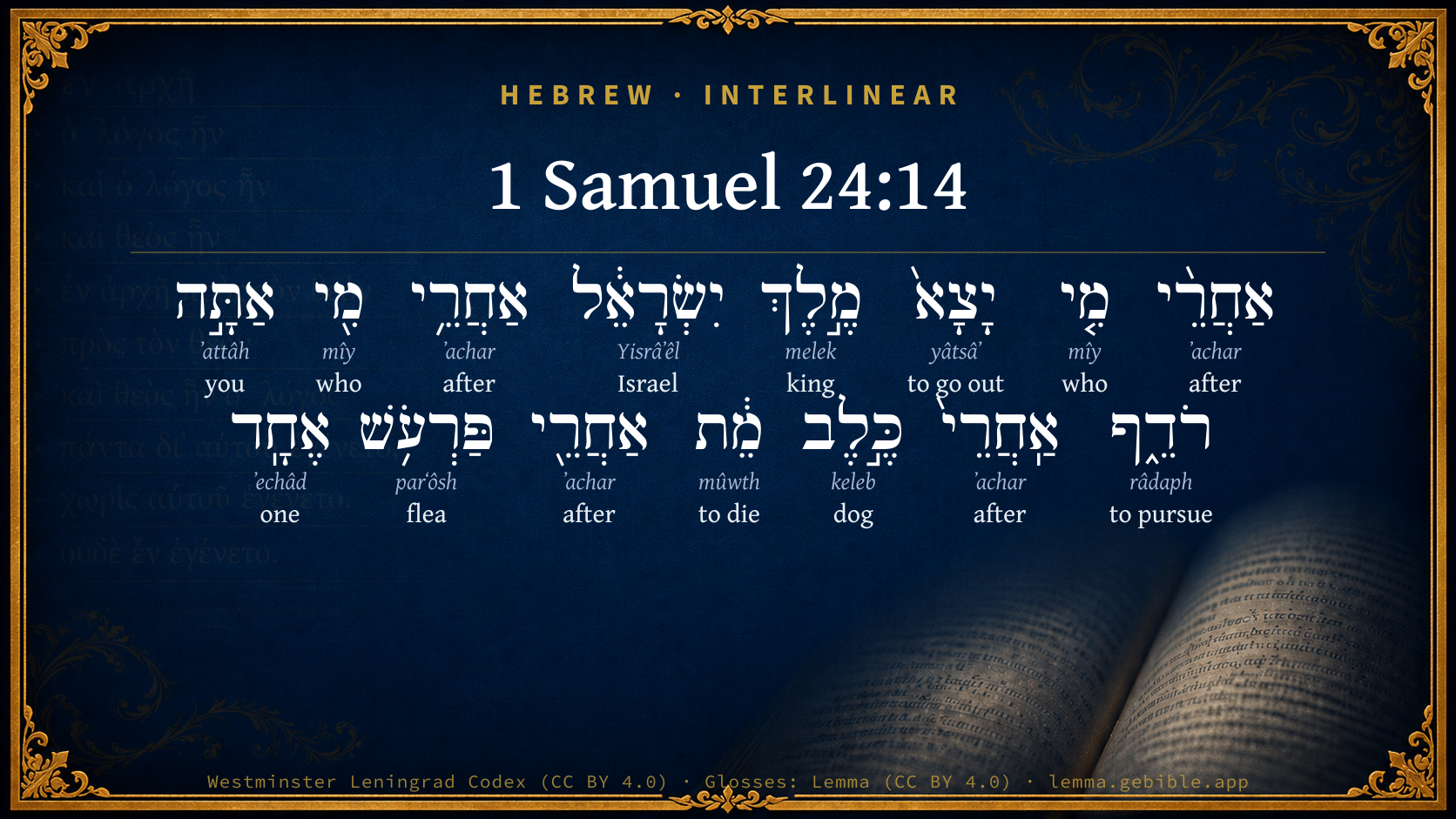
1 Samuel 24:14

Hebrew (Westminster Leningrad Codex) 1 Samuel 24:14 appears in the Hebrew Old Testament. The text above is from the Westminster Leningrad Codex. Each word links to its Strong’s number, a concise gloss, and parsing drawn from the Open Scriptures Hebrew Bible morphology. Click any word for its full Brown-Driver-Briggs (BDB) entry.
Download image
Cite this verse

1 Samuel 24:14 (World English Bible). Public Domain. Lemma interlinear Bible study tool, https://lemma.gebible.app/v/1-samuel/24/14.

Show BibTeX & RIS
BibTeX
RIS
English Translation
After whom is the king of Israel come out? after whom do you pursue? after a dead dog, after a flea.
World English Bible · Public Domain
Highlights
  • 1 first appearance in the Hebrew Bible
Full analysis ↓
Download a study sheet

One document with this verse’s original text, its word-by-word gloss line, the meaning frame, cross-references with their text, attributed commentary, and full source and license credits — printable, and it pastes into notes with its structure intact.

This verse Autodidact and up

Study sheet (.html) Plain text (.txt)

A passage Seminary Student

Up to 50 verses in one chapter. A passage sheet keeps up to 6 commentary sources and 12 cross-references per verse, in the order this page ranks them, and says so on the sheet whenever that leaves anything out. Ask for a single verse and you get the Autodidact verse sheet above.

Everything on this page stays free to read, with no account — the sheet is a download of what is already on screen, not access to it.

Want to remove ads? Support Godless Engineer
Compare translations 3

The same verse in 3 English versions, stacked beneath the original-language interlinear above. Click any original word for its lexicon entry.

Each is an independent rendering of the whole verse — the interlinear is not word-aligned to these translations.

Highlighted words mark where these versions differ — a whole-verse word diff, not a word-by-word alignment.

  • World English Bible Public Domain
    After whom is the king of Israel come out? after whom do you pursue? after a dead dog, after a flea.
  • King James Version Public Domain
    After whom is the king of Israel come out? after whom dost thou pursue? after a dead dog, after a flea.
  • unfoldingWord Literal Text CC BY-SA 4.0
    After whom does the king of Israel come out? After whom are you pursuing? After a dead dog! After one flea!

unfoldingWord Literal Text — © unfoldingWord, licensed CC BY-SA 4.0. Word-aligned USFM3 via Door43 (git.door43.org/unfoldingWord/en_ult).

Versions to compare (up to 4)

3 of 4 selected

Show all 18 translations

Every available English version of this verse, each an independent rendering of the whole verse.

  • World English Bible Public Domain
    After whom is the king of Israel come out? after whom do you pursue? after a dead dog, after a flea.
  • Berean Standard Bible Public Domain
    Against whom has the king of Israel come out? Whom are you pursuing? A dead dog? A flea?
  • Majority Standard Bible Public Domain
    Against whom has the king of Israel come out? Whom are you pursuing? A dead dog? A flea?
  • King James Version Public Domain
    After whom is the king of Israel come out? after whom dost thou pursue? after a dead dog, after a flea.
  • American Standard Version (1901) Public Domain
    After whom is the king of Israel come out? after whom dost thou pursue? after a dead dog, after a flea.
  • Revised Version (1885) Public Domain
    After whom is the king of Israel come out? after whom dost thou pursue? after a dead dog, after a flea.
  • Geneva Bible (1599) Public Domain
    According as the olde prouerbe sayeth, Wickednesse proceedeth from the wicked, but mine hand be not vpon thee.
  • Douay-Rheims (1899) Public Domain
    As also it is said in the old proverb: From the wicked shall wickedness come forth: therefore my hand shall not be upon thee. After whom dost thou come out, O king of Israel?
  • Young's Literal Translation Public Domain
    `After whom hath the king of Israel come out? after whom art thou pursuing? -- after a dead dog! after one flea!
  • Literal Standard Version CC BY-SA 4.0
    After whom has the king of Israel come out? After whom are you pursuing? After a dead dog! After one flea!
  • Unlocked Literal Bible CC BY-SA 4.0
    After whom has the king of Israel come out? After whom do you pursue? After a dead dog! After a flea!
  • unfoldingWord Literal Text CC BY-SA 4.0
    After whom does the king of Israel come out? After whom are you pursuing? After a dead dog! After one flea!
  • Darby Bible Public Domain
    After whom is the king of Israel come out? after whom dost thou pursue? after a dead dog, after a single flea.
  • World Messianic Bible Public Domain
    Against whom has the king of Israel come out? Whom do you pursue? A dead dog? A flea?
  • Webster's Bible Public Domain
    \\24:13\\As saith the proverb of the ancients, Wickedness proceedeth from the wicked: but my hand shall not be upon thee.
  • Free Bible Version CC BY-SA 4.0
    Who is the king of Israel coming after? Who are you chasing? A dead dog! Just a flea!
  • Bible in Basic English Public Domain
    There is an old saying, From the evil-doer comes evil: but my hand will never be lifted up against you.
  • JPS Tanakh (1917) Public Domain
    (24-15) After whom is the king of Israel come out? after whom dost thou pursue? after a dead dog, after a flea.

Literal Standard Version (2020), Covenant Press — licensed CC BY-SA 4.0. Text via the HelloAO Bible API (eBible.org). Unlocked Literal Bible (unfoldingWord) — licensed CC BY-SA 4.0. Text via the HelloAO Bible API (eBible.org). unfoldingWord Literal Text — © unfoldingWord, licensed CC BY-SA 4.0. Word-aligned USFM3 via Door43 (git.door43.org/unfoldingWord/en_ult). Free Bible Version, Dr. Jonathan Gallagher — licensed CC BY-SA 4.0. Text via the HelloAO Bible API (eBible.org).

Word by word

More ways to search: Search by grammar → Find every occurrence → Compare this word →

Practice this passage: Drill this verse → Learn its vocabulary →

פַּרְעֹ֥שׁ
parʻôsh
H6550
“flea”
Noun, Common, Masculine, Singular, Absolute
Part of Speech
Noun
Type
Common
Gender
Masculine
Number
Singular
State
Absolute
Full BDB Definition

Origin: probably from H6544 and H6211

TWOT: 1825 . 1

flea
  1. אַחֲרֵ֨י ʼachar H310 “after” Preposition
  2. מִ֤י mîy H4310 “who” Particle, Interrogative
  3. יָצָא֙ yâtsâʼ H3318 “to go out” Verb, Qal, Perfect, 3rd Person, Masculine, Singular
  4. מֶ֣לֶךְ melek H4428 “king of” Noun, Common, Masculine, Singular, Construct
  5. יִשְׂרָאֵ֔ל Yisrâʼêl H3478 “Israel” Noun, Proper
  6. אַחֲרֵ֥י ʼachar H310 “after” Preposition
  7. מִ֖י mîy H4310 “who” Particle, Interrogative
  8. אַתָּ֣ה ʼattâh H859 “you” Pronoun, Personal, 2nd Person, Masculine, Singular
  9. רֹדֵ֑ף râdaph H7291 “pursuing” Verb, Qal, Participle Active, Masculine, Singular, Absolute
  10. אַֽחֲרֵי֙ ʼachar H310 “after” Preposition
  11. כֶּ֣לֶב keleb H3611 “dog” Noun, Common, Masculine, Singular, Absolute
  12. מֵ֔ת mûwth H4191 “dying” Verb, Qal, Participle Active, Masculine, Singular, Absolute
  13. אַחֲרֵ֖י ʼachar H310 “after” Preposition
  14. אֶחָֽד ʼechâd H259 “one” Adjective, Cardinal number, Masculine, Singular, Absolute

About this verse

These counts appear in no published source. They are computed here, from the morphology-tagged text and Lemma’s own curated glosses. What Lemma adds →

15
words
11
distinct lemmas
Historical
section

Notable vocabulary

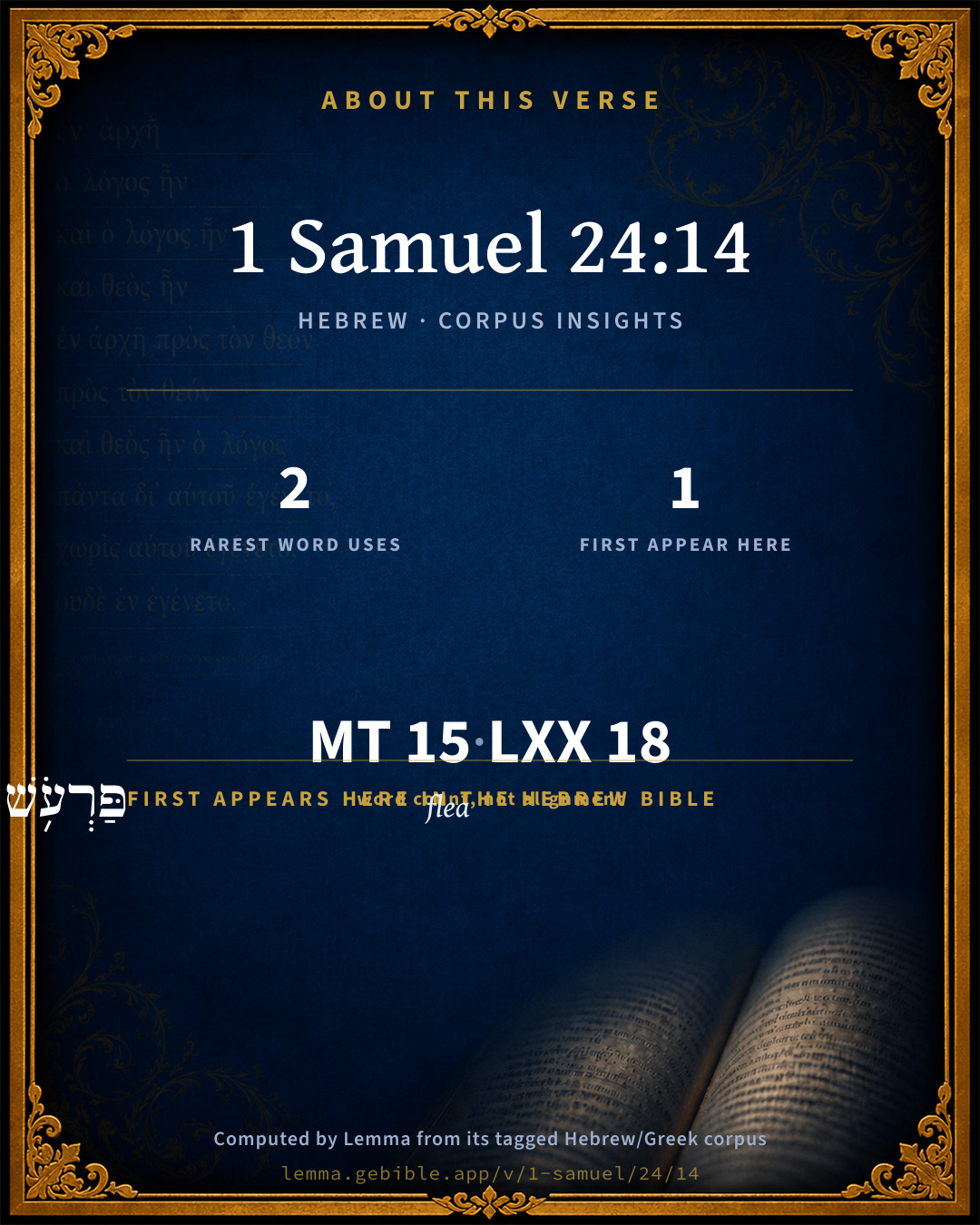
The rarest word here is פַּרְעֹ֥שׁ flea H6550 — appearing just 2 times in the whole Hebrew Bible.

First appearance in Scripture

This word makes its first canonical appearance in the Hebrew Bible here:

  • פַּרְעֹ֥שׁ flea H6550

Shared distinctive vocabulary

פַּרְעֹ֥שׁ flea H6550 occurs in 2 verses of the Hebrew Bible. Also found in:

Grammatical profile

  • 3 verbs
  • 4 nouns
  • 1 adjective
  • 1 pronoun
  • 4 prepositions
  • 2 particles

Verb forms

  • יָצָא֙ Qal · Perfect
  • רֹדֵ֑ף Qal · Participle Active
  • מֵ֔ת Qal · Participle Active

Repetition

Words recur within this verse — often emphatic in Hebrew:

  • אַחֲרֵ֨י after H310 ×4
  • מִ֤י who H4310 ×2

Hebrew & Septuagint length

In English translation the verse runs 21 words from the Hebrew and 20 from the Septuagint (LXX English) — closely comparable.

A rough comparison of the two English renderings, which tokenize alike — not a word-level alignment.

Word counts can differ between the Hebrew and the Greek without any difference in meaning — e.g. the Hebrew direct-object marker אֵת has no separate Greek word, and Greek often adds the article ὁ.

In the original languages it is 15 Hebrew tokens and 18 Greek tokens — but the two are counted differently (Hebrew bundles its prefixes and suffixes into one token; the Greek is in lemma form), so that isn’t a like-for-like length.

Cross-references

8

Topical passages linked to 1 Samuel 24:14 in the Treasury of Scripture Knowledge — connected by theme and wording, ordered by reader-vote popularity; previews shown in the World English Bible.

  • 1 Samuel 26:20 Now therefore, don't let my blood fall to the earth away from the presence of Yahweh: for the king of Israel is come out to seek a flea, as when one does hunt a partridge in the mountains.
  • 1 Samuel 17:43 The Philistine said to David, Am I a dog, that you come to me with sticks? The Philistine cursed David by his gods.
  • 2 Samuel 9:8 He did obeisance, and said, "What is your servant, that you should look on such a dead dog as I am?"
  • Judges 8:1–3 The men of Ephraim said to him, Why have you served us thus, that you didn't call us, when you went to fight with Midian? They did chide with him sharply.
  • 2 Samuel 3:8 Then was Abner very angry for the words of Ish-bosheth, and said, Am I a dog's head that belongs to Judah? This day do I show kindness to the house of Saul your father, to his brothers, and to his friends, and have not delivered you into the hand of David; and yet you charge me this day with a fault concerning this woman.
  • 2 Samuel 16:9 Then said Abishai the son of Zeruiah to the king, "Why should this dead dog curse my lord the king? Please let me go over and take off his head."
  • 1 Kings 21:7 Jezebel his wife said to him, Do you now govern the kingdom of Israel? arise, and eat bread, and let your heart be merry: I will give you the vineyard of Naboth the Jezreelite.
  • 2 Samuel 6:20 Then David returned to bless his household. Michal the daughter of Saul came out to meet David, and said, How glorious was the king of Israel today, who uncovered himself today in the eyes of the handmaids of his servants, as one of the vain fellows shamelessly uncovers himself!

Cross-references courtesy of OpenBible.info (CC BY 4.0).

Hebrew and Greek witnesses Masoretic Hebrew ↔ Greek Septuagint

The same verse in the two great witnesses to the Old Testament, shown verse-for-verse.

These are two independent witnesses, not word-aligned to each other, and the Septuagint is shown in lemma (dictionary) form.

Hebrew 1 Samuel 24:14 Masoretic · Westminster Leningrad Codex

אַחֲרֵ֨י מִ֤י יָצָא֙ מֶ֣לֶךְ יִשְׂרָאֵ֔ל אַחֲרֵ֥י מִ֖י אַתָּ֣ה רֹדֵ֑ף אַֽחֲרֵי֙ כֶּ֣לֶב מֵ֔ת אַחֲרֵ֖י פַּרְעֹ֥שׁ אֶחָֽד

After whom is the king of Israel come out? after whom do you pursue? after a dead dog, after a flea.

World English Bible · Public Domain

Greek LXX 1 Samuel 24:14 Septuagint · lemma form

καθώς λέγω ὁ παραβολή ὁ ἀρχαῖος ἐκ ἄνομος ἐκἔρχομαι πλημμέλεια καί ὁ χείρ ἐγώ οὐ εἰμί ἐπί σύ

As the old proverb says, Transgression will proceed from the wicked ones: but my hand shall not be upon you.

LXX2012 (modern English Septuagint) · Public Domain

Hebrew: Westminster Leningrad Codex (CC BY 4.0). Greek: Septuagint (public domain); English from LXX2012 (modern English Septuagint) (Public Domain). How the Septuagint differs from the Hebrew →

Targum (Aramaic paraphrase)

1

The Targum is the ancient Jewish Aramaic paraphrase of the Hebrew Scriptures — an interpretive translation, not the Hebrew text itself. Onkelos (literal) and Pseudo-Jonathan (expansive) render the Torah, and Jonathan the Prophets. Coverage is partial: where no permissively-licensed English translation exists for a verse, only the Aramaic is shown. This is verse-level text, not a word-by-word alignment to the Hebrew.

  1. Targum Jonathan Prophets (Joshua–Malachi)
    כְּמָא דְאָמְרִין מַתְלָא דְמִלְקָדְמִין מֵרַשִׁיעִין תִּפּוֹק חוֹבַתְהוֹן וִידִי לָא תְהֵי בָךְ:

    (no public-domain English translation for this verse)

    Targum Jonathan — Aramaic: “Mikraot Gedolot” (public domain). English: “Sefaria Community Translation” (CC0 1.0 (public-domain dedication)); “London "Chaldee Paraphrase," 1871” (public domain). Text via Sefaria.

Commentary

Notes on 1 Samuel 24:14 from classic Christian and Jewish commentators (each source and its license shown beneath its notes). The classic Christian expositions comment on the surrounding passage and are grouped to its opening verse, so a note may address several verses; the Jewish commentaries on the Tanakh (Rashi and others) are per-verse, so they appear only where the commentator wrote on this verse.

Lemma curates 59 commentaries, every one of them public domain or Creative Commons licensed, each selected and text-cleaned for this edition rather than reprinted as found. About our sources →

Trapp's Complete Commentary

John Trapp

1Sa 24:14 After whom is the king of Israel come out? after whom dost thou pursue? after a dead dog, after a flea.

Ver. 14. After a dead dog, after a flea.] Egregiam vero laudem, a great praise, a great purchase sure, to kill a dead dog, to fight with a flea! Is this an employment fit for a king? an exploit worthy of such an army? {a} Caligula took his army to the ocean, as if he would have passed over into Brittany, and done great matters there: but he only caused his soldiers to pick up cockle shells that lay on the shore, and so returned to Rome: Magnifie glorians quasi oceano subacto. Ridiculum caput! {b} Domitian spent his time in catching flies: and Artaxerxes in making knife handles. Was this handsome? Aquila non captat muscas, as saith the proverb of the ancients.

{a} Facis quod est tanto rege indignum, dum me tenuissimum, infimum, et infirmissimum tanto comitatu persequeris. - Jun.

{b} Dio, in Calig.

John Trapp, A Commentary or Exposition upon All the Books of the Old and New Testament (1647–1656) — public domain. Text from a community e-Sword module.

Joseph Benson's Commentary

1Sa 24:14-15. After whom is the king of Israel come out? — David here employs every persuasive art to move Saul. He represents himself in as contemptible a light as possible; that he might convince Saul it was not for his honour to take so much pains to kill him, if he could do it. The Lord, therefore, be judge — He thought he could not repeat this too often, that as he had done hitherto, so he still resolved hereafter, to leave it to God to judge which of them was in the right, and not to avenge himself.

Joseph Benson's Commentary on the Old and New Testaments (1811–1818) — public domain. Text from a community e-Sword module.

Keil & Delitzsch

C. F. Keil & F. Delitzsch

And even if he should wish to attack the king, he did not possess the power. This thought introduces Sa1 24:14 : "After whom is the king of Israel gone out? After whom dost thou pursue? A dead dog, a single flea." By these similes David meant to describe himself as a perfectly harmless and insignificant man, of whom Saul had no occasion to be afraid, and whom the king of Israel ought to think it beneath his dignity to pursue. A dead dog cannot bite or hurt, and is an object about which a king ought not to trouble himself (cf. Sa2 9:8 and Sa2 16:9, where the idea of something contemptible is included). The point of comparison with a flea is the insignificance of such an animal (cf. Sa1 26:20).

Keil & Delitzsch — Biblical Commentary on the Old Testament (1861–1891) — public domain (CC PDM 1.0). Text via the HelloAO Bible API. (Old Testament only.)

Geneva Bible (1599)

Geneva Bible translators

Or, the proverb of an ancient man.

Geneva Bible (1599) marginal notes — public domain. Text via Bolls.life.

Adam Clarke's Commentary

Verse 14. After a dead dog] A term used among the Hebrews to signify the most sovereign contempt; see 2Sa 16:9. One utterly incapable of making the least resistance against Saul, and the troops of Israel. The same idea is expressed in the term flea. The Targum properly expresses both thus: one who is weak, one who is contemptible.

Adam Clarke's Commentary on the Bible (1810–1826) — public domain. Text from a community e-Sword/MySword module.

Ellicott's Commentary for English Readers

(14) After a dead dog, after a flea.—These homely but vivid similes are very common in Oriental discourse. David certainly, in his protestations of loyalty, could scarcely humble himself more than by drawing a comparison between the king of Israel in his grandeur and power and a poor dead dog—evidently an object held in special loathing by the Hebrews. “After a flea”—the original is even stronger, after “one flea” (a single flea)—“against a single flea,” which is not easily caught, and easily escapes, and if it is caught, is poor game for a royal hunter.—Berl. Bible and Lange.

A Bible Commentary for English Readers, edited by Charles John Ellicott (1878–1897) — public domain. Text from a community e-Sword module.

The Cambridge Bible for Schools and Colleges

gen. ed. J. J. S. Perowne

14. after a dead dog, &c.] “A dead dog, a single flea,” express what is absolutely contemptible, harmless, and insignificant. A worthy object truly for an expedition of the King of Israel with his picked troops!

The Cambridge Bible for Schools and Colleges (gen. ed. J. J. S. Perowne; Cambridge University Press, 1878–1918) — public domain. Text from a community e-Sword module.

John Gill's Exposition

After whom is the king of Israel come out?.... From his court and palace, with an army of men, and at the head of them:

after whom dost thou pursue? with such eagerness and fury:

after a dead dog; as David was in the opinion, and according to the representation of his enemies, a dog, vile, mean, worthless, of no account; a dead dog, whose name was made to stink through the calumnies cast upon him; and if a dead dog, then as he was an useless person, and could do no good, so neither could he do any hurt, not so much as bark, much less bite; and therefore it was unworthy of so great a prince, a lessening, a degrading of himself, as well as a vain and impertinent thing, to pursue after such an one, that was not worthy of his notice, and could do him neither good nor harm:

after a flea? a little contemptible animal, not easily caught, as it is observed by some, and when caught good for nothing. David, by this simile, fitly represents not only his weakness and impotence, his being worthless, and of no account, and beneath the notice of such a prince as Saul; but the circumstances he was in, being obliged to move from place to place, as a flea leaps from one place to another, and is not easily taken, and when it is, of no worth and value; signifying, that as it was not worth his pains to seek after him, so it would be to no purpose, he should not be able to take him.

John Gill's Exposition of the Whole Bible (1746–1763) — public domain (CC PDM 1.0). Text via the HelloAO Bible API.

Albert Barnes' Notes on the Bible

After whom ... - i. e., was it consistent with the dignity of the king of Israel to lead armies in pursuit of a weak and helpless individual like David?

Albert Barnes' Notes on the Bible (1834–1885) — public domain. Text from a community e-Sword/MySword module.

Haydock's Catholic Bible Commentary

Thee: the tree is known by its fruit. If therefore I have behaved in this manner, no longer trust the reports of others against me. (Calmet) --- The wicked, if left to themselves, will be their own tormentors. He may thus indirectly threaten Saul, as iniquity is often put for punishment. (Menochius) --- The wicked shall at last open thier eyes, and be reclaimed. (Rabbins ap. Munster.) --- David entertained hopes that even Saul would now be convinced of his innocence. (Haydock)

George Leo Haydock (1774–1849), Haydock's Catholic Family Bible and Commentary, 1859 edition — public domain. Excludes Psalms (Douay-Rheims chapter numbering differs from Protestant) and Deuterocanonical books (Catholic canon only).

Matthew Poole's English Annotations

After a worthless, contemptible, and impotent person, such as I am. Thou disparagest thyself in contending with such a person; and even thy conquest of me will be inglorious and shameful.

Matthew Poole's English Annotations on the Holy Bible (1683–1685) — public domain. Text from a community e-Sword/MySword module.

Whedon's Commentary on the Bible

Daniel D. Whedon

14. After a dead dog, after a flea — A term of contempt and a term of insignificance. By these terms David represents himself as one so contemptible and insignificant that it was beneath the dignity of Israel’s royal monarch to pursue him.

Daniel D. Whedon (gen. ed.), Commentary on the Old and New Testaments (1874–1909) — public domain. Text from a community e-Sword module.

The Pulpit Commentary

Vers. 14, 15. Finally, David makes a pathetic appeal to Saul, contrasting him in his grandeur as the king of Israel with the fugitive whom he so relentlessly persecuted. In calling himself a dead dog he implies that he was at once despicable and powerless. Even more insignificant is a flea, Hebrew, "one flea," "a single flea." The point is lost by omitting the numeral. David means that it is unworthy of a king to go forth with 3000 men to hunt a single flea. As the king"s conduct is thus both unjust and foolish, David therefore appeals to Jehovah to be judge and plead his cause, i.e. be his advocate, and state the proofs of his innocence. For deliver me out of thy hand, the Hebrew is, "will judge me out of thy hand," i.e. will judge me, and by doing so justly will deliver me from thy power.

The Pulpit Commentary (1880–1919), ed. H.D.M. Spence-Jones & Joseph S. Exell — public domain. Text from a community e-Sword module.

unfoldingWord translationNotes

Door43 World Missions Community

After whom has the king of Israel come out? After whom do you pursue?

These rhetorical questions can be translated as statements. When David asks the questions, he knows that he will answer the questions himself. AT: "Let me tell you who the king of Israel has come out after. Let me tell you who it is that you are pursuing." (See: Rhetorical Question)

After a dead dog

The words "dead dog" are a metaphor for a powerless person. This sentence can be made complete. AT: "You are pursuing a person who is as powerless as a dead dog" (See: Metaphor and Ellipsis)

After a flea

The word "flea" is a metaphor for a person whom others do not consider important. AT: "You are pursuing a person who is as unimportant as a flea" (See: Metaphor and Ellipsis)

see to it, and plead my cause

Possible meanings are 1) "do what is right, and plead my cause" or 2) "see that my cause is right and fight for me."

from your hand

The word "hand" is a metonym for power. AT: "so that you have no power over me" (See: Metonymy)

translationWords

king

Israel

die

Yahweh

judge

plea

hand

unfoldingWord translationNotes — © Distant Shores Media and the Door43 World Missions Community, licensed CC BY-SA 4.0. Source: git.door43.org/Door43/en_tn.

Rashi

Rabbi Shlomo Yitzchaki (Rashi)

As the ancient proverb says. The proverb of the Ancient One of the world [referring to] the Torah, which is the proverb of the Holy One, Blessed is He.

From the wicked comes wickedness. The Holy One, Blessed is He, destines the wicked to fall into the hand of the wicked like himself. And where did the Torah say this, "And God destined it into his hand," as it is stated in Maseches Makos.

Rashi on the Tanakh — English translations: “The Judaica Press complete Tanach with Rashi, translated by A. J. Rosenberg” (CC BY 4.0); “Pentateuch with Rashi's commentary by M. Rosenbaum and A.M. Silbermann, 1929-1934” (public domain); “The Metsudah Tanach series, Lakewood, N.J” (CC BY 4.0); and “The Book of Joshua, Metsudah Publications, 1997” (CC BY 4.0). Text via Sefaria.

Lesson kit

Teaching starters — assembled from the data on this page, not authored interpretation. Every prompt links to the verse data it draws on. Edit before teaching.

1 Samuel, in the Historical, opens this verse with 15 words (11 distinct Hebrew lemmas). Its most distinctive word is parʻôsh (“flea”). A historical commentator’s framing appears above. Read the whole chapter for the surrounding context.

Discussion questions

  1. How does “flea” (parʻôsh) shape what this verse is saying?
  2. This is the first place “flea” appears in Scripture (first appears here). What does its debut here establish?
  3. How does 1 Samuel 26:20, which shares the word «flea», read alongside this verse?
  4. What does the repetition of “after” (4× in this one verse) do in this verse?
  5. These translations render this verse differently. What is at stake in choosing one wording over another?
  6. «יָצָא֙» is a Qal Perfect verb. How does that grammatical form shape the action described?
  7. Compare how Trapp's Complete Commentary and Joseph Benson's Commentary read this verse. Where do they agree or differ?

Things to notice

Reading settings

Reading text

Shown beneath each verse's original-language words.

Old Testament
Old Testament edition

Read the OT as the Masoretic Hebrew (MT) or the Greek Septuagint (LXX).

English shown for the Greek Septuagint (in the Hebrew ↔ Greek comparison).

Comparing translations? Open the Compare panel on any verse page to stack up to four side by side.