
Genesis 11:28

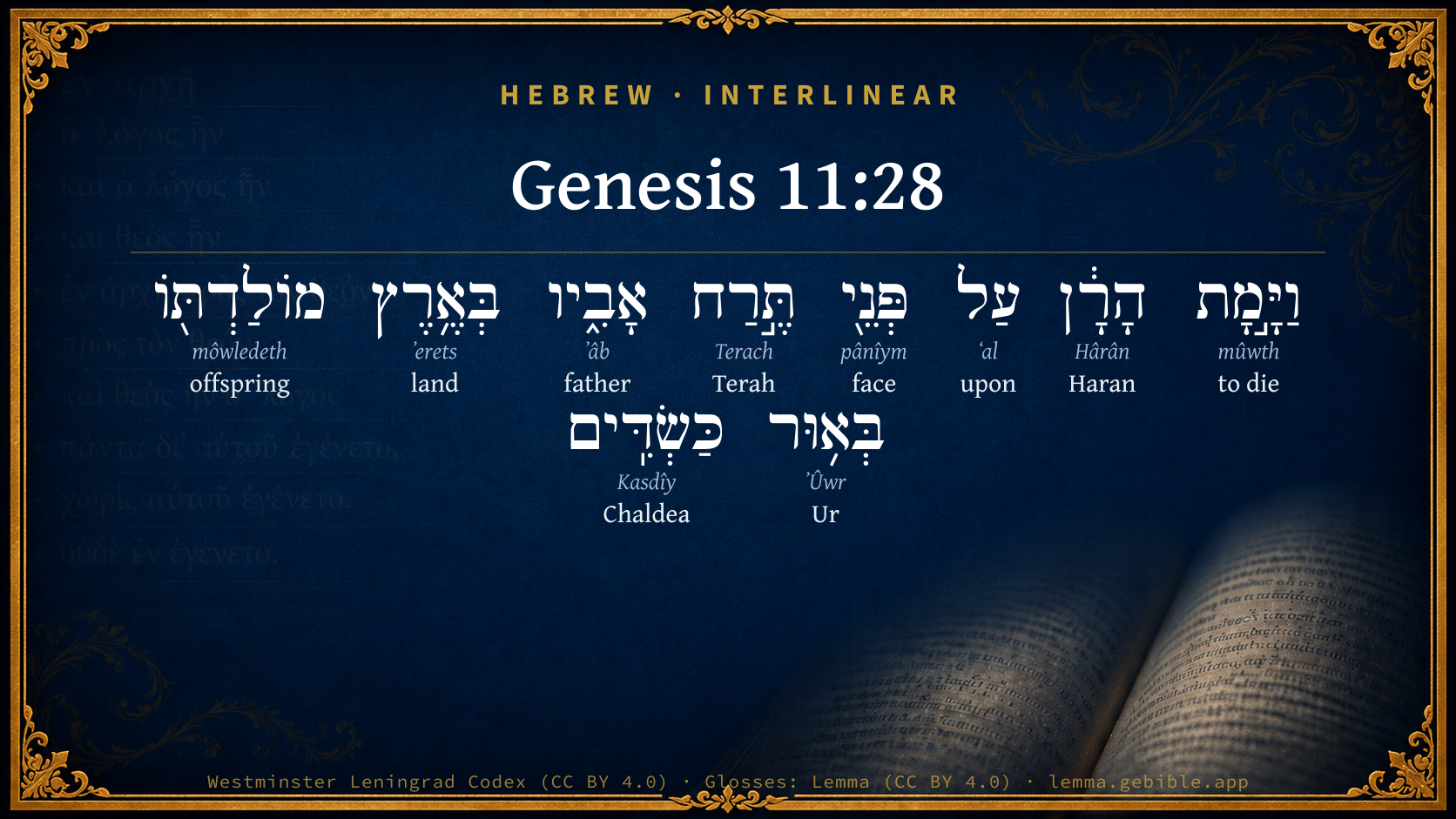
Hebrew (Westminster Leningrad Codex) Genesis 11:28 appears in the Hebrew Old Testament. The text above is from the Westminster Leningrad Codex. Each word links to its Strong’s number, a concise gloss, and parsing drawn from the Open Scriptures Hebrew Bible morphology. Click any word for its full Brown-Driver-Briggs (BDB) entry.
Download image
Cite this verse

Genesis 11:28 (World English Bible). Public Domain. Lemma interlinear Bible study tool, https://lemma.gebible.app/v/genesis/11/28.

Show BibTeX & RIS
BibTeX
RIS
English Translation
Haran died before his father Terah in the land of his birth, in Ur of the Chaldees.
World English Bible · Public Domain
Highlights Full analysis ↓
Download a study sheet

One document with this verse’s original text, its word-by-word gloss line, the meaning frame, cross-references with their text, attributed commentary, and full source and license credits — printable, and it pastes into notes with its structure intact.

This verse Autodidact and up

Study sheet (.html) Plain text (.txt)

A passage Seminary Student

Up to 50 verses in one chapter. A passage sheet keeps up to 6 commentary sources and 12 cross-references per verse, in the order this page ranks them, and says so on the sheet whenever that leaves anything out. Ask for a single verse and you get the Autodidact verse sheet above.

Everything on this page stays free to read, with no account — the sheet is a download of what is already on screen, not access to it.

Want to remove ads? Support Godless Engineer
Compare translations 3

The same verse in 3 English versions, stacked beneath the original-language interlinear above. Click any original word for its lexicon entry.

Each is an independent rendering of the whole verse — the interlinear is not word-aligned to these translations.

Highlighted words mark where these versions differ — a whole-verse word diff, not a word-by-word alignment.

  • World English Bible Public Domain
    Haran died before his father Terah in the land of his birth, in Ur of the Chaldees.
  • King James Version Public Domain
    And Haran died before his father Terah in the land of his nativity, in Ur of the Chaldees.
  • unfoldingWord Literal Text CC BY-SA 4.0
    And Haran died in the presence of Terah his father, in the land of his birth, in Ur of the Chaldeans.

unfoldingWord Literal Text — © unfoldingWord, licensed CC BY-SA 4.0. Word-aligned USFM3 via Door43 (git.door43.org/unfoldingWord/en_ult).

Versions to compare (up to 4)

3 of 4 selected

Show all 18 translations

Every available English version of this verse, each an independent rendering of the whole verse.

  • World English Bible Public Domain
    Haran died before his father Terah in the land of his birth, in Ur of the Chaldees.
  • Berean Standard Bible Public Domain
    During his father Terah’s lifetime, Haran died in his native land, in Ur of the Chaldeans.
  • Majority Standard Bible Public Domain
    During his father Terah’s lifetime, Haran died in his native land, in Ur of the Chaldeans.
  • King James Version Public Domain
    And Haran died before his father Terah in the land of his nativity, in Ur of the Chaldees.
  • American Standard Version (1901) Public Domain
    And Haran died before his father Terah in the land of his nativity, in Ur of the Chaldees.
  • Revised Version (1885) Public Domain
    And Haran died in the presence of his father Terah in the land of his nativity, in Ur of the Chaldees.
  • Geneva Bible (1599) Public Domain
    Then Haran died before Terah his father in the land of his natiuitie, in Vr of the Caldees.
  • Douay-Rheims (1899) Public Domain
    And Aran died before Thare his father, in the land of his nativity in Ur of the Chaldees.
  • Young's Literal Translation Public Domain
    and Haran dieth in the presence of Terah his father, in the land of his birth, in Ur of the Chaldees.
  • Literal Standard Version CC BY-SA 4.0
    and Haran dies in the presence of Terah his father, in the land of his birth, in Ur of the Chaldees.
  • Unlocked Literal Bible CC BY-SA 4.0
    Haran died in the presence of his father Terah in the land of his birth, in Ur of the Chaldeans.
  • unfoldingWord Literal Text CC BY-SA 4.0
    And Haran died in the presence of Terah his father, in the land of his birth, in Ur of the Chaldeans.
  • Darby Bible Public Domain
    And Haran died before the face of his father Terah in the land of his nativity at Ur of the Chaldeans.
  • World Messianic Bible Public Domain
    Haran died in the land of his birth, in Ur-Kasdim, while his father Terah was still alive.
  • Webster's Bible Public Domain
    And Haran died before his father Terah, in the land of his nativity, in Ur of the Chaldees.
  • Free Bible Version CC BY-SA 4.0
    However, Haran died while his father, Terah, was still alive, in Ur of the Chaldeans, the land of his birth.
  • Bible in Basic English Public Domain
    And death came to Haran when he was with his father Terah in the land of his birth, Ur of the Chaldees.
  • JPS Tanakh (1917) Public Domain
    And Haran died in the presence of his father Terah in the land of his nativity, in Ur of the Chaldees.

Literal Standard Version (2020), Covenant Press — licensed CC BY-SA 4.0. Text via the HelloAO Bible API (eBible.org). Unlocked Literal Bible (unfoldingWord) — licensed CC BY-SA 4.0. Text via the HelloAO Bible API (eBible.org). unfoldingWord Literal Text — © unfoldingWord, licensed CC BY-SA 4.0. Word-aligned USFM3 via Door43 (git.door43.org/unfoldingWord/en_ult). Free Bible Version, Dr. Jonathan Gallagher — licensed CC BY-SA 4.0. Text via the HelloAO Bible API (eBible.org).

Word by word

More ways to search: Search by grammar → Find every occurrence → Compare this word →

Practice this passage: Drill this verse → Learn its vocabulary →

בְּא֥וּר
ʼÛwr
H218
“in/at · Ur”
Preposition + Noun, Proper
Part of Speech
Preposition + Noun
Type
Proper
Full BDB Definition

Origin: the same as H217

TWOT: None

Ur = "flame" - city in southern Babylonia, city of the Chaldeans, centre of moon worship, home of Abraham's father, Terah, and departure point for the Abraham's migration to Mesopotamia and Canaan
  1. וַיָּ֣מָת mûwth H4191 “and · to die” Conjunction + Verb, Qal, Sequential Imperfect, 3rd Person, Masculine, Singular
  2. הָרָ֔ן Hârân H2039 “Haran” Noun, Proper
  3. עַל ʻal H5921 “upon” Preposition
  4. פְּנֵ֖י pânîym H6440 “face(s) of” Noun, Common, Both, Plural, Construct
  5. תֶּ֣רַח Terach H8646 “Terah” Noun, Proper
  6. אָבִ֑יו ʼâb H1 “father · his” Noun, Common, Masculine, Singular, Construct + Suffix, Personal, 3rd Person, Masculine, Singular
  7. בְּאֶ֥רֶץ ʼerets H776 “in/at · land of” Preposition + Noun, Common, Both, Singular, Construct
  8. מוֹלַדְתּ֖וֹ môwledeth H4138 “offspring · his” Noun, Common, Feminine, Singular, Construct + Suffix, Personal, 3rd Person, Masculine, Singular
  9. כַּשְׂדִּֽים Kasdîy H3778 “Chaldea” Noun, Proper

About this verse

These counts appear in no published source. They are computed here, from the morphology-tagged text and Lemma’s own curated glosses. What Lemma adds →

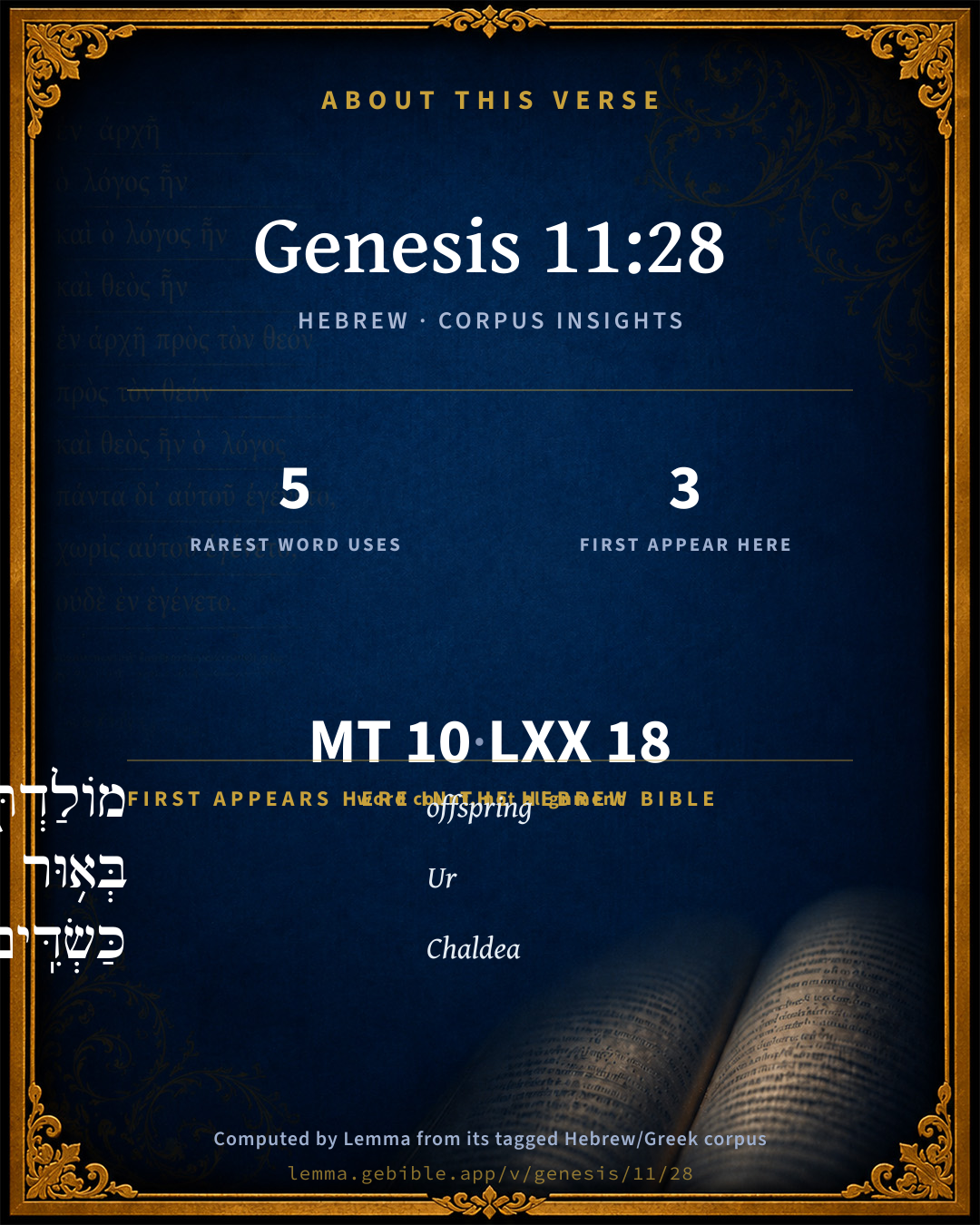
10
words
10
distinct lemmas
Pentateuch
section

Notable vocabulary

The rarest word here is בְּא֥וּר Ur H218 — appearing just 5 times in the whole Hebrew Bible.

First appearance in Scripture

These words make their first canonical appearance in the Hebrew Bible here:

  • מוֹלַדְתּ֖וֹ offspring H4138
  • בְּא֥וּר Ur H218
  • כַּשְׂדִּֽים Chaldea H3778

Shared distinctive vocabulary

בְּא֥וּר Ur H218 occurs in 5 verses of the Hebrew Bible. Also found in:

Grammatical profile

  • 1 verb
  • 8 nouns
  • 1 preposition

Verb forms

  • וַיָּ֣מָת Qal · Sequential Imperfect

Hebrew & Septuagint length

In English translation the verse runs 17 words from the Hebrew and 24 from the Septuagint (LXX English) — the Septuagint runs noticeably longer here. See the side-by-side →

A rough comparison of the two English renderings, which tokenize alike — not a word-level alignment.

Word counts can differ between the Hebrew and the Greek without any difference in meaning — e.g. the Hebrew direct-object marker אֵת has no separate Greek word, and Greek often adds the article ὁ.

In the original languages it is 10 Hebrew tokens and 18 Greek tokens — but the two are counted differently (Hebrew bundles its prefixes and suffixes into one token; the Greek is in lemma form), so that isn’t a like-for-like length.

Cross-references

4

Topical passages linked to Genesis 11:28 in the Treasury of Scripture Knowledge — connected by theme and wording, ordered by reader-vote popularity; previews shown in the World English Bible.

  • Genesis 15:7 He said to him, "I am Yahweh who brought you out of Ur of the Chaldees, to give you this land to inherit it."
  • Genesis 11:31 Terah took Abram his son, Lot the son of Haran, his son's son, and Sarai his daughter-in-law, his son Abram's wife. They went forth from Ur of the Chaldees, to go into the land of Canaan. They came to Haran, and lived there.
  • Nehemiah 9:7 You are Yahweh the God, who did choose Abram, and brought him forth out of Ur of the Chaldees, and gave him the name of Abraham,
  • Acts 7:2–4 He said, "Brothers and fathers, listen. The God of glory appeared to our father Abraham, when he was in Mesopotamia, before he lived in Haran,

Cross-references courtesy of OpenBible.info (CC BY 4.0).

Hebrew and Greek witnesses Masoretic Hebrew ↔ Greek Septuagint

The same verse in the two great witnesses to the Old Testament, shown verse-for-verse.

Here the Septuagint runs noticeably longer than the Hebrew — LXX2012 (modern English Septuagint) 24 words vs World English Bible 17. A rough length comparison of the two English translations, not a word-level alignment — read both below.

These are two independent witnesses, not word-aligned to each other, and the Septuagint is shown in lemma (dictionary) form.

Hebrew Genesis 11:28 Masoretic · Westminster Leningrad Codex

וַיָּ֣מָת הָרָ֔ן עַל פְּנֵ֖י תֶּ֣רַח אָבִ֑יו בְּאֶ֥רֶץ מוֹלַדְתּ֖וֹ בְּא֥וּר כַּשְׂדִּֽים

Haran died before his father Terah in the land of his birth, in Ur of the Chaldees.

World English Bible · Public Domain

Greek LXX Genesis 11:28 Septuagint · lemma form

καί ἀποθνήσκω αρραν ἐνώπιον θαρα ὁ πατήρ αὐτός ἐν ὁ γῆ ὅς γίγνομαι ἐν ὁ χώρα ὁ χαλδαῖος

And Arrhan died in the presence of Tharrha his father, in the land in which he was born, in the country of the Chaldees.

LXX2012 (modern English Septuagint) · Public Domain

On this verse, The Pulpit Commentary discusses the Septuagint’s reading. Read the note in Commentary ↓

Hebrew: Westminster Leningrad Codex (CC BY 4.0). Greek: Septuagint (public domain); English from LXX2012 (modern English Septuagint) (Public Domain). How the Septuagint differs from the Hebrew →

Targum (Aramaic paraphrase)

2

The Targum is the ancient Jewish Aramaic paraphrase of the Hebrew Scriptures — an interpretive translation, not the Hebrew text itself. Onkelos (literal) and Pseudo-Jonathan (expansive) render the Torah, and Jonathan the Prophets. Coverage is partial: where no permissively-licensed English translation exists for a verse, only the Aramaic is shown. This is verse-level text, not a word-by-word alignment to the Hebrew.

  1. Targum Onkelos Torah (Genesis–Deuteronomy)
    וּמִית הָרָן עַל אַפֵּי תֶּרַח אֲבוּהִי בְּאַרְעָא דְּיַלָּדוּתֵהּ בְּאוּרָא דְכַסְדָּאֵי

    And Haran died before Terach his father in the land of his nativity, in Ura of the Kasdaee.

    Targum Onkelos — Aramaic: “Onkelos Genesis” (public domain); “Onkelos Exodus” (public domain); “Onkelos Leviticus” (public domain); “Onkelos Numbers” (public domain); “Onkelos Deuteronomy” (public domain). English: “Sefaria Community Translation” (CC0 1.0 (public-domain dedication)); “J.W. Etheridge. The Targums of Onkelos and Jonathan Ben Uzziel on the Pentateuch. London: Longmans, Green, 1862” (public domain). Text via Sefaria.

  2. Targum Pseudo-Jonathan Torah (Genesis–Deuteronomy)
    וַהֲוָה כַּד רָמָא נִמְרוֹד יַת אַבְרָם לְאַתּוּנָא דְנוּרָא דְלָא פְלַח לְטַעֲוָותֵיהּ וְלָא הֲוָה רְשׁוּתָא לְנוּרָא לְמוֹקְדֵיהּ וּבְכֵן אִתְפְּלַג לִבָּא דְהָרָן לְמֵימַר אִילוּ נָצַח נִמְרוֹד אֱהֵא מִן סִיַעְתֵּהּ וְאִלוּ נָצַח אַבְרָם אֱהֵא מִן סִיַעֲתֵּהּ וּכְדִי חָמוּן כָּל עַמְמַיָא דַהֲווֹ תַמָן דְלָא שָׁלְטַת נוּרָא בְּאַבְרָם אָמְרוּ בְּלִבְּהוֹן הֲלָא הָרָן אֲחוֹי דְאַבְרָם מָלֵא קוּסְמִין וְחַרְשִׁין וְאִיהוּ לָחַשׁ עֲלוֹי אֵישָׁתָא דְלָא לְמֵיקַד יַת אָחוֹי מִן יַד נָפְלַת אֵישָׁתָא מִן שְׁמֵי מְרוֹמָא וּגְמַרְתֵּיהּ וּמִית הָרָן לְמֵיחְמֵי תֶּרַח אֲבוֹי הֵיךְ אִתּוֹקָד בְּאַרְעָא יַלְדוּתֵיהּ בְּאַתּוּן נוּרָא דְעָבְדוּ כַּשְדָאֵי לְאַבְרָם אָחוֹי

    And it was when Nimrod had cast Abram into the furnace of fire because he would not worship his idol, and the fire had no power to burn him, that Haran's heart became doubtful, saying, If Nimrod overcome, I will be on his side: but if Abram overcome, I will be on his side. And when all the people who were there saw that the fire had no power over Abram, they said in their hearts, Is not Haran the brother of Abram full of divinations and charms, and has he not uttered spells over the fire that it should not burn his brother? Immediately (min yad, out of hand) there fell fire from the high heavens and consumed him; and Haran died in the sight of Terah his father, where he was burned in the land of his nativity, in the furnace of fire which the Kasdai had made for Abram his brother.

    Targum Pseudo-Jonathan — Aramaic: “Targum Jonathan on Genesis” (public domain); “Targum Jonathan on Exodus” (public domain); “Targum Jonathan on Leviticus” (public domain); “Targum Jonathan on Numbers” (public domain); “Targum Jonathan on Deuteronomy” (public domain). English: “The Targum of Jonathan ben Uzziel, trans. J. W. Etheridge, London, 1862” (public domain). Text via Sefaria.

Commentary

Notes on Genesis 11:28 from classic Christian and Jewish commentators (each source and its license shown beneath its notes). The classic Christian expositions comment on the surrounding passage and are grouped to its opening verse, so a note may address several verses; the Jewish commentaries on the Tanakh (Rashi and others) are per-verse, so they appear only where the commentator wrote on this verse.

Lemma curates 59 commentaries, every one of them public domain or Creative Commons licensed, each selected and text-cleaned for this edition rather than reprinted as found. About our sources →

Trapp's Complete Commentary

John Trapp

Gen 11:28 And Haran died before his father Terah in the land of his nativity, in Ur of the Chaldees.

Ver. 28. And Haran died before his father Terah.] The Hebrews say he died a martyr, being burnt with fire by his countrymen the Chaldees, because he would not worship the fire, which they had made their god. Martyrdom came early into the world, as we know in Abel, who as he was the first that died, so he died for religion. Now if this be true of Haran, as the Jewish doctors will have it; then he had, for aught we know, the maidenhead (as a certain martyr phrased it) of that kind of martyrdom. The first that were burnt for religion, since the Reformation, are said to be Henry and John, two Augustinian monks at Brussels, anno 1523, under James Hogostratus the Dominican Inquisitor. The executioner, being demanded whether they recanted in the flames, denied there was any such thing; but said, that when the fire was put to them, they continued singing the creed, and Te Deum , till the flame took away their voice. All this Erasmus testifieth, {a} though he was no Lutheran; and thereupon maketh this good but wary note, Damnari, dissecari, suspendi:, exuri, decollari, piis cum impiis sunt communia: damnare, dissecare, in crucem agere, exurere, decollare, bonis iudicibus cum piratis ac tyrannis communia sunt. Varia sunt hominum iudicia, ille foelix qui iudice Deo absolvitur . Our protomartyr in Queen Mary’s days was Reverend Master Rogers; he gave the first adventure upon the fire. His wife, and children, being eleven in number, ten able to go, and one sucking at her breast, met him by the way as he went toward Smithfield. This sorrowful sight of his own flesh and blood could nothing move him, but that he constantly held out to the death, and so received a crown of life. {b} Neither hath God left himself without witness among the very heathens. For in the city of Lima, in Mexico, not two months before our coming there, saith Captain Drake, {c} twelve persons were condemned by the Spaniards there for profession of the gospel; of which, six were bound to one stake and burnt; the rest remained yet in prison, to drink of the same cup within a few days.

{a} Erasm., lib. xxiv., epist. 4.

{b} Act. and Mon., fol. 1356.

{c} The World Encompassed, by Sir F. Drake p. 59.

John Trapp, A Commentary or Exposition upon All the Books of the Old and New Testament (1647–1656) — public domain. Text from a community e-Sword module.

Whedon's Commentary on the Bible

Daniel D. Whedon

MIGRATION FROM UR, Gen_11:28-32.

28. And Haran died before his father Terah — That is, in the presence of Terah, or it may mean before, as a designation of time, (see Gesenius,) since the phrase refers to both place and time. If Haran were, as we suppose, the eldest son, there is a special reason why his death should here be mentioned. Terah, as the head of the family tribe, adopts Lot, his grandson, in the place of Haran, his son, as heir to the chieftainship, and then, perhaps, saddened at his loss, under a providential leading, resolves to emigrate from his native land. Abram, as we learn from Act_7:2, had already heard a divine call to break loose from the idolatries that surrounded him, and in which it seems that Terah’s family were involved, for Joshua says to the Israelites: “Your fathers dwelt on the other side of the flood [Euphrates] in old time… and they served other gods.”

Jos_24:2, note.

Ur of the Chaldees — Ur was a city, or district, of the כשׂדים, Kasdim, Kardi, Kurds, or Kaldees, a people not mentioned in the table of nations, Genesis 10, under this name, but whose native name, Accad, as it appears in the Babylonian inscriptions, is mentioned in Gen_10:10, as designating a city in the land of Shinar, the beginning of the (Hamite) kingdom of Nimrod. The primitive Chaldees were an Hamitic people, descendants of Cush, famous as the builders of the first cities, inventors of alphabetic writing, and discoverers in science, especially in astronomy. The name was afterward applied (as in Daniel) to a sect of astrologers and philosophers, who inherited the science and astrologic arts of the ancient Chaldees, and transmitted them in the Cushite language, although dwelling among Shemitic peoples. These Chaldeans of the time of Daniel were thus a learned aristocracy, who had their schools, corresponding to modern universities, (Strabo, 16:1, 6,) at Orchoe and Borsippa, and also (Pliny, H. N., 11:26) at Babylon and Sippara. Chaldea is the great alluvial plain of the Euphrates and Tigris, stretching from the mountains of Kurdistan to the Persian Gulf, about 400 miles in length, and about 100 in breadth, ascending on the east to the chalky limestone wall of the great table-land of Iran, and descending on the west to the Arabian desert. Covered for many centuries with the mighty cities, and teeming with the vast populations, of the Assyrian and Babylonian empires, the whole plain fertilized through a network of canals branching from the two great arterial rivers, it is now a desert, with swamps and marshes and pools, the dwelling-place of lions and jackals and wolves, although in early spring it seems a wilderness of flowers. The great plain is ridged here and there along the courses of ancient canals, and dotted with mounds of earth-covered ruins, from which now and then a solitary mass of ragged brickwork rises into the malarious air. Ur is supposed by Rawlinson to be the Hur of the Babylonian inscriptions, the modern Mugheir, in lower Chaldea, about six miles west of the Euphrates. Orfa, in upper Chaldea, is a rival site, but this place is too near Haran, being only a day’s journey distant. On the rude bricks of Mugheir are found legends of Urukh, king of Hur, the most ancient inscriptions known, unless it be those of a king called Kadur-mapula, found in the same region, who is likely to have been the Elamite Chedorlaomer of Genesis 14. The ruins of a Chaldean temple dedicated to the moon, built in stages like the Tower of Babel, (see above, p. 162,) and composed of sun-dried and kiln-burnt bricks cemented with bitumen, are yet found at Mugheir, whose inscriptions are deemed by Assyrian scholars to show an antiquity higher than Abram’s call. This venerable temple, now nearly 4,000 years old, when it stood in massive magnificence, a monument of Chaldean idolatry, we may probably regard as the very shrine where the family of Terah worshipped; and they turned away from its splendours at the divine call to wander to a far land, there to dwell in tents for centuries, that they might learn to teach mankind the lessons of the ONE only GOD. Whether Terah himself had these higher motives is doubtful. See on Gen_11:31.

Daniel D. Whedon (gen. ed.), Commentary on the Old and New Testaments (1874–1909) — public domain. Text from a community e-Sword module.

Tyndale Open Study Notes

Tyndale Open Resources

11:28 The call of Abram occurred in Ur of the Chaldeans (15:7; Acts 7:2-4), the main city of Sumer in Mesopotamia near the mouth of the Persian Gulf. The family had moved there perhaps generations before the call. Their ancestral home (“native country,” Gen 12:1) was apparently near Haran, in the region of the descendants of Shem (11:10-26); thus they settled there when they left Ur (11:31) and were later described as “Arameans” (Deut 26:5). • land of his birth: The same Hebrew phrase is repeated in 12:1 (“native country”), making Ur, not Haran, the location of Abram’s call (see 15:7; Neh 9:7; Acts 7:2).

Tyndale Open Study Notes — © Tyndale Open Resources, licensed CC BY-SA 4.0. Text via the HelloAO Bible API.

Geneva Bible (1599)

Geneva Bible translators

Hebrew, Casdim.

Geneva Bible (1599) marginal notes — public domain. Text via Bolls.life.

Jamieson, Fausset & Brown

Robert Jamieson, A. R. Fausset & David Brown

Ur--now Orfa; that is, "light," or "fire." Its name probably derived from its being devoted to the rites of fire-worship. Terah and his family were equally infected with that idolatry as the rest of the inhabitants (Jos 24:15).

Jamieson, Fausset & Brown — Commentary Critical and Explanatory on the Whole Bible (1871) — public domain (CC PDM 1.0). Text via the HelloAO Bible API.

John Calvin's Commentaries

28. And Haran died. Haran is said to have died before the face of his father; because he left his father the survivor. It is also said that he died in his country, that is, in Ur. The Jews turn the proper name into an appellative, and say that he died in the fire. For, as they are bold in forging fables, they pretend that he, with his brother Abram, were thrown by the Chaldeans into the fire, because they shunned idolatry; but that Abram escaped by the constancy of his faith. The twenty-fourth chapter of Joshua (Joshua 24:1,) however, which I have cited above, openly declares, that this whole family was not less infected with superstition than the country itself. I confess, indeed, that the name Ur is derived from fire: names, however, are wont to be assigned to cities, either from their situation, or from some particular event. It is possible that they there cherished the sacred fire, or that the splendor of the sun was more conspicuous than in other places. Others will have it, that the city was so named, because it was situated in a valley, for the Hebrews call valleys ארוים (Uraim) But there is no reason why we should be very anxious about such a matter: let it suffice, that Moses, speaking of the country of Abram immediately afterwards declares it to have been Ur of the Chaldeans.

John Calvin's Commentaries (1540-1563) — public domain. Text from the Calvin Translation Society English edition (1840s-50s) via the Christian Classics Ethereal Library (ccel.org). Calvin's coverage is partial (roughly two-thirds of the Bible); uncommented books and verses are honest gaps, never fabricated. The 19th-century editor's footnotes and remarks are omitted so the notes are faithfully Calvin's own voice.

Ellicott's Commentary for English Readers

(28) Haran died before his father.—Heb., in the presence of his father. This is the first recorded instance of a premature death caused by natural decay.

In Ur of the Chaldees.—Ur-Casdim. A flood of light has been thrown upon this town by the translation of the cuneiform inscriptions, and we may regard it as certain that Ur is now represented by the mounds of the city of Mugheir. When first we read of this city, it was inhabited by a population of Accadians, a Turanian race, sprang probably from an early offshoot of the family of Japheth; but in course of time it was conquered by men of the Semitic family, who from thence overran the whole of Shinar, or Babylonia, and expelled from it the descendants of Cush. Mr. Sayce (Chald. Gen. p. 20) puts this conquest at some very uncertain date, two or three thousand years before Christ; but the establishment of a powerful monarchy under a king named Lig-Bagas, and the consolidation under his sway of several petty kingdoms, into which Chaldea had been previously split up, he places with some confidence at 3,000 years before the Christian era (ibid., p. 24). Now, there are in our museums inscribed bricks and engraved cylinders actually from the library of Lig-Bagas, and we learn that the Accadian literature was still older; for many of the works found at Agané are translations from it: and thus all those difficulties as to the antiquity of the art of syllabic writing which used to exist when men had nothing better to judge by than Egyptian picture-writing have passed away. Abraham migrated from a town which was then a famous seat of learning, and where even the ordinary transactions of life were recorded on tablets of terra-cotta. Very probably, therefore, he carried with him bricks and cylinders inscribed with these ancient records. We are no longer, therefore, surprised at the striking similarity between the narratives in the Book of Genesis prior to the migration of Abraham and those preserved in the cuneiform inscriptions. But the believer in inspiration cannot fail to be struck also at their dissimilarity. The cuneiform inscriptions are polytheistic, acknowledging twelve superior gods, and of gods inferior a countless multitude. The Semitic race is accused of adding to these a number of goddesses, chief among whom were Beltis, the wife of Bel, and Istar, the planet Venus. Of all this there is no trace in the Biblical records; nor is there in the whole Chaldean literature anything so grand and Divine as the thoughts expressed in the opening words of Genesis: “In the beginning God created the heaven and the earth.”

As Ur is an Accadian word, we must reject all Semitic interpretations of its meaning; we must further add that Mr. Rawlinson gives reasons for believing that its early importance was due to its being a great maritime emporium (Anc. Mon., i. 27). It was, we read, a walled town, and the great port for the commerce of the Persian Gulf, while round it lay a marvellously rich country, said to be the original home of the wheat-plant, and famous for its dates and other fruits. Its being called Ur-Casdim, “Ur of the Chaldees,” shows that they had already won it from the Accadians when Terah dwelt there. Its subsequent name, Mugheir, probably means “mother of bitumen”—that is, producer of it.

A Bible Commentary for English Readers, edited by Charles John Ellicott (1878–1897) — public domain. Text from a community e-Sword module.

The Cambridge Bible for Schools and Colleges

gen. ed. J. J. S. Perowne

28. This and the following verse are taken from J, and commence the personal history of the patriarch.

Haran died] This may indicate a tradition that the hill people, or families who joined the main body of the Terahites, lost their separate existence and became completely merged in the house of Terah.

The grave of Haran was shewn in the days of Josephus (Ant. i. 151).

in the presence of his father] i.e. while his father Terah was still alive.

in the land of his nativity] To these words is appended the explanation, “in Ur of the Chaldees,” very possibly added as a gloss by a later hand, as in Gen_15:7. Abram in Gen_24:4; Gen_24:7; Gen_24:10 refers to Haran, or Aram naharaim, as the land of his nativity; and that region is generally treated as the home of the ancestors of the Israelites. It is clear, however, that, beside the tradition which ascribed the origin of Israel to Mesopotamia, there was also another which derived them ultimately from S. Babylonia. See Gen_11:31.

The Cambridge Bible for Schools and Colleges (gen. ed. J. J. S. Perowne; Cambridge University Press, 1878–1918) — public domain. Text from a community e-Sword module.

Matthew Poole's English Annotations

i.e. In the presence and during the life of his father.

Matthew Poole's English Annotations on the Holy Bible (1683–1685) — public domain. Text from a community e-Sword/MySword module.

The Pulpit Commentary

And Haran died before his father. Literally, upon the face of his father; ejnwpion tou patrov aujtou (LXX); while his father was alive (Munster, Luther, Calvin, Rosenm perhaps also in his father s presence (Keil, Lange), though the Jewish fable may be discarded that Terah, at this time an "idolater, accused his sons to Nimrod, who cast them into a furnace for refusing to worship the fire-god, and That,haran perished in the flames in his father s sight. The decease of Haran is the first recorded instance of the natural death of a son before his father. In the land of his nativity. jEn th gh h ejgennhqh (LXX). In Ur of the Chaldees. Ur Kasdim (Gen_11:31 Gen_15:7; Neh_9:7) The Kasdim formerly believed to have been Shemites on account of

(1) Abram"s settlement among them,

(2) the preservation of the name Kesed among his kindred, (Gen_22:22)

(3) the close affinity to a Shemite tongue of the language known to modern philologists as Chaldee, an Arameean dialect differing but slightly from the Syriac (Heeren), and

(4) the supposed identity or intimate connection of the Babylonians with the Assyrians (Niebuhr) are now, with greater probability, and certainly with closer adherence to Biblical history, (Gen_10:8-12) regarded as having been a Hamite race (Rawlinson, Smith); an opinion which receives confirmation from

(1) the statement of Homer ("Odyss.," 1:23, 24), that the Ethiopians were divided and dwelt at the ends of the earth, towards the setting and the rising sun, i.e. , according to Strabo, on both sides of the Arabian Gulf;

(2) the primitive traditions

(a) of the Greeks, who regarded Memnon, King of Ethiopia, as the founder of Susa (Herod., 5:54), and the son of a Cissian woman (Strabo, 15:3,

(b) of the Nilotic Ethiopians, who claimed him as one of their monarchs; and

(c) of the Egyptians, who identified him with their King Amunoph III, whose statue became known as the vocal Memnon (vide Rawlinson"s "Ancient Monarchies," vol. 1. p. 48);

(3) the testimony of Moses of Chorene ("History of Armenia," 1:6), who connects in the closest way Babylonia, Egypt, and Ethiopia Proper, identifying Belus, King of Babylon, with Nimrod, and making him the son of Mizraim, or the grandson of Cush; and

(4) the monumental history of Babylonia, which shows the language of the earliest inscriptions, according to Rawlinson "differing greatly from the later Babylonian," to have been that of a Turanian people (cf. "Records of the Past," vol. 3. p. 3). The term Ur has been explained to be identical with It, a city (Rawlinson); the Zend Vare, a fortress (Gesenius); Ur, the light country, i.e. the land of the sun-rising (Furst); and even Ur, fire, with special reference to the legendary furnace already referred to (Talmudists). Whether a district (LXX, Lange, Kalisch) or a city (Josephus, Eusebius, Onkelos, Drnsius, Keil, Murphy, "Speaker"s Commentary"), its exact site is uncertain. Rival claimants for the honor of representing it have appeared in

(1) a Persian fortress (Persicum Castellum) of the name of Ur, mentioned by Ammianus Marcellinus (75. 100. 8) as lying between Nisibis and the Tigris (Bochart, Michaelis, Rosenm Delitzsch);

(2) the modern Orfah, the Edsssa of the Greeks, situated "on one of the bare, rugged spurs which descend from the mountains of Armenia into the Assyrian plains" (Stanley"s "Jewish Church," 1:7); and

(3) Hur, the most important of the early capitals of Chaldaea, now the ruins of Mugheir, at no great distance from the mouth, and six miles to the west, of the Euphrates (Rawlinson"s "Ancient Monarchies," 1:15, 16; Smith"s "Assyrian Discoveries," 12:233; "Records of the Past," vol. 3. p. 9). Yet none of them is quite exempt from difficulty. A military fort, to take the first-named location, does not appear a suitable or likely place for a nomade horde to settle in; while the second has been reckoned too near Charran, the first place of encampment of the emigrants; and the third, besides being exceedingly remote from Charran, scarcely harmonises with Stephen"s speech before the Sanhedrim. (Act_7:2) Unless, therefore, Stephen meant Chaldsea when he said Mesopotamia (Dykes), and Abraham could speak of Northern Mesopotamia as his country, (Gen_24:4) when in reality he belonged to Southern Babylonia, the identification of Ur of the Chaldees with the Mugheir ruin though regarded with most favor by archaeologists, will continue to be doubtful; while, if the clan march commenced at Edessa, it will always require an effort to account for their coming to a halt so soon after starting and so near home; and the Nisibis station, though apparently more suitable than either in respect of distance, will remain encumbered with its own peculiar difficulties. It would seem, therefore, as if the exact situation of the patriarchal town or country must be left undetermined until further light can be obtained.

The Pulpit Commentary (1880–1919), ed. H.D.M. Spence-Jones & Joseph S. Exell — public domain. Text from a community e-Sword module.

Rashi

Rabbi Shlomo Yitzchaki (Rashi)

על פני תרח אביו IN THE PRESENCE OF HIS FATHER TERAH — meaning during his father’s lifetime (Genesis Rabbah 38:13). The Midrashic explanation is that he died through his father. For Terah accused his son Abram before Nimrod of having smashed his idols to pieces, and he cast him into a fiery furnace. Haran waited and said to himself, “If Abram proves triumphant I will be on his side; if Nimrod wins I shall be on his”. When Abram was saved they said to Haran, “Whose side are you on?” Haran replied, “I am on Abram’s side”. They therefore cast him into the fiery furnace and he was burnt to death. It is to this that the name of the place Ur-Kasdim (fire of the Chaldees) alludes (Genesis Rabbah 38:13). Menachem ben Seruk, however, explains that אור means a valley, as (Isaiah 24:15) “Glorify ye the Lord in the valleys (באורים)”, and as (Isaiah 11:8) “the den (מאורת) of the basilisk”. Every hole or deep cleft may be called אור.

Rashi on the Tanakh — English translations: “The Judaica Press complete Tanach with Rashi, translated by A. J. Rosenberg” (CC BY 4.0); “Pentateuch with Rashi's commentary by M. Rosenbaum and A.M. Silbermann, 1929-1934” (public domain); “The Metsudah Tanach series, Lakewood, N.J” (CC BY 4.0); and “The Book of Joshua, Metsudah Publications, 1997” (CC BY 4.0). Text via Sefaria.

Ramban (Nachmanides)

Rabbi Moshe ben Nachman (Ramban / Nachmanides)

AND HARAN DIED IN THE PRESENCE OF HIS FATHER TERAH IN THE LAND OF HIS BIRTH IN UR OF THE CHALDEES. In accordance with the words of our Rabbis, Rashi wrote, “Terah accused his son Abram before Nimrod of having broken his idols, and he cast him into a fiery furnace. Meanwhile Haran waited and said to himself, ‘if Abram proves triumphant I will be on his side, and if Nimrod wins I shall be on his.’ When Abram was saved, they said to Haran, ‘On whose side are you?’ He replied, ‘I am on Abram’s side.’ They therefore cast him into the fiery furnace, and he was burnt to death. It is to this event that the name Ur Kasdim (fire of the Chaldees) alludes. Menachem ben Saruk, however, explained the word ur as meaning ‘valley.’ So also, Therefore glorify ye the Eternal ‘ba’urim’ (in the valleys), and also, ‘me’urath’ (the den of) the basilisk., 11:8. Every hole or deep cleft may be called ur.” This matter received by our Rabbis through tradition is the truth, and I will elucidate it.Our father Abraham was not born in the land of Chaldaea. His ancestors were descendants of Shem, and Chaldaea and the whole land of Shinar were countries inhabited by the sons of Ham, and Scripture states, And he told to Abram the ‘Hebrew,’ not Abram the Chaldean. And it is further written, Your fathers dwelt in days of old beyond the river, Terah the father of Abraham, and the father of Nahor, the word mei’olam (of old) teaching that his origins were always from there. And again Scripture states, And I took your father Abraham from beyond the river. 3. Proof of the matter is that we find Nahor [Abraham’s brother] in Haran. Now if Terah’s place were in Ur of the Chaldees in the land of Shinar and Scripture relates that upon Terah’s going forth from Ur of the Chaldees he took with him only his son Abram, his grandson Lot the son of Haran, and Sarai his daughter-in-law, then Nahor was left in the land of Chaldaea, [and yet we find that he was in Haran, which is in the land of Mesopotamia, as explained further].But the truth of the matter is that the country of the birth of Abraham’s ancestors was the land of Aram, which is beyond the River Euphrates; this was always the habitat of his ancestors. Thus Scripture says concerning the children of Shem, And their dwelling was from Mesha, as thou goest toward Sephar, unto the mountain of the east, this being a generic name applicable to all their countries, as it is written there, in their land, after their nations, and again it is written, From Aram Balak bringeth me, the king of Moab from the mountains of the east, [proving that Aram is in the land of “the mountains of the east”]. Thus it is clear that Abram and his ancestors always lived in the land of Aram. Furthermore, we find in the Talmud that Abraham was imprisoned [by Nimrod because he broke the idols] in Cuthah, and that city is not in the land of Chaldaea, for it is written, And the king of Assyria brought men from Babylon, and from Cuthah, and from Avva, and from Hamath, and it is further written, And the men of Babylon made Succoth-benoth, and the men of Cuth made Nergal., Verse 30. But it would appear that Cuthah is a city beyond the river, in the land of Mesopotamia, for Haran is the name of a city in the land of Mesopotamia, as it is written, And he went to Aram-naharaim [Mesopotamia], unto the city of Nahor, which is Haran. Furthermore, we have investigated and know it from the word of many students who lived in that country that Cuthah is a large city between Haran and Assyria, far from the country of Babylon. The distance between it and Haran is about that of a six-day journey. It is, however, included in the term, “beyond the river,” 3. because it lies between Mesopotamia and the River Euphrates — which is the border of the land of Israel — and the Tigris which goeth towards the east of Assyria. Thus Terah begot his older sons, Abraham and Nahor, in the area “beyond the river,” the land of his ancestors. He then went with his son Abram to the land of Chaldaea, where his youngest son, Haran, was born. His son Nahor, however, remained “beyond the river,” in the city of Haran. It may be that he was born there or that he came to settle there from Cuthah. This is the meaning of [the verse here which says of Haran], in the land of his birth, in Ur of the Chaldees, since that was the birthplace of Haran alone [among Terah’s children].This matter received through tradition [that Cuthah was the birthplace of Abraham] is also found in a book called The Antiquities of the Nations, as the Rabbi, Note 139. wrote in the Moreh Nebuchim that in the book of Egyptian Agriculture it is mentioned that Abraham, who was born in Cuthah, differed with the opinion of the people who worshipped the sun, and the king put him in prison, but he continued to argue against them for many days. At last the king was afraid that he might corrupt his land and turn the people away from their religion, and so he expelled him to the far land of Canaan, after confiscating all his wealth.Thus in any case it was in this place, the land of Chaldaea, that a miracle — or more exactly a hidden miracle — was done to our father Abraham, for G-d put it into the heart of that king to save him and not to kill him, and so he released him from prison to go where he desires. It may be that it was an overt miracle, i.e., that the king threw him into a fiery furnace, and he was saved, as our Rabbis have stated. Let not Rabbi Abraham ibn Ezra mislead you with his questions, saying that Scripture has not narrated this wonder, for I will yet give you a reason for the omission and proof of the verity of this and other miracles like it. These peoples, however, did not mention it in their books because they differed with his [the Patriarch’s] opinion, and they thought his miracle was a deed of sorcery, just as was the case with our teacher Moses in his confrontation with the Egyptians at the beginning of his deeds. It is on account of this that Scripture no longer mentions this miracle [of Abraham] for it would have had to mention the words of those who differed with him, as it mentioned the words of the Egyptian magicians, and Abraham’s words were not as openly verified to them as were ultimately the words of our teacher Moses, [which were established by ten clearly revealed miracles]. Thus Scripture says, I am the Eternal that brought thee out of Ur of the Chaldees to give thee this land to inherit it, for the word hotzeisicha (brought thee out) points to a miracle. It does not say, “that took thee from Ur of the Chaldees;” instead it says, that brought thee out, meaning that He brought out a prisoner from the dungeon just as in the verse: that brought thee out from the land of Egypt. And He said to Abraham, to give thee this land to inherit it, because from the time that G-d brought him out of Ur of the Chaldees, it was His Will, exalted be He, to make him into a great nation and to give him this land of Canaan. From that day on which Abraham was saved, Terah — his father — and Abraham had in mind to go to the land of Canaan, a distant point far from the land of Chaldaea, out of fear of the king, since Haran, [the city of their inhabitance], was near them [the Chaldeans], and they were one people with one language since Aramaic was their common language. They [Terah and Abraham] wanted to go to a nation where their speech would not be understood by that king and his people. This is the meaning of the verse, And they went forth with them from Ur of the Chaldees, to go into the land of Canaan, and they came unto Haran where their families and ancestors ever lived, and they settled among them, staying there for many days. It was there that Abraham was commanded to do what he had intended, i.e., to go to the land of Canaan, and so he left his father, who later died there in Haran, his country, and went with his wife and Lot, his brother’s son, to the land of Canaan. Thus Scripture says, And I took your father Abraham from beyond the river, and led him throughout all the land of Canaan, 3. for Abraham was commanded concerning this when he was yet “beyond the river,” and from there G-d took him and led him throughout all the land of Canaan.Now according to the opinion of our Rabbis [that Nimrod threw Abraham into a fiery furnace, the name] Ur Kasdim will be understood as the plain meaning indicates, [namely, “Fires of the Chaldees”], from the same expression: I am warm, I have seen ‘ur’ (the fire). Scripture thus says, And they went forth with them from Ur of the Chaldees, even though Terah did not go forth from the fiery furnace. However, since Abram is the main [person of interest, it mentions Ur Kasdim although the name has reference to him alone]. It may be that on account of the miracle the place came to be so called, just as we find, And at Taberah, and at Massah, and at Kibroth-hattaavah, and others. Scripture thus alludes that when Abram went forth from the fiery furnace, they all fled from that country.And the meaning of the verse, Glorify ye the Eternal ‘ba’urim,’ is in my opinion consonant with that which the Rabbis have said [concerning Ur Kasdim, namely, that it means “the Fire of the Chaldees”], for urim are the high mountains on which they make fires and “kindle the flares” to make the new events known quickly in distant places, even as it says [in the second half of the verse]: In the isles of the sea, the name of the Eternal, the G-d of Israel. The sense of that verse is thus that for the glory of G-d they should let the whole world know the miracle and the wonder which had been done to them. So also, ‘Me’urath’ the basilisk, 11:8. means his [the serpent’s] hole, where his fire and great heat are, just as he is indeed called saraph [the serpent, but literally, “the burning one”]. And I have seen in the Midrash: “Arise, ‘uri’ (shine). Therefore glorify ye the Eternal ‘ba’urim.’ How do you glorify Him? Rabbi Yeivo bar Kahana said, ‘With these torches such as the lanterns which burn in synagogues in all places, even in the isles of the sea, to the glory of G-d.’” Thus it is clear that the Rabbis understood the word ba’urim as an expression of fire, in accordance with its simple sense.

Ramban (Nachmanides) on the Tanakh — English translation: “Commentary on the Torah by Ramban (Nachmanides). Translated and annotated by Charles B. Chavel. New York, Shilo Pub. House, 1971-1976” (CC BY 4.0). Text via Sefaria.

Radak

Rabbi David Kimhi (Radak)

וימת הרן על פני תרח אביו, during his father’s lifetime. Something parallel occurred when the two sons of Aaron, Nadav and Avihu died during the lifetime of their father (Numbers 3,4).

בארץ מולדתו, the Torah mentions this seeing that Terach, Haran’s father did not die in the land where he had been born, but died in Charan after having emigrated there. This became the reason why Lot emigrated with his grandfather Terach from Ur Kasdim.

באור כשדים, a place known nowadays as Ur Kasdim, It could not have had that name at the time Terach and Avraham lived, as כשד the son of Nachor had not been born until later (Genesis 22,22) The offspring of this Kessed became were known as the Kasdim.

אור, the word means: “valley.” It occurs in this sense also in Isaiah 24,15 על כן באורים כבדו ה', “therefore honour the Lord in the valleys.” The view of our sages in the Midrash that the name is a reference to the place where Avraham was saved from the furnace of Nimrod is well known. (Bereshit Rabbah 38,13) They understand the word אור as meaning “fire.”

Radak on the Tanakh — English translations: “Sefaria Community Translation” (CC0 1.0 (public-domain dedication)); “Eliyahu Munk, HaChut Hameshulash” (CC BY 4.0); “Rabbi Mike Feuer, Jerusalem Anthology” (CC BY 4.0); and “R. David Kimhi on the first book of Psalms, Translated by R.G. Finch, London, 1919” (public domain). Text via Sefaria.

Lesson kit

Teaching starters — assembled from the data on this page, not authored interpretation. Every prompt links to the verse data it draws on. Edit before teaching.

Genesis, in the Pentateuch, opens this verse with 10 words (10 distinct Hebrew lemmas). Its most distinctive word is ʼÛwr (“Ur”). The Greek Septuagint runs longer here. A historical commentator’s framing appears above. Read the whole chapter for the surrounding context.

Discussion questions

  1. How does “Ur” (ʼÛwr) shape what this verse is saying?
  2. 3 words here appear for the first time in Scripture. What is being introduced at this debut?
  3. Genesis 11:31 shares the word «Ur» with this verse. How do the two illuminate each other?
  4. Compared with the Hebrew, the Septuagint runs longer here. What questions does that raise?
  5. These translations render this verse differently. What is at stake in choosing one wording over another?
  6. The verb «וַיָּ֣מָת» is Qal Sequential Imperfect. How does its form color the action?
  7. Reading how Trapp's Complete Commentary and Whedon's Commentary on the Bible read this verse, where do the two commentators agree and where do they part?

Things to notice

Reading settings

Reading text

Shown beneath each verse's original-language words.

Old Testament
Old Testament edition

Read the OT as the Masoretic Hebrew (MT) or the Greek Septuagint (LXX).

English shown for the Greek Septuagint (in the Hebrew ↔ Greek comparison).

Comparing translations? Open the Compare panel on any verse page to stack up to four side by side.