Numbers 16:49

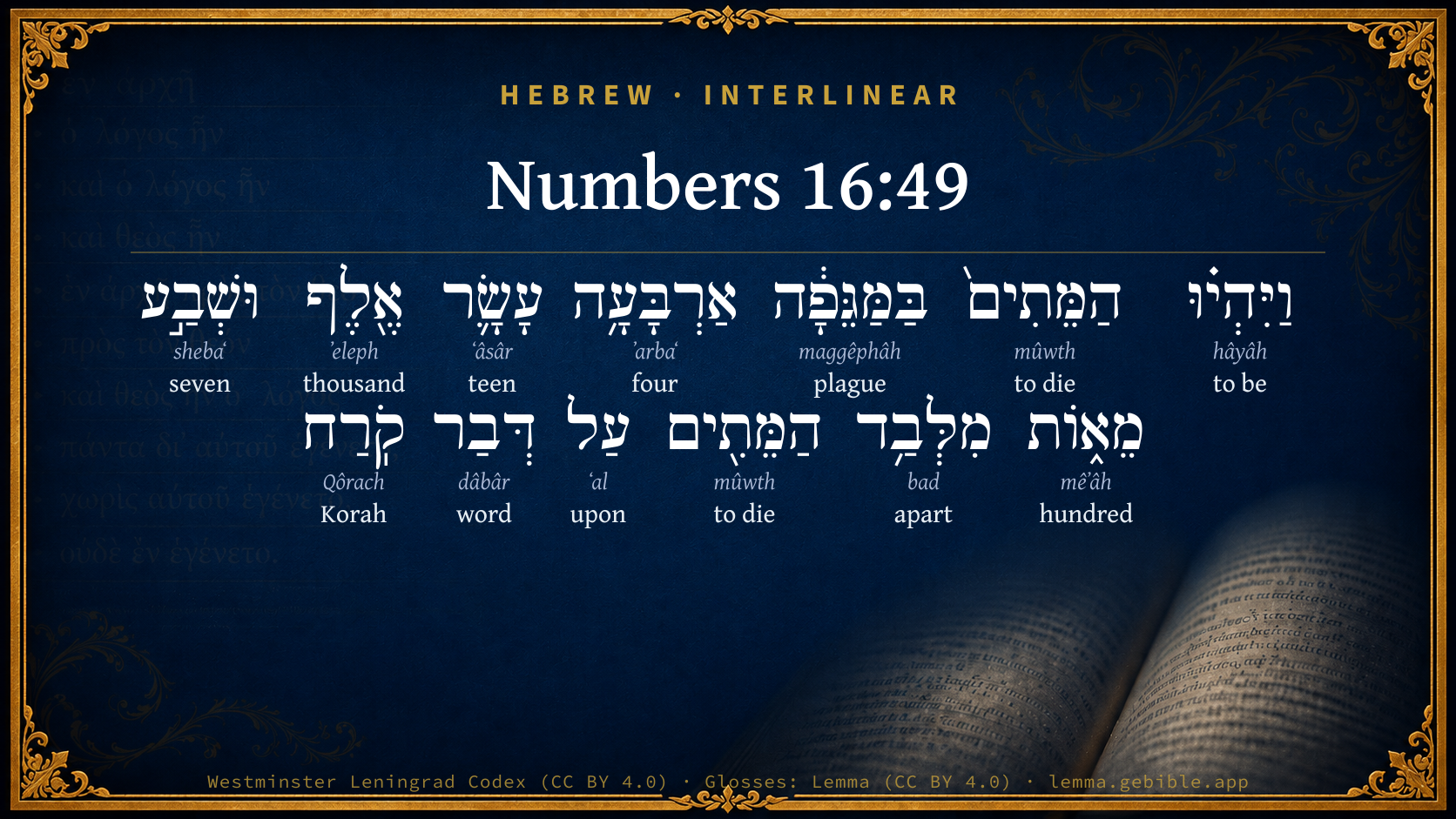
Hebrew (Westminster Leningrad Codex) Numbers 16:49 appears in the Hebrew Old Testament. The text above is from the Westminster Leningrad Codex. Each word links to its Strong’s number, a concise gloss, and parsing drawn from the Open Scriptures Hebrew Bible morphology. Click any word for its full Brown-Driver-Briggs (BDB) entry.
Download image
Cite this verse

Numbers 16:49 (World English Bible). Public Domain. Lemma interlinear Bible study tool, https://lemma.gebible.app/v/numbers/16/49.

Show BibTeX & RIS
BibTeX
RIS
English Translation
Now those who died by the plague were fourteen thousand and seven hundred, besides those who died about the matter of Korah.
World English Bible · Public Domain
Download a study sheet

One document with this verse’s original text, its word-by-word gloss line, the meaning frame, cross-references with their text, attributed commentary, and full source and license credits — printable, and it pastes into notes with its structure intact.

This verse Autodidact and up

Study sheet (.html) Plain text (.txt)

A passage Seminary Student

Up to 50 verses in one chapter. A passage sheet keeps up to 6 commentary sources and 12 cross-references per verse, in the order this page ranks them, and says so on the sheet whenever that leaves anything out. Ask for a single verse and you get the Autodidact verse sheet above.

Everything on this page stays free to read, with no account — the sheet is a download of what is already on screen, not access to it.

Want to remove ads? Support Godless Engineer
Compare translations 3

The same verse in 3 English versions, stacked beneath the original-language interlinear above. Click any original word for its lexicon entry.

Each is an independent rendering of the whole verse — the interlinear is not word-aligned to these translations.

Highlighted words mark where these versions differ — a whole-verse word diff, not a word-by-word alignment.

  • World English Bible Public Domain
    Now those who died by the plague were fourteen thousand and seven hundred, besides those who died about the matter of Korah.
  • King James Version Public Domain
    Now they that died in the plague were fourteen thousand and seven hundred, beside them that died about the matter of Korah.
  • unfoldingWord Literal Text CC BY-SA 4.0
    And the ones dying by the plague were 14, 700, besides the ones dying on account of the matter of Korah.

unfoldingWord Literal Text — © unfoldingWord, licensed CC BY-SA 4.0. Word-aligned USFM3 via Door43 (git.door43.org/unfoldingWord/en_ult).

Versions to compare (up to 4)

3 of 4 selected

Show all 18 translations

Every available English version of this verse, each an independent rendering of the whole verse.

  • World English Bible Public Domain
    Now those who died by the plague were fourteen thousand and seven hundred, besides those who died about the matter of Korah.
  • Berean Standard Bible Public Domain
    But those who died from the plague numbered 14,700, in addition to those who had died on account of Korah.
  • Majority Standard Bible Public Domain
    But those who died from the plague numbered 14,700, in addition to those who had died on account of Korah.
  • King James Version Public Domain
    Now they that died in the plague were fourteen thousand and seven hundred, beside them that died about the matter of Korah.
  • American Standard Version (1901) Public Domain
    Now they that died by the plague were fourteen thousand and seven hundred, besides them that died about the matter of Korah.
  • Revised Version (1885) Public Domain
    Now they that died by the plague were fourteen thousand and seven hundred, besides them that died about the matter of Korah.
  • Geneva Bible (1599) Public Domain
    So they died of this plague fourtene thousande and seuen hundreth, beside them that dyed in the conspiracie of Korah.
  • Douay-Rheims (1899) Public Domain
    And the number of them that were slain was fourteen thousand and seven hundred men, besides them that had perished in the sedition of Core.
  • Young's Literal Translation Public Domain
    and those who die by the plague are fourteen thousand and seven hundred, apart from those who die for the matter of Korah;
  • Literal Standard Version CC BY-SA 4.0
    and those who die by the plague are fourteen thousand and seven hundred, apart from those who die for the matter of Korah;
  • Unlocked Literal Bible CC BY-SA 4.0
    Those who died by the plague were 14,700 in number, besides those who had died in the matter of Korah.
  • unfoldingWord Literal Text CC BY-SA 4.0
    And the ones dying by the plague were 14, 700, besides the ones dying on account of the matter of Korah.
  • Darby Bible Public Domain
    Now they that died in the plague were fourteen thousand seven hundred, besides them that had died because of the matter of Korah.
  • World Messianic Bible Public Domain
    Now those who died by the plague were fourteen thousand seven hundred, in addition to those who died about the matter of Korah.
  • Webster's Bible Public Domain
    Now they that died in the plague were fourteen thousand and seven hundred, besides them that died about the matter of Korah.
  • Free Bible Version CC BY-SA 4.0
    However, 14,700 died from the plague in addition to those who'd died because of Korah.
  • Bible in Basic English Public Domain
    Now fourteen thousand, seven hundred deaths were caused by that disease, in addition to those who came to their end because of what Korah had done.
  • JPS Tanakh (1917) Public Domain
    (17-14) Now they that died by the plague were fourteen thousand and seven hundred, besides them that died about the matter of Korah.

Literal Standard Version (2020), Covenant Press — licensed CC BY-SA 4.0. Text via the HelloAO Bible API (eBible.org). Unlocked Literal Bible (unfoldingWord) — licensed CC BY-SA 4.0. Text via the HelloAO Bible API (eBible.org). unfoldingWord Literal Text — © unfoldingWord, licensed CC BY-SA 4.0. Word-aligned USFM3 via Door43 (git.door43.org/unfoldingWord/en_ult). Free Bible Version, Dr. Jonathan Gallagher — licensed CC BY-SA 4.0. Text via the HelloAO Bible API (eBible.org).

Word by word

More ways to search: Search by grammar → Find every occurrence → Compare this word →

Practice this passage: Drill this verse → Learn its vocabulary →

בַּמַּגֵּפָ֔ה
maggêphâh
H4046
“in/at the · plague”
Preposition, Determined + Noun, Common, Feminine, Singular, Absolute
Part of Speech
Preposition + Noun
Type
Common
Gender
Feminine
Number
Singular
State
Absolute
Full BDB Definition

Origin: from H5062

TWOT: 1294b

blow, slaughter, plague, pestilence, strike, smite - blow (fatal stroke) - slaughter (of battle) - plague, pestilence (divine judgment)
  1. וַיִּהְי֗וּ hâyâh H1961 “and · to be” Conjunction + Verb, Qal, Sequential Imperfect, 3rd Person, Masculine, Plural
  2. הַמֵּתִים֙ mûwth H4191 “the · dying” Particle, Definite Article + Verb, Qal, Participle Active, Masculine, Plural, Absolute
  3. אַרְבָּעָ֥ה ʼarbaʻ H702 “four” Adjective, Cardinal number, Masculine, Singular, Absolute
  4. עָשָׂ֛ר ʻâsâr H6240 “teen” Adjective, Cardinal number, Masculine, Singular, Absolute
  5. אֶ֖לֶף ʼeleph H505 “thousand” Adjective, Cardinal number, Both, Singular, Absolute
  6. וּשְׁבַ֣ע shebaʻ H7651 “and · seven” Conjunction + Adjective, Cardinal number, Feminine, Singular, Absolute
  7. מֵא֑וֹת mêʼâh H3967 “hundred” Adjective, Cardinal number, Both, Plural, Absolute
  8. מִלְּבַ֥ד bad H905 “from · to/for · apart of” Preposition + Preposition + Noun, Common, Masculine, Singular, Construct
  9. הַמֵּתִ֖ים mûwth H4191 “the · dying” Particle, Definite Article + Verb, Qal, Participle Active, Masculine, Plural, Absolute
  10. עַל ʻal H5921 “upon” Preposition
  11. דְּבַר dâbâr H1697 “word of” Noun, Common, Masculine, Singular, Construct
  12. קֹֽרַח Qôrach H7141 “Korah” Noun, Proper

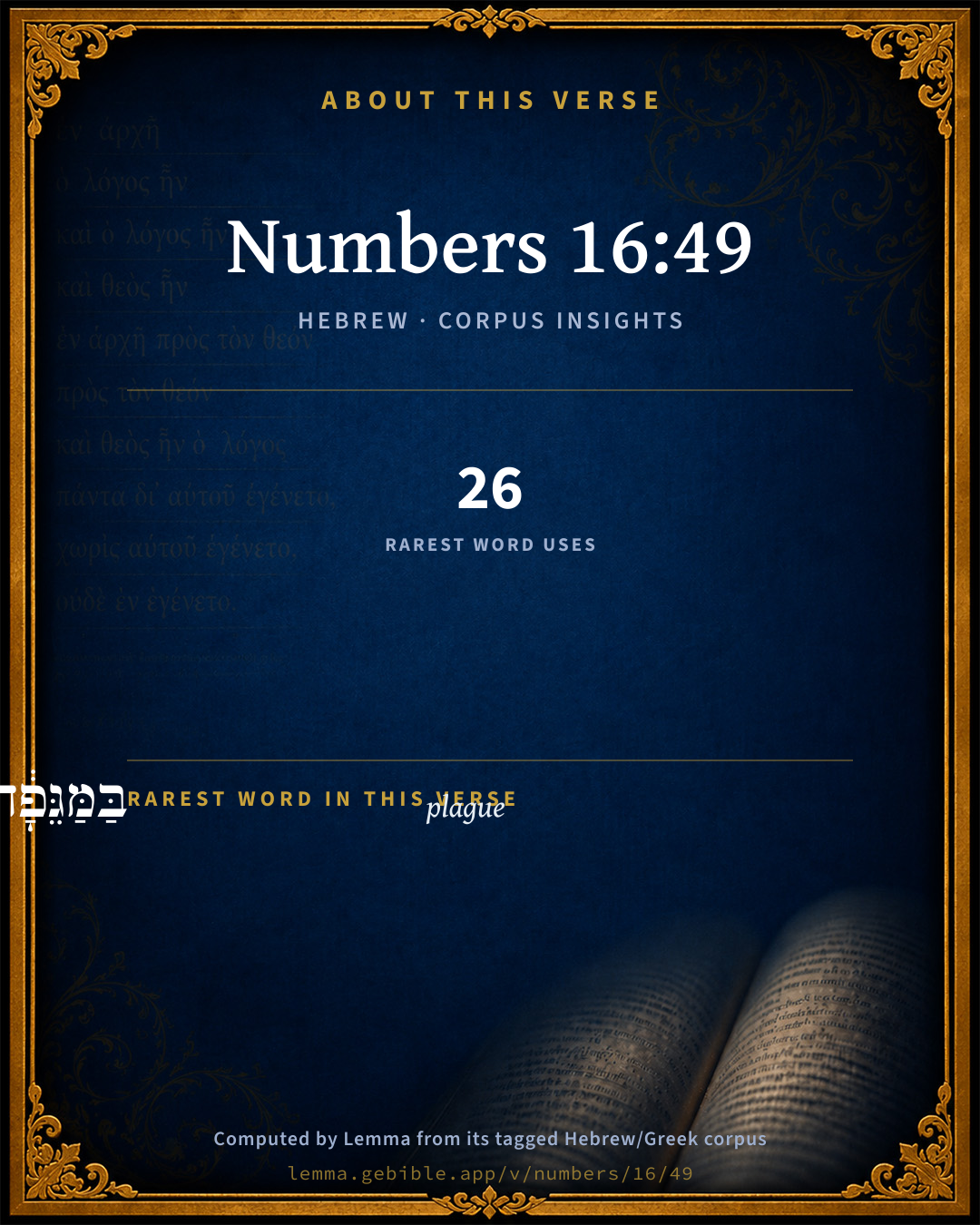
About this verse

These counts appear in no published source. They are computed here, from the morphology-tagged text and Lemma’s own curated glosses. What Lemma adds →

13
words
12
distinct lemmas
Pentateuch
section

Shared distinctive vocabulary

בַּמַּגֵּפָ֔ה plague H4046 occurs in 25 verses of the Hebrew Bible. Also found in:

Grammatical profile

  • 3 verbs
  • 4 nouns
  • 5 adjectives
  • 1 preposition

Verb forms

  • וַיִּהְי֗וּ Qal · Sequential Imperfect
  • הַמֵּתִים֙ Qal · Participle Active
  • הַמֵּתִ֖ים Qal · Participle Active

Repetition

A word recurs within this verse — often emphatic in Hebrew:

  • הַמֵּתִים֙ to die H4191 ×2

Hebrew & Septuagint length

In English translation the verse runs 22 words from the Hebrew and 21 from the Septuagint (LXX English) — closely comparable.

A rough comparison of the two English renderings, which tokenize alike — not a word-level alignment.

Word counts can differ between the Hebrew and the Greek without any difference in meaning — e.g. the Hebrew direct-object marker אֵת has no separate Greek word, and Greek often adds the article ὁ.

Cross-references

6

Topical passages linked to Numbers 16:49 in the Treasury of Scripture Knowledge — connected by theme and wording, ordered by reader-vote popularity; previews shown in the World English Bible.

  • Numbers 16:32–35 and the earth opened its mouth, and swallowed them up, and their households, and all the men who appertained to Korah, and all their goods.
  • Numbers 25:9 Those who died by the plague were twenty-four thousand.
  • 1 Chronicles 21:14 So Yahweh sent a pestilence on Israel; and there fell of Israel seventy thousand men.
  • Hebrews 2:1–3 Therefore we ought to pay greater attention to the things that were heard, lest perhaps we drift away.
  • Hebrews 10:28–29 A man who disregards Moses' law dies without compassion on the word of two or three witnesses.
  • Hebrews 12:25 See that you don't refuse him who speaks. For if they didn't escape when they refused him who warned on the Earth, how much more will we not escape who turn away from him who warns from heaven,

Cross-references courtesy of OpenBible.info (CC BY 4.0).

Hebrew and Greek witnesses Masoretic Hebrew ↔ Greek Septuagint

The same verse in the two great witnesses to the Old Testament, shown verse-for-verse.

These are two independent witnesses, not word-aligned to each other, and the Septuagint is shown in lemma (dictionary) form.

Hebrew Numbers 16:49 Masoretic · Westminster Leningrad Codex

וַיִּהְי֗וּ הַמֵּתִים֙ בַּמַּגֵּפָ֔ה אַרְבָּעָ֥ה עָשָׂ֛ר אֶ֖לֶף וּשְׁבַ֣ע מֵא֑וֹת מִלְּבַ֥ד הַמֵּתִ֖ים עַל דְּבַר קֹֽרַח

Now those who died by the plague were fourteen thousand and seven hundred, besides those who died about the matter of Korah.

World English Bible · Public Domain

Greek LXX Numbers 16:49 Septuagint · lemma form
And they that died in the plague were fourteen thousand and seven hundred, besides those that died on account of Core.

LXX2012 (modern English Septuagint) · Public Domain

Hebrew: Westminster Leningrad Codex (CC BY 4.0). Greek: Septuagint (public domain); English from LXX2012 (modern English Septuagint) (Public Domain). How the Septuagint differs from the Hebrew →

Commentary

Notes on Numbers 16:49 from classic Christian and Jewish commentators (each source and its license shown beneath its notes). The classic Christian expositions comment on the surrounding passage and are grouped to its opening verse, so a note may address several verses; the Jewish commentaries on the Tanakh (Rashi and others) are per-verse, so they appear only where the commentator wrote on this verse.

Lemma curates 59 commentaries, every one of them public domain or Creative Commons licensed, each selected and text-cleaned for this edition rather than reprinted as found. About our sources →

The Cambridge Bible for Schools and Colleges

gen. ed. J. J. S. Perowne

49. them that died about the matter of Korah] i.e. the 250 princes. It should be noticed that the death of Korah himself is nowhere related in the chapter, Num_16:24; Num_16:27 a might seem to imply that Korah was about to be swallowed up in the earth with Dathan and Abiram; and this supposition is adopted by the writer of Num_26:10. But apart from the critical reasons for distinguishing the narratives, and for reading ‘the tabernacle of Jehovah’ in Num_16:24; Num_16:27, it would be very strange that Korah should have been separated from his adherents in their punishment. In the fusing of the two stories by the compiler, a statement of the personal fate of Korah fell out of the chapter.

The Cambridge Bible for Schools and Colleges (gen. ed. J. J. S. Perowne; Cambridge University Press, 1878–1918) — public domain. Text from a community e-Sword module.

John Gill's Exposition

And Aaron returned unto Moses,.... After he had by his atonement and intercession put a stop to the wrath of God broken forth upon the people:

unto the door of the tabernacle of the congregation; where Moses was waiting for his return, and to know the issue of this affair:

and the plague was stayed: even before Aaron left the camp, and is here repeated for the certainty of it, and to intimate that it continued to cease, and broke not out again.

Next: Numbers Chapter 17

John Gill's Exposition of the Whole Bible (1746–1763) — public domain (CC PDM 1.0). Text via the HelloAO Bible API.

Haydock's Catholic Bible Commentary

Core. We cannot reckon less than 15,000, who perished in consequence of their adherence to this innovator. Behold the first-fruits of ambition and of rebellion. (Haydock)

George Leo Haydock (1774–1849), Haydock's Catholic Family Bible and Commentary, 1859 edition — public domain. Excludes Psalms (Douay-Rheims chapter numbering differs from Protestant) and Deuterocanonical books (Catholic canon only).

The Pulpit Commentary

Fourteen thousand and seven hundred. A very large number to have died in the course of a few minutes, as the narrative seems to imply. The plague was undoubtedly of a supernatural character, and cannot be considered as a pestilence or other natural visitation. Beside them that died about the matter of Korah. These were

(1) the two hundred and fifty men who offered incense,

(2) Dathan and Abiram, and their families,

(3) probably Korah himself,

(4) possibly some other partisans of Korah (see on verse 32), making in all about 300 souls.

Thus we get the round number of 15, 000 as the total of those that perished on this occasion.

The Pulpit Commentary (1880–1919), ed. H.D.M. Spence-Jones & Joseph S. Exell — public domain. Text from a community e-Sword module.

unfoldingWord translationNotes

Door43 World Missions Community

14,700 in number

"fourteen thousand seven hundred in number" (See: Numbers)

translationWords

Korah

tent of meeting

unfoldingWord translationNotes — © Distant Shores Media and the Door43 World Missions Community, licensed CC BY-SA 4.0. Source: git.door43.org/Door43/en_tn.

Lesson kit

Teaching starters — assembled from the data on this page, not authored interpretation. Every prompt links to the verse data it draws on. Edit before teaching.

Numbers, in the Pentateuch, opens this verse with 13 words (12 distinct Hebrew lemmas). Its most distinctive word is maggêphâh (“plague”). A historical commentator’s framing appears above. Read the whole chapter for the surrounding context.

Discussion questions

  1. The word maggêphâh carries the sense “plague.” How does it shape the verse?
  2. Exodus 9:14 shares the word «plague» with this verse. How do the two illuminate each other?
  3. “to die” occurs 2× in this one verse. What is the effect of the repetition?
  4. These translations render this verse differently; the difference is in the English rendering, not the original. What questions does that raise?
  5. The verb «וַיִּהְי֗וּ» is Qal Sequential Imperfect. How does its form color the action?
  6. Reading how The Cambridge Bible for Schools and Colleges and John Gill's Exposition read this verse, where do the two commentators agree and where do they part?

Things to notice

Reading settings

Reading text

Shown beneath each verse's original-language words.

Old Testament
Old Testament edition

Read the OT as the Masoretic Hebrew (MT) or the Greek Septuagint (LXX).

English shown for the Greek Septuagint (in the Hebrew ↔ Greek comparison).

Comparing translations? Open the Compare panel on any verse page to stack up to four side by side.