
Leviticus 20:10

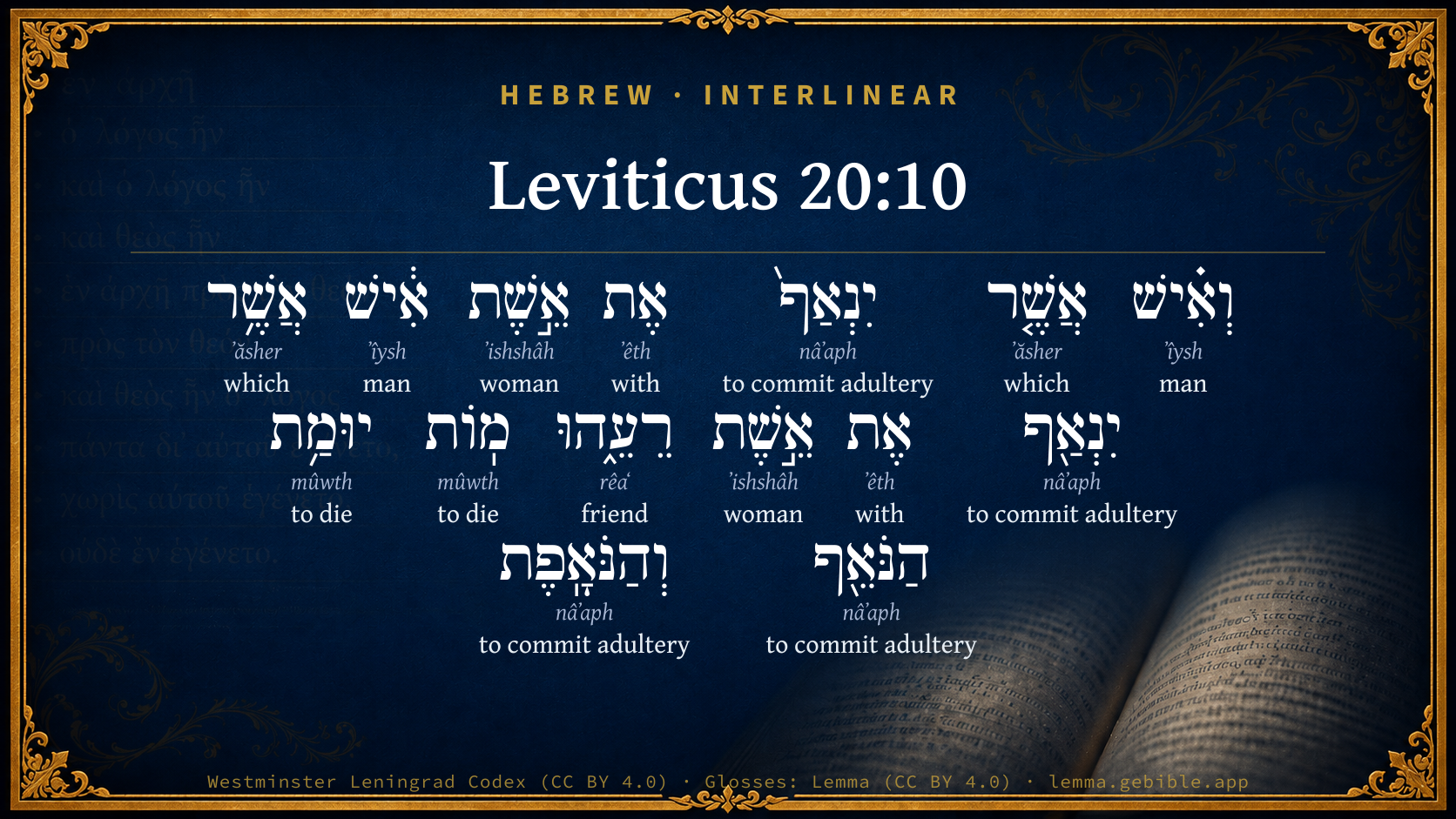
Hebrew (Westminster Leningrad Codex) Leviticus 20:10 appears in the Hebrew Old Testament. The text above is from the Westminster Leningrad Codex. Each word links to its Strong’s number, a concise gloss, and parsing drawn from the Open Scriptures Hebrew Bible morphology. Click any word for its full Brown-Driver-Briggs (BDB) entry.
Download image
Cite this verse

Leviticus 20:10 (World English Bible). Public Domain. Lemma interlinear Bible study tool, https://lemma.gebible.app/v/leviticus/20/10.

Show BibTeX & RIS
BibTeX
RIS
English Translation
"'The man who commits adultery with another man's wife, even he who commits adultery with his neighbor's wife, the adulterer and the adulteress shall surely be put to death.
World English Bible · Public Domain
Download a study sheet

One document with this verse’s original text, its word-by-word gloss line, the meaning frame, cross-references with their text, attributed commentary, and full source and license credits — printable, and it pastes into notes with its structure intact.

This verse Autodidact and up

Study sheet (.html) Plain text (.txt)

A passage Seminary Student

Up to 50 verses in one chapter. A passage sheet keeps up to 6 commentary sources and 12 cross-references per verse, in the order this page ranks them, and says so on the sheet whenever that leaves anything out. Ask for a single verse and you get the Autodidact verse sheet above.

Everything on this page stays free to read, with no account — the sheet is a download of what is already on screen, not access to it.

Want to remove ads? Support Godless Engineer
Compare translations 3

The same verse in 3 English versions, stacked beneath the original-language interlinear above. Click any original word for its lexicon entry.

Each is an independent rendering of the whole verse — the interlinear is not word-aligned to these translations.

Highlighted words mark where these versions differ — a whole-verse word diff, not a word-by-word alignment.

  • World English Bible Public Domain
    "'The man who commits adultery with another man's wife, even he who commits adultery with his neighbor's wife, the adulterer and the adulteress shall surely be put to death.
  • King James Version Public Domain
    And the man that committeth adultery with another man's wife, even he that committeth adultery with his neighbor's wife, the adulterer and the adulteress shall surely be put to death.
  • unfoldingWord Literal Text CC BY-SA 4.0
    And a man who commits adultery the wife of a man, who commits adultery the wife of his neighbor—dying, the adulterer and the adulteress shall be executed.

unfoldingWord Literal Text — © unfoldingWord, licensed CC BY-SA 4.0. Word-aligned USFM3 via Door43 (git.door43.org/unfoldingWord/en_ult).

Versions to compare (up to 4)

3 of 4 selected

Show all 18 translations

Every available English version of this verse, each an independent rendering of the whole verse.

  • World English Bible Public Domain
    "'The man who commits adultery with another man's wife, even he who commits adultery with his neighbor's wife, the adulterer and the adulteress shall surely be put to death.
  • Berean Standard Bible Public Domain
    If a man commits adultery with another man’s wife—with the wife of his neighbor—both the adulterer and the adulteress must surely be put to death.
  • Majority Standard Bible Public Domain
    If a man commits adultery with another man’s wife—with the wife of his neighbor—both the adulterer and the adulteress must surely be put to death.
  • King James Version Public Domain
    And the man that committeth adultery with another man's wife, even he that committeth adultery with his neighbor's wife, the adulterer and the adulteress shall surely be put to death.
  • American Standard Version (1901) Public Domain
    And the man that committeth adultery with another man's wife, even he that committeth adultery with his neighbor's wife, the adulterer and the adulteress shall surely be put to death.
  • Revised Version (1885) Public Domain
    And the man that committeth adultery with another man’s wife, even he that committeth adultery with his neighbour’s wife, the adulterer and the adulteress shall surely be put to death.
  • Geneva Bible (1599) Public Domain
    And the man that committeth adulterie with another mans wife, because he hath comitted adulterie with his neighbours wife, the adulterer and the adulteresse shall die the death.
  • Douay-Rheims (1899) Public Domain
    If any man commit adultery with the wife of another, and defile his neighbour's wife, let then: be put to death, both the adulterer and the adulteress.
  • Young's Literal Translation Public Domain
    `And a man who committeth adultery with a man's wife -- who committeth adultery with the wife of his neighbour -- the adulterer and the adulteress are surely put to death.
  • Literal Standard Version CC BY-SA 4.0
    And a man who commits adultery with a man’s wife—who commits adultery with the wife of his neighbor—the adulterer and the adulteress are surely put to death.
  • Unlocked Literal Bible CC BY-SA 4.0
    The man who commits adultery with another man's wife, that is, anyone who commits adultery with his neighbor's wife—the adulterer and the adulteress must both certainly be put to death.
  • unfoldingWord Literal Text CC BY-SA 4.0
    And a man who commits adultery the wife of a man, who commits adultery the wife of his neighbor—dying, the adulterer and the adulteress shall be executed.
  • Darby Bible Public Domain
    And a man that committeth adultery with a man's wife, who committeth adultery with his neighbour's wife, -- the adulterer and the adulteress shall certainly be put to death.
  • World Messianic Bible Public Domain
    “‘The man who commits adultery with another man’s wife, even he who commits adultery with his neighbor’s wife, the adulterer and the adulteress shall surely be put to death.
  • Webster's Bible Public Domain
    And the man that committeth adultery with another man's wife, even he that committeth adultery with his neighbor's wife, the adulterer and the adulteress shall surely be put to death.
  • Free Bible Version CC BY-SA 4.0
    Any man who commits adultery with someone else's wife must be executed, as well as the woman.
  • Bible in Basic English Public Domain
    And if a man has sex relations with another man's wife, even the wife of his neighbour, he and she are certainly to be put to death.
  • JPS Tanakh (1917) Public Domain
    And the man that committeth adultery with another man's wife, even he that committeth adultery with his neighbour's wife, both the adulterer and the adulteress shall surely be put to death.

Literal Standard Version (2020), Covenant Press — licensed CC BY-SA 4.0. Text via the HelloAO Bible API (eBible.org). Unlocked Literal Bible (unfoldingWord) — licensed CC BY-SA 4.0. Text via the HelloAO Bible API (eBible.org). unfoldingWord Literal Text — © unfoldingWord, licensed CC BY-SA 4.0. Word-aligned USFM3 via Door43 (git.door43.org/unfoldingWord/en_ult). Free Bible Version, Dr. Jonathan Gallagher — licensed CC BY-SA 4.0. Text via the HelloAO Bible API (eBible.org).

Word by word

More ways to search: Search by grammar → Find every occurrence → Compare this word →

Practice this passage: Drill this verse → Learn its vocabulary →

יִנְאַף֙
nâʼaph
H5003
“to commit adultery”
Verb, Qal, Imperfect, 3rd Person, Masculine, Singular
Part of Speech
Verb
Stem
Qal
Form
Imperfect
Person
3rd Person
Gender
Masculine
Number
Singular
Full BDB Definition

Origin: a primitive root

TWOT: 1273

to commit adultery - (Qal) - to commit adultery - usually of man - always with wife of another - adultery (of women) (participle) - idolatrous worship (figuratively) - (Piel) - to commit adultery - of man - adultery (of women) (participle) - idolatrous worship (figuratively)
  1. וְאִ֗ישׁ ʼîysh H376 “and · man” Conjunction + Noun, Common, Masculine, Singular, Absolute
  2. אֲשֶׁ֤ר ʼăsher H834 “which” Particle, Relative
  3. אֶת ʼêth H854 “with” Preposition
  4. אֵ֣שֶׁת ʼishshâh H802 “woman of” Noun, Common, Feminine, Singular, Construct
  5. אִ֔ישׁ ʼîysh H376 “man” Noun, Common, Masculine, Singular, Absolute
  6. אֲשֶׁ֥ר ʼăsher H834 “which” Particle, Relative
  7. יִנְאַ֖ף nâʼaph H5003 “to commit adultery” Verb, Qal, Imperfect, 3rd Person, Masculine, Singular
  8. אֶת ʼêth H854 “with” Preposition
  9. אֵ֣שֶׁת ʼishshâh H802 “woman of” Noun, Common, Feminine, Singular, Construct
  10. רֵעֵ֑הוּ rêaʻ H7453 “friend · his” Noun, Common, Masculine, Singular, Construct + Suffix, Personal, 3rd Person, Masculine, Singular
  11. מֽוֹת mûwth H4191 “to die” Verb, Qal, Infinitive Absolute
  12. יוּמַ֥ת mûwth H4191 “to die” Verb, Hophal, Imperfect, 3rd Person, Masculine, Singular
  13. הַנֹּאֵ֖ף nâʼaph H5003 “the · committing adultery” Particle, Definite Article + Verb, Qal, Participle Active, Masculine, Singular, Absolute
  14. וְהַנֹּאָֽפֶת nâʼaph H5003 “and · the · committing adultery” Conjunction + Particle, Definite Article + Verb, Qal, Participle Active, Feminine, Singular, Absolute

About this verse

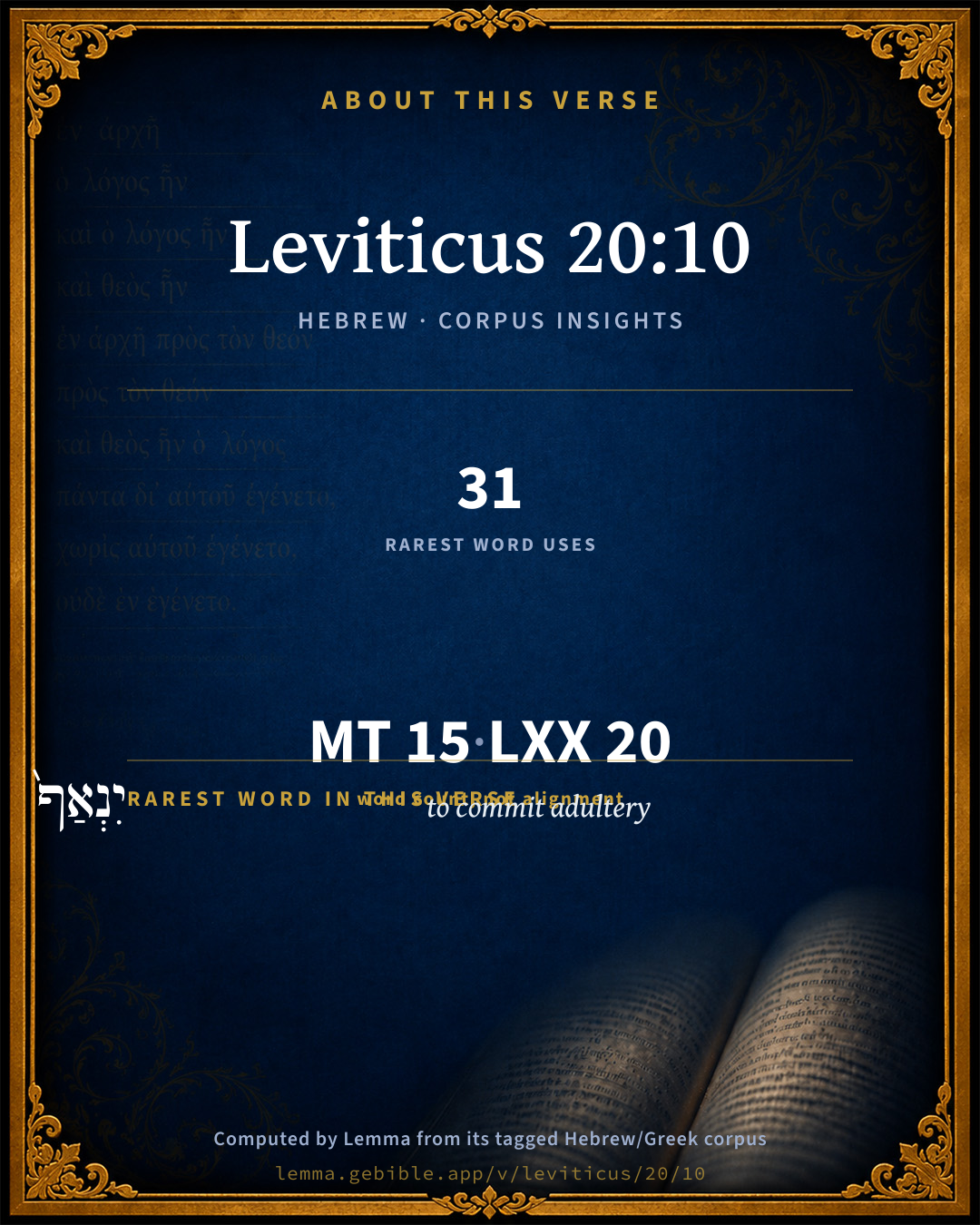
These counts appear in no published source. They are computed here, from the morphology-tagged text and Lemma’s own curated glosses. What Lemma adds →

15
words
7
distinct lemmas
Pentateuch
section

Shared distinctive vocabulary

יִנְאַף֙ to commit adultery H5003 occurs in 26 verses of the Hebrew Bible. Also found in:

Grammatical profile

  • 6 verbs
  • 5 nouns
  • 2 prepositions
  • 2 particles

Verb forms

  • יִנְאַף֙ Qal · Imperfect
  • יִנְאַ֖ף Qal · Imperfect
  • מֽוֹת Qal · Infinitive Absolute
  • יוּמַ֥ת Hophal · Imperfect
  • הַנֹּאֵ֖ף Qal · Participle Active
  • וְהַנֹּאָֽפֶת Qal · Participle Active

Repetition

Words recur within this verse — often emphatic in Hebrew:

  • יִנְאַף֙ to commit adultery H5003 ×4
  • וְאִ֗ישׁ man H376 ×2
  • אֵ֣שֶׁת woman H802 ×2
  • מֽוֹת to die H4191 ×2
  • אֲשֶׁ֤ר which H834 ×2
  • אֶת with H854 ×2

Hebrew & Septuagint length

In English translation the verse runs 29 words from the Hebrew and 32 from the Septuagint (LXX English) — closely comparable.

A rough comparison of the two English renderings, which tokenize alike — not a word-level alignment.

Word counts can differ between the Hebrew and the Greek without any difference in meaning — e.g. the Hebrew direct-object marker אֵת has no separate Greek word, and Greek often adds the article ὁ.

In the original languages it is 15 Hebrew tokens and 20 Greek tokens — but the two are counted differently (Hebrew bundles its prefixes and suffixes into one token; the Greek is in lemma form), so that isn’t a like-for-like length.

Cross-references

7

Topical passages linked to Leviticus 20:10 in the Treasury of Scripture Knowledge — connected by theme and wording, ordered by reader-vote popularity; previews shown in the World English Bible.

  • John 8:4–5 they told him, "Teacher, we found this woman in adultery, in the very act.
  • Deuteronomy 22:22–24 If a man be found lying with a woman married to a husband, then they shall both of them die, the man who lay with the woman, and the woman: so shall you put away the evil from Israel.
  • Deuteronomy 5:18 "Neither shall you commit adultery.
  • Exodus 20:14 "You shall not commit adultery.
  • Leviticus 18:20 "'You shall not lie carnally with your neighbor's wife, and defile yourself with her.
  • 2 Samuel 12:13 David said to Nathan, "I have sinned against Yahweh." Nathan said to David, "Yahweh also has put away your sin. You will not die.
  • Ezekiel 23:45–47 Righteous men, they shall judge them with the judgment of adulteresses, and with the judgment of women who shed blood; because they are adulteresses, and blood is in their hands.

Cross-references courtesy of OpenBible.info (CC BY 4.0).

Hebrew and Greek witnesses Masoretic Hebrew ↔ Greek Septuagint

The same verse in the two great witnesses to the Old Testament, shown verse-for-verse.

These are two independent witnesses, not word-aligned to each other, and the Septuagint is shown in lemma (dictionary) form.

Hebrew Leviticus 20:10 Masoretic · Westminster Leningrad Codex

וְאִ֗ישׁ אֲשֶׁ֤ר יִנְאַף֙ אֶת אֵ֣שֶׁת אִ֔ישׁ אֲשֶׁ֥ר יִנְאַ֖ף אֶת אֵ֣שֶׁת רֵעֵ֑הוּ מֽוֹת יוּמַ֥ת הַנֹּאֵ֖ף וְהַנֹּאָֽפֶת

"'The man who commits adultery with another man's wife, even he who commits adultery with his neighbor's wife, the adulterer and the adulteress shall surely be put to death.

World English Bible · Public Domain

Greek LXX Leviticus 20:10 Septuagint · lemma form

ἄνθρωπος ὅς ἄν μοιχεύω γυνή ἀνήρ ἤ ὅς ἄν μοιχεύω γυνή ὁ πλησίον θάνατος θανατόω ὁ μοιχεύω καί ὁ μοιχεύω

Whatever man shall commit adultery with the wife of a man, or whoever shall commit adultery with the wife of his neighbor, let them die the death, the adulterer and the adulteress.

LXX2012 (modern English Septuagint) · Public Domain

Hebrew: Westminster Leningrad Codex (CC BY 4.0). Greek: Septuagint (public domain); English from LXX2012 (modern English Septuagint) (Public Domain). How the Septuagint differs from the Hebrew →

Targum (Aramaic paraphrase)

2

The Targum is the ancient Jewish Aramaic paraphrase of the Hebrew Scriptures — an interpretive translation, not the Hebrew text itself. Onkelos (literal) and Pseudo-Jonathan (expansive) render the Torah, and Jonathan the Prophets. Coverage is partial: where no permissively-licensed English translation exists for a verse, only the Aramaic is shown. This is verse-level text, not a word-by-word alignment to the Hebrew.

  1. Targum Onkelos Torah (Genesis–Deuteronomy)
    וּגְבַר דִי יְגוּף יָת אִתַּת גְבַר דִי יְגוּף יָת אִתַּת חַבְרֵהּ אִתְקְטָלָא יִתְקְטֵל גַיָפָא וְגַיַפְתָּא

    (no public-domain English translation for this verse)

    Targum Onkelos — Aramaic: “Onkelos Genesis” (public domain); “Onkelos Exodus” (public domain); “Onkelos Leviticus” (public domain); “Onkelos Numbers” (public domain); “Onkelos Deuteronomy” (public domain). English: “Sefaria Community Translation” (CC0 1.0 (public-domain dedication)); “J.W. Etheridge. The Targums of Onkelos and Jonathan Ben Uzziel on the Pentateuch. London: Longmans, Green, 1862” (public domain). Text via Sefaria.

  2. Targum Pseudo-Jonathan Torah (Genesis–Deuteronomy)
    וּגְבַר דִי יִגוֹר יַת אִתַּת גְבַר מֵאַרְסָא אוֹ דִי יִגוֹר יַת אִתַּת חַבְרֵיהּ מִבַּעְלָא אִיתְקְטָלָא יִתְקְטֵיל עַל מִיבְעֲלָא בְּשִׁינוּק סוּדְרָא אַקוֹשָׁא בְּגוֹ רְכִיכָא וְעַל מֵאַרְסָא בְּאַטְלוּת אַבְנִין גִיוֹרָא וְגִיוֹרְתָּא

    And the man who by adultery defileth the wife of (another) man, or who committeth adultery with the wife of his married neighbour, shall be verily put to death, by strangulation, with the hard towel in the tender part (?): and on account of a betrothed person, by the casting of stones: both the adulterer and the adulteress (shall die).

    Targum Pseudo-Jonathan — Aramaic: “Targum Jonathan on Genesis” (public domain); “Targum Jonathan on Exodus” (public domain); “Targum Jonathan on Leviticus” (public domain); “Targum Jonathan on Numbers” (public domain); “Targum Jonathan on Deuteronomy” (public domain). English: “The Targum of Jonathan ben Uzziel, trans. J. W. Etheridge, London, 1862” (public domain). Text via Sefaria.

Commentary

Notes on Leviticus 20:10 from classic Christian and Jewish commentators (each source and its license shown beneath its notes). The classic Christian expositions comment on the surrounding passage and are grouped to its opening verse, so a note may address several verses; the Jewish commentaries on the Tanakh (Rashi and others) are per-verse, so they appear only where the commentator wrote on this verse.

Lemma curates 59 commentaries, every one of them public domain or Creative Commons licensed, each selected and text-cleaned for this edition rather than reprinted as found. About our sources →

Matthew Henry's Commentary

Sins against the seventh commandment are here ordered to be severely punished. These are sins which, of all others, fools are most apt to make a mock at; but God would teach those the heinousness of the guilt by the extremity of the punishment that would not otherwise be taught it.

I. Lying with another man's wife was made a capital crime. The adulterer and the adulteress that had joined in the sin must fall alike under the sentence: they shall both be put to death, Lev 20:10. Long before this, even in Job's time, this was reputed a heinous crime and an iniquity to be punished by the judges, Job 31:11. It is a presumptuous contempt of an ordinance of God, and a violation of his covenant, Pro 2:17. It is an irreparable wrong to the injured husband, and debauches the mind and conscience of both the offenders as much as any thing. It is a sin which headstrong and unbridled lusts hurry men violently to, and therefore it needs such a powerful restraint as this. It is a sin which defiles a land and brings down God's judgments upon it, which disquiets families, and tends to the ruin of all virtue and religion, and therefore is fit to be animadverted upon by the conservators of the public peace: but see Joh 8:3-11.

II. Incestuous connections, whether by marriage or not. 1. Some of them were to be punished with death, as a man's lying with his father's wife, Lev 20:11. Reuben would have been put to death for his crime (Gen 35:22) if this law had been then made. It was the sin of the incestuous Corinthian, for which he was to be delivered unto Satan, Co1 5:1, Co1 5:5. A man's debauching his daughter-in-law, or his mother-in-law, or his sister, was likewise to be punished with death, Lev 20:12, Lev 20:14, Lev 20:17. 2. Others of them God would punish with the curse of barrenness, as a man's defiling his aunt, or his brother's wife (Lev 20:19-21): They shall die childless. Those that keep not within the divine rules of marriage forfeit the blessings of marriage: They shall commit whoredom, and shall not increase, Hos 4:10. Nay it is said, They shall bear their iniquity, that is, though they be not immediately cut off by the hand either of God or man for this sin, yet the guilt of it shall lie upon them, to be reckoned for another day, and not be purged with sacrifice or offering.

III. The unnatural lusts of sodomy and bestiality (sins not to be mentioned without horror) were to be punished with death, as they are at this day by our law, Lev 20:13, Lev 20:15, Lev 20:16. Even the beast that was thus abused was to be killed with the sinner, who was thereby openly put to the greater shame: and the villany was thus represented as in the highest degree execrable and abominable, all occasions of the remembrance or mention of it being to be taken away. Even the unseasonable use of the marriage, if presumptuous, and in contempt of the law, would expose the offenders to the just judgment of God: they shall be cut off, Lev 20:18. For this is the will of God, that every man should possess his vessel (and the wife is called the weaker vessel) in sanctification and honour, as becomes saints.

Matthew Henry's Commentary on the Whole Bible (1708–1710) — public domain (CC PDM 1.0). Text via the HelloAO Bible API.

Trapp's Complete Commentary

John Trapp

Lev 20:10 And the man that committeth adultery with [another] man’s wife, [even he] that committeth adultery with his neighbour’s wife, the adulterer and the adulteress shall surely be put to death.

Ver. 10. Shall surely be put to death.] Adultery was death long before this law. {Gen 26:11; Gen 38:24} So it was afterwards among the Greeks, Romans, and many other nations. {Jer 29:22-23}

John Trapp, A Commentary or Exposition upon All the Books of the Old and New Testament (1647–1656) — public domain. Text from a community e-Sword module.

Joseph Benson's Commentary

Lev 20:10. The adulterer and adulteress shall surely be put to death —Adultery, however lightly it may be accounted of by men who are lost to all sense of virtue and honour, has not only under the Mosaic economy, but by several other civilized nations; been reckoned a capital wickedness. By the ancient laws of Solon the husband was authorized to kill the adulterer and adulteress, if he found them in the fact; or if he did not choose to proceed to that severity, he might put out their eyes. Among the Egyptians too, adulterers were punished with the utmost severity. If a woman were enticed to commit adultery, her nose was slit, and the man received a thousand blows with rods. To the same purpose, by the Roman laws, the adulterer might be put to death if he were taken in the act. Considering the heinous nature and fatal consequences of this vice, we need not wonder much, if, in well-regulated states, it has been punishable with death. By our laws a man shall lose his life by robbing another of a few shillings; but what proportion is there between robbing a man of a sum of money, and invading his property in what he often cherishes more tenderly than ease, plenty, honour, and even life itself?

Joseph Benson's Commentary on the Old and New Testaments (1811–1818) — public domain. Text from a community e-Sword module.

Tyndale Open Study Notes

Tyndale Open Resources

20:10 See study note on 18:20; see also Exod 20:14.

Tyndale Open Study Notes — © Tyndale Open Resources, licensed CC BY-SA 4.0. Text via the HelloAO Bible API.

Adam Clarke's Commentary

Verse 10. Committeth adultery] To what has been said in Clarke's note on "Ex 20:14", we may add, that the word adultery comes from the Latin adulterium, which is compounded of ad, to or with, and alter, another, or, according to Minshieu, of ad alterius forum, he that approaches to another man's bed.

Adam Clarke's Commentary on the Bible (1810–1826) — public domain. Text from a community e-Sword/MySword module.

Ellicott's Commentary for English Readers

(10) Shall be surely put to death—That is, by stoning. (See Lev_20:2.) This precept is also to be found in Exo_21:17; Pro_20:20, and is referred to by our Lord (Mat_15:14; Mar_7:10).

His blood shall be upon him—That is, he has brought it upon himself to be killed. (See Jos_2:19.) This phrase, which occurs seven times either in the singular or plural, is only to be found in this chapter (See Lev_20:9; Lev_20:11-13; Lev_20:16; Lev_20:27). According to the authorities during the second Temple, it carried with it death by lapidation.

(10) Shall surely be put to death.—This is, by penalty for the sin forbidden in Lev_18:20. According to Jewish tradition whenever the phrase “shall surely be put to death” occurs by itself, it denotes death by strangling. This death was inflicted for six crimes—upon him who had commerce with another man’s wife; who smote his father or mother; (3) who stole an Israelite; (4) who being an elder rebelled against the decree of the senate (Deu_17:12); (5) who played the false prophet; and (6) who prophesied in the name of another god.

A Bible Commentary for English Readers, edited by Charles John Ellicott (1878–1897) — public domain. Text from a community e-Sword module.

The Cambridge Bible for Schools and Colleges

gen. ed. J. J. S. Perowne

10–21. Directions on the whole similar to those of Lev_18:6-20; Lev_18:22-23, but adding penalties for transgression.

The Cambridge Bible for Schools and Colleges (gen. ed. J. J. S. Perowne; Cambridge University Press, 1878–1918) — public domain. Text from a community e-Sword module.

John Gill's Exposition

And the man that committeth adultery with another man's wife,.... Which is a breach of the seventh command, Exo 20:14,

even he that committeth adultery with his neighbour's wife: which is only an explanation of the former clause; though the Jewish writers, as Jarchi and Ben Gersom, say this is so expressed to except the wife of a stranger, or a Gentile; but it means whether a Gentile or an Israelite; and which may be confirmed by the instance of Phinehas slaying a prince of Israel, that lay with a Midianitish woman, Num 25:6,

the adulterer and the adulteress shall surely be put to death; on account of her that is espoused, by strangling, with a hard napkin within a soft one; and on account of her that is married, by casting stones; even both the adulterer and adulteress, as the Targum: and the Jews say (b), strangling was thus performed; they that were strangled were fixed up to their knees in dung, and then they put a hard napkin within a soft one, and rolled it about his neck, and one drew it to him this way, and another drew it to him that way, until he expired: and there is no unlawful copulation punished with strangling, according to Maimonides (c), but lying with another man's wife; and who observes, that the death which is spoken of in the law absolutely, that is, without specifying any kind of death, is strangling; but stoning seems rather meant, agreeably to Deu 22:24.

(b) Misn. Sanhedrin, c. 7. sect. 3. (c) Hilchot lssure Biah, c. 1. sect. 6.

John Gill's Exposition of the Whole Bible (1746–1763) — public domain (CC PDM 1.0). Text via the HelloAO Bible API.

Haydock's Catholic Bible Commentary

Adulteress. Philo (de Josephus) says, whoever discovered a man in the very act, might kill him; and the Roman law allowed the same liberty, impune necato. But God requires a juridical process, and witnesses, as we see in the case of Susanna, (Daniel xiii.) and in that of the woman who was brought to our Saviour. One witness might authorize a person to put his wife away, and if he then retained her, he was esteemed a fool, Proverbs xviii. 23. But more witnesses were requisite before she could be put to death. They put their hands on the heads of the guilty, thus taking their blood upon themselves, if they accused them wrongfully. Solon allowed the husband to kill the adulterer. The woman was not permitted to wear any ornaments, or to enter any temple afterwards. If she did, any one might tear her clothes, and beat, but not kill her.

George Leo Haydock (1774–1849), Haydock's Catholic Family Bible and Commentary, 1859 edition — public domain. Excludes Psalms (Douay-Rheims chapter numbering differs from Protestant) and Deuterocanonical books (Catholic canon only).

Whedon's Commentary on the Bible

Daniel D. Whedon

10. The adulterer and the adulteress — In the Mosaic law adultery is committed only through the unchastity of a wife. A husband commits this crime only with the free wife of another. See Exo_20:14, note.

Put to death — If the adulteress was another’s slave, the penalty was milder, probably corporeal punishment. The allowance of polygamy implies that the wife has no such exclusive right to the husband as the husband has to the wife. In many countries the adulteress has suffered capital punishment while the adulterer has escaped with a less penalty. Since this crime destroys the family, the corner-stone of society, it deserves the severest penalty. If both parties are married persons, the crime is double adultery; if but one is under marriage vows, it is single. See Exo_20:14, note.

Daniel D. Whedon (gen. ed.), Commentary on the Old and New Testaments (1874–1909) — public domain. Text from a community e-Sword module.

The Pulpit Commentary

The Hebrew punishment for adultery is more severe than that of most other nations. Death is again pronounced as the penalty of both adulterer and adulteress in Deu_22:22. The crime is that of a man with a married woman, whether the man be married or not; it is not that of a married man with an unmarried woman, which, in a country where polygamy was allowed, could not be regarded in the same light.

The Pulpit Commentary (1880–1919), ed. H.D.M. Spence-Jones & Joseph S. Exell — public domain. Text from a community e-Sword module.

Kretzmann's Popular Commentary

Paul E. Kretzmann

For Unlawful Marriages

v. 10. And the man that committeth adultery with another man’s wife, even he that committeth adultery with his neighbor’s wife, who, according to Lev 18:20, is restricted to her husband, so far as sexual relations are concerned, 1Co 7:4-5, the adulterer and the adulteress shall surely be put to death.

v. 11. And the man that lieth with his father’s wife, with his stepmother,hath uncovered his father’s nakedness. Both of them shall surely be put to death; their blood shall be up on them.

v. 12. And if a man lie with his daughter-in-law, both of them shall surely be put to death; they have wrought confusion, become guilty of a revolting defilement;their blood shall be up on them.

v. 13. If a man also lie with mankind as he lieth with a woman, in the sin of pederasty, both of them have committed an abomination, a bestial crime, contrary to nature, a horror; they shall surely be put to death; their blood shall be upon them.

v. 14. And if a man take a wife and her mother, in revolting incest, it is wickedness, a most horrible act, an unheard-of deed of shame; they shall be burned with fire, both he and they, after they have been stoned, for thus the abnormality of their crime was emphasized; that there be no wickedness among you. In all these cases, both persons are alike guilty, because even the passive part consented to the act, permitted the seduction to take place. In the case of rape the Lord’s judgment is different. Deu 22:26-27.

v. 15. And if a man lie with a beast, he shall surely be put to death; and ye shall slay the beast.

v. 16. And if a woman approach unto any beast and lie down thereto, thou shalt kill the woman and the beast; they shall surely be put to death; their blood shall be upon them. "With the beastly human being the beast itself was also to be destroyed. " (Lange. )

v. 17. And if a man shall take his sister, his father’s daughter or his mother’s daughter, his (older) half-sister, and see her nakedness and she see his nakedness, it is a wicked thing, a disgraceful act; and they shall be cut off in the sight of their people; he hath uncovered his sister’s nakedness; he shall bear his iniquity, his misdeed.

v. 18. And if a man lie with a woman having her sickness, her menstrual period, and shall uncover her nakedness, knowingly and intentionally, he hath discovered her fountain, exposed her life-spring, and she hath uncovered the fountain of her blood; and both of them shall be cut off from among their people. For the penalty of the unintentional offense, see Lev 15:24.

v. 19. And thou shalt not uncover the nakedness of thy mother’s sister nor of thy father’s sister; for he uncovereth his near kin; they shall bear their iniquity. This transgression was not punished with death by the government, but the Lord Himself would take their case in hand.

v. 20. And if a man shall lie with his uncle’s wife, his aunt by marriage, he hath uncovered his uncle’s nakedness; they shall bear their sin; they shall die childless. While the marriage was not annulled, the Lord’s punishment was very severe, for childlessness was classed with bereavement in the estimation of the Jews.

v. 21. And if a man shall take his brother’s wife, in any case but that of the levirate marriage, it is an unclean thing, calling forth God’s curse of the first degree; he hath uncovered his brother’s nakedness; they shall be childless. The aim of all these provisions was to purify sexual life among the Hebrews, since the entire nation was consecrated to the Lord as a royal priesthood, Exo 19:6. Christians will keep in mind at all times that marriage is honorable in all and the bed undefiled, Heb 13:4.

Paul E. Kretzmann, Popular Commentary of the Bible (1921–1924) — public domain. Text from a community e-Sword module.

unfoldingWord translationNotes

Door43 World Missions Community

The man who commits adultery with another man's wife, that is, anyone who commits adultery with his neighbor's wife

The full meaning of this can be made explicit. AT: "The man who commits adultery with someone else's wife" (See: Assumed Knowledge and Implicit Information)

certainly be put to death

This can be translated in active form. AT: "you must certainly put both of them to death" (See: Active or Passive)

lies with his father's wife

This is a polite way of saying that he had sex with his father's wife. Some languages use more direct phrases such as "has sex with his father's wife." (See: Euphemism)

They have committed perversion

Here God calls a man having sex with his son's wife a "perversion", a serious sin. See how you translated "perversion" in Leviticus 18:23.

translationWords

adultery

neighbor

ancestor

had relations with

guilt

unfoldingWord translationNotes — © Distant Shores Media and the Door43 World Missions Community, licensed CC BY-SA 4.0. Source: git.door43.org/Door43/en_tn.

Rashi

Rabbi Shlomo Yitzchaki (Rashi)

ואיש AND THE MAN [THAT COMMITTETH ADULERY SHALL SURELY BE PUT TO DEATH] — a man, thus excluding a minor (Sifra, Kedoshim, Chapter 10 8).

אשר ינאף את אשת איש WHO COMMITTETH ADULTERY WITH ANOTHER MAN'S WIFE — a man's wife, thus excluding the wife of a minor from the death penalty. This teaches us that a minor cannot enter into a marriage contract. And in reference to what married woman do I make you liable to the death penalty?

אשר ינאף את אשת רעהו IF HE COMMITTETH ADULTERY WITH THE WIFE OF HIS FELLOW-MAN — his fellow-man, thus excluding the wife of a heathen; this teaches us that a heathen cannot enter into a marriage contract according to Jewish law (Sifra, Kedoshim, Chapter 10 8; Sanhedrin 52b).

מות יומת הנאף והנאפת THE ADULTERER AND THE ADULTRESS SHALL SURELY BE PUT TO DEATH — Wherever a death penalty is mentioned in Scripture without being precisely defined, only strangulation is intended (Sifra, Kedoshim, Chapter 10 8; Sanhedrin 55b).

Rashi on the Tanakh — English translations: “The Judaica Press complete Tanach with Rashi, translated by A. J. Rosenberg” (CC BY 4.0); “Pentateuch with Rashi's commentary by M. Rosenbaum and A.M. Silbermann, 1929-1934” (public domain); “The Metsudah Tanach series, Lakewood, N.J” (CC BY 4.0); and “The Book of Joshua, Metsudah Publications, 1997” (CC BY 4.0). Text via Sefaria.

Lesson kit

Teaching starters — assembled from the data on this page, not authored interpretation. Every prompt links to the verse data it draws on. Edit before teaching.

Leviticus, in the Pentateuch, opens this verse with 15 words (7 distinct Hebrew lemmas). Its most distinctive word is nâʼaph (“to commit adultery”). A historical commentator’s framing appears above. Read the whole chapter for the surrounding context.

Discussion questions

  1. What does “to commit adultery” (nâʼaph) contribute to the verse as a whole?
  2. How does Exodus 20:14, which shares the word «to commit adultery», read alongside this verse?
  3. What does the repetition of “to commit adultery” (4× in this one verse) do in this verse?
  4. These translations render this verse differently; the difference is in the English rendering, not the original. What questions does that raise?
  5. «יִנְאַף֙» is a Qal Imperfect verb. How does that grammatical form shape the action described?
  6. Compare how Matthew Henry's Commentary and Trapp's Complete Commentary read this verse. Where do they agree or differ?

Things to notice

Reading settings

Reading text

Shown beneath each verse's original-language words.

Old Testament
Old Testament edition

Read the OT as the Masoretic Hebrew (MT) or the Greek Septuagint (LXX).

English shown for the Greek Septuagint (in the Hebrew ↔ Greek comparison).

Comparing translations? Open the Compare panel on any verse page to stack up to four side by side.