
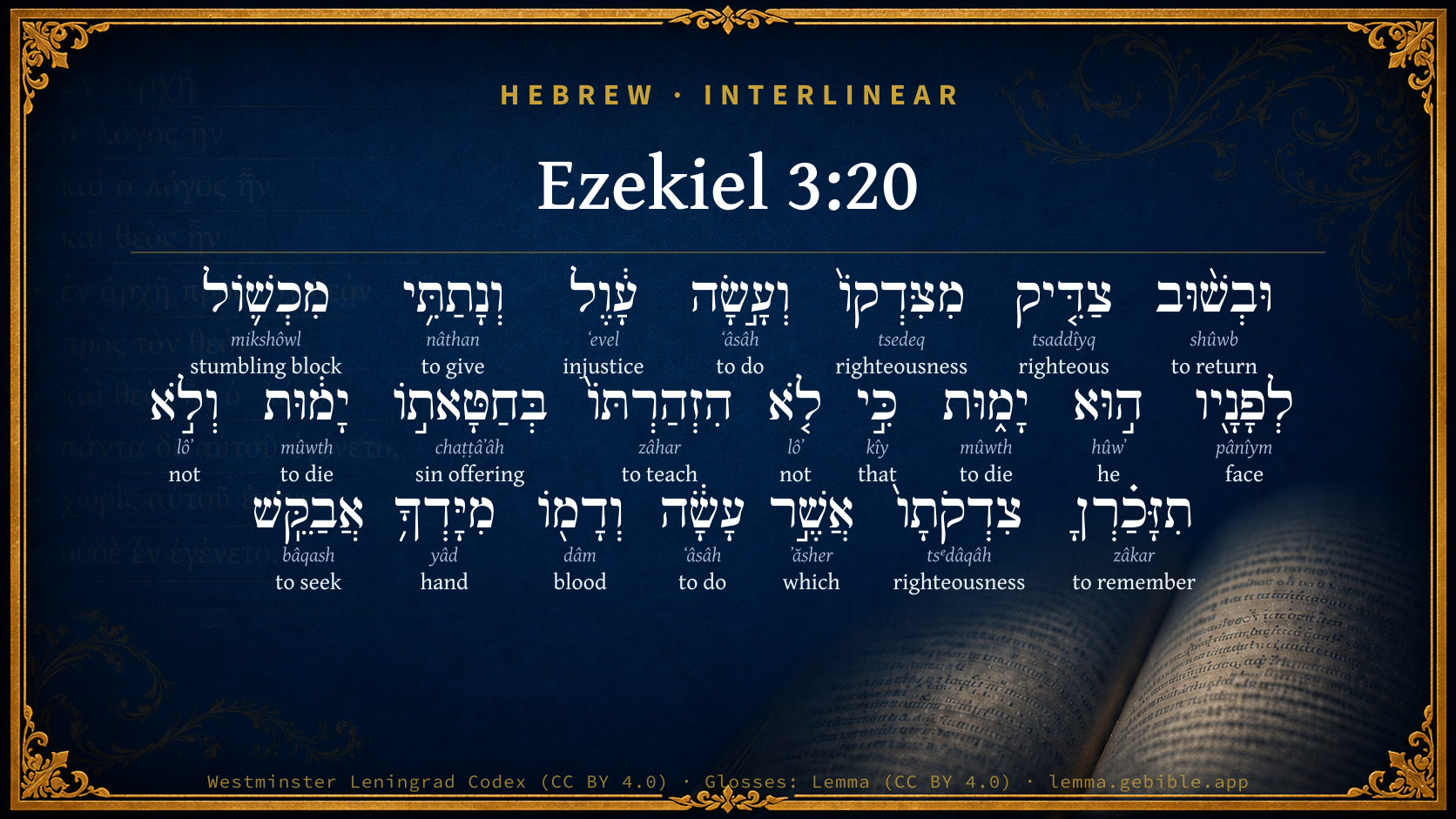
Ezekiel 3:20

Hebrew (Westminster Leningrad Codex) Ezekiel 3:20 appears in the Hebrew Old Testament. The text above is from the Westminster Leningrad Codex. Each word links to its Strong’s number, a concise gloss, and parsing drawn from the Open Scriptures Hebrew Bible morphology. Click any word for its full Brown-Driver-Briggs (BDB) entry.
Download image
Cite this verse

Ezekiel 3:20 (World English Bible). Public Domain. Lemma interlinear Bible study tool, https://lemma.gebible.app/v/ezekiel/3/20.

Show BibTeX & RIS
BibTeX
RIS
English Translation
Again, when a righteous man does turn from his righteousness, and commit iniquity, and I lay a stumbling block before him, he shall die: because you have not given him warning, he shall die in his sin, and his righteous deeds which he has done shall not be remembered; but his blood will I require at your hand.
World English Bible · Public Domain
Download a study sheet

One document with this verse’s original text, its word-by-word gloss line, the meaning frame, cross-references with their text, attributed commentary, and full source and license credits — printable, and it pastes into notes with its structure intact.

This verse Autodidact and up

Study sheet (.html) Plain text (.txt)

A passage Seminary Student

Up to 50 verses in one chapter. A passage sheet keeps up to 6 commentary sources and 12 cross-references per verse, in the order this page ranks them, and says so on the sheet whenever that leaves anything out. Ask for a single verse and you get the Autodidact verse sheet above.

Everything on this page stays free to read, with no account — the sheet is a download of what is already on screen, not access to it.

Want to remove ads? Support Godless Engineer
Compare translations 3

The same verse in 3 English versions, stacked beneath the original-language interlinear above. Click any original word for its lexicon entry.

Each is an independent rendering of the whole verse — the interlinear is not word-aligned to these translations.

Highlighted words mark where these versions differ — a whole-verse word diff, not a word-by-word alignment.

  • World English Bible Public Domain
    Again, when a righteous man does turn from his righteousness, and commit iniquity, and I lay a stumbling block before him, he shall die: because you have not given him warning, he shall die in his sin, and his righteous deeds which he has done shall not be remembered; but his blood will I require at your hand.
  • King James Version Public Domain
    Again, When a righteous man doth turn from his righteousness, and commit iniquity, and I lay a stumbling-block before him, he shall die: because thou hast not given him warning, he shall die in his sin, and his righteousness which he hath done shall not be remembered; but his blood will I require at thine hand.
  • unfoldingWord Literal Text CC BY-SA 4.0
    If a righteous man turns from his righteousness and acts unjustly, and I set a stumbling block before him, he will die. Because you did not warn him, he will die in his sin, and I will not call to mind the righteous deeds that he performed, but I will require his blood from your hand.

unfoldingWord Literal Text — © unfoldingWord, licensed CC BY-SA 4.0. Word-aligned USFM3 via Door43 (git.door43.org/unfoldingWord/en_ult).

Versions to compare (up to 4)

3 of 4 selected

Show all 18 translations

Every available English version of this verse, each an independent rendering of the whole verse.

  • World English Bible Public Domain
    Again, when a righteous man does turn from his righteousness, and commit iniquity, and I lay a stumbling block before him, he shall die: because you have not given him warning, he shall die in his sin, and his righteous deeds which he has done shall not be remembered; but his blood will I require at your hand.
  • Berean Standard Bible Public Domain
    Now if a righteous man turns from his righteousness and commits iniquity, and I put a stumbling block before him, he will die. If you did not warn him, he will die in his sin, and the righteous acts he did will not be remembered. And I will hold you responsible for his blood.
  • Majority Standard Bible Public Domain
    Now if a righteous man turns from his righteousness and commits iniquity, and I put a stumbling block before him, he will die. If you did not warn him, he will die in his sin, and the righteous acts he did will not be remembered. And I will hold you responsible for his blood.
  • King James Version Public Domain
    Again, When a righteous man doth turn from his righteousness, and commit iniquity, and I lay a stumbling-block before him, he shall die: because thou hast not given him warning, he shall die in his sin, and his righteousness which he hath done shall not be remembered; but his blood will I require at thine hand.
  • American Standard Version (1901) Public Domain
    Again, when a righteous man doth turn from his righteousness, and commit iniquity, and I lay a stumblingblock before him, he shall die: because thou hast not given him warning, he shall die in his sin, and his righteous deeds which he hath done shall not be remembered; but his blood will I require at thy hand.
  • Revised Version (1885) Public Domain
    Again, when a righteous man doth turn from his righteousness, and commit iniquity, and I lay a stumblingblock before him, he shall die: because thou hast not given him warning, he shall die in his sin, and his righteous deeds which he hath done shall not be remembered; but his blood will I require at thine hand.
  • Geneva Bible (1599) Public Domain
    Likewise if a righteous man turne from his righteousnesse, and commit iniquitie, I will lay a stumbling blocke before him, and he shall die, because thou hast not giuen him warning: he shall die in his sinne, and his righteous deedes, which he hath done, shall not be remembred: but his blood will I require at thine hand.
  • Douay-Rheims (1899) Public Domain
    Moreover if the just man shall turn away from his justice, and shall commit iniquity: I will lay a stumblingblock before him, he shall die, because thou hast not given him warning: he shall die in his sin, and his justices which he hath done, shall not be remembered: but I will require his blood at thy hand.
  • Young's Literal Translation Public Domain
    `And in the turning back of the righteous from his righteousness, and he hath done perversity, and I have put a stumbling-block before him, he dieth; because thou hast not warned him, in his sin he dieth, and not remembered is his righteousness that he hath done, and his blood from thy hand I require.
  • Literal Standard Version CC BY-SA 4.0
    And in the turning back of the righteous from his righteousness, and he has done perversity, and I have put a stumbling-block before him, he dies; because you have not warned him, he dies in his sin, and his righteousness that he has done is not remembered, and I require his blood from your hand.
  • Unlocked Literal Bible CC BY-SA 4.0
    If a righteous man turns from his righteousness and acts unjustly, and I set a stumbling block before him, he will die. Because you did not warn him, he will die in his sin, and I will not call to mind the righteous deeds that he performed, but I will require his blood from your hand.
  • unfoldingWord Literal Text CC BY-SA 4.0
    If a righteous man turns from his righteousness and acts unjustly, and I set a stumbling block before him, he will die. Because you did not warn him, he will die in his sin, and I will not call to mind the righteous deeds that he performed, but I will require his blood from your hand.
  • Darby Bible Public Domain
    And when a righteous [man] doth turn from his righteousness, and do what is wrong, and I lay a stumbling-block before him, he shall die; because thou hast not given him warning, he shall die in his sin, and his righteous acts which he hath done shall not be remembered; but his blood will I require at thy hand.
  • World Messianic Bible Public Domain
    “Again, when a righteous man turns from his righteousness and commits iniquity, and I lay a stumbling block before him, he will die. Because you have not given him warning, he will die in his sin, and his righteous deeds which he has done will not be remembered; but I will require his blood at your hand.
  • Webster's Bible Public Domain
    Again, When a righteous man doth turn from his righteousness, and commit iniquity, and I lay a stumbling-block before him, he shall die: because thou hast not given him warning, he shall die in his sin, and his righteousness which he hath done shall not be remembered; but his blood will I require at thy hand.
  • Free Bible Version CC BY-SA 4.0
    Again, if someone who lives right stops doing so and sins and disregards my attempts to correct them, then they will die. If you didn't warn them, they will die in their sins, and the good things they did won't be remembered. In addition, I will hold you responsible for their death.
  • Bible in Basic English Public Domain
    Again, when an upright man, turning away from his righteousness, does evil, and I put a cause of falling in his way, death will overtake him: because you have given him no word of his danger, death will overtake him in his evil-doing, and there will be no memory of the upright acts which he has done; but I will make you responsible for his blood.
  • JPS Tanakh (1917) Public Domain
    Again, when a righteous man doth turn from his righteousness, and commit iniquity, I will lay a stumblingblock before him, he shall die; because thou hast not given him warning, he shall die in his sin, and his righteous deeds which he hath done shall not be remembered; but his blood will I require at thy hand.

Literal Standard Version (2020), Covenant Press — licensed CC BY-SA 4.0. Text via the HelloAO Bible API (eBible.org). Unlocked Literal Bible (unfoldingWord) — licensed CC BY-SA 4.0. Text via the HelloAO Bible API (eBible.org). unfoldingWord Literal Text — © unfoldingWord, licensed CC BY-SA 4.0. Word-aligned USFM3 via Door43 (git.door43.org/unfoldingWord/en_ult). Free Bible Version, Dr. Jonathan Gallagher — licensed CC BY-SA 4.0. Text via the HelloAO Bible API (eBible.org).

Word by word

More ways to search: Search by grammar → Find every occurrence → Compare this word →

Practice this passage: Drill this verse → Learn its vocabulary →

מִכְשׁ֛וֹל
mikshôwl
H4383
“stumbling block”
Noun, Common, Masculine, Singular, Absolute
Part of Speech
Noun
Type
Common
Gender
Masculine
Number
Singular
State
Absolute
Full BDB Definition

Origin: from H3782

TWOT: 1050c

a stumbling, means or occasion of stumbling, stumbling block - stumbling, fall - means or occasion of stumbling, stumbling block
  1. וּבְשׁ֨וּב shûwb H7725 “and · in/at · to return” Conjunction + Preposition + Verb, Qal, Infinitive Construct
  2. צַדִּ֤יק tsaddîyq H6662 “righteous” Adjective, Adjective, Masculine, Singular, Absolute
  3. מִצִּדְקוֹ֙ tsedeq H6664 “from · righteousness · his” Preposition + Noun, Common, Masculine, Singular, Construct + Suffix, Personal, 3rd Person, Masculine, Singular
  4. וְעָ֣שָׂה ʻâsâh H6213 “and · to do” Conjunction + Verb, Qal, Perfect, 3rd Person, Masculine, Singular
  5. עָ֔וֶל ʻevel H5766 “injustice” Noun, Common, Both, Singular, Absolute
  6. וְנָתַתִּ֥י nâthan H5414 “and · to give” Conjunction + Verb, Qal, Sequential Perfect, 1st Person, Common, Singular
  7. לְפָנָ֖יו pânîym H6440 “to/for · face(s) · his” Preposition + Noun, Common, Both, Plural, Construct + Suffix, Personal, 3rd Person, Masculine, Singular
  8. ה֣וּא hûwʼ H1931 “he” Pronoun, Personal, 3rd Person, Masculine, Singular
  9. יָמ֑וּת mûwth H4191 “to die” Verb, Qal, Imperfect, 3rd Person, Masculine, Singular
  10. כִּ֣י kîy H3588 “that” Conjunction
  11. לֹ֤א lôʼ H3808 “not” Particle, Negative
  12. הִזְהַרְתּוֹ֙ zâhar H2094 “to teach · him” Verb, Hiphil, Perfect, 2nd Person, Masculine, Singular + Suffix, Personal, 3rd Person, Masculine, Singular
  13. בְּחַטָּאת֣וֹ chaṭṭâʼâh H2403 “in/at · sin offering · his” Preposition + Noun, Common, Feminine, Singular, Construct + Suffix, Personal, 3rd Person, Masculine, Singular
  14. יָמ֔וּת mûwth H4191 “to die” Verb, Qal, Imperfect, 3rd Person, Masculine, Singular
  15. וְלֹ֣א lôʼ H3808 “and · not” Conjunction + Particle, Negative
  16. תִזָּכַ֗רְןָ zâkar H2142 “to remember” Verb, Niphal, Imperfect, 3rd Person, Feminine, Plural
  17. צִדְקֹתָו֙ tsᵉdâqâh H6666 “righteous acts · his” Noun, Common, Feminine, Plural, Construct + Suffix, Personal, 3rd Person, Masculine, Singular
  18. אֲשֶׁ֣ר ʼăsher H834 “which” Particle, Relative
  19. עָשָׂ֔ה ʻâsâh H6213 “to do” Verb, Qal, Perfect, 3rd Person, Masculine, Singular
  20. וְדָמ֖וֹ dâm H1818 “and · blood · his” Conjunction + Noun, Common, Masculine, Singular, Construct + Suffix, Personal, 3rd Person, Masculine, Singular
  21. מִיָּדְךָ֥ yâd H3027 “from · hand · your” Preposition + Noun, Common, Both, Singular, Construct + Suffix, Personal, 2nd Person, Masculine, Singular
  22. אֲבַקֵּֽשׁ bâqash H1245 “to seek” Verb, Piel, Imperfect, 1st Person, Common, Singular

About this verse

These counts appear in no published source. They are computed here, from the morphology-tagged text and Lemma’s own curated glosses. What Lemma adds →

23
words
20
distinct lemmas
Prophets
section

Notable vocabulary

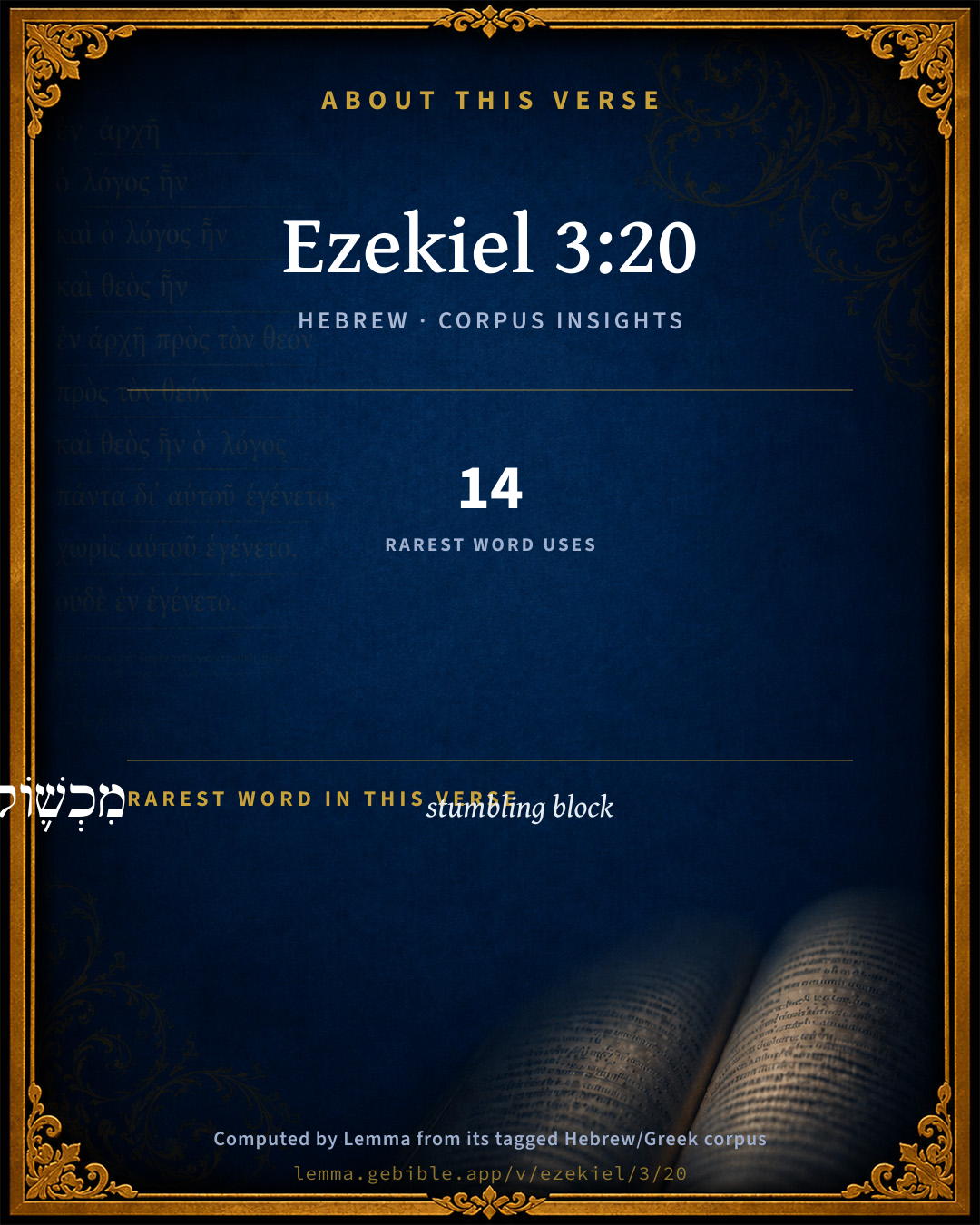
The rarest word here is מִכְשׁ֛וֹל stumbling block H4383 — appearing just 14 times in the whole Hebrew Bible.

Shared distinctive vocabulary

מִכְשׁ֛וֹל stumbling block H4383 occurs in 14 verses of the Hebrew Bible. Also found in:

Grammatical profile

  • 9 verbs
  • 8 nouns
  • 1 adjective
  • 1 pronoun
  • 1 conjunction
  • 3 particles

Verb forms

  • וּבְשׁ֨וּב Qal · Infinitive Construct
  • וְעָ֣שָׂה Qal · Perfect
  • וְנָתַתִּ֥י Qal · Sequential Perfect
  • יָמ֑וּת Qal · Imperfect
  • הִזְהַרְתּוֹ֙ Hiphil · Perfect
  • יָמ֔וּת Qal · Imperfect
  • תִזָּכַ֗רְןָ Niphal · Imperfect
  • עָשָׂ֔ה Qal · Perfect
  • אֲבַקֵּֽשׁ Piel · Imperfect

Repetition

Words recur within this verse — often emphatic in Hebrew:

  • וְעָ֣שָׂה to do H6213 ×2
  • יָמ֑וּת to die H4191 ×2
  • לֹ֤א not H3808 ×2

Hebrew & Septuagint length

In English translation the verse runs 58 words from the Hebrew and 52 from the Septuagint (LXX English) — closely comparable.

A rough comparison of the two English renderings, which tokenize alike — not a word-level alignment.

Word counts can differ between the Hebrew and the Greek without any difference in meaning — e.g. the Hebrew direct-object marker אֵת has no separate Greek word, and Greek often adds the article ὁ.

Cross-references

39

Topical passages linked to Ezekiel 3:20 in the Treasury of Scripture Knowledge — connected by theme and wording, ordered by reader-vote popularity; previews shown in the World English Bible.

  • Ezekiel 18:24 But when the righteous turns away from his righteousness, and commits iniquity, and does according to all the abominations that the wicked man does, shall he live? None of his righteous deeds that he has done shall be remembered: in his trespass that he has trespassed, and in his sin that he has sinned, in them shall he die.
  • Ezekiel 18:26 When the righteous man turns away from his righteousness, and commits iniquity, and dies therein; in his iniquity that he has done shall he die.
  • Ezekiel 33:12–13 You, son of man, tell the children of your people, The righteousness of the righteous shall not deliver him in the day of his disobedience; and as for the wickedness of the wicked, he shall not fall thereby in the day that he turns from his wickedness; neither shall he who is righteous be able to live thereby in the day that he sins.
  • Ezekiel 3:18 When I tell the wicked, You shall surely die; and you give him no warning, nor speak to warn the wicked from his wicked way, to save his life; the same wicked man shall die in his iniquity; but his blood will I require at your hand.
  • Romans 2:7–8 to those who by patience in well-doing seek for glory and honor and incorruptibility, eternal life;
  • Hebrews 10:38 But the righteous will live by faith. If he shrinks back, my soul has no pleasure in him."
  • Psalms 125:5 But as for those who turn aside to their crooked ways, Yahweh will lead them away with the workers of iniquity. Peace be on Israel.
  • 2 Peter 2:18–22 For, uttering great swelling words of emptiness, they entice in the lusts of the flesh, by licentiousness, those who are indeed escaping from those who live in error;
  • Psalms 119:165 Those who love your law have great peace. Nothing causes them to stumble.
  • Isaiah 8:14 He shall be for a sanctuary; but for a stone of stumbling and for a rock of offense to both the houses of Israel, for a gin and for a snare to the inhabitants of Jerusalem.
  • Isaiah 64:6 For we are all become as one who is unclean, and all our righteousness are as a polluted garment: and we all do fade as a leaf; and our iniquities, like the wind, take us away.
  • 2 Thessalonians 2:9–12 even he whose coming is according to the working of Satan with all power and signs and lying wonders,
  • 1 John 2:19 They went out from us, but they didn't belong to us; for if they had belonged to us, they would have continued with us. But they left, that they might be revealed that none of them belong to us.
  • Deuteronomy 13:3 you shall not listen to the words of that prophet, or to that dreamer of dreams: for Yahweh your God proves you, to know whether you love Yahweh your God with all your heart and with all your soul.
  • Jeremiah 6:21 Therefore thus says Yahweh, Behold, I will lay stumbling-blocks before this people; and the fathers and the sons together shall stumble against them; the neighbor and his friend shall perish.
  • Ezekiel 7:19 They shall cast their silver in the streets, and their gold shall be as an unclean thing; their silver and their gold shall not be able to deliver them in the day of the wrath of Yahweh: they shall not satisfy their souls, neither fill their bowels; because it has been the stumbling block of their iniquity.
  • Ezekiel 14:7–9 For everyone of the house of Israel, or of the strangers who sojourn in Israel, who separates himself from me, and takes his idols into his heart, and puts the stumbling block of his iniquity before his face, and comes to the prophet to inquire for himself of me; I Yahweh will answer him by myself:
  • Ezekiel 33:18 When the righteous turns from his righteousness, and commits iniquity, he shall even die therein.
  • Romans 9:32–33 Why? Because they didn't seek it by faith, but as it were by works of the law. They stumbled over the stumbling stone;
  • Romans 11:9 David says, "Let their table be made a snare, and a trap, A stumbling block, and a retribution to them.
  • 1 Peter 2:8 and, "A stone of stumbling, and a rock of offense." For they stumble at the word, being disobedient, whereunto also they were appointed.
  • 2 Chronicles 24:2 Joash did that which was right in the eyes of Yahweh all the days of Jehoiada the priest.
  • 2 Chronicles 24:17–22 Now after the death of Jehoiada came the princes of Judah, and made obeisance to the king. Then the king listened to them.
  • Psalms 36:3 The words of his mouth are iniquity and deceit. He has ceased to be wise and to do good.
  • Proverbs 25:12 As an ear-ring of gold, and an ornament of fine gold, So is a wise reprover to an obedient ear.
  • Ezekiel 14:3 Son of man, these men have taken their idols into their heart, and put the stumbling block of their iniquity before their face: should I be inquired of at all by them?
  • Ezekiel 33:6 But if the watchman sees the sword come, and doesn't blow the trumpet, and the people aren't warned, and the sword comes, and take any person from among them; he is taken away in his iniquity, but his blood will I require at the watchman's hand.
  • Zephaniah 1:6 those who have turned back from following Yahweh, and those who haven't sought Yahweh nor inquired after him.
  • Matthew 13:20–21 What was sown on the rocky places, this is he who hears the word, and immediately with joy receives it;
  • Leviticus 19:17 "'You shall not hate your brother in your heart. You shall surely rebuke your neighbor, and not bear sin because of him.
  • 2 Samuel 12:7–13 Nathan said to David, "You are the man. This is what Yahweh, the God of Israel, says: 'I anointed you king over Israel, and I delivered you out of the hand of Saul.
  • 2 Chronicles 19:2–4 Jehu the son of Hanani the seer went out to meet him, and said to king Jehoshaphat, Should you help the wicked, and love those who hate Yahweh? for this thing wrath is on you from before Yahweh.
  • 2 Chronicles 25:15 Therefore the anger of Yahweh was kindled against Amaziah, and he sent to him a prophet, who said to him, Why have you sought after the gods of the people, which have not delivered their own people out of your hand?
  • Daniel 9:18 My God, turn your ear, and hear; open your eyes, and see our desolations, and the city which is called by your name: for we do not present our petitions before you for our righteousness, but for your great mercies' sake.
  • Matthew 12:43–45 But the unclean spirit, when he is gone out of the man, passes through waterless places, seeking rest, and doesn't find it.
  • Matthew 18:15 "If your brother sins against you, go, show him his fault between you and him alone. If he listens to you, you have gained back your brother.
  • Luke 8:15 That in the good ground, these are such as in an honest and good heart, having heard the word, hold it tightly, and bring forth fruit with patience.
  • 1 Corinthians 1:23 but we preach Christ crucified; a stumbling block to Jews, and foolishness to Greeks,
  • Hebrews 13:17 Obey your leaders and submit to them, for they watch on behalf of your souls, as those who will give account, that they may do this with joy, and not with groaning, for that would be unprofitable for you.

Cross-references courtesy of OpenBible.info (CC BY 4.0).

Hebrew and Greek witnesses Masoretic Hebrew ↔ Greek Septuagint

The same verse in the two great witnesses to the Old Testament, shown verse-for-verse.

These are two independent witnesses, not word-aligned to each other, and the Septuagint is shown in lemma (dictionary) form.

Hebrew Ezekiel 3:20 Masoretic · Westminster Leningrad Codex

וּבְשׁ֨וּב צַדִּ֤יק מִצִּדְקוֹ֙ וְעָ֣שָׂה עָ֔וֶל וְנָתַתִּ֥י מִכְשׁ֛וֹל לְפָנָ֖יו ה֣וּא יָמ֑וּת כִּ֣י לֹ֤א הִזְהַרְתּוֹ֙ בְּחַטָּאת֣וֹ יָמ֔וּת וְלֹ֣א תִזָּכַ֗רְןָ צִדְקֹתָו֙ אֲשֶׁ֣ר עָשָׂ֔ה וְדָמ֖וֹ מִיָּדְךָ֥ אֲבַקֵּֽשׁ

Again, when a righteous man does turn from his righteousness, and commit iniquity, and I lay a stumbling block before him, he shall die: because you have not given him warning, he shall die in his sin, and his righteous deeds which he has done shall not be remembered; but his blood will I require at your hand.

World English Bible · Public Domain

Greek LXX Ezekiel 3:20 Septuagint · lemma form

καί ἐν ὁ ἀποστρέφω δίκαιος ἀπό ὁ δικαιοσύνη αὐτός καί ποιέω παράπτωμα καί δίδωμι ὁ βάσανος εἰς πρόσωπον αὐτός αὐτός ἀποθνήσκω ὅτι οὐ διαστέλλω αὐτός καί ἐν ὁ ἁμαρτία αὐτός ἀποθνήσκω διότι οὐ μή μιμνήσκω ὁ δικαιοσύνη αὐτός ὅς ποιέω καί ὁ αἷμα αὐτός ἐκ ὁ χείρ σύ ἐκζητέω

And when the righteous turns away from his righteousness, and commits a trespass, and I shall bring punishment before him, he shall die, because you did not warn him: he shall even die in his sins, because his righteousness shall not be remembered; but his blood will I require at your hand.

LXX2012 (modern English Septuagint) · Public Domain

On this verse, John Gill's Exposition discusses the Septuagint’s reading. Read the note in Commentary ↓

Hebrew: Westminster Leningrad Codex (CC BY 4.0). Greek: Septuagint (public domain); English from LXX2012 (modern English Septuagint) (Public Domain). How the Septuagint differs from the Hebrew →

Targum (Aramaic paraphrase)

1

The Targum is the ancient Jewish Aramaic paraphrase of the Hebrew Scriptures — an interpretive translation, not the Hebrew text itself. Onkelos (literal) and Pseudo-Jonathan (expansive) render the Torah, and Jonathan the Prophets. Coverage is partial: where no permissively-licensed English translation exists for a verse, only the Aramaic is shown. This is verse-level text, not a word-by-word alignment to the Hebrew.

  1. Targum Jonathan Prophets (Joshua–Malachi)
    וְכַד יְתוּב זַכָּאָה מִזְכוּתֵיהּ וְיַעֲבֵיד שְׁקַר וְאֶתֵּן תַּקְלַת חוֹבִין קֳדָמוֹהִי הוּא יְמוּת אֲרֵי לָא אַזְהַרְתֵּיהּ בְּחוֹבֵיהּ יְמוּת וְלָא אִדַכְּרָן זַכְוָתֵיהּ דַעֲבַד וּדְמֵיהּ מִן יְדָךְ אֶתְּבַע:

    (no public-domain English translation for this verse)

    Targum Jonathan — Aramaic: “Mikraot Gedolot” (public domain). English: “Sefaria Community Translation” (CC0 1.0 (public-domain dedication)); “London "Chaldee Paraphrase," 1871” (public domain). Text via Sefaria.

Commentary

Notes on Ezekiel 3:20 from classic Christian and Jewish commentators (each source and its license shown beneath its notes). The classic Christian expositions comment on the surrounding passage and are grouped to its opening verse, so a note may address several verses; the Jewish commentaries on the Tanakh (Rashi and others) are per-verse, so they appear only where the commentator wrote on this verse.

Lemma curates 59 commentaries, every one of them public domain or Creative Commons licensed, each selected and text-cleaned for this edition rather than reprinted as found. About our sources →

Jamieson, Fausset & Brown

Robert Jamieson, A. R. Fausset & David Brown

righteous . . . turn from . . . righteousness--not one "righteous" as to the root and spirit of regeneration (Psa 89:33; Psa 138:8; Isa 26:12; Isa 27:3; Joh 10:28; Phi 1:6), but as to its outward appearance and performances. So the "righteous" (Pro 18:17; Mat 9:13). As in Eze 3:19 the minister is required to lead the wicked to good, so in Eze 3:20 he is to confirm the well-disposed in their duty.

commit iniquity--that is, give himself up wholly to it (Jo1 3:8-9), for even the best often fall, but not wilfully and habitually.

I lay a stumbling-block--not that God tempts to sin (Jam 1:13-14), but God gives men over to judicial blindness, and to their own corruptions (Psa 9:16-17; Psa 94:23) when they "like not to retain God in their knowledge" (Rom 1:24, Rom 1:26); just as, on the contrary, God makes "the way of the righteous plain" (Pro 4:11-12; Pro 15:19), so that they do "not stumble." CALVIN refers "stumbling-block" not to the guilt, but to its punishment; "I bring ruin on him." The former is best. Ahab, after a kind of righteousness (Kg1 21:27-29), relapsed and consulted lying spirits in false prophets; so God permitted one of these to be his "stumbling-block," both to sin and its corresponding punishment (Kg1 22:21-23).

his blood will I require-- (Heb 13:17).

Jamieson, Fausset & Brown — Commentary Critical and Explanatory on the Whole Bible (1871) — public domain (CC PDM 1.0). Text via the HelloAO Bible API.

Trapp's Complete Commentary

John Trapp

Eze 3:20 Again, When a righteous [man] doth turn from his righteousness, and commit iniquity, and I lay a stumblingblock before him, he shall die: because thou hast not given him warning, he shall die in his sin, and his righteousness which he hath done shall not be remembered; but his blood will I require at thine hand.

Ver. 20. Again, When a righteous man.] So esteemed by others, and haply also by himself; a self-deceiver.

Doth turn from his righteousness.] As he may soon do, where it is but a semblance. Falling stars were never but meteors.

And commit iniquity.] This a righteous man, rightly so called, doth not. {Joh 8:34 1Jn 3:8} {See Trapp on "1Jn 3:8"}

And I lay a stumblingblock before him,] i.e., I cause him to prosper in his sin, saith Vatablus, which is a heavy judgment. Fatted ware is but fitted for the shambles.

Because thou hast not given him warning.] Hast not uncased and unkennelled the hypocrite, driving him out of his starting-holes. {a}

And his righteousness.] His works that were materially good, but not formally and eventually. Bonum non sit nisi ex integra causa.

Shall not be remembered,] i.e., Reckoned to him he shall not thereby set off with God, or make amends by his good deeds for his bad; nay, his dissembled sanctity shall pass for double iniquity, and he shall be held therefore the worse, because he pretended to be better.

{a} A hole in which a hunted animal takes refuge; transf. a place in which a criminal or a hunted enemy finds refuge.

John Trapp, A Commentary or Exposition upon All the Books of the Old and New Testament (1647–1656) — public domain. Text from a community e-Sword module.

Joseph Benson's Commentary

Eze 3:20-21. Again, When a righteous man — One truly righteous, and devoted to the love and service of God in heart and life; one whose person is justified, whose nature is renewed, and whose practice is conformed to God’s holy will; doth turn from his righteousness and commit iniquity — Which the Scriptures show to be very possible, and experience and observation demonstrate to be a case not uncommon. And I lay a stumbling-block before him — Such a temptation to sin as he might have resisted, but to which, nevertheless, he yielded, and by which he was overcome. The word מכשׁול, here rendered stumbling-block, sometimes signifies ruin, as Eze 18:30. Therefore some render this clause, And I cause iniquity to become his ruin; he shall die — Shall perish in his sin; and his righteousness shall not be remembered — Shall be of no advantage to him; shall stand him in no stead for the preventing of punishment. But his blood will I require at thy hand — See on Eze 3:18. Nevertheless if thou warn the righteous man — That he may not be drawn aside by bad examples, or any other temptation, to forsake the ways of piety and virtue. And he doth not sin — But continues conscientiously to walk in God’s ordinances and commandments blameless. He shall surely live — In the favour of God here, and in his kingdom hereafter. Also thou hast delivered thy soul — Both the warner and the warned escape destruction.

Joseph Benson's Commentary on the Old and New Testaments (1811–1818) — public domain. Text from a community e-Sword module.

Tyndale Open Study Notes

Tyndale Open Resources

3:20-21 The prophet spoke to two classes of people, the righteous and the wicked. Ezekiel was to express his message indiscriminately, for both the righteous and the wicked would be judged on the basis of their response to his words (cp. Matt 13:3-9, 18-23). Those who heeded him would receive life; those who rejected his message would receive death, even if they had previously been righteous. Faith in the Lord’s word through his prophet was the sole criterion that divided those who would live from those who would die.

Tyndale Open Study Notes — © Tyndale Open Resources, licensed CC BY-SA 4.0. Text via the HelloAO Bible API.

Geneva Bible (1599)

Geneva Bible translators

I will give him up to a reprobate mind, Rom. 1:28.

If he that hath been instructed in the right way turn back.

Which seemed to have been done in faith, and were not.

Geneva Bible (1599) marginal notes — public domain. Text via Bolls.life.

Adam Clarke's Commentary

Verse 20. When a righteous man doth turn from his righteousness] Which these words plainly state he may do, and commit iniquity, and die in his sin; and consequently die eternally, which is also here granted; if he have not been warned, though he die in his sin, the blood-the life and salvation, of this person also will God require at the watchman's hand. Pastor hunc occidit, quia eum tacendo morti tradidit. "This man the pastor kills; for in being silent, he delivers him over to death." - GREGORY. From these passages we see that a righteous man may fall from grace, and perish everlastingly. Should it be said that it means the self-righteous, I reply, this is absurd; for self-righteousness is a fall itself, and the sooner a man falls from it the better for himself. Real, genuine righteousness of heart and life is that which is meant. Let him that standeth take heed lest he fall.

And I lay a stumbling-block before him] That is, I permit him to be tried, and he fall in the trial. God is repeatedly represented as doing things which he only permits to be done. He lays a stumbling-block, i.e., he permits one to be laid.

Adam Clarke's Commentary on the Bible (1810–1826) — public domain. Text from a community e-Sword/MySword module.

John Calvin's Commentaries

Here God adds another part of duty which is incumbent on all Prophets. For they are first sent to bring back into the way those who had been alienated from God, then to retain those who are already within the flock, and to lead those onward to the goal who have already entered upon the course. We see, therefore, that Prophets ought to be occupied with both duties, so that they may not only recall to their obedience to God those who wander after their own lusts, but also confirm those who are, of their own accord, teachable already, and encourage them to persevere, and prevent them from failing away. Hence, after God has spoken concerning the correction of sinners who had strayed, he now adds another member. If, says he, the righteous man be turned aside from his righteousness, and thou hast not admonished him, he shall ate, and I will require his blood at thy hand Where in effect God signifies, that Prophets are guilty, not only if they do not exhort those who have withdrawn from the right way to retrace their steps, but also if they do not retain within their duty those who have already entered upon the right course. We must then have two objects in view, to recall those who have fallen into various errors, and to take care that those within the fold should not fall away, but be strengthened in perseverance. Hence it is now added, If the righteous shall turn aside, he indeed shall die, but his blood will I require

Here it may be asked, how can the just turn aside, since there is no righteousness without the spirit of regeneration But the seed of the Spirit is incorruptible, (1 Peter 1:23,) nor can it ever happen that his grace is utterly extinguished; for the Spirit, is the earnest and seal of our adoption, for God’s adoption is without repentance, as Paul says. (Romans 11:29.) Hence it may seem absurd to say, that the just recedes and turns aside from the right way. That passage of John is well known — if they had been of us, they had remained with us, (1 John 2:19,) but because they have departed, that falling away proves sufficiently that they were never ours. But we must here mark, that righteousness is here called so:, which has only the outward appearance and not the root: for when once the spirit of regeneration begins to flourish, as I have said, it remains perpetually. And we shall sometimes see men borne along with a wonderful ardor of zeal for the worship of God, and to be urged to promote his glory beyond even the very best men; indeed we shall see this, but, says Paul, God knows those who are his own. (2 Timothy 2:19.) Hence it is not wonderful that God under the name of righteousness here commends virtues which deserve praise before men, even if they do not spring from a pure fountain. Thus we see it. often happens that the righteous are alienated, and turn aside from the right way. This passage, then, ought to stir us up to seek from God continually a spirit of perseverance, because such is our propensity to sin, that we immediately flow in different directions like water, unless God strengthen us. When therefore we see the righteous themselves depart from the way, let us lead and become sure of the constancy of our own faith, only let our confidence be founded on the help of the Holy Spirit and not in ourselves. In the meantime, we see that Christ did not pronounce this passage in vain: Happy are those who persevere unto the end, (Matthew 24:13,) because many fall away in the midst of their course, or reversing their steps, turn their backs upon God.

Now we must carefully remark what follows, his righteousness shall not be remembered, because some desire to bargain with God, so that if for a time they enter upon the pursuit of piety, that may be taken into account and avail in their favor. But we hear what God pronounces, all their righteousness shall not be remembered in the case of backsliders There is no encouragement to flatter ourselves into sloth and security, when God shows that unless we continue to the end, even the goal of our career, whatever else we attain unto, it is useless. He says, as clearly as words will express it, if he shall fall away, or recede, or turn aside from his righteousness and shall commit iniquity We must mark this diligently, because we know that the very best men often fall away; but here a falling away is intended, where any one casts himself headlong on impiety: hence to commit iniquity is to give oneself up entirely to impiety; as when John says, that those who are born again of the Spirit of God do not commit sin, (1 John 3:9,) he means, are not addicted to sin, even if as yet they dwell among many infirmities and failings: as also Paul says, that sin dwells in us, but does not reign. (Romans 6:12.) Hence to commit sin is to give oneself up to sin. But God says, I will place, or for placing, or if I shall have placed, a stumblingblock before his face Punishment is here called a stumblingblock, when God demonstrates his vengeance against apostates. Although a stumblingblock may also be called actual admonition, as the phrase is; but because that is too far-fetched, I receive it simply, if the righteous shall have turned aside: but I shall have rendered the reward which he deserved, he shall die, because thou hast not admonished him: in his unrighteousness shall he die: thus I point it off, for interpreters seem to me improperly to have mingled together — he shall die, and — he shall die in his iniquity. Now that threat which we have seen is repeated, namely, that all prophets who have deserted their office are guilty before God, because their sloth differs little from perfidy: for God considered them worthy of the greatest honor, since he committed souls to them, which, as we have said, he esteems so dear and precious. But if they reject this trust committed to them, we see that they not only act injuriously to man, but are also ungrateful to God; and their sluggishness is not only united with perfidy, but also with sacrilege, because they permit Satan to snatch from God what was his own. Just as if any watchman should desert his post and betray it to the enemy; because when they see some wander and others desert, it is clear that this does not arise from ignorance, as we have said, but to the snares of Satan and lust are those exposed whom Christ has redeemed with his blood: hence as we have said, this their treachery is without excuse.

John Calvin's Commentaries (1540-1563) — public domain. Text from the Calvin Translation Society English edition (1840s-50s) via the Christian Classics Ethereal Library (ccel.org). Calvin's coverage is partial (roughly two-thirds of the Bible); uncommented books and verses are honest gaps, never fabricated. The 19th-century editor's footnotes and remarks are omitted so the notes are faithfully Calvin's own voice.

Ellicott's Commentary for English Readers

(20) When a righteous man doth turn from his righteousness.—Quite independently of any theological question, it is undeniable that the Scripture here, as often elsewhere, represents the upright man as exposed to temptation, and in danger of falling into sin. The duty of the prophet, therefore, is not only to seek to turn the wicked from his evil way, but also to warn the righteous against falling into the same path. Both terms must necessarily be taken as comparative; but they show that there was even now a considerable difference in character among the captives.

I lay a stumblingblock before him.—A “stumbling-block” is anything at which people actually stumble, whether intended for that purpose or, on the contrary, designed for their highest good. Thus Christ is foretold as a stumbling-block to both the houses of Israel (Isa_8:14), and is several times spoken of as such by the apostles (1Co_1:23; Rom_9:32-33; 1Pe_2:8). The word is used oftener by Ezekiel than by all the other Old Testament writers together; in Eze_7:19 the riches of the people are spoken of as their stumbling-block, and in Eze_44:12 (marg.) the sinful Levites are described as a stumbling-block. The meaning here is plainly, “when a man perverts any of God’s gifts or providences into an occasion of sin.”

A Bible Commentary for English Readers, edited by Charles John Ellicott (1878–1897) — public domain. Text from a community e-Sword module.

The Cambridge Bible for Schools and Colleges

gen. ed. J. J. S. Perowne

20. I lay a stumbling-block] i.e. something over which he shall fall and perish; Lev_19:14, “Nor put a stumbling-block before the blind.” When God prepares such a stumbling-block for the righteous who has sinned, unless he is warned he will fall and be broken, and his blood will be on the prophet.

The Cambridge Bible for Schools and Colleges (gen. ed. J. J. S. Perowne; Cambridge University Press, 1878–1918) — public domain. Text from a community e-Sword module.

John Gill's Exposition

Again, when a righteous man doth turn from his righteousness,.... This is to be understood not of one that is truly righteous, or is justified by the righteousness of Christ; for such can never turn from that righteousness, or be in an unjustified state; seeing that is the righteousness of God, and an everlasting one; but of one that is denominated righteous, from "his" own righteousness, from a righteousness "which he hath done", as is afterwards expressed; one that is outwardly righteous before men, that is outwardly reformed, that has a righteousness of his own, consisting of a little negative holiness, and a few moral performances; from such righteousness a man may apostatize, and go into a vicious course of life:

and commit iniquity; live in sin, make a trade of it; lead a life, the whole series and course of which is nothing else but sin; in this sense, one that is born of God, and has the righteousness of Christ revealed from faith to faith unto him, and lives by faith upon it, cannot commit sin, Jo1 3:9;

and I lay a stumbling block before him; the Targum renders it, "the stumbling block of sins"; which designs either an occasion of sinning, which God permits, leaving him to his own lusts, and suffering him to fall thereby; and by this means he is discovered to be what he is, not a truly righteous man, but only one in appearance; that looked like a righteous person, but secretly a sinner, and now the Lord by such means exposes him openly; so Jarchi and other Jewish Rabbins; but Kimchi's father interprets the stumbling block of prosperity in this world (u): or rather the punishment of sin is meant, as Kimchi himself observes; and the Septuagint renders it "torment"; since this follows up on his turning from righteousness, and committing sin; and seems to be explained by the next clause:

he shall die; the second death:

because thou hast not given him warning: of the dreadful evil of apostasy, and the sad estate of apostates, and the danger they are in, their last estate being worse than the first:

he shall die in his sin; of apostasy, and for it, being never to be recovered and brought to repentance:

and his righteousness which he hath done shall not be remembered; according to the "Keri" or marginal reading it is, "his righteousnesses"; all his works of righteousness which he hath done; and which reading is followed by the Targum, Septuagint, Vulgate Latin, and the eastern versions; these shall not be remembered, neither in this world nor in that to come; no account shall be taken of them, nor shall they be reckoned as a righteousness unto him:

but his blood will I require at thine hand; See Gill on Eze 3:18.

(u) Vid. T. Bab. Yoma, fol. 86. 2.

John Gill's Exposition of the Whole Bible (1746–1763) — public domain (CC PDM 1.0). Text via the HelloAO Bible API.

Haydock's Catholic Bible Commentary

Iniquity, for want of thy instruction; (Haydock) or, if thou neglect to reclaim him, (Calmet) and he perish, or owe his conversion to another, when duty requires thee to take care of him, thou shalt answer for the possible bad consequences. Thy sin is great, whatever become of him. But if he be damned, though he must blame himself chiefly, yet the blood of his soul shall cry for vengeance more than Abel’s. (Haydock) --- Before him, taking away my grace in punishment of his revolt. (Worthington) --- If thou neglect to attempt reclaiming him, thou shalt perish with him; (St. Gregory) or if he be exposed to trial, and thou abandon him, (Vatable) of if thou neglect to husband well the precious moments, when I open his eyes, and fill him with apprehensions of his dangerous state, I will require, &c. (Origin; St. Jerome) --- Remembered. Ingratitude caused the fruits of virtue to decay, and former crimes to revive, in some sense. (St. Thomas, [Summa Theologiae] iii. p. q. 88. a. 1.) (Matthew v. 26.) (Calmet)

George Leo Haydock (1774–1849), Haydock's Catholic Family Bible and Commentary, 1859 edition — public domain. Excludes Psalms (Douay-Rheims chapter numbering differs from Protestant) and Deuterocanonical books (Catholic canon only).

Matthew Poole's English Annotations

What must be done to sinners is said, now for those that have been righteous take thy directions.

A righteous man; either one that hath for some continuance of time professed the way of righteousness, but is now overcome of vices; or who is righteous only in appearance, as Pro 18:17; Eze 18:24,26; 33:13; Mat 9:13.

Doth turn from his righteousness; gives just cause to fear he not only hath committed some particular sin, but that he hath changed the course of life, the thoughts and purposes from good to evil, hath forsaken the way of righteousness.

Commit iniquity; gives himself up to a sinful life, wallows in sin.

I lay a stumbling-block; dispose affairs so by a just and punishing providence that what did restrain is taken away, or what will be occasion of greater sinning is not removed, or any other way I give such a one up to his own heart’s lust, so that he continue in sin.

He shall die; shall perish in his sin.

His righteousness; either external, and seeming; or his partial and temporary righteousness, which he himself or others ascribed to him, and thought to be in him; shall not be profitable to him: he that apostatizeth is the worst of men, because he falls from known ways of goodness and holiness. Yet such must be warned, else their blood will be required at the hand of those who were to warn them.

Matthew Poole's English Annotations on the Holy Bible (1683–1685) — public domain. Text from a community e-Sword/MySword module.

Whedon's Commentary on the Bible

Daniel D. Whedon

20. I lay a stumbling-block — For an explanation of God’s agency in temptation see chap. xviii and Plumptre, Pulpit Commentary, p. 49. Every man in the last hour of his life trips over a stumbling-block — which God sees, and permits to remain — and falls into the grave. The point here is that if the prophet fails to warn a man who once was righteous but is now wicked, and he dies without repentance, he will be lost, and his blood will be upon the head of the silent watchman.

Daniel D. Whedon (gen. ed.), Commentary on the Old and New Testaments (1874–1909) — public domain. Text from a community e-Sword module.

The Pulpit Commentary

From his righteousness. The Hebrew gives the plural, "his righteousnesses all his single righteous acts that lie behind. I lay a stumbling block, etc. The word is again characteristic. (Eze_7:19 Eze_14:3, Eze_14:4) It occurs in Jer_6:21, and Ezekiel may have learnt the use of the word from him. It is found also in Lev_19:14 and Isa_57:14; but the date of these, according to the so called higher criticism, may be later than Ezekiel. in Isa_8:14: the word is different. The English word sufficiently expresses the sense. One of the acts of Eastern malignity was to put a stone in a man"s way, that he might fall and hurt himself Here the putting the stone is described as the act of Jehovah, and is applied to anything that tempts a man to evil, and so to his own destruction. (Jer_6:21) The thought is startling to us, and seems at variance with true conceptions of the Divine will. (Jam_1:13) The explanation is to be found in the fact that the prophet"s mind did not draw the distinction which we draw between evil permitted and the same evil decreed. All, from this point of view, is as God wills, and even those who thwart that will are indeed fulfilling it. Glimpses are given of the purpose which leads to the permission or decree. In the case now before us the man has turned from his righteousness before the stumbling block is laid in his way. The temptation is permitted that the man may become conscious of his evil. (so Rom_7:13) If the prophet preacher does his duty, the man may conquer the temptation, and the stumbling block may become a "stepping stone to higher things." If, through the prophet"s negligence, he comes unwarned, and stumbles and falls, he, as in the case of the wicked, bears the penalty of his guilt, but the prophet has here also the guilt of blood upon his soul. The "righteousnesses" of the man (here, as before, we have the plural), his individual acts of righteousness, shall not be remembered, because he was tried, and found wanting in the essential element of all righteousness. The highest development of the thought is found in the fact that Christ himself is represented as a "stumbling stone". (Isa_8:14; Rom_9:32, Rom_9:33; 1Co_1:23) St. Paul"s solution of the problem is found in the question, "Have they stumbled that they should fall?". (Rom_11:11) Was that the end contemplated in the Divine purpose Will it really be the end?

The Pulpit Commentary (1880–1919), ed. H.D.M. Spence-Jones & Joseph S. Exell — public domain. Text from a community e-Sword module.

John Wesley's Explanatory Notes

I Lay - Permit it to be laid before him. He shall - Perish in his sin. Remembered - Shall not be profitable to him; "he that apostatizes is the worst of men, because he falls from known ways of goodness and holiness."

John Wesley, Explanatory Notes Upon the Whole Bible (1754–1765) — public domain. Text via the GEBible commentary corpus.

unfoldingWord translationNotes

Door43 World Missions Community

set a stumbling block before him

Possible meanings are 1) "make something bad happen to him" or 2) "cause him to sin openly." (See: Metaphor)

he will die in his sin

"he will die as a sinner" or "he will die as a guilty person because he has disobeyed me"

I will require his blood from your hand

This is an idiom for holding someone responsible or guilty of murder. See how you translated this in Ezekiel 3:18. AT: "I will treat you as if you had murdered him" (See: Idiom)

since he was warned

This can be translated in active form. AT: "since you warned him" (See: Active or Passive)

translationWords

righteous

just

stumbling block

sin

hand

unfoldingWord translationNotes — © Distant Shores Media and the Door43 World Missions Community, licensed CC BY-SA 4.0. Source: git.door43.org/Door43/en_tn.

Rashi

Rabbi Shlomo Yitzchaki (Rashi)

I shall place a stumbling block before him When he does his deeds in secret and displays himself as a righteous man, I place an overt sin before him in order to reveal his deeds, and when I bring evil upon him, they will not question Me.

and his righteous deeds...will not be remembered Our Rabbis explained this as referring to one who regrets his first oneshe regrets the first righteous deeds that he performed.

Rashi on the Tanakh — English translations: “The Judaica Press complete Tanach with Rashi, translated by A. J. Rosenberg” (CC BY 4.0); “Pentateuch with Rashi's commentary by M. Rosenbaum and A.M. Silbermann, 1929-1934” (public domain); “The Metsudah Tanach series, Lakewood, N.J” (CC BY 4.0); and “The Book of Joshua, Metsudah Publications, 1997” (CC BY 4.0). Text via Sefaria.

Lesson kit

Teaching starters — assembled from the data on this page, not authored interpretation. Every prompt links to the verse data it draws on. Edit before teaching.

Ezekiel, in the Prophets, opens this verse with 23 words (20 distinct Hebrew lemmas). Its most distinctive word is mikshôwl (“stumbling block”). A historical commentator’s framing appears above. Read the whole chapter for the surrounding context.

Discussion questions

  1. How does “stumbling block” (mikshôwl) shape what this verse is saying?
  2. Leviticus 19:14 shares the word «stumbling block» with this verse. How do the two illuminate each other?
  3. “to do” occurs 2× in this one verse. What is the effect of the repetition?
  4. The translations on this page render this verse differently — a whole-verse word diff, not a word-by-word alignment. What might account for the different wordings?
  5. The verb «וּבְשׁ֨וּב» is Qal Infinitive Construct. How does its form color the action?
  6. Reading how Jamieson, Fausset & Brown and Trapp's Complete Commentary read this verse, where do the two commentators agree and where do they part?

Things to notice

Reading settings

Reading text

Shown beneath each verse's original-language words.

Old Testament
Old Testament edition

Read the OT as the Masoretic Hebrew (MT) or the Greek Septuagint (LXX).

English shown for the Greek Septuagint (in the Hebrew ↔ Greek comparison).

Comparing translations? Open the Compare panel on any verse page to stack up to four side by side.