
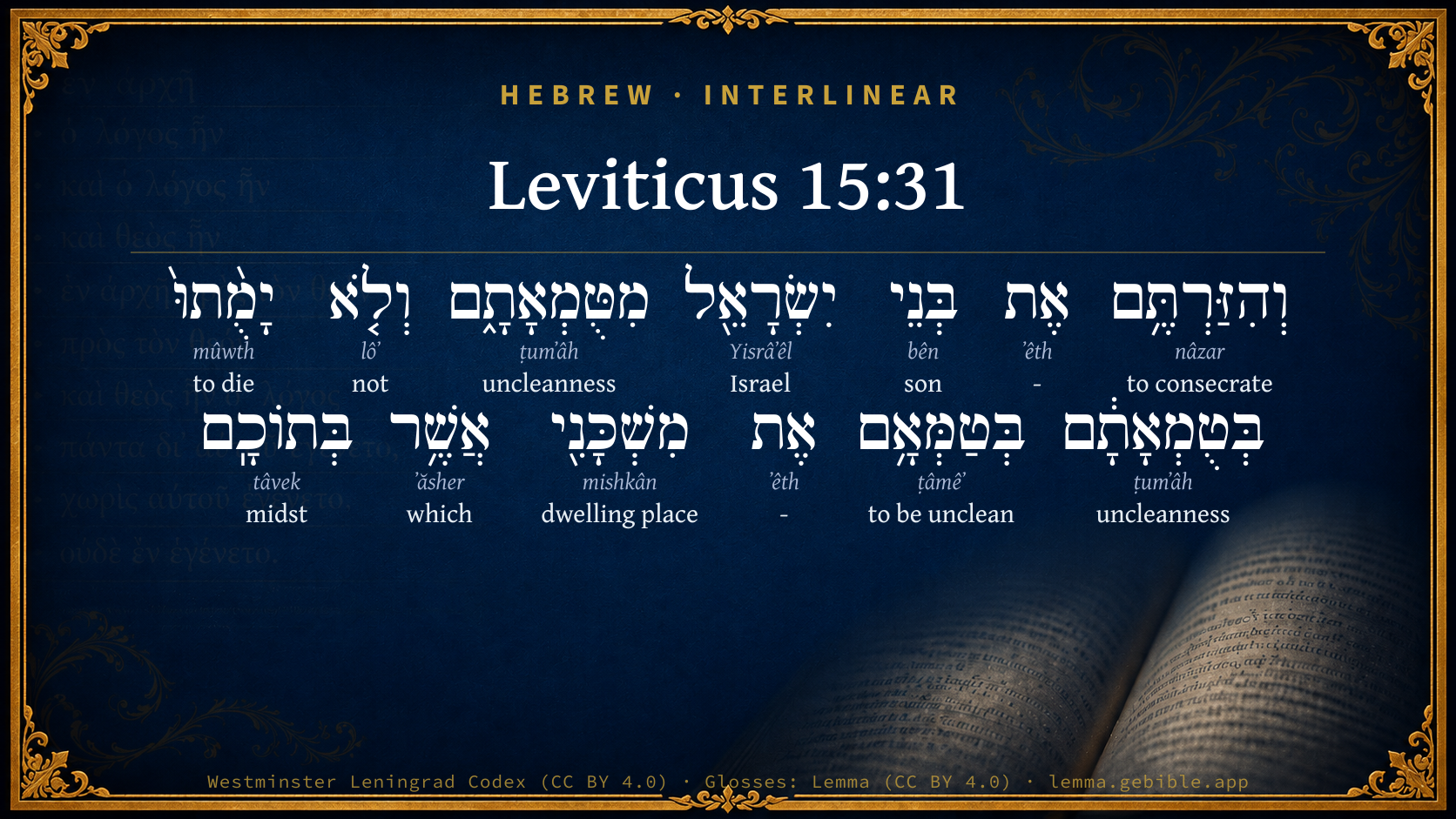
Leviticus 15:31

Hebrew (Westminster Leningrad Codex) Leviticus 15:31 appears in the Hebrew Old Testament. The text above is from the Westminster Leningrad Codex. Each word links to its Strong’s number, a concise gloss, and parsing drawn from the Open Scriptures Hebrew Bible morphology. Click any word for its full Brown-Driver-Briggs (BDB) entry.
Download image
Cite this verse

Leviticus 15:31 (World English Bible). Public Domain. Lemma interlinear Bible study tool, https://lemma.gebible.app/v/leviticus/15/31.

Show BibTeX & RIS
BibTeX
RIS
English Translation
"'Thus you shall separate the children of Israel from their uncleanness, so they will not die in their uncleanness, when they defile my tabernacle that is in their midst.'"
World English Bible · Public Domain
Highlights
  • 1 first appearance in the Hebrew Bible
Full analysis ↓
Download a study sheet

One document with this verse’s original text, its word-by-word gloss line, the meaning frame, cross-references with their text, attributed commentary, and full source and license credits — printable, and it pastes into notes with its structure intact.

This verse Autodidact and up

Study sheet (.html) Plain text (.txt)

A passage Seminary Student

Up to 50 verses in one chapter. A passage sheet keeps up to 6 commentary sources and 12 cross-references per verse, in the order this page ranks them, and says so on the sheet whenever that leaves anything out. Ask for a single verse and you get the Autodidact verse sheet above.

Everything on this page stays free to read, with no account — the sheet is a download of what is already on screen, not access to it.

Want to remove ads? Support Godless Engineer
Compare translations 3

The same verse in 3 English versions, stacked beneath the original-language interlinear above. Click any original word for its lexicon entry.

Each is an independent rendering of the whole verse — the interlinear is not word-aligned to these translations.

Highlighted words mark where these versions differ — a whole-verse word diff, not a word-by-word alignment.

  • World English Bible Public Domain
    "'Thus you shall separate the children of Israel from their uncleanness, so they will not die in their uncleanness, when they defile my tabernacle that is in their midst.'"
  • King James Version Public Domain
    Thus shall ye separate the children of Israel from their uncleanness; that they die not in their uncleanness, when they defile my tabernacle that is among them.
  • unfoldingWord Literal Text CC BY-SA 4.0
    And you shall hold back the sons of Israel from their uncleanness, and they will not die by their uncleanness, by their defiling my Dwelling, which in their midst.

unfoldingWord Literal Text — © unfoldingWord, licensed CC BY-SA 4.0. Word-aligned USFM3 via Door43 (git.door43.org/unfoldingWord/en_ult).

Versions to compare (up to 4)

3 of 4 selected

Show all 18 translations

Every available English version of this verse, each an independent rendering of the whole verse.

  • World English Bible Public Domain
    "'Thus you shall separate the children of Israel from their uncleanness, so they will not die in their uncleanness, when they defile my tabernacle that is in their midst.'"
  • Berean Standard Bible Public Domain
    You must keep the children of Israel separate from their uncleanness, so that they do not die by defiling My tabernacle, which is among them.
  • Majority Standard Bible Public Domain
    You must keep the children of Israel separate from their uncleanness, so that they do not die by defiling My tabernacle, which is among them.
  • King James Version Public Domain
    Thus shall ye separate the children of Israel from their uncleanness; that they die not in their uncleanness, when they defile my tabernacle that is among them.
  • American Standard Version (1901) Public Domain
    Thus shall ye separate the children of Israel from their uncleanness, that they die not in their uncleanness, when they defile my tabernacle that is in the midst of them.
  • Revised Version (1885) Public Domain
    Thus shall ye separate the children of Israel from their uncleanness; that they die not in their uncleanness, when they defile my tabernacle that is in the midst of them.
  • Geneva Bible (1599) Public Domain
    Thus shall yee separate the children of Israel from their vncleannes, that they dye not in their vncleannesse, if they defile my Tabernacle that is among them.
  • Douay-Rheims (1899) Public Domain
    You shall teach therefore the children of Israel to take heed of uncleanness, that they may not die in their filth, when they shall have defiled my tabernacle that is among them.
  • Young's Literal Translation Public Domain
    `And ye have separated the sons of Israel from their uncleanness, and they die not in their uncleanness, in their defiling My tabernacle which `is' in their midst.
  • Literal Standard Version CC BY-SA 4.0
    And you have separated the sons of Israel from their uncleanness, and they do not die in their uncleanness, in their defiling My Dwelling Place which [is] in their midst.
  • Unlocked Literal Bible CC BY-SA 4.0
    This is how you must separate the people of Israel from their uncleanness, so they will not die due to their uncleanness, by defiling my tabernacle, where I live among them.
  • unfoldingWord Literal Text CC BY-SA 4.0
    And you shall hold back the sons of Israel from their uncleanness, and they will not die by their uncleanness, by their defiling my Dwelling, which in their midst.
  • Darby Bible Public Domain
    And ye shall separate the children of Israel from their uncleanness, that they die not in their uncleanness, when they defile my tabernacle that is in their midst.
  • World Messianic Bible Public Domain
    “‘Thus you shall separate the children of Israel from their uncleanness, so they will not die in their uncleanness when they defile my tabernacle that is among them.’”
  • Webster's Bible Public Domain
    Thus shall ye separate the children of Israel from their uncleanness: that they die not in their uncleanness, when they defile my tabernacle that is among them.
  • Free Bible Version CC BY-SA 4.0
    This is how you must stop the Israelites from becoming ceremonially unclean, so that they don't die by making my Tabernacle unclean, the place where I live with them.
  • Bible in Basic English Public Domain
    In this way may the children of Israel be made free from all sorts of unclean conditions, so that death may not overtake them when they are unclean and when they make unclean my holy place which is among them.
  • JPS Tanakh (1917) Public Domain
    Thus shall ye separate the children of Israel from their uncleanness; that they die not in their uncleanness, when they defile My tabernacle that is in the midst of them.

Literal Standard Version (2020), Covenant Press — licensed CC BY-SA 4.0. Text via the HelloAO Bible API (eBible.org). Unlocked Literal Bible (unfoldingWord) — licensed CC BY-SA 4.0. Text via the HelloAO Bible API (eBible.org). unfoldingWord Literal Text — © unfoldingWord, licensed CC BY-SA 4.0. Word-aligned USFM3 via Door43 (git.door43.org/unfoldingWord/en_ult). Free Bible Version, Dr. Jonathan Gallagher — licensed CC BY-SA 4.0. Text via the HelloAO Bible API (eBible.org).

Word by word

More ways to search: Search by grammar → Find every occurrence → Compare this word →

Practice this passage: Drill this verse → Learn its vocabulary →

וְהִזַּרְתֶּ֥ם
nâzar
H5144
“and · to consecrate”
Conjunction + Verb, Hiphil, Sequential Perfect, 2nd Person, Masculine, Plural
Part of Speech
Conjunction + Verb
Stem
Hiphil
Form
Sequential Perfect
Person
2nd Person
Gender
Masculine
Number
Plural
Full BDB Definition

Origin: a primitive root

TWOT: 1340

to dedicate, consecrate, separate - (Niphal) to dedicate oneself, devote oneself - (Hiphil) to keep sacredly separate - (Hiphil) to be a Nazarite, live as a Nazarite
  1. אֶת ʼêth H853 “-” Particle, Direct Object
  2. בְּנֵי bên H1121 “sons of” Noun, Common, Masculine, Plural, Construct
  3. יִשְׂרָאֵ֖ל Yisrâʼêl H3478 “Israel” Noun, Proper
  4. מִטֻּמְאָתָ֑ם ṭumʼâh H2932 “from · uncleanness · their” Preposition + Noun, Common, Feminine, Singular, Construct + Suffix, Personal, 3rd Person, Masculine, Plural
  5. וְלֹ֤א lôʼ H3808 “and · not” Conjunction + Particle, Negative
  6. יָמֻ֨תוּ֙ mûwth H4191 “to die” Verb, Qal, Imperfect, 3rd Person, Masculine, Plural
  7. בְּטֻמְאָתָ֔ם ṭumʼâh H2932 “in/at · uncleanness · their” Preposition + Noun, Common, Feminine, Singular, Construct + Suffix, Personal, 3rd Person, Masculine, Plural
  8. בְּטַמְּאָ֥ם ṭâmêʼ H2930 “in/at · to be unclean · them” Preposition + Verb, Piel, Infinitive Construct + Suffix, Personal, 3rd Person, Masculine, Plural
  9. אֶת ʼêth H853 “-” Particle, Direct Object
  10. מִשְׁכָּנִ֖י mishkân H4908 “dwelling place · my” Noun, Common, Masculine, Singular, Construct + Suffix, Personal, 1st Person, Common, Singular
  11. אֲשֶׁ֥ר ʼăsher H834 “which” Particle, Relative
  12. בְּתוֹכָֽם tâvek H8432 “in/at · midst · their” Preposition + Noun, Common, Masculine, Singular, Construct + Suffix, Personal, 3rd Person, Masculine, Plural

About this verse

These counts appear in no published source. They are computed here, from the morphology-tagged text and Lemma’s own curated glosses. What Lemma adds →

13
words
11
distinct lemmas
Pentateuch
section

Notable vocabulary

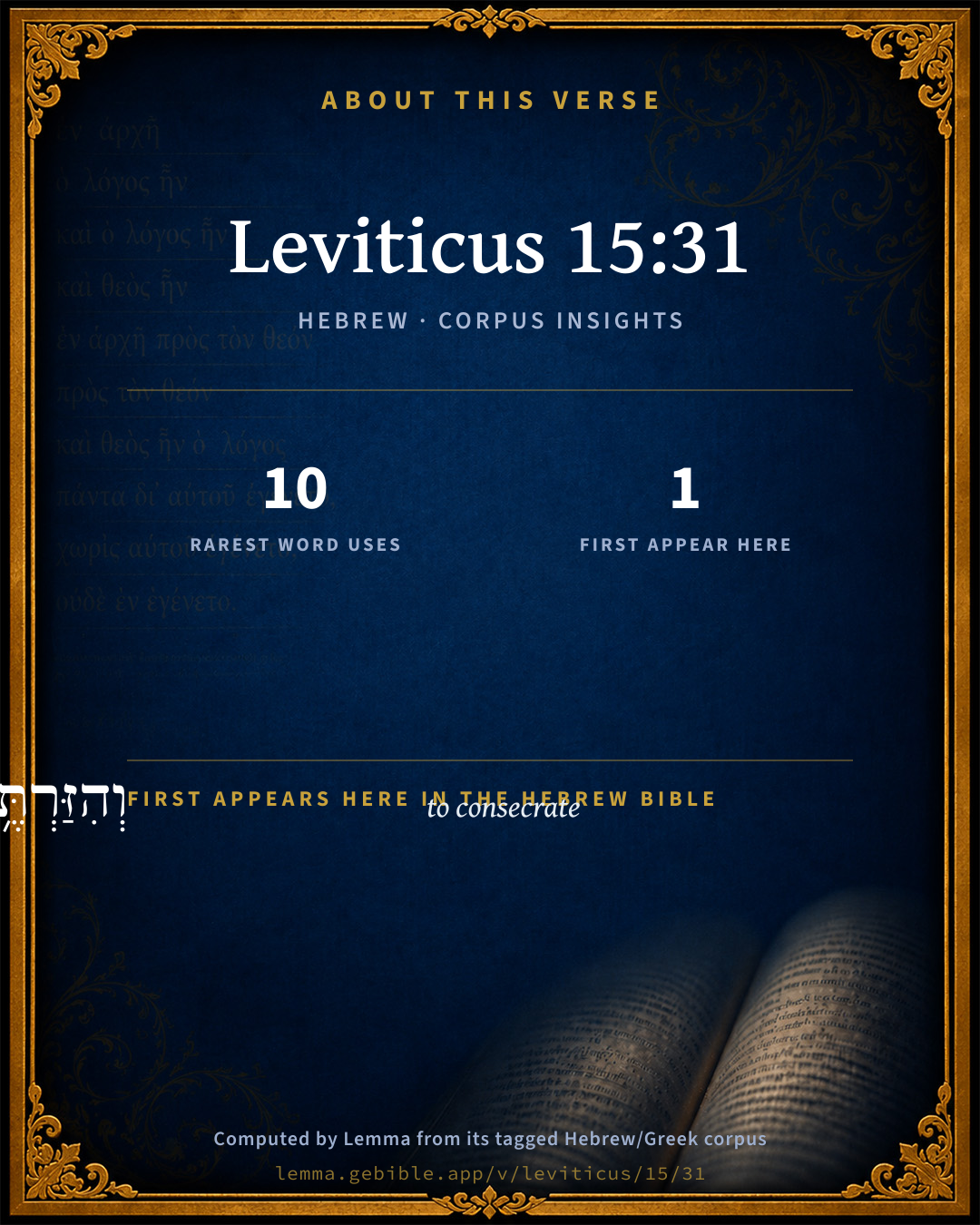
The rarest word here is וְהִזַּרְתֶּ֥ם to consecrate H5144 — appearing just 10 times in the whole Hebrew Bible.

First appearance in Scripture

This word makes its first canonical appearance in the Hebrew Bible here:

  • וְהִזַּרְתֶּ֥ם to consecrate H5144

Shared distinctive vocabulary

וְהִזַּרְתֶּ֥ם to consecrate H5144 occurs in 10 verses of the Hebrew Bible. Also found in:

Grammatical profile

  • 3 verbs
  • 6 nouns
  • 4 particles

Verb forms

  • וְהִזַּרְתֶּ֥ם Hiphil · Sequential Perfect
  • יָמֻ֨תוּ֙ Qal · Imperfect
  • בְּטַמְּאָ֥ם Piel · Infinitive Construct

Repetition

A word recurs within this verse — often emphatic in Hebrew:

  • מִטֻּמְאָתָ֑ם uncleanness H2932 ×2

Hebrew & Septuagint length

In English translation the verse runs 29 words from the Hebrew and 29 from the Septuagint (LXX English) — the same length.

A rough comparison of the two English renderings, which tokenize alike — not a word-level alignment.

Word counts can differ between the Hebrew and the Greek without any difference in meaning — e.g. the Hebrew direct-object marker אֵת has no separate Greek word, and Greek often adds the article ὁ.

Cross-references

19

Topical passages linked to Leviticus 15:31 in the Treasury of Scripture Knowledge — connected by theme and wording, ordered by reader-vote popularity; previews shown in the World English Bible.

  • Numbers 19:20 But the man who shall be unclean, and shall not purify himself, that soul shall be cut off from the midst of the assembly, because he has defiled the sanctuary of Yahweh: the water for impurity has not been sprinkled on him; he is unclean.
  • Numbers 19:13 Whoever touches a dead person, the body of a man who has died, and doesn't purifies himself, defiles the tent of Yahweh; and that soul shall be cut off from Israel: because the water for impurity was not sprinkled on him, he shall be unclean; his uncleanness is yet on him.
  • Ezekiel 5:11 Therefore, as I live, says the Lord Yahweh, surely, because you have defiled my sanctuary with all your detestable things, and with all your abominations, therefore will I also diminish [you]; neither shall my eye spare, and I also will have no pity.
  • Numbers 5:3 Both male and female shall you put out, outside of the camp shall you put them; that they not defile their camp, in the midst of which I dwell."
  • Ezekiel 23:38 Moreover this they have done to me: they have defiled my sanctuary in the same day, and have profaned my Sabbaths.
  • 1 Corinthians 3:17 If anyone destroys the temple of God, God will destroy him; for God's temple is holy, which you are.
  • Ezekiel 44:23 They shall teach my people the difference between the holy and the common, and cause them to discern between the unclean and the clean.
  • Hebrews 10:29 How much worse punishment, do you think, will he be judged worthy of, who has trodden under foot the Son of God, and has counted the blood of the covenant with which he was sanctified an unholy thing, and has insulted the Spirit of grace?
  • Hebrews 12:14–15 Follow after peace with all men, and the sanctification without which no man will see the Lord,
  • Jude 1:4 For there are certain men who crept in secretly, even those who were long ago written about for this condemnation: ungodly men, turning the grace of our God into lasciviousness, and denying our only Master, God, and Lord, Jesus Christ.
  • Daniel 9:27 He shall make a firm covenant with many for one week: and in the midst of the week he shall cause the sacrifice and the offering to cease; and on the wing of abominations [shall come] one who makes desolate; and even to the full end, and that determined, shall [wrath] be poured out on the desolate.
  • Leviticus 11:47 to make a distinction between the unclean and the clean, and between the living thing that may be eaten and the living thing that may not be eaten.'"
  • Leviticus 13:59 This is the law of the plague of mildew in a garment of wool or linen, either in the warp, or the woof, or in anything of skin, to pronounce it clean, or to pronounce it unclean.
  • Leviticus 19:30 "'You shall keep my Sabbaths, and reverence my sanctuary; I am Yahweh.
  • Leviticus 20:3 I also will set my face against that person, and will cut him off from among his people because he has given of his seed to Molech, to defile my sanctuary, and to profane my holy name.
  • Leviticus 21:23 He shall not come near to the veil, nor come near to the altar, because he has a blemish; that he may not profane my sanctuaries, for I am Yahweh who sanctifies them.'"
  • Deuteronomy 24:8 Take heed in the plague of leprosy, that you observe diligently, and do according to all that the priests the Levites shall teach you: as I commanded them, so you shall observe to do.
  • Psalms 66:18 If I cherished sin in my heart, The Lord wouldn't have listened.
  • Ezekiel 44:5–7 Yahweh said to me, Son of man, mark well, and see with your eyes, and hear with your ears all that I tell you concerning all the ordinances of the house of Yahweh, and all the laws of it; and mark well the entrance of the house, with every exit of the sanctuary.

Cross-references courtesy of OpenBible.info (CC BY 4.0).

Hebrew and Greek witnesses Masoretic Hebrew ↔ Greek Septuagint

The same verse in the two great witnesses to the Old Testament, shown verse-for-verse.

These are two independent witnesses, not word-aligned to each other, and the Septuagint is shown in lemma (dictionary) form.

Hebrew Leviticus 15:31 Masoretic · Westminster Leningrad Codex

וְהִזַּרְתֶּ֥ם אֶת בְּנֵי יִשְׂרָאֵ֖ל מִטֻּמְאָתָ֑ם וְלֹ֤א יָמֻ֨תוּ֙ בְּטֻמְאָתָ֔ם בְּטַמְּאָ֥ם אֶת מִשְׁכָּנִ֖י אֲשֶׁ֥ר בְּתוֹכָֽם

"'Thus you shall separate the children of Israel from their uncleanness, so they will not die in their uncleanness, when they defile my tabernacle that is in their midst.'"

World English Bible · Public Domain

Greek LXX Leviticus 15:31 Septuagint · lemma form

καί εὐλαβής ποιέω ὁ υἱός ἰσραήλ ἀπό ὁ ἀκαθαρσία αὐτός καί οὐ ἀποθνήσκω διά ὁ ἀκαθαρσία αὐτός ἐν ὁ μιαίνω αὐτός ὁ σκηνή ἐγώ ὁ ἐν αὐτός

And you⌃ shall cause the children of Israel to beware of their uncleannesses; so they shall not die for their uncleanness, in polluting my tabernacle that is among them.

LXX2012 (modern English Septuagint) · Public Domain

On this verse, Haydock's Catholic Bible Commentary discusses the Septuagint’s reading. Read the note in Commentary ↓

Hebrew: Westminster Leningrad Codex (CC BY 4.0). Greek: Septuagint (public domain); English from LXX2012 (modern English Septuagint) (Public Domain). How the Septuagint differs from the Hebrew →

Targum (Aramaic paraphrase)

2

The Targum is the ancient Jewish Aramaic paraphrase of the Hebrew Scriptures — an interpretive translation, not the Hebrew text itself. Onkelos (literal) and Pseudo-Jonathan (expansive) render the Torah, and Jonathan the Prophets. Coverage is partial: where no permissively-licensed English translation exists for a verse, only the Aramaic is shown. This is verse-level text, not a word-by-word alignment to the Hebrew.

  1. Targum Onkelos Torah (Genesis–Deuteronomy)
    וְתַפְרְשׁוּן יָת בְּנֵי יִשְׂרָאֵל מִסוֹאֲבַתְהוֹן וְלָא יְמוּתוּן בְּסוֹאֲבַתְהוֹן בְּסָאָבְהוֹן יָת מַשְׁכְּנִי דִי בֵינֵיהוֹן

    (no public-domain English translation for this verse)

    Targum Onkelos — Aramaic: “Onkelos Genesis” (public domain); “Onkelos Exodus” (public domain); “Onkelos Leviticus” (public domain); “Onkelos Numbers” (public domain); “Onkelos Deuteronomy” (public domain). English: “Sefaria Community Translation” (CC0 1.0 (public-domain dedication)); “J.W. Etheridge. The Targums of Onkelos and Jonathan Ben Uzziel on the Pentateuch. London: Longmans, Green, 1862” (public domain). Text via Sefaria.

  2. Targum Pseudo-Jonathan Torah (Genesis–Deuteronomy)
    וְתִפְרְשׁוּן יַת בְּנֵי יִשְרָאֵל מִן סְאוֹבְתֵּיהוֹן וְיִתְפַּרְשׁוּן מִן נְשֵׁיהוֹן סְמוֹךְ לְוֶוסְתְּהוֹן וְלָא יִסְתַּקֵף עֲלֵיהוֹן דִימוּתוּן מְטוּל סְאוֹבְתְּהוֹן בְּסָאֲבֵיהוֹן יַת מַשְׁכְּנִי דְתַמָן אִיקַר שְׁכִינְתִּי שַׁרְיָא בֵּינֵיהוֹן

    So shall you separate the children of Israel from their uncleanness, and make them to be separate from their wives at the time of their seclusion, and to give not occasion that they die for their uncleanness in defiling My tabernacle, where the glory of My Shekinah dwelleth among them.

    Targum Pseudo-Jonathan — Aramaic: “Targum Jonathan on Genesis” (public domain); “Targum Jonathan on Exodus” (public domain); “Targum Jonathan on Leviticus” (public domain); “Targum Jonathan on Numbers” (public domain); “Targum Jonathan on Deuteronomy” (public domain). English: “The Targum of Jonathan ben Uzziel, trans. J. W. Etheridge, London, 1862” (public domain). Text via Sefaria.

Commentary

Notes on Leviticus 15:31 from classic Christian and Jewish commentators (each source and its license shown beneath its notes). The classic Christian expositions comment on the surrounding passage and are grouped to its opening verse, so a note may address several verses; the Jewish commentaries on the Tanakh (Rashi and others) are per-verse, so they appear only where the commentator wrote on this verse.

Lemma curates 59 commentaries, every one of them public domain or Creative Commons licensed, each selected and text-cleaned for this edition rather than reprinted as found. About our sources →

Trapp's Complete Commentary

John Trapp

Lev 15:31 Thus shall ye separate the children of Israel from their uncleanness; that they die not in their uncleanness, when they defile my tabernacle that [is] among them.

Ver. 31. That they die not.] Which is worse than to die in a ditch.

John Trapp, A Commentary or Exposition upon All the Books of the Old and New Testament (1647–1656) — public domain. Text from a community e-Sword module.

Albert Barnes' Notes on the Bible

This solemn admonition is addressed to Moses and Aaron, see Lev 15:1.

Lev 15:31

My tabernacle - Strictly, “my dwelling-place” משׁכן mı̂shkān, as in Lev 8:10; Lev 17:4; Lev 26:11. The word rendered “tabernacle” elsewhere in Leviticus is properly “tent.” See the Exo 26:1 note.

Albert Barnes' Notes on the Bible (1834–1885) — public domain. Text from a community e-Sword/MySword module.

Joseph Benson's Commentary

Lev 15:31. When they defile my tabernacle — Both ceremonially, by coming into it in their uncleanness; and morally, by the contempt of God’s express command to cleanse themselves. This shows that one main design of these laws was to impress the minds of that carnal people with a high respect and veneration for the worship of God, and whatever bore the name of sacred. It was to separate the children of Israel from their uncleanness. Hereby they were taught their privilege and their honour, that they were purified unto God a peculiar people; for that was a defilement to them which was not to others. They were also taught their duty, which was to keep themselves clean from all pollution.

From all this, 1st, Let us learn to bless God that we are not under the yoke of these carnal ordinances; that, as nothing can defile us, so nothing can destroy us, but sin. They may now partake of the Lord’s supper, who durst not then eat of the peace-offering. And the defilement we contract by our daily infirmities we may be cleansed from in secret, by the renewed acts of repentance and faith, without bathing in water, or bringing an offering to the door of the tabernacle. 2d, Let us carefully abstain from all sin, as defiling to the conscience, and particularly from all fleshly lusts; possessing our vessel in sanctification and honour, and not in the lusts of uncleanness, which not only pollute the soul, but war against it, and threaten its ruin. 3d, Let us consider, and be persuaded, how indispensably necessary real holiness is to our future happiness; and get our hearts purified by faith, that we may be admitted to see God, and enter into the heavenly sanctuary to worship and rejoice before him. Lord, who shall abide in thy tabernacle? Who shall dwell in thy holy hill? He that hath clean hands and a pure heart, and none else; for without holiness no man shall see the Lord.

Joseph Benson's Commentary on the Old and New Testaments (1811–1818) — public domain. Text from a community e-Sword module.

Geneva Bible (1599)

Geneva Bible translators

Seeing that God required of his purity and cleanness: we cannot be his, except our filth and sins be purged with the blood of Jesus Christ, and so we learn to detest all sin.

Geneva Bible (1599) marginal notes — public domain. Text via Bolls.life.

Jamieson, Fausset & Brown

Robert Jamieson, A. R. Fausset & David Brown

Thus shall ye separate the children of Israel from their uncleanness--The divine wisdom was manifested in inspiring the Israelites with a profound reverence for holy things; and nothing was more suited to this purpose than to debar from the tabernacle all who were polluted by any kind of uncleanness, ceremonial as well as natural, mental as well as physical. The better to mark out that people as His family, His servants and priests, dwelling in the camp as in a holy place, consecrated by His presence and His tabernacle, He required of them complete purity, and did not allow them to come before Him when defiled, even by involuntary or secret impurities, as a want of respect due to His majesty. And when we bear in mind that God was training a people to live in His presence in some measure as priests devoted to His service, we shall not consider these rules for the maintenance of personal purity either too stringent or too minute (Th1 4:4).

Next: Leviticus Chapter 16

Jamieson, Fausset & Brown — Commentary Critical and Explanatory on the Whole Bible (1871) — public domain (CC PDM 1.0). Text via the HelloAO Bible API.

Adam Clarke's Commentary

Verse 31. Thus shall ye separate the children of Israel from their uncleanness] By this separation the cause became less frequent, and the contagion, if it did exist, was prevented from spreading. So pest-houses and fever-wards are constructed for the purpose of separating the infected from the sound; and thus contagion is lessened, and its diffusion prevented.

That they die not] That life may be prolonged by these prudential cares; and that he who is morally and legally unclean, may not presume to enter into the tabernacle of God till purified, lest he provoke Divine justice to consume him, while attempting to worship with a polluted mind and impure hands.

1. How unpromising and how forbidding, at the first view, is this chapter! and yet how full of wise, humane, and moral regulations, manifesting at once the wisdom and kindness of the great Legislator! Every word of God is pure in itself, and of great importance to us. He who cannot derive instruction from the chapter before him, and be led by a proper consideration of its contents to adore the wisdom and goodness of God, must have either a very stupid or a very vitiated mind.

2. In all these ordinances we may plainly see that God has purity of heart continually in view - that the soul may be holy, he cuts off the occasions of sin; and that men may be obliged to keep within due bounds, and possess their vessels in sanctification and honour, he hedges up their way with briars and thorns, and renders transgression painful, shameful, and expensive.

3. Preventing grace is not less necessary than that which saves and which preserves. These three chapters, avoided and neglected by most, contain lessons of instruction for all; and though many things contained in them belong exclusively to the Jewish people as to the letter, yet in their spirit and gracious design they form a part of those revealed things which are for us and for our children; and although they cannot be made the subject of public oral instruction, yet they are highly necessary to be known, and hence the advantage of reading the Scriptures in regular order in private. May we read so as to understand, and practise what we know, that, being wise unto salvation, we may walk as children of the light and of the day, in whom there shall be no occasion of stumbling!

Adam Clarke's Commentary on the Bible (1810–1826) — public domain. Text from a community e-Sword/MySword module.

Ellicott's Commentary for English Readers

(31) Thus shall ye separate.—That is, according to the regulations laid down in this chapter. “Ye”—i.e., Moses and Aaron, to whom they were conjointly addressed (see Lev_15:1)—are to restrain the children of Israel, lest they be punished with death when they approach the Lord in a defiled state.

Defile my tabernacle.—Better, my dwelling place, which can here be used, though in Lev_8:10, where it also occurs, the expression “dwelling-place” does not suit so well.

A Bible Commentary for English Readers, edited by Charles John Ellicott (1878–1897) — public domain. Text from a community e-Sword module.

The Cambridge Bible for Schools and Colleges

gen. ed. J. J. S. Perowne

31. A reason for these purifications is given.

my tabernacle] Another name for the tabernacle is (Heb. mishkân) dwelling, e.g. Exo_25:9 R.V. mg. In Exodus 25-27, and in parts of 35–40 the word is used to denote the structure described in 26, 36, and distinguished as the ‘tabernacle’ from the ‘tent over the tabernacle’ (Exo_26:7; Exo_36:14 in R.V.). But in other passages it is used as the equivalent of the ‘tent of meeting’ for the tabernacle with its covering tent. It indicates the place where God dwells among the children of Israel according to His promise (so in Lev_16:16, Lev_26:11 f.; Exo_29:45; cp. Exo_25:8; Num_5:3; Num_35:34), and is used only of the tabernacle1[52] (in the plur., Num_24:5, it is used of Israel in poetical parallelism with ‘tents’). The combination ‘tabernacle of the tent of meeting’ occurs Exo_40:2; Exo_40:6; Exo_40:29†. As the A.V. renders both ‘ohel (see on Lev_1:1) and mishkân by ‘tabernacle,’ the difference does not appear in that version.

[52] The use of the word tabernacle of the tents of Korah, Dathan, and Abiram (see McNeile C. B. ad loc. Num_16:24; Num_16:27) is very strange, and the text must be considered doubtful.

The Cambridge Bible for Schools and Colleges (gen. ed. J. J. S. Perowne; Cambridge University Press, 1878–1918) — public domain. Text from a community e-Sword module.

John Gill's Exposition

And of her that is sick of her flowers,.... Her monthly courses, for these are a sickness, Lev 20:18; and make a woman languid and faint, as the word is rendered, Lam 1:13; or to be in pain (n), as some render it here; and pains are reckoned among the signs of them by the Misnic doctors (o):

and of him that hath an issue, of the man, and of the woman; of both, whether the one or the other:

and of him that lieth with her that is unclean; though her own husband.

(n) "et dolentis", Montanus. (o) Misn. Niddah, c. 9. sect. 8.

Next: Leviticus Chapter 16

John Gill's Exposition of the Whole Bible (1746–1763) — public domain (CC PDM 1.0). Text via the HelloAO Bible API.

Haydock's Catholic Bible Commentary

Teach. So the Septuagint also read. Hebrew, "Thus you shall remove....from their filth." (Houbigant) --- Filth. God threatens to kill them, if they approach unclean. (Menochius) --- St. Jerome (in Gal. v.) understands this of those abominable sins, which ought not to be mentioned. (Worthington)

George Leo Haydock (1774–1849), Haydock's Catholic Family Bible and Commentary, 1859 edition — public domain. Excludes Psalms (Douay-Rheims chapter numbering differs from Protestant) and Deuterocanonical books (Catholic canon only).

Matthew Poole's English Annotations

When they defile my tabernacle; which they did both ceremonially, by coming into it in their uncleanness, and morally, by the gross neglect and contempt of God’s express and positive command to cleanse themselves.

Matthew Poole's English Annotations on the Holy Bible (1683–1685) — public domain. Text from a community e-Sword/MySword module.

Whedon's Commentary on the Bible

Daniel D. Whedon

31. That they die not, when they defile my tabernacle — These words explain the minute requirements of this chapter. Continuance in uncleanness without the prescribed purification was followed by death, not merely in the case of the unclean man venturing into the sanctuary, but also in the case of all who persisted in defiling Israel, called to be a holy nation. The holy Jehovah had condescended to abide in the midst of Israel.

Nothing offensive or uncomely should be suffered within the sacred precincts of his presence. The trifling spot upon the person must be carefully inspected by the official custodians of the holy place. It was because of his holiness that Jehovah exercised the most jealous care over all the habits of his people, at home and abroad, by day and by night. Their food, their clothing, their most hidden privacy, were under his constant inspection. This elaborate code of ceremonialism was perpetually uttering in the ear of the spiritually-minded Hebrew the sublime cry of the seraphim, “Holy, holy, holy, is the Lord of hosts; the whole earth is full of his glory.”

Isa_6:3. To lovers of holiness these restraints would not be irksome, but delightful; while they would be the most intolerable burden to the carnally minded. Thus the Levitical law tested and sifted the Israelites as the requirements of faith in the atoning blood of Christ is the touchstone of character to-day. To the sceptic who declares that this chapter is derogatory to the Divine Being, we reply that it is the office of the Spirit of inspiration to reveal truth by “interpreting spiritual things to spiritual men.”

Daniel D. Whedon (gen. ed.), Commentary on the Old and New Testaments (1874–1909) — public domain. Text from a community e-Sword module.

John Wesley's Explanatory Notes

When they defile my tabernacle - Both ceremonially, by coming into it in their uncleanness, and morally by the contempt of God's express command to cleanse themselves. The grand reason of all these laws was, to separate the children of Israel from their uncleanness. Hereby they were taught their privilege and honour, that they were purified unto God, a peculiar people; for that was a defilement to them, which was not so to others. They were also taught their duty, which was to keep themselves clean from all pollutions.

John Wesley, Explanatory Notes Upon the Whole Bible (1754–1765) — public domain. Text via the GEBible commentary corpus.

unfoldingWord translationNotes

Door43 World Missions Community

This is how you must separate the people of Israel from their uncleanness

Yahweh speaks of preventing the people from becoming unclean as if it were keeping the people at a safe distance from uncleanness. The abstract noun "uncleanness" can be stated as "unclean." AT: "This is how you must prevent the people of Israel from becoming unclean" (See: Metaphor and Abstract Nouns)

their uncleanness

People whom other people may not touch and who are not acceptable for God's purposes are spoken of as if they were physically unclean. (See: Metaphor)

translationWords

Israel

die

defile

tabernacle

life

unfoldingWord translationNotes — © Distant Shores Media and the Door43 World Missions Community, licensed CC BY-SA 4.0. Source: git.door43.org/Door43/en_tn.

Rashi

Rabbi Shlomo Yitzchaki (Rashi)

והזרתם THUS SHALL YE PUT APART [THE CHILDREN OF ISRAEL] — The word נזר has wherever it occurs the meaning of "separating". Similar is (Isaiah 1:4) “they are gone away (נזורו) backward"; (Genesis 49:26) “him that was separated from (נזיר) his brethren” (Sifra, Metzora Parashat Zavim, Chapter 9 6).

ולא ימתו בטמאתם THAT THEY DIE NOT IN THEIR UNCLEANNESS [WHEN THEY DEFILE MY TABERNACLE] — Thus you see that the penalty of “excision” to which one who defiles the Holy Place is subject (cf. Numbers 19:13) is here called מיתה (i. e. מיתה בידי שמים) (cf. Sifrei Bamidbar 125).

Rashi on the Tanakh — English translations: “The Judaica Press complete Tanach with Rashi, translated by A. J. Rosenberg” (CC BY 4.0); “Pentateuch with Rashi's commentary by M. Rosenbaum and A.M. Silbermann, 1929-1934” (public domain); “The Metsudah Tanach series, Lakewood, N.J” (CC BY 4.0); and “The Book of Joshua, Metsudah Publications, 1997” (CC BY 4.0). Text via Sefaria.

Lesson kit

Teaching starters — assembled from the data on this page, not authored interpretation. Every prompt links to the verse data it draws on. Edit before teaching.

Leviticus, in the Pentateuch, opens this verse with 13 words (11 distinct Hebrew lemmas). Its most distinctive word is nâzar (“to consecrate”). A historical commentator’s framing appears above. Read the whole chapter for the surrounding context.

Discussion questions

  1. The word nâzar carries the sense “to consecrate.” How does it shape the verse?
  2. The word “to consecrate” first appears here in Scripture. What is being introduced at this debut?
  3. Leviticus 22:2 shares the word «to consecrate» with this verse. How do the two illuminate each other?
  4. “uncleanness” occurs 2× in this one verse. What is the effect of the repetition?
  5. These translations render this verse differently; the difference is in the English rendering, not the original. What questions does that raise?
  6. The verb «וְהִזַּרְתֶּ֥ם» is Hiphil Sequential Perfect. How does its form color the action?
  7. Reading how Trapp's Complete Commentary and Albert Barnes' Notes on the Bible read this verse, where do the two commentators agree and where do they part?

Things to notice

  • 1 word makes its first canonical appearance in Scripture here.
  • These translations choose different wording for 16 words in this verse.
  • “uncleanness” occurs 2× in this single verse.
  • 11 distinct Hebrew lemmas span 13 words in this verse.

Reading settings

Reading text

Shown beneath each verse's original-language words.

Old Testament
Old Testament edition

Read the OT as the Masoretic Hebrew (MT) or the Greek Septuagint (LXX).

English shown for the Greek Septuagint (in the Hebrew ↔ Greek comparison).

Comparing translations? Open the Compare panel on any verse page to stack up to four side by side.