2 Chronicles 15:13

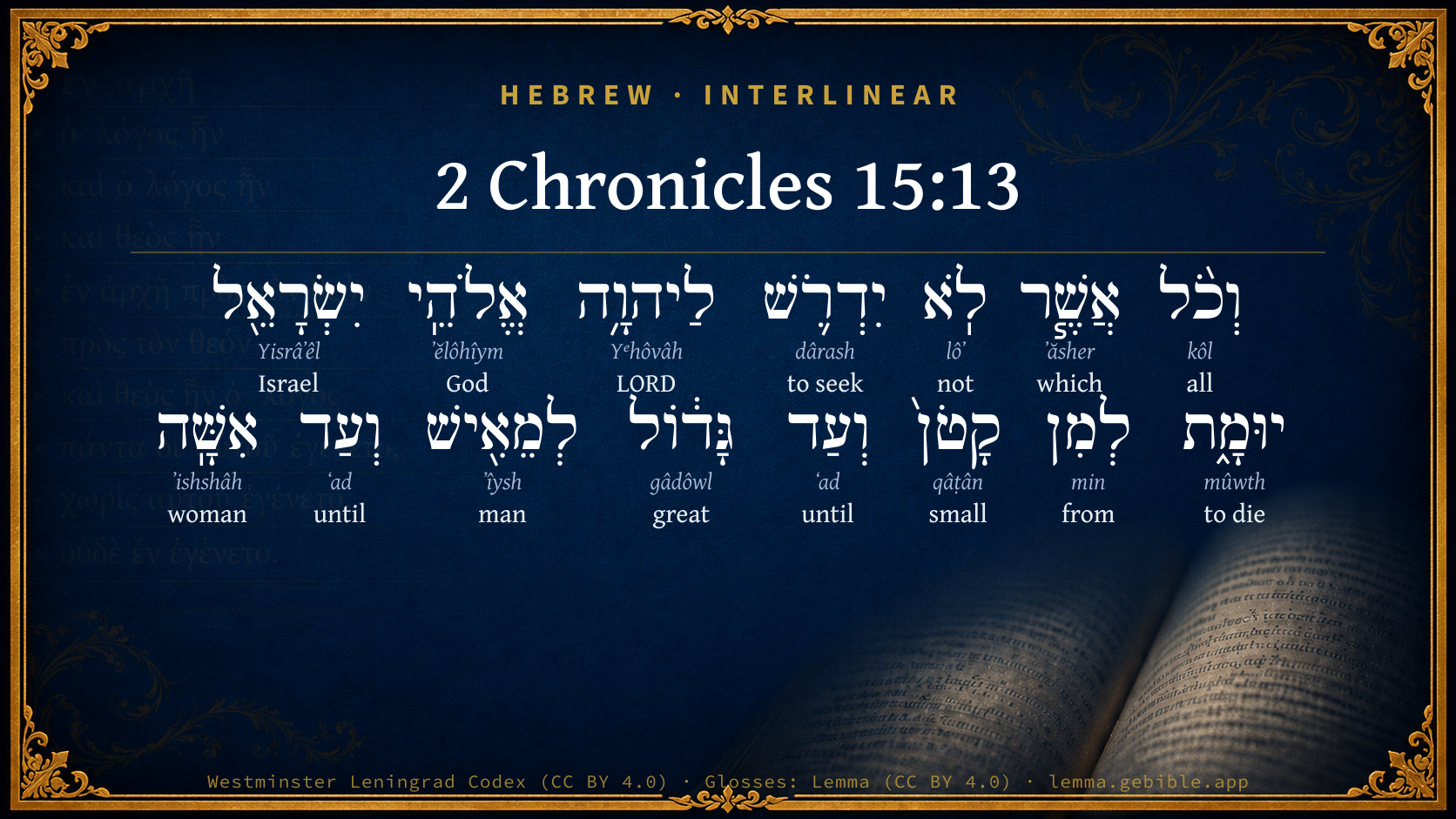
Hebrew (Westminster Leningrad Codex) 2 Chronicles 15:13 appears in the Hebrew Old Testament. The text above is from the Westminster Leningrad Codex. Each word links to its Strong’s number, a concise gloss, and parsing drawn from the Open Scriptures Hebrew Bible morphology. Click any word for its full Brown-Driver-Briggs (BDB) entry.
Download image
Cite this verse

2 Chronicles 15:13 (World English Bible). Public Domain. Lemma interlinear Bible study tool, https://lemma.gebible.app/v/2-chronicles/15/13.

Show BibTeX & RIS
BibTeX
RIS
English Translation
and that whoever would not seek Yahweh, the God of Israel, should be put to death, whether small or great, whether man or woman.
World English Bible · Public Domain
Download a study sheet

One document with this verse’s original text, its word-by-word gloss line, the meaning frame, cross-references with their text, attributed commentary, and full source and license credits — printable, and it pastes into notes with its structure intact.

This verse Autodidact and up

Study sheet (.html) Plain text (.txt)

A passage Seminary Student

Up to 50 verses in one chapter. A passage sheet keeps up to 6 commentary sources and 12 cross-references per verse, in the order this page ranks them, and says so on the sheet whenever that leaves anything out. Ask for a single verse and you get the Autodidact verse sheet above.

Everything on this page stays free to read, with no account — the sheet is a download of what is already on screen, not access to it.

Want to remove ads? Support Godless Engineer
Compare translations 3

The same verse in 3 English versions, stacked beneath the original-language interlinear above. Click any original word for its lexicon entry.

Each is an independent rendering of the whole verse — the interlinear is not word-aligned to these translations.

Highlighted words mark where these versions differ — a whole-verse word diff, not a word-by-word alignment.

  • World English Bible Public Domain
    and that whoever would not seek Yahweh, the God of Israel, should be put to death, whether small or great, whether man or woman.
  • King James Version Public Domain
    That whosoever would not seek the LORD God of Israel should be put to death, whether small or great, whether man or woman.
  • unfoldingWord Literal Text CC BY-SA 4.0
    And any who does not seek Yahweh, the God of Israel, will be killed, whether small or great, whether man or woman.

unfoldingWord Literal Text — © unfoldingWord, licensed CC BY-SA 4.0. Word-aligned USFM3 via Door43 (git.door43.org/unfoldingWord/en_ult).

Versions to compare (up to 4)

3 of 4 selected

Show all 18 translations

Every available English version of this verse, each an independent rendering of the whole verse.

  • World English Bible Public Domain
    and that whoever would not seek Yahweh, the God of Israel, should be put to death, whether small or great, whether man or woman.
  • Berean Standard Bible Public Domain
    And whoever would not seek the LORD, the God of Israel, would be put to death, whether young or old, man or woman.
  • Majority Standard Bible Public Domain
    And whoever would not seek the LORD, the God of Israel, would be put to death, whether young or old, man or woman.
  • King James Version Public Domain
    That whosoever would not seek the LORD God of Israel should be put to death, whether small or great, whether man or woman.
  • American Standard Version (1901) Public Domain
    and that whosoever would not seek Jehovah, the God of Israel, should be put to death, whether small or great, whether man or woman.
  • Revised Version (1885) Public Domain
    and that whosoever would not seek the LORD, the God of Israel, should be put to death, whether small or great, whether man or woman.
  • Geneva Bible (1599) Public Domain
    And whosoeuer will not seeke the Lord God of Israel, shalbe slaine, whether he were small or great, man or woman.
  • Douay-Rheims (1899) Public Domain
    And if any one, said he, seek not the Lord the God of Israel, let him die, whether little or great, man or woman.
  • Young's Literal Translation Public Domain
    and every one who doth not seek for Jehovah, God of Israel, is put to death, from small unto great, from man unto woman.
  • Literal Standard Version CC BY-SA 4.0
    and everyone who does not seek for YHWH, God of Israel, is put to death, from small to great, from man to woman.
  • Unlocked Literal Bible CC BY-SA 4.0
    They agreed that whoever refused to seek Yahweh, the God of Israel, should be put to death, whether the person was small or great, whether man or woman.
  • unfoldingWord Literal Text CC BY-SA 4.0
    And any who does not seek Yahweh, the God of Israel, will be killed, whether small or great, whether man or woman.
  • Darby Bible Public Domain
    and that whoever would not seek Jehovah the God of Israel should be put to death, whether small or great, whether man or woman.
  • World Messianic Bible Public Domain
    and that whoever would not seek the LORD, the God of Israel, should be put to death, whether small or great, whether man or woman.
  • Webster's Bible Public Domain
    That whoever would not seek the LORD God of Israel should be put to death, whether small or great, whether man or woman.
  • Free Bible Version CC BY-SA 4.0
    They also agreed that anyone who refused to follow the Lord, the God of Israel, would be put to death, whether young or old, man or woman.
  • Bible in Basic English Public Domain
    And that anyone, small or great, man or woman, who was not true to the Lord, the God of Israel, would be put to death.
  • JPS Tanakh (1917) Public Domain
    and that whosoever would not seek the LORD, the God of Israel, should be put to death, whether small or great, whether man or woman.

Literal Standard Version (2020), Covenant Press — licensed CC BY-SA 4.0. Text via the HelloAO Bible API (eBible.org). Unlocked Literal Bible (unfoldingWord) — licensed CC BY-SA 4.0. Text via the HelloAO Bible API (eBible.org). unfoldingWord Literal Text — © unfoldingWord, licensed CC BY-SA 4.0. Word-aligned USFM3 via Door43 (git.door43.org/unfoldingWord/en_ult). Free Bible Version, Dr. Jonathan Gallagher — licensed CC BY-SA 4.0. Text via the HelloAO Bible API (eBible.org).

Word by word

More ways to search: Search by grammar → Find every occurrence → Compare this word →

Practice this passage: Drill this verse → Learn its vocabulary →

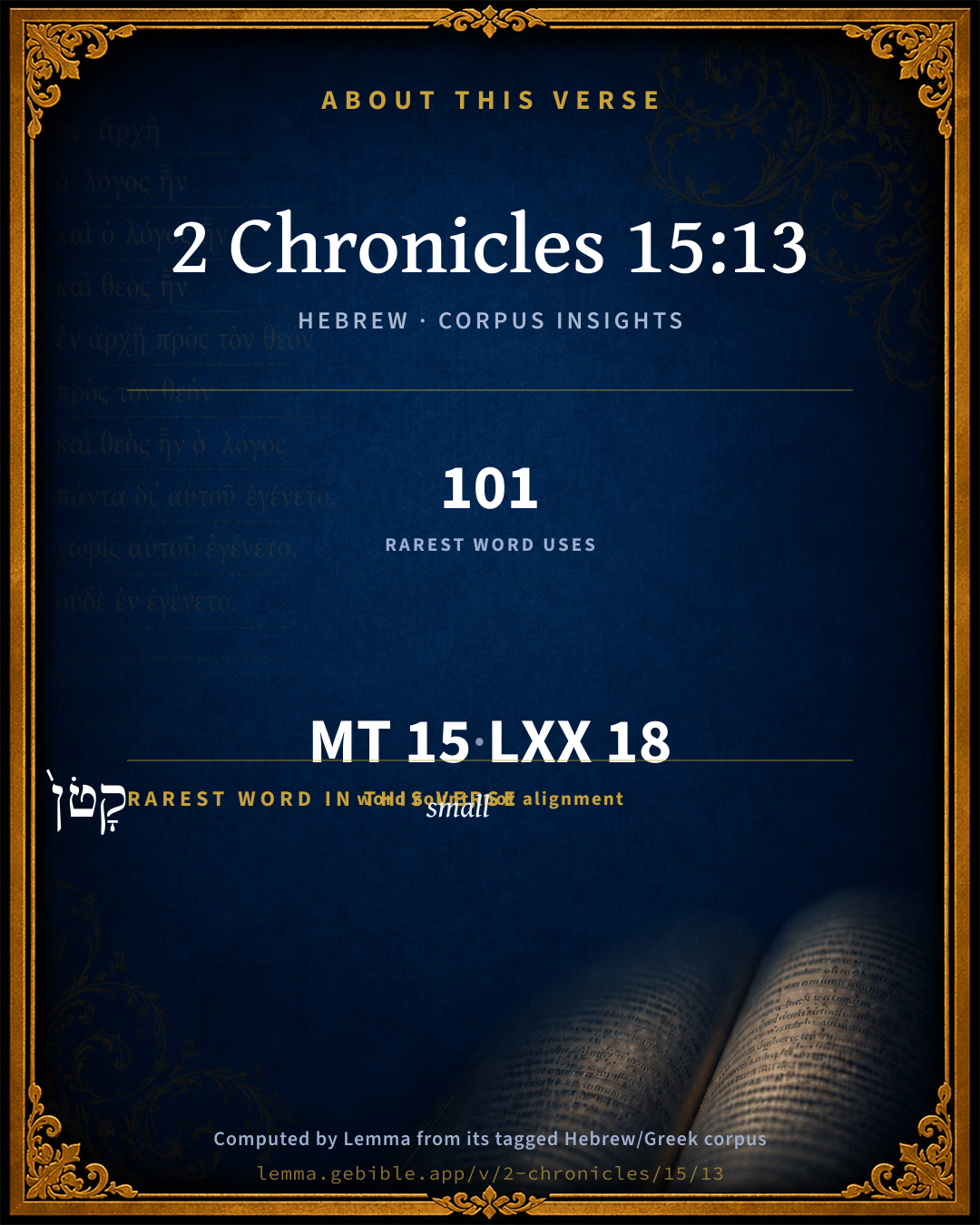
קָטֹן֙
qâṭân
H6996
“small”
Adjective, Adjective, Masculine, Singular, Absolute
Part of Speech
Adjective
Type
Adjective
Gender
Masculine
Number
Singular
State
Absolute
Full BDB Definition

Origin: from H6962

TWOT: 2009a , 2009b

young, small, insignificant, unimportant - small - insignificant - young - unimportant
  1. וְכֹ֨ל kôl H3605 “and · all” Conjunction + Noun, Common, Masculine, Singular, Absolute
  2. אֲשֶׁ֧ר ʼăsher H834 “which” Particle, Relative
  3. לֹֽא lôʼ H3808 “not” Particle, Negative
  4. יִדְרֹ֛שׁ dârash H1875 “to seek” Verb, Qal, Imperfect, 3rd Person, Masculine, Singular
  5. לַיהוָ֥ה Yᵉhôvâh H3068 “to/for · LORD” Preposition + Noun, Proper
  6. אֱלֹהֵֽי ʼĕlôhîym H430 “God(s) of” Noun, Common, Masculine, Plural, Construct
  7. יִשְׂרָאֵ֖ל Yisrâʼêl H3478 “Israel” Noun, Proper
  8. יוּמָ֑ת mûwth H4191 “to die” Verb, Hophal, Imperfect, 3rd Person, Masculine, Singular
  9. לְמִן min H4480 “to/for · from” Preposition + Preposition
  10. וְעַד ʻad H5704 “and · until” Conjunction + Preposition
  11. גָּד֔וֹל gâdôwl H1419 “great” Adjective, Adjective, Masculine, Singular, Absolute
  12. לְמֵאִ֖ישׁ ʼîysh H376 “to/for · from · man” Preposition + Preposition + Noun, Common, Masculine, Singular, Absolute
  13. וְעַד ʻad H5704 “and · until” Conjunction + Preposition
  14. אִשָּֽׁה ʼishshâh H802 “woman” Noun, Common, Feminine, Singular, Absolute

About this verse

These counts appear in no published source. They are computed here, from the morphology-tagged text and Lemma’s own curated glosses. What Lemma adds →

15
words
14
distinct lemmas
Historical
section

Grammatical profile

  • 2 verbs
  • 6 nouns
  • 2 adjectives
  • 3 prepositions
  • 2 particles

Verb forms

  • יִדְרֹ֛שׁ Qal · Imperfect
  • יוּמָ֑ת Hophal · Imperfect

Repetition

A word recurs within this verse — often emphatic in Hebrew:

  • וְעַד until H5704 ×2

Hebrew & Septuagint length

In English translation the verse runs 24 words from the Hebrew and 21 from the Septuagint (LXX English) — closely comparable.

A rough comparison of the two English renderings, which tokenize alike — not a word-level alignment.

Word counts can differ between the Hebrew and the Greek without any difference in meaning — e.g. the Hebrew direct-object marker אֵת has no separate Greek word, and Greek often adds the article ὁ.

In the original languages it is 15 Hebrew tokens and 18 Greek tokens — but the two are counted differently (Hebrew bundles its prefixes and suffixes into one token; the Greek is in lemma form), so that isn’t a like-for-like length.

Cross-references

13

Topical passages linked to 2 Chronicles 15:13 in the Treasury of Scripture Knowledge — connected by theme and wording, ordered by reader-vote popularity; previews shown in the World English Bible.

  • Exodus 22:20 "He who sacrifices to any god, except to Yahweh only, shall be utterly destroyed.
  • Deuteronomy 29:18 lest there should be among you man, or woman, or family, or tribe, whose heart turns away this day from Yahweh our God, to go to serve the gods of those nations; lest there should be among you a root that bears gall and wormwood;
  • Deuteronomy 13:5–15 That prophet, or that dreamer of dreams, shall be put to death, because he has spoken rebellion against Yahweh your God, who brought you out of the land of Egypt, and redeemed you out of the house of bondage, to draw you aside out of the way which Yahweh your God commanded you to walk in. So shall you put away the evil from the midst of you.
  • Deuteronomy 17:2–5 If there be found in the midst of you, within any of your gates which Yahweh your God gives you, man or woman, who does that which is evil in the sight of Yahweh your God, in transgressing his covenant,
  • 1 Kings 18:40 and Elijah said to them, Take the prophets of Baal; don't let one of them escape. They took them; and Elijah brought them down to the brook Kishon, and killed them there.
  • Psalms 115:13 He will bless those who fear Yahweh, Both small and great.
  • Acts 26:22 Having therefore obtained the help that is from God, I stand to this day testifying both to small and great, saying nothing but what the prophets and Moses said would happen,
  • Revelation 20:12 I saw the dead, the great and the small, standing before the throne, and they opened books. Another book was opened, which is the book of life. The dead were judged out of the things which were written in the books, according to their works.
  • Genesis 19:11 They struck the men who were at the door of the house with blindness, both small and great, so that they wearied themselves to find the door.
  • Exodus 12:29 It happened at midnight, that Yahweh struck all the firstborn in the land of Egypt, from the firstborn of Pharaoh who sat on his throne to the firstborn of the captive who was in the dungeon; and all the firstborn of cattle.
  • Job 3:19 The small and the great are there. The servant is free from his master.
  • Job 34:19 Who doesn't respect the persons of princes, Nor regards the rich more than the poor; For they all are the work of his hands.
  • Revelation 6:15 The kings of the earth, the princes, the commanding officers, the rich, the strong, and every slave and free person, hid themselves in the caves and in the rocks of the mountains.

Cross-references courtesy of OpenBible.info (CC BY 4.0).

Hebrew and Greek witnesses Masoretic Hebrew ↔ Greek Septuagint

The same verse in the two great witnesses to the Old Testament, shown verse-for-verse.

These are two independent witnesses, not word-aligned to each other, and the Septuagint is shown in lemma (dictionary) form.

Hebrew 2 Chronicles 15:13 Masoretic · Westminster Leningrad Codex

וְכֹ֨ל אֲשֶׁ֧ר לֹֽא יִדְרֹ֛שׁ לַיהוָ֥ה אֱלֹהֵֽי יִשְׂרָאֵ֖ל יוּמָ֑ת לְמִן קָטֹן֙ וְעַד גָּד֔וֹל לְמֵאִ֖ישׁ וְעַד אִשָּֽׁה

and that whoever would not seek Yahweh, the God of Israel, should be put to death, whether small or great, whether man or woman.

World English Bible · Public Domain

Greek LXX 2 Chronicles 15:13 Septuagint · lemma form

καί πᾶς ὅς ἐάν μή ἐκζητέω κύριος θεός ἰσραήλ ἀποθνήσκω ἀπό νέος ἕως πρεσβύτερος ἀπό ἀνήρ ἕως γυνή

And that whoever should not seek the Lord God of Israel, should die, whether young or old, whether man or woman.

LXX2012 (modern English Septuagint) · Public Domain

Hebrew: Westminster Leningrad Codex (CC BY 4.0). Greek: Septuagint (public domain); English from LXX2012 (modern English Septuagint) (Public Domain). How the Septuagint differs from the Hebrew →

Commentary

Notes on 2 Chronicles 15:13 from classic Christian and Jewish commentators (each source and its license shown beneath its notes). The classic Christian expositions comment on the surrounding passage and are grouped to its opening verse, so a note may address several verses; the Jewish commentaries on the Tanakh (Rashi and others) are per-verse, so they appear only where the commentator wrote on this verse.

Lemma curates 59 commentaries, every one of them public domain or Creative Commons licensed, each selected and text-cleaned for this edition rather than reprinted as found. About our sources →

Trapp's Complete Commentary

John Trapp

2Ch 15:13 That whosoever would not seek the LORD God of Israel should be put to death, whether small or great, whether man or woman.

Ver. 13. That whosoever would not seek the Lord,] i.e., Be subject to the Lord, but seek to other gods.

Should be put to death.] According to the law. {Deu 13:9} Say not, This is Old Testament, we find no such thing in gospel. See Zec 13:3; Zec 12:10; Rom 13:4; 1Pe 2:13-14; and distinguish not where the Scripture doth not distingnish. See 2Ch 34:33 Ezr 7:26 Dan 3:29. Heathen magistrates are commended for interesting themselves in matters of religion. Good kings, as here, and 2Ch 34:33, are commended for putting upon their people wholesome laws and strait, binding them to the purity of religion and power of godliness. Neither is this any impeachment to their Christian liberty, - as Anabaptists hold, and the Donatists afore them, asking malapertly, Quid imperatori cum ecclesia? What hath the civil magistrate to do with the Church? - it is rather an ornament to their beauty, &c.

John Trapp, A Commentary or Exposition upon All the Books of the Old and New Testament (1647–1656) — public domain. Text from a community e-Sword module.

Joseph Benson's Commentary

2Ch 15:13. That whosoever would not seek the Lord God of Israel — Would either worship other gods, or refuse to join with them in the worship of the true God; that was either an obstinate idolater, or an obstinate atheist, should be put to death — Which was not a new law of their own making, but an order to put in execution the law of God to this purpose, contained Deu 18:2, &c., which, if it had been duly executed in former times, would have kept the land clear of those many abominable idols which were found in and brought God’s wrath upon it: compare Heb 10:28. But though they might do well in executing the sentence of the law upon idolaters, this ought not to be pleaded by any persons professing Christianity as a precedent for persecuting any of their fellow-Christians, much less for putting them to death who may happen to differ from them in any point of doctrine, or mode of worship; because all Christians, as such, however they may disagree as to some lesser points, yet worship one and the same living and true God; and, added to this, the spirit of the gospel is very different from that of the Jewish law: see Luk 9:55. Nor may we, under our mild dispensation, attempt to compel by force any man to become religious. For the weapons of our warfare are not carnal.

Joseph Benson's Commentary on the Old and New Testaments (1811–1818) — public domain. Text from a community e-Sword module.

Geneva Bible (1599)

Geneva Bible translators

These were the words of their covenant, which commanded all idolaters to be put to death, according to the Law of God, Deut. 13:5, 9, 15.

Geneva Bible (1599) marginal notes — public domain. Text via Bolls.life.

Ellicott's Commentary for English Readers

(13) That.—And.

Whosoever would not seek the Lord God . . .—Part of the solemn oath of the king and people; a sanction prescribed by the law of Deu_13:6, sqq., Deu_17:2-6.

A Bible Commentary for English Readers, edited by Charles John Ellicott (1878–1897) — public domain. Text from a community e-Sword module.

The Cambridge Bible for Schools and Colleges

gen. ed. J. J. S. Perowne

13. should be put to death] According to the Law; Deu_17:2-7.

The Cambridge Bible for Schools and Colleges (gen. ed. J. J. S. Perowne; Cambridge University Press, 1878–1918) — public domain. Text from a community e-Sword module.

John Gill's Exposition

That whosoever would not seek the Lord God of Israel should be put to death,.... That obstinately refused to worship him, and served other gods, which by the law was deserving of death, Deu 17:2,

whether small or great, whether man or woman; without any regard to rank or dignity, age or sex.

John Gill's Exposition of the Whole Bible (1746–1763) — public domain (CC PDM 1.0). Text via the HelloAO Bible API.

Haydock's Catholic Bible Commentary

Said he, is not in Hebrew, &c. (Haydock) --- Die, according to Deuteronomy xvii. 7.

George Leo Haydock (1774–1849), Haydock's Catholic Family Bible and Commentary, 1859 edition — public domain. Excludes Psalms (Douay-Rheims chapter numbering differs from Protestant) and Deuterocanonical books (Catholic canon only).

Matthew Poole's English Annotations

Whosoever should obstinately refuse to pay unto God that solemn worship which he required at his temple in Jerusalem, or should disown God, or serve other gods,

should be put to death, by virtue of all those laws which command that such persons should be cut off, and in pursuance of that law, Deu 17:2. Compare Heb 10:28.

Matthew Poole's English Annotations on the Holy Bible (1683–1685) — public domain. Text from a community e-Sword/MySword module.

Whedon's Commentary on the Bible

Daniel D. Whedon

13. Whosoever would not seek the Lord… should be put to death — The stern requirement of the ancient law. See at Exo_22:20; Deu_13:6-17; Deu_17:2-7.

Daniel D. Whedon (gen. ed.), Commentary on the Old and New Testaments (1874–1909) — public domain. Text from a community e-Sword module.

The Pulpit Commentary

Whosoever would not should be put to death (see Exo_22:20; Deu_13:9 Deu_17:2-6)

The Pulpit Commentary (1880–1919), ed. H.D.M. Spence-Jones & Joseph S. Exell — public domain. Text from a community e-Sword module.

Keil & Delitzsch

C. F. Keil & F. Delitzsch

To attest the sincerity of their return to the Lord, they determined at the same time to punish defection from Jahve on the part of any one, without respect to age or sex, with death, according to the command in Deu 17:2-6. ליהוה דרשׁ לא, not to worship Jahve, is substantially the same as to serve other gods, Deu 17:3. This they swore aloud and solemnly, בּתרוּעה, with joyful shouting and the sound of trumpets and horns.

Keil & Delitzsch — Biblical Commentary on the Old Testament (1861–1891) — public domain (CC PDM 1.0). Text via the HelloAO Bible API. (Old Testament only.)

Lesson kit

Teaching starters — assembled from the data on this page, not authored interpretation. Every prompt links to the verse data it draws on. Edit before teaching.

2 Chronicles, in the Historical, opens this verse with 15 words (14 distinct Hebrew lemmas). Its most distinctive word is qâṭân (“small”). A historical commentator’s framing appears above. Read the whole chapter for the surrounding context.

Discussion questions

  1. How does “small” (qâṭân) shape what this verse is saying?
  2. Exodus 22:20 shares this passage’s theme. How do the two illuminate each other?
  3. “until” occurs 2× in this one verse. What is the effect of the repetition?
  4. These translations render this verse differently; the difference is in the English rendering, not the original. What questions does that raise?
  5. The verb «יִדְרֹ֛שׁ» is Qal Imperfect. How does its form color the action?
  6. Reading how Trapp's Complete Commentary and Joseph Benson's Commentary read this verse, where do the two commentators agree and where do they part?

Things to notice

Reading settings

Reading text

Shown beneath each verse's original-language words.

Old Testament
Old Testament edition

Read the OT as the Masoretic Hebrew (MT) or the Greek Septuagint (LXX).

English shown for the Greek Septuagint (in the Hebrew ↔ Greek comparison).

Comparing translations? Open the Compare panel on any verse page to stack up to four side by side.