
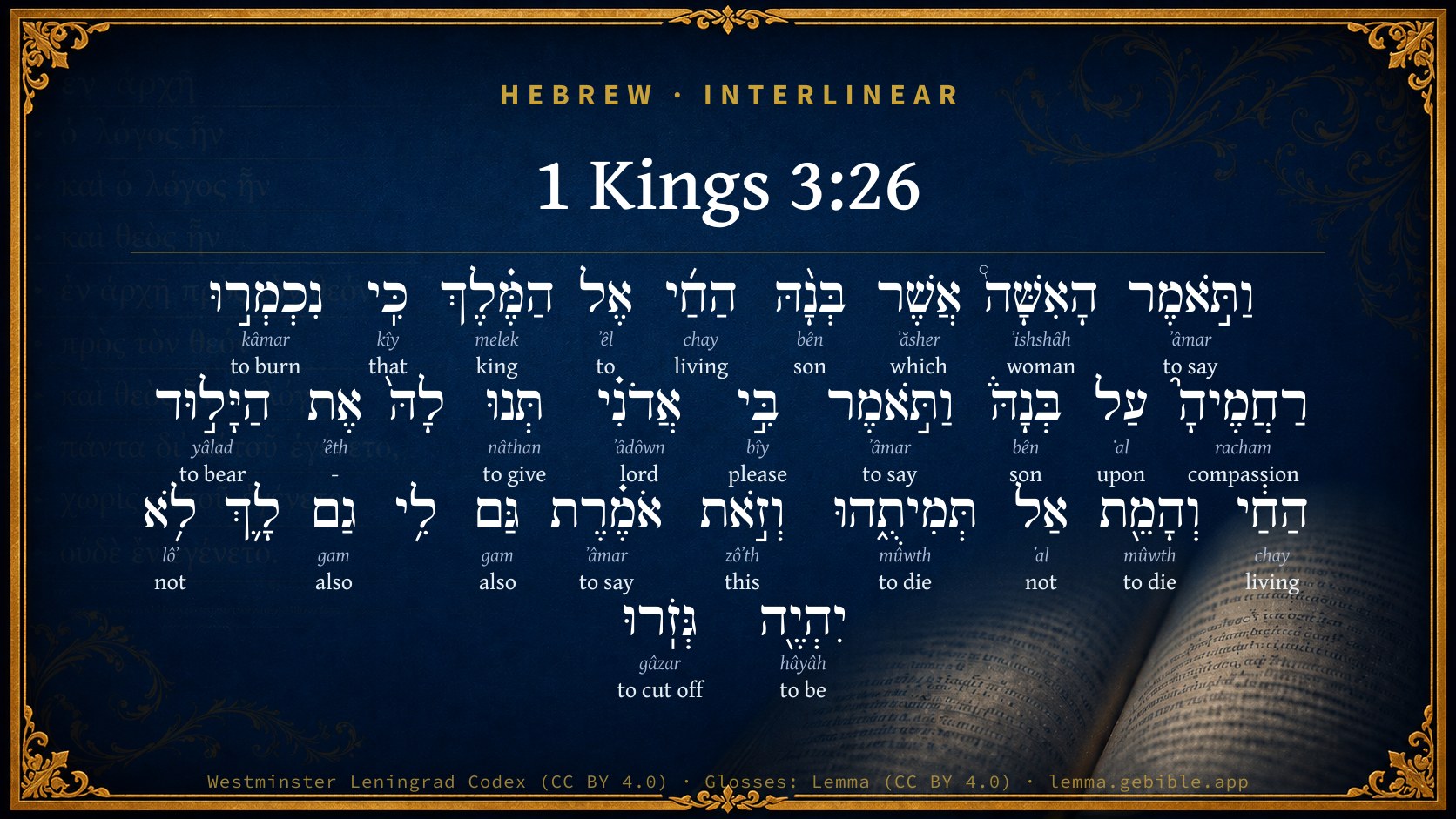
1 Kings 3:26

Hebrew (Westminster Leningrad Codex) 1 Kings 3:26 appears in the Hebrew Old Testament. The text above is from the Westminster Leningrad Codex. Each word links to its Strong’s number, a concise gloss, and parsing drawn from the Open Scriptures Hebrew Bible morphology. Click any word for its full Brown-Driver-Briggs (BDB) entry.
Download image
Cite this verse

1 Kings 3:26 (World English Bible). Public Domain. Lemma interlinear Bible study tool, https://lemma.gebible.app/v/1-kings/3/26.

Show BibTeX & RIS
BibTeX
RIS
English Translation
Then spoke the woman whose the living child was to the king, for her heart yearned over her son, and she said, Oh, my lord, give her the living child, and in no way kill it. But the other said, It shall be neither mine nor yours; divide it.
World English Bible · Public Domain
Download a study sheet

One document with this verse’s original text, its word-by-word gloss line, the meaning frame, cross-references with their text, attributed commentary, and full source and license credits — printable, and it pastes into notes with its structure intact.

This verse Autodidact and up

Study sheet (.html) Plain text (.txt)

A passage Seminary Student

Up to 50 verses in one chapter. A passage sheet keeps up to 6 commentary sources and 12 cross-references per verse, in the order this page ranks them, and says so on the sheet whenever that leaves anything out. Ask for a single verse and you get the Autodidact verse sheet above.

Everything on this page stays free to read, with no account — the sheet is a download of what is already on screen, not access to it.

Want to remove ads? Support Godless Engineer
Compare translations 3

The same verse in 3 English versions, stacked beneath the original-language interlinear above. Click any original word for its lexicon entry.

Each is an independent rendering of the whole verse — the interlinear is not word-aligned to these translations.

Highlighted words mark where these versions differ — a whole-verse word diff, not a word-by-word alignment.

  • World English Bible Public Domain
    Then spoke the woman whose the living child was to the king, for her heart yearned over her son, and she said, Oh, my lord, give her the living child, and in no way kill it. But the other said, It shall be neither mine nor yours; divide it.
  • King James Version Public Domain
    Then spake the woman whose the living child was unto the king, for her bowels yearned upon her son, and she said, O my lord, give her the living child, and in no wise slay it. But the other said, Let it be neither mine nor thine, but divide it.
  • unfoldingWord Literal Text CC BY-SA 4.0
    And the woman whose son the living one spoke to the king, for her compassions for her son were kindled. And she said, “Please, my lord, give the living child to her, but killing, you must not kill him!” But this one was saying, “He will not be either for me or for you. Divide.”

unfoldingWord Literal Text — © unfoldingWord, licensed CC BY-SA 4.0. Word-aligned USFM3 via Door43 (git.door43.org/unfoldingWord/en_ult).

Versions to compare (up to 4)

3 of 4 selected

Show all 18 translations

Every available English version of this verse, each an independent rendering of the whole verse.

  • World English Bible Public Domain
    Then spoke the woman whose the living child was to the king, for her heart yearned over her son, and she said, Oh, my lord, give her the living child, and in no way kill it. But the other said, It shall be neither mine nor yours; divide it.
  • Berean Standard Bible Public Domain
    Then the woman whose son was alive spoke to the king because she yearned with compassion for her son. “Please, my lord,” she said, “give her the living baby. Do not kill him!” But the other woman said, “He will be neither mine nor yours. Cut him in two!”
  • Majority Standard Bible Public Domain
    Then the woman whose son was alive spoke to the king because she yearned with compassion for her son. “Please, my lord,” she said, “give her the living baby. Do not kill him!” But the other woman said, “He will be neither mine nor yours. Cut him in two!”
  • King James Version Public Domain
    Then spake the woman whose the living child was unto the king, for her bowels yearned upon her son, and she said, O my lord, give her the living child, and in no wise slay it. But the other said, Let it be neither mine nor thine, but divide it.
  • American Standard Version (1901) Public Domain
    Then spake the woman whose the living child was unto the king, for her heart yearned over her son, and she said, Oh, my lord, give her the living child, and in no wise slay it. But the other said, It shall be neither mine nor thine; divide it.
  • Revised Version (1885) Public Domain
    Then spake the woman whose the living child was unto the king, for her bowels yearned upon her son, and she said, Oh my lord, give her the living child, and in no wise slay it. But the other said, It shall be neither mine nor thine; divide it.
  • Geneva Bible (1599) Public Domain
    Then spake the woman, whose the liuing child was, vnto the King, for her compassion was kindled toward her sonne, and she sayde, Oh my lorde, giue her the liuing childe, and slay him not: but the other sayde, Let it be neither mine nor thine, but deuide it.
  • Douay-Rheims (1899) Public Domain
    But the woman whose child was alive, said to the king, (for her bowels were moved upon her child,) I beseech thee, my lord, give her the child alive, and do not kill it. But the other said: Let it be neither mine nor thine, but divide it.
  • Young's Literal Translation Public Domain
    And the woman whose son `is' the living one saith unto the king (for her bowels yearned over her son), yea, she saith, `O, my lord, give to her the living child, and put it not at all to death;' and this `one' saith, `Let it be neither mine or thine -- cut `it'.'
  • Literal Standard Version CC BY-SA 4.0
    And the woman whose son [is] the living one says to the king (for her bowels yearned over her son), indeed, she says, “O my lord, give the living child to her, and do not put him to death at all”; and this [one] says, “Let him be neither mine or yours—cut [him].”
  • Unlocked Literal Bible CC BY-SA 4.0
    Then the woman whose son was alive spoke to the king, for her heart was full of compassion for her son, and she said, “Oh, my master, give her the living child, and by no means kill him.” But the other woman said, “He shall be neither mine nor yours. Divide him.”
  • unfoldingWord Literal Text CC BY-SA 4.0
    And the woman whose son the living one spoke to the king, for her compassions for her son were kindled. And she said, “Please, my lord, give the living child to her, but killing, you must not kill him!” But this one was saying, “He will not be either for me or for you. Divide.”
  • Darby Bible Public Domain
    Then spoke the woman whose was the living child to the king, for her bowels yearned over her son, and she said, Ah, my lord! give her the living child, and in no wise put it to death. But the other said, Let it be neither mine nor thine; divide it.
  • World Messianic Bible Public Domain
    Then the woman whose the living child was spoke to the king, for her heart yearned over her son, and she said, “Oh, my lord, give her the living child, and in no way kill him!” But the other said, “He shall be neither mine nor yours. Divide him.”
  • Webster's Bible Public Domain
    Then spoke the woman whose the living child was to the king, for her bowels yearned upon her son, and she said, O my lord, give her the living child, and in no wise slay it. But the other said, Let it be neither mine nor thine, but divide it.
  • Free Bible Version CC BY-SA 4.0
    But the woman whose son was alive had so much love for him as a mother that she cried out to the king, “Please, Your Majesty, give her the boy! Don't kill him!” But the other woman said, “He won't be mine or yours—cut him in two!”
  • Bible in Basic English Public Domain
    Then the mother of the living child came forward, for her heart went out to her son, and she said, O my lord, give her the child; do not on any account put it to death. But the other woman said, It will not be mine or yours; let it be cut in two.
  • JPS Tanakh (1917) Public Domain
    Then spoke the woman whose the living child was unto the king, for her heart yearned upon her son, and she said: 'Oh, my lord, give her the living child, and in no wise slay it.' But the other said: 'It shall be neither mine nor thine; divide it.'

Literal Standard Version (2020), Covenant Press — licensed CC BY-SA 4.0. Text via the HelloAO Bible API (eBible.org). Unlocked Literal Bible (unfoldingWord) — licensed CC BY-SA 4.0. Text via the HelloAO Bible API (eBible.org). unfoldingWord Literal Text — © unfoldingWord, licensed CC BY-SA 4.0. Word-aligned USFM3 via Door43 (git.door43.org/unfoldingWord/en_ult). Free Bible Version, Dr. Jonathan Gallagher — licensed CC BY-SA 4.0. Text via the HelloAO Bible API (eBible.org).

Word by word

More ways to search: Search by grammar → Find every occurrence → Compare this word →

Practice this passage: Drill this verse → Learn its vocabulary →

נִכְמְר֣וּ
kâmar
H3648
“to burn”
Verb, Niphal, Perfect, 3rd Person, Common, Plural
Part of Speech
Verb
Stem
Niphal
Form
Perfect
Person
3rd Person
Gender
Common
Number
Plural
Full BDB Definition

Origin: a primitive root

TWOT: 993 , 994 , 995

to yearn, be kindled, be black (hot), grow warm and tender, be or grow hot, become hot, become emotionally agitated - (Niphal) - to grow warm and tender - to be or grow hot
  1. וַתֹּ֣אמֶר ʼâmar H559 “and · to say” Conjunction + Verb, Qal, Sequential Imperfect, 3rd Person, Feminine, Singular
  2. הָאִשָּׁה֩ ʼishshâh H802 “the · woman” Particle, Definite Article + Noun, Common, Feminine, Singular, Absolute
  3. אֲשֶׁר ʼăsher H834 “which” Particle, Relative
  4. בְּנָ֨הּ bên H1121 “son · her” Noun, Common, Masculine, Singular, Construct + Suffix, Personal, 3rd Person, Feminine, Singular
  5. הַחַ֜י chay H2416 “the · living” Particle, Definite Article + Adjective, Adjective, Masculine, Singular, Absolute
  6. אֶל ʼêl H413 “to” Preposition
  7. הַמֶּ֗לֶךְ melek H4428 “the · king” Particle, Definite Article + Noun, Common, Masculine, Singular, Absolute
  8. כִּֽי kîy H3588 “that” Conjunction
  9. רַחֲמֶיהָ֮ racham H7356 “compassion · her” Noun, Common, Masculine, Plural, Construct + Suffix, Personal, 3rd Person, Feminine, Singular
  10. עַל ʻal H5921 “upon” Preposition
  11. בְּנָהּ֒ bên H1121 “son · her” Noun, Common, Masculine, Singular, Construct + Suffix, Personal, 3rd Person, Feminine, Singular
  12. וַתֹּ֣אמֶר ʼâmar H559 “and · to say” Conjunction + Verb, Qal, Sequential Imperfect, 3rd Person, Feminine, Singular
  13. בִּ֣י bîy H994 “please” Particle, Exhortation
  14. אֲדֹנִ֗י ʼâdôwn H113 “lord · my” Noun, Common, Masculine, Singular, Construct + Suffix, Personal, 1st Person, Common, Singular
  15. תְּנוּ nâthan H5414 “give” Verb, Qal, Imperative, 2nd Person, Masculine, Plural
  16. אֶת ʼêth H853 “-” Particle, Direct Object
  17. הַיָּל֣וּד yâlad H3205 “the · borne” Particle, Definite Article + Verb, Qal, Participle Passive, Masculine, Singular, Absolute
  18. הַחַ֔י chay H2416 “the · living” Particle, Definite Article + Adjective, Adjective, Masculine, Singular, Absolute
  19. וְהָמֵ֖ת mûwth H4191 “and · to die” Conjunction + Verb, Hiphil, Infinitive Absolute
  20. אַל ʼal H408 “not” Particle, Negative
  21. תְּמִיתֻ֑הוּ mûwth H4191 “to die · him” Verb, Hiphil, Jussive, 2nd Person, Masculine, Plural + Suffix, Personal, 3rd Person, Masculine, Singular
  22. וְזֹ֣את zôʼth H2063 “and · this” Conjunction + Pronoun, Demonstrative, Feminine, Singular
  23. אֹמֶ֗רֶת ʼâmar H559 “saying” Verb, Qal, Participle Active, Feminine, Singular, Absolute
  24. גַּם gam H1571 “also” Particle, Accusative
  25. גַם gam H1571 “also” Adverb
  26. לֹ֥א lôʼ H3808 “not” Particle, Negative
  27. יִהְיֶ֖ה hâyâh H1961 “to be” Verb, Qal, Imperfect, 3rd Person, Masculine, Singular
  28. גְּזֹֽרוּ gâzar H1504 “cut off” Verb, Qal, Imperative, 2nd Person, Masculine, Plural

About this verse

These counts appear in no published source. They are computed here, from the morphology-tagged text and Lemma’s own curated glosses. What Lemma adds →

32
words
23
distinct lemmas
Historical
section

Notable vocabulary

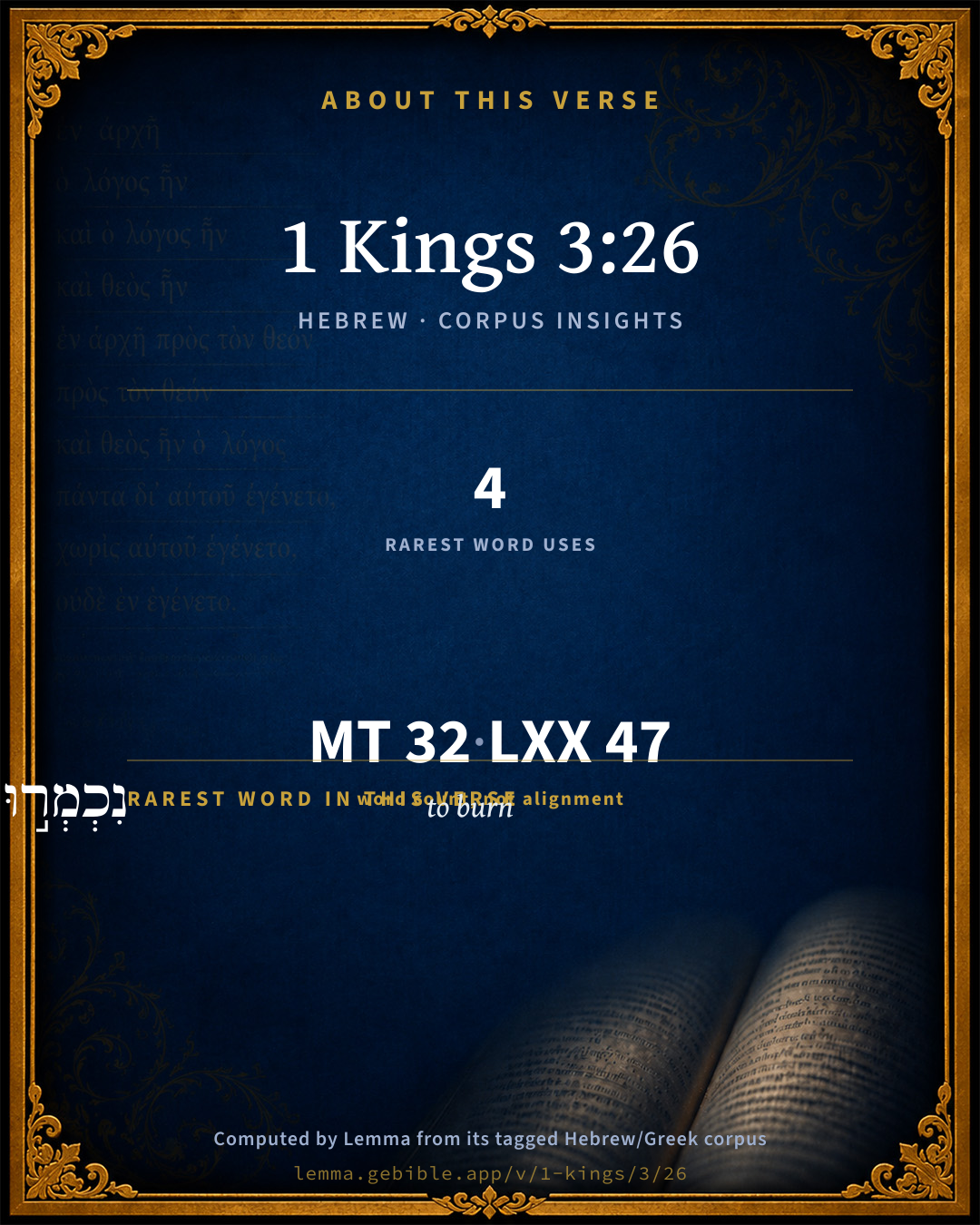
The rarest word here is נִכְמְר֣וּ to burn H3648 — appearing just 4 times in the whole Hebrew Bible.

Shared distinctive vocabulary

נִכְמְר֣וּ to burn H3648 occurs in 4 verses of the Hebrew Bible. Also found in:

Grammatical profile

  • 10 verbs
  • 6 nouns
  • 2 adjectives
  • 1 pronoun
  • 5 prepositions
  • 1 conjunction
  • 1 adverb
  • 6 particles

Verb forms

  • וַתֹּ֣אמֶר Qal · Sequential Imperfect
  • נִכְמְר֣וּ Niphal · Perfect
  • וַתֹּ֣אמֶר Qal · Sequential Imperfect
  • תְּנוּ Qal · Imperative
  • הַיָּל֣וּד Qal · Participle Passive
  • וְהָמֵ֖ת Hiphil · Infinitive Absolute
  • תְּמִיתֻ֑הוּ Hiphil · Jussive
  • אֹמֶ֗רֶת Qal · Participle Active
  • יִהְיֶ֖ה Qal · Imperfect
  • גְּזֹֽרוּ Qal · Imperative

Repetition

Words recur within this verse — often emphatic in Hebrew:

  • וַתֹּ֣אמֶר to say H559 ×3
  • בְּנָ֨הּ son H1121 ×2
  • הַחַ֜י living H2416 ×2
  • וְהָמֵ֖ת to die H4191 ×2
  • גַּם also H1571 ×2

Hebrew & Septuagint length

In English translation the verse runs 49 words from the Hebrew and 51 from the Septuagint (LXX English) — closely comparable.

A rough comparison of the two English renderings, which tokenize alike — not a word-level alignment.

Word counts can differ between the Hebrew and the Greek without any difference in meaning — e.g. the Hebrew direct-object marker אֵת has no separate Greek word, and Greek often adds the article ὁ.

In the original languages it is 32 Hebrew tokens and 47 Greek tokens — but the two are counted differently (Hebrew bundles its prefixes and suffixes into one token; the Greek is in lemma form), so that isn’t a like-for-like length.

Cross-references

10

Topical passages linked to 1 Kings 3:26 in the Treasury of Scripture Knowledge — connected by theme and wording, ordered by reader-vote popularity; previews shown in the World English Bible.

  • Isaiah 49:15 Can a woman forget her sucking child, that she should not have compassion on the son of her womb? yes, these may forget, yet I will not forget you.
  • Jeremiah 31:20 Is Ephraim my dear son? is he a darling child? for as often as I speak against him, I do earnestly remember him still: therefore my heart yearns for him; I will surely have mercy on him, says Yahweh.
  • 1 John 3:17 But whoever has the world's goods, and sees his brother in need, and closes his heart of compassion against him, how does the love of God remain in him?
  • Genesis 43:30 Joseph made haste; for his heart yearned over his brother: and he sought a place to weep; and he entered into his room, and wept there.
  • Hosea 11:8 "How can I give you up, Ephraim? How can I hand you over, Israel? How can I make you like Admah? How can I make you like Zeboiim? My heart is turned within me, My compassion is aroused.
  • Philippians 1:8 For God is my witness, how I long after all of you in the tender mercies of Christ Jesus.
  • Philippians 2:1 If there is therefore any exhortation in Christ, if any consolation of love, if any fellowship of the Spirit, if any tender mercies and compassion,
  • Psalms 39:3 My heart was hot within me. While I meditated, the fire burned: I spoke with my tongue:
  • Romans 1:31 without understanding, covenant-breakers, without natural affection, unforgiving, unmerciful;
  • 2 Timothy 3:3 without natural affection, unforgiving, slanderers, without self-control, fierce, no lovers of good,

Cross-references courtesy of OpenBible.info (CC BY 4.0).

Hebrew and Greek witnesses Masoretic Hebrew ↔ Greek Septuagint

The same verse in the two great witnesses to the Old Testament, shown verse-for-verse.

These are two independent witnesses, not word-aligned to each other, and the Septuagint is shown in lemma (dictionary) form.

Hebrew 1 Kings 3:26 Masoretic · Westminster Leningrad Codex

וַתֹּ֣אמֶר הָאִשָּׁה֩ אֲשֶׁר בְּנָ֨הּ הַחַ֜י אֶל הַמֶּ֗לֶךְ כִּֽי נִכְמְר֣וּ רַחֲמֶיהָ֮ עַל בְּנָהּ֒ וַתֹּ֣אמֶר בִּ֣י אֲדֹנִ֗י תְּנוּ לָהּ֙ אֶת הַיָּל֣וּד הַחַ֔י וְהָמֵ֖ת אַל תְּמִיתֻ֑הוּ וְזֹ֣את אֹמֶ֗רֶת גַּם לִ֥י גַם לָ֛ךְ לֹ֥א יִהְיֶ֖ה גְּזֹֽרוּ

Then spoke the woman whose the living child was to the king, for her heart yearned over her son, and she said, Oh, my lord, give her the living child, and in no way kill it. But the other said, It shall be neither mine nor yours; divide it.

World English Bible · Public Domain

Greek LXX 1 Kings 3:26 Septuagint · lemma form

καί ἀποκρίνω ὁ γυνή ὅς εἰμί ὁ υἱός ὁ ζάω καί εἶπον πρός ὁ βασιλεύς ὅτι ταράσσω ὁ μήτρα αὐτός ἐπί ὁ υἱός αὐτός καί εἶπον ἐν ἐγώ κύριος δίδωμι αὐτός ὁ παιδίον καί θάνατος μή θανατόω αὐτός καί οὗτος εἶπον μήτε ἐγώ μήτε αὐτός εἰμί διααἱρέω

And the woman whose the living child was, answered and said to the king, (for her bowels yearned over her son) and she said, I pray you, my lord, give her the child, and in nowise kill it. But the other said, Let it be neither mine nor hers; divide it.

LXX2012 (modern English Septuagint) · Public Domain

Hebrew: Westminster Leningrad Codex (CC BY 4.0). Greek: Septuagint (public domain); English from LXX2012 (modern English Septuagint) (Public Domain). How the Septuagint differs from the Hebrew →

Targum (Aramaic paraphrase)

1

The Targum is the ancient Jewish Aramaic paraphrase of the Hebrew Scriptures — an interpretive translation, not the Hebrew text itself. Onkelos (literal) and Pseudo-Jonathan (expansive) render the Torah, and Jonathan the Prophets. Coverage is partial: where no permissively-licensed English translation exists for a verse, only the Aramaic is shown. This is verse-level text, not a word-by-word alignment to the Hebrew.

  1. Targum Jonathan Prophets (Joshua–Malachi)
    וַאֲמַרַת אִתְּתָא דִי בְרָה חַיָא לְמַלְכָּא אֲרֵי אִתְגְלָלוּ רַחֲמָהָא עַל בְּרָהּ וַאֲמַרַת בְּבָעוּ רִבּוֹנִי הָבוּ לָהּ יַת רַבְיָא חַיָא וּמִקְטַל לָא תִקְטְלוּנֵיהּ וְדָא אֲמַרָא אַף דִלִי אַף דִילָךְ לָא יְהֵי פְּסוּקוּ:

    (no public-domain English translation for this verse)

    Targum Jonathan — Aramaic: “Mikraot Gedolot” (public domain). English: “Sefaria Community Translation” (CC0 1.0 (public-domain dedication)); “London "Chaldee Paraphrase," 1871” (public domain). Text via Sefaria.

Commentary

Notes on 1 Kings 3:26 from classic Christian and Jewish commentators (each source and its license shown beneath its notes). The classic Christian expositions comment on the surrounding passage and are grouped to its opening verse, so a note may address several verses; the Jewish commentaries on the Tanakh (Rashi and others) are per-verse, so they appear only where the commentator wrote on this verse.

Lemma curates 59 commentaries, every one of them public domain or Creative Commons licensed, each selected and text-cleaned for this edition rather than reprinted as found. About our sources →

Trapp's Complete Commentary

John Trapp

1Ki 3:26 Then spake the woman whose the living child [was] unto the king, for her bowels yearned upon her son, and she said, O my lord, give her the living child, and in no wise slay it. But the other said, Let it be neither mine nor thine, [but] divide [it].

Ver. 26. For her bowels yearned.] Good blood, we say, will not belie itself: good nature will work.

O my lord.] Parce puero, spare my child: this she would have said to the king. Give her, &c. This she saith to the officers.

John Trapp, A Commentary or Exposition upon All the Books of the Old and New Testament (1647–1656) — public domain. Text from a community e-Sword module.

Geneva Bible (1599)

Geneva Bible translators

Her motherly affection herein appeareth that she had rather endure the rigor of the Law, than see her child cruelly slain.

Geneva Bible (1599) marginal notes — public domain. Text via Bolls.life.

The Cambridge Bible for Schools and Colleges

gen. ed. J. J. S. Perowne

26. her bowels yerned] It was believed that some of the viscera were the seat of the emotions. Hence this expression is very common both in the Old and New Testament for the keenest and strongest feeling. The verb yern, cognate with the German adverb gern = ‘eagerly’, ‘gladly’, implies intense desire. The literal sense of the Hebrew verb is ‘to grow excessively warm.’ We speak of the heart burning within any one.

in no wise slay it] The mother’s love comes out. She could be content if it only lived and she might see it, though it were called the child of another.

divide it] In this word she addresses those who stand ready to execute the king’s sentence, ‘divide (ye) it.’

The Cambridge Bible for Schools and Colleges (gen. ed. J. J. S. Perowne; Cambridge University Press, 1878–1918) — public domain. Text from a community e-Sword module.

John Gill's Exposition

Then the king answered and said, give her the living child,

and in no wise slay it,.... That is, to her who desired it might not be slain, but rather be given to her who had no right to it:

she is the mother thereof; which might be strongly concluded from her compassion for it, her eagerness and earnestness to have its life spared, and from the indifference of the other, yea, from her cruelty and barbarity in moving to have it divided.

John Gill's Exposition of the Whole Bible (1746–1763) — public domain (CC PDM 1.0). Text via the HelloAO Bible API.

Whedon's Commentary on the Bible

Daniel D. Whedon

26. Let it be neither mine nor thine — Wordsworth compares this language of the false mother to the demands of schism in the Church of Christ, and calls it “the popular language of sects and sectaries, who say, Let various forms of religion be equally encouraged and patronized; there are numerous different ways all leading to heaven, and every man is free to choose which he likes best for himself, without any regard to the authority and judgment of Christ speaking in his Church. But the true mother shuns division and loves unity.” There may be some force in such comparison, if it is aimed against that wicked kind of schism which delights to make discord and dispute among the true disciples of Christ; but when aimed against the various evangelical denominations into which Protestant Christendom is divided, the comparison becomes ludicrous, and the comment above quoted may be turned upon its author and the Church party he represents with biting force. “High Churchism,” whether in Rome, England, or America, has been, in her legitimate results, the most schismatic of all “sects.” “Her zeal for unity,” which the above-named writer regards as “the evidence of her marriage and of her motherhood,” has never scrupled, when she had the power, to use the fagot and the sword in accomplishing her objects. So she has followed the fleshly methods of the child of that Sinai “which gendereth to bondage,” (Gal_4:24, compare 29.) Not organic unity, but the unity of spiritual freedom, is the mark of that “Jerusalem which is the mother of us all.” Contemptible is that narrowness which sees in the unity of Romish ecclesiasticism a something better than the unity of spirit and of life which is the glory of evangelical Protestantism. The true mother in this narrative showed at least the spirit of concession and yielding to her rival; but when did ever the narrow ecclesiasticism of papacy or semi-papacy yield even the most trivial point to a rival “sect” in order to secure organic unity, or when did she ever say to her rival, in the spirit of the true mother, “Give her the living child?”

Daniel D. Whedon (gen. ed.), Commentary on the Old and New Testaments (1874–1909) — public domain. Text from a community e-Sword module.

The Pulpit Commentary

Then spake the woman whose the living child was unto the king, for her bowels (thought by most of the ancients to be the seat of the affections, probably because of the sensations which strong emotions excite there. Cf. ta splagcna in the New Testament (2Co_6:12 Php_2:1 Phm_1:7, Phm_1:20, etc.) yearned (Heb. glowed. We speak of "glowing with pity," etc.) upon her son, and she said, O my lord, give her the living child, and in no wise slay it, But the other (Heb. this) said (Heb. saying) Let it be neither mine nor thine, but divide it. (The Hebrew is strikingly concise, "divide. We have here by far the greatest difficulty in the story. When the pretender, who has clamoured for the child, is at last offered it by its mother, she refuses the gift and heartlessly urges that it shall be cut in two. We can only account for her strange conduct on the supposition that. she caught eagerly at any way of escape from the dilemma in which she had placed herself, and thought, no doubt, that to accept his decision would be to flatter and please the king. (See Homiletics.)

Let it be neither mine nor thine, but divide it.

"The Word of God is quick and powerful, and sharper than any two-edged sword and is a discerner of the thoughts and intents of the heart." The judgment of Solomon is a striking commentary on this passage; indeed, it is possible that the writer had this incident in his mind when he penned these words. For assuredly the word of Solomon, "Divide," etc., was sharper than the sword they had just brought him (f1) in wounding the mother"s heart; (cf. Luk_2:35) while not more surely would the king"s sword, had it not been stayed, have pierced to the dividing asunder of the joints and marrow of the child, than did the king"s word distinguish between the true and the false, revealing both the tenderness and yearning love of the real mother, and also the thoughts and intents and workings of heart of the pretender. It is probably, in part at least, because of their revelation of character that they are recorded here. Let us now, therefore, consider the character and motives of the pseudo mother, as disclosed to us in her words and conduct. And first, let us ask, what can have led to this cruel and unnatural speech? Here is a woman who has recently become a mother, and who claims to be the mother of the child, having no pity on a helpless babe. At one moment, she strenuously contends before the king for its possession, and at the next she connives at, and indeed clamours for, its murder. She has surreptitiously taken it from one who would have guarded and cherished it; she loudly protests that it is hers; she is so anxious to have it that she will plead for it before the royal tribunal, and yet, when it is gravely proposed to cut the hapless child in two, she is loud in her approval of the plan. How can we account for such strange inconsistency? The usual explanation is that she was impelled to do and say what she did by spite, by jealousy. And, without doubt, there was an element of spite in her conduct. If she was to be denied the child, she was resolved that none else should have it. She would never submit to the humiliation of leaving the judgement seat with the character of an impostor, while that other one carried off the babe in her arms in triumph. But while the feeling of "dog in the manger" explains much, it does not explain all. It does not account, for example, for her having cumbered herself with the care of the child in the first instance; and it hardly explains her proceeding to the extremity of judicial murder. Nor even if we combine with spite the desire to flatter the youthful king, do we find a sufficient explanation of her inconsistency. No doubt she thought it would be a compliment to her prince readily to acquiesce in his proposal. It is not the first time or the last that men have readily assented to wrong-doing because a crowned head suggested it. We see in her cry, "Divide it," a cringing, fawning desire to ingratiate herself into Solomon"s favour, or if not that, at least to play the courtier; but we do not see in this desire alone a sufficient explanation of this clamour for the life of a puling and innocent babe. No, if we are to get at the very root of her strange and shameful conduct, we must first ask another question, viz., What led her to steal this child from its mother"s arms and to claim it for her own? What induced her when she woke in the night and found her own child dead, to creep in the darkness to her companion"s couch and take a changeling for her son. For this was surely a strange thing to do. We could more readily understand her rejoicing in the death of her own child of shame than this eager desire to burden herself with a bastard that she had not borne.

Now, it is quite possible that there were special circumstances connected with this case, which, if we knew them, would offer a complete and certain explanation of her conduct. For example, to pass by other possibilities, hers may have been such case as Tamar"s (Genesis 38) But as we do not and cannot know what these peculiar circumstances were, if there were any, we can only collect her motives, as best we may, from the record of facts which we possess.

It is clear, then, that she was not actuated by love for the child. It is unlikely that a woman such as she was could have love for a child such as this was; while it is inconceivable that if she really loved it, she would have consented to and counselled its death. Nor can it have been the pride and joy of having a man child to call her son. (Joh_16:21) For the child was not hers, and no one knew this better than herself. No doubt the Jewish mother had special reasons for desiring offspring and for cherishing her children, but this was the child of stranger.

What then were her motives? Were they not these? First, the fear of reproach, and secondly, jealousy of her more fortunate companion. Fear of reproach; for no woman, in any age of the world, or under any circumstances, can fail to be mortified and humbled and ashamed at having occasioned, by her maladroitness, the death of her child. She knew what the tongues of the neighbours would say: she could see them, perhaps, even mocking her as a murderess. For they could not know that the death was accidental and some of them, she feared, might think, if they did not say, that there had been foul play on her part. These thoughts, as they rushed through her mind in the black and dark night, would be accentuated and made well nigh intolerable by the thought that her companion had been more careful or more fortunate. What may have passed between these two women we cannot say. For aught we know, each may have boasted of her child, or the one may have disparaged the child of the other. There must almost have been something of the kind and it may have been something extremely simple to account for this act of child stealing.

It is quite possible, of course, that this woman, had she been interrogated after the fraud was detected, would have found it difficult to say what led her to play this false part. For we may rest assured she did not argue about it, did not stop to parley with herself or to weigh the consequences. She acted on a blind, hasty, unreasoning impulse. But all the same it is not difficult for us to see that these must have been among the springs of her conduct. And when the fatal move was once made, the rest of her sin is easily explained. There was then nothing for her to do but to brazen it out. It was impossible for her to stop, without proclaiming herself both liar and thief. As she had lied to her companion, so she must lie to the neighbours, and as she had lied to the neighbours, so she must lie even before the king. There was no help for it. Vestigia nulla retrorsum! She must go on to the bitter end.

But it is easy to see how terribly trying and painful her position would at last become. The constant fear of detection, or the fear lest she should betray herself, must have made it almost insupportable. Any moment something might ooze out which would reveal the deceit and cover her with infamy. Bitterly must she have regretted that she had ever embarked on this course of fraud; eagerly must she have cast about for any chance of escape.

And so when the king proposed to cut the Gordian knot; when he proposed, that is, to extricate her from the toils which she had woven round herself, is there any wonder that she caught eagerly at the first chance that offered, and that without a moment"s reflection as to the morality of the remedy, and without the least perception of the snare that was spread for her. All she thought was that it promised an honourable retreat from ground which was every moment becoming more insecure; that it opened to her, in her despair and dread of detection, a door of escape. It is this accounts for the cry, "Divide it." The murder would cover her multitude of lies, the blood of the innocent would efface the traces of her guilt.

The lessons taught by this history must be very briefly indicated. Among them are these:

Impurity almost inevitably leads to deceit. The root of all the mischief here was the unchastity. The sin against the body makes other sins comparatively easy. "It is only the first step that costs." And what a step is that!

Moral cowardice may lead to murder. The fear which prompted the hasty resolve to possess herself of the living child, led this miserable woman to stealing, lying, persistent falseness, and to murder, in thought and will. Facilis descensus Averni, etc.

Falsehood leads to falsehood. The proverb says, "If we tell one lie we must tell twenty more to bury it." "One lie must be thatched with another or it will soon rain through." "O what a tangled web we weave When once we venture to deceive.

Jealousy dries up the milk of human kindness. It is "cruel as the grave." "Fiercer than famine, war, or spotted pestilence; Baneful as death, and horrible as hell.

It led this woman to act like a fiend; to desire the butchery of an innocent babe.

Sin overreaches itself. The pretender was caught in her own toils. She had no sooner said, "Divide it," than she saw she was undone. She had proclaimed her own falseness. "Out of thine own mouth will I judge thee.

When the sinner is most secure, then sudden destruction comes upon him. This woman had never breathed freely till Solomon said, "Divide it." That seemed such a certain deliverance that she echoed the cry. Now she began to feel safe. The next moment she was disgraced, condemned, ruined. Cf. Mat_24:50 Mat_25:44 1Th_5:8, etc.

The Pulpit Commentary (1880–1919), ed. H.D.M. Spence-Jones & Joseph S. Exell — public domain. Text from a community e-Sword module.

unfoldingWord translationNotes

Door43 World Missions Community

General Information:

The real mother asks the king to spare the child's life.

her heart was full of compassion for her son

This speaks of the woman having a lot of compassion as if her heart were a container and compassion were a solid object. AT: "she greatly loved her baby" (See: Metaphor)

all Israel

This is a generalization. (See: Hyperbole and Generalization)

translationWords

son

heart

compassion

lord

Israel

judge

fear

wise

God

unfoldingWord translationNotes — © Distant Shores Media and the Door43 World Missions Community, licensed CC BY-SA 4.0. Source: git.door43.org/Door43/en_tn.

Lesson kit

Teaching starters — assembled from the data on this page, not authored interpretation. Every prompt links to the verse data it draws on. Edit before teaching.

1 Kings, in the Historical, opens this verse with 32 words (23 distinct Hebrew lemmas). Its most distinctive word is kâmar (“to burn”). A historical commentator’s framing appears above. Read the whole chapter for the surrounding context.

Discussion questions

  1. What does “to burn” (kâmar) contribute to the verse as a whole?
  2. Genesis 43:30 shares the word «to burn» with this verse. How do the two illuminate each other?
  3. “to say” occurs 3× in this one verse. What is the effect of the repetition?
  4. These translations render this verse differently. What is at stake in choosing one wording over another?
  5. The verb «וַתֹּ֣אמֶר» is Qal Sequential Imperfect. How does its form color the action?
  6. Reading how Trapp's Complete Commentary and Geneva Bible (1599) read this verse, where do the two commentators agree and where do they part?

Things to notice

Reading settings

Reading text

Shown beneath each verse's original-language words.

Old Testament
Old Testament edition

Read the OT as the Masoretic Hebrew (MT) or the Greek Septuagint (LXX).

English shown for the Greek Septuagint (in the Hebrew ↔ Greek comparison).

Comparing translations? Open the Compare panel on any verse page to stack up to four side by side.