
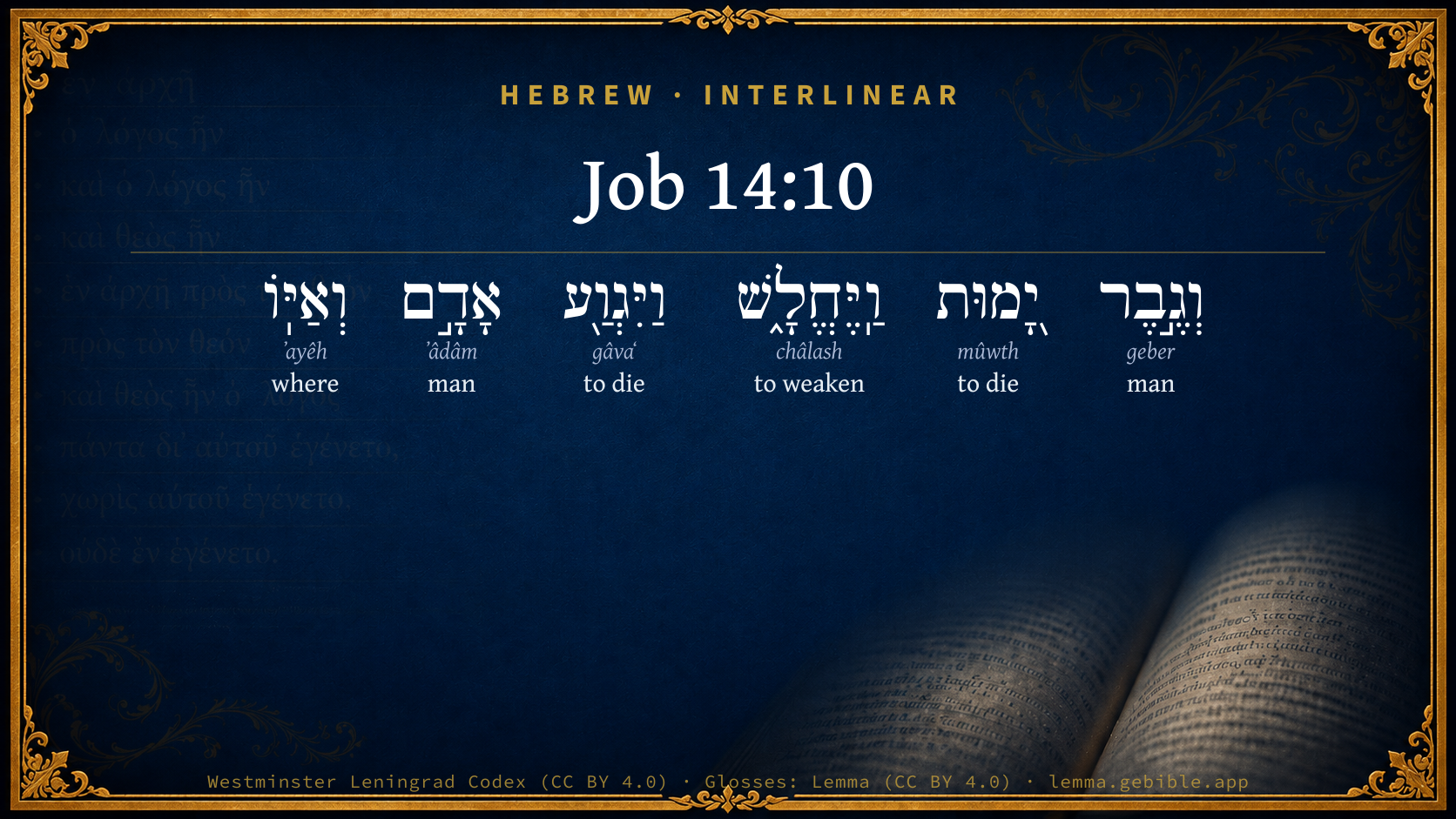
Job 14:10

Hebrew (Westminster Leningrad Codex) Job 14:10 appears in the Hebrew Old Testament. The text above is from the Westminster Leningrad Codex. Each word links to its Strong’s number, a concise gloss, and parsing drawn from the Open Scriptures Hebrew Bible morphology. Click any word for its full Brown-Driver-Briggs (BDB) entry.
Download image
Cite this verse

Job 14:10 (World English Bible). Public Domain. Lemma interlinear Bible study tool, https://lemma.gebible.app/v/job/14/10.

Show BibTeX & RIS
BibTeX
RIS
English Translation
But man dies, and is laid low. Yes, man gives up the spirit, and where is he?
World English Bible · Public Domain
Download a study sheet

One document with this verse’s original text, its word-by-word gloss line, the meaning frame, cross-references with their text, attributed commentary, and full source and license credits — printable, and it pastes into notes with its structure intact.

This verse Autodidact and up

Study sheet (.html) Plain text (.txt)

A passage Seminary Student

Up to 50 verses in one chapter. A passage sheet keeps up to 6 commentary sources and 12 cross-references per verse, in the order this page ranks them, and says so on the sheet whenever that leaves anything out. Ask for a single verse and you get the Autodidact verse sheet above.

Everything on this page stays free to read, with no account — the sheet is a download of what is already on screen, not access to it.

Want to remove ads? Support Godless Engineer
Compare translations 3

The same verse in 3 English versions, stacked beneath the original-language interlinear above. Click any original word for its lexicon entry.

Each is an independent rendering of the whole verse — the interlinear is not word-aligned to these translations.

Highlighted words mark where these versions differ — a whole-verse word diff, not a word-by-word alignment.

  • World English Bible Public Domain
    But man dies, and is laid low. Yes, man gives up the spirit, and where is he?
  • King James Version Public Domain
    But man dieth, and wasteth away: yea, man giveth up the ghost, and where is he?
  • unfoldingWord Literal Text CC BY-SA 4.0
    But a man dies, and a man weakens and expires, and where he?

unfoldingWord Literal Text — © unfoldingWord, licensed CC BY-SA 4.0. Word-aligned USFM3 via Door43 (git.door43.org/unfoldingWord/en_ult).

Versions to compare (up to 4)

3 of 4 selected

Show all 18 translations

Every available English version of this verse, each an independent rendering of the whole verse.

  • World English Bible Public Domain
    But man dies, and is laid low. Yes, man gives up the spirit, and where is he?
  • Berean Standard Bible Public Domain
    But a man dies and is laid low; he breathes his last, and where is he?
  • Majority Standard Bible Public Domain
    But a man dies and is laid low; he breathes his last, and where is he?
  • King James Version Public Domain
    But man dieth, and wasteth away: yea, man giveth up the ghost, and where is he?
  • American Standard Version (1901) Public Domain
    But man dieth, and is laid low: Yea, man giveth up the ghost, and where is he?
  • Revised Version (1885) Public Domain
    But man dieth, and wasteth away: yea, man giveth up the ghost, and where is he?
  • Geneva Bible (1599) Public Domain
    But man is sicke, and dyeth, and man perisheth, and where is he?
  • Douay-Rheims (1899) Public Domain
    But man when he shall be dead, and stripped and consumed, I pray you where is he?
  • Young's Literal Translation Public Domain
    And a man dieth, and becometh weak, And man expireth, and where `is' he?
  • Literal Standard Version CC BY-SA 4.0
    And a man dies, and becomes weak, || And man expires, and where [is] he?
  • Unlocked Literal Bible CC BY-SA 4.0
    But man dies; he becomes weak; indeed, man stops breathing, and then where is he?
  • unfoldingWord Literal Text CC BY-SA 4.0
    But a man dies, and a man weakens and expires, and where he?
  • Darby Bible Public Domain
    But a man dieth, and is prostrate; yea, man expireth, and where is he?
  • World Messianic Bible Public Domain
    But man dies, and is laid low. Yes, man gives up the spirit, and where is he?
  • Webster's Bible Public Domain
    But man dieth, and wasteth away: yes, man yieldeth his breath, and where is he?
  • Free Bible Version CC BY-SA 4.0
    But human beings die, their strength dwindles away; they perish, and where are they then?
  • Bible in Basic English Public Domain
    But man comes to his death and is gone: he gives up his spirit, and where is he?
  • JPS Tanakh (1917) Public Domain
    But man dieth, and lieth low; yea, man perisheth, and where is he?

Literal Standard Version (2020), Covenant Press — licensed CC BY-SA 4.0. Text via the HelloAO Bible API (eBible.org). Unlocked Literal Bible (unfoldingWord) — licensed CC BY-SA 4.0. Text via the HelloAO Bible API (eBible.org). unfoldingWord Literal Text — © unfoldingWord, licensed CC BY-SA 4.0. Word-aligned USFM3 via Door43 (git.door43.org/unfoldingWord/en_ult). Free Bible Version, Dr. Jonathan Gallagher — licensed CC BY-SA 4.0. Text via the HelloAO Bible API (eBible.org).

Word by word

More ways to search: Search by grammar → Find every occurrence → Compare this word →

Practice this passage: Drill this verse → Learn its vocabulary →

About this verse

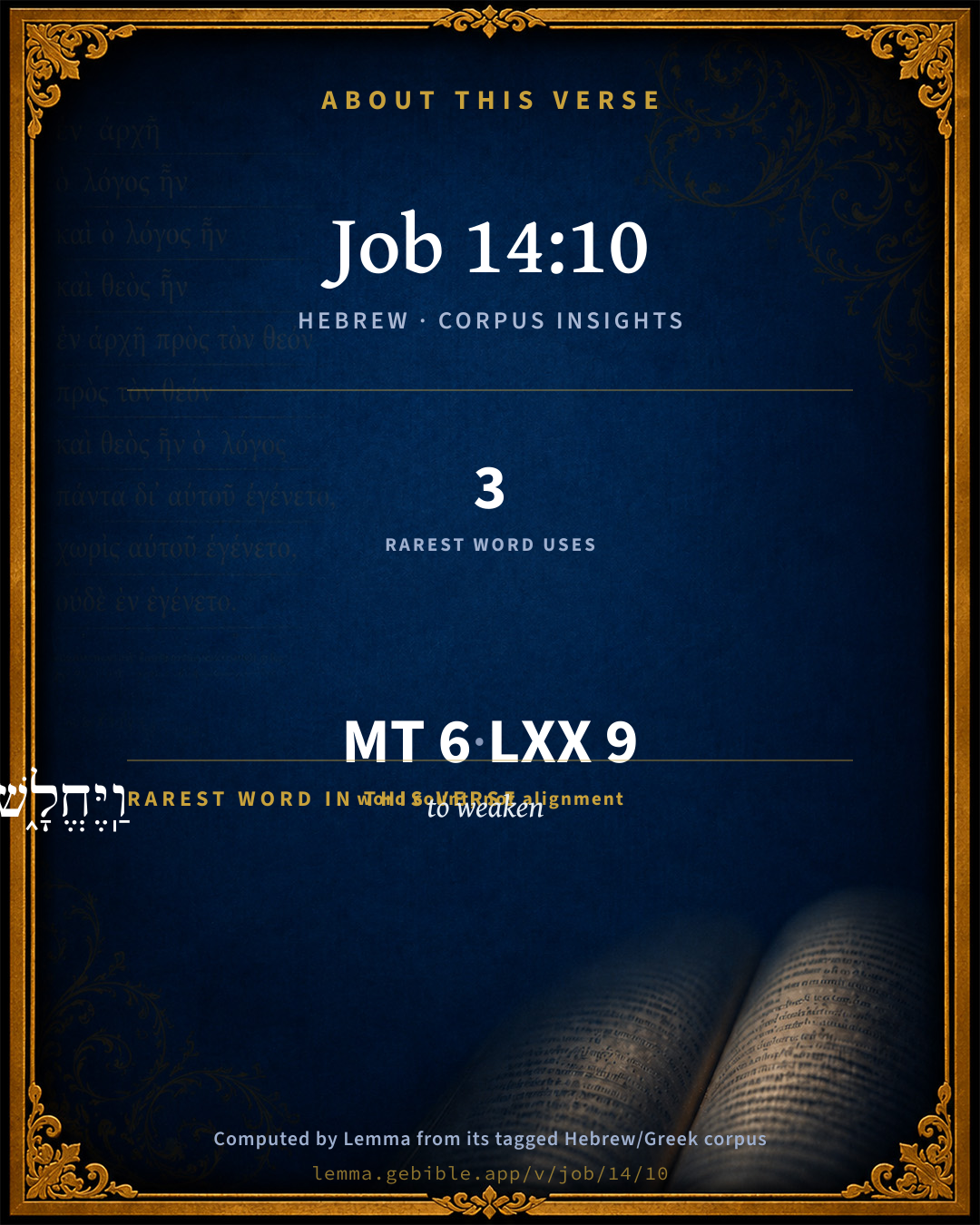
These counts appear in no published source. They are computed here, from the morphology-tagged text and Lemma’s own curated glosses. What Lemma adds →

6
words
6
distinct lemmas
Wisdom
section

Notable vocabulary

The rarest word here is וַֽיֶּחֱלָ֑שׁ to weaken H2522 — appearing just 3 times in the whole Hebrew Bible.

Shared distinctive vocabulary

וַֽיֶּחֱלָ֑שׁ to weaken H2522 occurs in 3 verses of the Hebrew Bible. Also found in:

Grammatical profile

  • 3 verbs
  • 2 nouns
  • 1 particle

Verb forms

  • יָ֭מוּת Qal · Imperfect
  • וַֽיֶּחֱלָ֑שׁ Qal · Sequential Imperfect
  • וַיִּגְוַ֖ע Qal · Sequential Imperfect

Hebrew & Septuagint length

In English translation the verse runs 17 words from the Hebrew and 19 from the Septuagint (LXX English) — closely comparable.

A rough comparison of the two English renderings, which tokenize alike — not a word-level alignment.

Word counts can differ between the Hebrew and the Greek without any difference in meaning — e.g. the Hebrew direct-object marker אֵת has no separate Greek word, and Greek often adds the article ὁ.

In the original languages it is 6 Hebrew tokens and 9 Greek tokens — but the two are counted differently (Hebrew bundles its prefixes and suffixes into one token; the Greek is in lemma form), so that isn’t a like-for-like length.

Cross-references

12

Topical passages linked to Job 14:10 in the Treasury of Scripture Knowledge — connected by theme and wording, ordered by reader-vote popularity; previews shown in the World English Bible.

  • Job 19:26 After my skin is destroyed, Then in my flesh shall I see God,
  • Genesis 49:33 When Jacob made an end of charging his sons, he gathered up his feet into the bed, and yielded up the spirit, and was gathered to his people.
  • Job 7:7–10 Oh remember that my life is a breath. My eye shall no more see good.
  • Proverbs 14:32 The wicked is brought down in his calamity, But in death, the righteous has a refuge.
  • Job 11:20 But the eyes of the wicked shall fail, They shall have no way to flee; Their hope shall be the giving up of the spirit."
  • Job 14:12 So man lies down and doesn't rise; Until the heavens are no more, they shall not awake, Nor be roused out of their sleep.
  • Job 17:13–16 If I look for Sheol as my house, If I have spread my couch in the darkness,
  • Matthew 27:50 Jesus cried again with a loud voice, and yielded up his spirit.
  • Luke 16:22–23 It happened that the beggar died, and that he was carried away by the angels to Abraham's bosom. The rich man also died, and was buried.
  • Acts 5:10 She fell down immediately at his feet, and died. The young men came in and found her dead, and they carried her out and buried her by her husband.
  • Job 3:11 "Why didn't I die from the womb? Why didn't I give up the spirit when my mother bore me?
  • Job 10:18 "'Why, then, have you brought me forth out of the womb? I wish I had given up the spirit, and no eye had seen me.

Cross-references courtesy of OpenBible.info (CC BY 4.0).

Hebrew and Greek witnesses Masoretic Hebrew ↔ Greek Septuagint

The same verse in the two great witnesses to the Old Testament, shown verse-for-verse.

These are two independent witnesses, not word-aligned to each other, and the Septuagint is shown in lemma (dictionary) form.

Hebrew Job 14:10 Masoretic · Westminster Leningrad Codex

וְגֶ֣בֶר יָ֭מוּת וַֽיֶּחֱלָ֑שׁ וַיִּגְוַ֖ע אָדָ֣ם וְאַיּֽוֹ

But man dies, and is laid low. Yes, man gives up the spirit, and where is he?

World English Bible · Public Domain

Greek LXX Job 14:10 Septuagint · lemma form

ἀνήρ δέ τελευτάω οἴχομαι πίπτω δέ βροτός οὐκέτι εἰμί

But a man that has died is utterly gone; and when a mortal has fallen, he is no more.

LXX2012 (modern English Septuagint) · Public Domain

On this verse, Albert Barnes' Notes on the Bible discusses the Septuagint’s reading. Read the note in Commentary ↓

Hebrew: Westminster Leningrad Codex (CC BY 4.0). Greek: Septuagint (public domain); English from LXX2012 (modern English Septuagint) (Public Domain). How the Septuagint differs from the Hebrew →

Commentary

Notes on Job 14:10 from classic Christian and Jewish commentators (each source and its license shown beneath its notes). The classic Christian expositions comment on the surrounding passage and are grouped to its opening verse, so a note may address several verses; the Jewish commentaries on the Tanakh (Rashi and others) are per-verse, so they appear only where the commentator wrote on this verse.

Lemma curates 59 commentaries, every one of them public domain or Creative Commons licensed, each selected and text-cleaned for this edition rather than reprinted as found. About our sources →

Trapp's Complete Commentary

John Trapp

Job 14:10 But man dieth, and wasteth away: yea, man giveth up the ghost, and where [is] he?

Ver. 10. But man dieth, and wasteth away] Heb. Strong and lusty man, Homo quantum vis robustus (Vat.), dieth and wasteth away, or is cut off, sc. worse than a tree, for he grows no more; or is discomfited, vanquished, as Exo 17:13; Exo 32:18, sc. by death, and so carried clean out of this world.

Yea, man giveth up the ghost] Homo vulgaris et plebeius. All of all sorts must die, whether noble or ignoble, as Rabbi Abraham here observeth. Job is very much in this discourse about death; and surely, as Nazianzen wisheth of hell, so could I of death, Utinam ubique de morte dissereretur! Oh that it were more in men’s minds and mouths than it is!

And where is he?] q.d. Nowhere above ground; or if he be, putrefit et teterrime olet, he putrefies and stinks filthily; and as his life is taken away, so is his glory; yea, being once out of sight, he grows by little and little out of mind too, little thought of, less spoken of, many times not so much as his name mentioned or remembered in the next generation, Ecc 1:11. There is no remembrance of former things, or men, neither shall there be any remembrance, &c. So Ecc 2:16; Ecc 8:10; Ecc 9:5. Hence the state of the dead is called "the land of forgetfulness," Psa 88:12; Psa 31:12, "I am forgotten, as a dead man out of mind." Heathens also say the same (Hor. lib. 4, Carm. 7):

Cum semel occideris, et de te splendida Minos

Fecerit arbitria,

Non, Torquate, genus, non te facundia, non te

Restituet pietas.

John Trapp, A Commentary or Exposition upon All the Books of the Old and New Testament (1647–1656) — public domain. Text from a community e-Sword module.

The Biblical Illustrator

Joseph S. Exell

Job_14:10

But man dieth . . . and where is he?

Am I to live forever

I. The belief indicated that mans nature is two fold. There are two distinct processes ever going on within our frame. We may lose our physical organs, but the soul may think, wish, or purpose, as energetically as ever. The brain is the organ of the mind; but this does not warrant our saying that the brain and the mind are of the same material, or that they are only different sides of that material thing. If there are manifestations in our constitution which matter cannot give account of, it would be absurd to follow that up by saying that man goes out of life altogether when he dies and wastes away. We should rather believe that as our nature is two fold, that part which is spiritual may survive that which is material.

II. A doubt expressed as to what becomes of the man when he dies. Death tells us nothing. There is no evidence in it of what becomes of the man. Death fails to prove anything as to the survival of the soul. Yet the belief has been general, that those who have passed away are still somewhere. Why should men have believed that the soul still had a place? Every sense was against it.

III. The grounds on which the conviction is built that man lives after death. I go behind the Bible, and look at the action of our own nature.

1. The indestructibility of force or energy. When once a force has begun to be in operation that force continues. It is never blotted out.

2. The incompleteness of mans life here. God is a teacher who sets us a task which we cannot prepare in school.

3. The best affections which distinguish this life speak of continuance beyond this present state.

4. When man dieth, we forecast a judgment for the deeds done in the body. It may be, indeed, it will be, that the judgment shall not be such as we pass upon one another. We look upon the outward appearance, God looks on the heart. We are to be judged. What are we to be judged for? (D. G. Watt, M. A.)

Where is he?

The certainty of the general truth referred to in our text, Man dieth and wasteth away; yea, man giveth up the ghost. And then we shall take up the concluding inquiry, And where is he? Now, the words translated man are different. There are two different words to express man in the original. The first properly means a mighty man: the second is Adam, man of the earth; implying that the mighty man dieth and wasteth away,--yea, man because he is of earth giveth up the ghost. It is quite unnecessary to attempt any proof of the solemn truth that man dieth. You all know that you must die. Yet how often does a mans conduct give a denial to his conviction. Hence it is needful for the ministers of the Gospel frequently to bring forward truths which are familiar to our minds, but which on that very account are apt to be little regarded. We are not unwilling to feel that others must die, but we are indisposed to bring the same conclusion home to ourselves; and yet it is the law of our being. It is appointed unto men once to die. The first breath we draw contains the germ of life and of destruction. The stem of human nature has never yet put forth a flower without a canker at the bud, or a worm at its heart. Why is this? By one man sin entered into the world, and death by sin; and so death passed upon all men, for that all have sinned. It is of the greatest importance for us all to know that through the infinite merits of our gracious Redeemer the power of death has been broken and subdued, and the sting of death which is sin has been extracted, and thus may death become not an enemy but a welcome friend to introduce us to new, to holy, to immortal life. There are a thousand different ways by which mortals are hurried hence the lingering disease, the rapid fever, the devouring flames, the devastating tempest. But now our text suggests to us an important inquiry, And where is he? You must at once see that this is a question of the last importance to you and to me. We ought to be able to answer it. What has become of him? A short time since he was here in health and vigour, but where is he now? Where shall we seek for information on this interesting point? Shall we turn to some of our modern philosophers? Alas, they will afford but poor comfort! They will probably answer, Why, he is no more; he is as though he had never been. And do all the boasted discoveries of the present age which refuse to believe in the annihilation of matter, tend to raise our hopes no higher than annihilation for the soul? Shall we ask the Romanist, Where is he? We shall be told he is in a state of purgatory, from whence, after having endured a sufficient degree of fiery punishment and after a sufficient number of masses have been said on his behalf, he will be delivered and received into heaven. Truly it may be said of all such, miserable comforters are ye all. Revelation alone can cherish and support in us a hope of glory hereafter. It replies to our inquiry thus, The dust shall return to the earth as it was, and the spirit shall return to God who gave it. Accordingly we are exhorted to fear not them which kill the body, but are not able to kill the soul; but rather fear Him who is able to destroy both soul and body in hell. Now these passages are sufficient to show that the body and soul in man are distinct, the one from the other, and that while the one is in the grave mingling its dust with the clods of the valley, the other is in eternity, in happiness or misery. We therefore now ask your attention to the Word of God for an answer to the inquiry, Where is he? And here we must observe that however different individuals may appear to their fellow men, yet the Scriptures divide all mankind into two classes only, those who serve God, and those who serve Him not. Hence the reply given to the inquiry will have distinct reference to one or other of these classes. With respect to the question as relating to the righteous, Where is he? the Bible comforts us with the cheering answer, that absent from the body he is present with the Lord. For we know, says the apostle, that if our earthly house of this tabernacle were dissolved, we have a building of God, a house not made with hands, eternal in the heavens. Therefore we are always confident, knowing that whilst we are at home in the body, we are absent from the Lord. In accordance with this representation was our Lords promise to the penitent thief, Today shalt thou be with Me in paradise. Where are the righteous? In that happy place with the spirits of just men made perfect, waiting for the glorious time when the whole redeemed family shall be gathered in to celebrate the marriage supper of the Lamb. I go to prepare a place for you, said the Saviour, and I will come again and receive you to Myself, that where I am there ye may be also. So shall we ever be with the Lord. But then there is another class--the wicked, the impenitent. Where is he? The Scriptures afford a sad, though not less faithful answer. They inform us that the wicked is driven away in his wickedness,--that their condemnation slumbereth not. In order that we may bring the subject practically home to ourselves, let me put the question in a slightly altered form. Where are you now? What is your relation to God, and what preparation are you making for the period of death and judgment? We ask those who have never broken off their sins by true repentance and faith in Christ, where are you? Why, you are simply exposed to the vengeance of Gods law, which you know you have broken a thousand times. If you die as you have lived, Gods enemies--you must be condemned. You know that the Word of God says, The soul that sinneth, it shall die. The wages of sin is death. The Judge says, Except ye repent, ye shall all likewise perish. But I put the question, next, to those who seem to have got a step in advance,--who have heard the call to repentance, and are striving to forsake those sins which before had dominion over them. Where are you? It is a common deceit of Satan, when he sees that the sinner is really alarmed at his state and begins to cry to God for mercy, to persuade him that his altered life must needs be pleasing to God, and that his good deeds will certainly merit heaven for him. This is a delusion which I believe to be far more common than is supposed. People seem to think that by a moral life they are doing God service, forgetting that repentance is not the condition of our salvation, but faith. He that believeth not the Son shall not see life, said our blessed Lord. The wrath of God abideth on him. He that believeth not is condemned already. Oh, but, says one, are we not to repent? Assuredly! Repentance and a life of piety will be sure to be the necessary result of faith in Jesus as our Saviour. But, then, repentance can never undo a single sin you have committed, or pay the penalty of Gods broken law. But come with me to a death bed or two, and we will put the question there, Where is he? A death bed is a detector of the heart. Men may live fools, but fools they cannot die. No; the scene is then changed. The infidel then drops his mask. The hypocrite who through life has deceived himself and his fellow creatures, trembles as he draws near the valley of the shadow of death. Now, behold that pale emaciated wretch. That is the notorious infidel Thomas Paine. Where is he? He is dying, a victim of profligacy and of brandy. He is horrorstruck to be left alone for a minute. He dares not let those who are waiting upon him be out of his sight. He exclaims incessantly so as to alarm all in the house, O Lord, help me. Lord Jesus, help me. He confesses to one who had burned his infidel Age of Reason, that he wished that all who had read it had been as wise; and he added, If ever the devil had an agent on earth, I have been that one. And when the terror of death came over this most unhappy man, he exclaimed, I think I can say what they make Jesus Christ to have said, My God, my God, why hast Thou forsaken me? In that state of mind he died, a stranger to penitence, in all the horrors of an accusing conscience. Infidelity has no support for its deluded followers on a death bed. The apostle when contemplating his end said, I have a desire to depart, and to be with Christ, which is far better. I have fought the good fight, I have finished my course, I have kept the faith. Henceforth there is laid up for me a crown of righteousness, which the Lord, the righteous Judge, shall give me; and not to me only, but unto all them that love His appearing. This blessed experience is as much the inheritance of Christians now as it was in the apostles time, for there is the same Saviour, and the same sure word of promise on which to rely. The Rev. Holden Stuart when smitten with a sickness unto death, said to his medical attendant, Doctor, dont be afraid to tell me the truth, for the day of my death will be the happiest day of my life. Someone who had great experience of human nature, once remarked, Tell me how a man has lived, and I will tell you how he will die. (W. Windle.)

Where are the dead

Man was originally formed to be a representative of Gods moral perfections--His wisdom, goodness, holiness, and truth. By the apostasy of our first parents the scene is changed, and holiness and happiness must now be sought after in fairer worlds on high. Death is said to be of three kinds--natural, spiritual, eternal.

I. A most solemn and humiliating declaration. It cannot be questioned. What lessons may be deduced from it?

1. It is a very affecting truth.

2. Here is an instructive lesson--man should be humble.

3. Learn also the value of time.

4. Learn the nature of sin, the infinite evil, and the awful consequences of it.

5. God will most surely execute the judgments which He threatens in His most Holy Word.

II. A most momentous inquiry. It relates not to the body, but to the soul, to the man himself. The soul is still in existence, still thinks and feels. Guided by the light of Scripture, we may safely find an answer to the solemn inquiry, Where is he? For the very moment the soul bids farewell to this world he enters the world of spirits, enters upon a state of everlasting happiness or woe. (John Vaughan, LL. D.)

The great question

I. The solemn scene which is before us.

1. Man giveth up the ghost, not by an option, but by an obligation; not by a deed at will, but by the stern and just necessity of law. The surrender of life in the blessed Jesus was an option. But man gives up the ghost, and there is a Divine will in that surrender, a surrender which is resistless when that will makes it so. Death is just the absence of life--and what a mysterious thing is life! I do not stop to show that man has a ghost, an immaterial and immortal spirit. Ones own consciousness contradicts the materialist, and the Bible is in harmony with what one observes in nature, and human consciousness teaches.

2. The manner of the surrender is uncertain. Though its occurrence is mysterious, its actual occurrence is certain. There is but one mode of entering life, but there are a thousand methods of leaving it.

II. The inquiry of anxious affection when the scene is over. Where is he?

1. Death brings a change of condition, never a change of character.

2. Though death is a change of condition, it is not a change of companionship. The same style of company it is a pleasure to him to keep on earth, a man must expect to keep in eternity. (C. J. P. Eyre, A. M.)

Man is a dying creature

1. This is spoken of man twice in the text. In the original two different words are used, one meaning the strong man, and the other the weak man. In the grave they meet together.

(1) Man dies though he be (geber) a mighty man.

(2) Man dies because he is a man of the earth (Gen_2:7; Gen_3:10).

2. Man is a dying creature. He dies daily, some or other going off every day.

(1) Before death, he wasteth away. He is weakening. Even in health, certainly in sickness and old age, we are wasting away. Inference--

1. See how vain man is.

2. How foolish they are who waste any part of their short lives upon their lusts.

(2) In death man giveth up the ghost. Man expires by a sudden stroke. He breathes out his last.

(3) After death, where is he? He is not where he was. He is somewhere. Think where the body is. Think where the soul is. It is gone into the world of spirits to which we are so much strangers. It is gone into an unchangeable state; it is gone into eternity. After death the judgment. (M. Henry.)

The state of the dead

The stage of human existence which intervenes between death and the resurrection is naturally regarded by us with great curiosity and solicitude. On this subject nature is silent, and revelation does but whisper faintly and vaguely. We are able to form a much more distinct conception of the heavenly state than of that which immediately precedes it. The final condition of man is much more analogous to his present state than that which intervenes between the two. At death we enter upon a disembodied state of being, a state of life purely spiritual and immaterial. Of this we have no knowledge from experience or observation; and we can form no clear and satisfactory conception of it. We are so accustomed to the use of material organs and instruments, that we cannot understand how we can do without them. Incorporeal life seems to us impotent, cheerless, naked, unreal. The souls of men after death remain conscious, still percipient and active.

1. We seem warranted in regarding the interval between death and the resurrection as a period of repose. It is the sleeping time of humanity. The repose that awaits us there will be all the more welcome and delightful from contrast with the turmoil and vexation of the life that precedes it.

2. The intermediate state will be a condition of progress. Progress is the law of life, and we cannot reasonably suppose that its operation will be suspended during that long period which is to elapse between death and the resurrection.

3. To the clearer vision of spirit, purged from fleshly films and earthly obstructions, will truth unfold itself with increased clearness, certainty, and power.

4. The separate state will be a condition of hope. It is a season of waiting, the vestibule only of a more glorious state to which it is introductory. But there is nothing in this waiting that is wearisome or tedious. I have spoken only of the holy dead, of those who sleep in Jesus. The subject--

(1) Gives consolation to the bereaved.

(2) In it we find comfort in the prospect of our own approaching departure. (R. A. Hallam, D. D.)

The momentous event

Men generally live as though they should never die.

I. The solemn statement. Man dieth, and giveth up the ghost.

1. An event peculiarly affecting. The removal of man from society; from all the ties of kindred and friendship. Dissolution of the union between body and soul.

2. An event absolutely and universally certain. The seeds of death are in our nature.

3. It is an event to which we are liable every moment. We live on the borders of the grave, on the margin of eternity.

4. An event irreparable in its effects. Its melancholy results no power can repair.

5. An event which demands our solemn consideration. We should consider its certainty, its possible nearness, its awful nature.

II. The important interrogation. Where is he? Apply the question to--

1. The infidel.

2. The profane.

3. The worldling.

4. The afflicted Christian.

Learn--

(1) That death will surely come.

(2) That an interest in Christ can alone prepare us for the event.

(3) That eternal things should have in our hearts the constant preeminence. (J. Burns, D. D.)

Immortality of the soul

The people of France once wrote over the gates of their burial places, Death is an eternal sleep, but this was only when the nation had run mad. The ordinary mode of proving the immortality of the soul is simple enough.

1. It is argued from the nature of the soul itself--especially from its immateriality. The nature of God seems also to favour the idea that He who made the soul capable of such vast improvement, and such constant advances towards perfection, would never suffer it to perish.

2. Belief in mans immortality is universal. No race of savages can be found, so debased and blind, as not to have some glimmerings of this truth.

3. We claim immortality as the heritage of man, because, on any other supposition, all the analogies of nature would be violated.

4. Man must be immortal, because this is indispensable to explain certain inequalities of happiness and misery on earth--inequalities which a just God would never allow, unless it was His good pleasure to make them right. Man is generally called a rational being; but he hardly deserves the name, while attempting to undermine our faith in that consoling which alone renders life worth having, and robs death of its terrors. (John N. Norton.)

The mystery of death

This is one of Jobs discontented and querulous utterances. It is tinged, too, with all that indistinctness of view which is characteristic of the eider dispensation. Job expresses the general feeling in a somewhat exaggerated form. He speaks as if the hour of dissolution were the hour of extinction. Then he craves for himself that oblivion of anguish which he thinks is only to be obtained in the solitude and silence of the grave. The words of the text express a very natural feeling, of which we have all had more or less experience. Man giveth up the ghost, and where is he? Gone, say some, into absolute nothingness. The individual perishes. Gone, say others, into final felicity. All lives, whatever they have been, lead to one bourne, and that the bourne of happiness. These are daydreams, and dangerous daydreams too. Christianity knows nothing about them. She tells us that when life is over, we pass into a conscious but a fixed and unalterable condition. Gone, we say, to reap what he has sown. The life we are living here below is a seed. Eternity is only the development of this puny, petty life of ours. The Divine laws are immutable. Every seed bringeth forth after its kind. We are all of us gravitating towards a certain centre. We move to join our own companions. Gone to give account of himself before God. Human life is like a stage; there are many actors and many parts. When the play is ended, the question will be about the manner of playing it. Men will be seen, not in their circumstances but in themselves. An hour will come to us when all the world will seem absolutely nothing, and when Christ, and interest in Christ, will seem to be everything. (Gordon Calthrop, M. A.)

An anxious query answered

After all, this is a question. Reason and revelation leave it such. The speculations of the ancients, where Catholic sentiments prevailed and the voice of poetry, which is but the plaint of philosophy, leave it a question. It is obscure, spectral, vaporous and ghostly as an apparition, the figure of a restless, undeveloped being, beyond our knowledge, crude, cloudy, vague. Where is he? There runs a yearning through our nature, as the autumn breeze steals through the trees. It is the question. Its intensity is proportioned to its obscurity. Where is he? Other data are needed. We may ask, as we do in reference to a stranger of stately form or commanding voice, whom we meet on the sidewalk, Who is he? The question may be of eager interest and concern, of sympathy or of opposition. Or we may say of man, What is he? and institute a metaphysical analysis into the nature of matter and mind; then push the query, What is man, and what am I? All these problems depend on the disclosure of the ultimate destiny of man. Where is he at last? Now we may mistake the shadow for the substance, a ship in the distance for a cloud, a meteor for a star. Walking in the edge of a wood, looking out upon the water, I may see a forest of masts, and for an instant take them for dry trees, until I see those tall, quivering masts move and the vessels floated out upon the bosom of the bay. Human life cannot be distinctly defined until we find out all there is of a man. We want facts. Oftentimes we answer one question by asking another. So let us turn to history and seek a famous or infamous man, a Cyrus or a Caligula, a Washington or a Robespierre. Each may now be but a heap of ashes, but what was the real distinction all the way through the careers of these men? What is love, and what is honour? We cannot answer until we get the data. Notice, then, two things, the unsettled element, and the point of solution where light breaks in.

1. The unsolved question, Where is he? You have lost a child. Whither has he gone? You do not say that you have lost a treasure until you have gone to the place where you feel sure it is, and do not find it. You are bereaved because you are bewildered. You were talking to a friend by your side. Unexpectedly he vanished without your knowledge, and you find yourself talking to vacancy. The mother bends over and peers into the vacant cradle, takes up a little shoe, a toy, a treasure, and says, He was here, he ought to be here, he must be here! Where is he? Not here, is all the answer that nature gives her. She is bewildered. The same query touches scepticism. Though there be an intellectual, logical assent to the doctrine of immortality, there is a difficulty in entertaining the idea. We cannot see the spirit or its passage upwards. We enter the chamber of death. We see that still body, white and limp; the garments it wore, the medicines administered, and the objects it once beheld. We look out and see that the sky is just as blue as ever, and the tramp of hunting feet is heard, as usual, in the street. We cry aloud, Ho! have ye seen a spirit pass? Not here, comes back again. Where, where is he? This is the unsettled element.

2. Here is the point where light breaks in upon the bewildered soul. It is found in the revelation of a flesh form and a spirit form revealed in Christ, the risen one. Science tells us of material elements, unseen by natural vision, globules of ether, and crystals of light to be detected by instruments prepared by the optician. The microscope reveals atoms that the unaided eye never could find. So the New Testament reveals what nature and science cannot make manifest. Dissolution is not annihilation. We read, In Him was life. He came, He descended, and ascended again. When a candle goes out, where goes the light? Christ went out and back, to and fro, as you show a child the way by going into and out of a door. He came forth from God, and His first life was a glorious disclosure; but we must not forget His second life after His death, burial, and resurrection. He gave up the ghost, and He lay in the tomb; then stood up, walked and talked with the disciples, a human being. He showed the fact that because He lives we shall live also. I will that they whom Thou hast given Me be with Me, where I am. Let not your heart be troubled. I go to prepare a place for you. Now light, refluent and radiant, breaks upon our way. He is not here, but risen, and this same Jesus shall return again. I may ask a mother, Where are your children? She may say that they are at school, or at play, or somewhere on the premises. They are not lost, though she may not exactly locate them. Or, Where is your husband? He went out awhile ago, or, The children went out with him; their father took them from home early. So with our dear departed. Out of sight they are not out of mind; not out of your mind, of course, and,, you are not out of their mind, nor out of their sight, I think. They are somewhere about the premises, the many-mansioned universe of God, expanding, radiant everywhere. It is one abode. (Hugh S. Carpenter, D. D.)

The query of the ages

This interrogatory has Sounded down all the centuries, and thrills today every thoughtful heart. Hence, if Job uttered these words in a moment of doubt, it was because he sat in the twilight hour of revelation. Hence, also, we must seek our answer to the question from Jesus, rather than from Job, from the full and final revelation of the New Testament, rather than from the types and shadows of the Old.

I. He is somewhere. Death is not annihilation.

1. Jesus taught mans existence after death so often and in such emphatic terms that it became an essential in Christian doctrine. In His words to the Sadducees, in the parable of the rich man and Lazarus, when speaking to Mary and Martha, when comforting His disciples who were mourning His near departure, in His last prayer with and for them--everywhere He clearly implied that man continues to exist somewhere after death.

2. To this revelation of life and immortality our hearts gladly assent.

3. Reason, likewise, adds its sanction. Thus we believe the dead are somewhere, they have not ceased to be.

II. But where? This is the emphatic word.

1. Where surroundings correspond with character. In this life man finds the earth prepared for his occupancy, as a house that has been erected, furnished, heated, lighted. Believing in the universality and continuity of law, we expect the same provision and adaptation hereafter. It is the law of environment of the scientist, the Divine providence of the Christian. Revelation makes this expectation a certainty, The righteous enter a kingdom prepared for them from the foundation of the world; the wicked depart to a place prepared for the devil and his angels.

2. Where the law of spiritual gravitation carries him. In the United States Mint are scales constructed with an ingenuity and delicacy that are wonderful. In them all coins are finally tested. Each one is weighed by itself. From the balance every coin glides into one of several openings, according to its weight; if it is too light, into this one; if too heavy, into that; if it is right, into the third.

III. Where justice and mercy unite to place him. Justice and mercy unite to determine the destinies of both wicked and righteous. Redemption manifests both; so does retribution. Conclusion--It is not so much where, as what; for the what determines the where. We are ourselves determining the what, in our acceptance or rejection of Christ. (Byron A. Woods.)

A four-fold view of man alter death

1. Man is still on earth, as to his influence. The full amount of good or evil which anyone effects will not be ascertained till the end of the world.

2. Man is in the grave, as to his body. In this respect, all things come alike to all. As the saint, so is the sinner.

3. He is in eternity, as to his soul. Man consists of two parts-of soul and of body. At death these for a season separate. The body returns to its native dust; the soul returns to God, who gave it.

4. He is in heaven or hell, as to his state. What a solemn thought is this! (C. Clayton, M. A.)

The shortness and vanity of human life

1. Man is subject to decay, though he suffer neither outward violence nor internal injury. In the midst of life we are in death.

2. Numbers die by accident--suicide, violence, intemperance.

3. The mortality of the human race is universal.

4. Human life is so short and uncertain that it is invariably compared to those things that are most subject to change.

5. What a specimen we have of the ravages of death since the time of Adam.

6. Death is attended with painful circumstances. He giveth up the ghost.

1. This expression implies that after man has died and wasted away, the soul still remains in a separate state. This is one of those truths that even reason itself teaches.

2. That the soul remains in a separate state is certain, from Scripture passages and facts. Such as Samuels appearance to Saul. Moses and Elias at the Transfiguration.

At the resurrection of Christ many of the dead arose and appeared. And where is he?

1. This is a question very frequently and very naturally asked, when those are missing whom we constantly saw or heard speak of, or with whom we were wont to converse.

2. The affecting answer is, They have died and wasted away--they have given up the ghost. What is become of the soul? We only know that the final destiny of man depends upon his state and character at the hour of death, It is true that neither the righteous nor the wicked enjoy or suffer their happiness or misery until after the resurrection. The intermediate space affords ample time for reflection.

3. But what will be the subject of their reflection?

(1) Things present: the good; the blessings, the enjoyments, the company of paradise. The bad the horrors, the sorrows, the companions of the dark pit.

(2) Things absent: the godly, the departure of all evil; the ungodly, the absence of all good.

(3) Things past: the righteous, a long and perilous pilgrimage; the wicked, a useless and wicked life.

(4) Things to come: the saved, the glories of the last great day, the acquittal of the Judge, the union with the body, the prospect of never-ending felicity; the lost, the terrors of the great day, the presence and sentence of the Judge, the consciousness of having to endure eternal torments. (B. Bailey.)

The Biblical Illustrator, edited by Joseph S. Exell (c. 1880s–1900s) — public domain. Text from a community e-Sword module.

Keil & Delitzsch

C. F. Keil & F. Delitzsch

10 But man dieth, he lieth there stretched out,

Man giveth up the ghost, and where is he?

11 The waters flow away from the sea,

And a stream decayeth and dryeth up:

12 So man lieth down and riseth not again;

Till the heavens pass away they wake not,

And are not aroused from their sleep.

How much less favoured is the final lot of man! He dies, and then lies there completely broken down and melted away (חלשׁ( yaw, in the neuter signification, confectum esse, rendered in the Targum by אתּבר and אתמקמק). The fut. consec. continues the description of the cheerless results of death: He who has thus once fallen together is gone without leaving a trace of life. In Job 14:11. this vanishing away without hope and beyond recovery is contemplated under the figure of running water, or of water that is dried up and never returns again to its channel. Instead of אזלוּ Isaiah uses נשּׁתוּ (Job 19:5) in the oracle on Egypt, a prophecy in which many passages borrowed from the book of Job are interwoven. The former means to flow away (related radically with נזל), the latter to dry up (transposed נתּשׁ, Jer 18:14). But he also uses יחרב, which signifies the drying in, and then ויבשׁ, which is the complete drying up which follows upon the drying in (vid., Genesis, S. 264). What is thus figuratively expressed is introduced by waw (Job 14:12), similar to the waw adaequationis of the emblematic proverbs mentioned at Job 5:7; Job 11:12 : so there is for man no rising (קוּם), no waking up (הקיץ), no ἐγείρεσθαι (נעור), and indeed not for ever; for what does not happen until the heavens are no more (comp. Psa 72:7, till the moon is no more), never happens; because God has called the heavens and the stars with their laws into existence, לעד לעולם (Psa 148:6), they never cease (Jer 31:35.), the days of heaven are eternal (Psa 89:30). This is not opposed to declarations like Psa 102:27, for the world's history, according to the teaching of Scripture, closes with a change in all these, but not their annihilation. What is affirmed in Job 14:10-12 of mankind in general, is, by the change to the plural in Job 14:12, affirmed of each individual of the race. Their sleep of death is עזלם שׁנת (Jer 51:39, Jer 51:57). What Sheôl summons away from the world, the world never sees again. Oh that it were otherwise! How would the brighter future have comforted him with respect to the sorrowful present and the dark night of the grave!

Keil & Delitzsch — Biblical Commentary on the Old Testament (1861–1891) — public domain (CC PDM 1.0). Text via the HelloAO Bible API. (Old Testament only.)

Geneva Bible (1599)

Geneva Bible translators

He speaketh not here as though he had not hope of the immortality, but as a man in extreme pain, when reason is overcome by affections and torments.

Geneva Bible (1599) marginal notes — public domain. Text via Bolls.life.

Jamieson, Fausset & Brown

Robert Jamieson, A. R. Fausset & David Brown

man . . . man--Two distinct Hebrew words are here used; Geber, a mighty man: though mighty, he dies. Adam, a man of earth: because earthly, he gives up the ghost.

wasteth--is reduced to nothing: he cannot revive in the present state, as the tree does. The cypress and pine, which when cut down do not revive, were the symbols of death among the Romans.

Jamieson, Fausset & Brown — Commentary Critical and Explanatory on the Whole Bible (1871) — public domain (CC PDM 1.0). Text via the HelloAO Bible API.

Adam Clarke's Commentary

Verse 10. But man dieth] No human being ever can spring from the dead body of man; that wasteth away, corrupts, and is dissolved; for the man dies; and when he breathes out his last breath, and his body is reduced to dust, then, where is he? There is a beautiful verse in the Persian poet Khosroo, that is not unlike this saying of Job: -

[Persic]

[Persic]

[Persic]

[Persic]

"I went towards the burying ground, and wept

To think of the departure of friends which

were captives to death;

I said, Where are they! and Fate

Gave back this answer by Echo, Where are they?

Thus paraphrased by a learned friend: -

Beneath the cypress' solemn shade,

As on surrounding tombs I gazed,

I wept, and thought of friends there laid,

Whose hearts with warmest love had blazed.

Where are those friends my heart doth lack,

Whose words, in grief, gave peace? Ah, where?

And Fate, by Echo, gave me back

This short but just reply, Ah, where?

Adam Clarke's Commentary on the Bible (1810–1826) — public domain. Text from a community e-Sword/MySword module.

The Cambridge Bible for Schools and Colleges

gen. ed. J. J. S. Perowne

10. wasteth away] lit. is laid prostrate.

The Cambridge Bible for Schools and Colleges (gen. ed. J. J. S. Perowne; Cambridge University Press, 1878–1918) — public domain. Text from a community e-Sword module.

John Gill's Exposition

But man dieth, and wasteth away,.... All men, every man, "Geber", the mighty man, the strong man; some die in their full strength; the wise man, notwithstanding all his wisdom and knowledge, and even skill in the art of medicine; the rich man, with all his riches, with which he cannot bribe death, nor keep it off; the great and the honourable, emperors, kings, princes, nobles, all die, and their honour is laid in the dust; yea, good men die, though Christ has died for them; even those that are the most useful and beneficial to men, the prophets of the Lord, and the ministers of his word; and it is no wonder that wicked men should die, though they put the evil day far from them, make an agreement with death, or bid it defiance, their wickedness shall not deliver from it; all men have sinned, and death passes on them, it is appointed for them to die; not their souls, which are immortal, but their bodies, which return to dust, and are only the mortal part; death is a disunion or separation of soul and body: and now when this is made, the body "wasteth away" in the grave, and becomes rottenness, dust, and worms, and does not by the strength of nature spring up again, as a tree does; though some understand, by an inversion of the phrases, a wasting before death through diseases, as if the words were to be read, "but man wasteth away and dieth" (z); he is enervated by sickness, his strength is weakened in the way, and when he dies there is none left in him; he is cut off (a), as some choose to render it, or cut down as a tree is; but then there is no force or natural strength in him to rise again, as in a tree:

yea, man giveth up the ghost, and where is he? not in the same place he was; not in his house and habitation where he lived; nor in his family, and among his friends, with whom he conversed, nor in the world, and on the earth where he did business; he is indeed somewhere, but where is he? his body is in the grave; his soul, where is that? if a good man, it is in the presence of God, where is fulness of joy; it is with Christ, which is far better than to be here; it is with the spirits of just men made perfect; it is in Abraham's bosom, feasting with him and other saints; it is in heaven, in paradise, in a state of endless joy and happiness: if a wicked man, his soul is in hell, in the lake which burns with fire and brimstone, with the devil and his angels, and other damned spirits; in a prison, from whence there is no release, and in the uttermost misery and distress, banished from the divine Presence, and under a continual sense of the wrath of God.

(z) So the Tigurine version, Vatablus, and some in Drusius; and some Hebrews in Ramban and Bar Tzemach. (a) "exciditur", Beza, Piscator, Mercerus; so Kimchi & Ben Gersom.

John Gill's Exposition of the Whole Bible (1746–1763) — public domain (CC PDM 1.0). Text via the HelloAO Bible API.

Albert Barnes' Notes on the Bible

But man dieth and wasteth away - Margin, “Is weakened, or cut off.” The Hebrew word (חלשׁ châlash) means to overthrow, prostrate, discomfit; and hence, to be weak, frail, or waste away. The Septuagint renders it Ἀνὴρ δὲ τελευτήσας ᾤχετο Anēr de teleutēsas ōcheto - “man dying goes away.” Herder renders it,” his power is gone.” The idea is, he entirely vanishes. He leaves nothing to sprout up again. There is no germ; no shoot; no living root; no seminal principle. Of course, this refers wholly to his living again on the earth, and not to the question about his future existence. That is a different inquiry. The main idea with Job here is, that when man dies there is no germinating principle, as there is in a tree that is cut down. Of the truth of this there can be no doubt; and this comparison of man with the vegetable world, must have early occurred to mankind, and hence, led to the inquiry whether he would not live in a future state. Other flyings that are cut down, spring up again and live. But man is cut down, and does not spring up again. Will he not be likely, therefore, to have an existence in some future state, and to spring up and flourish there? “The Romans,” says Rosenmuller, “made those trees to be the symbol of death, which, being cut down, do not live again, or from whose roots no germs arise, as the pine and cypress, which were planted in burial-places, or were accustomed to be placed at the doors of the houses of the dead.”

Man giveth up the ghost - Expires, or dies. This is all that the word (גוע gâva‛) means. The notion of giving up the spirit or the ghost - an idea not improper in itself - is not found in the Hebrew word, nor is it in the corresponding Greek word in the New Testament; compare Act 5:10.

Albert Barnes' Notes on the Bible (1834–1885) — public domain. Text from a community e-Sword/MySword module.

Haydock's Catholic Bible Commentary

Is he? Will he naturally come to life again?

George Leo Haydock (1774–1849), Haydock's Catholic Family Bible and Commentary, 1859 edition — public domain. Excludes Psalms (Douay-Rheims chapter numbering differs from Protestant) and Deuterocanonical books (Catholic canon only).

Matthew Poole's English Annotations

Dieth, and wasteth away; his body by degrees rotting away; or, and is cut off, as this word is used, Exo 17:13; Isa 14:12.

Where is he? i.e. he is nowhere; or, he is not, to wit, in this world, as that phrase is commonly used. See Job 3:16; 7:8,21.

Matthew Poole's English Annotations on the Holy Bible (1683–1685) — public domain. Text from a community e-Sword/MySword module.

Whedon's Commentary on the Bible

Daniel D. Whedon

10. Wasteth away — Lies powerless. (Furst.) Lies stretched out. (Delitzsch.) A like epithet is applied to death by Homer, (Il., 8:70,) τανηλεγης, “laying one out at length.” Like the tree when cut down, man, “the mighty man,” (geber,) has no inward power of recovery; he “lies powerless.” He who swayed the sceptre of a world cannot now lift an eyelid.

And where he? — The very question seems to imply the continued existence of the man; but where? It has often rang through the caverns of the grave, but without response. The ancient custom (still perpetuated at the death of a Roman pontiff) was a most touching one, that of thrice calling the name of the dead man over his own pale corpse.

Daniel D. Whedon (gen. ed.), Commentary on the Old and New Testaments (1874–1909) — public domain. Text from a community e-Sword module.

The Pulpit Commentary

But man dieth. "Man" is here rbg, "the brave, strong man," not or vwOna, and the meaning is that man, however brave and" strong, perishes. And wasteth away; i.e. "comes to nought, remains no strength or vitality." Yea, man giveth up the ghost, and where is he? "Where is he?" Job could not answer this question. He might say, "In Sheol." But where was Sheol, and what was Sheol? There was no written revelation on this subject, and no traditional knowledge on which dependence could be placed. The Hebrew notions on the subject were very vague and indeterminate; Job"s notions are likely to have been still vaguer. There is no reason to believe that he had any exact acquaintance with the tenets of the Egyptians. He may have known the Chaldean teaching, but it would not have carried him very far (see above, pp. 178, 179). Doubt and perplexity beset him whenever he turned his attention to the problem of man"s condition after death, and, excepting when carried away by a burst of enthusiasm, he seems to have regarded it as the highest wisdom, in matters of this kind, "to knew that he knew nothing." The question, "Where is he?" is an acknowledgment of this profound ignorance.

The Pulpit Commentary (1880–1919), ed. H.D.M. Spence-Jones & Joseph S. Exell — public domain. Text from a community e-Sword module.

John Wesley's Explanatory Notes

Man - Two words are here used for man. Geber, a mighty man, tho' mighty, dies. Adam, a man of earth, returns to it. Before death, he is dying daily, continually wasting away. In death, he giveth up the ghost, the spirit returns to God that gave it. After death, where is he? Not where he was: his place knows him no more. But is he nowhere? Yes, he is gone to the world of spirits, gone into eternity, gone, never to return to this world!

John Wesley, Explanatory Notes Upon the Whole Bible (1754–1765) — public domain. Text via the GEBible commentary corpus.

unfoldingWord translationNotes

Door43 World Missions Community

then where is he?

Job uses this question to emphasize that when a person dies, he is not present. AT: "no one knows where he is." or "he is gone." (See: Rhetorical Question)

As water disappears from a lake ... and do not rise again

The fact that death cannot be reversed is compared to water that dried up and cannot return. (See: Simile)

As water disappears ... as a river loses

These two phrases are describing the same thought and are repeated to emphasize the fact that death is final. (See: Parallelism)

so people lie down

Lying down represents dying. AT: "so people die" (See: Metaphor)

do not rise again

Rising again represents living again. AT: "do not live again" (See: Metaphor)

they will not awake nor be roused out of their sleep

These two phrases mean the same thing and are used together to emphasize that death is final. Sleeping represents dying and awaking represents living again. AT: "people who die will not live again and be raised from death" (See: Parallelism and Metaphor)

translationWords

raise

heaven

asleep

unfoldingWord translationNotes — © Distant Shores Media and the Door43 World Missions Community, licensed CC BY-SA 4.0. Source: git.door43.org/Door43/en_tn.

Lesson kit

Teaching starters — assembled from the data on this page, not authored interpretation. Every prompt links to the verse data it draws on. Edit before teaching.

Job, in the Wisdom, opens this verse with 6 words (6 distinct Hebrew lemmas). Its most distinctive word is châlash (“to weaken”). A historical commentator’s framing appears above. Read the whole chapter for the surrounding context.

Discussion questions

  1. The word châlash carries the sense “to weaken.” How does it shape the verse?
  2. How does Exodus 17:13, which shares the word «to weaken», read alongside this verse?
  3. These translations render this verse differently; the difference is in the English rendering, not the original. What questions does that raise?
  4. «יָ֭מוּת» is a Qal Imperfect verb. How does that grammatical form shape the action described?
  5. Compare how Trapp's Complete Commentary and The Biblical Illustrator read this verse. Where do they agree or differ?

Things to notice

Reading settings

Reading text

Shown beneath each verse's original-language words.

Old Testament
Old Testament edition

Read the OT as the Masoretic Hebrew (MT) or the Greek Septuagint (LXX).

English shown for the Greek Septuagint (in the Hebrew ↔ Greek comparison).

Comparing translations? Open the Compare panel on any verse page to stack up to four side by side.