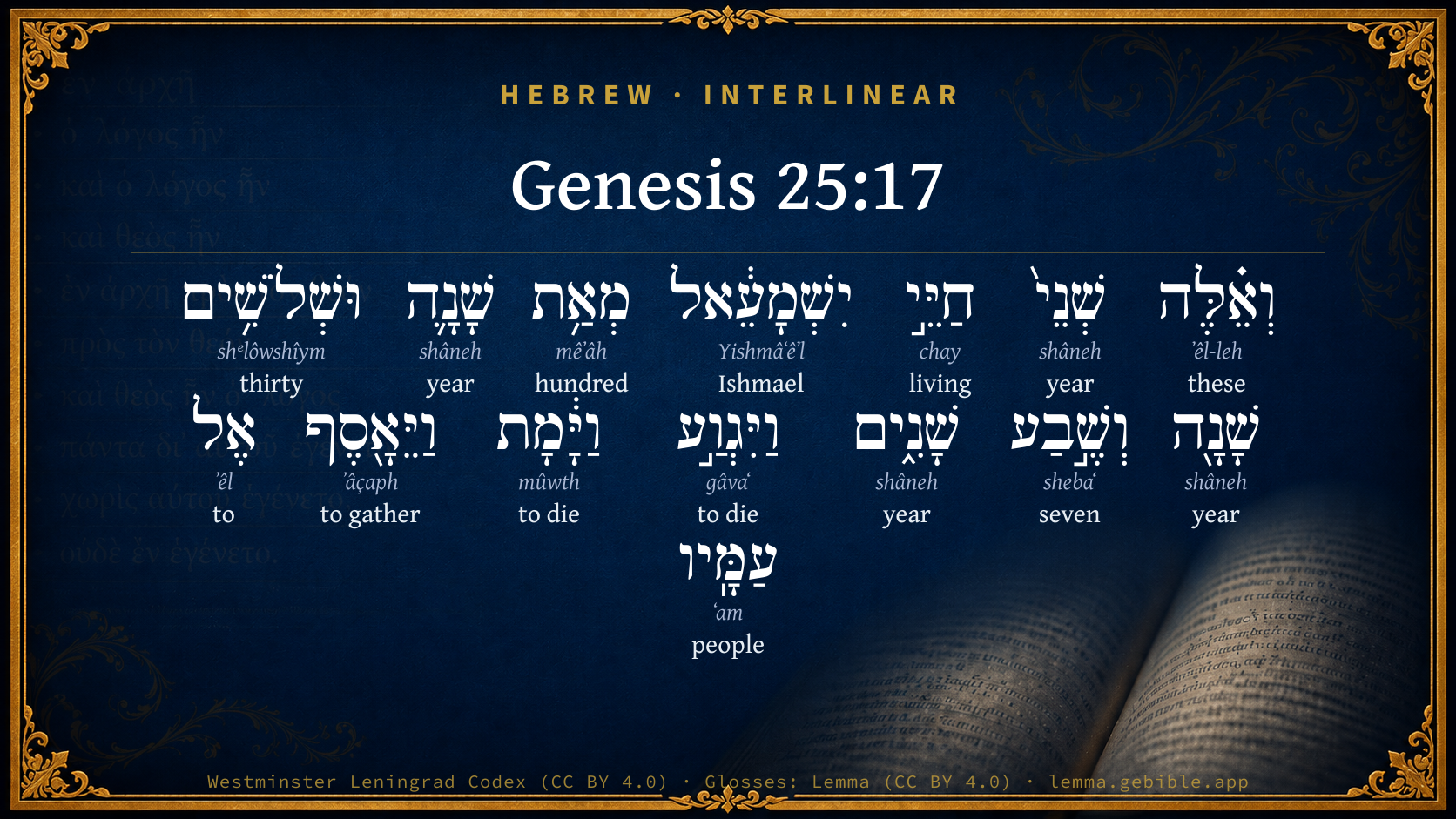
Genesis 25:17

Hebrew (Westminster Leningrad Codex) Genesis 25:17 appears in the Hebrew Old Testament. The text above is from the Westminster Leningrad Codex. Each word links to its Strong’s number, a concise gloss, and parsing drawn from the Open Scriptures Hebrew Bible morphology. Click any word for its full Brown-Driver-Briggs (BDB) entry.
Download image
Cite this verse

Genesis 25:17 (World English Bible). Public Domain. Lemma interlinear Bible study tool, https://lemma.gebible.app/v/genesis/25/17.

Show BibTeX & RIS
BibTeX
RIS
English Translation
These are the years of the life of Ishmael: one hundred thirty-seven years. He gave up the spirit and died, and was gathered to his people.
World English Bible · Public Domain
Download a study sheet

One document with this verse’s original text, its word-by-word gloss line, the meaning frame, cross-references with their text, attributed commentary, and full source and license credits — printable, and it pastes into notes with its structure intact.

This verse Autodidact and up

Study sheet (.html) Plain text (.txt)

A passage Seminary Student

Up to 50 verses in one chapter. A passage sheet keeps up to 6 commentary sources and 12 cross-references per verse, in the order this page ranks them, and says so on the sheet whenever that leaves anything out. Ask for a single verse and you get the Autodidact verse sheet above.

Everything on this page stays free to read, with no account — the sheet is a download of what is already on screen, not access to it.

Want to remove ads? Support Godless Engineer
Compare translations 3

The same verse in 3 English versions, stacked beneath the original-language interlinear above. Click any original word for its lexicon entry.

Each is an independent rendering of the whole verse — the interlinear is not word-aligned to these translations.

Highlighted words mark where these versions differ — a whole-verse word diff, not a word-by-word alignment.

  • World English Bible Public Domain
    These are the years of the life of Ishmael: one hundred thirty-seven years. He gave up the spirit and died, and was gathered to his people.
  • King James Version Public Domain
    And these are the years of the life of Ishmael, an hundred and thirty and seven years: and he gave up the ghost and died; and was gathered unto his people.
  • unfoldingWord Literal Text CC BY-SA 4.0
    And these the years of the life of Ishmael: 137 years. Then he exhaled and died, and he was gathered to his people.

unfoldingWord Literal Text — © unfoldingWord, licensed CC BY-SA 4.0. Word-aligned USFM3 via Door43 (git.door43.org/unfoldingWord/en_ult).

Versions to compare (up to 4)

3 of 4 selected

Show all 18 translations

Every available English version of this verse, each an independent rendering of the whole verse.

  • World English Bible Public Domain
    These are the years of the life of Ishmael: one hundred thirty-seven years. He gave up the spirit and died, and was gathered to his people.
  • Berean Standard Bible Public Domain
    Ishmael lived a total of 137 years. Then he breathed his last and died, and was gathered to his people.
  • Majority Standard Bible Public Domain
    Ishmael lived a total of 137 years. Then he breathed his last and died, and was gathered to his people.
  • King James Version Public Domain
    And these are the years of the life of Ishmael, an hundred and thirty and seven years: and he gave up the ghost and died; and was gathered unto his people.
  • American Standard Version (1901) Public Domain
    And these are the years of the life of Ishmael, a hundred and thirty and seven years. And he gave up the ghost and died, and was gathered unto his people.
  • Revised Version (1885) Public Domain
    And these are the years of the life of Ishmael, an hundred and thirty and seven years: and he gave up the ghost and died; and was gathered unto his people.
  • Geneva Bible (1599) Public Domain
    (And these are the yeeres of the life of Ishmael, an hundreth thirtie and seuen yeere, and he yeelded the spirit, and dyed, and was gathered vnto his people)
  • Douay-Rheims (1899) Public Domain
    And the years of Ismael's life were a hundred and thirty-seven, and decaying he died, and was gathered unto his people.
  • Young's Literal Translation Public Domain
    And these `are' the years of the life of Ishmael, a hundred and thirty and seven years; and he expireth, and dieth, and is gathered unto his people;
  • Literal Standard Version CC BY-SA 4.0
    And these [are] the years of the life of Ishmael, one hundred and thirty-seven years; and he expires, and dies, and is gathered to his people;
  • Unlocked Literal Bible CC BY-SA 4.0
    These were the years of the life of Ishmael, 137 years. He breathed his last and died, and was gathered to his people.
  • unfoldingWord Literal Text CC BY-SA 4.0
    And these the years of the life of Ishmael: 137 years. Then he exhaled and died, and he was gathered to his people.
  • Darby Bible Public Domain
    And these are the years of the life of Ishmael: a hundred and thirty-seven years; and he expired and died, and was gathered to his peoples.
  • World Messianic Bible Public Domain
    These are the years of the life of Ishmael: one hundred thirty-seven years. He gave up his spirit and died, and was gathered to his people.
  • Webster's Bible Public Domain
    And these are the years of the life of Ishmael; a hundred and thirty and seven years: and he expired and died, and was gathered to his people.
  • Free Bible Version CC BY-SA 4.0
    Ishmael lived to be 137. Then he breathed his last and died, and joined his forefathers in death.
  • Bible in Basic English Public Domain
    And the years of Ishmael's life were a hundred and thirty-seven: and he came to his end, and was put to rest with his people.
  • JPS Tanakh (1917) Public Domain
    And these are the years of the life of Ishmael, a hundred and thirty and seven years; and he expired and died; and was gathered unto his people.

Literal Standard Version (2020), Covenant Press — licensed CC BY-SA 4.0. Text via the HelloAO Bible API (eBible.org). Unlocked Literal Bible (unfoldingWord) — licensed CC BY-SA 4.0. Text via the HelloAO Bible API (eBible.org). unfoldingWord Literal Text — © unfoldingWord, licensed CC BY-SA 4.0. Word-aligned USFM3 via Door43 (git.door43.org/unfoldingWord/en_ult). Free Bible Version, Dr. Jonathan Gallagher — licensed CC BY-SA 4.0. Text via the HelloAO Bible API (eBible.org).

Word by word

More ways to search: Search by grammar → Find every occurrence → Compare this word →

Practice this passage: Drill this verse → Learn its vocabulary →

וַיִּגְוַ֣ע
gâvaʻ
H1478
“and · to die”
Conjunction + Verb, Qal, Sequential Imperfect, 3rd Person, Masculine, Singular
Part of Speech
Conjunction + Verb
Stem
Qal
Form
Sequential Imperfect
Person
3rd Person
Gender
Masculine
Number
Singular
Full BDB Definition

Origin: a primitive root

TWOT: 328

to expire, die, perish, give up the ghost, yield up the ghost, be dead, be ready to die - (Qal) to expire, die, be about to die
  1. וְאֵ֗לֶּה ʼêl-leh H428 “and · these” Conjunction + Pronoun, Demonstrative, Common, Plural
  2. שְׁנֵי֙ shâneh H8141 “year” Adjective, Cardinal number, Masculine, Dual, Construct
  3. חַיֵּ֣י chay H2416 “living things of” Noun, Common, Masculine, Plural, Construct
  4. יִשְׁמָעֵ֔אל Yishmâʻêʼl H3458 “Ishmael” Noun, Proper
  5. מְאַ֥ת mêʼâh H3967 “hundred” Adjective, Cardinal number, Feminine, Singular, Construct
  6. שָׁנָ֛ה shâneh H8141 “year” Noun, Common, Feminine, Singular, Absolute
  7. וּשְׁלֹשִׁ֥ים shᵉlôwshîym H7970 “and · thirty” Conjunction + Adjective, Cardinal number, Both, Plural, Absolute
  8. שָׁנָ֖ה shâneh H8141 “year” Noun, Common, Feminine, Singular, Absolute
  9. וְשֶׁ֣בַע shebaʻ H7651 “and · seven” Conjunction + Adjective, Cardinal number, Feminine, Singular, Absolute
  10. שָׁנִ֑ים shâneh H8141 “years” Noun, Common, Feminine, Plural, Absolute
  11. וַיָּ֔מָת mûwth H4191 “and · to die” Conjunction + Verb, Qal, Sequential Imperfect, 3rd Person, Masculine, Singular
  12. וַיֵּאָ֖סֶף ʼâçaph H622 “and · to gather” Conjunction + Verb, Niphal, Sequential Imperfect, 3rd Person, Masculine, Singular
  13. אֶל ʼêl H413 “to” Preposition
  14. עַמָּֽיו ʻam H5971 “peoples · his” Noun, Common, Masculine, Plural, Construct + Suffix, Personal, 3rd Person, Masculine, Singular

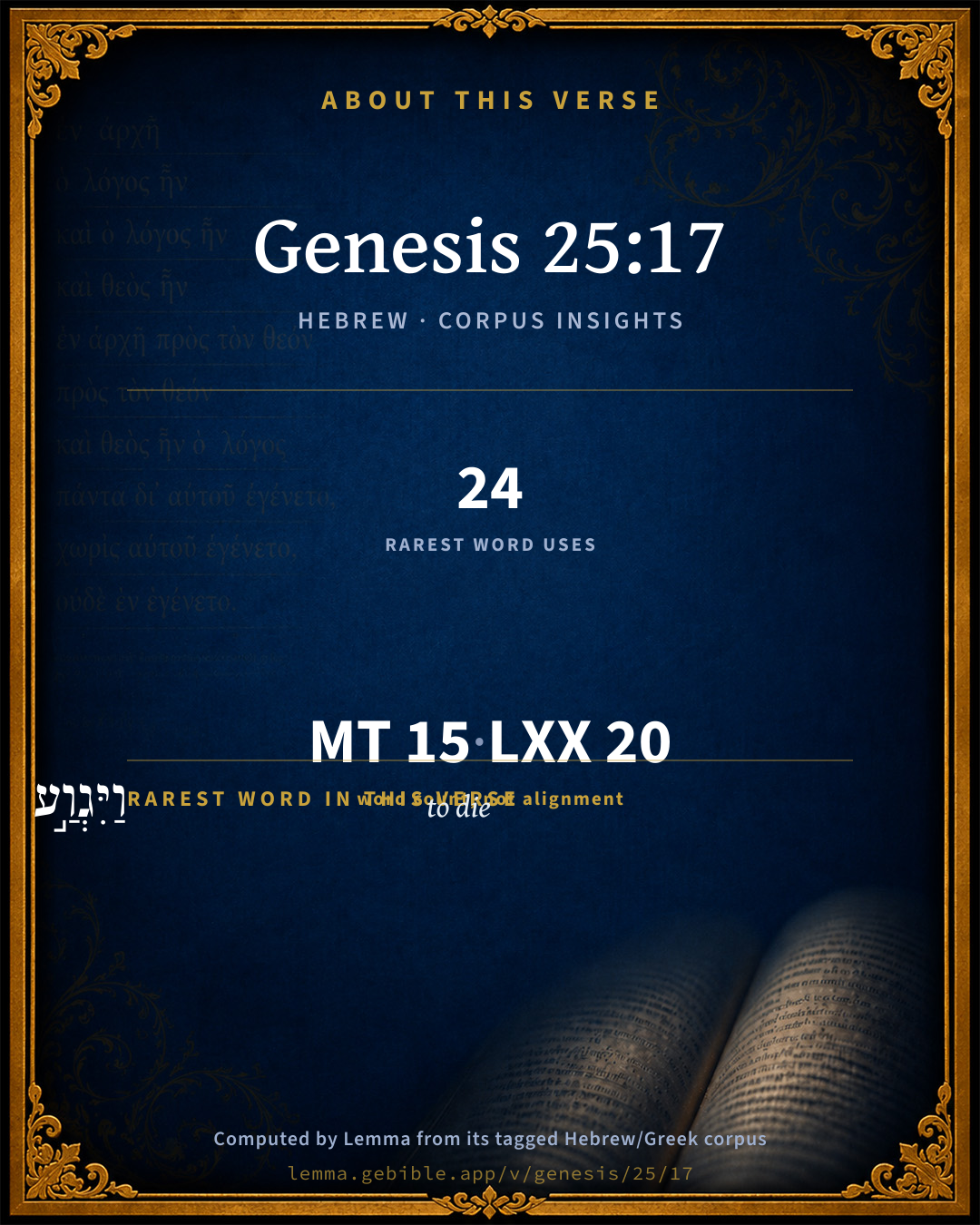
About this verse

These counts appear in no published source. They are computed here, from the morphology-tagged text and Lemma’s own curated glosses. What Lemma adds →

15
words
12
distinct lemmas
Pentateuch
section

Notable vocabulary

The rarest word here is וַיִּגְוַ֣ע to die H1478 — appearing just 24 times in the whole Hebrew Bible.

Shared distinctive vocabulary

וַיִּגְוַ֣ע to die H1478 occurs in 23 verses of the Hebrew Bible. Also found in:

Grammatical profile

  • 3 verbs
  • 6 nouns
  • 4 adjectives
  • 1 pronoun
  • 1 preposition

Verb forms

  • וַיִּגְוַ֣ע Qal · Sequential Imperfect
  • וַיָּ֔מָת Qal · Sequential Imperfect
  • וַיֵּאָ֖סֶף Niphal · Sequential Imperfect

Repetition

A word recurs within this verse — often emphatic in Hebrew:

  • שְׁנֵי֙ year H8141 ×4

Hebrew & Septuagint length

In English translation the verse runs 26 words from the Hebrew and 26 from the Septuagint (LXX English) — the same length.

A rough comparison of the two English renderings, which tokenize alike — not a word-level alignment.

Word counts can differ between the Hebrew and the Greek without any difference in meaning — e.g. the Hebrew direct-object marker אֵת has no separate Greek word, and Greek often adds the article ὁ.

In the original languages it is 15 Hebrew tokens and 20 Greek tokens — but the two are counted differently (Hebrew bundles its prefixes and suffixes into one token; the Greek is in lemma form), so that isn’t a like-for-like length.

Cross-references

2

Topical passages linked to Genesis 25:17 in the Treasury of Scripture Knowledge — connected by theme and wording, ordered by reader-vote popularity; previews shown in the World English Bible.

  • Genesis 15:15 But you will go to your fathers in peace. You will be buried in a good old age.
  • Genesis 25:7–8 These are the days of the years of Abraham's life which he lived: one hundred seventy-five years.

Cross-references courtesy of OpenBible.info (CC BY 4.0).

Hebrew and Greek witnesses Masoretic Hebrew ↔ Greek Septuagint

The same verse in the two great witnesses to the Old Testament, shown verse-for-verse.

These are two independent witnesses, not word-aligned to each other, and the Septuagint is shown in lemma (dictionary) form.

Hebrew Genesis 25:17 Masoretic · Westminster Leningrad Codex

וְאֵ֗לֶּה שְׁנֵי֙ חַיֵּ֣י יִשְׁמָעֵ֔אל מְאַ֥ת שָׁנָ֛ה וּשְׁלֹשִׁ֥ים שָׁנָ֖ה וְשֶׁ֣בַע שָׁנִ֑ים וַיִּגְוַ֣ע וַיָּ֔מָת וַיֵּאָ֖סֶף אֶל עַמָּֽיו

These are the years of the life of Ishmael: one hundred thirty-seven years. He gave up the spirit and died, and was gathered to his people.

World English Bible · Public Domain

Greek LXX Genesis 25:17 Septuagint · lemma form

καί οὗτος ὁ ἔτος ὁ ζωή ισμαηλ ἑκατόν τριάκοντα ἑπτά ἔτος καί ἐκλείπω ἀποθνήσκω καί προςτίθημι πρός ὁ γένος αὐτός

And these are the years of the life of Ismael, one hundred and thirty-seven years; and he failed and died, and was added to his fathers.

LXX2012 (modern English Septuagint) · Public Domain

On this verse, The Pulpit Commentary discusses the Septuagint’s reading. Read the note in Commentary ↓

Hebrew: Westminster Leningrad Codex (CC BY 4.0). Greek: Septuagint (public domain); English from LXX2012 (modern English Septuagint) (Public Domain). How the Septuagint differs from the Hebrew →

Targum (Aramaic paraphrase)

2

The Targum is the ancient Jewish Aramaic paraphrase of the Hebrew Scriptures — an interpretive translation, not the Hebrew text itself. Onkelos (literal) and Pseudo-Jonathan (expansive) render the Torah, and Jonathan the Prophets. Coverage is partial: where no permissively-licensed English translation exists for a verse, only the Aramaic is shown. This is verse-level text, not a word-by-word alignment to the Hebrew.

  1. Targum Onkelos Torah (Genesis–Deuteronomy)
    וְאִלֵּין שְׁנֵי חַיֵּי יִשְׁמָעֵאל מְאָה וּתְלָתִין וּשְׁבַע שְׁנִין וְאִתְנְגִיד וּמִית וְאִתְכְּנִישׁ לְעַמֵּהּ

    (no public-domain English translation for this verse)

    Targum Onkelos — Aramaic: “Onkelos Genesis” (public domain); “Onkelos Exodus” (public domain); “Onkelos Leviticus” (public domain); “Onkelos Numbers” (public domain); “Onkelos Deuteronomy” (public domain). English: “Sefaria Community Translation” (CC0 1.0 (public-domain dedication)); “J.W. Etheridge. The Targums of Onkelos and Jonathan Ben Uzziel on the Pentateuch. London: Longmans, Green, 1862” (public domain). Text via Sefaria.

  2. Targum Pseudo-Jonathan Torah (Genesis–Deuteronomy)
    וְאִלֵין שְׁנֵי חַיֵי יִשְׁמָעֵאל מְאָה וּתְלָתִין וּשְׁבַע שְׁנִין וְהָדַר בִּתְיוּבְתָּא וְאִתְנְגִיד וְאִתְכְּנִישׁ לְעַמֵיהּ

    And these are the years of the life of Ishmael, a hundred and thirty and seven years; and he was coverted in repentance, and expired, and was gathered to his people.

    Targum Pseudo-Jonathan — Aramaic: “Targum Jonathan on Genesis” (public domain); “Targum Jonathan on Exodus” (public domain); “Targum Jonathan on Leviticus” (public domain); “Targum Jonathan on Numbers” (public domain); “Targum Jonathan on Deuteronomy” (public domain). English: “The Targum of Jonathan ben Uzziel, trans. J. W. Etheridge, London, 1862” (public domain). Text via Sefaria.

Commentary

Notes on Genesis 25:17 from classic Christian and Jewish commentators (each source and its license shown beneath its notes). The classic Christian expositions comment on the surrounding passage and are grouped to its opening verse, so a note may address several verses; the Jewish commentaries on the Tanakh (Rashi and others) are per-verse, so they appear only where the commentator wrote on this verse.

Lemma curates 59 commentaries, every one of them public domain or Creative Commons licensed, each selected and text-cleaned for this edition rather than reprinted as found. About our sources →

Trapp's Complete Commentary

John Trapp

Gen 25:17 And these [are] the years of the life of Ishmael, an hundred and thirty and seven years: and he gave up the ghost and died; and was gathered unto his people.

Ver. 17. And he gave up the ghost and died; and was gathered,] sc., to "the congregation house of all living," as the grave is called, {Job 30:23} and, for aught we know, to "the congregation house (πανηγυρις) of the firstborn," as heaven is called. {Heb 12:23} Abraham prayed that Ishmael might live in God’s sight: Ishmael joined with his brother Isaac in burying their father Abraham. {Gen 25:9} Here he hath his whole lifetime recorded, the like whereof cannot be showed of any reprobate; and at his death, he is said gently to "give up the ghost," or yield up the spirit (as Abraham also did, Gen 25:8), and to be "gathered to his people," as he. These are probable arguments, that, however he lived, yet he died in the faith of his father Abraham. He runs far, we say, that never turns. Nunquam sere si serio.

John Trapp, A Commentary or Exposition upon All the Books of the Old and New Testament (1647–1656) — public domain. Text from a community e-Sword module.

Joseph Benson's Commentary

Gen 25:17. He lived a hundred and thirty-seven years — Which is recorded to show the efficacy of Abraham’s prayer for him, Gen 17:18, O that Ishmael might live before thee! Then he also was gathered to his people. And he died in the presence of all his brethren — With his friends about him. Who would not wish so to die?

Joseph Benson's Commentary on the Old and New Testaments (1811–1818) — public domain. Text from a community e-Sword module.

Geneva Bible (1599)

Geneva Bible translators

Which dwelt among the Arabians, and were separate from the blessed seed.

Geneva Bible (1599) marginal notes — public domain. Text via Bolls.life.

The Cambridge Bible for Schools and Colleges

gen. ed. J. J. S. Perowne

17. And these are, &c.] The same phrases occur in this verse as in Gen_25:7-8.

gathered unto his people] See note on Gen_25:8.

18 (J). from Havilah unto Shur] Cf. 1Sa_15:7. See note on “Havilah,” Gen_10:29. It was apparently a locality in the N.E. of Arabia. On “Shur,” see note on Gen_16:7. It was on the eastern border of Egypt. It has been conjectured that this summary description of Ishmael’s territory concluded J’s narrative of Hagar and Ishmael (Gen_16:1-14). It seems to indicate the whole extent of country between N.E. Arabia and the E. Egyptian frontier.

before Egypt] The preposition “before,” i.e. “in front of,” denotes “the eastern side.” See note on Gen_16:12.

as thou goest … Assyria] The mention of “Assyria” is here evidently quite out of place, and the explanation of Delitzsch that it means “up to, or as far as, the country under the rule of Assyria,” is very forced and improbable. Either, therefore, the Asshur here mentioned is to be connected with the country of the “Asshurim” (Gen_25:3), or we must suppose that the text has suffered some corruption. Hence Hupfeld conjectured “unto Shur.”

abode] R.V. marg. settled; Heb. fell.

in the presence of] R. V. marg. over against. The same preposition as is rendered “before” in the previous clause. The words are the fulfilment of the angel’s promise to Hagar in Gen_16:12, where see note.

The Cambridge Bible for Schools and Colleges (gen. ed. J. J. S. Perowne; Cambridge University Press, 1878–1918) — public domain. Text from a community e-Sword module.

John Gill's Exposition

And these are the years of the life of Ishmael, an hundred and thirty and seven years,.... one hundred and thirty seven years old. So that he lived forty eight years after the death of Abraham, Gen 25:8; and, though he did not live to be so old as he, yet it was a considerable age he attained unto; see Gill on Gen 25:7,

and he gave up the ghost and died, and was gathered unto his people; some of the same expressions being used of him as of his father, Gen 25:8, have led some to conclude that he was a penitent and died a good man, and was gathered to the same people; but these phrases are used both of good and bad men.

John Gill's Exposition of the Whole Bible (1746–1763) — public domain (CC PDM 1.0). Text via the HelloAO Bible API.

Whedon's Commentary on the Bible

Daniel D. Whedon

17. Hundred and thirty and seven — Lange suggests that the violent disposition and passions of Ishmael consumed his life comparatively early; while the more peaceful and serene Isaac outlived him by more than forty years.

His people — He doubtless died in the faith of Abraham. Comp. Gen_25:8, note.

Daniel D. Whedon (gen. ed.), Commentary on the Old and New Testaments (1874–1909) — public domain. Text from a community e-Sword module.

The Pulpit Commentary

Vers. 17, 18. And these are the years of the life of Ishmael, an hundred and thirty and seven years: a life shorter by nearly half a century than that of Isaac; (Gen_35:21) does this prove the life-prolonging influence of piety?and he gave up the ghost and died; and wee gathered unto his people (vide on ver. 8). And they dwelt from Havilah unto Shur, that is before Egypt, as thou goest toward; Assyria: (vide Gen_10:29 Gen_16:7) and He died literally, fell down; not expired (Vulgate, A Lapide, Aben Ezra, et alii), but settled down, had his lot cast (Calvin, Keil, Kalisch); katwkhse (LXX) in the presence of all his brethren. (a fulfillment of Gen_16:12)

The Pulpit Commentary (1880–1919), ed. H.D.M. Spence-Jones & Joseph S. Exell — public domain. Text from a community e-Sword module.

John Wesley's Explanatory Notes

He lived an hundred and thirty and seven years - Which is recorded to shew the efficacy of Abraham's prayer for him, chap. xvii, 18. O that Ishmael might live before thee! Then he also was gathered to his people. And he died in the presence of all his brethren - With his friends about him. Who would not wish so to do?

John Wesley, Explanatory Notes Upon the Whole Bible (1754–1765) — public domain. Text via the GEBible commentary corpus.

unfoldingWord translationNotes

Door43 World Missions Community

These were the years of the life of Ishmael, 137 years

"These were ... Ishmael, one hundred and thirty-seven years." Ishmael lived 137 years. (See: Numbers)

breathed his last and died

The terms "breathed his last" and "died" mean basically the same thing. AT: "died" (See: Doublet)

was gathered to his people

This means that after Ishmael died, his soul went to the same place as his relatives who died before him. This can be stated in active form. AT: "he joined his family members who had already died" (See: Idiom and Active or Passive)

They lived

"His descendants settled"

from Havilah to Ashhur

"between Havilah and Ashhur"

Havilah

Havilah was located somewhere in the Arabian Desert. See how you translated this in Genesis 2:11. (See: How to Translate Names)

as one goes toward

"in the direction of"

They lived in hostility with each other

Possible meanings are 1) "they did not live in peace together," or 2) "they lived away from their other relatives."

translationWords

Ishmael

Egypt

Assyria

unfoldingWord translationNotes — © Distant Shores Media and the Door43 World Missions Community, licensed CC BY-SA 4.0. Source: git.door43.org/Door43/en_tn.

Rashi

Rabbi Shlomo Yitzchaki (Rashi)

ואלה שני חיי ישמעאל וגו AND THESE ARE THE YEARS OF THE LIFE OF ISHMAEL etc. —R. Chija the son of Abba asked: Why are the years of Ishmael enumerated? In order to trace through them the years of Jacob (i. e. the years in which the various incidents of his life happened). Calculating from the age of Ishmael (when he died) we may learn that Jacob attended at the School of Eber for fourteen years after he left his father and before he arrived at Laban’s house, for just when Jacob left his father Ishmael died, for it is said, (28:9) ‘‘So Esau went to Ishmael etc.”, as is explained in the Chapter Megilla Nikraath (Megillah 17a) (cf. Rashi on Genesis 28:9).

ויגוע AND HE EXPIRED — This expression — expiring — associated with a word denoting dying is only mentioned in the case of righteous people (Bava Batra 16b).

Rashi on the Tanakh — English translations: “The Judaica Press complete Tanach with Rashi, translated by A. J. Rosenberg” (CC BY 4.0); “Pentateuch with Rashi's commentary by M. Rosenbaum and A.M. Silbermann, 1929-1934” (public domain); “The Metsudah Tanach series, Lakewood, N.J” (CC BY 4.0); and “The Book of Joshua, Metsudah Publications, 1997” (CC BY 4.0). Text via Sefaria.

Ramban (Nachmanides)

Rabbi Moshe ben Nachman (Ramban / Nachmanides)

AND THESE ARE THE YEARS OF THE LIFE OF ISHMAEL. It appears plausible in line with the simple explanation that Scripture relates, in the case of the sons of the righteous, their generations and the number of their years in order to inform us that the seed of the righteous shall be blessed. However, it did not relate the number of Esau’s years for he outlived Jacob, and the narrative was concluded with the death of Jacob. Hence, Scripture did not want to return to the life of Esau since it had already mentioned his generations in their appropriate place. In the Midrash of our Rabbis there are many reasons for the Scriptural account of Ishmael’s years. The correct one among them is that he was righteous, a man of repentance, and Scripture tells of him as it does with all righteous people.

AND HE EXPIRED (‘VAYIGVA’). Rashi comments: “This expression — ‘expiring’ — is only mentioned in the case of righteous people.” But in the Gemara (teaching) constitutes the collected discussions of the Amoraim, centering around the Mishnah. The Mishnah and Gemara combined are known as the Talmud. the Rabbis objected, “But it says ‘expiring’ with reference to the generation of the flood: And all flesh expired that moved upon the earth, etc., and every man; Every thing that is in the earth shall expire.”, 6:17. And the Gemara answers: “We were referring to [those places where it mentions both] ‘expiring’ and ‘gathering,’” [as it says in the case of Abraham and in the present verse concerning Ishmael].The intent of the Rabbis is that the expression “expiring” indicates death without prolonged sickness and without pains. This death is merited only by the righteous people, [and concerning their death both “expiring” and “gathering” are mentioned]. But the men of the generation of the flood, who were overthrown as in a moment, and no hands fell upon them, as also those who died in the desert — with them Scripture therefore mentions only “expiring”: when our brethren expired. And so is the sense of the verse, And that man expired not alone in his iniquity, meaning that his iniquity did not cause him instant death. But when Scripture so mentions the term “expiring” in reference to death together with the word vayei’aseph (and he was gathered [unto his people]) or vayamoth (and he died), it hints to the death of the righteous ones.In the words of Bereshith Rabbah, “And Abraham expired, and died, Rabbi Yehudah the son of Rabbi Ilai said, ‘The early pious men used to suffer with intestinal disease for about ten or twenty days before death, thus establishing the principle that illness cleanses from sin.’ Rabbi Yehudah said, ‘All who are said to have expired died of intestinal disease.’” There in Bereshith Rabbah the Rabbis also said, “Everything that is in the earth ‘yigva’, 6:17. — will shrivel.”It would appear that to the Rabbis, the word gviyah (expiring) was analogous to Their flesh shall consume while they stand upon their feet. So also is the opinion of Onkelos who translated here ve’isnagid, meaning “fainting,” similar to the expressions: “isnagid (he became faint) and sighed”; “You might think he may pay as a fine five negidim (emaciated) oxen.” ) ‘tachtav’ “ — in its place. In other words each one of the five oxen must be equal in value to the stolen ox, “for otherwise he might pay him back five emaciated oxen which together will not equal even the value of the one stolen” (Meiri, Baba Kamma ibid.). It is so said in the case of the flood, as Scripture states, And He blotted out every being. After having said, And all flesh perished (‘vayigva’), and having said, whatever was in the dry land, died, Scripture continues to say, “And He blotted out, meaning etc.”(see above p. 112). Here in discussing the meaning of the word gviyah. Ramban brings proof to his theory that gviyah in itself does not mean death but fainting, emaciation, etc. For it is on this basis that we can understand why after having said ‘vayigva’ all flesh Scripture continued to inform us further that it died and was blotted out, since these facts are not included in the term of gviyah. And in the case of Ishmael it is stated in the verse before us: And he expired and died, as a man who is powerless and dies, and this is the measure meted out to righteous people. Toldoth

Ramban (Nachmanides) on the Tanakh — English translation: “Commentary on the Torah by Ramban (Nachmanides). Translated and annotated by Charles B. Chavel. New York, Shilo Pub. House, 1971-1976” (CC BY 4.0). Text via Sefaria.

Radak

Rabbi David Kimhi (Radak)

ואלה, The Torah mentions Ishmael’s age at death also as a form of tribute to his father Avraham as we have already mentioned (verse 12). According to our sages in Megillah 17 this information also serves us to calculate how old Yaakov was during certain episodes which occurred during his life.

Radak on the Tanakh — English translations: “Sefaria Community Translation” (CC0 1.0 (public-domain dedication)); “Eliyahu Munk, HaChut Hameshulash” (CC BY 4.0); “Rabbi Mike Feuer, Jerusalem Anthology” (CC BY 4.0); and “R. David Kimhi on the first book of Psalms, Translated by R.G. Finch, London, 1919” (public domain). Text via Sefaria.

Lesson kit

Teaching starters — assembled from the data on this page, not authored interpretation. Every prompt links to the verse data it draws on. Edit before teaching.

Genesis, in the Pentateuch, opens this verse with 15 words (12 distinct Hebrew lemmas). Its most distinctive word is gâvaʻ (“to die”). A historical commentator’s framing appears above. Read the whole chapter for the surrounding context.

Discussion questions

  1. The word gâvaʻ carries the sense “to die.” How does it shape the verse?
  2. How does Genesis 6:17, which shares the word «to die», read alongside this verse?
  3. What does the repetition of “year” (4× in this one verse) do in this verse?
  4. These translations render this verse differently. What is at stake in choosing one wording over another?
  5. «וַיִּגְוַ֣ע» is a Qal Sequential Imperfect verb. How does that grammatical form shape the action described?
  6. Compare how Trapp's Complete Commentary and Joseph Benson's Commentary read this verse. Where do they agree or differ?

Things to notice

Reading settings

Reading text

Shown beneath each verse's original-language words.

Old Testament
Old Testament edition

Read the OT as the Masoretic Hebrew (MT) or the Greek Septuagint (LXX).

English shown for the Greek Septuagint (in the Hebrew ↔ Greek comparison).

Comparing translations? Open the Compare panel on any verse page to stack up to four side by side.