Exodus 12:33

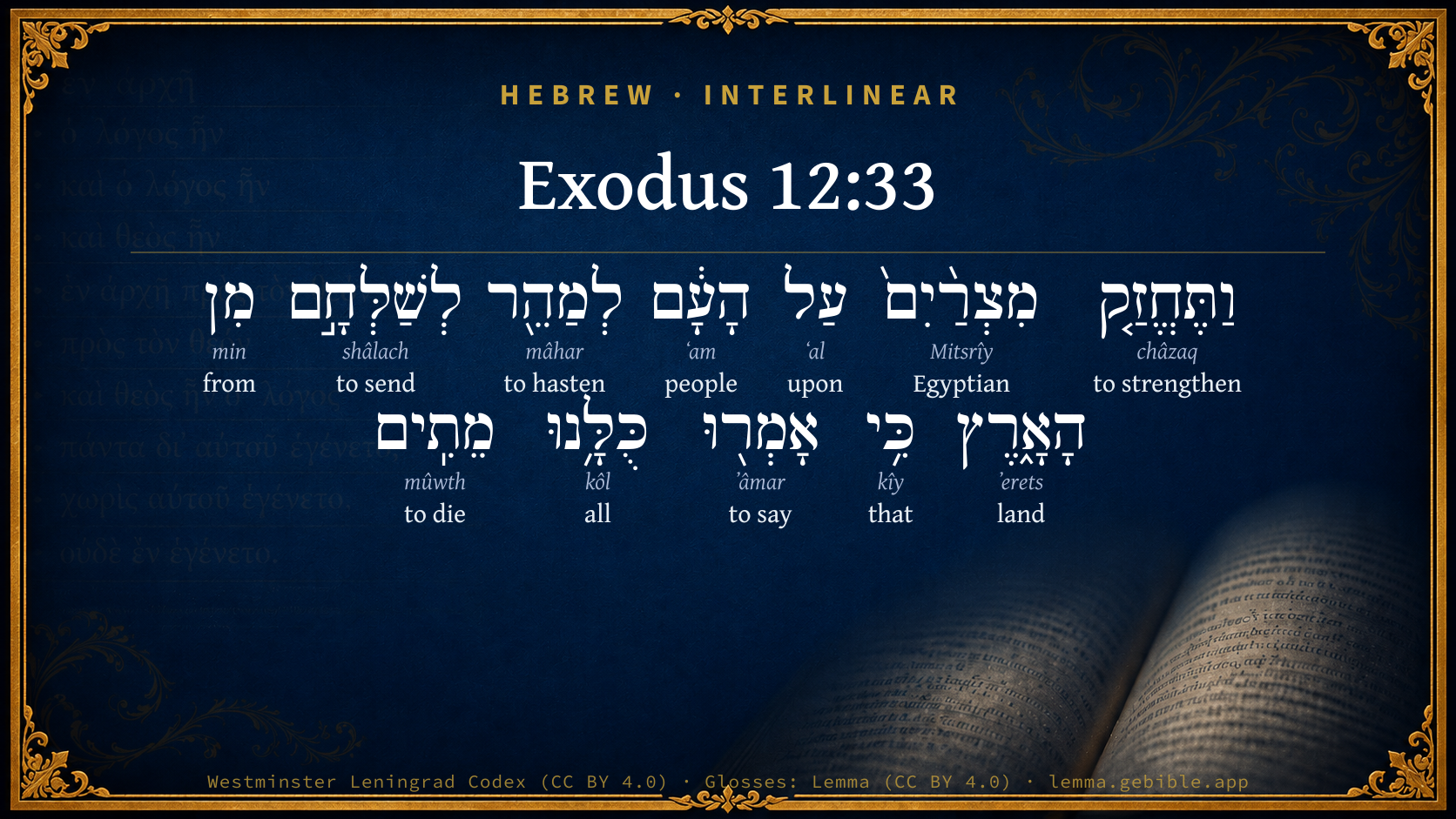
Hebrew (Westminster Leningrad Codex) Exodus 12:33 appears in the Hebrew Old Testament. The text above is from the Westminster Leningrad Codex. Each word links to its Strong’s number, a concise gloss, and parsing drawn from the Open Scriptures Hebrew Bible morphology. Click any word for its full Brown-Driver-Briggs (BDB) entry.
Download image
Cite this verse

Exodus 12:33 (World English Bible). Public Domain. Lemma interlinear Bible study tool, https://lemma.gebible.app/v/exodus/12/33.

Show BibTeX & RIS
BibTeX
RIS
English Translation
The Egyptians were urgent with the people, to send them out of the land in haste, for they said, "We are all dead men."
World English Bible · Public Domain
Download a study sheet

One document with this verse’s original text, its word-by-word gloss line, the meaning frame, cross-references with their text, attributed commentary, and full source and license credits — printable, and it pastes into notes with its structure intact.

This verse Autodidact and up

Study sheet (.html) Plain text (.txt)

A passage Seminary Student

Up to 50 verses in one chapter. A passage sheet keeps up to 6 commentary sources and 12 cross-references per verse, in the order this page ranks them, and says so on the sheet whenever that leaves anything out. Ask for a single verse and you get the Autodidact verse sheet above.

Everything on this page stays free to read, with no account — the sheet is a download of what is already on screen, not access to it.

Want to remove ads? Support Godless Engineer
Compare translations 3

The same verse in 3 English versions, stacked beneath the original-language interlinear above. Click any original word for its lexicon entry.

Each is an independent rendering of the whole verse — the interlinear is not word-aligned to these translations.

Highlighted words mark where these versions differ — a whole-verse word diff, not a word-by-word alignment.

  • World English Bible Public Domain
    The Egyptians were urgent with the people, to send them out of the land in haste, for they said, "We are all dead men."
  • King James Version Public Domain
    And the Egyptians were urgent upon the people, that they might send them out of the land in haste; for they said, We be all dead men.
  • unfoldingWord Literal Text CC BY-SA 4.0
    And the Egyptians strengthened the people, hurrying to let them go from the land, for they said, “We are all dying.”

unfoldingWord Literal Text — © unfoldingWord, licensed CC BY-SA 4.0. Word-aligned USFM3 via Door43 (git.door43.org/unfoldingWord/en_ult).

Versions to compare (up to 4)

3 of 4 selected

Show all 18 translations

Every available English version of this verse, each an independent rendering of the whole verse.

  • World English Bible Public Domain
    The Egyptians were urgent with the people, to send them out of the land in haste, for they said, "We are all dead men."
  • Berean Standard Bible Public Domain
    And in order to send them out of the land quickly, the Egyptians urged the people on. “For otherwise,” they said, “we are all going to die!”
  • Majority Standard Bible Public Domain
    And in order to send them out of the land quickly, the Egyptians urged the people on. “For otherwise,” they said, “we are all going to die!”
  • King James Version Public Domain
    And the Egyptians were urgent upon the people, that they might send them out of the land in haste; for they said, We be all dead men.
  • American Standard Version (1901) Public Domain
    And the Egyptians were urgent upon the people, to send them out of the land in haste; for they said, We are all dead men.
  • Revised Version (1885) Public Domain
    And the Egyptians were urgent upon the people, to send them out of the land in haste; for they said, We be all dead men.
  • Geneva Bible (1599) Public Domain
    And the Egyptians did force the people, because they would send them out of the land in haste: for they said, We die all.
  • Douay-Rheims (1899) Public Domain
    And the Egyptians pressed the people to go forth out of the land speedily, saying: We shall all die.
  • Young's Literal Translation Public Domain
    And the Egyptians are urgent on the people, hasting to send them away out of the land, for they said, `We are all dead;'
  • Literal Standard Version CC BY-SA 4.0
    And the Egyptians are urgent on the people, hastening to send them away out of the land, for they said, “We are all dead”;
  • Unlocked Literal Bible CC BY-SA 4.0
    The Egyptians were in a great hurry to send them out of the land, for they said, “We will all die.”
  • unfoldingWord Literal Text CC BY-SA 4.0
    And the Egyptians strengthened the people, hurrying to let them go from the land, for they said, “We are all dying.”
  • Darby Bible Public Domain
    And the Egyptians urged the people, to send them out of the land in haste; for they said, We are all dead [men]!
  • World Messianic Bible Public Domain
    The Egyptians were urgent with the people, to send them out of the land in haste, for they said, “We are all dead men.”
  • Webster's Bible Public Domain
    And the Egyptians were urgent upon the people, that they might send them out of the land in haste; for they said, We are all dead men.
  • Free Bible Version CC BY-SA 4.0
    The Egyptians urged the Israelites to leave their country as quickly as possible, saying, “Otherwise we'll all die!”
  • Bible in Basic English Public Domain
    And the Egyptians were forcing the people on, to get them out of the land quickly; for they said, We are all dead men.
  • JPS Tanakh (1917) Public Domain
    And the Egyptians were urgent upon the people, to send them out of the land in haste; for they said: 'We are all dead men.'

Literal Standard Version (2020), Covenant Press — licensed CC BY-SA 4.0. Text via the HelloAO Bible API (eBible.org). Unlocked Literal Bible (unfoldingWord) — licensed CC BY-SA 4.0. Text via the HelloAO Bible API (eBible.org). unfoldingWord Literal Text — © unfoldingWord, licensed CC BY-SA 4.0. Word-aligned USFM3 via Door43 (git.door43.org/unfoldingWord/en_ult). Free Bible Version, Dr. Jonathan Gallagher — licensed CC BY-SA 4.0. Text via the HelloAO Bible API (eBible.org).

Word by word

More ways to search: Search by grammar → Find every occurrence → Compare this word →

Practice this passage: Drill this verse → Learn its vocabulary →

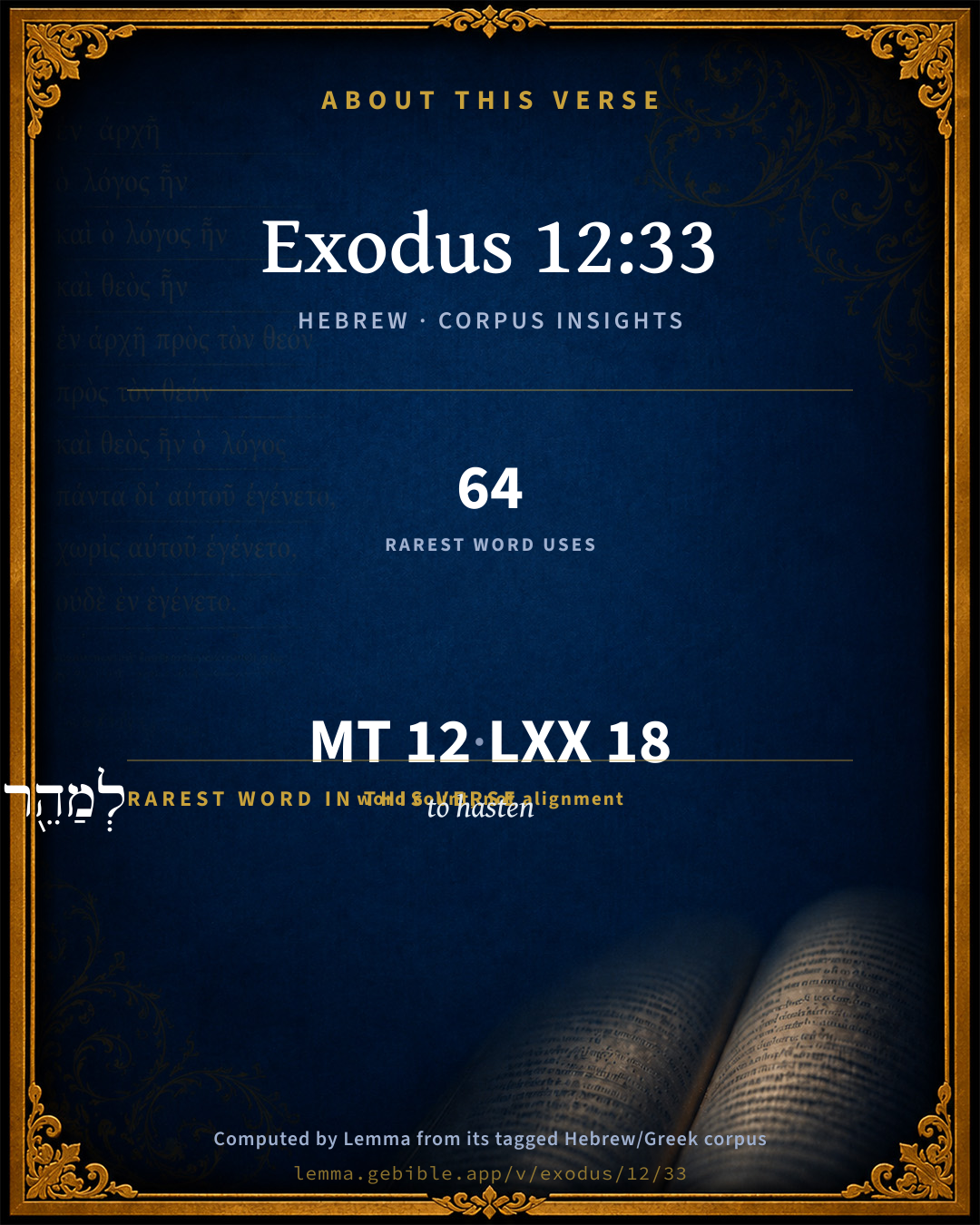
לְמַהֵ֖ר
mâhar
H4116
“to hasten”
Preposition + Verb, Piel, Infinitive Construct
Part of Speech
Preposition + Verb
Stem
Piel
Form
Infinitive Construct
Full BDB Definition

Origin: a primitive root

TWOT: 1152

(Qal) to hasten - (Niphal) to be hurried, be anxious - hasty, precipitate, impetuous - (Piel) - to hasten, make haste - hasten (used as adverb with another verb) - to hasten, prepare quickly, do quickly, bring quickly
  1. וַתֶּחֱזַ֤ק châzaq H2388 “and · to strengthen” Conjunction + Verb, Qal, Sequential Imperfect, 3rd Person, Feminine, Singular
  2. מִצְרַ֨יִם֙ Mitsrîy H4713 “Egyptian” Noun, Proper
  3. עַל ʻal H5921 “upon” Preposition
  4. הָעָ֔ם ʻam H5971 “the · people” Particle, Definite Article + Noun, Common, Masculine, Singular, Absolute
  5. לְשַׁלְּחָ֣ם shâlach H7971 “to send · them” Preposition + Verb, Piel, Infinitive Construct + Suffix, Personal, 3rd Person, Masculine, Plural
  6. מִן min H4480 “from” Preposition
  7. הָאָ֑רֶץ ʼerets H776 “the · land” Particle, Definite Article + Noun, Common, Both, Singular, Absolute
  8. כִּ֥י kîy H3588 “that” Conjunction
  9. אָמְר֖וּ ʼâmar H559 “to say” Verb, Qal, Perfect, 3rd Person, Common, Plural
  10. כֻּלָּ֥נוּ kôl H3605 “all · our” Noun, Common, Masculine, Singular, Construct + Suffix, Personal, 1st Person, Common, Plural
  11. מֵתִֽים mûwth H4191 “dying” Verb, Qal, Participle Active, Masculine, Plural, Absolute

About this verse

These counts appear in no published source. They are computed here, from the morphology-tagged text and Lemma’s own curated glosses. What Lemma adds →

12
words
12
distinct lemmas
Pentateuch
section

Grammatical profile

  • 5 verbs
  • 4 nouns
  • 2 prepositions
  • 1 conjunction

Verb forms

  • וַתֶּחֱזַ֤ק Qal · Sequential Imperfect
  • לְמַהֵ֖ר Piel · Infinitive Construct
  • לְשַׁלְּחָ֣ם Piel · Infinitive Construct
  • אָמְר֖וּ Qal · Perfect
  • מֵתִֽים Qal · Participle Active

Hebrew & Septuagint length

In English translation the verse runs 24 words from the Hebrew and 24 from the Septuagint (LXX English) — the same length.

A rough comparison of the two English renderings, which tokenize alike — not a word-level alignment.

Word counts can differ between the Hebrew and the Greek without any difference in meaning — e.g. the Hebrew direct-object marker אֵת has no separate Greek word, and Greek often adds the article ὁ.

In the original languages it is 12 Hebrew tokens and 18 Greek tokens — but the two are counted differently (Hebrew bundles its prefixes and suffixes into one token; the Greek is in lemma form), so that isn’t a like-for-like length.

Cross-references

4

Topical passages linked to Exodus 12:33 in the Treasury of Scripture Knowledge — connected by theme and wording, ordered by reader-vote popularity; previews shown in the World English Bible.

  • Psalms 105:38 Egypt was glad when they departed, For the fear of them had fallen on them.
  • Exodus 11:1 Yahweh said to Moses, "Yet one plague more will I bring on Pharaoh, and on Egypt; afterwards he will let you go. When he lets you go, he will surely thrust you out altogether.
  • Genesis 20:3 But God came to Abimelech in a dream of the night, and said to him, "Behold, you are a dead man, because of the woman whom you have taken. For she is a man's wife."
  • Numbers 17:12–13 The children of Israel spoke to Moses, saying, Behold, we perish, we are undone, we are all undone.

Cross-references courtesy of OpenBible.info (CC BY 4.0).

Hebrew and Greek witnesses Masoretic Hebrew ↔ Greek Septuagint

The same verse in the two great witnesses to the Old Testament, shown verse-for-verse.

These are two independent witnesses, not word-aligned to each other, and the Septuagint is shown in lemma (dictionary) form.

Hebrew Exodus 12:33 Masoretic · Westminster Leningrad Codex

וַתֶּחֱזַ֤ק מִצְרַ֨יִם֙ עַל הָעָ֔ם לְמַהֵ֖ר לְשַׁלְּחָ֣ם מִן הָאָ֑רֶץ כִּ֥י אָמְר֖וּ כֻּלָּ֥נוּ מֵתִֽים

The Egyptians were urgent with the people, to send them out of the land in haste, for they said, "We are all dead men."

World English Bible · Public Domain

Greek LXX Exodus 12:33 Septuagint · lemma form

καί καταβιάζομαι ὁ αἰγύπτιος ὁ λαός σπουδή ἐκβάλλω αὐτός ἐκ ὁ γῆ εἶπον γάρ ὅτι πᾶς ἐγώ ἀποθνήσκω

And the Egyptians constrained the people, so that they cast them out of the land with haste, for they said, We all shall die.

LXX2012 (modern English Septuagint) · Public Domain

Hebrew: Westminster Leningrad Codex (CC BY 4.0). Greek: Septuagint (public domain); English from LXX2012 (modern English Septuagint) (Public Domain). How the Septuagint differs from the Hebrew →

Targum (Aramaic paraphrase)

2

The Targum is the ancient Jewish Aramaic paraphrase of the Hebrew Scriptures — an interpretive translation, not the Hebrew text itself. Onkelos (literal) and Pseudo-Jonathan (expansive) render the Torah, and Jonathan the Prophets. Coverage is partial: where no permissively-licensed English translation exists for a verse, only the Aramaic is shown. This is verse-level text, not a word-by-word alignment to the Hebrew.

  1. Targum Onkelos Torah (Genesis–Deuteronomy)
    וּתְקֵיפַת מִצְרַיִם עַל עַמָא לְאוֹחָאָה לְשַׁלָחוּתְהוֹן מִן אַרְעָא אֲרֵי אֲמָרוּ כֻּלָנָא מָיְתִין:

    (no public-domain English translation for this verse)

    Targum Onkelos — Aramaic: “Onkelos Genesis” (public domain); “Onkelos Exodus” (public domain); “Onkelos Leviticus” (public domain); “Onkelos Numbers” (public domain); “Onkelos Deuteronomy” (public domain). English: “Sefaria Community Translation” (CC0 1.0 (public-domain dedication)); “J.W. Etheridge. The Targums of Onkelos and Jonathan Ben Uzziel on the Pentateuch. London: Longmans, Green, 1862” (public domain). Text via Sefaria.

  2. Targum Pseudo-Jonathan Torah (Genesis–Deuteronomy)
    וְכַד שְׁמָעוּ משֶׁה וְאַהֲרן וּבְנֵי יִשְרָאֵל קָל בְּכוּתָא דְפַרְעה וְלָא אַשְׁגָחוּ עַד דְּאָזַל הוּא וְכָל עַבְדוֹי וְכָל מִצְרָאֵי וּתְקִיפוּ לְכָל עַמָּא בֵּית יִשְרָאֵל לְמִפְטְרִינוּן מִן אַרְעָא אֲרוּם אָמְרִין אִי שַׁהְיַין הִינוּן הָכָא שַׁעְתָּא חָדָא הָא כּוּלָנָא מַיְיתוּן

    When Mosheh and Aharon, and the sons of Israel, heard the voice of Pharoh's weeping, they were not mindful, until he came himself, and all his servants, and all the Mizraee, and urged all the people of the house of Israel, that they might hasten to send them forth from the land; For, said they, if they prolong here one hour more, behold, we are all dead.

    Targum Pseudo-Jonathan — Aramaic: “Targum Jonathan on Genesis” (public domain); “Targum Jonathan on Exodus” (public domain); “Targum Jonathan on Leviticus” (public domain); “Targum Jonathan on Numbers” (public domain); “Targum Jonathan on Deuteronomy” (public domain). English: “The Targum of Jonathan ben Uzziel, trans. J. W. Etheridge, London, 1862” (public domain). Text via Sefaria.

Commentary

Notes on Exodus 12:33 from classic Christian and Jewish commentators (each source and its license shown beneath its notes). The classic Christian expositions comment on the surrounding passage and are grouped to its opening verse, so a note may address several verses; the Jewish commentaries on the Tanakh (Rashi and others) are per-verse, so they appear only where the commentator wrote on this verse.

Lemma curates 59 commentaries, every one of them public domain or Creative Commons licensed, each selected and text-cleaned for this edition rather than reprinted as found. About our sources →

Trapp's Complete Commentary

John Trapp

Exo 12:33 And the Egyptians were urgent upon the people, that they might send them out of the land in haste; for they said, We [be] all dead [men].

Ver. 33. We be all dead men.] Quis autem vult mori? prorsus nemo. Everything makes much of life, from the highest angel to the lowest worm. {a}

{a} Zωον φιλοζωον ο ανθρωπος. - Aristot.

John Trapp, A Commentary or Exposition upon All the Books of the Old and New Testament (1647–1656) — public domain. Text from a community e-Sword module.

The Biblical Illustrator

Joseph S. Exell

Exo_12:33; Exo_12:35

The Egyptians were urgent upon the people that they might send them out of the land.

Hastened out of Egypt

1. Note the reason of this urgency. Fear lest death overtake them all.

2. Note the utter selfishness of the motive. No true repentance in it.

3. Urgency is fitting when there is imminent danger.

4. There is the greatest need of urgency in every sinners case. Doom and death are at hand. (Homiletic Review.)

The Israelites going out of Egyptian bondage; or, the freedom of the Church

I. That the Israelites were given their freedom by those who had long oppressed them; and so the Church shall be freed by those who have long enslaved it.

II. That the Israelites, in availing themselves of their freedom, had to make many temporary shifts; and so the Church, in stepping into liberty, will have to encounter many perplexities.

III. That the Israelites, going into freedom, took with them all the wealth they could get from the Egyptians; and so the Church, in entering upon its liberty, should avail itself of all the valuables it can obtain from the world. (J. S. Exell, M. A.)

Borrowed from the Egyptians.

Borrowing from the enemy

I remember, when visiting Denmark some twenty years ago, I learned a little incident in the history of a great Danish admiral. On one occasion, when commanding a little sloop--it was before he was admiral--he had the audacity to engage an English frigate in battle. They both fired away, but after a little time the captain of the frigate noticed that the firing from the sloop ceased. A flag of truce was hoisted; a boat was lowered, and the Danish captain came alongside. Addressing his opponent, he said, Sir, our powder is all done, and we have come to borrow some from you! The devil has been using money against the cause of God for many years; let us take it from him, and turn his guns against himself. (Dr. Sinclair Patterson.)

The Biblical Illustrator, edited by Joseph S. Exell (c. 1880s–1900s) — public domain. Text from a community e-Sword module.

Joseph Benson's Commentary

Exo 12:33. The Egyptians were urgent — They were willing to make all concessions, so they would but be gone; ransoming their lives, not only by prayers, but by their most precious things. For they said, We be all dead men — When death comes into our houses it is seasonable for us to think of our own mortality.

Joseph Benson's Commentary on the Old and New Testaments (1811–1818) — public domain. Text from a community e-Sword module.

Adam Clarke's Commentary

Verse 33. The Egyptians were urgent upon the people] They felt much, they feared more; and therefore wished to get immediately rid of a people on whose account they found they were smitten with so many and such dreadful plagues.

Adam Clarke's Commentary on the Bible (1810–1826) — public domain. Text from a community e-Sword/MySword module.

Ellicott's Commentary for English Readers

(33) The Egyptians were urgent.—Not only Pharaoh, but the Egyptian nation generally was anxious for the immediate departure of the Israelites, and expedited it in every way. This must greatly have facilitated their all setting forth at once. It also accounts for the readiness of the Egyptians to part with their “jewels” and “raiment” (Exo_12:35).

A Bible Commentary for English Readers, edited by Charles John Ellicott (1878–1897) — public domain. Text from a community e-Sword module.

The Cambridge Bible for Schools and Colleges

gen. ed. J. J. S. Perowne

33. We be all dead men] cf. (though the terms are milder) Exo_10:7.

The Cambridge Bible for Schools and Colleges (gen. ed. J. J. S. Perowne; Cambridge University Press, 1878–1918) — public domain. Text from a community e-Sword module.

John Gill's Exposition

And the children of Israel did according to the word of Moses,.... Exo 3:22.

and they borrowed of the Egyptians jewels of silver, and jewels of gold, and raiment; or "they asked" (a) them of the Egyptians to give them them, which they readily did to get rid of them; for upon their being urgent with the Israelites to be gone in haste, they might reply, that they were not provided with things suitable for a journey, and therefore requested such things of them, which they at once freely consented to; See Gill on Exo 3:22, Exo 11:2, Exo 11:3.

(a) "et postulaverunt", Pagninus, Montanus, Vatablus; "petierunt", Junius & Tremellius, Piscator.

John Gill's Exposition of the Whole Bible (1746–1763) — public domain (CC PDM 1.0). Text via the HelloAO Bible API.

Matthew Poole's English Annotations

They were urgent, not by force, which they durst not now use, but by earnest and importunate entreaties, Exo 11:8. This was the ground of that fable of the heathens mentioned in Tacitus, that the Jews were driven out of Egypt for their scabs; so they falsely and maliciously ascribed their own ulcers and scabs sent upon them by God to the Israelites.

Matthew Poole's English Annotations on the Holy Bible (1683–1685) — public domain. Text from a community e-Sword/MySword module.

The Pulpit Commentary

The Egyptians were urgent upon the people. The Egyptians feared that, if any further delay took place, the God of the Hebrews might not be content with slaying all the first-born, but might punish with death the whole nation, or at any rate all the males. It is easy to see how their desire to get rid of the Israelites would expedite matters, and enable all to set out upon the journey on the same day.

The Pulpit Commentary (1880–1919), ed. H.D.M. Spence-Jones & Joseph S. Exell — public domain. Text from a community e-Sword module.

John Wesley's Explanatory Notes

We be all dead men - When death comes unto our houses, it is seasonable for us to think of our own mortality.

John Wesley, Explanatory Notes Upon the Whole Bible (1754–1765) — public domain. Text via the GEBible commentary corpus.

Rashi

Rabbi Shlomo Yitzchaki (Rashi)

כלנו מתים WE ARE ALL DEAD MEN — They said, Not according to Moses’ decree is this what has happened for he said (10:5) “And every firstborn shall die”, and here all the ordinary people are dead, five or ten in one house (Mekhilta).

Rashi on the Tanakh — English translations: “The Judaica Press complete Tanach with Rashi, translated by A. J. Rosenberg” (CC BY 4.0); “Pentateuch with Rashi's commentary by M. Rosenbaum and A.M. Silbermann, 1929-1934” (public domain); “The Metsudah Tanach series, Lakewood, N.J” (CC BY 4.0); and “The Book of Joshua, Metsudah Publications, 1997” (CC BY 4.0). Text via Sefaria.

Lesson kit

Teaching starters — assembled from the data on this page, not authored interpretation. Every prompt links to the verse data it draws on. Edit before teaching.

Exodus, in the Pentateuch, opens this verse with 12 words (12 distinct Hebrew lemmas). Its most distinctive word is mâhar (“to hasten”). A historical commentator’s framing appears above. Read the whole chapter for the surrounding context.

Discussion questions

  1. How does “to hasten” (mâhar) shape what this verse is saying?
  2. How does Psalms 105:38, which shares this passage’s theme, read alongside this verse?
  3. The translations on this page render this verse differently — a whole-verse word diff, not a word-by-word alignment. What might account for the different wordings?
  4. «וַתֶּחֱזַ֤ק» is a Qal Sequential Imperfect verb. How does that grammatical form shape the action described?
  5. Compare how Trapp's Complete Commentary and The Biblical Illustrator read this verse. Where do they agree or differ?

Things to notice

Reading settings

Reading text

Shown beneath each verse's original-language words.

Old Testament
Old Testament edition

Read the OT as the Masoretic Hebrew (MT) or the Greek Septuagint (LXX).

English shown for the Greek Septuagint (in the Hebrew ↔ Greek comparison).

Comparing translations? Open the Compare panel on any verse page to stack up to four side by side.