
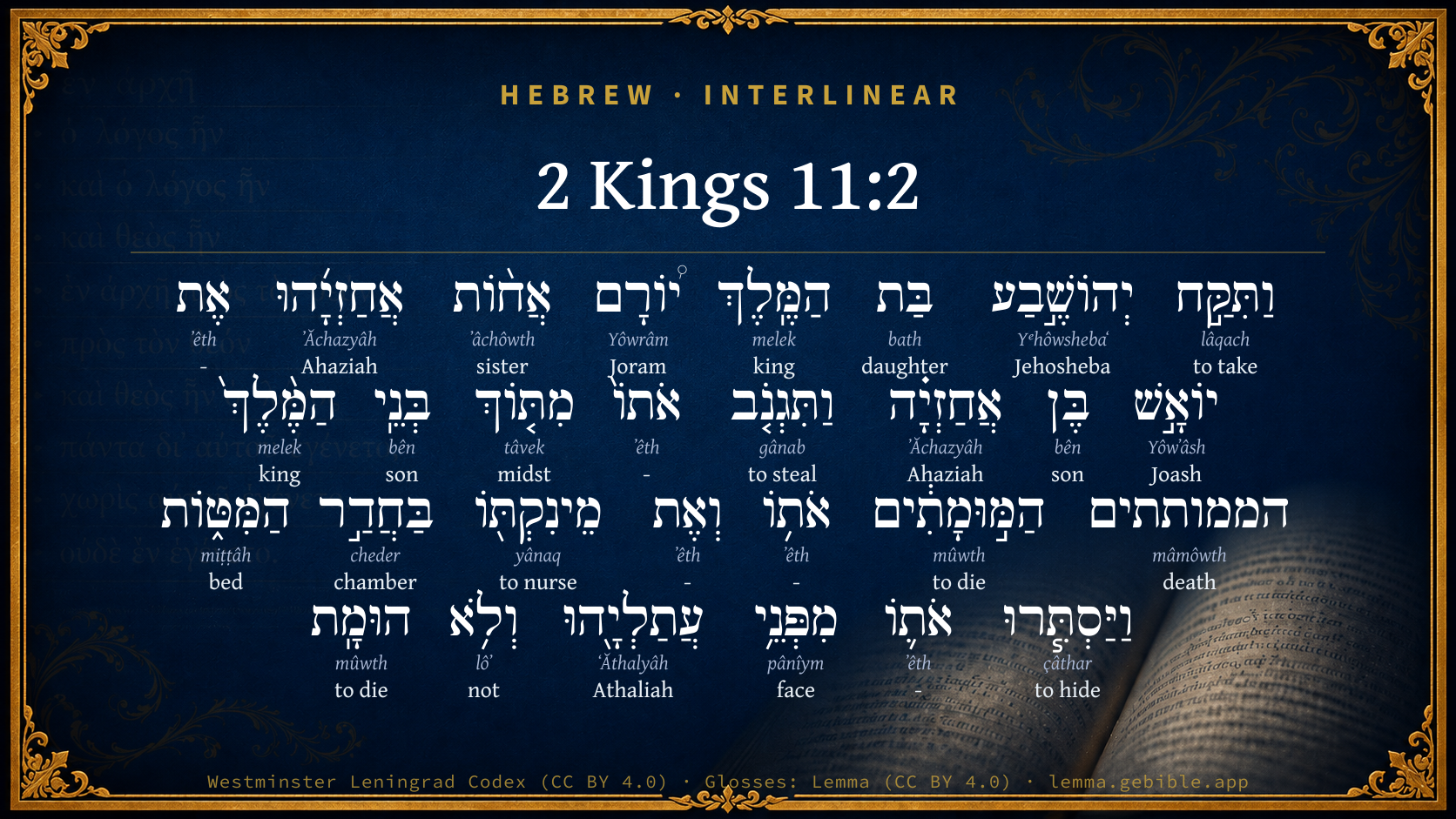
2 Kings 11:2

Hebrew (Westminster Leningrad Codex) 2 Kings 11:2 appears in the Hebrew Old Testament. The text above is from the Westminster Leningrad Codex. Each word links to its Strong’s number, a concise gloss, and parsing drawn from the Open Scriptures Hebrew Bible morphology. Click any word for its full Brown-Driver-Briggs (BDB) entry.
Download image
Cite this verse

2 Kings 11:2 (World English Bible). Public Domain. Lemma interlinear Bible study tool, https://lemma.gebible.app/v/2-kings/11/2.

Show BibTeX & RIS
BibTeX
RIS
English Translation
But Jehosheba, the daughter of king Joram, sister of Ahaziah, took Joash the son of Ahaziah, and stole him away from among the king's sons who were slain, even him and his nurse, [and put them] in the bedchamber; and they hid him from Athaliah, so that he was not slain;
World English Bible · Public Domain
Highlights
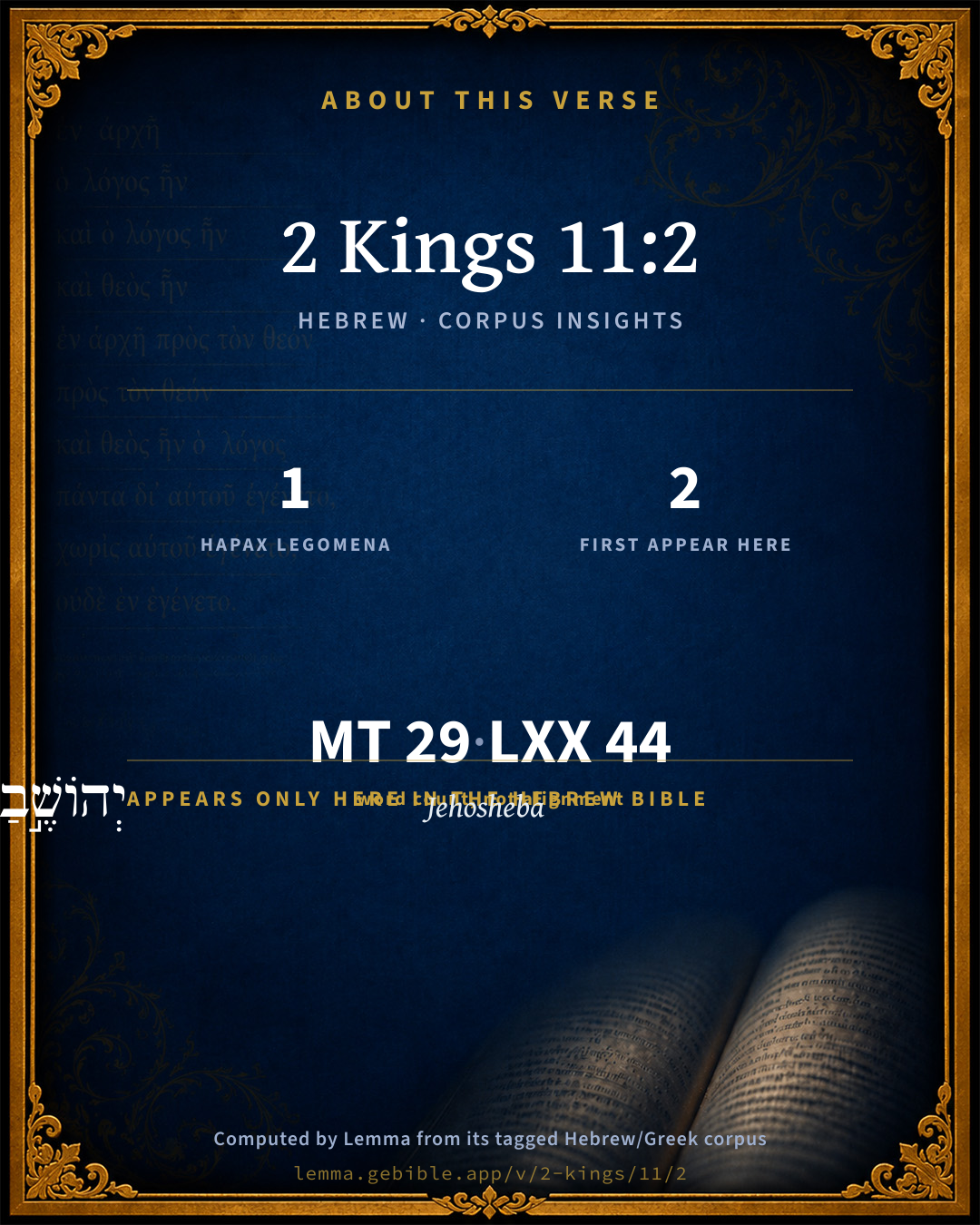
  • 1 hapax legomenon — only here in the Hebrew Bible
  • 2 first appearances in the Hebrew Bible
Full analysis ↓
Download a study sheet

One document with this verse’s original text, its word-by-word gloss line, the meaning frame, cross-references with their text, attributed commentary, and full source and license credits — printable, and it pastes into notes with its structure intact.

This verse Autodidact and up

Study sheet (.html) Plain text (.txt)

A passage Seminary Student

Up to 50 verses in one chapter. A passage sheet keeps up to 6 commentary sources and 12 cross-references per verse, in the order this page ranks them, and says so on the sheet whenever that leaves anything out. Ask for a single verse and you get the Autodidact verse sheet above.

Everything on this page stays free to read, with no account — the sheet is a download of what is already on screen, not access to it.

Want to remove ads? Support Godless Engineer
Compare translations 3

The same verse in 3 English versions, stacked beneath the original-language interlinear above. Click any original word for its lexicon entry.

Each is an independent rendering of the whole verse — the interlinear is not word-aligned to these translations.

Highlighted words mark where these versions differ — a whole-verse word diff, not a word-by-word alignment.

  • World English Bible Public Domain
    But Jehosheba, the daughter of king Joram, sister of Ahaziah, took Joash the son of Ahaziah, and stole him away from among the king's sons who were slain, even him and his nurse, [and put them] in the bedchamber; and they hid him from Athaliah, so that he was not slain;
  • King James Version Public Domain
    But Jehosheba, the daughter of king Joram, sister of Ahaziah, took Joash the son of Ahaziah, and stole him from among the king's sons which were slain; and they hid him, even him and his nurse, in the bedchamber from Athaliah, so that he was not slain.
  • unfoldingWord Literal Text CC BY-SA 4.0
    But Jehosheba, the daughter of King Joram, the sister of Ahaziah, took Joash, the son of Ahaziah, and she stole him away from the midst of the sons of the king being killed, him and his nurse, in the room of the beds. And they hid him from the face of Athaliah, and he was not killed.

unfoldingWord Literal Text — © unfoldingWord, licensed CC BY-SA 4.0. Word-aligned USFM3 via Door43 (git.door43.org/unfoldingWord/en_ult).

Versions to compare (up to 4)

3 of 4 selected

Show all 18 translations

Every available English version of this verse, each an independent rendering of the whole verse.

  • World English Bible Public Domain
    But Jehosheba, the daughter of king Joram, sister of Ahaziah, took Joash the son of Ahaziah, and stole him away from among the king's sons who were slain, even him and his nurse, [and put them] in the bedchamber; and they hid him from Athaliah, so that he was not slain;
  • Berean Standard Bible Public Domain
    But Jehosheba daughter of King Joram, the sister of Ahaziah, took Joash son of Ahaziah and stole him away from among the sons of the king who were being murdered. She put him and his nurse in a bedroom to hide him from Athaliah, and he was not killed.
  • Majority Standard Bible Public Domain
    But Jehosheba daughter of King Joram, the sister of Ahaziah, took Joash son of Ahaziah and stole him away from among the sons of the king who were being murdered. She put him and his nurse in a bedroom to hide him from Athaliah, and he was not killed.
  • King James Version Public Domain
    But Jehosheba, the daughter of king Joram, sister of Ahaziah, took Joash the son of Ahaziah, and stole him from among the king's sons which were slain; and they hid him, even him and his nurse, in the bedchamber from Athaliah, so that he was not slain.
  • American Standard Version (1901) Public Domain
    But Jehosheba, the daughter of king Joram, sister of Ahaziah, took Joash the son of Ahaziah, and stole him away from among the king's sons that were slain, even him and his nurse, `and put them' in the bedchamber; and they hid him from Athaliah, so that he was not slain;
  • Revised Version (1885) Public Domain
    But Jehosheba, the daughter of king Joram, sister of Ahaziah, took Joash the son of Ahaziah, and stole him away from among the king’s sons that were slain, even him and his nurse, and put them in the bedchamber; and they hid him from Athaliah, so that he was not slain.
  • Geneva Bible (1599) Public Domain
    But Iehosheba the daughter of King Ioram, and sister to Ahaziah tooke Ioash the sonne of Ahaziah, and stale him from among the Kings sonnes that shoulde be slaine, both him and his nource, keeping them in the bed chaber, and they hid him from Athaliah, so that he was not slaine.
  • Douay-Rheims (1899) Public Domain
    But Josaba the daughter of king Joram, sister of Ochozias, took Joas the son of Ochozias, and stole him from among the king's sons that were slain, out of the bedchamber with his nurse: and hid him from the face of Athalia, so that he was not slain.
  • Young's Literal Translation Public Domain
    and Jehosheba daughter of king Joram, sister of Ahaziah, taketh Joash son of Ahaziah, and stealeth him out of the midst of the sons of the king who are put to death, him and his nurse, in the inner part of the bed-chambers, and they hide him from the presence of Athaliah, and he hath not been put to death,
  • Literal Standard Version CC BY-SA 4.0
    and Jehosheba daughter of king Joram, sister of Ahaziah, takes Joash son of Ahaziah, and steals him out of the midst of the sons of the king who are put to death, him and his nurse, in the inner part of the bed-chambers, and they hide him from the presence of Athaliah, and he has not been put to death,
  • Unlocked Literal Bible CC BY-SA 4.0
    But Jehosheba, a daughter of King Jehoram and sister of Ahaziah, took Joash son of Ahaziah, and hid him away from among the king's sons who were killed, along with his nurse; she put them into a bedroom. They hid him from Athaliah so that he was not killed.
  • unfoldingWord Literal Text CC BY-SA 4.0
    But Jehosheba, the daughter of King Joram, the sister of Ahaziah, took Joash, the son of Ahaziah, and she stole him away from the midst of the sons of the king being killed, him and his nurse, in the room of the beds. And they hid him from the face of Athaliah, and he was not killed.
  • Darby Bible Public Domain
    But Jehosheba, the daughter of king Joram, the sister of Ahaziah, took Joash the son of Ahaziah and stole him from among the king's sons that were slain, [and hid] him and his nurse in the bedchamber; and they hid him from Athaliah, so that he was not slain.
  • World Messianic Bible Public Domain
    But Jehosheba, the daughter of King Joram, sister of Ahaziah, took Joash the son of Ahaziah, and stole him away from among the king’s sons who were slain, even him and his nurse, and put them in the bedroom; and they hid him from Athaliah, so that he was not slain.
  • Webster's Bible Public Domain
    But Jehosheba, the daughter of king Joram, sister of Ahaziah, took Joash the the son of Ahaziah, and stole him from among the king's sons who were slain; and they hid him, even him and his nurse, in the bed-chamber, from Athaliah, so that he was not slain.
  • Free Bible Version CC BY-SA 4.0
    But Jehosheba, daughter of King Jehoram, sister of Ahaziah, took Ahaziah's son Joash, stealing him away from the rest of the sons of the king who were being killed. She put him and his nurse in a bedroom to hide him from Athaliah, and he was not murdered.
  • Bible in Basic English Public Domain
    But Jehosheba, the daughter of King Joram, sister of Ahaziah, secretly took Joash, the son of Ahaziah, with the woman who took care of him, away from among the king's sons who were put to death, and put him in the bedroom; and they kept him safe from Athaliah, so that he was not put to death.
  • JPS Tanakh (1917) Public Domain
    But Jehosheba, the daughter of king Joram, sister of Ahaziah, took Joash the son of Ahaziah, and stole him away from among the king's sons that were slain, even him and his nurse, and put them in the bed-chamber; and they hid him from Athaliah, so that he was not slain.

Literal Standard Version (2020), Covenant Press — licensed CC BY-SA 4.0. Text via the HelloAO Bible API (eBible.org). Unlocked Literal Bible (unfoldingWord) — licensed CC BY-SA 4.0. Text via the HelloAO Bible API (eBible.org). unfoldingWord Literal Text — © unfoldingWord, licensed CC BY-SA 4.0. Word-aligned USFM3 via Door43 (git.door43.org/unfoldingWord/en_ult). Free Bible Version, Dr. Jonathan Gallagher — licensed CC BY-SA 4.0. Text via the HelloAO Bible API (eBible.org).

Word by word

More ways to search: Search by grammar → Find every occurrence → Compare this word →

Practice this passage: Drill this verse → Learn its vocabulary →

יְהוֹשֶׁ֣בַע
Yᵉhôwshebaʻ
H3089
“Jehosheba”
Noun, Proper
Part of Speech
Noun
Type
Proper
Full BDB Definition

Origin: from H3068 and H7650

TWOT: None

Jehosheba = "Jehovah has sworn" - daughter of king Joram of Judah and wife of the high priest Jehoiada
  1. וַתִּקַּ֣ח lâqach H3947 “and · to take” Conjunction + Verb, Qal, Sequential Imperfect, 3rd Person, Feminine, Singular
  2. בַּת bath H1323 “daughter of” Noun, Common, Feminine, Singular, Construct
  3. הַמֶּֽלֶךְ melek H4428 “the · king” Particle, Definite Article + Noun, Common, Masculine, Singular, Absolute
  4. י֠וֹרָם Yôwrâm H3141 “Joram” Noun, Proper
  5. אֲח֨וֹת ʼâchôwth H269 “sister of” Noun, Common, Feminine, Singular, Construct
  6. אֲחַזְיָ֜הוּ ʼĂchazyâh H274 “Ahaziah” Noun, Proper
  7. אֶת ʼêth H853 “-” Particle, Direct Object
  8. יוֹאָ֣שׁ Yôwʼâsh H3101 “Joash” Noun, Proper
  9. בֶּן bên H1121 “son of” Noun, Common, Masculine, Singular, Construct
  10. אֲחַזְיָ֗ה ʼĂchazyâh H274 “Ahaziah” Noun, Proper
  11. וַתִּגְנֹ֤ב gânab H1589 “and · to steal” Conjunction + Verb, Qal, Sequential Imperfect, 3rd Person, Feminine, Singular
  12. אֹתוֹ֙ ʼêth H853 “- · him” Particle, Direct Object + Suffix, Personal, 3rd Person, Masculine, Singular
  13. מִתּ֤וֹךְ tâvek H8432 “from · midst of” Preposition + Noun, Common, Masculine, Singular, Construct
  14. בְּנֵֽי bên H1121 “sons of” Noun, Common, Masculine, Plural, Construct
  15. הַמֶּ֨לֶךְ֙ melek H4428 “the · king” Particle, Definite Article + Noun, Common, Masculine, Singular, Absolute
  16. הממותתים mâmôwth H4463 “the · death” Particle, Definite Article + Verb, Hophal, Participle Passive, Masculine, Plural, Absolute
  17. הַמּ֣וּמָתִ֔ים mûwth H4191 “the · died” Particle, Definite Article + Verb, Hophal, Participle Passive, Masculine, Plural, Absolute
  18. אֹת֥וֹ ʼêth H853 “- · him” Particle, Direct Object + Suffix, Personal, 3rd Person, Masculine, Singular
  19. וְאֶת ʼêth H853 “and · -” Conjunction + Particle, Direct Object
  20. מֵינִקְתּ֖וֹ yânaq H3243 “nurse · his” Noun, Common, Feminine, Singular, Construct + Suffix, Personal, 3rd Person, Masculine, Singular
  21. בַּחֲדַ֣ר cheder H2315 “in/at · chamber of” Preposition + Noun, Common, Masculine, Singular, Construct
  22. הַמִּטּ֑וֹת miṭṭâh H4296 “the · beds” Particle, Definite Article + Noun, Common, Feminine, Plural, Absolute
  23. וַיַּסְתִּ֧רוּ çâthar H5641 “and · to hide” Conjunction + Verb, Hiphil, Sequential Imperfect, 3rd Person, Masculine, Plural
  24. אֹת֛וֹ ʼêth H853 “- · him” Particle, Direct Object + Suffix, Personal, 3rd Person, Masculine, Singular
  25. מִפְּנֵ֥י pânîym H6440 “from · face(s) of” Preposition + Noun, Common, Both, Plural, Construct
  26. עֲתַלְיָ֖הוּ ʻĂthalyâh H6271 “Athaliah” Noun, Proper
  27. וְלֹ֥א lôʼ H3808 “and · not” Conjunction + Particle, Negative
  28. הוּמָֽת mûwth H4191 “to die” Verb, Hophal, Perfect, 3rd Person, Masculine, Singular

About this verse

These counts appear in no published source. They are computed here, from the morphology-tagged text and Lemma’s own curated glosses. What Lemma adds →

29
words
21
distinct lemmas
Historical
section

Notable vocabulary

1 hapax legomenon — a word that appears only here in the entire Hebrew Bible:

  • יְהוֹשֶׁ֣בַע Jehosheba H3089

First appearance in Scripture

These words make their first canonical appearance in the Hebrew Bible here:

  • יְהוֹשֶׁ֣בַע Jehosheba H3089
  • הממותתים death H4463

Shared distinctive vocabulary

הממותתים death H4463 occurs in 3 verses of the Hebrew Bible. Also found in:

Grammatical profile

  • 6 verbs
  • 17 nouns
  • 6 particles

Verb forms

  • וַתִּקַּ֣ח Qal · Sequential Imperfect
  • וַתִּגְנֹ֤ב Qal · Sequential Imperfect
  • הממותתים Hophal · Participle Passive
  • הַמּ֣וּמָתִ֔ים Hophal · Participle Passive
  • וַיַּסְתִּ֧רוּ Hiphil · Sequential Imperfect
  • הוּמָֽת Hophal · Perfect

Repetition

Words recur within this verse — often emphatic in Hebrew:

  • הַמֶּֽלֶךְ king H4428 ×2
  • אֲחַזְיָ֜הוּ Ahaziah H274 ×2
  • בֶּן son H1121 ×2
  • הַמּ֣וּמָתִ֔ים to die H4191 ×2

Hebrew & Septuagint length

In English translation the verse runs 51 words from the Hebrew and 50 from the Septuagint (LXX English) — closely comparable.

A rough comparison of the two English renderings, which tokenize alike — not a word-level alignment.

Word counts can differ between the Hebrew and the Greek without any difference in meaning — e.g. the Hebrew direct-object marker אֵת has no separate Greek word, and Greek often adds the article ὁ.

In the original languages it is 29 Hebrew tokens and 44 Greek tokens — but the two are counted differently (Hebrew bundles its prefixes and suffixes into one token; the Greek is in lemma form), so that isn’t a like-for-like length.

Cross-references

16

Topical passages linked to 2 Kings 11:2 in the Treasury of Scripture Knowledge — connected by theme and wording, ordered by reader-vote popularity; previews shown in the World English Bible.

  • 1 Kings 6:8 The door for the middle side-chambers was in the right side of the house: and they went up by winding stairs into the middle [story], and out of the middle into the third.
  • 1 Kings 6:10 He built the stories against all the house, each five cubits high: and they rested on the house with timber of cedar.
  • 2 Kings 8:16 In the fifth year of Joram the son of Ahab king of Israel, Jehoshaphat being then king of Judah, Jehoram the son of Jehoshaphat king of Judah began to reign.
  • 2 Kings 8:19 However Yahweh would not destroy Judah, for David his servant's sake, as he promised him to give to him a lamp for his children always.
  • 2 Kings 11:21–12:2 Jehoash was seven years old when he began to reign.
  • 2 Chronicles 22:11 But Jehoshabeath, the daughter of the king, took Joash the son of Ahaziah, and stole him away from among the king's sons who were slain, and put him and his nurse in the bedchamber. So Jehoshabeath, the daughter of king Jehoram, the wife of Jehoiada the priest (for she was the sister of Ahaziah), hid him from Athaliah, so that she didn't kill him.
  • Proverbs 21:30 There is no wisdom nor understanding Nor counsel against Yahweh.
  • Isaiah 7:6–7 "Let's go up against Judah, and tear it apart, and let's divide it among ourselves, and set up a king in the midst of it, even the son of Tabeel."
  • Isaiah 37:35 For I will defend this city to save it, for my own sake, and for my servant David's sake.
  • Isaiah 65:8–9 Thus says Yahweh, As the new wine is found in the cluster, and one says, Don't destroy it, for a blessing is in it: so will I do for my servants' sake, that I may not destroy them all.
  • Jeremiah 33:17 For thus says Yahweh: David shall never want a man to sit on the throne of the house of Israel;
  • Jeremiah 33:21 then may also my covenant be broken with David my servant, that he shall not have a son to reign on his throne; and with the Levites the priests, my ministers.
  • Jeremiah 33:26 then will I also cast away the seed of Jacob, and of David my servant, so that I will not take of his seed to be rulers over the seed of Abraham, Isaac, and Jacob: for I will cause their captivity to return, and will have mercy on them.
  • Jeremiah 35:2 Go to the house of the Rechabites, and speak to them, and bring them into the house of Yahweh, into one of the chambers, and give them wine to drink.
  • Ezekiel 40:45 He said to me, This chamber, whose prospect is toward the south, is for the priests, the keepers of the charge of the house;
  • 1 Kings 6:5–6 Against the wall of the house he built stories round about, against the walls of the house round about, both of the temple and of the oracle; and he made side-chambers round about.

Cross-references courtesy of OpenBible.info (CC BY 4.0).

Hebrew and Greek witnesses Masoretic Hebrew ↔ Greek Septuagint

The same verse in the two great witnesses to the Old Testament, shown verse-for-verse.

These are two independent witnesses, not word-aligned to each other, and the Septuagint is shown in lemma (dictionary) form.

Hebrew 2 Kings 11:2 Masoretic · Westminster Leningrad Codex

וַתִּקַּ֣ח יְהוֹשֶׁ֣בַע בַּת הַמֶּֽלֶךְ י֠וֹרָם אֲח֨וֹת אֲחַזְיָ֜הוּ אֶת יוֹאָ֣שׁ בֶּן אֲחַזְיָ֗ה וַתִּגְנֹ֤ב אֹתוֹ֙ מִתּ֤וֹךְ בְּנֵֽי הַמֶּ֨לֶךְ֙ הממותתים הַמּ֣וּמָתִ֔ים אֹת֥וֹ וְאֶת מֵינִקְתּ֖וֹ בַּחֲדַ֣ר הַמִּטּ֑וֹת וַיַּסְתִּ֧רוּ אֹת֛וֹ מִפְּנֵ֥י עֲתַלְיָ֖הוּ וְלֹ֥א הוּמָֽת

But Jehosheba, the daughter of king Joram, sister of Ahaziah, took Joash the son of Ahaziah, and stole him away from among the king's sons who were slain, even him and his nurse, [and put them] in the bedchamber; and they hid him from Athaliah, so that he was not slain;

World English Bible · Public Domain

Greek LXX 2 Kings 11:2 Septuagint · lemma form

καί λαμβάνω ιωσαβεε θυγάτηρ ὁ βασιλεύς ιωραμ ἀδελφή οχοζιας ὁ ιωας υἱός ἀδελφός αὐτός καί κλέπτω αὐτός ἐκ μέσος ὁ υἱός ὁ βασιλεύς ὁ θανατόω αὐτός καί ὁ τροφός αὐτός ἐν ὁ ταμιεῖον ὁ κλίνη καί κρύπτω αὐτός ἀπό πρόσωπον γοθολια καί οὐ θανατόω

And Josabee daughter of king Joram, sister of Ochozias, took Joas the son of her brother, and stole him from among the king's sons that were put to death, secreting him and his nurse in the bedchamber, and hid him from the face of Gotholia, and he was not slain.

LXX2012 (modern English Septuagint) · Public Domain

Hebrew: Westminster Leningrad Codex (CC BY 4.0). Greek: Septuagint (public domain); English from LXX2012 (modern English Septuagint) (Public Domain). How the Septuagint differs from the Hebrew →

Targum (Aramaic paraphrase)

1

The Targum is the ancient Jewish Aramaic paraphrase of the Hebrew Scriptures — an interpretive translation, not the Hebrew text itself. Onkelos (literal) and Pseudo-Jonathan (expansive) render the Torah, and Jonathan the Prophets. Coverage is partial: where no permissively-licensed English translation exists for a verse, only the Aramaic is shown. This is verse-level text, not a word-by-word alignment to the Hebrew.

  1. Targum Jonathan Prophets (Joshua–Malachi)
    וּנְסִיבַת יְהוֹשֶׁבַע בַּת מַלְכָּא יוֹרָם אֲחָתֵיהּ דַאֲחַזְיָה יַת יוֹאָשׁ בַּר אֲחַזְיָה וּגְנָבַת יָתֵיהּ מִגוֹ בְּנֵי מַלְכָּא דְמִתְקַטְלִין וְאַטְמָרַת יָתֵיהּ וְיַת מֵנִקְתֵּיהּ בְּאִידְרוֹן בֵּית עַרְסָתָא וְאַטְמָרוּ יָתֵיהּ מִן קֳדָם עֲתַלְיָה וְלָא אִתְקְטֵיל:

    (no public-domain English translation for this verse)

    Targum Jonathan — Aramaic: “Mikraot Gedolot” (public domain). English: “Sefaria Community Translation” (CC0 1.0 (public-domain dedication)); “London "Chaldee Paraphrase," 1871” (public domain). Text via Sefaria.

Commentary

Notes on 2 Kings 11:2 from classic Christian and Jewish commentators (each source and its license shown beneath its notes). The classic Christian expositions comment on the surrounding passage and are grouped to its opening verse, so a note may address several verses; the Jewish commentaries on the Tanakh (Rashi and others) are per-verse, so they appear only where the commentator wrote on this verse.

Lemma curates 59 commentaries, every one of them public domain or Creative Commons licensed, each selected and text-cleaned for this edition rather than reprinted as found. About our sources →

Trapp's Complete Commentary

John Trapp

2Ki 11:2 But Jehosheba, the daughter of king Joram, sister of Ahaziah, took Joash the son of Ahaziah, and stole him from among the king’s sons [which were] slain; and they hid him, [even] him and his nurse, in the bedchamber from Athaliah, so that he was not slain.

Ver. 2. And stole him from among the king’s sons.] Out of the nursery; but how he should escape Athaliah’s bloody hands, is hard to say; whether by bribing the assassins, or substituting another child, &c. The nurse of Mauricius, the emperor’s child, offered her own to be slain by that bloody Phocas, to preserve her foster child’s life, the son of the emperor.

So that he was not slain.] No more was Theodosius, though in great danger of death by the superstition of Valens, his predecessor; who, being told by the soothsayers that one should succeed him in the empire, whose name began with those four letters, θ, ε, ο, δ, killed many that were called Theodori, Theodoti, Theoduli, &c., and among the rest, Theodosiolus, the father of Theodosius, whom God nevertheless preserved to the empire from the bloody hands of that wretched Arian.

John Trapp, A Commentary or Exposition upon All the Books of the Old and New Testament (1647–1656) — public domain. Text from a community e-Sword module.

The Biblical Illustrator

Joseph S. Exell

2Ki_11:2-3

Jehosheba . . . took Joash the son of Ahaziah, and stole him from among the kings sons which were slain.

Stolen from death

Grandmothers are more lenient with their childrens children than they were with their own. At forty years of age, if discipline be necessary, chastisement is used; but at seventy, the grandmother, looking upon the misbehaviour of the grandchild, is apologetic, and disposed to substitute confectionery for whip. There is nothing more beautiful than this mellowing of old age toward childhood But here we have a grandmother of a different hue. It is old Athaliah, the queenly murderess. She ought to have been honourable. Her father was a king. Her husband was a king. Her son was a king. And yet we find her plotting for the extermination of the entire royal family, including her own grandchildren. But the six years expire, and it is time for young Joash to come forth and take the throne, and to push back into disgrace and death old Athaliah. The arrangements are all made for political revolution. The military come and take possession of the temple, swear loyalty to the boy Joash, and stand around for his defence.

I. The first thought from this subject is, that the extermination of righteousness is an impossibility. Superstition rises up and says: I will just put an end to pure religion. Domitian slew forty thousand Christians, Diocletian slew eight hundred and forty-four thousand Christians. And the scythe of persecution has been swung through all the ages, and the flames hissed, and the auto da fe rattled, and the guillotine chopped, and the Bastile groaned; but did the foes of Christianity exterminate it? Did they exterminate Alban, the first British sacrifice; or Zuinglius, the Swiss reformer; or John Oldcastle, the Christian nobleman; or Abdallah, the Arabian martyr; or Anne Askew, or Sanders, or Cranmer? Great work of extermination they made of it. Just at the time when they thought they had slain all the royal family of Jesus, some Joash would spring up and out, and take the throne of power, and wield a very sceptre of Christian dominion. Infidelity says: Ill just exterminate the Bible, and the Scriptures were thrown into the street for the mob to trample on, and they were piled up in the public squares and set on fire, and mountains of indignant contempt were hurled on them, and learned universities decreed the Bible out of existence. In my Age of Reason I have annihilated the Scriptures, said Thomas Paine. Your Washington is a pusillanimous Christian, but I am the foe of Bibles and of churches. O, how many assaults upon that Word. Said one man, in his infidel desperation, to his wife: You must not be reading that Bible, and he snatched it away from her. And though in that Bible was a lock of hair of the dead child--the only child that God had ever given them--he pitched the book with its contents into the fire, and stirred it with the tongs, and spat on it, and cursed it, and said: Susan, never have any more of that stuff here! How many individual and organised attempts have been made to exterminate that Bible. Have they done it? Have they exterminated the Bible Society? Have they exterminated the thousands of Christian institutions whose only object it is to multiply copies of the Scriptures, and throw them broadcast around the world? Yea, if there should come a time of persecution in which all the known Bibles of the earth should be destroyed, all these lamps of life that blaze in our pulpits and in our families extinguished--in the very day that infidelity and sin should be holding jubilee over the universal extinction there would be in some closet of a backwoods church a secreted copy of the Bible, and this Joash of eternal literature would come out and come up and take the throne, and the Athaliah of infidelity and persecution would fly out the back door of the palace, and drop her miserable carcass under the hoofs of the horses of the kings stables. You cannot exterminate Christianity! You cannot kill Joash!

II. The second thought from my subject is, that there are opportunities in which we may save royal life. You know that profane history is replete with stories of strangled monarchs and of young princes who have been put out of the way. Here is the story of a young king saved. But why should we spend our time in praising this bravery of expedition when God asks the same thing of you and me? all around us are the imperilled children of a great king. They are born of Almighty parentage, and will come to a throne or a crown, if permitted. But sin, the old Athaliah, goes forth to the massacre. Murderous temptations are out for the assassination. But sin is more terrific in its denunciation. It matters not how you spell your name, you come under its knife, under its sword, under its doom, unless there be some omnipotent relief brought to the rescue. But blessed be God, there is such a thing as delivering a royal soul. Who will snatch away Joash? This afternoon, in your Sabbathschool class, there will be a prince of God--some Cromwell to dissolve a Parliament, some Beethoven to touch the worlds harp-strings, some John Howard to pour fresh air into the lazaretto, some Florence Nightingale to bandage the battle wounds, some Miss Dix to soothe the crazed brain, some John Frederick Oberlin to educate the besotted, some David Brainerd to change the Indians war-whoop to a Sabbath song, some John Wesley to marshal three-fourths of Christendom, some John Knox to make queens turn pale, some Joash to demolish idolatry and strike for the kingdom of heaven. There are sleeping in your cradles by night, there are playing in your nurseries by day, imperial souls waiting for dominion, and whichever side the cradle they get out will decide the destiny of empires.

III. The third thought from my text is, that the Church of God is a good hiding-place. When Jehosheba rushes into the nursery of the king and picks up Joash, what shall she do with him? Shall she take him to some room in the palace? No; for the official desperadoes will hunt through every nook and corner of that building. Would God that we were all as wise as Jehosheba, and knew that the Church of God is the best hiding-place. O, men of the world, outside there, betrayed, caricatured, and cheated of the world, why do you not come in through the broad, wide open door of Christian communion? I wish I could act the part of Jehosheba to-day, and steal you away from your perils and hide you in the temple. How few of us appreciate the fact that the Church of God is a hiding-place. More than that, you yourself will want the Church for a hiding-place when the mortgage is foreclosed; when your daughter, just blooming into womanhood, suddenly clasps her hands in a slumber that knows no waking; when gaunt trouble walks through the parlour, and the sitting-room, and the dining-hall, and the nursery, you will want some shelter from the tempest. Ah, some of you have been run upon by misfortune, and trial; why do you not come into the shelter? I said to a widowed mother after she had buried her only son--months after, I said to her: How do you get along now-a-days? Oh, she replied, I get along tolerably well, except when the sun shines. I said: What do you mean by that? when she said: I cant bear to see the sun shine; my heart is so dark that all the brightness of the natural world seems a mockery to me. Oh, darkened soul, oh, broken-hearted man, broken-hearted woman, why do you not come into the shelter? I swing the door wide open. I swing it from wall to wall. Come in! Come in! You want a place where your troubles shall be interpreted, where your burdens shall be unstrapped, where your tears shall be wiped away. (T. De Witt Talmage, D. D.)

The fallacy of evil

The transaction with which the text is connected belongs to that series of bloody events which were involved with the destruction of the house of Ahab. Among those who were slain in the fierce onslaught of Jehu, was Ahaziah, King of Judah. Hearing of his death, his mother Athaliah, the daughter of Jezebel--her daughter in disposition as well as by birth--resolved to secure the kingdom of Judah for herself; and to that end, she put to death, as she supposed, the entire brood of her own grandchildren; and having perpetrated this unnatural slaughter, she ascended the vacant throne. But the text informs us that to this wholesale murder there was one exception. Joash, the infant heir of Ahaziah, was by his aunt, Jehosheba, wife of Jehoiada the high priest, snatched from the fury of the usurping queen, and concealed in the temple. Athaliah maintained her guilty reign for six years. It was a cruel, oppressive, and idolatrous reign, sternly calculated to foment the opposition of all who were loyal to the legitimate government and the ancient religion, and to cement their union. At length Jehoiada, under oath, disclosed his secret to some of the chief men of the Jewish nation, and, having secured the alliance of the military and the priesthood, broke out with a successful revolution. Upon a day appointed, the guard and the people having assembled in the temple, Jehoiada brought the young Joash out before them. Having anointed and crowned him, the people clapped their hands, shouting, God save the king! This entire transaction suggests the fallacy of evil, the falsehood of sin. And so this incident of a very ancient time is applicable to all time. To some it may appear a very superfluous task to urge an argument against evil in itself. Up to this point it may seem that all argument is foreclosed. It may be thought that the very term evil suggests all the argument that is necessary. The moral sense of every man repudiates it. Nevertheless, evil prevails; not often, it is to be hoped, in such shapes of conspicuous and revolting wickedness as in the case of the Jewish queen, but in countless other shapes, both in public and in private.

I. The insecurity of evil. This is very clearly illustrated in the incident before us. Athaliahs scheme was a sweeping one. It was summary in its execution. The argument which she employed was the sword; and it seemed as though all obstacles had gone down before it. But one point was left exposed, and through that point entered destruction. And it is wonderful how common such mistakes are, even in the most cunningly planned iniquity. When the evil-doer has arranged all his devices, and they seem to be turning out just as he would have them turn out, very often he seems smitten by judicial blindness, and he leaves some clew by him unperceived. Or we may say Providence gathers up some witness in its concealing folds, and lo! all at once it leaps out upon him. Take some of the grosser instances of iniquity. The thief, as he supposes, clears away every thread of detection; but, in the most unthought of way, the keen eye of justice picks out some slender filament of guilt, and presently the entire web is dragged into the light. The calumniator constructs his charge so-plausibly, that as it seems his victim can find no flaw for escape, when accidentally some minute test of truth is applied, and the lie shriven, and shows all its blackness. The murderer drops some bloody hint of his deed. He makes a footmark in the leaves, or babbles his secret in the revelations of a dream. But let us proceed to the consideration of less conspicuous instances. A man conducts business on a system of petty frauds. For a while they glide quite smoothly, and he secretly chuckles at his own practical demonstration that dishonesty is the best policy. But in time his meanness gets wind: custom drops off, and he sinks in credit. Or his good fortune, if good fortune he has, is tainted by his reputation, men will worship a golden calf for the sake of the gold; but there is apt to be a polite sniffing at gilded carrion. Another finds it convenient, now and then, to oil the hinges of opportunity with a little lying. Quite likely he does so with very slight compunction or thought. It may serve his purpose. And yet it is just as possible that he will find a nest of trouble in it. Perhaps, in some unlucky moment, the truth strikes him flat in the face, and brings him to open shame. Or he has to fabricate a series of lies to support the first, until the chain breaks of its own weight, or tangles and trips him; and it turns out that it costs more to keep a set of lies in tune than it would to have told the truth in the outset. A man who cannot afford to lose money by speaking the truth, and who has enthroned himself on lies, is always likely to encounter some uncomfortable Joash that will bring him down. Then, again, there are some evil devices that one cannot carry out alone--they must be helped by other people; and this creates the insecurity of participated council. The confederate may be bribed to treachery, or become conscience-stricken. At least we may be quite sure that one who will connive at fraud or mischief can have but slight anchorage in principle; and no seal of honour so-called, or even of interest, is strong enough to assure the wrong-doer that he is not plotting with a town tattler or a States evidence. The doctrine of consequences is a doctrine of secondary considerations, which a good man does not want, and which a bad man means to dodge. And that is a very ungodly sorrow which is only sorry for the exposure, Nevertheless this is one argument against evil: its methods and its instruments are insecure. Good men will make mistakes. Good men will commit oversights. Perhaps they are more likely to do so than those of the other class. Trusting simply to the right, they may not keep their wits so keenly on the alert. Men who undertake to engineer a bad enterprise are very apt to be what are called smart men. There are not many downright wicked fools. It is quite possible, that, for a time, the knaves will foil mere righteousness; and, where cleverness is the only point in consideration, they may show themselves superior to those who are simple enough to trust in honesty. And throughout every department of human action, there is this essential difference between fraud and truth, treachery and loyalty--whatever exposure may take place, the good man has no reason to fear. The exposure may demonstrate that he was weak in judgment, or unskilful in execution; but the right motive will redeem his work. But the least slip may ruin the knave and unfrock the hypocrite. The short-sightedness of the right intention is an honest mistake; the oversight of the base purpose is a fatal error. Therefore, in the first instance insecurity means a very different thing from what it does in the last. Yes, life is an uncertain sea, and the good as well as the bad may suffer the shipwreck of their hopes. But the one has done the best he could. He has laid a well-intended course, studying his chart, and observing heaven. The other of his own accord has run his ship among quicksands and breakers. Both are liable to mistakes; but, I say once more, the insecurity of the good is not like the insecurity of the bad.

II. There is another argument against evil in the fact, that in any wrong course there is an intrinsic incongruity. This truth, perhaps, is easier felt than expressed. But I may be able to convey some idea of my meaning by saying that evil does not tally with truth. It cannot profoundly and completely simulate the good. In one word, it is contrary to God. Now, I have already admitted that evil methods do sometimes--indeed, I must say do frequently--succeed. Nevertheless, I do not admit that this triumph is a final triumph. Very likely it will turn out that the consummated guilt does not set well. It wears a doubtful aspect. Suspicion warps it, although detection may not lay it open. It does not fit snug into the general order. I have spoken of a tainted reputation. And I ask, does not a bad man find it Somewhat difficult to hide his real character? The process is apt to develop undue clumsiness, or extra facility, too little heat, or too much zeal. The painting is over-coloured; or else it is quite evident that the face is wax and the eyes are glass. Some time since, I was examining a sample of ore that looked very much like gold: I was informed that the material has often been taken for gold. Perhaps in nine hundred and ninety-nine cases out of a thousand it would pass for gold. Is there, then, no test by which it may be distinguished from the nobler metal? Yes: it does not weigh quite so much as gold. So base-metal acts, that look like shining gold, may sometimes get weighed. So do the elements of sin sometimes burst their glittering disguises; guilty passion glares through all the proprieties; and in the witnessing presence of Gods own universe the intrinsic incongruity of evil appears. Besides this, we must remember also that wrong always occupies the place of some right. It exists by repressing that right. Therefore it is exposed to the re-action of that right. Referring to instances that are important enough to remain visible above the horizon of time, we find, that, as the world moves, there goes on a rectifying process. Justice sifts and sifts, until the verdict abides with the right, even though canonised bones are stirred in their cerements, and the graves give up their dead. As we retreat from the past, the eternal disc of truth emerges from temporary obscurations, while on the great ecliptic of history everything fails into its proper posture. The schemes of wicked policy, and the idols of a deluded veneration, lie crushed and exposed. The memory of the tyrant blackens, and the martyr has his palm. No wrong can go down secure and compact through the ages. It does not assimilate with Gods order, and it bears no fertility of blessedness in its bosom. The celestial movements may seem slow and wearisome: nevertheless, the stars in their courses fight against Sisera. There is no peace for the wicked, though robed in the most splendid success. There is no security for the wrong, however sealed and established. Evil may seem to be as well as the good. But it is not as well. Like that guilty Jewish queen, it falsely occupies the throne; and sooner or later justice comes, like the lawful heir, and claims the birthright.

III. But, after all, the great argument against evil is the essential nature of evil. Suppose Athaliah, instead of being overtaken by that signal punishment, had kept the throne, and died in ripe old age, a crowned and successful sovereign. Would anyone really envy Athaliahs career? Would her position have been a desirable one? Would it have been really a success and a blessing? No. The essential evil in her case appears in what the guilty woman was in herself. Here, then, is the actual point. We must reject evil for what it is in itself; and, in this, all its sophistries are exposed. Surely there is no instance in which a man deliberately elects wickedness for itself alone, and as the final cause of his action. No man who employs fraud or falsehood maintains that his chief good is in the fraud or falsehood. They are his instruments. Hence, he defends them, or acquiesces in the use of them. Thus he lies and cheats, not for the heartfelt satisfaction of lying and cheating, but for the purposes of a worldly policy. He spins some dishonest scheme, because he thinks this the best way to secure his end. He would just as soon use the morality of the Ten Commandments if he thought the stock was as available. But, agreeably to his experience, falsehood makes the money stick to his fingers a little closer than clean-handed honesty will. And that is why he uses falsehood. But now here arises the consideration that evil does become an end, remains an end, when the object sought for has failed or vanished. The gains of the unscrupulous seeker may crumble, his pleasure may taste upon his lips like the lees of dead wine, and in the end of his ambition he may find only the arrows of calumny or the scoffings of popular change. But the evil itself does not desert him. The agent which he has cherished and used--the falsehood and the baseness--stick and abide in his soul, which he may have forgotten, but upon which at some time he must fall back. There, within,--in the elements of his own personality,--what meanness and accusation, what woe and ruin! All the capital that the guilty man possesses is this perishable stuff without, and within a world whose dark recesses he dares not fathom, in which lurk ugly memories and fearful thoughts, and where conscience rolls its low, deep thunder. (E. H. Chapin.)

The Biblical Illustrator, edited by Joseph S. Exell (c. 1880s–1900s) — public domain. Text from a community e-Sword module.

Joseph Benson's Commentary

2Ki 11:2. But Jehosheba — Called Jehoshabeath, 2Ch 22:11; the daughter of King Joram — Namely, by another wife, and not by this Athaliah: for Athaliah would not have suffered her daughter to be married to the high-priest of the true God, nor would he, in all likelihood, have married the daughter of such an idolatrous woman. Stole him from among the king’s sons, &c. — Either took him from among the slain, he happening not to be quite despatched; or else secretly conveyed him away, before the execution was done. And they hid him — Jehosheba and her husband Jehoiada. And his nurse, in the bed-chamber — Which, according to the next verse, was in the house of the Lord: so that it was one of those chambers adjoining to the temple, that were for the uses of the priests and Levites only, which made it more proper for this purpose. Now was the promise made to David bound up in one life, and yet it did not fail. Thus to the son of David will God, according to his promise, secure a spiritual seed; which, though sometimes reduced to a small number, brought very low, and seemingly lost, yet will be preserved to the end of time. It was a special providence, that Joram, though a king, a wicked king, married his daughter to Jehoiada, a priest, a holy priest: this some might think a disparagement to the royal family, but it saved the royal family from ruin; for Jehoiada’s interest in the temple gave her an opportunity to preserve the child, and her interest in the royal family gave him an opportunity of setting him on the throne. See what blessings they lay up in store for their families, who marry their children to those that are wise and good.

Joseph Benson's Commentary on the Old and New Testaments (1811–1818) — public domain. Text from a community e-Sword module.

Tyndale Open Study Notes

Tyndale Open Resources

11:2 Jehosheba was probably born to Jehoram by a wife other than Athaliah and was therefore Ahaziah’s half-sister (cp. Josephus, Antiquities 9.7.1). • The infant Joash was born to Zibiah of Beersheba (2 Chr 24:1), perhaps a lesser wife of Ahaziah. The baby’s birth might therefore have escaped Athaliah’s notice.

Tyndale Open Study Notes — © Tyndale Open Resources, licensed CC BY-SA 4.0. Text via the HelloAO Bible API.

Geneva Bible (1599)

Geneva Bible translators

The Lord promised to maintain the family of David, and not to quench the light thereof, therefore he moved the heart of Jehosheba to preserve him.

Where the Priests did lie.

Geneva Bible (1599) marginal notes — public domain. Text via Bolls.life.

Jamieson, Fausset & Brown

Robert Jamieson, A. R. Fausset & David Brown

Jehosheba--or Jehoshabeath (Ch2 22:11).

daughter of King Joram--not by Athaliah, but by a secondary wife.

stole him from among the king's sons which were slain--either from among the corpses, he being considered dead, or out of the palace nursery.

hid him . . . in the bedchamber--for the use of the priests, which was in some part of the temple (Kg2 11:3), and of which Jehoiada and his wife had the sole charge. What is called, however, the bedchamber in the East is not the kind of apartment that we understand by the name, but a small closet, into which are flung during the day the mattresses and other bedding materials spread on the floors or divans of the sitting-rooms by day. Such a slumber-room was well suited to be a convenient place for the recovery of his wounds, and a hiding-place for the royal infant and his nurse.

Jamieson, Fausset & Brown — Commentary Critical and Explanatory on the Whole Bible (1871) — public domain (CC PDM 1.0). Text via the HelloAO Bible API.

Adam Clarke's Commentary

Verse 2. Daughter of - Joram, sister of Ahaziah] It is not likely that Jehosheba was the daughter of Athaliah; she was sister, we find, to Ahaziah the son of Athaliah, but probably by a different mother. The mother of Jehoash was Zibiah of Beer-sheba; see 2Kg 12:1.

Adam Clarke's Commentary on the Bible (1810–1826) — public domain. Text from a community e-Sword/MySword module.

Ellicott's Commentary for English Readers

(2) But Jehosheba . . . sister of Ahaziah.—By a different mother (see Josephus). Athaliah would not have allowed her daughter to marry the high priest of Jehovah. (Comp. 2Ki_11:3 with 2Ch_22:11.) This marriage with a sister of the king shows what almost royal dignity belonged to the high priest’s office.

The king’s sons which were slain.—Rather, which were to be put to death. At the time when the order for slaying the princes had been given, Jehosheba (or Jehoshabeath; Chronicles) concealed the infant Joash. The fact of his infancy caused him to be overlooked. [The Hebrew text here reads by mistake a word meaning deaths (Jer_16:4). Chronicles supports the Hebrew margin.]

And they hid him.—This clause is out of its place here. The Hebrew is, him and his nurse in the chamber of the beds; and they hid him from Athaliah, and he was not put to death. Clearly the word, “and she put,” supplied in Chronicles, has fallen out before this. The Targum and Syriac read, “and she hid him and his nurse,” &c.

In the bedchamber.—In the chamber of beds, i.e., the room in the palace where the mattresses and the coverlets were kept, according to a custom still prevalent in the East. This chamber being unoccupied was the nearest hiding-place at first. The babe was afterwards secretly conveyed within the Temple precincts.

A Bible Commentary for English Readers, edited by Charles John Ellicott (1878–1897) — public domain. Text from a community e-Sword module.

The Cambridge Bible for Schools and Colleges

gen. ed. J. J. S. Perowne

2. But Jehosheba] Called in 2Ch_22:11 Jehoshabeath. She was only half sister to Ahaziah, and not the daughter of Athaliah. Josephus says she was Ὁχοζίᾳ ὁμοπάτριος ἀδελφή. In Chronicles we learn that she was the wife of Jehoiada the priest, which explains the ease with which she could arrange for hiding the child she had saved in the house of the Lord.

took Joash] He must have been a mere babe at the time, not a year old. Cf. vv. 3 and 21.

and stale him from among the king’s sons which [R.V. that] were slain] The slight change conforms the sentence to Chronicles, where the words are exactly the same. To make the two passagesalike, as in the Hebrew, R.V. reads the rest of the sentence thus even him and his nurse, and put them in the bed chamber, and they hid him from Athaliah, so &c.’

the bedchamber] A chamber where beds were stowed away. Josephus says τὸ ταμιεῖον τῶν κλινῶν, the storeroom for beds and couches. The fury of Athaliah would leave no sleeping room unsearched, but in such a place it was possible for nurse and child to lie hid till there was a chance of getting into more secure shelter.

The Cambridge Bible for Schools and Colleges (gen. ed. J. J. S. Perowne; Cambridge University Press, 1878–1918) — public domain. Text from a community e-Sword module.

John Gill's Exposition

But Jehosheba, the daughter of King Joram,.... Not by Athaliah, but another woman; for an high priest, as her husband was, would not have married the daughter of such an idolatrous woman, nor would she have married her to him:

sister of Ahaziah, took Joash the son of Ahaziah, and stole him from among the king's sons which were slain: among whom he lay; either being cast there by the murderer, or her associates, supposed to be dead, or by his nurse, that he might be thought to be so, who acquainting his aunt with it, went and privately took him away:

and they hid him, even him and his nurse, in the bedchamber from Athaliah, so that he was not slain; that is, Jehosheba and her husband hid him and his nurse in a bedchamber; or "chamber of beds" (y), in which there were more beds than one; one of the chambers of the priests and Levites in the temple, that is, which were adjoining to it; for into the sanctuary itself it was not usual to bring beds (z); wherefore

the house of the Lord, in the next verse, must be understood largely as including all the appendages of it.

(y) "in cubiculo lectorum", Pagninus, Montanus. So Sept. &c. (z) T. Bab. Tamid, c. 1. fol. 26. 2.

John Gill's Exposition of the Whole Bible (1746–1763) — public domain (CC PDM 1.0). Text via the HelloAO Bible API.

Albert Barnes' Notes on the Bible

Jehosheba ... sister of Ahaziah - “Half-sister,” according to Josephus - daughter of Joram, not by Athaliah, but by another wife. She was married to Jehoiada the high priest, and was thus in a position to save and conceal her nephew, Joash, who was only one year old (compare 2Ki 11:3, 2Ki 11:21).

In the bedchamber - literally, “in the chamber of mattresses” - probabIy a store-room in the palace in which mattresses were kept.

Albert Barnes' Notes on the Bible (1834–1885) — public domain. Text from a community e-Sword/MySword module.

Haydock's Catholic Bible Commentary

Sister. She had probably a different mother, as she consented to the death of Athalia. (Calmet) --- But the crimes of the latter require such a punishment; and even a daughter would have done wrong to screen her. (Haydock) --- Josabeth, as she is called in 2 Paralipomenon xxii. 11., was married to Joiada the high priest, ibid.[2 Paralipomenon xxii. 11.] --- Out of. Hebrew and Paralipomenon, "hid him, even him and his nurse, in the bed-chamber" of the priest, in the temple; (Salien) different from that bed-chamber in which he had hitherto been nursed. Thus the passage may be reconciled. (Menochius) (Calmet) --- Some maintain that Joas was not the son of Ochozias, in whom the line of Solomon ended, but a descendant of David by Nathan. But he is always styled the king’s son, and the authority of the false Philo of Annius is of no weight. (Calmet) --- Joiada is called Barachias, "blessed of the Lord," on account of his justice, (St. Jerome) in Matthew xxiii.

George Leo Haydock (1774–1849), Haydock's Catholic Family Bible and Commentary, 1859 edition — public domain. Excludes Psalms (Douay-Rheims chapter numbering differs from Protestant) and Deuterocanonical books (Catholic canon only).

Matthew Poole's English Annotations

Jehosheba, called Jehoshabeath, 2Ch 22:11.

The daughter of king Joram, to wit, by another wife, and not by this Athaliah; for it is not likely Jehoiada, who married her, 2Ch 22:11, would have married one of that wicked and cursed house, except he were married very young, and therein overruled by his parents.

Joash the son of Ahaziah: either,

1. His adopted and legal son, who was to succeed him, though he was of another house, and of Nathan’s family, as many think; such persons being sometimes called the sons of their predecessors, as we shall see hereafter. Or rather,

2. His proper and natural son; for not only he, but the rest who were slain, are here called the king’s (i.e. Joram’s) sons. From among the king’s sons which were slain; either,

1. From amidst of the carcasses, where this infant was laid, and supposed by her to be killed, though it was not quite dead, either through the compassion or connivance of the instruments of this execution, or by some other artifice which his nurse used. Or,

2. Out of that apartment of the palace which was allotted for the king’s children.

They hid him; Jehosheba and her husband Jehoiada.

In the bed-chamber; which was in the house of the Lord, as is affirmed in the next verse. So that it was one of those chambers adjoining or near to the temple, which were for the uses of the priests and Levites, and for them only; which made it more proper for this purpose.

Matthew Poole's English Annotations on the Holy Bible (1683–1685) — public domain. Text from a community e-Sword/MySword module.

Whedon's Commentary on the Bible

Daniel D. Whedon

2. Sister of Ahaziah — Probably a half sister, being Joram’s daughter by another wife than Athaliah. She was the wife of Jehoiada the priest, (2Ch_22:11,) and this fact explains how he came to be hid in the temple.

The bed-chamber — “The bed-chamber in the temple, in which Jehosheba hid Joash, does not seem to mean a lodging chamber, but a chamber used as a repository for beds. I am indebted to Sir John Chardin for this thought, which seems to be a just one; for the original words signify a chamber of beds, and the expression differs from that which is used when a lodging chamber is meant. He supposes that place is meant where beds are kept; for in the East, and particularly in Persia and Turkey, beds are not raised from the ground with bed posts, a canopy, and curtains, people lie on the ground. In the evening they spread out a mattress or two of cotton, very light, of which they have several in great houses, and a room on purpose for them.” — Harmer’s Observations.

Daniel D. Whedon (gen. ed.), Commentary on the Old and New Testaments (1874–1909) — public domain. Text from a community e-Sword module.

The Pulpit Commentary

But Jehosheba ("Jehoshabeath," Chronicles; "Josabethe," Josephus). The daughter of King Joram, sister of Ahaziah half-sister, according to Josephus ("Ant. Jud:," 9:7. the daughter of Joram by a secondary wife, not by Athaliah took Jonah the son of Ahaziah, and stole him from among the king"s sons which were slain.

As aunt of the royal children, Jehosheba would have free entrance into the palace, and liberty to visit all the apartments. She did not dare openly to oppose Athallah"s will, but contrived secretly to save one of the intended victims, the smallest of them, an infant of a year old (pamdion ejniausion, Josephus). His tender age, probably, moved her compassion, and induced her to select him from the rest. And they hid him: even him and his nurse. The order in the Hebrew is, "even him and his nurse, and they hid him," which clears the sense. Jehosheba stole away Joash and his nurse, and they, i.e. Jehosheba and the nurse together, hid him between them. In the bedchamber; rather, in the chamber of mattresses a room in the palace where mattresses, and perhaps coverlets, were stored. Chardin notes ("Works," vol. 3. p: 357) that there is usually retch a room m an Oriental palace, which is only used as a store-chamber, and not as a dwelling-room. From Athaliah, so that he was not slain. Athaliah"s servants may not have been very anxious to carry out her cruel orders to the uttermost, and may have made no very careful search.

The Pulpit Commentary (1880–1919), ed. H.D.M. Spence-Jones & Joseph S. Exell — public domain. Text from a community e-Sword module.

John Wesley's Explanatory Notes

They hid - Jehosheba and her husband Jehoiada. Bed-chamber - Which was in the house of the Lord. So that it was one of those chambers adjoining to the temple, that were for the uses of the priests and Levites only: which made it more proper for this purpose. Now was the promise made to David bound up in one life. And yet it did not fail. Thus to the Son of David will God, according to his promise, secure a spiritual seed: which tho' sometimes reduced to a small number, brought very low, and seemingly lost, yet will be preserved to the end of time. It was a special providence that Joram tho' a king, a wicked king, married his daughter to Jehoiada, a priest, an holy priest. This some might think a disparagement to the royal family; but it saved the royal family from ruin. For Jehoiada's interest in the temple, gave her an opportunity to preserve the child: and her interest in the royal family, gave him an opportunity of setting him on the throne. See what blessings they lay up in store for their families who marry their children to those that are wise and good.

John Wesley, Explanatory Notes Upon the Whole Bible (1754–1765) — public domain. Text via the GEBible commentary corpus.

Rashi

Rabbi Shlomo Yitzchaki (Rashi)

Into the bed-chamber‘room. In the attic of the Holy of Holies, and she therefore had access to the chambers in the Beis Hamikdosh. as it states, “And he remained with her in the Beis [Hamikdosh] of Adonoy, hiding, etc.” Concerning him Dovid said, “For He will hide me in His Tabernacle … He will conceal me in the shelter of His Tent.” He calls it the “bed-chamber” in accordance with, “Between my breasts He lodges.” This is what Rabbi Eliezer instituted, [May He remember for atonement] “the destruction of the bed-chamber,” [i.e.,] “May the destruction of Your Beis [Hamikdosh] atone for them.”

Rashi on the Tanakh — English translations: “The Judaica Press complete Tanach with Rashi, translated by A. J. Rosenberg” (CC BY 4.0); “Pentateuch with Rashi's commentary by M. Rosenbaum and A.M. Silbermann, 1929-1934” (public domain); “The Metsudah Tanach series, Lakewood, N.J” (CC BY 4.0); and “The Book of Joshua, Metsudah Publications, 1997” (CC BY 4.0). Text via Sefaria.

Lesson kit

Teaching starters — assembled from the data on this page, not authored interpretation. Every prompt links to the verse data it draws on. Edit before teaching.

2 Kings, in the Historical, opens this verse with 29 words (21 distinct Hebrew lemmas). Its most distinctive word is Yᵉhôwshebaʻ (“Jehosheba”). A historical commentator’s framing appears above. Read the whole chapter for the surrounding context.

Discussion questions

  1. The word Yᵉhôwshebaʻ carries the sense “Jehosheba.” How does it shape the verse?
  2. This verse holds 1 word here found nowhere else in the Hebrew Bible. What might the rare word draw attention to?
  3. 2 words here appear for the first time in Scripture. What is being introduced at this debut?
  4. Jeremiah 16:4 shares the word «death» with this verse. How do the two illuminate each other?
  5. “king” occurs 2× in this one verse. What is the effect of the repetition?
  6. The translations on this page render this verse differently — a whole-verse word diff, not a word-by-word alignment. What might account for the different wordings?
  7. The verb «וַתִּקַּ֣ח» is Qal Sequential Imperfect. How does its form color the action?
  8. Reading how Trapp's Complete Commentary and The Biblical Illustrator read this verse, where do the two commentators agree and where do they part?

Things to notice

  • 1 word in this verse appears nowhere else in the Hebrew Bible.
  • 2 words make their first canonical appearance in Scripture here.
  • This verse counts 29 Hebrew ↔ 44 Greek words.
  • These translations choose different wording for 15 words in this verse.
  • “king” occurs 2× in this single verse.

Reading settings

Reading text

Shown beneath each verse's original-language words.

Old Testament
Old Testament edition

Read the OT as the Masoretic Hebrew (MT) or the Greek Septuagint (LXX).

English shown for the Greek Septuagint (in the Hebrew ↔ Greek comparison).

Comparing translations? Open the Compare panel on any verse page to stack up to four side by side.