
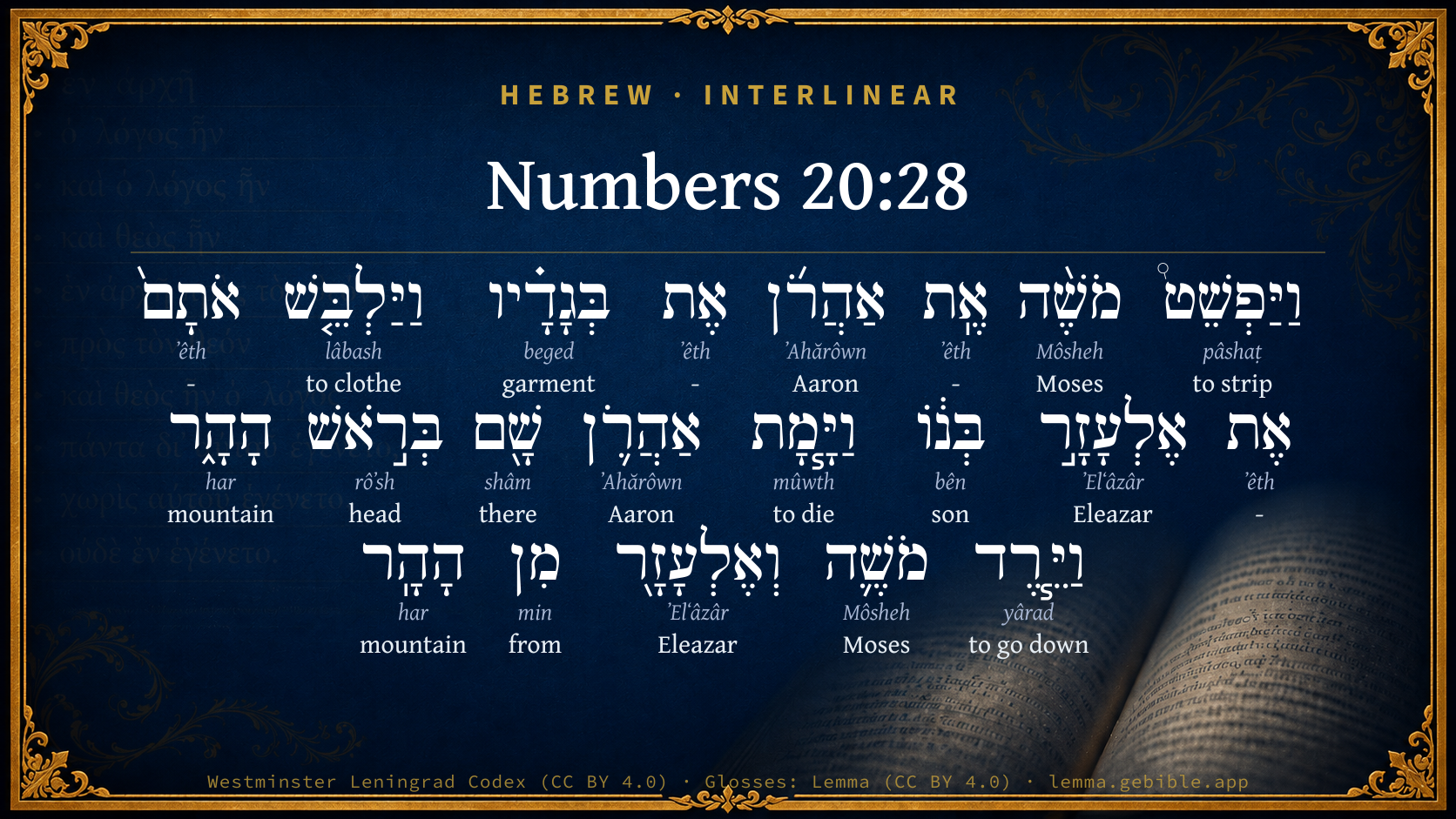
Numbers 20:28

Hebrew (Westminster Leningrad Codex) Numbers 20:28 appears in the Hebrew Old Testament. The text above is from the Westminster Leningrad Codex. Each word links to its Strong’s number, a concise gloss, and parsing drawn from the Open Scriptures Hebrew Bible morphology. Click any word for its full Brown-Driver-Briggs (BDB) entry.
Download image
Cite this verse

Numbers 20:28 (World English Bible). Public Domain. Lemma interlinear Bible study tool, https://lemma.gebible.app/v/numbers/20/28.

Show BibTeX & RIS
BibTeX
RIS
English Translation
Moses stripped Aaron of his garments, and put them on Eleazar his son; and Aaron died there on the top of the mountain: and Moses and Eleazar came down from the mountain.
World English Bible · Public Domain
Download a study sheet

One document with this verse’s original text, its word-by-word gloss line, the meaning frame, cross-references with their text, attributed commentary, and full source and license credits — printable, and it pastes into notes with its structure intact.

This verse Autodidact and up

Study sheet (.html) Plain text (.txt)

A passage Seminary Student

Up to 50 verses in one chapter. A passage sheet keeps up to 6 commentary sources and 12 cross-references per verse, in the order this page ranks them, and says so on the sheet whenever that leaves anything out. Ask for a single verse and you get the Autodidact verse sheet above.

Everything on this page stays free to read, with no account — the sheet is a download of what is already on screen, not access to it.

Want to remove ads? Support Godless Engineer
Compare translations 3

The same verse in 3 English versions, stacked beneath the original-language interlinear above. Click any original word for its lexicon entry.

Each is an independent rendering of the whole verse — the interlinear is not word-aligned to these translations.

Highlighted words mark where these versions differ — a whole-verse word diff, not a word-by-word alignment.

  • World English Bible Public Domain
    Moses stripped Aaron of his garments, and put them on Eleazar his son; and Aaron died there on the top of the mountain: and Moses and Eleazar came down from the mountain.
  • King James Version Public Domain
    And Moses stripped Aaron of his garments, and put them upon Eleazar his son; and Aaron died there in the top of the mount: and Moses and Eleazar came down from the mount.
  • unfoldingWord Literal Text CC BY-SA 4.0
    And Moses stripped Aaron of his clothes and clothed Eleazar his son with them. And Aaron died there on the top of the mountain. And Moses and Eleazar went down from the mountain.

unfoldingWord Literal Text — © unfoldingWord, licensed CC BY-SA 4.0. Word-aligned USFM3 via Door43 (git.door43.org/unfoldingWord/en_ult).

Versions to compare (up to 4)

3 of 4 selected

Show all 18 translations

Every available English version of this verse, each an independent rendering of the whole verse.

  • World English Bible Public Domain
    Moses stripped Aaron of his garments, and put them on Eleazar his son; and Aaron died there on the top of the mountain: and Moses and Eleazar came down from the mountain.
  • Berean Standard Bible Public Domain
    After Moses had removed Aaron’s garments and put them on his son Eleazar, Aaron died there on top of the mountain. Then Moses and Eleazar came down from the mountain.
  • Majority Standard Bible Public Domain
    After Moses had removed Aaron’s garments and put them on his son Eleazar, Aaron died there on top of the mountain. Then Moses and Eleazar came down from the mountain.
  • King James Version Public Domain
    And Moses stripped Aaron of his garments, and put them upon Eleazar his son; and Aaron died there in the top of the mount: and Moses and Eleazar came down from the mount.
  • American Standard Version (1901) Public Domain
    And Moses stripped Aaron of his garments, and put them upon Eleazar his son; and Aaron died there on the top of the mount: and Moses and Eleazar came down from the mount.
  • Revised Version (1885) Public Domain
    And Moses stripped Aaron of his garments, and put them upon Eleazar his son; and Aaron died there in the top of the mount: and Moses and Eleazar came down from the mount.
  • Geneva Bible (1599) Public Domain
    And Moses put off Aarons clothes, and put them vpon Eleazar his sonne: so Aaron dyed there in the top of the mount: and Moses and Eleazar came downe from off the mount.
  • Douay-Rheims (1899) Public Domain
    And when he had stripped Aaron of his vestments, he vested Eleazar his son with them.
  • Young's Literal Translation Public Domain
    and Moses strippeth Aaron of his garments, and clotheth with them Eleazar his son, and Aaron dieth there on the top of the mount; and Moses cometh down -- Eleazar also -- from the mount,
  • Literal Standard Version CC BY-SA 4.0
    and Moses strips Aaron of his garments, and clothes his son Eleazar with them, and Aaron dies there on the top of the mountain; and Moses comes down—Eleazar also—from the mountain,
  • Unlocked Literal Bible CC BY-SA 4.0
    Moses took Aaron's priestly garments off him and put them on Eleazar his son. Aaron died there on the top of the mountain. Then Moses and Eleazar came down.
  • unfoldingWord Literal Text CC BY-SA 4.0
    And Moses stripped Aaron of his clothes and clothed Eleazar his son with them. And Aaron died there on the top of the mountain. And Moses and Eleazar went down from the mountain.
  • Darby Bible Public Domain
    And Moses stripped Aaron of his garments, and put them upon Eleazar his son; and Aaron died there upon the top of the mountain; and Moses and Eleazar came down from the mountain.
  • World Messianic Bible Public Domain
    Moses stripped Aaron of his garments, and put them on Eleazar his son. Aaron died there on the top of the mountain, and Moses and Eleazar came down from the mountain.
  • Webster's Bible Public Domain
    And Moses stripped Aaron of his garments, and put them upon Eleazar his son; and Aaron died there on the top of the mount: and Moses and Eleazar came down from the mount.
  • Free Bible Version CC BY-SA 4.0
    Moses removed the priestly clothes that Aaron was wearing and put them on Aaron's son Eleazar. Aaron died there, on the top of the mountain. Then Moses and Eleazar went back down.
  • Bible in Basic English Public Domain
    And Moses took off Aaron's robes, and put them on Eleazar, his son; and there on the top of the mountain death came to Aaron: then Moses and Eleazar came down from the mountain.
  • JPS Tanakh (1917) Public Domain
    And Moses stripped Aaron of his garments, and put them upon Eleazar his son; and Aaron died there in the top of the mount; and Moses and Eleazar came down from the mount.

Literal Standard Version (2020), Covenant Press — licensed CC BY-SA 4.0. Text via the HelloAO Bible API (eBible.org). Unlocked Literal Bible (unfoldingWord) — licensed CC BY-SA 4.0. Text via the HelloAO Bible API (eBible.org). unfoldingWord Literal Text — © unfoldingWord, licensed CC BY-SA 4.0. Word-aligned USFM3 via Door43 (git.door43.org/unfoldingWord/en_ult). Free Bible Version, Dr. Jonathan Gallagher — licensed CC BY-SA 4.0. Text via the HelloAO Bible API (eBible.org).

Word by word

More ways to search: Search by grammar → Find every occurrence → Compare this word →

Practice this passage: Drill this verse → Learn its vocabulary →

וַיַּפְשֵׁט֩
pâshaṭ
H6584
“and · to strip”
Conjunction + Verb, Hiphil, Sequential Imperfect, 3rd Person, Masculine, Singular
Part of Speech
Conjunction + Verb
Stem
Hiphil
Form
Sequential Imperfect
Person
3rd Person
Gender
Masculine
Number
Singular
Full BDB Definition

Origin: a primitive root

TWOT: 1845

to strip, invade, strip off, make a dash, raid, spread out - (Qal) - to strip off, put off - to put off (one's shelter), make a dash - (Piel) to strip - (Hiphil) - to strip of - to strip off - to flay - (Hithpael) to strip oneself of
  1. מֹשֶׁ֨ה Môsheh H4872 “Moses” Noun, Proper
  2. אֶֽת ʼêth H853 “-” Particle, Direct Object
  3. אַהֲרֹ֜ן ʼAhărôwn H175 “Aaron” Noun, Proper
  4. אֶת ʼêth H853 “-” Particle, Direct Object
  5. בְּגָדָ֗יו beged H899 “garments · his” Noun, Common, Masculine, Plural, Construct + Suffix, Personal, 3rd Person, Masculine, Singular
  6. וַיַּלְבֵּ֤שׁ lâbash H3847 “and · to clothe” Conjunction + Verb, Hiphil, Sequential Imperfect, 3rd Person, Masculine, Singular
  7. אֹתָם֙ ʼêth H853 “- · them” Particle, Direct Object + Suffix, Personal, 3rd Person, Masculine, Plural
  8. אֶת ʼêth H853 “-” Particle, Direct Object
  9. אֶלְעָזָ֣ר ʼElʻâzâr H499 “Eleazar” Noun, Proper
  10. בְּנ֔וֹ bên H1121 “son · his” Noun, Common, Masculine, Singular, Construct + Suffix, Personal, 3rd Person, Masculine, Singular
  11. וַיָּ֧מָת mûwth H4191 “and · to die” Conjunction + Verb, Qal, Sequential Imperfect, 3rd Person, Masculine, Singular
  12. אַהֲרֹ֛ן ʼAhărôwn H175 “Aaron” Noun, Proper
  13. שָׁ֖ם shâm H8033 “there” Adverb
  14. בְּרֹ֣אשׁ rôʼsh H7218 “in/at · head of” Preposition + Noun, Common, Masculine, Singular, Construct
  15. הָהָ֑ר har H2022 “the · mountain” Particle, Definite Article + Noun, Common, Masculine, Singular, Absolute
  16. וַיֵּ֧רֶד yârad H3381 “and · to go down” Conjunction + Verb, Qal, Sequential Imperfect, 3rd Person, Masculine, Singular
  17. מֹשֶׁ֛ה Môsheh H4872 “Moses” Noun, Proper
  18. וְאֶלְעָזָ֖ר ʼElʻâzâr H499 “and · Eleazar” Conjunction + Noun, Proper
  19. מִן min H4480 “from” Preposition
  20. הָהָֽר har H2022 “the · mountain” Particle, Definite Article + Noun, Common, Masculine, Singular, Absolute

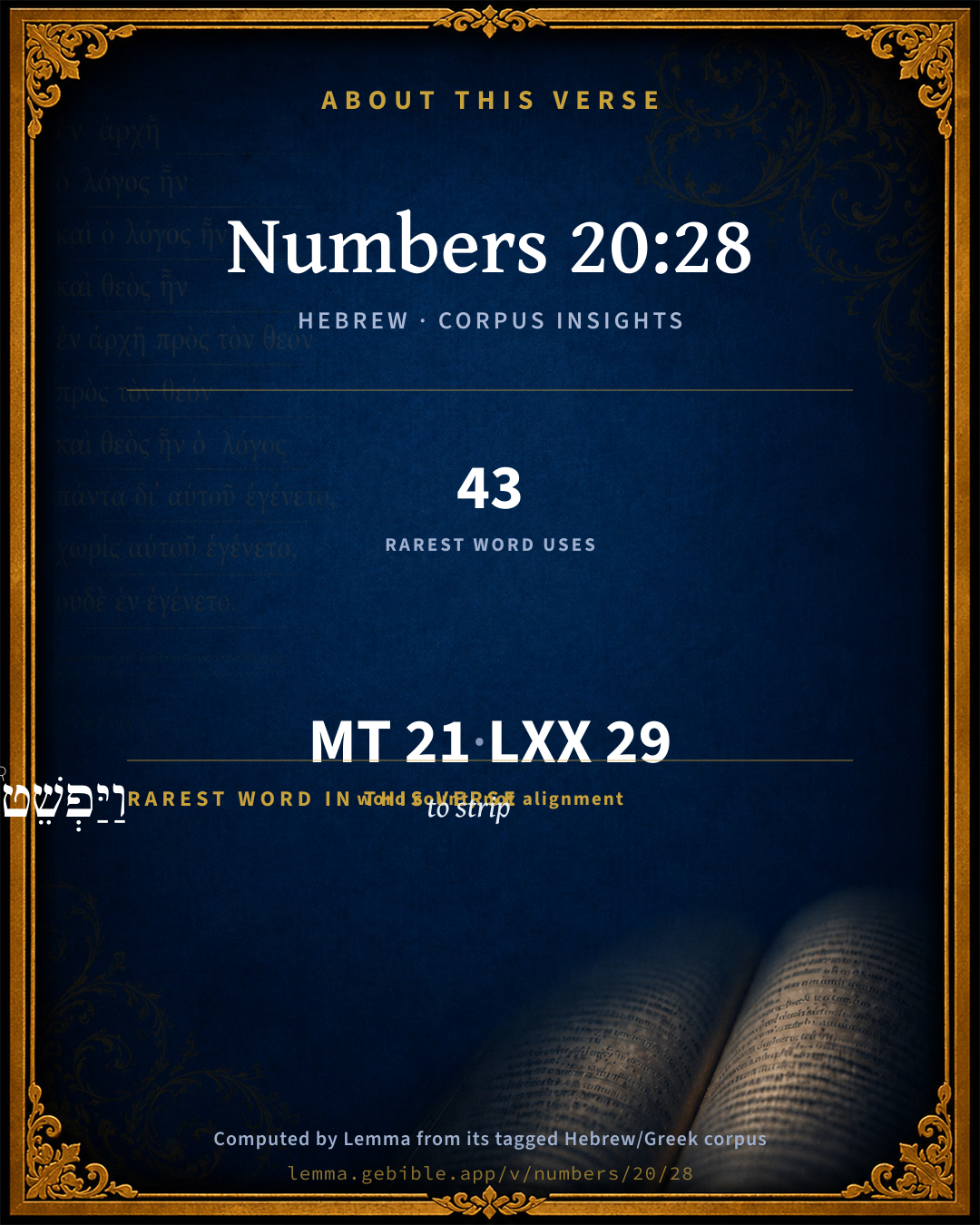
About this verse

These counts appear in no published source. They are computed here, from the morphology-tagged text and Lemma’s own curated glosses. What Lemma adds →

21
words
14
distinct lemmas
Pentateuch
section

Shared distinctive vocabulary

וַיַּפְשֵׁט֩ to strip H6584 occurs in 42 verses of the Hebrew Bible. Also found in:

Grammatical profile

  • 4 verbs
  • 11 nouns
  • 1 preposition
  • 1 adverb
  • 4 particles

Verb forms

  • וַיַּפְשֵׁט֩ Hiphil · Sequential Imperfect
  • וַיַּלְבֵּ֤שׁ Hiphil · Sequential Imperfect
  • וַיָּ֧מָת Qal · Sequential Imperfect
  • וַיֵּ֧רֶד Qal · Sequential Imperfect

Repetition

Words recur within this verse — often emphatic in Hebrew:

  • מֹשֶׁ֨ה Moses H4872 ×2
  • אַהֲרֹ֜ן Aaron H175 ×2
  • אֶלְעָזָ֣ר Eleazar H499 ×2
  • הָהָ֑ר mountain H2022 ×2

Hebrew & Septuagint length

In English translation the verse runs 32 words from the Hebrew and 32 from the Septuagint (LXX English) — the same length.

A rough comparison of the two English renderings, which tokenize alike — not a word-level alignment.

Word counts can differ between the Hebrew and the Greek without any difference in meaning — e.g. the Hebrew direct-object marker אֵת has no separate Greek word, and Greek often adds the article ὁ.

In the original languages it is 21 Hebrew tokens and 29 Greek tokens — but the two are counted differently (Hebrew bundles its prefixes and suffixes into one token; the Greek is in lemma form), so that isn’t a like-for-like length.

Cross-references

15

Topical passages linked to Numbers 20:28 in the Treasury of Scripture Knowledge — connected by theme and wording, ordered by reader-vote popularity; previews shown in the World English Bible.

  • Deuteronomy 10:6 (The children of Israel traveled from Beeroth Bene Jaakan to Moserah. There Aaron died, and there he was buried; and Eleazar his son ministered in the priest's office in his place.
  • Exodus 29:29–30 "The holy garments of Aaron shall be for his sons after him, to be anointed in them, and to be consecrated in them.
  • Numbers 20:26 and strip Aaron of his garments, and put them on Eleazar his son: and Aaron shall be gathered [to his people], and shall die there.
  • Numbers 27:16–23 Let Yahweh, the God of the spirits of all flesh, appoint a man over the congregation,
  • Numbers 33:38–49 Aaron the priest went up into Mount Hor at the commandment of Yahweh, and died there, in the fortieth year after the children of Israel were come out of the land of Egypt, in the fifth month, on the first day of the month.
  • Deuteronomy 31:7–8 Moses called to Joshua, and said to him in the sight of all Israel, Be strong and of good courage: for you shall go with this people into the land which Yahweh has sworn to their fathers to give them; and you shall cause them to inherit it.
  • Deuteronomy 32:49–50 Go up into this mountain of Abarim, to Mount Nebo, which is in the land of Moab, that is over against Jericho; and see the land of Canaan, which I give to the children of Israel for a possession;
  • Deuteronomy 34:5 So Moses the servant of Yahweh died there in the land of Moab, according to the word of Yahweh.
  • Deuteronomy 34:9 Joshua the son of Nun was full of the spirit of wisdom; for Moses had laid his hands on him: and the children of Israel listened to him, and did as Yahweh commanded Moses.
  • 1 Chronicles 22:11–12 Now, my son, Yahweh be with you; and prosper you, and build the house of Yahweh your God, as he has spoken concerning you.
  • 1 Chronicles 22:17 David also commanded all the princes of Israel to help Solomon his son, [saying],
  • 1 Chronicles 28:5–9 Of all my sons (for Yahweh has given me many sons), he has chosen Solomon my son to sit on the throne of the kingdom of Yahweh over Israel.
  • Acts 20:25–29 Now, behold, I know that you all, among whom I went about preaching the Kingdom of God, will see my face no more.
  • Hebrews 7:24–25 But he, because he lives forever, has his priesthood unchangeable.
  • 2 Peter 1:15 Yes, I will make every effort that you may always be able to remember these things even after my departure.

Cross-references courtesy of OpenBible.info (CC BY 4.0).

Hebrew and Greek witnesses Masoretic Hebrew ↔ Greek Septuagint

The same verse in the two great witnesses to the Old Testament, shown verse-for-verse.

These are two independent witnesses, not word-aligned to each other, and the Septuagint is shown in lemma (dictionary) form.

Hebrew Numbers 20:28 Masoretic · Westminster Leningrad Codex

וַיַּפְשֵׁט֩ מֹשֶׁ֨ה אֶֽת אַהֲרֹ֜ן אֶת בְּגָדָ֗יו וַיַּלְבֵּ֤שׁ אֹתָם֙ אֶת אֶלְעָזָ֣ר בְּנ֔וֹ וַיָּ֧מָת אַהֲרֹ֛ן שָׁ֖ם בְּרֹ֣אשׁ הָהָ֑ר וַיֵּ֧רֶד מֹשֶׁ֛ה וְאֶלְעָזָ֖ר מִן הָהָֽר

Moses stripped Aaron of his garments, and put them on Eleazar his son; and Aaron died there on the top of the mountain: and Moses and Eleazar came down from the mountain.

World English Bible · Public Domain

Greek LXX Numbers 20:28 Septuagint · lemma form

καί ἐκδύω ἀαρών ὁ ἱμάτιον αὐτός καί ἐνδύω αὐτός ελεαζαρ ὁ υἱός αὐτός καί ἀποθνήσκω ἀαρών ἐπί ὁ κορυφή ὁ ὄρος καί καταβαίνω μωυσῆς καί ελεαζαρ ἐκ ὁ ὄρος

And he took Aaron's garments off him, and put them on Eleazar his son, and Aaron died on the top of the mountain; and Moses and Eleazar came down from the mountain.

LXX2012 (modern English Septuagint) · Public Domain

Hebrew: Westminster Leningrad Codex (CC BY 4.0). Greek: Septuagint (public domain); English from LXX2012 (modern English Septuagint) (Public Domain). How the Septuagint differs from the Hebrew →

Targum (Aramaic paraphrase)

2

The Targum is the ancient Jewish Aramaic paraphrase of the Hebrew Scriptures — an interpretive translation, not the Hebrew text itself. Onkelos (literal) and Pseudo-Jonathan (expansive) render the Torah, and Jonathan the Prophets. Coverage is partial: where no permissively-licensed English translation exists for a verse, only the Aramaic is shown. This is verse-level text, not a word-by-word alignment to the Hebrew.

  1. Targum Onkelos Torah (Genesis–Deuteronomy)
    וְאַשְׁלַח משֶׁה יָת אַהֲרֹן יָת לְבוּשׁוֹהִי וְאַלְבִּישׁ יָתְהוֹן יָת אֶלְעָזָר בְּרֵיהּ וּמִית אַהֲרֹן תַּמָן בְּרֵישׁ טוּרָא וּנְחַת משֶׁה וְאֶלְעָזָר מִן טוּרָא

    (no public-domain English translation for this verse)

    Targum Onkelos — Aramaic: “Onkelos Genesis” (public domain); “Onkelos Exodus” (public domain); “Onkelos Leviticus” (public domain); “Onkelos Numbers” (public domain); “Onkelos Deuteronomy” (public domain). English: “Sefaria Community Translation” (CC0 1.0 (public-domain dedication)); “J.W. Etheridge. The Targums of Onkelos and Jonathan Ben Uzziel on the Pentateuch. London: Longmans, Green, 1862” (public domain). Text via Sefaria.

  2. Targum Pseudo-Jonathan Torah (Genesis–Deuteronomy)
    וְאַשְׁלַח משֶׁה יַת אַהֲרן יַת לְבוּשׁוֹי אִיקַר כְּהוּנְתָּא וְאַלְבֵּישׁ יַת אֶלְעָזָר בְּרֵיהּ וּמִית אַהֲרן תַּמָן בְּרֵישׁ טַוְוָרא וּנְחַת משֶׁה וְאֶלְעָזָר מִן טַוְורָא

    And Mosheh stripped Aharon of his vestments, the priestly decoration, and put them on Elazar his son; and Aharon died there on the summit of the mountain and Mosheh and Elazar came down from the mount.

    Targum Pseudo-Jonathan — Aramaic: “Targum Jonathan on Genesis” (public domain); “Targum Jonathan on Exodus” (public domain); “Targum Jonathan on Leviticus” (public domain); “Targum Jonathan on Numbers” (public domain); “Targum Jonathan on Deuteronomy” (public domain). English: “The Targum of Jonathan ben Uzziel, trans. J. W. Etheridge, London, 1862” (public domain). Text via Sefaria.

Commentary

Notes on Numbers 20:28 from classic Christian and Jewish commentators (each source and its license shown beneath its notes). The classic Christian expositions comment on the surrounding passage and are grouped to its opening verse, so a note may address several verses; the Jewish commentaries on the Tanakh (Rashi and others) are per-verse, so they appear only where the commentator wrote on this verse.

Lemma curates 59 commentaries, every one of them public domain or Creative Commons licensed, each selected and text-cleaned for this edition rather than reprinted as found. About our sources →

Joseph Benson's Commentary

Num 20:28. And Moses stripped Aaron — And death will strip us. Naked we came into the world; naked we must go out. We shall see little reason to be proud of our clothes, our ornaments, or marks of honour if we consider how soon death will strip us of all our glory, and take the crown off from our head! Aaron died there — He died in Mosera, Deu 10:6. Mosera was the general name of the place where that station was, and mount Hor a particular place in it. Presently after he was stripped of his priestly garments, he lay down and died. A good man would desire, if it were the will of God, not to outlive his usefulness. Why should we covet to continue any longer in this world, than while we may do God and our generation some service?

Joseph Benson's Commentary on the Old and New Testaments (1811–1818) — public domain. Text from a community e-Sword module.

Jamieson, Fausset & Brown

Robert Jamieson, A. R. Fausset & David Brown

Aaron died there in the top of the mount--(See on Deu 10:6). A tomb has been erected upon or close by the spot where he was buried.

Jamieson, Fausset & Brown — Commentary Critical and Explanatory on the Whole Bible (1871) — public domain (CC PDM 1.0). Text via the HelloAO Bible API.

Adam Clarke's Commentary

Verse 28. And Aaron died there] Hence, as Dr. Lightfoot has justly observed, we have an "indisputable proof that the earthly Canaan was not the utmost felicity at which God's promises to the Israelites aimed since the best men among them were excluded from it."

THE remark of some of the fathers here is worthy of attention: "Neither Moses the representative of the law, nor Miriam the representative of the prophets, nor Aaron the representative of the priesthood and its sacrificial rites, could bring the Israelites into possession of the promised land. This was reserved for Joshua, who was in name and conduct the lively type of our Lord and Saviour Jesus Christ." He alone can bring those who believe in his name into that rest which remains for the people of God.

There are some observations made by Dr. Lightfoot on this and some of the preceding chapters which should be more generally known.

"The place where the people murmured upon the return of the spies was Kadesh-Barnea, Nu 13:26; Nu 32:8; De 1:19. This place was called Rithmah before, (Nu 33:18, compared with Nu 12:16, and Nu 13:26), and was so called probably from the juniper trees that grew there; but is now named Kadesh, because the Lord was there sanctified upon the people, as Nu 20:13; and Barnea, or the wandering son, because here was the decree made of their long wandering in the wilderness. They continued a good space at Kadesh before they removed; for so said Moses, Ye abode in Kadesh many days; or as the Hebrew, According to the days that ye had made abode, namely, at Sinai, Nu 20:6. And so they spent one whole year there, for so they had done at Sinai. And whereas God commands them at their murmuring to turn back to the Red Sea, (De 1:40), his meaning was, that at their next march, whensoever it was, they should not go forward unto Canaan, but back again towards the Red Sea, whence they came; (but see on De 1:1). And they did so, for they wandered by many stations and marches from Kadesh-Barnea till they came to Kadesh-Barnea again, seven or eight and thirty years after they had first left it. These marches, mentioned in Nu 33:1-49, were these: From Kadesh or Rithmah to Rimmon Parez, to Libnah, to Rissah, to Kehelathah, to Mount Shapher, to Haradah, to Makheloth, to Tahath, to Tarah, to Mithcah, to Hashmonah, to Moseroth, to Benejaaken, to Horhagidgad, to Jotbathah, to Ebronah, to Ezion-Gaber, to Kadesh again, in the fortieth year. And though it was only eleven days' journey from Horeb, by the way of Mount Seir to Kadesh-Barnea, (De 1:2), they made it above thrice eleven years' journey!" Had they trusted in God, and obeyed him, their enemies long ere this would have been discomfited, and themselves quietly established in possession of the promised inheritance. But they grieved the Spirit of God, and did not believe his promise; and it would have been inconsistent with the whole economy of grace to have introduced unbelievers into that rest which was a type of the kingdom of God.

Adam Clarke's Commentary on the Bible (1810–1826) — public domain. Text from a community e-Sword/MySword module.

Ellicott's Commentary for English Readers

(28) And Aaron died there in the top of the mount.—The date of Aaron’s death, as we learn from Num_33:38, was the first day of the fifth month, in the fortieth year after the exodus, and his age a hundred and twenty-three years (Num_33:39), which accords with the statement contained in Exo_7:7, that “Moses was fourscore years old, and Aaron fourscore and three years old, when they spake unto Pharaoh.” The difference in the circumstances of the death of the two brothers is remarkable. Both Moses and Aaron were excluded from the land of promise by reason of transgression. Both died upon the top of a mountain. But whilst Moses died in solitary grandeur, and the place of his burial was unknown, Aaron ascended the mount “in the sight of all the people,” and died in the presence of Moses and Eleazar. The death of Aaron was an indication of the imperfection of the Levitical priesthood. “They truly were many priests, because they were not suffered to continue by reason of death; but this man because he continueth ever, hath an unchangeable priesthood” (Heb_7:23-24).

A Bible Commentary for English Readers, edited by Charles John Ellicott (1878–1897) — public domain. Text from a community e-Sword module.

John Gill's Exposition

And when all the congregation saw that Aaron was dead,.... Not that they saw his dead body, but they perceived by the relation of Moses, and by various circumstances, as not seeing Aaron come down, whom they saw go up, and seeing Eleazar with Aaron's garments on him, and perhaps by tokens of mourning in Moses and Eleazar; so the Targums of Jonathan and Jerusalem say, they saw them come down from the top of the mountain, with their garments rent, and ashes on their heads, weeping and lamenting:

they mourned for Aaron thirty days; the whole month out; so long public mourning with the Jews lasted, as Josephus (m) relates:

even all the house of Israel; men and women, as the Targum of Jonathan, and so Jarchi: no doubt it was for the amiable virtues and abundant grace that were in him, and the many services he had done for them, both before and since he was invested with the priestly office; and oftentimes the memory of such things is revived after the death of a good man, which are not so much taken notice of in his life, nor he be thanked for them, or have honour and respect shown him on account of them; but when dead, he, and what he has done, are spoken well of, and his loss lamented.

(m) De Bello Jud. l. 3. c. 8. sect. 5.

Next: Numbers Chapter 21

John Gill's Exposition of the Whole Bible (1746–1763) — public domain (CC PDM 1.0). Text via the HelloAO Bible API.

Matthew Poole's English Annotations

Aaron died there, to wit, in Mount Hor.

Object. He died in Mosera, Deu 10:6.

Answ. Mosera was the general name of the place where that station was, and Mount Hor is a particular place in it, where he died, and was buried also, Deu 10:6.

Matthew Poole's English Annotations on the Holy Bible (1683–1685) — public domain. Text from a community e-Sword/MySword module.

Whedon's Commentary on the Bible

Daniel D. Whedon

28. Aaron died there in the top of the mount — The chapel of Aaron’s tomb stands on the traditional spot. The chief interest of Mount Hor will always consist in the prospect from its summit — the last view of Aaron. Says Stanley, “We saw all the main points on which his eye must have rested. He looked over the valley of the Arabah, countersected by its hundred water-courses, and beyond over the white mountains of the wilderness they had so long traversed; at the northern edge of it there must have been visible the heights through which the Israelites had vainly attempted to force their way into the Promised Land. This was the western view. Close around him on the east were the rugged mountains of Edom, and far along the horizon the wide downs of Mount Seir, through which the passage had been denied by the wild tribes of Esau, who hunted over their long slopes. A dreary moment and a dreary scene. Such it must have seemed to the aged priest.”

Daniel D. Whedon (gen. ed.), Commentary on the Old and New Testaments (1874–1909) — public domain. Text from a community e-Sword module.

The Pulpit Commentary

Moses stripped Aaron of his garments, and put them upon Eleazar his son. This was done in token that the office was transferred; it was done out of sight, and far above, in token that the priesthood was perpetual, although the priest was mortal. Aaron died there. In this ease, as in that of Miriam (verse 1), and of Moses himself, (Deu_34:5) no details are given. God drew as it were a veil over a departure hence which could but be very sad, because it was in a special sense the wages of sin. We may perhaps conclude that Aaron died alone, and was buried, as Moses was, by God; otherwise Moses and Eleazar would have been unclean under the law of Num_19:11. (cf. also Lev_21:11)

The Pulpit Commentary (1880–1919), ed. H.D.M. Spence-Jones & Joseph S. Exell — public domain. Text from a community e-Sword module.

John Wesley's Explanatory Notes

And Moses stript Aaron - And Death will strip us. Naked we came into the world: naked we must go out. We shall see little reason to be proud of our cloaths, our ornaments, or marks of honour, if we consider how soon death will strip us of all our glory, and take the crown off from our head! Aaron died there - He died in Mosera, Deut. x, 6. Mosera was the general name of the place where that station was, and mount Hor a particular place in it. Presently after he was stript of his priestly garments, he laid him down and died. A good man would desire, if it were the will of God, not to outlive his usefulness. Why should we covet to continue any longer in this world, than while we may do God and our generation some service?

John Wesley, Explanatory Notes Upon the Whole Bible (1754–1765) — public domain. Text via the GEBible commentary corpus.

Scofield Reference Notes

C. I. Scofield

died

The death of Aaron marks the end of the wanderings. Henceforth Israel marches or halts, but does not wander.

(See Scofield "Num 15:1").

The Scofield Reference Bible (1917 edition), notes by C. I. Scofield — public domain. Text from a community e-Sword module.

Lesson kit

Teaching starters — assembled from the data on this page, not authored interpretation. Every prompt links to the verse data it draws on. Edit before teaching.

Numbers, in the Pentateuch, opens this verse with 21 words (14 distinct Hebrew lemmas). Its most distinctive word is pâshaṭ (“to strip”). A historical commentator’s framing appears above. Read the whole chapter for the surrounding context.

Discussion questions

  1. The word pâshaṭ carries the sense “to strip.” How does it shape the verse?
  2. Genesis 37:23 shares the word «to strip» with this verse. How do the two illuminate each other?
  3. “Moses” occurs 2× in this one verse. What is the effect of the repetition?
  4. These translations render this verse differently. What is at stake in choosing one wording over another?
  5. The verb «וַיַּפְשֵׁט֩» is Hiphil Sequential Imperfect. How does its form color the action?
  6. Reading how Joseph Benson's Commentary and Jamieson, Fausset & Brown read this verse, where do the two commentators agree and where do they part?

Things to notice

Reading settings

Reading text

Shown beneath each verse's original-language words.

Old Testament
Old Testament edition

Read the OT as the Masoretic Hebrew (MT) or the Greek Septuagint (LXX).

English shown for the Greek Septuagint (in the Hebrew ↔ Greek comparison).

Comparing translations? Open the Compare panel on any verse page to stack up to four side by side.