Genesis 44:9

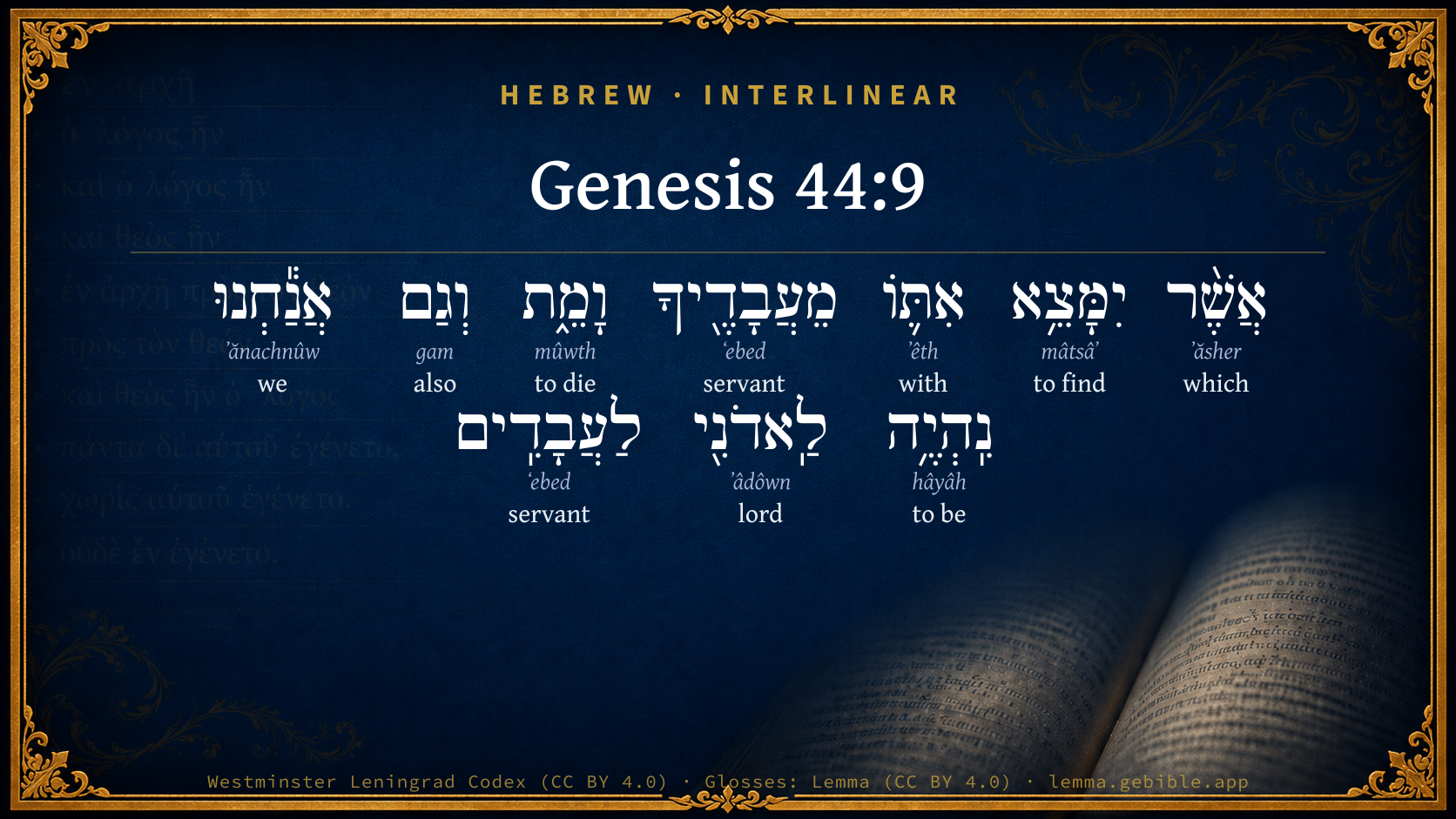
Hebrew (Westminster Leningrad Codex) Genesis 44:9 appears in the Hebrew Old Testament. The text above is from the Westminster Leningrad Codex. Each word links to its Strong’s number, a concise gloss, and parsing drawn from the Open Scriptures Hebrew Bible morphology. Click any word for its full Brown-Driver-Briggs (BDB) entry.
Download image
Cite this verse

Genesis 44:9 (World English Bible). Public Domain. Lemma interlinear Bible study tool, https://lemma.gebible.app/v/genesis/44/9.

Show BibTeX & RIS
BibTeX
RIS
English Translation
With whoever of your servants it be found, let him die, and we also will be my lord's bondservants."
World English Bible · Public Domain
Download a study sheet

One document with this verse’s original text, its word-by-word gloss line, the meaning frame, cross-references with their text, attributed commentary, and full source and license credits — printable, and it pastes into notes with its structure intact.

This verse Autodidact and up

Study sheet (.html) Plain text (.txt)

A passage Seminary Student

Up to 50 verses in one chapter. A passage sheet keeps up to 6 commentary sources and 12 cross-references per verse, in the order this page ranks them, and says so on the sheet whenever that leaves anything out. Ask for a single verse and you get the Autodidact verse sheet above.

Everything on this page stays free to read, with no account — the sheet is a download of what is already on screen, not access to it.

Want to remove ads? Support Godless Engineer
Compare translations 3

The same verse in 3 English versions, stacked beneath the original-language interlinear above. Click any original word for its lexicon entry.

Each is an independent rendering of the whole verse — the interlinear is not word-aligned to these translations.

Highlighted words mark where these versions differ — a whole-verse word diff, not a word-by-word alignment.

  • World English Bible Public Domain
    With whoever of your servants it be found, let him die, and we also will be my lord's bondservants."
  • King James Version Public Domain
    With whomsoever of thy servants it be found, both let him die, and we also will be my lord's bondmen.
  • unfoldingWord Literal Text CC BY-SA 4.0
    Whoever of your servants is found with it, then he will die, and we also will be slaves for my lord.”

unfoldingWord Literal Text — © unfoldingWord, licensed CC BY-SA 4.0. Word-aligned USFM3 via Door43 (git.door43.org/unfoldingWord/en_ult).

Versions to compare (up to 4)

3 of 4 selected

Show all 18 translations

Every available English version of this verse, each an independent rendering of the whole verse.

  • World English Bible Public Domain
    With whoever of your servants it be found, let him die, and we also will be my lord's bondservants."
  • Berean Standard Bible Public Domain
    If any of your servants is found to have it, he must die, and the rest will become slaves of my lord.”
  • Majority Standard Bible Public Domain
    If any of your servants is found to have it, he must die, and the rest will become slaves of my lord.”
  • King James Version Public Domain
    With whomsoever of thy servants it be found, both let him die, and we also will be my lord's bondmen.
  • American Standard Version (1901) Public Domain
    With whomsoever of thy servants it be found, let him die, and we also will be my lord's bondmen.
  • Revised Version (1885) Public Domain
    With whomsoever of thy servants it be found, let him die, and we also will be my lord’s bondmen.
  • Geneva Bible (1599) Public Domain
    With whomesoeuer of thy seruants it bee found, let him dye, and we also will be my lordes bondmen.
  • Douay-Rheims (1899) Public Domain
    With whomsoever of thy servants shall be found that which thou seekest, let him die, and we will be the bondmen of my lord.
  • Young's Literal Translation Public Domain
    with whomsoever of thy servants it is found, he hath died, and we also are to my lord for servants.'
  • Literal Standard Version CC BY-SA 4.0
    With whomsoever of your servants it is found, he has died, and we also are to my lord for servants.”
  • Unlocked Literal Bible CC BY-SA 4.0
    With whomever of your servants it is found, let him die, and we also will be my master's slaves.”
  • unfoldingWord Literal Text CC BY-SA 4.0
    Whoever of your servants is found with it, then he will die, and we also will be slaves for my lord.”
  • Darby Bible Public Domain
    With whomsoever of thy servants it is found, let him die; and we also will be my lord's bondmen.
  • World Messianic Bible Public Domain
    With whomever of your servants it is found, let him die, and we also will be my lord’s slaves.”
  • Webster's Bible Public Domain
    With whom soever of thy servants it shall be found, both let him die, and we also will be my lord's bond-men.
  • Free Bible Version CC BY-SA 4.0
    If any one of us is found with it, he shall die, and all of us will become your slaves.”
  • Bible in Basic English Public Domain
    If it comes to light that any of your servants has done this, let him be put to death, and we will be your lord's servants.
  • JPS Tanakh (1917) Public Domain
    With whomsoever of thy servants it be found, let him die, and we also will be my lord's bondmen.'

Literal Standard Version (2020), Covenant Press — licensed CC BY-SA 4.0. Text via the HelloAO Bible API (eBible.org). Unlocked Literal Bible (unfoldingWord) — licensed CC BY-SA 4.0. Text via the HelloAO Bible API (eBible.org). unfoldingWord Literal Text — © unfoldingWord, licensed CC BY-SA 4.0. Word-aligned USFM3 via Door43 (git.door43.org/unfoldingWord/en_ult). Free Bible Version, Dr. Jonathan Gallagher — licensed CC BY-SA 4.0. Text via the HelloAO Bible API (eBible.org).

Word by word

More ways to search: Search by grammar → Find every occurrence → Compare this word →

Practice this passage: Drill this verse → Learn its vocabulary →

אֲנַ֕חְנוּ
ʼănachnûw
H587
“we”
Pronoun, Personal, 1st Person, Common, Plural
Part of Speech
Pronoun
Type
Personal
Person
1st Person
Gender
Common
Number
Plural
Full BDB Definition

Origin: apparently from H595

TWOT: 128

we (first person plural - usually used for emphasis)
  1. אֲשֶׁ֨ר ʼăsher H834 “which” Particle, Relative
  2. יִמָּצֵ֥א mâtsâʼ H4672 “to find” Verb, Niphal, Imperfect, 3rd Person, Masculine, Singular
  3. אִתּ֛וֹ ʼêth H854 “with · him” Preposition + Suffix, Personal, 3rd Person, Masculine, Singular
  4. מֵעֲבָדֶ֖יךָ ʻebed H5650 “from · servants · your” Preposition + Noun, Common, Masculine, Plural, Construct + Suffix, Personal, 2nd Person, Masculine, Singular
  5. וָמֵ֑ת mûwth H4191 “and · to die” Conjunction + Verb, Qal, Sequential Perfect, 3rd Person, Masculine, Singular
  6. וְגַם gam H1571 “and · also” Conjunction + Particle, Accusative
  7. נִֽהְיֶ֥ה hâyâh H1961 “to be” Verb, Qal, Imperfect, 1st Person, Common, Plural
  8. לַֽאדֹנִ֖י ʼâdôwn H113 “to/for · lord · my” Preposition + Noun, Common, Masculine, Singular, Construct + Suffix, Personal, 1st Person, Common, Singular
  9. לַעֲבָדִֽים ʻebed H5650 “to/for · servants” Preposition + Noun, Common, Masculine, Plural, Absolute

About this verse

These counts appear in no published source. They are computed here, from the morphology-tagged text and Lemma’s own curated glosses. What Lemma adds →

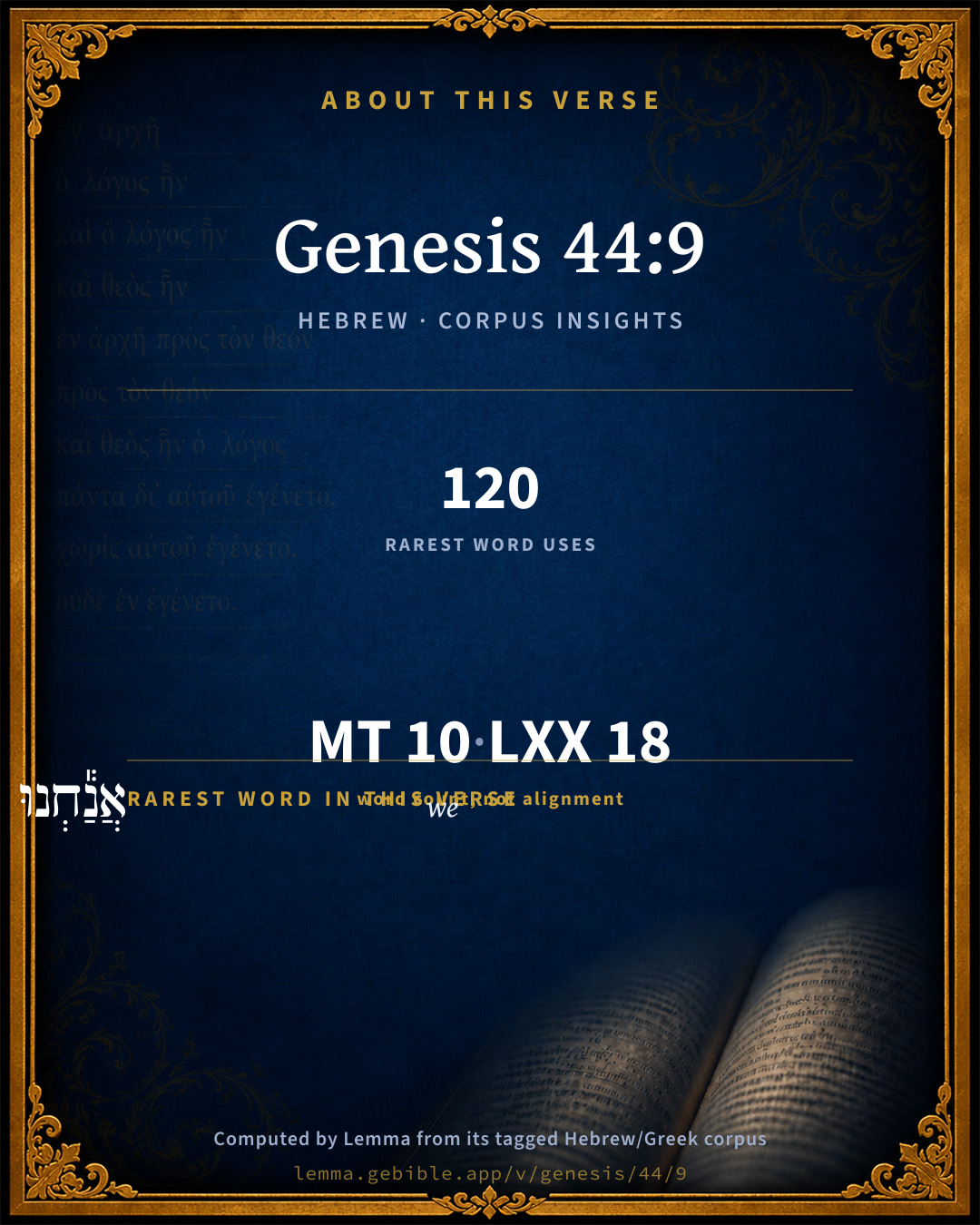
10
words
9
distinct lemmas
Pentateuch
section

Grammatical profile

  • 3 verbs
  • 3 nouns
  • 1 pronoun
  • 1 preposition
  • 2 particles

Verb forms

  • יִמָּצֵ֥א Niphal · Imperfect
  • וָמֵ֑ת Qal · Sequential Perfect
  • נִֽהְיֶ֥ה Qal · Imperfect

Repetition

A word recurs within this verse — often emphatic in Hebrew:

  • מֵעֲבָדֶ֖יךָ servant H5650 ×2

Hebrew & Septuagint length

In English translation the verse runs 19 words from the Hebrew and 22 from the Septuagint (LXX English) — closely comparable.

A rough comparison of the two English renderings, which tokenize alike — not a word-level alignment.

Word counts can differ between the Hebrew and the Greek without any difference in meaning — e.g. the Hebrew direct-object marker אֵת has no separate Greek word, and Greek often adds the article ὁ.

In the original languages it is 10 Hebrew tokens and 18 Greek tokens — but the two are counted differently (Hebrew bundles its prefixes and suffixes into one token; the Greek is in lemma form), so that isn’t a like-for-like length.

Cross-references

6

Topical passages linked to Genesis 44:9 in the Treasury of Scripture Knowledge — connected by theme and wording, ordered by reader-vote popularity; previews shown in the World English Bible.

  • Genesis 31:32 With whoever you find your gods, he shall not live. Before our relatives, discern what is yours with me, and take it." For Jacob didn't know that Rachel had stolen them.
  • Genesis 43:18 The men were afraid, because they were brought to Joseph's house; and they said, "Because of the money that was returned in our sacks at the first time are we brought in; that he may seek occasion against us, and fall on us, and take us for bondservants, along with our donkeys."
  • Genesis 44:16 Judah said, "What will we tell my lord? What will we speak? Or how will we clear ourselves? God has found out the iniquity of your servants. Behold, we are my lord's bondservants, both we, and he also in whose hand the cup is found."
  • Job 31:38–40 If my land cries out against me, And the furrows of it weep together;
  • Psalms 7:3–5 Yahweh, my God, if I have done this, If there is iniquity in my hands,
  • Acts 25:11 For if I have done wrong, and have committed anything worthy of death, I don't refuse to die; but if none of those things is true that they accuse me of, no one can give me up to them. I appeal to Caesar!"

Cross-references courtesy of OpenBible.info (CC BY 4.0).

Hebrew and Greek witnesses Masoretic Hebrew ↔ Greek Septuagint

The same verse in the two great witnesses to the Old Testament, shown verse-for-verse.

These are two independent witnesses, not word-aligned to each other, and the Septuagint is shown in lemma (dictionary) form.

Hebrew Genesis 44:9 Masoretic · Westminster Leningrad Codex

אֲשֶׁ֨ר יִמָּצֵ֥א אִתּ֛וֹ מֵעֲבָדֶ֖יךָ וָמֵ֑ת וְגַם אֲנַ֕חְנוּ נִֽהְיֶ֥ה לַֽאדֹנִ֖י לַעֲבָדִֽים

With whoever of your servants it be found, let him die, and we also will be my lord's bondservants."

World English Bible · Public Domain

Greek LXX Genesis 44:9 Septuagint · lemma form

παρά ὅς ἄν εὑρίσκω ὁ κόνδυ ὁ παῖς σύ ἀποθνήσκω καί ἐγώ δέ εἰμί παῖς ὁ κύριος ἐγώ

With whoever of your servants you shall find the cup, let him die; and, moreover, we will be servants to our lord.

LXX2012 (modern English Septuagint) · Public Domain

Hebrew: Westminster Leningrad Codex (CC BY 4.0). Greek: Septuagint (public domain); English from LXX2012 (modern English Septuagint) (Public Domain). How the Septuagint differs from the Hebrew →

Targum (Aramaic paraphrase)

2

The Targum is the ancient Jewish Aramaic paraphrase of the Hebrew Scriptures — an interpretive translation, not the Hebrew text itself. Onkelos (literal) and Pseudo-Jonathan (expansive) render the Torah, and Jonathan the Prophets. Coverage is partial: where no permissively-licensed English translation exists for a verse, only the Aramaic is shown. This is verse-level text, not a word-by-word alignment to the Hebrew.

  1. Targum Onkelos Torah (Genesis–Deuteronomy)
    דִּי יִשְׁתְּכַח עִמֵּהּ מֵעַבְדָיךְ וּמִית וְאַף אַנַחְנָא נְהֵי לְרִבּוֹנִי לְעַבְדִין

    (no public-domain English translation for this verse)

    Targum Onkelos — Aramaic: “Onkelos Genesis” (public domain); “Onkelos Exodus” (public domain); “Onkelos Leviticus” (public domain); “Onkelos Numbers” (public domain); “Onkelos Deuteronomy” (public domain). English: “Sefaria Community Translation” (CC0 1.0 (public-domain dedication)); “J.W. Etheridge. The Targums of Onkelos and Jonathan Ben Uzziel on the Pentateuch. London: Longmans, Green, 1862” (public domain). Text via Sefaria.

  2. Targum Pseudo-Jonathan Torah (Genesis–Deuteronomy)
    דִי יִשְׁתְּכַח עִמֵיהּ מֵעַבְדָךְ יְהִי חַיָיב קְטוֹל וְאוּף אֲנַן נְהִי לְרִבּוֹנִי לְעַבְדִין

    With whomsoever of thy servants it shall be found, let him be guilty of death, and we also will be slaves of thy lord.

    Targum Pseudo-Jonathan — Aramaic: “Targum Jonathan on Genesis” (public domain); “Targum Jonathan on Exodus” (public domain); “Targum Jonathan on Leviticus” (public domain); “Targum Jonathan on Numbers” (public domain); “Targum Jonathan on Deuteronomy” (public domain). English: “The Targum of Jonathan ben Uzziel, trans. J. W. Etheridge, London, 1862” (public domain). Text via Sefaria.

Commentary

Notes on Genesis 44:9 from classic Christian and Jewish commentators (each source and its license shown beneath its notes). The classic Christian expositions comment on the surrounding passage and are grouped to its opening verse, so a note may address several verses; the Jewish commentaries on the Tanakh (Rashi and others) are per-verse, so they appear only where the commentator wrote on this verse.

Lemma curates 59 commentaries, every one of them public domain or Creative Commons licensed, each selected and text-cleaned for this edition rather than reprinted as found. About our sources →

Trapp's Complete Commentary

John Trapp

Gen 44:9 With whomsoever of thy servants it be found, both let him die, and we also will be my lord’s bondmen.

Ver. 9. With whomsoever it be found, &c.] Innocency is bold, but withal had need to be wise, for fear of further inconvenience. {See Trapp on "Gen 31:32"}

John Trapp, A Commentary or Exposition upon All the Books of the Old and New Testament (1647–1656) — public domain. Text from a community e-Sword module.

Tyndale Open Study Notes

Tyndale Open Resources

44:9-10 The punishment that the brothers proposed was harsher than necessary; it was normal in antiquity to stake your life on what you said. The palace manager was agreeable but enforced a punishment that matched Joseph’s intentions (44:17).

Tyndale Open Study Notes — © Tyndale Open Resources, licensed CC BY-SA 4.0. Text via the HelloAO Bible API.

The Cambridge Bible for Schools and Colleges

gen. ed. J. J. S. Perowne

9. With whomsoever] Joseph’s brethren propose the harshest possible penalty, death for the thief, and slavery for all the company. Cf. Jacob’s proposal in Gen_31:32.

The Cambridge Bible for Schools and Colleges (gen. ed. J. J. S. Perowne; Cambridge University Press, 1878–1918) — public domain. Text from a community e-Sword module.

John Gill's Exposition

With whomsoever of thy servants it be found,.... The silver cup:

both let him die; which was rashly said, since they might have thought the cup might be put in one of their sacks unknown to them, as their money had been before; and besides, death was a punishment too severe for such a crime, and therefore is by the steward himself moderated; but this they said the more strongly to express their innocence:

and we also will be my lord's bondmen; his servants, as long as they lived: this was likewise carrying the matter too far, and exceeding all bounds of justice, which could only require satisfaction of the offender.

John Gill's Exposition of the Whole Bible (1746–1763) — public domain (CC PDM 1.0). Text via the HelloAO Bible API.

Matthew Poole's English Annotations

This overdaring offer proceeded from hence, that they were all conscious of their own innocency, and did not suspect any fraud or artifice in the matter.

Matthew Poole's English Annotations on the Holy Bible (1683–1685) — public domain. Text from a community e-Sword/MySword module.

Whedon's Commentary on the Bible

Daniel D. Whedon

9. Let him die — Their words on the occasion show the intensity of their feeling and excitement, and their entire action evinced their consciousness of innocency as to the charge of stealing the cup.

Daniel D. Whedon (gen. ed.), Commentary on the Old and New Testaments (1874–1909) — public domain. Text from a community e-Sword module.

Lesson kit

Teaching starters — assembled from the data on this page, not authored interpretation. Every prompt links to the verse data it draws on. Edit before teaching.

Genesis, in the Pentateuch, opens this verse with 10 words (9 distinct Hebrew lemmas). Its most distinctive word is ʼănachnûw (“we”). A historical commentator’s framing appears above. Read the whole chapter for the surrounding context.

Discussion questions

  1. How does “we” (ʼănachnûw) shape what this verse is saying?
  2. How does Genesis 31:32, which shares this passage’s theme, read alongside this verse?
  3. What does the repetition of “servant” (2× in this one verse) do in this verse?
  4. These translations render this verse differently. What is at stake in choosing one wording over another?
  5. «יִמָּצֵ֥א» is a Niphal Imperfect verb. How does that grammatical form shape the action described?
  6. Compare how Trapp's Complete Commentary and Tyndale Open Study Notes read this verse. Where do they agree or differ?

Things to notice

Reading settings

Reading text

Shown beneath each verse's original-language words.

Old Testament
Old Testament edition

Read the OT as the Masoretic Hebrew (MT) or the Greek Septuagint (LXX).

English shown for the Greek Septuagint (in the Hebrew ↔ Greek comparison).

Comparing translations? Open the Compare panel on any verse page to stack up to four side by side.