
Numbers 4:15

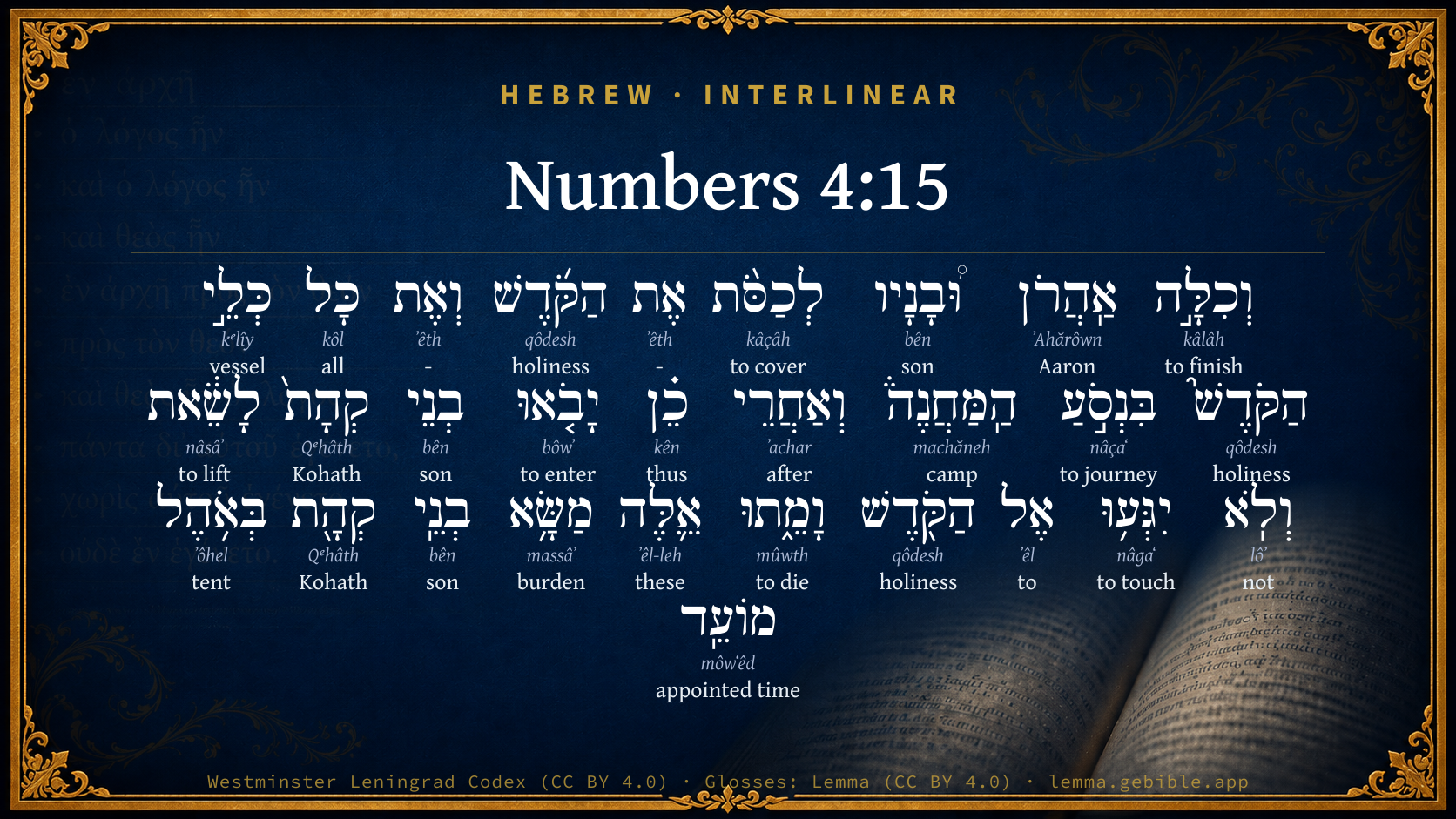
Hebrew (Westminster Leningrad Codex) Numbers 4:15 appears in the Hebrew Old Testament. The text above is from the Westminster Leningrad Codex. Each word links to its Strong’s number, a concise gloss, and parsing drawn from the Open Scriptures Hebrew Bible morphology. Click any word for its full Brown-Driver-Briggs (BDB) entry.
Download image
Cite this verse

Numbers 4:15 (World English Bible). Public Domain. Lemma interlinear Bible study tool, https://lemma.gebible.app/v/numbers/4/15.

Show BibTeX & RIS
BibTeX
RIS
English Translation
"When Aaron and his sons have finished covering the sanctuary, and all the furniture of the sanctuary, as the camp moves forward; after that, the sons of Kohath shall come to carry it: but they shall not touch the sanctuary, lest they die. These things are the burden of the sons of Kohath in the Tent of Meeting.
World English Bible · Public Domain
Download a study sheet

One document with this verse’s original text, its word-by-word gloss line, the meaning frame, cross-references with their text, attributed commentary, and full source and license credits — printable, and it pastes into notes with its structure intact.

This verse Autodidact and up

Study sheet (.html) Plain text (.txt)

A passage Seminary Student

Up to 50 verses in one chapter. A passage sheet keeps up to 6 commentary sources and 12 cross-references per verse, in the order this page ranks them, and says so on the sheet whenever that leaves anything out. Ask for a single verse and you get the Autodidact verse sheet above.

Everything on this page stays free to read, with no account — the sheet is a download of what is already on screen, not access to it.

Want to remove ads? Support Godless Engineer
Compare translations 3

The same verse in 3 English versions, stacked beneath the original-language interlinear above. Click any original word for its lexicon entry.

Each is an independent rendering of the whole verse — the interlinear is not word-aligned to these translations.

Highlighted words mark where these versions differ — a whole-verse word diff, not a word-by-word alignment.

  • World English Bible Public Domain
    "When Aaron and his sons have finished covering the sanctuary, and all the furniture of the sanctuary, as the camp moves forward; after that, the sons of Kohath shall come to carry it: but they shall not touch the sanctuary, lest they die. These things are the burden of the sons of Kohath in the Tent of Meeting.
  • King James Version Public Domain
    And when Aaron and his sons have made an end of covering the sanctuary, and all the vessels of the sanctuary, as the camp is to set forward; after that, the sons of Kohath shall come to bear it: but they shall not touch any holy thing, lest they die. These things are the burden of the sons of Kohath in the tabernacle of the congregation.
  • unfoldingWord Literal Text CC BY-SA 4.0
    And Aaron and his sons shall finish to cover the holy place and all the vessels of the holy place when the camp sets out. And after that the sons of Kohath shall come to carry, and they shall not touch the holy place and die. These are the burden of the sons of Kohath in the tent of meeting.

unfoldingWord Literal Text — © unfoldingWord, licensed CC BY-SA 4.0. Word-aligned USFM3 via Door43 (git.door43.org/unfoldingWord/en_ult).

Versions to compare (up to 4)

3 of 4 selected

Show all 18 translations

Every available English version of this verse, each an independent rendering of the whole verse.

  • World English Bible Public Domain
    "When Aaron and his sons have finished covering the sanctuary, and all the furniture of the sanctuary, as the camp moves forward; after that, the sons of Kohath shall come to carry it: but they shall not touch the sanctuary, lest they die. These things are the burden of the sons of Kohath in the Tent of Meeting.
  • Berean Standard Bible Public Domain
    When Aaron and his sons have finished covering the holy objects and all their equipment, as soon as the camp is ready to move, the Kohathites shall come and do the carrying. But they must not touch the holy objects, or they will die. These are the transportation duties of the Kohathites regarding the Tent of Meeting.
  • Majority Standard Bible Public Domain
    When Aaron and his sons have finished covering the holy objects and all their equipment, as soon as the camp is ready to move, the Kohathites shall come and do the carrying. But they must not touch the holy objects, or they will die. These are the transportation duties of the Kohathites regarding the Tent of Meeting.
  • King James Version Public Domain
    And when Aaron and his sons have made an end of covering the sanctuary, and all the vessels of the sanctuary, as the camp is to set forward; after that, the sons of Kohath shall come to bear it: but they shall not touch any holy thing, lest they die. These things are the burden of the sons of Kohath in the tabernacle of the congregation.
  • American Standard Version (1901) Public Domain
    And when Aaron and his sons have made an end of covering the sanctuary, and all the furniture of the sanctuary, as the camp is set forward; after that, the sons of Kohath shall come to bear it: but they shall not touch the sanctuary, lest they die. These things are the burden of the sons of Kohath in the tent of meeting.
  • Revised Version (1885) Public Domain
    And when Aaron and his sons have made an end of covering the sanctuary, and all the furniture of the sanctuary, as the camp is to set forward; after that, the sons of Kohath shall come to bear it: but they shall not touch the sanctuary, lest they die. These things are the burden of the sons of Kohath in the tent of meeting.
  • Geneva Bible (1599) Public Domain
    And when Aaron and his sonnes haue made an ende of couering the Sanctuarie, and al the instruments of the Sanctuarie, at the remouing of the host, afterward the sonnes of Kohath shall come to beare it, but they shall not touch any holy thing, lest they dye. This is the charge of the sonnes of Kohath in the Tabernacle of the Congregation.
  • Douay-Rheims (1899) Public Domain
    And when Aaron and his sons have wrapped up the sanctuary and the vessels thereof at the removing of the camp, then shall the sons of Caath enter in to carry the things wrapped up: and they shall not touch the vessels of the sanctuary, lest they die. These are the burdens of the sons of Caath: in the tabernacle of the covenant:
  • Young's Literal Translation Public Domain
    `And Aaron hath finished -- his sons also -- covering the sanctuary, and all the vessels of the sanctuary, in the journeying of the camp, and afterwards do the sons of Kohath come in to bear `it', and they do not come unto the holy thing, that they have died; these `things are' the burden of the sons of Kohath in the tent of meeting.
  • Literal Standard Version CC BY-SA 4.0
    And Aaron has finished—his sons also—covering the holy place, and all the vessels of the holy place, in the journeying of the camp, and afterward the sons of Kohath come in to carry [it], and they do not come to the holy thing, lest they have died; these [things are] the burden of the sons of Kohath in the Tent of Meeting.
  • Unlocked Literal Bible CC BY-SA 4.0
    When Aaron and his sons have completely covered the holy place and all its equipment, and when the camp moves forward, then the descendants of Kohath must come to carry the holy place. If they touch the holy instruments, they must die. This is the work of the descendants of Kohath, to carry the furnishings in the tent of meeting.
  • unfoldingWord Literal Text CC BY-SA 4.0
    And Aaron and his sons shall finish to cover the holy place and all the vessels of the holy place when the camp sets out. And after that the sons of Kohath shall come to carry, and they shall not touch the holy place and die. These are the burden of the sons of Kohath in the tent of meeting.
  • Darby Bible Public Domain
    And when Aaron and his sons have ended covering the sanctuary, and all the utensils of the sanctuary, when the camp setteth forward, then afterwards the sons of Kohath shall come to carry it; but they shall not touch the holy things, lest they die. This is what the sons of Kohath have to carry in the tent of meeting.
  • World Messianic Bible Public Domain
    “When Aaron and his sons have finished covering the sanctuary and all the furniture of the sanctuary, as the camp moves forward; after that, the sons of Kohath shall come to carry it; but they shall not touch the sanctuary, lest they die. The sons of Kohath shall carry these things belonging to the Tent of Meeting.
  • Webster's Bible Public Domain
    And when Aaron and his sons have made an end of covering the sanctuary, and all the vessels of the sanctuary, as the camp is to move forward; after that, the sons of Kohath shall come to bear it: but they shall not touch any holy thing, lest they die. These things are the burden of the sons of Kohath in the tabernacle of the congregation.
  • Free Bible Version CC BY-SA 4.0
    Once Aaron and his sons have finished covering these holy things and all the equipment connected with them, when the camp is ready to move, the priests of the Kohath family are to come and carry them. But they are forbidden to touch anything holy, otherwise they'll die. These are their responsibilities for moving the Tent of Meeting.
  • Bible in Basic English Public Domain
    And after the holy place and all its vessels have been covered up by Aaron and his sons, when the tents of the people go forward, the sons of Kohath are to come and take it up; but the holy things may not be touched by them for fear of death.
  • JPS Tanakh (1917) Public Domain
    And when Aaron and his sons have made an end of covering the holy furniture, and all the holy vessels, as the camp is to set forward — after that, the sons of Kohath shall come to bear them; but they shall not touch the holy things, lest they die. These things are the burden of the sons of Kohath in the tent of meeting.

Literal Standard Version (2020), Covenant Press — licensed CC BY-SA 4.0. Text via the HelloAO Bible API (eBible.org). Unlocked Literal Bible (unfoldingWord) — licensed CC BY-SA 4.0. Text via the HelloAO Bible API (eBible.org). unfoldingWord Literal Text — © unfoldingWord, licensed CC BY-SA 4.0. Word-aligned USFM3 via Door43 (git.door43.org/unfoldingWord/en_ult). Free Bible Version, Dr. Jonathan Gallagher — licensed CC BY-SA 4.0. Text via the HelloAO Bible API (eBible.org).

Word by word

More ways to search: Search by grammar → Find every occurrence → Compare this word →

Practice this passage: Drill this verse → Learn its vocabulary →

קְהָת֙
Qᵉhâth
H6955
“Kohath”
Noun, Proper
Part of Speech
Noun
Type
Proper
Full BDB Definition

Origin: from an unused root meaning to ally oneself

TWOT: None

Kohath = "assembly" - the 2nd of the 3 sons of Levi and progenitor of a family in the tribe of Levi
  1. וְכִלָּ֣ה kâlâh H3615 “and · to finish” Conjunction + Verb, Piel, Sequential Perfect, 3rd Person, Masculine, Singular
  2. אַֽהֲרֹן ʼAhărôwn H175 “Aaron” Noun, Proper
  3. וּ֠בָנָיו bên H1121 “and · sons · his” Conjunction + Noun, Common, Masculine, Plural, Construct + Suffix, Personal, 3rd Person, Masculine, Singular
  4. לְכַסֹּ֨ת kâçâh H3680 “to cover” Preposition + Verb, Piel, Infinitive Construct
  5. אֶת ʼêth H853 “-” Particle, Direct Object
  6. הַקֹּ֜דֶשׁ qôdesh H6944 “the · holiness” Particle, Definite Article + Noun, Common, Masculine, Singular, Absolute
  7. וְאֶת ʼêth H853 “and · -” Conjunction + Particle, Direct Object
  8. כָּל kôl H3605 “all of” Noun, Common, Masculine, Singular, Construct
  9. כְּלֵ֣י kᵉlîy H3627 “vessels of” Noun, Common, Masculine, Plural, Construct
  10. הַקֹּדֶשׁ֮ qôdesh H6944 “the · holiness” Particle, Definite Article + Noun, Common, Masculine, Singular, Absolute
  11. בִּנְסֹ֣עַ nâçaʻ H5265 “in/at · to journey” Preposition + Verb, Qal, Infinitive Construct
  12. הַֽמַּחֲנֶה֒ machăneh H4264 “the · camp” Particle, Definite Article + Noun, Common, Both, Singular, Absolute
  13. וְאַחֲרֵי ʼachar H310 “and · after” Conjunction + Preposition
  14. כֵ֗ן kên H3651 “thus” Adverb
  15. יָבֹ֤אוּ bôwʼ H935 “to enter” Verb, Qal, Imperfect, 3rd Person, Masculine, Plural
  16. בְנֵי bên H1121 “sons of” Noun, Common, Masculine, Plural, Construct
  17. לָשֵׂ֔את nâsâʼ H5375 “to lift” Preposition + Verb, Qal, Infinitive Construct
  18. וְלֹֽא lôʼ H3808 “and · not” Conjunction + Particle, Negative
  19. יִגְּע֥וּ nâgaʻ H5060 “to touch” Verb, Qal, Imperfect, 3rd Person, Masculine, Plural
  20. אֶל ʼêl H413 “to” Preposition
  21. הַקֹּ֖דֶשׁ qôdesh H6944 “the · holiness” Particle, Definite Article + Noun, Common, Masculine, Singular, Absolute
  22. וָמֵ֑תוּ mûwth H4191 “and · to die” Conjunction + Verb, Qal, Sequential Perfect, 3rd Person, Common, Plural
  23. אֵ֛לֶּה ʼêl-leh H428 “these” Pronoun, Demonstrative, Common, Plural
  24. מַשָּׂ֥א massâʼ H4853 “burden of” Noun, Common, Masculine, Singular, Construct
  25. בְנֵֽי bên H1121 “sons of” Noun, Common, Masculine, Plural, Construct
  26. קְהָ֖ת Qᵉhâth H6955 “Kohath” Noun, Proper
  27. בְּאֹ֥הֶל ʼôhel H168 “in/at · tent of” Preposition + Noun, Common, Masculine, Singular, Construct
  28. מוֹעֵֽד môwʻêd H4150 “appointed time” Noun, Common, Masculine, Singular, Absolute

About this verse

These counts appear in no published source. They are computed here, from the morphology-tagged text and Lemma’s own curated glosses. What Lemma adds →

29
words
23
distinct lemmas
Pentateuch
section

Shared distinctive vocabulary

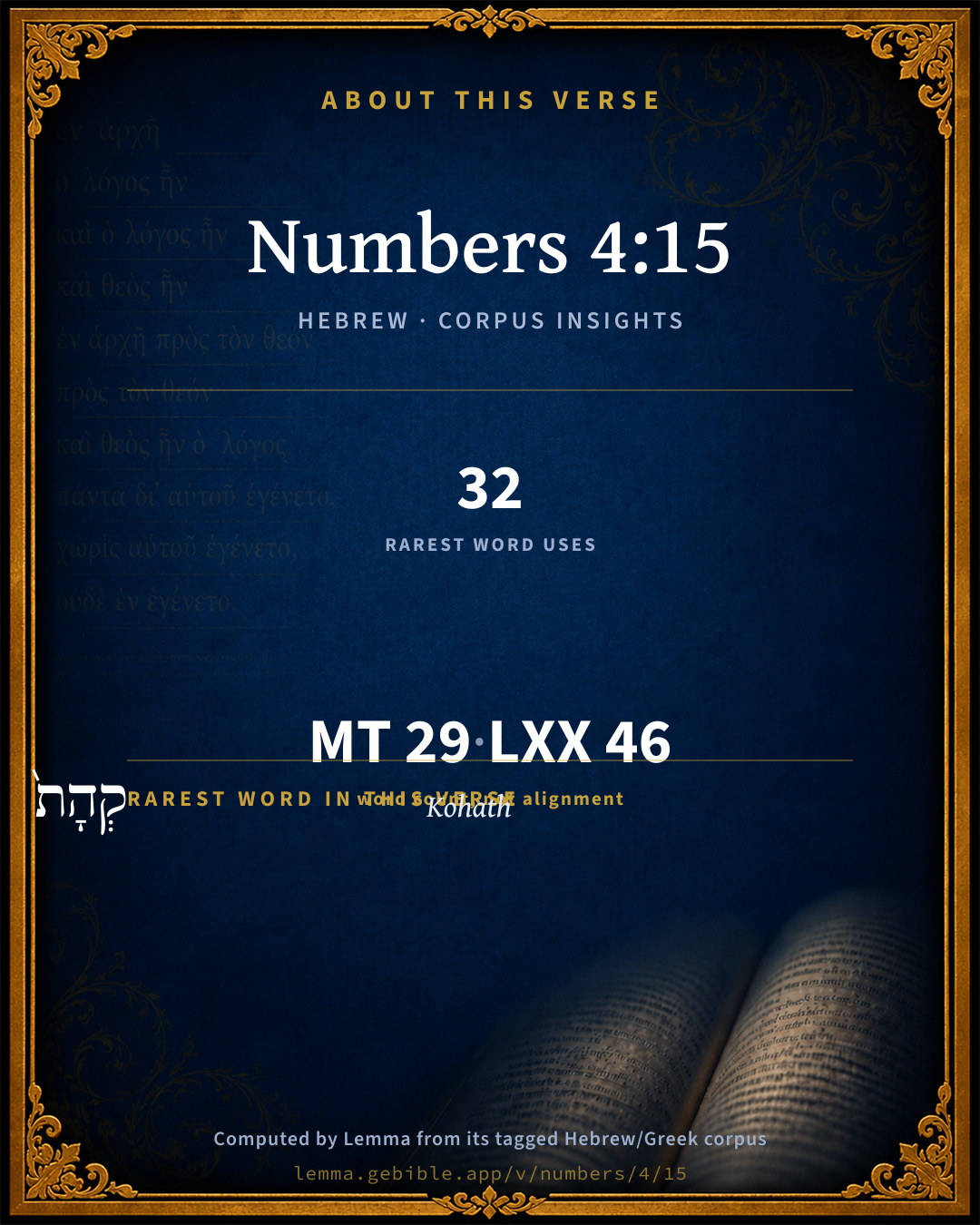
קְהָת֙ Kohath H6955 occurs in 29 verses of the Hebrew Bible. Also found in:

Grammatical profile

  • 7 verbs
  • 15 nouns
  • 1 pronoun
  • 2 prepositions
  • 1 adverb
  • 3 particles

Verb forms

  • וְכִלָּ֣ה Piel · Sequential Perfect
  • לְכַסֹּ֨ת Piel · Infinitive Construct
  • בִּנְסֹ֣עַ Qal · Infinitive Construct
  • יָבֹ֤אוּ Qal · Imperfect
  • לָשֵׂ֔את Qal · Infinitive Construct
  • יִגְּע֥וּ Qal · Imperfect
  • וָמֵ֑תוּ Qal · Sequential Perfect

Repetition

Words recur within this verse — often emphatic in Hebrew:

  • וּ֠בָנָיו son H1121 ×3
  • הַקֹּ֜דֶשׁ holiness H6944 ×3
  • קְהָת֙ Kohath H6955 ×2

Hebrew & Septuagint length

In English translation the verse runs 58 words from the Hebrew and 58 from the Septuagint (LXX English) — the same length.

A rough comparison of the two English renderings, which tokenize alike — not a word-level alignment.

Word counts can differ between the Hebrew and the Greek without any difference in meaning — e.g. the Hebrew direct-object marker אֵת has no separate Greek word, and Greek often adds the article ὁ.

In the original languages it is 29 Hebrew tokens and 46 Greek tokens — but the two are counted differently (Hebrew bundles its prefixes and suffixes into one token; the Greek is in lemma form), so that isn’t a like-for-like length.

Cross-references

15

Topical passages linked to Numbers 4:15 in the Treasury of Scripture Knowledge — connected by theme and wording, ordered by reader-vote popularity; previews shown in the World English Bible.

  • 2 Samuel 6:6–7 When they came to the threshing floor of Nacon, Uzzah put forth [his hand] to the ark of God, and took hold of it; for the oxen stumbled.
  • Numbers 7:9 But to the sons of Kohath he gave none, because the service of the sanctuary belonged to them; they carried it on their shoulders.
  • Deuteronomy 31:9 Moses wrote this law, and delivered it to the priests the sons of Levi, who bore the ark of the covenant of Yahweh, and to all the elders of Israel.
  • Numbers 10:21 The Kohathites set forward, bearing the sanctuary: and [the others] did set up the tent against their coming.
  • 1 Chronicles 13:9–10 When they came to the threshing floor of Chidon, Uzza put forth his hand to hold the ark; for the oxen stumbled.
  • 1 Samuel 6:19 He struck of the men of Beth-shemesh, because they had looked into the ark of Yahweh, he struck of the people fifty thousand seventy men; and the people mourned, because Yahweh had struck the people with a great slaughter.
  • 1 Chronicles 15:2 Then David said, None ought to carry the ark of God but the Levites: for them has Yahweh chosen to carry the ark of God, and to minister to him forever.
  • Exodus 19:12 You shall set bounds to the people round about, saying, 'Be careful that you don't go up onto the mountain, or touch its border. Whoever touches the mountain shall be surely put to death.
  • Numbers 1:51 When the tabernacle is to move, the Levites shall take it down; and when the tabernacle is to be set up, the Levites shall set it up. The stranger who comes near shall be put to death.
  • Numbers 3:30–31 The prince of the fathers' house of the families of the Kohathites shall be Elizaphan the son of Uzziel.
  • Numbers 3:38 Those who encamp before the tabernacle eastward, in front of the Tent of Meeting toward the sunrise, shall be Moses, and Aaron and his sons, keeping the charge of the sanctuary for the charge of the children of Israel. The stranger who comes near shall be put to death.
  • Joshua 4:10 For the priests who bore the ark stood in the midst of the Jordan, until everything was finished that Yahweh commanded Joshua to speak to the people, according to all that Moses commanded Joshua: and the people hurried and passed over.
  • 2 Samuel 6:13 It was so, that, when those who bore the ark of Yahweh had gone six paces, he sacrificed an ox and a fattened calf.
  • 1 Chronicles 15:15 The children of the Levites bore the ark of God on their shoulders with the poles thereon, as Moses commanded according to the word of Yahweh.
  • Hebrews 12:18–29 For you have not come to a mountain that might be touched, and that burned with fire, and to blackness, darkness, tempest,

Cross-references courtesy of OpenBible.info (CC BY 4.0).

Hebrew and Greek witnesses Masoretic Hebrew ↔ Greek Septuagint

The same verse in the two great witnesses to the Old Testament, shown verse-for-verse.

These are two independent witnesses, not word-aligned to each other, and the Septuagint is shown in lemma (dictionary) form.

Hebrew Numbers 4:15 Masoretic · Westminster Leningrad Codex

וְכִלָּ֣ה אַֽהֲרֹן וּ֠בָנָיו לְכַסֹּ֨ת אֶת הַקֹּ֜דֶשׁ וְאֶת כָּל כְּלֵ֣י הַקֹּדֶשׁ֮ בִּנְסֹ֣עַ הַֽמַּחֲנֶה֒ וְאַחֲרֵי כֵ֗ן יָבֹ֤אוּ בְנֵי קְהָת֙ לָשֵׂ֔את וְלֹֽא יִגְּע֥וּ אֶל הַקֹּ֖דֶשׁ וָמֵ֑תוּ אֵ֛לֶּה מַשָּׂ֥א בְנֵֽי קְהָ֖ת בְּאֹ֥הֶל מוֹעֵֽד

"When Aaron and his sons have finished covering the sanctuary, and all the furniture of the sanctuary, as the camp moves forward; after that, the sons of Kohath shall come to carry it: but they shall not touch the sanctuary, lest they die. These things are the burden of the sons of Kohath in the Tent of Meeting.

World English Bible · Public Domain

Greek LXX Numbers 4:15 Septuagint · lemma form

καί συντελέω ἀαρών καί ὁ υἱός αὐτός καλύπτω ὁ ἅγιος καί πᾶς ὁ σκεῦος ὁ ἅγιος ἐν ὁ ἐκαἴρω ὁ παρεμβολή καί μετά οὗτος εἰςἔρχομαι υἱός κααθ αἴρω καί οὐ ἅπτομαι ὁ ἅγιος ἵνα μή ἀποθνήσκω οὗτος αἴρω ὁ υἱός κααθ ἐν ὁ σκηνή ὁ μαρτύριον

And Aaron and his sons shall finish covering the holy things, and all the holy vessels, when the camp begins to move; and afterwards the sons of Caath shall go in to take up the furniture; but shall not touch the holy things, lest they die: these shall the sons of Caath bear in the tabernacle of witness.

LXX2012 (modern English Septuagint) · Public Domain

On this verse, Ellicott's Commentary for English Readers discusses the Septuagint’s reading. Read the note in Commentary ↓

Hebrew: Westminster Leningrad Codex (CC BY 4.0). Greek: Septuagint (public domain); English from LXX2012 (modern English Septuagint) (Public Domain). How the Septuagint differs from the Hebrew →

Targum (Aramaic paraphrase)

2

The Targum is the ancient Jewish Aramaic paraphrase of the Hebrew Scriptures — an interpretive translation, not the Hebrew text itself. Onkelos (literal) and Pseudo-Jonathan (expansive) render the Torah, and Jonathan the Prophets. Coverage is partial: where no permissively-licensed English translation exists for a verse, only the Aramaic is shown. This is verse-level text, not a word-by-word alignment to the Hebrew.

  1. Targum Onkelos Torah (Genesis–Deuteronomy)
    וִישֵׁיצֵי אַהֲרֹן וּבְנוֹהִי לְכַסָאָה יָת קוּדְשָׁא וְיָת כָּל מָנֵי קוּדְשָׁא בְּמֵטַל מַשְׁרִיתָא וּבָתַר כֵּן יַעֲלוּן בְּנֵי קְהָת לְמִטַּל וְלָא יִקְרְבוּן לְקוּדְשָׁא וְלָא יְמוּתוּן אִלֵין מַטוּל בְּנֵי קְהָת בְּמַשְׁכַּן זִמְנָא

    (no public-domain English translation for this verse)

    Targum Onkelos — Aramaic: “Onkelos Genesis” (public domain); “Onkelos Exodus” (public domain); “Onkelos Leviticus” (public domain); “Onkelos Numbers” (public domain); “Onkelos Deuteronomy” (public domain). English: “Sefaria Community Translation” (CC0 1.0 (public-domain dedication)); “J.W. Etheridge. The Targums of Onkelos and Jonathan Ben Uzziel on the Pentateuch. London: Longmans, Green, 1862” (public domain). Text via Sefaria.

  2. Targum Pseudo-Jonathan Torah (Genesis–Deuteronomy)
    וְיִפְסוֹק אַהֲרן וּבְנוֹי לְכַסָאָה יַת קוּדְשָׁא וְיַת כָּל מָאנֵי קוּדְשָׁא בִּזְמַן מֵיטַל מַשְׁרִיתָא וּמִן בָּתַר כְּדֵין יֵיעָלוּן בְּנֵי קְהָת לִמְסוֹבָרָא וְלָא יִקְרְבוּן לְקוּדְשָׁא דְלָא יְמוּתוּן בְּאֵשָׁא מְצַלְהֲבָא דֵין מַטוֹל בְּנֵי קְהָת בְּמַשְׁכַּן זִמְנָא

    And after Aharon and his sons have completed to cover the sanctuary, and all the vessels thereof, when the camp is to go forward, then the sons of Kehath may enter in to carry: but they shall not touch any holy thing, lest they die by the flaming fire. This is the burden of the sons of Kehath in the tabernacle of ordinance.

    Targum Pseudo-Jonathan — Aramaic: “Targum Jonathan on Genesis” (public domain); “Targum Jonathan on Exodus” (public domain); “Targum Jonathan on Leviticus” (public domain); “Targum Jonathan on Numbers” (public domain); “Targum Jonathan on Deuteronomy” (public domain). English: “The Targum of Jonathan ben Uzziel, trans. J. W. Etheridge, London, 1862” (public domain). Text via Sefaria.

Commentary

Notes on Numbers 4:15 from classic Christian and Jewish commentators (each source and its license shown beneath its notes). The classic Christian expositions comment on the surrounding passage and are grouped to its opening verse, so a note may address several verses; the Jewish commentaries on the Tanakh (Rashi and others) are per-verse, so they appear only where the commentator wrote on this verse.

Lemma curates 59 commentaries, every one of them public domain or Creative Commons licensed, each selected and text-cleaned for this edition rather than reprinted as found. About our sources →

Trapp's Complete Commentary

John Trapp

Num 4:15 And when Aaron and his sons have made an end of covering the sanctuary, and all the vessels of the sanctuary, as the camp is to set forward; after that, the sons of Kohath shall come to bear [it]: but they shall not touch [any] holy thing, lest they die. These [things are] the burden of the sons of Kohath in the tabernacle of the congregation.

Ver. 15. Lest they die.] As Uzzah did. {1Ch 13:10}

The burden of the sons of Kohath.] Who, as they had the honos, so the onus See Num 4:1.

“ Fructus honos oneris, fructus honoris onus. ”

John Trapp, A Commentary or Exposition upon All the Books of the Old and New Testament (1647–1656) — public domain. Text from a community e-Sword module.

Joseph Benson's Commentary

Num 4:15. Bear it — Upon their shoulders. Afterward the priests themselves, being multiplied, carried these things, though the Levites were not excluded. They shall not touch — Before they are covered.

Joseph Benson's Commentary on the Old and New Testaments (1811–1818) — public domain. Text from a community e-Sword module.

Tyndale Open Study Notes

Tyndale Open Resources

4:15 Aaron and his surviving sons Eleazar and Ithamar had to cover the sanctuary and all the sacred articles completely before the camp was ready to move, with the groups of non-Levitical tribes marching before and behind the Levites who carried the Tabernacle. The royalty of these objects is seen in the symbolic colors of the coverings, and their sacredness underlies the stern warning that even though the Kohathites were the designated handlers, they must not touch the sacred objects, or they would die. Such respect marked the holiness of Israel’s Lord. The dangers of disregarding these instructions are apparent in 1 Sam 6:19-20 and 2 Sam 6:6-7.

Tyndale Open Study Notes — © Tyndale Open Resources, licensed CC BY-SA 4.0. Text via the HelloAO Bible API.

Geneva Bible (1599)

Geneva Bible translators

That is, in folding up the things of the Sanctuary, as the Ark, etc.

Before it be covered.

Geneva Bible (1599) marginal notes — public domain. Text via Bolls.life.

Jamieson, Fausset & Brown

Robert Jamieson, A. R. Fausset & David Brown

the sons of Kohath shall come to bear it, but they shall not touch any holy thing, lest they die--The mode of transport was upon the shoulders of the Levites (see on Num 7:9), although afterwards wheeled vehicles were employed (Sa2 6:3; Ch1 15:12). And it was allowed to touch the covering, but not the things covered, on the penalty of death, which was inflicted more than once (Sa1 6:19; Sa2 6:6-7). This stern denunciation was designed to inspire a sentiment of deep and habitual reverence in the minds of those who were officially engaged about holy things.

Jamieson, Fausset & Brown — Commentary Critical and Explanatory on the Whole Bible (1871) — public domain (CC PDM 1.0). Text via the HelloAO Bible API.

Ellicott's Commentary for English Readers

(15) And all the vessels of the sanctuary.—No mention is here made of the laver (Exo_30:18). The LXX. and the Samaritan text supply a statement respecting the covering and conveyance of the brazen laver. The clause in the LXX. is as follows :—“And they shall take a purple cloth, and cover the laver and its foot (or base), and they shall put it into a blue cover of skin, and put it on bars.” There is no sufficient ground. however, for supposing that the present Hebrew text is deficient in this place; and it seems more probable to suppose that the laver was not to be covered during its transport.

After that, the sons of Kohath shall come to bear it.—Better, to bear, or carry—viz., the whole of the vessels of ministry which had been previously enumerated. The distinction between the service of the priests and that of the Levites in regard to the removal of the Tabernacle and its furniture is here clearly marked.

But they shall not touch any holy thing, lest they die.—The word which is rendered “any holy thing” may here, as elsewhere, denote the sanctuary. This injunction is repeated in Num_18:3. We find in 2Sa_6:6-7 an instance of the fatal result of the violation of this command by Uzzah, who being, as is most probable, a Levite, and of the family of Kohath, ought to have been acquainted with the law respecting the removal of the Ark. It is obvious that the Kohathites, as the immediate assistants of the priests, in regard to the vessels of the Sanctuary, were specially exposed to the risk of violating the law by touching the most holy things.

A Bible Commentary for English Readers, edited by Charles John Ellicott (1878–1897) — public domain. Text from a community e-Sword module.

The Cambridge Bible for Schools and Colleges

gen. ed. J. J. S. Perowne

15. they shall not touch the sanctuary] Better the holy things, as in R.V. marg. The Heb. word is strictly a singular abstract substantive, ‘the sacredness,’ which is here employed to denote the whole collection of sacred objects.

The Cambridge Bible for Schools and Colleges (gen. ed. J. J. S. Perowne; Cambridge University Press, 1878–1918) — public domain. Text from a community e-Sword module.

John Gill's Exposition

And to the office of Eleazar, the son of Aaron the priest,

pertaineth the oil for the light,.... The following things, to bear them, according to some Jewish writers; but rather it was to give the oil for the light, that is, the vessels, and so the vessels of the oil to the sons of the Kohathites; agreeably to which are the Targums of Onkelos and Jonathan, who paraphrase the words,"and that which was delivered to Eleazar, the son of Aaron the priest, the oil for the light, &c.''And indeed the words, as they are in the Hebrew text, may be rendered,"and the oversight of Eleazar, the son of Aaron the priest, shall be, or "let it be", the oil for the light, &c. (z);''the same word being so rendered in a latter clause of this same text: he had the inspection of these, and on him lay to see to it, that these were carried by the Kohathites, the oil for the light of the lamps in the candlestick; of which see Exo 27:20,

and the sweet incense: to burn on the altar of incense, Exo 30:34,

and the daily meat offering; offered with the lambs morning and evening, Exo 29:40,

and the anointing oil; with which Aaron and his sons were anointed, the tabernacle and all its vessels, Exo 30:23,

and the oversight of all the tabernacle, and of all that therein is,

in the sanctuary, and in the vessels thereof: the former, the oil for the light, &c. were his immediate oversight and care; but the oversight of these by his brother Ithamar, according to the Jewish writers.

(z) So Montanus, Tigurine version, Piscator.

John Gill's Exposition of the Whole Bible (1746–1763) — public domain (CC PDM 1.0). Text via the HelloAO Bible API.

Haydock's Catholic Bible Commentary

Vessels of, &c. Some say, not even their coverings. God threatens to punish all idle curiosity or negligence, particularly with respect to the ark, which the Caathites had to carry, till the priests became sufficiently numerous to perform that office, as they generally did, Deuteronomy xxxi. 9. (Calmet)

George Leo Haydock (1774–1849), Haydock's Catholic Family Bible and Commentary, 1859 edition — public domain. Excludes Psalms (Douay-Rheims chapter numbering differs from Protestant) and Deuterocanonical books (Catholic canon only).

Matthew Poole's English Annotations

The sons of Kohath shall bear it, to wit upon their shoulders, not upon carts or waggons, as appears from Num 7:9, the neglect of which order did provoke the Lord, 2Sa 6:6,7; 1Ch 13:7; 15:12, &c. Afterward the priests themselves, being multiplied, carried these things, as appears from Deu 31:9; Jos 3:6; 8:33; 1Sa 4:4, though the Levites also were not excluded, 2Ch 5:5. They shall not to any holy thing; immediately, or before they be covered. Lest they die, as some did for that sin. See 1Sa 6:19; 2Sa 6:6,7.

Matthew Poole's English Annotations on the Holy Bible (1683–1685) — public domain. Text from a community e-Sword/MySword module.

Whedon's Commentary on the Bible

Daniel D. Whedon

15. Covering the sanctuary — Since none but Aaron could enter into the holy of holies under the penalty of death, we are to understand, by the sons of Aaron assisting in preparing the sanctuary and its furniture, that the prohibition was in force only when the cloud rested upon the tabernacle. But when this was removed the sons of Aaron might enter the most holy place to assist in these preparations for removal. Now that Christ has rent the veil by his death for us, we may all draw near with boldness, not to the ark of the covenant, divested of the glorious presence of the Shekinah, but to the throne of grace, filled with the presence of the merciful Father, propitiated by the great High Priest, who ever liveth to make intercession for us.

Daniel D. Whedon (gen. ed.), Commentary on the Old and New Testaments (1874–1909) — public domain. Text from a community e-Sword module.

The Pulpit Commentary

These things are the burden of the sons of Kohath. One thing which the Kohathites almost certainly had to carry is omitted here, possibly because it was carried without any cover at all, and was not regarded as of equal sanctity with the rest. Anyhow, the omission is very remarkable, and may have been accidental. It is supplied by the Septuagint and the Samaritan text in the following addition to verse 14: "And they shall take a purple cloth, and cover the laver and its foot, and they shall put it into a hyacinthine cover of skin, and put it on bars." The burdens of the Kohathites were six, not counting the laver and its foot:

(1) the ark;

(2) the table of shewbread;

(3) the candelabrum;

(4) the golden altar;

(5) "instruments of ministry;

(6) the frame of the brazen altar.

HOMILIES BY E.S. PROUT Vers. 15-20. The perils of distinguished service.

The sons of Kohath had the most honourable of the duties assigned to the Levites, in being permitted to carry the sacred vessels of the tabernacle. But they were thus exposed to temptations and perils from which their less favoured brethren were exempt. To touch or even to see the holy things was death. Similar temptations, to those intrusted with distinguished service in God"s Church, may arise from

I CURIOSITY. Illustrate from the sin of the men of Bethshemesh. (1Sa 6) Men brought by their duties into close contact with Divine mysteries may yield to the curiosity of unauthorized speculations to which ignorant and groveling minds are not exposed. (cf. Col_2:18) Illustrate from speculations on the Trinity, the incarnation, or the profitless inquiries of some of the schoolmen as to angels, etc. Caution applicable to theological speculations of today. (Deu_29:29)

II THOUGHTLESSNESS. A thoughtless disregard of God"s strict injunctions, by either a priest (verses 18, 19) or a Kohathite, might have been fatal. So now those who have perpetually to deal with Divine things are in danger of irreverence from thoughtlessness. E.g., Christian ministers, who have to be constantly praying and preaching, as part of their service for God. Christians who have a reputation for saintliness above their brethren need special reverence, lest they should handle Divine things in a familiar, unauthorized manner. Apply to some habits of modern public worship tending to sad irreverence.

III DISTRUST. Illustrate from the sin of Uzzah. (2Sa_6:6, 2Sa_6:7) We are thus warned against using illegitimate means in support of the cause of God which we think to be in danger. Carnal methods must not be resorted to for the defense of spiritual truths. Some of the most devoted servants of Christ have profaned the ark of God, when they thought it in danger, by touching and propping it by supports God has never sanctioned. E.g., persecutions on behalf of the truth of God. Caution to those who now rely on worldly alliances and statesmanship on behalf of God"s Church. Front such perils we may be preserved by the spirit of

(1) profound humility, at the privilege of being allowed to come so near and to deal with the mysteries of God; (Eph_3:8 Heb_12:28, Heb_12:29)

(2) reverential obedience to every item of the instructions God has given us; (1Ch_15:12, 13 Psa_119:128)

(3) fearless trust in the Lord Jesus Christ, who has guarded his Church hitherto, is saving us, and who will protect his people and his truth by his own power to the end. P. (2Ti_4:18)

The Pulpit Commentary (1880–1919), ed. H.D.M. Spence-Jones & Joseph S. Exell — public domain. Text from a community e-Sword module.

John Wesley's Explanatory Notes

Bear it - Upon their shoulders. Afterward the priests themselves, being multiplied, carried these things, though the Levites also were not excluded. They shall not touch - Before they are covered.

John Wesley, Explanatory Notes Upon the Whole Bible (1754–1765) — public domain. Text via the GEBible commentary corpus.

Keil & Delitzsch

C. F. Keil & F. Delitzsch

After the priests had completed the wrapping up of all these things, the Kohathites were to come up to carry them; but they were not to touch "the holy" (the holy things), lest they should die (see Num 1:53; Num 18:3, and comp. Sa2 6:6-7).

Keil & Delitzsch — Biblical Commentary on the Old Testament (1861–1891) — public domain (CC PDM 1.0). Text via the HelloAO Bible API. (Old Testament only.)

unfoldingWord translationNotes

Door43 World Missions Community

to carry the holy place

Here the holy place refers to all the items that make up the holy place that Aaron and his sons covered in cloth and skins. AT: "to carry all of the items of the holy place" (See: Synecdoche)

when the camp moves forward

Here the word "camp" refers to all of the people in the camp. AT: "when the people move forward" (See: Metonymy)

Kohath

See how you translated this man's name in Numbers 3:17.

the holy instruments

"the holy equipment"

the oil for the light

Here the word "light" is used to refer to the "lamps." AT: "the oil for the lamps" (See: Metonymy)

the care of

Here the abstract noun "care" can be expressed as a verb. AT: "those who care for" (See: Abstract Nouns)

translationWords

Aaron

descend

die

tent of meeting

Eleazar

priest

incense

grain offering

anoint

tabernacle

holy

unfoldingWord translationNotes — © Distant Shores Media and the Door43 World Missions Community, licensed CC BY-SA 4.0. Source: git.door43.org/Door43/en_tn.

Rashi

Rabbi Shlomo Yitzchaki (Rashi)

לכסת את הקדש [AND AARON AND HIS SONS FINISHED] COVERING THE HOLY THINGS — the Ark and the altar,

ואת כל כלי הקדש AND ALL THE VESSELS OF THE SANCTUARY — the candelabrum and the vessels for service,

ומתו [SO THAT THEY SHALL NOT TOUCH ANY THING OF HOLINESS] LEST THEY DIE — because if they do touch they become liable to death by Heaven.

Rashi on the Tanakh — English translations: “The Judaica Press complete Tanach with Rashi, translated by A. J. Rosenberg” (CC BY 4.0); “Pentateuch with Rashi's commentary by M. Rosenbaum and A.M. Silbermann, 1929-1934” (public domain); “The Metsudah Tanach series, Lakewood, N.J” (CC BY 4.0); and “The Book of Joshua, Metsudah Publications, 1997” (CC BY 4.0). Text via Sefaria.

Lesson kit

Teaching starters — assembled from the data on this page, not authored interpretation. Every prompt links to the verse data it draws on. Edit before teaching.

Numbers, in the Pentateuch, opens this verse with 29 words (23 distinct Hebrew lemmas). Its most distinctive word is Qᵉhâth (“Kohath”). A historical commentator’s framing appears above. Read the whole chapter for the surrounding context.

Discussion questions

  1. How does “Kohath” (Qᵉhâth) shape what this verse is saying?
  2. Genesis 46:11 shares the word «Kohath» with this verse. How do the two illuminate each other?
  3. “son” occurs 3× in this one verse. What is the effect of the repetition?
  4. The translations on this page render this verse differently — a whole-verse word diff, not a word-by-word alignment. What might account for the different wordings?
  5. The verb «וְכִלָּ֣ה» is Piel Sequential Perfect. How does its form color the action?
  6. Reading how Trapp's Complete Commentary and Joseph Benson's Commentary read this verse, where do the two commentators agree and where do they part?

Things to notice

Reading settings

Reading text

Shown beneath each verse's original-language words.

Old Testament
Old Testament edition

Read the OT as the Masoretic Hebrew (MT) or the Greek Septuagint (LXX).

English shown for the Greek Septuagint (in the Hebrew ↔ Greek comparison).

Comparing translations? Open the Compare panel on any verse page to stack up to four side by side.