
Judges 16:30

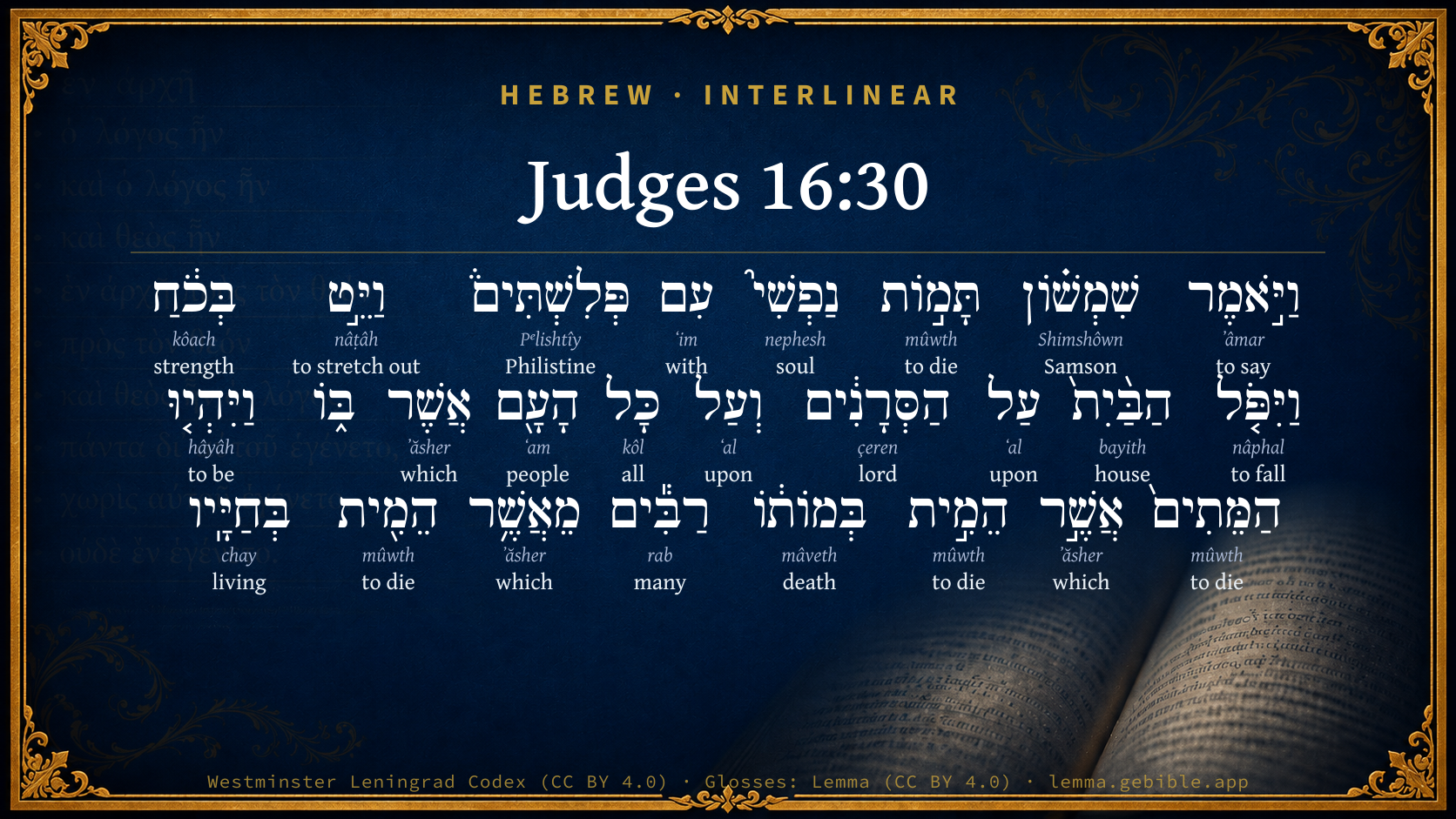
Hebrew (Westminster Leningrad Codex) Judges 16:30 appears in the Hebrew Old Testament. The text above is from the Westminster Leningrad Codex. Each word links to its Strong’s number, a concise gloss, and parsing drawn from the Open Scriptures Hebrew Bible morphology. Click any word for its full Brown-Driver-Briggs (BDB) entry.
Download image
Cite this verse

Judges 16:30 (World English Bible). Public Domain. Lemma interlinear Bible study tool, https://lemma.gebible.app/v/judges/16/30.

Show BibTeX & RIS
BibTeX
RIS
English Translation
Samson said, Let me die with the Philistines. He bowed himself with all his might; and the house fell on the lords, and on all the people who were therein. So the dead that he killed at his death were more than those who he killed in his life.
World English Bible · Public Domain
Download a study sheet

One document with this verse’s original text, its word-by-word gloss line, the meaning frame, cross-references with their text, attributed commentary, and full source and license credits — printable, and it pastes into notes with its structure intact.

This verse Autodidact and up

Study sheet (.html) Plain text (.txt)

A passage Seminary Student

Up to 50 verses in one chapter. A passage sheet keeps up to 6 commentary sources and 12 cross-references per verse, in the order this page ranks them, and says so on the sheet whenever that leaves anything out. Ask for a single verse and you get the Autodidact verse sheet above.

Everything on this page stays free to read, with no account — the sheet is a download of what is already on screen, not access to it.

Want to remove ads? Support Godless Engineer
Compare translations 3

The same verse in 3 English versions, stacked beneath the original-language interlinear above. Click any original word for its lexicon entry.

Each is an independent rendering of the whole verse — the interlinear is not word-aligned to these translations.

Highlighted words mark where these versions differ — a whole-verse word diff, not a word-by-word alignment.

  • World English Bible Public Domain
    Samson said, Let me die with the Philistines. He bowed himself with all his might; and the house fell on the lords, and on all the people who were therein. So the dead that he killed at his death were more than those who he killed in his life.
  • King James Version Public Domain
    And Samson said, Let me die with the Philistines. And he bowed himself with all his might; and the house fell upon the lords, and upon all the people that were therein. So the dead which he slew at his death were more than they which he slew in his life.
  • unfoldingWord Literal Text CC BY-SA 4.0
    Then Samson said, “My soul shall die with the Philistines!” And he stretched out with his strength, and the house fell on the lords and on all of the people who in it. So the ones dying whom he killed at his death were more than those he killed in his life.

unfoldingWord Literal Text — © unfoldingWord, licensed CC BY-SA 4.0. Word-aligned USFM3 via Door43 (git.door43.org/unfoldingWord/en_ult).

Versions to compare (up to 4)

3 of 4 selected

Show all 18 translations

Every available English version of this verse, each an independent rendering of the whole verse.

  • World English Bible Public Domain
    Samson said, Let me die with the Philistines. He bowed himself with all his might; and the house fell on the lords, and on all the people who were therein. So the dead that he killed at his death were more than those who he killed in his life.
  • Berean Standard Bible Public Domain
    Samson said, “Let me die with the Philistines.” Then he pushed with all his might, and the temple fell on the lords and all the people in it. So in his death he killed more than he had killed in his life.
  • Majority Standard Bible Public Domain
    Samson said, “Let me die with the Philistines.” Then he pushed with all his might, and the temple fell on the lords and all the people in it. So in his death he killed more than he had killed in his life.
  • King James Version Public Domain
    And Samson said, Let me die with the Philistines. And he bowed himself with all his might; and the house fell upon the lords, and upon all the people that were therein. So the dead which he slew at his death were more than they which he slew in his life.
  • American Standard Version (1901) Public Domain
    And Samson said, Let me die with the Philistines. And he bowed himself with all his might; and the house fell upon the lords, and upon all the people that were therein. So the dead that he slew at his death were more than they that he slew in his life.
  • Revised Version (1885) Public Domain
    And Samson said, Let me die with the Philistines. And he bowed himself with all his might; and the house fell upon the lords, and upon all the people that were therein. So the dead which he slew at his death were more than they which he slew in his life.
  • Geneva Bible (1599) Public Domain
    Then Samson saide, Let me lose my life with the Philistims: and he bowed him with all his might, and the house fell vpon the princes, and vpon all the people that were therein. so the dead which he slewe at his death were more then they which he had slaine in his life.
  • Douay-Rheims (1899) Public Domain
    He said: Let me die with the Philistines. And when he had strongly shook the pillars, the house fell upon all the princes, and the rest of the multitude that was there: and he killed many more at his death, than he had killed before in his life.
  • Young's Literal Translation Public Domain
    and Samson saith, `Let me die with the Philistines,' and he inclineth himself powerfully, and the house falleth on the princes, and on all the people who `are' in it, and the dead whom he hath put to death in his death are more than those whom he put to death in his life.
  • Literal Standard Version CC BY-SA 4.0
    and Samson says, “Let me die with the Philistines,” and he inclines himself powerfully, and the house falls on the princes, and on all the people who [are] in it, and the dead whom he has put to death in his death are more than those whom he put to death in his life.
  • Unlocked Literal Bible CC BY-SA 4.0
    Samson said, “Let me die with the Philistines!” He stretched out with his strength and the building fell on the rulers and on all the people who were in it. So the dead that he killed when he died were more than those he killed during his life.
  • unfoldingWord Literal Text CC BY-SA 4.0
    Then Samson said, “My soul shall die with the Philistines!” And he stretched out with his strength, and the house fell on the lords and on all of the people who in it. So the ones dying whom he killed at his death were more than those he killed in his life.
  • Darby Bible Public Domain
    And Samson said, "Let me die with the Philistines." Then he bowed with all his might; and the house fell upon the lords and upon all the people that were in it. So the dead whom he slew at his death were more than those whom he had slain during his life.
  • World Messianic Bible Public Domain
    Samson said, “Let me die with the Philistines!” He bowed himself with all his might; and the house fell on the lords, and on all the people who were in it. So the dead that he killed at his death were more than those who he killed in his life.
  • Webster's Bible Public Domain
    And Samson said, Let me die with the Philistines. And he bowed himself with all his might; and the house fell upon the lords, and upon all the people that were in it. So the dead which he slew at his death were more than they which he slew in his life.
  • Free Bible Version CC BY-SA 4.0
    Samson shouted, “Let me die with the Philistines!” and he pushed with all his strength. The temple collapsed on the rulers and all the people in it. So those killed at his death were more than he killed in his life.
  • Bible in Basic English Public Domain
    And Samson said, Let death overtake me with the Philistines. And he put out all his strength, and the house came down on the chiefs and on all the people who were in it. So the dead whom he sent to destruction by his death were more than all those on whom he had sent destruction in his life.
  • JPS Tanakh (1917) Public Domain
    And Samson said: 'Let me die with the Philistines.' And he bent with all his might; and the house fell upon the lords, and upon all the people that were therein. So the dead that he slew at his death were more than they that he slew in his life.

Literal Standard Version (2020), Covenant Press — licensed CC BY-SA 4.0. Text via the HelloAO Bible API (eBible.org). Unlocked Literal Bible (unfoldingWord) — licensed CC BY-SA 4.0. Text via the HelloAO Bible API (eBible.org). unfoldingWord Literal Text — © unfoldingWord, licensed CC BY-SA 4.0. Word-aligned USFM3 via Door43 (git.door43.org/unfoldingWord/en_ult). Free Bible Version, Dr. Jonathan Gallagher — licensed CC BY-SA 4.0. Text via the HelloAO Bible API (eBible.org).

Word by word

More ways to search: Search by grammar → Find every occurrence → Compare this word →

Practice this passage: Drill this verse → Learn its vocabulary →

הַסְּרָנִ֔ים
çeren
H5633
“the · lords”
Particle, Definite Article + Noun, Common, Masculine, Plural, Absolute
Part of Speech
Particle + Noun
Type
Common
Gender
Masculine
Number
Plural
State
Absolute
Full BDB Definition

Origin: from an unused root of uncertain meaning

TWOT: 1546 , 1547

lord, ruler, tyrant - axle
  1. וַיֹּ֣אמֶר ʼâmar H559 “and · to say” Conjunction + Verb, Qal, Sequential Imperfect, 3rd Person, Masculine, Singular
  2. שִׁמְשׁ֗וֹן Shimshôwn H8123 “Samson” Noun, Proper
  3. תָּמ֣וֹת mûwth H4191 “to die” Verb, Qal, Imperfect, 3rd Person, Feminine, Singular
  4. נַפְשִׁי֮ nephesh H5315 “soul · my” Noun, Common, Both, Singular, Construct + Suffix, Personal, 1st Person, Common, Singular
  5. עִם ʻim H5973 “with” Preposition
  6. פְּלִשְׁתִּים֒ Pᵉlishtîy H6430 “Philistines” Noun, Gentilic, Masculine, Plural, Absolute
  7. וַיֵּ֣ט nâṭâh H5186 “and · to stretch out” Conjunction + Verb, Qal, Sequential Imperfect, 3rd Person, Masculine, Singular
  8. בְּכֹ֔חַ kôach H3581 “in/at · strength” Preposition + Noun, Common, Masculine, Singular, Absolute
  9. וַיִּפֹּ֤ל nâphal H5307 “and · to fall” Conjunction + Verb, Qal, Sequential Imperfect, 3rd Person, Masculine, Singular
  10. הַבַּ֨יִת֙ bayith H1004 “the · house” Particle, Definite Article + Noun, Common, Masculine, Singular, Absolute
  11. עַל ʻal H5921 “upon” Preposition
  12. וְעַל ʻal H5921 “and · upon” Conjunction + Preposition
  13. כָּל kôl H3605 “all of” Noun, Common, Masculine, Singular, Construct
  14. הָעָ֖ם ʻam H5971 “the · people” Particle, Definite Article + Noun, Common, Masculine, Singular, Absolute
  15. אֲשֶׁר ʼăsher H834 “which” Particle, Relative
  16. וַיִּהְי֤וּ hâyâh H1961 “and · to be” Conjunction + Verb, Qal, Sequential Imperfect, 3rd Person, Masculine, Plural
  17. הַמֵּתִים֙ mûwth H4191 “the · dying” Particle, Definite Article + Verb, Qal, Participle Active, Masculine, Plural, Absolute
  18. אֲשֶׁ֣ר ʼăsher H834 “which” Particle, Relative
  19. הֵמִ֣ית mûwth H4191 “to die” Verb, Hiphil, Perfect, 3rd Person, Masculine, Singular
  20. בְּמוֹת֔וֹ mâveth H4194 “in/at · death · his” Preposition + Noun, Common, Masculine, Singular, Construct + Suffix, Personal, 3rd Person, Masculine, Singular
  21. רַבִּ֕ים rab H7227 “many” Adjective, Adjective, Masculine, Plural, Absolute
  22. מֵאֲשֶׁ֥ר ʼăsher H834 “from · which” Preposition + Particle, Relative
  23. הֵמִ֖ית mûwth H4191 “to die” Verb, Hiphil, Perfect, 3rd Person, Masculine, Singular
  24. בְּחַיָּֽיו chay H2416 “in/at · living things · his” Preposition + Noun, Common, Masculine, Plural, Construct + Suffix, Personal, 3rd Person, Masculine, Singular

About this verse

These counts appear in no published source. They are computed here, from the morphology-tagged text and Lemma’s own curated glosses. What Lemma adds →

26
words
19
distinct lemmas
Historical
section

Notable vocabulary

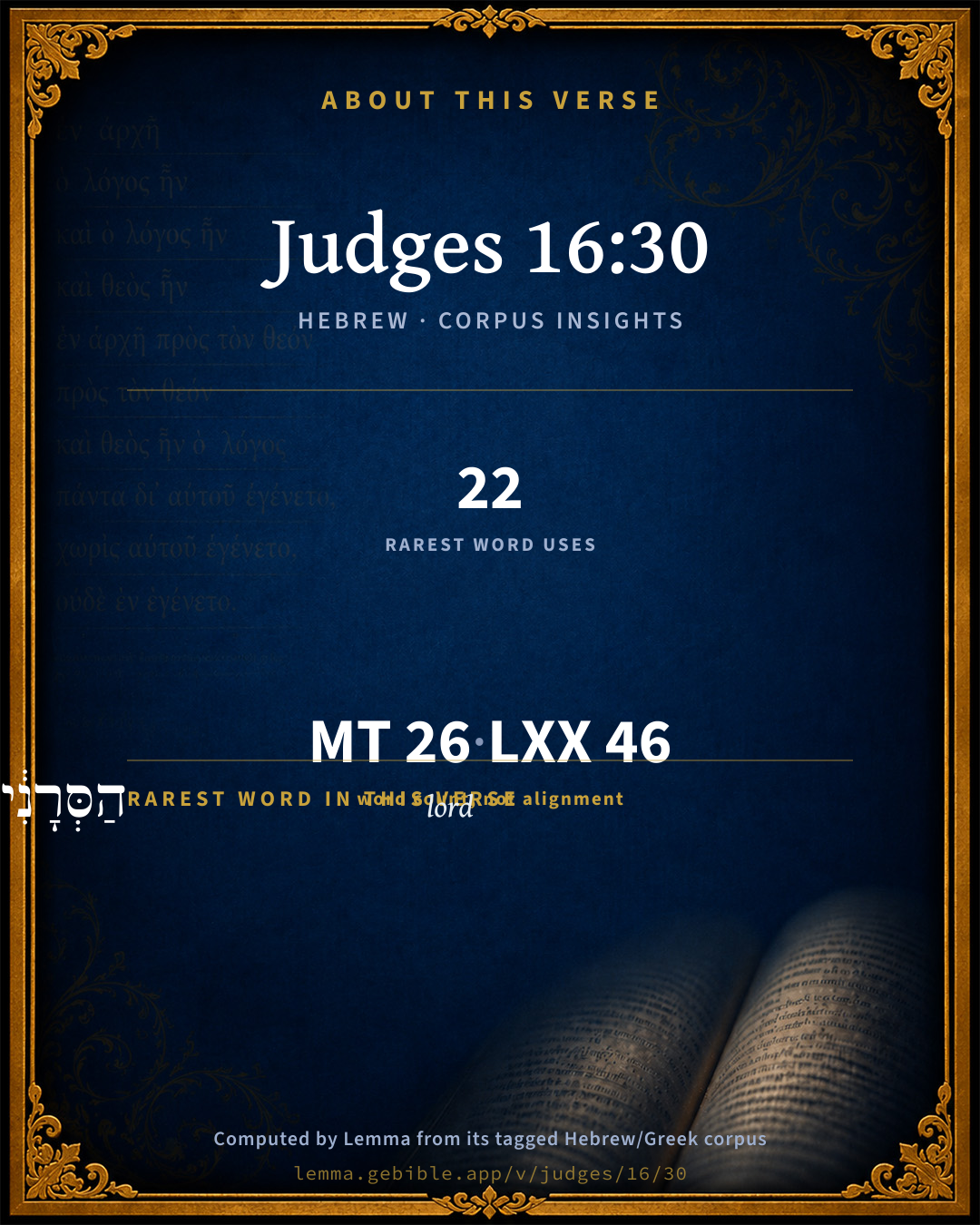
The rarest word here is הַסְּרָנִ֔ים lord H5633 — appearing just 22 times in the whole Hebrew Bible.

Shared distinctive vocabulary

הַסְּרָנִ֔ים lord H5633 occurs in 20 verses of the Hebrew Bible. Also found in:

Grammatical profile

  • 8 verbs
  • 10 nouns
  • 1 adjective
  • 4 prepositions
  • 3 particles

Verb forms

  • וַיֹּ֣אמֶר Qal · Sequential Imperfect
  • תָּמ֣וֹת Qal · Imperfect
  • וַיֵּ֣ט Qal · Sequential Imperfect
  • וַיִּפֹּ֤ל Qal · Sequential Imperfect
  • וַיִּהְי֤וּ Qal · Sequential Imperfect
  • הַמֵּתִים֙ Qal · Participle Active
  • הֵמִ֣ית Hiphil · Perfect
  • הֵמִ֖ית Hiphil · Perfect

Repetition

Words recur within this verse — often emphatic in Hebrew:

  • תָּמ֣וֹת to die H4191 ×4
  • עַל upon H5921 ×2
  • אֲשֶׁר which H834 ×3

Hebrew & Septuagint length

In English translation the verse runs 49 words from the Hebrew and 50 from the Septuagint (LXX English) — closely comparable.

A rough comparison of the two English renderings, which tokenize alike — not a word-level alignment.

Word counts can differ between the Hebrew and the Greek without any difference in meaning — e.g. the Hebrew direct-object marker אֵת has no separate Greek word, and Greek often adds the article ὁ.

In the original languages it is 26 Hebrew tokens and 46 Greek tokens — but the two are counted differently (Hebrew bundles its prefixes and suffixes into one token; the Greek is in lemma form), so that isn’t a like-for-like length.

Cross-references

19

Topical passages linked to Judges 16:30 in the Treasury of Scripture Knowledge — connected by theme and wording, ordered by reader-vote popularity; previews shown in the World English Bible.

  • Matthew 16:25 For whoever desires to save his life will lose it, and whoever will lose his life for my sake will find it.
  • Philippians 2:8 And being found in human form, he humbled himself, becoming obedient to death, yes, the death of the cross.
  • Matthew 24:38–39 For as in those days which were before the flood they were eating and drinking, marrying and giving in marriage, until the day that Noah entered into the ark,
  • Acts 21:13 Then Paul answered, "What are you doing, weeping and breaking my heart? For I am ready not only to be bound, but also to die at Jerusalem for the name of the Lord Jesus."
  • Philippians 2:17 Yes, and if I am poured out on the sacrifice and service of your faith, I rejoice, and rejoice with you all.
  • 1 Thessalonians 5:2 For you yourselves know well that the day of the Lord comes like a thief in the night.
  • Genesis 3:15 I will put enmity between you and the woman, and between your offspring and her offspring. He will bruise your head, and you will bruise his heel."
  • Job 20:5 That the triumphing of the wicked is short, The joy of the godless but for a moment?
  • Job 31:3 Is it not calamity to the unrighteous, And disaster to the workers of iniquity?
  • Psalms 62:3 How long will you assault a man, Would all of you throw him down, Like a leaning wall, like a tottering fence?
  • Ecclesiastes 9:12 For man also doesn't know his time. As the fish that are taken in an evil net, and as the birds that are caught in the snare, even so are the sons of men snared in an evil time, when it falls suddenly on them.
  • Acts 20:24 But these things don't count; nor do I hold my life dear to myself, so that I may finish my race with joy, and the ministry which I received from the Lord Jesus, to fully testify to the Gospel of the grace of God.
  • Philippians 2:30 because for the work of Christ he came near to death, risking his life to supply that which was lacking in your service toward me.
  • Colossians 2:15 having stripped the principalities and the powers, he made a show of them openly, triumphing over them in it.
  • Hebrews 2:14–15 Since then the children have shared in flesh and blood, he also himself in like manner partook of the same, that through death he might bring to nothing him who had the power of death, that is, the devil,
  • Hebrews 12:1–4 Therefore let us also, seeing we are surrounded by so great a cloud of witnesses, lay aside every weight and the sin which so easily entangles us, and let us run with patience the race that is set before us,
  • Judges 14:19 The Spirit of Yahweh came mightily on him, and he went down to Ashkelon, and struck thirty men of them, and took their spoil, and gave the changes [of clothing] to those who declared the riddle. His anger was kindled, and he went up to his father's house.
  • Judges 15:8 He struck them hip and thigh with a great slaughter: and he went down and lived in the cleft of the rock of Etam.
  • Judges 15:15 He found a fresh jawbone of a donkey, and put forth his hand, and took it, and struck a thousand men therewith.

Cross-references courtesy of OpenBible.info (CC BY 4.0).

Hebrew and Greek witnesses Masoretic Hebrew ↔ Greek Septuagint

The same verse in the two great witnesses to the Old Testament, shown verse-for-verse.

These are two independent witnesses, not word-aligned to each other, and the Septuagint is shown in lemma (dictionary) form.

Hebrew Judges 16:30 Masoretic · Westminster Leningrad Codex

וַיֹּ֣אמֶר שִׁמְשׁ֗וֹן תָּמ֣וֹת נַפְשִׁי֮ עִם פְּלִשְׁתִּים֒ וַיֵּ֣ט בְּכֹ֔חַ וַיִּפֹּ֤ל הַבַּ֨יִת֙ עַל הַסְּרָנִ֔ים וְעַל כָּל הָעָ֖ם אֲשֶׁר בּ֑וֹ וַיִּהְי֤וּ הַמֵּתִים֙ אֲשֶׁ֣ר הֵמִ֣ית בְּמוֹת֔וֹ רַבִּ֕ים מֵאֲשֶׁ֥ר הֵמִ֖ית בְּחַיָּֽיו

Samson said, Let me die with the Philistines. He bowed himself with all his might; and the house fell on the lords, and on all the people who were therein. So the dead that he killed at his death were more than those who he killed in his life.

World English Bible · Public Domain

Greek LXX Judges 16:30 Septuagint · lemma form

καί εἶπον σαμψων ἀποθνήσκω ψυχή ἐγώ μετά ἀλλόφυλος καί βαστάζω ἐν ἰσχύς καί πίπτω ὁ οἶκος ἐπί ὁ ἄρχων καί ἐπί πᾶς ὁ λαός ὁ ἐν αὐτός καί εἰμί ὁ θνήσκω ὅς θανατόω σαμψων ἐν ὁ θάνατος αὐτός πολύς ἤ ὅς θανατόω ἐν ὁ ζωή αὐτός

And Sampson said, Let my soul perish with the Philistines: and he bowed himself mightily; and the house fell upon the princes, and upon all the people that were in it: and the dead whom Sampson killed in his death were more than those whom he killed in his life.

LXX2012 (modern English Septuagint) · Public Domain

Hebrew: Westminster Leningrad Codex (CC BY 4.0). Greek: Septuagint (public domain); English from LXX2012 (modern English Septuagint) (Public Domain). How the Septuagint differs from the Hebrew →

Targum (Aramaic paraphrase)

1

The Targum is the ancient Jewish Aramaic paraphrase of the Hebrew Scriptures — an interpretive translation, not the Hebrew text itself. Onkelos (literal) and Pseudo-Jonathan (expansive) render the Torah, and Jonathan the Prophets. Coverage is partial: where no permissively-licensed English translation exists for a verse, only the Aramaic is shown. This is verse-level text, not a word-by-word alignment to the Hebrew.

  1. Targum Jonathan Prophets (Joshua–Malachi)
    וַאֲמַר שִׁמְשׁוֹן תְּמוּת נַפְשִׁי עִם פְּלִשְׁתָּאֵי וּנְגַד בְּחֵילָא וּנְפַל בֵּיתָא עַל טוּרְנַיָא וְעַל כָּל עַמָא דִי בֵיהּ וַהֲווֹ קְטִילַיָא דִי קְטַל בְּמוֹתֵיהּ סַגִיאִין מִדִי קְטַל בְּחַיוֹהִי:

    (no public-domain English translation for this verse)

    Targum Jonathan — Aramaic: “Mikraot Gedolot” (public domain). English: “Sefaria Community Translation” (CC0 1.0 (public-domain dedication)); “London "Chaldee Paraphrase," 1871” (public domain). Text via Sefaria.

Commentary

Notes on Judges 16:30 from classic Christian and Jewish commentators (each source and its license shown beneath its notes). The classic Christian expositions comment on the surrounding passage and are grouped to its opening verse, so a note may address several verses; the Jewish commentaries on the Tanakh (Rashi and others) are per-verse, so they appear only where the commentator wrote on this verse.

Lemma curates 59 commentaries, every one of them public domain or Creative Commons licensed, each selected and text-cleaned for this edition rather than reprinted as found. About our sources →

Trapp's Complete Commentary

John Trapp

Jdg 16:30 And Samson said, Let me die with the Philistines. And he bowed himself with [all his] might; and the house fell upon the lords, and upon all the people that [were] therein. So the dead which he slew at his death were more than [they] which he slew in his life.

Ver. 30. Let me die with the Philistines.] Heb., Let my soul die {as Num 23:10} with the Philistines, - yet not as the Philistines, but the death of the righteous, who hath hope in his death, - to {Pro 14:32} destroy these Philistines, God’s enemies, out of a zeal of God’s glory. He devoted himself to death, not out of despair, or for vainglory, as some heathens did - Codrus the king of Athens, Decius the Roman Consul, &c. - but by an extraordinary instinct of God’s Spirit, and for a public good: as that Christian soldier did, who at the siege of Buda, to prevent the taking of the town, threw himself down from the wall, together with the dog, as he called him, - the Turk who had first got to the top of it, and set up the Turkish colours there; whereby the town was saved. Samson knew that he should die with the Philistines, Simili quidem poena, sed dissimili culpa, et diverso fine ac fato. Multum interest et qualia quis, et quisque patiatur, saith Augustine. These all died alike, but not for a like cause, or with like comfort.

And the house fell upon the lords, &c.] Lords and the common people perished together. So they did at Fidenae in the days of Tiberius, where the amphitheatre fell at a sight of sword playing, and destroyed thirty thousand people, {a} So at the fall of Blackfriars, many Papists were slain at a Mass: Drury the priest had his sermon and his brains knocked out of his head together. Let those that sport themselves with oaths as the Philistines did with Samson, beware; it will pull the house about their ears. {Zec 5:4}

So the dead.] A type of Christ herein. {Heb 2:14} Death also is to a saint the accomplishment of mortification. {Rom 6:7}

{a} Sueton.

John Trapp, A Commentary or Exposition upon All the Books of the Old and New Testament (1647–1656) — public domain. Text from a community e-Sword module.

Joseph Benson's Commentary

Jdg 16:30. Samson said, Let me die with the Philistines — That is, I am content to die, so I can but contribute to the vindication of God’s glory, and the deliverance of God’s people. This is no encouragement to those who wickedly murder themselves: for Samson did not desire or procure his own death voluntarily, but by mere necessity; he was by his office obliged to seek the destruction of these enemies and blasphemers of God, and oppressors of his people; which in these circumstances he could not effect without his own death. Moreover, Samson did this by divine direction, as God’s answer to his prayer manifests, and that he might be a type of Christ, who, by voluntarily undergoing death, destroyed the enemies of God and of his people. They died just when they were insulting over an Israelite, persecuting him whom God had smitten. Nothing fills up the measure of the iniquity of any person or people faster than mocking or misusing the servants of God; yea, though it is by their own folly that they are brought low. Those know not what they do, nor whom they affront, that make sport with the Lord’s servants.

Joseph Benson's Commentary on the Old and New Testaments (1811–1818) — public domain. Text from a community e-Sword module.

Geneva Bible (1599)

Geneva Bible translators

He speaketh not this of despair, but humbling himself for neglecting his office and the offence thereby given.

Geneva Bible (1599) marginal notes — public domain. Text via Bolls.life.

Adam Clarke's Commentary

Verse 30. So the dead which he slew] We are informed that the house was full of men and women, with about three thousand of both sexes on the top; now as the whole house was pulled down, consequently the principal part of all these were slain; and among them we find there were the lords of the Philistines. The death of these, with so many of the inferior chiefs of the people, was such a crush to the Philistine ascendancy, that they troubled Israel no more for several years, and did not even attempt to hinder Samson's relatives from taking away and burying his dead body.

Adam Clarke's Commentary on the Bible (1810–1826) — public domain. Text from a community e-Sword/MySword module.

The Cambridge Bible for Schools and Colleges

gen. ed. J. J. S. Perowne

30. Let me die] lit. ‘let my soul die.’ In the O.T. the soul is not the immortal, but the mortal, element in man: it is that which breathes, the principle of life. When a person dies the soul goes out (Gen_35:18, cf. Jer_15:9) and exists no more.

the dead which he slew]

‘Samson hath quit himself

Like Samson.’—Milton, S. Agonistes, 1709 f.

The Cambridge Bible for Schools and Colleges (gen. ed. J. J. S. Perowne; Cambridge University Press, 1878–1918) — public domain. Text from a community e-Sword module.

John Gill's Exposition

And Samson said, let me die with the Philistines,.... He sought their death, and was content to lose his own life to be avenged on them; in neither of which did he act a criminal part as a judge of Israel; and from a public spirit he might desire the death of their enemies, and seek to effect it by all means possible; and was the more justifiable at this time, as they were not only insulting him, the representative of his nation, but were affronting the most high God with their idolatries, being now in the temple of their idol, and sacrificing to him. As for his own death, he did not simply desire that, only as he could not be avenged on his enemies without it, he was willing to submit to it; nor did he lay hands on himself, and cannot be charged with being guilty of suicide, and did no other than what a man of valour and public spirit will do; who for the good of his country will not only expose his life to danger in common, but for the sake of that will engage in a desperate enterprise, when he knows most certainly that he must perish in it. Besides, Samson said this, and did what he did under the direction and influence of the Spirit of God; and herein was a type of Christ, who freely laid down his life for his people, that he might destroy his and their enemies:

and he bowed himself with all his might, having fresh strength, and a large measure of it given him at this instant, which he had faith in, and therefore made the attempt, and for which he is reckoned among the heroes for faith in Heb 11:32.

and the house fell upon the lords, and upon all the people that were therein; who were all killed, and Samson himself; an emblem this of the destruction of Satan, and his principalities and powers, by the death of Christ:

so the dead which he slew at his death were more than they which he slew in his life; for besides the lords, and they that were in the house, there were 3000 men and women on the roof, which fell in, and lost their lives also, so that it is very likely there were at least 6000 or 7000 slain; Philo Byblius says 40,000, which is not probable; whereas in his life we only read of 1000 slain by him with the jawbone, besides thirty men at Ashkelon, and the slaughter made when he smote hip and thigh, the number of which is not known. As this house pulled down by Samson is generally thought to be the temple of Dagon, a traveller (a) in those parts tells us, that there is now extant the temple of Dagon in half demolished, and the pillars of it are yet to be seen; but he doubtless mistakes an edifice of a later construction for it: and another traveller (b) of our own country says, on the northeast corner and summit of the hill (on which the city is built) are the ruins of huge arches sunk low in the earth, and other foundations of a stately building; the Jews, adds he, do fable this place to have been the theatre of Samson pulled down on the heads of the Philistines; but he takes it to be the ruins of a later building; See Gill on Sa1 5:2.

(a) Baumgarten. Perogrinatio, l. 2. c. 3. p. 27. Vid. Adrichom. Theatrum Terrae S. p. 134. (b) Sandy's Travels, l. 3. p. 116.

John Gill's Exposition of the Whole Bible (1746–1763) — public domain (CC PDM 1.0). Text via the HelloAO Bible API.

Haydock's Catholic Bible Commentary

Let me die. Literally, let my soul die. Samson did not sin on this occasion, though he was indirectly the cause of his own death. Because he was moved to what he did, by a particular inspiration of God, who also concurred with him by a miracle, in restoring his strength upon the spot, in consequence of his prayer. Samson, by dying in this manner, was a figure of Christ, who by his death overcame all his enemies. (Challoner; Worthington) --- St. Augustine says, "he was not under a human delusion, but divinely inspired....Who will accuse his obedience?" (De C. i. 21., and 26., &c.) And St. Bernard (de præc. 3.) observes that he would have sinned, if he had not received a particular inspiration. But many think that he might have acted as he did, without it, in quality of judge, as he might intend primarily to avenge his people and the glory of God. He was willing to sacrifice his life for this purpose, though he would have preserved it, if it had been in his power. (Cajetan; Lessius, &c) --- The Church honours many virgin martyrs, (Calmet) who have thrown themselves into fire or water, in similar dispositions. St. Ambrose says, "it is to be presumed that their zeal came from God." (De Virg. iii. 7.) He mentions St. Pelagia, and her mother and sisters, and St. Soteris, a relation of his, whose memory is honoured on the 10th of February. St. Apollonia’s feast occurs the day before. "She leapt into the fire, having her breast enkindled with a stronger flame of the holy spirit. (Brev. Rom. [Roman Breviary?]) See the fact of Razas, 2 Machabees xiv. 37. (Haydock) --- So that the revelation of St. Mathildes doubting of his, Solomon’s, Origen’s, and Trajan’s salvation, as if God would thus keep mankind in fear, seems to be a fabrication. (Baronius. A.D. 604.) St. Paul ranks Samson among the saints, Hebrews xi. 32. --- Life. Express mention is made of 1000 slain by Samson, besides the great numbers, which excited the astonishment of the Philistines, chap. xv. 8. But on this occasion he destroyed 3000 at once, and the death of all the princes made the slaughter more terrible, (Calmet) insomuch that the people being without a head, were glad to let Samson’s brethren take away his body without molestation, as they have every reason to fear that the Israelites would now fall upon them. (Salien) --- If 3000 perished on the outside of the temple, (Haydock) Serarius concludes that not less than 20,000 were destroyed in all.

George Leo Haydock (1774–1849), Haydock's Catholic Family Bible and Commentary, 1859 edition — public domain. Excludes Psalms (Douay-Rheims chapter numbering differs from Protestant) and Deuterocanonical books (Catholic canon only).

Matthew Poole's English Annotations

Let me die with the Philistines, i.e. I am contented to die, so I can but therewith contribute any thing to the vindication of God’s glory, here trampled upon, and to the deliverance of God’s people. This is no example nor encouragement to those that wickedly murder themselves; for Samson did not desire nor procure his own death voluntarily, but only by mere force and necessity, because he did desire, and by his office was obliged to seek, the destruction of these enemies and blasphemers of God, and oppressors of his people; which in these circumstances he could not effect without his own death: and his case was not much unlike theirs, that in the heat of battle run upon the very mouth of the cannon, or other evident and certain danger of death, to execute a design upon the enemy; or theirs, who go in a fire-ship to destroy the enemy’s best ships, though they are sure to perish in the enterprise. Moreover, Samson did this by Divine instinct and approbation, as God’s answer to his prayer manifests, and that he might be a type of Christ, who by voluntarily undergoing death destroyed the enemies of God, and of his people.

Matthew Poole's English Annotations on the Holy Bible (1683–1685) — public domain. Text from a community e-Sword/MySword module.

Whedon's Commentary on the Bible

Daniel D. Whedon

30. More than they which he slew in his life — All that he slew in his life, as far as we know, were the thirty men of Ashkelon, (Jdg_14:19,) the thousand at Lehi, (Jdg_15:15,) and the unnamed number of the great slaughter mentioned Jdg_15:8. He probably slew more than these, but all together would not amount to five or six thousand — the number that perished by the fall of this temple. If three thousand were on the roof, there were doubtless as many more below.

Daniel D. Whedon (gen. ed.), Commentary on the Old and New Testaments (1874–1909) — public domain. Text from a community e-Sword module.

The Pulpit Commentary

Let me die, or, my life shall perish with the Philistines. He knew it was certain death to himself, but he did not shrink from it. His last act should be to destroy the oppressors of his country. So the dead which he slew, etc. The words sound like the snatch of some song or proverb in which Samson"s death was described.

The Pulpit Commentary (1880–1919), ed. H.D.M. Spence-Jones & Joseph S. Exell — public domain. Text from a community e-Sword module.

John Wesley's Explanatory Notes

Two pillars - Instances are not wanting of more capacious buildings than this, that have been supported only by one pillar. Pliny in the 15th chapter of the 36th Book of his Natural History, mentions two theatres built by C. Curio, in Julius Caesar's time; each of which was supported only by one pillar, tho' many thousands of people sat in it together. Let me die - That is, I am content to die, so I can but contribute to the vindication of God's glory, and the deliverance of God's people. This is no encouragement to those who wickedly murder themselves: for Samson did not desire, or procure his own death voluntarily, but by mere necessity; he was by his office obliged to seek the destruction of these enemies and blasphemers of God, and oppressors of his people; which in these circumstances he could not effect without his own death. Moreover, Samson did this by Divine direction, as God's answer to his prayer manifests, and that he might be a type of Christ, who by voluntarily undergoing death, destroyed the enemies of God, and of his people. They died, just when they were insulting over an Israelite, persecuting him whom God had smitten. Nothing fills up the measure of the iniquity of any person or people faster, than mocking or misusing the servants of God, yea, tho' it is by their own folly, that they are brought low. Those know not what they do, nor whom they affront, that make sport with a good man.

John Wesley, Explanatory Notes Upon the Whole Bible (1754–1765) — public domain. Text via the GEBible commentary corpus.

unfoldingWord translationNotes

Door43 World Missions Community

He stretched out with his strength

When Samson stretched out his arms he pushed down the pillars of the building. AT: "He used his strength to push down the pillars" or "He used his strength to push over the pillars" (See: Assumed Knowledge and Implicit Information)

the dead

This refers to people who are dead. AT: "the dead people" (See: Nominal Adjectives)

were more

"were a greater amount"

all the house of his father

Here the word "house" refers to his family. AT: "all of his father's family" (See: Metonymy)

came down

The phrase "came down" is used here because the place that Samson's family traveled form was higher in elevation than Gaza.

Zorah ... Eshtaol

See how you translated the names of these places in Judges 13:2 and Judges 13:25.

in the burial place of Manoah, his father

"where his father, Manoah, is buried"

Manoah

See how you translated this man's name in Judges 13:2. (See: How to Translate Names)

Samson had judged Israel for twenty years

This same sentence is also in Judges 15:20. It is repeated here to remind readers of how long he judged Israel. AT: "Samson had judged Israel for twenty years before he died" (See: Assumed Knowledge and Implicit Information)

twenty years

"20 years" (See: Numbers)

translationWords

Samson

die

Philistines

rule

life

brother

house

bury

grave

judge, judges

Israel

unfoldingWord translationNotes — © Distant Shores Media and the Door43 World Missions Community, licensed CC BY-SA 4.0. Source: git.door43.org/Door43/en_tn.

Lesson kit

Teaching starters — assembled from the data on this page, not authored interpretation. Every prompt links to the verse data it draws on. Edit before teaching.

Judges, in the Historical, opens this verse with 26 words (19 distinct Hebrew lemmas). Its most distinctive word is çeren (“lord”). A historical commentator’s framing appears above. Read the whole chapter for the surrounding context.

Discussion questions

  1. How does “lord” (çeren) shape what this verse is saying?
  2. Joshua 13:3 shares the word «lord» with this verse. How do the two illuminate each other?
  3. “to die” occurs 4× in this one verse. What is the effect of the repetition?
  4. These translations render this verse differently; the difference is in the English rendering, not the original. What questions does that raise?
  5. The verb «וַיֹּ֣אמֶר» is Qal Sequential Imperfect. How does its form color the action?
  6. Reading how Trapp's Complete Commentary and Joseph Benson's Commentary read this verse, where do the two commentators agree and where do they part?

Things to notice

Reading settings

Reading text

Shown beneath each verse's original-language words.

Old Testament
Old Testament edition

Read the OT as the Masoretic Hebrew (MT) or the Greek Septuagint (LXX).

English shown for the Greek Septuagint (in the Hebrew ↔ Greek comparison).

Comparing translations? Open the Compare panel on any verse page to stack up to four side by side.