Numbers 19:14

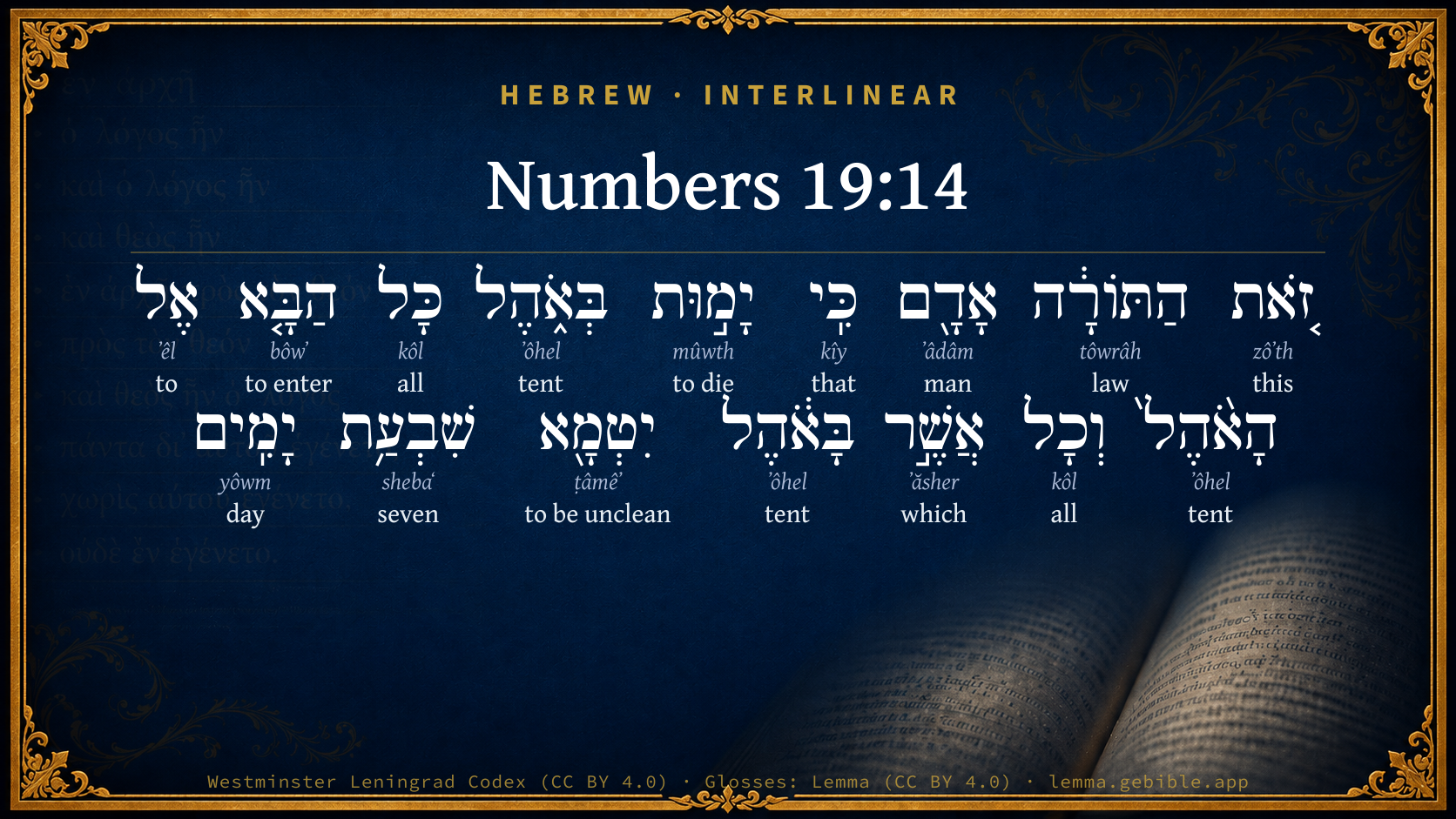
Hebrew (Westminster Leningrad Codex) Numbers 19:14 appears in the Hebrew Old Testament. The text above is from the Westminster Leningrad Codex. Each word links to its Strong’s number, a concise gloss, and parsing drawn from the Open Scriptures Hebrew Bible morphology. Click any word for its full Brown-Driver-Briggs (BDB) entry.
Download image
Cite this verse

Numbers 19:14 (World English Bible). Public Domain. Lemma interlinear Bible study tool, https://lemma.gebible.app/v/numbers/19/14.

Show BibTeX & RIS
BibTeX
RIS
English Translation
This is the law when a man dies in a tent: everyone who comes into the tent, and everyone who is in the tent, shall be unclean seven days.
World English Bible · Public Domain
Download a study sheet

One document with this verse’s original text, its word-by-word gloss line, the meaning frame, cross-references with their text, attributed commentary, and full source and license credits — printable, and it pastes into notes with its structure intact.

This verse Autodidact and up

Study sheet (.html) Plain text (.txt)

A passage Seminary Student

Up to 50 verses in one chapter. A passage sheet keeps up to 6 commentary sources and 12 cross-references per verse, in the order this page ranks them, and says so on the sheet whenever that leaves anything out. Ask for a single verse and you get the Autodidact verse sheet above.

Everything on this page stays free to read, with no account — the sheet is a download of what is already on screen, not access to it.

Want to remove ads? Support Godless Engineer
Compare translations 3

The same verse in 3 English versions, stacked beneath the original-language interlinear above. Click any original word for its lexicon entry.

Each is an independent rendering of the whole verse — the interlinear is not word-aligned to these translations.

Highlighted words mark where these versions differ — a whole-verse word diff, not a word-by-word alignment.

  • World English Bible Public Domain
    This is the law when a man dies in a tent: everyone who comes into the tent, and everyone who is in the tent, shall be unclean seven days.
  • King James Version Public Domain
    This is the law, when a man dieth in a tent: all that come into the tent, and all that is in the tent, shall be unclean seven days.
  • unfoldingWord Literal Text CC BY-SA 4.0
    This the law when a man dies in a tent: everyone coming into the tent and everyone who in the tent shall be unclean seven days.

unfoldingWord Literal Text — © unfoldingWord, licensed CC BY-SA 4.0. Word-aligned USFM3 via Door43 (git.door43.org/unfoldingWord/en_ult).

Versions to compare (up to 4)

3 of 4 selected

Show all 18 translations

Every available English version of this verse, each an independent rendering of the whole verse.

  • World English Bible Public Domain
    This is the law when a man dies in a tent: everyone who comes into the tent, and everyone who is in the tent, shall be unclean seven days.
  • Berean Standard Bible Public Domain
    This is the law when a person dies in a tent: Everyone who enters the tent and everyone already in the tent will be unclean for seven days,
  • Majority Standard Bible Public Domain
    This is the law when a person dies in a tent: Everyone who enters the tent and everyone already in the tent will be unclean for seven days,
  • King James Version Public Domain
    This is the law, when a man dieth in a tent: all that come into the tent, and all that is in the tent, shall be unclean seven days.
  • American Standard Version (1901) Public Domain
    This is the law when a man dieth in a tent: every one that cometh into the tent, and every one that is in the tent, shall be unclean seven days.
  • Revised Version (1885) Public Domain
    This is the law when a man dieth in a tent: every one that cometh into the tent, and every one that is in the tent, shall be unclean seven days.
  • Geneva Bible (1599) Public Domain
    This is the law, Whe a man dieth in a tent, all that come into the tent, and all that is in the tent, shalbe vncleane seuen dayes,
  • Douay-Rheims (1899) Public Domain
    This is the law of a mall that dieth in a tent: All that go into his tent and all the vessels that are there, shall be unclean seven days.
  • Young's Literal Translation Public Domain
    `This `is' the law, when a man dieth in a tent: every one who is coming in unto the tent, and all that `is' in the tent, is unclean seven days;
  • Literal Standard Version CC BY-SA 4.0
    This [is] the law when a man dies in a tent: everyone who is coming into the tent and all that [is] in the tent are unclean [for] seven days;
  • Unlocked Literal Bible CC BY-SA 4.0
    This is the law for when someone dies in a tent. Everyone who goes into the tent and everyone who is already in the tent will be unclean for seven days.
  • unfoldingWord Literal Text CC BY-SA 4.0
    This the law when a man dies in a tent: everyone coming into the tent and everyone who in the tent shall be unclean seven days.
  • Darby Bible Public Domain
    This is the law, when a man dieth in a tent: every one that cometh into the tent, and all that is in the tent, shall be unclean seven days.
  • World Messianic Bible Public Domain
    “This is the law when a man dies in a tent: everyone who comes into the tent, and everyone who is in the tent, shall be unclean seven days.
  • Webster's Bible Public Domain
    This is the law, when a man dieth in a tent: all that come into the tent, and all that is in the tent, shall be unclean seven days.
  • Free Bible Version CC BY-SA 4.0
    The following regulation applies when a person dies in a tent. Everyone who comes into the tent and everyone who is already in the tent will be unclean for seven days.
  • Bible in Basic English Public Domain
    This is the law when death comes to a man in his tent: everyone who comes into the tent, and everyone who is in the tent, will be unclean for seven days.
  • JPS Tanakh (1917) Public Domain
    This is the law: when a man dieth in a tent, every one that cometh into the tent, and every thing that is in the tent, shall be unclean seven days.

Literal Standard Version (2020), Covenant Press — licensed CC BY-SA 4.0. Text via the HelloAO Bible API (eBible.org). Unlocked Literal Bible (unfoldingWord) — licensed CC BY-SA 4.0. Text via the HelloAO Bible API (eBible.org). unfoldingWord Literal Text — © unfoldingWord, licensed CC BY-SA 4.0. Word-aligned USFM3 via Door43 (git.door43.org/unfoldingWord/en_ult). Free Bible Version, Dr. Jonathan Gallagher — licensed CC BY-SA 4.0. Text via the HelloAO Bible API (eBible.org).

Word by word

More ways to search: Search by grammar → Find every occurrence → Compare this word →

Practice this passage: Drill this verse → Learn its vocabulary →

יִטְמָ֖א
ṭâmêʼ
H2930
“to be unclean”
Verb, Qal, Imperfect, 3rd Person, Masculine, Singular
Part of Speech
Verb
Stem
Qal
Form
Imperfect
Person
3rd Person
Gender
Masculine
Number
Singular
Full BDB Definition

Origin: a primitive root

TWOT: 809

to be unclean, become unclean, become impure - (Qal) to be or become unclean - sexually - religiously - ceremonially - (Niphal) - to defile oneself, be defiled - sexually - by idolatry - ceremonially - to be regarded as unclean - (Piel) - to defile - sexually - religiously - ceremonially - to pronounce unclean, declare unclean (ceremonially) - to profane (God's name) - (Pual) to be defiled - (Hithpael) to be unclean - (Hothpael) to be defiled
  1. זֹ֚את zôʼth H2063 “this” Pronoun, Demonstrative, Feminine, Singular
  2. הַתּוֹרָ֔ה tôwrâh H8451 “the · law” Particle, Definite Article + Noun, Common, Feminine, Singular, Absolute
  3. אָדָ֖ם ʼâdâm H120 “man” Noun, Common, Masculine, Singular, Absolute
  4. כִּֽי kîy H3588 “that” Conjunction
  5. יָמ֣וּת mûwth H4191 “to die” Verb, Qal, Imperfect, 3rd Person, Masculine, Singular
  6. בְּאֹ֑הֶל ʼôhel H168 “in/at · tent” Preposition + Noun, Common, Masculine, Singular, Absolute
  7. כָּל kôl H3605 “all of” Noun, Common, Masculine, Singular, Construct
  8. הַבָּ֤א bôwʼ H935 “the · entering” Particle, Definite Article + Verb, Qal, Participle Active, Masculine, Singular, Absolute
  9. אֶל ʼêl H413 “to” Preposition
  10. הָאֹ֨הֶל֙ ʼôhel H168 “the · tent” Particle, Definite Article + Noun, Common, Masculine, Singular, Absolute
  11. וְכָל kôl H3605 “and · all of” Conjunction + Noun, Common, Masculine, Singular, Construct
  12. אֲשֶׁ֣ר ʼăsher H834 “which” Particle, Relative
  13. בָּאֹ֔הֶל ʼôhel H168 “in/at the · tent” Preposition, Determined + Noun, Common, Masculine, Singular, Absolute
  14. שִׁבְעַ֥ת shebaʻ H7651 “seven” Adjective, Cardinal number, Masculine, Singular, Construct
  15. יָמִֽים yôwm H3117 “days” Noun, Common, Masculine, Plural, Absolute

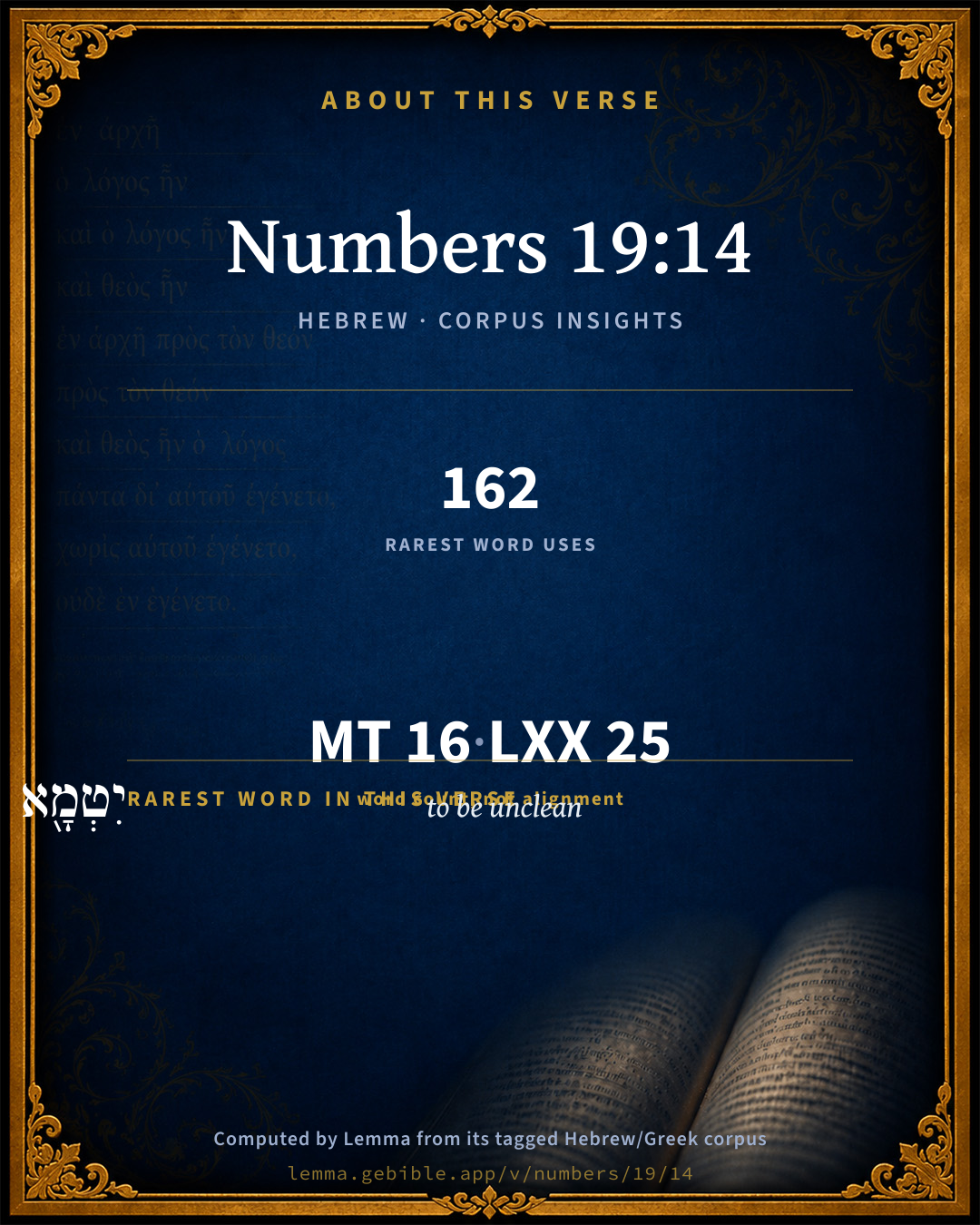
About this verse

These counts appear in no published source. They are computed here, from the morphology-tagged text and Lemma’s own curated glosses. What Lemma adds →

16
words
13
distinct lemmas
Pentateuch
section

Grammatical profile

  • 3 verbs
  • 8 nouns
  • 1 adjective
  • 1 pronoun
  • 1 preposition
  • 1 conjunction
  • 1 particle

Verb forms

  • יָמ֣וּת Qal · Imperfect
  • הַבָּ֤א Qal · Participle Active
  • יִטְמָ֖א Qal · Imperfect

Repetition

Words recur within this verse — often emphatic in Hebrew:

  • בְּאֹ֑הֶל tent H168 ×3
  • כָּל all H3605 ×2

Hebrew & Septuagint length

In English translation the verse runs 29 words from the Hebrew and 30 from the Septuagint (LXX English) — closely comparable.

A rough comparison of the two English renderings, which tokenize alike — not a word-level alignment.

Word counts can differ between the Hebrew and the Greek without any difference in meaning — e.g. the Hebrew direct-object marker אֵת has no separate Greek word, and Greek often adds the article ὁ.

In the original languages it is 16 Hebrew tokens and 25 Greek tokens — but the two are counted differently (Hebrew bundles its prefixes and suffixes into one token; the Greek is in lemma form), so that isn’t a like-for-like length.

Hebrew and Greek witnesses Masoretic Hebrew ↔ Greek Septuagint

The same verse in the two great witnesses to the Old Testament, shown verse-for-verse.

These are two independent witnesses, not word-aligned to each other, and the Septuagint is shown in lemma (dictionary) form.

Hebrew Numbers 19:14 Masoretic · Westminster Leningrad Codex

זֹ֚את הַתּוֹרָ֔ה אָדָ֖ם כִּֽי יָמ֣וּת בְּאֹ֑הֶל כָּל הַבָּ֤א אֶל הָאֹ֨הֶל֙ וְכָל אֲשֶׁ֣ר בָּאֹ֔הֶל יִטְמָ֖א שִׁבְעַ֥ת יָמִֽים

This is the law when a man dies in a tent: everyone who comes into the tent, and everyone who is in the tent, shall be unclean seven days.

World English Bible · Public Domain

Greek LXX Numbers 19:14 Septuagint · lemma form

καί οὗτος ὁ νόμος ἄνθρωπος ἐάν ἀποθνήσκω ἐν οἰκία πᾶς ὁ εἰςπορεύομαι εἰς ὁ οἰκία καί ὅσος εἰμί ἐν ὁ οἰκία ἀκάθαρτος εἰμί ἑπτά ἡμέρα

And this is the law; if a man die in a house, every one that goes into the house, and all things in the house, shall be unclean seven days.

LXX2012 (modern English Septuagint) · Public Domain

On this verse, Whedon's Commentary on the Bible discusses the Septuagint’s reading. Read the note in Commentary ↓

Hebrew: Westminster Leningrad Codex (CC BY 4.0). Greek: Septuagint (public domain); English from LXX2012 (modern English Septuagint) (Public Domain). How the Septuagint differs from the Hebrew →

Targum (Aramaic paraphrase)

2

The Targum is the ancient Jewish Aramaic paraphrase of the Hebrew Scriptures — an interpretive translation, not the Hebrew text itself. Onkelos (literal) and Pseudo-Jonathan (expansive) render the Torah, and Jonathan the Prophets. Coverage is partial: where no permissively-licensed English translation exists for a verse, only the Aramaic is shown. This is verse-level text, not a word-by-word alignment to the Hebrew.

  1. Targum Onkelos Torah (Genesis–Deuteronomy)
    דָא אוֹרַיְתָא אֱנַשׁ אֲרֵי יְמוּת בְּמַשְׁכְּנָא כָּל דְעָלֵל לְמַשְׁכְּנָא וְכָל דִי בְמַשְׁכְּנָא יְהֵי מְסָאָב שַׁבְעָא יוֹמִין

    (no public-domain English translation for this verse)

    Targum Onkelos — Aramaic: “Onkelos Genesis” (public domain); “Onkelos Exodus” (public domain); “Onkelos Leviticus” (public domain); “Onkelos Numbers” (public domain); “Onkelos Deuteronomy” (public domain). English: “Sefaria Community Translation” (CC0 1.0 (public-domain dedication)); “J.W. Etheridge. The Targums of Onkelos and Jonathan Ben Uzziel on the Pentateuch. London: Longmans, Green, 1862” (public domain). Text via Sefaria.

  2. Targum Pseudo-Jonathan Torah (Genesis–Deuteronomy)
    דָא אַחְוָויַית אוֹרַיְתָא גְבַר אֲרֵי יְמוֹת תְּחוֹת גַנָנָא דְפָרִיס כָּל מַאן דְעָלִיל לְמַשְׁכְּנָא אוֹרַח תַּרְעָא וְלָא מִן צִדְדֵיהּ כִּדְפָתַח תַּרְעֵיהּ מִכָּל דִבְמַשְׁכְּנָא וַאֲפִילוּ קַרְקָעִיתֵיהּ וְאַבְנוֹי וְקִיסוֹי וּמָנוֹי יְהֵי מְסָאָב שׁוּבְעָא יוֹמִין

    This is the indication of the law concerning a man when he hath died under the outspread tent every one who entereth into the tent by the way of the door, but not from its side, when its door is open, (or when one hath opened its door,) and whatever is in the tent, its floor, stone, wood, and vessels, shall be unclean seven days.

    Targum Pseudo-Jonathan — Aramaic: “Targum Jonathan on Genesis” (public domain); “Targum Jonathan on Exodus” (public domain); “Targum Jonathan on Leviticus” (public domain); “Targum Jonathan on Numbers” (public domain); “Targum Jonathan on Deuteronomy” (public domain). English: “The Targum of Jonathan ben Uzziel, trans. J. W. Etheridge, London, 1862” (public domain). Text via Sefaria.

Commentary

Notes on Numbers 19:14 from classic Christian and Jewish commentators (each source and its license shown beneath its notes). The classic Christian expositions comment on the surrounding passage and are grouped to its opening verse, so a note may address several verses; the Jewish commentaries on the Tanakh (Rashi and others) are per-verse, so they appear only where the commentator wrote on this verse.

Lemma curates 59 commentaries, every one of them public domain or Creative Commons licensed, each selected and text-cleaned for this edition rather than reprinted as found. About our sources →

Tyndale Open Study Notes

Tyndale Open Resources

19:14-16 Death’s contagion could be transmitted to an object or to a place where death had occurred (cp. Lev 15:1-12).

Tyndale Open Study Notes — © Tyndale Open Resources, licensed CC BY-SA 4.0. Text via the HelloAO Bible API.

Jamieson, Fausset & Brown

Robert Jamieson, A. R. Fausset & David Brown

when a man dieth in a tent, &c.--The instances adduced appear very minute and trivial; but important ends, both of a religious and of a sanitary nature, were promoted by carrying the idea of pollution from contact with dead bodies to so great an extent. While it would effectually prevent that Egyptianized race of Israelites imitating the superstitious custom of the Egyptians, who kept in their houses the mummied remains of their ancestors, it ensured a speedy interment to all, thus not only keeping burial places at a distance, but removing from the habitations of the living the corpses of persons who died from infectious disorders, and from the open field the unburied remains of strangers and foreigners who fell in battle.

Jamieson, Fausset & Brown — Commentary Critical and Explanatory on the Whole Bible (1871) — public domain (CC PDM 1.0). Text via the HelloAO Bible API.

The Cambridge Bible for Schools and Colleges

gen. ed. J. J. S. Perowne

14–22. A second use of the ‘water of impurity.’

Mere presence under the same roof as the dead, without actual contact, causes defilement.

The Cambridge Bible for Schools and Colleges (gen. ed. J. J. S. Perowne; Cambridge University Press, 1878–1918) — public domain. Text from a community e-Sword module.

John Gill's Exposition

This is the law when a man dieth in a tent,.... A tent is only mentioned, because the Israelites now dwelt in tents, as Aben Ezra remarks; otherwise the law holds equally good of an house as of a tent:

all that come into the tent, and all that is in the tent, shall be unclean seven days; the meaning of which is, that all persons that come into a tent or house where a dead body is are equally unclean as those that were in it when it died; and the same is to be supposed of all vessels brought into it, as well as those that are in it, that is, open ones, as appears by what follows.

John Gill's Exposition of the Whole Bible (1746–1763) — public domain (CC PDM 1.0). Text via the HelloAO Bible API.

Haydock's Catholic Bible Commentary

Days. Almost all nations seem to have considered themselves defiled by the presence of a corpse. Virgin (Æneid, vi. 149,) writes, Præterea jacet exanimum tibi corpus amici---Heu nescis! totamque incestat funere classem.

George Leo Haydock (1774–1849), Haydock's Catholic Family Bible and Commentary, 1859 edition — public domain. Excludes Psalms (Douay-Rheims chapter numbering differs from Protestant) and Deuterocanonical books (Catholic canon only).

Whedon's Commentary on the Bible

Daniel D. Whedon

14. In a tent — This is an incidental proof that this law was given in the wilderness. The law for the tent was afterward extended by the rabbins to the entire house, (οικια, Septuagint), and not merely to the apartment in which the death had occurred. Modern Jews sustain the rabbins.

Daniel D. Whedon (gen. ed.), Commentary on the Old and New Testaments (1874–1909) — public domain. Text from a community e-Sword module.

The Pulpit Commentary

This is the law. hrwOTh. By this law the extent of the infection is rigidly defined, as its duration by the last. In a tent. This fixes the date of the law as given in the wilderness, but it leaves in some uncertainty the rule as to settled habitations. The Septuagint, however, has here en oikia , and therefore it would appear that the law was transferred without modification from the tent to the house. In the case of large houses with many inhabitants, some relaxation of the strictness must have been found necessary.

The Pulpit Commentary (1880–1919), ed. H.D.M. Spence-Jones & Joseph S. Exell — public domain. Text from a community e-Sword module.

unfoldingWord translationNotes

Door43 World Missions Community

General Information:

The idea of "unclean" represents not being acceptable to God or fit for use. (See: Metaphor)

Every open container with no cover becomes unclean

This can be stated in a positive form. AT: "Open containers will remain clean only if they have covers" (See: Double Negatives)

someone who has been killed with a sword

This can be stated in active form. AT: "someone whom someone else has killed with a sword" (See: Active or Passive)

translationWords

tent

clean

sword

grave

unfoldingWord translationNotes — © Distant Shores Media and the Door43 World Missions Community, licensed CC BY-SA 4.0. Source: git.door43.org/Door43/en_tn.

Rashi

Rabbi Shlomo Yitzchaki (Rashi)

כל הבא אל האהל ALL THAT COMETH INTO THE TENT, whilst the dead body is within it, shall be unclean seven days.

Rashi on the Tanakh — English translations: “The Judaica Press complete Tanach with Rashi, translated by A. J. Rosenberg” (CC BY 4.0); “Pentateuch with Rashi's commentary by M. Rosenbaum and A.M. Silbermann, 1929-1934” (public domain); “The Metsudah Tanach series, Lakewood, N.J” (CC BY 4.0); and “The Book of Joshua, Metsudah Publications, 1997” (CC BY 4.0). Text via Sefaria.

Ramban (Nachmanides)

Rabbi Moshe ben Nachman (Ramban / Nachmanides)

WHEN A MAN DIETH IN A TENT. The meaning thereof is: “When a man dies, and he is now [lying] in a tent” [even though he may have died outside the tent and was later on brought in]; or it may be that Scripture speaks about the usual circumstances [and people usually die inside a building], but the same law applies if he died outside and they brought him into the tent. All that come into the tent and all that is in the tent — this includes the vessels therein and the tent itself, as He said [further on], and he shall sprinkle upon the tent and upon all the vessels and upon the persons that were there. Scripture mentions the tent in order to let us know that the tent itself is rendered unclean for seven days, and [in order to become clean again] requires sprinkling [with the waters of purification]. Furthermore, the Israelites were tent-dwellers in the wilderness and Scripture spoke of the usual [circumstances at that time], because the commandment applied [both] immediately and for later generations; but the same law applies to a house and to everything that “covers” [a corpse], namely that they convey uncleanness to all the vessels and persons that are there, except that a house which is [permanently] attached to the ground cannot itself become impure [unlike a tent which is also defiled].Now Scripture stated [that] a corpse [conveys] impurity by contact. — See Vol. III, p. 129, Note 150, on the interchangeable use of the terms “clean,” and “unclean,” or “pure” and “impure.” and by an ‘ohel,’ but does not mention [that it also conveys impurity to the person who] carries it. Our Rabbis, however, deduced it by a kal vachomer from [the law of] a dead animal, (see Note 32), nonetheless does convey impurity [to one who] carries it — surely a corpse [which conveys impurity for seven days, and also by ohel, conveys impurity to one who carries it]! And just as in the case of a dead animal, touching it conveys impurity until the [same] evening and carrying it [likewise] conveys impurity until the evening, so also in the case of a corpse, where touching conveys impurity for seven days, carrying also conveys impurity for seven days” (Rambam, Mishneh Torah, Hilchoth Tumath Hameith, 1:2). and have included it in [the law of] uncleanness of seven days, just like [one who] touches [a corpse]. This is also in accordance with the plain meaning of Scripture, for He mentioned in the case of one who dies [of his own accord] or was killed that he who touches him becomes unclean for seven days,. — See Vol. III, p. 129, Note 150, on the interchangeable use of the terms “clean,” and “unclean,” or “pure” and “impure.” and [requires] sprinkling [with the waters of purification]; and it is already known that [the word] “touching” in the Torah refers to actual personal contact, and to contact through another object, that is, by carrying it [in which case he is “touching” the object carried by means of the intervening object].

Ramban (Nachmanides) on the Tanakh — English translation: “Commentary on the Torah by Ramban (Nachmanides). Translated and annotated by Charles B. Chavel. New York, Shilo Pub. House, 1971-1976” (CC BY 4.0). Text via Sefaria.

Lesson kit

Teaching starters — assembled from the data on this page, not authored interpretation. Every prompt links to the verse data it draws on. Edit before teaching.

Numbers, in the Pentateuch, opens this verse with 16 words (13 distinct Hebrew lemmas). Its most distinctive word is ṭâmêʼ (“to be unclean”). A historical commentator’s framing appears above. Read the whole chapter for the surrounding context.

Discussion questions

  1. What does “to be unclean” (ṭâmêʼ) contribute to the verse as a whole?
  2. What does the repetition of “tent” (3× in this one verse) do in this verse?
  3. The translations on this page render this verse differently — a whole-verse word diff, not a word-by-word alignment. What might account for the different wordings?
  4. «יָמ֣וּת» is a Qal Imperfect verb. How does that grammatical form shape the action described?
  5. Compare how Tyndale Open Study Notes and Jamieson, Fausset & Brown read this verse. Where do they agree or differ?

Things to notice

Reading settings

Reading text

Shown beneath each verse's original-language words.

Old Testament
Old Testament edition

Read the OT as the Masoretic Hebrew (MT) or the Greek Septuagint (LXX).

English shown for the Greek Septuagint (in the Hebrew ↔ Greek comparison).

Comparing translations? Open the Compare panel on any verse page to stack up to four side by side.