
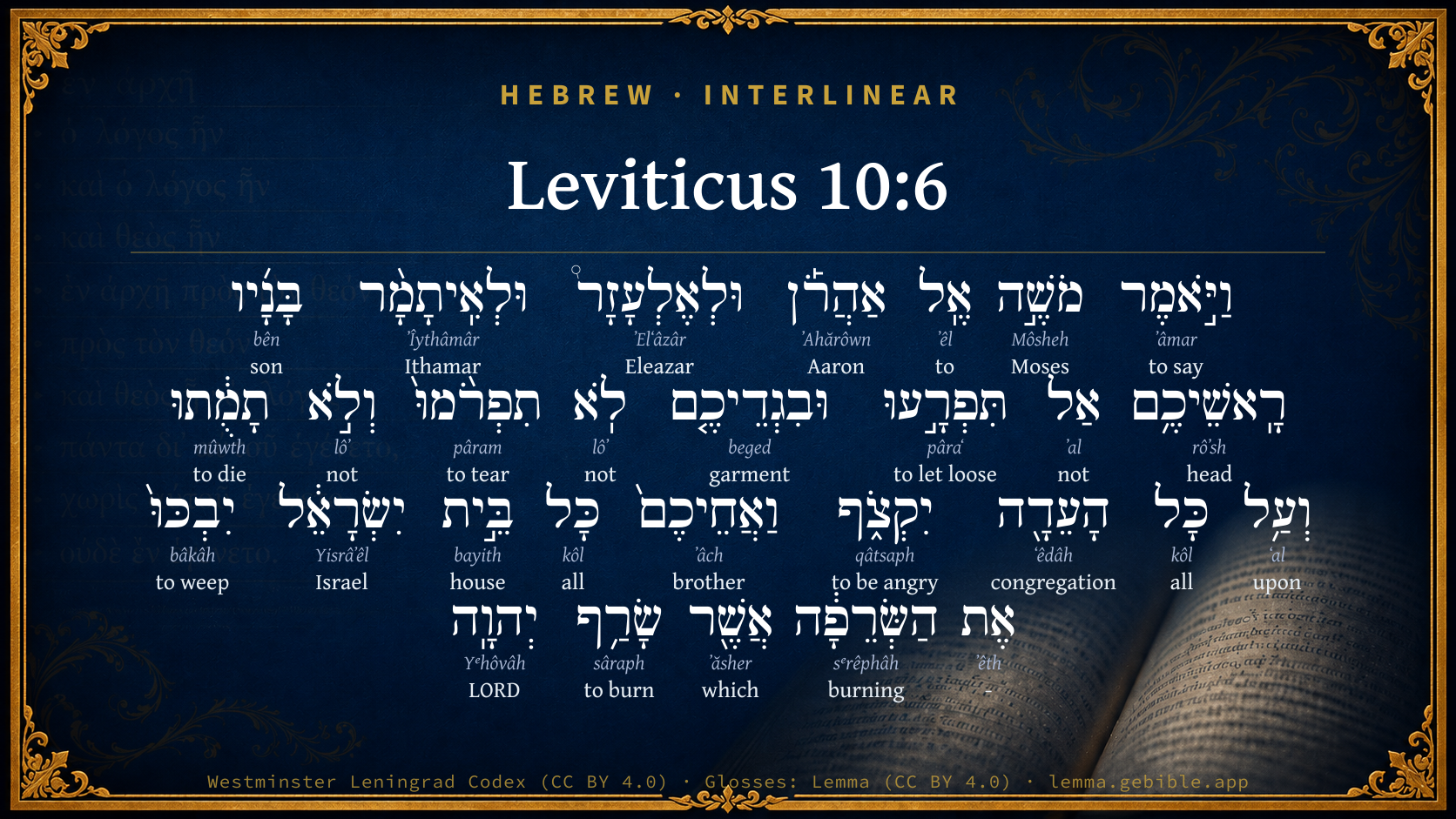
Leviticus 10:6

Hebrew (Westminster Leningrad Codex) Leviticus 10:6 appears in the Hebrew Old Testament. The text above is from the Westminster Leningrad Codex. Each word links to its Strong’s number, a concise gloss, and parsing drawn from the Open Scriptures Hebrew Bible morphology. Click any word for its full Brown-Driver-Briggs (BDB) entry.
Download image
Cite this verse

Leviticus 10:6 (World English Bible). Public Domain. Lemma interlinear Bible study tool, https://lemma.gebible.app/v/leviticus/10/6.

Show BibTeX & RIS
BibTeX
RIS
English Translation
Moses said to Aaron, and to Eleazar and to Ithamar, his sons, "Don't let the hair of your heads go loose, neither tear your clothes; that you don't die, and that he not be angry with all the congregation: but let your brothers, the whole house of Israel, bewail the burning which Yahweh has kindled.
World English Bible · Public Domain
Highlights
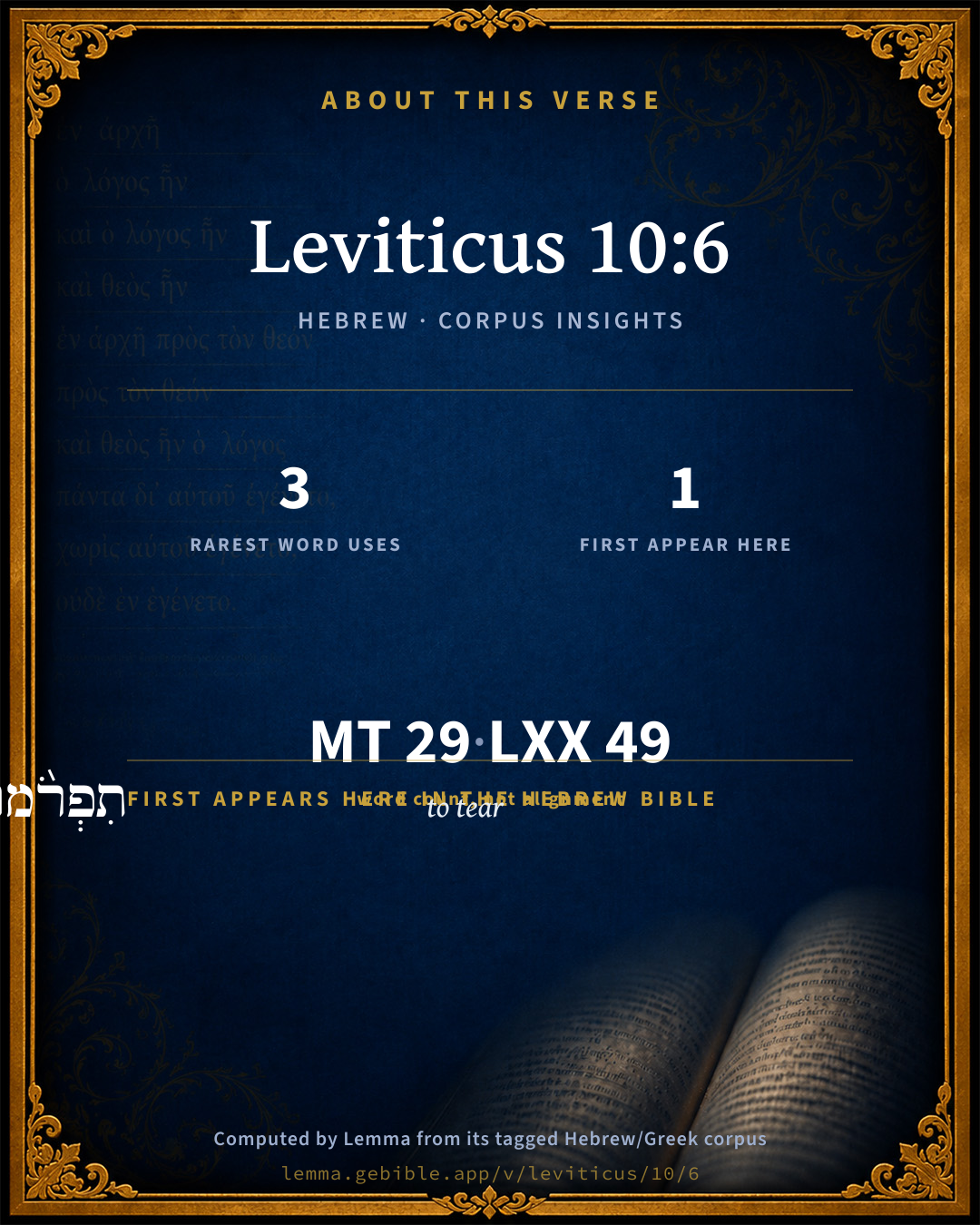
  • 1 first appearance in the Hebrew Bible
Full analysis ↓
Download a study sheet

One document with this verse’s original text, its word-by-word gloss line, the meaning frame, cross-references with their text, attributed commentary, and full source and license credits — printable, and it pastes into notes with its structure intact.

This verse Autodidact and up

Study sheet (.html) Plain text (.txt)

A passage Seminary Student

Up to 50 verses in one chapter. A passage sheet keeps up to 6 commentary sources and 12 cross-references per verse, in the order this page ranks them, and says so on the sheet whenever that leaves anything out. Ask for a single verse and you get the Autodidact verse sheet above.

Everything on this page stays free to read, with no account — the sheet is a download of what is already on screen, not access to it.

Want to remove ads? Support Godless Engineer
Compare translations 3

The same verse in 3 English versions, stacked beneath the original-language interlinear above. Click any original word for its lexicon entry.

Each is an independent rendering of the whole verse — the interlinear is not word-aligned to these translations.

Highlighted words mark where these versions differ — a whole-verse word diff, not a word-by-word alignment.

  • World English Bible Public Domain
    Moses said to Aaron, and to Eleazar and to Ithamar, his sons, "Don't let the hair of your heads go loose, neither tear your clothes; that you don't die, and that he not be angry with all the congregation: but let your brothers, the whole house of Israel, bewail the burning which Yahweh has kindled.
  • King James Version Public Domain
    And Moses said unto Aaron, and unto Eleazar and unto Ithamar, his sons, Uncover not your heads, neither rend your clothes; lest ye die, and lest wrath come upon all the people: but let your brethren, the whole house of Israel, bewail the burning which the LORD hath kindled.
  • unfoldingWord Literal Text CC BY-SA 4.0
    And Moses said to Aaron and to Eleazar and to Ithamar, his sons, “Do not let your heads be loose and do not tear your clothes, so that you will not die and against all the congregation he will be angry. But your brothers, all of the house of Israel, shall weep the burning that Yahweh has burned.

unfoldingWord Literal Text — © unfoldingWord, licensed CC BY-SA 4.0. Word-aligned USFM3 via Door43 (git.door43.org/unfoldingWord/en_ult).

Versions to compare (up to 4)

3 of 4 selected

Show all 18 translations

Every available English version of this verse, each an independent rendering of the whole verse.

  • World English Bible Public Domain
    Moses said to Aaron, and to Eleazar and to Ithamar, his sons, "Don't let the hair of your heads go loose, neither tear your clothes; that you don't die, and that he not be angry with all the congregation: but let your brothers, the whole house of Israel, bewail the burning which Yahweh has kindled.
  • Berean Standard Bible Public Domain
    Then Moses said to Aaron and his sons Eleazar and Ithamar, “Do not let your hair become disheveled and do not tear your garments, or else you will die, and the LORD will be angry with the whole congregation. But your brothers, the whole house of Israel, may mourn on account of the fire that the LORD has ignited.
  • Majority Standard Bible Public Domain
    Then Moses said to Aaron and his sons Eleazar and Ithamar, “Do not let your hair become disheveled and do not tear your garments, or else you will die, and the LORD will be angry with the whole congregation. But your brothers, the whole house of Israel, may mourn on account of the fire that the LORD has ignited.
  • King James Version Public Domain
    And Moses said unto Aaron, and unto Eleazar and unto Ithamar, his sons, Uncover not your heads, neither rend your clothes; lest ye die, and lest wrath come upon all the people: but let your brethren, the whole house of Israel, bewail the burning which the LORD hath kindled.
  • American Standard Version (1901) Public Domain
    And Moses said unto Aaron, and unto Eleazar and unto Ithamar, his sons, Let not the hair of your heads go loose, neither rend your clothes; that ye die not, and that he be not wroth with all the congregation: but let your brethren, the whole house of Israel, bewail the burning which Jehovah hath kindled.
  • Revised Version (1885) Public Domain
    And Moses said unto Aaron, and unto Eleazar and unto Ithamar, his sons, Let not the hair of your heads go loose, neither rend your clothes; that ye die not, and that he be not wroth with all the congregation: but let your brethren, the whole house of Israel, bewail the burning which the LORD hath kindled.
  • Geneva Bible (1599) Public Domain
    After, Moses saide vnto Aaron and vnto Eleazar and Ithamar his sonnes, Vncouer not your heads, neither rent your clothes, least ye dye, and least wrath come vpon all ye people: but let your brethren, all the house of Israel bewayle the burning which the Lord hath kindled.
  • Douay-Rheims (1899) Public Domain
    And Moses said to Aaron, and to Eleazar and Ithamar, his sons: Uncover not your heads, and rend not your garments, lest perhaps you die, and indignation come upon all the congregation. Let your brethren, and all the house of Israel, bewail the burning which the Lord has kindled:
  • Young's Literal Translation Public Domain
    And Moses saith unto Aaron, and to Eleazar, and to Ithamar his sons, `Your heads ye do not uncover, and your garments ye do not rend, that ye die not, and on all the company He be wroth; as to your brethren, the whole house of Israel, they bewail the burning which Jehovah hath kindled;
  • Literal Standard Version CC BY-SA 4.0
    And Moses says to Aaron and his sons, to Eleazar and to Ithamar, “You do not uncover your heads, and you do not tear your garments, that you do not die, and He is angry on all the congregation; as for your brothers, the whole house of Israel, they lament the burning which YHWH has kindled;
  • Unlocked Literal Bible CC BY-SA 4.0
    Then Moses said to Aaron and to Eleazar and to Ithamar, his sons, “Do not let your hair on your heads hang loosely, and do not tear your clothes, so that you may not die, and so that Yahweh may not be angry with all the assembly. But allow your relatives, the entire house of Israel, to mourn for those whom the fire of Yahweh has set ablaze.
  • unfoldingWord Literal Text CC BY-SA 4.0
    And Moses said to Aaron and to Eleazar and to Ithamar, his sons, “Do not let your heads be loose and do not tear your clothes, so that you will not die and against all the congregation he will be angry. But your brothers, all of the house of Israel, shall weep the burning that Yahweh has burned.
  • Darby Bible Public Domain
    And Moses said to Aaron, and to Eleazar and to Ithamar his sons, Your heads shall ye not uncover, neither rend your clothes; lest ye die, and lest wrath come on all the assembly; but your brethren, the whole house of Israel, shall bewail the burning which Jehovah hath kindled.
  • World Messianic Bible Public Domain
    Moses said to Aaron, and to Eleazar and to Ithamar, his sons, “Don’t let the hair of your heads go loose, and don’t tear your clothes, so that you don’t die, and so that he will not be angry with all the congregation; but let your brothers, the whole house of Israel, bewail the burning which the LORD has kindled.
  • Webster's Bible Public Domain
    And Moses said to Aaron, and to Eleazar and to Ithamar, his sons, Uncover not your heads, neither rend your clothes; lest ye die, and lest wrath come upon all the people: but let your brethren, the whole house of Israel, bewail the burning which the LORD hath kindled.
  • Free Bible Version CC BY-SA 4.0
    Then Moses told Aaron and his sons Eleazar and Ithamar, “Don't leave your hair uncombed, and don't tear your clothes, otherwise you will die, and the Lord will be angry with everyone. But your relatives and all the other Israelites may mourn for those the Lord killed by fire.
  • Bible in Basic English Public Domain
    And Moses said to Aaron and to Eleazar and Ithamar, his sons, Do not let your hair be loose, and give no signs of grief; so that death may not overtake you, and his wrath come on all the people; but let there be weeping among your brothers and all the house of Israel for this burning of the Lord's fire.
  • JPS Tanakh (1917) Public Domain
    And Moses said unto Aaron, and unto Eleazar and unto Ithamar, his sons: 'Let not the hair of your heads go loose, neither tend your clothes, that ye die not, and that He be not wroth with all the congregation; but let your brethren, the whole house of Israel, bewail the burning which the LORD hath kindled.

Literal Standard Version (2020), Covenant Press — licensed CC BY-SA 4.0. Text via the HelloAO Bible API (eBible.org). Unlocked Literal Bible (unfoldingWord) — licensed CC BY-SA 4.0. Text via the HelloAO Bible API (eBible.org). unfoldingWord Literal Text — © unfoldingWord, licensed CC BY-SA 4.0. Word-aligned USFM3 via Door43 (git.door43.org/unfoldingWord/en_ult). Free Bible Version, Dr. Jonathan Gallagher — licensed CC BY-SA 4.0. Text via the HelloAO Bible API (eBible.org).

Word by word

More ways to search: Search by grammar → Find every occurrence → Compare this word →

Practice this passage: Drill this verse → Learn its vocabulary →

תִפְרֹ֨מוּ֙
pâram
H6533
“to tear”
Verb, Qal, Imperfect, 2nd Person, Masculine, Plural
Part of Speech
Verb
Stem
Qal
Form
Imperfect
Person
2nd Person
Gender
Masculine
Number
Plural
Full BDB Definition

Origin: a primitive root

TWOT: 1819

(Qal) to tear, rend garment, rip
  1. וַיֹּ֣אמֶר ʼâmar H559 “and · to say” Conjunction + Verb, Qal, Sequential Imperfect, 3rd Person, Masculine, Singular
  2. מֹשֶׁ֣ה Môsheh H4872 “Moses” Noun, Proper
  3. אֶֽל ʼêl H413 “to” Preposition
  4. אַהֲרֹ֡ן ʼAhărôwn H175 “Aaron” Noun, Proper
  5. וּלְאֶלְעָזָר֩ ʼElʻâzâr H499 “and · to/for · Eleazar” Conjunction + Preposition + Noun, Proper
  6. וּלְאִֽיתָמָ֨ר ʼÎythâmâr H385 “and · to/for · Ithamar” Conjunction + Preposition + Noun, Proper
  7. בָּנָ֜יו bên H1121 “sons · his” Noun, Common, Masculine, Plural, Construct + Suffix, Personal, 3rd Person, Masculine, Singular
  8. רָֽאשֵׁיכֶ֥ם rôʼsh H7218 “heads · your” Noun, Common, Masculine, Plural, Construct + Suffix, Personal, 2nd Person, Masculine, Plural
  9. אַל ʼal H408 “not” Particle, Negative
  10. תִּפְרָ֣עוּ pâraʻ H6544 “to let loose” Verb, Qal, Jussive, 2nd Person, Masculine, Plural
  11. וּבִגְדֵיכֶ֤ם beged H899 “and · garments · your” Conjunction + Noun, Common, Masculine, Plural, Construct + Suffix, Personal, 2nd Person, Masculine, Plural
  12. לֹֽא lôʼ H3808 “not” Particle, Negative
  13. וְלֹ֣א lôʼ H3808 “and · not” Conjunction + Particle, Negative
  14. תָמֻ֔תוּ mûwth H4191 “to die” Verb, Qal, Imperfect, 2nd Person, Masculine, Plural
  15. וְעַ֥ל ʻal H5921 “and · upon” Conjunction + Preposition
  16. כָּל kôl H3605 “all of” Noun, Common, Masculine, Singular, Construct
  17. הָעֵדָ֖ה ʻêdâh H5712 “the · congregation” Particle, Definite Article + Noun, Common, Feminine, Singular, Absolute
  18. יִקְצֹ֑ף qâtsaph H7107 “to be angry” Verb, Qal, Imperfect, 3rd Person, Masculine, Singular
  19. וַאֲחֵיכֶם֙ ʼâch H251 “and · brothers · your” Conjunction + Noun, Common, Masculine, Plural, Construct + Suffix, Personal, 2nd Person, Masculine, Plural
  20. כָּל kôl H3605 “all of” Noun, Common, Masculine, Singular, Construct
  21. בֵּ֣ית bayith H1004 “house of” Noun, Common, Masculine, Singular, Construct
  22. יִשְׂרָאֵ֔ל Yisrâʼêl H3478 “Israel” Noun, Proper
  23. יִבְכּוּ֙ bâkâh H1058 “to weep” Verb, Qal, Imperfect, 3rd Person, Masculine, Plural
  24. אֶת ʼêth H853 “-” Particle, Direct Object
  25. הַשְּׂרֵפָ֔ה sᵉrêphâh H8316 “the · burning” Particle, Definite Article + Noun, Common, Feminine, Singular, Absolute
  26. אֲשֶׁ֖ר ʼăsher H834 “which” Particle, Relative
  27. שָׂרַ֥ף sâraph H8313 “to burn” Verb, Qal, Perfect, 3rd Person, Masculine, Singular
  28. יְהוָֽה Yᵉhôvâh H3068 “LORD” Noun, Proper

About this verse

These counts appear in no published source. They are computed here, from the morphology-tagged text and Lemma’s own curated glosses. What Lemma adds →

29
words
27
distinct lemmas
Pentateuch
section

Notable vocabulary

The rarest word here is תִפְרֹ֨מוּ֙ to tear H6533 — appearing just 3 times in the whole Hebrew Bible.

First appearance in Scripture

This word makes its first canonical appearance in the Hebrew Bible here:

  • תִפְרֹ֨מוּ֙ to tear H6533

Shared distinctive vocabulary

תִפְרֹ֨מוּ֙ to tear H6533 occurs in 3 verses of the Hebrew Bible. Also found in:

Grammatical profile

  • 7 verbs
  • 15 nouns
  • 2 prepositions
  • 5 particles

Verb forms

  • וַיֹּ֣אמֶר Qal · Sequential Imperfect
  • תִּפְרָ֣עוּ Qal · Jussive
  • תִפְרֹ֨מוּ֙ Qal · Imperfect
  • תָמֻ֔תוּ Qal · Imperfect
  • יִקְצֹ֑ף Qal · Imperfect
  • יִבְכּוּ֙ Qal · Imperfect
  • שָׂרַ֥ף Qal · Perfect

Repetition

Words recur within this verse — often emphatic in Hebrew:

Hebrew & Septuagint length

In English translation the verse runs 55 words from the Hebrew and 64 from the Septuagint (LXX English) — closely comparable.

A rough comparison of the two English renderings, which tokenize alike — not a word-level alignment.

Word counts can differ between the Hebrew and the Greek without any difference in meaning — e.g. the Hebrew direct-object marker אֵת has no separate Greek word, and Greek often adds the article ὁ.

In the original languages it is 29 Hebrew tokens and 49 Greek tokens — but the two are counted differently (Hebrew bundles its prefixes and suffixes into one token; the Greek is in lemma form), so that isn’t a like-for-like length.

Cross-references

19

Topical passages linked to Leviticus 10:6 in the Treasury of Scripture Knowledge — connected by theme and wording, ordered by reader-vote popularity; previews shown in the World English Bible.

  • Numbers 1:53 But the Levites shall encamp around the Tabernacle of the Testimony, that there may be no wrath on the congregation of the children of Israel: and the Levites shall be responsible for the Tabernacle of the Testimony."
  • Numbers 16:22 They fell on their faces, and said, God, the God of the spirits of all flesh, shall one man sin, and will you be angry with all the congregation?
  • Joshua 7:1 But the children of Israel committed a trespass in the devoted thing; for Achan, the son of Carmi, the son of Zabdi, the son of Zerah, of the tribe of Judah, took of the devoted thing: and the anger of Yahweh was kindled against the children of Israel.
  • Joshua 22:18 that you must turn away this day from following Yahweh? and it will be, seeing you rebel today against Yahweh, that tomorrow he will be angry with the whole congregation of Israel.
  • Leviticus 13:45 "The leper in whom the plague is shall wear torn clothes, and the hair of his head shall hang loose. He shall cover his upper lip, and shall cry, 'Unclean! Unclean!'
  • Joshua 22:20 Didn't Achan the son of Zerah commit a trespass in the devoted thing, and wrath fell on all the congregation of Israel? and that man didn't perish alone in his iniquity.
  • 2 Samuel 24:1 Again the anger of Yahweh was kindled against Israel, and he moved David against them, saying, Go, number Israel and Judah.
  • Numbers 6:6–7 "All the days that he separates himself to Yahweh he shall not go near a dead body.
  • Numbers 18:5 You shall keep the charge of the sanctuary, and the charge of the altar; that there be wrath no more on the children of Israel.
  • Ezekiel 24:16–17 Son of man, behold, I take away from you the desire of your eyes with a stroke: yet you shall neither mourn nor weep, neither shall your tears run down.
  • Exodus 33:5 Yahweh said to Moses, "Tell the children of Israel, 'You are a stiff-necked people. If I were to go up into your midst for one moment, I would consume you. Therefore now take off your jewelry from you, that I may know what to do to you."
  • Numbers 5:18 The priest shall set the woman before Yahweh, and let the hair of the woman's head go loose, and put the meal offering of memorial in her hands, which is the meal offering of jealousy. The priest shall have in his hand the water of bitterness that brings a curse.
  • Numbers 14:6 Joshua the son of Nun and Caleb the son of Jephunneh, who were of those who spied out the land, tore their clothes:
  • Numbers 16:41–47 But on the next day all the congregation of the children of Israel murmured against Moses and against Aaron, saying, You have killed the people of Yahweh.
  • Deuteronomy 33:9 Who said of his father, and of his mother, I have not seen him; Neither did he acknowledge his brothers, Nor knew he his own children: For they have observed your word, Keep your covenant.
  • Joshua 7:11 Israel has sinned; yes, they have even transgressed my covenant which I commanded them: yes, they have even taken of the devoted thing, and have also stolen, and dissembled also; and they have even put it among their own stuff.
  • 2 Samuel 24:15–17 So Yahweh sent a pestilence on Israel from the morning even to the time appointed; and there died of the people from Dan even to Beersheba seventy thousand men.
  • Jeremiah 7:29 Cut off your hair, [Jerusalem], and cast it away, and take up a lamentation on the bare heights; for Yahweh has rejected and forsaken the generation of his wrath.
  • Micah 1:16 Shave your heads, And cut off your hair for the children of your delight. Enlarge your baldness like the vulture; For they have gone into captivity from you!

Cross-references courtesy of OpenBible.info (CC BY 4.0).

Hebrew and Greek witnesses Masoretic Hebrew ↔ Greek Septuagint

The same verse in the two great witnesses to the Old Testament, shown verse-for-verse.

These are two independent witnesses, not word-aligned to each other, and the Septuagint is shown in lemma (dictionary) form.

Hebrew Leviticus 10:6 Masoretic · Westminster Leningrad Codex

וַיֹּ֣אמֶר מֹשֶׁ֣ה אֶֽל אַהֲרֹ֡ן וּלְאֶלְעָזָר֩ וּלְאִֽיתָמָ֨ר בָּנָ֜יו רָֽאשֵׁיכֶ֥ם אַל תִּפְרָ֣עוּ וּבִגְדֵיכֶ֤ם לֹֽא תִפְרֹ֨מוּ֙ וְלֹ֣א תָמֻ֔תוּ וְעַ֥ל כָּל הָעֵדָ֖ה יִקְצֹ֑ף וַאֲחֵיכֶם֙ כָּל בֵּ֣ית יִשְׂרָאֵ֔ל יִבְכּוּ֙ אֶת הַשְּׂרֵפָ֔ה אֲשֶׁ֖ר שָׂרַ֥ף יְהוָֽה

Moses said to Aaron, and to Eleazar and to Ithamar, his sons, "Don't let the hair of your heads go loose, neither tear your clothes; that you don't die, and that he not be angry with all the congregation: but let your brothers, the whole house of Israel, bewail the burning which Yahweh has kindled.

World English Bible · Public Domain

Greek LXX Leviticus 10:6 Septuagint · lemma form

καί εἶπον μωυσῆς πρός ἀαρών καί ελεαζαρ καί ιθαμαρ ὁ υἱός αὐτός ὁ καταλείπω ὁ κεφαλή σύ οὐ ἀποκιδαρόω καί ὁ ἱμάτιον σύ οὐ διαῥήγνυμι ἵνα μή ἀποθνήσκω καί ἐπί πᾶς ὁ συναγωγή εἰμί θυμός ὁ ἀδελφός σύ πᾶς ὁ οἶκος ἰσραήλ κλαίω ὁ ἐμπυρισμός ὅς ἐνπυρίζω ὑπό κύριος

And Moses said to Aaron, and Eleazar and Ithamar his sons that were left, You⌃ shall not make bare your heads, and you⌃ shall not tear your garments; that you⌃ die not, and so there should be wrath on all the congregation: but your brethren, even all the house of Israel, shall lament for the burning, with which they were burnt by the Lord.

LXX2012 (modern English Septuagint) · Public Domain

On this verse, John Gill's Exposition discusses the Septuagint’s reading. Read the note in Commentary ↓

Hebrew: Westminster Leningrad Codex (CC BY 4.0). Greek: Septuagint (public domain); English from LXX2012 (modern English Septuagint) (Public Domain). How the Septuagint differs from the Hebrew →

Targum (Aramaic paraphrase)

2

The Targum is the ancient Jewish Aramaic paraphrase of the Hebrew Scriptures — an interpretive translation, not the Hebrew text itself. Onkelos (literal) and Pseudo-Jonathan (expansive) render the Torah, and Jonathan the Prophets. Coverage is partial: where no permissively-licensed English translation exists for a verse, only the Aramaic is shown. This is verse-level text, not a word-by-word alignment to the Hebrew.

  1. Targum Onkelos Torah (Genesis–Deuteronomy)
    וַאֲמַר מֹשֶׁה לְאַהֲרֹן וּלְאֶלְעָזָר וּלְאִיתָמָר בְּנוֹהִי רֵישֵׁיכוֹן לָא תְרַבּוּן פֵּרוּעַ וּלְבוּשֵׁיכוֹן לָא תְבַזְעוּן וְלָא תְמוּתוּן וְעַל כָּל כְּנִשְׁתָּא יְהֵא רוּגְזָא וַאֲחֵיכוֹן כָּל בֵּית יִשְׂרָאֵל יִבְכּוּן יָת יְקִדְתָּא דִי אוֹקִיד יְיָ

    (no public-domain English translation for this verse)

    Targum Onkelos — Aramaic: “Onkelos Genesis” (public domain); “Onkelos Exodus” (public domain); “Onkelos Leviticus” (public domain); “Onkelos Numbers” (public domain); “Onkelos Deuteronomy” (public domain). English: “Sefaria Community Translation” (CC0 1.0 (public-domain dedication)); “J.W. Etheridge. The Targums of Onkelos and Jonathan Ben Uzziel on the Pentateuch. London: Longmans, Green, 1862” (public domain). Text via Sefaria.

  2. Targum Pseudo-Jonathan Torah (Genesis–Deuteronomy)
    וַאֲמַר משֶׁה לְאַהֲרן וּלְאֶלְעָזָר וּלְאִיתָמָר בְּנוֹי רֵישֵׁיכוֹן לָא תַרְבּוּן פָּרוּעַ וּלְבוּשֵׁיכוֹן לָא תְבַזְעוּן וְלָא תְמוּתוּן בִּיקִידַת אֵישָׁתָא וְעִילוֹי כָּל כְּנִישְׁתָּא יְהֵי רוּגְזָא בְּרַם שְׁתּוּקוּן וְתִזְכּוּן יַת דִינָא עֲלֵיכוֹן וַאֲחֵיכוֹן כָּל בֵּית יִשְרָאֵל יִבְכּוּן יַת יַקִידְתָּא דְאוֹקִיד יְיָ

    And Mosheh said to Aharon, and to Elasar and to Ithamar, his sons, Unbare not your heads, neither rend your garments, lest you die by the burning fire, and there be wrath upon all the congregation; but be silent and justify the judgment upon you, and let all your brethren of the house of Israel bewail the burning which the Lord hath kindled.

    Targum Pseudo-Jonathan — Aramaic: “Targum Jonathan on Genesis” (public domain); “Targum Jonathan on Exodus” (public domain); “Targum Jonathan on Leviticus” (public domain); “Targum Jonathan on Numbers” (public domain); “Targum Jonathan on Deuteronomy” (public domain). English: “The Targum of Jonathan ben Uzziel, trans. J. W. Etheridge, London, 1862” (public domain). Text via Sefaria.

Commentary

Notes on Leviticus 10:6 from classic Christian and Jewish commentators (each source and its license shown beneath its notes). The classic Christian expositions comment on the surrounding passage and are grouped to its opening verse, so a note may address several verses; the Jewish commentaries on the Tanakh (Rashi and others) are per-verse, so they appear only where the commentator wrote on this verse.

Lemma curates 59 commentaries, every one of them public domain or Creative Commons licensed, each selected and text-cleaned for this edition rather than reprinted as found. About our sources →

Trapp's Complete Commentary

John Trapp

Lev 10:6 And Moses said unto Aaron, and unto Eleazar and unto Ithamar, his sons, Uncover not your heads, neither rend your clothes; lest ye die, and lest wrath come upon all the people: but let your brethren, the whole house of Israel, bewail the burning which the LORD hath kindled.

Ver. 6. And Moses said unto Aaron.] Philo reporteth that the high priest of the Jews, to keep always his soul pure, never saw any mournful object. Tiberius, counterfeiting grief at the funeral of Drusus, had a vail laid betwixt the dead and him, that he might not see the body, because he was, as the rest of the emperors also were, pontifex maximus, or the high priest; and therefore a sacred person. Mourning in Aaron might have seemed murmuring; he is therefore forbidden it, and accordingly he forbears. So did Luther when he buried his daughter; he was not seen to shed a tear. {a} No more did Rev. William Whately, late pastor of Banbury, when, after he had preached his own child’s funeral upon this text, "The will of the Lord be done," he and his wife laid the child in the grave with their own hands.

Bewail the burning.] It is fit enough, ordinarily, that the body, when sown in corruption, be watered by the tears of those that plant it in the earth.

{a} Manlii, loc. com., p. 215.

John Trapp, A Commentary or Exposition upon All the Books of the Old and New Testament (1647–1656) — public domain. Text from a community e-Sword module.

Albert Barnes' Notes on the Bible

Aaron and his two surviving sons are forbidden to show the accustomed signs of mourning, or to leave the court of the tabernacle in order to attend the funeral, because, from their office, they were especially concerned as consecrated priests in outwardly maintaining the honor of Yahweh. They were to bear visible testimony to the righteousness of the punishment of Nadab and Abihu. The people, on the other hand, as not formally standing so near to Yahweh, were permitted to “bewail” as an acknowledgment that the nation had a share in the sin of its priests. (Compare 1Co 12:26.)

Lev 10:6

Uncover not your heads - Or, “set free ... let go loose.” It was a custom to let the hair grow long and fall loosely over the head and face Lev 13:45; 2Sa 15:30; 2Sa 19:4; and the substance of the command would thus be that they should not let the hair go disheveled. Ripping the clothes in front so as to lay open the breast was one of the most common manifestations of grief (see Gen 37:29; Gen 44:13; 2Sa 1:11; Job 1:20; Joe 2:13, etc.). The garments as well as the persons of the priests were consecrated; this appears to be the reason of the prohibition of these ordinary signs of mourning. Compare Lev 20:10.

Lest ye die - See Exo 28:35 note.

Lev 10:7

The anointing oil ... is upon you - See Lev 8:12, Lev 8:30. The holy oil, as the symbol of the Holy Spirit, the Spirit of Life and immortality and joy, was the sign of the priests being brought near to Yahweh. It was therefore by its meaning connected both with the general law which forbade the high priest ever to put on signs of mourning on account of death Lev 21:10-12, and with the special reason for the prohibition on this occasion.

Albert Barnes' Notes on the Bible (1834–1885) — public domain. Text from a community e-Sword/MySword module.

Joseph Benson's Commentary

Lev 10:6. Uncover not your heads — That is, give no signification of your sorrow; mourn not for them; partly lest you should seem to justify your brethren, and tacitly reflect upon God as too severe; and partly lest thereby you should be diverted from, or disturbed, in your present service, which God expects to be done cheerfully. But let the whole house of Israel bewail the burning — Not so much in compassion to them, as in sorrow for the tokens of divine displeasure.

Joseph Benson's Commentary on the Old and New Testaments (1811–1818) — public domain. Text from a community e-Sword module.

Tyndale Open Study Notes

Tyndale Open Resources

10:6 Eleazar and Ithamar were Aaron’s two remaining sons (Exod 6:23). • leaving your hair uncombed: This practice and others like it were ways to show grief in biblical times (cp. Gen 37:29; 44:13; Deut 14:1; 2 Sam 1:11; Job 1:20; Jer 16:6; 47:5). As high priest, Aaron was prohibited from participating in these rituals or in any way displaying his grief (Lev 21:10). The injunction extended to Eleazar and Ithamar; if God’s representatives had shown grief on this occasion, it might have been interpreted by observers as disagreeing with God’s justice. However, the laypeople were allowed to mourn.

Tyndale Open Study Notes — © Tyndale Open Resources, licensed CC BY-SA 4.0. Text via the HelloAO Bible API.

Geneva Bible (1599)

Geneva Bible translators

As though ye lamented for them, preferring your carnal affection to God’s just judgment, Lev. 19:18; Deut. 14:1.

In destroying Nadab and Abihu the chief, and menacing the rest, except they repent.

Geneva Bible (1599) marginal notes — public domain. Text via Bolls.life.

Jamieson, Fausset & Brown

Robert Jamieson, A. R. Fausset & David Brown

Uncover not your heads--They who were ordered to carry out the two bodies, being engaged in their sacred duties, were forbidden to remove their turbans, in conformity with the usual customs of mourning; and the prohibition "neither rend your garments," was, in all probability, confined also to their official costume. For at other times the priests wore the ordinary dress of their countrymen and, in common with their families, might indulge their private feelings by the usual signs or expressions of grief.

Jamieson, Fausset & Brown — Commentary Critical and Explanatory on the Whole Bible (1871) — public domain (CC PDM 1.0). Text via the HelloAO Bible API.

Adam Clarke's Commentary

Verse 6. Uncover not your heads, c.] They were to use no sign of grief or mourning,

1. Because those who were employed in the service of the sanctuary should avoid every thing that might incapacitate them for that service and,

2. Because the crime of their brethren was so highly provoking to God, and so fully merited the punishment which he had inflicted, that their mourning might be considered as accusing the Divine justice of undue severity.

Adam Clarke's Commentary on the Bible (1810–1826) — public domain. Text from a community e-Sword/MySword module.

Ellicott's Commentary for English Readers

(6) Uncover not your heads.—Better, let not your heads be dishevelled. It was the custom for mourners to let their hair grow long, and let it fall in a disorderly and wild manner over the head and face. (See Lev_13:45; Lev_21:10; 2Sa_15:30; 2Sa_19:4, &c.) For this reason the priests who are consecrated to the service of the Lord are even on ordinary occasions not to shave their heads nor suffer their locks to grow long. (Eze_44:20.) On this occasion more especially Aaron and his two surviving sons are forbidden to give way to these manifestations of grief, since it might be considered as a reflection upon the justice of the punishment.

Neither rend your clothes.—This was another ordinary manifestation of sorrow and mourning. (See Gen_37:29; Gen_37:34; Jos_7:6; 2Sa_13:21, &c.) To this day the Jews observe this custom of mourning for the death of their near relations; they tear their garments, let their hair and nails grow, and do not wash.

And lest wrath come upon all the people.—The transgression of this command would not only bring down upon Aaron and his sons the same awful judgment, but would expose the whole community to the Divine wrath. In virtue of the intimate connection which subsisted between the representative of the nation and the people, a sin committed by the high priest in his official position involved the whole community, and they had to share the consequences of the offence. (See Lev_4:3.)

But let your brethren.—The afflicted relatives were, however, not to be deprived of all the customary expressions of mourning. The whole house of Israel, who are here designedly called “the brethren” of the bereaved, to show the depth of their sympathy, were allowed to mourn over the great calamity which had thus befallen them.

A Bible Commentary for English Readers, edited by Charles John Ellicott (1878–1897) — public domain. Text from a community e-Sword module.

The Cambridge Bible for Schools and Colleges

gen. ed. J. J. S. Perowne

6. The ordinary priest might defile himself for those near of kin (Lev_21:2) but the high priest was not allowed to do so (Lev_21:11). On this occasion Aaron, Eleazar, and Ithamar were all subject to the stricter rule. The whole house of Israel joined in the mourning.

Let not the hair of your heads go loose] It was said to Ezekiel when forbidden to mourn, ‘bind thy headtire upon thee’ (Eze_24:17). On removing the headtire the hair would fall down, so that the prohibition ‘Uncover not your heads’ (A.V.), is in effect the same. To let the hair loose and to rend the garments were and still are signs of mourning among the Jews and Eastern nations.

The Cambridge Bible for Schools and Colleges (gen. ed. J. J. S. Perowne; Cambridge University Press, 1878–1918) — public domain. Text from a community e-Sword module.

John Gill's Exposition

And Moses said unto Aaron, and unto Eleazar, and unto Ithamar, his sons,.... His two younger sons, which yet remained; and so the Septuagint version adds, as in Lev 10:12.

uncover not your heads; that is, do not take off your mitre, as the Septuagint version; or the bonnets which they wore in the time of their ministry; for the Jewish priests always had their mitres and bonnets on when they sacrificed; in imitation of which, the Heathens had their heads covered when they offered their sacrifices (k): now it was the way, or custom of a mourner, as Ben Melech observes, to remove his mitre, bonnet, or tiara, from his head; but in this case, that no sign of mourning might be shown, Aaron and his sons are forbid to uncover the head: the Targum of Onkelos is,"do not increase the hair,''or nourish it, or suffer it to grow, as Jarchi and Ben Gersom interpret it: now in times of distress and mourning they used to let the hair grow, whether on the head or beard, see Sa2 19:24 and in this the Jews were imitated by the Egyptians, contrary to other nations; the priests of the gods in other places, says Herodotus (l), took care of their hair (or wore their hair), in Egypt they are shaved; with others the custom is, for the head immediately to be shaved at funerals; but the Egyptians, at death, suffer their hair to grow in the parts before shaved; but this custom with the Jews, though at other times used, is here forbid Aaron and his sons:

neither rend your clothes, which was sometimes done at the report of the death of near relations, as children, in token of mourning, Gen 37:34 but here it is forbid, that there might be no sign of it: it is a particular word that is here used: Ben Melech says, there is a difference between rending and tearing; tearing is in the body of a garment where there is no seam, but rending (which is what is here meant) where there is a seam: the priests rending their garments was after this manner, according to the Jewish canons (m),"an high priest rends below and a common priest above;''that is, as one of their commentators (n) interprets it, the former rends the extreme part of his garment next the feet, and the latter at the breast near the shoulder; but in this case no rent at all was to be made:

lest ye die, and lest wrath come upon all the people; so very provoking to God would be any signs of mourning in Aaron and his sons, on this account:

but let your brethren, the whole house of Israel, bewail the burning which the Lord hath kindled: though Aaron and his sons might not mourn on this occasion, the whole body of the people might, though not bewail so much the death of the persons, as the cause of it; and be concerned for the awful judgment of God, and for the wrath that was sone forth, lest it should proceed and destroy others also, all being sinners.

(k) "Purpureo velare comas", &c. Virgil. Aeneid. l. 3. Vid. Kipping. Rom. Antiqu. l. 1. c. 12. sect. 17. p. 495. (l) Euterpe sive, l. 2. c. 36. (m) Misn. Horayot, c. 3. sect. 5. (n) Bartenora in ib.

John Gill's Exposition of the Whole Bible (1746–1763) — public domain (CC PDM 1.0). Text via the HelloAO Bible API.

Haydock's Catholic Bible Commentary

Uncover not. Take not off your mitres; (Septuagint) let not your hair grow long, (Chaldean) as the Egyptians do in mourning, nor, yet shave your heads, like the priests of Isis. This God forbids, chap. xxi. 5. And Ezechiel, (xliv. 20,) probably with reference to this law, says, Neither shall they shave their heads, nor wear long hair....and no priest shall drink wine when, &c. --- Garments, sacred vestments, which were worn only in the tabernacle or temple. (Calmet) --- The high priests are forbidden to tear their garments at funerals, (chap. xxi. 10,) as this would betray a want of fortitude. --- Perhaps. This does not imply any doubt. (Menochius) See Genesis iii. 3. --- Indignation of God, punishing the people, while there is none to entreat for them. --- Burning of the two priests.

George Leo Haydock (1774–1849), Haydock's Catholic Family Bible and Commentary, 1859 edition — public domain. Excludes Psalms (Douay-Rheims chapter numbering differs from Protestant) and Deuterocanonical books (Catholic canon only).

Matthew Poole's English Annotations

Uncover not your heads; either,

1. By putting off your mitres and bonnets, or ornaments, and going bare-headed, as mourners sometimes did. See Lev 13:45; Eze 24:17,23. Or,

2. By shaving off the hair of your heads and beards, as mourners did. See Job 1:20; Jer 7:29; 41:5; Eze 44:20; Mic 1:16. This latter may seem to be principally intended,

1. Because this ceremony of uncovering the head being used by the people as well as by the priests in case of mourning, as the places now alleged show; and the other ceremony here joined with it, of rending the clothes, being also common to the people; seems to imply that he speaks not of that uncovering of the head which was peculiar to the priests, but of that which was common both to priests and people, especially seeing that which is here forbidden to these priests is in the following words allowed to the people, to

bewail their death, which as at other times it was, so now probably might be performed by these same ceremonies.

2. Because the high priest is forbidden to uncover his head in way of mourning for the dead, not only at that time when he was in actual ministration, but at all times, even when he had neither his mitre nor any of the holy garments upon him, Lev 21:10.

Neither rend your clothes; give no signification of your sorrow; mourn not for them; partly lest you should seem to justify and approve of your brethren, and tacitly reflect upon God as too severe in his proceedings with them; and partly lest thereby you should be diverted from or disturbed in your present service, which God expects should be done cheerfully.

But let your brethren...bewail the burning, not so much in compassion to them against whom God hath showed such great and just indignation, as in sorrow for the tokens of Divine displeasure.

Matthew Poole's English Annotations on the Holy Bible (1683–1685) — public domain. Text from a community e-Sword/MySword module.

Whedon's Commentary on the Bible

Daniel D. Whedon

6. Uncover not your heads — “It was the law that the priest should never leave the altar to go to burials, or interrupt his sacred ministry by shedding tears. He represented God as well as represented the people, and he must abide at his duty whoever died. It was military religion in its mechanical arrangement; it was spiritual obedience in the acceptation of its intention.” — Joseph Parker. They were forbidden to remove their hats, to unbind their head-bands, and dishevel their hair in token of grief. This was an act derogatory to priestly dignity. This command was generalized in the case of the high priest, who was forever prohibited to attend a funeral or to give any indication of mourning for the dead. Neither Judaism nor Christianity ignores the ties of human kindred except when they stand in the way of duty. All affections must yield to the paramount claims of God. Luk_14:26. Those who are brought nigh to God by the anointing of the Holy Spirit must move in a sphere beyond the range of nature’s influences. Priestly nearness to God gives the soul such an insight into all his ways as right and good that one is enabled joyfully to worship in his presence, even though the stroke of his hand has removed from us the object of tender affection.

Neither rend… clothes — This act was an oriental symbol of grief, despair, or indignation.

Lest wrath come upon all the people — Personal gratification must be subordinate to the public weal. “For even Christ,” our high priest, “pleased not himself.” Thus vicarious suffering by the priest is early foreshadowed as a requisite of the coming great High Priest. Nevertheless the erring priests are not to die unwept. The whole house of Israel are commanded to bewail the stroke of vengeance, and to soothe the wounded family of Aaron.

Daniel D. Whedon (gen. ed.), Commentary on the Old and New Testaments (1874–1909) — public domain. Text from a community e-Sword module.

The Pulpit Commentary

Uncover not your heads. They are to abstain from all the conventional signs of mourning, in order to show that they acknowledged the justice of the punishment. The whole house of Israel, that is, the people in general, might mourn the death of their priests, but the high priest and his remaining sons must prove their submission to the Divine chastisement by crushing their individual feelings of sorrow. A murmur on their part would have brought God"s wrath on themselves and on the whole congregation, which they represented. (Lev_4:3) Uncover not your heads may be otherwise translated, Let not your hair fall disheveled. (see Lev_21:10)

Vers. 6, 7. Restrictions and infirmities of religious service.

That honour involves responsibility is implied in many of these ordinances, and is recognized in the judgment passed on the conduct of men occupying conspicuous positions in society and in the Church. To be dedicated to God"s service was an inestimable privilege conferred on Aaron and his family, Their time and labour were bestowed upon high and holy employments, The seal of God was stamped upon their brow, the people regarded them with respect and provided for their maintenance. Compare the honourable position of ministers, missionaries, yea, all the followers of Christ now, and note that there arc special restrictions consequent upon their consecration, and common infirmities to which they are subject equally with others.

I THE RESTRICTIONS.

1. Forbidden to mingle with the world in its engagements. "Not go out of the sanctuary," at least for a season, they are deprived of the liberty others enjoy, Pursuits which may be harmlessly indulged in by others are unbecoming to them.

2. Prohibited from contact with all that is defiling. They must not touch the dead bodies of their relations; the cousins of Aaron shall perform the last offices for their brethren. What concord hath the Spirit of life with death? To profane the holy unction is to incur the Divine displeasure. "Neither filthiness, nor foolish talking, nor jesting, which are not convenient." "Have no fellowship with the unfruitful works of darkness.

3. Free manifestation of grief at God"s visitations not permitted. The usual relief found in expression is excluded; there must be no signs of mourning upon the priests. Let it suffice for the nation to "bewail the burning." How shall the oil of gladness consort with mourning? The people of God are not to be demonstrative in their sorrow at his chastisements, lest it be misconstrued, and others, taking occasion from their example, go further and even denounce the ways of God, and so "wrath come upon" them. We must remember the wisdom of the Almighty and the glory due unto his Name. Will not the world entertain hard thoughts concerning him if we his servants are over-loud in lamentation?

II THE INFIRMITIES which are not prevented.

1. They are subject to the common losses and bereavements. There is no special providence in this respect. Even Aaron and his sons have to bow before afflicting dispensations. If it were otherwise great part of the discipline of life would be omitted from the training of God"s chiefest scholars.

2. They also feel the natural pangs of sorrow. It is evidently so in the present case, or the command to refrain from the usual manifestations of grief would not have been issued. God"s ministers are not expected to become hard-hearted and callous, but they are not to give way to outbursts of anguish.

3. They are liable to commit acts displeasing to God. Nadab and Abihu are a solemn warning of the possibility of transgression. Even Christians of repute fall into grievous sin. They get hurried away by worldly passion, and offer unacceptable worship.

CONCLUSION. Observe the influence of our behaviour upon

(1) the honour of God, and

(2) the welfare of our fellows.

He who expects great things of us wilt also, if we ask him, accord us the necessary strength to enable us to comply with his demands. Whilst conscious of the importance attaching to all our actions, we need not be depressed with a load of anxiety. We may "rejoice in the Lord alway. S.R.A.

The Pulpit Commentary (1880–1919), ed. H.D.M. Spence-Jones & Joseph S. Exell — public domain. Text from a community e-Sword module.

John Wesley's Explanatory Notes

Uncover not your head - That is, give no signification of your sorrow; mourn not for them; partly lest you should seem to justify your brethren, and tacitly reflect upon God as too severe; and partly lest thereby you should be diverted from, or disturbed in your present service, which God expects to be done cheerfully. But bewail the burning - Not so much in compassion to them, as in sorrow for the tokens of divine displeasure.

John Wesley, Explanatory Notes Upon the Whole Bible (1754–1765) — public domain. Text via the GEBible commentary corpus.

Keil & Delitzsch

C. F. Keil & F. Delitzsch

Moses prohibited Aaron and his remaining sons from showing any sign of mourning on account of this fatal calamity. "Uncover not your heads," i.e., do not go about with your hair dishevelled, or flowing free and in disorder (Lev 13:45). ראשׁ פּרע does not signify merely uncovering the head by taking off the head-band (lxx, Vulg., Kimchi, etc.), or by shaving off the hair (Ges. and others; see on the other hand Knobel on Lev 21:10), but is to be taken in a similar sense ראשׁו שׂער פּרע, the free growth of the hair, not cut short with scissors (Num 6:5; Eze 44:20). It is derived from פּרע, to let loose from anything (Pro 1:25; Pro 4:5, etc.), to let a people loose, equivalent to giving them the reins (Exo 32:25), and signifies solvere crines, capellos, to leave the hair in disorder, which certainly implies the laying aside of the head-dress in the case of the priest, though without consisting in this alone. On this sign of mourning among the Roman and other nations, see M. Geier de Ebraeorum luctu viii. 2. The Jews observe the same custom still, and in times of deep mourning neither wash themselves, nor cut their hair, nor pare their nails (see Buxtorf, Synog. jud. p. 706). They were also not to rend their clothes, i.e., not to make a rent in the clothes in front of the breast-a very natural expression of grief, by which the sorrow of the heart was to be laid bare, and one which was not only common among the Israelites (Gen 37:29; Gen 44:13; Sa2 1:11; Sa2 3:31; Sa2 13:31), but was very widely spread among the other nations of antiquity (cf. Geier l.c. xxii. 9). פּרם, to rend, occurs, in addition to this passage, in Lev 13:45; Lev 21:10; in other places פרע, to tear in pieces, is used. Aaron and his sons were to abstain from these expressions of sorrow, "lest they should die and wrath come upon all the people." Accordingly, we are not to seek the reason for this prohibition merely in the fact, that they would defile themselves by contact with the corpses, a reason which afterwards led to this prohibition being raised into a general law for the high priest (Lev 21:10-11). The reason was simply this, that any manifestation of grief on account of the death that had occurred, would have indicated dissatisfaction with the judgment of God; and Aaron and his sons would thereby not only have fallen into mortal sin themselves, but have brought down upon the congregation the wrath of God, which fell upon it through every act of sin committed by the high priest in his official position (Lev 4:3). "Your brethren, (namely) the whole house of Israel, may bewail this burning" (the burning of the wrath of Jehovah). Mourning was permitted to the nation, as an expression of sorrow on account of the calamity which had befallen the whole nation in the consecrated priests. For the nation generally did not stand in such close fellowship with Jehovah as the priests, who had been consecrated by anointing.

Keil & Delitzsch — Biblical Commentary on the Old Testament (1861–1891) — public domain (CC PDM 1.0). Text via the HelloAO Bible API. (Old Testament only.)

Scofield Reference Notes

C. I. Scofield

El-e-a-zar, ’God has helped.’ Ith-a-mar, ’isle of palms.’

The Scofield Reference Bible (1917 edition), notes by C. I. Scofield — public domain. Text from a community e-Sword module.

Rashi

Rabbi Shlomo Yitzchaki (Rashi)

ראשיכם] אל תפרעו] means, let not your hair grow long (cf. Numbers 6:5) (Sifra, Shemini, Mechilta d'Miluim 2 40). From this (from the fact that Scripture forbade these particular mourners to let their hair grow long) it follows that an אבל (one mourning the death of a near relative) is forbidden to cut his hair. Moses's words therefore signified: Ordinarily an אבל may not cut his hair but ye, disturb ye not the joy of the Omnipresent God by displaying signs of mourning (Moed Katan 14b).

ולא תמתו LEST YE DIE — Consequently if ye do this ye shall die (Sifra, Shemini, Mechilta d'Miluim 2 41).

ואחיכם כי בית ישראל BUT (LET] YOUR BRETHREN, THE WHOLE OF ISRAEL [WEEP] — From this it follows that for the miseries of the learned the duty devolves upon everyone (the entire community) to mourn (cf. Moed Katan 28b.)

Rashi on the Tanakh — English translations: “The Judaica Press complete Tanach with Rashi, translated by A. J. Rosenberg” (CC BY 4.0); “Pentateuch with Rashi's commentary by M. Rosenbaum and A.M. Silbermann, 1929-1934” (public domain); “The Metsudah Tanach series, Lakewood, N.J” (CC BY 4.0); and “The Book of Joshua, Metsudah Publications, 1997” (CC BY 4.0). Text via Sefaria.

Ramban (Nachmanides)

Rabbi Moshe ben Nachman (Ramban / Nachmanides)

LET NOT THE HAIR OF YOUR HEADS GO LOOSE. “[This means]: do not grow your hair long. From this [the fact that Scripture forbade these particular mourners to let their hair grow long], we learn that a mourner is forbidden to cut his hair. [Moses thus said to them: Normally a mourner may not cut his hair], but you must not disturb the joy of G-d. THAT YE DIE NOT. But if you do this you shall die.” Thus far the language of Rashi.Now that which Rashi says, “From this we learn that a mourner is forbidden to cut his hair,” is merely a Scriptural support for a Rabbinic enactment., p. 314, Note 449. Moreover, according to this explanation one cannot then interpret: “But if you do this [i.e., you let your hair grow long] you shall die.” Rather. But if you [the sons of Aaron] do this [i.e., let your hair grow long] you shall die” — the real explanation is as follows: “That ye die not. You need not fear death for not letting your hair grow long,” as other mourners would be so punishable if they would not let their hair grow. it was optional in the case of Aaron’s sons, Scripture stating: “You are not obliged to let your hair grow long and rend your garments, as are other mourners; that ye die not, meaning that you will not be liable to death if you do so [i.e., neither let your hair grow nor rend your garments], but other mourners are liable [to death] if they fail to observe it.” Thus also have the Rabbis said in the Gemara of Mashkin: is the name of the first chapter of the tractate. On the term Gemara see in Exodus, Seder Bo, p. 132, Note 204. “A mourner who did not let his hair grow long, and did not rent his garments, is liable [to punishment of death], as it is said, Let not the hair of your heads go loose, neither rend your clothes, that ye die not; but other mourners who do not let their hair grow long, or rend their garments, are liable [to that punishment].” But this text is similar to other Rabbinic laws for which the Talmud merely found a Scriptural support, for letting one’s hair grow long and rending one’s garments when in mourning are only matters of Rabbinic ordinance. Or perhaps the mourning of the first day [after the death and burial] is a law given to Moses at Sinai, being derived from that of aninuth [the state of mourning before the burial of a relative] according to the opinion of the Gaonim., p. 521, Note 74.But the real meaning of the verse is an admonition to Aaron’s sons, and listen to the meaning thereof. Our Rabbis have already said that a High Priest may bring an offering whilst he is still an onen by law of the Torah is a mourner on the day of death of his relative whether before or after burial on that day. [On the night following he is an onen by law of the Rabbis. If burial has not taken place on the day of death he continues to be an onen by law of the Rabbis. When burial finally takes place he is an onen by law of the Rabbis even after burial, but at night he is no longer considered an onen at all.] An onen is to be distinguished from an avel who is a mourner for a period of seven or thirty days. The laws of mourning as affecting the Divine Service in the Tabernacle and its holy offerings relate to the priest when he is an onen. but may not eat it. If any of his next of kin 2:1). die, he is not allowed to let his hair grow or rend his garments or defile himself for them, as it is said, he shall not let the hair of his head go loose, nor rend his clothes; neither shall he enter [a tent containing] a dead body. Now since he is permitted to bring offerings whilst he is an onen, by law of the Torah is a mourner on the day of death of his relative whether before or after burial on that day. [On the night following he is an onen by law of the Rabbis. If burial has not taken place on the day of death he continues to be an onen by law of the Rabbis. When burial finally takes place he is an onen by law of the Rabbis even after burial, but at night he is no longer considered an onen at all.] An onen is to be distinguished from an avel who is a mourner for a period of seven or thirty days. The laws of mourning as affecting the Divine Service in the Tabernacle and its holy offerings relate to the priest when he is an onen. Scripture therefore said about him, Neither shall he go out of the Sanctuary, nor profane the Sanctuary of his G-d., Verse 12. This means that He warned him against going out of the Sanctuary and leaving the Service, for this would be a profanation of G-d’s Name. Now this warning against leaving the Sanctuary at the time of the Service applies to all priests, except that in the case of the High Priest He taught that he may bring offerings whilst he is still an onen by law of the Torah is a mourner on the day of death of his relative whether before or after burial on that day. [On the night following he is an onen by law of the Rabbis. If burial has not taken place on the day of death he continues to be an onen by law of the Rabbis. When burial finally takes place he is an onen by law of the Rabbis even after burial, but at night he is no longer considered an onen at all.] An onen is to be distinguished from an avel who is a mourner for a period of seven or thirty days. The laws of mourning as affecting the Divine Service in the Tabernacle and its holy offerings relate to the priest when he is an onen. [whereas an ordinary priest must interrupt his Service and another one completes it, and he is not permitted to leave the Sanctuary until it is completed]. Accordingly, if the High Priest [on becoming apprised of the death of a near relative], leaves the Service and goes out of the Sanctuary whilst he is an onen, he is liable [to punishment] just like any [ordinary] priest who leaves the Service and goes as he pleases.Now Moses warned Aaron here that he should not let his hair grow long, nor rend his garments, for this [negative] commandment applies to him [as High Priest] for all times. But his sons who were ordinary priests, were not permitted to bring offerings on that day since they were onenim [mourners whose dead are still unburied], and an onen who officiates profanes the Service. They were in fact obliged to defile themselves for their brothers, and similarly they were either permitted or obliged ” (see Note 82) is merely a Scriptural support for a Rabbinic ordinance, as Ramban has it; “obliged,” if the final decision of the law is in accordance with the opinion of the Gaonim (mentioned above), that the mourning of the first day [after death and burial] is a law declared to Moses on Sinai. to let their hair grow and to rend their garments. Yet Moses warned them against doing all this as a special decision [“in order not to disturb the joy of G-d” on that occasion, as mentioned above by Rashi]. Therefore Moses charged Mishael and Elzaphan that they should defile themselves for the dead, and not the priests. He further commanded [the priests] not to let their hair grow, nor to rend their garments, just like their father, [who as High Priest was not permitted to do so], and not to cry at all. This is the meaning of the verse, but let your brethren, the whole house of Israel, bewail the burning which the Eternal hath kindled, but not you. All this was in order not to disturb G-d’s joy [by their displaying signs of mourning]. He treated this strictly by making them liable to death [by the hand of Heaven] if they would disturb the joyous occasion in any way.It is possible that Moses was commanded about this from the mouth of the Almighty, even though it is not expressly written, or that he derived it from that which he was commanded [to relay to Aaron and his sons for the seven days of consecration], and ye shall keep the charge of the Eternal, that ye die not, [from which Moses learned] that the charge of the Eternal includes also the eighth day. Now it was revealed to and known by the Creator of the world that the sons of Aaron were destined to be onenim, and yet He commanded that they should not leave the Sanctuary; thus [we see that here exceptionally] they were not to defile themselves for the dead or to mourn at all.Now the sons of Aaron, the priests that were anointed, even though they were ordinary priests, yet [G-d] made the law applicable to them during the days of the consecration to be like the law of the priest anointed for war in future generations, since he [too] must not let his hair grow long or rend his garments or defile himself for deceased relatives, just like the High Priest, but he may not perform the rites of offerings whilst he is an onen [although the High Priest may do so]. Thus Aaron’s sons, too, did not perform the rites of the offerings on that day, as the Rabbis interpreted: “And Aaron spoke unto Moses: Behold, this day have they offered their sin-offering. Did they [i.e., my sons] then bring the offering — they who are ordinary priests? It was I [Aaron] that offered — I who am the High Priest [who may offer even when being an onen].” Now during this entire incident nothing [which was to be done during] the consecration was abolished, since the offerings had already been brought, and at night they all ate of the hallowed food which they were to eat. It is possible that this law applied to Elazar and Ithamar [Aaron’s remaining sons] all their lives, namely, that their laws be like those of the priest anointed for war [as mentioned above], because they had been anointed with the oil of anointment, this being the sense of the expression, [And ye shall not go out from the door of the Tent of Meeting …] for the anointing oil of the Eternal is upon you. I have already mentioned, Verse 35. the Beraitha of the Torath Kohanim 42. which states: “And ye shall not go out from the door of the Tent of Meeting. I might think that [on becoming apprised of the death of a near relative, an ordinary priest may not leave the Sanctuary] whether he is ministering or not; Scripture therefore says, Neither shall he go out of the Sanctuary, nor profane. When is he not permitted to go out, so that [only by his staying there] he does not profane it? I must say that this applies only when he is ministering. Lest ye die — from the negative you infer the positive [that if they do go out in the middle of their ministering, they are liable to death by the hand of Heaven]. For the anointing oil of the Eternal is upon you. Why is this said? I might think that this tells me only that Aaron and his sons, who were anointed with the oil of anointment, are liable to death if they leave the Sanctuary whilst they are ministering. How do I know that [the prohibition applies also to] all priests at all times? Scripture therefore says, for the anointing oil of the Eternal is upon you.” Similarly have I also seen in the Tosephta of Tractate Sanhedrin: “The Sages said to Rabbi Yehudah: The verse Neither shall he go out of the Sanctuary only applies at the time of ministration.”Now according to this interpretation, the warning and punishment [under consideration] applied to [both] Aaron and his sons, so that if they went out from the door of the Tent of Meeting at the time of performing the Service, they would be liable [to death by the hand of Heaven]. But since it was Aaron who brought the offerings on that day, therefore [Moses] warned him [especially] that he should not leave the Service and go out. His sons, however, were onenim by law of the Torah is a mourner on the day of death of his relative whether before or after burial on that day. [On the night following he is an onen by law of the Rabbis. If burial has not taken place on the day of death he continues to be an onen by law of the Rabbis. When burial finally takes place he is an onen by law of the Rabbis even after burial, but at night he is no longer considered an onen at all.] An onen is to be distinguished from an avel who is a mourner for a period of seven or thirty days. The laws of mourning as affecting the Divine Service in the Tabernacle and its holy offerings relate to the priest when he is an onen. on that day and did not perform the Service. If so, [the question appears]: how were they included in this warning [not to leave the Service and go out of the Sanctuary, when they were in fact doing no Service to begin with]? Perhaps we may say that Moses said to all of them, and ye shall not go out from the door of the Tent of Meeting at the time of the Service, lest ye die, and they knew that Aaron [as High Priest] could perform the rites of offering [although] an onen, by law of the Torah is a mourner on the day of death of his relative whether before or after burial on that day. [On the night following he is an onen by law of the Rabbis. If burial has not taken place on the day of death he continues to be an onen by law of the Rabbis. When burial finally takes place he is an onen by law of the Rabbis even after burial, but at night he is no longer considered an onen at all.] An onen is to be distinguished from an avel who is a mourner for a period of seven or thirty days. The laws of mourning as affecting the Divine Service in the Tabernacle and its holy offerings relate to the priest when he is an onen. and therefore he is included in the prohibition at once, but his sons are included in the prohibition and punishment whenever they would be fit for the Service from that day onwards. It is for this reason that He said here in an unqualified manner, and ye shall not go out from the door of the Tent of Meeting, and did not explain until when this [prohibition] applied, whether until the evening or the next day, since His intent was that they should not leave the Service, and this was to be a commandment applying to all generations.It is possible that the command to the sons of Aaron was a special decision, that they should not go out from there on that day and was therefore prohibited from leaving the Sanctuary. This was to serve as a mark of honor and indication of the joyousness of the occasion. [specifically], just as their father [could not leave], this being in honor of the joyous occasion [i.e., the culmination of the erection of the Tabernacle and inauguration of the priests], but ordinary priests throughout the generations are warned against leaving their Service on the basis of the verse which states, Neither shall he go out of the Sanctuary, nor profane, which means that any priest who goes out of the Sanctuary and leaves his Service profanes it thereby. Thus the verse here [And ye shall not go out from the door of the Tent of Meeting, lest ye die, for the anointing oil of the Eternal is upon you], is only necessary to derive the punishment, that whoever leaves the Service and goes out is subject to death [by the hand of Heaven], for it says, for the anointing oil of the Eternal is upon you, and that anointment is upon them for all generations, as it says, and their anointing oil shall be to them for an everlasting priesthood. So also the Rabbis taught in the Beraitha of Torath Kohanim: 28. “From here the Rabbis have derived the principle that no mark of mourning whatever is shown for those executed by the court. ” (Verse 6) (Rabad, in his commentary on Torath Kohanim). Perhaps you will say, ‘We [the brothers] will go to our homes and mourn, grieve and cry [over the death of Nadab and Abihu], behold G-d has already commanded us not to go out of the Sanctuary.’” From this text it would appear that it was a special decision to the effect that those who died through the Heavenly Court, should be treated like those executed by a [human] court for transgressions, in which case the rule is that [the relatives of the executed] come and greet the judges and the witnesses. ). Here too, they were to remain standing before G-d in the day of his espousals, and in the day of the gladness of his heart. “In the day of his espousals — this is the day of Sinai [i.e., the Giving of the Torah]. And in the day of the gladness of his heart — this is the day [of the setting up] of the Tent of Meeting.” — this is the Giving of the Torah. And in the day of the gladness of his heart — this is the building of the Sanctuary” [in Jerusalem].

Ramban (Nachmanides) on the Tanakh — English translation: “Commentary on the Torah by Ramban (Nachmanides). Translated and annotated by Charles B. Chavel. New York, Shilo Pub. House, 1971-1976” (CC BY 4.0). Text via Sefaria.

Sforno

Rabbi Ovadia Sforno

Although Nodov and Avihu were relatives for which a regular kohein may become impure, the Torah was strict with Elozor and Isomor because they were anointed, as it says (v. 7), “for the anointing oil of Adonoy is on you.”

The entire House of Yisroel shall weep. Because two great righteous men are lacking, and thereby the honor of the dead will not be diminished [if Elozor and Isosmor do not show signs of mourning].

Sforno on the Tanakh — English translation: “Yalkut, Sifsei Chachomim Chumash, Metsudah Publications, 2009” (CC BY 4.0). Text via Sefaria.

Lesson kit

Teaching starters — assembled from the data on this page, not authored interpretation. Every prompt links to the verse data it draws on. Edit before teaching.

Leviticus, in the Pentateuch, opens this verse with 29 words (27 distinct Hebrew lemmas). Its most distinctive word is pâram (“to tear”). A historical commentator’s framing appears above. Read the whole chapter for the surrounding context.

Discussion questions

  1. How does “to tear” (pâram) shape what this verse is saying?
  2. This is the first place “to tear” appears in Scripture (first appears here). What does its debut here establish?
  3. How does Leviticus 13:45, which shares the word «to tear», read alongside this verse?
  4. What does the repetition of “all” (2× in this one verse) do in this verse?
  5. These translations render this verse differently; the difference is in the English rendering, not the original. What questions does that raise?
  6. «וַיֹּ֣אמֶר» is a Qal Sequential Imperfect verb. How does that grammatical form shape the action described?
  7. Compare how Trapp's Complete Commentary and Albert Barnes' Notes on the Bible read this verse. Where do they agree or differ?

Things to notice

Reading settings

Reading text

Shown beneath each verse's original-language words.

Old Testament
Old Testament edition

Read the OT as the Masoretic Hebrew (MT) or the Greek Septuagint (LXX).

English shown for the Greek Septuagint (in the Hebrew ↔ Greek comparison).

Comparing translations? Open the Compare panel on any verse page to stack up to four side by side.