
Genesis 25:32

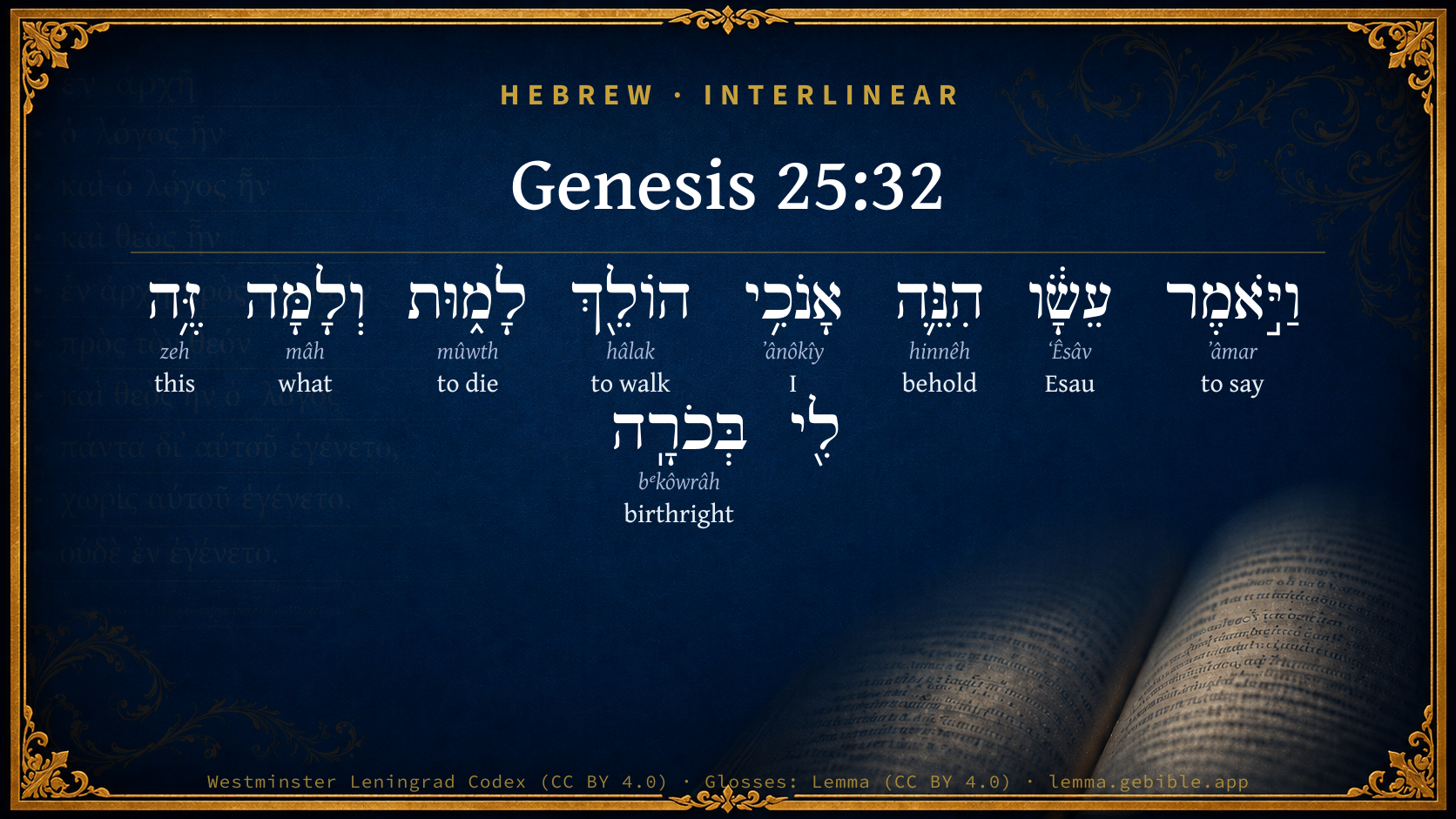
Hebrew (Westminster Leningrad Codex) Genesis 25:32 appears in the Hebrew Old Testament. The text above is from the Westminster Leningrad Codex. Each word links to its Strong’s number, a concise gloss, and parsing drawn from the Open Scriptures Hebrew Bible morphology. Click any word for its full Brown-Driver-Briggs (BDB) entry.
Download image
Cite this verse

Genesis 25:32 (World English Bible). Public Domain. Lemma interlinear Bible study tool, https://lemma.gebible.app/v/genesis/25/32.

Show BibTeX & RIS
BibTeX
RIS
English Translation
Esau said, "Behold, I am about to die. What good is the birthright to me?"
World English Bible · Public Domain
Download a study sheet

One document with this verse’s original text, its word-by-word gloss line, the meaning frame, cross-references with their text, attributed commentary, and full source and license credits — printable, and it pastes into notes with its structure intact.

This verse Autodidact and up

Study sheet (.html) Plain text (.txt)

A passage Seminary Student

Up to 50 verses in one chapter. A passage sheet keeps up to 6 commentary sources and 12 cross-references per verse, in the order this page ranks them, and says so on the sheet whenever that leaves anything out. Ask for a single verse and you get the Autodidact verse sheet above.

Everything on this page stays free to read, with no account — the sheet is a download of what is already on screen, not access to it.

Want to remove ads? Support Godless Engineer
Compare translations 3

The same verse in 3 English versions, stacked beneath the original-language interlinear above. Click any original word for its lexicon entry.

Each is an independent rendering of the whole verse — the interlinear is not word-aligned to these translations.

Highlighted words mark where these versions differ — a whole-verse word diff, not a word-by-word alignment.

  • World English Bible Public Domain
    Esau said, "Behold, I am about to die. What good is the birthright to me?"
  • King James Version Public Domain
    And Esau said, Behold, I am at the point to die: and what profit shall this birthright do to me?
  • unfoldingWord Literal Text CC BY-SA 4.0
    And Esau said, “Behold, I am about to die! So for what use that to me, a birthright?”

unfoldingWord Literal Text — © unfoldingWord, licensed CC BY-SA 4.0. Word-aligned USFM3 via Door43 (git.door43.org/unfoldingWord/en_ult).

Versions to compare (up to 4)

3 of 4 selected

Show all 18 translations

Every available English version of this verse, each an independent rendering of the whole verse.

  • World English Bible Public Domain
    Esau said, "Behold, I am about to die. What good is the birthright to me?"
  • Berean Standard Bible Public Domain
    “Look,” said Esau, “I am about to die, so what good is a birthright to me?”
  • Majority Standard Bible Public Domain
    “Look,” said Esau, “I am about to die, so what good is a birthright to me?”
  • King James Version Public Domain
    And Esau said, Behold, I am at the point to die: and what profit shall this birthright do to me?
  • American Standard Version (1901) Public Domain
    And Esau said, Behold, I am about to die. And what profit shall the birthright do to me?
  • Revised Version (1885) Public Domain
    And Esau said, Behold, I am at the point to die: and what profit shall the birthright do to me?
  • Geneva Bible (1599) Public Domain
    And Esau sayd, Lo, I am almost dead, what is then this birthright to me?
  • Douay-Rheims (1899) Public Domain
    He answered: Lo I die, what will the first birthright avail me.
  • Young's Literal Translation Public Domain
    And Esau saith, `Lo, I am going to die, and what is this to me -- birthright?'
  • Literal Standard Version CC BY-SA 4.0
    And Esau says, “Behold, I am going to die, and what is this to me—a birthright?”
  • Unlocked Literal Bible CC BY-SA 4.0
    Esau said, “Look, I am about to die. What good is the birthright to me?”
  • unfoldingWord Literal Text CC BY-SA 4.0
    And Esau said, “Behold, I am about to die! So for what use that to me, a birthright?”
  • Darby Bible Public Domain
    And Esau said, Behold, I am going to die, and of what use can the birthright be to me?
  • World Messianic Bible Public Domain
    Esau said, “Behold, I am about to die. What good is the birthright to me?”
  • Webster's Bible Public Domain
    And Esau said, Behold, I am at the point to die: and what profit shall this birth-right bring to me?
  • Free Bible Version CC BY-SA 4.0
    “Look! I'm dying here! What use are the rights of the firstborn to me?” Esau declared.
  • Bible in Basic English Public Domain
    And Esau said, Truly, I am at the point of death: what profit is the birthright to me?
  • JPS Tanakh (1917) Public Domain
    And Esau said: 'Behold, I am at the point to die; and what profit shall the birthright do to me?'

Literal Standard Version (2020), Covenant Press — licensed CC BY-SA 4.0. Text via the HelloAO Bible API (eBible.org). Unlocked Literal Bible (unfoldingWord) — licensed CC BY-SA 4.0. Text via the HelloAO Bible API (eBible.org). unfoldingWord Literal Text — © unfoldingWord, licensed CC BY-SA 4.0. Word-aligned USFM3 via Door43 (git.door43.org/unfoldingWord/en_ult). Free Bible Version, Dr. Jonathan Gallagher — licensed CC BY-SA 4.0. Text via the HelloAO Bible API (eBible.org).

Word by word

More ways to search: Search by grammar → Find every occurrence → Compare this word →

Practice this passage: Drill this verse → Learn its vocabulary →

About this verse

These counts appear in no published source. They are computed here, from the morphology-tagged text and Lemma’s own curated glosses. What Lemma adds →

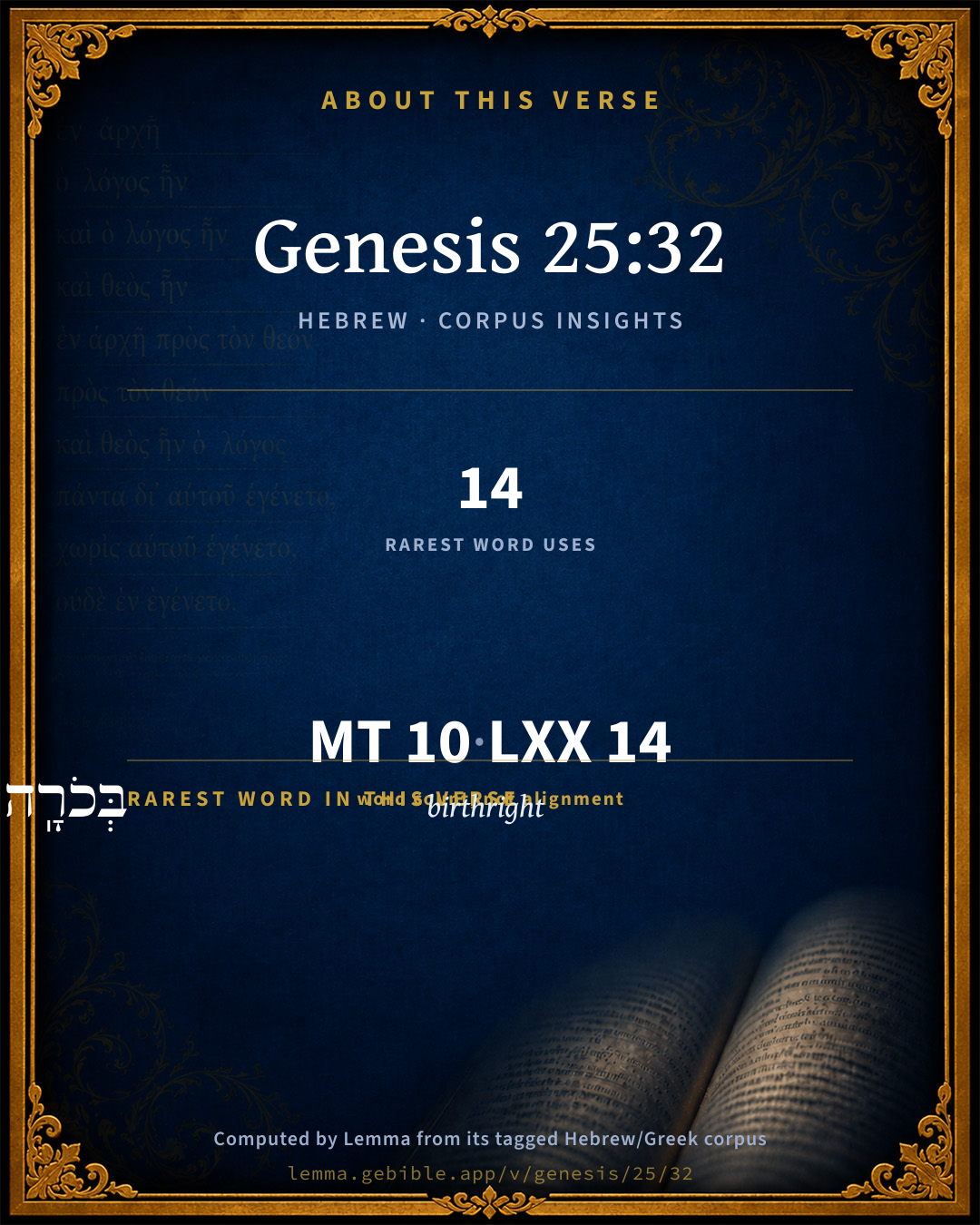
10
words
9
distinct lemmas
Pentateuch
section

Notable vocabulary

The rarest word here is בְּכֹרָֽה birthright H1062 — appearing just 14 times in the whole Hebrew Bible.

Shared distinctive vocabulary

בְּכֹרָֽה birthright H1062 occurs in 13 verses of the Hebrew Bible. Also found in:

Grammatical profile

  • 3 verbs
  • 2 nouns
  • 2 pronouns
  • 1 preposition
  • 2 particles

Verb forms

  • וַיֹּ֣אמֶר Qal · Sequential Imperfect
  • הוֹלֵ֖ךְ Qal · Participle Active
  • לָמ֑וּת Qal · Infinitive Construct

Hebrew & Septuagint length

In English translation the verse runs 15 words from the Hebrew and 19 from the Septuagint (LXX English) — closely comparable.

A rough comparison of the two English renderings, which tokenize alike — not a word-level alignment.

Word counts can differ between the Hebrew and the Greek without any difference in meaning — e.g. the Hebrew direct-object marker אֵת has no separate Greek word, and Greek often adds the article ὁ.

In the original languages it is 10 Hebrew tokens and 14 Greek tokens — but the two are counted differently (Hebrew bundles its prefixes and suffixes into one token; the Greek is in lemma form), so that isn’t a like-for-like length.

Cross-references

5

Topical passages linked to Genesis 25:32 in the Treasury of Scripture Knowledge — connected by theme and wording, ordered by reader-vote popularity; previews shown in the World English Bible.

  • Job 21:15 What is the Almighty, that we should serve him? What profit should we have, if we pray to him?'
  • Job 22:17 Who said to God, 'Depart from us;' And, 'What can the Almighty do for us?'
  • Job 34:9 For he has said, 'It profits a man nothing That he should delight himself with God.'
  • Malachi 3:14 You have said, 'It is vain to serve God;' and 'What profit is it that we have kept his charge, and that we have walked mournfully before Yahweh of Hosts?
  • Exodus 22:9 For every matter of trespass, whether it be for ox, for donkey, for sheep, for clothing, or for any kind of lost thing, about which one says, 'This is mine,' the cause of both parties shall come before God. He whom God condemns shall pay double to his neighbor.

Cross-references courtesy of OpenBible.info (CC BY 4.0).

Hebrew and Greek witnesses Masoretic Hebrew ↔ Greek Septuagint

The same verse in the two great witnesses to the Old Testament, shown verse-for-verse.

These are two independent witnesses, not word-aligned to each other, and the Septuagint is shown in lemma (dictionary) form.

Hebrew Genesis 25:32 Masoretic · Westminster Leningrad Codex

וַיֹּ֣אמֶר עֵשָׂ֔ו הִנֵּ֛ה אָנֹכִ֥י הוֹלֵ֖ךְ לָמ֑וּת וְלָמָּה זֶּ֥ה לִ֖י בְּכֹרָֽה

Esau said, "Behold, I am about to die. What good is the birthright to me?"

World English Bible · Public Domain

Greek LXX Genesis 25:32 Septuagint · lemma form

εἶπον δέ ησαυ ἰδού ἐγώ πορεύομαι τελευτάω καί ἵνα τίς ἐγώ οὗτος ὁ πρωτοτόκιον

And Esau said, Behold, I am going to die, and for what good does this birthright belong to me?

LXX2012 (modern English Septuagint) · Public Domain

On this verse, The Cambridge Bible for Schools and Colleges discusses the Septuagint’s reading. Read the note in Commentary ↓

Hebrew: Westminster Leningrad Codex (CC BY 4.0). Greek: Septuagint (public domain); English from LXX2012 (modern English Septuagint) (Public Domain). How the Septuagint differs from the Hebrew →

Targum (Aramaic paraphrase)

2

The Targum is the ancient Jewish Aramaic paraphrase of the Hebrew Scriptures — an interpretive translation, not the Hebrew text itself. Onkelos (literal) and Pseudo-Jonathan (expansive) render the Torah, and Jonathan the Prophets. Coverage is partial: where no permissively-licensed English translation exists for a verse, only the Aramaic is shown. This is verse-level text, not a word-by-word alignment to the Hebrew.

  1. Targum Onkelos Torah (Genesis–Deuteronomy)
    וַאֲמַר עֵשָׂו הָא אֲנָא אָזֵל לִמְמָת וּלְמָה דְּנָן לִי בְּכֵרוּתָא

    (no public-domain English translation for this verse)

    Targum Onkelos — Aramaic: “Onkelos Genesis” (public domain); “Onkelos Exodus” (public domain); “Onkelos Leviticus” (public domain); “Onkelos Numbers” (public domain); “Onkelos Deuteronomy” (public domain). English: “Sefaria Community Translation” (CC0 1.0 (public-domain dedication)); “J.W. Etheridge. The Targums of Onkelos and Jonathan Ben Uzziel on the Pentateuch. London: Longmans, Green, 1862” (public domain). Text via Sefaria.

  2. Targum Pseudo-Jonathan Torah (Genesis–Deuteronomy)
    וַאֲמַר עֵשָו הָא אֲנָא אַזִיל לִמְמַת וְלֵית אֲנָא חֲיַי תּוּב בְּעָלַם אָחְרַן וְלָמָה דְנַן לִי בְּכֵרוּתָא וְחוּלְקָא בְעָלְמָא דְאַתְּ אָמַר

    And Esau said, Behold, I am going to die, and in another world I shall have no life; and what then to me is the birthright, or the portion in the world of which thou speakest?

    Targum Pseudo-Jonathan — Aramaic: “Targum Jonathan on Genesis” (public domain); “Targum Jonathan on Exodus” (public domain); “Targum Jonathan on Leviticus” (public domain); “Targum Jonathan on Numbers” (public domain); “Targum Jonathan on Deuteronomy” (public domain). English: “The Targum of Jonathan ben Uzziel, trans. J. W. Etheridge, London, 1862” (public domain). Text via Sefaria.

Commentary

Notes on Genesis 25:32 from classic Christian and Jewish commentators (each source and its license shown beneath its notes). The classic Christian expositions comment on the surrounding passage and are grouped to its opening verse, so a note may address several verses; the Jewish commentaries on the Tanakh (Rashi and others) are per-verse, so they appear only where the commentator wrote on this verse.

Lemma curates 59 commentaries, every one of them public domain or Creative Commons licensed, each selected and text-cleaned for this edition rather than reprinted as found. About our sources →

Trapp's Complete Commentary

John Trapp

Gen 25:32 And Esau said, Behold, I [am] at the point to die: and what profit shall this birthright do to me?

Ver. 32. What profit shall this birthright, &c.] Pluris facio pulticulam bonam, quam titulam inahem. Sensualists look only at the present pleasure, and sell their souls for it. Earthly things are present and pleasant, therefore we so cleave to them; striving, like the toad, who shall fall asleep with most earth in his paws.

John Trapp, A Commentary or Exposition upon All the Books of the Old and New Testament (1647–1656) — public domain. Text from a community e-Sword module.

Geneva Bible (1599)

Geneva Bible translators

The reprobate esteem not God’s benefits except they feel them presently, and therefore they prefer present pleasures.

Geneva Bible (1599) marginal notes — public domain. Text via Bolls.life.

Jamieson, Fausset & Brown

Robert Jamieson, A. R. Fausset & David Brown

Esau said . . . I am at the point to die--that is, I am running daily risk of my life; and of what use will the birthright be to me: so he despised or cared little about it, in comparison with gratifying his appetite--he threw away his religious privileges for a trifle; and thence he is styled "a profane person" (Heb 12:16; also Job 31:7, Job 31:16; Job 6:13; Phi 3:19). "There was never any meat, except the forbidden fruit, so dear bought, as this broth of Jacob" [BISHOP HALL].

Next: Genesis Chapter 26

Jamieson, Fausset & Brown — Commentary Critical and Explanatory on the Whole Bible (1871) — public domain (CC PDM 1.0). Text via the HelloAO Bible API.

The Cambridge Bible for Schools and Colleges

gen. ed. J. J. S. Perowne

32. I am at the point to die] Esau’s words mean that he is dying of hunger, and has no thought of anything but the prospect of food. So LXX ἰδοὺ ἐγὼ πορεύομαι τελευτᾶν, Lat. en morior. A more improbable and very insipid interpretation makes Esau say, “I live as a hunter in continual danger of death.”

The Cambridge Bible for Schools and Colleges (gen. ed. J. J. S. Perowne; Cambridge University Press, 1878–1918) — public domain. Text from a community e-Sword module.

John Gill's Exposition

And Esau said, behold, I am at the point to die,.... Or, "going to die" (y), going the way of all flesh; which he might say on account of the common frailty and mortality of man, and the brevity of life at most, or by reason of the danger of life he was always exposed to in hunting of wild beasts, as Aben Ezra suggests; or rather, because of his present hunger and faintness, which, unless immediately relieved, must issue in death. Dr. Lightfoot (z) thinks it was now the time of the famine spoken of in the following chapter, Gen 26:1,

and what profit shall this birthright do to me? a dying man, or when dead? In such a case, all the privileges of it in course would devolve on Jacob; and as for the promises of the Messiah, and of the land of Canaan, made to Abraham and his seed, these seemed to be at a great distance, and if he lived ever so long might never enjoy them; and therefore judged it most advisable to consult his present interest, and have something in hand, than to trust to futurity; and, by thus saying, he signified an entire willingness to part with his birthright on the terms proposed.

(y) "vadens ad moriendum", Montanus. (z) Works, vol. 1. p. 15, 696.

John Gill's Exposition of the Whole Bible (1746–1763) — public domain (CC PDM 1.0). Text via the HelloAO Bible API.

Matthew Poole's English Annotations

I am at the point to die; not with famine, which could not consist with Isaac’s plentiful estate and house, but by the perpetual hazards to which his course of life exposed him in the pursuit of wild beasts, and contending with other men.

What profit shall this birthright do to me? by which he plainly showeth that his care and affections reached no further than the present life.

Matthew Poole's English Annotations on the Holy Bible (1683–1685) — public domain. Text from a community e-Sword/MySword module.

The Pulpit Commentary

And Esau said, Behold, I am at the point to die: literally, going to die; meaning, "on the eve of expiring," through hunger; ex animo testetur se mortis sensu urgeri" (Calvin); or, "liable to death," through the, dangerous pursuits of his daily calling (Ainsworth, Bush, Rosenm or, what is most probable, "on the way to meet death uttered in a spirit of Epicurean levity, "Let us eat and drink, for to-morrow we die" (Keil, Kalisch)and what profit shall this birthright do to me? literally, of what (use) this (thing) to me, (called) a birthright? signifying, according to the sense attached to the foregoing expression, either,-Of what use can a birthright be to a man dying of starvation? or, The birthright is not likely ever to be of service to me, who am almost certain to be cut off soon by a violent and sudden death; on What signifies a birthright whose enjoyment is all in the future to a man who has only a short time to live? I prefer present gratifications to deferred felicities.

HOMILIES BY F. HASTINGS Ver. 32.

Esau, the spiritually indifferent.

profit shall the birthright do to me?" There was very much in Esau which would be greatly admired. He was of good humor, off-handed, manly, open, daring, and fond of field sports. He, and not Jacob, would in society have carded off the palm. He was a fair sample of a worldling. He knew nothing of the consecration of heart to God, or of spiritual aspirations. In the narrative we see how he showed indifference to the birthright, which carried with it certain spiritual advantages. He came in faint from the field, and the wafted odor of Jacob"s savory lentils filled him with longing. For a share in a mess of pottage he parted with his birthright.

I THE UNRENEWED HEART ALWAYS UNDERVALUES MATERIAL, NATURAL, AND SPIRITUAL BLESSINGS. We may enjoy all the blessings God may shower upon us and not think of them as coming from God. We undervalue the gift of life, and the various means by which God has arranged that life shall be sustained. Then we forget that God preserves to us reason and the power of acquiring knowledge. But there are spiritual advantages analogous to those which Esau despised which we may treat indifferently.

1. Authority and honor as the firstborn.

2. A double portion of his father"s possessions.

3. The privilege of the priesthood. Evidently the eldest son acted as the priest of the family in offering the sacrifices, and the priestly garb was kept for him. It was this that Rebekah had by her, and which she put on Jacob to deceive Isaac.

4. The peculiar blessing of his father, which was bestowed with solemnity. A covenant was ratified by eating, and hence Isaac sent out Esau to prepare venison; but Rebekah forestalled him.

5. Included in that blessing of Isaac was the promise made by God to Abraham, and which was to be handed on from one generation to another. It was for this Jacob longed. He rightly appraised the spiritual advantages connected with it. Though there was much that was mean in his character at first, he had these spiritual desires and faith in God not possessed by his brother. These brothers were twins, yet how diverse their character. It may have been that Jacob, knowing he was of equal age, felt he had an equal right to be accounted the firstborn. This may be said by way of excuse for that which otherwise would appear outrageous and mean. Probably when Esau said he was "at the point of death" he only meant it in the same way that we say "we are dying of hunger." Jacob asked the transfer because he knew his brother cared little about it, and because he may have heard him express his indifference to it. Jacob could not have taken it by violence, and Esau should have refused the suggestion with an emphatic "no;" say, "I will rather die than part with that." Esau may have even smiled at Jacob for caring so much about that which was of such little worth to him A depraved heart made him profane, indifferent, ungrateful, and rash.

II A TIME IS SURE TO COME WHEN THE GOOD WE UNDERVALUED BECOMES OF GREATEST WORTH, AND WHEN IT MAY BE BEYOND OUR REACH. It was probably about twenty years after Esau had parted with his birthright that Isaac felt one day that his end was approaching, and desired to bless his son before he died. He was ignorant of the transfer which had been made. Esau deceived his father. He ignored a solemn compact. He would now rob his brother. He comes back perspiring and exhausted from the field, thinking that anyhow he has earned his father"s blessing. He finds that Jacob has acted in his right and obtained the blessing. His own mother frustrates him, believing that she was acting rightly for her son Jacob. We can see how questionable were her doings, but we must not measure" her nor Jacob by present moral standards. Esau weeps, "What, no blessing for thy firstborn?" He gets a blessing, but not the best. Deep his regret. He sees now his folly in its true light. "No place for repentance," &c. means no chance of repairing the mischief. Thus things done thoughtlessly in youth may have fearful after-consequences. Neglect of educational advantages, incurring of debt, acquirement of habits, rejection of appeals, and withstanding religious impressions. As the icicle freezes one drop at a time, so character is gradually formed. It depends on the water as to what the icicle will be. If muddy and tinged, the frozen mass will not be transparent; clear or thick, it is frozen and fixed, and will never be altered until dissolved altogether. Where are the warm rays that are to change our character? Esau sought to change his father"s mind, but it was useless. Our heavenly Father is always willing to forgive if there be true repentance, but his forgiveness may not conquer the fixed evil habit. So long as there is life none should despair. See how David sinned, but he repented too. Esau lacked contrition. His sorrow was only remorse. What if we are risking the loss of some great spiritual advantage like to Esau"s! We shall discover it on the death-bed or at the judgment bar. There is then a serious warning

1. To those who are trifling with religion. Can you push the cross aside, and laugh on Calvary"s mount?

2. To those hardening their hearts in neglect. An old man once said to me, "It is no use talking of religion to me now; I am past it. There was a time once when I felt, but now I cannot.

3. To those who think it will be easier to repent and do the right later in life. God promises pardon when we repent, but he does not promise to prolong life. Probably there is not one present who has not heard this warning before, therefore it is to be feared it will he as unavailing at the preceding. Oh, Holy Spirit, forbid that it should. H.

The Pulpit Commentary (1880–1919), ed. H.D.M. Spence-Jones & Joseph S. Exell — public domain. Text from a community e-Sword module.

Rashi

Rabbi Shlomo Yitzchaki (Rashi)

הנה אנכי הולך למות BEHOLD I AM IN PERIL TO DIE — The birthright is something unstable, for not always will the sacrificial duties be performed by the first-born, for the tribe of Levi will assume this. Further Esau said: What is the nature of this Service? Jacob replied, “Many prohibitions and punishments and many acts involving even the punishment of death are associated with it — just as we read in the Mishna, (Sanhedrin 22b): The following priests are liable to death: those who carry out their duties after having drunk too much wine and those who officiate long-haired. He said: If I am going to die through it, why should I desire it.

Rashi on the Tanakh — English translations: “The Judaica Press complete Tanach with Rashi, translated by A. J. Rosenberg” (CC BY 4.0); “Pentateuch with Rashi's commentary by M. Rosenbaum and A.M. Silbermann, 1929-1934” (public domain); “The Metsudah Tanach series, Lakewood, N.J” (CC BY 4.0); and “The Book of Joshua, Metsudah Publications, 1997” (CC BY 4.0). Text via Sefaria.

Radak

Rabbi David Kimhi (Radak)

ויאמר עשו, it is not clear whether the Torah records Esau’s reflections on Yaakov’s demand, something Esau did not articulate, or whether Esau told Yaakov in so many words that the birthright was of no value to him as he did not expect to live long enough to benefit from it

Radak on the Tanakh — English translations: “Sefaria Community Translation” (CC0 1.0 (public-domain dedication)); “Eliyahu Munk, HaChut Hameshulash” (CC BY 4.0); “Rabbi Mike Feuer, Jerusalem Anthology” (CC BY 4.0); and “R. David Kimhi on the first book of Psalms, Translated by R.G. Finch, London, 1919” (public domain). Text via Sefaria.

Ibn Ezra

Rabbi Abraham ibn Ezra

I am about to die. Eisov observed that on account of his hazardous life as a hunter he might very well die before his father and never enjoy the portion of the first born.

Ibn Ezra on the Tanakh — English translations: “Sefaria Community Translation” (CC0 1.0 (public-domain dedication)); “Yalkut, Sifsei Chachomim Chumash, Metsudah Publications, 2009” (CC BY 4.0); and “Commentary of Ibn Ezra on Isaiah - trans. by M. Friedlander, 1873” (public domain). Text via Sefaria.

Lesson kit

Teaching starters — assembled from the data on this page, not authored interpretation. Every prompt links to the verse data it draws on. Edit before teaching.

Genesis, in the Pentateuch, opens this verse with 10 words (9 distinct Hebrew lemmas). Its most distinctive word is bᵉkôwrâh (“birthright”). A historical commentator’s framing appears above. Read the whole chapter for the surrounding context.

Discussion questions

  1. What does “birthright” (bᵉkôwrâh) contribute to the verse as a whole?
  2. Genesis 4:4 shares the word «birthright» with this verse. How do the two illuminate each other?
  3. These translations render this verse differently; the difference is in the English rendering, not the original. What questions does that raise?
  4. The verb «וַיֹּ֣אמֶר» is Qal Sequential Imperfect. How does its form color the action?
  5. Reading how Trapp's Complete Commentary and Geneva Bible (1599) read this verse, where do the two commentators agree and where do they part?

Things to notice

Reading settings

Reading text

Shown beneath each verse's original-language words.

Old Testament
Old Testament edition

Read the OT as the Masoretic Hebrew (MT) or the Greek Septuagint (LXX).

English shown for the Greek Septuagint (in the Hebrew ↔ Greek comparison).

Comparing translations? Open the Compare panel on any verse page to stack up to four side by side.