
Proverbs 19:16

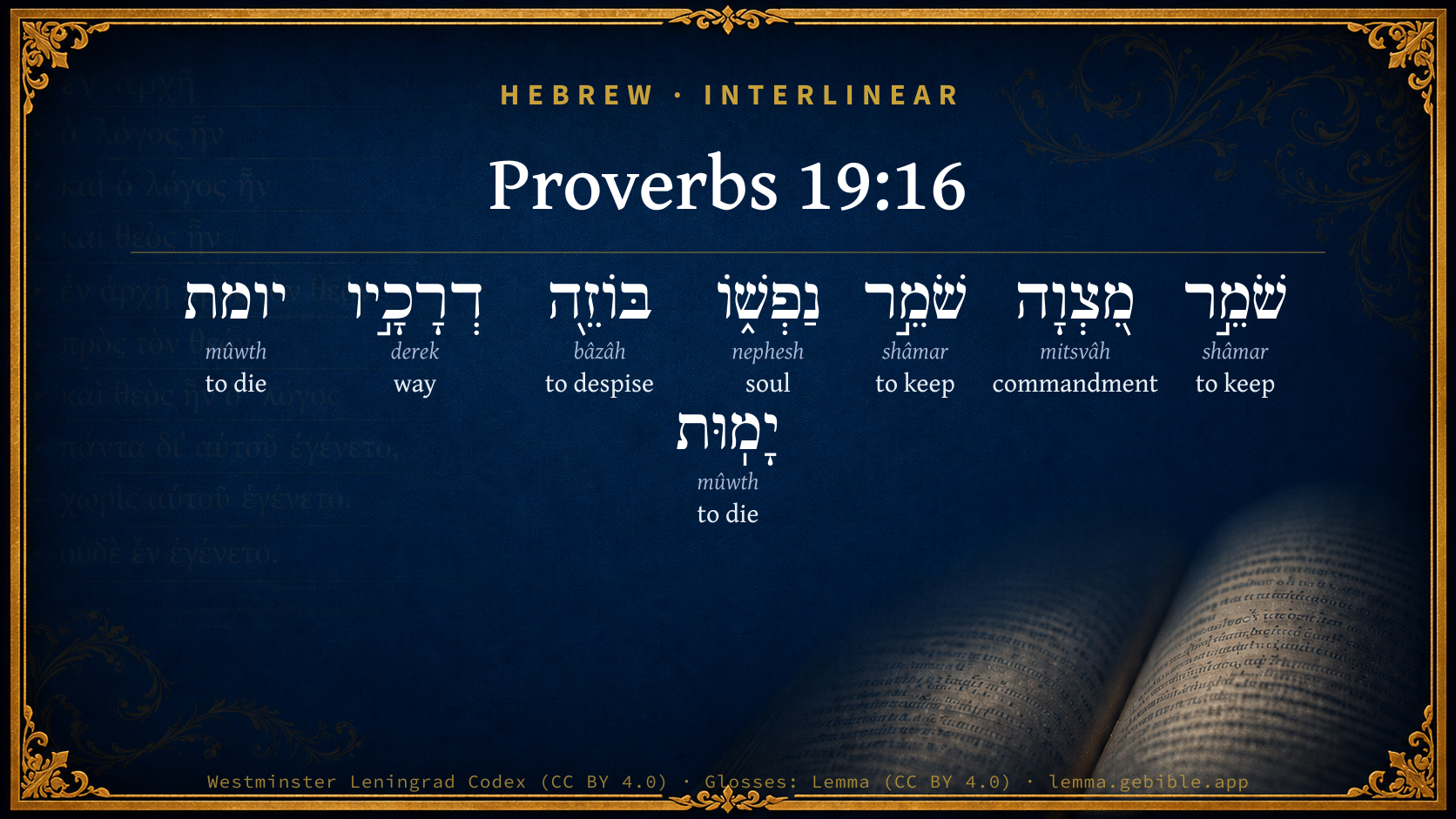
Hebrew (Westminster Leningrad Codex) Proverbs 19:16 appears in the Hebrew Old Testament. The text above is from the Westminster Leningrad Codex. Each word links to its Strong’s number, a concise gloss, and parsing drawn from the Open Scriptures Hebrew Bible morphology. Click any word for its full Brown-Driver-Briggs (BDB) entry.
Download image
Cite this verse

Proverbs 19:16 (World English Bible). Public Domain. Lemma interlinear Bible study tool, https://lemma.gebible.app/v/proverbs/19/16.

Show BibTeX & RIS
BibTeX
RIS
English Translation
He who keeps the commandment keeps his soul, But he who is contemptuous in his ways shall die.
World English Bible · Public Domain
Download a study sheet

One document with this verse’s original text, its word-by-word gloss line, the meaning frame, cross-references with their text, attributed commentary, and full source and license credits — printable, and it pastes into notes with its structure intact.

This verse Autodidact and up

Study sheet (.html) Plain text (.txt)

A passage Seminary Student

Up to 50 verses in one chapter. A passage sheet keeps up to 6 commentary sources and 12 cross-references per verse, in the order this page ranks them, and says so on the sheet whenever that leaves anything out. Ask for a single verse and you get the Autodidact verse sheet above.

Everything on this page stays free to read, with no account — the sheet is a download of what is already on screen, not access to it.

Want to remove ads? Support Godless Engineer
Compare translations 3

The same verse in 3 English versions, stacked beneath the original-language interlinear above. Click any original word for its lexicon entry.

Each is an independent rendering of the whole verse — the interlinear is not word-aligned to these translations.

Highlighted words mark where these versions differ — a whole-verse word diff, not a word-by-word alignment.

  • World English Bible Public Domain
    He who keeps the commandment keeps his soul, But he who is contemptuous in his ways shall die.
  • King James Version Public Domain
    He that keepeth the commandment keepeth his own soul; but he that despiseth his ways shall die.
  • unfoldingWord Literal Text CC BY-SA 4.0
    One who keeps a commandment keeps his life; one who despises his ways will die.

unfoldingWord Literal Text — © unfoldingWord, licensed CC BY-SA 4.0. Word-aligned USFM3 via Door43 (git.door43.org/unfoldingWord/en_ult).

Versions to compare (up to 4)

3 of 4 selected

Show all 18 translations

Every available English version of this verse, each an independent rendering of the whole verse.

  • World English Bible Public Domain
    He who keeps the commandment keeps his soul, But he who is contemptuous in his ways shall die.
  • Berean Standard Bible Public Domain
    He who keeps a commandment preserves his soul, but he who is careless in his ways will die.
  • Majority Standard Bible Public Domain
    He who keeps a commandment preserves his soul, but he who is careless in his ways will die.
  • King James Version Public Domain
    He that keepeth the commandment keepeth his own soul; but he that despiseth his ways shall die.
  • American Standard Version (1901) Public Domain
    He that keepeth the commandment keepeth his soul; `But' he that is careless of his ways shall die.
  • Revised Version (1885) Public Domain
    He that keepeth the commandment keepeth his soul: but he that is careless of his ways shall die.
  • Geneva Bible (1599) Public Domain
    He that keepeth the commandement, keepeth his owne soule: but hee that despiseth his wayes, shall dye.
  • Douay-Rheims (1899) Public Domain
    He that keepeth the commandment, keepeth his own soul: but he that neglecteth his own way, shall die.
  • Young's Literal Translation Public Domain
    Whoso is keeping the command is keeping his soul, Whoso is despising His ways dieth.
  • Literal Standard Version CC BY-SA 4.0
    Whoever is keeping the command is keeping his soul, || Whoever is despising His ways dies.
  • Unlocked Literal Bible CC BY-SA 4.0
    The one who obeys the command guards his life, but the person who does not think about his ways will die.
  • unfoldingWord Literal Text CC BY-SA 4.0
    One who keeps a commandment keeps his life; one who despises his ways will die.
  • Darby Bible Public Domain
    He that keepeth the commandment keepeth his soul; he that is careless of his ways shall die.
  • World Messianic Bible Public Domain
    He who keeps the commandment keeps his soul, but he who is contemptuous in his ways shall die.
  • Webster's Bible Public Domain
    He that keepeth the commandment keepeth his own soul; but he that despiseth his ways shall die.
  • Free Bible Version CC BY-SA 4.0
    Keep the commandments, and you'll live; despise them and you'll die.
  • Bible in Basic English Public Domain
    He who keeps the law keeps his soul; but death will be the fate of him who takes no note of the word.
  • JPS Tanakh (1917) Public Domain
    He that keepeth the commandment keepeth his soul; but he that despiseth His ways shall die.

Literal Standard Version (2020), Covenant Press — licensed CC BY-SA 4.0. Text via the HelloAO Bible API (eBible.org). Unlocked Literal Bible (unfoldingWord) — licensed CC BY-SA 4.0. Text via the HelloAO Bible API (eBible.org). unfoldingWord Literal Text — © unfoldingWord, licensed CC BY-SA 4.0. Word-aligned USFM3 via Door43 (git.door43.org/unfoldingWord/en_ult). Free Bible Version, Dr. Jonathan Gallagher — licensed CC BY-SA 4.0. Text via the HelloAO Bible API (eBible.org).

Word by word

More ways to search: Search by grammar → Find every occurrence → Compare this word →

Practice this passage: Drill this verse → Learn its vocabulary →

בּוֹזֵ֖ה
bâzâh
H959
“despising”
Verb, Qal, Participle Active, Masculine, Singular, Construct
Part of Speech
Verb
Stem
Qal
Form
Participle Active
Gender
Masculine
Number
Singular
State
Construct
Full BDB Definition

Origin: a primitive root

TWOT: 224

to despise, hold in contempt, disdain - (Qal) to despise, regard with contempt - (Niphal) - to be despised - to be despicable - to be vile, worthless - (Hiphil) to cause to despise
  1. שֹׁמֵ֣ר shâmar H8104 “keeping” Verb, Qal, Participle Active, Masculine, Singular, Construct
  2. מִ֭צְוָה mitsvâh H4687 “commandment” Noun, Common, Feminine, Singular, Absolute
  3. שֹׁמֵ֣ר shâmar H8104 “keeping” Verb, Qal, Participle Active, Masculine, Singular, Construct
  4. נַפְשׁ֑וֹ nephesh H5315 “soul · his” Noun, Common, Both, Singular, Construct + Suffix, Personal, 3rd Person, Masculine, Singular
  5. דְרָכָ֣יו derek H1870 “ways · his” Noun, Common, Both, Plural, Construct + Suffix, Personal, 3rd Person, Masculine, Singular
  6. יומת mûwth H4191 “to die” Verb, Hophal, Imperfect, 3rd Person, Masculine, Singular
  7. יָמֽוּת mûwth H4191 “to die” Verb, Qal, Imperfect, 3rd Person, Masculine, Singular

About this verse

These counts appear in no published source. They are computed here, from the morphology-tagged text and Lemma’s own curated glosses. What Lemma adds →

8
words
6
distinct lemmas
Wisdom
section

Shared distinctive vocabulary

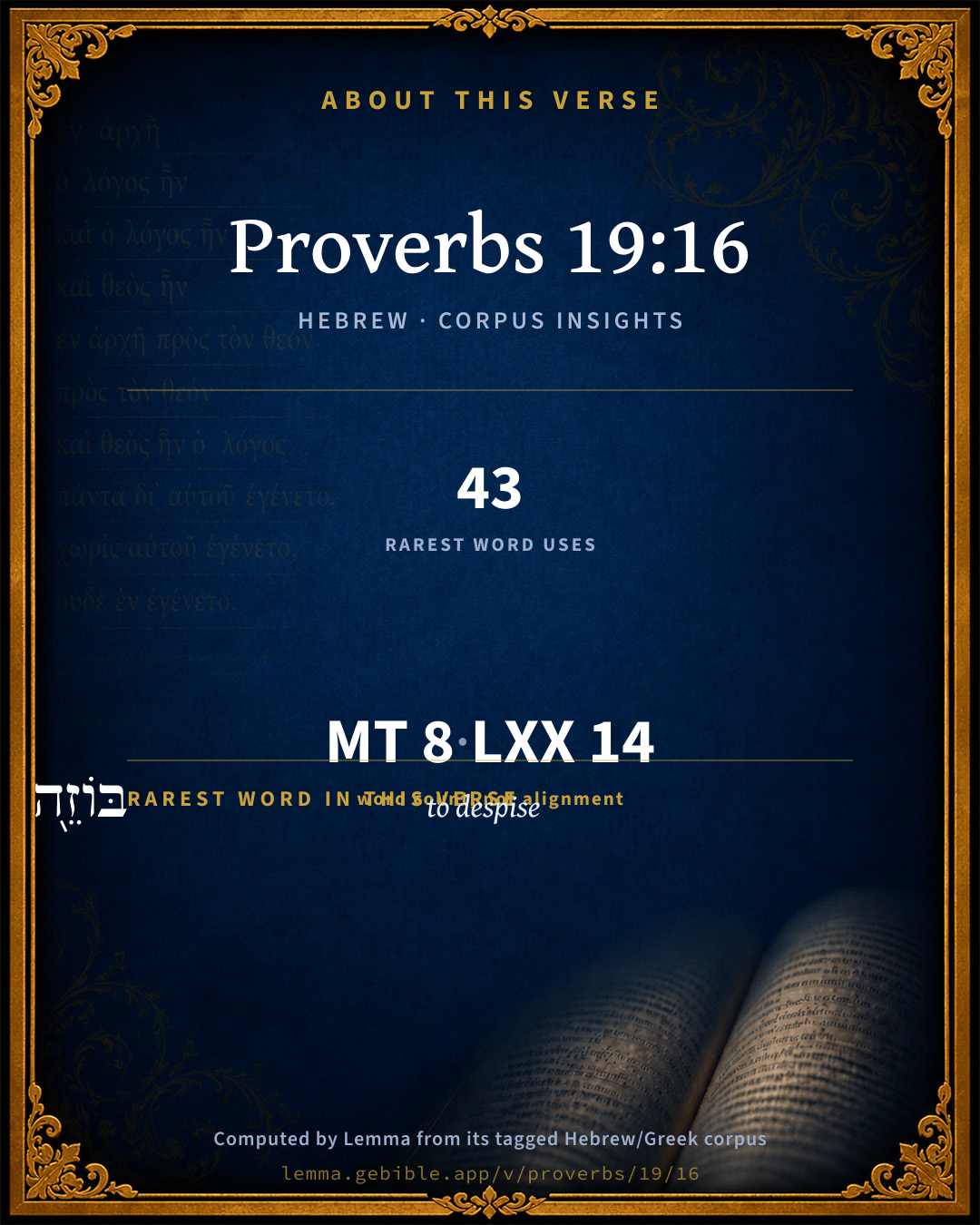
בּוֹזֵ֖ה to despise H959 occurs in 41 verses of the Hebrew Bible. Also found in:

Grammatical profile

  • 5 verbs
  • 3 nouns

Verb forms

  • שֹׁמֵ֣ר Qal · Participle Active
  • שֹׁמֵ֣ר Qal · Participle Active
  • בּוֹזֵ֖ה Qal · Participle Active
  • יומת Hophal · Imperfect
  • יָמֽוּת Qal · Imperfect

Repetition

Words recur within this verse — often emphatic in Hebrew:

  • שֹׁמֵ֣ר to keep H8104 ×2
  • יומת to die H4191 ×2

Hebrew & Septuagint length

In English translation the verse runs 18 words from the Hebrew and 17 from the Septuagint (LXX English) — closely comparable.

A rough comparison of the two English renderings, which tokenize alike — not a word-level alignment.

Word counts can differ between the Hebrew and the Greek without any difference in meaning — e.g. the Hebrew direct-object marker אֵת has no separate Greek word, and Greek often adds the article ὁ.

In the original languages it is 8 Hebrew tokens and 14 Greek tokens — but the two are counted differently (Hebrew bundles its prefixes and suffixes into one token; the Greek is in lemma form), so that isn’t a like-for-like length.

Cross-references

23

Topical passages linked to Proverbs 19:16 in the Treasury of Scripture Knowledge — connected by theme and wording, ordered by reader-vote popularity; previews shown in the World English Bible.

  • Luke 10:28 He said to him, "You have answered correctly. Do this, and you will live."
  • Proverbs 13:13 Whoever despises instruction will pay for it, But he who respects a command will be rewarded.
  • 1 John 5:3 For this is the love of God, that we keep his commandments. His commandments are not grievous.
  • Luke 11:28 But he said, "On the contrary, blessed are those who hear the word of God, and keep it."
  • Proverbs 16:17 The highway of the upright is to depart from evil. He who keeps his way preserves his soul.
  • Proverbs 21:23 Whoever guards his mouth and his tongue Keeps his soul from troubles.
  • Proverbs 29:18 Where there is no revelation, the people cast off restraint; But one who keeps the law is blessed.
  • Ecclesiastes 8:5 Whoever keeps the commandment shall not come to harm, and his wise heart will know the time and procedure.
  • Matthew 16:26 For what will it profit a man, if he gains the whole world, and forfeits his life? Or what will a man give in exchange for his life?
  • 1 John 3:22 and whatever we ask, we receive from him, because we keep his commandments and do the things that are pleasing in his sight.
  • Revelation 22:14 Blessed are those who do his commandments, that they may have the right to the tree of life, and may enter in by the gates into the city.
  • Proverbs 3:1 My son, don't forget my teaching; But let your heart keep my commandments:
  • Proverbs 22:5 Thorns and snares are in the path of the wicked: Whoever guards his soul stays from them.
  • Ecclesiastes 12:13 This is the end of the matter. All has been heard. Fear God, and keep his commandments; for this is the whole duty of man.
  • John 15:10–14 If you keep my commandments, you will remain in my love; even as I have kept my Father's commandments, and remain in his love.
  • 1 Corinthians 7:19 Circumcision is nothing, and uncircumcision is nothing, but the keeping of the commandments of God.
  • Proverbs 15:32 He who refuses correction despises his own soul, But he who listens to reproof gets understanding.
  • Jeremiah 7:23 but this thing I commanded them, saying, Listen to my voice, and I will be your God, and you shall be my people; and walk you in all the way that I command you, that it may be well with you.
  • Ezekiel 33:5 He heard the sound of the trumpet, and didn't take warning; his blood shall be on him; whereas if he had taken warning, he would have delivered his soul.
  • John 14:15 If you love me, keep my commandments.
  • John 14:21–23 One who has my commandments, and keeps them, that person is one who loves me. One who loves me will be loved by my Father, and I will love him, and will reveal myself to him."
  • 1 John 2:3–4 This is how we know that we know him: if we keep his commandments.
  • Psalms 103:18 To those who keep his covenant, To those who remember to obey his precepts.

Cross-references courtesy of OpenBible.info (CC BY 4.0).

Hebrew and Greek witnesses Masoretic Hebrew ↔ Greek Septuagint

The same verse in the two great witnesses to the Old Testament, shown verse-for-verse.

These are two independent witnesses, not word-aligned to each other, and the Septuagint is shown in lemma (dictionary) form.

Hebrew Proverbs 19:16 Masoretic · Westminster Leningrad Codex

שֹׁמֵ֣ר מִ֭צְוָה שֹׁמֵ֣ר נַפְשׁ֑וֹ בּוֹזֵ֖ה דְרָכָ֣יו יומת יָמֽוּת

He who keeps the commandment keeps his soul, But he who is contemptuous in his ways shall die.

World English Bible · Public Domain

Greek LXX Proverbs 19:16 Septuagint · lemma form

ὅς φυλάσσω ἐντολή τηρέω ὁ ἑαυτοῦ ψυχή ὁ δέ καταφρονέω ὁ ἑαυτοῦ ὁδός ἀποὀλλύω

He that keeps the commandment keeps his own soul; but he that despises his ways shall perish.

LXX2012 (modern English Septuagint) · Public Domain

On this verse, The Pulpit Commentary discusses the Septuagint’s reading. Read the note in Commentary ↓

Hebrew: Westminster Leningrad Codex (CC BY 4.0). Greek: Septuagint (public domain); English from LXX2012 (modern English Septuagint) (Public Domain). How the Septuagint differs from the Hebrew →

Commentary

Notes on Proverbs 19:16 from classic Christian and Jewish commentators (each source and its license shown beneath its notes). The classic Christian expositions comment on the surrounding passage and are grouped to its opening verse, so a note may address several verses; the Jewish commentaries on the Tanakh (Rashi and others) are per-verse, so they appear only where the commentator wrote on this verse.

Lemma curates 59 commentaries, every one of them public domain or Creative Commons licensed, each selected and text-cleaned for this edition rather than reprinted as found. About our sources →

Trapp's Complete Commentary

John Trapp

Pro 19:16 He that keepeth the commandment keepeth his own soul; [but] he that despiseth his ways shall die.

Ver. 16. He that keepeth the commandment keepeth his own soul.] This is the first fruit of shaking off sloth and sleepiness. He that "stirs up himself to take hold of God," {Isa 64:7} and to "take hold of his covenant," {Isa 56:4} "to love the name of the Lord, and to be his servant," {Pro 19:6} to "love him, and keep his commandments," {Exo 20:6} to do that little he does out of love, if it be no more than to "think upon his commandments to do them," {Psa 103:18} this man’s soul shall be bound up "in the bundle of life," he shall find his name written "in the book of like." For in vitae libro scribuntur omnes qui quod possunt faciunt, etsi quod debent non possunt, saith Bernard. Their names are written in heaven who do what they can, though they cannot do what they ought. "If there be a willing mind, God accepts according to what a man hath, not according to what he hath not." {2Co 8:12} And here also, Nolentem, praevenit Deus ut velit, volentem subsequitur ne frustra velit. {a} God, that gives "both to will and to do," "causeth his people to keep his commandments," and "worketh all their works in them, and for them." {Php 1:13 Eze 36:17 Isa 26:12} Lex iubet, gratia iuvat; petamus ut det, quod ut habeamus iubet. The law commandeth, but grace helpeth. Let us beg that God would make us to be what he requires us to be. {b}

But he that despiseth his ways.] That is, God’s ways, chalked out in his word. {See Trapp on "Pro 13:13"} Or, He that despiseth his own ways - lives carelessly, and at random; walks at all adventures with God, cui vita est incomposita, et pessime morata contra gnomonem et canonem Decalogi, a loose and lawless person - he "shall die," not a natural death only, as all do, but spiritual and eternal. {c} There is but an inch between him and hell, which already gapes for him, and will certainly swallow him up.

{a} Aug. Enebir. cap. 32.

{b} Augustin. in Exod. quaest. 55.

{c} Aut mentem aut restim comparandum. - Chrysip.

John Trapp, A Commentary or Exposition upon All the Books of the Old and New Testament (1647–1656) — public domain. Text from a community e-Sword module.

The Biblical Illustrator

Joseph S. Exell

Pro_19:16

But he that despiseth his ways shall die.

The folly of despising our own ways

I. The sinners fall and ruin. He shall die. There is a death that is common to all mankind. That is the general effect of sin. But there is a death which is the particular lot of impenitent sinners. This is--

1. A spiritual death, which is, being cut off from all communion with God.

2. An eternal death. This is but the perfection of the former. This second death is a real thing, and a fearful thing, and it is very near to all who are going on still in their trespasses.

II. The sinners fault and folly which brings him to this ruin. Despising his own ways. When may we be said to despise our own ways? When we are altogether unconcerned about the end of our ways. When we are indifferent about the rule of our ways, and the measures by which we govern ourselves in them. Those certainly despise their ways who walk at all adventures, and live at large when they should walk circumspectly and live by rule. God has given us the Scriptures to be the guide of our way. He has appointed conscience to be a monitor to us concerning our way. When we are wavering and unsettled in the course and tenor of our ways, then we despise them. If we do not apply ourselves to God in our ways, and acknowledge Him, we despise our own soul. When we are careless of our past ways and take not the account we ought to take of them. When we are heedless and inconsiderate as to the way that is before us, and walk at all adventures. If we are in no care to avoid sin, or to do our duty.

III. The foolishness and danger of despising our own ways.

1. The God of heaven observes and takes particular notice of all our ways.

2. Satan seeks to pervert our ways.

3. Many eyes are on us that are witnesses to our ways.

4. According as our ways are now, it is likely to be ill or well with us to eternity.

Application:

1. Caution not to be rigid and severe in our censures of other peoples ways.

2. Let it charge us to look well to our own ways.

Be strict in your inquiries concerning your present ways. Be impartial in your reflections upon your past ways. Be very circumspect and considerate as to the particular paths that are before you. (Matthew Henry.)

The Biblical Illustrator, edited by Joseph S. Exell (c. 1880s–1900s) — public domain. Text from a community e-Sword module.

The Preacher's Complete Homiletical Commentary

Joseph S. Exell (gen. ed.)

CRITICAL NOTES.—

Pro_19:16. Miller reads this verse “He that guards the commandment guards himself; in scattering his ways he dies.” (See his comment.) Hitzig’s rendering of the last clause agrees with Miller’s.

MAIN HOMILETICS OF Pro_19:16

A DOUBLE KEEPING

I. A keeping of the Divine commandments. What is it to “keep the commandment?” Dr. Miller translates this verb to guard or watch. Taken in this sense therefore the proverb implies that there is need—

1. To lay up God’s law in our hearts. It is to be our constant aim to know the will of God—the words which He has spoken, the commands which He has given, are to be constantly kept in remembrance and made the principal subject of our thoughts. We are to tread in the footsteps of the man described in the first Psalm, whose “delight is in the law of the Lord” and who “meditates” upon it “day and night. But the word as it is commonly understood implies—

2. To translate God’s law into life, It is one thing to know the will of God, it is another thing to do it. Knowledge must come before obedience, but knowledge alone will not save the soul from death.

II. A keeping of the human soul. There is but one way to guard the human soul from the dangers to which it is exposed, and that is by complying with the demands of the God who can alone give spiritual life. He commands us to yield ourselves unreservedly to his guidance, to accept his method of being made right in relation to His law, to fight against the evil tendencies of our fallen nature, and to seek His help to overcome them. In doing this He has promised that we shall find that emancipation from the bondage of sin, that awakening of spiritual faculties, and that sense of His favour which alone is the life of the soul. We have before dwelt upon proverbs which embody truths similar to those contained in this verse. (See on chap. Pro_11:3, page 195; chap. Pro_10:8, page 151; chap. Pro_13:6; Pro_13:13-14, pages 299, 312, 313; chap. Pro_16:17, page 479.)

OUTLINES AND SUGGESTIVE COMMENTS

Keep means to retain. Guard means to watch. The root of the present word means to bristle, then to watch close, either from the bristling of spears, or from a sharp stave. There is a philosophy in these words, … viz., that conscience is vagrant. We have to watch. Like the mind itself, it is hard to hold it to the point. Attention is our whole voluntary work. And, to a most amazing degree, the Scriptures are framed upon this idea. We are to remember now our Creator (Ecc_12:1). We are to remember the Sabbath day (Exo_20:8). We are to “observe to do,” etc. (this very word guard). See Deu_5:1; Deu_5:32, et passim. Wherewithal shall a young man cleanse his way? By taking heed (this same word guarding) thereto according to Thy word” (Psa_119:9). “Guards himself” (the same word). (See Critical Notes.) This is an iron link of sequence which no Anti-Calvinistic thought can shake. He who stands sentry over the “commandment” stands sentry over himself; literally “his soul.” There is no helplessness in man other than that tardema, or deep sleep (Pro_19:15) which “sloth” wilfully casts him into, and which a voluntary slothfulness perpetually increases and maintains.” The fault is not in our stars, but in ourselves, that we are aliens.” The proverb advances upon this in the second clause. What more voluntary than a man’s “way?” It has a voluntary goal, it has a daily journeying, and it includes all that is voluntary. Seize a man at any moment. All that he is upon is part of his life’s travel. Now, a Christian has but one way. So far forth as he is a Christian, he has but one end, and one path for reaching it. There is a beautiful unitariness in his journeying. It is a habit of Scripture to turn attention to the scattered life of the lost. They have no one end. “If thine eye be single, thy whole body shall be full of light,” says the Saviour (Mat_6:23). Thou “hast scattered thy ways to the strangers,” says Jeremiah (Pro_3:13); this same expression. “Why gaddest thou about so much to change thy way” (Jer_2:36). Despiseth (English version) suits the lexicon and suits the sense, for certainly the lost man has less respect for his way and life than the pardoned believer; but “scattering” is equally legitimate and common; more strengthened by analogy, and more in keeping with the first clause, where the verb to guard stands more opposed to vagrant and distraught ideas. “Dies;” see Job_5:2. Corruption is seated in the soul, but not out of reach by any means. A man can increase it. What we do outside kills inwardly. A man’s counting-house might seem to have little to do with the state of his soul, but it is shaping it all the time. If he scatters his ways he is killing his soul, and what we are to remark is, that there is an ipso actu condition of the effect (as in chap. Pro_11:19) which is expressed in the Hebrew. The vagrancy of a morning’s worldliness is that much more death, as punctually administered as any of the chemistries of nature. The form is participial. It is “in scattering,” or “as scattering,” his ways that “he dies.”—Miller.

The Preacher's Complete Homiletical Commentary (gen. ed. Joseph S. Exell; Funk & Wagnalls, c. 1892) — public domain (pre-1929). A full-Bible homiletical/sermon-outline anthology covering 65 of 66 books (2 John is absent from the source module). Text from a community e-Sword module.

Tyndale Open Study Notes

Tyndale Open Resources

19:16 Keeping God’s commandments (i.e., the law of Moses) protects one’s life (see Deut 28:15-68).

Tyndale Open Study Notes — © Tyndale Open Resources, licensed CC BY-SA 4.0. Text via the HelloAO Bible API.

Matthew Henry's Commentary

Here is, 1. The happiness of those that walk circumspectly. Those that make conscience of keeping the commandment in every thing, that live by rule, as becomes servants and patients, keep their own souls; they secure their present peace and future bliss, and provide every way well for themselves. If we keep God's word, God's word will keep us from every thing really hurtful. 2. The misery of those that live at large and never mind what they do: Those that despair their ways shall die, shall perish eternally; they are in the high road to ruin. With respect to those that are careless about the end of their ways, and never consider whither they are going, and about the rule of their ways, that will walk in the way of their hearts and after the course of the world (Ecc 11:9), that never consider what they have done nor what they are concerned to do, but walk at all adventures (Lev 26:21), right or wrong, it is all one to them - what can come of this but the greatest mischief?

Matthew Henry's Commentary on the Whole Bible (1708–1710) — public domain (CC PDM 1.0). Text via the HelloAO Bible API.

Jamieson, Fausset & Brown

Robert Jamieson, A. R. Fausset & David Brown

(Compare Pro 10:17; Pro 13:13).

despiseth . . . ways--opposed to keeping or observing, neglects (Pro 16:17) (as unworthy of regard) his moral conduct.

Jamieson, Fausset & Brown — Commentary Critical and Explanatory on the Whole Bible (1871) — public domain (CC PDM 1.0). Text via the HelloAO Bible API.

Ellicott's Commentary for English Readers

(16) He that despiseth his ways—i.e., takes no heed to them, whether they please God or not.

Shall die.—Physically (comp. Exo_12:15; 1Co_11:30), spiritually (comp. Luk_1:79); a death to be completed hereafter (Rev_2:11).

A Bible Commentary for English Readers, edited by Charles John Ellicott (1878–1897) — public domain. Text from a community e-Sword module.

The Cambridge Bible for Schools and Colleges

gen. ed. J. J. S. Perowne

16. despiseth] i.e. pays no heed to them (is careless of, R.V.; negligit, Vulg.), through a contemptuous disregard of “the commandment” which should regulate them. Similarly for despise not, A. V., we have regard not lightly, R.V. in Heb_12:5. Contrast Pro_16:17.

The Cambridge Bible for Schools and Colleges (gen. ed. J. J. S. Perowne; Cambridge University Press, 1878–1918) — public domain. Text from a community e-Sword module.

John Gill's Exposition

He that keepeth the commandment,.... Either of parents, as children ought to do; or of masters, as servants should; or of kings and princes, as is the duty of subjects in all things lawful: or rather of God; every command of his, whether of a moral or positive nature, which, though they cannot be perfectly kept, yet should as much as in man lies, in faith, from a principle of love, and to the glory of God: and such a man

keepeth his own soul, or "observes" (s) it; he shows that he has a concern for its welfare and peace; for though peace does not arise from keeping the commandments of God, yet such have great peace of soul who do love and keep the law of God; though there is no reward for, yet there is a reward in keeping the divine commands; though salvation is not hereby, yet blessed are they that do his commands; by which it appears they have a right to enter into the city, into eternal happiness, Psa 119:165;

but he that despiseth his ways: which are at and proper for him to walk in, as Aben Ezra observes; or who is negligent of his ways, does not care in what ways he walks, or what is the issue of them; he walks in the ways of his own heart, and in the sight of his eyes; has his conversation according to the course of this world; walks with a multitude, with a crowd, to do evil, in the broad road which leads to destruction, and yet is quite careless about it: or that despises the ways of the commandment or word of God, which that directs to; for that is a lamp and a light, which men would do well to take heed to, as it shows them the ways in which they should walk; but these they neglect and contemn: or he that despises the ways of God, the ways he himself takes in the salvation of men, all whose ways are mercy and truth; that despises the ways of peace, pardon, righteousness, and salvation by Jesus Christ: he

shall die; he is dead in sins already, and he shall die the second death, that neglects and despises so great salvation, and all the ways of the Lord, Heb 2:3. There is a "Keri", or marginal reading, which we follow; but the "Cetib", or written text, is, "he shall be killed", or put to death; and so the Syriac version; immediately, by the hand of heaven, by the Lord himself, before his time; or by the judges and civil magistrates; his sins being openly known, as Aben Ezra.

(s) "observat".

John Gill's Exposition of the Whole Bible (1746–1763) — public domain (CC PDM 1.0). Text via the HelloAO Bible API.

Albert Barnes' Notes on the Bible

Keepeth his own soul - i. e., His life in the truest and highest sense.

Albert Barnes' Notes on the Bible (1834–1885) — public domain. Text from a community e-Sword/MySword module.

Haydock's Catholic Bible Commentary

Neglecteth. Hebrew, "contemneth." In the law of Moses, many transgressions are punished with death, but here that of the soul is meant. (Calmet)

George Leo Haydock (1774–1849), Haydock's Catholic Family Bible and Commentary, 1859 edition — public domain. Excludes Psalms (Douay-Rheims chapter numbering differs from Protestant) and Deuterocanonical books (Catholic canon only).

Matthew Poole's English Annotations

The commandment; the commands of God, called by way of eminence the commandment, as the word is oft used emphatically for the word of God, as hath been noted before. fore. His ways; either,

1. His own ways, by not taking heed to his ways, so as to order his conversation aright. Or,

2. The ways of God, who is understood in the former clause.

Matthew Poole's English Annotations on the Holy Bible (1683–1685) — public domain. Text from a community e-Sword/MySword module.

Whedon's Commentary on the Bible

Daniel D. Whedon

16. He that keepeth the commandment — Observes or practices the law of God.

Keepeth… soul — Himself. But he that despiseth, or slights, his ways shall die — Shall be put to death. Instead of despises, some critics read divides or scatters, understanding it of the man’s own ways, as being divided in his adherence to the worship of Jehovah. It is not certain whether his ways means the man’s ways or the Lord’s. Comp. Pro_16:17; Ecc_8:5; Luk_11:28.

Daniel D. Whedon (gen. ed.), Commentary on the Old and New Testaments (1874–1909) — public domain. Text from a community e-Sword module.

The Pulpit Commentary

Keepeth his own soul. Obedience to God"s commandments preserves a man"s natural and spiritual life. (comp. Pro_13:13 Pro_16:17) So we read in Ecc_8:5, "Whoso keepeth the commandment (mitsvah, as here) shall feel no evil thing." He that despiseth his ways shall die. He that cares nothing what he does, whether his life pleases God or not, shall perish. Apoleitai , Septuagint; mortificabitur, Vulgate. The result is understood differently. The Khetib reads, tmWy (iumath), "shall be punished with death" according to the penalties enacted in the Mosaic Law. The Keri reads, tWmy (iamuth), "shall die," as in Pro_15:10; and this seems more in agreement with what we find elsewhere in the book, as in Pro_10:21 Pro_23:13. This insensate carelessness leads to ruin, whether its punishment be undertaken by outraged law. or whether it be left to the Divine retribution.

Soul keeping.

The "Power that makes for righteousness," though not impersonal, as Mr. Matthew Arnold assumed, is nevertheless active as by a constant law. It is so ordered in nature and providence that goodness preserves life, and badness tends to ruin and death. Let us endeavour to see how the process is worked out.

I THE GREAT RESULT OF RIGHTEOUSNESS IS SOUL KEEPING.

1. It may not be wealth. We cannot assume that goodness tends to riches. Keeping the commandments does not always result in a man"s making his fortune. Christ was a poor man.

2. It may not be earthly happiness. Other things being, a clear conscience should bring peace and inward joy. But there are troubles that fall upon us independently of our conduct. There are distresses that come directly from doing right. Christ was a "Man of sorrows.

3. It may not be long life on earth. No doubt this was expected in Old Testament times, for then but dim notions of any existence beyond the grave ever entered the minds of men. On the whole, no doubt, goodness tends to health of body and mind. Still, very good people may die young. Christ died at thirty-three years of age.

4. It will be the real preservation of the soul. The true life will be safe. The self will abide. Now, all our being really resides in our personal self. If this continues in safety, we have the highest personal security. But if not, all other gain is but a mockery; for "what is a man profited if he should gain the whole world, and lose his own soul his life, himself?". (Mat_16:26)

II RIGHTEOUSNESS LEADS TO SOUL KEEPING BY NATURAL LAWS. It is a matter of Divine ordering that obedience should be followed by life, disobedience by death. This was seen in the trial of Adam. (Gen_3:3) It lies at the root of the great sanctions of the Mosaic Law. (Eze_3:18) He who gave the commandments also gives life. Our life is in the hand of oar Lawgiver. It is in his power to withhold the life if we break the law. But we may look more closely into this princess. God"s commandments are not arbitrary. They follow the natural lines of spiritual health. His prohibitions are really the warnings against the course that leads naturally and inevitably to death. Goodness is itself vitality, and badness has a deadening effect on the soul. The faculties are quickened by use in the service of what is right, and they are dwarfed, perverted, paralyzed, and finally killed by reckless, lawless conduct. The profligate is a suicide.

III CHRISTIANITY HELPS US TO TRUE SOUL KEEPING BY LEADING US TO RIGHTEOUSNESS. We find ourselves in the unhappy condition of those who have not kept the commandments. Therefore we are in danger of death. We have "despised our ways." The law and the promise are not addressed to us as to new beings; but they meet us in our sin and on our road to ruin. Therefore, if there were no gospel, there would be no hope. Hence the need of a Saviour. But when we enter the realm of Christian truth we cannot turn our backs on the principles of the older economy. We cannot regard them as the laws of another planet, out of the reach of which we have escaped. They are eternal truths, and we are still within their range. Christ helps us, not by teaching us to despise moral considerations as though they were irrelevant to those who had entered into the covenant of grace, but by giving us his own righteousness to be in us as well as on us. He puts us in the way of obedience, while he cancels the consequences of the old disobedience. Thus he saves our souls by helping us to preserve them in a new fidelity to the ancient, eternal right.

The Pulpit Commentary (1880–1919), ed. H.D.M. Spence-Jones & Joseph S. Exell — public domain. Text from a community e-Sword module.

John Wesley's Explanatory Notes

His ways - The commands of God.

John Wesley, Explanatory Notes Upon the Whole Bible (1754–1765) — public domain. Text via the GEBible commentary corpus.

Keil & Delitzsch

C. F. Keil & F. Delitzsch

16 He that keepeth the commandment keepeth his soul;

He that taketh no heed to his ways dies.

As at Pro 6:23, cf. Ecc 8:5, מצוה is here the commandment of God, and thus obligatory, which directs man in every case to do that which is right, and warns him against that which is wrong. And בּוזה דּרכיו (according to the Masora with Tsere, as in Codd. and old editions, not בוזה) is the antithesis of נצר דּרכּו, Pro 16:17. To despise one's own way is equivalent to, to regard it as worth no consideration, as no question of conscience whether one should enter upon this way or that. Hitzig's reading, פּוזר, "he that scattereth his ways," lets himself be drawn by the manifold objects of sensuality sometimes in one direction and sometimes in another, is supported by Jer 3:13, according to which it must be מפזּר; the conj. is not in the style of the Book of Proverbs, and besides is superfluous. The lxx, which is fond of a quid pro quo - it makes, 13b, a courtesan offering a sacrifice she had vowed of the wages of sin of the quarrelsome woman - has here, as the Heb. text: ὁ καταφρονῶν τῶν ἑαυτοῦ ὁδῶν. Thus after the Kerı̂ ימת, as also the Targ., Syro-Hexap., and Luther; on the contrary, the Syr., Jerome, the Venet. adopt the Chethı̂b יוּמת: he will become dead, i.e., dies no natural death. The Kerı̂ is more in the spirit and style of the Book of Proverbs (Pro 15:10; Pro 23:13; Pro 10:21).

Keil & Delitzsch — Biblical Commentary on the Old Testament (1861–1891) — public domain (CC PDM 1.0). Text via the HelloAO Bible API. (Old Testament only.)

Bridges on Proverbs

Charles Bridges

The fearing of the commandment is the path of honour. (Pro 13:13 .) The keeping of it is our security. Keep the word, and the word will keep us securely. Our duties are thus identified with our privileges. (Psa 19:11 ; Psa 119:165 .) This is the first successful effort to shake ourselves from the deep sleep of slothfulness; when we "stir up ourselves to take hold of God, choosing the things that please him, and joining ourselves to him, to serve him, and to love his name."†1 Yet the power to keep the commandment is not in a man’s self.†2 Is it not God working in us, through, by, with us?†3 Thus "all our deeds are wrought in him;"†4 and nothing is left us, but the thankful, humbling acknowledgment — "Yet not I, but the grace of God that is with me."†5 Let then the world know, that we do not exercise obedience in a covenant of works, nor reject it as a system of bondage and despondency; but that keeping the commandment evangelically is keeping our own souls†6 — the way of present happiness,†7 the seal of everlasting mercy,†8 the pathway to heaven.†9

But alas! the multitude, instead of keeping the commandment, "go at all adventures,"†10 careless of their ways, reckless of their end. It is with them scarcely worth looking into, whether God is displeased or not; whether they be walking in the narrow or broad path; and what the end of that path may be. The sight before our eyes defies illustration. The most momentous realities, that could ever attract the attention of an immortal being, stand before him, not in dreaming visions, but in actual demonstration — the favor or the curse of the ever-blessed God — salvation or damnation. They confront him in the presence of God. He sees them in the light of God. He acknowledges the stamp of God upon them; and yet with this tremendous sight, this fearful responsibility, not a serious thought fixes in his mind. Instead of being overwhelmed with the consciousness of his own interest in it (enough — were it apprehended — to suspend almost the power of thought) he is ready for any trifle or vanity that crosses his path. He despises his ways, and dies.

Sometimes men come into this thoughtless world, fresh from the influence of a religious education. For a while they yield alternately to their conscience and their corruptions. They are touched a moment under the convictions of the word, or the corrections of the rod. Yet the want of steadiness and consistency soon sweeps all away into "worse" hardness than before. (2Pe 2:20-22 .) They are "carried away unto their idols, even as they were led" (1Co 12:2 ); and, slaves of their wills, their lusts, their fancies, they know not, they care not to know, "that for all these things God will call them to judgment."†11

Young people — "Ponder the path of your feet." Look to it well at every step, that "your ways may be established" (Pro 4:26 ) in converting grace, the only security for Christian steadfastness. (2Pe 3:17-18 .) Keep the conscience tender, the Divine rule before your eyes, and the promise in the heart. Cherish a pliable spirit for your Father’s guidance. How solemn the warning — He that despiseth his ways shall die! Sinner! would that thou wouldest ponder this death! It is no creation of a distempered fancy. It is the death, which sin bringeth forth to perfection. (Jas 1:14-15 .) It is the harvest from that seed. (Gal 6:7-8 .) It is the death such as a soul can die — an eternal reality of infinite, unchangeable misery; the extinction, not of thy being (that were a boon indeed!) but of thy happiness. What must it be to be immovably linked with the wrath of God! Yea — to have the wrath of an immortal God filling the conscience of thine immortal soul, with all its power eternally enlarging to receive the full and eternal impression! And whilst thou art "going on frowardly in the way of thine heart" (Isa 57:17 ), remember "there is but a step" — who knows how short a step — how soon taken? — "between thee and this death." (1Sa 20:3 .) "Why" then "wilt thou die," when the oath of thy God testifies, that "he hath no pleasure in thy death," when his gracious voice to thee is — "Turn and live.†12 Consider thy ways."†13 Oh! listen, ere thou learn the wisdom of fools, to be wise too late.

Footnotes:

†1 Isa 64:7; Isa 56:4-6 .

†2 Jer 10:23.

†3 Isa 26:12. Php 2:12-13 .

†4 Joh 3:21.

†5 1Co 15:10 .

†6 Pro 10:17; Pro 16:17 ; Pro 22:5 .

†7 Isa 64:5. Joh 14:21-23 .

†8 Psa 103:17-18.

†9 Isa 35:8-10. Rev 22:14 .

†10 Lev 26:21, margin={contrary...: or, at all adventures with me}

†11 Ecc 11:9, with 2Ki 10:31 . Jer 44:17 .

†12 Eze 33:11; Eze 18:32 .

†13 Hag 1:5, Hag 1:7 .

Charles Bridges, An Exposition of the Book of Proverbs (1846) — public domain. Text from a community e-Sword module.

Kretzmann's Popular Commentary

Paul E. Kretzmann

v. 16. He that keepeth the commandment, namely, that of God’s Law, keepeth his own soul, for such conduct is conducive to spiritual life; but he that despiseth his ways, taking no heed to keep them in agreement with the Word of God, shall die, for destruction is the punishment of such disobedience.

Paul E. Kretzmann, Popular Commentary of the Bible (1921–1924) — public domain. Text from a community e-Sword module.

Rashi

Rabbi Shlomo Yitzchaki (Rashi)

He who keeps a commandment keeps his soul; he who despises his ways will die He does not take heed to weigh them.

Rashi on the Tanakh — English translations: “The Judaica Press complete Tanach with Rashi, translated by A. J. Rosenberg” (CC BY 4.0); “Pentateuch with Rashi's commentary by M. Rosenbaum and A.M. Silbermann, 1929-1934” (public domain); “The Metsudah Tanach series, Lakewood, N.J” (CC BY 4.0); and “The Book of Joshua, Metsudah Publications, 1997” (CC BY 4.0). Text via Sefaria.

Lesson kit

Teaching starters — assembled from the data on this page, not authored interpretation. Every prompt links to the verse data it draws on. Edit before teaching.

Proverbs, in the Wisdom, opens this verse with 8 words (6 distinct Hebrew lemmas). Its most distinctive word is bâzâh (“to despise”). A historical commentator’s framing appears above. Read the whole chapter for the surrounding context.

Discussion questions

  1. The word bâzâh carries the sense “to despise.” How does it shape the verse?
  2. Genesis 25:34 shares the word «to despise» with this verse. How do the two illuminate each other?
  3. “to keep” occurs 2× in this one verse. What is the effect of the repetition?
  4. These translations render this verse differently. What is at stake in choosing one wording over another?
  5. The verb «שֹׁמֵ֣ר» is Qal Participle Active. How does its form color the action?
  6. Reading how Trapp's Complete Commentary and The Biblical Illustrator read this verse, where do the two commentators agree and where do they part?

Things to notice

Reading settings

Reading text

Shown beneath each verse's original-language words.

Old Testament
Old Testament edition

Read the OT as the Masoretic Hebrew (MT) or the Greek Septuagint (LXX).

English shown for the Greek Septuagint (in the Hebrew ↔ Greek comparison).

Comparing translations? Open the Compare panel on any verse page to stack up to four side by side.