Numbers 20:4

Hebrew (Westminster Leningrad Codex) Numbers 20:4 appears in the Hebrew Old Testament. The text above is from the Westminster Leningrad Codex. Each word links to its Strong’s number, a concise gloss, and parsing drawn from the Open Scriptures Hebrew Bible morphology. Click any word for its full Brown-Driver-Briggs (BDB) entry.
Download image
Cite this verse

Numbers 20:4 (World English Bible). Public Domain. Lemma interlinear Bible study tool, https://lemma.gebible.app/v/numbers/20/4.

Show BibTeX & RIS
BibTeX
RIS
English Translation
Why have you brought the assembly of Yahweh into this wilderness, that we should die there, we and our animals?
World English Bible · Public Domain
Download a study sheet

One document with this verse’s original text, its word-by-word gloss line, the meaning frame, cross-references with their text, attributed commentary, and full source and license credits — printable, and it pastes into notes with its structure intact.

This verse Autodidact and up

Study sheet (.html) Plain text (.txt)

A passage Seminary Student

Up to 50 verses in one chapter. A passage sheet keeps up to 6 commentary sources and 12 cross-references per verse, in the order this page ranks them, and says so on the sheet whenever that leaves anything out. Ask for a single verse and you get the Autodidact verse sheet above.

Everything on this page stays free to read, with no account — the sheet is a download of what is already on screen, not access to it.

Want to remove ads? Support Godless Engineer
Compare translations 3

The same verse in 3 English versions, stacked beneath the original-language interlinear above. Click any original word for its lexicon entry.

Each is an independent rendering of the whole verse — the interlinear is not word-aligned to these translations.

Highlighted words mark where these versions differ — a whole-verse word diff, not a word-by-word alignment.

  • World English Bible Public Domain
    Why have you brought the assembly of Yahweh into this wilderness, that we should die there, we and our animals?
  • King James Version Public Domain
    And why have ye brought up the congregation of the LORD into this wilderness, that we and our cattle should die there?
  • unfoldingWord Literal Text CC BY-SA 4.0
    And why have you brought the assembly of Yahweh to this wilderness to die there, we and our livestock?

unfoldingWord Literal Text — © unfoldingWord, licensed CC BY-SA 4.0. Word-aligned USFM3 via Door43 (git.door43.org/unfoldingWord/en_ult).

Versions to compare (up to 4)

3 of 4 selected

Show all 18 translations

Every available English version of this verse, each an independent rendering of the whole verse.

  • World English Bible Public Domain
    Why have you brought the assembly of Yahweh into this wilderness, that we should die there, we and our animals?
  • Berean Standard Bible Public Domain
    Why have you brought the LORD’s assembly into this wilderness for us and our livestock to die here?
  • Majority Standard Bible Public Domain
    Why have you brought the LORD’s assembly into this wilderness for us and our livestock to die here?
  • King James Version Public Domain
    And why have ye brought up the congregation of the LORD into this wilderness, that we and our cattle should die there?
  • American Standard Version (1901) Public Domain
    And why have ye brought the assembly of Jehovah into this wilderness, that we should die there, we and our beasts?
  • Revised Version (1885) Public Domain
    And why have ye brought the assembly of the LORD into this wilderness, that we should die there, we and our cattle?
  • Geneva Bible (1599) Public Domain
    Why haue ye thus brought the Congregation of the Lord vnto his wildernesse, that both we, and our cattell should die there?
  • Douay-Rheims (1899) Public Domain
    Why have you brought out the church of the Lord into the wilderness, that both we and our cattle should die?
  • Young's Literal Translation Public Domain
    and why have ye brought in the assembly of Jehovah unto this wilderness to die there, we and our beasts?
  • Literal Standard Version CC BY-SA 4.0
    And why have you brought in the assembly of YHWH to this wilderness to die there, we and our beasts?
  • Unlocked Literal Bible CC BY-SA 4.0
    Why have you brought Yahweh's community into this wilderness to die here, we and our animals?
  • unfoldingWord Literal Text CC BY-SA 4.0
    And why have you brought the assembly of Yahweh to this wilderness to die there, we and our livestock?
  • Darby Bible Public Domain
    And why have ye brought the congregation of Jehovah into this wilderness, that we should die there, we and our beasts?
  • World Messianic Bible Public Domain
    Why have you brought the LORD’s assembly into this wilderness, that we should die there, we and our animals?
  • Webster's Bible Public Domain
    And why have ye brought the congregation of the LORD into this wilderness, that we and our cattle should die there?
  • Free Bible Version CC BY-SA 4.0
    Why have you brought the Lord's people into this desert just so we and our livestock can die here?
  • Bible in Basic English Public Domain
    Why have you taken the Lord's people into this waste, for death to come to us and to our cattle there?
  • JPS Tanakh (1917) Public Domain
    And why have ye brought the assembly of the LORD into this wilderness, to die there, we and our cattle?

Literal Standard Version (2020), Covenant Press — licensed CC BY-SA 4.0. Text via the HelloAO Bible API (eBible.org). Unlocked Literal Bible (unfoldingWord) — licensed CC BY-SA 4.0. Text via the HelloAO Bible API (eBible.org). unfoldingWord Literal Text — © unfoldingWord, licensed CC BY-SA 4.0. Word-aligned USFM3 via Door43 (git.door43.org/unfoldingWord/en_ult). Free Bible Version, Dr. Jonathan Gallagher — licensed CC BY-SA 4.0. Text via the HelloAO Bible API (eBible.org).

Word by word

More ways to search: Search by grammar → Find every occurrence → Compare this word →

Practice this passage: Drill this verse → Learn its vocabulary →

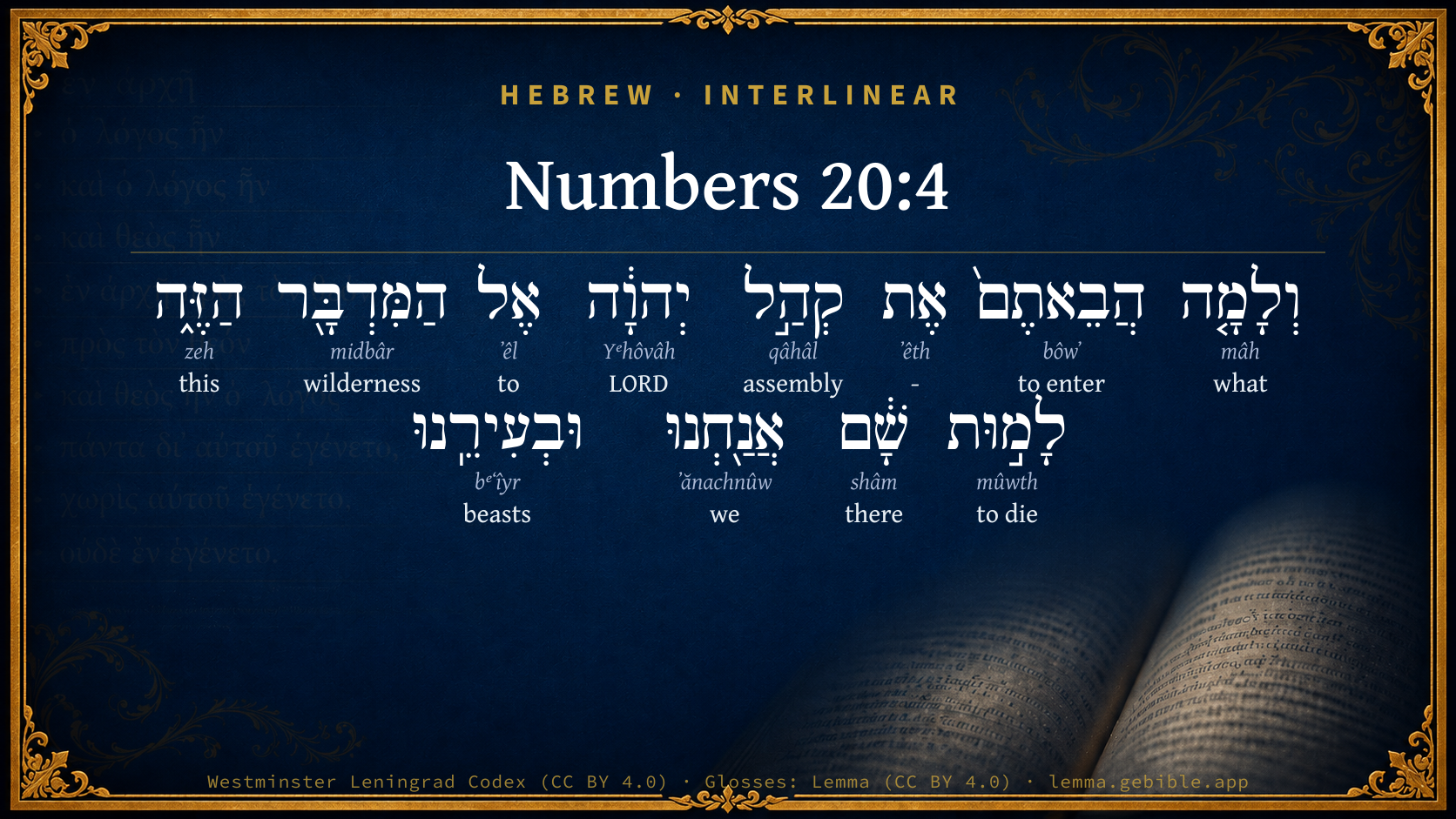
וּבְעִירֵֽנוּ
bᵉʻîyr
H1165
“and · beasts · our”
Conjunction + Noun, Common, Masculine, Singular, Construct + Suffix, Personal, 1st Person, Common, Plural
Part of Speech
Conjunction + Noun
Type
Common
Gender
Masculine
Number
Singular
State
Construct
Full BDB Definition

Origin: from H1197 (in the sense of eating)

TWOT: 264a

beasts, cattle
  1. וְלָמָ֤ה mâh H4100 “and · to/for · what” Conjunction + Preposition + Particle, Interrogative
  2. הֲבֵאתֶם֙ bôwʼ H935 “to enter” Verb, Hiphil, Perfect, 2nd Person, Masculine, Plural
  3. אֶת ʼêth H853 “-” Particle, Direct Object
  4. קְהַ֣ל qâhâl H6951 “assembly of” Noun, Common, Masculine, Singular, Construct
  5. יְהוָ֔ה Yᵉhôvâh H3068 “LORD” Noun, Proper
  6. אֶל ʼêl H413 “to” Preposition
  7. הַמִּדְבָּ֖ר midbâr H4057 “the · wilderness” Particle, Definite Article + Noun, Common, Masculine, Singular, Absolute
  8. הַזֶּ֑ה zeh H2088 “the · this” Particle, Definite Article + Pronoun, Demonstrative, Masculine, Singular
  9. לָמ֣וּת mûwth H4191 “to die” Preposition + Verb, Qal, Infinitive Construct
  10. שָׁ֔ם shâm H8033 “there” Adverb
  11. אֲנַ֖חְנוּ ʼănachnûw H587 “we” Pronoun, Personal, 1st Person, Common, Plural

About this verse

These counts appear in no published source. They are computed here, from the morphology-tagged text and Lemma’s own curated glosses. What Lemma adds →

12
words
12
distinct lemmas
Pentateuch
section

Notable vocabulary

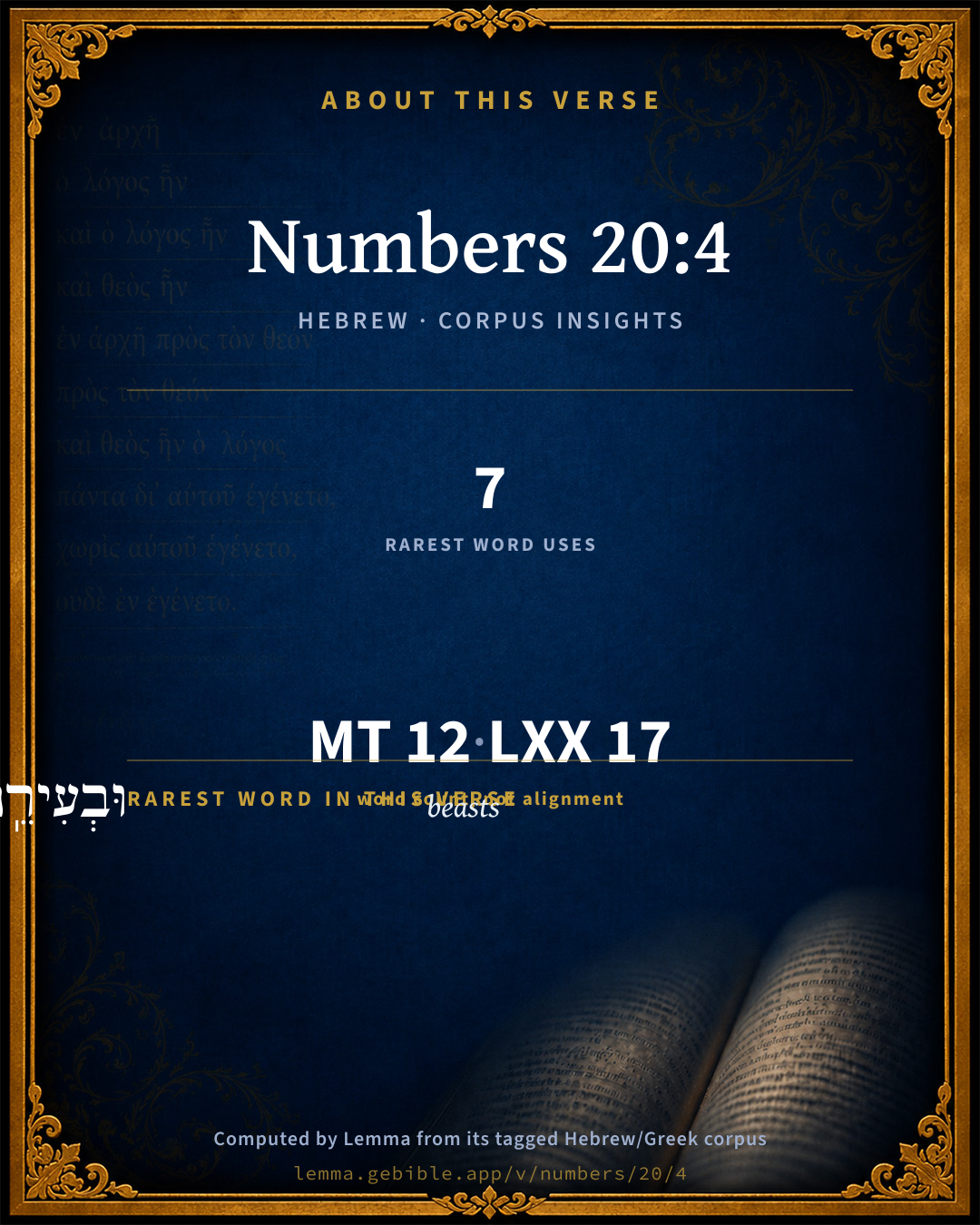
The rarest word here is וּבְעִירֵֽנוּ beasts H1165 — appearing just 7 times in the whole Hebrew Bible.

Shared distinctive vocabulary

וּבְעִירֵֽנוּ beasts H1165 occurs in 6 verses of the Hebrew Bible. Also found in:

Grammatical profile

  • 2 verbs
  • 4 nouns
  • 2 pronouns
  • 1 preposition
  • 1 adverb
  • 2 particles

Verb forms

  • הֲבֵאתֶם֙ Hiphil · Perfect
  • לָמ֣וּת Qal · Infinitive Construct

Hebrew & Septuagint length

In English translation the verse runs 20 words from the Hebrew and 20 from the Septuagint (LXX English) — the same length.

A rough comparison of the two English renderings, which tokenize alike — not a word-level alignment.

Word counts can differ between the Hebrew and the Greek without any difference in meaning — e.g. the Hebrew direct-object marker אֵת has no separate Greek word, and Greek often adds the article ὁ.

In the original languages it is 12 Hebrew tokens and 17 Greek tokens — but the two are counted differently (Hebrew bundles its prefixes and suffixes into one token; the Greek is in lemma form), so that isn’t a like-for-like length.

Cross-references

10

Topical passages linked to Numbers 20:4 in the Treasury of Scripture Knowledge — connected by theme and wording, ordered by reader-vote popularity; previews shown in the World English Bible.

  • Exodus 17:3 The people were thirsty for water there; and the people murmured against Moses, and said, "Why have you brought us up out of Egypt, to kill us, our children, and our livestock with thirst?"
  • Psalms 106:21 They forgot God, their Savior, Who had done great things in Egypt,
  • Exodus 5:21 and they said to them, "May Yahweh look at you, and judge, because you have made us a stench to be abhorred in the eyes of Pharaoh, and in the eyes of his servants, to put a sword in their hand to kill us."
  • Exodus 14:11–12 They said to Moses, "Because there were no graves in Egypt, have you taken us away to die in the wilderness? Why have you treated us this way, to bring us forth out of Egypt?
  • Exodus 16:3 and the children of Israel said to them, "We wish that we had died by the hand of Yahweh in the land of Egypt, when we sat by the flesh-pots, when we ate our fill of bread, for you have brought us out into this wilderness, to kill this whole assembly with hunger."
  • Numbers 11:5 We remember the fish, which we ate in Egypt for nothing; the cucumbers, and the melons, and the leeks, and the onions, and the garlic:
  • Numbers 16:13–14 is it a small thing that you have brought us up out of a land flowing with milk and honey, to kill us in the wilderness, but you must needs make yourself also a prince over us?
  • Numbers 16:41 But on the next day all the congregation of the children of Israel murmured against Moses and against Aaron, saying, You have killed the people of Yahweh.
  • Acts 7:35 "This Moses, whom they refused, saying, 'Who made you a ruler and a judge?'--God has sent him as both a ruler and a deliverer by the hand of the angel who appeared to him in the bush.
  • Acts 7:39–40 to whom our fathers wouldn't be obedient, but rejected him, and turned back in their hearts to Egypt,

Cross-references courtesy of OpenBible.info (CC BY 4.0).

Hebrew and Greek witnesses Masoretic Hebrew ↔ Greek Septuagint

The same verse in the two great witnesses to the Old Testament, shown verse-for-verse.

These are two independent witnesses, not word-aligned to each other, and the Septuagint is shown in lemma (dictionary) form.

Hebrew Numbers 20:4 Masoretic · Westminster Leningrad Codex

וְלָמָ֤ה הֲבֵאתֶם֙ אֶת קְהַ֣ל יְהוָ֔ה אֶל הַמִּדְבָּ֖ר הַזֶּ֑ה לָמ֣וּת שָׁ֔ם אֲנַ֖חְנוּ וּבְעִירֵֽנוּ

Why have you brought the assembly of Yahweh into this wilderness, that we should die there, we and our animals?

World English Bible · Public Domain

Greek LXX Numbers 20:4 Septuagint · lemma form

καί ἵνα τίς ἀναἄγω ὁ συναγωγή κύριος εἰς ὁ ἔρημος οὗτος ἀποκτείνω ἐγώ καί ὁ κτῆνος ἐγώ

And therefore have you⌃ brought up the congregation of the Lord into this wilderness, to kill us and our cattle?

LXX2012 (modern English Septuagint) · Public Domain

Hebrew: Westminster Leningrad Codex (CC BY 4.0). Greek: Septuagint (public domain); English from LXX2012 (modern English Septuagint) (Public Domain). How the Septuagint differs from the Hebrew →

Targum (Aramaic paraphrase)

2

The Targum is the ancient Jewish Aramaic paraphrase of the Hebrew Scriptures — an interpretive translation, not the Hebrew text itself. Onkelos (literal) and Pseudo-Jonathan (expansive) render the Torah, and Jonathan the Prophets. Coverage is partial: where no permissively-licensed English translation exists for a verse, only the Aramaic is shown. This is verse-level text, not a word-by-word alignment to the Hebrew.

  1. Targum Onkelos Torah (Genesis–Deuteronomy)
    וּלְמָא אַעֶלְתּוּן יָת קְהָלָא דַיְיָ לְמַדְבְּרָא הָדֵין לִמְמַת תַּמָן אֲנַחְנָא וּבְעִירָנָא

    (no public-domain English translation for this verse)

    Targum Onkelos — Aramaic: “Onkelos Genesis” (public domain); “Onkelos Exodus” (public domain); “Onkelos Leviticus” (public domain); “Onkelos Numbers” (public domain); “Onkelos Deuteronomy” (public domain). English: “Sefaria Community Translation” (CC0 1.0 (public-domain dedication)); “J.W. Etheridge. The Targums of Onkelos and Jonathan Ben Uzziel on the Pentateuch. London: Longmans, Green, 1862” (public domain). Text via Sefaria.

  2. Targum Pseudo-Jonathan Torah (Genesis–Deuteronomy)
    וּלְמָא אָתֵיתוּן יַת קְהָלָא דַיְיָ לְמַדְבְּרָא הָדֵין לִמְמַת תַּמָן אֲנַחְנָא וּבְעִירָנָא

    And why hast thou brought the congregation of the Lord into this desert, that we and our cattle may die here?

    Targum Pseudo-Jonathan — Aramaic: “Targum Jonathan on Genesis” (public domain); “Targum Jonathan on Exodus” (public domain); “Targum Jonathan on Leviticus” (public domain); “Targum Jonathan on Numbers” (public domain); “Targum Jonathan on Deuteronomy” (public domain). English: “The Targum of Jonathan ben Uzziel, trans. J. W. Etheridge, London, 1862” (public domain). Text via Sefaria.

Commentary

Notes on Numbers 20:4 from classic Christian and Jewish commentators (each source and its license shown beneath its notes). The classic Christian expositions comment on the surrounding passage and are grouped to its opening verse, so a note may address several verses; the Jewish commentaries on the Tanakh (Rashi and others) are per-verse, so they appear only where the commentator wrote on this verse.

Lemma curates 59 commentaries, every one of them public domain or Creative Commons licensed, each selected and text-cleaned for this edition rather than reprinted as found. About our sources →

Trapp's Complete Commentary

John Trapp

Num 20:4 And why have ye brought up the congregation of the LORD into this wilderness, that we and our cattle should die there?

Ver. 4. And why have ye brought up.] See how this new generation doth patrissare This is but the old coccysmus of those ancient malcontents; {Exo 17:2} so much the worse in these, because they made no better use of God’s dealing with their fathers. {Dan 5:22}

John Trapp, A Commentary or Exposition upon All the Books of the Old and New Testament (1647–1656) — public domain. Text from a community e-Sword module.

John Gill's Exposition

And why have ye brought up the congregation of the Lord into this wilderness,.... The wilderness of Zin, whither by various marches and journeys, and through different stations, they were at length come:

that we and our cattle should die there? with thirst; they seem to represent it, as if this was the end, design, and intention of Moses and Aaron in bringing them thither; their language is much the same with their fathers on a like occasion; which shows the bad influence of example, and how careful parents should be of their words and actions, that their posterity be not harmed by them; see Exo 17:3.

John Gill's Exposition of the Whole Bible (1746–1763) — public domain (CC PDM 1.0). Text via the HelloAO Bible API.

The Pulpit Commentary

Why have ye brought up the congregation of the Lord into this wilderness? These words are almost exactly repeated from Exo_17:3. They, and those which follow, are no doubt out of place if considered as expressing the feelings of the great bulk of the people, who had no knowledge of Egypt, and had grown up in the wilderness. But on such occasions it is always the few who put words into the months of the many, and the ringleaders in this gainsaying would naturally be the survivors of the elder generation, whose dis. position was exactly the same as ever, and who had always shown a remarkable want of originality in their complaints.

The Pulpit Commentary (1880–1919), ed. H.D.M. Spence-Jones & Joseph S. Exell — public domain. Text from a community e-Sword module.

unfoldingWord translationNotes

Door43 World Missions Community

Connecting Statement:

The people of Israel continue to complain to Moses and Aaron.

Why have you brought Yahweh's community into this wilderness to die here, we and our animals?

The people use this question in order to complain against Moses and Aaron. It can be translated as a statement. AT: "You should not have brought Yahweh's community into this wilderness to die here, we and our animals." (See: Rhetorical Question)

Why did you make us come up out of Egypt to bring us to this horrible place?

The people use this question in order to complain against Moses and Aaron. It can be translated as a statement. AT: "You should not have made us leave Egypt to bring us to this horrible place." (See: Rhetorical Question)

translationWords

desert

Egypt

seed

fig

vine

pomegranate

unfoldingWord translationNotes — © Distant Shores Media and the Door43 World Missions Community, licensed CC BY-SA 4.0. Source: git.door43.org/Door43/en_tn.

Lesson kit

Teaching starters — assembled from the data on this page, not authored interpretation. Every prompt links to the verse data it draws on. Edit before teaching.

Numbers, in the Pentateuch, opens this verse with 12 words (12 distinct Hebrew lemmas). Its most distinctive word is bᵉʻîyr (“beasts”). A historical commentator’s framing appears above. Read the whole chapter for the surrounding context.

Discussion questions

  1. How does “beasts” (bᵉʻîyr) shape what this verse is saying?
  2. Genesis 45:17 shares the word «beasts» with this verse. How do the two illuminate each other?
  3. The translations on this page render this verse differently — a whole-verse word diff, not a word-by-word alignment. What might account for the different wordings?
  4. The verb «הֲבֵאתֶם֙» is Hiphil Perfect. How does its form color the action?
  5. Reading how Trapp's Complete Commentary and John Gill's Exposition read this verse, where do the two commentators agree and where do they part?

Things to notice

Reading settings

Reading text

Shown beneath each verse's original-language words.

Old Testament
Old Testament edition

Read the OT as the Masoretic Hebrew (MT) or the Greek Septuagint (LXX).

English shown for the Greek Septuagint (in the Hebrew ↔ Greek comparison).

Comparing translations? Open the Compare panel on any verse page to stack up to four side by side.