
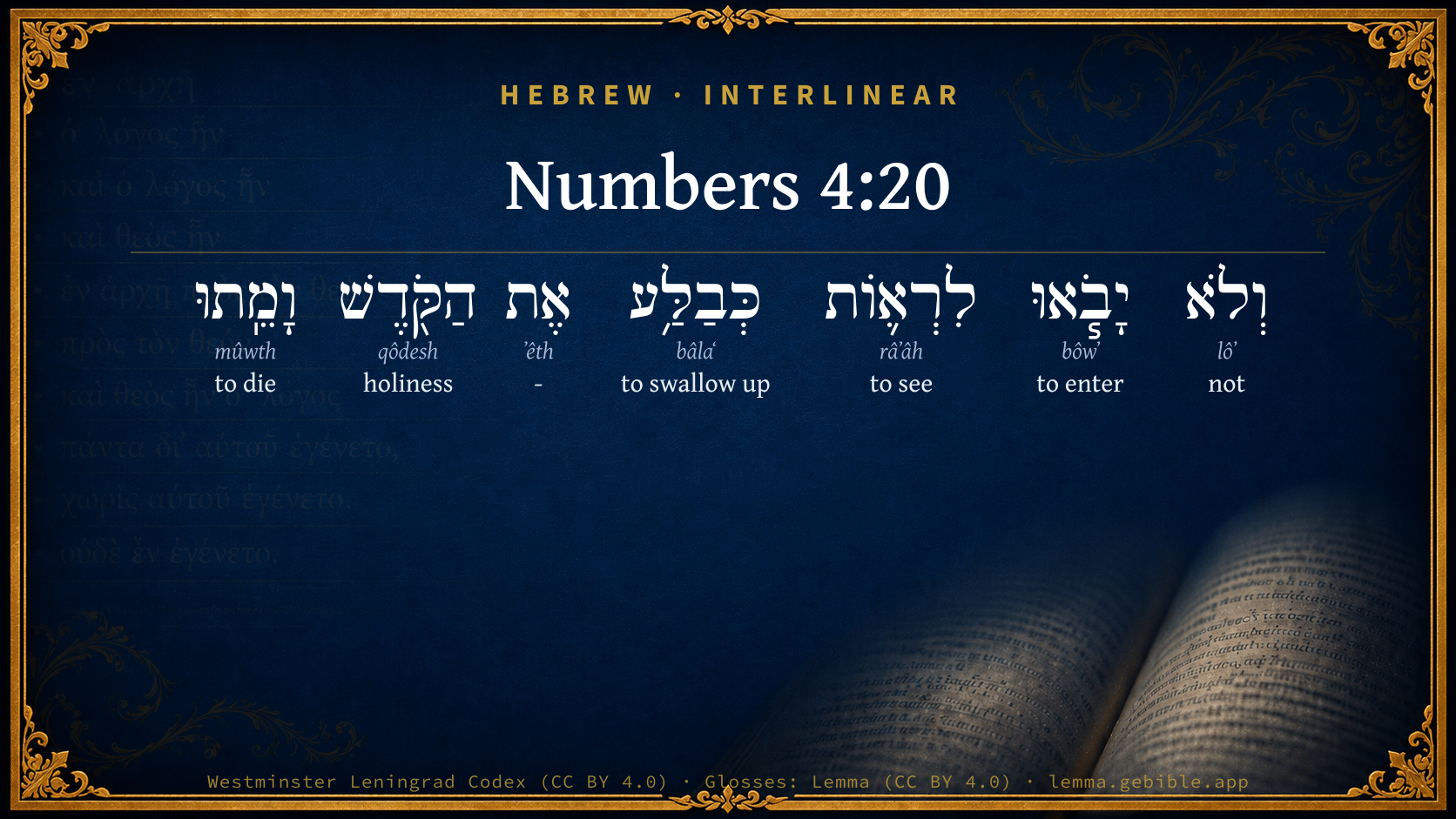
Numbers 4:20

Hebrew (Westminster Leningrad Codex) Numbers 4:20 appears in the Hebrew Old Testament. The text above is from the Westminster Leningrad Codex. Each word links to its Strong’s number, a concise gloss, and parsing drawn from the Open Scriptures Hebrew Bible morphology. Click any word for its full Brown-Driver-Briggs (BDB) entry.
Download image
Cite this verse

Numbers 4:20 (World English Bible). Public Domain. Lemma interlinear Bible study tool, https://lemma.gebible.app/v/numbers/4/20.

Show BibTeX & RIS
BibTeX
RIS
English Translation
but they shall not go in to see the sanctuary even for a moment, lest they die."
World English Bible · Public Domain
Download a study sheet

One document with this verse’s original text, its word-by-word gloss line, the meaning frame, cross-references with their text, attributed commentary, and full source and license credits — printable, and it pastes into notes with its structure intact.

This verse Autodidact and up

Study sheet (.html) Plain text (.txt)

A passage Seminary Student

Up to 50 verses in one chapter. A passage sheet keeps up to 6 commentary sources and 12 cross-references per verse, in the order this page ranks them, and says so on the sheet whenever that leaves anything out. Ask for a single verse and you get the Autodidact verse sheet above.

Everything on this page stays free to read, with no account — the sheet is a download of what is already on screen, not access to it.

Want to remove ads? Support Godless Engineer
Compare translations 3

The same verse in 3 English versions, stacked beneath the original-language interlinear above. Click any original word for its lexicon entry.

Each is an independent rendering of the whole verse — the interlinear is not word-aligned to these translations.

Highlighted words mark where these versions differ — a whole-verse word diff, not a word-by-word alignment.

  • World English Bible Public Domain
    but they shall not go in to see the sanctuary even for a moment, lest they die."
  • King James Version Public Domain
    But they shall not go in to see when the holy things are covered, lest they die.
  • unfoldingWord Literal Text CC BY-SA 4.0
    But they shall not go to see, when swallowing, the holy place and die.”

unfoldingWord Literal Text — © unfoldingWord, licensed CC BY-SA 4.0. Word-aligned USFM3 via Door43 (git.door43.org/unfoldingWord/en_ult).

Versions to compare (up to 4)

3 of 4 selected

Show all 18 translations

Every available English version of this verse, each an independent rendering of the whole verse.

  • World English Bible Public Domain
    but they shall not go in to see the sanctuary even for a moment, lest they die."
  • Berean Standard Bible Public Domain
    But the Kohathites are not to go in and look at the holy objects, even for a moment, or they will die.”
  • Majority Standard Bible Public Domain
    But the Kohathites are not to go in and look at the holy objects, even for a moment, or they will die.”
  • King James Version Public Domain
    But they shall not go in to see when the holy things are covered, lest they die.
  • American Standard Version (1901) Public Domain
    but they shall not go in to see the sanctuary even for a moment, lest they die.
  • Revised Version (1885) Public Domain
    but they shall not go in to see the sanctuary even for a moment, lest they die.
  • Geneva Bible (1599) Public Domain
    But let them not goe in, to see when the Sanctuarie is folden vp, lest they die.
  • Douay-Rheims (1899) Public Domain
    Let not others by any curiosity see the things that are in the sanctuary before they be wrapped up, otherwise they shall die.
  • Young's Literal Translation Public Domain
    and they go not in to see when the holy thing is swallowed, that they have died.'
  • Literal Standard Version CC BY-SA 4.0
    and they do not go in to see when the holy thing is swallowed, lest they have died.”
  • Unlocked Literal Bible CC BY-SA 4.0
    they must not go in to see the holy place even for a moment, or they must die. Aaron and his sons must go in, and then Aaron and his sons must assign each of the Kohathites to his work, to his special tasks.”
  • unfoldingWord Literal Text CC BY-SA 4.0
    But they shall not go to see, when swallowing, the holy place and die.”
  • Darby Bible Public Domain
    but they shall not go in and see for a moment the holy things, lest they die.
  • World Messianic Bible Public Domain
    but they shall not go in to see the sanctuary even for a moment, lest they die.”
  • Webster's Bible Public Domain
    But they shall not go in to see when the holy things are covered, lest they die.
  • Free Bible Version CC BY-SA 4.0
    But they must not go in and look at the things that are most holy, even for just a moment, otherwise they'll die.”
  • Bible in Basic English Public Domain
    But they themselves are not to go in to see the holy place, even for a minute, for fear of death.
  • JPS Tanakh (1917) Public Domain
    but they shall not go in to see the holy things as they are being covered, lest they die.'

Literal Standard Version (2020), Covenant Press — licensed CC BY-SA 4.0. Text via the HelloAO Bible API (eBible.org). Unlocked Literal Bible (unfoldingWord) — licensed CC BY-SA 4.0. Text via the HelloAO Bible API (eBible.org). unfoldingWord Literal Text — © unfoldingWord, licensed CC BY-SA 4.0. Word-aligned USFM3 via Door43 (git.door43.org/unfoldingWord/en_ult). Free Bible Version, Dr. Jonathan Gallagher — licensed CC BY-SA 4.0. Text via the HelloAO Bible API (eBible.org).

Word by word

More ways to search: Search by grammar → Find every occurrence → Compare this word →

Practice this passage: Drill this verse → Learn its vocabulary →

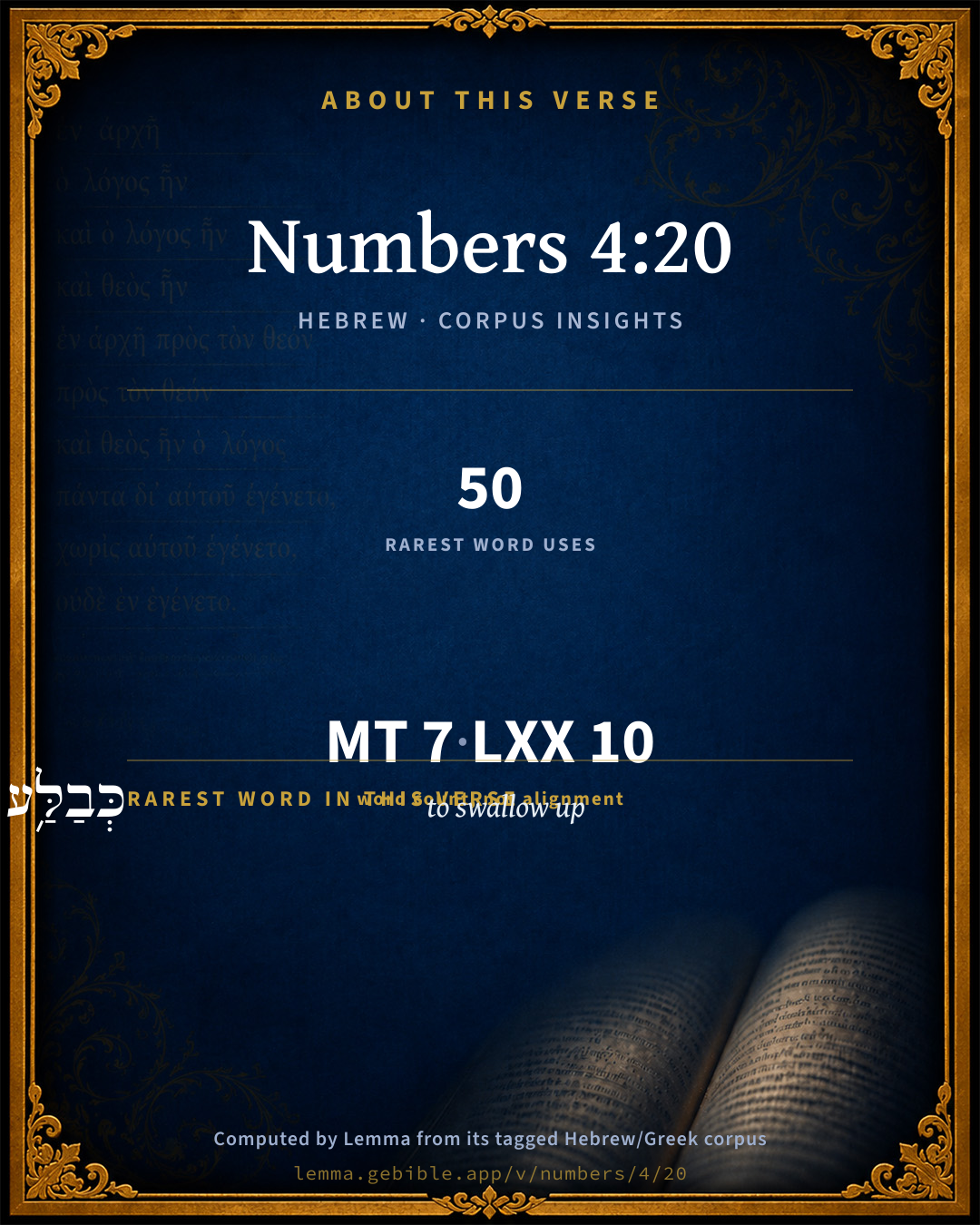
About this verse

These counts appear in no published source. They are computed here, from the morphology-tagged text and Lemma’s own curated glosses. What Lemma adds →

7
words
7
distinct lemmas
Pentateuch
section

Shared distinctive vocabulary

כְּבַלַּ֥ע to swallow up H1104 occurs in 48 verses of the Hebrew Bible. Also found in:

Grammatical profile

  • 4 verbs
  • 1 noun
  • 2 particles

Verb forms

  • יָבֹ֧אוּ Qal · Imperfect
  • לִרְא֛וֹת Qal · Infinitive Construct
  • כְּבַלַּ֥ע Piel · Infinitive Construct
  • וָמֵֽתוּ Qal · Sequential Perfect

Hebrew & Septuagint length

In English translation the verse runs 17 words from the Hebrew and 18 from the Septuagint (LXX English) — closely comparable.

A rough comparison of the two English renderings, which tokenize alike — not a word-level alignment.

Word counts can differ between the Hebrew and the Greek without any difference in meaning — e.g. the Hebrew direct-object marker אֵת has no separate Greek word, and Greek often adds the article ὁ.

In the original languages it is 7 Hebrew tokens and 10 Greek tokens — but the two are counted differently (Hebrew bundles its prefixes and suffixes into one token; the Greek is in lemma form), so that isn’t a like-for-like length.

Cross-references

7

Topical passages linked to Numbers 4:20 in the Treasury of Scripture Knowledge — connected by theme and wording, ordered by reader-vote popularity; previews shown in the World English Bible.

  • 1 Samuel 6:19 He struck of the men of Beth-shemesh, because they had looked into the ark of Yahweh, he struck of the people fifty thousand seventy men; and the people mourned, because Yahweh had struck the people with a great slaughter.
  • Exodus 19:21 Yahweh said to Moses, "Go down, charge the people, lest they break through to Yahweh to gaze, and many of them perish.
  • Leviticus 10:2 And fire came forth from before Yahweh, and devoured them, and they died before Yahweh.
  • Numbers 4:15 "When Aaron and his sons have finished covering the sanctuary, and all the furniture of the sanctuary, as the camp moves forward; after that, the sons of Kohath shall come to carry it: but they shall not touch the sanctuary, lest they die. These things are the burden of the sons of Kohath in the Tent of Meeting.
  • Numbers 4:19 but thus do to them, that they may live, and not die, when they approach to the most holy things: Aaron and his sons shall go in, and appoint them everyone to his service and to his burden;
  • Hebrews 10:19–20 Having therefore, brothers, boldness to enter into the holy place by the blood of Jesus,
  • Revelation 11:19 God's temple that is in heaven was opened, and the ark of the Lord's covenant was seen in his temple. Lightnings, sounds, thunders, an earthquake, and great hail followed.

Cross-references courtesy of OpenBible.info (CC BY 4.0).

Hebrew and Greek witnesses Masoretic Hebrew ↔ Greek Septuagint

The same verse in the two great witnesses to the Old Testament, shown verse-for-verse.

These are two independent witnesses, not word-aligned to each other, and the Septuagint is shown in lemma (dictionary) form.

Hebrew Numbers 4:20 Masoretic · Westminster Leningrad Codex

וְלֹא יָבֹ֧אוּ לִרְא֛וֹת כְּבַלַּ֥ע אֶת הַקֹּ֖דֶשׁ וָמֵֽתוּ

but they shall not go in to see the sanctuary even for a moment, lest they die."

World English Bible · Public Domain

Greek LXX Numbers 4:20 Septuagint · lemma form

καί οὐ μή εἰςἔρχομαι ὁράω ἐξάπινα ὁ ἅγιος καί ἀποθνήσκω

And so they shall by no means go in to look suddenly upon the holy things, and die.

LXX2012 (modern English Septuagint) · Public Domain

On this verse, Haydock's Catholic Bible Commentary discusses the Septuagint’s reading. Read the note in Commentary ↓

Hebrew: Westminster Leningrad Codex (CC BY 4.0). Greek: Septuagint (public domain); English from LXX2012 (modern English Septuagint) (Public Domain). How the Septuagint differs from the Hebrew →

Targum (Aramaic paraphrase)

2

The Targum is the ancient Jewish Aramaic paraphrase of the Hebrew Scriptures — an interpretive translation, not the Hebrew text itself. Onkelos (literal) and Pseudo-Jonathan (expansive) render the Torah, and Jonathan the Prophets. Coverage is partial: where no permissively-licensed English translation exists for a verse, only the Aramaic is shown. This is verse-level text, not a word-by-word alignment to the Hebrew.

  1. Targum Onkelos Torah (Genesis–Deuteronomy)
    וְלָא יֵעֲלוּן לְמֶחֱזֵי כַּד מְכַסָן יָת מָנֵי קוּדְשָׁא וְלָא יְמוּתוּן

    (no public-domain English translation for this verse)

    Targum Onkelos — Aramaic: “Onkelos Genesis” (public domain); “Onkelos Exodus” (public domain); “Onkelos Leviticus” (public domain); “Onkelos Numbers” (public domain); “Onkelos Deuteronomy” (public domain). English: “Sefaria Community Translation” (CC0 1.0 (public-domain dedication)); “J.W. Etheridge. The Targums of Onkelos and Jonathan Ben Uzziel on the Pentateuch. London: Longmans, Green, 1862” (public domain). Text via Sefaria.

  2. Targum Pseudo-Jonathan Torah (Genesis–Deuteronomy)
    וְלָא יֵיעָלוּן לְמַתְחַמְיָיא כַּד יֵיעָלוּן כַּהֲנַיָא לְשִׁיקוּעַ מָאנֵי קוּדְשָׁא דְלָא יְמוּתוּן בְּאֵשָׁא מְצַלְהֲבָא

    But they shall not go in to gaze, when the priests go in to cover the vessels of the sanctuary, that they die not by the flaming fire.

    Targum Pseudo-Jonathan — Aramaic: “Targum Jonathan on Genesis” (public domain); “Targum Jonathan on Exodus” (public domain); “Targum Jonathan on Leviticus” (public domain); “Targum Jonathan on Numbers” (public domain); “Targum Jonathan on Deuteronomy” (public domain). English: “The Targum of Jonathan ben Uzziel, trans. J. W. Etheridge, London, 1862” (public domain). Text via Sefaria.

Commentary

Notes on Numbers 4:20 from classic Christian and Jewish commentators (each source and its license shown beneath its notes). The classic Christian expositions comment on the surrounding passage and are grouped to its opening verse, so a note may address several verses; the Jewish commentaries on the Tanakh (Rashi and others) are per-verse, so they appear only where the commentator wrote on this verse.

Lemma curates 59 commentaries, every one of them public domain or Creative Commons licensed, each selected and text-cleaned for this edition rather than reprinted as found. About our sources →

Trapp's Complete Commentary

John Trapp

Num 4:20 But they shall not go in to see when the holy things are covered, lest they die.

Ver. 20. But they shall not go in to see.] The men of Bethshemesh paid for their peeping. {1Sa 6:9} Search not into God’s secrets: hic oportet mirari, non rimari {Deu 29:29} Remember that saying of Xenocrates the philosopher: Nihil interesse, pedesne quisquam, an oculos in aliena domo ponat, {a} It is as great unmannerliness to pry into another man’s house as to press into it.

{a} Plutarch, De Curiosit.

John Trapp, A Commentary or Exposition upon All the Books of the Old and New Testament (1647–1656) — public domain. Text from a community e-Sword module.

Keil & Delitzsch

C. F. Keil & F. Delitzsch

כּבלּע, "like a swallow, a gulp," is probably a proverbial expression, according to the analogy of Job 7:19, for "a single instant," of which the Arabic also furnishes examples (see A. Schultens on Job 7:19). The Sept. rendering, ἐξάπινα, conveys the actual sense. A historical illustration of Num 4:20 is furnished by Sa1 6:19.

(Note: According to Knobel, Num 4:17-20 have been interpolated by the Jehovist into the Elohistic text. But the reasons for this assumption are weak throughout. Neither the peculiar use of the word shebet, to which there is no corresponding parallel in the whole of the Old Testament, nor the construction of נגשׁ with את, which is only met with in Sa1 9:18 and Sa1 30:21, nor the Hiphil הכרית, can be regarded as criteria of a Jehovistic usage. And the assertion, that the Elohist lays the emphasis upon approaching and touching the holy things (Num 4:15; Num 8:19; Num 18:3, Num 18:22), and not upon seeing or looking at them, rests upon an antithesis which is arbitrarily forced upon the text, since not only seeing (Num 4:20), but touching also (Num 4:19), is described as causing death; so that seeing and touching form no antithesis at all.)

Keil & Delitzsch — Biblical Commentary on the Old Testament (1861–1891) — public domain (CC PDM 1.0). Text via the HelloAO Bible API. (Old Testament only.)

Adam Clarke's Commentary

Verse 20. When the holy things are covered] Literally, כבלע keballa, when they are swallowed down; which shows the promptitude with which every thing belonging to the holy of holies was put out of sight, for these mysteries must ever be treated with the deepest reverence; and indeed without this they could not have been to them the representatives of heavenly realities. See the concluding note.

Adam Clarke's Commentary on the Bible (1810–1826) — public domain. Text from a community e-Sword/MySword module.

Ellicott's Commentary for English Readers

(20) But they shall not go in to see when the holy things are covered.—Better, But they shall not go in to see the holy things (or, the sanctuary) for a moment. The Levites were not per-mitted to enter the holy place in which the priests ministered, much less the Holy of Holies. Whether this rule was or was not relaxed at the time of the removal of the Tabernacle, as the prohibition against entrance into the Holy of Holies must have been in regard to the priests, the Levites were not permitted in any case to look upon the Ark and the other holy things until they were covered.

A Bible Commentary for English Readers, edited by Charles John Ellicott (1878–1897) — public domain. Text from a community e-Sword module.

John Gill's Exposition

Take also the sum of the sons of Gershon,.... As well as of the sons of Kohath; for though Gershon was Levi's eldest son, yet his posterity were not excused from the service of the tabernacle, and bearing things of it in journeying:

throughout the houses of their fathers, by their families; all in their several houses, and in the several families in those houses, that were of the age next mentioned, were to be numbered.

John Gill's Exposition of the Whole Bible (1746–1763) — public domain (CC PDM 1.0). Text via the HelloAO Bible API.

Albert Barnes' Notes on the Bible

to see when the holy things are covered - Render: to see the holy things for an instant. The expression means Iiterally” as a gulp,” i. e. for the instant it takes to swallow.

Albert Barnes' Notes on the Bible (1834–1885) — public domain. Text from a community e-Sword/MySword module.

Haydock's Catholic Bible Commentary

Curiosity. Septuagint, "suddenly." Let them not rush in before all the vessels be properly covered. The priests folded them up with all haste, that they might see them as little as possible themselves. (Calmet)

George Leo Haydock (1774–1849), Haydock's Catholic Family Bible and Commentary, 1859 edition — public domain. Excludes Psalms (Douay-Rheims chapter numbering differs from Protestant) and Deuterocanonical books (Catholic canon only).

Whedon's Commentary on the Bible

Daniel D. Whedon

20. They shall not… see… lest they die — There is here a very expressive Hebrew word, כבלע, as a gulp, a swallowing. “They shall not see for a single instant the holy things.” Dr. A. Clarke’s reference of this word to the enveloping of the holy things is hardly admissible. The Authorized Version makes the same mistake by rendering it, when they are covered. While we shrink from announcing all the reasons for hanging so many terrors about the abode of Jehovah on the earth, we may say that nothing could more deeply impress upon all the Hebrew people the majesty, power, and holiness of their God in contrast with the divinities of all the surrounding nations. It is in mercy that God withholds from our eager eyes those revelations of his glory which our spiritual stupidity and littleness of faith so often crave. It was after the awful manifestation of Jehovah on the summit of Horeb that the people said to Moses, “Speak thou with us, and we will hear; but let not God speak, lest we die.” Exo_20:19.

Daniel D. Whedon (gen. ed.), Commentary on the Old and New Testaments (1874–1909) — public domain. Text from a community e-Sword module.

The Pulpit Commentary

They shall not go in to see when the holy things are covered. This translation is disputed. The word rendered "are covered" is the Piel infinitive from bala, to swallow, and so to destroy. It may signify the extreme rapidity with which the most holy things were hidden from sight and removed from touch, so as to become, as it were, non-existent for the time. So the Syriac, Arabic, Samaritan, and the Targums of Onkelos and Palestine. On the other hand, it may be a proverbial expression, "in a swallow, at a gulp," i.e., " for an instant," as in Job_7:19. And so the Septuagint, exapina , and most modern scholars. Whichever way, however, we take it, the phrase, "they shall not go in to see," seems to limit the prohibition under pain of death to the deliberate act of entering the tabernacle out of curiosity during the process of packing up the holy things. The case of the men of Bethshemesh, therefore, (1Sa_6:19) does not fall within the letter of this law, although it does within its spirit. The command, thus limited, is no doubt an addition to the previous command not to touch, but it is altogether in keeping with it. If it was the will of God to hedge about these sacred symbols of his presence and his worship with an awful sanctity, it is obvious that he was as much bound to defend them against the irreverent prying of the eye as against the irreverent touch of the hand; and the prying here prohibited would have been distinctly willful and inexcusable.

The Pulpit Commentary (1880–1919), ed. H.D.M. Spence-Jones & Joseph S. Exell — public domain. Text from a community e-Sword module.

Rashi

Rabbi Shlomo Yitzchaki (Rashi)

ולא יבאו לראות כבלע את הקדש BUT THEY SHALL NOT COME IN TO SEE WHEN THE HOLY THINGS ARE WRAPPED IN, each into its wrapping, as I have explained above in this section (v. 5 ff.): ‘‘and they shall spread upon it such-and-such a garment”, “and they shall cover it over with such-and-such a cover”, — for the “wrapping-up’ of it mentioned here is identical with the “covering up” of it mentioned in those passages.

Rashi on the Tanakh — English translations: “The Judaica Press complete Tanach with Rashi, translated by A. J. Rosenberg” (CC BY 4.0); “Pentateuch with Rashi's commentary by M. Rosenbaum and A.M. Silbermann, 1929-1934” (public domain); “The Metsudah Tanach series, Lakewood, N.J” (CC BY 4.0); and “The Book of Joshua, Metsudah Publications, 1997” (CC BY 4.0). Text via Sefaria.

Ramban (Nachmanides)

Rabbi Moshe ben Nachman (Ramban / Nachmanides)

AND THEY [i.e., the Kohathites] SHALL NOT GO IN TO SEE THE HOLY THING ‘K’VALA’ (AS THEY ARE BEING COVERED) — “as they [the priests] put each vessel into its wrapping, as I have explained above in this section: ‘and they shall spread upon it such-and-such a garment, and they shall cover it with such-and-such a cover,’ the [term] ‘k’vala’ referring to its ‘covering.’” This is Rashi’s language. It is also Onkelos’ opinion [who translated the verse as quoted above]. But our Rabbis have said in Tractate Sanhedrin that this verse constitutes a prohibition against stealing a sacred vessel, for which one suffers death [by the hand of Heaven], and zealous people have the right to strike such a thief, for stealing and robbing are referred to as b’liah (swallowing, devouring), as in the expressions: ‘bala’ (he hath swallowed down) riches, and he shall vomit them up again; and I will bring forth out of his mouth ‘eth bil’o’ (that which he hath swallowed up). But Rabbi Abraham ibn Ezra explained [the verse] in its plain sense: that [the Kohathites] should not come in to see when the screening Veil is removed and the ark becomes exposed; only afterwards when it is covered are they to come in to carry it. Accordingly, the expression k’vala eth hakodesh means [they shall not come in to see] “when the structure [i.e., the screening Veil] is being removed from the ark, which is hakodesh (the holiness),” [the word ‘k’vala’] being related to the expressions: ‘bila Hashem’ (the Eternal hath swallowed up) unsparingly [which means that He “destroyed the structure” of the habitations of Jacob mentioned further on in the verse]; Thy hands have framed me … together round about; yet ‘va’tval’eini’ (Thou dost destroy me). Thus the Levites are warned not to touch the holy ark lest they die, and only by means of its staves are they to carry it. He furthermore warned them against coming in at all to see the dismantling of the structure, while Aaron is taking down the screening Veil, in a similar way to that which is said [of the people of Beth-shemesh that they were punished] because they had gazed upon the ark of the Eternal. He [i.e., Ibn Ezra] has explained it well [i.e., the simple meaning of the verse]. But the [true] intention of the verse is that since the Glory that resides upon the cherubim [on the cover of the ark] is there, the Levites were warned not to break through “to see the Eternal” until the priests take down the Veil, for then the Glory is seen in the hiding of His power, and it returns to its former place in “the Holy of Holies.” In this way the expression k’vala eth hakodesh is to be understood in its literal sense. The student learned in the mysteries of the Cabala will understand.Naso

Ramban (Nachmanides) on the Tanakh — English translation: “Commentary on the Torah by Ramban (Nachmanides). Translated and annotated by Charles B. Chavel. New York, Shilo Pub. House, 1971-1976” (CC BY 4.0). Text via Sefaria.

Lesson kit

Teaching starters — assembled from the data on this page, not authored interpretation. Every prompt links to the verse data it draws on. Edit before teaching.

Numbers, in the Pentateuch, opens this verse with 7 words (7 distinct Hebrew lemmas). Its most distinctive word is bâlaʻ (“to swallow up”). A historical commentator’s framing appears above. Read the whole chapter for the surrounding context.

Discussion questions

  1. What does “to swallow up” (bâlaʻ) contribute to the verse as a whole?
  2. Genesis 41:7 shares the word «to swallow up» with this verse. How do the two illuminate each other?
  3. The translations on this page render this verse differently — a whole-verse word diff, not a word-by-word alignment. What might account for the different wordings?
  4. The verb «יָבֹ֧אוּ» is Qal Imperfect. How does its form color the action?
  5. Reading how Trapp's Complete Commentary and Keil & Delitzsch read this verse, where do the two commentators agree and where do they part?

Things to notice

Reading settings

Reading text

Shown beneath each verse's original-language words.

Old Testament
Old Testament edition

Read the OT as the Masoretic Hebrew (MT) or the Greek Septuagint (LXX).

English shown for the Greek Septuagint (in the Hebrew ↔ Greek comparison).

Comparing translations? Open the Compare panel on any verse page to stack up to four side by side.