
Deuteronomy 32:39

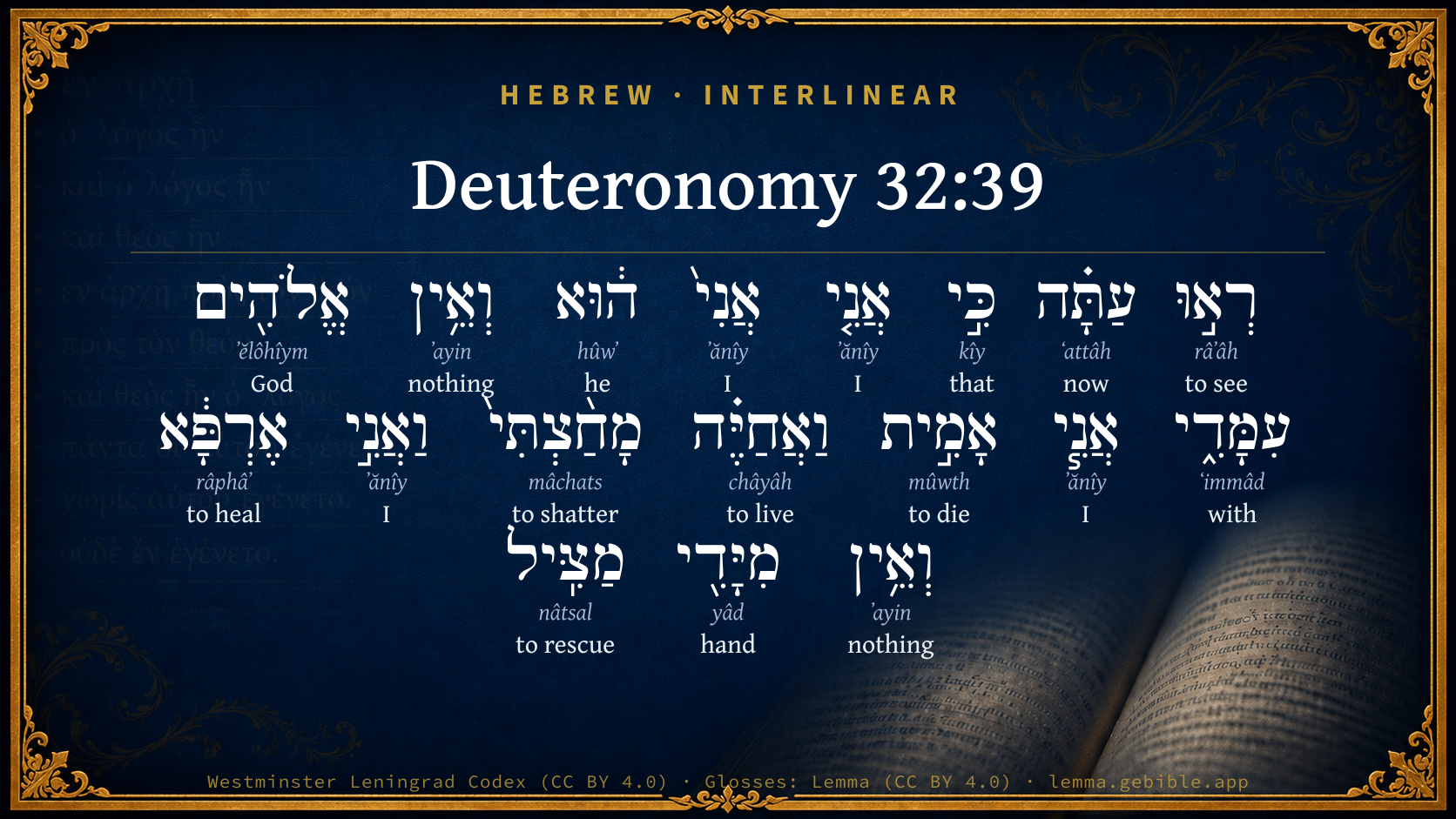
Hebrew (Westminster Leningrad Codex) Deuteronomy 32:39 appears in the Hebrew Old Testament. The text above is from the Westminster Leningrad Codex. Each word links to its Strong’s number, a concise gloss, and parsing drawn from the Open Scriptures Hebrew Bible morphology. Click any word for its full Brown-Driver-Briggs (BDB) entry.
Download image
Cite this verse

Deuteronomy 32:39 (World English Bible). Public Domain. Lemma interlinear Bible study tool, https://lemma.gebible.app/v/deuteronomy/32/39.

Show BibTeX & RIS
BibTeX
RIS
English Translation
See now that I, even I, am he, There is no god with me: I kill, and I make alive; I wound, and I heal; There is none who can deliver out of my hand.
World English Bible · Public Domain
Download a study sheet

One document with this verse’s original text, its word-by-word gloss line, the meaning frame, cross-references with their text, attributed commentary, and full source and license credits — printable, and it pastes into notes with its structure intact.

This verse Autodidact and up

Study sheet (.html) Plain text (.txt)

A passage Seminary Student

Up to 50 verses in one chapter. A passage sheet keeps up to 6 commentary sources and 12 cross-references per verse, in the order this page ranks them, and says so on the sheet whenever that leaves anything out. Ask for a single verse and you get the Autodidact verse sheet above.

Everything on this page stays free to read, with no account — the sheet is a download of what is already on screen, not access to it.

Want to remove ads? Support Godless Engineer
Compare translations 3

The same verse in 3 English versions, stacked beneath the original-language interlinear above. Click any original word for its lexicon entry.

Each is an independent rendering of the whole verse — the interlinear is not word-aligned to these translations.

Highlighted words mark where these versions differ — a whole-verse word diff, not a word-by-word alignment.

  • World English Bible Public Domain
    See now that I, even I, am he, There is no god with me: I kill, and I make alive; I wound, and I heal; There is none who can deliver out of my hand.
  • King James Version Public Domain
    See now that I, even I, am he, and there is no god with me: I kill, and I make alive; I wound, and I heal: neither is there any that can deliver out of my hand.
  • unfoldingWord Literal Text CC BY-SA 4.0
    See, now, that I, I he, and there is no god besides me. I put to death and give life; I wound, and I heal, and no one rescues from my hand,

unfoldingWord Literal Text — © unfoldingWord, licensed CC BY-SA 4.0. Word-aligned USFM3 via Door43 (git.door43.org/unfoldingWord/en_ult).

Versions to compare (up to 4)

3 of 4 selected

Show all 18 translations

Every available English version of this verse, each an independent rendering of the whole verse.

  • World English Bible Public Domain
    See now that I, even I, am he, There is no god with me: I kill, and I make alive; I wound, and I heal; There is none who can deliver out of my hand.
  • Berean Standard Bible Public Domain
    See now that I am He; there is no God besides Me. I bring death and I give life; I wound and I heal, and there is no one who can deliver from My hand.
  • Majority Standard Bible Public Domain
    See now that I am He; there is no God besides Me. I bring death and I give life; I wound and I heal, and there is no one who can deliver from My hand.
  • King James Version Public Domain
    See now that I, even I, am he, and there is no god with me: I kill, and I make alive; I wound, and I heal: neither is there any that can deliver out of my hand.
  • American Standard Version (1901) Public Domain
    See now that I, even I, am he, And there is no god with me: I kill, and I make alive; I wound, and I heal; And there is none that can deliver out of my hand.
  • Revised Version (1885) Public Domain
    See now that I, even I, am he, And there is no god with me: I kill, and I make alive; I have wounded, and I heal: And there is none that can deliver out of my hand.
  • Geneva Bible (1599) Public Domain
    Behold now, for I, I am he, and there is no gods with me: I kill, and giue life: I wound, and I make whole: neither is there any that can deliuer out of mine hand.
  • Douay-Rheims (1899) Public Domain
    See ye that I alone am, and there is no other God besides me: I will kill and I will make to live: I will strike, and I will heal, and there is none that can deliver out of my hand.
  • Young's Literal Translation Public Domain
    See ye, now, that I -- I `am' He, And there is no god with Me: I put to death, and I keep alive; I have smitten, and I heal; And there is not from My hand a deliverer,
  • Literal Standard Version CC BY-SA 4.0
    See, now, that I [am] He, || And there is no god besides Me; I put to death and I keep alive; I have struck and I heal; And there is not a deliverer from My hand,
  • Unlocked Literal Bible CC BY-SA 4.0
    See now that I, even I, am God, and that there is no god besides me; I kill, and I make alive; I wound, and I heal, and there is no one who can save you from my might.
  • unfoldingWord Literal Text CC BY-SA 4.0
    See, now, that I, I he, and there is no god besides me. I put to death and give life; I wound, and I heal, and no one rescues from my hand,
  • Darby Bible Public Domain
    See now that I, I am HE, And there is no god with me; I kill, and I make alive; I wound, and I heal, And there is none that delivereth out of my hand,
  • World Messianic Bible Public Domain
    “See now that I myself am he. There is no god with me. I kill and I make alive. I wound and I heal. There is no one who can deliver out of my hand.
  • Webster's Bible Public Domain
    See now that I, even I am he, and there is no god with me: I kill, and I make alive; I wound, and I heal: neither is there any that can deliver out of my hand.
  • Free Bible Version CC BY-SA 4.0
    Listen! I am the only God! There is no other God except me! I bring death, and I give life; I wound, and I heal. No one can be rescued from my power.
  • Bible in Basic English Public Domain
    See now, I myself am he; there is no other god but me: giver of death and life, wounding and making well: and no one has power to make you free from my hand.
  • JPS Tanakh (1917) Public Domain
    See now that I, even I, am He, and there is no god with Me; I kill, and I make alive; I have wounded, and I heal; and there is none that can deliver out of My hand.

Literal Standard Version (2020), Covenant Press — licensed CC BY-SA 4.0. Text via the HelloAO Bible API (eBible.org). Unlocked Literal Bible (unfoldingWord) — licensed CC BY-SA 4.0. Text via the HelloAO Bible API (eBible.org). unfoldingWord Literal Text — © unfoldingWord, licensed CC BY-SA 4.0. Word-aligned USFM3 via Door43 (git.door43.org/unfoldingWord/en_ult). Free Bible Version, Dr. Jonathan Gallagher — licensed CC BY-SA 4.0. Text via the HelloAO Bible API (eBible.org).

Word by word

More ways to search: Search by grammar → Find every occurrence → Compare this word →

Practice this passage: Drill this verse → Learn its vocabulary →

מָחַ֨צְתִּי֙
mâchats
H4272
“to shatter”
Verb, Qal, Perfect, 1st Person, Common, Singular
Part of Speech
Verb
Stem
Qal
Form
Perfect
Person
1st Person
Gender
Common
Number
Singular
Full BDB Definition

Origin: a primitive root

TWOT: 1183

to smite through, shatter, wound severely - (Qal) - to shatter - shattering (participle)
  1. רְא֣וּ râʼâh H7200 “see” Verb, Qal, Imperative, 2nd Person, Masculine, Plural
  2. עַתָּ֗ה ʻattâh H6258 “now” Adverb
  3. כִּ֣י kîy H3588 “that” Conjunction
  4. אֲנִ֤י ʼănîy H589 “I” Pronoun, Personal, 1st Person, Common, Singular
  5. אֲנִי֙ ʼănîy H589 “I” Pronoun, Personal, 1st Person, Common, Singular
  6. ה֔וּא hûwʼ H1931 “he” Pronoun, Personal, 3rd Person, Masculine, Singular
  7. וְאֵ֥ין ʼayin H369 “and · nothing” Conjunction + Particle, Negative
  8. אֱלֹהִ֖ים ʼĕlôhîym H430 “God(s)” Noun, Common, Masculine, Plural, Absolute
  9. עִמָּדִ֑י ʻimmâd H5978 “with · me” Preposition + Suffix, Personal, 1st Person, Common, Singular
  10. אֲנִ֧י ʼănîy H589 “I” Pronoun, Personal, 1st Person, Common, Singular
  11. אָמִ֣ית mûwth H4191 “to die” Verb, Hiphil, Imperfect, 1st Person, Common, Singular
  12. וַאֲחַיֶּ֗ה châyâh H2421 “and · to live” Conjunction + Verb, Piel, Imperfect, 1st Person, Common, Singular
  13. וַאֲנִ֣י ʼănîy H589 “and · I” Conjunction + Pronoun, Personal, 1st Person, Common, Singular
  14. אֶרְפָּ֔א râphâʼ H7495 “to heal” Verb, Qal, Imperfect, 1st Person, Common, Singular
  15. וְאֵ֥ין ʼayin H369 “and · nothing” Conjunction + Particle, Negative
  16. מִיָּדִ֖י yâd H3027 “from · hand · my” Preposition + Noun, Common, Both, Singular, Construct + Suffix, Personal, 1st Person, Common, Singular
  17. מַצִּֽיל nâtsal H5337 “rescuing” Verb, Hiphil, Participle Active, Masculine, Singular, Absolute

About this verse

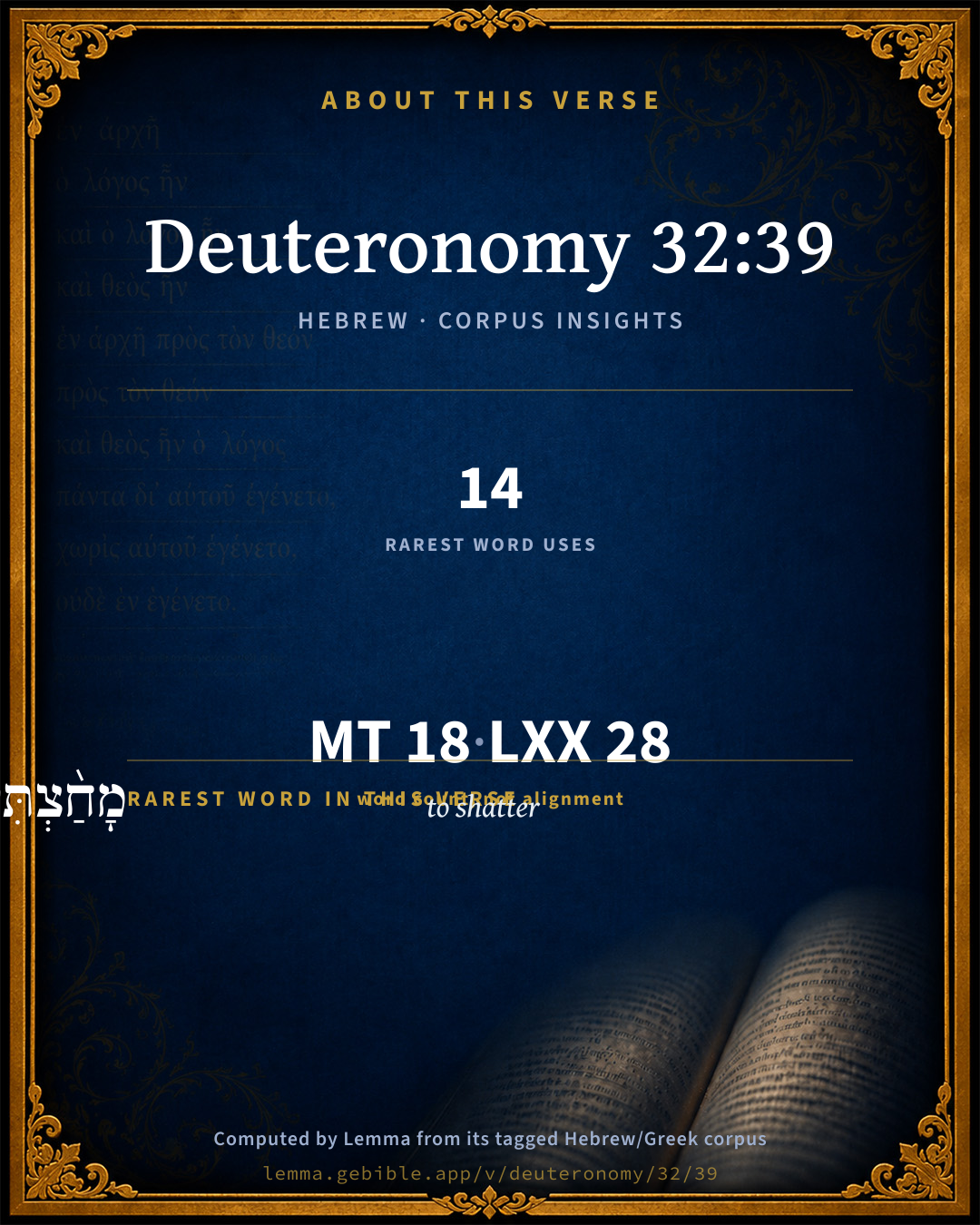
These counts appear in no published source. They are computed here, from the morphology-tagged text and Lemma’s own curated glosses. What Lemma adds →

18
words
14
distinct lemmas
Pentateuch
section

Notable vocabulary

The rarest word here is מָחַ֨צְתִּי֙ to shatter H4272 — appearing just 14 times in the whole Hebrew Bible.

Shared distinctive vocabulary

מָחַ֨צְתִּי֙ to shatter H4272 occurs in 14 verses of the Hebrew Bible. Also found in:

Grammatical profile

  • 6 verbs
  • 2 nouns
  • 5 pronouns
  • 1 preposition
  • 1 conjunction
  • 1 adverb
  • 2 particles

Verb forms

  • רְא֣וּ Qal · Imperative
  • אָמִ֣ית Hiphil · Imperfect
  • וַאֲחַיֶּ֗ה Piel · Imperfect
  • מָחַ֨צְתִּי֙ Qal · Perfect
  • אֶרְפָּ֔א Qal · Imperfect
  • מַצִּֽיל Hiphil · Participle Active

Repetition

Words recur within this verse — often emphatic in Hebrew:

  • וְאֵ֥ין nothing H369 ×2
  • אֲנִ֤י I H589 ×4

Hebrew & Septuagint length

In English translation the verse runs 35 words from the Hebrew and 39 from the Septuagint (LXX English) — closely comparable.

A rough comparison of the two English renderings, which tokenize alike — not a word-level alignment.

Word counts can differ between the Hebrew and the Greek without any difference in meaning — e.g. the Hebrew direct-object marker אֵת has no separate Greek word, and Greek often adds the article ὁ.

In the original languages it is 18 Hebrew tokens and 28 Greek tokens — but the two are counted differently (Hebrew bundles its prefixes and suffixes into one token; the Greek is in lemma form), so that isn’t a like-for-like length.

Cross-references

22

Topical passages linked to Deuteronomy 32:39 in the Treasury of Scripture Knowledge — connected by theme and wording, ordered by reader-vote popularity; previews shown in the World English Bible.

  • 1 Samuel 2:6 Yahweh kills, and makes alive: He brings down to Sheol, and brings up.
  • Hosea 6:1 "Come, and let us return to Yahweh; For he has torn us to pieces, And he will heal us; He has injured us, And he will bind up our wounds.
  • Job 5:18 For he wounds, and binds up; He injures, and his hands make whole.
  • Isaiah 45:5 I am Yahweh, and there is none else; besides me there is no God. I will gird you, though you have not known me;
  • Isaiah 45:22 Look to me, and be you saved, all the ends of the earth; for I am God, and there is none else.
  • Isaiah 43:13 Yes, since the day was I am he; and there is none who can deliver out of my hand: I will work, and who can hinder it?
  • Isaiah 46:4 and even to old age I am he, and even to gray hairs will I carry you. I have made, and I will bear; yes, I will carry, and will deliver.
  • Psalms 68:20 God is to us a God of deliverance. To Yahweh, the Lord, belongs escape from death.
  • Isaiah 45:18 For thus says Yahweh who created the heavens, the God who formed the earth and made it, who established it and didn't create it a waste, who formed it to be inhabited: I am Yahweh; and there is no one else.
  • Isaiah 41:4 Who has worked and done it, calling the generations from the beginning? I, Yahweh, the first, and with the last, I am he.
  • Revelation 1:17–18 When I saw him, I fell at his feet like a dead man. He laid his right hand on me, saying, "Don't be afraid. I am the first and the last,
  • Deuteronomy 4:35 To you it was shown, that you might know that Yahweh he is God; there is none else besides him.
  • Psalms 50:22 "Now consider this, you who forget God, Lest I tear you into pieces, and there be none to deliver.
  • 2 Kings 5:7 It happened, when the king of Israel had read the letter, that he tore his clothes, and said, Am I God, to kill and to make alive, that this man does send to me to recover a man of his leprosy? but consider, I pray you, and see how he seeks a quarrel against me.
  • Job 10:7 Although you know that I am not wicked, There is no one who can deliver out of your hand.
  • Psalms 102:27 But you are the same. Your years will have no end.
  • Micah 5:8 The remnant of Jacob will be among the nations, In the midst of many peoples, Like a lion among the animals of the forest, Like a young lion among the flocks of sheep; Who, if he goes through, treads down and tears in pieces, And there is no one to deliver.
  • Revelation 2:8 "To the angel of the assembly in Smyrna write: "The first and the last, who was dead, and has come to life says these things:
  • Isaiah 48:12 Listen to me, O Jacob, and Israel my called: I am he; I am the first, I also am the last.
  • John 8:24 I said therefore to you that you will die in your sins; for unless you believe that I am he, you will die in your sins."
  • Hebrews 1:12 As a mantle you will roll them up, And they will be changed; But you are the same. Your years will not fail."
  • Revelation 1:11 saying, "What you see, write in a book and send to the seven assemblies: to Ephesus, Smyrna, Pergamum, Thyatira, Sardis, Philadelphia, and to Laodicea."

Cross-references courtesy of OpenBible.info (CC BY 4.0).

Hebrew and Greek witnesses Masoretic Hebrew ↔ Greek Septuagint

The same verse in the two great witnesses to the Old Testament, shown verse-for-verse.

These are two independent witnesses, not word-aligned to each other, and the Septuagint is shown in lemma (dictionary) form.

Hebrew Deuteronomy 32:39 Masoretic · Westminster Leningrad Codex

רְא֣וּ עַתָּ֗ה כִּ֣י אֲנִ֤י אֲנִי֙ ה֔וּא וְאֵ֥ין אֱלֹהִ֖ים עִמָּדִ֑י אֲנִ֧י אָמִ֣ית וַאֲחַיֶּ֗ה מָחַ֨צְתִּי֙ וַאֲנִ֣י אֶרְפָּ֔א וְאֵ֥ין מִיָּדִ֖י מַצִּֽיל

See now that I, even I, am he, There is no god with me: I kill, and I make alive; I wound, and I heal; There is none who can deliver out of my hand.

World English Bible · Public Domain

Greek LXX Deuteronomy 32:39 Septuagint · lemma form

ὁράω ὁράω ὅτι ἐγώ εἰμί καί οὐ εἰμί θεός πλήν ἐγώ ἐγώ ἀποκτείνω καί ζάω ποιέω πατάσσω καΐἐγώ ἰάομαι καί οὐ εἰμί ὅς ἐκαἱρέω ἐκ ὁ χείρ ἐγώ

Behold, behold that I am he, and there is no god beside me: I kill, and I will make to live: I will strike, and I will heal; and there is none who shall deliver out of my hands.

LXX2012 (modern English Septuagint) · Public Domain

On this verse, John Gill's Exposition discusses the Septuagint’s reading. Read the note in Commentary ↓

Hebrew: Westminster Leningrad Codex (CC BY 4.0). Greek: Septuagint (public domain); English from LXX2012 (modern English Septuagint) (Public Domain). How the Septuagint differs from the Hebrew →

Targum (Aramaic paraphrase)

2

The Targum is the ancient Jewish Aramaic paraphrase of the Hebrew Scriptures — an interpretive translation, not the Hebrew text itself. Onkelos (literal) and Pseudo-Jonathan (expansive) render the Torah, and Jonathan the Prophets. Coverage is partial: where no permissively-licensed English translation exists for a verse, only the Aramaic is shown. This is verse-level text, not a word-by-word alignment to the Hebrew.

  1. Targum Onkelos Torah (Genesis–Deuteronomy)
    חֲזוֹ כְּעַן אֲרֵי אֲנָא אֲנָא הוּא וְלֵית אֱלָהּ בַּר מִנִי אֲנָא מֵמִית וּמְחַיֵה מָחֵינָא וְאַף מַסֵינָא וְלֵית מִן יְדִי מְשֵׁזֵב

    (no public-domain English translation for this verse)

    Targum Onkelos — Aramaic: “Onkelos Genesis” (public domain); “Onkelos Exodus” (public domain); “Onkelos Leviticus” (public domain); “Onkelos Numbers” (public domain); “Onkelos Deuteronomy” (public domain). English: “Sefaria Community Translation” (CC0 1.0 (public-domain dedication)); “J.W. Etheridge. The Targums of Onkelos and Jonathan Ben Uzziel on the Pentateuch. London: Longmans, Green, 1862” (public domain). Text via Sefaria.

  2. Targum Pseudo-Jonathan Torah (Genesis–Deuteronomy)
    כַּד יִתְגְלֵי מֵימְרָא דַיְיָ לְמִפְרוֹק יַת עַמֵיהּ יֵימַר לְכָל עַמְמַיָא חֲמוֹן כְּדוֹן אֲרוּם אֲנָא הוּא דַהֲוֵויתִי וַהֲוִית וַאֲנָא הוּא דְעָתִיד לְמֶהֱוֵי וְלֵית אֱלָהָא חוֹרַן בַּר מִינִי אֲנָא בְּמֵימְרִי מֵמִית וּמָחֵי מָחִיתִי יַת עַמָא בֵּית יִשְרָאֵל וַאֲנָא אָסֵי יַתְהוֹן בְּסוֹף יוֹמַיָא וְלֵית דִמְשֵׁזִיב מִן יְדַי גוֹג וּמַשִׁרְיָיתֵיהּ לִמְסַדְרָא סִדְרֵי קְרָבָא עִמְהוֹן

    When the Word of the Lord shall reveal Himself to redeem His people, He will say to all the nations: Behold now, that I am He who Am, and Was, and Will Be, and there is no other God beside Me: I, in My Word, kill and make alive; I smite the people of the Beth Israel, and I will heal them at the end of the days; and there will be none who can deliver them from My hand, Gog and his armies whom I have permitted to make war against them.

    Targum Pseudo-Jonathan — Aramaic: “Targum Jonathan on Genesis” (public domain); “Targum Jonathan on Exodus” (public domain); “Targum Jonathan on Leviticus” (public domain); “Targum Jonathan on Numbers” (public domain); “Targum Jonathan on Deuteronomy” (public domain). English: “The Targum of Jonathan ben Uzziel, trans. J. W. Etheridge, London, 1862” (public domain). Text via Sefaria.

Commentary

Notes on Deuteronomy 32:39 from classic Christian and Jewish commentators (each source and its license shown beneath its notes). The classic Christian expositions comment on the surrounding passage and are grouped to its opening verse, so a note may address several verses; the Jewish commentaries on the Tanakh (Rashi and others) are per-verse, so they appear only where the commentator wrote on this verse.

Lemma curates 59 commentaries, every one of them public domain or Creative Commons licensed, each selected and text-cleaned for this edition rather than reprinted as found. About our sources →

Matthew Henry's Commentary

This conclusion of the song speaks three things:

I. Glory to God, Deu 32:39. "See now upon the whole matter, that I, even I, am he. Learn this from the destruction of idolaters, and the inability of their idols to help them." The great God here demands the glory, 1. Of a self-existence: I, even I, am he. Thus Moses concludes with that name of God by which he was first made to know him (Exo 3:14), "I am that I am. I am he that I have been, that I will be, that I have promised to be, that I have threatened to be; all shall find me true to my word." The Targum of Uzzielides paraphrases it thus: When the Word of the Lord shall reveal himself to redeem his people, he shall say to all people, See that I now am what I am, and have been, and I am what I will be, which we know very well how to apply to him who said to John, I am he who is, and was, and is to come, Rev 1:8. These words, I even I, am he, we meet with often in those chapters of Isaiah where God is encouraging his people to hope for their deliverance out of Babylon, Isa 41:4; Isa 43:11, Isa 43:13, Isa 43:25, Isa 46:4. 2. Of a sole supremacy. "There is no god with me. None to help with me, none to cope with me." See Isa 43:10, Isa 43:11. 3. Of an absolute sovereignty, a universal agency: I kill, and I make alive; that is, all evil and all good come from his hand to providence; he forms both the light of life and the darkness of death, Isa 45:7; Lam 3:37, Lam 3:38. Or, He kills and wounds his enemies, but heals and makes alive his own people, kills and wounds with his judgments those that revolt from him and rebel against him; but, when they return and repent, he heals them, and makes them alive with his mercy and grace. Or it denotes his incontestable authority to dispose of all his creatures, and the beings he has given them, so as to serve his own purposes by them: Whom he will he slays, and whom he will he keeps alive, when his judgments are abroad. Or thus, Though he kill, yet he makes alive again: though he cause grief, yet will he have compassion, Lam 3:32. Though he have torn, he will heal us, Hos 6:1, Hos 6:2. The Jerusalem Targum reads it, I kill those that are alive in this world, and make those alive in the other world that are dead. And some of the Jewish doctors themselves have observed that death, and a life after it, that is, eternal life, is intimated in these words. 4. Of an irresistible power, which cannot be controlled: Neither is there any that can deliver out of my hand those that I have marked for destruction. As no exception can be made against the sentence of God's justice, so no escape can be made from the executions of his power.

II. Terror to his enemies, Deu 32:40-42. Terror indeed to those that hate him, as all those do that serve other gods, that persist in wilful disobedience to the divine law, and that malign and persecute his faithful servants. These are those to whom God will render vengeance, those his enemies that will not have him to reign over them. In order to alarm such in time to repent and return to their allegiance, the wrath of God is here revealed from heaven against them. 1. The divine sentence is ratified with an oath (Deu 32:40): He lifts up his hand to heaven, the habitation of his holiness; this was an ancient and very significant sign used in swearing, Gen 14:22. And, since he could swear by no greater, he swears by himself and his own life. Those are miserable without remedy that have the word and oath of God against them. The Lord hath sworn, and will not repent, that the sin of sinners shall be their ruin if they go on in it. 2. Preparation is made for the execution: The glittering sword is whet. See Psa 7:12. It is a sword bathed in heaven, Isa 34:5. While the sword is in whetting, space is given to the sinner to repent and make his peace, which, if he neglects, will render the wound the deeper. And, as the sword is whet, so the hand that is to wield it takes hold on judgment with a resolution to go through with it. 3. The execution itself will be very terrible: The sword shall devour flesh in abundance, and the arrows be made drunk with blood, such vast quantities of it shall be shed, the blood of the slain in battle, and of the captives, to whom no quarter shall be given, but who shall be put under military execution. When he begins revenge he will make an end; for in this also his work is perfect. The critics are much perplexed with the last clause, From the beginning of revenges upon the enemy. The learned bishop Patrick (that great master) thinks it may admit this reading, From the king to the slave of the enemies, Jer 50:35-37. When the sword of God's wrath is drawn it will make bloody work, blood to the horse-bridles, Rev 14:20.

III. Comfort to his own people (Deu 32:43): Rejoice, O you nations, with his people. He concludes the song with words of joy; for in God's Israel there is a remnant whose end will be peace. God's people will rejoice at last, will rejoice everlastingly. Three things are here mentioned as the matter of joy: - 1. The enlarging of the church's bounds. The apostle applies the first words of this verse to the conversion of the Gentiles. Rom 15:10, Rejoice you Gentiles with his people. See what the grace of God does in the conversion of souls, it brings them to rejoice with the people of God; for true religion brings us acquainted with true joy, so great a mistake are those under that think it tends to make men melancholy. 2. The avenging of the church's controversies upon her adversaries. He will make inquisition for the blood of his servants, and it shall appear how precious it is to him; for those that spilt it shall have blood given them to drink. 3. The mercy God has in store for his church, and for all that belong to it: He will be merciful to his land, and to his people, that is, to all every where that fear and serve him. Whatever judgments are brought upon sinners, it shall go well with the people of God; in this let Jews and Gentiles rejoice together.

Matthew Henry's Commentary on the Whole Bible (1708–1710) — public domain (CC PDM 1.0). Text via the HelloAO Bible API.

Trapp's Complete Commentary

John Trapp

Deu 32:39 See now that I, [even] I, [am] he, and [there is] no god with me: I kill, and I make alive; I wound, and I heal: neither [is there any] that can deliver out of my hand.

Ver. 39. I, even I am he.] I is emphatical and exclusive.

John Trapp, A Commentary or Exposition upon All the Books of the Old and New Testament (1647–1656) — public domain. Text from a community e-Sword module.

The Biblical Illustrator

Joseph S. Exell

Deu_32:39-41

See now that I, even I, am He, and there is no God with Me.

The royal prerogative

I. None but the Lord can would or heal.

1. The Lord alone can spiritually wound. It is the Holy Spirits work to convince of sin, and until He puts forth His power the preacher may preach himself dumb with weariness and blind with weeping, but no result can possibly follow.

2. None but the Lord can heal. Gospel truth is sufficient in itself to comfort all that mourn, but it will comfort nobody so long as the natural unbelief of the heart remains. Get a hold of a lacerated spirit, torn with unbelief, and try what you can do. Say, Trust in the Lord, my friend, and he replies, I cannot trust. Tell him Christ Jesus came into the world to save sinners; and he says he knows that, but he cannot get hold of it. Do your duty with him, for whether you can heal him or not you are bound to set the Gospel before him: but you shall find that you have worked in vain if you have gone in your own strength. God can use you to heal a broken heart, but you cannot do it yourself.

II. The Lord can wound and He can heal.

1. The Lord can wound. He can pierce the most unlikely heart. Therefore, despair of none. The wretch who is the nearest approach to an incarnate devil may yet become as an angel of God.

2. What a very sweet side of the truth is the second part of it--namely, that He can heal. There are some awful cases of bleeding wounds! I have known the heart bleed as though it would bleed to death beneath the sword of conviction. Some are driven to despair, and have been ready to lay violent hands upon themselves in the bitterness of their souls. Let it ring out like a trumpet, that these poor despairing ones may hear it,--the Lord can heal. There is no case so desperate but what Jehovah-Jesus can recover it. Despair! thou must let thy Captive go. Despondency! thou must open thy prison house when Jesus comes.

III. The Lord does wound and does heal.

1. I have a bundle of arrows which I have seen shot at different times from the bow of God so as to wound men.

(1) The arrow of continual gentleness. Augustine tells of one to whom God was so wonderfully kind, and the man was so wonderfully bad, that at last he grew astonished at Gods goodness, and since the Lord continued to load him with benefits, he turned round and cried, Most benignant God, I am ashamed of being Thine enemy any longer. I confess my sin and repent of it.

(2) God is angry with the wicked every day. Surely this should cut you to the quick.

(3) He that believeth not is condemned already.

(4) The wicked shall be turned into hell, etc.

(5) Thou hast destroyed thyself

(6) You are dead in sin. You have destroyed yourself, but you cannot save yourself.

2. Now, I will hold up before you the bottle of balm. When a soul is wounded, the Lord applies His sacred surgery to the heart. He has healed some of us.

(1) The particular bottle of balm which He used in healing me is one which I know well, and shall never forget. This was the label, Look unto Me and be ye saved, all ye ends of the earth, for I am God, and beside Me there is none else. Why, do you know? I was afraid of God until I heard that God was in Christ, and that I was to look to God in Christ, and that the very God whom I dreaded would save me. That revelation came home with Divine power to my soul! The preacher said, Look. This is all that is wanted. There, he said, a fool can look; a little child can look; a half idiot can look; a dying man can look Look said he and it is done. Did I really understand him--that I was only to look to Christ dying on the Cross for me, and see God making an atonement for my sin in the person of His Son--that I was only to look, and I should live at once? It was even so, and I did look. My burden passed away.

(2) Here is another drop of balm,--When a man is wounded he feels that he cannot help himself; but then there comes in this precious truth--that the Spirit of God can do it. O you wounded ones, may the great Spirit show you at this time the person of the dear Son of God--God and man. (C H. Spurgeon.)

Neither is there any that can deliver out of My hand.

The undeliverableness of man from the hand of God

1. The continuance of every mans existence rests entirely upon the Divine will.

2. The preservation of every sinners existence must be ascribed to Divine forbearance.

3. The well-being of a moral intelligence is impossible apart from supreme sympathy with God. All moral hells and heavens are in the loathing or the loving. What then is our duty and interest? To cherish supreme love for the Absolute. (Homilist.)

The Biblical Illustrator, edited by Joseph S. Exell (c. 1880s–1900s) — public domain. Text from a community e-Sword module.

Joseph Benson's Commentary

Deu 32:39. See now — Open your eyes and be convinced by your own sad experience what vain and impotent things idols are. I am he — The only true, omnipotent, and irresistible God. There is no god with me — As I have no superior, so neither have I any equal. I kill and I make alive — I am the arbiter of life and death, the dispenser of prosperity and adversity, and the author of national changes and revolutions, whether in the way of mercy or judgment. We may observe that it is usual, in Scripture language, to represent extreme calamities under the notion of death, and to express happiness and prosperity by the word life.

Joseph Benson's Commentary on the Old and New Testaments (1811–1818) — public domain. Text from a community e-Sword module.

Adam Clarke's Commentary

Verse 39. See now that I - am he] Be convinced that God alone can save, and God alone can destroy, and that your idols can neither hurt nor help you.

I kill, and I make alive, &c.] My mercy is as great as my justice, for I am as ready to save the penitent as I was to punish the rebellious.

Adam Clarke's Commentary on the Bible (1810–1826) — public domain. Text from a community e-Sword/MySword module.

Ellicott's Commentary for English Readers

(39) I, even I, am he, and there is no God with me.—There are many very similar passages in Isaiah 41-46; but none of them exactly reproduces this sentence.

I kill, and I make alive.—This was repeated by Hannah in her song, “The Lord killeth and maketh alive” (1Sa_2:6). Comp. also Isa_43:13, “Yea, before the day was I am he; and there is none that can deliver out of my hand.”

A Bible Commentary for English Readers, edited by Charles John Ellicott (1878–1897) — public domain. Text from a community e-Sword module.

The Cambridge Bible for Schools and Colleges

gen. ed. J. J. S. Perowne

39 See now that I, I am He,

And never a god beside me.

I do to death and revive,

I shattered and I shall heal.

[With none to save from my hand.]

40 For I lift to heaven mine hand,

And say, ‘As I live for ever,

41 I will whet my lightning sword,

And on judgement my hand shall close,

Vengeance I wreak on my foes,

And recompense them that hate me.

42 I drench mine arrows in blood,

And my sword shall feed upon flesh;

With the blood of the slain and the captive,

With the long-haired heads of the foe.’

39. I am he] The only God, Deu_4:35. Cp. Isa_41:4; Isa_43:10; Isa_43:13; Isa_48:12.

And there is none, etc.] This line is out of place both for the rhythm and the sense, and is apparently borrowed from Isa_43:13 in a similar context. Cp. Hos_5:14 b.

The Cambridge Bible for Schools and Colleges (gen. ed. J. J. S. Perowne; Cambridge University Press, 1878–1918) — public domain. Text from a community e-Sword module.

John Gill's Exposition

For I lift up my hand to heaven,.... Which is a gesture used in swearing, Gen 14:22, and is ascribed to a divine Person, Eze 20:5; and particularly to Christ the angel, that is so wonderfully described, Rev 10:1; though sometimes it is used, as Aben Ezra observes, to excite the attention of hearers, but here it signifies swearing; and so the Targums of Jonathan and Jerusalem paraphrase it,"I have lift up my hands with an oath to heaven;''and to the same sense is the Septuagint version:

and say, I live for ever; which is the form of an oath; when men swear, they are to swear, the Lord liveth, or to swear by the living God, and him only, Jer 4:2; and when the Lord swears in this manner, he swears by his life, by himself, because he can swear by no greater; and his form of swearing is, "as truly as I live, saith the Lord", Num 14:21; so the above angel is said to swear by him that liveth for ever and ever, Rev 10:6; and since Christ is the living God, without beginning of days, and end of life, and lives for evermore, he may be thought to swear by himself, by his own life, which is for ever; and as the oath of the Lord is used in condescension by him, to confirm the faith of his people in the immutability of his counsel and promises, and to ascertain unto them the sure performance of them; so it is also used to assure wicked men of the certain performance of his threatenings; and it is as if Christ here said, as sure as I am the living God, and do and shall live for ever, I will most certainly do the things which next follow.

John Gill's Exposition of the Whole Bible (1746–1763) — public domain (CC PDM 1.0). Text via the HelloAO Bible API.

Matthew Poole's English Annotations

See now; learn now by your own sad experience what vain and impotent things idols are, and what a silly thing it was in you to put your trust in them, as they did Deu 32:37.

I am he, i.e. the only true, and omnipotent, and irresistible God, as it here follows.

Matthew Poole's English Annotations on the Holy Bible (1683–1685) — public domain. Text from a community e-Sword/MySword module.

Whedon's Commentary on the Bible

Daniel D. Whedon

39. I,

even I, am he — The original is very emphatic from its brevity — I, I, he. Jehovah will reveal himself with power.

Daniel D. Whedon (gen. ed.), Commentary on the Old and New Testaments (1874–1909) — public domain. Text from a community e-Sword module.

The Pulpit Commentary

See now that I am, even I am he. The Hebrew is more expressive, See now that I, I am; LXX, idete idete oti ejgw eijmi. (cf. Isa_41:4 Isa_48:12; Joh_8:24 Joh_18:5) Their own experience of the utter impotency of these idol-gods to help them or to protect themselves flora the stroke of the Almighty was enough to convince them that they were no gods, and that he alone was to be feared and worshipped.

The Pulpit Commentary (1880–1919), ed. H.D.M. Spence-Jones & Joseph S. Exell — public domain. Text from a community e-Sword module.

John Wesley's Explanatory Notes

See now - Learn by your own sad experience what vain and impotent things idols are. I am he - The only true, omnipotent and irresistible God.

John Wesley, Explanatory Notes Upon the Whole Bible (1754–1765) — public domain. Text via the GEBible commentary corpus.

unfoldingWord translationNotes

Door43 World Missions Community

General Information:

Moses speaks a poetic song to the people of Israel. (See: Parallelism)

I, even I

"I, I myself" or "I, I alone." Yahweh repeats "I" to emphasize that only he is God.

I lift up my hand to heaven and say

"I lift up my hand to heaven and swear" or "I have taken an oath." Lifting up the hand is a sign of making an oath.

As I live forever

"As certainly as I live forever" or "I swear by my life which is never-ending." This statement assures the people that what God says in Deuteronomy 32:41-Deuteronomy 32:42 will happen.

translationWords

God

false god

life

cure

save

might

hand

heaven

eternity

unfoldingWord translationNotes — © Distant Shores Media and the Door43 World Missions Community, licensed CC BY-SA 4.0. Source: git.door43.org/Door43/en_tn.

Rashi

Rabbi Shlomo Yitzchaki (Rashi)

ראו עתה SEE NOW — Realise now from the punishment which I have brought upon you and from which there was no one to save you, and, on the other hand, from the help which I will render you and there will be none who can prevent Me,

אני אני הוא [THAT] IT IS I, EVEN I — I am He Who have the power to abase (make low) and it is I who have the power to raise,

ואין אלהים עמדי AND THERE IS NO GOD WITH ME — i.e. standing against Me to prevent this.

עמדי means, who is my equal and like Me.

ואין מידי מציל AND THERE IS NONE WHO CAN DELIVER OUT OF MY HAND those who rebel against Me.

Rashi on the Tanakh — English translations: “The Judaica Press complete Tanach with Rashi, translated by A. J. Rosenberg” (CC BY 4.0); “Pentateuch with Rashi's commentary by M. Rosenbaum and A.M. Silbermann, 1929-1934” (public domain); “The Metsudah Tanach series, Lakewood, N.J” (CC BY 4.0); and “The Book of Joshua, Metsudah Publications, 1997” (CC BY 4.0). Text via Sefaria.

Lesson kit

Teaching starters — assembled from the data on this page, not authored interpretation. Every prompt links to the verse data it draws on. Edit before teaching.

Deuteronomy, in the Pentateuch, opens this verse with 18 words (14 distinct Hebrew lemmas). Its most distinctive word is mâchats (“to shatter”). A historical commentator’s framing appears above. Read the whole chapter for the surrounding context.

Discussion questions

  1. What does “to shatter” (mâchats) contribute to the verse as a whole?
  2. Numbers 24:8 shares the word «to shatter» with this verse. How do the two illuminate each other?
  3. “nothing” occurs 2× in this one verse. What is the effect of the repetition?
  4. These translations render this verse differently. What is at stake in choosing one wording over another?
  5. The verb «רְא֣וּ» is Qal Imperative. How does its form color the action?
  6. Reading how Matthew Henry's Commentary and Trapp's Complete Commentary read this verse, where do the two commentators agree and where do they part?

Things to notice

Reading settings

Reading text

Shown beneath each verse's original-language words.

Old Testament
Old Testament edition

Read the OT as the Masoretic Hebrew (MT) or the Greek Septuagint (LXX).

English shown for the Greek Septuagint (in the Hebrew ↔ Greek comparison).

Comparing translations? Open the Compare panel on any verse page to stack up to four side by side.