
Leviticus 16:13

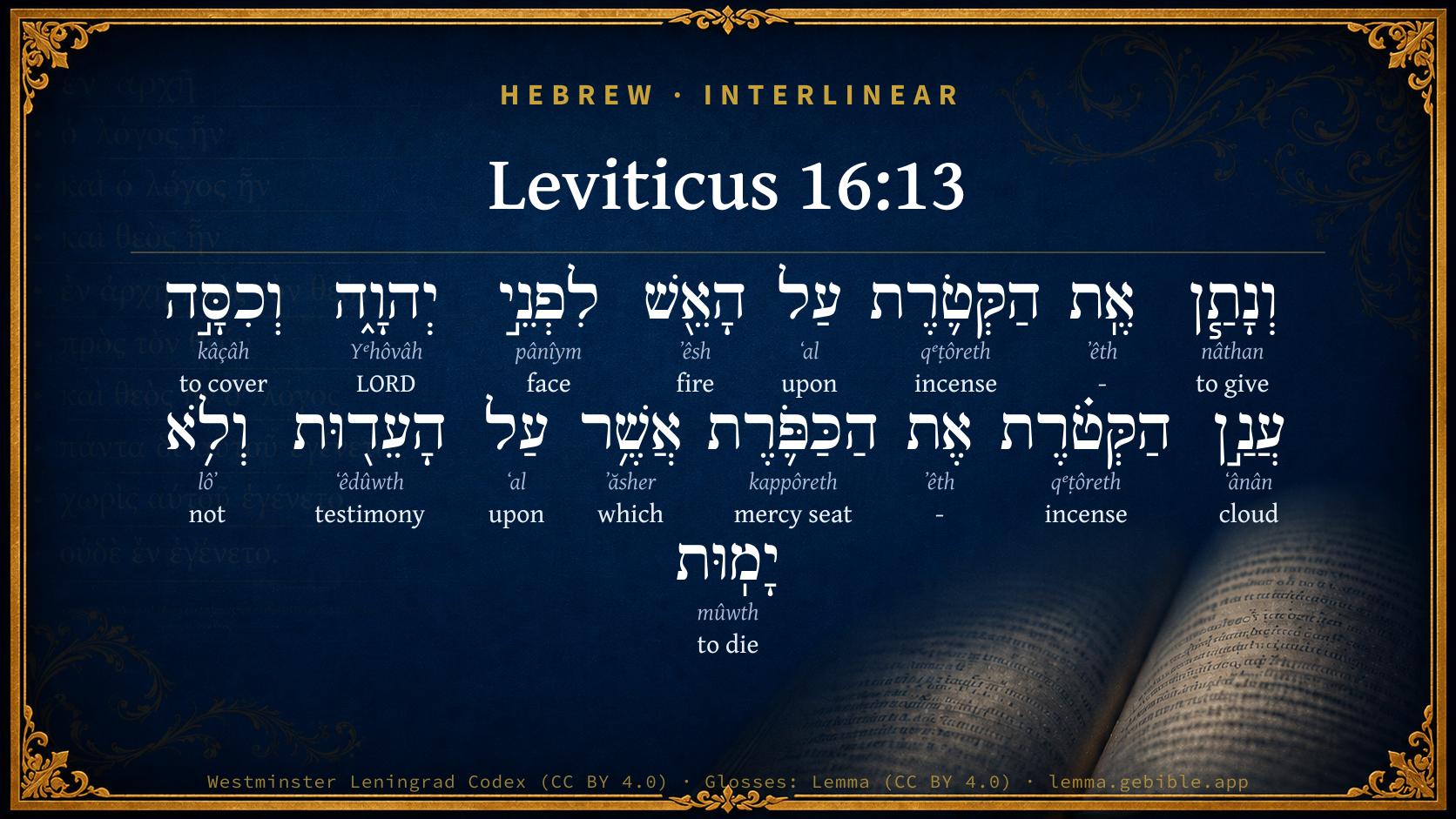
Hebrew (Westminster Leningrad Codex) Leviticus 16:13 appears in the Hebrew Old Testament. The text above is from the Westminster Leningrad Codex. Each word links to its Strong’s number, a concise gloss, and parsing drawn from the Open Scriptures Hebrew Bible morphology. Click any word for its full Brown-Driver-Briggs (BDB) entry.
Download image
Cite this verse

Leviticus 16:13 (World English Bible). Public Domain. Lemma interlinear Bible study tool, https://lemma.gebible.app/v/leviticus/16/13.

Show BibTeX & RIS
BibTeX
RIS
English Translation
and he shall put the incense on the fire before Yahweh, that the cloud of the incense may cover the mercy seat that is on the testimony, so that he will not die.
World English Bible · Public Domain
Download a study sheet

One document with this verse’s original text, its word-by-word gloss line, the meaning frame, cross-references with their text, attributed commentary, and full source and license credits — printable, and it pastes into notes with its structure intact.

This verse Autodidact and up

Study sheet (.html) Plain text (.txt)

A passage Seminary Student

Up to 50 verses in one chapter. A passage sheet keeps up to 6 commentary sources and 12 cross-references per verse, in the order this page ranks them, and says so on the sheet whenever that leaves anything out. Ask for a single verse and you get the Autodidact verse sheet above.

Everything on this page stays free to read, with no account — the sheet is a download of what is already on screen, not access to it.

Want to remove ads? Support Godless Engineer
Compare translations 3

The same verse in 3 English versions, stacked beneath the original-language interlinear above. Click any original word for its lexicon entry.

Each is an independent rendering of the whole verse — the interlinear is not word-aligned to these translations.

Highlighted words mark where these versions differ — a whole-verse word diff, not a word-by-word alignment.

  • World English Bible Public Domain
    and he shall put the incense on the fire before Yahweh, that the cloud of the incense may cover the mercy seat that is on the testimony, so that he will not die.
  • King James Version Public Domain
    And he shall put the incense upon the fire before the LORD, that the cloud of the incense may cover the mercy seat that is upon the testimony, that he die not:
  • unfoldingWord Literal Text CC BY-SA 4.0
    And he shall put the incense on the fire to the face of Yahweh. And the cloud of the incense will cover the atonement lid that over the Testimony, and he will not die.

unfoldingWord Literal Text — © unfoldingWord, licensed CC BY-SA 4.0. Word-aligned USFM3 via Door43 (git.door43.org/unfoldingWord/en_ult).

Versions to compare (up to 4)

3 of 4 selected

Show all 18 translations

Every available English version of this verse, each an independent rendering of the whole verse.

  • World English Bible Public Domain
    and he shall put the incense on the fire before Yahweh, that the cloud of the incense may cover the mercy seat that is on the testimony, so that he will not die.
  • Berean Standard Bible Public Domain
    He is to put the incense on the fire before the LORD, and the cloud of incense will cover the mercy seat above the Testimony, so that he will not die.
  • Majority Standard Bible Public Domain
    He is to put the incense on the fire before the LORD, and the cloud of incense will cover the mercy seat above the Testimony, so that he will not die.
  • King James Version Public Domain
    And he shall put the incense upon the fire before the LORD, that the cloud of the incense may cover the mercy seat that is upon the testimony, that he die not:
  • American Standard Version (1901) Public Domain
    and he shall put the incense upon the fire before Jehovah, that the cloud of the incense may cover the mercy-seat that is upon the testimony, that he die not:
  • Revised Version (1885) Public Domain
    and he shall put the incense upon the fire before the LORD, that the cloud of the incense may cover the mercy-seat that is upon the testimony, that he die not:
  • Geneva Bible (1599) Public Domain
    And shall put the incense vpon the fire before the Lord, that the cloude of the incense may couer the Merciseat that is vpon the Testimonie: so he shall not dye.
  • Douay-Rheims (1899) Public Domain
    That when the perfumes are put upon the fire, the cloud and vapour thereof may cover the oracle, which is over the testimony, and he may not die.
  • Young's Literal Translation Public Domain
    and he hath put the perfume on the fire before Jehovah, and the cloud of the perfume hath covered the mercy-seat which `is' on the testimony, and he dieth not.
  • Literal Standard Version CC BY-SA 4.0
    and he has put the incense on the fire before YHWH, and the cloud of the incense has covered the propitiatory covering which [is] on the Testimony, and he does not die.
  • Unlocked Literal Bible CC BY-SA 4.0
    There he must put the incense on the fire before Yahweh so that the cloud from the incense may cover the atonement lid over the covenant decrees. He must do this so he will not die.
  • unfoldingWord Literal Text CC BY-SA 4.0
    And he shall put the incense on the fire to the face of Yahweh. And the cloud of the incense will cover the atonement lid that over the Testimony, and he will not die.
  • Darby Bible Public Domain
    And he shall put the incense upon the fire before Jehovah, that the cloud of the incense may cover the mercy-seat which is upon the testimony, that he die not.
  • World Messianic Bible Public Domain
    He shall put the incense on the fire before the LORD, that the cloud of the incense may cover the mercy seat that is on the covenant, so that he will not die.
  • Webster's Bible Public Domain
    And he shall put the incense upon the fire before the LORD, that the cloud of the incense may cover the mercy-seat that is upon the testimony, that he may not die.
  • Free Bible Version CC BY-SA 4.0
    In the presence of the Lord he will put the incense on the burning coals, and the smoke from the incense will cover the atonement cover above the Testimony, so that he will not die.
  • Bible in Basic English Public Domain
    And let him put the perfume on the fire before the Lord so that the ark may be covered with a cloud of the smoke of the perfume, in order that death may not overtake him.
  • JPS Tanakh (1917) Public Domain
    And he shall put the incense upon the fire before the LORD, that the cloud of the incense may cover the ark-cover that is upon the testimony, that he die not.

Literal Standard Version (2020), Covenant Press — licensed CC BY-SA 4.0. Text via the HelloAO Bible API (eBible.org). Unlocked Literal Bible (unfoldingWord) — licensed CC BY-SA 4.0. Text via the HelloAO Bible API (eBible.org). unfoldingWord Literal Text — © unfoldingWord, licensed CC BY-SA 4.0. Word-aligned USFM3 via Door43 (git.door43.org/unfoldingWord/en_ult). Free Bible Version, Dr. Jonathan Gallagher — licensed CC BY-SA 4.0. Text via the HelloAO Bible API (eBible.org).

Word by word

More ways to search: Search by grammar → Find every occurrence → Compare this word →

Practice this passage: Drill this verse → Learn its vocabulary →

הַכַּפֹּ֛רֶת
kappôreth
H3727
“the · mercy seat”
Particle, Definite Article + Noun, Common, Feminine, Singular, Absolute
Part of Speech
Particle + Noun
Type
Common
Gender
Feminine
Number
Singular
State
Absolute
Full BDB Definition

Origin: from H3722

TWOT: 1023c

mercy-seat, place of atonement - the golden plate of propitiation on which the High Priest sprinkled the seat 7 times on the Day of Atonement symbolically reconciling Jehovah and His chosen people - the slab of gold on top of the ark of the covenant which measured 2.5 by 1.5 cubits; on it and part of it were the two golden cherubim facing each other whose outstretched wings came together above and constituted the throne of God
  1. וְנָתַ֧ן nâthan H5414 “and · to give” Conjunction + Verb, Qal, Sequential Perfect, 3rd Person, Masculine, Singular
  2. אֶֽת ʼêth H853 “-” Particle, Direct Object
  3. הַקְּטֹ֛רֶת qᵉṭôreth H7004 “the · incense” Particle, Definite Article + Noun, Common, Feminine, Singular, Absolute
  4. עַל ʻal H5921 “upon” Preposition
  5. הָאֵ֖שׁ ʼêsh H784 “the · fire” Particle, Definite Article + Noun, Common, Both, Singular, Absolute
  6. לִפְנֵ֣י pânîym H6440 “to/for · face(s) of” Preposition + Noun, Common, Both, Plural, Construct
  7. יְהוָ֑ה Yᵉhôvâh H3068 “LORD” Noun, Proper
  8. וְכִסָּ֣ה kâçâh H3680 “and · to cover” Conjunction + Verb, Piel, Sequential Perfect, 3rd Person, Masculine, Singular
  9. עֲנַ֣ן ʻânân H6051 “cloud of” Noun, Common, Masculine, Singular, Construct
  10. הַקְּטֹ֗רֶת qᵉṭôreth H7004 “the · incense” Particle, Definite Article + Noun, Common, Feminine, Singular, Absolute
  11. אֶת ʼêth H853 “-” Particle, Direct Object
  12. אֲשֶׁ֥ר ʼăsher H834 “which” Particle, Relative
  13. עַל ʻal H5921 “upon” Preposition
  14. הָעֵד֖וּת ʻêdûwth H5715 “the · testimony” Particle, Definite Article + Noun, Common, Feminine, Singular, Absolute
  15. וְלֹ֥א lôʼ H3808 “and · not” Conjunction + Particle, Negative
  16. יָמֽוּת mûwth H4191 “to die” Verb, Qal, Imperfect, 3rd Person, Masculine, Singular

About this verse

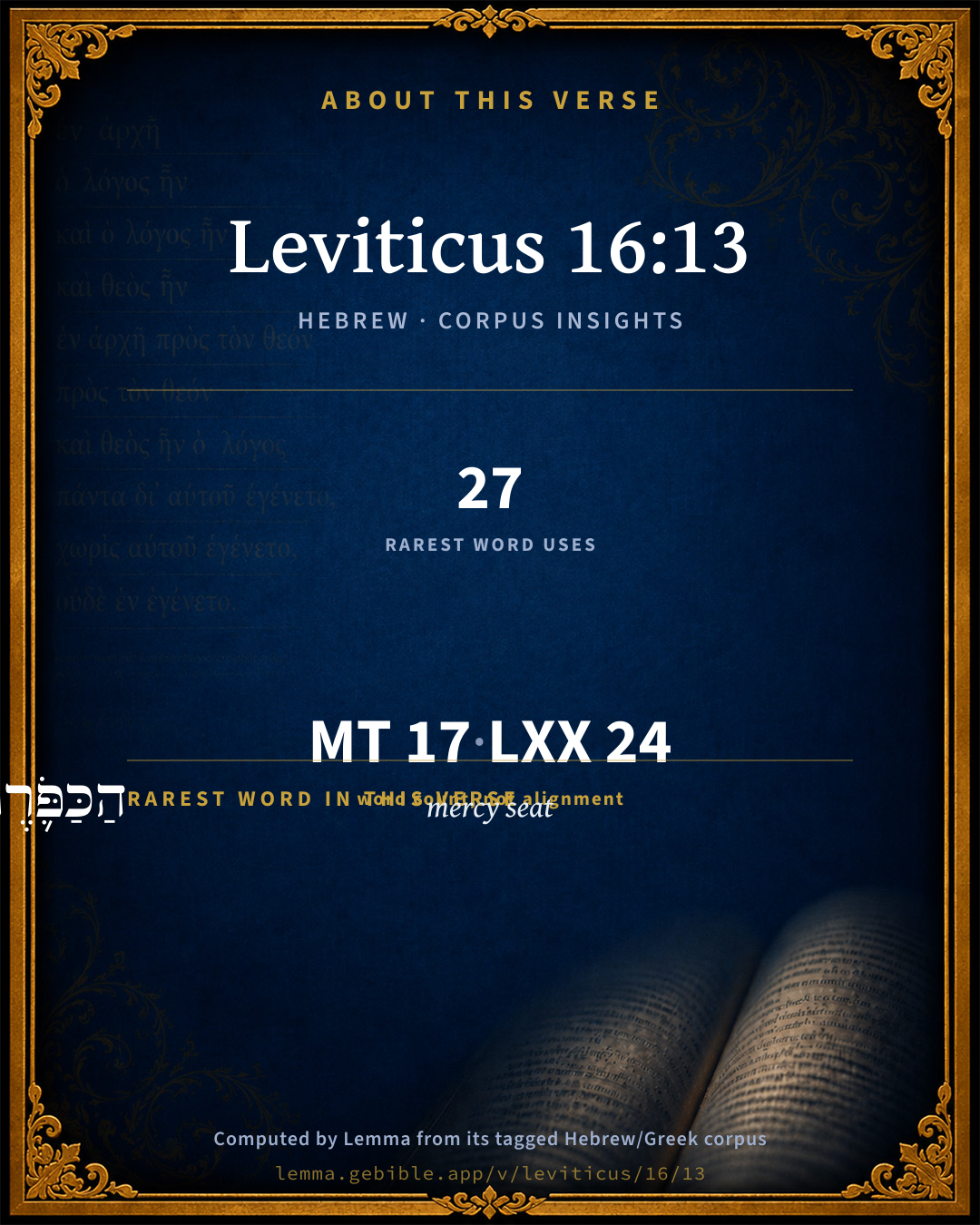
These counts appear in no published source. They are computed here, from the morphology-tagged text and Lemma’s own curated glosses. What Lemma adds →

17
words
14
distinct lemmas
Pentateuch
section

Shared distinctive vocabulary

הַכַּפֹּ֛רֶת mercy seat H3727 occurs in 22 verses of the Hebrew Bible. Also found in:

Grammatical profile

  • 3 verbs
  • 8 nouns
  • 2 prepositions
  • 4 particles

Verb forms

  • וְנָתַ֧ן Qal · Sequential Perfect
  • וְכִסָּ֣ה Piel · Sequential Perfect
  • יָמֽוּת Qal · Imperfect

Repetition

Words recur within this verse — often emphatic in Hebrew:

  • הַקְּטֹ֛רֶת incense H7004 ×2
  • עַל upon H5921 ×2

Hebrew & Septuagint length

In English translation the verse runs 33 words from the Hebrew and 32 from the Septuagint (LXX English) — closely comparable.

A rough comparison of the two English renderings, which tokenize alike — not a word-level alignment.

Word counts can differ between the Hebrew and the Greek without any difference in meaning — e.g. the Hebrew direct-object marker אֵת has no separate Greek word, and Greek often adds the article ὁ.

In the original languages it is 17 Hebrew tokens and 24 Greek tokens — but the two are counted differently (Hebrew bundles its prefixes and suffixes into one token; the Greek is in lemma form), so that isn’t a like-for-like length.

Cross-references

13

Topical passages linked to Leviticus 16:13 in the Treasury of Scripture Knowledge — connected by theme and wording, ordered by reader-vote popularity; previews shown in the World English Bible.

  • Exodus 25:21 You shall put the mercy seat on top of the ark, and in the ark you shall put the testimony that I will give you.
  • Exodus 30:1 "You shall make an altar to burn incense on. You shall make it of acacia wood.
  • Exodus 30:7–8 Aaron shall burn incense of sweet spices on it every morning. When he tends the lamps, he shall burn it.
  • 1 John 2:1–2 My little children, I write these things to you so that you may not sin. If anyone sins, we have a Counselor with the Father, Jesus Christ, the righteous.
  • Exodus 28:43 They shall be on Aaron, and on his sons, when they go in to the tent of meeting, or when they come near to the altar to minister in the holy place; that they don't bear iniquity, and die: it shall be a statute forever to him and to his descendants after him.
  • Leviticus 22:9 "'They shall therefore keep my charge, lest they bear sin for it, and die therein, if they profane it. I am Yahweh who sanctifies them.
  • Numbers 16:7 and put fire in them, and put incense on them before Yahweh tomorrow: and it shall be that the man whom Yahweh does choose, he [shall be] holy: you take too much on you, you sons of Levi.
  • Numbers 16:18 They took every man his censer, and put fire in them, and laid incense thereon, and stood at the door of the tent of meeting with Moses and Aaron.
  • Numbers 16:46 Moses said to Aaron, Take your censer, and put fire therein from off the altar, and lay incense thereon, and carry it quickly to the congregation, and make atonement for them: for there is wrath gone out from Yahweh; the plague is begun.
  • Hebrews 4:14–16 Having then a great high priest, who has passed through the heavens, Jesus, the Son of God, let us hold tightly to our confession.
  • Hebrews 7:25 Therefore he is also able to save to the uttermost those who draw near to God through him, seeing he ever lives to make intercession for them.
  • Hebrews 9:24 For Christ hasn't entered into holy places made with hands, which are representations of the true, but into heaven itself, now to appear in the presence of God for us;
  • Revelation 8:3–4 Another angel came and stood over the altar, having a golden censer. Much incense was given to him, that he should add it to the prayers of all the saints on the golden altar which was before the throne.

Cross-references courtesy of OpenBible.info (CC BY 4.0).

Hebrew and Greek witnesses Masoretic Hebrew ↔ Greek Septuagint

The same verse in the two great witnesses to the Old Testament, shown verse-for-verse.

These are two independent witnesses, not word-aligned to each other, and the Septuagint is shown in lemma (dictionary) form.

Hebrew Leviticus 16:13 Masoretic · Westminster Leningrad Codex

וְנָתַ֧ן אֶֽת הַקְּטֹ֛רֶת עַל הָאֵ֖שׁ לִפְנֵ֣י יְהוָ֑ה וְכִסָּ֣ה עֲנַ֣ן הַקְּטֹ֗רֶת אֶת הַכַּפֹּ֛רֶת אֲשֶׁ֥ר עַל הָעֵד֖וּת וְלֹ֥א יָמֽוּת

and he shall put the incense on the fire before Yahweh, that the cloud of the incense may cover the mercy seat that is on the testimony, so that he will not die.

World English Bible · Public Domain

Greek LXX Leviticus 16:13 Septuagint · lemma form

καί ἐπιτίθημι ὁ θυμίαμα ἐπί ὁ πῦρ ἔναντι κύριος καί καλύπτω ὁ ἀτμίς ὁ θυμίαμα ὁ ἱλαστήριον ὁ ἐπί ὁ μαρτύριον καί οὐ ἀποθνήσκω

And he shall put the incense on the fire before the Lord, and the smoke of the incense shall cover the mercy-seat over the tables of testimony, and he shall not die.

LXX2012 (modern English Septuagint) · Public Domain

On this verse, Haydock's Catholic Bible Commentary discusses the Septuagint’s reading. Read the note in Commentary ↓

Hebrew: Westminster Leningrad Codex (CC BY 4.0). Greek: Septuagint (public domain); English from LXX2012 (modern English Septuagint) (Public Domain). How the Septuagint differs from the Hebrew →

Targum (Aramaic paraphrase)

2

The Targum is the ancient Jewish Aramaic paraphrase of the Hebrew Scriptures — an interpretive translation, not the Hebrew text itself. Onkelos (literal) and Pseudo-Jonathan (expansive) render the Torah, and Jonathan the Prophets. Coverage is partial: where no permissively-licensed English translation exists for a verse, only the Aramaic is shown. This is verse-level text, not a word-by-word alignment to the Hebrew.

  1. Targum Onkelos Torah (Genesis–Deuteronomy)
    וְיִתֵּן יָת קְטוֹרֶת בּוּסְמַיָא עַל אֶשָׁתָא לָקֳדָם יְיָ וְחָפֵי עֲנָנָא קְטָרְתָּא יָת כַּפֻּרְתָּא דִי עַל סַהֲדוּתָא וְלָא יְמוּת

    (no public-domain English translation for this verse)

    Targum Onkelos — Aramaic: “Onkelos Genesis” (public domain); “Onkelos Exodus” (public domain); “Onkelos Leviticus” (public domain); “Onkelos Numbers” (public domain); “Onkelos Deuteronomy” (public domain). English: “Sefaria Community Translation” (CC0 1.0 (public-domain dedication)); “J.W. Etheridge. The Targums of Onkelos and Jonathan Ben Uzziel on the Pentateuch. London: Longmans, Green, 1862” (public domain). Text via Sefaria.

  2. Targum Pseudo-Jonathan Torah (Genesis–Deuteronomy)
    וְיִתֵּן יַת קְטוֹרֶת בּוּסְמַיָא עַל אֵישָׁתָא קֳדָם יְיָ וְיַחְפֵי עֲנַן תְּנַן קְטוּרְתָּא יַת כַּפּוּרְתָּא דְעַל סַהֲדוּתָא וְלָא יְמוּת בְּאֵישָׁא מְצַלְהֲבָא קֳדָם יְיָ

    And he shall put the sweet incense upon the fire before the Lord, and the cloud of the fuming incense shall envelope the mercy-seat that is over the testimony, that he may not die by the flaming fire before the Lord.

    Targum Pseudo-Jonathan — Aramaic: “Targum Jonathan on Genesis” (public domain); “Targum Jonathan on Exodus” (public domain); “Targum Jonathan on Leviticus” (public domain); “Targum Jonathan on Numbers” (public domain); “Targum Jonathan on Deuteronomy” (public domain). English: “The Targum of Jonathan ben Uzziel, trans. J. W. Etheridge, London, 1862” (public domain). Text via Sefaria.

Commentary

Notes on Leviticus 16:13 from classic Christian and Jewish commentators (each source and its license shown beneath its notes). The classic Christian expositions comment on the surrounding passage and are grouped to its opening verse, so a note may address several verses; the Jewish commentaries on the Tanakh (Rashi and others) are per-verse, so they appear only where the commentator wrote on this verse.

Lemma curates 59 commentaries, every one of them public domain or Creative Commons licensed, each selected and text-cleaned for this edition rather than reprinted as found. About our sources →

Trapp's Complete Commentary

John Trapp

Lev 16:13 And he shall put the incense upon the fire before the LORD, that the cloud of the incense may cover the mercy seat that [is] upon the testimony, that he die not:

Ver. 13. May cover the mercy seat.] And so be as a screen betwixt the priest and those everlasting burnings: or as a cloud to darken the glory of their shining, for the high priest’s safety.

John Trapp, A Commentary or Exposition upon All the Books of the Old and New Testament (1647–1656) — public domain. Text from a community e-Sword module.

Joseph Benson's Commentary

Lev 16:13. He shall put the incense upon the fire — The high-priest, having begun the solemn service with slaying the bullock, as a sin-offering of deprecation and atonement for himself and the other priests, lighted his incense-vessel, or censer, at the great altar of burnt-offering, and at his entrance into the holy of holies, threw the incense upon the burning coals, and so filled the place with a cloud of smoke, to prevent him from seeing the ark, and being struck with the glory issuing from between the cherubims, where the Shechinah or emblem of the divine presence resided: or, as others say, that he might not offend by too curiously gazing on the symbols of the divine glory. If we may believe the Jews, he entered sideways, as not daring to look directly on the glory of the place, and that, having filled the sanctuary with a cloud of smoke, he went out backward, having his face directed toward the mercy-seat, in reverence for the divine majesty, which was there represented.

Joseph Benson's Commentary on the Old and New Testaments (1811–1818) — public domain. Text from a community e-Sword module.

Geneva Bible (1599)

Geneva Bible translators

Or, the smoke.

Or, the Ark.

Geneva Bible (1599) marginal notes — public domain. Text via Bolls.life.

Ellicott's Commentary for English Readers

(13) And he shall put the incense.—The high priest now threw the incense upon the coals in the censer, in the Holy of Holies, and stayed there till the whole place was filled with a cloud of smoke, taking special care that the mercy seat and the cherubim should be enveloped in the cloud. Whereupon he left the Holy of Holies, walking backward, with his face to the holy place and his back to the Temple. Upon his emerging from within the second vail, and arriving in the Holy place, he pronounced the following prayer :—“May it please Thee, O Lord my God, that if this year was intended to be one of drought, it be one of rain. May he who rules over the house of Judah not die. May Thy people not be in want, so that one should beg bread from another or from strangers; and let not the prayers of travellers come before Thee” [because they pray that no rain may fall].

A Bible Commentary for English Readers, edited by Charles John Ellicott (1878–1897) — public domain. Text from a community e-Sword module.

The Cambridge Bible for Schools and Colleges

gen. ed. J. J. S. Perowne

13. the testimony] ‘çduth, always with the definite article, except in the Psalms. This was something put into the ark, Exo_25:16; Exo_25:21; Exo_40:20; cp. ‘which I shall give thee,’ Exo_25:16, with Exo_31:18, ‘And he gave unto Moses … the two tables of the testimony.’ They are so called Exo_32:15, and are identified with the first tables on which the ten words were written, Deu_5:22; Deu_9:10-17. The first tables being broken were replaced by others which were put into the ark, Exo_34:28-29; Deu_10:1-5. Hence the ark is called the ‘ark of the testimony,’ and the tabernacle is called the ‘tabernacle (mishkân) of the testimony,’ Exo_38:21; Num_1:50; Num_1:53; Num_10:11, and the ‘tent (’ohel) of the testimony,’ Num_9:15; Num_17:7; Num_18:2 (note that of these three passages which are all that contain the expression, the first is correctly rendered by A.V., but the other two are rendered ‘tabernacle of witness’).

The mercy-seat (kappôreth) which is upon the ark is described here as ‘the mercy-seat that is upon the testimony’; and the veil (pârôkheth) which is before the ark is described (Exo_27:21) as ‘the veil which is before the testimony,’ and (Lev_24:3) as ‘the veil of the testimony.’

The Cambridge Bible for Schools and Colleges (gen. ed. J. J. S. Perowne; Cambridge University Press, 1878–1918) — public domain. Text from a community e-Sword module.

John Gill's Exposition

And he shall put the incense upon the fire before the Lord,.... Both the incense and burning coals of fire being carried within the vail, the incense was put upon the coals, and so it burned before the Lord, whose seat was between the cherubim; and from whence it appears, that this was done, not without but within the vail: the Sadducees under the second temple would have it, that the incense was put upon the fire without the vail, wherefore the high priest, on the evening of this day, was sworn by the messengers of the sanhedrim not to make any alteration in what they should say to him; and this oath was given him in the house of Abtines, where the incense was made, with a special respect to that, since it being within the vail, they could not see it performed: the manner of his performance of this part of his service is thus related; he went in between the rails, till he came to the north; when he was come to the north, he turned his face to the south; he went on his left hand near the vail, till he came to the ark; he put the censer between the two bars, and heaped the incense upon the top of the coals, and the whole house was filled with the smoke; he then went out backwards, and prayed a short prayer in the outward house (the holy place), and he did not continue long in prayer, lest the people of Israel should be frightened (l): the prayer he made is given us by the Jews (m): now the incense being put upon the coals may denote the fervour and ardency of Christ's intercession, and that his sufferings are the foundation of it, on which it proceeds, and are what give it a grateful odour, or make it acceptable to the Lord:

and this was done, that the cloud of the incense may cover the mercy seat that is upon the testimony; where was the Shechinah, or glorious majesty of God, and which was not to be seen, and therefore to be covered after this manner; which shows, that there is no access to God but as upon a seat of mercy and a throne of grace; and even that there is no coming to him upon that, but through the mediation and intercession of Christ:

that he die not; as his sons did, boldly intruding where, and doing what they should not: there is no approaching to God as an absolute God, and live; but through Christ the Mediator, and his intercession, believers may draw nigh and see the face of God in Christ, and live, as Jacob did, Gen 32:30.

(l) Misn. Yoma, c. 5. sect. 1. (m) Maimon. & Bartenora in ib.

John Gill's Exposition of the Whole Bible (1746–1763) — public domain (CC PDM 1.0). Text via the HelloAO Bible API.

Haydock's Catholic Bible Commentary

The cloud. --- The blood, &c. This is to teach us, that if we would go into the sanctuary of God, we must take with us the incense of prayer, and the blood, that is, the passion of Christ. Where also note, that the high priest, before he went into the holy of holies, was to wash his whole body; and then to put on white linen garments; to signify the purity and chastity with which we are to approach to God. (Challoner) --- The Septuagint call this goat apopompaion, "the averter of evils, or the one sent away." Hazazel is taken by Spencer Julian, the apostate, (ap. St. Cyril. 9. and ep. 39,) to mean the devil; as if the goat was sent or sacrificed to him, which is very foolish. (Calmet) --- East. That is, the forepart of the mercy-seat, which was not to be touched with the blood, (Menochius) no more than the veil. (Rabbins)

George Leo Haydock (1774–1849), Haydock's Catholic Family Bible and Commentary, 1859 edition — public domain. Excludes Psalms (Douay-Rheims chapter numbering differs from Protestant) and Deuterocanonical books (Catholic canon only).

Matthew Poole's English Annotations

Upon the fire, which was in the censer, Lev 16:12.

That he die not for so gross an error committed in the highest acts of worship, and that by a high priest, whose knowledge and function was a great aggravation to his sin.

Matthew Poole's English Annotations on the Holy Bible (1683–1685) — public domain. Text from a community e-Sword/MySword module.

Whedon's Commentary on the Bible

Daniel D. Whedon

13. Before the Lord — This must here signify in the most holy place. It was considered a grave mistake, amounting to a sacrilege, in a certain Sadducean high priest to dare to kindle the incense without the vail and to carry it smoking within. Since the holy of holies was left in utter darkness, the venture of the high priest into the “thick darkness” where God dwelt strikingly illustrates the faith which is required to approach the mercy seat, where the “light inaccessible” veils itself in the cloud.

That he die not — Death through neglect of these precautions may have been natural, and not judicial. See Num_4:18, note. “Thou canst not see my face: for there shall no man see me, and live.” Exo_33:20. “Common priests burned incense every day at the altar without the vail. Only once a year, and only after the most careful preparation, goes the high priest into the holiest. If he fail in his preparation he is liable to die. To ask a confirmatory sign of only Gabriel’s message in the holy place, outside the holiest, is to get dumbness for a sign. The high priest went into the holiest with a cord attached, that his body might be drawn out if he were slain.” — Bishop H.W. Warren. The command that the priest envelop himself in a cloud of incense when he raises the curtain expresses the fact that full and cloudless communion with God was not realized under the Old Testament sacrifices; that not until Jesus “by his own blood entered in once into the holy place, having obtained eternal redemption for us,” were we able with “boldness to enter into the holiest by the blood of Jesus;” nor until then could believers enjoy the crowning blessing in the gift of God, the “communion of the Holy Ghost.” Joh_14:16; 2Co_13:14.

Daniel D. Whedon (gen. ed.), Commentary on the Old and New Testaments (1874–1909) — public domain. Text from a community e-Sword module.

John Wesley's Explanatory Notes

Upon the fire - Which was in the censer, ver. 12.

John Wesley, Explanatory Notes Upon the Whole Bible (1754–1765) — public domain. Text via the GEBible commentary corpus.

Rashi

Rabbi Shlomo Yitzchaki (Rashi)

על האש UPON THE FIRE which was in the censer.

ולא ימות THAT IIE DIE NOT — Hence, if he did not offer it according to regulation he was liable to the death penalty (Sifra, Acharei Mot, Chapter 3 10; Yoma 53a).

Rashi on the Tanakh — English translations: “The Judaica Press complete Tanach with Rashi, translated by A. J. Rosenberg” (CC BY 4.0); “Pentateuch with Rashi's commentary by M. Rosenbaum and A.M. Silbermann, 1929-1934” (public domain); “The Metsudah Tanach series, Lakewood, N.J” (CC BY 4.0); and “The Book of Joshua, Metsudah Publications, 1997” (CC BY 4.0). Text via Sefaria.

Lesson kit

Teaching starters — assembled from the data on this page, not authored interpretation. Every prompt links to the verse data it draws on. Edit before teaching.

Leviticus, in the Pentateuch, opens this verse with 17 words (14 distinct Hebrew lemmas). Its most distinctive word is kappôreth (“mercy seat”). A historical commentator’s framing appears above. Read the whole chapter for the surrounding context.

Discussion questions

  1. The word kappôreth carries the sense “mercy seat.” How does it shape the verse?
  2. How does Exodus 25:17, which shares the word «mercy seat», read alongside this verse?
  3. What does the repetition of “incense” (2× in this one verse) do in this verse?
  4. These translations render this verse differently; the difference is in the English rendering, not the original. What questions does that raise?
  5. «וְנָתַ֧ן» is a Qal Sequential Perfect verb. How does that grammatical form shape the action described?
  6. Compare how Trapp's Complete Commentary and Joseph Benson's Commentary read this verse. Where do they agree or differ?

Things to notice

Reading settings

Reading text

Shown beneath each verse's original-language words.

Old Testament
Old Testament edition

Read the OT as the Masoretic Hebrew (MT) or the Greek Septuagint (LXX).

English shown for the Greek Septuagint (in the Hebrew ↔ Greek comparison).

Comparing translations? Open the Compare panel on any verse page to stack up to four side by side.