Deuteronomy 19:12

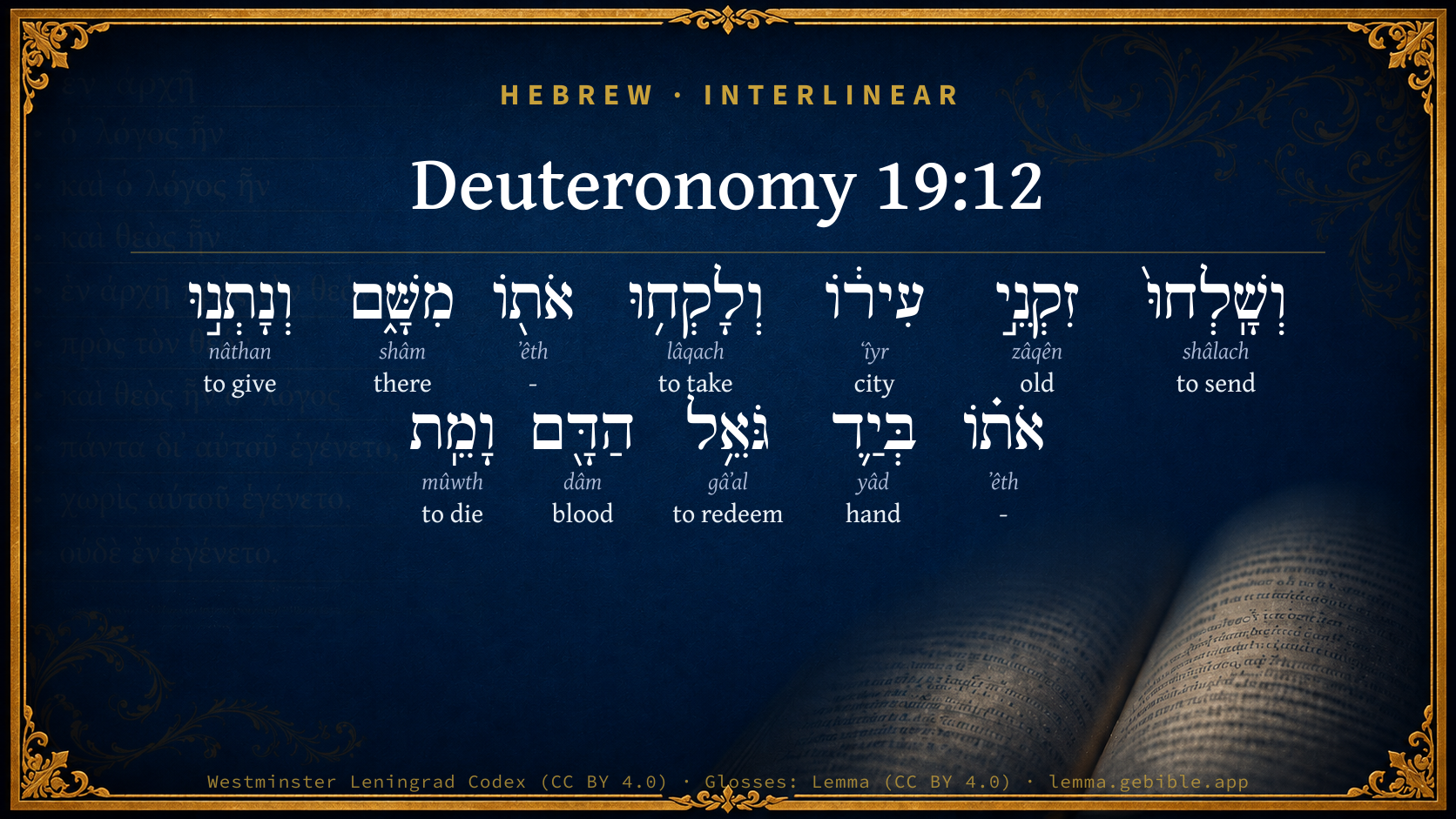
Hebrew (Westminster Leningrad Codex) Deuteronomy 19:12 appears in the Hebrew Old Testament. The text above is from the Westminster Leningrad Codex. Each word links to its Strong’s number, a concise gloss, and parsing drawn from the Open Scriptures Hebrew Bible morphology. Click any word for its full Brown-Driver-Briggs (BDB) entry.
Download image
Cite this verse

Deuteronomy 19:12 (World English Bible). Public Domain. Lemma interlinear Bible study tool, https://lemma.gebible.app/v/deuteronomy/19/12.

Show BibTeX & RIS
BibTeX
RIS
English Translation
then the elders of his city shall send and bring him there, and deliver him into the hand of the avenger of blood, that he may die.
World English Bible · Public Domain
Download a study sheet

One document with this verse’s original text, its word-by-word gloss line, the meaning frame, cross-references with their text, attributed commentary, and full source and license credits — printable, and it pastes into notes with its structure intact.

This verse Autodidact and up

Study sheet (.html) Plain text (.txt)

A passage Seminary Student

Up to 50 verses in one chapter. A passage sheet keeps up to 6 commentary sources and 12 cross-references per verse, in the order this page ranks them, and says so on the sheet whenever that leaves anything out. Ask for a single verse and you get the Autodidact verse sheet above.

Everything on this page stays free to read, with no account — the sheet is a download of what is already on screen, not access to it.

Want to remove ads? Support Godless Engineer
Compare translations 3

The same verse in 3 English versions, stacked beneath the original-language interlinear above. Click any original word for its lexicon entry.

Each is an independent rendering of the whole verse — the interlinear is not word-aligned to these translations.

Highlighted words mark where these versions differ — a whole-verse word diff, not a word-by-word alignment.

  • World English Bible Public Domain
    then the elders of his city shall send and bring him there, and deliver him into the hand of the avenger of blood, that he may die.
  • King James Version Public Domain
    Then the elders of his city shall send and fetch him thence, and deliver him into the hand of the avenger of blood, that he may die.
  • unfoldingWord Literal Text CC BY-SA 4.0
    then the elders of his city shall send out and take him from there and give him into the hand of the avenger of blood, then he shall die.

unfoldingWord Literal Text — © unfoldingWord, licensed CC BY-SA 4.0. Word-aligned USFM3 via Door43 (git.door43.org/unfoldingWord/en_ult).

Versions to compare (up to 4)

3 of 4 selected

Show all 18 translations

Every available English version of this verse, each an independent rendering of the whole verse.

  • World English Bible Public Domain
    then the elders of his city shall send and bring him there, and deliver him into the hand of the avenger of blood, that he may die.
  • Berean Standard Bible Public Domain
    the elders of his city must send for him, bring him back, and hand him over to the avenger of blood to die.
  • Majority Standard Bible Public Domain
    the elders of his city must send for him, bring him back, and hand him over to the avenger of blood to die.
  • King James Version Public Domain
    Then the elders of his city shall send and fetch him thence, and deliver him into the hand of the avenger of blood, that he may die.
  • American Standard Version (1901) Public Domain
    then the elders of his city shall send and fetch him thence, and deliver him into the hand of the avenger of blood, that he may die.
  • Revised Version (1885) Public Domain
    then the elders of his city shall send and fetch him thence, and deliver him into the hand of the avenger of blood, that he may die.
  • Geneva Bible (1599) Public Domain
    Then the Elders of his citie shall send and set him thence, and deliuer him into the hands of the auenger of the blood, that he may die.
  • Douay-Rheims (1899) Public Domain
    The ancients of his city shall send, and take him out of the place of refuge, and shall deliver him into the hand of the kinsman of him whose blood was shed, and he shall die.
  • Young's Literal Translation Public Domain
    then the elders of his city have sent and taken him from thence, and given him into the hand of the redeemer of blood, and he hath died;
  • Literal Standard Version CC BY-SA 4.0
    and [the] elderly of his city have sent and taken him from there, and given him into the hand of the redeemer of blood, and he has died;
  • Unlocked Literal Bible CC BY-SA 4.0
    then the elders of his city must send and bring him back from there, and turn him over into the hand of the responsible relative, so that he may die.
  • unfoldingWord Literal Text CC BY-SA 4.0
    then the elders of his city shall send out and take him from there and give him into the hand of the avenger of blood, then he shall die.
  • Darby Bible Public Domain
    then the elders of his city shall send and fetch him thence, and deliver him into the hand of the avenger of blood, that he may die.
  • World Messianic Bible Public Domain
    then the elders of his city shall send and bring him there, and deliver him into the hand of the avenger of blood, that he may die.
  • Webster's Bible Public Domain
    Then the elders of his city shall send and bring him thence, and deliver him into the hand of the avenger of blood, that he may die.
  • Free Bible Version CC BY-SA 4.0
    the elders of his home town must send for him, bring him back, and hand him over to the avenger to be killed.
  • Bible in Basic English Public Domain
    The responsible men of his town are to send and take him, and give him up to the one who has the right of punishment to be put to death.
  • JPS Tanakh (1917) Public Domain
    then the elders of his city shall send and fetch him thence, and deliver him into the hand of the avenger of blood, that he may die.

Literal Standard Version (2020), Covenant Press — licensed CC BY-SA 4.0. Text via the HelloAO Bible API (eBible.org). Unlocked Literal Bible (unfoldingWord) — licensed CC BY-SA 4.0. Text via the HelloAO Bible API (eBible.org). unfoldingWord Literal Text — © unfoldingWord, licensed CC BY-SA 4.0. Word-aligned USFM3 via Door43 (git.door43.org/unfoldingWord/en_ult). Free Bible Version, Dr. Jonathan Gallagher — licensed CC BY-SA 4.0. Text via the HelloAO Bible API (eBible.org).

Word by word

More ways to search: Search by grammar → Find every occurrence → Compare this word →

Practice this passage: Drill this verse → Learn its vocabulary →

גֹּאֵ֥ל
gâʼal
H1350
“redeeming”
Verb, Qal, Participle Active, Masculine, Singular, Construct
Part of Speech
Verb
Stem
Qal
Form
Participle Active
Gender
Masculine
Number
Singular
State
Construct
Full BDB Definition

Origin: a primitive root

TWOT: 300

to redeem, act as kinsman-redeemer, avenge, revenge, ransom, do the part of a kinsman - (Qal) - to act as kinsman, do the part of next of kin, act as kinsman-redeemer - by marrying brother's widow to beget a child for him, to redeem from slavery, to redeem land, to exact vengeance - to redeem (by payment) - to redeem (with God as subject) - individuals from death - Israel from Egyptian bondage - Israel from exile - (Niphal) - to redeem oneself - to be redeemed
  1. וְשָֽׁלְחוּ֙ shâlach H7971 “and · to send” Conjunction + Verb, Qal, Sequential Perfect, 3rd Person, Common, Plural
  2. זִקְנֵ֣י zâqên H2205 “old of” Adjective, Adjective, Masculine, Plural, Construct
  3. עִיר֔וֹ ʻîyr H5892 “city · his” Noun, Common, Feminine, Singular, Construct + Suffix, Personal, 3rd Person, Masculine, Singular
  4. וְלָקְח֥וּ lâqach H3947 “and · to take” Conjunction + Verb, Qal, Sequential Perfect, 3rd Person, Common, Plural
  5. אֹת֖וֹ ʼêth H853 “- · him” Particle, Direct Object + Suffix, Personal, 3rd Person, Masculine, Singular
  6. מִשָּׁ֑ם shâm H8033 “from · there” Preposition + Adverb
  7. וְנָתְנ֣וּ nâthan H5414 “and · to give” Conjunction + Verb, Qal, Sequential Perfect, 3rd Person, Common, Plural
  8. אֹת֗וֹ ʼêth H853 “- · him” Particle, Direct Object + Suffix, Personal, 3rd Person, Masculine, Singular
  9. בְּיַ֛ד yâd H3027 “in/at · hand of” Preposition + Noun, Common, Both, Singular, Construct
  10. הַדָּ֖ם dâm H1818 “the · blood” Particle, Definite Article + Noun, Common, Masculine, Singular, Absolute
  11. וָמֵֽת mûwth H4191 “and · to die” Conjunction + Verb, Qal, Sequential Perfect, 3rd Person, Masculine, Singular

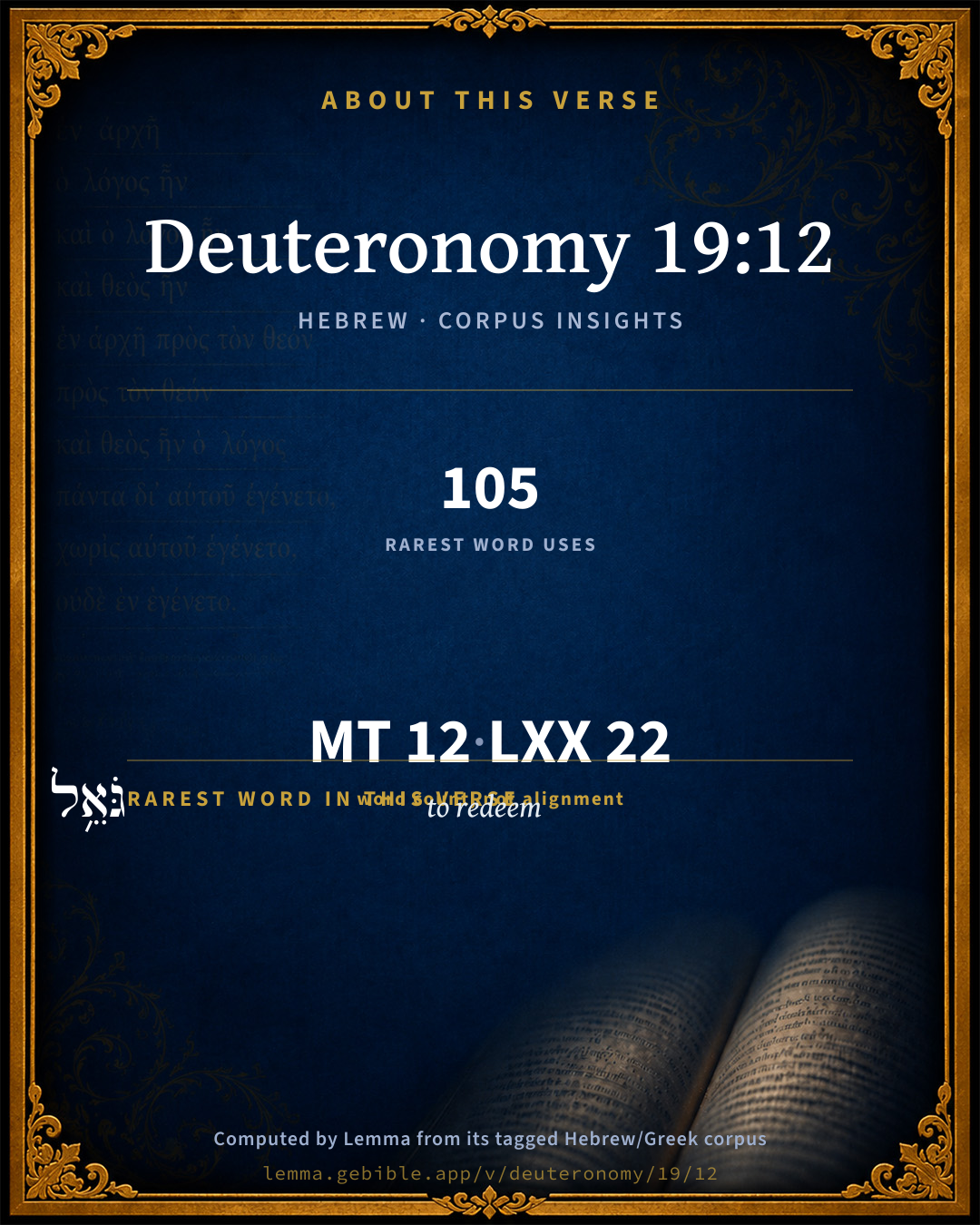
About this verse

These counts appear in no published source. They are computed here, from the morphology-tagged text and Lemma’s own curated glosses. What Lemma adds →

12
words
11
distinct lemmas
Pentateuch
section

Grammatical profile

  • 5 verbs
  • 3 nouns
  • 1 adjective
  • 1 adverb
  • 2 particles

Verb forms

  • וְשָֽׁלְחוּ֙ Qal · Sequential Perfect
  • וְלָקְח֥וּ Qal · Sequential Perfect
  • וְנָתְנ֣וּ Qal · Sequential Perfect
  • גֹּאֵ֥ל Qal · Participle Active
  • וָמֵֽת Qal · Sequential Perfect

Hebrew & Septuagint length

In English translation the verse runs 27 words from the Hebrew and 29 from the Septuagint (LXX English) — closely comparable.

A rough comparison of the two English renderings, which tokenize alike — not a word-level alignment.

Word counts can differ between the Hebrew and the Greek without any difference in meaning — e.g. the Hebrew direct-object marker אֵת has no separate Greek word, and Greek often adds the article ὁ.

In the original languages it is 12 Hebrew tokens and 22 Greek tokens — but the two are counted differently (Hebrew bundles its prefixes and suffixes into one token; the Greek is in lemma form), so that isn’t a like-for-like length.

Cross-references

2

Topical passages linked to Deuteronomy 19:12 in the Treasury of Scripture Knowledge — connected by theme and wording, ordered by reader-vote popularity; previews shown in the World English Bible.

  • 1 Kings 2:5–6 Moreover you know also what Joab the son of Zeruiah did to me, even what he did to the two captains of the hosts of Israel, to Abner the son of Ner, and to Amasa the son of Jether, whom he killed, and shed the blood of war in peace, and put the blood of war on his sash that was about his loins, and in his shoes that were on his feet.
  • 1 Kings 2:28–34 The news came to Joab; for Joab had turned after Adonijah, though he didn't turn after Absalom. Joab fled to the Tent of Yahweh, and caught hold on the horns of the altar.

Cross-references courtesy of OpenBible.info (CC BY 4.0).

Hebrew and Greek witnesses Masoretic Hebrew ↔ Greek Septuagint

The same verse in the two great witnesses to the Old Testament, shown verse-for-verse.

These are two independent witnesses, not word-aligned to each other, and the Septuagint is shown in lemma (dictionary) form.

Hebrew Deuteronomy 19:12 Masoretic · Westminster Leningrad Codex

וְשָֽׁלְחוּ֙ זִקְנֵ֣י עִיר֔וֹ וְלָקְח֥וּ אֹת֖וֹ מִשָּׁ֑ם וְנָתְנ֣וּ אֹת֗וֹ בְּיַ֛ד גֹּאֵ֥ל הַדָּ֖ם וָמֵֽת

then the elders of his city shall send and bring him there, and deliver him into the hand of the avenger of blood, that he may die.

World English Bible · Public Domain

Greek LXX Deuteronomy 19:12 Septuagint · lemma form

καί ἀποστέλλω ὁ γερουσία ὁ πόλις αὐτός καί λαμβάνω αὐτός ἐκεῖθεν καί παραδίδωμι αὐτός εἰς χείρ ὁ ἀγχιστεύω ὁ αἷμα καί ἀποθνήσκω

then shall the elders of his city send, and take him thence, and they shall deliver him into the hands of the avengers of blood, and he shall die.

LXX2012 (modern English Septuagint) · Public Domain

Hebrew: Westminster Leningrad Codex (CC BY 4.0). Greek: Septuagint (public domain); English from LXX2012 (modern English Septuagint) (Public Domain). How the Septuagint differs from the Hebrew →

Targum (Aramaic paraphrase)

2

The Targum is the ancient Jewish Aramaic paraphrase of the Hebrew Scriptures — an interpretive translation, not the Hebrew text itself. Onkelos (literal) and Pseudo-Jonathan (expansive) render the Torah, and Jonathan the Prophets. Coverage is partial: where no permissively-licensed English translation exists for a verse, only the Aramaic is shown. This is verse-level text, not a word-by-word alignment to the Hebrew.

  1. Targum Onkelos Torah (Genesis–Deuteronomy)
    וִישַׁלְחוּן סָבֵי קַרְתֵּהּ וְיִדְבְּרוּן יָתֵהּ מִתַּמָן וְיִתְּנוּן יָתֵהּ בְּיַד גָאֵל דְמָא וִימוּת

    (no public-domain English translation for this verse)

    Targum Onkelos — Aramaic: “Onkelos Genesis” (public domain); “Onkelos Exodus” (public domain); “Onkelos Leviticus” (public domain); “Onkelos Numbers” (public domain); “Onkelos Deuteronomy” (public domain). English: “Sefaria Community Translation” (CC0 1.0 (public-domain dedication)); “J.W. Etheridge. The Targums of Onkelos and Jonathan Ben Uzziel on the Pentateuch. London: Longmans, Green, 1862” (public domain). Text via Sefaria.

  2. Targum Pseudo-Jonathan Torah (Genesis–Deuteronomy)
    וִישַׁדְרוּן חַכִּימִין קַרְתֵּיהּ וִידַבְּרוּן יָתֵיהּ מִתַּמָּן וְיִמְסְרוּן יָתֵיהּ בְּיַד תְּבַע אַדְמָא וְיִתְקְטֵל

    the sages of his cities shall send and take him thence, and give him up into the hand of the pursuer for blood, and he shall be put to death.

    Targum Pseudo-Jonathan — Aramaic: “Targum Jonathan on Genesis” (public domain); “Targum Jonathan on Exodus” (public domain); “Targum Jonathan on Leviticus” (public domain); “Targum Jonathan on Numbers” (public domain); “Targum Jonathan on Deuteronomy” (public domain). English: “The Targum of Jonathan ben Uzziel, trans. J. W. Etheridge, London, 1862” (public domain). Text via Sefaria.

Commentary

Notes on Deuteronomy 19:12 from classic Christian and Jewish commentators (each source and its license shown beneath its notes). The classic Christian expositions comment on the surrounding passage and are grouped to its opening verse, so a note may address several verses; the Jewish commentaries on the Tanakh (Rashi and others) are per-verse, so they appear only where the commentator wrote on this verse.

Lemma curates 59 commentaries, every one of them public domain or Creative Commons licensed, each selected and text-cleaned for this edition rather than reprinted as found. About our sources →

Trapp's Complete Commentary

John Trapp

Deu 19:12 Then the elders of his city shall send and fetch him thence, and deliver him into the hand of the avenger of blood, that he may die.

Ver. 12. And fetch him thence.] From the altar to the halter, from the palace to the gallows. {Pro 28:17}

John Trapp, A Commentary or Exposition upon All the Books of the Old and New Testament (1647–1656) — public domain. Text from a community e-Sword module.

Joseph Benson's Commentary

Deu 19:12. The elders of his city — The city of the manslayer. The sense is, that upon any information or suspicion of murder, laid against any one that had taken refuge in any of these cities, the magistrates of the town or district where the fact was committed, should send for the person out of the refuge-city, bring him to a fair trial, and, upon clear evidence of wilful murder, condemn him to death, and cause execution to be done without fear, partiality, or affection; as they valued the divine blessing, and desired to be free of the guilt of innocent blood, which otherwise would be required at their hands.

Joseph Benson's Commentary on the Old and New Testaments (1811–1818) — public domain. Text from a community e-Sword module.

Geneva Bible (1599)

Geneva Bible translators

The Magistrates.

Geneva Bible (1599) marginal notes — public domain. Text via Bolls.life.

The Cambridge Bible for Schools and Colleges

gen. ed. J. J. S. Perowne

12. the elders of his city, etc.] It is not said who are to judge if wilful murder has been committed (for this see Jos_20:4-9), but the elders of the murderer’s town are responsible for his delivery into the hands of the avenger; it is assumed that they are satisfied as to his guilt. The control of the old custom—in which the punishment of a murderer was a family duty—is in the hands of the public authorities. This is not without analogies among the Semitic nomads (Musil, Ethn. Ber. 361 ff.). Elders also appear in Deu_21:2 ff, Deu_21:6; Deu_21:19 f., Deu_22:15-18, Deu_25:7-9, with judicial or executive functions. On their relations to the judges see on Deu_16:18. Doughty (II. 368) mentions a case of murder at Aneyza, where the father was commanded by the Emir and elders to slay the murderess and declined, whereupon she was executed by the public authorities.

The Cambridge Bible for Schools and Colleges (gen. ed. J. J. S. Perowne; Cambridge University Press, 1878–1918) — public domain. Text from a community e-Sword module.

John Gill's Exposition

Thine eye shall not pity him,.... This is not said to the avenger of blood, who is not to be supposed to have any pity or compassion on such a person, but to the elders, judges, and civil magistrates of the city to which he belonged, who took cognizance of his case; these were to show him no favour on account of his being a citizen, a neighbour, a relation or friend, or a rich man, or on any account whatever; but without favour or affection were to judge him and put him to death as a murderer; see Num 35:21,

but thou shall put away the guilt of innocent blood from Israel; by which they would be defiled, and be liable to punishment for it; see Num 35:33, the Targum of Jonathan is,"shall put away those that shed innocent blood out of Israel;''put them away by death:

that it may go well with thee; with the whole land and its inhabitants, and with the city particularly, and the magistrates, and men of it, to which the murderer condemned to death belonged, being continued in the enjoyment of all temporal blessings and mercies.

John Gill's Exposition of the Whole Bible (1746–1763) — public domain (CC PDM 1.0). Text via the HelloAO Bible API.

Haydock's Catholic Bible Commentary

His city. Strict enquiry was made into the circumstances attending the manslaughter, Numbers xxxv. 12. If the refugee was proved guilty, he was delivered up to the next relation of the deceased to be put to death. (Haydock)

George Leo Haydock (1774–1849), Haydock's Catholic Family Bible and Commentary, 1859 edition — public domain. Excludes Psalms (Douay-Rheims chapter numbering differs from Protestant) and Deuterocanonical books (Catholic canon only).

Matthew Poole's English Annotations

The elders of his city; either of the slain person, who were most likely to prosecute the murderer; or of the murderer, because God would oblige even his own fellow citizens to prosecute him to death, that it might appear how hateful murder and the murderer is to God, and ought to be to all men.

Fetch him thence; demand him of the elders of the city of refuge, who upon the hearing of the cause and the evidence of the murder were obliged to deliver the offender to justice.

Matthew Poole's English Annotations on the Holy Bible (1683–1685) — public domain. Text from a community e-Sword/MySword module.

Lesson kit

Teaching starters — assembled from the data on this page, not authored interpretation. Every prompt links to the verse data it draws on. Edit before teaching.

Deuteronomy, in the Pentateuch, opens this verse with 12 words (11 distinct Hebrew lemmas). Its most distinctive word is gâʼal (“to redeem”). A historical commentator’s framing appears above. Read the whole chapter for the surrounding context.

Discussion questions

  1. How does “to redeem” (gâʼal) shape what this verse is saying?
  2. 1 Kings 2:5–6 shares this passage’s theme. How do the two illuminate each other?
  3. The translations on this page render this verse differently — a whole-verse word diff, not a word-by-word alignment. What might account for the different wordings?
  4. The verb «וְשָֽׁלְחוּ֙» is Qal Sequential Perfect. How does its form color the action?
  5. Reading how Trapp's Complete Commentary and Joseph Benson's Commentary read this verse, where do the two commentators agree and where do they part?

Things to notice

Reading settings

Reading text

Shown beneath each verse's original-language words.

Old Testament
Old Testament edition

Read the OT as the Masoretic Hebrew (MT) or the Greek Septuagint (LXX).

English shown for the Greek Septuagint (in the Hebrew ↔ Greek comparison).

Comparing translations? Open the Compare panel on any verse page to stack up to four side by side.