Exodus 10:28

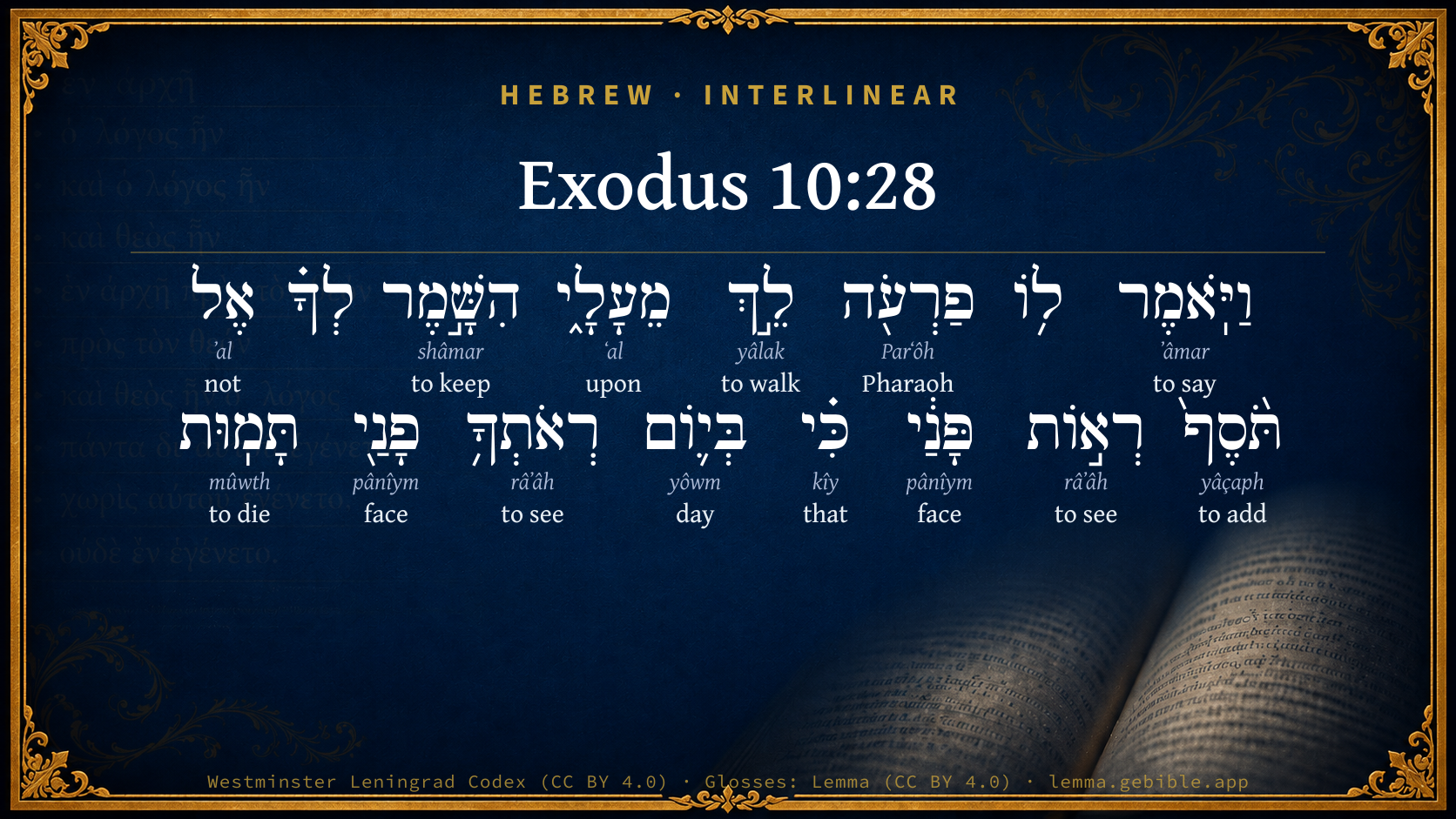
Hebrew (Westminster Leningrad Codex) Exodus 10:28 appears in the Hebrew Old Testament. The text above is from the Westminster Leningrad Codex. Each word links to its Strong’s number, a concise gloss, and parsing drawn from the Open Scriptures Hebrew Bible morphology. Click any word for its full Brown-Driver-Briggs (BDB) entry.
Download image
Cite this verse

Exodus 10:28 (World English Bible). Public Domain. Lemma interlinear Bible study tool, https://lemma.gebible.app/v/exodus/10/28.

Show BibTeX & RIS
BibTeX
RIS
English Translation
Pharaoh said to him, "Get away from me! Be careful to see my face no more; for in the day you see my face you shall die!"
World English Bible · Public Domain
Download a study sheet

One document with this verse’s original text, its word-by-word gloss line, the meaning frame, cross-references with their text, attributed commentary, and full source and license credits — printable, and it pastes into notes with its structure intact.

This verse Autodidact and up

Study sheet (.html) Plain text (.txt)

A passage Seminary Student

Up to 50 verses in one chapter. A passage sheet keeps up to 6 commentary sources and 12 cross-references per verse, in the order this page ranks them, and says so on the sheet whenever that leaves anything out. Ask for a single verse and you get the Autodidact verse sheet above.

Everything on this page stays free to read, with no account — the sheet is a download of what is already on screen, not access to it.

Want to remove ads? Support Godless Engineer
Compare translations 3

The same verse in 3 English versions, stacked beneath the original-language interlinear above. Click any original word for its lexicon entry.

Each is an independent rendering of the whole verse — the interlinear is not word-aligned to these translations.

Highlighted words mark where these versions differ — a whole-verse word diff, not a word-by-word alignment.

  • World English Bible Public Domain
    Pharaoh said to him, "Get away from me! Be careful to see my face no more; for in the day you see my face you shall die!"
  • King James Version Public Domain
    And Pharaoh said unto him, Get thee from me, take heed to thyself, see my face no more; for in that day thou seest my face thou shalt die.
  • unfoldingWord Literal Text CC BY-SA 4.0
    And Pharaoh said to him, “Get away from me! Watch yourself; you shall not again see my face; because in the day of your seeing my face, you shall die.”

unfoldingWord Literal Text — © unfoldingWord, licensed CC BY-SA 4.0. Word-aligned USFM3 via Door43 (git.door43.org/unfoldingWord/en_ult).

Versions to compare (up to 4)

3 of 4 selected

Show all 18 translations

Every available English version of this verse, each an independent rendering of the whole verse.

  • World English Bible Public Domain
    Pharaoh said to him, "Get away from me! Be careful to see my face no more; for in the day you see my face you shall die!"
  • Berean Standard Bible Public Domain
    “Depart from me!” Pharaoh said to Moses. “Make sure you never see my face again, for on the day you see my face, you will die.”
  • Majority Standard Bible Public Domain
    “Depart from me!” Pharaoh said to Moses. “Make sure you never see my face again, for on the day you see my face, you will die.”
  • King James Version Public Domain
    And Pharaoh said unto him, Get thee from me, take heed to thyself, see my face no more; for in that day thou seest my face thou shalt die.
  • American Standard Version (1901) Public Domain
    And Pharaoh said unto him, Get thee from me, take heed to thyself, see my face no more; for in the day thou seest my face thou shalt die.
  • Revised Version (1885) Public Domain
    And Pharaoh said unto him, Get thee from me, take heed to thyself, see my face no more; for in the day thou seest my face thou shalt die.
  • Geneva Bible (1599) Public Domain
    And Pharaoh sayde vnto him, Get thee from mee: looke thou see my face no more: for whensoeuer thou commest in my sight, thou shalt dye.
  • Douay-Rheims (1899) Public Domain
    And Pharao said to Moses: Get thee from me, and beware thou see not my face any more: in what day soever thou shalt come in my sight, thou shalt die.
  • Young's Literal Translation Public Domain
    and Pharaoh saith to him, `Go from me, take heed to thyself, add not to see my face, for in the day thou seest my face thou diest;'
  • Literal Standard Version CC BY-SA 4.0
    and Pharaoh says to him, “Go from me, take heed to yourself, do not add to see my face, for in the day you see my face you die”;
  • Unlocked Literal Bible CC BY-SA 4.0
    Pharaoh said to Moses, “Go from me! Be careful about one thing, that you do not see me again, for on the day you see my face, you will die.”
  • unfoldingWord Literal Text CC BY-SA 4.0
    And Pharaoh said to him, “Get away from me! Watch yourself; you shall not again see my face; because in the day of your seeing my face, you shall die.”
  • Darby Bible Public Domain
    And Pharaoh said to him, Get thee from me, take heed to thyself, see my face no more; for in the day thou seest my face thou shalt die.
  • World Messianic Bible Public Domain
    Pharaoh said to him, “Get away from me! Be careful to see my face no more; for in the day you see my face you shall die!”
  • Webster's Bible Public Domain
    And Pharaoh said to him, Depart from me, take heed to thyself, see my face no more: for in that day thou seest my face, thou shalt die.
  • Free Bible Version CC BY-SA 4.0
    Pharaoh shouted at Moses, “Get out of here! I don't want to see you ever again! If I ever do see you again you'll die!”
  • Bible in Basic English Public Domain
    And Pharaoh said to him, Go away from me, take care that you come not again before me; for the day when you see my face again will be your last.
  • JPS Tanakh (1917) Public Domain
    And Pharaoh said unto him: 'Get thee from me, take heed to thyself, see my face no more; for in the day thou seest my face thou shalt die.'

Literal Standard Version (2020), Covenant Press — licensed CC BY-SA 4.0. Text via the HelloAO Bible API (eBible.org). Unlocked Literal Bible (unfoldingWord) — licensed CC BY-SA 4.0. Text via the HelloAO Bible API (eBible.org). unfoldingWord Literal Text — © unfoldingWord, licensed CC BY-SA 4.0. Word-aligned USFM3 via Door43 (git.door43.org/unfoldingWord/en_ult). Free Bible Version, Dr. Jonathan Gallagher — licensed CC BY-SA 4.0. Text via the HelloAO Bible API (eBible.org).

Word by word

More ways to search: Search by grammar → Find every occurrence → Compare this word →

Practice this passage: Drill this verse → Learn its vocabulary →

תֹּ֨סֶף֙
yâçaph
H3254
“to add”
Verb, Hiphil, Jussive, 2nd Person, Masculine, Singular
Part of Speech
Verb
Stem
Hiphil
Form
Jussive
Person
2nd Person
Gender
Masculine
Number
Singular
Full BDB Definition

Origin: a primitive root

TWOT: 876

to add, increase, do again - (Qal) to add, increase, do again - (Niphal) - to join, join oneself to - to be joined, be added to - (Hiphil) - to cause to add, increase - to do more, do again
  1. וַיֹּֽאמֶר ʼâmar H559 “and · to say” Conjunction + Verb, Qal, Sequential Imperfect, 3rd Person, Masculine, Singular
  2. פַרְעֹ֖ה Parʻôh H6547 “Pharaoh” Noun, Proper
  3. לֵ֣ךְ yâlak H3212 “walk” Verb, Qal, Imperative, 2nd Person, Masculine, Singular
  4. מֵעָלָ֑י ʻal H5921 “from · upon · me” Preposition + Preposition + Suffix, Personal, 1st Person, Common, Singular
  5. הִשָּׁ֣מֶר shâmar H8104 “keep” Verb, Niphal, Imperative, 2nd Person, Masculine, Singular
  6. אֶל ʼal H408 “not” Particle, Negative
  7. רְא֣וֹת râʼâh H7200 “to see” Verb, Qal, Infinitive Construct
  8. פָּנַ֔י pânîym H6440 “face(s) · my” Noun, Common, Both, Plural, Construct + Suffix, Personal, 1st Person, Common, Singular
  9. כִּ֗י kîy H3588 “that” Conjunction
  10. בְּי֛וֹם yôwm H3117 “in/at · day of” Preposition + Noun, Common, Masculine, Singular, Construct
  11. רְאֹתְךָ֥ râʼâh H7200 “to see · you” Verb, Qal, Infinitive Construct + Suffix, Personal, 2nd Person, Masculine, Singular
  12. פָנַ֖י pânîym H6440 “face(s) · my” Noun, Common, Both, Plural, Construct + Suffix, Personal, 1st Person, Common, Singular
  13. תָּמֽוּת mûwth H4191 “to die” Verb, Qal, Imperfect, 2nd Person, Masculine, Singular

About this verse

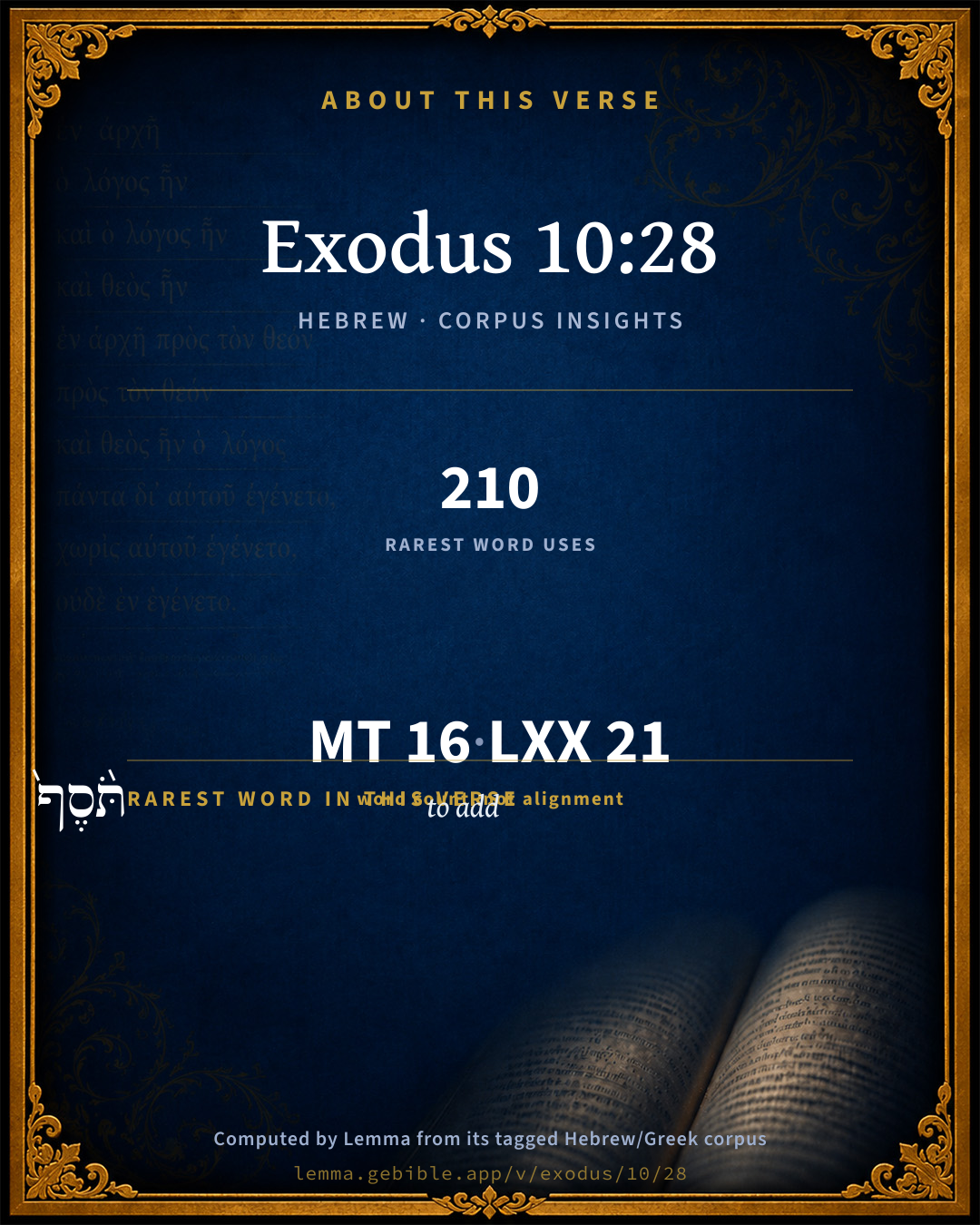
These counts appear in no published source. They are computed here, from the morphology-tagged text and Lemma’s own curated glosses. What Lemma adds →

16
words
12
distinct lemmas
Pentateuch
section

Grammatical profile

  • 7 verbs
  • 4 nouns
  • 3 prepositions
  • 1 conjunction
  • 1 particle

Verb forms

  • וַיֹּֽאמֶר Qal · Sequential Imperfect
  • לֵ֣ךְ Qal · Imperative
  • הִשָּׁ֣מֶר Niphal · Imperative
  • תֹּ֨סֶף֙ Hiphil · Jussive
  • רְא֣וֹת Qal · Infinitive Construct
  • רְאֹתְךָ֥ Qal · Infinitive Construct
  • תָּמֽוּת Qal · Imperfect

Repetition

Words recur within this verse — often emphatic in Hebrew:

  • רְא֣וֹת to see H7200 ×2
  • פָּנַ֔י face H6440 ×2

Hebrew & Septuagint length

In English translation the verse runs 27 words from the Hebrew and 24 from the Septuagint (LXX English) — closely comparable.

A rough comparison of the two English renderings, which tokenize alike — not a word-level alignment.

Word counts can differ between the Hebrew and the Greek without any difference in meaning — e.g. the Hebrew direct-object marker אֵת has no separate Greek word, and Greek often adds the article ὁ.

In the original languages it is 16 Hebrew tokens and 21 Greek tokens — but the two are counted differently (Hebrew bundles its prefixes and suffixes into one token; the Greek is in lemma form), so that isn’t a like-for-like length.

Cross-references

3

Topical passages linked to Exodus 10:28 in the Treasury of Scripture Knowledge — connected by theme and wording, ordered by reader-vote popularity; previews shown in the World English Bible.

  • 2 Chronicles 16:10 Then Asa was angry with the seer, and put him in the prison-house; for he was in a rage with him because of this thing. Asa oppressed some of the people at the same time.
  • 2 Chronicles 25:16 It happened, as he talked with him, that [the king] said to him, Have we made you of the king's counsel? Stop! Why should you be struck down? Then the prophet stopped, and said, I know that God has determined to destroy you, because you have done this, and have not listened to my counsel.
  • Amos 7:13 but don't prophesy again any more at Bethel; for it is the king's sanctuary, and it is a royal house!"

Cross-references courtesy of OpenBible.info (CC BY 4.0).

Hebrew and Greek witnesses Masoretic Hebrew ↔ Greek Septuagint

The same verse in the two great witnesses to the Old Testament, shown verse-for-verse.

These are two independent witnesses, not word-aligned to each other, and the Septuagint is shown in lemma (dictionary) form.

Hebrew Exodus 10:28 Masoretic · Westminster Leningrad Codex

וַיֹּֽאמֶר ל֥וֹ פַרְעֹ֖ה לֵ֣ךְ מֵעָלָ֑י הִשָּׁ֣מֶר לְךָ֗ אֶל תֹּ֨סֶף֙ רְא֣וֹת פָּנַ֔י כִּ֗י בְּי֛וֹם רְאֹתְךָ֥ פָנַ֖י תָּמֽוּת

Pharaoh said to him, "Get away from me! Be careful to see my face no more; for in the day you see my face you shall die!"

World English Bible · Public Domain

Greek LXX Exodus 10:28 Septuagint · lemma form

καί λέγω φαραώ ἀποἔρχομαι ἀπό ἐγώ προςἔχω σεαυτοῦ ἔτι προςτίθημι ὁράω ἐγώ ὁ πρόσωπον ὅς δέ ἄν ἡμέρα ὁράω ἐγώ ἀποθνήσκω

And Pharao says, Depart from me, beware of seeing my face again, for in what day you shall appear before me, you shall die.

LXX2012 (modern English Septuagint) · Public Domain

Hebrew: Westminster Leningrad Codex (CC BY 4.0). Greek: Septuagint (public domain); English from LXX2012 (modern English Septuagint) (Public Domain). How the Septuagint differs from the Hebrew →

Targum (Aramaic paraphrase)

2

The Targum is the ancient Jewish Aramaic paraphrase of the Hebrew Scriptures — an interpretive translation, not the Hebrew text itself. Onkelos (literal) and Pseudo-Jonathan (expansive) render the Torah, and Jonathan the Prophets. Coverage is partial: where no permissively-licensed English translation exists for a verse, only the Aramaic is shown. This is verse-level text, not a word-by-word alignment to the Hebrew.

  1. Targum Onkelos Torah (Genesis–Deuteronomy)
    וַאֲמַר לֵּהּ פַּרְעֹה אִזֵיל מֵעִלָוָי אִסְתַּמַר לָךְ לָא תוֹסִיף לְמֶחֱזֵי אַפַּי אֲרֵי בְּיוֹמָא דְתֶחֱזֵי אַפַּי תְּמוּת:

    (no public-domain English translation for this verse)

    Targum Onkelos — Aramaic: “Onkelos Genesis” (public domain); “Onkelos Exodus” (public domain); “Onkelos Leviticus” (public domain); “Onkelos Numbers” (public domain); “Onkelos Deuteronomy” (public domain). English: “Sefaria Community Translation” (CC0 1.0 (public-domain dedication)); “J.W. Etheridge. The Targums of Onkelos and Jonathan Ben Uzziel on the Pentateuch. London: Longmans, Green, 1862” (public domain). Text via Sefaria.

  2. Targum Pseudo-Jonathan Torah (Genesis–Deuteronomy)
    וַאֲמַר לֵיהּ פַּרְעה אִיזֵל מֵעִילַוָוי אִיזְדַהַר לָךְ לָא תוֹסִיף לְמֶחֱמֵי סְבַר אַפַּי לְמַלָלָא קֳדָמַי חֲדָא מִן מִלַיָא קַשְׁיָיתָא כְּאִלֵּין אֲרוּם בְּיוֹמָא דְאַתְּ חָמֵי סְבַר אַפַּי יִתְקוֹף רוּגְזִי בָךְ וְאֶמְסוֹר יָתָךְ בְּיַד בְּנֵי נְשָׁא אִילֵין דַּהֲווֹ תַּבְעִין נַפְשָׁךְ לְמִיסַב יָתָהּ

    And Pharoh said to him, Go from me. Beware that thou add not to see my face to speak before me one of these words that are so hard: for in the day that thou seest my face, my anger will grow strong against thee, and I will deliver thee into the hands of the men who seek thy life to take it.

    Targum Pseudo-Jonathan — Aramaic: “Targum Jonathan on Genesis” (public domain); “Targum Jonathan on Exodus” (public domain); “Targum Jonathan on Leviticus” (public domain); “Targum Jonathan on Numbers” (public domain); “Targum Jonathan on Deuteronomy” (public domain). English: “The Targum of Jonathan ben Uzziel, trans. J. W. Etheridge, London, 1862” (public domain). Text via Sefaria.

Commentary

Notes on Exodus 10:28 from classic Christian and Jewish commentators (each source and its license shown beneath its notes). The classic Christian expositions comment on the surrounding passage and are grouped to its opening verse, so a note may address several verses; the Jewish commentaries on the Tanakh (Rashi and others) are per-verse, so they appear only where the commentator wrote on this verse.

Lemma curates 59 commentaries, every one of them public domain or Creative Commons licensed, each selected and text-cleaned for this edition rather than reprinted as found. About our sources →

Trapp's Complete Commentary

John Trapp

Exo 10:28 And Pharaoh said unto him, Get thee from me, take heed to thyself, see my face no more; for in [that] day thou seest my face thou shalt die.

Ver. 28. Get thee from me.] Evermore when God’s messengers are abandoned, destruction is at next door by. "I know that the Lord hath a purpose to destroy thee." {2Ch 25:16; 2Ch 36:16}

John Trapp, A Commentary or Exposition upon All the Books of the Old and New Testament (1647–1656) — public domain. Text from a community e-Sword module.

The Biblical Illustrator

Joseph S. Exell

Exo_10:28-29

I will see thy face no more.

Pharaoh and Moses; or, contrasted characters

I. In this world often the worst of men come in contact with the best of men.

1. Pharaoh, an idolater, the greatest of tyrants, a signal monument of Gods displeasure; Moses, a true worshipper of the true and living God, the meekest of men, an object of Gods highest favour.

2. Such opposite characters as these come in contact in families, in schools, in political and social circles.

II. It is possible that the worst of men may come in contact with the best without being at all benefited.

1. Think of the noble example which Moses set before Pharaoh.

(1) Disinterestedness.

(2) Meekness.

(3) Holiness.

2. Think of the important truths which Moses taught Pharaoh.

(1) The existence of one true God alone.

(2) That this world is under Gods control.

(3) That Pharaoh was accountable to God.

(4) That God was ready to forgive those who had rebelled against Him.

III. When the worst of men come in contact with the best without being benefited the parting is deeply affecting. (J. G. Roberts.)

The intercourse of life

I. That good men are often brought into contact with bad men.

1. Irrespective of moral character.

2. Irrespective of mental temperament.

3. Irrespective of social position.

And why?

1. That men may be imbued with the ideas of a common manhood,

2. That class prejudices may be destroyed,

3. That charity may be developed.

4. That life may become a unity.

II. That when good men are brought into contact with bad men the meeting should be educational to both.

1. The companionship of the good should be influential to the moral improvement of the bad.

2. The companionship of the bad should inspire the good with feelings of gratitude and humility. Good men might have been far otherwise.

III. That when good men are brought into contact with bad men the meeting is not always valued as it ought to be, and its opportunity for good is often unimproved. Lessons:

1. That a good life is a heavenly ministry.

2. That good men should seek to influence the bad aright.

3. That good men may learn lessons from wicked lines. (J. S. Exell, M. A.)

The way in which hardened sinners treat the messengers of God

1. With contempt.

2. With threatenings of evil.

3. With banishment. (J. S. Exell, M. A.)

The way in which messengers of God treat hardened sinners

1. They scorn their taunts.

2. They impart to the language of the wicked a deeper significance than was intended.

3. They are courageous.

4. They bid them a sad farewell. (J. S. Exell, M. A.)

Persistent obstinacy

The obstinacy of Pharaoh appears odious to us; but, alas! the same obstinacy is found in all sinners. It is seldom we meet with those who openly say, I will not be converted, I will do nothing for God, I mock Him, I brave Him, I defy Him. They do not use language such as this, but yet they cherish some secret sin. Among the wicked boys who are unfortunately to be found in most large towns, you will scarcely meet one, even let him perhaps be a thief, who would not say, I do not wish to die an enemy of God; but, then, in the meantime he cherishes his sin. What is still more sad, we sometimes hear even serious persons say, I wish to do the will of God, but cannot cure myself of this fault; it is stronger than I. I do not wish to lose my soul, I wish to obey the commands of God; but I cannot give up the society which is called bad, I cannot give up such and such a habit which I am told is a sinful one, I cannot make those sacrifices which I am told are necessary; I will not do it. And it is thus that people trifle with eternity! Let us take heed; we must give ourselves to God--wholly and without reserve. He will have no divided service. (Prof. Gaussen.)

Moses reply to Pharaoh

Remark the solemn and terrible reply of Moses, Thou hast spoken well, I will see thy face again no more. To understand the meaning of this answer we must remark that it does not finish with this verse, but that it has a continuation in the succeeding chapter. It contains a terrible threat to those who despise and reject the word of God. This was to be the last time that Pharaoh should hear the voice of the man of God, who had so often warned him and prayed for him. For him no more time was to be given. It was finished; the measure of his iniquities was filled up; the wrath of God was to come upon him to the uttermost. Then Moses went out from Pharaoh in great anger. There is such a thing as holy anger, for the Bible says, Be ye angry, and sin not; let not the sun go down upon your wrath. Our Lord Himself was indignant with the buyers and sellers in the Temple. And He was much displeased with His disciples when they rebuked those who brought young children to Him. He looked round about with anger on those who wished to hinder Him from curing a man on the Sabbath day. The anger of Moses was caused by the obstinacy and ingratitude of Pharaoh, and by the insulting manner in which he braved his Creator and his Judge. The meaning of his terrible reply was this, Thou hast rejected the word of God; the word of God rejects thee. Thou dost not choose any more to see the face of the servant of the Lord, who has come ten times to warn thee in His name. Well, thou shalt see his face no more. The word of God has been brought to thee, but the word of God will leave thee. The grace of God has been offered thee; thou hast despised it, therefore now will the grace of God leave thee. Thou hast chosen to ruin thyself, therefore thou wilt ruin thyself. How terrible is this! We must all die. Death is very formidable: it is very sad and solemn when we mourn for others; but there is a remedy for this sorrow in a loving Saviour, and in the knowledge that there is a home where all the children of God shall meet each other again. What is really much more terrible than death is thin sentence, Thou shalt see My face no more. (Prof. Gaussen.)

.

The Biblical Illustrator, edited by Joseph S. Exell (c. 1880s–1900s) — public domain. Text from a community e-Sword module.

Geneva Bible (1599)

Geneva Bible translators

Though before he confessed Moses just, yet again his own conscience he threateneth to put him to death.

Geneva Bible (1599) marginal notes — public domain. Text via Bolls.life.

Jamieson, Fausset & Brown

Robert Jamieson, A. R. Fausset & David Brown

Pharaoh said, . . . Get thee from me--The calm firmness of Moses provoked the tyrant. Frantic with disappointment and rage, with offended and desperate malice, he ordered him from his presence and forbade him ever to return.

Jamieson, Fausset & Brown — Commentary Critical and Explanatory on the Whole Bible (1871) — public domain (CC PDM 1.0). Text via the HelloAO Bible API.

Adam Clarke's Commentary

Verse 28. See my face no more] Hitherto Pharaoh had left the way open for negotiation; but now, in wrath against Jehovah, he dismisses his ambassador, and threatens him with death if he should attempt any more to come into his presence.

Adam Clarke's Commentary on the Bible (1810–1826) — public domain. Text from a community e-Sword/MySword module.

Ellicott's Commentary for English Readers

(28) Get thee from me.—This address is ruds, fierce, uncourteous. That a Pharaoh of the nineteenth (or eighteenth?) dynasty should have so spoken implies extreme and very uncommon excitement. Generally the Pharaohs of this polished period were as imper turbable as Chinese mandarins. We must suppose that up to this time the king had persuaded himself that he would be able to bring Moses to a compromise, but that now at last he despaired of so doing; hence his anger and rudeness.

Thou shalt die.—Egyptian kings had the power of life and death, but rarely exercised it arbitrarily, or without trial. Very long and elaborate judicial processes have been found among the Egyptian remains. Still, no doubt, a monarch could put to death whomsoever he pleased; and so Egyptian courtiers were wont to acknowledge that they had lived to old age “by the favour of the king” (Brugsch, History of Egypt, vol. i., p. 92).

A Bible Commentary for English Readers, edited by Charles John Ellicott (1878–1897) — public domain. Text from a community e-Sword module.

The Cambridge Bible for Schools and Colleges

gen. ed. J. J. S. Perowne

28. from me] Heb. from upon me, i.e. from being a trouble to me; cf. Gen_13:11, Num_20:21, 2Sa_13:17 (Lex. p. 759a). Not the ‘from’ [Heb. from with = παρὰ with a gen.] of Exo_8:12; Exo_8:29-30, Exo_9:33, Exo_10:6; Exo_10:18, Exo_11:8.

see my face] i.e. be admitted to my presence; cf. Gen_43:3, 2Sa_14:24; 2Sa_14:28, 2Ki_Exo_25:19.

The Cambridge Bible for Schools and Colleges (gen. ed. J. J. S. Perowne; Cambridge University Press, 1878–1918) — public domain. Text from a community e-Sword module.

The Pulpit Commentary

And Pharaoh said, etc. The reply of Pharaoh indicates violent anger. No doubt he thought that now the intention of Moses to deprive him altogether of the services of so many hundred thousand slaves was palpable, and scarcely concealed. Greatly enraged, he gives vent to his rage, with the want of self-control common among Oriental monarchs rudely bids Moses be gone (Get thee from me), threatens him (take heed to thyself), and bids hires never more seek his presence, under the penalty of instant death, if he makes his appearance. Considering the degree of civilization, refinement, and politeness to which the Egyptians had attained under the eighteenth and nineteenth dynasties, such an outbreak must be regarded as abnormal, and as implying violent excitement.

The Pulpit Commentary (1880–1919), ed. H.D.M. Spence-Jones & Joseph S. Exell — public domain. Text from a community e-Sword module.

Lesson kit

Teaching starters — assembled from the data on this page, not authored interpretation. Every prompt links to the verse data it draws on. Edit before teaching.

Exodus, in the Pentateuch, opens this verse with 16 words (12 distinct Hebrew lemmas). Its most distinctive word is yâçaph (“to add”). A historical commentator’s framing appears above. Read the whole chapter for the surrounding context.

Discussion questions

  1. The word yâçaph carries the sense “to add.” How does it shape the verse?
  2. How does 2 Chronicles 16:10, which shares this passage’s theme, read alongside this verse?
  3. What does the repetition of “to see” (2× in this one verse) do in this verse?
  4. The translations on this page render this verse differently — a whole-verse word diff, not a word-by-word alignment. What might account for the different wordings?
  5. «וַיֹּֽאמֶר» is a Qal Sequential Imperfect verb. How does that grammatical form shape the action described?
  6. Compare how Trapp's Complete Commentary and The Biblical Illustrator read this verse. Where do they agree or differ?

Things to notice

Reading settings

Reading text

Shown beneath each verse's original-language words.

Old Testament
Old Testament edition

Read the OT as the Masoretic Hebrew (MT) or the Greek Septuagint (LXX).

English shown for the Greek Septuagint (in the Hebrew ↔ Greek comparison).

Comparing translations? Open the Compare panel on any verse page to stack up to four side by side.