
Exodus 31:14

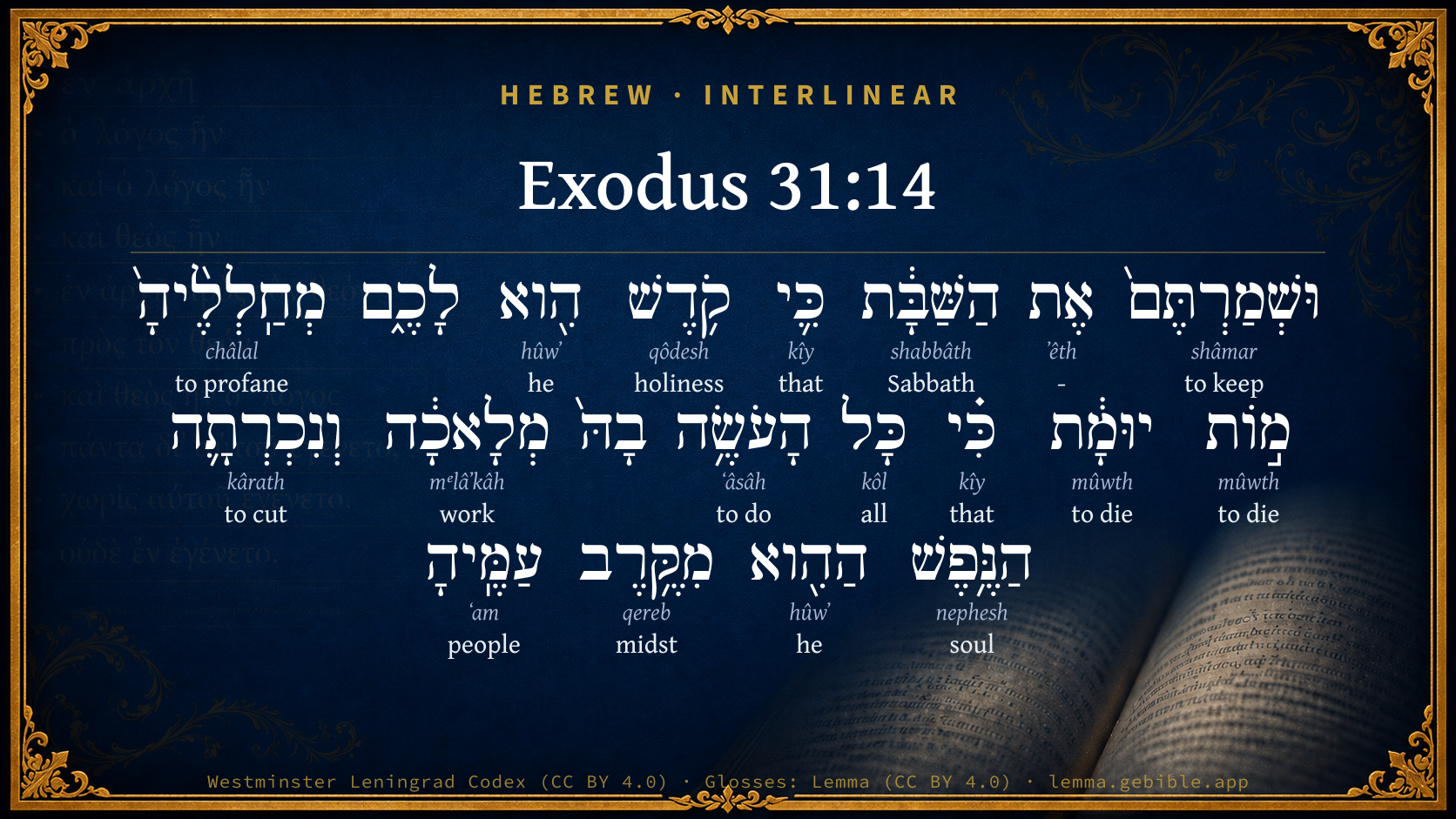
Hebrew (Westminster Leningrad Codex) Exodus 31:14 appears in the Hebrew Old Testament. The text above is from the Westminster Leningrad Codex. Each word links to its Strong’s number, a concise gloss, and parsing drawn from the Open Scriptures Hebrew Bible morphology. Click any word for its full Brown-Driver-Briggs (BDB) entry.
Download image
Cite this verse

Exodus 31:14 (World English Bible). Public Domain. Lemma interlinear Bible study tool, https://lemma.gebible.app/v/exodus/31/14.

Show BibTeX & RIS
BibTeX
RIS
English Translation
You shall keep the Sabbath therefore; for it is holy to you. Everyone who profanes it shall surely be put to death; for whoever does any work therein, that soul shall be cut off from among his people.
World English Bible · Public Domain
Download a study sheet

One document with this verse’s original text, its word-by-word gloss line, the meaning frame, cross-references with their text, attributed commentary, and full source and license credits — printable, and it pastes into notes with its structure intact.

This verse Autodidact and up

Study sheet (.html) Plain text (.txt)

A passage Seminary Student

Up to 50 verses in one chapter. A passage sheet keeps up to 6 commentary sources and 12 cross-references per verse, in the order this page ranks them, and says so on the sheet whenever that leaves anything out. Ask for a single verse and you get the Autodidact verse sheet above.

Everything on this page stays free to read, with no account — the sheet is a download of what is already on screen, not access to it.

Want to remove ads? Support Godless Engineer
Compare translations 3

The same verse in 3 English versions, stacked beneath the original-language interlinear above. Click any original word for its lexicon entry.

Each is an independent rendering of the whole verse — the interlinear is not word-aligned to these translations.

Highlighted words mark where these versions differ — a whole-verse word diff, not a word-by-word alignment.

  • World English Bible Public Domain
    You shall keep the Sabbath therefore; for it is holy to you. Everyone who profanes it shall surely be put to death; for whoever does any work therein, that soul shall be cut off from among his people.
  • King James Version Public Domain
    Ye shall keep the sabbath therefore; for it is holy unto you: every one that defileth it shall surely be put to death: for whosoever doeth any work therein, that soul shall be cut off from among his people.
  • unfoldingWord Literal Text CC BY-SA 4.0
    And you shall keep the Sabbath, for it is holy to you.’ The profaner of it shall surely be put to death, for every worker of work on it, that person shall be cut off from his people.

unfoldingWord Literal Text — © unfoldingWord, licensed CC BY-SA 4.0. Word-aligned USFM3 via Door43 (git.door43.org/unfoldingWord/en_ult).

Versions to compare (up to 4)

3 of 4 selected

Show all 18 translations

Every available English version of this verse, each an independent rendering of the whole verse.

  • World English Bible Public Domain
    You shall keep the Sabbath therefore; for it is holy to you. Everyone who profanes it shall surely be put to death; for whoever does any work therein, that soul shall be cut off from among his people.
  • Berean Standard Bible Public Domain
    Keep the Sabbath, for it is holy to you. Anyone who profanes it must surely be put to death. Whoever does any work on that day must be cut off from among his people.
  • Majority Standard Bible Public Domain
    Keep the Sabbath, for it is holy to you. Anyone who profanes it must surely be put to death. Whoever does any work on that day must be cut off from among his people.
  • King James Version Public Domain
    Ye shall keep the sabbath therefore; for it is holy unto you: every one that defileth it shall surely be put to death: for whosoever doeth any work therein, that soul shall be cut off from among his people.
  • American Standard Version (1901) Public Domain
    Ye shall keep the sabbath therefore; for it is holy unto you: every one that profaneth it shall surely be put to death; for whosoever doeth any work therein, that soul shall be cut off from among his people.
  • Revised Version (1885) Public Domain
    Ye shall keep the sabbath therefore; for it is holy unto you: every one that profaneth it shall surely be put to death: for whosoever doeth any work therein, that soul shall be cut off from among his people.
  • Geneva Bible (1599) Public Domain
    Ye shall therefore keepe the Sabbath: for it is holy vnto you: he that defileth it, shall die the death: therefore whosoeuer worketh therin, the same person shalbe euen cut off from among his people.
  • Douay-Rheims (1899) Public Domain
    Keep you my sabbath: for it is holy unto you: he that shall profane it, shall be put to death: he that shall do my work in it, his soul shall perish out of the midst of his people.
  • Young's Literal Translation Public Domain
    and ye have kept the sabbath, for it `is' holy to you, he who is polluting it is certainly put to death -- for any who doeth work in it -- that person hath even been cut off from the midst of his people.
  • Literal Standard Version CC BY-SA 4.0
    and you have kept the Sabbath, for it [is] holy to you, he who is defiling it is certainly put to death—for any who does work in it—that person has even been cut off from the midst of his people.
  • Unlocked Literal Bible CC BY-SA 4.0
    So you must keep the Sabbath, for it must be treated by you as holy, reserved for him. Everyone who defiles it must surely be put to death. Whoever works on the Sabbath, that person must surely be cut off from his people.
  • unfoldingWord Literal Text CC BY-SA 4.0
    And you shall keep the Sabbath, for it is holy to you.’ The profaner of it shall surely be put to death, for every worker of work on it, that person shall be cut off from his people.
  • Darby Bible Public Domain
    Keep the sabbath, therefore; for it is holy unto you; every one that profaneth it shall certainly be put to death: yea, whoever doeth work on it, that soul shall be cut off from among his peoples.
  • World Messianic Bible Public Domain
    You shall keep the Sabbath therefore, for it is holy to you. Everyone who profanes it shall surely be put to death; for whoever does any work therein, that soul shall be cut off from among his people.
  • Webster's Bible Public Domain
    Ye shall keep the sabbath therefore: for it is holy to you. Every one that profaneth it shall surely be put to death: for whoever doeth any work therein, that soul shall be cut off from among his people.
  • Free Bible Version CC BY-SA 4.0
    You shall keep the Sabbath because it is holy to you. Anyone who dishonors it must be killed. Anyone who works on that day must be cut off from their people.
  • Bible in Basic English Public Domain
    So you are to keep the Sabbath as a holy day; and anyone not honouring it will certainly be put to death: whoever does any work on that day will be cut off from his people.
  • JPS Tanakh (1917) Public Domain
    Ye shall keep the sabbath therefore, for it is holy unto you; every one that profaneth it shall surely be put to death; for whosoever doeth any work therein, that soul shall be cut off from among his people.

Literal Standard Version (2020), Covenant Press — licensed CC BY-SA 4.0. Text via the HelloAO Bible API (eBible.org). Unlocked Literal Bible (unfoldingWord) — licensed CC BY-SA 4.0. Text via the HelloAO Bible API (eBible.org). unfoldingWord Literal Text — © unfoldingWord, licensed CC BY-SA 4.0. Word-aligned USFM3 via Door43 (git.door43.org/unfoldingWord/en_ult). Free Bible Version, Dr. Jonathan Gallagher — licensed CC BY-SA 4.0. Text via the HelloAO Bible API (eBible.org).

Word by word

More ways to search: Search by grammar → Find every occurrence → Compare this word →

Practice this passage: Drill this verse → Learn its vocabulary →

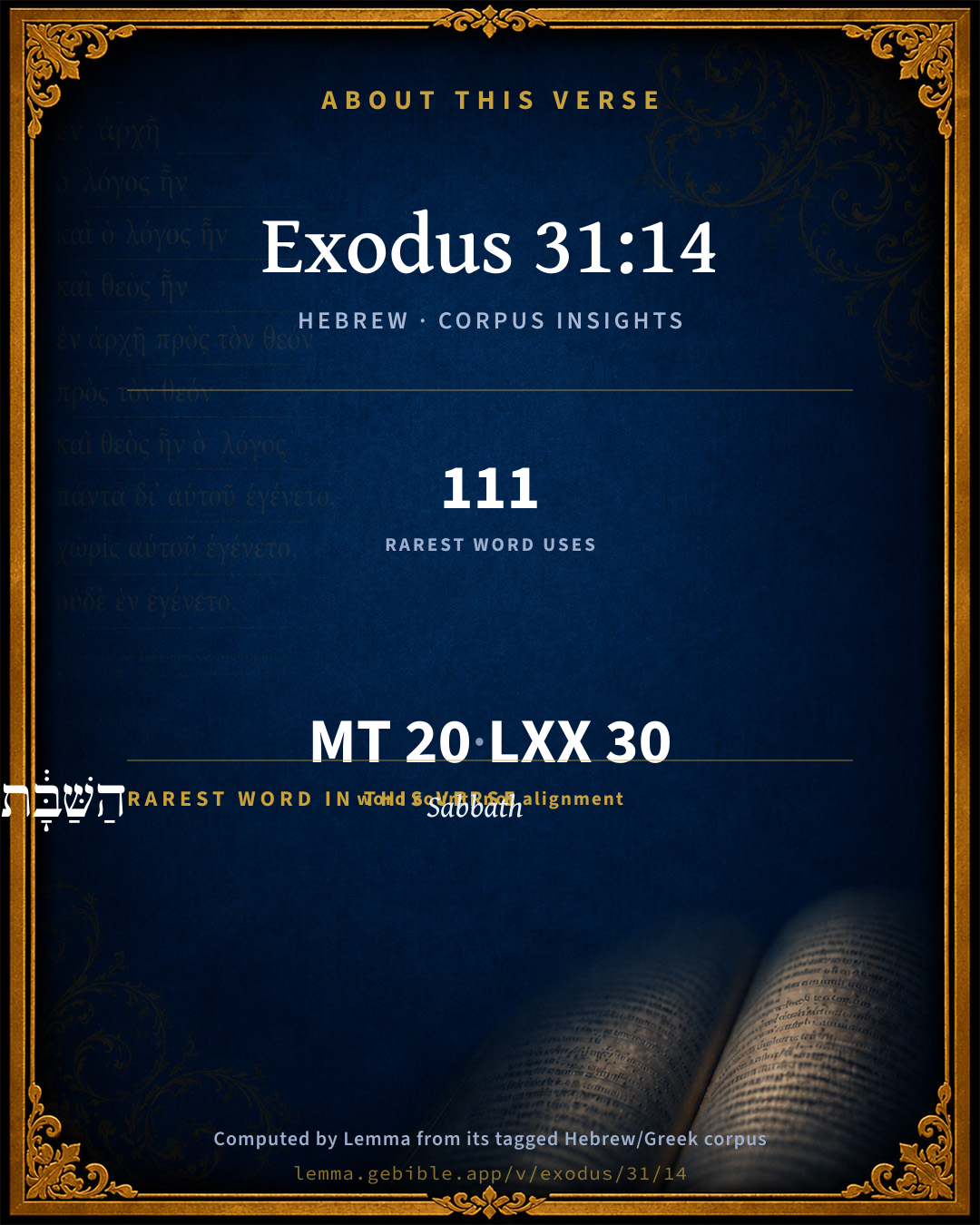
הַשַּׁבָּ֔ת
shabbâth
H7676
“the · Sabbath”
Particle, Definite Article + Noun, Common, Both, Singular, Absolute
Part of Speech
Particle + Noun
Type
Common
Gender
Both
Number
Singular
State
Absolute
Full BDB Definition

Origin: intensive from H7673

TWOT: 2323b

Sabbath - sabbath - day of atonement - sabbath year - week - produce (in sabbath year)
  1. וּשְׁמַרְתֶּם֙ shâmar H8104 “and · to keep” Conjunction + Verb, Qal, Sequential Perfect, 2nd Person, Masculine, Plural
  2. אֶת ʼêth H853 “-” Particle, Direct Object
  3. כִּ֛י kîy H3588 “that” Conjunction
  4. קֹ֥דֶשׁ qôdesh H6944 “holiness” Noun, Common, Masculine, Singular, Absolute
  5. הִ֖וא hûwʼ H1931 “he” Pronoun, Personal, 3rd Person, Feminine, Singular
  6. מְחַֽלְלֶ֨יהָ֙ châlal H2490 “profaning · her” Verb, Piel, Participle Active, Masculine, Plural, Construct + Suffix, Personal, 3rd Person, Feminine, Singular
  7. מ֣וֹת mûwth H4191 “to die” Verb, Qal, Infinitive Absolute
  8. יוּמָ֔ת mûwth H4191 “to die” Verb, Hophal, Imperfect, 3rd Person, Masculine, Singular
  9. כִּ֗י kîy H3588 “that” Conjunction
  10. כָּל kôl H3605 “all of” Noun, Common, Masculine, Singular, Construct
  11. הָעֹשֶׂ֥ה ʻâsâh H6213 “the · doing” Particle, Definite Article + Verb, Qal, Participle Active, Masculine, Singular, Absolute
  12. מְלָאכָ֔ה mᵉlâʼkâh H4399 “work” Noun, Common, Feminine, Singular, Absolute
  13. וְנִכְרְתָ֛ה kârath H3772 “and · to cut” Conjunction + Verb, Niphal, Sequential Perfect, 3rd Person, Feminine, Singular
  14. הַנֶּ֥פֶשׁ nephesh H5315 “the · soul” Particle, Definite Article + Noun, Common, Both, Singular, Absolute
  15. הַהִ֖וא hûwʼ H1931 “the · he” Particle, Definite Article + Pronoun, Personal, 3rd Person, Feminine, Singular
  16. מִקֶּ֥רֶב qereb H7130 “from · midst of” Preposition + Noun, Common, Masculine, Singular, Construct
  17. עַמֶּֽיהָ ʻam H5971 “peoples · her” Noun, Common, Masculine, Plural, Construct + Suffix, Personal, 3rd Person, Feminine, Singular

About this verse

These counts appear in no published source. They are computed here, from the morphology-tagged text and Lemma’s own curated glosses. What Lemma adds →

20
words
15
distinct lemmas
Pentateuch
section

Grammatical profile

  • 6 verbs
  • 7 nouns
  • 2 pronouns
  • 2 prepositions
  • 2 conjunctions
  • 1 particle

Verb forms

  • וּשְׁמַרְתֶּם֙ Qal · Sequential Perfect
  • מְחַֽלְלֶ֨יהָ֙ Piel · Participle Active
  • מ֣וֹת Qal · Infinitive Absolute
  • יוּמָ֔ת Hophal · Imperfect
  • הָעֹשֶׂ֥ה Qal · Participle Active
  • וְנִכְרְתָ֛ה Niphal · Sequential Perfect

Repetition

Words recur within this verse — often emphatic in Hebrew:

  • מ֣וֹת to die H4191 ×2
  • כִּ֛י that H3588 ×2
  • הִ֖וא he H1931 ×2

Hebrew & Septuagint length

In English translation the verse runs 38 words from the Hebrew and 45 from the Septuagint (LXX English) — closely comparable.

A rough comparison of the two English renderings, which tokenize alike — not a word-level alignment.

Word counts can differ between the Hebrew and the Greek without any difference in meaning — e.g. the Hebrew direct-object marker אֵת has no separate Greek word, and Greek often adds the article ὁ.

In the original languages it is 20 Hebrew tokens and 30 Greek tokens — but the two are counted differently (Hebrew bundles its prefixes and suffixes into one token; the Greek is in lemma form), so that isn’t a like-for-like length.

Cross-references

12

Topical passages linked to Exodus 31:14 in the Treasury of Scripture Knowledge — connected by theme and wording, ordered by reader-vote popularity; previews shown in the World English Bible.

  • Exodus 35:2–3 'Six days shall work be done, but on the seventh day there shall be a holy day for you, a Sabbath of solemn rest to Yahweh: whoever does any work in it shall be put to death.
  • Numbers 15:32–36 While the children of Israel were in the wilderness, they found a man gathering sticks on the Sabbath day.
  • Exodus 20:8 "Remember the Sabbath day, to keep it holy.
  • Deuteronomy 5:12–15 "Observe the Sabbath day, to keep it holy, as Yahweh your God commanded you.
  • Nehemiah 9:14 and made known to them your holy Sabbath, and commanded them commandments, and statutes, and a law, by Moses your servant,
  • Isaiah 56:2–6 Blessed is the man who does this, and the son of man who holds it fast; who keeps the Sabbath from profaning it, and keeps his hand from doing any evil.
  • Isaiah 58:13–14 If you turn away your foot from the Sabbath, from doing your pleasure on my holy day; and call the Sabbath a delight, [and] the holy of Yahweh honorable; and shall honor it, not doing your own ways, nor finding your own pleasure, nor speaking [your own] words:
  • Ezekiel 20:12–13 Moreover also I gave them my Sabbaths, to be a sign between me and them, that they might know that I am Yahweh who sanctifies them.
  • Ezekiel 20:16 because they rejected my ordinances, and didn't walk in my statutes, and profaned my Sabbaths: for their heart went after their idols.
  • Ezekiel 20:21 But the children rebelled against me; they didn't walk in my statutes, neither kept my ordinances to do them, which if a man do, he shall live in them; they profaned my Sabbaths. Then I said I would pour out my wrath on them, to accomplish my anger against them in the wilderness.
  • Ezekiel 20:24 because they had not executed my ordinances, but had rejected my statutes, and had profaned my Sabbaths, and their eyes were after their fathers' idols.
  • Ezekiel 44:24 In a controversy they shall stand to judge; according to my ordinances shall they judge it: and they shall keep my laws and my statutes in all my appointed feasts; and they shall make my Sabbaths holy.

Cross-references courtesy of OpenBible.info (CC BY 4.0).

Hebrew and Greek witnesses Masoretic Hebrew ↔ Greek Septuagint

The same verse in the two great witnesses to the Old Testament, shown verse-for-verse.

These are two independent witnesses, not word-aligned to each other, and the Septuagint is shown in lemma (dictionary) form.

Hebrew Exodus 31:14 Masoretic · Westminster Leningrad Codex

וּשְׁמַרְתֶּם֙ אֶת הַשַּׁבָּ֔ת כִּ֛י קֹ֥דֶשׁ הִ֖וא לָכֶ֑ם מְחַֽלְלֶ֨יהָ֙ מ֣וֹת יוּמָ֔ת כִּ֗י כָּל הָעֹשֶׂ֥ה בָהּ֙ מְלָאכָ֔ה וְנִכְרְתָ֛ה הַנֶּ֥פֶשׁ הַהִ֖וא מִקֶּ֥רֶב עַמֶּֽיהָ

You shall keep the Sabbath therefore; for it is holy to you. Everyone who profanes it shall surely be put to death; for whoever does any work therein, that soul shall be cut off from among his people.

World English Bible · Public Domain

Greek LXX Exodus 31:14 Septuagint · lemma form

καί φυλάσσω ὁ σάββατον ὅτι ἅγιος οὗτος εἰμί κύριος σύ ὁ βεβηλόω αὐτός θάνατος θανατόω πᾶς ὅς ποιέω ἐν αὐτός ἔργον ἐκὀλεθρεύω ὁ ψυχή ἐκεῖνος ἐκ μέσος ὁ λαός αὐτός

And you⌃ shall keep the sabbaths, because this is holy to the Lord for you; he that profanes it shall surely be put to death: every one who shall do a work on it, that soul shall be destroyed from the midst of his people.

LXX2012 (modern English Septuagint) · Public Domain

Hebrew: Westminster Leningrad Codex (CC BY 4.0). Greek: Septuagint (public domain); English from LXX2012 (modern English Septuagint) (Public Domain). How the Septuagint differs from the Hebrew →

Targum (Aramaic paraphrase)

2

The Targum is the ancient Jewish Aramaic paraphrase of the Hebrew Scriptures — an interpretive translation, not the Hebrew text itself. Onkelos (literal) and Pseudo-Jonathan (expansive) render the Torah, and Jonathan the Prophets. Coverage is partial: where no permissively-licensed English translation exists for a verse, only the Aramaic is shown. This is verse-level text, not a word-by-word alignment to the Hebrew.

  1. Targum Onkelos Torah (Genesis–Deuteronomy)
    וְתִטְּרוּן יָת שַׁבְּתָא אֲרֵי קוּדְשָׁא הִיא לְכוֹן מְחַלְלִנַהּ אִתְקְטָלָא יִתְקְטֵל אֲרֵי כָּל דְיַעְבֶּד בַּהּ עִבִידָא וְיִשְׁתֵּצֵי אֲנָשָׁא הַהוּא מִגוֹ עַמֵּהּ:

    (no public-domain English translation for this verse)

    Targum Onkelos — Aramaic: “Onkelos Genesis” (public domain); “Onkelos Exodus” (public domain); “Onkelos Leviticus” (public domain); “Onkelos Numbers” (public domain); “Onkelos Deuteronomy” (public domain). English: “Sefaria Community Translation” (CC0 1.0 (public-domain dedication)); “J.W. Etheridge. The Targums of Onkelos and Jonathan Ben Uzziel on the Pentateuch. London: Longmans, Green, 1862” (public domain). Text via Sefaria.

  2. Targum Pseudo-Jonathan Torah (Genesis–Deuteronomy)
    וְתִנְטְרוּן יַת שַׁבְּתָא אֲרוּם קוּדְשָׁא הִיא לְכוֹן דְּיַפְסִינָהּ אִיתְקְטָלָא יִתְקְטֵיל אֲרוּם כָּל מַאן דְּיַעֲבֵיד בָּהּ עִיבִידְתָּא וְיִשְׁתֵּיצֵי בַּר נְשָׁא הַהוּא מֵעַמֵּיהּ

    Ye shall keep the Sabbath, because it is holy to you; whosoever profaneth it, dying he shall die; whoso doeth work therein, that man shall be destroyed from his people.

    Targum Pseudo-Jonathan — Aramaic: “Targum Jonathan on Genesis” (public domain); “Targum Jonathan on Exodus” (public domain); “Targum Jonathan on Leviticus” (public domain); “Targum Jonathan on Numbers” (public domain); “Targum Jonathan on Deuteronomy” (public domain). English: “The Targum of Jonathan ben Uzziel, trans. J. W. Etheridge, London, 1862” (public domain). Text via Sefaria.

Commentary

Notes on Exodus 31:14 from classic Christian and Jewish commentators (each source and its license shown beneath its notes). The classic Christian expositions comment on the surrounding passage and are grouped to its opening verse, so a note may address several verses; the Jewish commentaries on the Tanakh (Rashi and others) are per-verse, so they appear only where the commentator wrote on this verse.

Lemma curates 59 commentaries, every one of them public domain or Creative Commons licensed, each selected and text-cleaned for this edition rather than reprinted as found. About our sources →

Trapp's Complete Commentary

John Trapp

Exo 31:14 Ye shall keep the sabbath therefore; for it [is] holy unto you: every one that defileth it shall surely be put to death: for whosoever doeth [any] work therein, that soul shall be cut off from among his people.

Ver. 14:. For it is holy unto you.] Hence the Hebrews gather, but falsely, that only Israel was charged with the Sabbath day, and not the nations of the world: but the Sabbath was kept before Israel was born.

John Trapp, A Commentary or Exposition upon All the Books of the Old and New Testament (1647–1656) — public domain. Text from a community e-Sword module.

Joseph Benson's Commentary

Exo 31:14-16. It is holy unto you — That is, it is designed for your benefit as well as for God’s honour; it shall be accounted holy by you. It is the sabbath of rest, holy to the Lord — It is separated from common use to the service of God; and by the observance of it we are taught to rest from worldly pursuits, and devote ourselves, and all we are, have, and can do, to God’s glory. It was to be observed throughout their generations, in every age, for a perpetual covenant — This was to be one of the most lasting tokens of the covenant between God and Israel.

Joseph Benson's Commentary on the Old and New Testaments (1811–1818) — public domain. Text from a community e-Sword module.

Tyndale Open Study Notes

Tyndale Open Resources

31:14-15 It is absolutely important to learn that we can find life in God only by coming to him in his way. This is underlined by the death sentence for disobedience (see also Num 15:32-36). This is not to say that followers of God must always punish those who commit these offenses in this way; but here at the outset, it was vital to make this truth clear (see Acts 5:1-11). If the spiritual truth of this lesson has not been learned, mere ritual obedience will be of no value (see Col 2:16-19).

Tyndale Open Study Notes — © Tyndale Open Resources, licensed CC BY-SA 4.0. Text via the HelloAO Bible API.

Geneva Bible (1599)

Geneva Bible translators

God repeateth this point because the whole keeping of the law standeth in the true use of the Sabbath, which is to cease from our works, and to obey the will of God.

Geneva Bible (1599) marginal notes — public domain. Text via Bolls.life.

Adam Clarke's Commentary

Verse 14. Every one that defileth it] By any kind of idolatrous or profane worship.

Shall surely be put to death] The magistrates shall examine into the business, and if the accused be found guilty, he shall be stoned to death.

Shall be cut off] Because that person who could so far contemn the Sabbath, which was a sign to them of the rest which remained for the people of God, was of course an infidel, and should be cut off from all the privileges and expectations of an Israelite.

Adam Clarke's Commentary on the Bible (1810–1826) — public domain. Text from a community e-Sword/MySword module.

Ellicott's Commentary for English Readers

(14) Every one that defileth it shall surely be put to death.—This is a new enactment, and must be regarded in conjunction with the new dignity attached to Sabbath observance by its having become the special covenant sign between God and His people. The Sabbath-breaker now threw himself out of covenant with God, and not only so, but did what in him lay to throw the whole people out of covenant. His guilt was therefore great, and the assignment to it of the death-penalty is in no way surprising; rather, it is in accordance with the general spirit of the code (see Exo_21:16-17; Exo_21:29; Exo_22:18-20, &c.). When the occasion arose, there was no hesitation in carrying the law out (Num_15:32-35).

Cut off.—Or, separated, set apart from. His act at once cast him out from the number of God’s people, made him an outlaw, ipso facto excommunicated him.

A Bible Commentary for English Readers, edited by Charles John Ellicott (1878–1897) — public domain. Text from a community e-Sword module.

The Cambridge Bible for Schools and Colleges

gen. ed. J. J. S. Perowne

14. holy] cf. Exo_16:23 (P), Exo_20:8 (E), Isa_58:13, Eze_20:20, &c.

profaneth] To ‘profane’ is characteristic—like its opposite, to ‘sanctify’—of H, Lev_18:21; Lev_19:8; Lev_19:12; Lev_19:29; Lev_20:3; Lev_21:4; Lev_21:6; Lev_21:9 (twice), Lev_21:12; Lev_21:15; Lev_21:23, Lev_22:2; Lev_22:9; Lev_22:15; Lev_22:32, and Ezek. (about 30 times,—6 times, as here, of the sabbath, viz. Eze_20:13; Eze_20:16; Eze_20:21; Eze_20:24, Eze_22:8, Eze_23:38 : so Isa_56:2, Neh_13:18). In P only once (Num_18:32).

shall surely be put to death] cf., in the Book of the Covenant, Exo_21:12; Exo_21:14-17, Exo_22:19; and in H, for various moral and religious offences, Lev_20:2; Lev_20:9-13; Lev_20:15-16; Lev_20:27; Lev_24:16-17 (for murder). In Num_15:32-36 (P) this penalty for sabbath-breaking is said to have been inflicted.

that soul, &c.] See on Exo_12:15, and Exo_30:33.

The Cambridge Bible for Schools and Colleges (gen. ed. J. J. S. Perowne; Cambridge University Press, 1878–1918) — public domain. Text from a community e-Sword module.

John Gill's Exposition

Ye shall keep the sabbath therefore,.... Strictly observe it, according to the rules given concerning it:

for it is holy unto you; a day that was set apart of God for holy exercises, peculiarly on their account:

everyone that defileth it; by doing any servile work upon it, or not observing it in a religious way:

shall surely be put to death; by the hand of the civil magistrate; if the law of the Jewish sabbath is now in force, the sanction continues, and the violation of it ought to be punished by a judge with death:

for whosoever doeth any work therein; so much as to kindle a fire, and dress any food, by boiling or roasting, or any other way:

that soul shall be cut off from among his people; that is, shall die by the hand of the civil magistrate, it being but another phrase for being put to death; though the Jewish writers, particularly Jarchi, understand the former phrase, "put to death", as to be done by a civil magistrate, when there are witnesses and full proof of the case; but this of "cutting off" by the hand of God, by immediate punishment from heaven, when it was done secretly, and there was no proof to be made of it.

John Gill's Exposition of the Whole Bible (1746–1763) — public domain (CC PDM 1.0). Text via the HelloAO Bible API.

Matthew Poole's English Annotations

Shall surely be put to death; of which see an example, Num 15:32, &c. i.e. Servile work, as it is explained. Lev 23:7, &c.

Matthew Poole's English Annotations on the Holy Bible (1683–1685) — public domain. Text from a community e-Sword/MySword module.

Whedon's Commentary on the Bible

Daniel D. Whedon

14. Surely be put to death — It is to be noted that all the commandments of the first table have the death penalty attached to their violation, and so it is taught that the wilful breaking of any of these laws was to be treated as a capital crime. None of them are so regarded under the Gospel. Idolatry, image-worship, blasphemy, sabbath-breaking, and dishonouring of parents are nowhere under a Christian civilization punishable with death. Has God therefore changed? No, but man has changed, and under the discipline of a dispensation “written and engraven in stones,” (2Co_3:7,)

“the ministration of death” has accomplished its work, and elevated the moral sense of man to a higher plane. With the higher and clearer revelations of divine truth the lower forms of the ancient moral discipline have been superseded. So, too, the avenger of blood is no longer tolerated, and the lex talionis is abolished by the light and methods of a higher civilization. But it would be in the highest degree absurd to argue, that because the ancient penalty of the sabbath law is no more in force, therefore the sabbath itself is no longer binding. Equally absurd is the notion of some modern critics that, because the sabbath law is variously repeated in the Pentateuch, with reasons and penalties in one place which are not found in another, therefore, these laws are of diverse authorship, and contradictory. A legislature may modify, change, or supplement its own action in the progress of a single session; much more may we suppose that the legislation through Moses would have received many supplements under his own immediate direction. Thus every new association or event which could be made to enhance in the people’s minds the sanctity and worth of the sabbath would and should have been utilized for such a worthy end.

Daniel D. Whedon (gen. ed.), Commentary on the Old and New Testaments (1874–1909) — public domain. Text from a community e-Sword module.

The Pulpit Commentary

Every one that defileth it shall surely be put to death. To defile the sabbath was to do any unnecessary servile work upon it. Works of mercy, works of necessity, and works connected with religious observance were not prohibited. (see Mat_12:1-7, Mat_12:10-12) The penalty of death for breaking the sabbath seems to moderns over-severe; but the erection of sabbath-observance into the special sacramental sign that Israel was in covenant with God made non-observance an offence of the gravest character. The man who broke the sabbath destroyed, so far as in him lay, the entire covenant between God and his people not only broke it, but annulled it, and threw Israel out of covenant. Hence, when the sin was committed, no hesitation was felt in carrying out the law. (see Num_15:32-36)

The Pulpit Commentary (1880–1919), ed. H.D.M. Spence-Jones & Joseph S. Exell — public domain. Text from a community e-Sword module.

John Wesley's Explanatory Notes

It is holy unto you - That is, it is designed for your benefit as well as for God's honour; it shall be accounted holy by you.

John Wesley, Explanatory Notes Upon the Whole Bible (1754–1765) — public domain. Text via the GEBible commentary corpus.

Rashi

Rabbi Shlomo Yitzchaki (Rashi)

מות יומת SHALL SURELY BE PUT TO DEATH by the judges if there are witnesses testifying to the desecration and if the warning required by law had been given to the culprit immediately before he committed the offence.

ונכרתה SHALL BE CUT OFF [FROM AMONG HIS PEOPLE] by God, if no such warning had been given (Mekhilta).

מחלליה means, whosoever treats it as חול, ordinary, in so far as its sanctity is concerned.

Rashi on the Tanakh — English translations: “The Judaica Press complete Tanach with Rashi, translated by A. J. Rosenberg” (CC BY 4.0); “Pentateuch with Rashi's commentary by M. Rosenbaum and A.M. Silbermann, 1929-1934” (public domain); “The Metsudah Tanach series, Lakewood, N.J” (CC BY 4.0); and “The Book of Joshua, Metsudah Publications, 1997” (CC BY 4.0). Text via Sefaria.

Lesson kit

Teaching starters — assembled from the data on this page, not authored interpretation. Every prompt links to the verse data it draws on. Edit before teaching.

Exodus, in the Pentateuch, opens this verse with 20 words (15 distinct Hebrew lemmas). Its most distinctive word is shabbâth (“Sabbath”). A historical commentator’s framing appears above. Read the whole chapter for the surrounding context.

Discussion questions

  1. How does “Sabbath” (shabbâth) shape what this verse is saying?
  2. How does Exodus 35:2–3, which shares this passage’s theme, read alongside this verse?
  3. What does the repetition of “to die” (2× in this one verse) do in this verse?
  4. These translations render this verse differently; the difference is in the English rendering, not the original. What questions does that raise?
  5. «וּשְׁמַרְתֶּם֙» is a Qal Sequential Perfect verb. How does that grammatical form shape the action described?
  6. Compare how Trapp's Complete Commentary and Joseph Benson's Commentary read this verse. Where do they agree or differ?

Things to notice

Reading settings

Reading text

Shown beneath each verse's original-language words.

Old Testament
Old Testament edition

Read the OT as the Masoretic Hebrew (MT) or the Greek Septuagint (LXX).

English shown for the Greek Septuagint (in the Hebrew ↔ Greek comparison).

Comparing translations? Open the Compare panel on any verse page to stack up to four side by side.