
Numbers 17:10

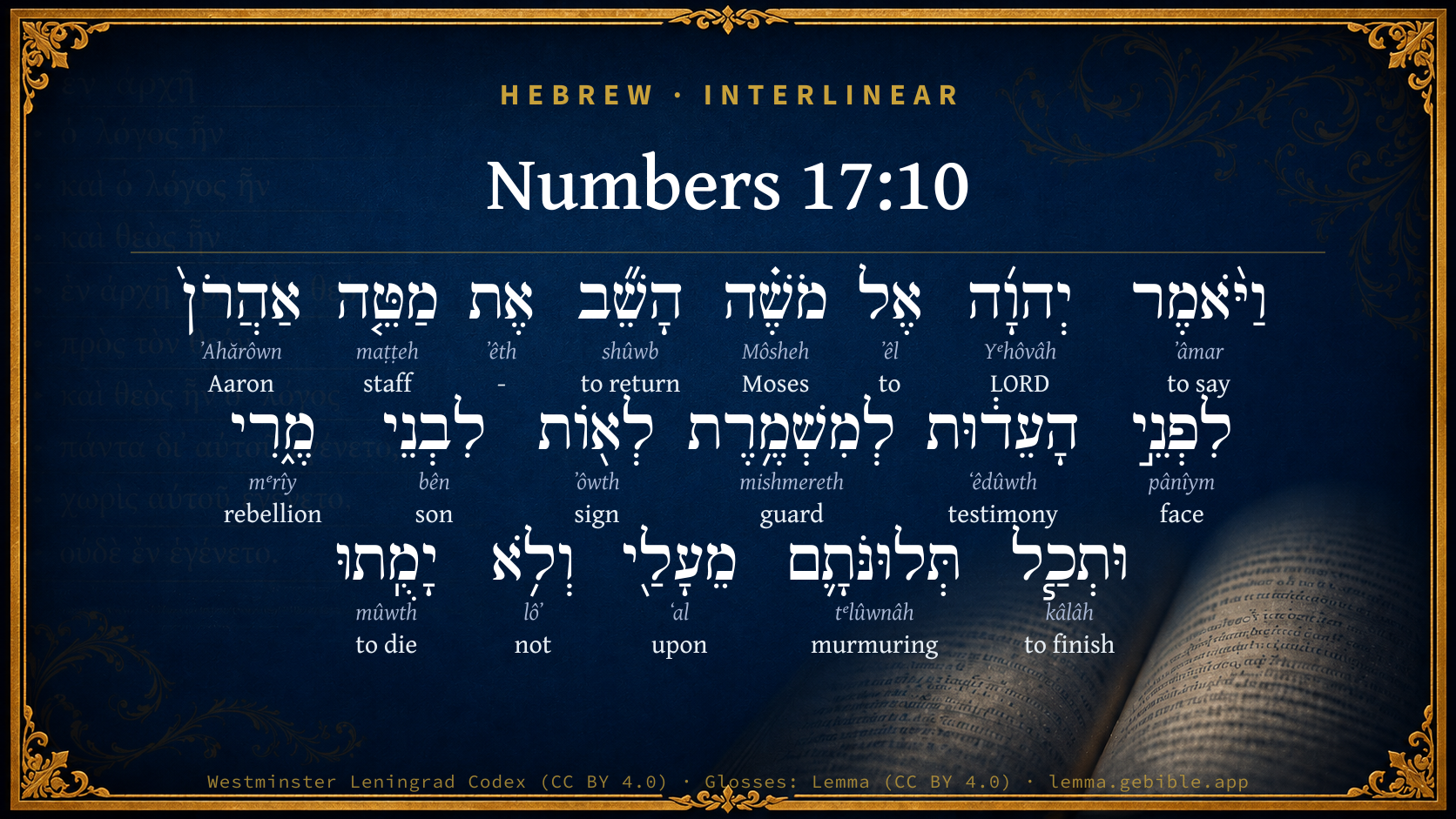
Hebrew (Westminster Leningrad Codex) Numbers 17:10 appears in the Hebrew Old Testament. The text above is from the Westminster Leningrad Codex. Each word links to its Strong’s number, a concise gloss, and parsing drawn from the Open Scriptures Hebrew Bible morphology. Click any word for its full Brown-Driver-Briggs (BDB) entry.
Download image
Cite this verse

Numbers 17:10 (World English Bible). Public Domain. Lemma interlinear Bible study tool, https://lemma.gebible.app/v/numbers/17/10.

Show BibTeX & RIS
BibTeX
RIS
English Translation
Yahweh said to Moses, Put back the rod of Aaron before the testimony, to be kept for a token against the children of rebellion; that you may make an end of their murmurings against me, that they not die.
World English Bible · Public Domain
Highlights
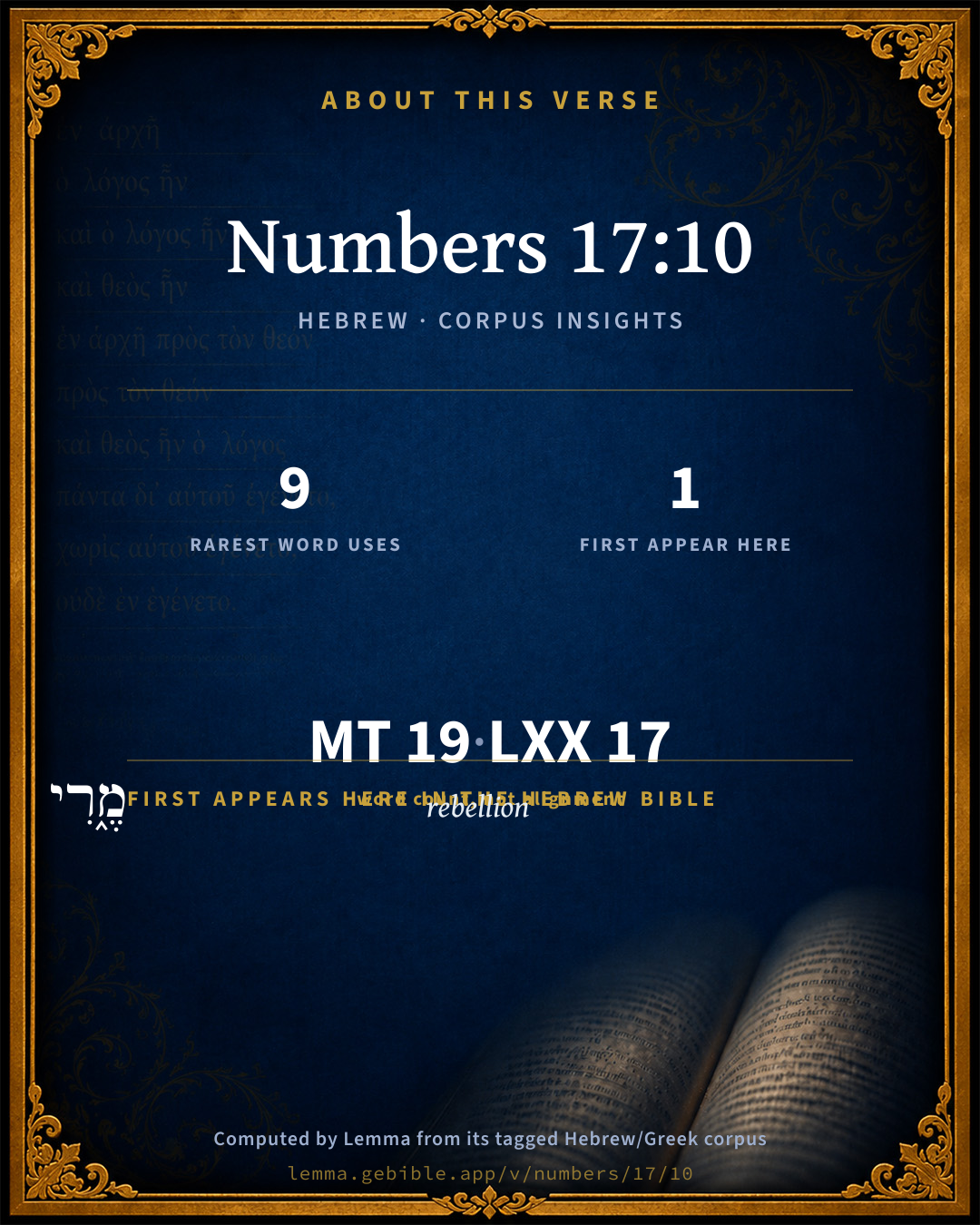
  • 1 first appearance in the Hebrew Bible
Full analysis ↓
Download a study sheet

One document with this verse’s original text, its word-by-word gloss line, the meaning frame, cross-references with their text, attributed commentary, and full source and license credits — printable, and it pastes into notes with its structure intact.

This verse Autodidact and up

Study sheet (.html) Plain text (.txt)

A passage Seminary Student

Up to 50 verses in one chapter. A passage sheet keeps up to 6 commentary sources and 12 cross-references per verse, in the order this page ranks them, and says so on the sheet whenever that leaves anything out. Ask for a single verse and you get the Autodidact verse sheet above.

Everything on this page stays free to read, with no account — the sheet is a download of what is already on screen, not access to it.

Want to remove ads? Support Godless Engineer
Compare translations 3

The same verse in 3 English versions, stacked beneath the original-language interlinear above. Click any original word for its lexicon entry.

Each is an independent rendering of the whole verse — the interlinear is not word-aligned to these translations.

Highlighted words mark where these versions differ — a whole-verse word diff, not a word-by-word alignment.

  • World English Bible Public Domain
    Yahweh said to Moses, Put back the rod of Aaron before the testimony, to be kept for a token against the children of rebellion; that you may make an end of their murmurings against me, that they not die.
  • King James Version Public Domain
    And the LORD said unto Moses, Bring Aaron's rod again before the testimony, to be kept for a token against the rebels; and thou shalt quite take away their murmurings from me, that they die not.
  • unfoldingWord Literal Text CC BY-SA 4.0
    And Yahweh said to Moses, “Return the staff of Aaron to the face of the Testimony for keeping, for a sign for the sons of rebellion. And you shall finish their murmurings from upon me, and they shall not die.”

unfoldingWord Literal Text — © unfoldingWord, licensed CC BY-SA 4.0. Word-aligned USFM3 via Door43 (git.door43.org/unfoldingWord/en_ult).

Versions to compare (up to 4)

3 of 4 selected

Show all 18 translations

Every available English version of this verse, each an independent rendering of the whole verse.

  • World English Bible Public Domain
    Yahweh said to Moses, Put back the rod of Aaron before the testimony, to be kept for a token against the children of rebellion; that you may make an end of their murmurings against me, that they not die.
  • Berean Standard Bible Public Domain
    The LORD said to Moses, “Put Aaron’s staff back in front of the Testimony, to be kept as a sign for the rebellious, so that you may put an end to their grumbling against Me, lest they die.”
  • Majority Standard Bible Public Domain
    The LORD said to Moses, “Put Aaron’s staff back in front of the Testimony, to be kept as a sign for the rebellious, so that you may put an end to their grumbling against Me, lest they die.”
  • King James Version Public Domain
    And the LORD said unto Moses, Bring Aaron's rod again before the testimony, to be kept for a token against the rebels; and thou shalt quite take away their murmurings from me, that they die not.
  • American Standard Version (1901) Public Domain
    And Jehovah said unto Moses, Put back the rod of Aaron before the testimony, to be kept for a token against the children of rebellion; that thou mayest make an end of their murmurings against me, that they die not.
  • Revised Version (1885) Public Domain
    And the LORD said unto Moses, Put back the rod of Aaron before the testimony, to be kept for a token against the children of rebellion; that thou mayest make an end of their murmurings against me, that they die not.
  • Geneva Bible (1599) Public Domain
    After, the Lord said vnto Moses, Bring Aarons rod againe before the Testimonie to bee kept for a token to the rebellious children, and thou shalt cause their murmurings to cease from me, that they dye not.
  • Douay-Rheims (1899) Public Domain
    And the Lord said to Moses: Carry back the rod of Aaron into the tabernacle of the testimony, that it may be kept there for a token of the rebellious children of Israel, and that their complaints may cease from me lest they die.
  • Young's Literal Translation Public Domain
    And Jehovah saith unto Moses, `Put back the rod of Aaron, before the testimony, for a charge, for a sign to the sons of rebellion, and thou dost remove their murmurings from off me, and they do not die;'
  • Literal Standard Version CC BY-SA 4.0
    And YHWH says to Moses, “Put back the rod of Aaron before the Testimony, for a charge, for a sign to the sons of rebellion, and you remove their murmurings from off Me, and they do not die”;
  • Unlocked Literal Bible CC BY-SA 4.0
    Yahweh said to Moses, “Put Aaron's staff in front of the covenant decrees. Keep it as a sign of guilt against the people who rebelled so that you may end complaints against me, or they will die.”
  • unfoldingWord Literal Text CC BY-SA 4.0
    And Yahweh said to Moses, “Return the staff of Aaron to the face of the Testimony for keeping, for a sign for the sons of rebellion. And you shall finish their murmurings from upon me, and they shall not die.”
  • Darby Bible Public Domain
    And Jehovah said to Moses, Bring Aaron's staff again before the testimony, to be kept as a token for the sons of rebellion, that thou mayest put an end to their murmurings before me, that they may not die.
  • World Messianic Bible Public Domain
    The LORD said to Moses, “Put back the rod of Aaron before the covenant, to be kept for a token against the children of rebellion; that you may make an end of their complaining against me, that they not die.”
  • Webster's Bible Public Domain
    And the LORD said to Moses, Bring Aaron's rod again, before the testimony, to be kept for a token against the rebels; and thou shalt quite take away their murmurings from me, that they die not.
  • Free Bible Version CC BY-SA 4.0
    The Lord told Moses, “Put Aaron's walking stick back in front of the Testimony, to be kept there as a reminder to warn anyone who wants to rebel, so that you may stop their complaining against me. Otherwise they'll die.”
  • Bible in Basic English Public Domain
    And the Lord said to Moses, Put Aaron's rod back in front of the ark of witness, to be kept for a sign against this false-hearted people, so that you may put a stop to their outcries against me, and death may not overtake them.
  • JPS Tanakh (1917) Public Domain
    (17-25) And the LORD said unto Moses: 'Put back the rod of Aaron before the testimony, to be kept there, for a token against the rebellious children; that there may be made an end of their murmurings against Me, that they die not.'

Literal Standard Version (2020), Covenant Press — licensed CC BY-SA 4.0. Text via the HelloAO Bible API (eBible.org). Unlocked Literal Bible (unfoldingWord) — licensed CC BY-SA 4.0. Text via the HelloAO Bible API (eBible.org). unfoldingWord Literal Text — © unfoldingWord, licensed CC BY-SA 4.0. Word-aligned USFM3 via Door43 (git.door43.org/unfoldingWord/en_ult). Free Bible Version, Dr. Jonathan Gallagher — licensed CC BY-SA 4.0. Text via the HelloAO Bible API (eBible.org).

Word by word

More ways to search: Search by grammar → Find every occurrence → Compare this word →

Practice this passage: Drill this verse → Learn its vocabulary →

תְּלוּנֹּתָ֛ם
tᵉlûwnâh
H8519
“murmurings · their”
Noun, Common, Feminine, Plural, Construct + Suffix, Personal, 3rd Person, Masculine, Plural
Part of Speech
Noun
Type
Common
Gender
Feminine
Number
Plural
State
Construct
Full BDB Definition

Origin: from H3885 in the sense of obstinacy

TWOT: 1097a

murmuring
  1. וַיֹּ֨אמֶר ʼâmar H559 “and · to say” Conjunction + Verb, Qal, Sequential Imperfect, 3rd Person, Masculine, Singular
  2. יְהוָ֜ה Yᵉhôvâh H3068 “LORD” Noun, Proper
  3. אֶל ʼêl H413 “to” Preposition
  4. מֹשֶׁ֗ה Môsheh H4872 “Moses” Noun, Proper
  5. הָשֵׁ֞ב shûwb H7725 “return” Verb, Hiphil, Imperative, 2nd Person, Masculine, Singular
  6. אֶת ʼêth H853 “-” Particle, Direct Object
  7. מַטֵּ֤ה maṭṭeh H4294 “staff of” Noun, Common, Masculine, Singular, Construct
  8. אַהֲרֹן֙ ʼAhărôwn H175 “Aaron” Noun, Proper
  9. לִפְנֵ֣י pânîym H6440 “to/for · face(s) of” Preposition + Noun, Common, Both, Plural, Construct
  10. הָעֵד֔וּת ʻêdûwth H5715 “the · testimony” Particle, Definite Article + Noun, Common, Feminine, Singular, Absolute
  11. לְמִשְׁמֶ֥רֶת mishmereth H4931 “to/for · guard” Preposition + Noun, Common, Feminine, Singular, Absolute
  12. לְא֖וֹת ʼôwth H226 “to/for · sign” Preposition + Noun, Common, Both, Singular, Absolute
  13. לִבְנֵי bên H1121 “to/for · sons of” Preposition + Noun, Common, Masculine, Plural, Construct
  14. מֶ֑רִי mᵉrîy H4805 “rebellion” Noun, Common, Masculine, Singular, Absolute
  15. וּתְכַ֧ל kâlâh H3615 “and · to finish” Conjunction + Verb, Piel, Imperfect, 2nd Person, Masculine, Singular
  16. מֵעָלַ֖י ʻal H5921 “from · upon · me” Preposition + Preposition + Suffix, Personal, 1st Person, Common, Singular
  17. וְלֹ֥א lôʼ H3808 “and · not” Conjunction + Particle, Negative
  18. יָמֻֽתוּ mûwth H4191 “to die” Verb, Qal, Imperfect, 3rd Person, Masculine, Plural

About this verse

These counts appear in no published source. They are computed here, from the morphology-tagged text and Lemma’s own curated glosses. What Lemma adds →

19
words
19
distinct lemmas
Pentateuch
section

Notable vocabulary

The rarest word here is תְּלוּנֹּתָ֛ם murmuring H8519 — appearing just 9 times in the whole Hebrew Bible.

First appearance in Scripture

This word makes its first canonical appearance in the Hebrew Bible here:

  • מֶ֑רִי rebellion H4805

Shared distinctive vocabulary

תְּלוּנֹּתָ֛ם murmuring H8519 occurs in 7 verses of the Hebrew Bible. Also found in:

Grammatical profile

  • 4 verbs
  • 11 nouns
  • 2 prepositions
  • 2 particles

Verb forms

  • וַיֹּ֨אמֶר Qal · Sequential Imperfect
  • הָשֵׁ֞ב Hiphil · Imperative
  • וּתְכַ֧ל Piel · Imperfect
  • יָמֻֽתוּ Qal · Imperfect

Hebrew & Septuagint length

In English translation the verse runs 39 words from the Hebrew and 39 from the Septuagint (LXX English) — the same length.

A rough comparison of the two English renderings, which tokenize alike — not a word-level alignment.

Word counts can differ between the Hebrew and the Greek without any difference in meaning — e.g. the Hebrew direct-object marker אֵת has no separate Greek word, and Greek often adds the article ὁ.

In the original languages it is 19 Hebrew tokens and 17 Greek tokens — but the two are counted differently (Hebrew bundles its prefixes and suffixes into one token; the Greek is in lemma form), so that isn’t a like-for-like length.

Cross-references

13

Topical passages linked to Numbers 17:10 in the Treasury of Scripture Knowledge — connected by theme and wording, ordered by reader-vote popularity; previews shown in the World English Bible.

  • Ephesians 5:6 Let no one deceive you with empty words. For because of these things, the wrath of God comes on the children of disobedience.
  • Hebrews 9:4 having a golden altar of incense, and the ark of the covenant overlaid on all sides with gold, in which was a golden pot holding the manna, Aaron's rod that budded, and the tables of the covenant;
  • Isaiah 1:2 Hear, heavens, And listen, earth; for Yahweh has spoken: I have nourished and brought up children, And they have rebelled against me.
  • Exodus 16:32 Moses said, "This is the thing which Yahweh has commanded, 'Let an omer-full of it be kept throughout your generations, that they may see the bread with which I fed you in the wilderness, when I brought you forth from the land of Egypt."
  • Numbers 16:38 even the censers of these sinners against their own lives; and let them be made beaten plates for a covering of the altar: for they offered them before Yahweh; therefore they are holy; and they shall be a sign to the children of Israel.
  • Numbers 16:40 to be a memorial to the children of Israel, to the end that no stranger, who isn't of the seed of Aaron, comes near to burn incense before Yahweh; that he not be as Korah, and as his company: as Yahweh spoke to him by Moses.
  • Deuteronomy 9:24 You have been rebellious against Yahweh from the day that I knew you.
  • Deuteronomy 31:19–26 Now therefore write you this song for you, and teach you it the children of Israel: put it in their mouths, that this song may be a witness for me against the children of Israel.
  • 1 Samuel 2:12 Now the sons of Eli were base men; they didn't know Yahweh.
  • 1 Samuel 30:22 Then answered all the wicked men and base fellows, of those who went with David, and said, Because they didn't go with us, we will not give them anything of the spoil that we have recovered, except to every man his wife and his children, that he may lead them away, and depart.
  • Psalms 57:4 My soul is among lions. I lie among those who are set on fire, Even the sons of men, whose teeth are spears and arrows, And their tongue a sharp sword.
  • Hosea 10:9 "Israel, you have sinned from the days of Gibeah. There they remained. The battle against the children of iniquity doesn't overtake them in Gibeah.
  • Ephesians 2:2–3 in which you once walked according to the course of this world, according to the prince of the powers of the air, the spirit who now works in the children of disobedience;

Cross-references courtesy of OpenBible.info (CC BY 4.0).

Hebrew and Greek witnesses Masoretic Hebrew ↔ Greek Septuagint

The same verse in the two great witnesses to the Old Testament, shown verse-for-verse.

These are two independent witnesses, not word-aligned to each other, and the Septuagint is shown in lemma (dictionary) form.

Hebrew Numbers 17:10 Masoretic · Westminster Leningrad Codex

וַיֹּ֨אמֶר יְהוָ֜ה אֶל מֹשֶׁ֗ה הָשֵׁ֞ב אֶת מַטֵּ֤ה אַהֲרֹן֙ לִפְנֵ֣י הָעֵד֔וּת לְמִשְׁמֶ֥רֶת לְא֖וֹת לִבְנֵי מֶ֑רִי וּתְכַ֧ל תְּלוּנֹּתָ֛ם מֵעָלַ֖י וְלֹ֥א יָמֻֽתוּ

Yahweh said to Moses, Put back the rod of Aaron before the testimony, to be kept for a token against the children of rebellion; that you may make an end of their murmurings against me, that they not die.

World English Bible · Public Domain

Greek LXX Numbers 17:10 Septuagint · lemma form

ἐκχωρέω ἐκ μέσος ὁ συναγωγή οὗτος καί ἐκ ἀναἁλίσκω αὐτός εἰς ἅπαξ καί πίπτω ἐπί πρόσωπον αὐτός

And the Lord said to Moses, Lay up the rod of Aaron before the testimonies to be kept as a sign for the children of the disobedient; and let their murmuring cease from me, and they shall not die.

LXX2012 (modern English Septuagint) · Public Domain

Hebrew: Westminster Leningrad Codex (CC BY 4.0). Greek: Septuagint (public domain); English from LXX2012 (modern English Septuagint) (Public Domain). How the Septuagint differs from the Hebrew →

Targum (Aramaic paraphrase)

2

The Targum is the ancient Jewish Aramaic paraphrase of the Hebrew Scriptures — an interpretive translation, not the Hebrew text itself. Onkelos (literal) and Pseudo-Jonathan (expansive) render the Torah, and Jonathan the Prophets. Coverage is partial: where no permissively-licensed English translation exists for a verse, only the Aramaic is shown. This is verse-level text, not a word-by-word alignment to the Hebrew.

  1. Targum Onkelos Torah (Genesis–Deuteronomy)
    אִתְפְרָשׁוּ מִגוֹ כְּנִשְׁתָּא הָדָא וְאֱשֵׁיצֵי יָתְהוֹן כְּשָׁעָה וּנְפָלוּ עַל אַפֵּיהוֹן

    (no public-domain English translation for this verse)

    Targum Onkelos — Aramaic: “Onkelos Genesis” (public domain); “Onkelos Exodus” (public domain); “Onkelos Leviticus” (public domain); “Onkelos Numbers” (public domain); “Onkelos Deuteronomy” (public domain). English: “Sefaria Community Translation” (CC0 1.0 (public-domain dedication)); “J.W. Etheridge. The Targums of Onkelos and Jonathan Ben Uzziel on the Pentateuch. London: Longmans, Green, 1862” (public domain). Text via Sefaria.

  2. Targum Pseudo-Jonathan Torah (Genesis–Deuteronomy)
    אִתְפְּרָשׁוּ מִגוֹ כְּנִשְׁתָּא הֲדָא וְאֵישֵׁיצֵי יַתְהוֹן כְּשָׁעָה זְעֵירָא וְאִתְרְכִינוּ בִּצְלוֹ עַל אַפֵּיהוֹן

    Separate from the midst of this congregation, and I will consume them at once. But they bowed themselves on their faces in prayer.

    Targum Pseudo-Jonathan — Aramaic: “Targum Jonathan on Genesis” (public domain); “Targum Jonathan on Exodus” (public domain); “Targum Jonathan on Leviticus” (public domain); “Targum Jonathan on Numbers” (public domain); “Targum Jonathan on Deuteronomy” (public domain). English: “The Targum of Jonathan ben Uzziel, trans. J. W. Etheridge, London, 1862” (public domain). Text via Sefaria.

Commentary

Notes on Numbers 17:10 from classic Christian and Jewish commentators (each source and its license shown beneath its notes). The classic Christian expositions comment on the surrounding passage and are grouped to its opening verse, so a note may address several verses; the Jewish commentaries on the Tanakh (Rashi and others) are per-verse, so they appear only where the commentator wrote on this verse.

Lemma curates 59 commentaries, every one of them public domain or Creative Commons licensed, each selected and text-cleaned for this edition rather than reprinted as found. About our sources →

Trapp's Complete Commentary

John Trapp

Num 17:10 And the LORD said unto Moses, Bring Aaron’s rod again before the testimony, to be kept for a token against the rebels; and thou shalt quite take away their murmurings from me, that they die not.

Ver. 10. And thou shalt quite take away their murmurinus.] Which yet would hardly be done. See on Num 17:5. Many men’s lips, like rusty hinges, for want of the oil of grace and gladness, move not without murmuring and complaining.

John Trapp, A Commentary or Exposition upon All the Books of the Old and New Testament (1647–1656) — public domain. Text from a community e-Sword module.

Joseph Benson's Commentary

Num 17:10. To be kept for a token — It is probable, the buds, and blossoms, and fruit, (all which could never have grown together, but by miracle,) continued fresh, the same power which produced them in a night, preserving them for ages.

Joseph Benson's Commentary on the Old and New Testaments (1811–1818) — public domain. Text from a community e-Sword module.

Geneva Bible (1599)

Geneva Bible translators

Grudging that Aaron should be high Priest.

Geneva Bible (1599) marginal notes — public domain. Text via Bolls.life.

Jamieson, Fausset & Brown

Robert Jamieson, A. R. Fausset & David Brown

Bring Aaron's rod again before the testimony, to be kept for a token against the rebels--For if, after all admonitions and judgments, seconded by miracles, the people should still rebel, they would certainly pay the penalty by death.

Jamieson, Fausset & Brown — Commentary Critical and Explanatory on the Whole Bible (1871) — public domain (CC PDM 1.0). Text via the HelloAO Bible API.

Ellicott's Commentary for English Readers

(10) Bring Aaron’s red again before the testimony.—Better, Put back (literally, make to return) Aaron’s rod . . . It is not stated here that the rod was put within the ark. Nor is it so stated in Exo_16:33 with regard to the pot of manna. Neither of these was within the ark when it was brought into Solomon’s temple (1Ki_8:9); but this statement is by no means inconsistent with that contained in Heb_9:4, inasmuch as the assertion that there was nothing but the tables of the law in the ark at that time does not prove that there were not other things in it at an earlier period, and may be thought to suggest the inference that such was actually the case. The Jews have a tradition that when King Josiah ordered the ark to be put in the house which King Solomon built, the rod of Aaron and the pot of manna and the anointing oil were hidden with the ark, and that at that time the rod of Aaron had buds and almonds.

A Bible Commentary for English Readers, edited by Charles John Ellicott (1878–1897) — public domain. Text from a community e-Sword module.

The Cambridge Bible for Schools and Colleges

gen. ed. J. J. S. Perowne

10. Put back the staff of Aaron] Cf. Heb_9:4.

the sons of rebellion] A common Heb. idiom to express a quality or characteristic; cf. 2Sa_3:34; 2Sa_7:10; 2Sa_12:6 (marg.); Pro_31:5 (marg.). ‘House of rebellion’ is found very frequently in Ezek. as a designation of the house of Israel.

The Cambridge Bible for Schools and Colleges (gen. ed. J. J. S. Perowne; Cambridge University Press, 1878–1918) — public domain. Text from a community e-Sword module.

John Gill's Exposition

And Moses did so; as the Lord commanded him, even so did he. Took Aaron's rod, and laid it up before the ark for the purpose mentioned, being a faithful servant to God in all his house.

And Moses did so; as the Lord commanded him, even so did he. Took Aaron's rod, and laid it up before the ark for the purpose mentioned, being a faithful servant to God in all his house.

Numbers 17:12

num 17:12

num 17:12

num 17:12And the children of Israel spake unto Moses,.... The princes of the tribes, who had seen the miracle of the rod, and knew that it was laid up in the most holy place, and for what purpose, which gave them a sensible concern: these, and as many as were acquainted with it, addressed Moses upon it, as follows:

saying, behold, we die, we perish, we all perish; which being expressed without the copulative, and in different words, show that they were spoken quick and in haste, and discover the passion of mind and distress they were in, and the sense they had of their sin and danger, fearing they should all die and perish, as many had already; it has respect, as some think, to punishments past and future, so the Targum of Jonathan,"some of us have been consumed by flaming fire, and others of us have been swallowed up in the earth and are lost, and, lo, we are accounted as if all of us would perish.''

John Gill's Exposition of the Whole Bible (1746–1763) — public domain (CC PDM 1.0). Text via the HelloAO Bible API.

Albert Barnes' Notes on the Bible

The testimony - i. e. the two tables of the Law; compare Exo 25:16 note. No doubt the rod lay in front of the tables within the ark. In the days of Solomon 1Ki 8:9 there was nothing in the ark save the Two tables. Aaron’s rod was probably lost when the ark was taken by the Philistines.

Albert Barnes' Notes on the Bible (1834–1885) — public domain. Text from a community e-Sword/MySword module.

Haydock's Catholic Bible Commentary

Testimony. St. Paul (Hebrews ix. 4,) says it was in the ark. See Deuteronomy xxxi. 26. (Calmet) --- It was not the rod with which so many miracles had been wrought. (Tirinus)

George Leo Haydock (1774–1849), Haydock's Catholic Family Bible and Commentary, 1859 edition — public domain. Excludes Psalms (Douay-Rheims chapter numbering differs from Protestant) and Deuterocanonical books (Catholic canon only).

Matthew Poole's English Annotations

For if after all these warnings and prohibitions, backed with such miracles and judgments, they shall usurp the priesthood, they shall assuredly die for it.

Matthew Poole's English Annotations on the Holy Bible (1683–1685) — public domain. Text from a community e-Sword/MySword module.

Whedon's Commentary on the Bible

Daniel D. Whedon

10. To be kept for a token — Probably the buds, blossoms, and fruit remained upon the rod fresh from age to age, a standing miracle and token of the presence and inworking of the Spirit of God in the priestly office, making its ministrations efficacious for the salvation of obedient Israel.

Daniel D. Whedon (gen. ed.), Commentary on the Old and New Testaments (1874–1909) — public domain. Text from a community e-Sword module.

The Pulpit Commentary

Before the testimony. By comparison with verse 7 this should mean before the ark in which the "testimony" lay. In Heb_9:4, however, the rod is said to have been in the ark, although before Solo-men"s time it had disappeared. (1Ki_8:9) We may suppose that after it had been inspected by the princes it was deposited for safer preservation and easier conveyance inside the sacred chest. To be kept for a token against the rebels. Rather, "against the rebellious," literally, "children of rebellion". (cf. Eph_2:2, Eph_2:3) It could only serve as a token as long as it retained the evidences of having sprouted and fruited, either miraculously in a fresh state, or naturally in a withered state. As a fact, however, it does not appear that the lesson ever needed to be learnt again, and therefore we may suppose that the rod was left first to shrivel with age, and then to be lost through some accident.

The two brethren and their rods.

I The rod of Moses, a shepherd"s staff, a commonplace instrument, changed by God"s power into "the rod of God", (Exo_4:17) "the rod of his strength.

(1) For the conviction of Moses himself; (Exo_4:1-5)

(2) for the punishment of the rebellious; (Exo_7:20, &c.);

(3) for the deliverance of God"s servants from imminent danger; (Exo_14:16, Exo_14:26)

(4) for the supply of their most urgent wants; (Exo_17:5, Exo_17:6)

(5) for the conquest of their foes. (Exo_17:9-12) Thus God makes the weakest commonest things of the world "mighty through God". (1Co_1:27 2Co_10:4) The rod of the lowly Jesus is "a rod of strength," or" of iron". (Psa_2:9 Psa_110:2 Isa_11:4)

II The rod of Aaron, a tribal scepter, a symbol of power, as the shepherd"s staff was not. This symbol of authority used for remedial and spiritual purposes.

(1) For the confutation of presumptuous upstarts;

(2) for the preservation of the tempted from further sin and consequent destruction (verse 10):

(3) for a type of the fruitfulness of every institution ordained and sustained by God. See further under verse 8. Thus God makes his mightiest power the means of attaining spiritual ends for the we]fare even of sinners. "Christ the power of God" is "the power of God unto salvation." The "Prince" is also the "Saviour". P. (Act_5:31)

The Pulpit Commentary (1880–1919), ed. H.D.M. Spence-Jones & Joseph S. Exell — public domain. Text from a community e-Sword module.

John Wesley's Explanatory Notes

To be kept for a token - it is probable, the buds and blossoms and fruit, all which could never have grown together, but by miracle, continued fresh, the same which produced them in a night preserving them for ages.

John Wesley, Explanatory Notes Upon the Whole Bible (1754–1765) — public domain. Text via the GEBible commentary corpus.

unfoldingWord translationNotes

Door43 World Missions Community

the covenant decrees

The phrase "the covenant decrees" refers to the box that held the tablets that the covenant decrees were written on. AT: "the ark of the covenant" or "the box that holds the covenant decrees" (See: Synecdoche)

so that you may end complaints against me

The word "complaints" is an abstract noun that can be expressed as a verb. AT: "so that you may stop them from complaining against me" (See: Abstract Nouns)

or they will die

This is what would happen if the people were to continue complaining. God wanted to prevent this. AT: "so that they will not die"

translationWords

Aaron

covenant

decree

sign

guilt

rebel

die

command

unfoldingWord translationNotes — © Distant Shores Media and the Door43 World Missions Community, licensed CC BY-SA 4.0. Source: git.door43.org/Door43/en_tn.

Ramban (Nachmanides)

Rabbi Moshe ben Nachman (Ramban / Nachmanides)

GET YOU UP FROM AMONG THIS CONGREGATION, THAT I MAY CONSUME THEM IN A MOMENT. I have not understood the intention of this verse, nor of its companion above, Separate yourselves from among this congregation, for G-d has the power to kill many people in a plague around one righteous person, and he alone remains [alive], as happened during [the plague on] the firstborn of Egypt. Similarly it happened in all other plagues [throughout the generations], that three people would sleep under one blanket — two of them would die whilst the middle one would be saved! It would appear, therefore, that the wrath went forth to slay even the whole congregation with the death of these sinners [Korach and his associates], who had followed in their way, [and so became liable to death either] by the earth opening its mouth or by a consuming fire — these being general punishments which kill all those who are standing there together, unless a miracle of an unusual nature occurs [to save some individuals amongst the people]. Or it may be that the Holy One, blessed be He, said this [Get you up …] in honor of the righteous men, for as long as they were amongst them [the sinners], He would not stretch forth His hand against them. The intention in these and similar words is to inform them that they have to plead for mercy and forgiveness, and Moses in his zeal did so immediately.

Ramban (Nachmanides) on the Tanakh — English translation: “Commentary on the Torah by Ramban (Nachmanides). Translated and annotated by Charles B. Chavel. New York, Shilo Pub. House, 1971-1976” (CC BY 4.0). Text via Sefaria.

Lesson kit

Teaching starters — assembled from the data on this page, not authored interpretation. Every prompt links to the verse data it draws on. Edit before teaching.

Numbers, in the Pentateuch, opens this verse with 19 words (19 distinct Hebrew lemmas). Its most distinctive word is tᵉlûwnâh (“murmuring”). A historical commentator’s framing appears above. Read the whole chapter for the surrounding context.

Discussion questions

  1. What does “murmuring” (tᵉlûwnâh) contribute to the verse as a whole?
  2. This is the first place “rebellion” appears in Scripture (first appears here). What does its debut here establish?
  3. How does Exodus 16:7, which shares the word «murmuring», read alongside this verse?
  4. These translations render this verse differently. What is at stake in choosing one wording over another?
  5. «וַיֹּ֨אמֶר» is a Qal Sequential Imperfect verb. How does that grammatical form shape the action described?
  6. Compare how Trapp's Complete Commentary and Joseph Benson's Commentary read this verse. Where do they agree or differ?

Things to notice

Reading settings

Reading text

Shown beneath each verse's original-language words.

Old Testament
Old Testament edition

Read the OT as the Masoretic Hebrew (MT) or the Greek Septuagint (LXX).

English shown for the Greek Septuagint (in the Hebrew ↔ Greek comparison).

Comparing translations? Open the Compare panel on any verse page to stack up to four side by side.