
Exodus 22:19

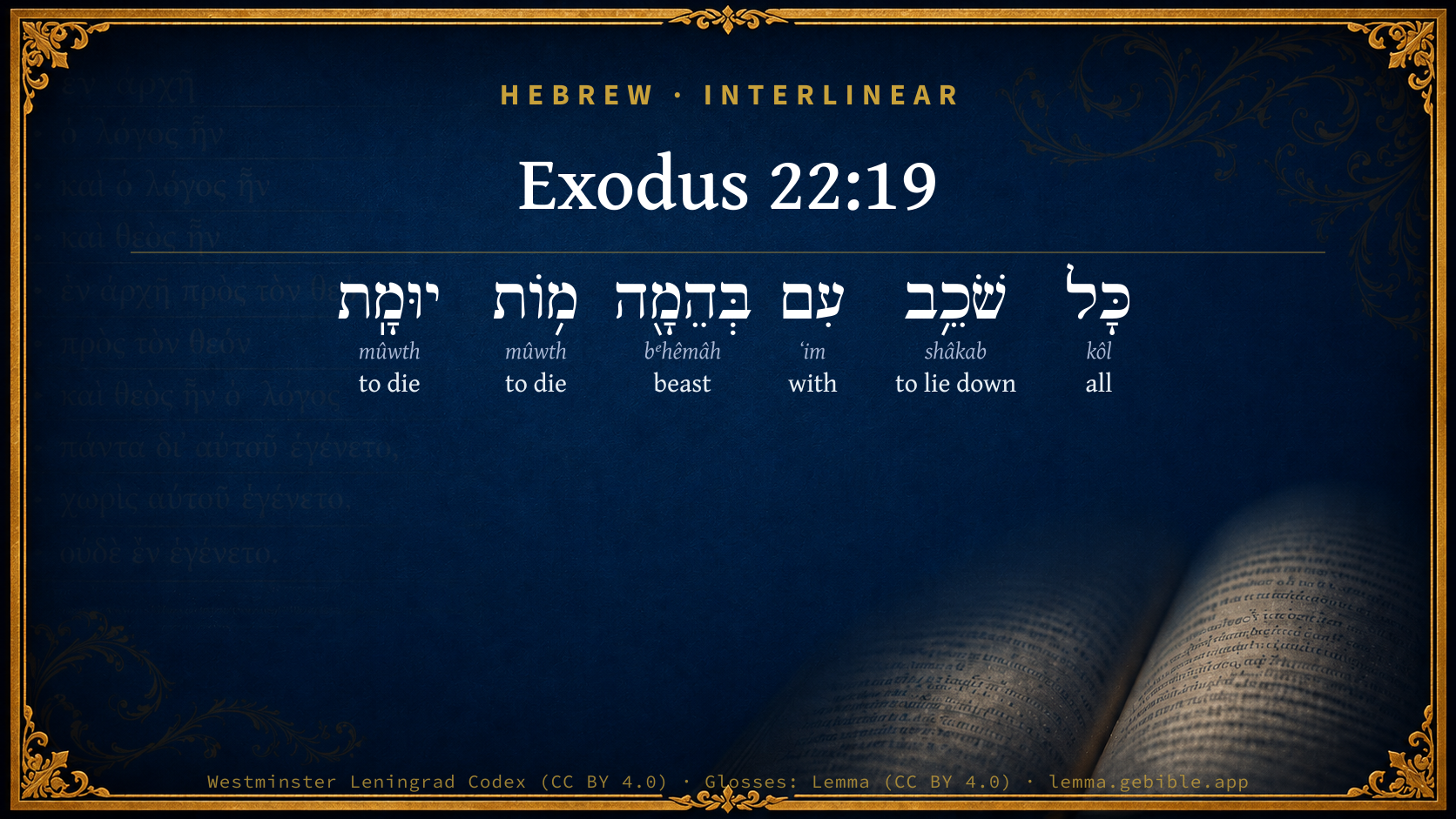
Hebrew (Westminster Leningrad Codex) Exodus 22:19 appears in the Hebrew Old Testament. The text above is from the Westminster Leningrad Codex. Each word links to its Strong’s number, a concise gloss, and parsing drawn from the Open Scriptures Hebrew Bible morphology. Click any word for its full Brown-Driver-Briggs (BDB) entry.
Download image
Cite this verse

Exodus 22:19 (World English Bible). Public Domain. Lemma interlinear Bible study tool, https://lemma.gebible.app/v/exodus/22/19.

Show BibTeX & RIS
BibTeX
RIS
English Translation
"Whoever has sex with an animal shall surely be put to death.
World English Bible · Public Domain
Download a study sheet

One document with this verse’s original text, its word-by-word gloss line, the meaning frame, cross-references with their text, attributed commentary, and full source and license credits — printable, and it pastes into notes with its structure intact.

This verse Autodidact and up

Study sheet (.html) Plain text (.txt)

A passage Seminary Student

Up to 50 verses in one chapter. A passage sheet keeps up to 6 commentary sources and 12 cross-references per verse, in the order this page ranks them, and says so on the sheet whenever that leaves anything out. Ask for a single verse and you get the Autodidact verse sheet above.

Everything on this page stays free to read, with no account — the sheet is a download of what is already on screen, not access to it.

Want to remove ads? Support Godless Engineer
Compare translations 3

The same verse in 3 English versions, stacked beneath the original-language interlinear above. Click any original word for its lexicon entry.

Each is an independent rendering of the whole verse — the interlinear is not word-aligned to these translations.

Highlighted words mark where these versions differ — a whole-verse word diff, not a word-by-word alignment.

  • World English Bible Public Domain
    "Whoever has sex with an animal shall surely be put to death.
  • King James Version Public Domain
    Whosoever lieth with a beast shall surely be put to death.
  • unfoldingWord Literal Text CC BY-SA 4.0
    Any lier with an animal shall surely be put to death.

unfoldingWord Literal Text — © unfoldingWord, licensed CC BY-SA 4.0. Word-aligned USFM3 via Door43 (git.door43.org/unfoldingWord/en_ult).

Versions to compare (up to 4)

3 of 4 selected

Show all 18 translations

Every available English version of this verse, each an independent rendering of the whole verse.

  • World English Bible Public Domain
    "Whoever has sex with an animal shall surely be put to death.
  • Berean Standard Bible Public Domain
    Whoever lies with an animal must surely be put to death.
  • Majority Standard Bible Public Domain
    Whoever lies with an animal must surely be put to death.
  • King James Version Public Domain
    Whosoever lieth with a beast shall surely be put to death.
  • American Standard Version (1901) Public Domain
    Whosoever lieth with a beast shall surely be put to death.
  • Revised Version (1885) Public Domain
    Whosoever lieth with a beast shall surely be put to death.
  • Geneva Bible (1599) Public Domain
    Whosoeuer lieth with a beast, shall dye the death.
  • Douay-Rheims (1899) Public Domain
    Whosoever copulateth with a beast shall be put to death.
  • Young's Literal Translation Public Domain
    `Whoever lieth with a beast is certainly put to death.
  • Literal Standard Version CC BY-SA 4.0
    Whoever lies with a beast is certainly put to death.
  • Unlocked Literal Bible CC BY-SA 4.0
    Whoever sleeps with a beast must surely be put to death.
  • unfoldingWord Literal Text CC BY-SA 4.0
    Any lier with an animal shall surely be put to death.
  • Darby Bible Public Domain
    -- Every one that lieth with a beast shall certainly be put to death.
  • World Messianic Bible Public Domain
    “Whoever has sex with an animal shall surely be put to death.
  • Webster's Bible Public Domain
    Whoever lieth with a beast shall surely be put to death.
  • Free Bible Version CC BY-SA 4.0
    Anyone who has sex with an animal must be executed.
  • Bible in Basic English Public Domain
    Any man who has sex connection with a beast is to be put to death.
  • JPS Tanakh (1917) Public Domain
    (22-18) Whosoever lieth with a beast shall surely be put to death.

Literal Standard Version (2020), Covenant Press — licensed CC BY-SA 4.0. Text via the HelloAO Bible API (eBible.org). Unlocked Literal Bible (unfoldingWord) — licensed CC BY-SA 4.0. Text via the HelloAO Bible API (eBible.org). unfoldingWord Literal Text — © unfoldingWord, licensed CC BY-SA 4.0. Word-aligned USFM3 via Door43 (git.door43.org/unfoldingWord/en_ult). Free Bible Version, Dr. Jonathan Gallagher — licensed CC BY-SA 4.0. Text via the HelloAO Bible API (eBible.org).

Word by word

More ways to search: Search by grammar → Find every occurrence → Compare this word →

Practice this passage: Drill this verse → Learn its vocabulary →

About this verse

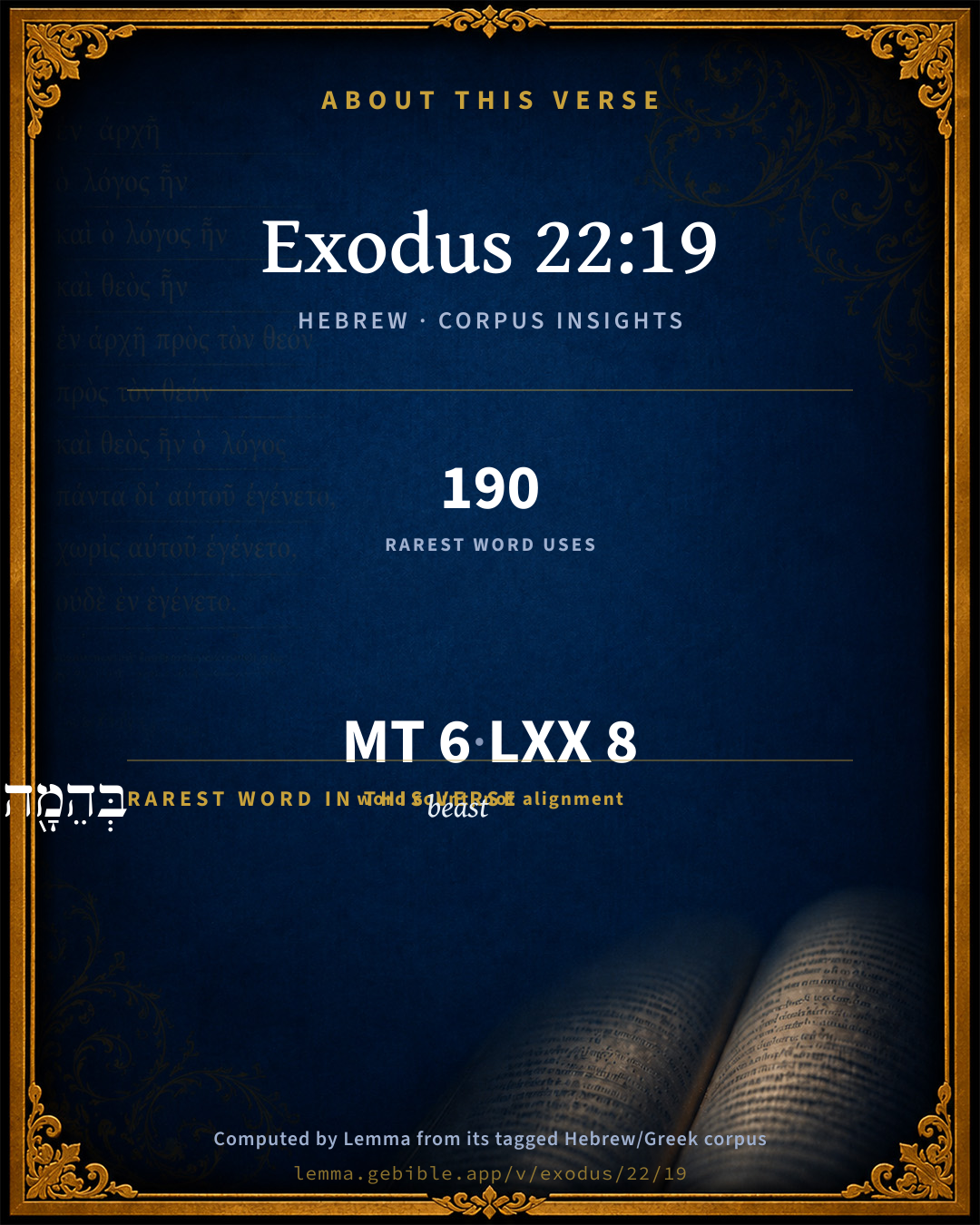
These counts appear in no published source. They are computed here, from the morphology-tagged text and Lemma’s own curated glosses. What Lemma adds →

6
words
5
distinct lemmas
Pentateuch
section

Grammatical profile

  • 3 verbs
  • 2 nouns
  • 1 preposition

Verb forms

  • שֹׁכֵ֥ב Qal · Participle Active
  • מ֥וֹת Qal · Infinitive Absolute
  • יוּמָֽת Hophal · Imperfect

Repetition

A word recurs within this verse — often emphatic in Hebrew:

  • מ֥וֹת to die H4191 ×2

Hebrew & Septuagint length

In English translation the verse runs 12 words from the Hebrew and 13 from the Septuagint (LXX English) — closely comparable.

A rough comparison of the two English renderings, which tokenize alike — not a word-level alignment.

Word counts can differ between the Hebrew and the Greek without any difference in meaning — e.g. the Hebrew direct-object marker אֵת has no separate Greek word, and Greek often adds the article ὁ.

In the original languages it is 6 Hebrew tokens and 8 Greek tokens — but the two are counted differently (Hebrew bundles its prefixes and suffixes into one token; the Greek is in lemma form), so that isn’t a like-for-like length.

Cross-references

4

Topical passages linked to Exodus 22:19 in the Treasury of Scripture Knowledge — connected by theme and wording, ordered by reader-vote popularity; previews shown in the World English Bible.

  • Leviticus 18:23 "'You shall not lie with any animal to defile yourself with it; neither shall any woman give herself to an animal, to lie down with it: it is a perversion.
  • Deuteronomy 27:21 Cursed be he who lies with any manner of animal. All the people shall say, Amen.
  • Leviticus 20:15–16 "'If a man lies with an animal, he shall surely be put to death; and you shall kill the animal.
  • Leviticus 18:25 The land was defiled: therefore I punished its iniquity, and the land vomitted out her inhabitants.

Cross-references courtesy of OpenBible.info (CC BY 4.0).

Hebrew and Greek witnesses Masoretic Hebrew ↔ Greek Septuagint

The same verse in the two great witnesses to the Old Testament, shown verse-for-verse.

These are two independent witnesses, not word-aligned to each other, and the Septuagint is shown in lemma (dictionary) form.

Hebrew Exodus 22:19 Masoretic · Westminster Leningrad Codex

כָּל שֹׁכֵ֥ב עִם בְּהֵמָ֖ה מ֥וֹת יוּמָֽת

"Whoever has sex with an animal shall surely be put to death.

World English Bible · Public Domain

Greek LXX Exodus 22:19 Septuagint · lemma form

ὁ θυσιάζω θεός θάνατος ὀλεθρεύω πλήν κύριος μόνος

Every one that lies with a beast you⌃ shall surely put to death.

LXX2012 (modern English Septuagint) · Public Domain

Hebrew: Westminster Leningrad Codex (CC BY 4.0). Greek: Septuagint (public domain); English from LXX2012 (modern English Septuagint) (Public Domain). How the Septuagint differs from the Hebrew →

Targum (Aramaic paraphrase)

2

The Targum is the ancient Jewish Aramaic paraphrase of the Hebrew Scriptures — an interpretive translation, not the Hebrew text itself. Onkelos (literal) and Pseudo-Jonathan (expansive) render the Torah, and Jonathan the Prophets. Coverage is partial: where no permissively-licensed English translation exists for a verse, only the Aramaic is shown. This is verse-level text, not a word-by-word alignment to the Hebrew.

  1. Targum Onkelos Torah (Genesis–Deuteronomy)
    דְדַבַּח לְטַעְוַת עַמְמַיָא יִתְקְטֵל אֶלָהֵן לִשְׁמָא דַיְיָ בִּלְחוֹדוֹהִי:

    (no public-domain English translation for this verse)

    Targum Onkelos — Aramaic: “Onkelos Genesis” (public domain); “Onkelos Exodus” (public domain); “Onkelos Leviticus” (public domain); “Onkelos Numbers” (public domain); “Onkelos Deuteronomy” (public domain). English: “Sefaria Community Translation” (CC0 1.0 (public-domain dedication)); “J.W. Etheridge. The Targums of Onkelos and Jonathan Ben Uzziel on the Pentateuch. London: Longmans, Green, 1862” (public domain). Text via Sefaria.

  2. Targum Pseudo-Jonathan Torah (Genesis–Deuteronomy)
    כָּל מַאן דְּדַבַּח לְטַעֲוַות עַמְמַיָא יִתְקְטֵל בְּסַיְיפָא וְנִכְסוֹי יִתְגַמְרוּן בְּגִין כֵּן לָא תְהוֹן פַּלְחִין אֱלָהֵן לִשְׁמָא דַיְיָ בִּלְחוֹדוֹי

    Whosoever sacrificeth to the idols of the Gentiles shall be slain with the sword, and his goods be destroyed; for ye shall worship only the Name of the Lord.

    Targum Pseudo-Jonathan — Aramaic: “Targum Jonathan on Genesis” (public domain); “Targum Jonathan on Exodus” (public domain); “Targum Jonathan on Leviticus” (public domain); “Targum Jonathan on Numbers” (public domain); “Targum Jonathan on Deuteronomy” (public domain). English: “The Targum of Jonathan ben Uzziel, trans. J. W. Etheridge, London, 1862” (public domain). Text via Sefaria.

Commentary

Notes on Exodus 22:19 from classic Christian and Jewish commentators (each source and its license shown beneath its notes). The classic Christian expositions comment on the surrounding passage and are grouped to its opening verse, so a note may address several verses; the Jewish commentaries on the Tanakh (Rashi and others) are per-verse, so they appear only where the commentator wrote on this verse.

Lemma curates 59 commentaries, every one of them public domain or Creative Commons licensed, each selected and text-cleaned for this edition rather than reprinted as found. About our sources →

Trapp's Complete Commentary

John Trapp

Exo 22:19 Whosoever lieth with a beast shall surely be put to death.

Ver. 19. Be put to death.] Heb., Put him to die. Gr., Kill him with death; as God threateneth to do Jezebel’s children. {Rev 2:23}

John Trapp, A Commentary or Exposition upon All the Books of the Old and New Testament (1647–1656) — public domain. Text from a community e-Sword module.

Adam Clarke's Commentary

Verse 19. Lieth with a beast] If this most abominable crime had not been common, it never would have been mentioned in a sacred code of laws. It is very likely that it was an Egyptian practice; and it is certain, from an account in Sonnini's Travels, that it is practised in Egypt to the present day.

Adam Clarke's Commentary on the Bible (1810–1826) — public domain. Text from a community e-Sword/MySword module.

Ellicott's Commentary for English Readers

(19) The sin here denounced was common among the Canaanitish nations (Lev_18:24), and not unknown in Egypt (Herod. ii. 46). It was therefore necessary that God’s abhorrence of it should be distinctly declared to Israel.

A Bible Commentary for English Readers, edited by Charles John Ellicott (1878–1897) — public domain. Text from a community e-Sword module.

The Cambridge Bible for Schools and Colleges

gen. ed. J. J. S. Perowne

19. Cf. Lev_18:23; Lev_20:15 f. (both H); Deu_27:21.

The Cambridge Bible for Schools and Colleges (gen. ed. J. J. S. Perowne; Cambridge University Press, 1878–1918) — public domain. Text from a community e-Sword module.

John Gill's Exposition

He that sacrificeth unto any god,.... To Elohim, to strange gods, to the idols of the people, as the Targum of Jonathan; to the Egyptian deities, to the gods of the Moabites, Amorites, Edomites, Canaanites, Philistines, or any other: Aben Ezra says the word Elohim comprehends angels; and by the exceptive clause it is plain it takes in all that had been, were, or ever would be the objects of idolatrous worship, especially the sun, moon, and stars, the principal objects of worship in those days:

save unto the Lord only; the true and living God; Jehovah, the self-existent, immutable, and eternal Being; the Creator of all things, the possessor of heaven and earth, the most high God, and the only one: sacrificing takes in all the acts of service performed to an idol as to the true God, as offering incense, pouring out a libation, as well as slaying and burning an animal as Jarchi observes: he shall be utterly destroyed; be accursed, anathematized, devoted to destruction, as the word used signifies: the Targum of Jonathan is,"he shall be killed with the sword, and his goods consumed,''not only lose his life but his substance, and so be destroyed in body and estate.

John Gill's Exposition of the Whole Bible (1746–1763) — public domain (CC PDM 1.0). Text via the HelloAO Bible API.

The Pulpit Commentary

Law against unnatural crime. The abomination here mentioned is said to have prevailed in Egypt, and even to have formed part of the Egyptian religion (Heb 2:46; Strab. 17. p. 802; Clem. A1. Cohort. ad Gentes, p. 9; etc.). Though regarded by the Greeks and Romans as disgusting and contemptible, it does not seem to have been made a crime by any of their legislators. It was, however, condemned by the Gentoo laws and by the laws of Menu (11:17).

The Pulpit Commentary (1880–1919), ed. H.D.M. Spence-Jones & Joseph S. Exell — public domain. Text from a community e-Sword module.

Rashi

Rabbi Shlomo Yitzchaki (Rashi)

לָאֱלֹהִים means TO IDOLS — If the word (a noun) were punctuated לֵאלֹהִים, with Tzéré under the first ל it would be necessary to define it more closely by adding the adjective אחרים = strange (gods — idols); now, however, that it says לָאֱלֹהִים it is not necessary to define it more closely by adding the word אחרים. For wherever ל or ב are prefixed to a word if it (the prefix) be punctuated with Chataph (שוא), as e. g., לְמֶלֶךְ a king, לְמִדְבָּר, to a desert, לָעִיר, to a city, it must be explained to which king, to which desert, to which city. The same is the case if the ל or ב has a Chirik instead of a Sheva which happens when they are placed before a word beginning with Sheva, as e.g., in לִמְלָכִים for kings, לִרְגָלִים, for festivals, (quoted from Mishnah Rosh Hashanah 1:1) it is necessary to state for which kings or festivals, and if he does not state this, all kings and festivals are implied by these words. Similarly here: the word לַאלֹהִים “to gods”, would imply “all gods”, including even Him of Whom the term אלהים is used in a holy sense (i. e. the Most High God). When, however, it (the prefix) is vowelled with Patach (or Kametz if the following letter cannot take Dagesh), as לַמֶּלֶךְ and לַמִּדְבָּר and לָעִיר it is quite plain which king one is speaking of, and similarly in the case of לָעִיר “to the city”, it is quite plain of which city one is speaking. In the same way, לָאֱלֹהִים, to the gods, means to those gods which in another passage you have been forbidden to worship. A similar instance is, (Psalms 86:8) אין כמוך בָאֱלֹהִים, “there is none like unto Thee among the gods” — because he did not more closely define it by the addition of some word like אחרים, it was necessary for him to vowel the ל with Patach (Kametz).

יחרם means SHALL BE PUT TO DEATH — Why is this verse with its predicate יחרם said at all? Was not the death penalty for him (the idolator) stated in another passage: (Deuteronomy 17:5) “Thou shalt bring forth that man or that woman [who have done that evil thing … and stone them]”? But the reason is: because Scripture does not specify there for what form of worship he (the idolator) is liable to death and it merely states, “and hath gone and served other gods” — now, in order that you might not say that any kind of worship offered to idols is punishable with death, Scripture comes and definitely tells you here: “one who sacrificeth unto any god [shall surely be put to death]”, to teach you that all kinds of worship which have a certain characteristic of “sacrifice” are meant here. What is this characteristic of sacrifice? It is an act of worship performed in honour of the Lord in the “Interior” (i. e. in the Temple)! So I mean to include as punishable by death anyone offering incense and libation since these are also acts of worship performed in the Temple, and that one is liable for these acts if he performed them in honour of any idol, whether this be the usual way of worshipping it or whether this be not the usual way of worshipping it. But other forms of adoration which are shown to some idols but which are not peculiar to the worship of the idol which one happens to be worshipping, — if, e. g., one sweeps the place before the idol in its honour, or one lays the dust in front of it by sprinkling water there, or one embraces or kisses it, — are not punishable by death (cf. Sanhedrin 60b).

Rashi on the Tanakh — English translations: “The Judaica Press complete Tanach with Rashi, translated by A. J. Rosenberg” (CC BY 4.0); “Pentateuch with Rashi's commentary by M. Rosenbaum and A.M. Silbermann, 1929-1934” (public domain); “The Metsudah Tanach series, Lakewood, N.J” (CC BY 4.0); and “The Book of Joshua, Metsudah Publications, 1997” (CC BY 4.0). Text via Sefaria.

Ramban (Nachmanides)

Rabbi Moshe ben Nachman (Ramban / Nachmanides)

HE THAT SACRIFICETH ‘LO’ELOHIM YOCHARAM’ (SHALL BE UTTERLY DESTROYED). “Lo’elohim means to the idols, for since the word is voweled with a patach, and kamatz are in this sense alike, as both indicate the definite article — “those gods which in another place you have been forbidden to worship.” The word lo’elohim is voweled with a kamatz. it means those gods which in another place you have been warned not to worship.” This is Rashi’s language. Rabbi Abraham ibn Ezra commented that in accordance with the plain meaning of Scripture, this command is not directed to Israel, as they had already been warned in the second of the Ten Commandments against the worship of idols. Instead it was said to “the stranger” mentioned in the following verse, that he may live in our land only on condition that he should not sacrifice to his gods as he was wont to do. — But he [i.e., Ibn Ezra] openeth his mouth in vanity. For in the Ten Commandments He warned against idolatry by a prohibition, and here He explained the punishment and the law that we are to apply to he who transgresses that commandment, just as He did in the case of Thou shalt not murder; Thou shalt not commit adultery, for these are the ordinances which He set before them [with respect to these commandments]. Thus He is hereby declaring that one who sacrifices to idols is guilty of death, for the term yocharam means death by the court. Similarly we find, All ‘cheirem’ that may be ‘yocharam’ of men may not be ransomed; he shall surely be put to death. signifies death by the court. He uses the term yocharam [of the root cheirem — unlawful, anathema], because he who sacrifices to that which is anathema, deserves destruction, similar to that which is said in the verse, And thou shalt not bring an abomination into thy house, and be ‘cheirem’ (accursed) like unto it; thou shalt utterly detest it, and thou shalt utterly abhor it; for it is an accursed thing. It is possible that the verse includes the slaughterer and the animal slaughtered, to tell us that they both go to cheirem (destruction), thus hinting that it is forbidden to derive any benefit from that which has been offered to the idols. It mentioned sacrificing, but the same law applies to bowing down before the idol, and to all other acts of worship performed in the Sanctuary, but other acts of worship — such as sweeping it, or besprinkling it, or putting his arms around it, or kissing it — are not punishable by death, provided that the idol is not usually worshipped in that manner, but if it is the customary way of worshipping it, he is liable to death under all circumstances, even if excreting to Baal Peor.The correct interpretation of the term lo’elohim with the lamed voweled with a patach, [or a kamatz as in this instance], is that it refers to the angels of above who are called elohim in many places of Scripture, as it is written: There is none like unto Thee among ‘elohim,’ O Eternal; He is G-d of ‘elohim’ and Lord of lords; Bow down to him, all ye ‘elohim.’ They are also called eilim (the mighty ones), as I have already mentioned. And He said here, save unto the Eternal only, because those who sacrifice to His angels think that thereby they do His will, and that the angels will be the intermediaries to obtain His favor for them, and that it is as if they sacrifice to G-d and His ministers; therefore He said [that sacrifices must not be brought] save unto the Eternal only. Inherent in this interpretation is also a profound secret, from which one can understand the concept of offerings, and the student learned in the secrets of the Cabala can understand it from that which we have written elsewhere. 5:3. and Seder Yithro 18:13. Onkelos hinted at it here. Eternal only.” With this translation Onkelos indicated that the intention of the sacrifice is to the proper Name of G-d (Abusaulah, and Ma’or V’shamesh). We shall yet allude to it in Torath Kohanim see Seder Yithro Note 590. with the help of G-d, may His Name forever be blessed to all eternity.

Ramban (Nachmanides) on the Tanakh — English translation: “Commentary on the Torah by Ramban (Nachmanides). Translated and annotated by Charles B. Chavel. New York, Shilo Pub. House, 1971-1976” (CC BY 4.0). Text via Sefaria.

Lesson kit

Teaching starters — assembled from the data on this page, not authored interpretation. Every prompt links to the verse data it draws on. Edit before teaching.

Exodus, in the Pentateuch, opens this verse with 6 words (5 distinct Hebrew lemmas). Its most distinctive word is bᵉhêmâh (“beast”). A historical commentator’s framing appears above. Read the whole chapter for the surrounding context.

Discussion questions

  1. The word bᵉhêmâh carries the sense “beast.” How does it shape the verse?
  2. Leviticus 18:23 shares this passage’s theme. How do the two illuminate each other?
  3. “to die” occurs 2× in this one verse. What is the effect of the repetition?
  4. The translations on this page render this verse differently — a whole-verse word diff, not a word-by-word alignment. What might account for the different wordings?
  5. The verb «שֹׁכֵ֥ב» is Qal Participle Active. How does its form color the action?
  6. Reading how Trapp's Complete Commentary and Adam Clarke's Commentary read this verse, where do the two commentators agree and where do they part?

Things to notice

Reading settings

Reading text

Shown beneath each verse's original-language words.

Old Testament
Old Testament edition

Read the OT as the Masoretic Hebrew (MT) or the Greek Septuagint (LXX).

English shown for the Greek Septuagint (in the Hebrew ↔ Greek comparison).

Comparing translations? Open the Compare panel on any verse page to stack up to four side by side.