
Genesis 38:11

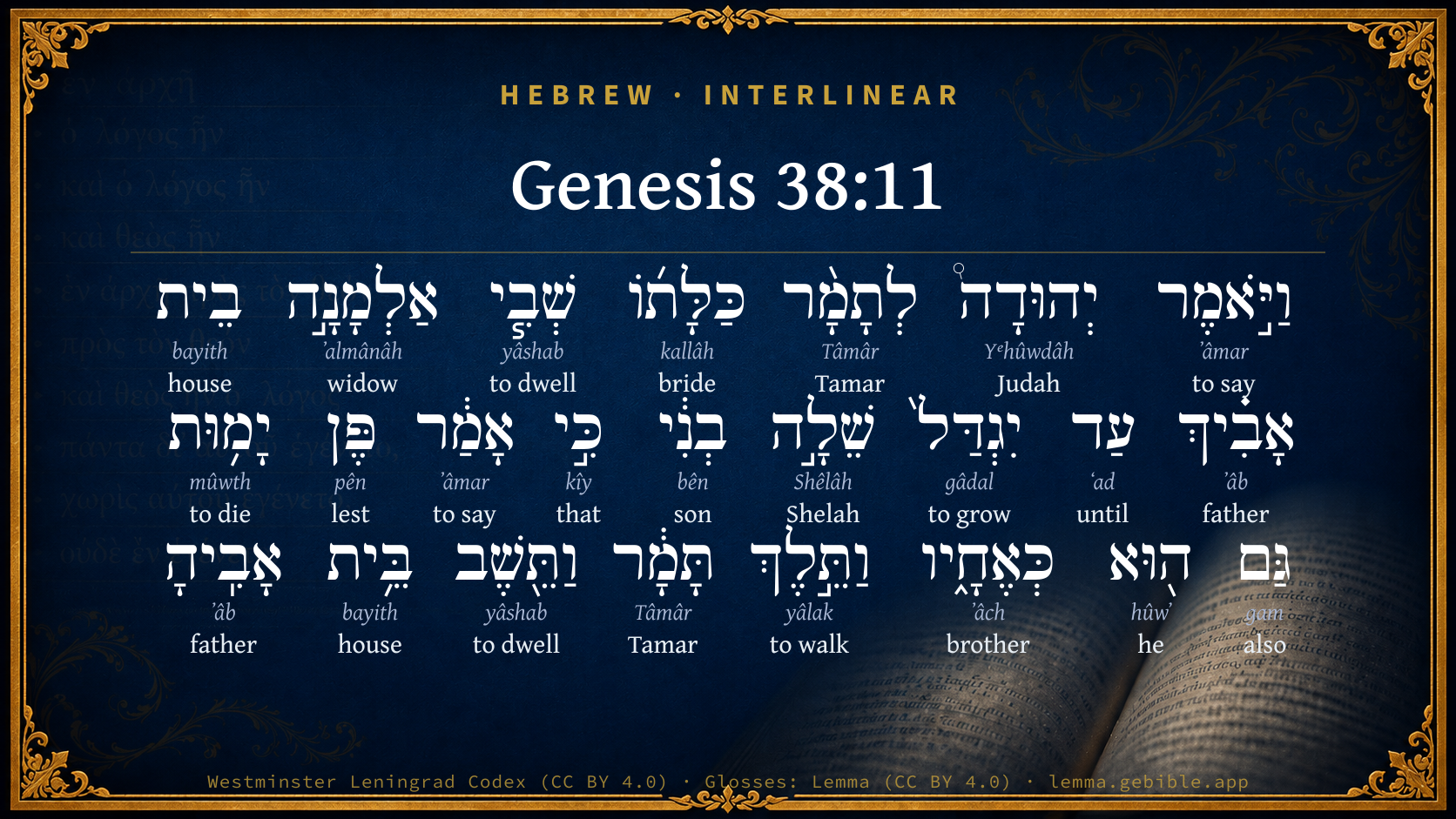
Hebrew (Westminster Leningrad Codex) Genesis 38:11 appears in the Hebrew Old Testament. The text above is from the Westminster Leningrad Codex. Each word links to its Strong’s number, a concise gloss, and parsing drawn from the Open Scriptures Hebrew Bible morphology. Click any word for its full Brown-Driver-Briggs (BDB) entry.
Download image
Cite this verse

Genesis 38:11 (World English Bible). Public Domain. Lemma interlinear Bible study tool, https://lemma.gebible.app/v/genesis/38/11.

Show BibTeX & RIS
BibTeX
RIS
English Translation
Then Judah said to Tamar, his daughter-in-law, "Remain a widow in your father's house, until Shelah, my son, is grown up;" for he said, "Lest he also die, like his brothers." Tamar went and lived in her father's house.
World English Bible · Public Domain
Highlights
  • 1 first appearance in the Hebrew Bible
Full analysis ↓
Download a study sheet

One document with this verse’s original text, its word-by-word gloss line, the meaning frame, cross-references with their text, attributed commentary, and full source and license credits — printable, and it pastes into notes with its structure intact.

This verse Autodidact and up

Study sheet (.html) Plain text (.txt)

A passage Seminary Student

Up to 50 verses in one chapter. A passage sheet keeps up to 6 commentary sources and 12 cross-references per verse, in the order this page ranks them, and says so on the sheet whenever that leaves anything out. Ask for a single verse and you get the Autodidact verse sheet above.

Everything on this page stays free to read, with no account — the sheet is a download of what is already on screen, not access to it.

Want to remove ads? Support Godless Engineer
Compare translations 3

The same verse in 3 English versions, stacked beneath the original-language interlinear above. Click any original word for its lexicon entry.

Each is an independent rendering of the whole verse — the interlinear is not word-aligned to these translations.

Highlighted words mark where these versions differ — a whole-verse word diff, not a word-by-word alignment.

  • World English Bible Public Domain
    Then Judah said to Tamar, his daughter-in-law, "Remain a widow in your father's house, until Shelah, my son, is grown up;" for he said, "Lest he also die, like his brothers." Tamar went and lived in her father's house.
  • King James Version Public Domain
    Then said Judah to Tamar his daughter in law, Remain a widow at thy father's house, till Shelah my son be grown: for he said, Lest peradventure he die also, as his brethren did. And Tamar went and dwelt in her father's house.
  • unfoldingWord Literal Text CC BY-SA 4.0
    Then Judah said to Tamar his daughter-in-law, “Remain a widow in the house of your father until Shelah my son grows up.” For he said, “So that he does not also die like his brothers!” So Tamar went and lived in the house of her father.

unfoldingWord Literal Text — © unfoldingWord, licensed CC BY-SA 4.0. Word-aligned USFM3 via Door43 (git.door43.org/unfoldingWord/en_ult).

Versions to compare (up to 4)

3 of 4 selected

Show all 18 translations

Every available English version of this verse, each an independent rendering of the whole verse.

  • World English Bible Public Domain
    Then Judah said to Tamar, his daughter-in-law, "Remain a widow in your father's house, until Shelah, my son, is grown up;" for he said, "Lest he also die, like his brothers." Tamar went and lived in her father's house.
  • Berean Standard Bible Public Domain
    Then Judah said to his daughter-in-law Tamar, “Live as a widow in your father’s house until my son Shelah grows up.” For he thought, “He may die too, like his brothers.” So Tamar went to live in her father’s house.
  • Majority Standard Bible Public Domain
    Then Judah said to his daughter-in-law Tamar, “Live as a widow in your father’s house until my son Shelah grows up.” For he thought, “He may die too, like his brothers.” So Tamar went to live in her father’s house.
  • King James Version Public Domain
    Then said Judah to Tamar his daughter in law, Remain a widow at thy father's house, till Shelah my son be grown: for he said, Lest peradventure he die also, as his brethren did. And Tamar went and dwelt in her father's house.
  • American Standard Version (1901) Public Domain
    Then said Judah to Tamar his daughter-in-law, Remain a widow in thy father's house, till Shelah my son be grown up; for he said, Lest he also die, like his brethren. And Tamar went and dwelt in her father's house.
  • Revised Version (1885) Public Domain
    Then said Judah to Tamar his daughter in law, Remain a widow in thy father’s house, till Shelah my son be grown up: for he said, Lest he also die, like his brethren. And Tamar went and dwelt in her father’s house.
  • Geneva Bible (1599) Public Domain
    Then said Iudah to Tamar his daughter in lawe, Remaine a widowe in thy fathers house, till Shelah my sonne growe vp (for he thought thus, Least he die as well as his brethren.) So Tamar went and dwelt in her fathers house.
  • Douay-Rheims (1899) Public Domain
    Wherefore Juda said to Thamar his daughter in law: Remain a widow in thy father's house, till Sela my son grow up: for he was afraid lest he also might die, as his brethren did. She went her way and dwelt in her father's house.
  • Young's Literal Translation Public Domain
    And Judah saith to Tamar his daughter-in-law, `Abide a widow at thy father's house, till Shelah my son groweth up;' for he said, `Lest he die -- even he -- like his brethren;' and Tamar goeth and dwelleth at her father's house.
  • Literal Standard Version CC BY-SA 4.0
    And Judah says to his daughter-in-law Tamar, “Abide [as] a widow at your father’s house, until my son Shelah grows up”; for he said, “Lest he die—even he—like his brothers”; and Tamar goes and dwells at her father’s house.
  • Unlocked Literal Bible CC BY-SA 4.0
    Then Judah said to Tamar, his daughter-in-law, “Remain a widow in your father's house until Shelah, my son, grows up.” For he feared, “He might also die, just like his brothers.” Tamar left and lived in her father's house.
  • unfoldingWord Literal Text CC BY-SA 4.0
    Then Judah said to Tamar his daughter-in-law, “Remain a widow in the house of your father until Shelah my son grows up.” For he said, “So that he does not also die like his brothers!” So Tamar went and lived in the house of her father.
  • Darby Bible Public Domain
    And Judah said to Tamar his daughter-in-law, Remain a widow in thy father's house, until Shelah my son is grown; for he said, Lest he die also, as his brethren. And Tamar went and remained in her father's house.
  • World Messianic Bible Public Domain
    Then Judah said to Tamar, his daughter-in-law, “Remain a widow in your father’s house, until Shelah, my son, is grown up;” for he said, “Lest he also die, like his brothers.” Tamar went and lived in her father’s house.
  • Webster's Bible Public Domain
    Then said Judah to Tamar his daughter-in-law, Remain a widow at thy father's house, till Shelah my son shall be grown; (for he said, Lest perhaps he die also as his brethren did:) and Tamar went and dwelt in her father's house.
  • Free Bible Version CC BY-SA 4.0
    Then Judah told his daughter-in-law Tamar, “Go to your father's house and live there as a widow until my son Shelah grows up.” For he thought, “Maybe he'll die too, just like his brothers.” So Tamar went and stayed in her father's house.
  • Bible in Basic English Public Domain
    Then Judah said to Tamar, his daughter-in-law, Go back to your father's house and keep yourself as a widow till my son Shelah becomes a man: for he had in his mind the thought that death might come to him as it had come to his brothers. So Tamar went back to her father's house.
  • JPS Tanakh (1917) Public Domain
    Then said Judah to Tamar his daughter-in-law: 'Remain a widow in thy father's house, till Shelah my son be grown up'; for he said: 'Lest he also die, like his brethren.' And Tamar went and dwelt in her father's house.

Literal Standard Version (2020), Covenant Press — licensed CC BY-SA 4.0. Text via the HelloAO Bible API (eBible.org). Unlocked Literal Bible (unfoldingWord) — licensed CC BY-SA 4.0. Text via the HelloAO Bible API (eBible.org). unfoldingWord Literal Text — © unfoldingWord, licensed CC BY-SA 4.0. Word-aligned USFM3 via Door43 (git.door43.org/unfoldingWord/en_ult). Free Bible Version, Dr. Jonathan Gallagher — licensed CC BY-SA 4.0. Text via the HelloAO Bible API (eBible.org).

Word by word

More ways to search: Search by grammar → Find every occurrence → Compare this word →

Practice this passage: Drill this verse → Learn its vocabulary →

שֵׁלָ֣ה
Shêlâh
H7956
“Shelah”
Noun, Proper
Part of Speech
Noun
Type
Proper
Full BDB Definition

Origin: the same as H7596 (shortened)

TWOT: None

Shelah = "a petition" - the youngest son of Judah
  1. וַיֹּ֣אמֶר ʼâmar H559 “and · to say” Conjunction + Verb, Qal, Sequential Imperfect, 3rd Person, Masculine, Singular
  2. יְהוּדָה֩ Yᵉhûwdâh H3063 “Judah” Noun, Proper
  3. לְתָמָ֨ר Tâmâr H8559 “to/for · Tamar” Preposition + Noun, Proper
  4. כַּלָּת֜וֹ kallâh H3618 “bride · his” Noun, Common, Feminine, Singular, Construct + Suffix, Personal, 3rd Person, Masculine, Singular
  5. שְׁבִ֧י yâshab H3427 “dwell” Verb, Qal, Imperative, 2nd Person, Feminine, Singular
  6. אַלְמָנָ֣ה ʼalmânâh H490 “widow” Noun, Common, Feminine, Singular, Absolute
  7. בֵית bayith H1004 “house of” Noun, Common, Masculine, Singular, Construct
  8. אָבִ֗יךְ ʼâb H1 “father · your” Noun, Common, Masculine, Singular, Construct + Suffix, Personal, 2nd Person, Feminine, Singular
  9. עַד ʻad H5704 “until” Preposition
  10. יִגְדַּל֙ gâdal H1431 “to grow” Verb, Qal, Imperfect, 3rd Person, Masculine, Singular
  11. בְנִ֔י bên H1121 “son · my” Noun, Common, Masculine, Singular, Construct + Suffix, Personal, 1st Person, Common, Singular
  12. כִּ֣י kîy H3588 “that” Conjunction
  13. אָמַ֔ר ʼâmar H559 “to say” Verb, Qal, Perfect, 3rd Person, Masculine, Singular
  14. פֶּן pên H6435 “lest” Conjunction
  15. יָמ֥וּת mûwth H4191 “to die” Verb, Qal, Imperfect, 3rd Person, Masculine, Singular
  16. גַּם gam H1571 “also” Particle, Accusative
  17. ה֖וּא hûwʼ H1931 “he” Pronoun, Personal, 3rd Person, Masculine, Singular
  18. כְּאֶחָ֑יו ʼâch H251 “like/as · brothers · his” Preposition + Noun, Common, Masculine, Plural, Construct + Suffix, Personal, 3rd Person, Masculine, Singular
  19. וַתֵּ֣לֶךְ yâlak H3212 “and · to walk” Conjunction + Verb, Qal, Sequential Imperfect, 3rd Person, Feminine, Singular
  20. תָּמָ֔ר Tâmâr H8559 “Tamar” Noun, Proper
  21. וַתֵּ֖שֶׁב yâshab H3427 “and · to dwell” Conjunction + Verb, Qal, Sequential Imperfect, 3rd Person, Feminine, Singular
  22. בֵּ֥ית bayith H1004 “house of” Noun, Common, Masculine, Singular, Construct
  23. אָבִֽיהָ ʼâb H1 “father · her” Noun, Common, Masculine, Singular, Construct + Suffix, Personal, 3rd Person, Feminine, Singular

About this verse

These counts appear in no published source. They are computed here, from the morphology-tagged text and Lemma’s own curated glosses. What Lemma adds →

24
words
19
distinct lemmas
Pentateuch
section

Notable vocabulary

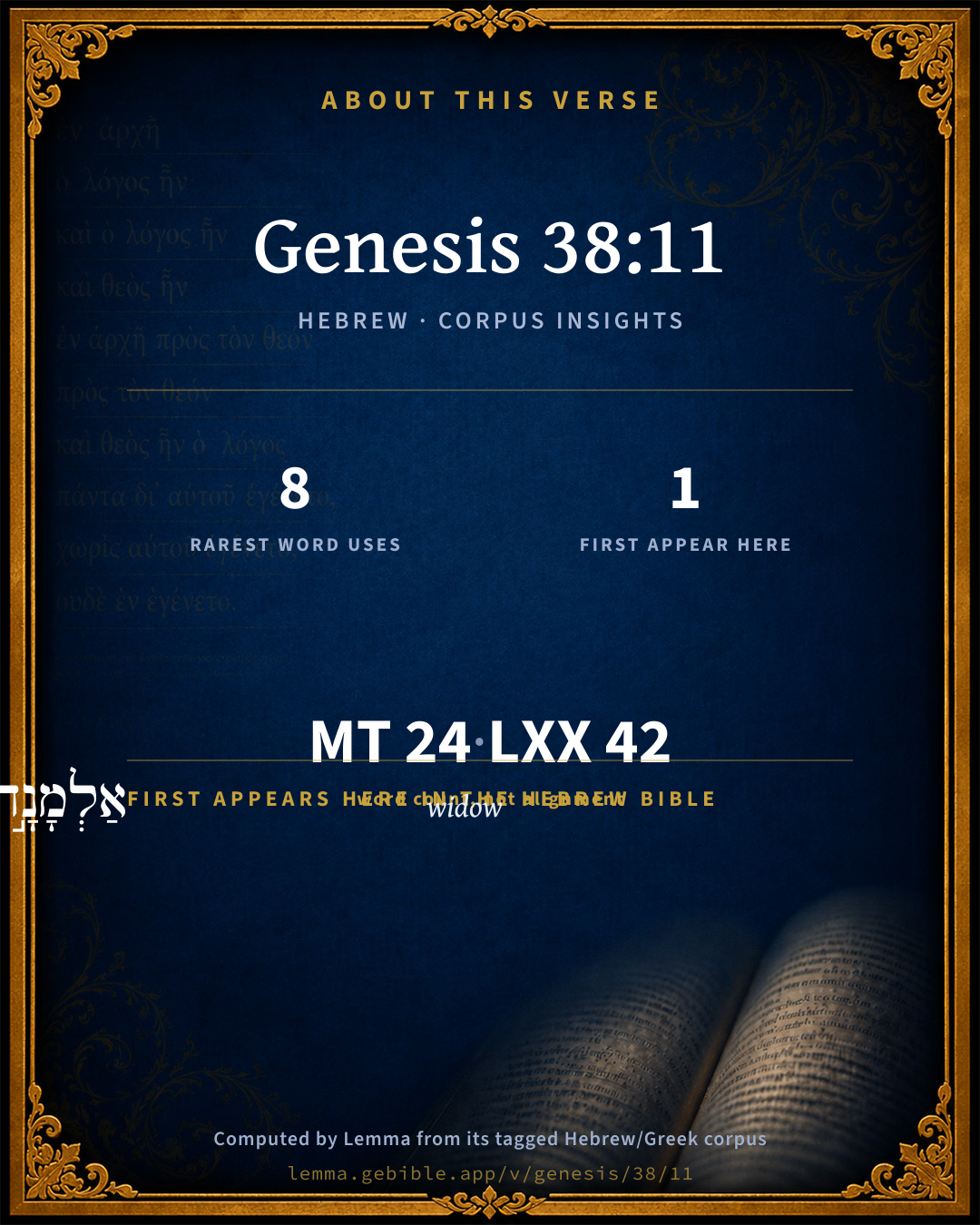
The rarest word here is שֵׁלָ֣ה Shelah H7956 — appearing just 8 times in the whole Hebrew Bible.

First appearance in Scripture

This word makes its first canonical appearance in the Hebrew Bible here:

  • אַלְמָנָ֣ה widow H490

Shared distinctive vocabulary

שֵׁלָ֣ה Shelah H7956 occurs in 8 verses of the Hebrew Bible. Also found in:

Grammatical profile

  • 7 verbs
  • 12 nouns
  • 1 pronoun
  • 1 preposition
  • 2 conjunctions
  • 1 particle

Verb forms

  • וַיֹּ֣אמֶר Qal · Sequential Imperfect
  • שְׁבִ֧י Qal · Imperative
  • יִגְדַּל֙ Qal · Imperfect
  • אָמַ֔ר Qal · Perfect
  • יָמ֥וּת Qal · Imperfect
  • וַתֵּ֣לֶךְ Qal · Sequential Imperfect
  • וַתֵּ֖שֶׁב Qal · Sequential Imperfect

Repetition

Words recur within this verse — often emphatic in Hebrew:

  • וַיֹּ֣אמֶר to say H559 ×2
  • לְתָמָ֨ר Tamar H8559 ×2
  • שְׁבִ֧י to dwell H3427 ×2
  • בֵית house H1004 ×2
  • אָבִ֗יךְ father H1 ×2

Hebrew & Septuagint length

In English translation the verse runs 39 words from the Hebrew and 44 from the Septuagint (LXX English) — closely comparable.

A rough comparison of the two English renderings, which tokenize alike — not a word-level alignment.

Word counts can differ between the Hebrew and the Greek without any difference in meaning — e.g. the Hebrew direct-object marker אֵת has no separate Greek word, and Greek often adds the article ὁ.

In the original languages it is 24 Hebrew tokens and 42 Greek tokens — but the two are counted differently (Hebrew bundles its prefixes and suffixes into one token; the Greek is in lemma form), so that isn’t a like-for-like length.

Cross-references

2

Topical passages linked to Genesis 38:11 in the Treasury of Scripture Knowledge — connected by theme and wording, ordered by reader-vote popularity; previews shown in the World English Bible.

  • Leviticus 22:13 But if a priest's daughter is a widow, or divorced, and has no child, and has returned to her father's house, as in her youth, she may eat of her father's bread: but no stranger shall eat any of it.
  • Ruth 1:11–13 Naomi said, Turn again, my daughters: why will you go with me? have I yet sons in my womb, that they may be your husbands?

Cross-references courtesy of OpenBible.info (CC BY 4.0).

Hebrew and Greek witnesses Masoretic Hebrew ↔ Greek Septuagint

The same verse in the two great witnesses to the Old Testament, shown verse-for-verse.

These are two independent witnesses, not word-aligned to each other, and the Septuagint is shown in lemma (dictionary) form.

Hebrew Genesis 38:11 Masoretic · Westminster Leningrad Codex

וַיֹּ֣אמֶר יְהוּדָה֩ לְתָמָ֨ר כַּלָּת֜וֹ שְׁבִ֧י אַלְמָנָ֣ה בֵית אָבִ֗יךְ עַד יִגְדַּל֙ שֵׁלָ֣ה בְנִ֔י כִּ֣י אָמַ֔ר פֶּן יָמ֥וּת גַּם ה֖וּא כְּאֶחָ֑יו וַתֵּ֣לֶךְ תָּמָ֔ר וַתֵּ֖שֶׁב בֵּ֥ית אָבִֽיהָ

Then Judah said to Tamar, his daughter-in-law, "Remain a widow in your father's house, until Shelah, my son, is grown up;" for he said, "Lest he also die, like his brothers." Tamar went and lived in her father's house.

World English Bible · Public Domain

Greek LXX Genesis 38:11 Septuagint · lemma form

εἶπον δέ ἰούδας θαμαρ ὁ νύμφη αὐτός καταἧμαι χήρα ἐν ὁ οἶκος ὁ πατήρ σύ ἕως μέγας γίγνομαι σηλωμ ὁ υἱός ἐγώ εἶπον γάρ μήποτε ἀποθνήσκω καί οὗτος ὥσπερ ὁ ἀδελφός αὐτός ἀποἔρχομαι δέ θαμαρ κάθημαι ἐν ὁ οἶκος ὁ πατήρ αὐτός

And Judas said to Thamar, his daughter-in-law, Sit you a widow in the house of your father-in-law, until Selom my son be grown; for he said, lest he also die as his brethren; and Thamar departed, and sat in the house of her father.

LXX2012 (modern English Septuagint) · Public Domain

Hebrew: Westminster Leningrad Codex (CC BY 4.0). Greek: Septuagint (public domain); English from LXX2012 (modern English Septuagint) (Public Domain). How the Septuagint differs from the Hebrew →

Targum (Aramaic paraphrase)

2

The Targum is the ancient Jewish Aramaic paraphrase of the Hebrew Scriptures — an interpretive translation, not the Hebrew text itself. Onkelos (literal) and Pseudo-Jonathan (expansive) render the Torah, and Jonathan the Prophets. Coverage is partial: where no permissively-licensed English translation exists for a verse, only the Aramaic is shown. This is verse-level text, not a word-by-word alignment to the Hebrew.

  1. Targum Onkelos Torah (Genesis–Deuteronomy)
    וַאֲמַר יְהוּדָה לְתָמָר כַּלְּתֵהּ תִּיבִי אַרְמְלָא בֵית אָבִיךְ עַד דְיִרְבֵּי שֵׁלָה בְרִי אֲרֵי אֲמַר דִּלְמָא יְמוּת אַף הוּא כְּאָחוֹהִי וַאֲזָלַת תָּמָר וִיתִיבַת בֵּית אָבוּהָא

    (no public-domain English translation for this verse)

    Targum Onkelos — Aramaic: “Onkelos Genesis” (public domain); “Onkelos Exodus” (public domain); “Onkelos Leviticus” (public domain); “Onkelos Numbers” (public domain); “Onkelos Deuteronomy” (public domain). English: “Sefaria Community Translation” (CC0 1.0 (public-domain dedication)); “J.W. Etheridge. The Targums of Onkelos and Jonathan Ben Uzziel on the Pentateuch. London: Longmans, Green, 1862” (public domain). Text via Sefaria.

  2. Targum Pseudo-Jonathan Torah (Genesis–Deuteronomy)
    וַאֲמַר יְהוּדָה לְתָמָר כַּלְתֵיהּ תִיבִי אַרְמְלָא בֵּית אֲבוּיִיךְ עַד דְיִרְבֵּי שֵׁלָה בְּרִי אֲרוּם אָמַר דִלְמָא יְמוּת אַף הוּא כְּאָחוֹי וְאָזְלַת תָּמָר וִיתֵבַת בֵּית אָבוּהָא

    And Jehuda said to Tamar his daughter--in--law, Remain a widow in thy father's house, till Shela my son be grown up. For he said, Lest he also die as his brethren Tamar went and remained in her father's house.

    Targum Pseudo-Jonathan — Aramaic: “Targum Jonathan on Genesis” (public domain); “Targum Jonathan on Exodus” (public domain); “Targum Jonathan on Leviticus” (public domain); “Targum Jonathan on Numbers” (public domain); “Targum Jonathan on Deuteronomy” (public domain). English: “The Targum of Jonathan ben Uzziel, trans. J. W. Etheridge, London, 1862” (public domain). Text via Sefaria.

Commentary

Notes on Genesis 38:11 from classic Christian and Jewish commentators (each source and its license shown beneath its notes). The classic Christian expositions comment on the surrounding passage and are grouped to its opening verse, so a note may address several verses; the Jewish commentaries on the Tanakh (Rashi and others) are per-verse, so they appear only where the commentator wrote on this verse.

Lemma curates 59 commentaries, every one of them public domain or Creative Commons licensed, each selected and text-cleaned for this edition rather than reprinted as found. About our sources →

Trapp's Complete Commentary

John Trapp

Gen 38:11 Then said Judah to Tamar his daughter in law, Remain a widow at thy father’s house, till Shelah my son be grown: for he said, Lest peradventure he die also, as his brethren [did]. And Tamar went and dwelt in her father’s house.

Ver. 11. Lest peradventure he die also, &c.] Judah lays the fault all on her, whereas it was in his sons. Sarah, on the other side, blamed herself only for barrenness. {Gen 16:2} "Judge not, that ye be not judged": but "if we judge ourselves, we shall not be judged." In judging of the cause of our crosses, we are oft as far out as she was, that laid the death of her child to the presence of the good prophet.

John Trapp, A Commentary or Exposition upon All the Books of the Old and New Testament (1647–1656) — public domain. Text from a community e-Sword module.

The Biblical Illustrator

Joseph S. Exell

Gen_38:11-30

Tamar

Lessons

1.

Sinful hearts when they suffer from Gods hand are apt to vent it upon creatures.

2. Carnal relations grow quickly weary of showing kindness when their aims are crossed by God.

3. Hard fathers-in-law, for their own ends, spare not to lay the hardest terms upon allies.

4. Such oppressors deal subtilly, though cruelly; they pretend fair at least.

5. Wicked hearts are apt to be jealous, and transfer faults and ill successes to others that are innocent.

6. Sinful fathers are willing to save children from death, but take bad ways to do it.

7. Widowhood is a solitary condition that binds souls to sit at home.

8. God overruling, natural hearts may be content to submit to hard injunctions from others when they cannot help it. So it was with Tamar when Judah layeth hard injunctions on her (Gen_38:11). (G. Hughes, B. D.)

Lessons

1. Injuries to daughters-in-law God may repay upon mens wives.

2. Days may seem many before Gods visit, but visitation will come for sin.

3. God may make death to be a just recompense of mens hard dealings.

4. Vain and sinful hearts are soon comforted after the death of wives.

5. Comforts carnal hearts do seek by fleshly feasting and employments.

6. Bad companions and opportune places bad hearts delight in to enjoy their lusts (Gen_38:12). (G. Hughes, B. D.)

Lessons

1. A lustful eye will quickly turn the foot out of the way to sin. Connection (Gen_38:15).

2. Men of lustful hearts turn of their own accord to evil with others without invitation.

3. Digression from mens lawful way tends to transgression against God and man.

4. Lust is a hard solicitor for its unclean enjoyments.

5. Lust runs blindfold even to defile near relations, and enquireth not.

6. Sometimes lust is put to it to pay a price for its pleasure. The whorish custom (Gen_38:16).

7. Unclean persons stick not to lessen their flock for increase of lust, so of estates.

8. Adulterous spirits are not credible with their own paramours; a price or pledge must be given (Gen_38:17).

9. Wicked hearts stick not at pledge or price unto whorish women for enjoying lust.

10. Unclean creatures are subtle to have a great pledge for a small price.

11. Be it ever so great, lust will give it to the whorish woman for its pleasure.

12. Blind lust doth not only solicit but violate nearest relations when it can.

13. Providence denieth not conception sometimes to the most incestuous mixtures of men and women.

14. It is the order of providence that conception should be for Judah as well as by him (Gen_38:18). (G. Hughes, B. D.)

Lessons

1. Sinful lust, when its turn is served, makes out of sight speedily.

2. Guile and deceit are usual adjuncts to lust of uncleanness.

3. Guileful harlots stay not long in common places, where they may be discovered.

4. Lust teacheth souls to put off, and to put on, any signals which might either discover or conceal them (Gen_38:19). (G. Hughes, B. D.)

Lessons

1. Pawns may make naughty hearts careful to pay their debts for sin.

2. Wicked affairs are best trusted to hands of wicked friends.

3. Payment of debts by sinners is accounted just to take up pawns.

4. It is no rare thing for partners in sin to deceive each other; to get out of the way when they should be found.

5. Under Providence the debt of lust is not always paid, nor the pawn of iniquity restored (Gen_38:20).

6. Sinners are diligent to inquire about their sinful affairs.

7. Sinners are impudent to ask openly after harlots in the high way; to bewray the worst matter.

8. Under wife providence, such inquisitors have an answer of frustration (Gen_38:21).

9. The trustiest messengers of sinners may return bootless to such as send them.

10. Objects of uncleanness maybe found to ensnare persons to sin, but not to satisfy demands.

11. God sometimes ordereth the frustration, of sinners with a witness (Gen_38:22).

12. By patience perforce, unclean sinners may be content to sit down with loss.

13. Fear of shame and reproach make sinners willing to be losers.

14. Uncleanness is a reproachful thing in the account of the worst adulterers.

15. A self-conceit of having done their duties make wicked ones sometimes content to sit down losers (Gen_38:23). (G. Hughes, B. D.)

Lessons

1. There is a season of bearing ordered by Providence and to be observed Ecc_3:2).

2. Providence may order abundant fruitfulness unto incestuous mixtures. Twins to incest (verse 27).

3. God sometimes returneth unto unclean conceptions bitter travails.

4. Cross coming of children to birth is Gods ordering to mind of sin sometimes.

5. Creatures may be deceived in marking that for first which cometh last (verse 28).

6. It is Gods prerogative to make first and last in births, and other conditions.

7. Even in the fruit of the womb God makes one child retreat that the other may come forth.

8. The breaking out of the fruit of the womb is sometimes wonderful to creatures.

9. The wonders of God are reasonably prepetuated in the very names of children (verse 29).

10. The first in mans thoughts is many times last in Gods.

11. Safe births are great mercies, whether first or last; all come forth under providence.

12. Such mercies should be made known in the very names and beings of creatures (verse 30). (G. Hughes, B. D.)

.

The Biblical Illustrator, edited by Joseph S. Exell (c. 1880s–1900s) — public domain. Text from a community e-Sword module.

Joseph Benson's Commentary

Gen 38:11. Remain a widow till Shelah my son be grown — The contract of marriage, it seems, was so understood, even before any positive law was made on the subject, that, if the husband died without any issue, his next brother was to marry his wife, and as long as any of his brethren remained they were bound to marry her, if left a widow. Accordingly Shelah, the third son, was reserved for Tamar, yet with design that he should not marry so young as his brothers had done. For it would seem from Judah’s expression, Lest peradventure he die also, that he thought marrying too young was the cause of their death; though some consider his conduct as an evidence that he never intended to give his son to her.

Joseph Benson's Commentary on the Old and New Testaments (1811–1818) — public domain. Text from a community e-Sword module.

Tyndale Open Study Notes

Tyndale Open Resources

38:11 Judah is now presented as the model for his sons’ behavior—he, too, was unfaithful to his levirate responsibility to Tamar as next kinsman (see study note on 38:8). Judah and his sons were far too Canaanite in their ways (see study note on 38:27-30; contrast Boaz, Ruth 3–4).

Tyndale Open Study Notes — © Tyndale Open Resources, licensed CC BY-SA 4.0. Text via the HelloAO Bible API.

Geneva Bible (1599)

Geneva Bible translators

For she could not marry in any other family so long as Judah would retain her in his.

Geneva Bible (1599) marginal notes — public domain. Text via Bolls.life.

John Calvin's Commentaries

11. Then said Judah to Tamar. Moses intimates that Tamar was not at liberty to marry into another family, so long as Judah wished to retain her under his own authority. It is possible that she voluntarily submitted herself to the will of her father-in-law, when she might have refused: but the language seems to mean, that it was according to a received practice, that Tamar should not pass over to another family, except at the will of her father-in-law, as long as there was a successor who might raise up seed by her. However this may be, Judah acted very unjustly in keeping one bound, whom he intended to defraud. For truly there was no cause why he should be unwilling to allow her to depart free from his house, unless he dreaded the charge of inconstancy. But he should not have allowed this ambitious sense of shame to render him perfidious and cruel to his daughter-in-law. Besides, this injury sprung from a wrong judgment: because, without considering the causes of the death of his sons, he falsely and unjustly transfers the blame to an innocent woman. He believes the marriage with Tamar to have been an unhappy one; why therefore does he not, for his own sake, permit her to seek a husband elsewhere? But in this also he does wrong, that whereas the cause of his sons’ destruction was their own wickedness, he judges unfavorably of Tamar herself, to whom no evil could be imputed. Let us then learn from this example, whenever anything adverse happens to us, not to transfer the blame to another, nor to gather from all quarters doubtful suspicions, but to shake off our own sins. We must also beware lest a foolish shame should so prevail over us, that while we endeavor to preserve our reputation uninjured among men, we should not be equally careful to maintain a good conscience before God.

John Calvin's Commentaries (1540-1563) — public domain. Text from the Calvin Translation Society English edition (1840s-50s) via the Christian Classics Ethereal Library (ccel.org). Calvin's coverage is partial (roughly two-thirds of the Bible); uncommented books and verses are honest gaps, never fabricated. The 19th-century editor's footnotes and remarks are omitted so the notes are faithfully Calvin's own voice.

Ellicott's Commentary for English Readers

(11) For he said, lest he also die.—It is evident from this that Judah, for reasons which, in Gen_38:26, he acknowledged to be insufficient, wished to evade the duty of giving a third son to Tamar. It does not follow that he blamed her for their deaths; for the loss of two sons in succession might well frighten him. Philippsohn says that it became the rule, that if a woman lost two husbands, the third brother was not bound to marry her, and she was even called Katlannith. the murderess. (But see St. Mat_22:25-26, where no such custom is acknowledged.)

A Bible Commentary for English Readers, edited by Charles John Ellicott (1878–1897) — public domain. Text from a community e-Sword module.

The Cambridge Bible for Schools and Colleges

gen. ed. J. J. S. Perowne

11. in thy father’s house] A widow without children went back to her father’s family; cf. Lev_22:13; Rth_1:8. A widow with children remained in the family of her husband, and under its protection. Judah evidently believes that the deaths of Er and Onan are somehow due to Tamar. Rather, then, than subject his youngest son Shelah to the risk of a similar fate, he sends Tamar back to her own people, on the pretext that Shelah is too young at present to perform the levirate duty. Compare the story in Tobit 3, where Sarah’s seven husbands are cut off in succession.

The Cambridge Bible for Schools and Colleges (gen. ed. J. J. S. Perowne; Cambridge University Press, 1878–1918) — public domain. Text from a community e-Sword module.

John Gill's Exposition

And in process of time the daughter of Shuah, Judah's wife,

died,.... Shuah was his wife's father, who was a Canaanite, Gen 38:2; what her name was is not certain, nor the exact time of her death; it was some time after Tamar was sent home to her father's house; and some take the death of Judah's wife to be a correction and reproof to him for his ill usage of his daughter-in-law, in neglecting to give her to his son, or not designing to do it at all:

and Judah was comforted: he mourned awhile for the death of his wife, according to the custom of the country, and of those times, and then he laid aside the tokens of it, and his sorrow wore off, and he appeared in company and conversed with his friends:

and went up unto his sheepshearers to Timnath; a city in the tribe of Judah, Jos 15:57, said (s) to be six miles from Adullam, where Judah lived; here he had his flocks of sheep, at least this was judged a proper place for the shearing and washing of them, and this time of the year a proper time for it, at which it was usual to have a feast; and Judah went up to his shearers, not only to see how they went on with their work, but with this view to make an entertainment for them, see Sa1 25:3,

he and his friend Hirah the Adullamite; he took him along with him for a companion, and to partake of the entertainment.

(s) Bunting's Travels, p. 78.

John Gill's Exposition of the Whole Bible (1746–1763) — public domain (CC PDM 1.0). Text via the HelloAO Bible API.

Haydock's Catholic Bible Commentary

Till. Juda had no design to give her to Sela, as the custom of that age required. (Calmet) --- She waited patiently for a time; when, perceiving that she was neglected, she devised a wicked scheme to punish Juda, even at the hazard of her own life. (Haydock)

George Leo Haydock (1774–1849), Haydock's Catholic Family Bible and Commentary, 1859 edition — public domain. Excludes Psalms (Douay-Rheims chapter numbering differs from Protestant) and Deuterocanonical books (Catholic canon only).

Matthew Poole's English Annotations

At thy father’s house, whither he sent her from his house, that Shelah might not be insnared by her presence and conversation. So he dismissed her with a pretence of kindness, and a tacit promise of marriage to her, which he never intended to keep, as the following words imply; for he said; or rather, but he said; for the Hebrew chi oft signifies but, as Gen 45:8; Psa 37:20; Ecc 2:10; 6:2. So here is an opposition between what he said to Tamar, and what he said to himself, or in his own heart, as that word said is oft used: he intimated to her that he would give Shelah to her, but he meant otherwise, and said in himself, I will not do it,

lest peradventure he die also as his brethren did; imputing the death of his two sons either to her fault, or to her unluckiness, rather than to his own or his son’s miscarriages.

Matthew Poole's English Annotations on the Holy Bible (1683–1685) — public domain. Text from a community e-Sword/MySword module.

Whedon's Commentary on the Bible

Daniel D. Whedon

11. Lest… he die also — Judah probably entertained some superstitious fear of Tamar, as if she were the cause of the death of his sons. Compare the story of Tobit. Gen_3:7. But it was their wickedness, not hers, which caused their sudden death.

Daniel D. Whedon (gen. ed.), Commentary on the Old and New Testaments (1874–1909) — public domain. Text from a community e-Sword module.

The Pulpit Commentary

Then said Judah to Tamer his daughter-in-law, Remain a widow alma-nah, from alam, to be solitary, forsaken, signifies one bereft of a husband, hence a widow (cf. Exo_22:21) at thy father"s house, (cf. Lev_22:13) till Shelah my son be grown. It is implied that this was merely a pretext on the part of Judah, and that he did not really intend to give his third son to Tamar, considering her an unlucky woman (Delitzsch, Keil, Kalisch), or, at least, not at present, under the impression that the deaths of Er and Onan had been occasioned by their too early marriages (Lange). The reason of his failure to release Tamar from her widowhood is added in the ensuing clause. For he said (sc. in his heart), Lest peradventure he die also, as his brethren did. And Tamer went and dwelt in her father"s house.

The Pulpit Commentary (1880–1919), ed. H.D.M. Spence-Jones & Joseph S. Exell — public domain. Text from a community e-Sword module.

John Wesley's Explanatory Notes

Shelah the third son was reserved for the widow, yet with design that he should not marry so young as his brothers had done, lest he die also. Some think that Judah never intended to marry Shelah to Tamar, but unjustly suspected her to have been the death of her two former husbands, (whereas it was their own wickedness that slew them) and then sent her to her father's house, with a charge to remain a widow. If so, it was an inexcusable piece of prevarication; however Tamar acquiesced, and waited for the issue.

John Wesley, Explanatory Notes Upon the Whole Bible (1754–1765) — public domain. Text via the GEBible commentary corpus.

unfoldingWord translationNotes

Door43 World Missions Community

his daughter-in-law

"his oldest son's wife"

in your father's house

This means her to live in here father's house. AT: "and live in your father's house" (See: Assumed Knowledge and Implicit Information)

until Shelah, my son, grows up

Judah intends for Tamar to marry Shelah when he grows up. AT: "and when Shelah, my son, grows up, he can marry you" (See: Assumed Knowledge and Implicit Information)

Shelah

This is the name of one of Judah's sons. See how you translated this name in Genesis 38:5. (See: How to Translate Names)

For he feared, "He might also die, just like his brothers

Judah feared that if Shelah married Tamar he would also die like his brothers did. AT: "For he feared, 'If he marries her he may also die like his brothers did" (See: Assumed Knowledge and Implicit Information)

translationWords

Judah

Tamar

unfoldingWord translationNotes — © Distant Shores Media and the Door43 World Missions Community, licensed CC BY-SA 4.0. Source: git.door43.org/Door43/en_tn.

Rashi

Rabbi Shlomo Yitzchaki (Rashi)

‘כי אמר וגו FOR HE SAID etc. — that is to say, he pushed her off with a straw (i.e., he put her off with a lame excuse) because he never intended to give her to him in marriage

כי אמר פן ימות FOR HE SAID LEST PERADVENTURE HE DIE — She is a woman of whom it may be presumed that the men she marries will always die young (Genesis Rabbah 85:5).

Rashi on the Tanakh — English translations: “The Judaica Press complete Tanach with Rashi, translated by A. J. Rosenberg” (CC BY 4.0); “Pentateuch with Rashi's commentary by M. Rosenbaum and A.M. Silbermann, 1929-1934” (public domain); “The Metsudah Tanach series, Lakewood, N.J” (CC BY 4.0); and “The Book of Joshua, Metsudah Publications, 1997” (CC BY 4.0). Text via Sefaria.

Ramban (Nachmanides)

Rabbi Moshe ben Nachman (Ramban / Nachmanides)

ABIDE A WIDOW AT THY FATHER’s HOUSE. The meaning thereof is that “you should conduct yourself there as a widow until Shelah be grown up.” He suggested to her: “Place yourself in mourning, put on mourning garments, do not anoint yourself with oil, as a woman girded with sack-cloth for the bridegroom of her youth, until Shelah be grown up and he will marry you.” Such was the custom of a widow waiting to be married: she who desires to be married to a stranger wears mourning garments only for a short period as is the custom, and then feigning comfort arrays herself in scarlet. And she covered herself with a veil, as an indication that she was no longer mourning. See Ramban further, Verse 16. until she be married to a man.

FOR HE SAID, LEST HE ALSO DIE, LIKE HIS BRETHREN. That is to say, he dismissed her with a paltry reply because he never intended to give her to him in marriage. For he said, Lest he also die, like his brethren, for she has established herself as one whose husbands die young. This is Rashi’s Language.Now I do not know why Judah, a ruler of his generation, should be shy towards this woman and not tell her, “Go in peace from my house,” and why should he mislead her when she is even forbidden to Shelah, just as the Rabbis have said concerning a married woman: “Twice establishes a presumption [that the woman is a katlanith — a woman whose husbands die].” However since Judah was angered by her harlotry to the extent of condemning her to be burned, it would appear that he originally did wish her to remain in his family. It is also unreasonable to say that Judah did not hear about how his children sinned against G-d, thus causing Him to deliver them into the hands of their fate, while Tamar was guiltless in their death. The correct view appears to me to be that Shelah was fit for the marriage, but his father did not want him to marry Tamar while he was still a youth, lest he commit some sin with her as had his brothers who died young, for they were boys, none of them having attained twelve years of age. His intention was that when he would mature and would listen to the instruction of his father, he would then give her to him as a wife. But when she had waited a long time and it appeared to her that Shelah had grown up — although in the eyes of his father he was still a boy as he was not yet ten years old and therefore his father was bent on waiting longer — then Tamar, in her craving to give birth from the sacred race, hastened and did this deed.

Ramban (Nachmanides) on the Tanakh — English translation: “Commentary on the Torah by Ramban (Nachmanides). Translated and annotated by Charles B. Chavel. New York, Shilo Pub. House, 1971-1976” (CC BY 4.0). Text via Sefaria.

Radak

Rabbi David Kimhi (Radak)

ויאמר... כי אמר פן ימות גם הוא כאחיו, in commenting on Yehudah’s reasoning, Bereshit Rabbah 85.5 quotes Rabbi Eleazar as saying [Rashi’s interpretation of his statement, Ed.] that although the Torah has enjoined us לא תנחשו, (Leviticus 19,26) not to be superstitious as for instance to allow a black cat crossing our path to determine our actions, there is such a thing as a סימן, a “hint from a higher domain,” to heed which is not idolatrous. Such a “hint” would be a catastrophe of the same kind three times repeated. This is what Yehudah was afraid of.

Radak on the Tanakh — English translations: “Sefaria Community Translation” (CC0 1.0 (public-domain dedication)); “Eliyahu Munk, HaChut Hameshulash” (CC BY 4.0); “Rabbi Mike Feuer, Jerusalem Anthology” (CC BY 4.0); and “R. David Kimhi on the first book of Psalms, Translated by R.G. Finch, London, 1919” (public domain). Text via Sefaria.

Lesson kit

Teaching starters — assembled from the data on this page, not authored interpretation. Every prompt links to the verse data it draws on. Edit before teaching.

Genesis, in the Pentateuch, opens this verse with 24 words (19 distinct Hebrew lemmas). Its most distinctive word is Shêlâh (“Shelah”). A historical commentator’s framing appears above. Read the whole chapter for the surrounding context.

Discussion questions

  1. The word Shêlâh carries the sense “Shelah.” How does it shape the verse?
  2. This is the first place “widow” appears in Scripture (first appears here). What does its debut here establish?
  3. How does Genesis 38:5, which shares the word «Shelah», read alongside this verse?
  4. What does the repetition of “to say” (2× in this one verse) do in this verse?
  5. These translations render this verse differently; the difference is in the English rendering, not the original. What questions does that raise?
  6. «וַיֹּ֣אמֶר» is a Qal Sequential Imperfect verb. How does that grammatical form shape the action described?
  7. Compare how Trapp's Complete Commentary and The Biblical Illustrator read this verse. Where do they agree or differ?

Things to notice

Reading settings

Reading text

Shown beneath each verse's original-language words.

Old Testament
Old Testament edition

Read the OT as the Masoretic Hebrew (MT) or the Greek Septuagint (LXX).

English shown for the Greek Septuagint (in the Hebrew ↔ Greek comparison).

Comparing translations? Open the Compare panel on any verse page to stack up to four side by side.