Exodus 14:30

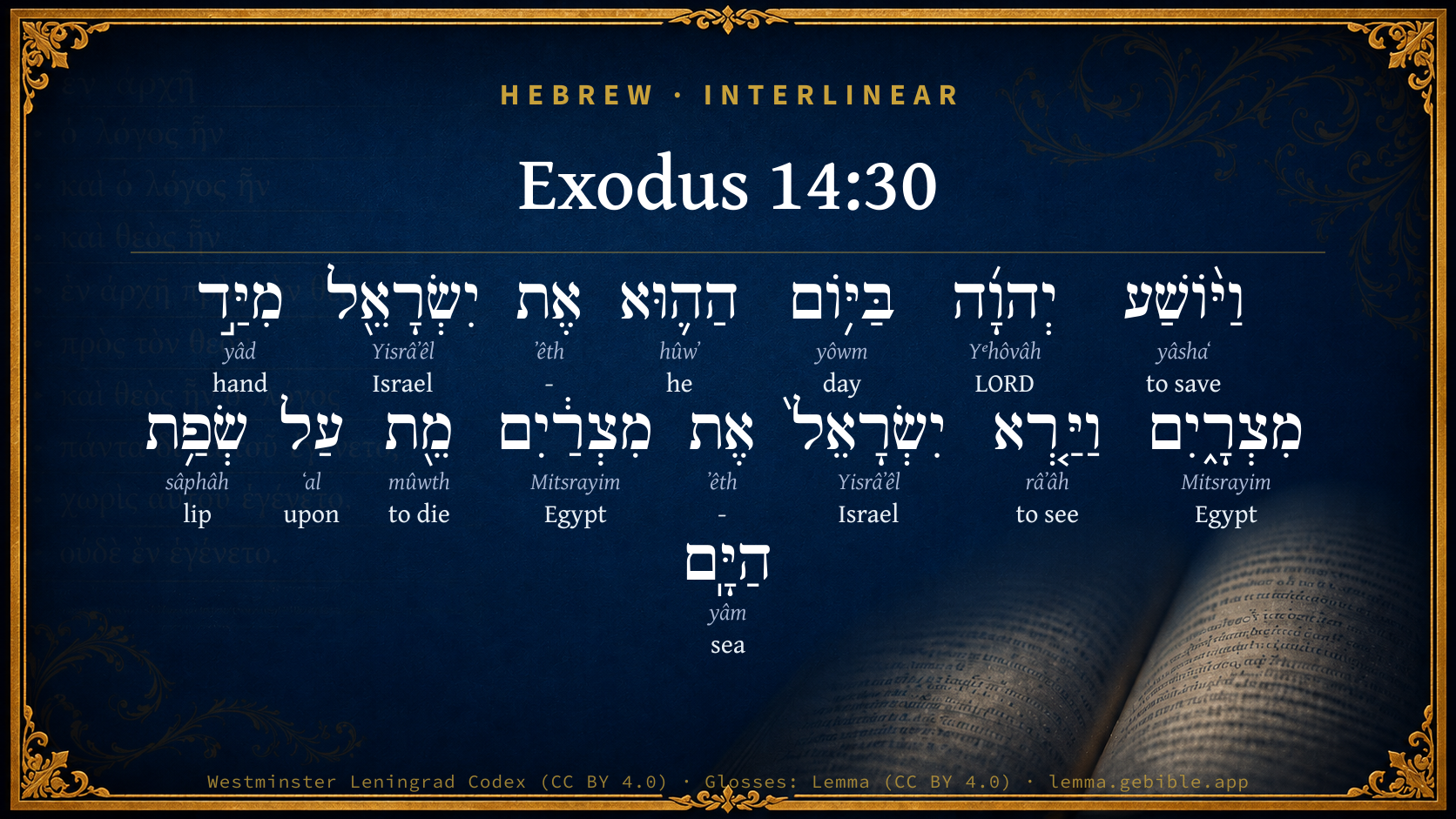
Hebrew (Westminster Leningrad Codex) Exodus 14:30 appears in the Hebrew Old Testament. The text above is from the Westminster Leningrad Codex. Each word links to its Strong’s number, a concise gloss, and parsing drawn from the Open Scriptures Hebrew Bible morphology. Click any word for its full Brown-Driver-Briggs (BDB) entry.
Download image
Cite this verse

Exodus 14:30 (World English Bible). Public Domain. Lemma interlinear Bible study tool, https://lemma.gebible.app/v/exodus/14/30.

Show BibTeX & RIS
BibTeX
RIS
English Translation
Thus Yahweh saved Israel that day out of the hand of the Egyptians; and Israel saw the Egyptians dead on the seashore.
World English Bible · Public Domain
Download a study sheet

One document with this verse’s original text, its word-by-word gloss line, the meaning frame, cross-references with their text, attributed commentary, and full source and license credits — printable, and it pastes into notes with its structure intact.

This verse Autodidact and up

Study sheet (.html) Plain text (.txt)

A passage Seminary Student

Up to 50 verses in one chapter. A passage sheet keeps up to 6 commentary sources and 12 cross-references per verse, in the order this page ranks them, and says so on the sheet whenever that leaves anything out. Ask for a single verse and you get the Autodidact verse sheet above.

Everything on this page stays free to read, with no account — the sheet is a download of what is already on screen, not access to it.

Want to remove ads? Support Godless Engineer
Compare translations 3

The same verse in 3 English versions, stacked beneath the original-language interlinear above. Click any original word for its lexicon entry.

Each is an independent rendering of the whole verse — the interlinear is not word-aligned to these translations.

Highlighted words mark where these versions differ — a whole-verse word diff, not a word-by-word alignment.

  • World English Bible Public Domain
    Thus Yahweh saved Israel that day out of the hand of the Egyptians; and Israel saw the Egyptians dead on the seashore.
  • King James Version Public Domain
    Thus the LORD saved Israel that day out of the hand of the Egyptians; and Israel saw the Egyptians dead upon the sea shore.
  • unfoldingWord Literal Text CC BY-SA 4.0
    And Yahweh saved Israel that day from the hand of Egypt, and Israel saw the Egyptians dead on the shore of the sea.

unfoldingWord Literal Text — © unfoldingWord, licensed CC BY-SA 4.0. Word-aligned USFM3 via Door43 (git.door43.org/unfoldingWord/en_ult).

Versions to compare (up to 4)

3 of 4 selected

Show all 18 translations

Every available English version of this verse, each an independent rendering of the whole verse.

  • World English Bible Public Domain
    Thus Yahweh saved Israel that day out of the hand of the Egyptians; and Israel saw the Egyptians dead on the seashore.
  • Berean Standard Bible Public Domain
    That day the LORD saved Israel from the hand of the Egyptians, and Israel saw the Egyptians dead on the shore.
  • Majority Standard Bible Public Domain
    That day the LORD saved Israel from the hand of the Egyptians, and Israel saw the Egyptians dead on the shore.
  • King James Version Public Domain
    Thus the LORD saved Israel that day out of the hand of the Egyptians; and Israel saw the Egyptians dead upon the sea shore.
  • American Standard Version (1901) Public Domain
    Thus Jehovah saved Israel that day out of the hand of the Egyptians; and Israel saw the Egyptians dead upon the sea-shore.
  • Revised Version (1885) Public Domain
    Thus the LORD saved Israel that day out of the hand of the Egyptians; and Israel saw the Egyptians dead upon the sea shore.
  • Geneva Bible (1599) Public Domain
    Thus the Lord saued Israel the same day out of the hand of the Egyptians, and Israel sawe the Egyptians dead vpon the Sea banke.
  • Douay-Rheims (1899) Public Domain
    And the Lord delivered Israel on that day out of the hands of the Egyptians.
  • Young's Literal Translation Public Domain
    and Jehovah saveth Israel in that day out of the hand of the Egyptians, and Israel seeth the Egyptians dead on the sea-shore,
  • Literal Standard Version CC BY-SA 4.0
    and YHWH saves Israel out of the hand of the Egyptians in that day, and Israel sees the Egyptians dead on the seashore,
  • Unlocked Literal Bible CC BY-SA 4.0
    So Yahweh saved Israel that day out of the hand of the Egyptians, and Israel saw dead Egyptians on the seashore.
  • unfoldingWord Literal Text CC BY-SA 4.0
    And Yahweh saved Israel that day from the hand of Egypt, and Israel saw the Egyptians dead on the shore of the sea.
  • Darby Bible Public Domain
    Thus Jehovah saved Israel that day out of the hand of the Egyptians; and Israel saw the Egyptians dead on the sea-shore.
  • World Messianic Bible Public Domain
    Thus the LORD saved Israel that day out of the hand of the Egyptians; and Israel saw the Egyptians dead on the seashore.
  • Webster's Bible Public Domain
    Thus the LORD saved Israel that day from the hand of the Egyptians: and Israel saw the Egyptians dead upon the sea-shore.
  • Free Bible Version CC BY-SA 4.0
    The Lord saved the Israelites from the threat of the Egyptians—the Israelites saw the Egyptians lying dead on the shore.
  • Bible in Basic English Public Domain
    So that day the Lord gave Israel salvation from the hands of the Egyptians; and Israel saw the Egyptians dead on the sea's edge.
  • JPS Tanakh (1917) Public Domain
    Thus the LORD saved Israel that day out of the hand of the Egyptians; and Israel saw the Egyptians dead upon the sea-shore.

Literal Standard Version (2020), Covenant Press — licensed CC BY-SA 4.0. Text via the HelloAO Bible API (eBible.org). Unlocked Literal Bible (unfoldingWord) — licensed CC BY-SA 4.0. Text via the HelloAO Bible API (eBible.org). unfoldingWord Literal Text — © unfoldingWord, licensed CC BY-SA 4.0. Word-aligned USFM3 via Door43 (git.door43.org/unfoldingWord/en_ult). Free Bible Version, Dr. Jonathan Gallagher — licensed CC BY-SA 4.0. Text via the HelloAO Bible API (eBible.org).

Word by word

More ways to search: Search by grammar → Find every occurrence → Compare this word →

Practice this passage: Drill this verse → Learn its vocabulary →

שְׂפַ֥ת
sâphâh
H8193
“lip of”
Noun, Common, Feminine, Singular, Construct
Part of Speech
Noun
Type
Common
Gender
Feminine
Number
Singular
State
Construct
Full BDB Definition

Origin: probably from H5595 or H8192 through the idea of termination (compare H5490 )

TWOT: 2278a

lip, language, speech, shore, bank, brink, brim, side, edge, border, binding - lip (as body part) - language - edge, shore, bank (of cup, sea, river, etc)
  1. וַיּ֨וֹשַׁע yâshaʻ H3467 “and · to save” Conjunction + Verb, Hiphil, Sequential Imperfect, 3rd Person, Masculine, Singular
  2. יְהוָ֜ה Yᵉhôvâh H3068 “LORD” Noun, Proper
  3. בַּיּ֥וֹם yôwm H3117 “in/at the · day” Preposition, Determined + Noun, Common, Masculine, Singular, Absolute
  4. הַה֛וּא hûwʼ H1931 “the · he” Particle, Definite Article + Pronoun, Personal, 3rd Person, Masculine, Singular
  5. אֶת ʼêth H853 “-” Particle, Direct Object
  6. יִשְׂרָאֵ֖ל Yisrâʼêl H3478 “Israel” Noun, Proper
  7. מִיַּ֣ד yâd H3027 “from · hand of” Preposition + Noun, Common, Both, Singular, Construct
  8. מִצְרָ֑יִם Mitsrayim H4714 “Egypt” Noun, Proper
  9. וַיַּ֤רְא râʼâh H7200 “and · to see” Conjunction + Verb, Qal, Sequential Imperfect, 3rd Person, Masculine, Singular
  10. יִשְׂרָאֵל֙ Yisrâʼêl H3478 “Israel” Noun, Proper
  11. אֶת ʼêth H853 “-” Particle, Direct Object
  12. מִצְרַ֔יִם Mitsrayim H4714 “Egypt” Noun, Proper
  13. מֵ֖ת mûwth H4191 “dying” Verb, Qal, Participle Active, Masculine, Singular, Absolute
  14. עַל ʻal H5921 “upon” Preposition
  15. הַיָּֽם yâm H3220 “the · sea” Particle, Definite Article + Noun, Common, Masculine, Singular, Absolute

About this verse

These counts appear in no published source. They are computed here, from the morphology-tagged text and Lemma’s own curated glosses. What Lemma adds →

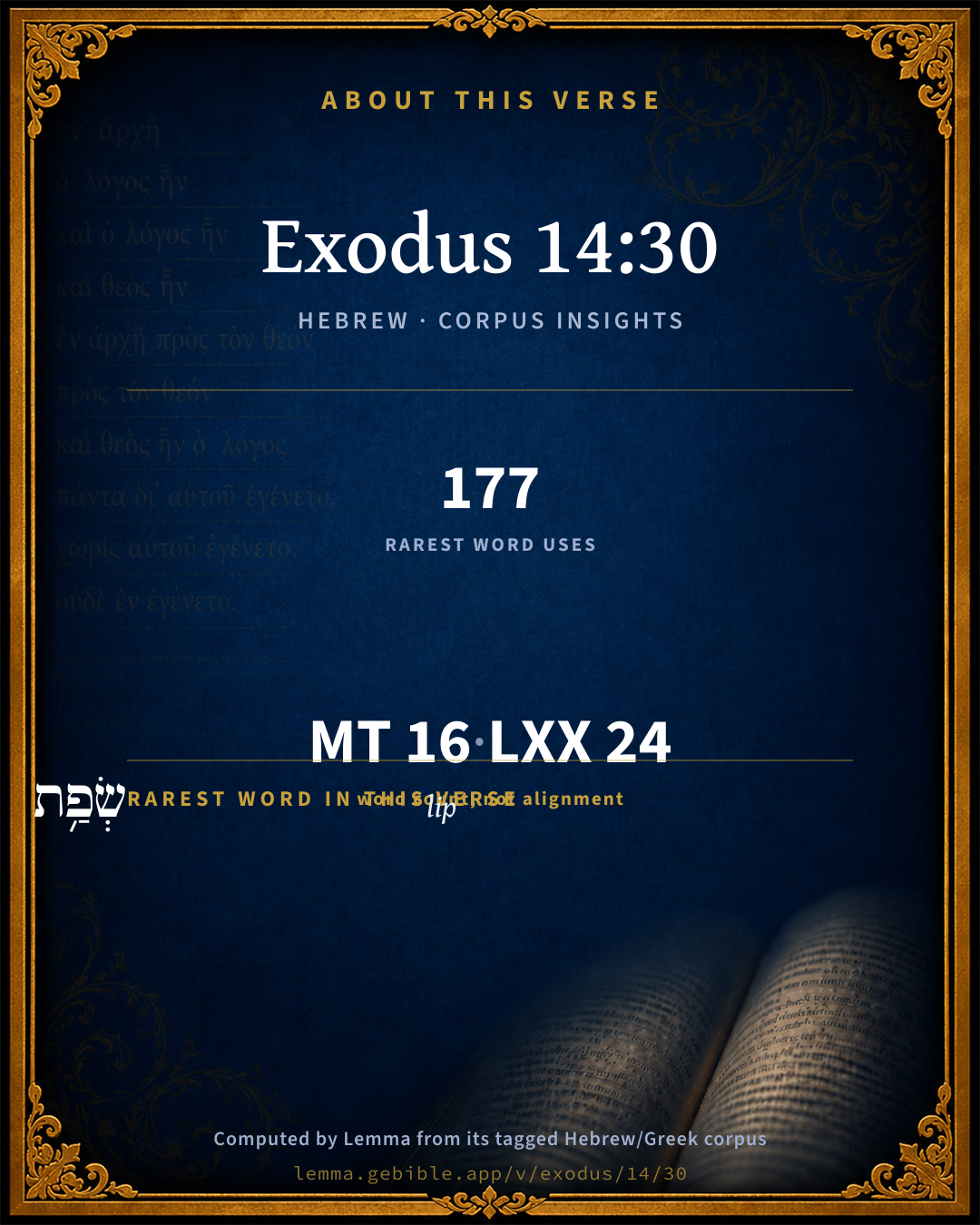
16
words
13
distinct lemmas
Pentateuch
section

Grammatical profile

  • 3 verbs
  • 9 nouns
  • 1 pronoun
  • 1 preposition
  • 2 particles

Verb forms

  • וַיּ֨וֹשַׁע Hiphil · Sequential Imperfect
  • וַיַּ֤רְא Qal · Sequential Imperfect
  • מֵ֖ת Qal · Participle Active

Repetition

Words recur within this verse — often emphatic in Hebrew:

  • יִשְׂרָאֵ֖ל Israel H3478 ×2
  • מִצְרָ֑יִם Egypt H4714 ×2

Hebrew & Septuagint length

In English translation the verse runs 22 words from the Hebrew and 26 from the Septuagint (LXX English) — closely comparable.

A rough comparison of the two English renderings, which tokenize alike — not a word-level alignment.

Word counts can differ between the Hebrew and the Greek without any difference in meaning — e.g. the Hebrew direct-object marker אֵת has no separate Greek word, and Greek often adds the article ὁ.

In the original languages it is 16 Hebrew tokens and 24 Greek tokens — but the two are counted differently (Hebrew bundles its prefixes and suffixes into one token; the Greek is in lemma form), so that isn’t a like-for-like length.

Cross-references

11

Topical passages linked to Exodus 14:30 in the Treasury of Scripture Knowledge — connected by theme and wording, ordered by reader-vote popularity; previews shown in the World English Bible.

  • Psalms 106:8 Nevertheless he saved them for his name's sake, That he might make his mighty power known.
  • Psalms 106:10 He saved them from the hand of him who hated them, And redeemed them from the hand of the enemy.
  • Psalms 58:10 The righteous shall rejoice when he sees the vengeance. He shall wash his feet in the blood of the wicked;
  • Psalms 92:9–11 For, behold, your enemies, Yahweh, For, behold, your enemies shall perish. All the evil-doers will be scattered.
  • Jude 1:5 Now I desire to remind you, though you already know this, that the Lord, having saved a people out of the land of Egypt, afterward destroyed those who didn't believe.
  • Exodus 14:13 Moses said to the people, "Don't be afraid. Stand still, and see the salvation of Yahweh, which he will work for you today: for the Egyptians whom you have seen today, you shall never see them again.
  • 1 Samuel 14:23 So Yahweh saved Israel that day: and the battle passed over by Beth Aven.
  • Psalms 59:10 My God will go before me with his loving kindness. God will let me look at my enemies in triumph.
  • 2 Chronicles 32:22 Thus Yahweh saved Hezekiah and the inhabitants of Jerusalem from the hand of Sennacherib the king of Assyria, and from the hand of all [others], and guided them on every side.
  • Psalms 91:8 You will only look with your eyes, And see the recompense of the wicked.
  • Isaiah 63:9 In all their affliction he was afflicted, and the angel of his presence saved them: in his love and in his pity he redeemed them; and he bore them, and carried them all the days of old.

Cross-references courtesy of OpenBible.info (CC BY 4.0).

Hebrew and Greek witnesses Masoretic Hebrew ↔ Greek Septuagint

The same verse in the two great witnesses to the Old Testament, shown verse-for-verse.

These are two independent witnesses, not word-aligned to each other, and the Septuagint is shown in lemma (dictionary) form.

Hebrew Exodus 14:30 Masoretic · Westminster Leningrad Codex

וַיּ֨וֹשַׁע יְהוָ֜ה בַּיּ֥וֹם הַה֛וּא אֶת יִשְׂרָאֵ֖ל מִיַּ֣ד מִצְרָ֑יִם וַיַּ֤רְא יִשְׂרָאֵל֙ אֶת מִצְרַ֔יִם מֵ֖ת עַל שְׂפַ֥ת הַיָּֽם

Thus Yahweh saved Israel that day out of the hand of the Egyptians; and Israel saw the Egyptians dead on the seashore.

World English Bible · Public Domain

Greek LXX Exodus 14:30 Septuagint · lemma form

καί ῥύομαι κύριος ὁ ἰσραήλ ἐν ὁ ἡμέρα ἐκεῖνος ἐκ χείρ ὁ αἰγύπτιος καί ὁράω ἰσραήλ ὁ αἰγύπτιος θνήσκω παρά ὁ χεῖλος ὁ θάλασσα

So the Lord delivered Israel in that day from the hand of the Egyptians, and Israel saw the Egyptians dead by the shore of the sea.

LXX2012 (modern English Septuagint) · Public Domain

Hebrew: Westminster Leningrad Codex (CC BY 4.0). Greek: Septuagint (public domain); English from LXX2012 (modern English Septuagint) (Public Domain). How the Septuagint differs from the Hebrew →

Targum (Aramaic paraphrase)

2

The Targum is the ancient Jewish Aramaic paraphrase of the Hebrew Scriptures — an interpretive translation, not the Hebrew text itself. Onkelos (literal) and Pseudo-Jonathan (expansive) render the Torah, and Jonathan the Prophets. Coverage is partial: where no permissively-licensed English translation exists for a verse, only the Aramaic is shown. This is verse-level text, not a word-by-word alignment to the Hebrew.

  1. Targum Onkelos Torah (Genesis–Deuteronomy)
    וּפְרַק יְיָ בְּיוֹמָא הַהוּא יָת יִשְׂרָאֵל מִידָא דְמִצְרָאֵי וַחֲזוֹ יִשְׂרָאֵל יָת מִצְרָאֵי מַיְתִין עַל כֵּיף יַמָא:

    (no public-domain English translation for this verse)

    Targum Onkelos — Aramaic: “Onkelos Genesis” (public domain); “Onkelos Exodus” (public domain); “Onkelos Leviticus” (public domain); “Onkelos Numbers” (public domain); “Onkelos Deuteronomy” (public domain). English: “Sefaria Community Translation” (CC0 1.0 (public-domain dedication)); “J.W. Etheridge. The Targums of Onkelos and Jonathan Ben Uzziel on the Pentateuch. London: Longmans, Green, 1862” (public domain). Text via Sefaria.

  2. Targum Pseudo-Jonathan Torah (Genesis–Deuteronomy)
    וּפְרִיק וּשְׁזִיב יְיָ בְּיוֹמָא הַהוּא יַת יִשְרָאֵל מִן יְדֵיהוֹן דְּמִצְרָאֵי וְחָמוּן יִשְרָאֵל יַת מִצְרָאֵי מֵיתִין וְלָא מֵיתִין רְמָאִין עַל גֵּיף יַמָא

    That day the Lord redeemed and saved Israel from the hand of the Mizraee; and Israel saw the Mizraee, dead and not dead, cast upon the shore of the sea.

    Targum Pseudo-Jonathan — Aramaic: “Targum Jonathan on Genesis” (public domain); “Targum Jonathan on Exodus” (public domain); “Targum Jonathan on Leviticus” (public domain); “Targum Jonathan on Numbers” (public domain); “Targum Jonathan on Deuteronomy” (public domain). English: “The Targum of Jonathan ben Uzziel, trans. J. W. Etheridge, London, 1862” (public domain). Text via Sefaria.

Commentary

Notes on Exodus 14:30 from classic Christian and Jewish commentators (each source and its license shown beneath its notes). The classic Christian expositions comment on the surrounding passage and are grouped to its opening verse, so a note may address several verses; the Jewish commentaries on the Tanakh (Rashi and others) are per-verse, so they appear only where the commentator wrote on this verse.

Lemma curates 59 commentaries, every one of them public domain or Creative Commons licensed, each selected and text-cleaned for this edition rather than reprinted as found. About our sources →

Trapp's Complete Commentary

John Trapp

Exo 14:30 Thus the LORD saved Israel that day out of the hand of the Egyptians; and Israel saw the Egyptians dead upon the sea shore.

Ver. 30, 31. Thus the Lord.] A mercy never enough memorised. What, then, is our redemption from sin, death, and hell

John Trapp, A Commentary or Exposition upon All the Books of the Old and New Testament (1647–1656) — public domain. Text from a community e-Sword module.

The Biblical Illustrator

Joseph S. Exell

Exo_14:30-31

Thus the Lord saved Israel

The great deliverance

Had it not been for this great deliverance, the children of Israel would only have been remembered in the after-history of the world as the slaves who helped to build the Pyramids.

Their religion was fast perishing among them, their religious rites forgotten; and they would soon have been found among the worshippers of the monster gods of Egypt. But God had better things in store for them, when He led them through the Red Sea, making a path for them amid the waters.

I. It was one of the greatest blessings for the human race, that during the preservation of the Jewish people, the great truth of the personality of God, and His nearness to His people, was set before them in language which could not be mistaken. And it is one of the greatest blessings which we enjoy, that we have the same Lord personally presented to us, revealed in the risen and glorified Lord Jesus Christ.

II. God is set before us here not only as a Person, but as a person who cares with all a fathers love and watchfulness for his own people, Our hopes in days of doubt and difficulty are directed to the same personal fatherly care of the great God who loves all His creatures, and who loves Christians above all in the Lord Jesus Christ.

III. When a great national victory is achieved, what boots it to him who loses his life in the hour of victory? The question for us is, not whether God has wrought a great deliverance, but whether we as individuals are partakers of that deliverance, partakers of the victory of the Lord Jesus Christ. (Archbishop Tait.)

Israels deliverance

I. The state of the Israelites when Moses came to them.

1. They were in bondage.

2. They were so far conscious of the misery of their position that they had a strong desire for liberty.

3. They were by no means ready at first to accept the message of Gods deliverance.

4. They had their comforts even in slavery. In all these things we have a picture of ourselves.

II. The deliverance.

1. The moment the Passover is observed, that moment Pharaohs power is broken. The moment that all is right between us and God, that moment Satans power is broken, and he can no longer hold us in bondage.

2. The waters of judgment which saved the Israelites were the means of destroying the vast hosts of Egypt. The power of Satan is broken by the very means by which he intended to destroy.

3. It is our privilege to take our stand on the other side of the Red Sea, and see ourselves raised up with christ into a new life. (W. Hay Aitken, M. A.)

The diving deliverer recognised

And this mighty God, who so delivered Israel in ancient time, is our God for ever and ever. The walls and covering of our habitations are as truly upheld and kept from falling and crushing us to death, by the Divine hand, as were the walls of waters kept upright, like solid stone, by Almighty power, while the Hebrews passed safely between. We say that it was miracle which protected them, and the laws of nature which protect us. But in both cases it is God. The deepest and truest philosophy of life and faith for us is to bring ourselves into the most intimate relations with the infinite God. The most profound and accurate student of nature is he whose eye is quickest to see the plan and purpose of an intelligent, governing Mind in everything that exists. What should we think of an Israelite walking through the depths of the sea on dry ground, between walls of water standing up like marble on either hand, and yet not recognizing the intended and merciful display of the Divine power for his protection? What should we think of a ransomed Hebrew standing on the safe shore of the Red Sea on that memorable morning, and yet refusing to join in the song of thanksgiving for the great deliverance of the night? The same that we ought to think of one who lies down to sleep at night in his own house, and goes to his daily occupation in the morning, and never prays, never offers thanksgiving to God, for the mercy which redeems his life from destruction every moment. In God we live, and move, and have our being. Every use of our faculties, every sensation of pleasure, every emotion of happiness, every possession, experience, and hope that makes existence a blessing, is a witness to us of Gods special, minute, and ceaseless attention to our welfare. (D. March, D. D.)

.

The Biblical Illustrator, edited by Joseph S. Exell (c. 1880s–1900s) — public domain. Text from a community e-Sword module.

Joseph Benson's Commentary

Exo 14:30. Israel saw the Egyptians dead upon the sea-shore — Rather, Israel upon (or from) the sea-shore saw the Egyptians dead — That is, saw their dead bodies floating upon the waters. It is likely, however, that the bodies of many of them were cast on shore, and became food to the beasts and birds of prey that frequent the wilderness, which may be the meaning of Psa 74:14; and that the Israelites had the benefit of the spoil, especially of their arms, which they wanted. The Egyptians were very curious in preserving the bodies of their great men; but here the utmost contempt is poured upon the grandees of Egypt: see how they lie, heaps upon heaps, as dung upon the face of the earth!

Joseph Benson's Commentary on the Old and New Testaments (1811–1818) — public domain. Text from a community e-Sword module.

Jamieson, Fausset & Brown

Robert Jamieson, A. R. Fausset & David Brown

Israel saw the Egyptians dead upon the sea-shore, &c.--The tide threw them up and left multitudes of corpses on the beach; a result that brought greater infamy on the Egyptians, but that tended, on the other hand, to enhance the triumph of the Israelites, and doubtless enriched them with arms, which they had not before. The locality of this famous passage has not yet been, and probably never will be, satisfactorily fixed. Some place it in the immediate neighborhood of Suez; where, they say, the part of the sea is most likely to be affected by "a strong east wind" [Exo 14:21]; where the road from the defile of Migdol (now Muktala) leads directly to this point; and where the sea, not above two miles broad, could be crossed in a short time. The vast majority, however, who have examined the spot, reject this opinion, and fix the passage, as does local tradition, about ten or twelve miles further down the shore at Wady Tawarik. "The time of the miracle was the whole night, at the season of the year, too, when the night would be about its average length. The sea at that point extends from six and a half to eight miles in breadth. There was thus ample time for the passage of the Israelites from any part of the valley, especially considering their excitement and animation by the gracious and wonderful interposition of Providence in their behalf" [WILSON].

Next: Exodus Chapter 15

Jamieson, Fausset & Brown — Commentary Critical and Explanatory on the Whole Bible (1871) — public domain (CC PDM 1.0). Text via the HelloAO Bible API.

Adam Clarke's Commentary

Verse 30. Israel saw the Egyptians dead upon the seashore.] By the extraordinary agitation of the waters, no doubt multitudes of the dead Egyptians were cast on the shore, and by their spoils the Israelites were probably furnished with considerable riches, and especially clothing and arms; which latter were essentially necessary to them in their wars with the Amalekites, Basanites, and Amorites, &c., on their way to the promised land. If they did not get their arms in this way, we know not how they got them, as there is not the slightest reason to believe that they brought any with them out of Egypt.

Adam Clarke's Commentary on the Bible (1810–1826) — public domain. Text from a community e-Sword/MySword module.

Ellicott's Commentary for English Readers

(30) Israel saw the Egyptians dead upon the sea shore.—On one who saw this sight it would be likely to make a great impression; to after generations it was nothing, since it had no further consequences. That it is recorded indicates the pen of an eyewitness.

A Bible Commentary for English Readers, edited by Charles John Ellicott (1878–1897) — public domain. Text from a community e-Sword module.

The Cambridge Bible for Schools and Colleges

gen. ed. J. J. S. Perowne

30. the Egyptians] Heb. Egypt (with a sing. partic. for ‘dead’): cf. vv. 10, 25.

30, 31. Close of the narrative in J.

The Cambridge Bible for Schools and Colleges (gen. ed. J. J. S. Perowne; Cambridge University Press, 1878–1918) — public domain. Text from a community e-Sword module.

John Gill's Exposition

Thus the Lord saved Israel that day out of the hand of the Egyptians,.... For though it was now six or seven days since they had leave to go out of Egypt, and actually did depart, yet they could not be said properly to be saved, or to be in safety, till this day, when all the Egyptians their enemies were destroyed, that pursued after them; and this was the twenty first day of the month, and the seventh and last day of the passover, and was an holy convocation to the Lord; See Gill on Exo 12:16.

and Israel saw the Egyptians dead on the sea shore; all along, as a late traveller (h) observes, as we may presume, from Sdur (or Shur) to Corondel, and at Corondel especially, from the assistance and termination of the current there. The word for "dead" (i) is in the singular number, and joined with a plural may denote that they saw everyone of the Egyptians dead, since they were all destroyed, and not one remained of them, as in Exo 14:28. Aben Ezra thinks the sense of the words is, not that the Egyptians were seen dead upon the sea shore, but that the Israelites standing upon the sea shore saw the dead bodies of the Egyptians, that is, floating on the waters of the sea; but rather the meaning is, that their dead bodies were by the force of the waters cast upon the shore, and there beheld and plundered by the Israelites. Josephus (k) observes, that the day following (that night the Egyptians were drowned) the arms of the Egyptians being cast on the shore where the Hebrews encamped, through the force of the sea and wind, Moses gathered them up and armed the Hebrews with them; and this will account for it how they came to have arms, since it is highly probable they came out of Egypt unarmed; and how they could fight battles as they did in the wilderness, and when they came into the land of Canaan.

(h) Shaw's Travels, p. 314. Ed. 2. (i) Mortuum, Montanus, Drusius. (k) Antiqu. l. 2. c. 16. sect. 6.

John Gill's Exposition of the Whole Bible (1746–1763) — public domain (CC PDM 1.0). Text via the HelloAO Bible API.

Matthew Poole's English Annotations

Which was done either,

1. By the natural power of the sea, which casteth up its dead bodies after a certain time; till which time God caused the Israelites to abide near the sea, that they might see this for their comfort. Or,

2. By the mighty power of God, which brought them, and their arms too, as many probably conceive, to shore before the usual time.

Quest. How could the Israelites, both they and their cattle, in so little time get over that great sea?

Answ. 1. The Hebrew and some other interpreters deny that they went over, and tell us, they only went into the sea, and fetched a compass in it, that they might allure the Egyptians to follow them, and then by Moses’s conduct returned to the Egyptian shore again. The principal ground of which opinion is this, That as they went into the sea out of the wilderness of Etham, Exo 13:20, so they came again out of the sea into the wilderness of Etham, Num 33:8. But the sameness of the name doth not prove that it is the same place, nothing being more frequent in Scripture, than for divers places to be called by one and the same name. And the Israelites might possibly give the name of Etham to this desert on the Arabian side of the Red Sea, either for its great resemblance to that desert so called on the Egyptian side; or to intimate, that God by dividing the sea, had made that and this to be one continued desert. Or the name of Etham might be common to all that desert at the end of the Red Sea, and on both sides of it.

Answ. 2. They might all conveniently pass over the sea to the Arabian shore in the time allowed for it, either by the mighty power of God, which could easily make both men and beasts to do it in much less than ordinary time, or even by the course of nature; for that part of the sea was not above eight or nine miles over, as geographers and others affirm. And the time allotted for their passage seems to be much more than interpreters have assigned for it. For the Egyptians and Israelites were divided one from another by the cloudy pillar all the night, Exo 14:20, and a strong east wind blew all that night, Exo 14:21. The next morning, as I apprehend it, the cloud still keeping between them, and possibly covering the Egyptians with gross and horrible darkness, which hindered their march, the whole body of the Israelites, and their cattle too, are drawn by Moses’s direction near the shore, and, it may be, the cattle were put into the sea, all which might well take up most of that day; then towards the evening they enter into the sea, and so proceed; and the cloud withdrawing further from the Egyptians, and following the Israelites, the Egyptians pursue after them, and, as it is very probable from the nature and reason of the thing, stand debating some considerable time, when they came to the shore, whether they should venture to follow them into the sea or no. At last the worst counsel prevails, as it generally happens when a people are under a Divine infatuation, and into the sea they go; and by the beginning of the morning watch they draw near the Israelites, when God seasonably appears for Israel’s succour, and puts a stop to the march of the Egyptians. So the morning watch, mentioned Exo 14:24, I take to be, not the morning watch of that night, mentioned Exo 14:20,21, (for all that night, and therefore the morning watch of that night, which was a third, or at least a fourth part of it, was now past and gone,) but the next morning watch after that night and the succeeding day; which seems much more reasonable, than to shrink up the march, first of the Israelites, and then of the Egyptians, into about three hours’ time, which is the time between the midnight and the morning watch. Nor is there any thing in the text which in the least contradicts this opinion, but only that this day’s interval and work is not mentioned in this story; whereas such omissions are frequent in Scripture relations, in which the substance only is mentioned, and many circumstances omitted, whereof we have seen some instances already, and shall meet with many more hereafter.

Matthew Poole's English Annotations on the Holy Bible (1683–1685) — public domain. Text from a community e-Sword/MySword module.

Whedon's Commentary on the Bible

Daniel D. Whedon

30, 31. The Egyptians dead upon the sea shore — The western wind and the returning tide strewed the eastern shore with men and horses, chariots and armour. Josephus says: “On the next day Moses gathered together the weapons of the Egyptians which were brought to the camp of the Hebrews by the current of the sea and the force of the winds assisting it.” (Antiq., 2:16, 6.) Thus might the Israelites have obtained arms for the battles afterwards described with the desert tribes and the Canaanites.

Thus the Lord saved Israel that day — Israel ever remembered this day and this event as the beginning of their national life. Reminiscences of the Red Sea deliverance are interwoven with all their literature, worship, and social life. Profane history has also preserved unmistakable traditions of this great event. Diodorus Siculus (iii, 39) relates that the inhabitants along the shore of the Sea have a tradition that it was once left dry by a great ebb tide, so that the bottom appeared. Artapanus relates (Euseb., Praep. Evang., 9:27) that the inhabitants of Memphis said that Moses led the hosts through the Red Sea during an ebb tide, while the inhabitants of Heliopolis said that Moses, when chased by the king, divided the Sea with his rod, but that when the Egyptians followed after them fire flashed upon them and the waters rolled back and destroyed them. In the language of Ewald, this is an event “whose historical certainty is well established, and its momentous results… are even to us distinctly visible.” (Hist. of Israel, 2:75.) It is not surprising that men who refuse to admit the supernatural anywhere attempt to explain the Red Sea deliverance as a fortuitous coincidence of natural events. Obstinate unbelief can resolve all answers to prayer into happy accidents. No amount of evidence can demonstrate the supernatural to him who lacks spiritual insight. No miracle can compel conviction like a mathematical demonstration, for the proof of divine activity is addressed to the moral and not to the intellectual man. The grandest miracle recorded in history, the resurrection of the Son of God, did not convince all who witnessed it, for “some doubted.” If unbelief were not always possible faith would not be a rewardable virtue, and it is this faith that sees with Israel that great work which Jehovah did upon the Egyptians.

Daniel D. Whedon (gen. ed.), Commentary on the Old and New Testaments (1874–1909) — public domain. Text from a community e-Sword module.

The Pulpit Commentary

Israel saw the Egyptians dead upon the sea-shore. Josephus says (Ant. Jud_1:2:16, that, after the passage of the sea by the Israelites, a west wind set in, which (assisted by the current) drove the bodies of the drowned Egyptians to the eastern side of the gulf, where many of them were cast up upon the shore. In this way Moses, according to him, obtained weapons and armour for a considerable number of Israelites.

The Pulpit Commentary (1880–1919), ed. H.D.M. Spence-Jones & Joseph S. Exell — public domain. Text from a community e-Sword module.

John Wesley's Explanatory Notes

And Israel saw the Egyptians dead upon the shore - The Egyptians were very curious in preserving the bodies of their great men, but here the utmost contempt is poured upon all the grandees of Egypt; see how they lie heaps upon heaps, as dung upon the face of the earth.

John Wesley, Explanatory Notes Upon the Whole Bible (1754–1765) — public domain. Text via the GEBible commentary corpus.

Keil & Delitzsch

C. F. Keil & F. Delitzsch

This miraculous deliverance of Israel from the power of Egypt, through the mighty hand of their God, produced so wholesome a fear of the Lord, that they believed in Jehovah, and His servant Moses.

Exo 14:31

"The great hand:" i.e., the might which Jehovah had displayed upon Egypt. In addition to the glory of God through the judgment upon Pharaoh (Exo 14:4, Exo 14:17), the guidance of Israel through the sea was also designed to establish Israel still more firmly in the fear of the Lord and in faith. But faith in the Lord was inseparably connected with faith in Moses as the servant of the Lord. Hence the miracle was wrought through the hand and staff of Moses. But this second design of the miraculous guidance of Israel did not exclude the first, viz., glory upon Pharaoh. From this manifestation of Jehovah's omnipotence, the Israelites were to discern not only the merciful Deliverer, but also the holy Judge of the ungodly, that they might grow in the fear of God, as well as in the faith which they had already shown, when, trusting in the omnipotence of Jehovah, they had gone, as though upon dry land (Heb 11:29), between the watery walls which might at any moment have overwhelmed them.

Keil & Delitzsch — Biblical Commentary on the Old Testament (1861–1891) — public domain (CC PDM 1.0). Text via the HelloAO Bible API. (Old Testament only.)

Scofield Reference Notes

C. I. Scofield

Thus the Lord saved Israel

Redemption: (Exodus type) Summary. Exodus is the book of redemption and teaches:

(1) redemption is wholly of God Exo 3:7; Exo 3:8; Joh 3:16.

(2) redemption is through a person. (See Scofield "Exo 2:2"). Joh 3:16; Joh 3:17.

(3) redemption is by blood Exo 12:13; Exo 12:23; Exo 12:27; 1Pe 1:18.

(4) redemption is by power Exo 6:6; Exo 13:14; Rom 8:2.

(See Scofield "Isa 59:20"). See Scofield "Rom 3:24".

The blood of Christ redeems the believer from the guilt and penalty of sin. 1Pe 1:18 as the power of the Spirit delivers from the dominion of sin.; Rom 8:2; Eph 2:2.

The Scofield Reference Bible (1917 edition), notes by C. I. Scofield — public domain. Text from a community e-Sword module.

Rashi

Rabbi Shlomo Yitzchaki (Rashi)

וירא ישראל את מצרים מת AND ISRAEL SAW THE EGYPTIANS DEAD — because the sea threw them out on its shore in order that the Israelites should not say: “Just as we have come up from out of the sea on this part, so they have come up on another part of this shore, but far away from us, and they will pursue us” (Mekhilta; Pesachim 118b; Arakhin 15a).

Rashi on the Tanakh — English translations: “The Judaica Press complete Tanach with Rashi, translated by A. J. Rosenberg” (CC BY 4.0); “Pentateuch with Rashi's commentary by M. Rosenbaum and A.M. Silbermann, 1929-1934” (public domain); “The Metsudah Tanach series, Lakewood, N.J” (CC BY 4.0); and “The Book of Joshua, Metsudah Publications, 1997” (CC BY 4.0). Text via Sefaria.

Ibn Ezra

Rabbi Abraham ibn Ezra

On that day Ad-noy delivered. Only now were B’nei Yisrael delivered from the Egyptians because until this point they were still in fear of Pharaoh. [B’nei] Yisrael saw the Egyptians dead. It is written later on that the Egyptians “sunk” into the sea (15:4) and that the earth, “swallowed them up” (15:12). Therefore the statement that B’nei Yisrael “saw the Egyptians dead on the seashore” must mean that B’nei Yisrael saw the Egyptians dead in the middle of the sea while they themselves were on the shore.

Ibn Ezra on the Tanakh — English translations: “Sefaria Community Translation” (CC0 1.0 (public-domain dedication)); “Yalkut, Sifsei Chachomim Chumash, Metsudah Publications, 2009” (CC BY 4.0); and “Commentary of Ibn Ezra on Isaiah - trans. by M. Friedlander, 1873” (public domain). Text via Sefaria.

Lesson kit

Teaching starters — assembled from the data on this page, not authored interpretation. Every prompt links to the verse data it draws on. Edit before teaching.

Exodus, in the Pentateuch, opens this verse with 16 words (13 distinct Hebrew lemmas). Its most distinctive word is sâphâh (“lip”). A historical commentator’s framing appears above. Read the whole chapter for the surrounding context.

Discussion questions

  1. What does “lip” (sâphâh) contribute to the verse as a whole?
  2. Psalms 106:8 shares this passage’s theme. How do the two illuminate each other?
  3. “Israel” occurs 2× in this one verse. What is the effect of the repetition?
  4. These translations render this verse differently; the difference is in the English rendering, not the original. What questions does that raise?
  5. The verb «וַיּ֨וֹשַׁע» is Hiphil Sequential Imperfect. How does its form color the action?
  6. Reading how Trapp's Complete Commentary and The Biblical Illustrator read this verse, where do the two commentators agree and where do they part?

Things to notice

Reading settings

Reading text

Shown beneath each verse's original-language words.

Old Testament
Old Testament edition

Read the OT as the Masoretic Hebrew (MT) or the Greek Septuagint (LXX).

English shown for the Greek Septuagint (in the Hebrew ↔ Greek comparison).

Comparing translations? Open the Compare panel on any verse page to stack up to four side by side.