
1 Kings 2:24

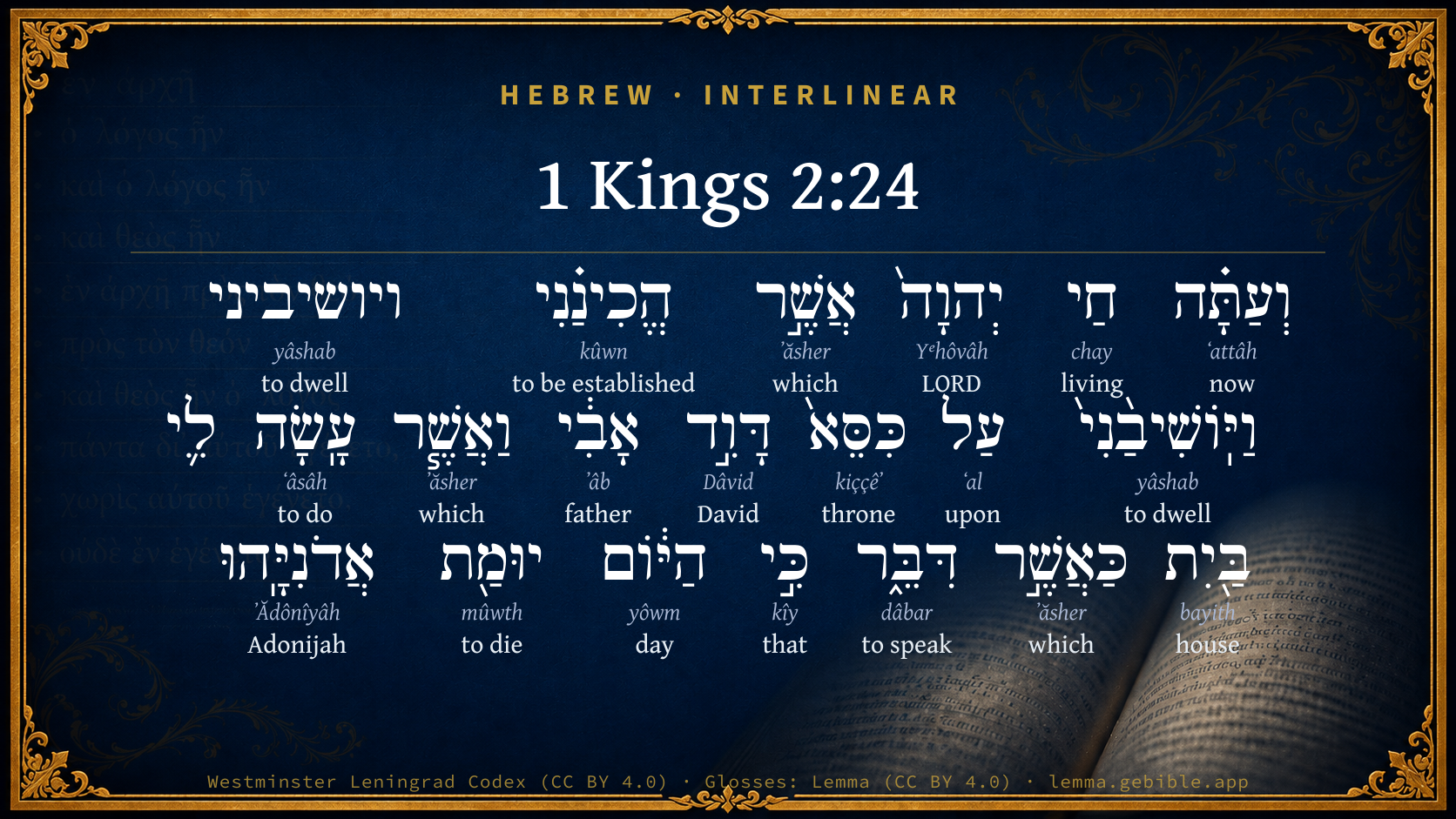
Hebrew (Westminster Leningrad Codex) 1 Kings 2:24 appears in the Hebrew Old Testament. The text above is from the Westminster Leningrad Codex. Each word links to its Strong’s number, a concise gloss, and parsing drawn from the Open Scriptures Hebrew Bible morphology. Click any word for its full Brown-Driver-Briggs (BDB) entry.
Download image
Cite this verse

1 Kings 2:24 (World English Bible). Public Domain. Lemma interlinear Bible study tool, https://lemma.gebible.app/v/1-kings/2/24.

Show BibTeX & RIS
BibTeX
RIS
English Translation
Now therefore as Yahweh lives, who has established me, and set me on the throne of David my father, and who has made me a house, as he promised, surely Adonijah shall be put to death this day.
World English Bible · Public Domain
Download a study sheet

One document with this verse’s original text, its word-by-word gloss line, the meaning frame, cross-references with their text, attributed commentary, and full source and license credits — printable, and it pastes into notes with its structure intact.

This verse Autodidact and up

Study sheet (.html) Plain text (.txt)

A passage Seminary Student

Up to 50 verses in one chapter. A passage sheet keeps up to 6 commentary sources and 12 cross-references per verse, in the order this page ranks them, and says so on the sheet whenever that leaves anything out. Ask for a single verse and you get the Autodidact verse sheet above.

Everything on this page stays free to read, with no account — the sheet is a download of what is already on screen, not access to it.

Want to remove ads? Support Godless Engineer
Compare translations 3

The same verse in 3 English versions, stacked beneath the original-language interlinear above. Click any original word for its lexicon entry.

Each is an independent rendering of the whole verse — the interlinear is not word-aligned to these translations.

Highlighted words mark where these versions differ — a whole-verse word diff, not a word-by-word alignment.

  • World English Bible Public Domain
    Now therefore as Yahweh lives, who has established me, and set me on the throne of David my father, and who has made me a house, as he promised, surely Adonijah shall be put to death this day.
  • King James Version Public Domain
    Now therefore, as the LORD liveth, which hath established me, and set me on the throne of David my father, and who hath made me an house, as he promised, Adonijah shall be put to death this day.
  • unfoldingWord Literal Text CC BY-SA 4.0
    And now, the life of Yahweh, who has established me and made me sit on the throne of David my father, and who has made a house for me, just as he said, surely Adonijah shall be killed today.”

unfoldingWord Literal Text — © unfoldingWord, licensed CC BY-SA 4.0. Word-aligned USFM3 via Door43 (git.door43.org/unfoldingWord/en_ult).

Versions to compare (up to 4)

3 of 4 selected

Show all 18 translations

Every available English version of this verse, each an independent rendering of the whole verse.

  • World English Bible Public Domain
    Now therefore as Yahweh lives, who has established me, and set me on the throne of David my father, and who has made me a house, as he promised, surely Adonijah shall be put to death this day.
  • Berean Standard Bible Public Domain
    And now, as surely as the LORD lives—the One who established me, who set me on the throne of my father David, and who founded for me a dynasty as He promised—surely Adonijah shall be put to death today!”
  • Majority Standard Bible Public Domain
    And now, as surely as the LORD lives—the One who established me, who set me on the throne of my father David, and who founded for me a dynasty as He promised—surely Adonijah shall be put to death today!”
  • King James Version Public Domain
    Now therefore, as the LORD liveth, which hath established me, and set me on the throne of David my father, and who hath made me an house, as he promised, Adonijah shall be put to death this day.
  • American Standard Version (1901) Public Domain
    Now therefore as Jehovah liveth, who hath established me, and set me on the throne of David my father, and who hath made me a house, as he promised, surely Adonijah shall be put to death this day.
  • Revised Version (1885) Public Domain
    Now therefore as the LORD liveth, who hath established me, and set me on the throne of David my father, and who hath made me an house, as he promised, surely Adonijah shall be put to death this day.
  • Geneva Bible (1599) Public Domain
    Now therefore as ye Lord liueth, who hath established me, and set me on the throne of Dauid my father, who also hath made me an house, as he promised, Adoniiah shall surely die this day.
  • Douay-Rheims (1899) Public Domain
    And now as the Lord liveth, who hath established me, and placed me upon the throne of David my father, and who hath made me a house, as he promised, Adonias shall be put to death this day.
  • Young's Literal Translation Public Domain
    and now, Jehovah liveth, who hath established me, and causeth me to sit on the throne of David my father, and who hath made for me an house as He spake -- surely to-day is Adonijah put to death.'
  • Literal Standard Version CC BY-SA 4.0
    and now, YHWH lives, who has established me, and causes me to sit on the throne of my father David, and who has made a house for me as He spoke—surely Adonijah is put to death today.”
  • Unlocked Literal Bible CC BY-SA 4.0
    Now therefore as Yahweh lives, who has established me and set me on the throne of David my father, and who has made me a house as he promised, surely Adonijah will be put to death today.”
  • unfoldingWord Literal Text CC BY-SA 4.0
    And now, the life of Yahweh, who has established me and made me sit on the throne of David my father, and who has made a house for me, just as he said, surely Adonijah shall be killed today.”
  • Darby Bible Public Domain
    And now [as] Jehovah liveth, who has established me, and set me on the throne of David my father, and who has made me a house, as he promised, Adonijah shall be put to death this day.
  • World Messianic Bible Public Domain
    Now therefore as the LORD lives, who has established me and set me on my father David’s throne, and who has made me a house as he promised, surely Adonijah shall be put to death today.”
  • Webster's Bible Public Domain
    Now therefore, as the LORD liveth, who hath established me, and set me on the throne of David my father, and who hath made me a house, as he promised, Adonijah shall be put to death this day.
  • Free Bible Version CC BY-SA 4.0
    So I vow, as the Lord lives, who affirmed me as king and placed me on the throne of my father David, making me the head of a dynasty as he promised, Adonijah shall be executed today.”
  • Bible in Basic English Public Domain
    Now by the living Lord, who has given me my place on the seat of David my father, and made me one of a line of kings, as he gave me his word, truly Adonijah will be put to death this day.
  • JPS Tanakh (1917) Public Domain
    Now therefore as the LORD liveth, who hath established me, and set me on the throne of David my father, and who hath made me a house, as He promised, surely Adonijah shall be put to death this day.'

Literal Standard Version (2020), Covenant Press — licensed CC BY-SA 4.0. Text via the HelloAO Bible API (eBible.org). Unlocked Literal Bible (unfoldingWord) — licensed CC BY-SA 4.0. Text via the HelloAO Bible API (eBible.org). unfoldingWord Literal Text — © unfoldingWord, licensed CC BY-SA 4.0. Word-aligned USFM3 via Door43 (git.door43.org/unfoldingWord/en_ult). Free Bible Version, Dr. Jonathan Gallagher — licensed CC BY-SA 4.0. Text via the HelloAO Bible API (eBible.org).

Word by word

More ways to search: Search by grammar → Find every occurrence → Compare this word →

Practice this passage: Drill this verse → Learn its vocabulary →

אֲדֹנִיָּֽהוּ
ʼĂdônîyâh
H138
“Adonijah”
Noun, Proper
Part of Speech
Noun
Type
Proper
Full BDB Definition

Origin: from H113 and H3050

TWOT: None

Adonijah = "my lord is Jehovah" - fourth son of David and Solomon's rival for the throne - Levite sent by Jehoshaphat to teach the Law - a chief of the people who co-operated with Nehemiah
  1. וְעַתָּ֗ה ʻattâh H6258 “and · now” Conjunction + Adverb
  2. חַי chay H2416 “living” Adjective, Adjective, Masculine, Singular, Absolute
  3. יְהוָה֙ Yᵉhôvâh H3068 “LORD” Noun, Proper
  4. אֲשֶׁ֣ר ʼăsher H834 “which” Particle, Relative
  5. הֱכִינַ֗נִי kûwn H3559 “to be established · me” Verb, Hiphil, Perfect, 3rd Person, Masculine, Singular + Suffix, Personal, 1st Person, Common, Singular
  6. ויושיביני yâshab H3427 “and · to dwell · me” Conjunction + Verb, Hiphil, Sequential Imperfect, 3rd Person, Masculine, Singular + Suffix, Personal, 1st Person, Common, Singular
  7. וַיּֽוֹשִׁיבַ֨נִי֙ yâshab H3427 “and · to dwell · me” Conjunction + Verb, Hiphil, Sequential Imperfect, 3rd Person, Masculine, Singular + Suffix, Personal, 1st Person, Common, Singular
  8. עַל ʻal H5921 “upon” Preposition
  9. כִּסֵּא֙ kiççêʼ H3678 “throne of” Noun, Common, Masculine, Singular, Construct
  10. דָּוִ֣ד Dâvid H1732 “David” Noun, Proper
  11. אָבִ֔י ʼâb H1 “father · my” Noun, Common, Masculine, Singular, Construct + Suffix, Personal, 1st Person, Common, Singular
  12. וַאֲשֶׁ֧ר ʼăsher H834 “and · which” Conjunction + Particle, Relative
  13. עָֽשָׂה ʻâsâh H6213 “to do” Verb, Qal, Perfect, 3rd Person, Masculine, Singular
  14. בַּ֖יִת bayith H1004 “house” Noun, Common, Masculine, Singular, Absolute
  15. כַּאֲשֶׁ֣ר ʼăsher H834 “like/as · which” Preposition + Particle, Relative
  16. דִּבֵּ֑ר dâbar H1696 “to speak” Verb, Piel, Perfect, 3rd Person, Masculine, Singular
  17. כִּ֣י kîy H3588 “that” Conjunction
  18. הַיּ֔וֹם yôwm H3117 “the · day” Particle, Definite Article + Noun, Common, Masculine, Singular, Absolute
  19. יוּמַ֖ת mûwth H4191 “to die” Verb, Hophal, Imperfect, 3rd Person, Masculine, Singular

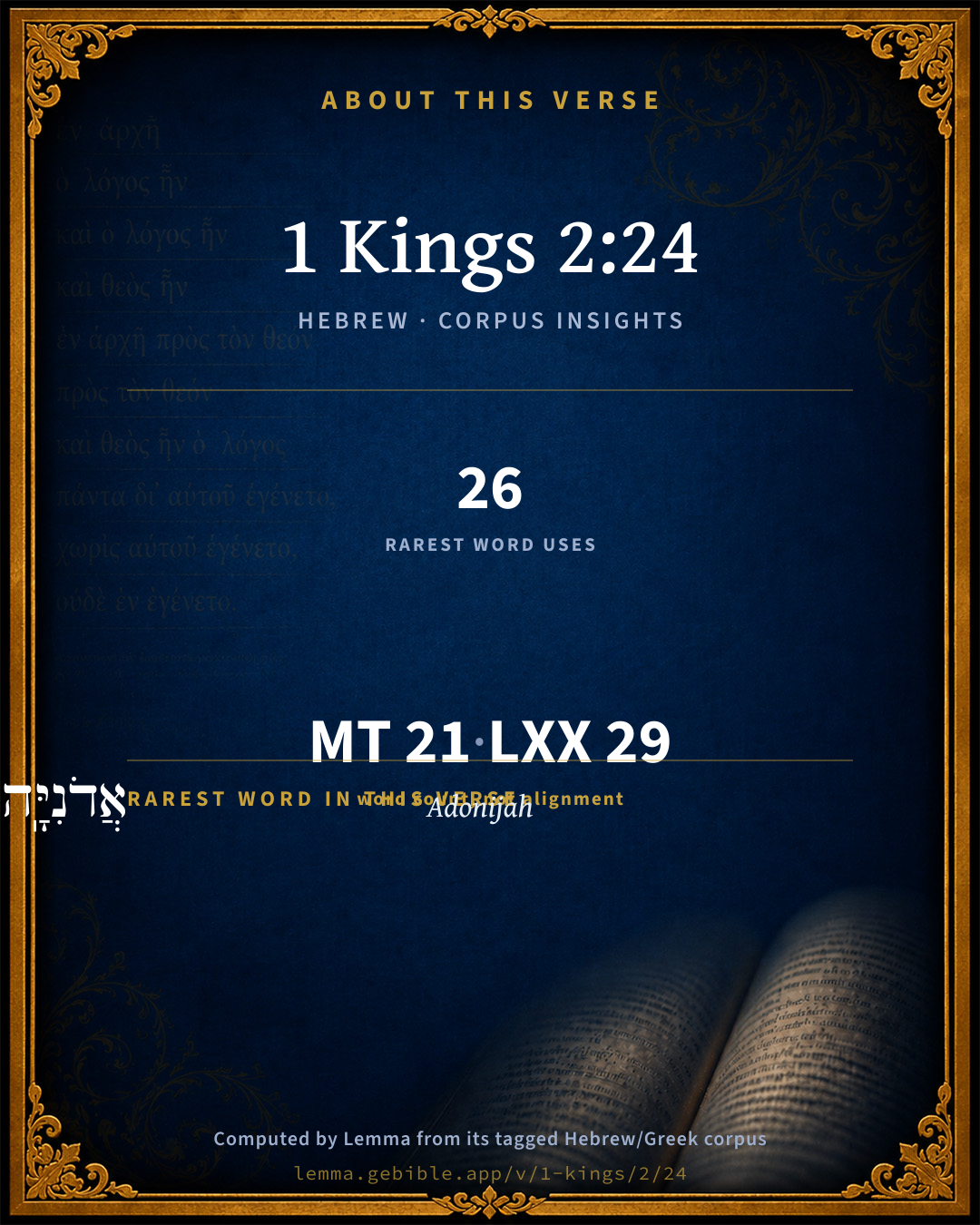
About this verse

These counts appear in no published source. They are computed here, from the morphology-tagged text and Lemma’s own curated glosses. What Lemma adds →

21
words
17
distinct lemmas
Historical
section

Shared distinctive vocabulary

אֲדֹנִיָּֽהוּ Adonijah H138 occurs in 26 verses of the Hebrew Bible. Also found in:

Grammatical profile

  • 6 verbs
  • 7 nouns
  • 1 adjective
  • 2 prepositions
  • 1 conjunction
  • 1 adverb
  • 3 particles

Verb forms

  • הֱכִינַ֗נִי Hiphil · Perfect
  • ויושיביני Hiphil · Sequential Imperfect
  • וַיּֽוֹשִׁיבַ֨נִי֙ Hiphil · Sequential Imperfect
  • עָֽשָׂה Qal · Perfect
  • דִּבֵּ֑ר Piel · Perfect
  • יוּמַ֖ת Hophal · Imperfect

Repetition

Words recur within this verse — often emphatic in Hebrew:

  • ויושיביני to dwell H3427 ×2
  • אֲשֶׁ֣ר which H834 ×3

Hebrew & Septuagint length

In English translation the verse runs 38 words from the Hebrew and 39 from the Septuagint (LXX English) — closely comparable.

A rough comparison of the two English renderings, which tokenize alike — not a word-level alignment.

Word counts can differ between the Hebrew and the Greek without any difference in meaning — e.g. the Hebrew direct-object marker אֵת has no separate Greek word, and Greek often adds the article ὁ.

In the original languages it is 21 Hebrew tokens and 29 Greek tokens — but the two are counted differently (Hebrew bundles its prefixes and suffixes into one token; the Greek is in lemma form), so that isn’t a like-for-like length.

Cross-references

16

Topical passages linked to 1 Kings 2:24 in the Treasury of Scripture Knowledge — connected by theme and wording, ordered by reader-vote popularity; previews shown in the World English Bible.

  • 1 Chronicles 22:10 he shall build a house for my name; and he shall be my son, and I will be his father; and I will establish the throne of his kingdom over Israel for ever.
  • Exodus 1:21 It happened, because the midwives feared God, that he gave them families.
  • 1 Samuel 25:28 Please forgive the trespass of your handmaid: for Yahweh will certainly make my lord a sure house, because my lord fights the battles of Yahweh; and evil shall not be found in you all your days.
  • 2 Samuel 7:11–13 and [as] from the day that I commanded judges to be over my people Israel; and I will cause you to rest from all your enemies. Moreover Yahweh tells you that Yahweh will make you a house.
  • 2 Samuel 7:27 For you, Yahweh of Hosts, the God of Israel, have revealed to your servant, saying, I will build you a house: therefore has your servant found in his heart to pray this prayer to you.
  • 1 Kings 1:29 The king swore, and said, As Yahweh lives, who has redeemed my soul out of all adversity,
  • 1 Kings 1:52 Solomon said, If he shall show himself a worthy man, there shall not a hair of him fall to the earth; but if wickedness be found in him, he shall die.
  • 1 Kings 3:6–7 Solomon said, You have shown to your servant David my father great loving kindness, according as he walked before you in truth, and in righteousness, and in uprightness of heart with you; and you have kept for him this great loving kindness, that you have given him a son to sit on his throne, as it is this day.
  • 1 Kings 10:9 Blessed be Yahweh your God, who delighted in you, to set you on the throne of Israel: because Yahweh loved Israel forever, therefore made he you king, to do justice and righteousness.
  • 1 Chronicles 17:10 and [as] from the day that I commanded judges to be over my people Israel; and I will subdue all your enemies. Moreover I tell you that Yahweh will build you a house.
  • 1 Chronicles 17:17 This was a small thing in your eyes, God; but you have spoken of your servant's house for a great while to come, and have regarded me according to the estate of a man of high degree, Yahweh God.
  • 1 Chronicles 17:23 Now, Yahweh, let the word that you have spoken concerning your servant, and concerning his house, be established forever, and do as you have spoken.
  • 1 Chronicles 29:23 Then Solomon sat on the throne of Yahweh as king instead of David his father, and prospered; and all Israel obeyed him.
  • 2 Chronicles 1:8–9 Solomon said to God, You have shown great loving kindness to David my father, and have made me king in his place.
  • Psalms 127:1 Unless Yahweh builds the house, They labor in vain who build it. Unless Yahweh watches over the city, The watchman guards it in vain.
  • Ecclesiastes 8:11–13 Because sentence against an evil work is not executed speedily, therefore the heart of the sons of men is fully set in them to do evil.

Cross-references courtesy of OpenBible.info (CC BY 4.0).

Hebrew and Greek witnesses Masoretic Hebrew ↔ Greek Septuagint

The same verse in the two great witnesses to the Old Testament, shown verse-for-verse.

These are two independent witnesses, not word-aligned to each other, and the Septuagint is shown in lemma (dictionary) form.

Hebrew 1 Kings 2:24 Masoretic · Westminster Leningrad Codex

וְעַתָּ֗ה חַי יְהוָה֙ אֲשֶׁ֣ר הֱכִינַ֗נִי ויושיביני וַיּֽוֹשִׁיבַ֨נִי֙ עַל כִּסֵּא֙ דָּוִ֣ד אָבִ֔י וַאֲשֶׁ֧ר עָֽשָׂה לִ֛י בַּ֖יִת כַּאֲשֶׁ֣ר דִּבֵּ֑ר כִּ֣י הַיּ֔וֹם יוּמַ֖ת אֲדֹנִיָּֽהוּ

Now therefore as Yahweh lives, who has established me, and set me on the throne of David my father, and who has made me a house, as he promised, surely Adonijah shall be put to death this day.

World English Bible · Public Domain

Greek LXX 1 Kings 2:24 Septuagint · lemma form

καί νῦν ζάω κύριος ὅς ἑτοιμάζω ἐγώ καί τίθημι ἐγώ ἐπί ὁ θρόνος δαυίδ ὁ πατήρ ἐγώ καί αὐτός ποιέω ἐγώ οἶκος καθώς λαλέω κύριος ὅτι σήμερον θανατόω αδωνίας

And now as the Lord lives who has established me, and set me on the throne of my father David, and he has made me a house, as the Lord spoke, this day shall Adonias be put to death.

LXX2012 (modern English Septuagint) · Public Domain

On this verse, The Cambridge Bible for Schools and Colleges discusses the Septuagint’s reading. Read the note in Commentary ↓

Hebrew: Westminster Leningrad Codex (CC BY 4.0). Greek: Septuagint (public domain); English from LXX2012 (modern English Septuagint) (Public Domain). How the Septuagint differs from the Hebrew →

Targum (Aramaic paraphrase)

1

The Targum is the ancient Jewish Aramaic paraphrase of the Hebrew Scriptures — an interpretive translation, not the Hebrew text itself. Onkelos (literal) and Pseudo-Jonathan (expansive) render the Torah, and Jonathan the Prophets. Coverage is partial: where no permissively-licensed English translation exists for a verse, only the Aramaic is shown. This is verse-level text, not a word-by-word alignment to the Hebrew.

  1. Targum Jonathan Prophets (Joshua–Malachi)
    וּכְעַן קַיָם הוּא יְיָ דְאַתְקְנַנִי וְאוֹתִיבַנִי עַל כּוּרְסֵי מַלְכוּתָא דְדָוִד אַבָּא וּדְקַיֵם לִי מַלְכוּ כְּמָא דְמַלֵיל אֲרֵי יוֹמָא דֵין יִתְקְטֵיל אֲדוֹנִיָהוּ:

    (no public-domain English translation for this verse)

    Targum Jonathan — Aramaic: “Mikraot Gedolot” (public domain). English: “Sefaria Community Translation” (CC0 1.0 (public-domain dedication)); “London "Chaldee Paraphrase," 1871” (public domain). Text via Sefaria.

Commentary

Notes on 1 Kings 2:24 from classic Christian and Jewish commentators (each source and its license shown beneath its notes). The classic Christian expositions comment on the surrounding passage and are grouped to its opening verse, so a note may address several verses; the Jewish commentaries on the Tanakh (Rashi and others) are per-verse, so they appear only where the commentator wrote on this verse.

Lemma curates 59 commentaries, every one of them public domain or Creative Commons licensed, each selected and text-cleaned for this edition rather than reprinted as found. About our sources →

Trapp's Complete Commentary

John Trapp

1Ki 2:24 Now therefore, [as] the LORD liveth, which hath established me, and set me on the throne of David my father, and who hath made me an house, as he promised, Adonijah shall be put to death this day.

Ver. 24. Adonijah shall be put to death this day.] This day; before tomorrow, lest delay should breed danger: who knoweth what a great-bellied day may bring forth? We use to say, A day breaketh no square: but that is not always true. Oh that we would be as quick in slaying our arch-rebels, those predominant sins that threaten our precious souls!

John Trapp, A Commentary or Exposition upon All the Books of the Old and New Testament (1647–1656) — public domain. Text from a community e-Sword module.

Joseph Benson's Commentary

1Ki 2:24. And set me on the throne of David — For, though Adonijah be my elder brother, yet I have an undoubted right and title to the crown, from the promise and appointment of that God who disposes of all kingdoms, and especially this of Israel, to whom he pleaseth; and therefore Adonijah in this and his former attempt is guilty of treason against me, and of rebellion against God. And who hath made me a house — Who hath given me posterity, as this phrase often means; see Exo 1:21; for Rehoboam was probably born before this time: or rather, who hath established me in the house and throne of David, and so hath fulfilled in and to me the promise made to him respecting his house, (2Sa 7:11,) and the settlement of the crown in him and his seed. Adonijah shall be put to death this day — “Had Adonijah lived under our constitution, he would have had a fair hearing before conviction. But we should remember that in the kingdoms of the East the government was absolute, and the power of life or death entirely in the prince; so that Solomon, without the formality of any process, could pronounce his brother dead; and because he conceived that in cases of this nature delays were dangerous, might send immediately and have him despatched; though we cannot but say that it would have been more to his commendation, had he showed more clemency and spared his life.” — Dodd.

Joseph Benson's Commentary on the Old and New Testaments (1811–1818) — public domain. Text from a community e-Sword module.

Ellicott's Commentary for English Readers

(24) As the Lord liveth, which hath . . .—There is something characteristic in this adjuration, as compared with that of David in 1Ki_1:29. In David we always see the living man, whose soul longs after God with a vivid personal devotion. Solomon is emphatically the king, sitting on the throne of David, with his house established for ever. In the majesty of his royalty his individual character is to us almost entirely merged.

A Bible Commentary for English Readers, edited by Charles John Ellicott (1878–1897) — public domain. Text from a community e-Sword module.

The Cambridge Bible for Schools and Colleges

gen. ed. J. J. S. Perowne

24. who hath made me a house] ‘House’ here is used in the sense of ‘possessions,’ ‘property.’ So (Est_8:1) the ‘house’ of Haman, i.e. his wealth and property, is given to queen Esther. The LXX. renders in that place by ὅσα ὑπῆρχεν Ἀμάν.

The Cambridge Bible for Schools and Colleges (gen. ed. J. J. S. Perowne; Cambridge University Press, 1878–1918) — public domain. Text from a community e-Sword module.

John Gill's Exposition

And King Solomon sent by the hand of Benaiah the son of Jehoiada,.... Orders to execute him, and proper persons to do it; perhaps some of the Cherethites and Pelethites under him, to assist at least in it:

and he fell upon him, that he died; Benaiah rushed in upon him with his men, and thrust his sword into him, and killed him; executions used to be done in those times and countries by great personages, as the instances of Gideon, Doeg, and others, show, and not by common executioners.

John Gill's Exposition of the Whole Bible (1746–1763) — public domain (CC PDM 1.0). Text via the HelloAO Bible API.

Albert Barnes' Notes on the Bible

The phrase “making a house” means “continuing the posterity” of a person, and, in the case of a royal person, “maintaining his descendants upon the throne.”

Albert Barnes' Notes on the Bible (1834–1885) — public domain. Text from a community e-Sword/MySword module.

Haydock's Catholic Bible Commentary

House. This generally denotes children, and Roboam was born this year. Some have considered his birth as miraculous, supposing that Solomon was not above 12 years old, ver. 9. (St. Jerome, Ep. ad Vital.)

George Leo Haydock (1774–1849), Haydock's Catholic Family Bible and Commentary, 1859 edition — public domain. Excludes Psalms (Douay-Rheims chapter numbering differs from Protestant) and Deuterocanonical books (Catholic canon only).

Matthew Poole's English Annotations

Though Adonijah be my elder brother, yet I have an undoubted right and title to the crown, and that from the promise and appointment of that God who disposeth of all kingdoms, and especially this of Israel, to whom he pleaseth; and therefore Adonijah in this and his former attempt is guilty of treason against me, and of rebellion against God.

Who hath made me an house; either,

1. Who hath given me posterity, as that phrase is used, Exo 1:21, and elsewhere; for Rehoboam most probably was born before this time, by comparing 1Ki 14:21. Or rather,

2. Who hath established me in the house and throne of David; which he thus expresseth, to signify, that God hath fulfilled in and to him that promise which he made to David, in 2Sa 7:11, where the same phrase is used, and where it doth not so much signify the giving of David posterity, which he had sufficiently before that time, as the settlement of the crown in him and his seed.

Adonijah shall be put to death this day; for he knew delays were dangerous in matters of that nature.

Matthew Poole's English Annotations on the Holy Bible (1683–1685) — public domain. Text from a community e-Sword/MySword module.

Whedon's Commentary on the Bible

Daniel D. Whedon

24. Adonijah shall be put to death this day — To the charge of those interpreters who condemn this vigorous severity of Solomon as a needless act of cruelty, the following words of Keil are an excellent and all-sufficient reply: “All attack or censure depends on un-biblical views of law and right, and on a complete misunderstanding of the theocratic point of view, according to which alone the question can be decided. By the attempt to usurp the throne Adonijah had already rebelled against Jehovah, who had appointed Solomon as the successor of David. Now if, after Solomon had forgiven his transgression, he comes out with a new attempt at rebellion, duty to God and the theocracy demanded of Solomon not to have respect to consanguinity, but to act according to the rigour of the law.”

Daniel D. Whedon (gen. ed.), Commentary on the Old and New Testaments (1874–1909) — public domain. Text from a community e-Sword module.

The Pulpit Commentary

Now therefore Heb. and now, as the Lord liveth, which hath established me, and set me a y has here crept into the text; obviously owing to the fact that this same letter both precedes and follows on the throne of David my father, and who hath made me a house Keil and Wordsworth understand by this expression, "hath given me issue." "Solomon," says Keil, "had already one son, viz., Rehoboam, about a year old (comp. 11:42 with 14:21, and." 2Ch_12:13) But some doubt seems to attach to the "forty and one years" mentioned as the age of Rehoboam at his accession. Bahr says Solomon"s "marriage did not occur till afterwards (3:1). And we find from 1Ki_11:38; 2Sa_7:11, 2Sa_7:27, that to "make," or "build a house," means to found a lasting dynasty" as he promised Heb. spake, i.e., at, 2Sa_7:11-13 Adonijah shall be put to death this day.

The Pulpit Commentary (1880–1919), ed. H.D.M. Spence-Jones & Joseph S. Exell — public domain. Text from a community e-Sword module.

unfoldingWord translationNotes

Door43 World Missions Community

General Information:

King Solomon executes Adonijah.

set me on the throne

The word "throne" refers to Solomon's authority to rule that was given by Yahweh. (See: Metonymy)

who has made me a house

Here "house" refers to descendants that Yahweh gave to King Solomon, who would continue to reign after him. (See: Metonymy)

translationWords

throne

David

ancestor

house

promise

die

Solomon

Benaiah

unfoldingWord translationNotes — © Distant Shores Media and the Door43 World Missions Community, licensed CC BY-SA 4.0. Source: git.door43.org/Door43/en_tn.

Rashi

Rabbi Shlomo Yitzchaki (Rashi)

And Who has made me a [royal] house. A house of royalty as he had spoken through Noson.

Rashi on the Tanakh — English translations: “The Judaica Press complete Tanach with Rashi, translated by A. J. Rosenberg” (CC BY 4.0); “Pentateuch with Rashi's commentary by M. Rosenbaum and A.M. Silbermann, 1929-1934” (public domain); “The Metsudah Tanach series, Lakewood, N.J” (CC BY 4.0); and “The Book of Joshua, Metsudah Publications, 1997” (CC BY 4.0). Text via Sefaria.

Lesson kit

Teaching starters — assembled from the data on this page, not authored interpretation. Every prompt links to the verse data it draws on. Edit before teaching.

1 Kings, in the Historical, opens this verse with 21 words (17 distinct Hebrew lemmas). Its most distinctive word is ʼĂdônîyâh (“Adonijah”). A historical commentator’s framing appears above. Read the whole chapter for the surrounding context.

Discussion questions

  1. The word ʼĂdônîyâh carries the sense “Adonijah.” How does it shape the verse?
  2. How does 2 Samuel 3:4, which shares the word «Adonijah», read alongside this verse?
  3. What does the repetition of “to dwell” (2× in this one verse) do in this verse?
  4. The translations on this page render this verse differently — a whole-verse word diff, not a word-by-word alignment. What might account for the different wordings?
  5. «הֱכִינַ֗נִי» is a Hiphil Perfect verb. How does that grammatical form shape the action described?
  6. Compare how Trapp's Complete Commentary and Joseph Benson's Commentary read this verse. Where do they agree or differ?

Things to notice

Reading settings

Reading text

Shown beneath each verse's original-language words.

Old Testament
Old Testament edition

Read the OT as the Masoretic Hebrew (MT) or the Greek Septuagint (LXX).

English shown for the Greek Septuagint (in the Hebrew ↔ Greek comparison).

Comparing translations? Open the Compare panel on any verse page to stack up to four side by side.