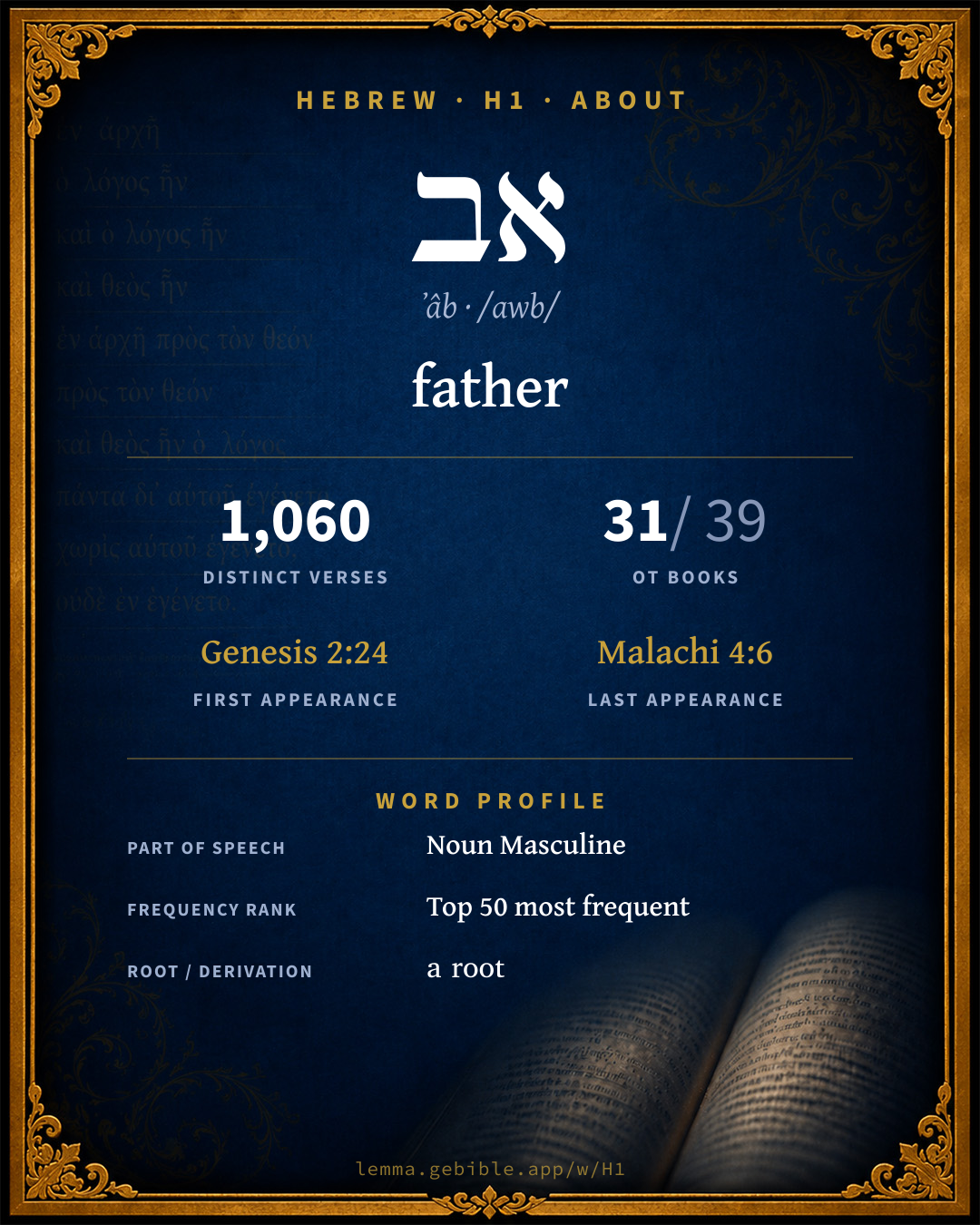
אָב
father
‘father’ is one of 9 main senses fuller range ↓
Full lexicon entry — Brown-Driver-Briggs (BDB)
From Brown-Driver-Briggs (BDB)
Where this word appears
See every Construct-state word in the Hebrew Bible →
Grammar key — what these labels mean
Part of speech
- Noun
- A naming word — a person, place, thing, or idea.
- Particle
- A short function word — article, negation, interrogative, the sign of the direct object, and the like.
Noun type
- Common
- A common noun — a general class of person, place, or thing (“king,” “city,” “water”), not a specific name.
- Proper
- A name of a specific person, place, or people (e.g. Abraham, Zion, Israel).
State
- Construct
- A noun bound to a following noun in a possessive / “of” relationship (the construct chain).
- Absolute
- The independent form of a noun, not bound to a following word.
Gender
- Masculine
- Grammatically masculine.
Number
- Singular
- One.
- Plural
- More than one (in Hebrew, generally three or more).
Grammatical forms
- Noun, Common, Masculine, Singular, Construct 671 times (55%)
- Noun, Common, Masculine, Plural, Construct 420 times (35%)
- Noun, Common, Masculine, Plural, Absolute 71 times (6%)
- Noun, Common, Masculine, Singular, Absolute 48 times (4%)
- Noun, Proper 2 times (0%)
- Particle, Exhortation 1 time (0%)
Parsed forms decoded from the imported morphology (morphhb / Westminster Leningrad Codex — WLC text public domain, morphhb tagging CC BY 4.0), counted across 1,213 parsed occurrences — not distinct verses.
Page 1 of 6 — showing verses 1–200 of 1,060 distinct verses where H1 appears, across 31 books. Click any verse to open its interlinear word-by-word view. Verse text shown in the World English Bible for context — . Each verse’s Hebrew form is shown with its reference; the English is not keyword-highlighted, since the data carries no word-level English alignment. Use “Compare translations” on any verse to read it across multiple English versions. This concordance covers the Hebrew Bible; Septuagint (Greek Old Testament) occurrences are not indexed here.
Genesis 170 verses
- Genesis 2:24 אָבִ֖י/ו n c ms cs + sfx pers 3ms Therefore a man will leave his father and his mother, and will join with his wife, and they will be one flesh.
- Genesis 4:20 אֲבִ֕י n c ms cs Adah gave birth to Jabal, who was the father of those who dwell in tents and have cattle.
- Genesis 4:21 אֲבִ֕י n c ms cs His brother's name was Jubal, who was the father of all who handle the harp and pipe.
- Genesis 9:18 אֲבִ֥י n c ms cs The sons of Noah who went forth from the ark were Shem, Ham, and Japheth. Ham is the father of Canaan.
- Genesis 9:22 אֲבִ֣י אָבִ֑י/ו n c ms cs n c ms cs + sfx pers 3ms Ham, the father of Canaan, saw the nakedness of his father, and told his two brothers outside.
- Genesis 9:23 אֲבִי/הֶ֑ם אֲבִי/הֶ֖ם n c ms cs + sfx pers 3mp n c ms cs + sfx pers 3mp Shem and Japheth took a garment, and laid it on both their shoulders, went in backwards, and covered the nakedness of their father. Their faces were backwards, and they didn't see their father's nakedness.
- Genesis 10:21 אֲבִי֙ n c ms cs To Shem, the father of all the children of Eber, the elder brother of Japheth, to him also were children born.
- Genesis 11:28 אָבִ֑י/ו n c ms cs + sfx pers 3ms Haran died before his father Terah in the land of his birth, in Ur of the Chaldees.
- Genesis 11:29 אֲבִֽי וַֽ/אֲבִ֥י n c ms cs conj + n c ms cs Abram and Nahor took wives. The name of Abram's wife was Sarai, and the name of Nahor's wife, Milcah, the daughter of Haran who was also the father of Iscah.
- Genesis 12:1 אָבִ֑י/ךָ n c ms cs + sfx pers 2ms Now Yahweh said to Abram, "Get out of your country, and from your relatives, and from your father's house, to the land that I will show you.
- Genesis 15:15 אֲבֹתֶ֖י/ךָ n c mp cs + sfx pers 2ms But you will go to your fathers in peace. You will be buried in a good old age.
- Genesis 17:4 לְ/אַ֖ב prep + n c ms cs "As for me, behold, my covenant is with you. You will be the father of a multitude of nations.
- Genesis 17:5 אַב n c ms cs Neither will your name any more be called Abram, but your name will be Abraham; for the father of a multitude of nations have I made you.
- Genesis 19:31 אָבִ֣י/נוּ n c ms cs + sfx pers 1cp The firstborn said to the younger, "Our father is old, and there is not a man in the earth to come in to us after the manner of all the earth.
- Genesis 19:32 אָבִ֛י/נוּ מֵ/אָבִ֖י/נוּ n c ms cs + sfx pers 1cp prep + n c ms cs + sfx pers 1cp Come, let's make our father drink wine, and we will lie with him, that we may preserve our father's seed."
- Genesis 19:33 אֲבִי/הֶ֛ן אָבִ֔י/הָ n c ms cs + sfx pers 3fp n c ms cs + sfx pers 3fs They made their father drink wine that night: and the firstborn went in, and lay with her father. He didn't know when she lay down, nor when she arose.
- Genesis 19:34 אָבִ֑/י מֵ/אָבִ֖י/נוּ n c ms cs + sfx pers 1cs prep + n c ms cs + sfx pers 1cp It came to pass on the next day, that the firstborn said to the younger, "Behold, I lay last night with my father. Let us make him drink wine again, tonight. You go in, and lie with him, that we may preserve our father's seed."
- Genesis 19:35 אֲבִי/הֶ֖ן n c ms cs + sfx pers 3fp They made their father drink wine that night also. The younger arose, and lay with him. He didn't know when she lay down, nor when she arose.
- Genesis 19:36 מֵ/אֲבִי/הֶֽן prep + n c ms cs + sfx pers 3fp Thus both of Lot's daughters were with child by their father.
- Genesis 19:37 אֲבִֽי n c ms cs The firstborn bore a son, and named him Moab. The same is the father of the Moabites to this day.
- Genesis 19:38 אֲבִ֥י n c ms cs The younger also bore a son, and called his name Ben Ammi. The same is the father of the children of Ammon to this day.
- Genesis 20:12 אָבִ/י֙ n c ms cs + sfx pers 1cs Moreover she is indeed my sister, the daughter of my father, but not the daughter of my mother; and she became my wife.
- Genesis 20:13 אָבִ/י֒ n c ms cs + sfx pers 1cs It happened, when God caused me to wander from my father's house, that I said to her, 'This is your kindness which you shall show to me. Everywhere that we go, say of me, "He is my brother."'"
- Genesis 22:7 אָבִי/ו֙ אָבִ֔/י n c ms cs + sfx pers 3ms n c ms cs + sfx pers 1cs Isaac spoke to Abraham his father, and said, "My father?" He said, "Here I am, my son." He said, "Here is the fire and the wood, but where is the lamb for a burnt offering?"
- Genesis 22:21 אֲבִ֥י n c ms cs Uz his firstborn, Buz his brother, Kemuel the father of Aram,
- Genesis 24:7 אָבִ/י֮ n c ms cs + sfx pers 1cs Yahweh, the God of heaven, who took me from my father's house, and from the land of my birth, who spoke to me, and who swore to me, saying, 'I will give this land to your seed.' He will send his angel before you, and you shall take a wife for my son from there.
- Genesis 24:23 אָבִ֛י/ךְ n c ms cs + sfx pers 3fs and said, "Whose daughter are you? Please tell me. Is there room in your father's house for us to lodge in?"
- Genesis 24:38 אָבִ֛/י n c ms cs + sfx pers 1cs but you shall go to my father's house, and to my relatives, and take a wife for my son.'
- Genesis 24:40 אָבִֽ/י n c ms cs + sfx pers 1cs He said to me, 'Yahweh, before whom I walk, will send his angel with you, and prosper your way. You shall take a wife for my son of my relatives, and of my father's house.
- Genesis 26:3 אָבִֽי/ךָ n c ms cs + sfx pers 2ms Sojourn in this land, and I will be with you, and will bless you. For to you, and to your seed, I will give all these lands, and I will establish the oath which I swore to Abraham your father.
- Genesis 26:15 אָבִ֔י/ו אָבִ֑י/ו n c ms cs + sfx pers 3ms n c ms cs + sfx pers 3ms Now all the wells which his father's servants had dug in the days of Abraham his father, the Philistines had stopped, and filled with earth.
- Genesis 26:18 אָבִ֔י/ו אָבִֽי/ו n c ms cs + sfx pers 3ms n c ms cs + sfx pers 3ms Isaac dug again the wells of water, which they had dug in the days of Abraham his father. For the Philistines had stopped them after the death of Abraham. He called their names after the names by which his father had called them.
- Genesis 26:24 אָבִ֑י/ךָ n c ms cs + sfx pers 2ms Yahweh appeared to him the same night, and said, "I am the God of Abraham your father. Don't be afraid, for I am with you, and will bless you, and multiply your seed for my servant Abraham's sake."
- Genesis 27:6 אָבִ֔י/ךָ n c ms cs + sfx pers 2ms Rebekah spoke to Jacob her son, saying, "Behold, I heard your father speak to Esau your brother, saying,
- Genesis 27:9 לְ/אָבִ֖י/ךָ prep + n c ms cs + sfx pers 2ms Go now to the flock, and get me from there two good kids of the goats. I will make them savory food for your father, such as he loves.
- Genesis 27:10 לְ/אָבִ֖י/ךָ prep + n c ms cs + sfx pers 2ms You shall bring it to your father, that he may eat, so that he may bless you before his death."
- Genesis 27:12 אָבִ֔/י n c ms cs + sfx pers 1cs What if my father touches me? I will seem to him as a deceiver, and I would bring a curse on myself, and not a blessing."
- Genesis 27:14 אָבִֽי/ו n c ms cs + sfx pers 3ms He went, and got them, and brought them to his mother. His mother made savory food, such as his father loved.
- Genesis 27:18 אָבִ֖י/ו אָבִ֑/י n c ms cs + sfx pers 3ms n c ms cs + sfx pers 1cs He came to his father, and said, "My father?" He said, "Here I am. Who are you, my son?"
- Genesis 27:19 אָבִ֗י/ו n c ms cs + sfx pers 3ms Jacob said to his father, "I am Esau your firstborn. I have done what you asked me to do. Please arise, sit and eat of my venison, that your soul may bless me."
- Genesis 27:22 אָבִ֖י/ו n c ms cs + sfx pers 3ms Jacob went near to Isaac his father. He felt him, and said, "The voice is Jacob's voice, but the hands are the hands of Esau."
- Genesis 27:26 אָבִ֑י/ו n c ms cs + sfx pers 3ms His father Isaac said to him, "Come near now, and kiss me, my son."
- Genesis 27:30 אָבִ֑י/ו n c ms cs + sfx pers 3ms It happened, as soon as Isaac had made an end of blessing Jacob, and Jacob had just gone out from the presence of Isaac his father, that Esau his brother came in from his hunting.
- Genesis 27:31 לְ/אָבִ֑י/ו לְ/אָבִ֗י/ו אָבִ/י֙ prep + n c ms cs + sfx pers 3ms prep + n c ms cs + sfx pers 3ms n c ms cs + sfx pers 1cs He also made savory food, and brought it to his father. He said to his father, "Let my father arise, and eat of his son's venison, that your soul may bless me."
- Genesis 27:32 אָבִ֖י/ו n c ms cs + sfx pers 3ms Isaac his father said to him, "Who are you?" He said, "I am your son, your firstborn, Esau."
- Genesis 27:34 אָבִ֔י/ו לְ/אָבִ֔י/ו אָבִֽ/י n c ms cs + sfx pers 3ms prep + n c ms cs + sfx pers 3ms n c ms cs + sfx pers 1cs When Esau heard the words of his father, he cried with an exceeding great and bitter cry, and said to his father, "Bless me, even me also, my father."
- Genesis 27:38 אָבִ֗י/ו אָבִ֔/י אָבִ֑/י n c ms cs + sfx pers 3ms n c ms cs + sfx pers 1cs n c ms cs + sfx pers 1cs Esau said to his father, "Have you but one blessing, my father? Bless me, even me also, my father." Esau lifted up his voice, and wept.
- Genesis 27:39 אָבִ֖י/ו n c ms cs + sfx pers 3ms Isaac his father answered him, "Behold, of the fatness of the earth will be your dwelling, and of the dew of the sky from above.
- Genesis 27:41 אָבִ֑י/ו אָבִ֔/י n c ms cs + sfx pers 3ms n c ms cs + sfx pers 1cs Esau hated Jacob because of the blessing with which his father blessed him. Esau said in his heart, "The days of mourning for my father are at hand. Then I will kill my brother Jacob."
- Genesis 28:2 אֲבִ֣י n c ms cs Arise, go to Paddan Aram, to the house of Bethuel your mother's father. Take a wife from there from the daughters of Laban, your mother's brother.
- Genesis 28:7 אָבִ֖י/ו n c ms cs + sfx pers 3ms and that Jacob obeyed his father and his mother, and was gone to Paddan Aram.
- Genesis 28:8 אָבִֽי/ו n c ms cs + sfx pers 3ms Esau saw that the daughters of Canaan didn't please Isaac, his father.
- Genesis 28:13 אָבִ֔י/ךָ n c ms cs + sfx pers 2ms Behold, Yahweh stood above it, and said, "I am Yahweh, the God of Abraham your father, and the God of Isaac. The land whereon you lie, to you will I give it, and to your seed.
- Genesis 28:21 אָבִ֑/י n c ms cs + sfx pers 1cs so that I come again to my father's house in peace, and Yahweh will be my God,
- Genesis 29:9 לְ/אָבִ֔י/הָ prep + n c ms cs + sfx pers 3fs While he was yet speaking with them, Rachel came with her father's sheep, for she kept them.
- Genesis 29:12 אָבִ֨י/הָ֙ לְ/אָבִֽי/הָ n c ms cs + sfx pers 3fs prep + n c ms cs + sfx pers 3fs Jacob told Rachel that he was her father's brother, and that he was Rebekah's son. She ran and told her father.
- Genesis 31:1 לְ/אָבִ֑י/נוּ לְ/אָבִ֔י/נוּ prep + n c ms cs + sfx pers 1cp prep + n c ms cs + sfx pers 1cp He heard the words of Laban's sons, saying, "Jacob has taken away all that was our father's. From that which was our father's, has he gotten all this wealth."
- Genesis 31:3 אֲבוֹתֶ֖י/ךָ n c mp cs + sfx pers 2ms Yahweh said to Jacob, "Return to the land of your fathers, and to your relatives, and I will be with you."
- Genesis 31:5 אֲבִי/כֶ֔ן אָבִ֔/י n c ms cs + sfx pers 2fp n c ms cs + sfx pers 1cs and said to them, "I see the expression on your father's face, that it is not toward me as before; but the God of my father has been with me.
- Genesis 31:6 אֲבִי/כֶֽן n c ms cs + sfx pers 2fp You know that I have served your father with all of my strength.
- Genesis 31:7 וַ/אֲבִי/כֶן֙ conj + n c ms cs + sfx pers 2fp Your father has deceived me, and changed my wages ten times, but God didn't allow him to hurt me.
- Genesis 31:9 אֲבִי/כֶ֖ם n c ms cs + sfx pers 2mp Thus God has taken away the cattle of your father, and given them to me.
- Genesis 31:14 אָבִֽי/נוּ n c ms cs + sfx pers 1cp Rachel and Leah answered him, "Is there yet any portion or inheritance for us in our father's house?
- Genesis 31:16 מֵֽ/אָבִ֔י/נוּ prep + n c ms cs + sfx pers 1cp For all the riches which God has taken away from our father, that is ours and our children's. Now then, whatever God has said to you, do."
- Genesis 31:18 אָבִ֖י/ו n c ms cs + sfx pers 3ms and he carried away all his cattle, and all his substance which he had gathered, the cattle of his getting, which he had gathered in Paddan Aram, to go to Isaac his father to the land of Canaan.
- Genesis 31:19 לְ/אָבִֽי/הָ prep + n c ms cs + sfx pers 3fs Now Laban had gone to shear his sheep: and Rachel stole the teraphim that were her father's.
- Genesis 31:29 אֲבִי/כֶ֜ם n c ms cs + sfx pers 2mp It is in the power of my hand to hurt you, but the God of your father spoke to me last night, saying, 'Take heed to yourself that you don't speak to Jacob either good or bad.'
- Genesis 31:30 אָבִ֑י/ךָ n c ms cs + sfx pers 2ms Now, you want to be gone, because you sore longed after your father's house, but why have you stolen my gods?"
- Genesis 31:35 אָבִ֗י/הָ n c ms cs + sfx pers 3fs She said to her father, "Don't let my lord be angry that I can't rise up before you; for the manner of women is on me." He searched, but didn't find the teraphim.
- Genesis 31:42 אָבִ/י֩ n c ms cs + sfx pers 1cs Unless the God of my father, the God of Abraham, and the fear of Isaac, had been with me, surely now you would have sent me away empty. God has seen my affliction and the labor of my hands, and rebuked you last night."
- Genesis 31:53 אֲבִי/הֶ֑ם אָבִ֥י/ו n c ms cs + sfx pers 3mp n c ms cs + sfx pers 3ms The God of Abraham, and the God of Nahor, the God of their father, judge between us." Then Jacob swore by the fear of his father, Isaac.
- Genesis 32:9 אָבִ֣/י אָבִ֣/י n c ms cs + sfx pers 1cs n c ms cs + sfx pers 1cs Jacob said, "God of my father Abraham, and God of my father Isaac, Yahweh, who said to me, 'Return to your country, and to your relatives, and I will do you good.'
- Genesis 33:19 אֲבִ֣י n c ms cs He bought the parcel of ground, where he had spread his tent, at the hand of the children of Hamor, Shechem's father, for one hundred pieces of money.
- Genesis 34:4 אָבִ֖י/ו n c ms cs + sfx pers 3ms Shechem spoke to his father, Hamor, saying, "Get me this young lady as a wife."
- Genesis 34:6 אֲבִֽי n c ms cs Hamor the father of Shechem went out to Jacob to talk with him.
- Genesis 34:11 אָבִ֣י/ה n c ms cs + sfx pers 3fs Shechem said to her father and to her brothers, "Let me find favor in your eyes, and whatever you will tell me I will give.
- Genesis 34:13 אָבִ֛י/ו n c ms cs + sfx pers 3ms The sons of Jacob answered Shechem and Hamor his father with deceit, and spoke, because he had defiled Dinah their sister,
- Genesis 34:19 אָבִֽי/ו n c ms cs + sfx pers 3ms The young man didn't wait to do this thing, because he had delight in Jacob's daughter, and he was honored above all the house of his father.
- Genesis 35:18 וְ/אָבִ֖י/ו conj + n c ms cs + sfx pers 3ms It happened, as her soul was departing (for she died), that she named him Ben-oni, but his father named him Benjamin.
- Genesis 35:22 אָבִ֔י/ו n c ms cs + sfx pers 3ms It happened, while Israel lived in that land, that Reuben went and lay with Bilhah, his father's concubine, and Israel heard of it. Now the sons of Jacob were twelve.
- Genesis 35:27 אָבִ֔י/ו n c ms cs + sfx pers 3ms Jacob came to Isaac his father, to Mamre, to Kiriath Arba (the same is Hebron), where Abraham and Isaac lived as foreigners.
- Genesis 36:9 אֲבִ֣י n c ms cs This is the history of the generations of Esau the father of the Edomites in the hill country of Seir:
- Genesis 36:24 אָבִֽי/ו n c ms cs + sfx pers 3ms These are the children of Zibeon: Aiah and Anah. This is Anah who found the hot springs in the wilderness, as he fed the donkeys of Zibeon his father.
- Genesis 36:43 אֲבִ֥י n c ms cs chief Magdiel, and chief Iram. These are the chiefs of Edom, according to their habitations in the land of their possession. This is Esau, the father of the Edomites.
- Genesis 37:1 אָבִ֑י/ו n c ms cs + sfx pers 3ms Jacob lived in the land of his father's travels, in the land of Canaan.
- Genesis 37:2 אָבִ֑י/ו אֲבִי/הֶֽם n c ms cs + sfx pers 3ms n c ms cs + sfx pers 3mp This is the history of the generations of Jacob. Joseph, being seventeen years old, was feeding the flock with his brothers. He was a boy with the sons of Bilhah and Zilpah, his father's wives. Joseph brought an evil report of them to their father.
- Genesis 37:4 אֲבִי/הֶם֙ n c ms cs + sfx pers 3mp His brothers saw that their father loved him more than all his brothers, and they hated him, and couldn't speak peaceably to him.
- Genesis 37:10 אָבִי/ו֮ אָבִ֔י/ו n c ms cs + sfx pers 3ms n c ms cs + sfx pers 3ms He told it to his father and to his brothers. His father rebuked him, and said to him, "What is this dream that you have dreamed? Will I and your mother and your brothers indeed come to bow ourselves down to you to the earth?"
- Genesis 37:11 וְ/אָבִ֖י/ו conj + n c ms cs + sfx pers 3ms His brothers envied him; but his father kept this saying in mind.
- Genesis 37:12 אֲבִי/הֶ֖ם n c ms cs + sfx pers 3mp His brothers went to feed their father's flock in Shechem.
- Genesis 37:22 אָבִֽי/ו n c ms cs + sfx pers 3ms Reuben said to them, "Shed no blood. Throw him into this pit that is in the wilderness, but lay no hand on him"-- that he might deliver him out of their hand, to restore him to his father.
- Genesis 37:32 אֲבִי/הֶ֔ם n c ms cs + sfx pers 3mp They took the coat of many colors, and they brought it to their father, and said, "We have found this. Examine it, now, whether it is your son's coat or not."
- Genesis 37:35 אָבִֽי/ו n c ms cs + sfx pers 3ms All his sons and all his daughters rose up to comfort him; but he refused to be comforted. He said, "For I will go down to Sheol to my son mourning." His father wept for him.
- Genesis 38:11 אָבִ֗י/ךְ אָבִֽי/הָ n c ms cs + sfx pers 2fs n c ms cs + sfx pers 3fs Then Judah said to Tamar, his daughter-in-law, "Remain a widow in your father's house, until Shelah, my son, is grown up;" for he said, "Lest he also die, like his brothers." Tamar went and lived in her father's house.
- Genesis 41:51 אָבִֽ/י n c ms cs + sfx pers 1cs Joseph called the name of the firstborn Manasseh, "For," he said, "God has made me forget all my toil, and all my father's house."
- Genesis 42:13 אָבִ֨י/נוּ֙ n c ms cs + sfx pers 1cp They said, "We, your servants, are twelve brothers, the sons of one man in the land of Canaan; and, behold, the youngest is this day with our father, and one is no more."
- Genesis 42:29 אֲבִי/הֶ֖ם n c ms cs + sfx pers 3mp They came to Jacob their father to the land of Canaan, and told him all that had happened to them, saying,
- Genesis 42:32 אָבִ֑י/נוּ אָבִ֖י/נוּ n c ms cs + sfx pers 1cp n c ms cs + sfx pers 1cp We are twelve brothers, sons of our father; one is no more, and the youngest is this day with our father in the land of Canaan.'
- Genesis 42:35 וַ/אֲבִי/הֶ֖ם conj + n c ms cs + sfx pers 3mp It happened as they emptied their sacks, that behold, every man's bundle of money was in his sack. When they and their father saw their bundles of money, they were afraid.
- Genesis 42:36 אֲבִי/הֶ֔ם n c ms cs + sfx pers 3mp Jacob, their father, said to them, "You have bereaved me of my children! Joseph is no more, Simeon is no more, and you want to take Benjamin away. All these things are against me."
- Genesis 42:37 אָבִ֣י/ו n c ms cs + sfx pers 3ms Reuben spoke to his father, saying, "Kill my two sons, if I don't bring him to you. Deliver him into my hand, and I will bring him to you again."
- Genesis 43:2 אֲבִי/הֶ֔ם n c ms cs + sfx pers 3mp It happened, when they had eaten up the grain which they had brought out of Egypt, their father said to them, "Go again, buy us a little more food."
- Genesis 43:7 אֲבִי/כֶ֥ם n c ms cs + sfx pers 2mp They said, "The man asked directly concerning ourselves, and concerning our relatives, saying, 'Is your father still alive? Have you another brother?' We just answered his questions. Is there any way we could know that he would say, 'Bring your brother down?'"
- Genesis 43:8 אָבִ֗י/ו n c ms cs + sfx pers 3ms Judah said to Israel, his father, "Send the boy with me, and we will arise and go, so that we may live, and not die, both we, and you, and also our little ones.
- Genesis 43:11 אֲבִי/הֶ֗ם n c ms cs + sfx pers 3mp Their father, Israel, said to them, "If it be so now, do this. Take from the choice fruits of the land in your bags, and carry down a present for the man, a little balm, a little honey, spices and myrrh, nuts, and almonds;
- Genesis 43:23 אֲבִי/כֶם֙ n c ms cs + sfx pers 2mp He said, "Peace be to you. Don't be afraid. Your God, and the God of your father, has given you treasure in your sacks. I received your money." He brought Simeon out to them.
- Genesis 43:27 אֲבִי/כֶ֥ם n c ms cs + sfx pers 2mp He asked them of their welfare, and said, "Is your father well, the old man of whom you spoke? Is he yet alive?"
- Genesis 43:28 לְ/אָבִ֖י/נוּ prep + n c ms cs + sfx pers 1cp They said, "Your servant, our father, is well. He is still alive." They bowed the head, and did homage.
- Genesis 44:17 אֲבִי/כֶֽם n c ms cs + sfx pers 2mp He said, "Far be it from me that I should do so. The man in whose hand the cup is found, he will be my bondservant; but as for you, go up in peace to your father."
- Genesis 44:19 אָ֖ב n c ms My lord asked his servants, saying, 'Have you a father, or a brother?'
- Genesis 44:20 אָ֣ב וְ/אָבִ֥י/ו n c ms conj + n c ms cs + sfx pers 3ms We said to my lord, 'We have a father, an old man, and a child of his old age, a little one; and his brother is dead, and he alone is left of his mother; and his father loves him.'
- Genesis 44:22 אָבִ֑י/ו אָבִ֖י/ו n c ms cs + sfx pers 3ms n c ms cs + sfx pers 3ms We said to my lord, 'The boy can't leave his father: for if he should leave his father, his father would die.'
- Genesis 44:24 אָבִ֑/י n c ms cs + sfx pers 1cs It happened when we came up to your servant my father, we told him the words of my lord.
- Genesis 44:25 אָבִ֑י/נוּ n c ms cs + sfx pers 1cp Our father said, 'Go again, buy us a little food.'
- Genesis 44:27 אָבִ֖/י n c ms cs + sfx pers 1cs Your servant, my father, said to us, 'You know that my wife bore me two sons:
- Genesis 44:30 אָבִ֔/י n c ms cs + sfx pers 1cs Now therefore when I come to your servant my father, and the boy is not with us; seeing that his life is bound up in the boy's life;
- Genesis 44:31 אָבִ֛י/נוּ n c ms cs + sfx pers 1cp it will happen, when he sees that the boy is no more, that he will die. Your servants will bring down the gray hairs of your servant, our father, with sorrow to Sheol.
- Genesis 44:32 אָבִ֖/י לְ/אָבִ֖/י n c ms cs + sfx pers 1cs prep + n c ms cs + sfx pers 1cs For your servant became collateral for the boy to my father, saying, 'If I don't bring him to you, then I will bear the blame to my father forever.'
- Genesis 44:34 אָבִ֔/י אָבִֽ/י n c ms cs + sfx pers 1cs n c ms cs + sfx pers 1cs For how will I go up to my father, if the boy isn't with me? Lest I see the evil that will come on my father."
- Genesis 45:3 אָבִ֖/י n c ms cs + sfx pers 1cs Joseph said to his brothers, "I am Joseph! Does my father still live?" His brothers couldn't answer him; for they were terrified at his presence.
- Genesis 45:8 לְ/אָ֜ב prep + n c ms So now it wasn't you who sent me here, but God, and he has made me a father to Pharaoh, lord of all his house, and ruler over all the land of Egypt.
- Genesis 45:9 אָבִ/י֒ n c ms cs + sfx pers 1cs Hurry, and go up to my father, and tell him, 'This is what your son Joseph says, "God has made me lord of all Egypt. Come down to me. Don't wait.
- Genesis 45:13 לְ/אָבִ֗/י אָבִ֖/י prep + n c ms cs + sfx pers 1cs n c ms cs + sfx pers 1cs You shall tell my father of all my glory in Egypt, and of all that you have seen. You shall hurry and bring my father down here."
- Genesis 45:18 אֲבִי/כֶ֛ם n c ms cs + sfx pers 2mp Take your father and your households, and come to me, and I will give you the good of the land of Egypt, and you will eat the fat of the land.'
- Genesis 45:19 אֲבִי/כֶ֖ם n c ms cs + sfx pers 2mp Now you are commanded: do this. Take wagons out of the land of Egypt for your little ones, and for your wives, and bring your father, and come.
- Genesis 45:23 וּ/לְ/אָבִ֞י/ו לְ/אָבִ֖י/ו conj + prep + n c ms cs + sfx pers 3ms prep + n c ms cs + sfx pers 3ms To his father, he sent after this manner: ten donkeys loaded with the good things of Egypt, and ten female donkeys loaded with grain and bread and provision for his father by the way.
- Genesis 45:25 אֲבִי/הֶֽם n c ms cs + sfx pers 3mp They went up out of Egypt, and came into the land of Canaan, to Jacob their father.
- Genesis 45:27 אֲבִי/הֶֽם n c ms cs + sfx pers 3mp They told him all the words of Joseph, which he had said to them. When he saw the wagons which Joseph had sent to carry him, the spirit of Jacob, their father, revived.
- Genesis 46:1 אָבִ֥י/ו n c ms cs + sfx pers 3ms Israel traveled with all that he had, and came to Beersheba, and offered sacrifices to the God of his father, Isaac.
- Genesis 46:3 אָבִ֑י/ךָ n c ms cs + sfx pers 2ms He said, "I am God, the God of your father. Don't be afraid to go down into Egypt; for there I will make of you a great nation.
- Genesis 46:5 אֲבִי/הֶ֗ם n c ms cs + sfx pers 3mp Jacob rose up from Beersheba, and the sons of Israel carried Jacob, their father, their little ones, and their wives, in the wagons which Pharaoh had sent to carry him.
- Genesis 46:29 אָבִ֖י/ו n c ms cs + sfx pers 3ms Joseph made ready his chariot, and went up to meet Israel, his father, in Goshen. He presented himself to him, and fell on his neck, and wept on his neck a good while.
- Genesis 46:31 אָבִ֔י/ו אָבִ֛/י n c ms cs + sfx pers 3ms n c ms cs + sfx pers 1cs Joseph said to his brothers, and to his father's house, "I will go up, and speak with Pharaoh, and will tell him, 'My brothers, and my father's house, who were in the land of Canaan, have come to me.
- Genesis 46:34 אֲבֹתֵ֑י/נוּ n c mp cs + sfx pers 1cp that you shall say, 'Your servants have been keepers of cattle from our youth even until now, both we, and our fathers:' that you may dwell in the land of Goshen; for every shepherd is an abomination to the Egyptians."
- Genesis 47:1 אָבִ֨/י n c ms cs + sfx pers 1cs Then Joseph went in and told Pharaoh, and said, "My father and my brothers, with their flocks, their herds, and all that they own, have come out of the land of Canaan; and, behold, they are in the land of Goshen."
- Genesis 47:3 אֲבוֹתֵֽי/נוּ n c mp cs + sfx pers 1cp Pharaoh said to his brothers, "What is your occupation?" They said to Pharaoh, "Your servants are shepherds, both we, and our fathers."
- Genesis 47:5 אָבִ֥י/ךָ n c ms cs + sfx pers 2ms Pharaoh spoke to Joseph, saying, "Your father and your brothers have come to you.
- Genesis 47:6 אָבִ֖י/ךָ n c ms cs + sfx pers 2ms The land of Egypt is before you. Make your father and your brothers dwell in the best of the land. Let them dwell in the land of Goshen. If you know any able men among them, then put them in charge of my cattle."
- Genesis 47:7 אָבִ֔י/ו n c ms cs + sfx pers 3ms Joseph brought in Jacob, his father, and set him before Pharaoh, and Jacob blessed Pharaoh.
- Genesis 47:9 אֲבֹתַ֔/י n c mp cs + sfx pers 1cs Jacob said to Pharaoh, "The days of the years of my pilgrimage are one hundred thirty years. Few and evil have been the days of the years of my life, and they have not attained to the days of the years of the life of my fathers in the days of their pilgrimage."
- Genesis 47:11 אָבִ֣י/ו n c ms cs + sfx pers 3ms Joseph placed his father and his brothers, and gave them a possession in the land of Egypt, in the best of the land, in the land of Rameses, as Pharaoh had commanded.
- Genesis 47:12 אָבִ֣י/ו אָבִ֑י/ו n c ms cs + sfx pers 3ms n c ms cs + sfx pers 3ms Joseph nourished his father, his brothers, and all of his father's household, with bread, according to their families.
- Genesis 47:30 אֲבֹתַ֔/י n c mp cs + sfx pers 1cs but when I sleep with my fathers, you shall carry me out of Egypt, and bury me in their burying place." He said, "I will do as you have said."
- Genesis 48:1 אָבִ֖י/ךָ n c ms cs + sfx pers 2ms It happened after these things, that someone said to Joseph, "Behold, your father is sick." He took with him his two sons, Manasseh and Ephraim.
- Genesis 48:9 אָבִ֔י/ו n c ms cs + sfx pers 3ms Joseph said to his father, "They are my sons, whom God has given me here." He said, "Please bring them to me, and I will bless them."
- Genesis 48:15 אֲבֹתַ֤/י n c mp cs + sfx pers 1cs He blessed Joseph, and said, "The God before whom my fathers Abraham and Isaac did walk, the God who has fed me all my life long to this day,
- Genesis 48:16 אֲבֹתַ֖/י n c mp cs + sfx pers 1cs the angel who has redeemed me from all evil, bless the lads, and let my name be named on them, and the name of my fathers Abraham and Isaac. Let them grow into a multitude in the midst of the earth."
- Genesis 48:17 אָבִ֧י/ו אָבִ֗י/ו n c ms cs + sfx pers 3ms n c ms cs + sfx pers 3ms When Joseph saw that his father laid his right hand on the head of Ephraim, it displeased him. He held up his father's hand, to remove it from Ephraim's head to Manasseh's head.
- Genesis 48:18 אָבִ֖י/ו אָבִ֑/י n c ms cs + sfx pers 3ms n c ms cs + sfx pers 1cs Joseph said to his father, "Not so, my father; for this is the firstborn; put your right hand on his head."
- Genesis 48:19 אָבִ֗י/ו n c ms cs + sfx pers 3ms His father refused, and said, "I know, my son, I know. He also will become a people, and he also will be great. However, his younger brother will be greater than he, and his seed will become a multitude of nations."
- Genesis 48:21 אֲבֹתֵי/כֶֽם n c mp cs + sfx pers 2mp Israel said to Joseph, "Behold, I am dying, but God will be with you, and bring you again to the land of your fathers.
- Genesis 49:2 אֲבִי/כֶֽם n c ms cs + sfx pers 2mp Assemble yourselves, and hear, you sons of Jacob; Listen to Israel, your father.
- Genesis 49:4 אָבִ֑י/ךָ n c ms cs + sfx pers 2ms Boiling over as water, you shall not have the pre-eminence; Because you went up to your father's bed; Then defiled it. He went up to my couch.
- Genesis 49:8 אָבִֽי/ךָ n c ms cs + sfx pers 2ms "Judah, your brothers will praise you: Your hand will be on the neck of your enemies; Your father's sons will bow down before you.
- Genesis 49:25 אָבִ֜י/ךָ n c ms cs + sfx pers 2ms Even by the God of your father, who will help you, By the Almighty, who will bless you, With blessings of heaven above, Blessings of the deep that lies below, Blessings of the breasts, and of the womb.
- Genesis 49:26 אָבִ֗י/ךָ n c ms cs + sfx pers 2ms The blessings of your father Have prevailed above the blessings of the ancient mountains, Above the bounty of the age-old hills. They will be on the head of Joseph, On the crown of the head of him who is separated from his brothers.
- Genesis 49:28 אֲבִי/הֶם֙ n c ms cs + sfx pers 3mp All these are the twelve tribes of Israel, and this is what their father spoke to them and blessed them. He blessed everyone according to his blessing.
- Genesis 49:29 אֲבֹתָ֑/י n c mp cs + sfx pers 1cs He charged them, and said to them, "I am to be gathered to my people. Bury me with my fathers in the cave that is in the field of Ephron the Hittite,
- Genesis 50:1 אָבִ֑י/ו n c ms cs + sfx pers 3ms Joseph fell on his father's face, wept on him, and kissed him.
- Genesis 50:2 אָבִ֑י/ו n c ms cs + sfx pers 3ms Joseph commanded his servants, the physicians, to embalm his father; and the physicians embalmed Israel.
- Genesis 50:5 אָבִ֞/י אָבִ֖/י n c ms cs + sfx pers 1cs n c ms cs + sfx pers 1cs 'My father made me swear, saying, "Behold, I am dying. Bury me in my grave which I have dug for myself in the land of Canaan." Now therefore, please let me go up and bury my father, and I will come again.'"
- Genesis 50:6 אָבִ֖י/ךָ n c ms cs + sfx pers 2ms Pharaoh said, "Go up, and bury your father, just like he made you swear."
- Genesis 50:7 אָבִ֑י/ו n c ms cs + sfx pers 3ms Joseph went up to bury his father; and with him went up all the servants of Pharaoh, the elders of his house, all the elders of the land of Egypt,
- Genesis 50:8 אָבִ֑י/ו n c ms cs + sfx pers 3ms all the house of Joseph, his brothers, and his father's house. Only their little ones, their flocks, and their herds, they left in the land of Goshen.
- Genesis 50:10 לְ/אָבִ֛י/ו prep + n c ms cs + sfx pers 3ms They came to the threshing floor of Atad, which is beyond the Jordan, and there they lamented with a very great and sore lamentation. He mourned for his father seven days.
- Genesis 50:14 אָבִ֑י/ו אָבִֽי/ו n c ms cs + sfx pers 3ms n c ms cs + sfx pers 3ms Joseph returned into Egypt--he, and his brothers, and all that went up with him to bury his father, after he had buried his father.
- Genesis 50:15 אֲבִי/הֶ֔ם n c ms cs + sfx pers 3mp When Joseph's brothers saw that their father was dead, they said, "It may be that Joseph will hate us, and will fully pay us back for all of the evil which we did to him.
- Genesis 50:16 אָבִ֣י/ךָ n c ms cs + sfx pers 2ms They sent a message to Joseph, saying, "Your father commanded before he died, saying,
- Genesis 50:17 אָבִ֑י/ךָ n c ms cs + sfx pers 2ms "So you shall tell Joseph, 'Now please forgive the disobedience of your brothers, and their sin, because they did evil to you.' Now, please forgive the disobedience of the servants of the God of your father." Joseph wept when they spoke to him.
- Genesis 50:22 אָבִ֑י/ו n c ms cs + sfx pers 3ms Joseph lived in Egypt, he, and his father's house. Joseph lived one hundred ten years.
Exodus 22 verses
- Exodus 2:16 אֲבִי/הֶֽן n c ms cs + sfx pers 3fp Now the priest of Midian had seven daughters. They came and drew water, and filled the troughs to water their father's flock.
- Exodus 2:18 אֲבִי/הֶ֑ן n c ms cs + sfx pers 3fp When they came to Reuel, their father, he said, "How is it that you have returned so early today?"
- Exodus 3:6 אָבִ֔י/ךָ n c ms cs + sfx pers 2ms Moreover he said, "I am the God of your father, the God of Abraham, the God of Isaac, and the God of Jacob." Moses hid his face; for he was afraid to look at God.
- Exodus 3:13 אֲבוֹתֵי/כֶ֖ם n c mp cs + sfx pers 2mp Moses said to God, "Behold, when I come to the children of Israel, and tell them, 'The God of your fathers has sent me to you;' and they ask me, 'What is his name?' What should I tell them?"
- Exodus 3:15 אֲבֹתֵי/כֶ֗ם n c mp cs + sfx pers 2mp God said moreover to Moses, "You shall tell the children of Israel this, 'Yahweh, the God of your fathers, the God of Abraham, the God of Isaac, and the God of Jacob, has sent me to you.' This is my name forever, and this is my memorial to all generations.
- Exodus 3:16 אֲבֹֽתֵי/כֶם֙ n c mp cs + sfx pers 2mp Go, and gather the elders of Israel together, and tell them, 'Yahweh, the God of your fathers, the God of Abraham, of Isaac, and of Jacob, has appeared to me, saying, "I have surely visited you, and seen that which is done to you in Egypt;
- Exodus 4:5 אֲבֹתָ֑/ם n c mp cs + sfx pers 3mp "That they may believe that Yahweh, the God of their fathers, the God of Abraham, the God of Isaac, and the God of Jacob, has appeared to you."
- Exodus 6:14 אֲבֹתָ֑/ם n c mp cs + sfx pers 3mp These are the heads of their fathers' houses. The sons of Reuben the firstborn of Israel: Hanoch, and Pallu, Hezron, and Carmi; these are the families of Reuben.
- Exodus 6:25 אֲב֥וֹת n c mp cs Eleazar Aaron's son took one of the daughters of Putiel as his wife; and she bore him Phinehas. These are the heads of the fathers' houses of the Levites according to their families.
- Exodus 10:6 אֲבֹתֶ֨י/ךָ֙ וַ/אֲב֣וֹת אֲבֹתֶ֔י/ךָ n c mp cs + sfx pers 2ms conj + n c mp cs n c mp cs + sfx pers 2ms Your houses shall be filled, and the houses of all your servants, and the houses of all the Egyptians; as neither your fathers nor your fathers' fathers have seen, since the day that they were on the earth to this day.'" He turned, and went out from Pharaoh.
- Exodus 12:3 אָבֹ֖ת n c mp Speak to all the congregation of Israel, saying, 'On the tenth day of this month, they shall take to them every man a lamb, according to their fathers' houses, a lamb for a household;
- Exodus 13:5 לַ/אֲבֹתֶ֨י/ךָ֙ prep + n c mp cs + sfx pers 2ms It shall be, when Yahweh shall bring you into the land of the Canaanite, and the Hittite, and the Amorite, and the Hivite, and the Jebusite, which he swore to your fathers to give you, a land flowing with milk and honey, that you shall keep this service in this month.
- Exodus 13:11 וְ/לַֽ/אֲבֹתֶ֑י/ךָ conj + prep + n c mp cs + sfx pers 2ms "It shall be, when Yahweh shall bring you into the land of the Canaanite, as he swore to you and to your fathers, and shall give it you,
- Exodus 15:2 אָבִ֖/י n c ms cs + sfx pers 1cs Yah is my strength and song, He has become my salvation: This is my God, and I will praise him; My father's God, and I will exalt him.
- Exodus 18:4 אָבִ/י֙ n c ms cs + sfx pers 1cs The name of the other was Eliezer, for he said, "My father's God was my help and delivered me from Pharaoh's sword."
- Exodus 20:5 אָבֹ֧ת n c mp you shall not bow yourself down to them, nor serve them, for I, Yahweh your God, am a jealous God, visiting the iniquity of the fathers on the children, on the third and on the fourth generation of those who hate me,
- Exodus 20:12 אָבִ֖י/ךָ n c ms cs + sfx pers 2ms "Honor your father and your mother, that your days may be long in the land which Yahweh your God gives you.
- Exodus 21:15 אָבִ֛י/ו n c ms cs + sfx pers 3ms "Anyone who attacks his father or his mother shall be surely put to death.
- Exodus 21:17 אָבִ֛י/ו n c ms cs + sfx pers 3ms "Anyone who curses his father or his mother shall surely be put to death.
- Exodus 22:17 אָבִ֖י/הָ n c ms cs + sfx pers 3fs If her father utterly refuses to give her to him, he shall pay money according to the dowry of virgins.
- Exodus 34:7 אָב֗וֹת n c mp keeping loving kindness for thousands, forgiving iniquity and disobedience and sin; and that will by no means clear the guilty, visiting the iniquity of the fathers on the children, and on the children's children, on the third and on the fourth generation."
- Exodus 40:15 אֲבִי/הֶ֔ם n c ms cs + sfx pers 3mp You shall anoint them, as you anointed their father, that they may minister to me in the priest's office. Their anointing shall be to them for an everlasting priesthood throughout their generations.
Leviticus 19 verses
- Leviticus 16:32 אָבִ֑י/ו n c ms cs + sfx pers 3ms The priest, who is anointed and who is consecrated to be priest in his father's place, shall make the atonement, and shall put on the linen garments, even the holy garments.
- Leviticus 18:7 אָבִ֛י/ךָ n c ms cs + sfx pers 2ms "'You shall not uncover the nakedness of your father, nor the nakedness of your mother: she is your mother. You shall not uncover her nakedness.
- Leviticus 18:8 אָבִ֖י/ךָ אָבִ֖י/ךָ n c ms cs + sfx pers 2ms n c ms cs + sfx pers 2ms "'You shall not uncover the nakedness of your father's wife: it is your father's nakedness.
- Leviticus 18:9 אָבִ֨י/ךָ֙ n c ms cs + sfx pers 2ms "'You shall not uncover the nakedness of your sister, the daughter of your father, or the daughter of your mother, whether born at home, or born abroad.
- Leviticus 18:11 אָבִ֨י/ךָ֙ אָבִ֔י/ךָ n c ms cs + sfx pers 2ms n c ms cs + sfx pers 2ms "'You shall not uncover the nakedness of your father's wife's daughter, conceived by your father, since she is your sister. "'
- Leviticus 18:12 אָבִ֖י/ךָ אָבִ֖י/ךָ n c ms cs + sfx pers 2ms n c ms cs + sfx pers 2ms You shall not uncover the nakedness of your father's sister: she is your father's near kinswoman.
- Leviticus 18:14 אָבִ֖י/ךָ n c ms cs + sfx pers 2ms "'You shall not uncover the nakedness of your father's brother, you shall not approach his wife: she is your aunt.
- Leviticus 19:3 וְ/אָבִי/ו֙ conj + n c ms cs + sfx pers 3ms "'Each one of you shall respect his mother and his father. You shall keep my Sabbaths. I am Yahweh your God.
About this entry
At a glance — auto-summarized from this page’s data, not written by a person. Every figure links to its source below. This summary describes the numbers; it doesn’t interpret them.
“father” is the headline sense of the Hebrew noun אב (ʼâb). Its meaning spans more than one sense — see its full sense range. It turns up in 1,060 verses across 31 books, one of the most common footprint. Its earliest occurrence is Genesis 2:24. It clusters with אב, אוב and אבי under a shared root. The sections below give every sense, occurrence, and version rendering.
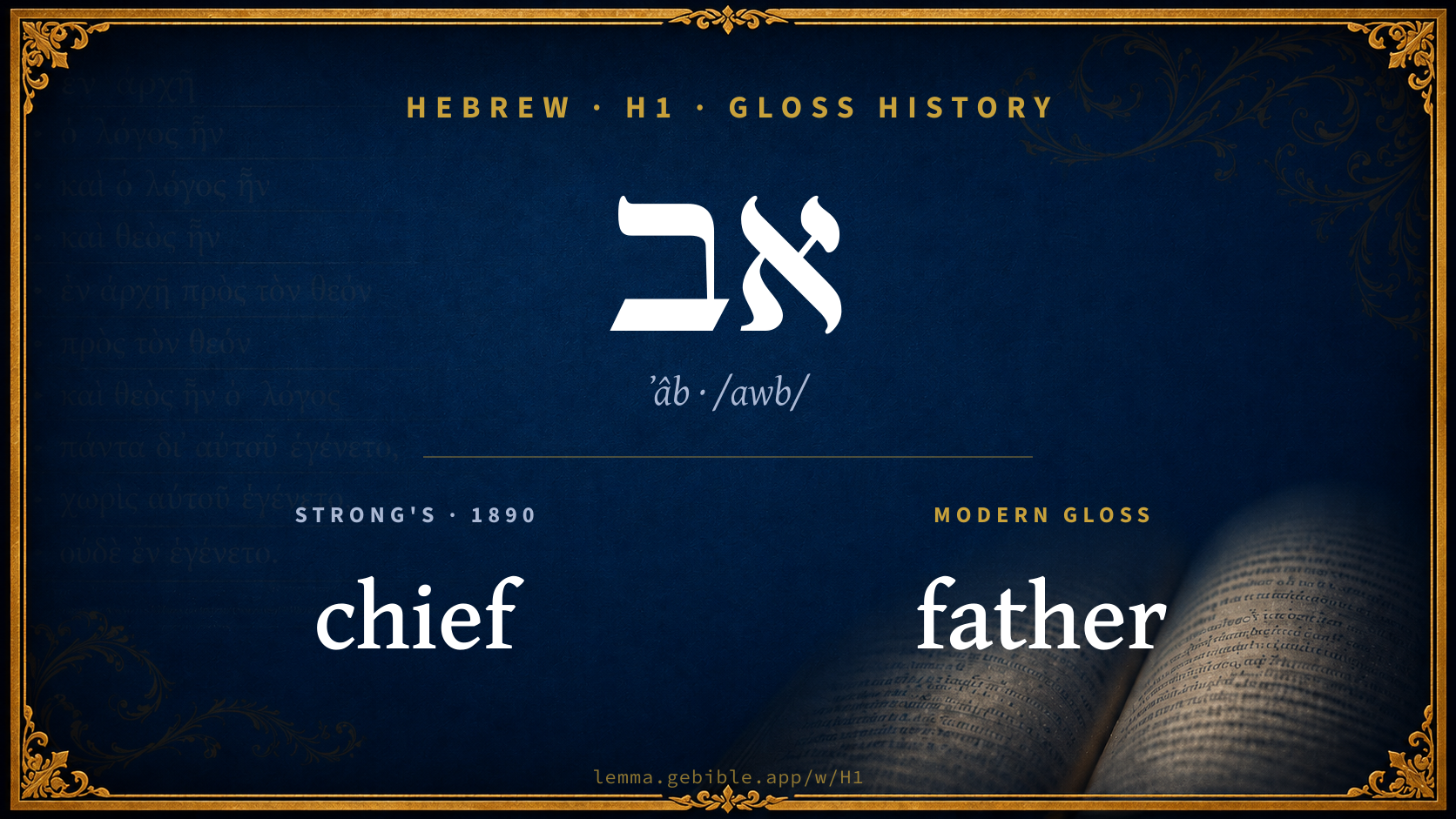
Gloss history
Strong's 1890 vs modern scholarship
About this word
Strong's H1 catalogs a Hebrew word from the Hebrew Old Testament.
These counts are not copied from any lexicon or concordance. They are computed here, from the morphology-tagged Hebrew Old Testament. What Lemma adds →
- 1,060
- distinct verses
- The word appears in 1,060 distinct verses.
- 31 / 39
- OT books
- The word appears in 31 of 39 Old Testament books.
- #30
- by frequency
- Top 50 most frequent Hebrew words (rank 30 of 8,640 Hebrew words by occurrence).
View all 1,060 occurrences in the concordance →
Most concentrated in
- Genesis 170 verses 16%
- 2 Chronicles 110 verses 10%
- 1 Chronicles 87 verses 8%
By section of the Old Testament
By traditional corpus
Conventional, traditional groupings — biblical authorship is debated, so this is a traditional corpus grouping, not an authorship claim. Each share is this word’s portion of its verses in that division of the Hebrew canon. Each figure is a share of the word’s 1,060 distinct verses.
- Prophets (Nevi'im) 413 verses · 39%
- Torah (Pentateuch) 351 verses · 33%
- Writings (Ketuvim) 296 verses · 28%
How translations render this word
Counts come from each version’s own published word-to-Strong’s tagging or interlinear alignment — an approximate guide to how each version renders this word, not a word-level alignment the data otherwise carries. Because each total is that version’s own tagged count, the per-version totals vary from one another and need not match the appearance or distinct-verse counts above. These counts may also differ from a printed concordance because Lemma counts each distinctly tagged rendering and does not collapse phrase taggings into a single head-word total. This is a fixed set of word-tagged versions (KJV, ASV, BSB, ULT) and does not change with the reading translation you choose elsewhere. Each version’s license is shown beside its name below (and on Sources).
BDB lists this Strong’s number as 2 distinct words (homographs). Each count above pools all of them and is not split by sense — see the Senses section below. A low-frequency rendering may belong to a different one of those words, not the primary meaning.
- King James Version†: Father 517×, Fathers 417×, Father's 93×
- American Standard Version†: Father 532×, Fathers 397×, According to their fathers 12×
- Berean Standard Bible†: Father 482×, Fathers 327×, Father’s 120×
- unfoldingWord Literal Text†: Father 608×, Fathers 443×, Father of 68×
King James Version Public Domain
Renders H1 across 1,212† tagged occurrences — most commonly:
Plus other, less common renderings. Plus 117 renderings that appear only once — usually multi-word phrases or single function words the recovered tagging swept in, not distinct renderings. Not rendered by a distinct English word in 3 further occurrences.
American Standard Version Public Domain
Renders H1 across 1,212† tagged occurrences — most commonly:
Plus other, less common renderings. Plus 172 renderings that appear only once — usually multi-word phrases or single function words the recovered tagging swept in, not distinct renderings.
Berean Standard Bible Public Domain
Renders H1 across 1,165† tagged occurrences — most commonly:
Plus other, less common renderings. Plus 77 renderings that appear only once — usually multi-word phrases or single function words the recovered tagging swept in, not distinct renderings. Not rendered by a distinct English word in 46 further occurrences.
unfoldingWord Literal Text CC BY-SA 4.0
Renders H1 across 1,203† tagged occurrences — most commonly:
Plus other, less common renderings. Plus 25 renderings that appear only once — usually multi-word phrases or single function words the recovered tagging swept in, not distinct renderings.
9 senses and sub-senses in the full BDB
What do BDB’s symbols mean?
BDB uses these scholarly abbreviations:
| Symbol | Meaning |
|---|---|
| 𝔊 | the Septuagint (the ancient Greek translation, LXX) |
| 𝔙 | the Vulgate (the Latin translation) |
| 𝔖 | the Syriac version (the Peshitta) |
| 𝔗 | the Targum (the Aramaic translation) |
| ψ | the Psalms |
| √ | root (the underlying root or stem) |
| ‖ | parallel passage (a synonymous or contrasted parallel) |
| † | the dagger: every passage where the word occurs is cited |
The 9 senses and sub-senses the full Brown-Driver-Briggs lexicon distinguishes for this word, in lexicon order (not ranked by frequency), with BDB’s own verbatim wording and sub-sense lettering. Shown in Hebrew script with BDB’s own scholarly abbreviations. The condensed entry is in the Lexicon Entry tab. See also the Forms in the corpus table below.
- 1. father of individual Gn 2:24 (+ אֵם) 11:28, 29(×2); 19:31, 32, 33, + often (mostly JED); of father as commanding Gn 50:16 (J) Je 35:6 f Pr 6:20 (cf. Gn 18:19 J 28:1, 6 P 1 S 17:20 1 K 2:1); instructing מוסר Pr 1:8; 4:1 (cf. Dt 8:5); specif. as begetter, genitor Pr 23:22 Zc 13:3(×2) (+ אֵם) Is 45:10; cf. Gn 49:4 (J) Lv 18:7, 8, 11 (P); rebuking Gn 37:10; loving Gn 37:4; 44:20 (JE; cf. 22:2; 25:28; 37:3 2 S 14:1); pitying ψ 103:13 (in sim. cf. 2 S 18:5); blessing Gn 27:41 (JE cf. 27:4 also 28:1 P +); as glad Pr 10:1; 15:20 cf. 29:3; grieving Gn 37:35 (JE; cf. 2 S 12:22; 19:1, 2 f) etc. Also as obj. of honour, obedience, love Ex 20:12 (E) = Dt 5:16; Ex 21:15, 17 (E) Dt 21:18, 19 Gn 28:7 (P), 50:1, 5 1 K 19:20 (all + אֵם) (J) Mal 1:6 etc. Hence metaph. of intimate connection Jb 17:14 to corruption I cry, My father art thou (‖ אִמִּי וַאֲחֹתִי לָֽרִמָּה). e.g. Genesis 2:24
- 2. of God as father of his people (v. RSSem 42), who constituted, controls, guides and lovingly watches over it: Dt 32:6 Je 3:4, 19; 31:9 Is 63:16(×2); 64:7 Mal 1:6; 2:10 (cf. Ex 4:22; 19:4 (JE) Dt 32:11 Ho 11:1); cf. Je 2:27 (of idolatr. Isr.) אֹמְרִים לָעֵץ אָבִי אַתָּה וְלָאֶבֶן אַתְּ ילדתני׃; especially God as father of Davidic line 2 S 7:14 ψ 89:27; f. of needy (late) ψ 68:6 (cf. 103:13) (in n.pr., f. of individ., cf. infr.) e.g. Deuteronomy 32:6
- 3. head of household, family or clan; בֵּית אָבִי as abode Gn 38:11(×2) Lv 22:13 +; = family Gn 24:40 (‖ מִשְׁפַחְתִּי) 41:51; 46:31 + cf. Nu 18:1, 2 Jos 2:12, 18; 6:25; especially techn. of divisions of Isr. בֵּית אָב לְמִשְׁפָּחוֹת Nu 3:30, 35 = a father’s house, i.e. a family or clan; more often pl. (אבותם, אבותיו) בֵית אָבוֹת = fathers’ houses = families, clans (cf. Di on Ex 6:14) Ex 6:14; 12:3 Nu 1:2, 18 ff. (often in Nu) Jos 22:14(×2) without בית Jos 14:1; 19:51; 21:1(×2) (always P in Hex.); also 1 Ch 5:13, 15 + often in Ch; cf. רָאשֵׁי אבות הלוים (= ר׳ בית א׳) Ex 6:25 cf. 1 K 8:1 1 Ch 6:4; 7:11 + often Ch Ezr Ne. e.g. Genesis 38:11
- 4. ancestor (a) of individual; grandfather (instead of precise term) Gn 28:13; 32:10 (J; where used of Abr. & Isaac); greatgr. 1 K 15:3; gr.-greatgr. 1 K 15:11, 24 etc.; cf. 2 K 14:3; 15:38; 16:2; 18:3; 22:2; often pl. (= fathers, forefathers) Gn 15:15; 46:34 (JE) 1 K 19:4; 21:3, 4 2 K 19:12; 20:17 +; particularly שׁכב עם אבותיו 1 K 1:21; 2:10; 11:21; 22:40 +; joined with ויקבר עם אב׳ 1 K 14:31; 15:24; 22:51 2 K 8:24; 15:38 cf. v 7, 16:20 + (all of kings of Judah); intens., אֲבֹתֶיךָ וַאֲבוֹת אֲבֹתֶיךָ Ex 10:6 cf. Dn 11:24; (b) of people Gn 10:21 (J) 17:4, 5 (P) 19:37, 38 (J) 36:9, 43 (P) Dt 26:5 Is 51:2; 43:27 (where אביך הראשׁון thy first father, v. Che) cf. also Ez 16:3, 45 + often; pl. Ex 3:13, 15, 16 (E) Dt 1:8 Jos 1:6 Ju 2:1 1 S 12:6 +; 1 S 12:15 ad fin read וּבְמַלְכְּכֶם 𝔊 We Dr. e.g. Genesis 28:13
- 5. originator or patron of a class, profession, or art Gn 4:20, 21. e.g. Genesis 4:20
- 6. fig. of producer, generator Jb 38:28 הֲיֵשׁ לַמָּטָר אָ֑ב (‖ מִי־הוֹלִיד אֶגְלֵי־טָֽל׃). e.g. Job 38:28
- 7. fig. of benevolence & protection Jb 29:16 אָב אָֽנֹכִי לָֽאֶבְיוֹנִים, cf. 31:18; of Eliakim Is 22:21; perhaps also of gracious Mess. king אֲבִי עַד Is 9:5 everlasting father (Ge Ew De Che Brd Di)—others divider of spoil (Abarb Hi Kn KueBrMP). e.g. Job 29:16
- 8. term of respect & honour (Abbas, Pater, Papa, Pope); appl. to master 2 K 5:13; priest Ju 17:10; 18:19; prophet 2 K 2:12(×2); 6:21; 13:14(×2) cf. 8:9; counsellor Gn 45:8 (E; cf. δευτέρου πατρός 𝔊 add. Est 3:13; τῷ πατρί 1 Mac 11:32); king 1 S 24:12; artificer 2 Ch 2:12; 4:16. e.g. 2 Kings 5:13
- 9. specif., ruler, chief (late) 1 Ch 2:24, 42(×2) etc. (cf. Ew§ 273b). See also EwGesch. i. 524 H i. 365. On the force of אָב in proper names (in many prob. a divine title), v. CheEncy. Bib., abi, names with Nöib., names, §§ 44, 45. e.g. 1 Chronicles 2:24
Senses from the full Brown-Driver-Briggs lexicon (Brown, Driver, Briggs; Oxford 1906 — public domain), digitized via Sefaria, supplemented by the OpenScriptures HebrewLexicon (CC BY 4.0). Full attribution on Sources.
Word origin
n.m. father (Ph. אב, Assyrian abu, Arabic أَبٌ, Sab. אב CISiv, 1. 37 1. 2 al. Ethiopic አብ Aramaic אַבָּא, ܐܰܒܳܐ )—abs. אָב Gn 44:19 + 47 times; cstr. אַב Gn 17:4, 5 (cf. in אַבְרָהָם ib. & elsewhere in n.pr. On Hal’s proposes אֲבִר v. אברהם); אֲבִי (cf. Ge§§ 90, 3b, 96) Gn 4:20 +; sf. אָבִי Gn 19:34 + (MI אבי); אָבִיךָ Gn 12:1 +; אָבִיו Gn 2:24 +; אָבִ֫יהוּ Ju 14:10 + 6 times; pl. אָבוֹת Ex 12:3 +; cstr. אֲבוֹת Ex 6:25 + 7 times; sf. אֲבוֹתַי (אֲבֹתַי, אֲבוֹתָ֑י) Gn 47:9 + 15 times; אֲבוֹתֵיהֶם 1 Ch 4:38 + 32 times (late); אֲבוֹתָם Ex 4:5 + 106 times etc.;—
— Brown-Driver-Briggs (Oxford 1906, public domain), digitized via Sefaria, supplemented by the OpenScriptures HebrewLexicon (CC BY 4.0). See Sources.
Origin: a root
Jastrow Dictionary
A second Hebrew/Aramaic lexicon for comparison, covering Aramaic and post-biblical (Talmudic, Targumic, Midrashic) usage that the biblical-Hebrew BDB does not. Matched by lemma rather than by Strong’s number, so a lemma may carry more than one Jastrow headword (shown separately below), and the entries cover usage well beyond the Bible.
אַב־
- a prefix of words of Greek origin answering to αὐ-, au-, e.g. אבטומטוס = αὐτόματος; or to εὐ, e.g. אבגינוס = εὐγενής.
אָב I
- (Assyr. A-bu, Schr. K. A. T., p. 247) Ab, the fifth month of the Jewish calendar (of thirty days) beginning between the eighth of July and the seventh of August, and ending between the sixth of August and the fifth of September. R. Hash. I, 3, על אב וכ׳ for announcing the beginning of Ab messengers are sent out, for the sake of the fast. Ib. 18ᵇ ט׳ באב the ninth of Ab, anniversary of Temple destruction. Taan. IV, 6 משנכנס אב with the beginning of Ab. Ib. 29ᵇ לישתמיט מיניה באב let him try to be relieved of (the law-suit) in Ab. Meg. 5ᵇ; a. e.
אָב II
- , const. אֲבִי, אַב [embracer], father, ancestor, progenitor; teacher; chief, leader; author, originator. Ex. R. s. 46 end המגדל אב the educator is the real father. Lev. R. s. 1 אבי החכמה וכ׳, the father of all wisdom, … the father of prophets. Y. Ned. V, 39ᵇ; a. fr.—אַב בית דין (abbr. אב"ד) president of the Court (Great Sanhedrin), next in dignity to the Nassi. Taan. II, 1; a. fr.—Metaph. origin, cause. Num. R. s. 10 (play on אֲבוֹי, Prov. XXIII, 29) א׳ אוי the cause of woe (sin).—אב מלאכה (for which also עיקר) one of the chief labors forbidden on the Sabbath, opp. תולדה a labor the prohibition of which is based on the ground of its being a species of the former, or derived from the former. Sabb. VII, 1 sq.; a. fr.—[Y. Sabb. II, 5ᵃ, אב שלה, sub. מלאכה.]—אב הטומאה one of the original or direct causes of levitical uncleanness, opp. ולד (child) secondary cause. Toh. I, 5; a. fr.—א׳ הנזק v. Pl.—בנין א׳ creation of a class, i.e. a conclusion, by analogy, from a case explicitly stated in the bibl. law on all similar cases not specified in detail. Sifra introd.—Ib. K’doshim, end, ch. 11 (ref. to Lev. XX, 27) זה ב׳ א׳ לכל דמיהם בם this forms the rule for all cases in which the Bible uses the word d’mēhem bam (that the penalty is stoning to death); a. fr.; v. also בֵּית אב.—Pl. אָבוֹת־, const. אֲבוֹת, e.g. Proverbs 23:29
- 1. fathers, ancestors, patriarchs &c. Ber. 26ᵇ prayers א׳ תקנום have been instituted by the Patriarchs; a. fr.—אבות בתי דינין, v. supra. Ḥag. II, 2.—בת א׳ a woman of noble descent. Num. R. s. 1; a. e.—Metaph. principal, chief א׳ מלאכות, v. supra. א׳ הטומא׳ Kel. I, 1; v. supra.—א׳ נזיקין (sing. אב הנזק) the chief actionable injuries or damages, from which the subordinate are deduced (תולדות). B. Kam. I, 1; a. e.
- 2. Aboth, the first section of the Prayer of Benedictions (v. תְּפִלָּה), so called because it alludes to the Patriarchs. R. Hash. IV, 5; a. fr.
- 3. Aboth, name of a treatise of the Mishnah, containing sayings of Talmudic authorities and belonging to the fourth section, נזיקין, of the Mishnah collection (משניות); also styled פִּרְקֵי א׳ a. מְסֶכֶת א׳. A similar collection of a later date is contained in Talmud Babli editions, named א׳ דרבי נתן Aboth d’Rabbi Nathan. [Y. Yoma VIII, 44ᵈ top אב בית נפש v. אֲבֵידָה.]
אָב II ²
- ch., v. אַבָּא
אֵב
- swelling, spreading, whence
- 1. the young shoots of a tree, opp. to the branches growing directly from the trunk. B. Kam. 81ᵃ אִיבּוֹ של אילן ed. (Ar. a. Ms. חובו, v. חוֹב II, cmp. Rashi a. l.). [Y. Erub. III, 21ᵃ top איבו; Y. Succ. II, 53ᵃ צידו.]
- 2. pl. אִבִּין, אִיבִּין state of growth, development. Ḥull. 58ᵃ cascuta which became wormy באִבֶּיהָ during its growth. Ib. 127ᵇ figs which shrunk באִבֵּיהֶן during development. Y. Sabb. VII, 10ᶜ bot. he who presses olives מאִבֵּיהֶן from where they grow (before they are ripe to be taken off). [Tosef. Maasr. I, 4 איבין אדומים, Var. אובין, read אוּגִין, v. אוֹג.] Ib. 5 they differ על האיבין concerning the plants in their growing state (between ripening [גמר] and blossoming [הנץ]; Var. אוֹנין incorr.); cmp. יָבַן. Ch. v. אִיבָּא I.
A Dictionary of the Targumim, the Talmud Babli and Yerushalmi, and the Midrashic Literature (Marcus Jastrow; London, Luzac, 1903) — Public Domain. Digitized via Sefaria. Digitized via Sefaria. Full attribution on Sources.
Forms in the corpus
The 406 distinct written forms H1 takes in the Hebrew Bible, most frequent first — each parse links to that state’s occurrences in the concordance. Hebrew forms include their vowel points and cantillation, so a single lemma takes many written forms.
The 60 most common forms are shown; 346 rarer forms follow in the full concordance.
Same root — word family
Other BDB entries built from the same root as H1, grouped by Strong’s listed origin. These share a root / origin per the lexicon — not necessarily a shared meaning. Each links to that word’s own entry.
Derived from this word
Proper names from this root
People and places named from this root — a name, not an additional meaning of the word.
- אבי ʼĂbîy H21 Abi
- אביאל ʼĂbîyʼêl H22 Abiel
- אביאסף ʼĂbîyʼâçâph H23 Abiasaph
- אבי גבעון ʼĂbîy Gibʻôwn H25 father of Gibeon
- אביגיל ʼĂbîygayil H26 Abigail
- אבידן ʼĂbîydân H27 Abidan
- אבידע ʼĂbîydâʻ H28 Abida
- אביה ʼĂbîyâh H29 Abijah
- אביהוא ʼĂbîyhûwʼ H30 Abihu
- אביהוד ʼĂbîyhûwd H31 Ahihud
- אביהיל ʼĂbîyhayil H32 Abihail
- אביטוב ʼĂbîyṭûwb H36 Abitub
- אביטל ʼĂbîyṭâl H37 Abital
- אבים ʼĂbîyâm H38 Abijam
- אבימאל ʼĂbîymâʼêl H39 Abimael
- אבימלך ʼĂbîymelek H40 Abimelech
- אבינדב ʼĂbîynâdâb H41 Abinadab
- אבינעם ʼĂbîynôʻam H42 Abinoam
- אביעזר ʼĂbîyʻezer H44 Abiezer
- אביעלבון ʼĂbîy-ʻalbôwn H45 Abialbon
- אבירם ʼĂbîyrâm H48 Abiram
- אבישג ʼĂbîyshag H49 Abishag
- אבישוע ʼĂbîyshûwaʻ H50 Abishua
- אבישור ʼĂbîyshûwr H51 Abishur
+7 more proper names from this root (not shown).
Compare all same-root words → Showing 4 of 34 — not the complete family. 31 of the same-root words are proper names (people or places). They share a root, not necessarily a meaning.
Septuagint verse parallels
This word appears in 1,020 verses that also exist in the Greek Old Testament (Septuagint), out of the 1,060 Hebrew verses it occurs in. You can read those verses in Greek by switching the Old Testament edition to the Septuagint.
Read these verses in the Septuagint
- Genesis 2:24
- Exodus 2:16
- Leviticus 16:32
- Numbers 1:2
- Deuteronomy 1:8
- Joshua 1:6
- Judges 1:14
- Ruth 2:11
- 1 Samuel 2:25
- 2 Samuel 2:32
- 1 Kings 1:6
- 2 Kings 2:12
This is a verse-level parallel only — the same verses exist in both the Hebrew and Greek Old Testaments. No word-level Hebrew↔Greek correspondence is claimed: the data carries no such alignment, so no Greek word is shown as this Hebrew word’s translation. Coverage is not total — the Septuagint omits the deuterocanon and renumbers the Psalms, so some Hebrew verses have no direct Greek parallel.