
Exodus 4:5

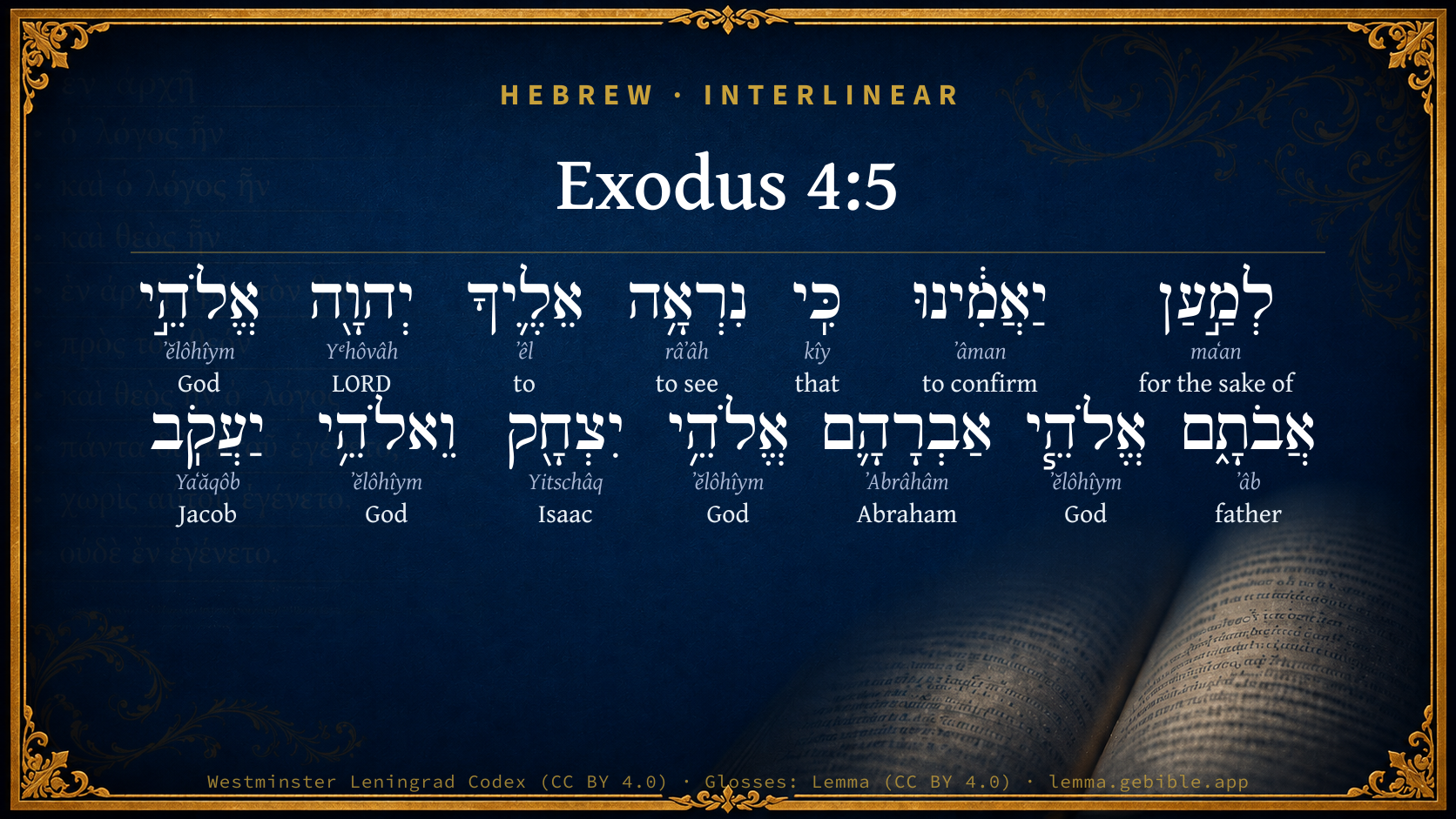
Hebrew (Westminster Leningrad Codex) Exodus 4:5 appears in the Hebrew Old Testament. The text above is from the Westminster Leningrad Codex. Each word links to its Strong’s number, a concise gloss, and parsing drawn from the Open Scriptures Hebrew Bible morphology. Click any word for its full Brown-Driver-Briggs (BDB) entry.
Download image
Cite this verse

Exodus 4:5 (World English Bible). Public Domain. Lemma interlinear Bible study tool, https://lemma.gebible.app/v/exodus/4/5.

Show BibTeX & RIS
BibTeX
RIS
English Translation
"That they may believe that Yahweh, the God of their fathers, the God of Abraham, the God of Isaac, and the God of Jacob, has appeared to you."
World English Bible · Public Domain
Download a study sheet

One document with this verse’s original text, its word-by-word gloss line, the meaning frame, cross-references with their text, attributed commentary, and full source and license credits — printable, and it pastes into notes with its structure intact.

This verse Autodidact and up

Study sheet (.html) Plain text (.txt)

A passage Seminary Student

Up to 50 verses in one chapter. A passage sheet keeps up to 6 commentary sources and 12 cross-references per verse, in the order this page ranks them, and says so on the sheet whenever that leaves anything out. Ask for a single verse and you get the Autodidact verse sheet above.

Everything on this page stays free to read, with no account — the sheet is a download of what is already on screen, not access to it.

Want to remove ads? Support Godless Engineer
Compare translations 3

The same verse in 3 English versions, stacked beneath the original-language interlinear above. Click any original word for its lexicon entry.

Each is an independent rendering of the whole verse — the interlinear is not word-aligned to these translations.

Highlighted words mark where these versions differ — a whole-verse word diff, not a word-by-word alignment.

  • World English Bible Public Domain
    "That they may believe that Yahweh, the God of their fathers, the God of Abraham, the God of Isaac, and the God of Jacob, has appeared to you."
  • King James Version Public Domain
    That they may believe that the LORD God of their fathers, the God of Abraham, the God of Isaac, and the God of Jacob, hath appeared unto thee.
  • unfoldingWord Literal Text CC BY-SA 4.0
    “in order to cause them to believe that Yahweh appeared to you, the God of their fathers, the God of Abraham, the God of Isaac, and the God of Jacob.”

unfoldingWord Literal Text — © unfoldingWord, licensed CC BY-SA 4.0. Word-aligned USFM3 via Door43 (git.door43.org/unfoldingWord/en_ult).

Versions to compare (up to 4)

3 of 4 selected

Show all 18 translations

Every available English version of this verse, each an independent rendering of the whole verse.

  • World English Bible Public Domain
    "That they may believe that Yahweh, the God of their fathers, the God of Abraham, the God of Isaac, and the God of Jacob, has appeared to you."
  • Berean Standard Bible Public Domain
    “This is so that they may believe that the LORD, the God of their fathers—the God of Abraham, the God of Isaac, and the God of Jacob—has appeared to you.”
  • Majority Standard Bible Public Domain
    “This is so that they may believe that the LORD, the God of their fathers—the God of Abraham, the God of Isaac, and the God of Jacob—has appeared to you.”
  • King James Version Public Domain
    That they may believe that the LORD God of their fathers, the God of Abraham, the God of Isaac, and the God of Jacob, hath appeared unto thee.
  • American Standard Version (1901) Public Domain
    That they may believe that Jehovah, the God of their fathers, the God of Abraham, the God of Isaac, and the God of Jacob, hath appeared unto thee.
  • Revised Version (1885) Public Domain
    that they may believe that the LORD, the God of their fathers, the God of Abraham, the God of Isaac, and the God of Jacob, hath appeared unto thee.
  • Geneva Bible (1599) Public Domain
    Do this that they may beleeue, that the Lord God of their fathers, the God of Abraham, the God of Izhak, and the God of Iaakob hath appeared vnto thee.
  • Douay-Rheims (1899) Public Domain
    That they may believe, saith he, that the Lord God of their fathers, the God of Abraham, the God of Isaac, and the God of Jacob, hath appeared to thee.
  • Young's Literal Translation Public Domain
    `-- so that they believe that Jehovah, God of their fathers, hath appeared unto thee, God of Abraham, God of Isaac, and God of Jacob.'
  • Literal Standard Version CC BY-SA 4.0
    “so that they believe that YHWH, God of their fathers, has appeared to you, God of Abraham, God of Isaac, and God of Jacob.”
  • Unlocked Literal Bible CC BY-SA 4.0
    “This is so they may believe that Yahweh, the God of their ancestors, the God of Abraham, the God of Isaac, and the God of Jacob, has appeared to you.”
  • unfoldingWord Literal Text CC BY-SA 4.0
    “in order to cause them to believe that Yahweh appeared to you, the God of their fathers, the God of Abraham, the God of Isaac, and the God of Jacob.”
  • Darby Bible Public Domain
    that they may believe that Jehovah, the God of their fathers, the God of Abraham, the God of Isaac, and the God of Jacob, hath appeared unto thee.
  • World Messianic Bible Public Domain
    “This is so that they may believe that the LORD, the God of their fathers, the God of Abraham, the God of Isaac, and the God of Jacob, has appeared to you.”
  • Webster's Bible Public Domain
    That they may believe that the LORD God of their fathers, the God of Abraham, the God of Isaac, and the God of Jacob, hath appeared to thee.
  • Free Bible Version CC BY-SA 4.0
    “You are to do this so that they will believe that I the Lord did appear to you, the God of their fathers, the God of Abraham, Isaac, and Jacob.”
  • Bible in Basic English Public Domain
    So that they may be certain that the Lord, the God of their fathers, the God of Abraham, of Isaac, and of Jacob, has been seen by you.
  • JPS Tanakh (1917) Public Domain
    that they may believe that the LORD, the God of their fathers, the God of Abraham, the God of Isaac, and the God of Jacob, hath appeared unto thee.'

Literal Standard Version (2020), Covenant Press — licensed CC BY-SA 4.0. Text via the HelloAO Bible API (eBible.org). Unlocked Literal Bible (unfoldingWord) — licensed CC BY-SA 4.0. Text via the HelloAO Bible API (eBible.org). unfoldingWord Literal Text — © unfoldingWord, licensed CC BY-SA 4.0. Word-aligned USFM3 via Door43 (git.door43.org/unfoldingWord/en_ult). Free Bible Version, Dr. Jonathan Gallagher — licensed CC BY-SA 4.0. Text via the HelloAO Bible API (eBible.org).

Word by word

More ways to search: Search by grammar → Find every occurrence → Compare this word →

Practice this passage: Drill this verse → Learn its vocabulary →

יַאֲמִ֔ינוּ
ʼâman
H539
“to confirm”
Verb, Hiphil, Imperfect, 3rd Person, Masculine, Plural
Part of Speech
Verb
Stem
Hiphil
Form
Imperfect
Person
3rd Person
Gender
Masculine
Number
Plural
Full BDB Definition

Origin: a primitive root

TWOT: 116

to support, confirm, be faithful - (Qal) - to support, confirm, be faithful, uphold, nourish - foster-father (substantive) - foster-mother, nurse - pillars, supporters of the door - (Niphal) - to be established, be faithful, be carried, make firm - to be carried by a nurse - made firm, sure, lasting - confirmed, established, sure - verified, confirmed - reliable, faithful, trusty - (Hiphil) - to stand firm, to trust, to be certain, to believe in - stand firm - trust, believe
  1. לְמַ֣עַן maʻan H4616 “for the sake of” Preposition
  2. כִּֽי kîy H3588 “that” Conjunction
  3. נִרְאָ֥ה râʼâh H7200 “to see” Verb, Niphal, Perfect, 3rd Person, Masculine, Singular
  4. אֵלֶ֛יךָ ʼêl H413 “to · you” Preposition + Suffix, Personal, 2nd Person, Masculine, Singular
  5. יְהוָ֖ה Yᵉhôvâh H3068 “LORD” Noun, Proper
  6. אֱלֹהֵ֣י ʼĕlôhîym H430 “God(s) of” Noun, Common, Masculine, Plural, Construct
  7. אֲבֹתָ֑ם ʼâb H1 “fathers · their” Noun, Common, Masculine, Plural, Construct + Suffix, Personal, 3rd Person, Masculine, Plural
  8. אֱלֹהֵ֧י ʼĕlôhîym H430 “God(s) of” Noun, Common, Masculine, Plural, Construct
  9. אַבְרָהָ֛ם ʼAbrâhâm H85 “Abraham” Noun, Proper
  10. אֱלֹהֵ֥י ʼĕlôhîym H430 “God(s) of” Noun, Common, Masculine, Plural, Construct
  11. יִצְחָ֖ק Yitschâq H3327 “Isaac” Noun, Proper
  12. וֵאלֹהֵ֥י ʼĕlôhîym H430 “and · God(s) of” Conjunction + Noun, Common, Masculine, Plural, Construct
  13. יַעֲקֹֽב Yaʻăqôb H3290 “Jacob” Noun, Proper

About this verse

These counts appear in no published source. They are computed here, from the morphology-tagged text and Lemma’s own curated glosses. What Lemma adds →

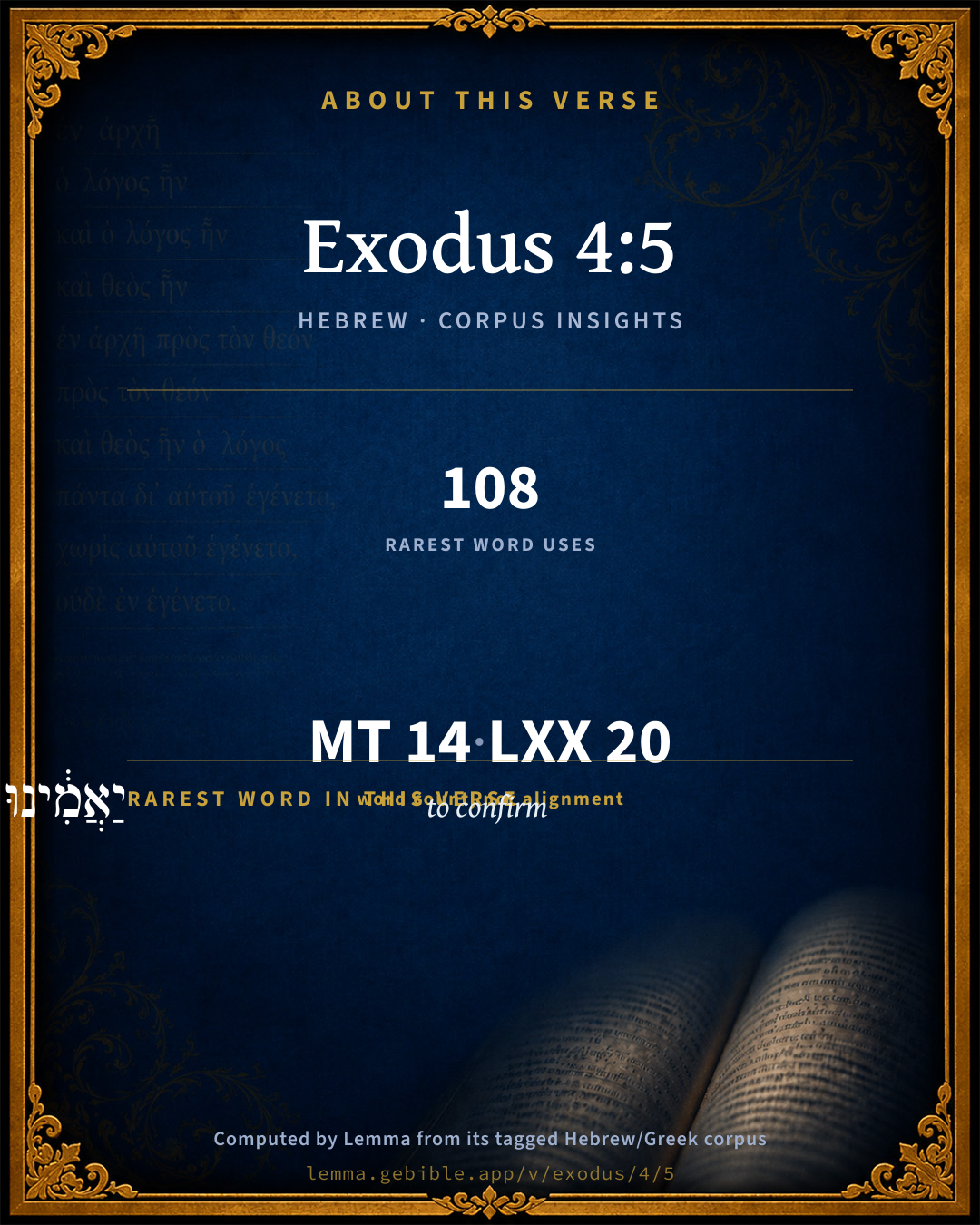
14
words
11
distinct lemmas
Pentateuch
section

Grammatical profile

  • 2 verbs
  • 9 nouns
  • 2 prepositions
  • 1 conjunction

Verb forms

  • יַאֲמִ֔ינוּ Hiphil · Imperfect
  • נִרְאָ֥ה Niphal · Perfect

Repetition

A word recurs within this verse — often emphatic in Hebrew:

  • אֱלֹהֵ֣י God H430 ×4

Hebrew & Septuagint length

In English translation the verse runs 28 words from the Hebrew and 35 from the Septuagint (LXX English) — closely comparable.

A rough comparison of the two English renderings, which tokenize alike — not a word-level alignment.

Word counts can differ between the Hebrew and the Greek without any difference in meaning — e.g. the Hebrew direct-object marker אֵת has no separate Greek word, and Greek often adds the article ὁ.

In the original languages it is 14 Hebrew tokens and 20 Greek tokens — but the two are counted differently (Hebrew bundles its prefixes and suffixes into one token; the Greek is in lemma form), so that isn’t a like-for-like length.

Cross-references

20

Topical passages linked to Exodus 4:5 in the Treasury of Scripture Knowledge — connected by theme and wording, ordered by reader-vote popularity; previews shown in the World English Bible.

  • Exodus 19:9 Yahweh said to Moses, "Behold, I come to you in a thick cloud, that the people may hear when I speak with you, and may also believe you forever." Moses told the words of the people to Yahweh.
  • Genesis 12:7 Yahweh appeared to Abram, and said, "I will give this land to your seed." He built an altar there to Yahweh, who appeared to him.
  • Genesis 18:1 Yahweh appeared to him by the oaks of Mamre, as he sat in the tent door in the heat of the day.
  • Genesis 26:2 Yahweh appeared to him, and said, "Don't go down into Egypt. Dwell in the land which I will tell you of.
  • Genesis 48:3 Jacob said to Joseph, "God Almighty appeared to me at Luz in the land of Canaan, and blessed me,
  • Exodus 3:15 God said moreover to Moses, "You shall tell the children of Israel this, 'Yahweh, the God of your fathers, the God of Abraham, the God of Isaac, and the God of Jacob, has sent me to you.' This is my name forever, and this is my memorial to all generations.
  • Exodus 4:31 The people believed, and when they heard that Yahweh had visited the children of Israel, and that he had seen their affliction, then they bowed their heads and worshiped.
  • John 11:42 I know that you always listen to me, but because of the multitude that stands around I said this, that they may believe that you sent me."
  • Genesis 17:1 When Abram was ninety-nine years old, Yahweh appeared to Abram, and said to him, "I am God Almighty. Walk before me, and be blameless.
  • Exodus 3:6 Moreover he said, "I am the God of your father, the God of Abraham, the God of Isaac, and the God of Jacob." Moses hid his face; for he was afraid to look at God.
  • Exodus 3:18 They will listen to your voice, and you shall come, you and the elders of Israel, to the king of Egypt, and you shall tell him, 'Yahweh, the God of the Hebrews, has met with us. Now please let us go three days' journey into the wilderness, that we may sacrifice to Yahweh, our God.'
  • Exodus 4:1 Moses answered, "But, behold, they will not believe me, nor listen to my voice; for they will say, 'Yahweh has not appeared to you.'"
  • 2 Chronicles 20:20 They rose early in the morning, and went forth into the wilderness of Tekoa: and as they went forth, Jehoshaphat stood and said, Hear me, Judah, and you inhabitants of Jerusalem: believe in Yahweh your God, so shall you be established; believe his prophets, so shall you prosper.
  • Isaiah 7:9 and the head of Ephraim is Samaria, and the head of Samaria is Remaliah's son. If you will not believe, surely you shall not be established.'"
  • Jeremiah 31:3 Yahweh appeared of old to me, [saying], Yes, I have loved you with an everlasting love: therefore with loving kindness have I drawn you.
  • John 5:36 But the testimony which I have is greater than that of John, for the works which the Father gave me to accomplish, the very works that I do, testify about me, that the Father has sent me.
  • John 11:15 I am glad for your sakes that I was not there, so that you may believe. Nevertheless, let's go to him."
  • John 20:27 Then he said to Thomas, "Reach here your finger, and see my hands. Reach here your hand, and put it into my side. Don't be unbelieving, but believing."
  • John 20:31 but these are written, that you may believe that Jesus is the Christ, the Son of God, and that believing you may have life in his name.
  • Acts 7:2 He said, "Brothers and fathers, listen. The God of glory appeared to our father Abraham, when he was in Mesopotamia, before he lived in Haran,

Cross-references courtesy of OpenBible.info (CC BY 4.0).

Hebrew and Greek witnesses Masoretic Hebrew ↔ Greek Septuagint

The same verse in the two great witnesses to the Old Testament, shown verse-for-verse.

These are two independent witnesses, not word-aligned to each other, and the Septuagint is shown in lemma (dictionary) form.

Hebrew Exodus 4:5 Masoretic · Westminster Leningrad Codex

לְמַ֣עַן יַאֲמִ֔ינוּ כִּֽי נִרְאָ֥ה אֵלֶ֛יךָ יְהוָ֖ה אֱלֹהֵ֣י אֲבֹתָ֑ם אֱלֹהֵ֧י אַבְרָהָ֛ם אֱלֹהֵ֥י יִצְחָ֖ק וֵאלֹהֵ֥י יַעֲקֹֽב

"That they may believe that Yahweh, the God of their fathers, the God of Abraham, the God of Isaac, and the God of Jacob, has appeared to you."

World English Bible · Public Domain

Greek LXX Exodus 4:5 Septuagint · lemma form

ἵνα πιστεύω σύ ὅτι ὁράω σύ κύριος ὁ θεός ὁ πατήρ αὐτός θεός αβρααμ καί θεός ισαακ καί θεός ἰακώβ

and it became a rod in his hand, —that they may believe you, that the God of your fathers has appeared to you, the God of Abraam, and God of Isaac, and God of Jacob.

LXX2012 (modern English Septuagint) · Public Domain

Hebrew: Westminster Leningrad Codex (CC BY 4.0). Greek: Septuagint (public domain); English from LXX2012 (modern English Septuagint) (Public Domain). How the Septuagint differs from the Hebrew →

Targum (Aramaic paraphrase)

2

The Targum is the ancient Jewish Aramaic paraphrase of the Hebrew Scriptures — an interpretive translation, not the Hebrew text itself. Onkelos (literal) and Pseudo-Jonathan (expansive) render the Torah, and Jonathan the Prophets. Coverage is partial: where no permissively-licensed English translation exists for a verse, only the Aramaic is shown. This is verse-level text, not a word-by-word alignment to the Hebrew.

  1. Targum Onkelos Torah (Genesis–Deuteronomy)
    בְּדִיל דִיהֵמְנוּן אֲרֵי אִתְגְלִי לָךְ יְיָ אֱלָהָא דְאַבְהַתְהוֹן אֱלָהֵהּ דְאַבְרָהָם אֱלָהֵהּ דְיִצְחָק וֵאֵלָהֵהּ דְיַעֲקֹב:

    (no public-domain English translation for this verse)

    Targum Onkelos — Aramaic: “Onkelos Genesis” (public domain); “Onkelos Exodus” (public domain); “Onkelos Leviticus” (public domain); “Onkelos Numbers” (public domain); “Onkelos Deuteronomy” (public domain). English: “Sefaria Community Translation” (CC0 1.0 (public-domain dedication)); “J.W. Etheridge. The Targums of Onkelos and Jonathan Ben Uzziel on the Pentateuch. London: Longmans, Green, 1862” (public domain). Text via Sefaria.

  2. Targum Pseudo-Jonathan Torah (Genesis–Deuteronomy)
    מִן בִּגְלַל דִיהֵמְנוּן אֲרוּם אִתְגְלֵי לָךְ יְיָ אֱלָהָא דְאַבָהַתְכוֹן אֱלָהֵיהּ דְאַבְרָהָם אֱלָהֵיהּ דְיִצְחָק וֵאלָהֵיהּ דְיַעֲקב

    In order that they may believe that the Lord God of their fathers, the God of Abraham, the God of Izhak, and the God of Jakob, hath revealed Himself to thee.

    Targum Pseudo-Jonathan — Aramaic: “Targum Jonathan on Genesis” (public domain); “Targum Jonathan on Exodus” (public domain); “Targum Jonathan on Leviticus” (public domain); “Targum Jonathan on Numbers” (public domain); “Targum Jonathan on Deuteronomy” (public domain). English: “The Targum of Jonathan ben Uzziel, trans. J. W. Etheridge, London, 1862” (public domain). Text via Sefaria.

Commentary

Notes on Exodus 4:5 from classic Christian and Jewish commentators (each source and its license shown beneath its notes). The classic Christian expositions comment on the surrounding passage and are grouped to its opening verse, so a note may address several verses; the Jewish commentaries on the Tanakh (Rashi and others) are per-verse, so they appear only where the commentator wrote on this verse.

Lemma curates 59 commentaries, every one of them public domain or Creative Commons licensed, each selected and text-cleaned for this edition rather than reprinted as found. About our sources →

Trapp's Complete Commentary

John Trapp

Exo 4:5 That they may believe that the LORD God of their fathers, the God of Abraham, the God of Isaac, and the God of Jacob, hath appeared unto thee.

Ver. 5. That they may believe.] Miracles are sufficient testimonies of an extraordinary calling from God, provided that they be true miracles (not such as Deu 13:1-3), to confirm a calling that is agreeable to God’s holy word, as here.

John Trapp, A Commentary or Exposition upon All the Books of the Old and New Testament (1647–1656) — public domain. Text from a community e-Sword module.

Joseph Benson's Commentary

Exo 4:5-6. That they may believe — The sentence is imperfect, but the meaning is, This thou shalt do before them that they may believe. His hand was leprous as snow — For whiteness. This signified, that Moses, by the power of God, should bring sore diseases upon Egypt, that at his prayer they should be removed. And that whereas the Israelites in Egypt were become leprous, polluted by sin, and almost consumed by oppression, by being taken into the bosom of Moses they should be cleansed and cured.

Joseph Benson's Commentary on the Old and New Testaments (1811–1818) — public domain. Text from a community e-Sword module.

Geneva Bible (1599)

Geneva Bible translators

This power to work miracles was to confirm his doctrine, and to assure him of his vocation.

Geneva Bible (1599) marginal notes — public domain. Text via Bolls.life.

Adam Clarke's Commentary

Verse 5. That they may believe] This is an example of what is called an imperfect or unfinished speech, several of which occur in the sacred writings. It may be thus supplied: Do this before them, that they may believe that the Lord - hath appeared unto thee.

Adam Clarke's Commentary on the Bible (1810–1826) — public domain. Text from a community e-Sword/MySword module.

Ellicott's Commentary for English Readers

(5) That they may believe . . . —These are God’s words to Moses, in continuation of those which form the first portion of the preceding verse. The clause describing the action of Moses in Exo_4:4 is parenthetic. The words give Diviue sanction to the view, so strangely combatted of late, that the power of working miracles is given to men, primarily and mainly, for its evidential value to accredit them as God’s messengers. Without the gift of miracles neither would Moses have persuaded the Israelites, nor would the Apostles have converted the world.

A Bible Commentary for English Readers, edited by Charles John Ellicott (1878–1897) — public domain. Text from a community e-Sword module.

John Gill's Exposition

That they may believe,.... The elders and people of Israel; for this miracle was wrought not for the confirmation of Moses's faith; for, as Aben Ezra observes, the sign of the burning bush was given to him to confirm his faith, that it was God that appeared to him, and called him to this work; but this was wrought to confirm the faith of the Israelites in his divine mission:

that the Lord God of their fathers, the God of Abraham, the God of Isaac, and the God of Jacob, hath appeared unto thee; See Gill on Exo 3:6.

John Gill's Exposition of the Whole Bible (1746–1763) — public domain (CC PDM 1.0). Text via the HelloAO Bible API.

Matthew Poole's English Annotations

An imperfect sentence, to be thus completed,

This thou shalt do before them, that they may believe. See the like in 2Sa 5:8, compared with 1Ch 11:6; and Mar 14:49, compared with Mat 26:56.

Matthew Poole's English Annotations on the Holy Bible (1683–1685) — public domain. Text from a community e-Sword/MySword module.

The Pulpit Commentary

That they may believe. The sign was to convince the Israelites, in the first instance, and cause them to accept the mission of Moses (see vers. 30, 31). It was afterwards to be exhibited before Pharaoh (ver. 21), to try him and prove him, but not to convince him.

The Pulpit Commentary (1880–1919), ed. H.D.M. Spence-Jones & Joseph S. Exell — public domain. Text from a community e-Sword module.

John Wesley's Explanatory Notes

That they may believe - An imperfect sentence to be thus compleated, This thou shalt do, before them, that they may believe.

John Wesley, Explanatory Notes Upon the Whole Bible (1754–1765) — public domain. Text via the GEBible commentary corpus.

Ramban (Nachmanides)

Rabbi Moshe ben Nachman (Ramban / Nachmanides)

THAT THEY MAY BELIEVE THAT THE ETERNAL … HATH APPEARED TO THEE. The interpretation of this verse is that “they may believe when you do the sign before them.” Scripture, however, speaks briefly about this for it is self-understood that G-d showed Moses wonders with the intent that he perform them before the people in order that they believe him.

Ramban (Nachmanides) on the Tanakh — English translation: “Commentary on the Torah by Ramban (Nachmanides). Translated and annotated by Charles B. Chavel. New York, Shilo Pub. House, 1971-1976” (CC BY 4.0). Text via Sefaria.

Lesson kit

Teaching starters — assembled from the data on this page, not authored interpretation. Every prompt links to the verse data it draws on. Edit before teaching.

Exodus, in the Pentateuch, opens this verse with 14 words (11 distinct Hebrew lemmas). Its most distinctive word is ʼâman (“to confirm”). A historical commentator’s framing appears above. Read the whole chapter for the surrounding context.

Discussion questions

  1. How does “to confirm” (ʼâman) shape what this verse is saying?
  2. How does Exodus 19:9, which shares this passage’s theme, read alongside this verse?
  3. What does the repetition of “God” (4× in this one verse) do in this verse?
  4. These translations render this verse differently. What is at stake in choosing one wording over another?
  5. «יַאֲמִ֔ינוּ» is a Hiphil Imperfect verb. How does that grammatical form shape the action described?
  6. Compare how Trapp's Complete Commentary and Joseph Benson's Commentary read this verse. Where do they agree or differ?

Things to notice

Reading settings

Reading text

Shown beneath each verse's original-language words.

Old Testament
Old Testament edition

Read the OT as the Masoretic Hebrew (MT) or the Greek Septuagint (LXX).

English shown for the Greek Septuagint (in the Hebrew ↔ Greek comparison).

Comparing translations? Open the Compare panel on any verse page to stack up to four side by side.