
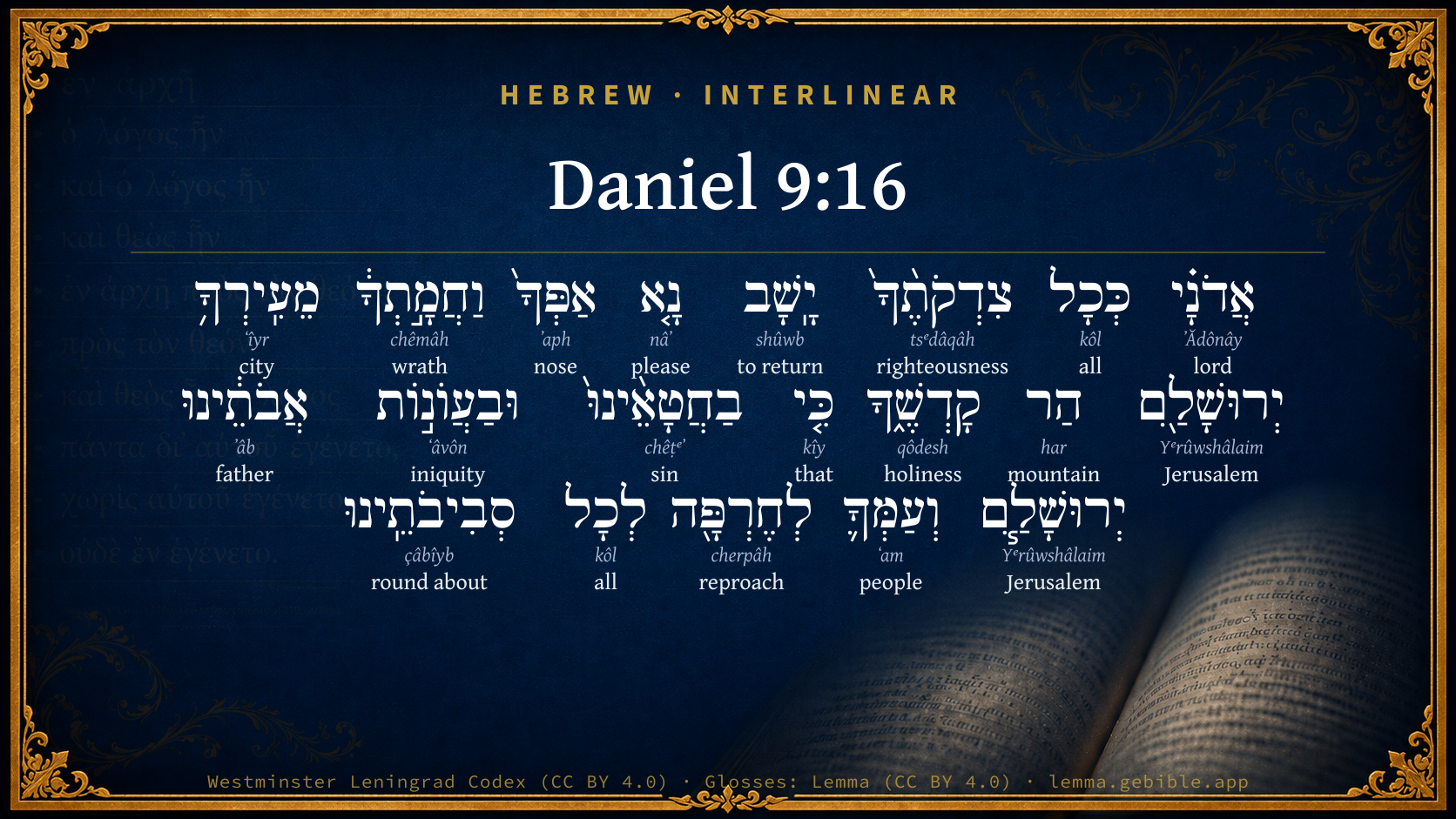
Daniel 9:16

Hebrew (Westminster Leningrad Codex) Daniel 9:16 appears in the Hebrew Old Testament. The text above is from the Westminster Leningrad Codex. Each word links to its Strong’s number, a concise gloss, and parsing drawn from the Open Scriptures Hebrew Bible morphology. Click any word for its full Brown-Driver-Briggs (BDB) entry.
Download image
Cite this verse

Daniel 9:16 (World English Bible). Public Domain. Lemma interlinear Bible study tool, https://lemma.gebible.app/v/daniel/9/16.

Show BibTeX & RIS
BibTeX
RIS
English Translation
Lord, according to all your righteousness, let your anger and please let your wrath be turned away from your city Jerusalem, your holy mountain; because for our sins, and for the iniquities of our fathers, Jerusalem and your people are become a reproach to all who are round about us.
World English Bible · Public Domain
Download a study sheet

One document with this verse’s original text, its word-by-word gloss line, the meaning frame, cross-references with their text, attributed commentary, and full source and license credits — printable, and it pastes into notes with its structure intact.

This verse Autodidact and up

Study sheet (.html) Plain text (.txt)

A passage Seminary Student

Up to 50 verses in one chapter. A passage sheet keeps up to 6 commentary sources and 12 cross-references per verse, in the order this page ranks them, and says so on the sheet whenever that leaves anything out. Ask for a single verse and you get the Autodidact verse sheet above.

Everything on this page stays free to read, with no account — the sheet is a download of what is already on screen, not access to it.

Want to remove ads? Support Godless Engineer
Compare translations 3

The same verse in 3 English versions, stacked beneath the original-language interlinear above. Click any original word for its lexicon entry.

Each is an independent rendering of the whole verse — the interlinear is not word-aligned to these translations.

Highlighted words mark where these versions differ — a whole-verse word diff, not a word-by-word alignment.

  • World English Bible Public Domain
    Lord, according to all your righteousness, let your anger and please let your wrath be turned away from your city Jerusalem, your holy mountain; because for our sins, and for the iniquities of our fathers, Jerusalem and your people are become a reproach to all who are round about us.
  • King James Version Public Domain
    O LORD, according to all thy righteousness, I beseech thee, let thine anger and thy fury be turned away from thy city Jerusalem, thy holy mountain: because for our sins, and for the iniquities of our fathers, Jerusalem and thy people are become a reproach to all that are about us.
  • unfoldingWord Literal Text CC BY-SA 4.0
    O Lord, in accordance with all your righteous acts, let your anger and your wrath turn away from your city Jerusalem, your holy mountain. Because for our sins and for the iniquities of our fathers, Jerusalem and your people have become an object of scorn to all those around us.

unfoldingWord Literal Text — © unfoldingWord, licensed CC BY-SA 4.0. Word-aligned USFM3 via Door43 (git.door43.org/unfoldingWord/en_ult).

Versions to compare (up to 4)

3 of 4 selected

Show all 18 translations

Every available English version of this verse, each an independent rendering of the whole verse.

  • World English Bible Public Domain
    Lord, according to all your righteousness, let your anger and please let your wrath be turned away from your city Jerusalem, your holy mountain; because for our sins, and for the iniquities of our fathers, Jerusalem and your people are become a reproach to all who are round about us.
  • Berean Standard Bible Public Domain
    O Lord, in keeping with all Your righteous acts, I pray that Your anger and wrath may turn away from Your city Jerusalem, Your holy mountain; for because of our sins and the iniquities of our fathers, Jerusalem and Your people are a reproach to all around us.
  • Majority Standard Bible Public Domain
    O Lord, in keeping with all Your righteous acts, I pray that Your anger and wrath may turn away from Your city Jerusalem, Your holy mountain; for because of our sins and the iniquities of our fathers, Jerusalem and Your people are a reproach to all around us.
  • King James Version Public Domain
    O LORD, according to all thy righteousness, I beseech thee, let thine anger and thy fury be turned away from thy city Jerusalem, thy holy mountain: because for our sins, and for the iniquities of our fathers, Jerusalem and thy people are become a reproach to all that are about us.
  • American Standard Version (1901) Public Domain
    O Lord, according to all thy righteousness, let thine anger and thy wrath, I pray thee, be turned away from thy city Jerusalem, thy holy mountain; because for our sins, and for the iniquities of our fathers, Jerusalem and thy people are become a reproach to all that are round about us.
  • Revised Version (1885) Public Domain
    O Lord, according to all thy righteousness, let thine anger and thy fury, I pray thee, be turned away from thy city Jerusalem, thy holy mountain: because for our sins, and for the iniquities of our fathers, Jerusalem and thy people are become a reproach to all that are round about us.
  • Geneva Bible (1599) Public Domain
    O Lord, according to all thy righteousnes, I beseech thee, let thine anger and thy wrath be turned away from thy citie Ierusalem thine holy Mountaine: for because of our sinnes, and for the iniquities of our fathers, Ierusalem and thy people are a reproche to all that are about vs.
  • Douay-Rheims (1899) Public Domain
    O Lord, against all thy justice: let thy wrath and thy indignation be turned away, I beseech thee, from thy city Jerusalem, and from thy holy mountain. For by reason of our sins, and the iniquities of our fathers, Jerusalem, and thy people are a reproach to all that are round about us.
  • Young's Literal Translation Public Domain
    `O Lord, according to all Thy righteous acts, let turn back, I pray Thee, Thine anger and Thy fury from Thy city Jerusalem, Thy holy mount, for by our sins, and by the iniquities of our fathers, Jerusalem and Thy people `are' for a reproach to all our neighbours;
  • Literal Standard Version CC BY-SA 4.0
    O Lord, according to all Your righteous acts, please let Your anger and Your fury turn back from Your city Jerusalem, Your holy mountain, for by our sins, and by the iniquities of our fathers, Jerusalem and Your people [are] for a reproach to all our neighbors;
  • Unlocked Literal Bible CC BY-SA 4.0
    Lord, because of all your righteous deeds, let your anger and your wrath turn away from your city Jerusalem, your holy mountain. Because of our sins, and because of the iniquities of our ancestors, Jerusalem and your people have become an object of scorn to all those around us.
  • unfoldingWord Literal Text CC BY-SA 4.0
    O Lord, in accordance with all your righteous acts, let your anger and your wrath turn away from your city Jerusalem, your holy mountain. Because for our sins and for the iniquities of our fathers, Jerusalem and your people have become an object of scorn to all those around us.
  • Darby Bible Public Domain
    Lord, according to all thy righteousnesses, I beseech thee, let thine anger and thy fury be turned away from thy city Jerusalem, thy holy mountain; for because of our sins, and because of the iniquities of our fathers, Jerusalem and thy people [are become] a reproach to all round about us.
  • World Messianic Bible Public Domain
    Lord, according to all your righteousness, please let your anger and your wrath be turned away from your city Jerusalem, your holy mountain; because for our sins and for the iniquities of our fathers, Jerusalem and your people have become a reproach to all who are around us.
  • Webster's Bible Public Domain
    O Lord, according to all thy righteousness, I beseech thee, let thy anger and thy fury be turned away from thy city Jerusalem, thy holy mountain: because for our sins and for the iniquities of our fathers, Jerusalem and thy people have become a reproach to all that are about us.
  • Free Bible Version CC BY-SA 4.0
    So Lord, because you are so good, please turn away from your anger and fury against Jerusalem, your holy mountain. Because of our sins and those of our forefathers, Jerusalem and your people are mocked by all our neighbors.
  • Bible in Basic English Public Domain
    O Lord, because of your righteousness, let your wrath and your passion be turned away from your town Jerusalem, your holy mountain: because, through our sins and the evil-doing of our fathers, Jerusalem and your people have become a cause of shame to all who are round about us.
  • JPS Tanakh (1917) Public Domain
    O Lord, according to all Thy righteousness, let Thine anger and Thy fury, I pray Thee, be turned away from Thy city Jerusalem, Thy holy mountain; because for our sins, and for the iniquities of our fathers, Jerusalem and Thy people are become a reproach to all that are about us.

Literal Standard Version (2020), Covenant Press — licensed CC BY-SA 4.0. Text via the HelloAO Bible API (eBible.org). Unlocked Literal Bible (unfoldingWord) — licensed CC BY-SA 4.0. Text via the HelloAO Bible API (eBible.org). unfoldingWord Literal Text — © unfoldingWord, licensed CC BY-SA 4.0. Word-aligned USFM3 via Door43 (git.door43.org/unfoldingWord/en_ult). Free Bible Version, Dr. Jonathan Gallagher — licensed CC BY-SA 4.0. Text via the HelloAO Bible API (eBible.org).

Word by word

More ways to search: Search by grammar → Find every occurrence → Compare this word →

Practice this passage: Drill this verse → Learn its vocabulary →

בַחֲטָאֵ֨ינוּ֙
chêṭᵉʼ
H2399
“in/at · sins · our”
Preposition + Noun, Common, Masculine, Plural, Construct + Suffix, Personal, 1st Person, Common, Plural
Part of Speech
Preposition + Noun
Type
Common
Gender
Masculine
Number
Plural
State
Construct
Full BDB Definition

Origin: from H2398

TWOT: 638a

sin - sin - guilt for sin - punishment for sin
  1. אֲדֹנָ֗י ʼĂdônây H136 “Lord · my” Noun, Common, Masculine, Plural, Construct + Suffix, Personal, 1st Person, Common, Singular
  2. כְּכָל kôl H3605 “like/as · all of” Preposition + Noun, Common, Masculine, Singular, Construct
  3. צִדְקֹתֶ֨ךָ֙ tsᵉdâqâh H6666 “righteous acts · your” Noun, Common, Feminine, Plural, Construct + Suffix, Personal, 2nd Person, Masculine, Singular
  4. יָֽשָׁב shûwb H7725 “to return” Verb, Qal, Jussive, 3rd Person, Masculine, Singular
  5. נָ֤א nâʼ H4994 “please” Particle, Exhortation
  6. אַפְּךָ֙ ʼaph H639 “nose · your” Noun, Common, Masculine, Singular, Construct + Suffix, Personal, 2nd Person, Masculine, Singular
  7. וַחֲמָ֣תְךָ֔ chêmâh H2534 “and · wrath · your” Conjunction + Noun, Common, Feminine, Singular, Construct + Suffix, Personal, 2nd Person, Masculine, Singular
  8. מֵעִֽירְךָ֥ ʻîyr H5892 “from · city · your” Preposition + Noun, Common, Feminine, Singular, Construct + Suffix, Personal, 2nd Person, Masculine, Singular
  9. יְרוּשָׁלִַ֖ם Yᵉrûwshâlaim H3389 “Jerusalem” Noun, Proper
  10. הַר har H2022 “mountain of” Noun, Common, Masculine, Singular, Construct
  11. קָדְשֶׁ֑ךָ qôdesh H6944 “holiness · your” Noun, Common, Masculine, Singular, Construct + Suffix, Personal, 2nd Person, Masculine, Singular
  12. כִּ֤י kîy H3588 “that” Conjunction
  13. וּבַעֲוֺנ֣וֹת ʻâvôn H5771 “and · in/at · iniquities of” Conjunction + Preposition + Noun, Common, Both, Plural, Construct
  14. אֲבֹתֵ֔ינוּ ʼâb H1 “fathers · our” Noun, Common, Masculine, Plural, Construct + Suffix, Personal, 1st Person, Common, Plural
  15. יְרוּשָׁלִַ֧ם Yᵉrûwshâlaim H3389 “Jerusalem” Noun, Proper
  16. וְעַמְּךָ֛ ʻam H5971 “and · people · your” Conjunction + Noun, Common, Masculine, Singular, Construct + Suffix, Personal, 2nd Person, Masculine, Singular
  17. לְחֶרְפָּ֖ה cherpâh H2781 “to/for · reproach” Preposition + Noun, Common, Feminine, Singular, Absolute
  18. לְכָל kôl H3605 “to/for · all of” Preposition + Noun, Common, Masculine, Singular, Construct
  19. סְבִיבֹתֵֽינוּ çâbîyb H5439 “surroundings · our” Noun, Common, Both, Plural, Construct + Suffix, Personal, 1st Person, Common, Plural

About this verse

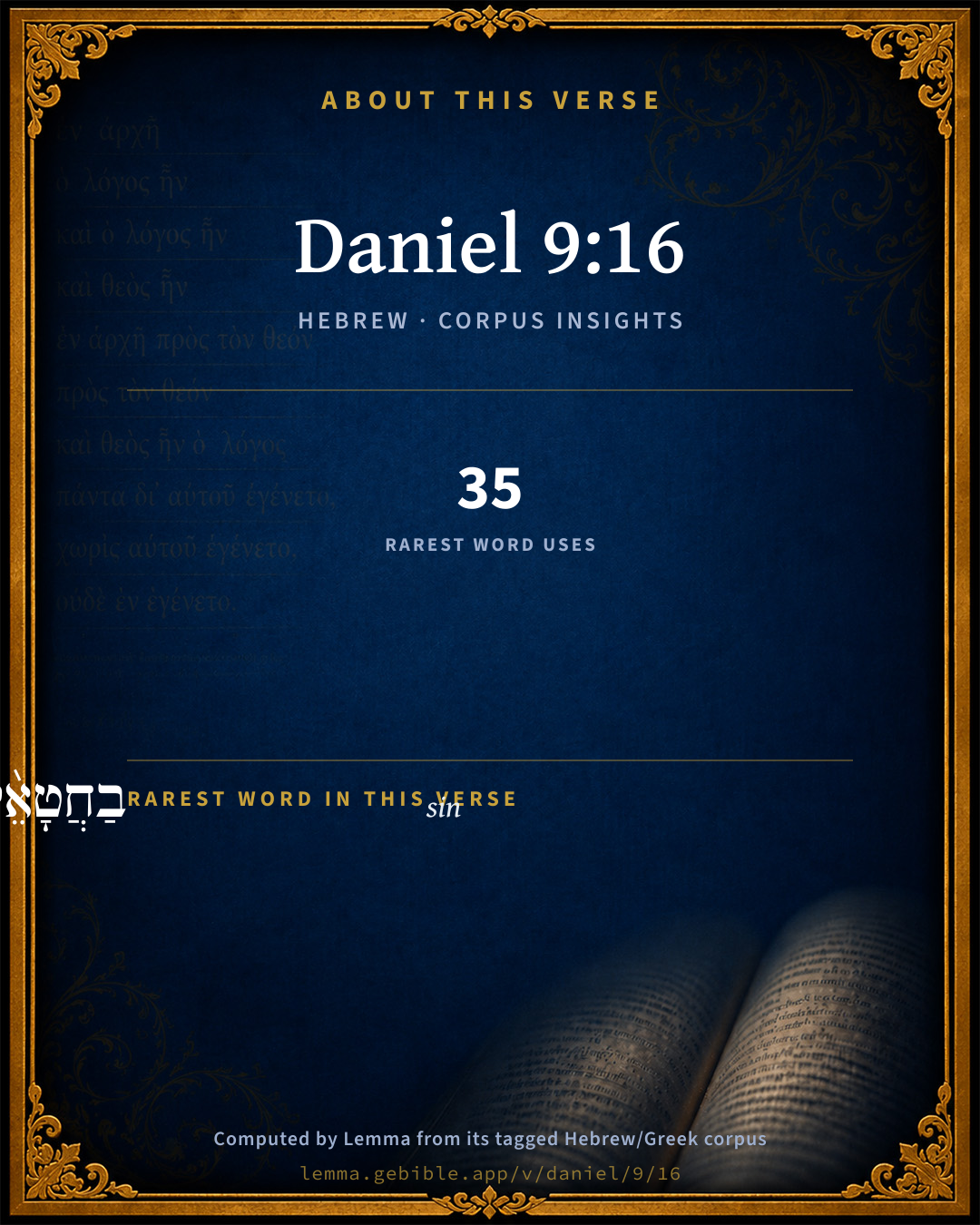
These counts appear in no published source. They are computed here, from the morphology-tagged text and Lemma’s own curated glosses. What Lemma adds →

20
words
18
distinct lemmas
Prophets
section

Shared distinctive vocabulary

בַחֲטָאֵ֨ינוּ֙ sin H2399 occurs in 34 verses of the Hebrew Bible. Also found in:

Grammatical profile

  • 1 verb
  • 17 nouns
  • 1 conjunction
  • 1 particle

Verb forms

  • יָֽשָׁב Qal · Jussive

Repetition

Words recur within this verse — often emphatic in Hebrew:

  • כְּכָל all H3605 ×2
  • יְרוּשָׁלִַ֖ם Jerusalem H3389 ×2

Hebrew & Septuagint length

In English translation the verse runs 50 words from the Hebrew and 55 from the Septuagint (LXX English) — closely comparable.

A rough comparison of the two English renderings, which tokenize alike — not a word-level alignment.

Word counts can differ between the Hebrew and the Greek without any difference in meaning — e.g. the Hebrew direct-object marker אֵת has no separate Greek word, and Greek often adds the article ὁ.

Cross-references

27

Topical passages linked to Daniel 9:16 in the Treasury of Scripture Knowledge — connected by theme and wording, ordered by reader-vote popularity; previews shown in the World English Bible.

  • Zechariah 8:3 Thus says Yahweh: "I have returned to Zion, and will dwell in the midst of Jerusalem. Jerusalem shall be called 'The City of Truth;' and the mountain of Yahweh of Hosts, 'The Holy Mountain.'"
  • Psalms 31:1 In you, Yahweh, I take refuge. Let me never be disappointed: Deliver me in your righteousness.
  • Psalms 87:1–3 His foundation is in the holy mountains.
  • Daniel 9:20 While I was speaking, and praying, and confessing my sin and the sin of my people Israel, and presenting my supplication before Yahweh my God for the holy mountain of my God;
  • Joel 3:17 "So you will know that I am Yahweh, your God, Dwelling in Zion, my holy mountain. Then Jerusalem will be holy, And no strangers will pass through her any more.
  • Exodus 20:5 you shall not bow yourself down to them, nor serve them, for I, Yahweh your God, am a jealous God, visiting the iniquity of the fathers on the children, on the third and on the fourth generation of those who hate me,
  • Psalms 71:2 Deliver me in your righteousness, and rescue me. Turn your ear to me, and save me.
  • Psalms 79:4 We have become a reproach to our neighbors, A scoffing and derision to those who are around us.
  • Lamentations 2:15–16 All that pass by clap their hands at you; They hiss and wag their head at the daughter of Jerusalem, [saying], Is this the city that men called The perfection of beauty, The joy of the whole earth?
  • Leviticus 26:39–40 Those of you who are left will pine away in their iniquity in your enemies' lands; and also in the iniquities of their fathers shall they pine away with them.
  • 1 Samuel 2:7 Yahweh makes poor, and makes rich: He brings low, he also lifts up.
  • 1 Kings 9:7–9 then will I cut off Israel out of the land which I have given them; and this house, which I have made holy for my name, will I cast out of my sight; and Israel shall be a proverb and a byword among all peoples.
  • Nehemiah 9:8 and found his heart faithful before you, and made a covenant with him to give the land of the Canaanite, the Hittite, the Amorite, and the Perizzite, and the Jebusite, and the Girgashite, to give it to his seed, and have performed your words; for you are righteous.
  • Psalms 41:13 Blessed be Yahweh, the God of Israel, From everlasting and to everlasting! Amen and amen.
  • Psalms 143:1 Hear my prayer, Yahweh. Listen to my petitions. In your faithfulness and righteousness, relieve me.
  • Isaiah 64:9–11 Don't be angry very sore, Yahweh, neither remember iniquity forever: see, look, we beg you, we are all your people.
  • Jeremiah 24:9 I will even give them up to be tossed back and forth among all the kingdoms of the earth for evil; to be a reproach and a proverb, a taunt and a curse, in all places where I shall drive them.
  • Jeremiah 29:18 I will pursue after them with the sword, with the famine, and with the pestilence, and will deliver them to be tossed back and forth among all the kingdoms of the earth, to be an object of horror, and an astonishment, and a hissing, and a reproach, among all the nations where I have driven them;
  • Jeremiah 32:32 because of all the evil of the children of Israel and of the children of Judah, which they have done to provoke me to anger, they, their kings, their princes, their priests, and their prophets, and the men of Judah, and the inhabitants of Jerusalem.
  • Lamentations 1:8–9 Jerusalem has grievously sinned; therefore she is become as an unclean thing; All who honored her despise her, because they have seen her nakedness: Yes, she sighs, and turns backward.
  • Ezekiel 5:14 Moreover I will make you a desolation and a reproach among the nations that are round about you, in the sight of all that pass by.
  • Micah 6:4–5 For I brought you up out of the land of Egypt, And redeemed you out of the house of bondage. I sent before you Moses, Aaron, and Miriam.
  • Matthew 23:31–32 Therefore you testify to yourselves that you are children of those who killed the prophets.
  • Luke 11:47–51 Woe to you! For you build the tombs of the prophets, and your fathers killed them.
  • 2 Thessalonians 1:6 Since it is a righteous thing with God to repay affliction to those who afflict you,
  • 1 John 1:9 If we confess our sins, he is faithful and righteous to forgive us the sins, and to cleanse us from all unrighteousness.
  • Psalms 106:6–48 We have sinned with our fathers. We have committed iniquity. We have done wickedly.

Cross-references courtesy of OpenBible.info (CC BY 4.0).

Hebrew and Greek witnesses Masoretic Hebrew ↔ Greek Septuagint

The same verse in the two great witnesses to the Old Testament, shown verse-for-verse.

These are two independent witnesses, not word-aligned to each other, and the Septuagint is shown in lemma (dictionary) form.

Hebrew Daniel 9:16 Masoretic · Westminster Leningrad Codex

אֲדֹנָ֗י כְּכָל צִדְקֹתֶ֨ךָ֙ יָֽשָׁב נָ֤א אַפְּךָ֙ וַחֲמָ֣תְךָ֔ מֵעִֽירְךָ֥ יְרוּשָׁלִַ֖ם הַר קָדְשֶׁ֑ךָ כִּ֤י בַחֲטָאֵ֨ינוּ֙ וּבַעֲוֺנ֣וֹת אֲבֹתֵ֔ינוּ יְרוּשָׁלִַ֧ם וְעַמְּךָ֛ לְחֶרְפָּ֖ה לְכָל סְבִיבֹתֵֽינוּ

Lord, according to all your righteousness, let your anger and please let your wrath be turned away from your city Jerusalem, your holy mountain; because for our sins, and for the iniquities of our fathers, Jerusalem and your people are become a reproach to all who are round about us.

World English Bible · Public Domain

Greek LXX Daniel 9:16 Septuagint · lemma form

δεσπότης κατά ὁ δικαιοσύνη σύ ἀποστρέφω ὁ θυμός σύ καί ὁ ὀργή σύ ἀπό ὁ πόλις σύ ἰερουσαλήμ ὄρος ὁ ἅγιος σύ ὅτι ἐν ὁ ἁμαρτία ἐγώ καί ἐν ὁ ἄγνοια ὁ πατήρ ἐγώ ἰερουσαλήμ καί ὁ δῆμος σύ κύριος εἰς ὀνειδισμός ἐν πᾶς ὁ περικύκλῳ ἐγώ

O Lord, your mercy is over all: let, I pray you, your wrath turn away, and your anger from your city Jerusalem, even your holy mountain: for we have sinned, and because of our iniquities, and those of our fathers, Jerusalem and your people are become a reproach among all that are round about us.

LXX2012 (modern English Septuagint) · Public Domain

On this verse, John Gill's Exposition discusses the Septuagint’s reading. Read the note in Commentary ↓

Hebrew: Westminster Leningrad Codex (CC BY 4.0). Greek: Septuagint (public domain); English from LXX2012 (modern English Septuagint) (Public Domain). How the Septuagint differs from the Hebrew →

Commentary

Notes on Daniel 9:16 from classic Christian and Jewish commentators (each source and its license shown beneath its notes). The classic Christian expositions comment on the surrounding passage and are grouped to its opening verse, so a note may address several verses; the Jewish commentaries on the Tanakh (Rashi and others) are per-verse, so they appear only where the commentator wrote on this verse.

Lemma curates 59 commentaries, every one of them public domain or Creative Commons licensed, each selected and text-cleaned for this edition rather than reprinted as found. About our sources →

Trapp's Complete Commentary

John Trapp

Dan 9:16 O Lord, according to all thy righteousness, I beseech thee, let thine anger and thy fury be turned away from thy city Jerusalem, thy holy mountain: because for our sins, and for the iniquities of our fathers, Jerusalem and thy people [are become] a reproach to all [that are] about us.

Ver. 16. O Lord, according to all thy righteousness.] Not that of equity, but the other of fidelity. {1Jn 1:9}

Thy holy mountain.] So Jerusalem is called, because dedicated to the Holy One; who also chose it for the seat of his royal resiance, the place of his holy oracle.

Thy people are a reproach.] And this reflecteth upon thee, as needs it must, since they do quarter arms with thee.

John Trapp, A Commentary or Exposition upon All the Books of the Old and New Testament (1647–1656) — public domain. Text from a community e-Sword module.

Joseph Benson's Commentary

Dan 9:16-17. According to all thy righteousness let thine anger be turned away — The word righteousness here, as in many other places of Scripture, is equivalent to mercy; (see the margin;) from thy holy mountain — The place whereon thy temple stood. Jerusalem and thy people are become a reproach — Our conquerors and others, who know into what a miserable condition we are brought, mock at us, and say, See to what a state the people are reduced, who boasted themselves to be the chosen people of the Lord of heaven and earth! Now, therefore, cause thy face to shine upon thy sanctuary — Return in mercy to us, and show that thou art reconciled to us, by repairing the desolations of thy sanctuary. For the Lord’s sake — That is, as some interpret the expression, for thine own sake; that is, do this that thou mayest do honour to thyself. Or rather, as most Christian interpreters understand the words, for the Lord Christ’s sake; for the sake of the Messiah promised, who is Lord. The Hebrew word, here rendered Lord, is אדני, Adonai, the word used for the Messiah Psa 110:1, where David calls him his Lord. It is for Christ’s sake, and because of the atonement he has made for sin, that God causes his face to shine upon sinners, when they repent and turn to him. In all our prayers, therefore, that must be our plea; we must make mention of his righteousness, even his only. He himself has directed us to pray in his name.

Joseph Benson's Commentary on the Old and New Testaments (1811–1818) — public domain. Text from a community e-Sword module.

Tyndale Open Study Notes

Tyndale Open Resources

9:16 mock Jerusalem and your people: God’s name was dishonored when his chosen city and his chosen people were ridiculed because of their helplessness before their enemies, making it appear that their God was helpless (9:19; cp. Ezek 36:19-20).

Tyndale Open Study Notes — © Tyndale Open Resources, licensed CC BY-SA 4.0. Text via the HelloAO Bible API.

Geneva Bible (1599)

Geneva Bible translators

That is, according to all thy merciful promises and the performance thereof.

Geneva Bible (1599) marginal notes — public domain. Text via Bolls.life.

Jamieson, Fausset & Brown

Robert Jamieson, A. R. Fausset & David Brown

thy righteousness--not stern justice in punishing, but Thy faithfulness to Thy promises of mercy to them who trust in Thee (Psa 31:1; Psa 143:1).

thy city--chosen as Thine in the election of grace, which changes not.

for . . . iniquities of . . . fathers-- (Exo 20:5). He does not impugn God's justice in this, as did the murmurers (Eze 18:2-3; compare Jer 31:29).

thy people . . . a reproach--which brings reproach on Thy name. "All the nations that are about us" will say that Thou, Jehovah, wast not able to save Thy peculiar people. So Dan 9:17, "for the Lord's sake"; Dan 9:19, "for Thine own sake" (Isa 48:9, Isa 48:11).

Jamieson, Fausset & Brown — Commentary Critical and Explanatory on the Whole Bible (1871) — public domain (CC PDM 1.0). Text via the HelloAO Bible API.

John Calvin's Commentaries

Lastly, he would not permit that redemption to fail which was an illustrious and eternal proof of his virtue, favor, and goodness. Hence he subjoins, O Lord, may thine anger be averted according to all thy righteousness, and thine indignation from thy city Jerusalem, the mountain of thy holiness. We observe how Daniel here excludes whatever merit there might be in the people. In reality they did not possess any, but I speak according to that foolish imagination which men can scarcely put off. They always take credit to themselves, although they are convicted of their sins a hundred times over, and still desire to conciliate God’s favor by pleading some merit before God. But here Daniel excludes all such considerations when he pleads before God his own justice, and uses the strong expression, according to all thy righteousness Those who take this word “righteousness” to mean “judgment,” are in error and inexperienced in interpreting the Scriptures; for they suppose God’s justice to be opposed to his pity. But we are familiar with God’s righteousness as made manifest, especially in the benefits he confers on us. It is just as if Daniel had said, that the single hope of the people consisted in God’s having regard to himself alone, and by no means to their conduct. Hence he takes the righteousness of God for his liberality, gratuitous favor, consistent fidelity, and protection, which he promised his servants: O God, therefore, he says, according to all thy prormsed mercies; that is, thou dost not fail those who trust in thee, thou dost promise nothing rashly, and thou art not accustomed to desert those who flee to thee; oh! by thy very justice, succor us in our distress. We must also notice the universal particle “all,” because when Daniel unites so many sins which might drown the people in an abyss a thousand times over, he opposes to this all God’s promised mercies. As if he had said, although the number of our iniquities is so great that we must perish a hundred times over, yet thy promised mercies are far more numerous, meaning, thy justice surpasses whatever thou mayest find in us of the deepest dye of guilt.

He says, again, Let thine anger be turned away, and thy burning wrath from thy city Jerusalem, and from thy holy mountain In joining together anger and burning wrath, the Prophet does not imply any excess on the part of God, as if he revenged the sins of the people too severely, but he again represents the aggravation of their wickedness, causing him to become so angry with them as to lay aside his usual character, and to treat their adoption as vain and fruitless. Daniel does not complain in this case of the severity of the punishment, but rather condemns himself and the rest of the people for causing a necessity for such severe measures. Once more, he sets before God the holy mountain which he had chosen, and in this way averts his countenance from judgment, lest he should reckon with them for so many sins, by which God was deservedly incensed. Here, therefore, God’s election is interposed, because he had consecrated Mount Zion to himself, and desired to be worshipped there, where also his name should be celebrated and sacrifices offered to him. In this respect, therefore, Daniel obtains favor for himself before God, and, as I have said, he excludes all other considerations.

He next adds, Because on account of our sins, and the iniquities of our fathers, Jerusalem and thy people are a reproach to all our neighbors By another argument, the Prophet desires to bend God to pity; for Jerusalem as well as the people were a disgrace to the nations; yet this caused equal disgrace to fall upon God himself. As, therefore, the Gentiles made a laughing-stock of the Jews, they did not spare the sacred name of God; nay, the Jews were so despised, that the Gentiles scarcely deigned to speak of them, and the God of Israel was contemptuously traduced, as if he had been conquered, because he had suffered his temple to be destroyed, and the whole city Jerusalem to be consumed with burning and cruel slaughter. The Prophet, therefore, now takes up this argument, and in speaking of the sacred city, doubtless refers to the sacredness of God’s name. His language implies, — Thou hast chosen Jerusalem as a kind of royal residence; it was thy wish to be worshipped there, and now this city has become an object of the greatest reproach to our neighbors. Thus he declares how God’s name was exposed to the reproaches of the Gentiles. He afterwards asserts the same of God’s people, not by way of complaint when the Jews suffered these reproaches, for they deserved them by their sins, but the language is emphatic, and yet they were God’s people. God’s name was intimately bound up with that of his people, and whatever infamy the profane east upon them, reflected chiefly on God himself. Here Daniel places before the Almighty his own name; as if he had said, O Lord! be thou the vindicater of thine own glory, thou hast once adopted us on this condition, and may the memory of thy name be ever inscribed upon us; permit us not to be so reproachfully slandered, let not the Gentiles insult thee on our account. And yet he says this was done on account of the iniquities of the people and of their fathers; by which expression he removes every possibility of doubt. 0h! how can it happen, that God will so lay his people prostrate? Why has he not spared at least his own name! Daniel, therefore, here testifies to his being just, because the iniquity of the people and of their fathers had risen so high, that God was compelled to exercise such vengeance against them.

John Calvin's Commentaries (1540-1563) — public domain. Text from the Calvin Translation Society English edition (1840s-50s) via the Christian Classics Ethereal Library (ccel.org). Calvin's coverage is partial (roughly two-thirds of the Bible); uncommented books and verses are honest gaps, never fabricated. The 19th-century editor's footnotes and remarks are omitted so the notes are faithfully Calvin's own voice.

Ellicott's Commentary for English Readers

(16) Righteousness.—Those acts of Jehovah which evince His righteousness, or His faithfulness to His promises. Mount Zion, the “holy mountain,” holds a very important place in prophecy. It is the outward visible sign of the stability of God’s promises to David, the “sure mercies of David,”’ as well as the centre of all that is Holy in the kingdom of God. (See Psa_68:15-16; Psa_132:13-14; Isa_2:2-4; and comp. Dan_9:20.)

A Bible Commentary for English Readers, edited by Charles John Ellicott (1878–1897) — public domain. Text from a community e-Sword module.

The Cambridge Bible for Schools and Colleges

gen. ed. J. J. S. Perowne

16. according to all thy righteousness] The plural, of righteousness exhibited in deeds, or, in other words, of acts of righteousness: so Jdg_5:11; 1Sa_12:7; Mic_6:5; Psa_103:6. God’s deliverance of His people, according to His covenant-promise, when and in so far as it deserves it, is regarded as a manifestation of His righteousness. As in the last verse, God’s acts of mercy towards His people and His interpositions on its behalf, in the past, are appealed to as a ground why He should interpose similarly now.

let thine anger, &c.] for the expression, cf. Num_25:4, Jer_23:20; Jer_30:24, Isa_12:1.

thy city] Dan_9:19 : cf. ‘my city,’ Isa_45:13.

thy holy mountain] Psa_15:1; Psa_43:3, and elsewhere. So Dan_9:24.

the iniquities of our fathers] Cf. Lev_26:39, Jer_11:10, Isa_65:7, Neh_9:2; also Psa_79:8.

a reproach to all that are round about us] Cf. Psa_44:13; Psa_79:4; also Eze_25:3; Eze_25:6; Eze_25:8; Eze_35:10; Eze_35:12-13. The words may, however, also glance at “the position of the faithful Jews under Antiochus, since in addition to the tyranny of the king they had to endure the taunts of their heathen neighbours, the Edomites, the Ammonites, etc.” (Bevan).

The Cambridge Bible for Schools and Colleges (gen. ed. J. J. S. Perowne; Cambridge University Press, 1878–1918) — public domain. Text from a community e-Sword module.

John Gill's Exposition

O Lord, according to all thy righteousness,.... Or "righteousnesses" (i); which he had been used to exercise in the world, in all ages of it; either punishing wicked men according to their deserts, to which respect may be had here; since turning away wrath from his people would issue in turning it upon their enemies, which would be in righteous judgment or in fulfilling his promises; and so it signifies his faithfulness, of which there had been so many instances in times past, and gave encouragement to believe the performance of those not yet accomplished: or this may be understood of his goodness, and kindness, which is sometimes meant by his righteousness see Psa 31:1 and so the Septuagint and Arabic versions render it, "in all thy mercy"; and Jacchiades paraphrases the words thus,

"O Lord, according to all the multitude of thy righteousness, and of thy kindness, which thou dost in the world:''

I beseech thee, let thine anger and thy fury be turned away from thy city Jerusalem; the city of the great King, which he chose for his residence, in which the temple, was, and where he was worshipped; and the prophet earnestly entreats, that the marks of divine displeasure, which were upon it, might be removed; that the punishments or judgments inflicted, as the effects of the anger and wrath of God, might cease, and the city be rebuilt, and restored to its former glory:

thy holy mountain; the temple, devoted to the worship and service of God; or Mount Moriah, on which it stood:

because for our sins, and for the iniquities of our fathers, Jerusalem and thy people are become a reproach to all that are about us; their neighbours, the Edomites, Moabites, Ammonites, Tyrians, and Philistines; who rejoiced at their destruction, and jeered at them and their religion, and scoffingly said, where were their temple of which they boasted, and their God in whom they trusted? the cause of all this is owned to be their own sins, and the sins of their ancestors, which they their posterity continued in; and therefore do not lay the fault wholly upon them, but take the blame to themselves.

(i) "justitias tuas", Vatablus, Calvin, Gejerus, Cocceius, Michaelis.

John Gill's Exposition of the Whole Bible (1746–1763) — public domain (CC PDM 1.0). Text via the HelloAO Bible API.

Albert Barnes' Notes on the Bible

O Lord, according to all thy righteousness - The word righteousness here seems to refer to all that was excellent and glorious in the character of God. The eye of Daniel is fixed upon what he had formerly done; upon his character of justice, and mercy, and goodness; upon the faithfulness of God to his people, and, in view of all that was excellent and lovely in his character, he pleaded that he would interpose and turn away his anger from his people now. It is the character of God that is the ground of his plea - and what else is there that can give us encouragement when we come before him in prayer.

Let thine anger and thy fury be turned away ... - The anger which had come upon the city, and which appeared to rest, upon it. Jerusalem was in ruins, and it seemed still to be lying under the wrath of God. The word rendered fury is the common one to denote wrath or indignation. It implies no more than anger or indignation, and refers here to the Divine displeasure against their sins, manifested in the destruction of their city.

Thy holy mountain - Jerusalem was built on hills, and the city in general might be designated by this phrase. Or, more probably, there is allusion either to Mount Zion, or to Mount Moriah.

Because for our sins ... - There is, on the part of Daniel, no disposition to blame God for what he had done. There is no murmuring or complaining, as if he had been unjust or severe in his dealings with his people. Jerusalem was indeed in ruins, and the people were captives in a distant land, but he felt and admitted that God was just in all that he had done. It was too manifest to be denied that all these calamities had come upon them on account of their sins, and this Daniel, in the name of the people, humbly and penitently acknowledged.

A reproach to all that are about us - All the surrounding nations. They reproach us with our sins, and with the judgments that have come upon us, as if we were peculiarly wicked, and were forsaken of heaven.

Albert Barnes' Notes on the Bible (1834–1885) — public domain. Text from a community e-Sword/MySword module.

Haydock's Catholic Bible Commentary

Against. Hebrew: "according to." --- Justice. Septuagint: "mercy." Let not the enemy boast that he has ruined thy temple, &c. (verse 17.) (Calmet)

George Leo Haydock (1774–1849), Haydock's Catholic Family Bible and Commentary, 1859 edition — public domain. Excludes Psalms (Douay-Rheims chapter numbering differs from Protestant) and Deuterocanonical books (Catholic canon only).

Matthew Poole's English Annotations

As if he had said, Lord, according to thy righteousness thou hast punished thy people, as they justly deserved; now also, according to thy mercies, which is the other part of thy righteousness, save thy people, though they deserve it not. See Psa 143:1,2. For God hath promised, and therefore he will do it, yet in mercy, and this is faithfulness and righteousness. See 1Jo 1:9. Now though sin is the reproach of any people and nation, yet much more of the people of God, which should be a holy people, because their God is a holy God, and his laws are holy laws, by which they excel all other people. Yet, Lord, saith he, if Jerusalem be a reproach, this is a reproach to thee, because of their relation to thee; therefore, I pray thee, take away this double reproach; it is. grievous unto us to bear it; for thy name’s sake, O let it be grievous unto thee, and therefore wipe it away.

Matthew Poole's English Annotations on the Holy Bible (1683–1685) — public domain. Text from a community e-Sword/MySword module.

Whedon's Commentary on the Bible

Daniel D. Whedon

16-19. The prophet cries out in great agony, beseeching Jehovah, since now his righteous punishments had been so fearfully fulfilled upon Jerusalem and the holy mountain (Psa_2:6; Jer_25:1-11), that the equally righteous promises to repentant Israel might also be speedily fulfilled (see Jer_25:12, etc.; Jer_27:22; Jer_29:10-14), and as a representative of repentant Israel he makes an intercessory prayer for the desolated and ruined sanctuary which reminds one of the mediatorial cry of Moses (Exo_32:32; Deu_9:26-29), and especially of the prayer of Jeremiah (Jeremiah 32) and the petition of the Levites (Nehemiah 9).

Daniel D. Whedon (gen. ed.), Commentary on the Old and New Testaments (1874–1909) — public domain. Text from a community e-Sword module.

The Pulpit Commentary

O lord, according to all thy righteousness, I beseech thee, let thine anger and thy fury be turned away from thy city Jerusalem, lilly holy mountain: because for our sins, and for the iniquities of our fathers, Jerusalem and thy people are become a reproach to all that are about us. The Septuagint rendering here is in close agreement with the Massoretic. The only point to be noted in regard to Theodotion is that he gives the late, and in this case inapplicable, meaning to "righteousness" of ejlehmosunh, "almsgiving." The Peshitta, imagining a certain want of completeness in the last clause, inserted after "Jerusalem" "is scattered into all lands." The appeal is made to God"s righteousness, because now the seventy years were nearing their end, and God"s righteousness was involved in the time not being exceeded. here signifies the fair dealing (wohlverhalten) of God to his people in reference to the fulfilment of hie promises" (Behrmann). "Righteousness" is really righteousnesses, in the plural, the reference being to the many proofs God has given in the past of his benevolence (Keil). "Thy city Jerusalem, thy holy mountain," forms a further argument: "The mountain of thy holiness". (Psa_2:6) A reproach to all that are about us. There is a striking resemblance here to Jeremiah: repeatedly in his prophecies are the Jews threatened that they will become a reproach (herpa). Especially is there a resemblance here to Jer_29:18, the letter of Jeremiah, to which reference is made in the beginning of the chapter. This whole prayer is saturated with phrases borrowed from Jeremiah. The apocryphal Book of Baruch, which has expanded on tiffs prayer, has also drawn from Jeremiah.

Vers. 16-19.

Prayer for pardon.

In its tone and character, the ends it seeks and the pleas it urges, this prayer of Daniel"s may be regarded as a model prayer for the forgiveness of sins.

I ITS CHARACTER. The very atmosphere of this prayer is purifying and inspiring. It is marked by several important characteristics.

1. Contrition. It follows a confession of sin (vers. 5-8), and frankly admits that the present calamities are the merited consequences of sin (ver. 16). Forgiveness is only possible after repentance (Act_3:19) and confession. (1Jn_1:9)

2. Earnestness. This is the most striking feature of the prayer Its short passionate phrases, its repetitions, its direct practical aims, are proofs of reality and intensity of desire. We may expect that God will attend to our prayers in proportion to our earnestness in offering them. Reverent importunity is expected by God, and attains its end, as with Abraham, (Gen_18:23-33) Jacob, (Gen_32:26) Moses, (Exo_32:7-14) and in our Lord"s parable of the importunate widow. (Luk_18:1-7)

3. Faith. In his distress the prophet seeks his God, though it is against his God that the sin has been committed. Faith confesses that there is no help but in God. Faith persists in pleading with God, and relies on his mercy.

II ITS OBJECT. The object of this prayer is the pardon of sin. All our greatest evil comes from sin, and can only be removed when our sin is forgiven. Forgiveness brings in its train all the best blessings.

1. The turning away of Gods anger. (Ver. 16.) The worst effect of our sin is seen in the changed relations between our souls and God. God is angry with us. The essence of forgiveness is not the remission of penalties, but the restoration of friendly relations between God and man. It is personal reconciliation rather than legal acquittal.

2. The awakening of Gods sympathy. The prophet prays, "Incline thine ear and hear; open thine eyes." Forgiveness is not merely the negative cessation of God"s anger. It is the positive restoration of his sympathy.

3. The practical help of God. "Cause thy face to shine;" "hearken and do;" "defer not," are earnest practical petitions. After the spiritual reconciliation, we may naturally ask for help in the external calamities which our sins have brought upon us. Forgiveness is the preface to active help.

III ITS PLEAS. The prophet has no plea of merit. We can ask for nothing for our own righteousness. All our pleas must be found, as Daniel found his, in the character and actions of God.

1. Gods righteousness. This is a plea,

(1) because it implies his faithfulness to his promises of pardon to the penitent; (Lev_26:40-44) and

(2) because righteousness is more honoured by the forgiveness which destroys sin than by the anger which only punishes it. (Isa_45:21)

1. Gods honour. Jerusalem is "God"s holy mountain;" the city is "called by his name." God is dishonoured in the humiliation of his people, and he is glorified in their restoration. (Num_14:13-16)

2. Gods mercy. (Ver. 18.) All prayer depends on the free grace of God. Prayer for pardon rests on that grace which pities misery and overlooks offences the grace which we call mercy. This plea is expressed by the Christian phrase, "for Christ"s sake," because Christ is both the Revelation of God"s mercy and the Sacrifice by which it becomes attainable.

The Pulpit Commentary (1880–1919), ed. H.D.M. Spence-Jones & Joseph S. Exell — public domain. Text from a community e-Sword module.

Rashi

Rabbi Shlomo Yitzchaki (Rashi)

a mockery [as translated,] a mockery.

to all those surrounding us to all our neighbors; they all mock us.

Rashi on the Tanakh — English translations: “The Judaica Press complete Tanach with Rashi, translated by A. J. Rosenberg” (CC BY 4.0); “Pentateuch with Rashi's commentary by M. Rosenbaum and A.M. Silbermann, 1929-1934” (public domain); “The Metsudah Tanach series, Lakewood, N.J” (CC BY 4.0); and “The Book of Joshua, Metsudah Publications, 1997” (CC BY 4.0). Text via Sefaria.

Lesson kit

Teaching starters — assembled from the data on this page, not authored interpretation. Every prompt links to the verse data it draws on. Edit before teaching.

Daniel, in the Prophets, opens this verse with 20 words (18 distinct Hebrew lemmas). Its most distinctive word is chêṭᵉʼ (“sin”). A historical commentator’s framing appears above. Read the whole chapter for the surrounding context.

Discussion questions

  1. What does “sin” (chêṭᵉʼ) contribute to the verse as a whole?
  2. How does Genesis 41:9, which shares the word «sin», read alongside this verse?
  3. What does the repetition of “all” (2× in this one verse) do in this verse?
  4. These translations render this verse differently; the difference is in the English rendering, not the original. What questions does that raise?
  5. «יָֽשָׁב» is a Qal Jussive verb. How does that grammatical form shape the action described?
  6. Compare how Trapp's Complete Commentary and Joseph Benson's Commentary read this verse. Where do they agree or differ?

Things to notice

Reading settings

Reading text

Shown beneath each verse's original-language words.

Old Testament
Old Testament edition

Read the OT as the Masoretic Hebrew (MT) or the Greek Septuagint (LXX).

English shown for the Greek Septuagint (in the Hebrew ↔ Greek comparison).

Comparing translations? Open the Compare panel on any verse page to stack up to four side by side.