
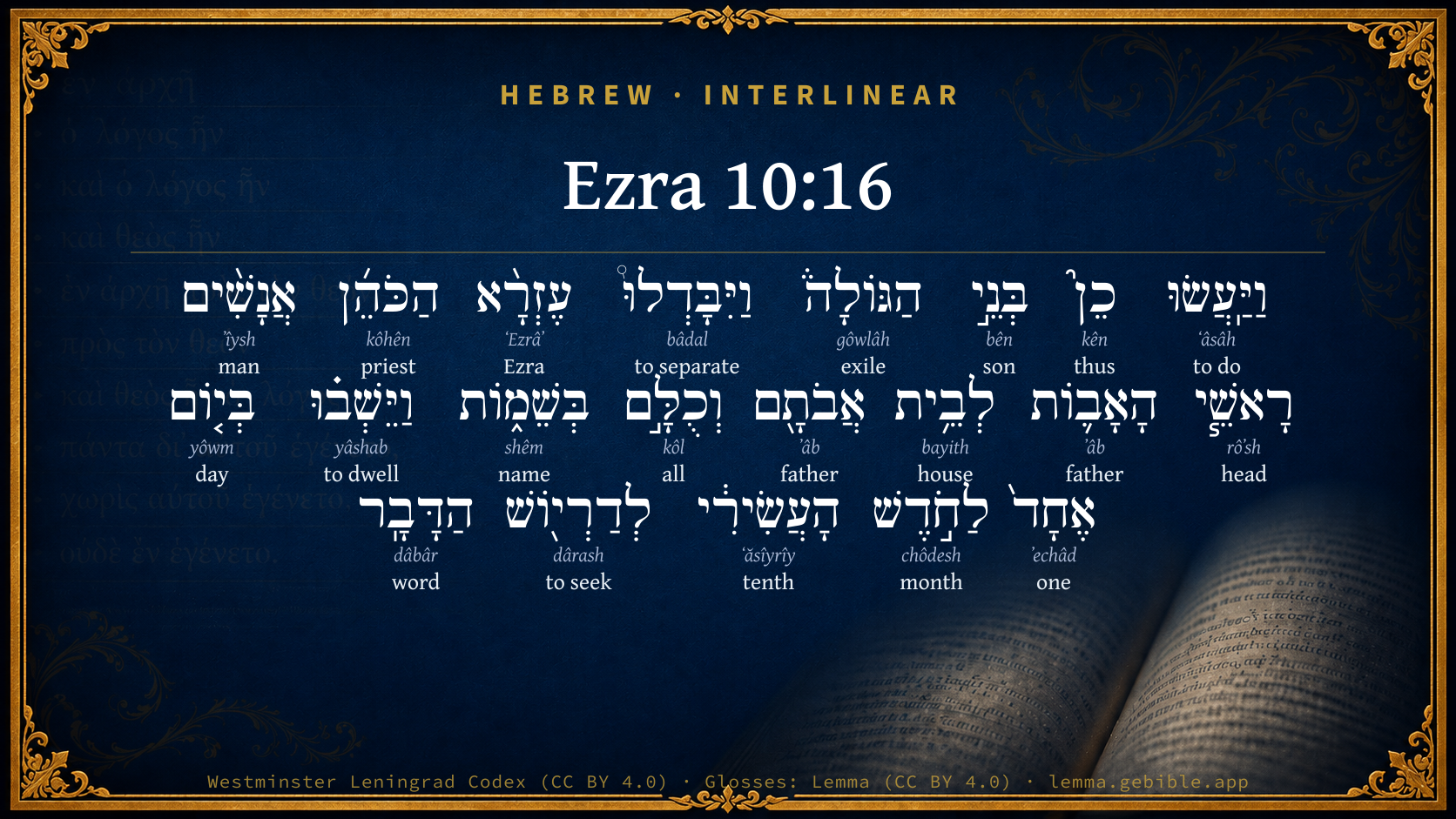
Ezra 10:16

Hebrew (Westminster Leningrad Codex) Ezra 10:16 appears in the Hebrew Old Testament. The text above is from the Westminster Leningrad Codex. Each word links to its Strong’s number, a concise gloss, and parsing drawn from the Open Scriptures Hebrew Bible morphology. Click any word for its full Brown-Driver-Briggs (BDB) entry.
Download image
Cite this verse

Ezra 10:16 (World English Bible). Public Domain. Lemma interlinear Bible study tool, https://lemma.gebible.app/v/ezra/10/16.

Show BibTeX & RIS
BibTeX
RIS
English Translation
The children of the captivity did so. Ezra the priest, [with] certain heads of fathers' [houses], after their fathers' houses, and all of them by their names, were set apart; and they sat down in the first day of the tenth month to examine the matter.
World English Bible · Public Domain
Download a study sheet

One document with this verse’s original text, its word-by-word gloss line, the meaning frame, cross-references with their text, attributed commentary, and full source and license credits — printable, and it pastes into notes with its structure intact.

This verse Autodidact and up

Study sheet (.html) Plain text (.txt)

A passage Seminary Student

Up to 50 verses in one chapter. A passage sheet keeps up to 6 commentary sources and 12 cross-references per verse, in the order this page ranks them, and says so on the sheet whenever that leaves anything out. Ask for a single verse and you get the Autodidact verse sheet above.

Everything on this page stays free to read, with no account — the sheet is a download of what is already on screen, not access to it.

Want to remove ads? Support Godless Engineer
Compare translations 3

The same verse in 3 English versions, stacked beneath the original-language interlinear above. Click any original word for its lexicon entry.

Each is an independent rendering of the whole verse — the interlinear is not word-aligned to these translations.

Highlighted words mark where these versions differ — a whole-verse word diff, not a word-by-word alignment.

  • World English Bible Public Domain
    The children of the captivity did so. Ezra the priest, [with] certain heads of fathers' [houses], after their fathers' houses, and all of them by their names, were set apart; and they sat down in the first day of the tenth month to examine the matter.
  • King James Version Public Domain
    And the children of the captivity did so. And Ezra the priest, with certain chief of the fathers, after the house of their fathers, and all of them by their names, were separated, and sat down in the first day of the tenth month to examine the matter.
  • unfoldingWord Literal Text CC BY-SA 4.0
    So the sons of the exile did thus, and men (the heads of the fathers by the house of their fathers, and all of them by names) were separated to Ezra the priest. And they sat down on day one of the tenth month to seek out the matter.

unfoldingWord Literal Text — © unfoldingWord, licensed CC BY-SA 4.0. Word-aligned USFM3 via Door43 (git.door43.org/unfoldingWord/en_ult).

Versions to compare (up to 4)

3 of 4 selected

Show all 18 translations

Every available English version of this verse, each an independent rendering of the whole verse.

  • World English Bible Public Domain
    The children of the captivity did so. Ezra the priest, [with] certain heads of fathers' [houses], after their fathers' houses, and all of them by their names, were set apart; and they sat down in the first day of the tenth month to examine the matter.
  • Berean Standard Bible Public Domain
    So the exiles did as proposed. Ezra the priest selected men who were family heads, each of them identified by name, to represent their families. On the first day of the tenth month they launched the investigation,
  • Majority Standard Bible Public Domain
    So the exiles did as proposed. Ezra the priest selected men who were family heads, each of them identified by name, to represent their families. On the first day of the tenth month they launched the investigation,
  • King James Version Public Domain
    And the children of the captivity did so. And Ezra the priest, with certain chief of the fathers, after the house of their fathers, and all of them by their names, were separated, and sat down in the first day of the tenth month to examine the matter.
  • American Standard Version (1901) Public Domain
    And the children of the captivity did so. And Ezra the priest, `with' certain heads of fathers' `houses', after their fathers' houses, and all of them by their names, were set apart; and they sat down in the first day of the tenth month to examine the matter.
  • Revised Version (1885) Public Domain
    And the children of the captivity did so. And Ezra the priest, with certain heads of fathers’ houses, after their fathers’ houses, and all of them by their names, were separated; and they sat down in the first day of the tenth month to examine the matter.
  • Geneva Bible (1599) Public Domain
    And they of the captiuitie did so, and departed, euen Ezra the Priest, and the men that were chiefe fathers to the familie of their fathers by name, and sate downe in the first day of the tenth moneth to examine the matter.
  • Douay-Rheims (1899) Public Domain
    And the children of the captivity did so. And Esdras the priest, and the men heads of the families in the houses of their fathers, and all by their names, went and sat down in the first day of the tenth month to examine the matter.
  • Young's Literal Translation Public Domain
    And the sons of the removal do so, and Ezra the priest, `and' men, heads of the fathers, for the house of their fathers, are separated, even all of them by name, and they sit on the first day of the tenth month, to examine the matter;
  • Literal Standard Version CC BY-SA 4.0
    And the sons of the expulsion do so, and Ezra the priest, [and] men, heads of the fathers, for the house of their fathers, are separated, even all of them by name, and they sit on the first day of the tenth month, to examine the matter;
  • Unlocked Literal Bible CC BY-SA 4.0
    So the people who returned from exile did this. Ezra the priest selected men, the leaders in their ancestors' clans and houses—all of them by name, and they looked into the matter on the first day of the tenth month.
  • unfoldingWord Literal Text CC BY-SA 4.0
    So the sons of the exile did thus, and men (the heads of the fathers by the house of their fathers, and all of them by names) were separated to Ezra the priest. And they sat down on day one of the tenth month to seek out the matter.
  • Darby Bible Public Domain
    And the children of the captivity did so. And Ezra the priest [and] certain of the chief fathers were separated according to their fathers' houses, and all of them [expressed] by name; and they sat down on the first day of the tenth month to examine the matter.
  • World Messianic Bible Public Domain
    The children of the captivity did so. Ezra the priest, with certain heads of fathers’ households, after their fathers’ houses, and all of them by their names, were set apart; and they sat down in the first day of the tenth month to examine the matter.
  • Webster's Bible Public Domain
    And the children of the captivity did so. And Ezra the priest, with certain chief of the fathers, after the house of their fathers, and all of them by their names, were separated, and sat down in the first day of the tenth month to examine the matter.
  • Free Bible Version CC BY-SA 4.0
    So this what the exiles did, selecting Ezra the priest and family leaders, according to their family divisions, all of them specifically named. On the first day of the tenth month they sat down to begin the inquiry,
  • Bible in Basic English Public Domain
    So those who had come back did so. And Ezra the priest, with certain heads of families, by their fathers' families, all of them by their names, were marked out; and on the first day of the tenth month they took their places to go into the question with care.
  • JPS Tanakh (1917) Public Domain
    And the children of the captivity did so. And Ezra the priest, with certain heads of fathers' houses, after their fathers' houses, and all of them by their names, were separated; and they sat down in the first day of the tenth month to examine the matter.

Literal Standard Version (2020), Covenant Press — licensed CC BY-SA 4.0. Text via the HelloAO Bible API (eBible.org). Unlocked Literal Bible (unfoldingWord) — licensed CC BY-SA 4.0. Text via the HelloAO Bible API (eBible.org). unfoldingWord Literal Text — © unfoldingWord, licensed CC BY-SA 4.0. Word-aligned USFM3 via Door43 (git.door43.org/unfoldingWord/en_ult). Free Bible Version, Dr. Jonathan Gallagher — licensed CC BY-SA 4.0. Text via the HelloAO Bible API (eBible.org).

Word by word

More ways to search: Search by grammar → Find every occurrence → Compare this word →

Practice this passage: Drill this verse → Learn its vocabulary →

עֶזְרָ֨א
ʻEzrâʼ
H5830
“Ezra”
Noun, Proper
Part of Speech
Noun
Type
Proper
Full BDB Definition

Origin: a variation of H5833

TWOT: None

Ezra = "help" - the priest and scribe who led the reforms of the returned exiles in Jerusalem; co-worker with Nehemiah - a priest with Zerubbabel - another post-exilic Jew
  1. וַיַּֽעֲשׂוּ ʻâsâh H6213 “and · to do” Conjunction + Verb, Qal, Sequential Imperfect, 3rd Person, Masculine, Plural
  2. כֵן֮ kên H3651 “thus” Adverb
  3. בְּנֵ֣י bên H1121 “sons of” Noun, Common, Masculine, Plural, Construct
  4. הַגּוֹלָה֒ gôwlâh H1473 “the · exile” Particle, Definite Article + Noun, Common, Feminine, Singular, Absolute
  5. וַיִּבָּדְלוּ֩ bâdal H914 “and · to separate” Conjunction + Verb, Niphal, Sequential Imperfect, 3rd Person, Masculine, Plural
  6. הַכֹּהֵ֜ן kôhên H3548 “the · priest” Particle, Definite Article + Noun, Common, Masculine, Singular, Absolute
  7. אֲנָשִׁ֨ים ʼîysh H376 “men” Noun, Common, Masculine, Plural, Absolute
  8. רָאשֵׁ֧י rôʼsh H7218 “heads of” Noun, Common, Masculine, Plural, Construct
  9. הָאָב֛וֹת ʼâb H1 “the · fathers” Particle, Definite Article + Noun, Common, Masculine, Plural, Absolute
  10. לְבֵ֥ית bayith H1004 “to/for · house of” Preposition + Noun, Common, Masculine, Singular, Construct
  11. אֲבֹתָ֖ם ʼâb H1 “fathers · their” Noun, Common, Masculine, Plural, Construct + Suffix, Personal, 3rd Person, Masculine, Plural
  12. וְכֻלָּ֣ם kôl H3605 “and · all · their” Conjunction + Noun, Common, Masculine, Singular, Construct + Suffix, Personal, 3rd Person, Masculine, Plural
  13. בְּשֵׁמ֑וֹת shêm H8034 “in/at · names” Preposition + Noun, Common, Masculine, Plural, Absolute
  14. וַיֵּשְׁב֗וּ yâshab H3427 “and · to dwell” Conjunction + Verb, Qal, Sequential Imperfect, 3rd Person, Masculine, Plural
  15. בְּי֤וֹם yôwm H3117 “in/at · day” Preposition + Noun, Common, Masculine, Singular, Absolute
  16. אֶחָד֙ ʼechâd H259 “one” Adjective, Cardinal number, Masculine, Singular, Absolute
  17. לַחֹ֣דֶשׁ chôdesh H2320 “to/for the · month” Preposition, Determined + Noun, Common, Masculine, Singular, Absolute
  18. הָעֲשִׂירִ֔י ʻăsîyrîy H6224 “the · tenth” Particle, Definite Article + Adjective, Ordinal number, Masculine, Singular, Absolute
  19. לְדַרְי֖וֹשׁ dârash H1875 “to seek” Preposition + Verb, Qal, Infinitive Construct
  20. הַדָּבָֽר dâbâr H1697 “the · word” Particle, Definite Article + Noun, Common, Masculine, Singular, Absolute

About this verse

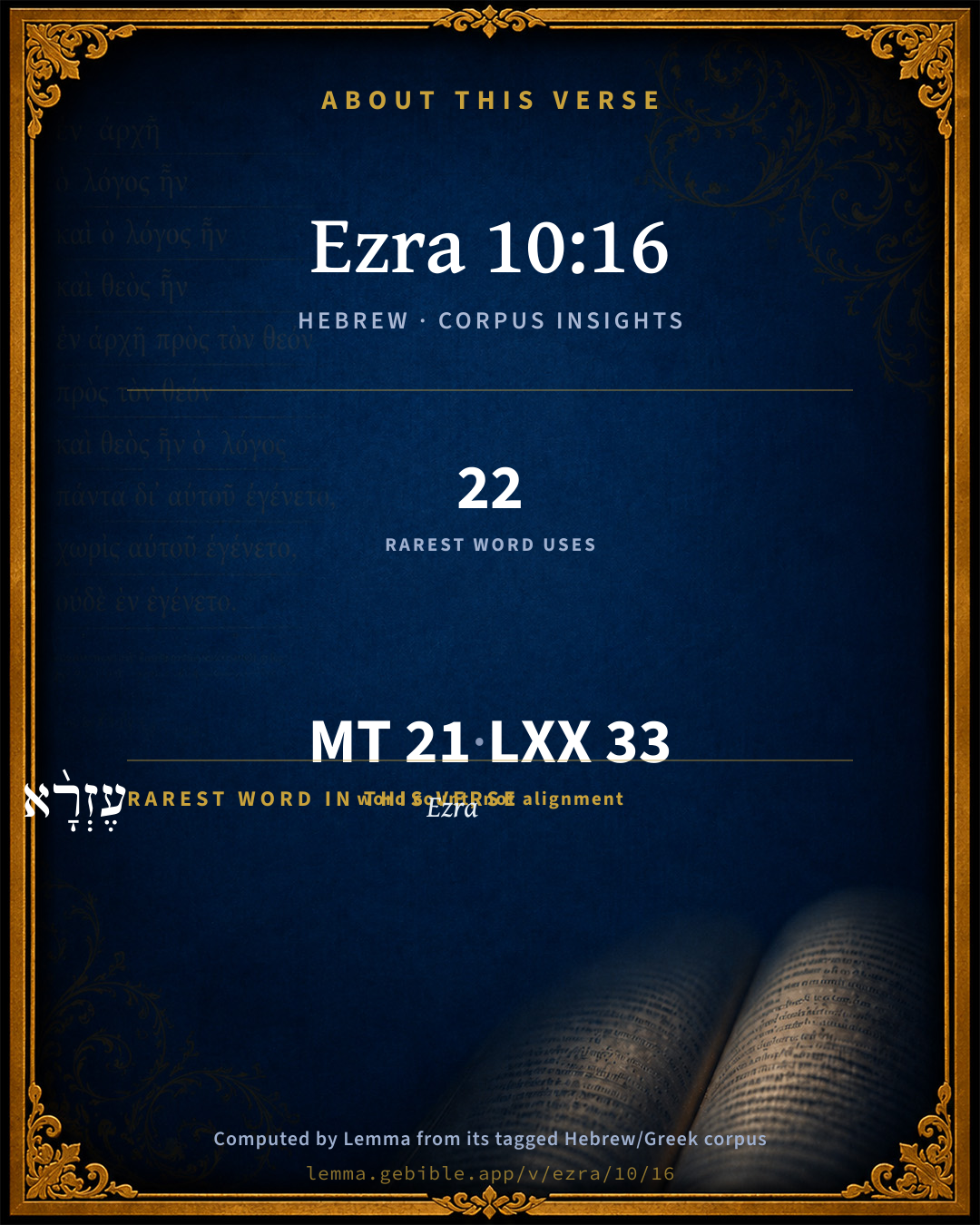
These counts appear in no published source. They are computed here, from the morphology-tagged text and Lemma’s own curated glosses. What Lemma adds →

21
words
20
distinct lemmas
Historical
section

Notable vocabulary

The rarest word here is עֶזְרָ֨א Ezra H5830 — appearing just 22 times in the whole Hebrew Bible.

Shared distinctive vocabulary

עֶזְרָ֨א Ezra H5830 occurs in 22 verses of the Hebrew Bible. Also found in:

Grammatical profile

  • 4 verbs
  • 14 nouns
  • 2 adjectives
  • 1 adverb

Verb forms

  • וַיַּֽעֲשׂוּ Qal · Sequential Imperfect
  • וַיִּבָּדְלוּ֩ Niphal · Sequential Imperfect
  • וַיֵּשְׁב֗וּ Qal · Sequential Imperfect
  • לְדַרְי֖וֹשׁ Qal · Infinitive Construct

Repetition

A word recurs within this verse — often emphatic in Hebrew:

  • הָאָב֛וֹת father H1 ×2

Hebrew & Septuagint length

In English translation the verse runs 46 words from the Hebrew and 43 from the Septuagint (LXX English) — closely comparable.

A rough comparison of the two English renderings, which tokenize alike — not a word-level alignment.

Word counts can differ between the Hebrew and the Greek without any difference in meaning — e.g. the Hebrew direct-object marker אֵת has no separate Greek word, and Greek often adds the article ὁ.

In the original languages it is 21 Hebrew tokens and 33 Greek tokens — but the two are counted differently (Hebrew bundles its prefixes and suffixes into one token; the Greek is in lemma form), so that isn’t a like-for-like length.

Cross-references

3

Topical passages linked to Ezra 10:16 in the Treasury of Scripture Knowledge — connected by theme and wording, ordered by reader-vote popularity; previews shown in the World English Bible.

  • Deuteronomy 13:14 then shall you inquire, and make search, and ask diligently; and, behold, if it be truth, and the thing certain, that such abomination is done in the midst of you,
  • Job 29:16 I was a father to the needy. The cause of him who I didn't know, I searched out.
  • John 7:51 "Does our law judge a man, unless it first hears from him personally and knows what he does?"

Cross-references courtesy of OpenBible.info (CC BY 4.0).

Hebrew and Greek witnesses Masoretic Hebrew ↔ Greek Septuagint

The same verse in the two great witnesses to the Old Testament, shown verse-for-verse.

These are two independent witnesses, not word-aligned to each other, and the Septuagint is shown in lemma (dictionary) form.

Hebrew Ezra 10:16 Masoretic · Westminster Leningrad Codex

וַיַּֽעֲשׂוּ כֵן֮ בְּנֵ֣י הַגּוֹלָה֒ וַיִּבָּדְלוּ֩ עֶזְרָ֨א הַכֹּהֵ֜ן אֲנָשִׁ֨ים רָאשֵׁ֧י הָאָב֛וֹת לְבֵ֥ית אֲבֹתָ֖ם וְכֻלָּ֣ם בְּשֵׁמ֑וֹת וַיֵּשְׁב֗וּ בְּי֤וֹם אֶחָד֙ לַחֹ֣דֶשׁ הָעֲשִׂירִ֔י לְדַרְי֖וֹשׁ הַדָּבָֽר

The children of the captivity did so. Ezra the priest, [with] certain heads of fathers' [houses], after their fathers' houses, and all of them by their names, were set apart; and they sat down in the first day of the tenth month to examine the matter.

World English Bible · Public Domain

Greek LXX Ezra 10:16 Septuagint · lemma form

καί ποιέω οὕτως υἱός ὁ ἀποικία καί διαστέλλω εσδρας ὁ ἱερεύς καί ἀνήρ ἄρχων πατριά ὁ οἶκος καί πᾶς ἐν ὄνομα ὅτι ἐπιστρέφω ἐν ἡμέρα εἷς ὁ μήν ὁ δέκατος ἐκζητέω ὁ ῥῆμα

And the children of the captivity did thus: and Esdras the priest, and heads of families according to their house were separated, and all by their names, for they returned in the first day of the tenth month to search out the matter.

LXX2012 (modern English Septuagint) · Public Domain

In the Septuagint this is one book — Esdras B (2 Esdras): Ezra is chapters 1–10, Nehemiah 11–23.

On this verse, The Cambridge Bible for Schools and Colleges discusses the Septuagint’s reading. Read the note in Commentary ↓

Hebrew: Westminster Leningrad Codex (CC BY 4.0). Greek: Septuagint (public domain); English from LXX2012 (modern English Septuagint) (Public Domain). How the Septuagint differs from the Hebrew →

Commentary

Notes on Ezra 10:16 from classic Christian and Jewish commentators (each source and its license shown beneath its notes). The classic Christian expositions comment on the surrounding passage and are grouped to its opening verse, so a note may address several verses; the Jewish commentaries on the Tanakh (Rashi and others) are per-verse, so they appear only where the commentator wrote on this verse.

Lemma curates 59 commentaries, every one of them public domain or Creative Commons licensed, each selected and text-cleaned for this edition rather than reprinted as found. About our sources →

Trapp's Complete Commentary

John Trapp

Ezr 10:16 And the children of the captivity did so. And Ezra the priest, [with] certain chief of the fathers, after the house of their fathers, and all of them by [their] names, were separated, and sat down in the first day of the tenth month to examine the matter.

Ver. 16. And the children of the captivity did so] Appointed such a course should be taken. And so it was a plain Plebiscitum, resolution of the people, and accordingly executed.

John Trapp, A Commentary or Exposition upon All the Books of the Old and New Testament (1647–1656) — public domain. Text from a community e-Sword module.

Joseph Benson's Commentary

Ezr 10:16-17. Ezra the priest, &c., were separated, and sat down — Sequestered themselves from all other business, and gave themselves wholly to this. They made an end, by the first day of the first month — Three months, therefore, were spent in this disquisition, which shows that it was very exact.

Joseph Benson's Commentary on the Old and New Testaments (1811–1818) — public domain. Text from a community e-Sword module.

Geneva Bible (1599)

Geneva Bible translators

They went to the chief cities to sit on this matter which was three months in finishing.

Geneva Bible (1599) marginal notes — public domain. Text via Bolls.life.

The Cambridge Bible for Schools and Colleges

gen. ed. J. J. S. Perowne

16, 17. The Commission at work

16. the children of the captivity did so] For this expression cf. Ezr_10:7. The proposal was no sooner made than it was carried into execution. The personal influence of Ezra must account for the ready acquiescence of the people generally.

And Ezra the priest] Ezra is here mentioned first, and it is probable that he presided over the court of enquiry. On his title ‘the priest’, cf. Ezr_7:11.

with certain chief of the fathers, after the house of their fathers] R.V. with certain heads of fathers’ houses, after their fathers’ houses. The word ‘with’ does not appear in the Hebrew, but, if the existing text be correct, we clearly need some such copula, which is supplied in the LXX. and Vulg. The phrase ‘certain heads of fathers’ houses, after their fathers’ houses’ seems to mean that each ‘father’s house’ (cf. Ezr_2:3, &c.) was represented on the commission by its chief or head. Literally rendered, the Hebrew runs, ‘Ezra the priest, men, heads of fathers’ houses, &c.’

all of them by their names] A full list of the households being furnished, the representative chiefs of certain ‘houses’ were required by name to attend. Cf. ‘were expressed by name’, Ezr_8:20.

were separated] i.e. were set apart for the work. The use of this word ‘separated’ shows that a certain number and not all of the chiefs were employed on this occasion. The text is not quite free from suspicion. The absence of the copula before ‘men (or, certain) heads’ taken in conjunction with the reading of the Syriac Peshitto favours another rendering ‘And Ezra the priest separated (or set apart for the work) certain men (that were) heads &c.’ In other words Ezra made the necessary selection. Not all the heads of the great houses were summoned to sit on the commission. We read of ninety-eight in, Ezr_2:3-61, and this number would have been far too unwieldy for the purpose. Certain of them were therefore to be set apart from the whole number. And Ezra was the natural person to make the selection. Having recently arrived from Babylon, he would be impartial, while the fact of his having originated the whole movement marked him out to be head of the enquiry.

, and sat down] R.V.; and they sat down. The R.V. separates the clause more-definitely from the preceding one. The Hebrew phrase is the same as the English ‘and the commission held its first sitting’.

in the first day of the tenth month] The first of Tebeth (see Est_2:16), the Assyrian Tibi-tuv, about the same as our January.

to examine the matter] The Hebrew word ‘to examine’ is of very strange form, and looks as if the name of ‘Darius’ had been carelessly introduced by a copyist in the place of the similar word ‘to examine’. He was perhaps reminded, by the look of the letters, of the word similarly formed composing the familiar name of the king.

The Cambridge Bible for Schools and Colleges (gen. ed. J. J. S. Perowne; Cambridge University Press, 1878–1918) — public domain. Text from a community e-Sword module.

John Gill's Exposition

And the children of the captivity did so,.... Put away their strange wives:

and Ezra the priest, with certain chief of the fathers, after the house of their fathers, and all of them by their names, were separated; from all their other business, and gave themselves up to attend to this wholly:

and sat down in the first day of the tenth month; the month Tebeth, which answers to part of December and January; this was ten days after the assembly of all the people met and broke up: these took their places in the great court, and there sat

to examine the matter; the accounts brought in from the several cities by the magistrates thereof, and recorded them.

John Gill's Exposition of the Whole Bible (1746–1763) — public domain (CC PDM 1.0). Text via the HelloAO Bible API.

Haydock's Catholic Bible Commentary

So. Cajetan improperly concludes, that the sentence was not put in execution; because Nehemias (chap. xiii. 23.) complains of such marriages. (Calmet) --- But the guilty might have resumed their women. (Haydock) --- Went. Hebrew, "were separated." (Haydock) --- By making a small change, we may translate, with 3 Esdras, "and Esdras separated or chose the men." Josephus seems generally to have followed the Greek of 3 Esdras. The Syriac says there were 20 judges.

George Leo Haydock (1774–1849), Haydock's Catholic Family Bible and Commentary, 1859 edition — public domain. Excludes Psalms (Douay-Rheims chapter numbering differs from Protestant) and Deuterocanonical books (Catholic canon only).

Matthew Poole's English Annotations

Were separated, i.e. sequestered themselves from all other business, and gave themselves wholly to this.

Matthew Poole's English Annotations on the Holy Bible (1683–1685) — public domain. Text from a community e-Sword/MySword module.

Whedon's Commentary on the Bible

Daniel D. Whedon

16. Children of the captivity did so — That is, the persons implicated, and the whole people, adopted the plan arranged by Ezra.

After the house of their fathers — So that every father’s house was represented.

All of them by their names — The name of each of the more distinguished fathers was probably called, and from each family thus represented a person was chosen, and all these, with Ezra himself, were separated, that is, chosen and set apart, to examine the matter. They had the responsibility and control of the investigation and decision of each case, while the four persons named it the previous verse were probably required to act as secretaries for them.

Daniel D. Whedon (gen. ed.), Commentary on the Old and New Testaments (1874–1909) — public domain. Text from a community e-Sword module.

The Pulpit Commentary

SETTLEMENT OF THE WHOLE MATTER BY THE REPUDIATION OF THE STRANGE WIVES (vers. 16, 17). The opposition made did not delay the business more than a few days. The great assembly had been held on the twentieth day of the ninth month. On the first day of the tenth month, little more than a week later, the commission for examining into the matter met under the presidency of Ezra, and commenced proceedings. The method of proceeding suggested at the great meeting was no doubt followed. The case of each city was taken separately. Its male inhabitants of full age attended, and its "elders" and "judges" sat on the commission as assessors while the conjugal position of their townsfolk was being investigated. Where a "mixed marriage" was proved the wife was repudiated. In 112 cases the necessity of repudiation was made out to the satisfaction of the commission, and this number of wives was put away. Probably the entire number of cases adjudicated upon was very much greater, since the commission continued at work for three months, and probably sat on seventy-five different days, judging (we may presume) three or four cases a day. On the whole, the small extent to which the evil had prevailed is remarkable; for 112 mixed marriages in a population where the adult males were about 40, 000 would give only one such marriage to three hundred or three hundred and fifty legitimate ones. Nevertheless, evils in a community are not to be judged simply by their prevalence. Great evils must be checked at once, even though they have not extended far, lest, if they spread at all widely, they become irremediable. Ezra is to be commended for having perceived the greatness of the peril, and for having taken prompt and decided measures to check it, without waiting till it had got to a head, and so become uncontrollable.

The children of the captivity did so. The people generally, notwithstanding the opposition of Jonathan, acquiesced in Ezra"s decision, and acted accordingly. Ezra the priest, with certain chief of the fathers. There is no "with," or other connective, in the original; but our translators did right in supplying one, since the conjunction w, "and," has almost certainly fallen out of the text by the mistake of a copyist. After the house of their fathers. Rather, "for each father"s housei.e. "for each family." It would seem from this clause that each recognised family was represented on the commission by its head. The number of such families appears by Ezr_2:3-61 to have been ninety-eight. And all of them by their names. Compare with this Ezr_8:20. In both places Ezra probably means that a list of the names was made out, and was in his possession, though he does not think it necessary to give them. Were separated. i.e. "set apart for the business." And they sat down, i.e. began their sittings," on the first day of the tenth month, the month Tebeth, corresponding nearly to our January.

The Pulpit Commentary (1880–1919), ed. H.D.M. Spence-Jones & Joseph S. Exell — public domain. Text from a community e-Sword module.

John Wesley's Explanatory Notes

Separated - Sequestered themselves from all other business, and gave themselves wholly to this.

John Wesley, Explanatory Notes Upon the Whole Bible (1754–1765) — public domain. Text via the GEBible commentary corpus.

Scofield Reference Notes

C. I. Scofield

tenth month

i.e. January.

The Scofield Reference Bible (1917 edition), notes by C. I. Scofield — public domain. Text from a community e-Sword module.

unfoldingWord translationNotes

Door43 World Missions Community

did this

The people investigated who had married non-Jewish wives.

the first day of the tenth month

This is the tenth month of the Hebrew calendar. The first day is near the middle of December on Western calendars. (See: Hebrew Months and Ordinal Numbers)

first day of the first month

This is near the middle of March on Western calendars. (See: Hebrew Months and Ordinal Numbers)

translationWords

exile

Ezra

priest

clan

name

day

alien

unfoldingWord translationNotes — © Distant Shores Media and the Door43 World Missions Community, licensed CC BY-SA 4.0. Source: git.door43.org/Door43/en_tn.

Rashi

Rabbi Shlomo Yitzchaki (Rashi)

to investigate Heb. לְדַרְיוֹשּׁ, like לִדְרוֹשּׁ.

Rashi on the Tanakh — English translations: “The Judaica Press complete Tanach with Rashi, translated by A. J. Rosenberg” (CC BY 4.0); “Pentateuch with Rashi's commentary by M. Rosenbaum and A.M. Silbermann, 1929-1934” (public domain); “The Metsudah Tanach series, Lakewood, N.J” (CC BY 4.0); and “The Book of Joshua, Metsudah Publications, 1997” (CC BY 4.0). Text via Sefaria.

Lesson kit

Teaching starters — assembled from the data on this page, not authored interpretation. Every prompt links to the verse data it draws on. Edit before teaching.

Ezra, in the Historical, opens this verse with 21 words (20 distinct Hebrew lemmas). Its most distinctive word is ʻEzrâʼ (“Ezra”). A historical commentator’s framing appears above. Read the whole chapter for the surrounding context.

Discussion questions

  1. How does “Ezra” (ʻEzrâʼ) shape what this verse is saying?
  2. Ezra 7:1 shares the word «Ezra» with this verse. How do the two illuminate each other?
  3. “father” occurs 2× in this one verse. What is the effect of the repetition?
  4. These translations render this verse differently; the difference is in the English rendering, not the original. What questions does that raise?
  5. The verb «וַיַּֽעֲשׂוּ» is Qal Sequential Imperfect. How does its form color the action?
  6. Reading how Trapp's Complete Commentary and Joseph Benson's Commentary read this verse, where do the two commentators agree and where do they part?

Things to notice

Reading settings

Reading text

Shown beneath each verse's original-language words.

Old Testament
Old Testament edition

Read the OT as the Masoretic Hebrew (MT) or the Greek Septuagint (LXX).

English shown for the Greek Septuagint (in the Hebrew ↔ Greek comparison).

Comparing translations? Open the Compare panel on any verse page to stack up to four side by side.