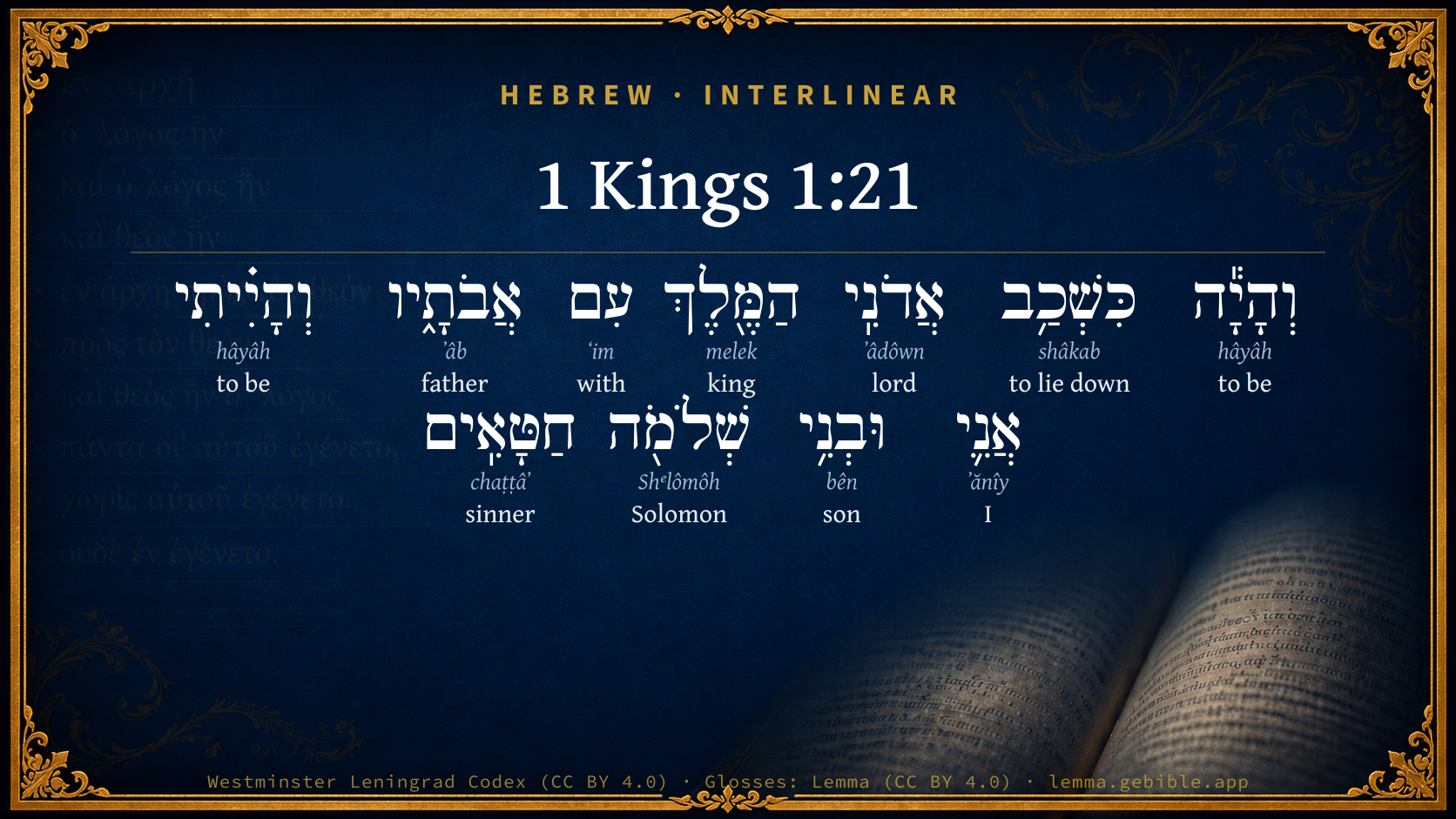
1 Kings 1:21

Hebrew (Westminster Leningrad Codex) 1 Kings 1:21 appears in the Hebrew Old Testament. The text above is from the Westminster Leningrad Codex. Each word links to its Strong’s number, a concise gloss, and parsing drawn from the Open Scriptures Hebrew Bible morphology. Click any word for its full Brown-Driver-Briggs (BDB) entry.
Download image
Cite this verse

1 Kings 1:21 (World English Bible). Public Domain. Lemma interlinear Bible study tool, https://lemma.gebible.app/v/1-kings/1/21.

Show BibTeX & RIS
BibTeX
RIS
English Translation
Otherwise it will happen, when my lord the king shall sleep with his fathers, that I and my son Solomon shall be counted offenders.
World English Bible · Public Domain
Download a study sheet

One document with this verse’s original text, its word-by-word gloss line, the meaning frame, cross-references with their text, attributed commentary, and full source and license credits — printable, and it pastes into notes with its structure intact.

This verse Autodidact and up

Study sheet (.html) Plain text (.txt)

A passage Seminary Student

Up to 50 verses in one chapter. A passage sheet keeps up to 6 commentary sources and 12 cross-references per verse, in the order this page ranks them, and says so on the sheet whenever that leaves anything out. Ask for a single verse and you get the Autodidact verse sheet above.

Everything on this page stays free to read, with no account — the sheet is a download of what is already on screen, not access to it.

Want to remove ads? Support Godless Engineer
Compare translations 3

The same verse in 3 English versions, stacked beneath the original-language interlinear above. Click any original word for its lexicon entry.

Each is an independent rendering of the whole verse — the interlinear is not word-aligned to these translations.

Highlighted words mark where these versions differ — a whole-verse word diff, not a word-by-word alignment.

  • World English Bible Public Domain
    Otherwise it will happen, when my lord the king shall sleep with his fathers, that I and my son Solomon shall be counted offenders.
  • King James Version Public Domain
    Otherwise it shall come to pass, when my lord the king shall sleep with his fathers, that I and my son Solomon shall be counted offenders.
  • unfoldingWord Literal Text CC BY-SA 4.0
    And it will happen, when my lord the king lies down with his fathers, that I will be, I and my son Solomon, offenders.”

unfoldingWord Literal Text — © unfoldingWord, licensed CC BY-SA 4.0. Word-aligned USFM3 via Door43 (git.door43.org/unfoldingWord/en_ult).

Versions to compare (up to 4)

3 of 4 selected

Show all 18 translations

Every available English version of this verse, each an independent rendering of the whole verse.

  • World English Bible Public Domain
    Otherwise it will happen, when my lord the king shall sleep with his fathers, that I and my son Solomon shall be counted offenders.
  • Berean Standard Bible Public Domain
    Otherwise, when my lord the king rests with his fathers, I and my son Solomon will be counted as criminals.”
  • Majority Standard Bible Public Domain
    Otherwise, when my lord the king rests with his fathers, I and my son Solomon will be counted as criminals.”
  • King James Version Public Domain
    Otherwise it shall come to pass, when my lord the king shall sleep with his fathers, that I and my son Solomon shall be counted offenders.
  • American Standard Version (1901) Public Domain
    Otherwise it will come to pass, when my lord the king shall sleep with his fathers, that I and my son Solomon shall be counted offenders.
  • Revised Version (1885) Public Domain
    Otherwise it shall come to pass, when my lord the king shall sleep with his fathers, that I and my son Solomon shall be counted offenders.
  • Geneva Bible (1599) Public Domain
    For els when my lord the King shall sleepe with his fathers, I and my sonne Salomon shalbe reputed vile.
  • Douay-Rheims (1899) Public Domain
    Otherwise it shall come to pass, when my lord the king sleepeth with his fathers, that I and my son Solomon shall be counted offenders.
  • Young's Literal Translation Public Domain
    and it hath been, when my lord the king lieth with his fathers, that I have been, I and my son Solomon -- `reckoned' sinners.'
  • Literal Standard Version CC BY-SA 4.0
    and it has been, when my lord the king lies with his fathers, that I have been, I and my son Solomon—[reckoned] sinners.”
  • Unlocked Literal Bible CC BY-SA 4.0
    Otherwise it will happen, when my master the king sleeps with his fathers, that I and my son Solomon will be regarded as criminals.”
  • unfoldingWord Literal Text CC BY-SA 4.0
    And it will happen, when my lord the king lies down with his fathers, that I will be, I and my son Solomon, offenders.”
  • Darby Bible Public Domain
    Otherwise it shall come to pass when my lord the king shall sleep with his fathers, that I and my son Solomon will be counted offenders.
  • World Messianic Bible Public Domain
    Otherwise it will happen, when my lord the king sleeps with his fathers, that I and my son Solomon will be considered criminals.”
  • Webster's Bible Public Domain
    Otherwise it shall come to pass, when my lord the king shall sleep with his fathers, that I and my son Solomon shall be counted offenders.
  • Free Bible Version CC BY-SA 4.0
    If you don't do anything, as soon as Your Majesty dies, I and my son Solomon will be considered traitors…”
  • Bible in Basic English Public Domain
    For as things are, it will come about, when my lord the king is sleeping with his fathers, that I and Solomon my son will be made outlaws.
  • JPS Tanakh (1917) Public Domain
    Otherwise it will come to pass, when my lord the king shall sleep with his fathers, that I and my son Solomon shall be counted offenders.'

Literal Standard Version (2020), Covenant Press — licensed CC BY-SA 4.0. Text via the HelloAO Bible API (eBible.org). Unlocked Literal Bible (unfoldingWord) — licensed CC BY-SA 4.0. Text via the HelloAO Bible API (eBible.org). unfoldingWord Literal Text — © unfoldingWord, licensed CC BY-SA 4.0. Word-aligned USFM3 via Door43 (git.door43.org/unfoldingWord/en_ult). Free Bible Version, Dr. Jonathan Gallagher — licensed CC BY-SA 4.0. Text via the HelloAO Bible API (eBible.org).

Word by word

More ways to search: Search by grammar → Find every occurrence → Compare this word →

Practice this passage: Drill this verse → Learn its vocabulary →

חַטָּאִֽים
chaṭṭâʼ
H2400
“sinner”
Adjective, Adjective, Masculine, Plural, Absolute
Part of Speech
Adjective
Type
Adjective
Gender
Masculine
Number
Plural
State
Absolute
Full BDB Definition

Origin: intensively from H2398

TWOT: 638b

sinners (noun masculine) - sinful (adjective) - exposed to condemnation, reckoned as offenders (adjective)
  1. וְהָיָ֕ה hâyâh H1961 “and · to be” Conjunction + Verb, Qal, Sequential Perfect, 3rd Person, Masculine, Singular
  2. כִּשְׁכַ֥ב shâkab H7901 “like/as · to lie down” Preposition + Verb, Qal, Infinitive Construct
  3. אֲדֹנִֽי ʼâdôwn H113 “lord · my” Noun, Common, Masculine, Singular, Construct + Suffix, Personal, 1st Person, Common, Singular
  4. הַמֶּ֖לֶךְ melek H4428 “the · king” Particle, Definite Article + Noun, Common, Masculine, Singular, Absolute
  5. עִם ʻim H5973 “with” Preposition
  6. אֲבֹתָ֑יו ʼâb H1 “fathers · his” Noun, Common, Masculine, Plural, Construct + Suffix, Personal, 3rd Person, Masculine, Singular
  7. וְהָיִ֗יתִי hâyâh H1961 “and · to be” Conjunction + Verb, Qal, Sequential Perfect, 1st Person, Common, Singular
  8. אֲנִ֛י ʼănîy H589 “I” Pronoun, Personal, 1st Person, Common, Singular
  9. וּבְנִ֥י bên H1121 “and · son · my” Conjunction + Noun, Common, Masculine, Singular, Construct + Suffix, Personal, 1st Person, Common, Singular
  10. שְׁלֹמֹ֖ה Shᵉlômôh H8010 “Solomon” Noun, Proper

About this verse

These counts appear in no published source. They are computed here, from the morphology-tagged text and Lemma’s own curated glosses. What Lemma adds →

11
words
10
distinct lemmas
Historical
section

Notable vocabulary

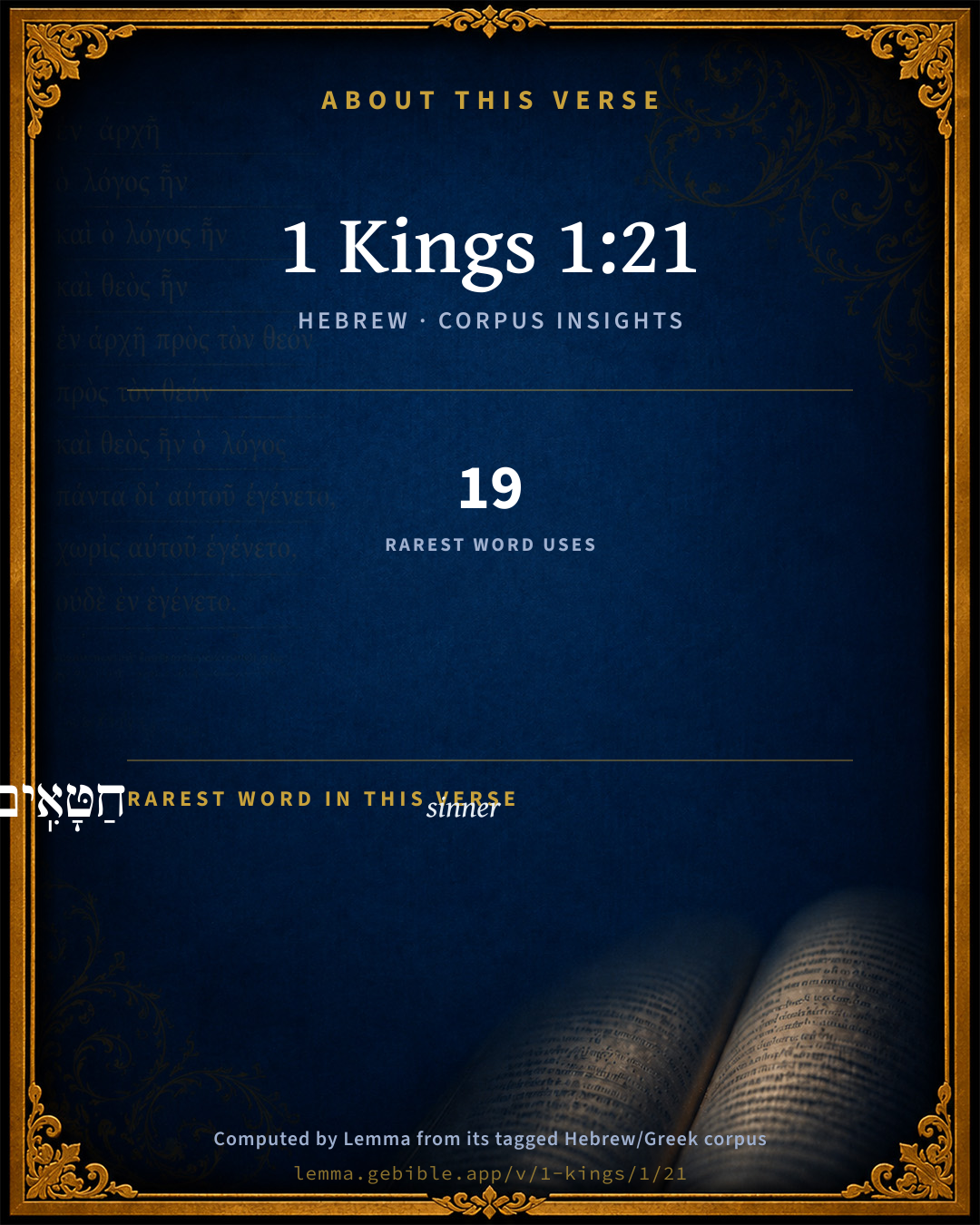
The rarest word here is חַטָּאִֽים sinner H2400 — appearing just 19 times in the whole Hebrew Bible.

Shared distinctive vocabulary

חַטָּאִֽים sinner H2400 occurs in 19 verses of the Hebrew Bible. Also found in:

Grammatical profile

  • 3 verbs
  • 5 nouns
  • 1 adjective
  • 1 pronoun
  • 1 preposition

Verb forms

  • וְהָיָ֕ה Qal · Sequential Perfect
  • כִּשְׁכַ֥ב Qal · Infinitive Construct
  • וְהָיִ֗יתִי Qal · Sequential Perfect

Repetition

A word recurs within this verse — often emphatic in Hebrew:

  • וְהָיָ֕ה to be H1961 ×2

Hebrew & Septuagint length

In English translation the verse runs 24 words from the Hebrew and 25 from the Septuagint (LXX English) — closely comparable.

A rough comparison of the two English renderings, which tokenize alike — not a word-level alignment.

Word counts can differ between the Hebrew and the Greek without any difference in meaning — e.g. the Hebrew direct-object marker אֵת has no separate Greek word, and Greek often adds the article ὁ.

Cross-references

6

Topical passages linked to 1 Kings 1:21 in the Treasury of Scripture Knowledge — connected by theme and wording, ordered by reader-vote popularity; previews shown in the World English Bible.

  • Deuteronomy 31:16 Yahweh said to Moses, Behold, you shall sleep with your fathers; and this people will rise up, and play the prostitute after the strange gods of the land, where they go to be among them, and will forsake me, and break my covenant which I have made with them.
  • 1 Kings 2:10 David slept with his fathers, and was buried in the city of David.
  • Genesis 15:15 But you will go to your fathers in peace. You will be buried in a good old age.
  • 2 Samuel 7:12 When your days are fulfilled, and you shall sleep with your fathers, I will set up your seed after you, who shall proceed out of your bowels, and I will establish his kingdom.
  • 1 Kings 2:15 He said, You know that the kingdom was mine, and that all Israel set their faces on me, that I should reign: however the kingdom is turned about, and is become my brother's; for it was his from Yahweh.
  • 1 Kings 2:22–24 King Solomon answered his mother, Why do you ask Abishag the Shunammite for Adonijah? ask for him the kingdom also; for he is my elder brother; even for him, and for Abiathar the priest, and for Joab the son of Zeruiah.

Cross-references courtesy of OpenBible.info (CC BY 4.0).

Hebrew and Greek witnesses Masoretic Hebrew ↔ Greek Septuagint

The same verse in the two great witnesses to the Old Testament, shown verse-for-verse.

These are two independent witnesses, not word-aligned to each other, and the Septuagint is shown in lemma (dictionary) form.

Hebrew 1 Kings 1:21 Masoretic · Westminster Leningrad Codex

וְהָיָ֕ה כִּשְׁכַ֥ב אֲדֹנִֽי הַמֶּ֖לֶךְ עִם אֲבֹתָ֑יו וְהָיִ֗יתִי אֲנִ֛י וּבְנִ֥י שְׁלֹמֹ֖ה חַטָּאִֽים

Otherwise it will happen, when my lord the king shall sleep with his fathers, that I and my son Solomon shall be counted offenders.

World English Bible · Public Domain

Greek LXX 1 Kings 1:21 Septuagint · lemma form

καί εἰμί ὡς ἄν κοιμάω ὁ κύριος ἐγώ ὁ βασιλεύς μετά ὁ πατήρ αὐτός καί εἰμί ἐγώ καί ὁ υἱός ἐγώ σαλωμών ἁμαρτωλός

And it shall come to pass, when my lord the king shall sleep with his fathers, that I and Solomon my son shall be offenders.

LXX2012 (modern English Septuagint) · Public Domain

Hebrew: Westminster Leningrad Codex (CC BY 4.0). Greek: Septuagint (public domain); English from LXX2012 (modern English Septuagint) (Public Domain). How the Septuagint differs from the Hebrew →

Targum (Aramaic paraphrase)

1

The Targum is the ancient Jewish Aramaic paraphrase of the Hebrew Scriptures — an interpretive translation, not the Hebrew text itself. Onkelos (literal) and Pseudo-Jonathan (expansive) render the Torah, and Jonathan the Prophets. Coverage is partial: where no permissively-licensed English translation exists for a verse, only the Aramaic is shown. This is verse-level text, not a word-by-word alignment to the Hebrew.

  1. Targum Jonathan Prophets (Joshua–Malachi)
    וִיהֵי כַּד יִשְׁכּוּב רִבּוֹנִי מַלְכָּא עִם אֲבָהָתוֹהִי וֶאֱהִי אֲנָא וּבְרִי שְׁלֹמֹה מִתְרְכִין:

    (no public-domain English translation for this verse)

    Targum Jonathan — Aramaic: “Mikraot Gedolot” (public domain). English: “Sefaria Community Translation” (CC0 1.0 (public-domain dedication)); “London "Chaldee Paraphrase," 1871” (public domain). Text via Sefaria.

Commentary

Notes on 1 Kings 1:21 from classic Christian and Jewish commentators (each source and its license shown beneath its notes). The classic Christian expositions comment on the surrounding passage and are grouped to its opening verse, so a note may address several verses; the Jewish commentaries on the Tanakh (Rashi and others) are per-verse, so they appear only where the commentator wrote on this verse.

Lemma curates 59 commentaries, every one of them public domain or Creative Commons licensed, each selected and text-cleaned for this edition rather than reprinted as found. About our sources →

Trapp's Complete Commentary

John Trapp

1Ki 1:21 Otherwise it shall come to pass, when my lord the king shall sleep with his fathers, that I and my son Solomon shall be counted offenders.

Ver. 21. Shall be counted offenders.] Heb., Sinners. Erimus Mamzeres - so Jerome senseth it, out of the Hebrew traditions - that is, we shall be accounted bastards and infamous. It is probable that Adonijah had spoken basely of Bathsheba as an adulteress, and of Solomon as illegitimate, and so not fit to be king. Or by sinners here understand rebels, and public enemies.

John Trapp, A Commentary or Exposition upon All the Books of the Old and New Testament (1647–1656) — public domain. Text from a community e-Sword module.

Geneva Bible (1599)

Geneva Bible translators

And so put to the death as wicked transgressors.

Hebrew, sinners.

Geneva Bible (1599) marginal notes — public domain. Text via Bolls.life.

Jamieson, Fausset & Brown

Robert Jamieson, A. R. Fausset & David Brown

I and my son . . . shall be counted offenders--that is, slain, according to the barbarous usage of the East towards all who are rivals to the throne.

Jamieson, Fausset & Brown — Commentary Critical and Explanatory on the Whole Bible (1871) — public domain (CC PDM 1.0). Text via the HelloAO Bible API.

Adam Clarke's Commentary

Verse 21. Shall be counted offenders.] When Adonijah and his party shall find that I and my son have had this promise from thee by oath, he will slay us both.

Adam Clarke's Commentary on the Bible (1810–1826) — public domain. Text from a community e-Sword/MySword module.

Ellicott's Commentary for English Readers

(21) Shall sleep with his fathers.—Here this phrase, so constantly used in the record of the death of the kings, occurs in these books for the first time. (It is also found in the message of promise by Nathan. 2Sa_7:12, relating to the succession of the son who should build the Temple.) We find corresponding expressions in Gen_15:15; Deu_31:16. Without connecting with the use of this phrase anything like the fulness of meaning which in the New Testament attaches to “the sleep” of the departed servants of God (as known to be a “sleep in Jesus”), it seems not unreasonable to recognise in it, at least, a rudimentary belief in death as rest and not extinction. The addition, “with his fathers,” has probably a reference to “the tombs of the kings;” especially as we find that it is not adopted in the cases of Jehoram (2Ch_21:20) and Joash. (2Ch_24:25), who were not buried therein.

A Bible Commentary for English Readers, edited by Charles John Ellicott (1878–1897) — public domain. Text from a community e-Sword module.

The Cambridge Bible for Schools and Colleges

gen. ed. J. J. S. Perowne

21. counted offenders] The Heb. word is literally ‘sinners.’ Bath-sheba does not go so far as Nathan, and say that the lives of herself and her son are in peril, but leaves the king to think what the lot of those offenders would be whom Adonijah knew to have aspired to the throne.

The Cambridge Bible for Schools and Colleges (gen. ed. J. J. S. Perowne; Cambridge University Press, 1878–1918) — public domain. Text from a community e-Sword module.

John Gill's Exposition

Otherwise it shall come to pass, when my lord the king shall sleep with his fathers,.... That is, shall die, and be buried in the sepulchre of his ancestors, where he shall lie till he awakes in the morning of the resurrection:

that I and my son Solomon shall be counted offenders; or "sinners" (g); not as if she would be reckoned an adulteress, and her son as illegitimate, as some think, and so be branded and treated as such; but as being traitors, making pretensions to the throne, she on the behalf of her son, and he for himself, when he had no right to it, being the younger son, and not declared successor by his father.

(g) "peccatores", V. L. Pagninus, Montanus, &c.

John Gill's Exposition of the Whole Bible (1746–1763) — public domain (CC PDM 1.0). Text via the HelloAO Bible API.

Albert Barnes' Notes on the Bible

Shall sleep - This euphemism for death, rare in the early Scriptures - being found only once in the Pentateuch (margin reference.), and once also in the historical books before Kings 2Sa 7:12 - becomes in Kings and Chronicles the ordinary mode of speech (see 1Ki 2:10; 1Ki 11:43, etc.; 2Ch 9:31; 2Ch 12:16, etc.). David uses the metaphor in one psalm Psa 13:3. In the later Scriptures it is, of course, common. (Jer 51:39; Dan 12:2; Mat 9:24; Joh 11:11; 1Co 11:30; 1Co 15:51; 1Th 4:14, etc.)

Albert Barnes' Notes on the Bible (1834–1885) — public domain. Text from a community e-Sword/MySword module.

Haydock's Catholic Bible Commentary

Offenders. I, as guilty of adultery; and my son, as a mamzer; (Deuteronomy xxiii. 2.; Tirinus) or we shall be accounted pretenders, (Haydock) and condemned as guilty of high treason. (Calmet) --- Our hopes and expectations will be frustrated. (Vatable) (Estius) --- We shall be despised or punished. (Worthington)

George Leo Haydock (1774–1849), Haydock's Catholic Family Bible and Commentary, 1859 edition — public domain. Excludes Psalms (Douay-Rheims chapter numbering differs from Protestant) and Deuterocanonical books (Catholic canon only).

Matthew Poole's English Annotations

Shall sleep with his fathers, i.e. die as his fathers did. See Gen 47:30.

I and my son Solomon shall be counted offenders; we shall be punished with death as malefactors, as guilty of practicing against the right heir of the crown, and transferring the kingdom to Solomon, and covering our ambitious designs with a pretence of religion.

Matthew Poole's English Annotations on the Holy Bible (1683–1685) — public domain. Text from a community e-Sword/MySword module.

The Pulpit Commentary

Otherwise there is no corresponding word in the Hebrews it shall come to pass, when my lord the king shall sleep strictly, "lie down:" see on 1Ki_2:10 with his fathers this phrase, so common in the books of Kings and Chronicles, only occurs "once in the Pentateuch (Deu_31:16) and once in the historical books before Kings" (Rawlinson). It was evidently the product of an age when the nation was settled, and men had their family sepulchres that I and my son Solomon shall be counted Hebrews be offenders Hebrews as marg., sinners. The primary meaning of afj is "to miss the mark." Like aJmartanein, it came to be used of all erring and transgression. Bathsheba and Solomon would be obnoxious to Adonijah, as representing a rival cause; possibly also as guilty of high treason (Clericus, Bahr, al. ) And when I rose in the morning while it was still dusk to give my child suck, behold it was dead: but when I had considered it in the morning i.e., in broad daylight; Vulg. clara luce behold this second "behold" marks a second discovery it was not my son which I did bear. And the other woman said, Nay, but the living is my son and the dead is thy son. And this said, No, but the dead is thy son and the living is my son. It is somewhat difficult to account for the pertinacious claim to the child, preferred even before the king by the pretended mother. The most probable explanation is, that having taken the child in the first instance on the spur of the moment, in order to avoid the reproach of having killed her offspring by her clumsiness and neglect, she found it difficult to draw back from her false position which indeed she could not do without owning herself both child stealer and liar and so she put on a bold face and maintained the imposture even before the monarch himself. That she did not really care for the child is evident from ver. 26. Thus they spake Heb. And they spake," i.e., affirmed and contradicted before the king.

The Pulpit Commentary (1880–1919), ed. H.D.M. Spence-Jones & Joseph S. Exell — public domain. Text from a community e-Sword module.

Rashi

Rabbi Shlomo Yitzchaki (Rashi)

Sinners. [They will be] lacking and restrained from any greatness, as in, “[Sling a stone] at a hair, and not miss [יחטיא].”

Rashi on the Tanakh — English translations: “The Judaica Press complete Tanach with Rashi, translated by A. J. Rosenberg” (CC BY 4.0); “Pentateuch with Rashi's commentary by M. Rosenbaum and A.M. Silbermann, 1929-1934” (public domain); “The Metsudah Tanach series, Lakewood, N.J” (CC BY 4.0); and “The Book of Joshua, Metsudah Publications, 1997” (CC BY 4.0). Text via Sefaria.

Lesson kit

Teaching starters — assembled from the data on this page, not authored interpretation. Every prompt links to the verse data it draws on. Edit before teaching.

1 Kings, in the Historical, opens this verse with 11 words (10 distinct Hebrew lemmas). Its most distinctive word is chaṭṭâʼ (“sinner”). A historical commentator’s framing appears above. Read the whole chapter for the surrounding context.

Discussion questions

  1. The word chaṭṭâʼ carries the sense “sinner.” How does it shape the verse?
  2. How does Genesis 13:13, which shares the word «sinner», read alongside this verse?
  3. What does the repetition of “to be” (2× in this one verse) do in this verse?
  4. These translations render this verse differently; the difference is in the English rendering, not the original. What questions does that raise?
  5. «וְהָיָ֕ה» is a Qal Sequential Perfect verb. How does that grammatical form shape the action described?
  6. Compare how Trapp's Complete Commentary and Geneva Bible (1599) read this verse. Where do they agree or differ?

Things to notice

Reading settings

Reading text

Shown beneath each verse's original-language words.

Old Testament
Old Testament edition

Read the OT as the Masoretic Hebrew (MT) or the Greek Septuagint (LXX).

English shown for the Greek Septuagint (in the Hebrew ↔ Greek comparison).

Comparing translations? Open the Compare panel on any verse page to stack up to four side by side.