
Exodus 3:16

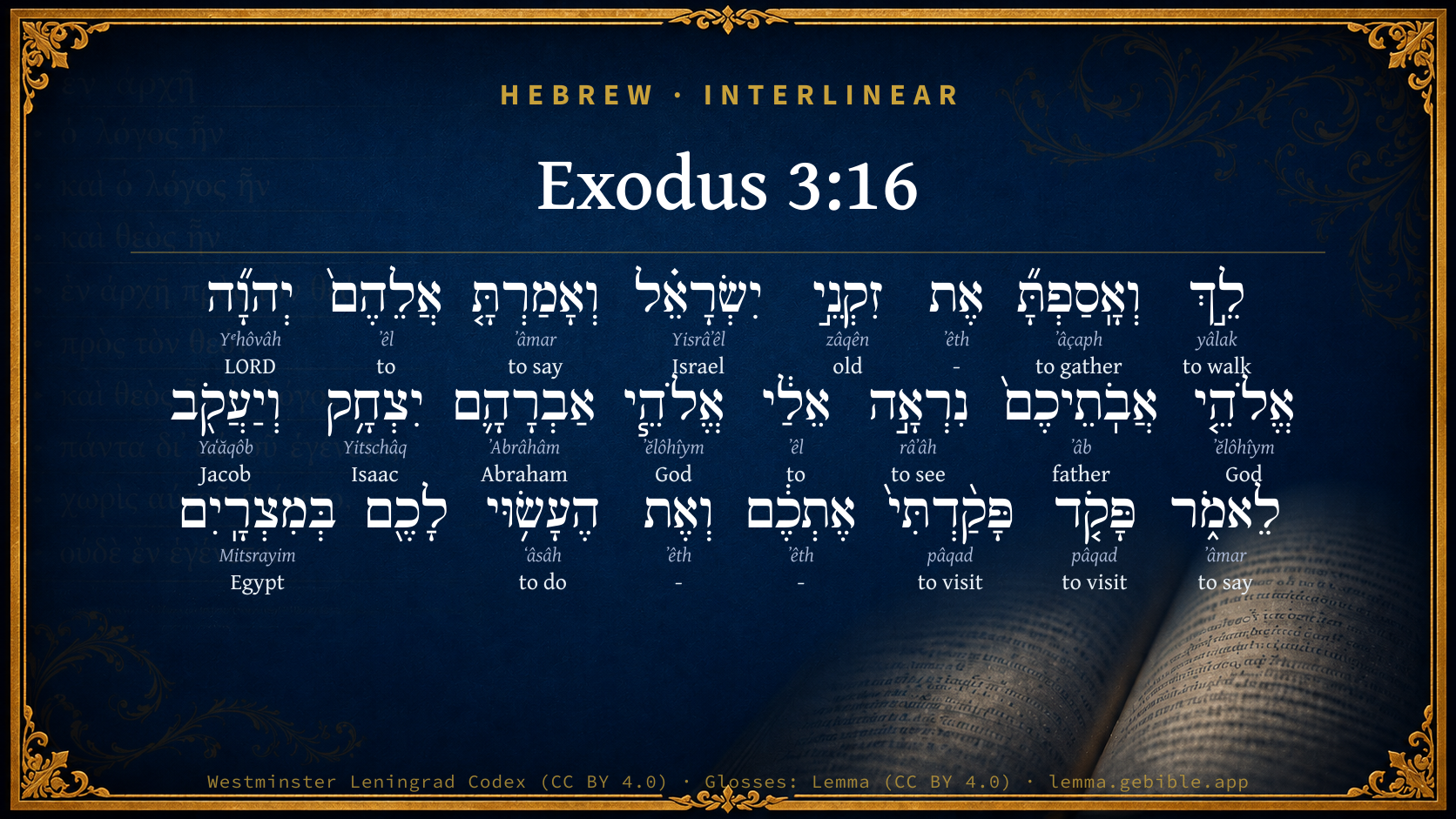
Hebrew (Westminster Leningrad Codex) Exodus 3:16 appears in the Hebrew Old Testament. The text above is from the Westminster Leningrad Codex. Each word links to its Strong’s number, a concise gloss, and parsing drawn from the Open Scriptures Hebrew Bible morphology. Click any word for its full Brown-Driver-Briggs (BDB) entry.
Download image
Cite this verse

Exodus 3:16 (World English Bible). Public Domain. Lemma interlinear Bible study tool, https://lemma.gebible.app/v/exodus/3/16.

Show BibTeX & RIS
BibTeX
RIS
English Translation
Go, and gather the elders of Israel together, and tell them, 'Yahweh, the God of your fathers, the God of Abraham, of Isaac, and of Jacob, has appeared to me, saying, "I have surely visited you, and seen that which is done to you in Egypt;
World English Bible · Public Domain
Download a study sheet

One document with this verse’s original text, its word-by-word gloss line, the meaning frame, cross-references with their text, attributed commentary, and full source and license credits — printable, and it pastes into notes with its structure intact.

This verse Autodidact and up

Study sheet (.html) Plain text (.txt)

A passage Seminary Student

Up to 50 verses in one chapter. A passage sheet keeps up to 6 commentary sources and 12 cross-references per verse, in the order this page ranks them, and says so on the sheet whenever that leaves anything out. Ask for a single verse and you get the Autodidact verse sheet above.

Everything on this page stays free to read, with no account — the sheet is a download of what is already on screen, not access to it.

Want to remove ads? Support Godless Engineer
Compare translations 3

The same verse in 3 English versions, stacked beneath the original-language interlinear above. Click any original word for its lexicon entry.

Each is an independent rendering of the whole verse — the interlinear is not word-aligned to these translations.

Highlighted words mark where these versions differ — a whole-verse word diff, not a word-by-word alignment.

  • World English Bible Public Domain
    Go, and gather the elders of Israel together, and tell them, 'Yahweh, the God of your fathers, the God of Abraham, of Isaac, and of Jacob, has appeared to me, saying, "I have surely visited you, and seen that which is done to you in Egypt;
  • King James Version Public Domain
    Go, and gather the elders of Israel together, and say unto them, The LORD God of your fathers, the God of Abraham, of Isaac, and of Jacob, appeared unto me, saying, I have surely visited you, and seen that which is done to you in Egypt:
  • unfoldingWord Literal Text CC BY-SA 4.0
    Go and gather the elders of Israel, and say to them, ‘Yahweh, the God of your fathers, appeared to me, the God of Abraham, Isaac, and Jacob, to say, “I have certainly attended to you and what is being done to you in Egypt,

unfoldingWord Literal Text — © unfoldingWord, licensed CC BY-SA 4.0. Word-aligned USFM3 via Door43 (git.door43.org/unfoldingWord/en_ult).

Versions to compare (up to 4)

3 of 4 selected

Show all 18 translations

Every available English version of this verse, each an independent rendering of the whole verse.

  • World English Bible Public Domain
    Go, and gather the elders of Israel together, and tell them, 'Yahweh, the God of your fathers, the God of Abraham, of Isaac, and of Jacob, has appeared to me, saying, "I have surely visited you, and seen that which is done to you in Egypt;
  • Berean Standard Bible Public Domain
    Go, assemble the elders of Israel and say to them, ‘The LORD, the God of your fathers—the God of Abraham, Isaac, and Jacob—has appeared to me and said: I have surely attended to you and have seen what has been done to you in Egypt.
  • Majority Standard Bible Public Domain
    Go, assemble the elders of Israel and say to them, ‘The LORD, the God of your fathers—the God of Abraham, Isaac, and Jacob—has appeared to me and said: I have surely attended to you and have seen what has been done to you in Egypt.
  • King James Version Public Domain
    Go, and gather the elders of Israel together, and say unto them, The LORD God of your fathers, the God of Abraham, of Isaac, and of Jacob, appeared unto me, saying, I have surely visited you, and seen that which is done to you in Egypt:
  • American Standard Version (1901) Public Domain
    Go, and gather the elders of Israel together, and say unto them, Jehovah, the God of your fathers, the God of Abraham, of Isaac, and of Jacob, hath appeared unto me, saying, I have surely visited you, and `seen' that which is done to you in Egypt:
  • Revised Version (1885) Public Domain
    Go, and gather the elders of Israel together, and say unto them, The LORD, the God of your fathers, the God of Abraham, of Isaac, and of Jacob, hath appeared unto me, saying, I have surely visited you, and seen that which is done to you in Egypt:
  • Geneva Bible (1599) Public Domain
    Go and gather the Elders of Israel together, and thou shalt say vnto the, The Lord God of your fathers, the God of Abraham, Izhak, and Iaakob appeared vnto me, and said, I haue surely remembred you, and that which is done to you in Egypt.
  • Douay-Rheims (1899) Public Domain
    Go, gather together the ancients of Israel, and thou shalt say to them: The Lord God of your fathers, the God of Abraham, the God of Isaac, and the God of Jacob, hath appeared to me, saying: Visiting I have visited you: and I have seen all that hath befallen you in Egypt.
  • Young's Literal Translation Public Domain
    `Go, and thou hast gathered the elders of Israel, and hast said unto them: Jehovah, God of your fathers, hath appeareth unto me, God of Abraham, Isaac, and Jacob, saying, I have certainly inspected you, and that which is done to you in Egypt;
  • Literal Standard Version CC BY-SA 4.0
    Go, and you have gathered the elderly of Israel, and have said to them: YHWH, God of your fathers, has appeared to me, God of Abraham, Isaac, and Jacob, saying, I have certainly inspected you, and that which is done to you in Egypt;
  • Unlocked Literal Bible CC BY-SA 4.0
    Go and gather the elders of Israel together. Say to them, 'Yahweh, the God of your ancestors, the God of Abraham, of Isaac, and of Jacob, has appeared to me and said, “I have indeed observed you and have seen what has been done to you in Egypt.
  • unfoldingWord Literal Text CC BY-SA 4.0
    Go and gather the elders of Israel, and say to them, ‘Yahweh, the God of your fathers, appeared to me, the God of Abraham, Isaac, and Jacob, to say, “I have certainly attended to you and what is being done to you in Egypt,
  • Darby Bible Public Domain
    Go and gather the elders of Israel together, and say unto them, Jehovah the God of your fathers, the God of Abraham, Isaac, and Jacob, hath appeared to me, saying, I have indeed visited you, and [seen] that which is done unto you in Egypt;
  • World Messianic Bible Public Domain
    Go and gather the elders of Israel together, and tell them, ‘The LORD, the God of your fathers, the God of Abraham, of Isaac, and of Jacob, has appeared to me, saying, “I have surely visited you, and seen that which is done to you in Egypt.
  • Webster's Bible Public Domain
    Go and assemble the elders of Israel, and say to them, The LORD God of your fathers, the God of Abraham, of Isaac, and of Jacob, appeared to me, saying, I have surely visited you, and seen that which is done to you in Egypt.
  • Free Bible Version CC BY-SA 4.0
    Go, and call all the elders of Israel to meet with you. Tell them, ‘The Lord, the God of your fathers, has appeared to me—the God of Abraham, Isaac, and Jacob. He said, “I have paid close attention to what's been happening to you in Egypt.
  • Bible in Basic English Public Domain
    Go and get together the chiefs of the children of Israel, and say to them, The Lord, the God of your fathers, the God of Abraham, of Isaac, and of Jacob, has been seen by me, and has said, Truly I have taken up your cause, because of what is done to you in Egypt;
  • JPS Tanakh (1917) Public Domain
    Go, and gather the elders of Israel together, and say unto them: The LORD, the God of your fathers, the God of Abraham, of Isaac, and of Jacob, hath appeared unto me, saying: I have surely remembered you, and seen that which is done to you in Egypt.

Literal Standard Version (2020), Covenant Press — licensed CC BY-SA 4.0. Text via the HelloAO Bible API (eBible.org). Unlocked Literal Bible (unfoldingWord) — licensed CC BY-SA 4.0. Text via the HelloAO Bible API (eBible.org). unfoldingWord Literal Text — © unfoldingWord, licensed CC BY-SA 4.0. Word-aligned USFM3 via Door43 (git.door43.org/unfoldingWord/en_ult). Free Bible Version, Dr. Jonathan Gallagher — licensed CC BY-SA 4.0. Text via the HelloAO Bible API (eBible.org).

Word by word

More ways to search: Search by grammar → Find every occurrence → Compare this word →

Practice this passage: Drill this verse → Learn its vocabulary →

יִצְחָ֥ק
Yitschâq
H3327
“Isaac”
Noun, Proper
Part of Speech
Noun
Type
Proper
Full BDB Definition

Origin: from H6711

TWOT: 1905b

Isaac = "he laughs" - son of Abraham by Sarah his wife and father of Jacob and Esau
  1. לֵ֣ךְ yâlak H3212 “walk” Verb, Qal, Imperative, 2nd Person, Masculine, Singular
  2. וְאָֽסַפְתָּ֞ ʼâçaph H622 “and · to gather” Conjunction + Verb, Qal, Sequential Perfect, 2nd Person, Masculine, Singular
  3. אֶת ʼêth H853 “-” Particle, Direct Object
  4. זִקְנֵ֣י zâqên H2205 “old of” Adjective, Adjective, Masculine, Plural, Construct
  5. יִשְׂרָאֵ֗ל Yisrâʼêl H3478 “Israel” Noun, Proper
  6. וְאָמַרְתָּ֤ ʼâmar H559 “and · to say” Conjunction + Verb, Qal, Sequential Perfect, 2nd Person, Masculine, Singular
  7. אֲלֵהֶם֙ ʼêl H413 “to · them” Preposition + Suffix, Personal, 3rd Person, Masculine, Plural
  8. יְהוָ֞ה Yᵉhôvâh H3068 “LORD” Noun, Proper
  9. אֱלֹהֵ֤י ʼĕlôhîym H430 “God(s) of” Noun, Common, Masculine, Plural, Construct
  10. אֲבֹֽתֵיכֶם֙ ʼâb H1 “fathers · your” Noun, Common, Masculine, Plural, Construct + Suffix, Personal, 2nd Person, Masculine, Plural
  11. נִרְאָ֣ה râʼâh H7200 “to see” Verb, Niphal, Perfect, 3rd Person, Masculine, Singular
  12. אֵלַ֔י ʼêl H413 “to · me” Preposition + Suffix, Personal, 1st Person, Common, Singular
  13. אֱלֹהֵ֧י ʼĕlôhîym H430 “God(s) of” Noun, Common, Masculine, Plural, Construct
  14. אַבְרָהָ֛ם ʼAbrâhâm H85 “Abraham” Noun, Proper
  15. וְיַעֲקֹ֖ב Yaʻăqôb H3290 “and · Jacob” Conjunction + Noun, Proper
  16. לֵאמֹ֑ר ʼâmar H559 “to say” Preposition + Verb, Qal, Infinitive Construct
  17. פָּקֹ֤ד pâqad H6485 “to visit” Verb, Qal, Infinitive Absolute
  18. פָּקַ֨דְתִּי֙ pâqad H6485 “to visit” Verb, Qal, Perfect, 1st Person, Common, Singular
  19. אֶתְכֶ֔ם ʼêth H853 “- · you” Particle, Direct Object + Suffix, Personal, 2nd Person, Masculine, Plural
  20. וְאֶת ʼêth H853 “and · -” Conjunction + Particle, Direct Object
  21. הֶעָשׂ֥וּי ʻâsâh H6213 “the · done” Particle, Definite Article + Verb, Qal, Participle Passive, Masculine, Singular, Absolute
  22. בְּמִצְרָֽיִם Mitsrayim H4714 “in/at · Egypt” Preposition + Noun, Proper

About this verse

These counts appear in no published source. They are computed here, from the morphology-tagged text and Lemma’s own curated glosses. What Lemma adds →

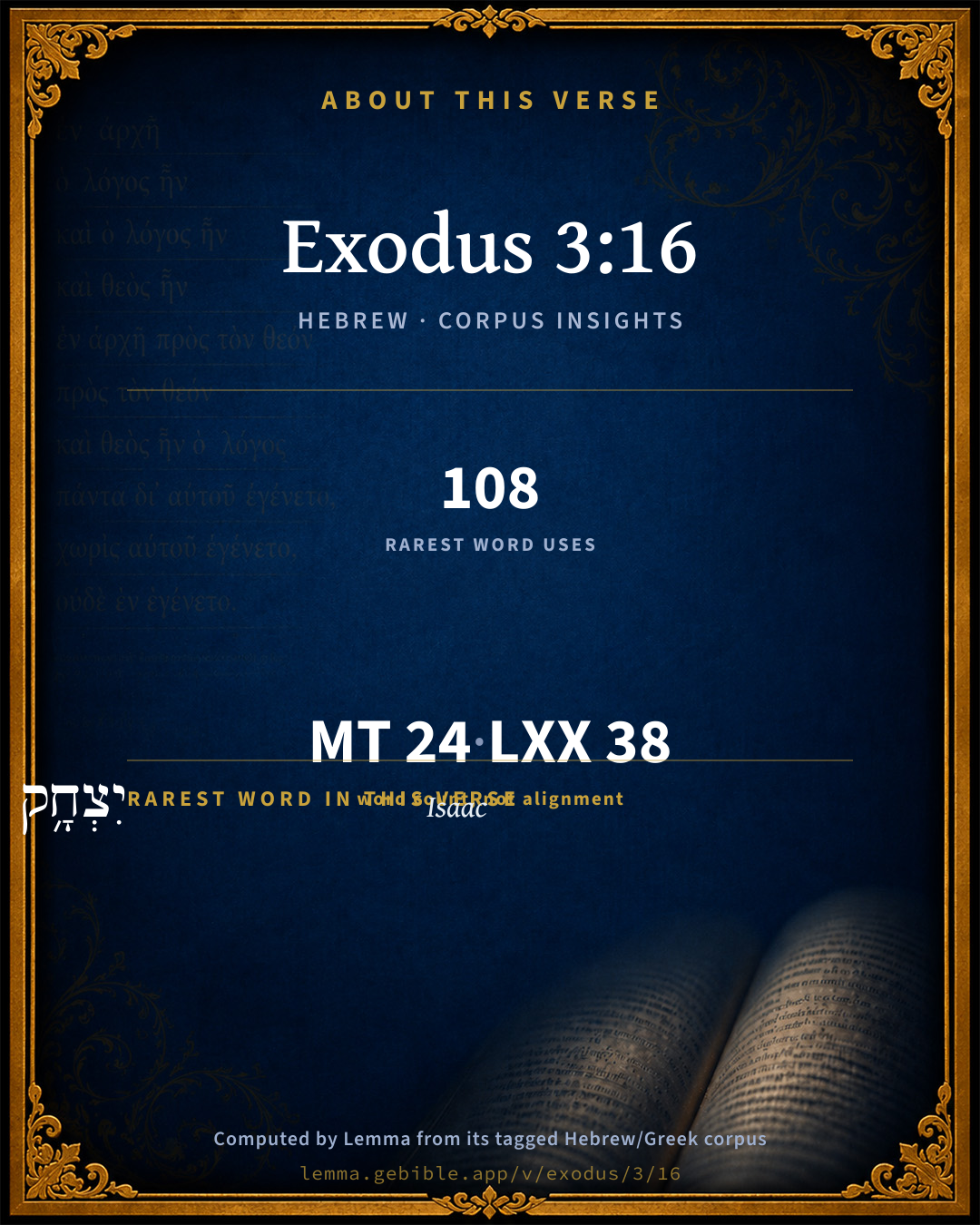
24
words
17
distinct lemmas
Pentateuch
section

Grammatical profile

  • 8 verbs
  • 9 nouns
  • 1 adjective
  • 3 prepositions
  • 3 particles

Verb forms

  • לֵ֣ךְ Qal · Imperative
  • וְאָֽסַפְתָּ֞ Qal · Sequential Perfect
  • וְאָמַרְתָּ֤ Qal · Sequential Perfect
  • נִרְאָ֣ה Niphal · Perfect
  • לֵאמֹ֑ר Qal · Infinitive Construct
  • פָּקֹ֤ד Qal · Infinitive Absolute
  • פָּקַ֨דְתִּי֙ Qal · Perfect
  • הֶעָשׂ֥וּי Qal · Participle Passive

Repetition

Words recur within this verse — often emphatic in Hebrew:

  • וְאָמַרְתָּ֤ to say H559 ×2
  • אֱלֹהֵ֤י God H430 ×2
  • פָּקֹ֤ד to visit H6485 ×2
  • אֲלֵהֶם֙ to H413 ×2

Hebrew & Septuagint length

In English translation the verse runs 46 words from the Hebrew and 58 from the Septuagint (LXX English) — closely comparable.

A rough comparison of the two English renderings, which tokenize alike — not a word-level alignment.

Word counts can differ between the Hebrew and the Greek without any difference in meaning — e.g. the Hebrew direct-object marker אֵת has no separate Greek word, and Greek often adds the article ὁ.

In the original languages it is 24 Hebrew tokens and 38 Greek tokens — but the two are counted differently (Hebrew bundles its prefixes and suffixes into one token; the Greek is in lemma form), so that isn’t a like-for-like length.

Cross-references

23

Topical passages linked to Exodus 3:16 in the Treasury of Scripture Knowledge — connected by theme and wording, ordered by reader-vote popularity; previews shown in the World English Bible.

  • Psalms 8:4 What is man, that you think of him? The son of man, that you care for him?
  • Exodus 4:29 Moses and Aaron went and gathered together all the elders of the children of Israel.
  • Exodus 4:31 The people believed, and when they heard that Yahweh had visited the children of Israel, and that he had seen their affliction, then they bowed their heads and worshiped.
  • Genesis 50:24 Joseph said to his brothers, "I am dying, but God will surely visit you, and bring you up out of this land to the land which he swore to Abraham, to Isaac, and to Jacob."
  • Acts 15:14 Simeon has reported how God first visited the Gentiles, to take out of them a people for his name.
  • Genesis 21:1 Yahweh visited Sarah as he had said, and Yahweh did to Sarah as he had spoken.
  • Exodus 2:25 God saw the children of Israel, and God was concerned about them.
  • Exodus 3:2 The angel of Yahweh appeared to him in a flame of fire out of the midst of a bush. He looked, and behold, the bush burned with fire, and the bush was not consumed.
  • Exodus 4:5 "That they may believe that Yahweh, the God of their fathers, the God of Abraham, the God of Isaac, and the God of Jacob, has appeared to you."
  • Exodus 13:19 Moses took the bones of Joseph with him, for he had made the children of Israel swear, saying, "God will surely visit you, and you shall carry up my bones away from here with you."
  • Ruth 1:6 Then she arose with her daughters-in-law, that she might return from the country of Moab: for she had heard in the country of Moab how that Yahweh had visited his people in giving them bread.
  • Matthew 26:3 Then the chief priests, the scribes, and the elders of the people were gathered together in the court of the high priest, who was called Caiaphas.
  • Luke 1:68 "Blessed be the Lord, the God of Israel, For he has visited and worked redemption for his people;
  • Luke 19:44 and will dash you and your children within you to the ground. They will not leave in you one stone on another, because you didn't know the time of your visitation."
  • Acts 11:30 which they also did, sending it to the elders by the hands of Barnabas and Saul.
  • Acts 20:17 From Miletus he sent to Ephesus, and called to himself the elders of the assembly.
  • Hebrews 2:6–7 But one has somewhere testified, saying, "What is man, that you think of him? Or the son of man, that you care for him?
  • 1 Peter 2:12 having good behavior among the nations, so in that which they speak against you as evil-doers, they may by your good works, which they see, glorify God in the day of visitation.
  • 1 Peter 5:1 I exhort the elders among you, as a fellow elder, and a witness of the sufferings of Christ, and who will also share in the glory that will be revealed.
  • Genesis 1:7 God made the expanse, and divided the waters which were under the expanse from the waters which were above the expanse, and it was so.
  • Exodus 15:14 The peoples have heard. They tremble. Pangs have taken hold on the inhabitants of Philistia.
  • Exodus 18:12 Jethro, Moses' father-in-law, took a burnt offering and sacrifices for God. Aaron came with all of the elders of Israel, to eat bread with Moses' father-in-law before God.
  • Exodus 24:11 He didn't lay his hand on the nobles of the children of Israel. They saw God, and ate and drank.

Cross-references courtesy of OpenBible.info (CC BY 4.0).

Hebrew and Greek witnesses Masoretic Hebrew ↔ Greek Septuagint

The same verse in the two great witnesses to the Old Testament, shown verse-for-verse.

These are two independent witnesses, not word-aligned to each other, and the Septuagint is shown in lemma (dictionary) form.

Hebrew Exodus 3:16 Masoretic · Westminster Leningrad Codex

לֵ֣ךְ וְאָֽסַפְתָּ֞ אֶת זִקְנֵ֣י יִשְׂרָאֵ֗ל וְאָמַרְתָּ֤ אֲלֵהֶם֙ יְהוָ֞ה אֱלֹהֵ֤י אֲבֹֽתֵיכֶם֙ נִרְאָ֣ה אֵלַ֔י אֱלֹהֵ֧י אַבְרָהָ֛ם יִצְחָ֥ק וְיַעֲקֹ֖ב לֵאמֹ֑ר פָּקֹ֤ד פָּקַ֨דְתִּי֙ אֶתְכֶ֔ם וְאֶת הֶעָשׂ֥וּי לָכֶ֖ם בְּמִצְרָֽיִם

Go, and gather the elders of Israel together, and tell them, 'Yahweh, the God of your fathers, the God of Abraham, of Isaac, and of Jacob, has appeared to me, saying, "I have surely visited you, and seen that which is done to you in Egypt;

World English Bible · Public Domain

Greek LXX Exodus 3:16 Septuagint · lemma form

ἔρχομαι οὖν συνἄγω ὁ γερουσία ὁ υἱός ἰσραήλ καί εἶπον πρός αὐτός κύριος ὁ θεός ὁ πατήρ σύ ὁράω ἐγώ θεός αβρααμ καί θεός ισαακ καί θεός ἰακώβ λέγω ἐπισκοπή ἐπισκέπτω σύ καί ὅσος συνβαίνω σύ ἐν αἴγυπτος

Go then and gather the elders of the children of Israel, and you shall say to them, The Lord God of our fathers has appeared to me, the God of Abraam, and God of Isaac, and God of Jacob, saying, I have surely looked upon you, and upon all the things which have happened to you in Egypt.

LXX2012 (modern English Septuagint) · Public Domain

On this verse, Keil & Delitzsch discusses the Septuagint’s reading. Read the note in Commentary ↓

Hebrew: Westminster Leningrad Codex (CC BY 4.0). Greek: Septuagint (public domain); English from LXX2012 (modern English Septuagint) (Public Domain). How the Septuagint differs from the Hebrew →

Targum (Aramaic paraphrase)

2

The Targum is the ancient Jewish Aramaic paraphrase of the Hebrew Scriptures — an interpretive translation, not the Hebrew text itself. Onkelos (literal) and Pseudo-Jonathan (expansive) render the Torah, and Jonathan the Prophets. Coverage is partial: where no permissively-licensed English translation exists for a verse, only the Aramaic is shown. This is verse-level text, not a word-by-word alignment to the Hebrew.

  1. Targum Onkelos Torah (Genesis–Deuteronomy)
    אִזֵיל וְתִכְנוֹשׁ יָת סָבֵי יִשְׂרָאֵל וְתֵימַר לְהוֹן יְיָ אֱלָהָא דְאַבְהַתְכוֹן אִתְגְלֵי לִי אֱלָהֵהּ דְאַבְרָהָם יִצְחָק וְיַעֲקֹב לְמֵימָר מִדְכַּר דְכִירְנָא יַתְכוֹן וְיָת דְאִתְעֲבַד לְכוֹן בְּמִצְרַיִם:

    (no public-domain English translation for this verse)

    Targum Onkelos — Aramaic: “Onkelos Genesis” (public domain); “Onkelos Exodus” (public domain); “Onkelos Leviticus” (public domain); “Onkelos Numbers” (public domain); “Onkelos Deuteronomy” (public domain). English: “Sefaria Community Translation” (CC0 1.0 (public-domain dedication)); “J.W. Etheridge. The Targums of Onkelos and Jonathan Ben Uzziel on the Pentateuch. London: Longmans, Green, 1862” (public domain). Text via Sefaria.

  2. Targum Pseudo-Jonathan Torah (Genesis–Deuteronomy)
    אִיזֵל וְתִכְנוֹש יַת סָבֵי יִשְרָאֵל וְתֵימַר יְיָ אֱלָהָא דְאַבְהַתְכוֹן אִתְגְלֵי לִי אֱלָהֵיהּ דְאַבְרָהָם יִצְחָק וְיַעֲקב לְמֵימַר מִידְכַּר דְכִירְנָא יַתְכוֹן וְיַת עוּלְבָנָא דְאִיתְעֲבִיד לְכוֹן בְּמִצְרַיִם

    Go, and assemble the elders of Israel, and say to them, The Lord God of your fathers hath appeared unto me, the God of Abraham, Izhak, and Jakob, saying, Remembering, I have remembered you, and the injury that is done you in Mizraim;

    Targum Pseudo-Jonathan — Aramaic: “Targum Jonathan on Genesis” (public domain); “Targum Jonathan on Exodus” (public domain); “Targum Jonathan on Leviticus” (public domain); “Targum Jonathan on Numbers” (public domain); “Targum Jonathan on Deuteronomy” (public domain). English: “The Targum of Jonathan ben Uzziel, trans. J. W. Etheridge, London, 1862” (public domain). Text via Sefaria.

Commentary

Notes on Exodus 3:16 from classic Christian and Jewish commentators (each source and its license shown beneath its notes). The classic Christian expositions comment on the surrounding passage and are grouped to its opening verse, so a note may address several verses; the Jewish commentaries on the Tanakh (Rashi and others) are per-verse, so they appear only where the commentator wrote on this verse.

Lemma curates 59 commentaries, every one of them public domain or Creative Commons licensed, each selected and text-cleaned for this edition rather than reprinted as found. About our sources →

Matthew Henry's Commentary

Moses is here more particularly instructed in his work, and informed beforehand of his success. 1. He must deal with the elders of Israel, and raise their expectation of a speedy removal to Canaan, Exo 3:16, Exo 3:17. He must repeat to them what God had said to him, as a faithful ambassador. Note, That which ministers have received of the Lord they must deliver to his people, and keep back nothing that is profitable. Lay an emphasis on that, Exo 3:17 : "I have said, I will bring you up; that is enough to satisfy them, I have said it:" hath he spoken, and will he not make it good? With us saying and doing are two things, but they are not so with God, for he is in one mind and who can turn him? "I have said it, and all the world cannot gainsay it. My counsel shall stand." His success with the elders of Israel would be good; so he is told (Exo 3:18): They shall hearken to thy voice, and not thrust thee away as they did forty years ago. He who, by his grace, inclines the heart, and opens the ear, could say beforehand, They shall hearken to thy voice, having determined to make them willing in this day of power. 2. He must deal with the king of Egypt (Exo 3:18), he and the elders of Israel, and in this they must not begin with a demand, but with a humble petition; that gentle and submissive method must be first tried, even with one who, it was certain, would not be wrought upon by it: We beseech thee, let us go. Moreover, they must only beg leave of Pharaoh to go as far as Mount Sinai to worship God, and say nothing to him of going quite away to Canaan; the latter would have been immediately rejected, but the former was a very modest and reasonable request, and his denying it was utterly inexcusable and justified them in the total deserting of his kingdom. If he would not give them leave to go and sacrifice at Sinai, justly did they go without leave to settle in Canaan. Note, The calls and commands which God sends to sinners are so highly reasonable in themselves, and delivered to them in such a gentle winning way, that the mouth of the disobedient must needs be for ever stopped. As to his success with Pharaoh, Moses is here told, (1.) That petitions, and persuasions, and humble remonstrances, would not prevail with him, no, nor a mighty hand stretched out in signs and wonders: I am sure he will not let you go, Exo 3:19. Note, God sends his messengers to those whose hardness and obstinacy he certainly knows and foresees, that it may appear he would have them turn and live. (2.) That plagues should compel him to it: I will smite Egypt, and then he will let you go, Exo 3:20. Note, Those will certainly be broken by the power of God's hand that will not bow to the power of his word; we may be sure that when God judges he will overcome. (3.) That his people should be more kind to them, and furnish them at their departure with abundance of plate and jewels, to their great enriching: I will give this people favour in the sight of the Egyptians, Exo 3:21, Exo 3:22. Note, [1.] God sometimes makes the enemies of his people, not only to be at peace with them, but to be kind to them. [2.] God has many ways of balancing accounts between the injured and the injurious, of righting the oppressed, and compelling those that have done wrong to make restitution; for he sits in the throne judging right.

Matthew Henry's Commentary on the Whole Bible (1708–1710) — public domain (CC PDM 1.0). Text via the HelloAO Bible API.

Trapp's Complete Commentary

John Trapp

Exo 3:16 Go, and gather the elders of Israel together, and say unto them, The LORD God of your fathers, the God of Abraham, of Isaac, and of Jacob, appeared unto me, saying, I have surely visited you, and [seen] that which is done to you in Egypt:

Ver. 16. The God of Abraham, &c.] His friends, with whom he had all things common. This was a greater honour done to these patriarchs than if God had written their names in the visible heavens, to be read of all men.

John Trapp, A Commentary or Exposition upon All the Books of the Old and New Testament (1647–1656) — public domain. Text from a community e-Sword module.

The Biblical Illustrator

Joseph S. Exell

Exo_3:16

Gather the elders.

The wisdom of gathering the few; or the considerateness of the Divine Being in reference to the mission of His servants

I. This would be the most effective method of enlightening the mind of the nation in reference to the Divine intention.

1. This afforded Moses a good opportunity for personal explanations.

2. It was a good precaution against the ignorance and fanaticism of the common people. The more agencies a man can bring into his life-work the better.

II. It would be the most effective method of gaining the sympathy of the nation. All great workers should be judicious in their movement.

III. It would thus be the most effective method of working out the Divine project in reference to the nation.

1. How considerate of the Divine Being to give Moses this idea of working! Many men will not listen to the Divine instructions. This is the occasion of the great failure of so much religious energy.

2. How numerous are the agencies put in motion for the performance of Divine projects. God is the source of all commissions for the moral good of man.

3. All great workers may find a pattern here. Not to trust their new and Divine enterprises to the tide of popular opinion--storms may gather--may be wrecked. Launch them first on the more tranquil waters of the few--afterwards they will be more likely to weather the national gale. (J. S. Exell, M. A.)

The Biblical Illustrator, edited by Joseph S. Exell (c. 1880s–1900s) — public domain. Text from a community e-Sword module.

Tyndale Open Study Notes

Tyndale Open Resources

3:16-17 Moses was to tell the people of Israel that the God who now spoke to them was the same God their ancestors knew and worshiped, and that he would lead them into a fruitful land wrested from the hands of many others. Moses’ message was not a magical formula, but the word of a God who, standing outside of history, can yet enter and direct it. • flowing with milk and honey: See study note on 3:8.

Tyndale Open Study Notes — © Tyndale Open Resources, licensed CC BY-SA 4.0. Text via the HelloAO Bible API.

Geneva Bible (1599)

Geneva Bible translators

Hebrew, in visiting have visited.

Geneva Bible (1599) marginal notes — public domain. Text via Bolls.life.

Adam Clarke's Commentary

Verse 16. Elders of Israel] Though it is not likely the Hebrews were permitted to have any regular government at this time, yet there can be no doubt of their having such a government in the time of Joseph, and for some considerable time after; the elders of each tribe forming a kind of court of magistrates, by which all actions were tried, and legal decisions made, in the Israelitish community.

I have surely visited you] An exact fulfillment of the prediction of Joseph, Ge 50:24, God will surely visit you, and in the same words too.

Adam Clarke's Commentary on the Bible (1810–1826) — public domain. Text from a community e-Sword/MySword module.

Ellicott's Commentary for English Readers

(16) The elders of Israel.—Not so much the old men generally, as the rulers—those who bore authority over the rest—men of considerable age, no doubt, for the most part. Rosenmüller reasonably concludes from this direction that the Hebrews, even during the oppression, enjoyed some kind of internal organisation and native government (Schol, in Exod. p. 58).

I have surely visited.—Heb., Visiting, I have visited. (Comp. Gen_1:24.)

A Bible Commentary for English Readers, edited by Charles John Ellicott (1878–1897) — public domain. Text from a community e-Sword module.

The Cambridge Bible for Schools and Colleges

gen. ed. J. J. S. Perowne

16. the elders] the older and leading men of the different families. Often mentioned as the representatives of the people: v. 18, Exo_4:29, Exo_17:5-6, Exo_18:12 al.

visited] i.e. shewn practical interest in, noticed in some practical way (Gen_21:1; Luk_1:68; Luk_7:16): so Exo_4:31; Exo_18:19 (Gen_50:24).

16–18. Moses is to gather together the elders of Israel, and communicate to them God’s purpose to lead His people into Canaan: they will listen to him; and the Pharaoh is then to be asked to allow a pilgrimage to worship Jehovah in the wilderness.

The Cambridge Bible for Schools and Colleges (gen. ed. J. J. S. Perowne; Cambridge University Press, 1878–1918) — public domain. Text from a community e-Sword module.

John Gill's Exposition

Go and gather the elders of Israel together,.... Not all the ancient men among them, nor the "judges" of the people of Israel; for it does not appear there were such among them in Egypt, until they came into the land of Canaan, but the heads of tribes or families:

and say unto them, the Lord God of your fathers, the God of Abraham, of Isaac, and of Jacob, appeared unto me; in a flame of fire in the midst of a bush at Horeb:

saying, I have surely visited you, and seen that which is done to you in Egypt; inspected into their state and circumstances, took notice of their afflictions and oppressions, and determined to deliver them out of them, as follows.

John Gill's Exposition of the Whole Bible (1746–1763) — public domain (CC PDM 1.0). Text via the HelloAO Bible API.

Haydock's Catholic Bible Commentary

Ancients. Perhaps there might be 72 magistrates already among the Hebrews, as there were afterwards in the desert (Grotius); or more probably they were only the chiefs of families, and leading men among their brethren, though without any public authority derived from the king of Egypt. --- Visiting. So Joseph had foretold, Genesis l. 23. God examines before he punishes, Genesis xviii. 21. (Calmet)

George Leo Haydock (1774–1849), Haydock's Catholic Family Bible and Commentary, 1859 edition — public domain. Excludes Psalms (Douay-Rheims chapter numbering differs from Protestant) and Deuterocanonical books (Catholic canon only).

Matthew Poole's English Annotations

The elders; either by age, or rather by office and authority. For though they were all slaves to the Egyptians, yet among themselves they retained some order and government, and had doubtless some whom they owned as their teachers and rulers, as. heads of tribes and families, &c.

Matthew Poole's English Annotations on the Holy Bible (1683–1685) — public domain. Text from a community e-Sword/MySword module.

The Pulpit Commentary

Gather the elders. It is generally thought that we are to understand by "the elders" not so much the more aged men, as these who bore a certain official rank and position among their brethren, the heads of the various houses, (Exo_6:14, 25 11:2) who exercised a certain authority even during the worst times of the oppression. Moses was first to prevail, on them to acknowledge his mission, and was then to go with them to Pharaoh and make his representation (ver. 18). I have surely visited you. The words are a repetition of those used by Joseph on his deathbed, (Gen_50:24) and may be taken to mean, "I have done as Joseph prophesied I have made his words good thus far. Expect, therefore, the completion of what he promised.

The Divine injunction to gather the elders.

God here added another injunction to those which he had previously given (ver. 10), as to the modus operandi which Moses was to adopt. He was to go to the children of Israel, but not immediately or as the first step. Before making any appeal to them he was, in the first instance, to "gather the elders of Israel together." In this is involved a principle of very general application. When great designs are on hand, consultation should first be with the few. With the few matters can be calmly and quietly discussed, without passion or prejudice; questions can be asked, explanations given. And the few will have influence with the many. This was the whole idea of ancient government, which was by a king, a council, and an assembly of the people, which last was expected to ratify the council"s decision. Direct appeal to the masses is, as much as possible, to be avoided. The masses are always, comparatively speaking, ignorant, stolid, unimpressible. Great ideas take root and grow by being first communicated in their fulness to a "little flock," who spread them among their companions and acquaintance, until at length they prevail generally. So our Lord called first the Twelve, and then the Seventy, and made known his doctrine to them, leaving it to them to form the Church after his ascension.

Vers. 16-22. The two messages.

I THE MESSAGE TO THE ELDERS OF ISRAEL (vers. 16-18). Moses was to go first to the elders of the people. First before he went to Pharaoh; and first before communicating with any of the people. This arrangement was

1. Necessary. The people"s consent must be obtained to their own deliverance. God would have them co-operate with him

(1) Freely.

(2) Intelligently; would carry them with him as free agents in all he did.

This applies to the higher Redemption. Men cannot be saved without their own consent. We must, in the sense of Php_2:12, work out our own salvation must co-operate with God, by freely adopting and falling in with his method of grace. There must be free choice of Christ as our Saviour, free compliance with the directions of the Gospel, free cooperation with the Spirit in the work of our sanctification.

2. Wise. The elders were the representatives of the people. They had a claim to be approached first. They were men of experience, and were better able to judge deliberately of the proposals laid before them. They had exceptional facilities for diffusing information, while communication with them would have the additional advantage of greater privacy. If Moses could satisfy the elders of his Divine commission, and could gain their intelligent consent to his proposals, the consent of the people would readily be forthcoming. So Paul, in going up to Jerusalem, communicated the Gospel he had received "privately to them which were of reputation, to "James, Cephas, and John, who seemed to be pillars". (Gal_2:2-9) And it was not till Jesus had been decisively rejected by the authorities in Jerusalem that he commenced a popular ministry in Galilee. Learn lessons

(1) Of the respect due to constituted authorities.

(2) Of the value of representative institutions.

(3) Of the need of prudence and caution in the initiation and conduct of public movements.

3. Kindly. No time was to be lost in carrying to the Israelites the tidings of approaching deliverance. The message brought to them was a true gospel. Mark its nature. It told how God had seen their affliction, and had visited them, and would redeem them from bondage. This gives no sanction to Ewald"s theory, that the Exodus had its origin in a powerful movement in the nation itself most extraordinary exertions, and most noble activities of the spirit wrestling for freedom." The narrative says nothing of this mighty spiritual movement, but represents the people as lying hopeless and helpless till God visited them; their help did not come from themselves, but from God. The two views well illustrate the two ways of conceiving the possibility of man"s deliverance from the woes that oppress him. The one the humanitarian trusts to recuperative powers inherent in the race, to its own "extraordinary exertions" and noble spiritual activities and predicts for it a glorious future wrought out by its own efforts. The other the Christian has no such hope. It views the race as lying in a state of moral and spiritual helplessness, and recognises the necessity of a salvation coming to it from without. "We look," says Neander, "upon Christianity, not as a power that has sprung up out of the hidden depths of man"s nature, but as one which descended from above, when heaven opened itself anew to man"s long-alienated race; a power which, as both in its origin and essence it is exalted above all that human nature can create out of its own resources, was designed to impart to that nature a new life, and to change it in its inmost principles.

II THE MESSAGE TO PHARAOH (ver. 18). Moses, with the elders, was to go to Pharaoh, and demand of him that the Hebrews be allowed to take a three days" journey into the wilderness, there to sacrifice to Jehovah. Note on this request

1. Its honesty. The ultimate design was to lead Israel out of Egypt altogether. If this first request was studiously made moderate, it was not with the intention of deceiving Pharaoh, but that it might be the easier for him to grant it. The demand was made in perfectly good faith. What was asked sufficed to test the king"s disposition. Had Pharaoh yielded, no advantage would have been taken of his compliance to effect a dishonourable escape from Egypt. New announcements would doubtless have been made to him, rewarding him as amply for obedience to this first word of God as afterwards he was punished for disobedience to it, and informing him further of the Divine intentions.

2. Its incompleteness. For this demand bore on the face of it that it was not the whole. It told Pharaoh his immediate duty, but beyond that left matters in a position requiring further revelation. Whatever was to follow the three days" journey, it was certain that "the God of the Hebrews," who had met with them, would never consent to his worshippers being sent back again to bondage. That Pharaoh must plainly enough have perceived, and Moses made no attempt to dissemble it. Learn

(1) God"s counsels are revealed to men bit by bit.

(2) When present duty is revealed to us, we ought to act on that, though ignorant of all that is to follow.

(3) God partially hides his counsels from men, that the spirit of obedience may be tested.

(4) The gravest consequences may hang on first acts of obedience or disobedience.

III PHARAOH"S REJECTION OF GOD"S MESSAGE (vers. 18-22.)

1. It was foreseen by God (ver. 19). Yet

2. It did not hinder the execution of God"s purpose (ver. 20). WhetherPharaoh willed or not, the Exodus would take place. If not with his consent, then against it, and "by a mighty hand." Pharaoh"s disobedience would be overruled

(1) To God"s glory. The clay cannot escape from the hand of the potter. (Jer_18:6; Rom_9:21) If Pharaoh will not be made a vessel unto honour, he will be moulded into a vessel unto dishonour, and made to subserve God"s purpose in another way. (Exo_9:16)

(2) To his own hurt (ver. 20). His disobedience would bring on him wrath and destruction. "Woe unto him that striveth with his Maker!". (Isa_45:9)

(3) To the enrichment of the people (vers. 21-22). The Egyptians would be glad in the end to give the Hebrews whatever they wished. So would they "spoil the Egyptians." Believers" trials tend to their ultimate enrichment. (2Co_4:18) And it is the saints of God who shall yet inherit the earth. Learn also that whatever is valuable in the world"s learning, science, literature, or art, is not to be despised, but to be freely appropriated by the Church, and used in God"s service. J.O.

The Pulpit Commentary (1880–1919), ed. H.D.M. Spence-Jones & Joseph S. Exell — public domain. Text from a community e-Sword module.

Keil & Delitzsch

C. F. Keil & F. Delitzsch

With the command, "Go and gather the elders of Israel together," God then gave Moses further instructions with reference to the execution of his mission. On his arrival in Egypt he was first of all to inform the elders, as the representatives of the nation (i.e., the heads of the families, households, and tribes), of the appearance of God to him, and the revelation of His design, to deliver His people out of Egypt and bring them to the land of the Canaanites. He was then to go with them to Pharaoh, and make known to him their resolution, in consequence of this appearance of God, to go a three days' journey into the wilderness and sacrifice to their God. The words, "I have surely visited," point to the fulfilment of the last words of the dying Joseph (Gen 50:24). עלינוּ נקרה (Exo 3:18) does not mean "He is named upon us" (lxx, Onk., Jon.), nor "He has called us" (Vulg., Luth.). The latter is grammatically wrong, for the verb is Niphal, or passive; and though the former has some support in the parallel passage in Exo 5:3, inasmuch as נקרא is the verb used there, it is only in appearance, for if the meaning really were "His name is named upon (over) us," the word שׁמו (שׁם) would not be omitted (vid., Deu 28:10; Ch2 7:14). The real meaning is, "He has met with us," from נקרה, obruam fieri, ordinarily construed with אל, but here with על, because God comes down from above to meet with man. The plural us is used, although it was only to Moses that God appeared, because His appearing had reference to the whole nation, which was represented before Pharaoh by Moses and the elders. In the words נלכה־נא, "we will go, then," equivalent to "let us go," the request for Pharaoh's permission to go out is couched in such a form as to answer to the relation of Israel to Pharaoh. He had no right to detain them, but he had a right to consent to their departure, as his predecessor had formerly done to their settlement. Still less had he any good reason for refusing their request to go a three days' journey into the wilderness and sacrifice to their God, since their return at the close of the festival was then taken for granted. But the purpose of God was, that Israel should not return. Was it the case, then, that the delegates were "to deceive the king," as Knobel affirms! By no means. God knew the hard heart of Pharaoh, and therefore directed that no more should be asked at first than he must either grant, or display the hardness of his heart. Had he consented, God would then have made known to him His whole design, and demanded that His people should be allowed to depart altogether. But when Pharaoh scornfully refused the first and smaller request (Exo 5), Moses was instructed to demand the entire departure of Israel from the land (Exo 6:10), and to show the omnipotence of the God of the Hebrews before and upon Pharaoh by miracles and heavy judgments (Heb 7:8.). Accordingly, Moses persisted in demanding permission for the people to go and serve their God (Exo 7:16; Exo 8:1; Exo 9:1, Exo 9:13; Exo 10:3); and it was not till Pharaoh offered to allow them to sacrifice in the land that Moses replied, "We will go three days' journey into the wilderness, and sacrifice to Jehovah our God" (Exo 8:27); but, observe, with this proviso, "as He shall command us," which left, under the circumstances, no hope that they would return. It was an act of mercy to Pharaoh, therefore, on the one hand, that the entire departure of the Israelites was not demanded at the very first audience of Moses and the representatives of the nation; for, had this been demanded, it would have been far more difficult for him to bend his heart in obedience to the divine will, than when the request presented was as trifling as it was reasonable. And if he had rendered obedience to the will of God in the smaller, God would have given him strength to be faithful in the greater. On the other hand, as God foresaw his resistance (Exo 3:19), this condescension, which demanded no more than the natural man could have performed, was also to answer the purpose of clearly displaying the justice of God. It was to prove alike to Egyptians and Israelites that Pharaoh was "without excuse," and that his eventual destruction was the well-merited punishment of his obduracy.

(Note: "This moderate request was made only at the period of the earlier plagues. It served to put Pharaoh to the proof. God did not come forth with His whole plan and desire at first, that his obduracy might appear so much the more glaring, and find no excuse in the greatness of the requirement. Had Pharaoh granted this request, Israel would not have gone beyond it; but had not God foreseen, what He repeatedly says (compare, for instance, Exo 3:18), that he would not comply with it, He would not thus have presented it; He would from the beginning have revealed His whole design. Thus Augustine remarks (Quaest. 13 in Ex.)." Hengstenberg, Diss. on the Pentateuch. vol. ii. p. 427, Ryland's translation. Clark, 1847.)

חזקה ביד ולא, "not even by means of a strong hand;" "except through great power" is not the true rendering, ולא does not mean ἐὰν μὴ, nisi. What follows, - viz., the statement that God would so smite the Egyptians with miracles that Pharaoh would, after all, let Israel go (Exo 3:20), - is not really at variance with this, the only admissible rendering of the words. For the meaning is, that Pharaoh would not be willing to let Israel depart even when he should be smitten by the strong hand of God; but that he would be compelled to do so against his will, would be forced to do so by the plagues that were about to fall upon Egypt. Thus even after the ninth plague it is still stated (Exo 10:27), that "Pharaoh would (אבה) not let them go;" and when he had given permission, in consequence of the last plague, and in fact had driven them out (Exo 12:31), he speedily repented, and pursued them with his army to bring them back again (Exo 14:5.); from which it is clearly to be seen that the strong hand of God had not broken his will, and yet Israel was brought out by the same strong hand of Jehovah.

Keil & Delitzsch — Biblical Commentary on the Old Testament (1861–1891) — public domain (CC PDM 1.0). Text via the HelloAO Bible API. (Old Testament only.)

unfoldingWord translationNotes

Door43 World Missions Community

General Information:

God continues speaking to Moses.

the God of your ancestors, the God of Abraham, of Isaac, and of Jacob

Abraham, Isaac and Jacob were three of Moses's ancestors. They all worshiped the same God.

I have indeed observed you

The word "you" refers to the people of Israel.

a land flowing with milk and honey

"a land where milk and honey flow." God spoke of the land being good for animals and plants as if the milk and honey from those animals and plants were flowing through the land. See how you translated this in Exodus 3:8. AT: "a land that is excellent for raising livestock and growing crops" (See: Metaphor and Metonymy)

flowing with

"full of" or "with an abundance of"

milk

Since milk comes from cows and goats, this represents food produced by livestock. AT: "food from livestock" (See: Metonymy)

honey

Since honey is produced from flowers, this represents food from crops. AT: "food from crops" (See: Metonymy)

They will listen to you

The word "you" refers to Moses. AT: "The elders will listen to you"

translationWords

elder

Israel

Yahweh

Canaan

Hittite

Amorite

Perizzite

Jebus

Pharaoh

Hebrew

desert

sacrifice

unfoldingWord translationNotes — © Distant Shores Media and the Door43 World Missions Community, licensed CC BY-SA 4.0. Source: git.door43.org/Door43/en_tn.

Rashi

Rabbi Shlomo Yitzchaki (Rashi)

את זקני ישראל THE ELDERS OF ISRAEL, those singled out to attend meetings, (i. e. the leaders) (cf. Yoma 28b). If, however, you should say that the text means old men in the ordinary sense I ask: How was it possible for him to gather all the old men amongst a male population of 600,000?

Rashi on the Tanakh — English translations: “The Judaica Press complete Tanach with Rashi, translated by A. J. Rosenberg” (CC BY 4.0); “Pentateuch with Rashi's commentary by M. Rosenbaum and A.M. Silbermann, 1929-1934” (public domain); “The Metsudah Tanach series, Lakewood, N.J” (CC BY 4.0); and “The Book of Joshua, Metsudah Publications, 1997” (CC BY 4.0). Text via Sefaria.

Lesson kit

Teaching starters — assembled from the data on this page, not authored interpretation. Every prompt links to the verse data it draws on. Edit before teaching.

Exodus, in the Pentateuch, opens this verse with 24 words (17 distinct Hebrew lemmas). Its most distinctive word is Yitschâq (“Isaac”). A historical commentator’s framing appears above. Read the whole chapter for the surrounding context.

Discussion questions

  1. What does “Isaac” (Yitschâq) contribute to the verse as a whole?
  2. Psalms 8:4 shares this passage’s theme. How do the two illuminate each other?
  3. “to say” occurs 2× in this one verse. What is the effect of the repetition?
  4. These translations render this verse differently; the difference is in the English rendering, not the original. What questions does that raise?
  5. The verb «לֵ֣ךְ» is Qal Imperative. How does its form color the action?
  6. Reading how Matthew Henry's Commentary and Trapp's Complete Commentary read this verse, where do the two commentators agree and where do they part?

Things to notice

Reading settings

Reading text

Shown beneath each verse's original-language words.

Old Testament
Old Testament edition

Read the OT as the Masoretic Hebrew (MT) or the Greek Septuagint (LXX).

English shown for the Greek Septuagint (in the Hebrew ↔ Greek comparison).

Comparing translations? Open the Compare panel on any verse page to stack up to four side by side.