Genesis 27:39

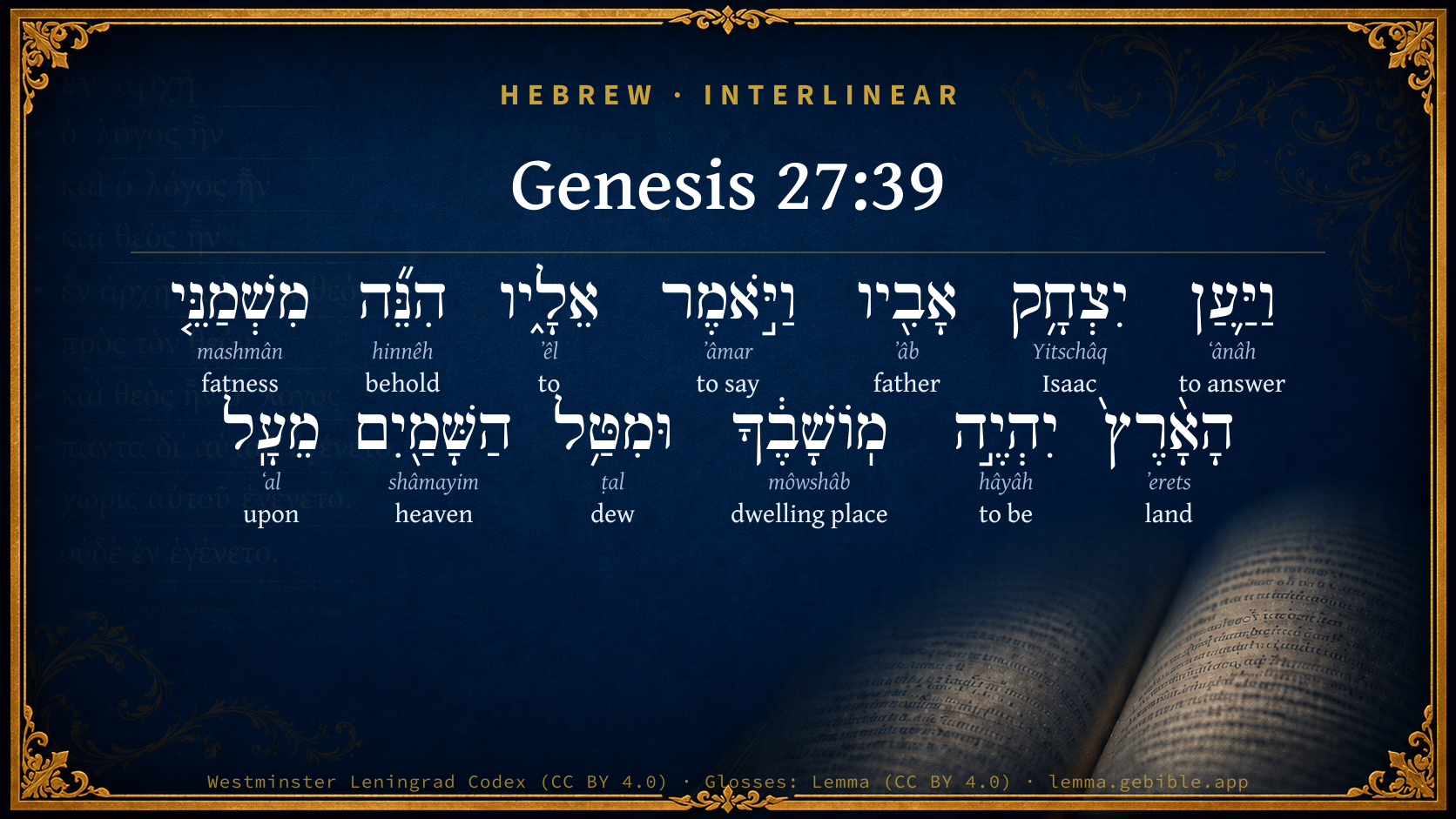
Hebrew (Westminster Leningrad Codex) Genesis 27:39 appears in the Hebrew Old Testament. The text above is from the Westminster Leningrad Codex. Each word links to its Strong’s number, a concise gloss, and parsing drawn from the Open Scriptures Hebrew Bible morphology. Click any word for its full Brown-Driver-Briggs (BDB) entry.
Download image
Cite this verse

Genesis 27:39 (World English Bible). Public Domain. Lemma interlinear Bible study tool, https://lemma.gebible.app/v/genesis/27/39.

Show BibTeX & RIS
BibTeX
RIS
English Translation
Isaac his father answered him, "Behold, of the fatness of the earth will be your dwelling, and of the dew of the sky from above.
World English Bible · Public Domain
Download a study sheet

One document with this verse’s original text, its word-by-word gloss line, the meaning frame, cross-references with their text, attributed commentary, and full source and license credits — printable, and it pastes into notes with its structure intact.

This verse Autodidact and up

Study sheet (.html) Plain text (.txt)

A passage Seminary Student

Up to 50 verses in one chapter. A passage sheet keeps up to 6 commentary sources and 12 cross-references per verse, in the order this page ranks them, and says so on the sheet whenever that leaves anything out. Ask for a single verse and you get the Autodidact verse sheet above.

Everything on this page stays free to read, with no account — the sheet is a download of what is already on screen, not access to it.

Want to remove ads? Support Godless Engineer
Compare translations 3

The same verse in 3 English versions, stacked beneath the original-language interlinear above. Click any original word for its lexicon entry.

Each is an independent rendering of the whole verse — the interlinear is not word-aligned to these translations.

Highlighted words mark where these versions differ — a whole-verse word diff, not a word-by-word alignment.

  • World English Bible Public Domain
    Isaac his father answered him, "Behold, of the fatness of the earth will be your dwelling, and of the dew of the sky from above.
  • King James Version Public Domain
    And Isaac his father answered and said unto him, Behold, thy dwelling shall be the fatness of the earth, and of the dew of heaven from above;
  • unfoldingWord Literal Text CC BY-SA 4.0
    Then Isaac his father responded and said to him, “Behold, your dwelling will be away from the fatness of the earth and away from the dew of the heavens from above.

unfoldingWord Literal Text — © unfoldingWord, licensed CC BY-SA 4.0. Word-aligned USFM3 via Door43 (git.door43.org/unfoldingWord/en_ult).

Versions to compare (up to 4)

3 of 4 selected

Show all 18 translations

Every available English version of this verse, each an independent rendering of the whole verse.

  • World English Bible Public Domain
    Isaac his father answered him, "Behold, of the fatness of the earth will be your dwelling, and of the dew of the sky from above.
  • Berean Standard Bible Public Domain
    His father Isaac answered him: “Behold, your dwelling place shall be away from the richness of the land, away from the dew of heaven above.
  • Majority Standard Bible Public Domain
    His father Isaac answered him: “Behold, your dwelling place shall be away from the richness of the land, away from the dew of heaven above.
  • King James Version Public Domain
    And Isaac his father answered and said unto him, Behold, thy dwelling shall be the fatness of the earth, and of the dew of heaven from above;
  • American Standard Version (1901) Public Domain
    And Isaac his father answered and said unto him, Behold, of the fatness of the earth shall be thy dwelling, And of the dew of heaven from above.
  • Revised Version (1885) Public Domain
    And Isaac his father answered and said unto him, Behold, of the fatness of the earth shall be thy dwelling, And of the dew of heaven from above;
  • Geneva Bible (1599) Public Domain
    Then Izhak his father answered, and sayde vnto him, Behold, the fatnesse of the earth shall be thy dwelling place, and thou shalt haue of the dewe of heauen from aboue.
  • Douay-Rheims (1899) Public Domain
    Isaac being moved, said to him: In the fat of the earth, and in the dew of heaven from above,
  • Young's Literal Translation Public Domain
    And Isaac his father answereth and saith unto him, `Lo, of the fatness of the earth is thy dwelling, and of the dew of the heavens from above;
  • Literal Standard Version CC BY-SA 4.0
    And his father Isaac answers and says to him, “Behold, of the fatness of the earth is your dwelling, and of the dew of the heavens from above;
  • Unlocked Literal Bible CC BY-SA 4.0
    Isaac his father answered and said to him, “Look, the place where you live will be far from the richness of the earth, away from the dew of the sky above.
  • unfoldingWord Literal Text CC BY-SA 4.0
    Then Isaac his father responded and said to him, “Behold, your dwelling will be away from the fatness of the earth and away from the dew of the heavens from above.
  • Darby Bible Public Domain
    And Isaac his father answered and said to him, Behold, thy dwelling shall be of the fatness of the earth, And of the dew of heaven from above;
  • World Messianic Bible Public Domain
    Isaac his father answered him, “Behold, your dwelling will be of the fatness of the earth, and of the dew of the sky from above.
  • Webster's Bible Public Domain
    And Isaac his father answered, and said to him, Behold, thy dwelling shall be the fatness of the earth, and of the dew of heaven from above;
  • Free Bible Version CC BY-SA 4.0
    Then his father Isaac declared, “Listen! You will live far away from fertile land, far from the dew of heaven that falls from above.
  • Bible in Basic English Public Domain
    Then Isaac his father made answer and said to him, Far from the fertile places of the earth, and far from the dew of heaven on high will your living-place be:
  • JPS Tanakh (1917) Public Domain
    And Isaac his father answered and said unto him: Behold, of the fat places of the earth shall be thy dwelling, and of the dew of heaven from above;

Literal Standard Version (2020), Covenant Press — licensed CC BY-SA 4.0. Text via the HelloAO Bible API (eBible.org). Unlocked Literal Bible (unfoldingWord) — licensed CC BY-SA 4.0. Text via the HelloAO Bible API (eBible.org). unfoldingWord Literal Text — © unfoldingWord, licensed CC BY-SA 4.0. Word-aligned USFM3 via Door43 (git.door43.org/unfoldingWord/en_ult). Free Bible Version, Dr. Jonathan Gallagher — licensed CC BY-SA 4.0. Text via the HelloAO Bible API (eBible.org).

Word by word

More ways to search: Search by grammar → Find every occurrence → Compare this word →

Practice this passage: Drill this verse → Learn its vocabulary →

מִשְׁמַנֵּ֤י
mashmân
H4924
“from · fat pieces of”
Preposition + Noun, Common, Masculine, Plural, Construct
Part of Speech
Preposition + Noun
Type
Common
Gender
Masculine
Number
Plural
State
Construct
Full BDB Definition

Origin: from H8080

TWOT: 2410e , 2410f

fatness, fat piece, fertile place, richly prepared food - fat, fatness, fat pieces - oil, olive oil - fatness - stout, vigorous - fertile spots or places
  1. וַיַּ֛עַן ʻânâh H6030 “and · to answer” Conjunction + Verb, Qal, Sequential Imperfect, 3rd Person, Masculine, Singular
  2. יִצְחָ֥ק Yitschâq H3327 “Isaac” Noun, Proper
  3. אָבִ֖יו ʼâb H1 “father · his” Noun, Common, Masculine, Singular, Construct + Suffix, Personal, 3rd Person, Masculine, Singular
  4. וַיֹּ֣אמֶר ʼâmar H559 “and · to say” Conjunction + Verb, Qal, Sequential Imperfect, 3rd Person, Masculine, Singular
  5. אֵלָ֑יו ʼêl H413 “to · him” Preposition + Suffix, Personal, 3rd Person, Masculine, Singular
  6. הִנֵּ֞ה hinnêh H2009 “behold” Particle, Demonstrative
  7. הָאָ֨רֶץ֙ ʼerets H776 “the · land” Particle, Definite Article + Noun, Common, Both, Singular, Absolute
  8. יִהְיֶ֣ה hâyâh H1961 “to be” Verb, Qal, Imperfect, 3rd Person, Masculine, Singular
  9. מֽוֹשָׁבֶ֔ךָ môwshâb H4186 “dwelling place · your” Noun, Common, Masculine, Singular, Construct + Suffix, Personal, 2nd Person, Masculine, Singular
  10. וּמִטַּ֥ל ṭal H2919 “and · from · dew of” Conjunction + Preposition + Noun, Common, Masculine, Singular, Construct
  11. הַשָּׁמַ֖יִם shâmayim H8064 “the · heaven(s)” Particle, Definite Article + Noun, Common, Masculine, Plural, Absolute
  12. מֵעָֽל ʻal H5921 “from · upon” Preposition + Noun, Common, Masculine, Singular, Absolute

About this verse

These counts appear in no published source. They are computed here, from the morphology-tagged text and Lemma’s own curated glosses. What Lemma adds →

13
words
13
distinct lemmas
Pentateuch
section

Notable vocabulary

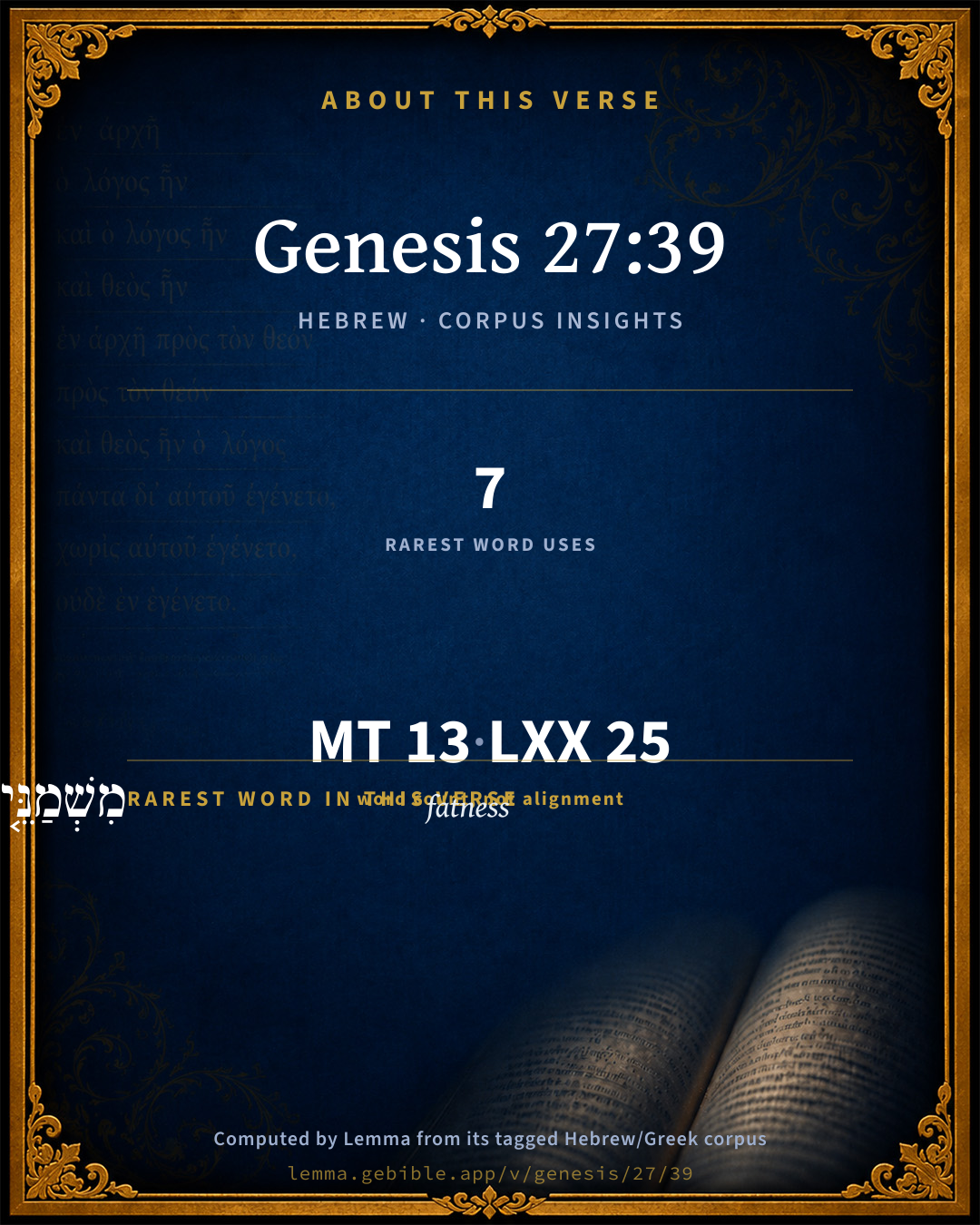
The rarest word here is מִשְׁמַנֵּ֤י fatness H4924 — appearing just 7 times in the whole Hebrew Bible.

Shared distinctive vocabulary

מִשְׁמַנֵּ֤י fatness H4924 occurs in 7 verses of the Hebrew Bible. Also found in:

Grammatical profile

  • 3 verbs
  • 8 nouns
  • 1 preposition
  • 1 particle

Verb forms

  • וַיַּ֛עַן Qal · Sequential Imperfect
  • וַיֹּ֣אמֶר Qal · Sequential Imperfect
  • יִהְיֶ֣ה Qal · Imperfect

Hebrew & Septuagint length

In English translation the verse runs 25 words from the Hebrew and 28 from the Septuagint (LXX English) — closely comparable.

A rough comparison of the two English renderings, which tokenize alike — not a word-level alignment.

Word counts can differ between the Hebrew and the Greek without any difference in meaning — e.g. the Hebrew direct-object marker אֵת has no separate Greek word, and Greek often adds the article ὁ.

In the original languages it is 13 Hebrew tokens and 25 Greek tokens — but the two are counted differently (Hebrew bundles its prefixes and suffixes into one token; the Greek is in lemma form), so that isn’t a like-for-like length.

Cross-references

4

Topical passages linked to Genesis 27:39 in the Treasury of Scripture Knowledge — connected by theme and wording, ordered by reader-vote popularity; previews shown in the World English Bible.

  • Genesis 27:28 God give you of the dew of the sky, of the fatness of the earth, and plenty of grain and new wine.
  • Hebrews 11:20 By faith, Isaac blessed Jacob and Esau, even concerning things to come.
  • Genesis 36:6–8 Esau took his wives, his sons, his daughters, and all the members of his household, with his cattle, all his animals, and all his possessions, which he had gathered in the land of Canaan, and went into a land away from his brother Jacob.
  • Joshua 24:4 I gave to Isaac Jacob and Esau: and I gave to Esau Mount Seir, to possess it: and Jacob and his children went down into Egypt.

Cross-references courtesy of OpenBible.info (CC BY 4.0).

Hebrew and Greek witnesses Masoretic Hebrew ↔ Greek Septuagint

The same verse in the two great witnesses to the Old Testament, shown verse-for-verse.

These are two independent witnesses, not word-aligned to each other, and the Septuagint is shown in lemma (dictionary) form.

Hebrew Genesis 27:39 Masoretic · Westminster Leningrad Codex

וַיַּ֛עַן יִצְחָ֥ק אָבִ֖יו וַיֹּ֣אמֶר אֵלָ֑יו הִנֵּ֞ה מִשְׁמַנֵּ֤י הָאָ֨רֶץ֙ יִהְיֶ֣ה מֽוֹשָׁבֶ֔ךָ וּמִטַּ֥ל הַשָּׁמַ֖יִם מֵעָֽל

Isaac his father answered him, "Behold, of the fatness of the earth will be your dwelling, and of the dew of the sky from above.

World English Bible · Public Domain

Greek LXX Genesis 27:39 Septuagint · lemma form

ἀποκρίνω δέ ισαακ ὁ πατήρ αὐτός εἶπον αὐτός ἰδού ἀπό ὁ πιότης ὁ γῆ εἰμί ὁ κατοίκησις σύ καί ἀπό ὁ δρόσος ὁ οὐρανός ἄνωθεν

And Isaac his father answered and said to him, Behold, your dwelling shall be of the fatness of the earth, and of the dew of heaven from above.

LXX2012 (modern English Septuagint) · Public Domain

Hebrew: Westminster Leningrad Codex (CC BY 4.0). Greek: Septuagint (public domain); English from LXX2012 (modern English Septuagint) (Public Domain). How the Septuagint differs from the Hebrew →

Targum (Aramaic paraphrase)

2

The Targum is the ancient Jewish Aramaic paraphrase of the Hebrew Scriptures — an interpretive translation, not the Hebrew text itself. Onkelos (literal) and Pseudo-Jonathan (expansive) render the Torah, and Jonathan the Prophets. Coverage is partial: where no permissively-licensed English translation exists for a verse, only the Aramaic is shown. This is verse-level text, not a word-by-word alignment to the Hebrew.

  1. Targum Onkelos Torah (Genesis–Deuteronomy)
    וַאֲתֵיב יִצְחָק אֲבוּהִי וַאֲמַר לֵהּ הָא מִטּוּבָא דְאַרְעָא יְהֵא מוֹתְבָךְ וּמִטַּלָּא דִּשְׁמַיָּא מִלְּעֵלָא

    (no public-domain English translation for this verse)

    Targum Onkelos — Aramaic: “Onkelos Genesis” (public domain); “Onkelos Exodus” (public domain); “Onkelos Leviticus” (public domain); “Onkelos Numbers” (public domain); “Onkelos Deuteronomy” (public domain). English: “Sefaria Community Translation” (CC0 1.0 (public-domain dedication)); “J.W. Etheridge. The Targums of Onkelos and Jonathan Ben Uzziel on the Pentateuch. London: Longmans, Green, 1862” (public domain). Text via Sefaria.

  2. Targum Pseudo-Jonathan Torah (Genesis–Deuteronomy)
    וְאָתֵיב יִצְחָק וַאֲמַר לְעֵשָו הָא בְּטוּב פֵּרֵי אַרְעָא יְהִי מוֹתָבָךְ וּמִטַלְיָא דִשְׁמַיָא מִלְעֵילָא

    And Izhak answered and said to Esau, Behold, among the good fruits of the earth shall be thy habitation, and with the dews of the heavens from above.

    Targum Pseudo-Jonathan — Aramaic: “Targum Jonathan on Genesis” (public domain); “Targum Jonathan on Exodus” (public domain); “Targum Jonathan on Leviticus” (public domain); “Targum Jonathan on Numbers” (public domain); “Targum Jonathan on Deuteronomy” (public domain). English: “The Targum of Jonathan ben Uzziel, trans. J. W. Etheridge, London, 1862” (public domain). Text via Sefaria.

Commentary

Notes on Genesis 27:39 from classic Christian and Jewish commentators (each source and its license shown beneath its notes). The classic Christian expositions comment on the surrounding passage and are grouped to its opening verse, so a note may address several verses; the Jewish commentaries on the Tanakh (Rashi and others) are per-verse, so they appear only where the commentator wrote on this verse.

Lemma curates 59 commentaries, every one of them public domain or Creative Commons licensed, each selected and text-cleaned for this edition rather than reprinted as found. About our sources →

Trapp's Complete Commentary

John Trapp

Gen 27:39 And Isaac his father answered and said unto him, Behold, thy dwelling shall be the fatness of the earth, and of the dew of heaven from above;

Ver. 39. Answered and said unto him.] Dixit, non benedixit; quia potius fuit praedictio futurae conditionis, quam benedictio, saith Pareus. And whereas we read, "Behold, thy dwelling shall be the fatness of the earth, and of the dew of heaven"; Castalio renders it thus: Tua quidem sedes a terrae pinguitudine, et a supero coeli rore aberit. For Mishmanne, saith he, signifieth ab pinguitudine, sive sine pinguitudine: as it doth also, Psa 109:24, "My flesh faileth from fatness," that is, for lack of fatness, or, without fatness." {a} So the sense he sets upon this text is, Thou shalt dwell far from the fatness of the earth, in a barren country, &c. For Isaac could not give Esau what he had given Jacob afore: and this was what Esau so grieved at, and threatened his brother for. Or if he could, what cause had Esau so to take on? why should it trouble me, that another partakes of the sunlight with me, when I have never the less? &c. Objection. But the apostle saith, "Isaac blessed Jacob and Esau". {Heb 11:20} Solution. It was a blessing, no doubt, that Edom should shake off Israel’s yoke; as it follows, Gen 27:40, and happened, 2Ki 8:20.

{a} Sic dicimus Ab re, απο τροπου, απο πατριδος: et composite, Amens, abesse, απογινεσθαι.

John Trapp, A Commentary or Exposition upon All the Books of the Old and New Testament (1647–1656) — public domain. Text from a community e-Sword module.

Joseph Benson's Commentary

Gen 27:39. The fatness of the earth — Mount Seir, the heritage of Esau, was a fertile place, refreshed with dews and showers. By thy sword shalt thou live — That is, thou shalt be warlike, and live upon spoil. This was remarkably fulfilled both in Esau himself, and his posterity. He was a cunning hunter, a man of the field, and his descendants got possession of mount Seir by force and violence, expelling thence the Horites, the former inhabitants, Deu 2:22. They were almost continually at war with the Jews, both before and after the Babylonish captivity. Josephus says, they were so fond of broils, that they went to war as others would do to a banquet. Thou shalt serve thy brother — God never permitted the Edomites to lord it over the Israelites, although he made use of almost all the other neighbouring nations successively to oppress them. When thou shalt have dominion — Shalt gain strength, become powerful, and appoint a king of thy own. Thou shalt break his yoke from off thy neck — “When the sons of Jacob,” says the Jerusalem Targum here, “attend to the law, and observe the precepts, they shall impose a yoke of servitude upon thy neck; but when they shall turn away themselves from studying the law, and neglect the precepts, behold, then thou shalt shake off the yoke of servitude.” This is no bad exposition of the passage: for it was David who brought the Edomites under the yoke, and in his time the Jews in a great degree observed the law. But in the reign of Jehoram, when they were very corrupt, “the Edomites revolted from under the dominion of Judah, making themselves a king,” 2Ch 21:8; 2Ch 21:10. We may observe here, although Esau obtained a blessing, it was far short of Jacob’s. There is nothing in it that points at Christ, nothing that brings either Esau or his posterity into the Church of God, and without that, “the fatness of the earth” and the plunder of the field will stand him in little stead. Thus Isaac, by faith, blessed them both according as their lot should be. And surely the exact accomplishment of these prophetic declarations, which were fulfilled many hundreds of years after the death of Moses who recorded them, must, if properly considered, give us a high idea of the Holy Scriptures, and convince us that they are truly the words of that BEING who knoweth the end from the beginning.

Joseph Benson's Commentary on the Old and New Testaments (1811–1818) — public domain. Text from a community e-Sword module.

Tyndale Open Study Notes

Tyndale Open Resources

27:39-40 All that remained for Esau was a promise of hardship and struggle (cp. 3:17-19; 16:11-12).

Tyndale Open Study Notes — © Tyndale Open Resources, licensed CC BY-SA 4.0. Text via the HelloAO Bible API.

unfoldingWord translationNotes

Door43 World Missions Community

said to him

"said to Esau"

Look, the place

"Pay attention, because what I am about to say is both true and important: the place"

far from the richness of the earth

This is a figure of speech referring to the earth's fertility. AT: "far from the fertile soil" (See: Metaphor)

your ... you

In Gen 27:39-40 these pronouns are singular and refer to Esau, but what Isaac says also applies to Esau's descendants (See: Synecdoche)

dew of the sky above

"Dew" is drops of water that form on the plants during the night. This can be made explicit in the translation. AT: "the night mist from the sky to water your crops" (See: Assumed Knowledge and Implicit Information)

By your sword you will live

Here "sword" stands for violence. AT: "You will rob and kill people in order to get what you need to live" (See: Metonymy)

you will shake his yoke from off your neck

This speaks about someone having a master as if the master's control over the person were a yoke that the person had to carry. AT: "you will free yourself from his control" (See: Metaphor)

translationWords

Isaac

heaven

sword

servant

rebel

yoke

unfoldingWord translationNotes — © Distant Shores Media and the Door43 World Missions Community, licensed CC BY-SA 4.0. Source: git.door43.org/Door43/en_tn.

Jamieson, Fausset & Brown

Robert Jamieson, A. R. Fausset & David Brown

Behold, thy dwelling shall be the fatness of the earth--The first part is a promise of temporal prosperity, made in the same terms as Jacob's [Gen 27:28] --the second part refers to the roving life of hunting freebooters, which he and his descendants should lead. Though Esau was not personally subject to his brother, his posterity were tributary to the Israelites, till the reign of Joram when they revolted and established a kingdom of their own (Kg2 8:20; Ch2 21:8-10).

Jamieson, Fausset & Brown — Commentary Critical and Explanatory on the Whole Bible (1871) — public domain (CC PDM 1.0). Text via the HelloAO Bible API.

John Calvin's Commentaries

39. Behold, thy dwelling shall be the fatness of the earth. At length Esau obtains what he had asked. For, perceiving himself to be cast down from the rank and honor of primogeniture, he chooses rather to have prosperity in the world, separated from the holy people, than to submit to the yoke of his younger brother. But it may be thought that Isaac contradicts himself, in offering a new benediction, when he had before declared, that he had given to his son Jacob all that was placed at his disposal. I answer, that what has been before said concerning Ishmael must be noted in this place. For God, though he hearkened to Abraham’s prayer for Ishmael, so far as concerned the present life, yet immediately restricts his promise, by adding the exception implied in the declaration, that in Isaac only should the seed be called. I do not, however, doubt, that the holy man, when he perceived that his younger son Jacob was the divinely ordained heir of a happy life, would endeavor to retain his firstborn, Esau, in the bond of fraternal connection, in order that he might not depart from the holy and elect flock of the Church. But now, when he sees him obstinately tending in another direction, he declares what will be his future condition. Meanwhile the spiritual blessing remains in its integrity with Jacob alone, to whom Esau refusing to attach himself, voluntarily becomes an exile from the kingdom of God. The prophecy uttered by Malachi, (Malachi 1:3,) may seem to be contradictory to this statement. For, comparing the two brothers, Esau and Jacob, with each other, he teaches that Esau was hated, inasmuch as a possession was given to him in the deserts; and yet Isaac promises him a fertile land. There is a twofold solution: either that the Prophet, speaking comparatively, may with truth call Idumea a desert in comparison with the land of Canaan, which was far more fruitful; or else that he was referring to his own times. For although the devastations of both lands had been terrible, yet the land of Canaan in a short time flourished again, while the territory of Edom was condemned to perpetual sterility, and given up to dragons. Therefore, although God, with respect to his own people, banished Esau to desert mountains, he yet gave to him a land sufficiently fertile in itself to render the promise by no means nugatory. For that mountainous region both had its own natural fruitfulness, and was so watered by the dew of heaven, that it would yield sustenance to its inhabitants.

John Calvin's Commentaries (1540-1563) — public domain. Text from the Calvin Translation Society English edition (1840s-50s) via the Christian Classics Ethereal Library (ccel.org). Calvin's coverage is partial (roughly two-thirds of the Bible); uncommented books and verses are honest gaps, never fabricated. The 19th-century editor's footnotes and remarks are omitted so the notes are faithfully Calvin's own voice.

Ellicott's Commentary for English Readers

(39) Isaac his father answered.—Unwillingly, and only after repeated entreaty and earnest expostulation, and even tears, upon Esau’s side, does Isaac bring himself to the effort to lessen in any way the painful consequences to his favourite son of his brother having robbed him of the blessing. Plainly, he felt that he had endeavoured to do what was wrong, and was afraid lest he should still be found resisting God’s will.

Thy dwelling shall be the fatness.—Heb., thy dwelling shall be of the fat places of the earth. (See Note on Gen_27:28.) But most modern expositors consider that the preposition should not be translated “of,” but from, that is:—

“Behold thy dwelling shall be away from the fat places of the earth,

And away from the dew of heaven from above,

And by (Heb., upon—depending upon) thy sword thou shalt live,” &c.

By this rendering the parts of the blessing agree together. Those who have fertile lands live by agriculture, but the inhabitants of sterile regions must look to more adventurous enterprises for a living. So the Swiss, like the Greeks of old, long served as mercenaries in the armies of other states. Idumæa, though not destitute of fruitful tracts, and even famous for its orchards, was, as a whole, sterile and unproductive, and the people were restless and unquiet. Moreover, Isaac had already given the corn-land and vineyards to Jacob (Gen_27:37), and had no second gift of them in his power. It is no answer to this to say that as the same preposition is used in Gen_27:28, it cannot have a contrary sense in the two blessings. It there follows a verb of giving, and necessarily has a partitive signification. Here there is nothing absolutely to settle its meaning, and we are left to the general sense. Possibly, Isaac may have purposely used an ambiguous word; but the meaning as a whole is clear. Esau was to inhabit a land which by its barrenness would force him to a life of adventure, military service, and freebooting.

A Bible Commentary for English Readers, edited by Charles John Ellicott (1878–1897) — public domain. Text from a community e-Sword module.

The Cambridge Bible for Schools and Colleges

gen. ed. J. J. S. Perowne

39. Behold, &c.] Isaac’s utterance again takes the form of poetry. His prediction as to Esau’s future is contained in 6 strophes; 1 and 2 refer to the physical conditions of the nation’s existence; 3 to its manner of life; 4 to its temporary subjection to Israel; 5 to its revolt; 6 to its ultimate independence.

of] Better, as R.V. marg., away from. The Heb. preposition min, “from,” admits of both renderings. The oracle is intentionally ambiguous. In Gen_27:28 (“of the dew … of the fatness”) there can be no doubt the preposition is used in its partitive sense, (a) The English versions in this verse translate min by “of,” as in Gen_27:28. It might be expected that a preposition used by the same person, with the same nouns, and in a similar context in the same passage, would be identical in meaning. According to this rendering, Isaac promises to Esau a country blessed with rich soil and favourable physical conditions: but he cannot promise a settled or happy government; only a struggle for existence, a temporary servitude, and final freedom. This interpretation, however, seems to miss the point of Isaac’s prediction as to the future material conditions of Esau’s lot. The land of Edom was rugged and mountainous; Esau will live by the sword, not by the fertility of the soil.

(b) It is better to follow the margin, “away from”; cf. 2Sa_1:22. Isaac has really only one blessing; cf. Gen_27:33. Esau’s future will not be as Jacob’s. His country in Mount Seir will not be rich and fertile, like the land of Canaan. His people will not be peaceful cultivators of the soil; they will dwell in the mountains, and get their livelihood as robbers. Edom will serve Israel; but only for a time. This is the climax of the prediction. In spite of hardships, in spite of social inferiority, and in spite of subjugation, Edom shall at last win freedom. According to this interpretation, Isaac’s words contain no soft blessing; but a stern, truthful, continuous prediction, describing (1) the barrenness and aridity of the soil of Edom, (2) the warlike temper of the people, (3) their subjugation to Israel, (4) their ultimate revolt and freedom.

The blessing of Jacob excludes the blessing of Esau; but does not shut out the hope of successful rebellion against the favoured brother. The play of words, produced by the different use of the same preposition, is what might be expected in the language of an ancient oracle; and is quite congenial to the genius of Heb. literature. For the oracular and different use of the same words, cf. Gen_40:13; Gen_40:19.

fatness … dew of heaven] See note on Gen_27:28.

The Cambridge Bible for Schools and Colleges (gen. ed. J. J. S. Perowne; Cambridge University Press, 1878–1918) — public domain. Text from a community e-Sword module.

John Gill's Exposition

And Isaac his father answered and said unto him,.... Being willing to bestow what he could upon him, without lessening or breaking in upon the grant made to Jacob:

behold, thy dwelling shall be the fatness of the earth, and of the dew of heaven from above: this agrees with part of the blessing of Jacob, only the clauses are inverted, and no mention made of corn and wine; the land of Edom not being so fat and fruitful as the land of Canaan. Castalio renders the words very differently, "thy habitation shall be from the fatness of the earth, or without the fatness of the earth, and without the dew of heaven from above" (c); or otherwise he thinks Esau would have the same blessing with Jacob, and so would have no occasion of complaint or grief, or to have hated his brother and sought his life; to which may be added, that the land of Edom, which Esau and his posterity inhabited, was a very desert country, see Mal 1:3.

(c) See the Bishop of Clogher's Chronology of the Hebrew Bible, p. 142.

John Gill's Exposition of the Whole Bible (1746–1763) — public domain (CC PDM 1.0). Text via the HelloAO Bible API.

Haydock's Catholic Bible Commentary

Moved; yet not so as to repent of what he had done; for Esau found no place of repentance in his father’s breast, although with tears he had sought it, (Hebrew xii. 17.) desiring to obtain the blessing of the first-born. (Haydock) --- In the fat, &c. Idumea was a barren country; and hence some would translate the Hebrew, "far from the fat...shall they dwelling be; but thou shalt live by the sword." Thus min often means from, as well as for in: my flesh is changed on account of the want of oil, Psalm cviii. 24. Hebrew, a pinguedine. (Calmet) --- But all the ancient versions agree with the Vulgate. So that we may say, the blessing of God made those barren regions supply the wants of the people abundantly; and so the Idumeans were to live by the sword, they would seize the rich habitations of their neighbours, (Haydock) and thus obtain a country rendered fertile without their labour. (Menochius)

George Leo Haydock (1774–1849), Haydock's Catholic Family Bible and Commentary, 1859 edition — public domain. Excludes Psalms (Douay-Rheims chapter numbering differs from Protestant) and Deuterocanonical books (Catholic canon only).

Matthew Poole's English Annotations

In a country competently fruitful and refreshed with convenient dews and showers.

Object. Thus Esau seems to have the same blessing which was before given to Jacob.

Answ. 1. Though it may seem to be the same as to the fertility of the soil, in which divers other parts of the world did and do equal the land of Canaan; yet there is an observable difference in the manner of Isaac’s expression. When he speaks of Esau, he only saith:

Thy dwelling shall be the fatness, & c. But when he speaks to Jacob, he saith: God give thee, or shall give thee of the fatness, &c.; which words being, as it may seem, purposely omitted concerning Esau, and so emphatically expressed concerning Jacob, seem to intimate, especially if compared with many other scriptures where that phrase is applied to good men, that Esau’s fat soil was rather taken by himself than given by God; or if given by God to him, it was only by his general providence, by which he giveth food to all creatures; whereas Jacob’s fat and fruitful soil was derived to him and his by God’s special gift, as a token of his singular kindness, and pledge of greater blessings:

2. This is but one branch of the blessing; the other part, which concerns dignity and superiority, is expressly given to Jacob, Gen 27:29, and denied to Esau, Gen 27:40.

Matthew Poole's English Annotations on the Holy Bible (1683–1685) — public domain. Text from a community e-Sword/MySword module.

Whedon's Commentary on the Bible

Daniel D. Whedon

39. His father answered — Isaac’s words now again take the form of prophecy, and, moved by the grief of his beloved son, and strong desire on his own part, he says:

Behold, of the fatness of the land shall be thy dwelling,

And of the dew of the heavens from above,

And upon thy sword shalt thou live,

And thy brother shalt thou serve,

And it shall be when thou shalt rove at large

That thou shalt break his yoke from off thy neck.

The fatness… of the dew — These expressions are precisely like those used in the blessing of Jacob, (Gen_27:28,) only reversed as to their order. But many of the best interpreters explain the preposition מן, as here used in a privative sense, away from, afar from the fatness and the dew, etc. This would give the whole oracle a double or doubtful meaning, one common expression, meaning in Jacob’s case a blessing and in Esau’s a curse. We exceedingly doubt that any such double entente is to be found in the prophecies of the Bible. It would imply a sort of duplicity on the part both of Isaac and of God, who inspired him to prophesy. It is true that God laid waste the mountains and heritage of Esau, (Mal_1:3,) but this is also true of the mountains and heritage of Israel at this day; so that we might argue a like double intente in Isaac’s words to Jacob. Gen_27:28. But Esau as well as Jacob for a long time enjoyed the blessing of fertile lands and refreshing dews, so that, in part, the brothers received like favours.

Daniel D. Whedon (gen. ed.), Commentary on the Old and New Testaments (1874–1909) — public domain. Text from a community e-Sword module.

The Pulpit Commentary

And Isaac his father (moved by the tearful earnestness of Esau) answered and said unto him, still speaking under inspiration, though it is doubtful whether what he spoke was a real, or only an apparent, blessing (vide infra)Behold, thy dwelling shall be the fatness of the earth, and of the dew of heaven from above. Literally, from (mi) the fatnesses (or fat places) of the earth, and from the dew of area; a substantial repetition of the temporal blessing bestowed on Jacob (ver. 28), with certain important variations, such as the omission of plenty of corn and wine at the close, and of the name of Elohim at the commencement, of the benediction (Vulgate, Luther, Calvin, Ainsworth, Rosenm "Speaker"s Commentary"); though, by assigning to the preposition a privative rather than a partitive sense, it is readily transformed into "a modified curse behold, away from the fatnesses o/the earth, &c., ;shall thy dwelling be, meaning that, in contrast to the land of Canaan, the descendants of Esau should be located in a sterile region (Tuch, Knobel, Kurtz, Delitzseh, Keil, Kalisch, Murphy). In support of this latter rendering it is urged

(1) that it is grammatically admissible;

(2) that it corresponds with the present aspect of Idumaea, which is "on the whole a dreary and unproductive land;

(3) that it agrees with the preceding statement that every blessing had already been bestowed upon Jacob; and

(4) that it explains the play upon the words "fatness" and "dew," which are hero chosen to describe a state of matter exactly the opposite to that which was declared to be the lot of Jacob. On the other hand, it is felt to be somewhat arbitrary to assign to the preposition a partitive sense in ver. 28 and a privative in ver. 39. Though called in later times. (Mal_1:3) a waste and desolate region, it may not have been originally so, or only in comparison with Canaan; while according to modern travelers the glens and mountain terraces of Edom, covered with rich soil, only want an industrious population to convert the entire region into "one of the wealthiest, as it is one of the most picturesque, countries in the world."

The Pulpit Commentary (1880–1919), ed. H.D.M. Spence-Jones & Joseph S. Exell — public domain. Text from a community e-Sword module.

John Wesley's Explanatory Notes

Esau likewise obtained a blessing: yet it was far short of Jacob's.

1. In Jacob's blessing the dew of heaven is put first, as that which he most valued and desired: in Esau's the fatness of the earth is put first, for that was it which he had the principal regard to.

2. Esau hath these, but Jacob hath them from God's hand. God give thee the dew of heaven, ver. 28. It was enough to have the possession, but Jacob desired it by promise.

3. Jacob shall have dominion over his brethren, for the Israelites often ruled over the Edomites. Esau shall have dominion, he shall gain some power, but shall never have dominion over his brother: we never find that the Jews were sold into the hands of the Edomites, or that they oppressed them. But the great difference is, that there is nothing in Esau's blessing that points at Christ, nothing that brings either him or his into the church, and without that the fatness of the earth, and the plunder of the field, will stand him in little stead. Thus Isaac by faith blessed them both, according as their lot should be.

John Wesley, Explanatory Notes Upon the Whole Bible (1754–1765) — public domain. Text via the GEBible commentary corpus.

Rashi

Rabbi Shlomo Yitzchaki (Rashi)

משמני הארץ וגו THE FATNESS OF THE EARTH etc. — This refers to the Greek portions of Italy (Graeca Magna) (Genesis Rabbah 67:6).

Rashi on the Tanakh — English translations: “The Judaica Press complete Tanach with Rashi, translated by A. J. Rosenberg” (CC BY 4.0); “Pentateuch with Rashi's commentary by M. Rosenbaum and A.M. Silbermann, 1929-1934” (public domain); “The Metsudah Tanach series, Lakewood, N.J” (CC BY 4.0); and “The Book of Joshua, Metsudah Publications, 1997” (CC BY 4.0). Text via Sefaria.

Ramban (Nachmanides)

Rabbi Moshe ben Nachman (Ramban / Nachmanides)

BEHOLD (‘HINEI’), OF THE FAT PLACES OF THE EARTH SHALL BE THY DWELLING. The intent of the word hinei (behold) is: “Now I could give you of the fat places of the earth and of the dew of heaven, for of these there is sufficient [abundance] for both of you to have of the fat places of the earth and of the dew of heaven, but in the matter of lordship, that will be his, and you shall serve him.” Isaac also did not give him plenty of corn and wine as he gave to his brother since he wanted to honor the one who had been blessed first above him. Later he said to Jacob, And G-d Almighty give thee the blessing of Abraham… that thou mayest inherit the land of thy sojournings, meaning that he should have the plentifulness of the corn and wine in the land of Canaan, which was Abraham’s gift, while Esau would have the dew and the fat places of the earth in another land.

Ramban (Nachmanides) on the Tanakh — English translation: “Commentary on the Torah by Ramban (Nachmanides). Translated and annotated by Charles B. Chavel. New York, Shilo Pub. House, 1971-1976” (CC BY 4.0). Text via Sefaria.

Radak

Rabbi David Kimhi (Radak)

ויען...הנה משמני הארץ, the earth which you will inherit and on which you will dwell will belong to the most productive areas of the earth, i.e. the Mountain of Seir.

ומטל השמים, your land will be rich and from above it will enjoy the dew from heaven so that this will be a blessing adequate to sustain you and will be also a blessing for him, seeing that his land will also be fruitful, productive.

Radak on the Tanakh — English translations: “Sefaria Community Translation” (CC0 1.0 (public-domain dedication)); “Eliyahu Munk, HaChut Hameshulash” (CC BY 4.0); “Rabbi Mike Feuer, Jerusalem Anthology” (CC BY 4.0); and “R. David Kimhi on the first book of Psalms, Translated by R.G. Finch, London, 1919” (public domain). Text via Sefaria.

Lesson kit

Teaching starters — assembled from the data on this page, not authored interpretation. Every prompt links to the verse data it draws on. Edit before teaching.

Genesis, in the Pentateuch, opens this verse with 13 words (13 distinct Hebrew lemmas). Its most distinctive word is mashmân (“fatness”). A historical commentator’s framing appears above. Read the whole chapter for the surrounding context.

Discussion questions

  1. The word mashmân carries the sense “fatness.” How does it shape the verse?
  2. How does Genesis 27:28, which shares the word «fatness», read alongside this verse?
  3. These translations render this verse differently; the difference is in the English rendering, not the original. What questions does that raise?
  4. «וַיַּ֛עַן» is a Qal Sequential Imperfect verb. How does that grammatical form shape the action described?
  5. Compare how Trapp's Complete Commentary and Joseph Benson's Commentary read this verse. Where do they agree or differ?

Things to notice

Reading settings

Reading text

Shown beneath each verse's original-language words.

Old Testament
Old Testament edition

Read the OT as the Masoretic Hebrew (MT) or the Greek Septuagint (LXX).

English shown for the Greek Septuagint (in the Hebrew ↔ Greek comparison).

Comparing translations? Open the Compare panel on any verse page to stack up to four side by side.