Genesis 31:3

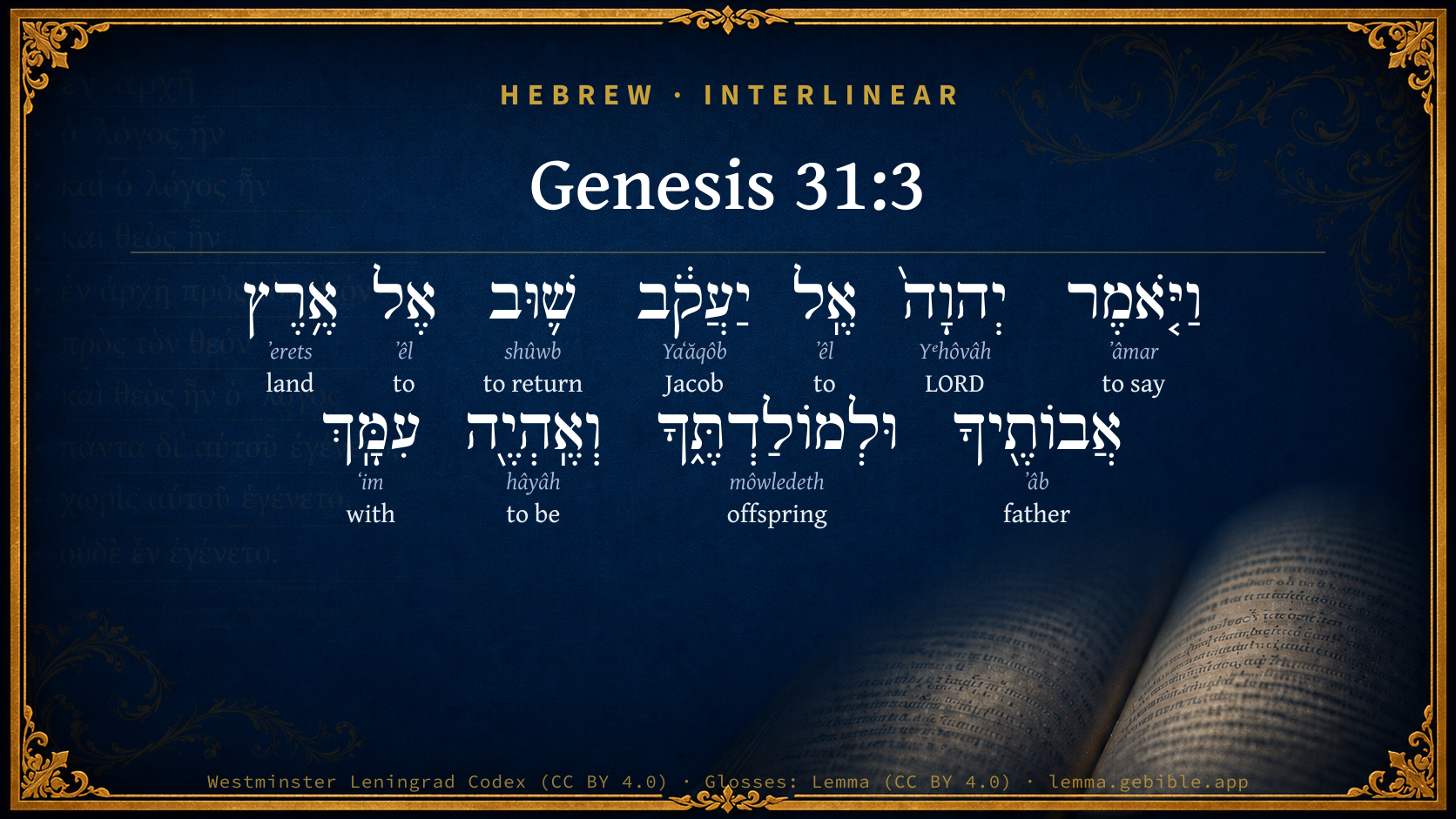
Hebrew (Westminster Leningrad Codex) Genesis 31:3 appears in the Hebrew Old Testament. The text above is from the Westminster Leningrad Codex. Each word links to its Strong’s number, a concise gloss, and parsing drawn from the Open Scriptures Hebrew Bible morphology. Click any word for its full Brown-Driver-Briggs (BDB) entry.
Download image
Cite this verse

Genesis 31:3 (World English Bible). Public Domain. Lemma interlinear Bible study tool, https://lemma.gebible.app/v/genesis/31/3.

Show BibTeX & RIS
BibTeX
RIS
English Translation
Yahweh said to Jacob, "Return to the land of your fathers, and to your relatives, and I will be with you."
World English Bible · Public Domain
Download a study sheet

One document with this verse’s original text, its word-by-word gloss line, the meaning frame, cross-references with their text, attributed commentary, and full source and license credits — printable, and it pastes into notes with its structure intact.

This verse Autodidact and up

Study sheet (.html) Plain text (.txt)

A passage Seminary Student

Up to 50 verses in one chapter. A passage sheet keeps up to 6 commentary sources and 12 cross-references per verse, in the order this page ranks them, and says so on the sheet whenever that leaves anything out. Ask for a single verse and you get the Autodidact verse sheet above.

Everything on this page stays free to read, with no account — the sheet is a download of what is already on screen, not access to it.

Want to remove ads? Support Godless Engineer
Compare translations 3

The same verse in 3 English versions, stacked beneath the original-language interlinear above. Click any original word for its lexicon entry.

Each is an independent rendering of the whole verse — the interlinear is not word-aligned to these translations.

Highlighted words mark where these versions differ — a whole-verse word diff, not a word-by-word alignment.

  • World English Bible Public Domain
    Yahweh said to Jacob, "Return to the land of your fathers, and to your relatives, and I will be with you."
  • King James Version Public Domain
    And the LORD said unto Jacob, Return unto the land of thy fathers, and to thy kindred; and I will be with thee.
  • unfoldingWord Literal Text CC BY-SA 4.0
    Then Yahweh said to Jacob, “Go back to the land of your fathers and to your relatives, and I will be with you.”

unfoldingWord Literal Text — © unfoldingWord, licensed CC BY-SA 4.0. Word-aligned USFM3 via Door43 (git.door43.org/unfoldingWord/en_ult).

Versions to compare (up to 4)

3 of 4 selected

Show all 18 translations

Every available English version of this verse, each an independent rendering of the whole verse.

  • World English Bible Public Domain
    Yahweh said to Jacob, "Return to the land of your fathers, and to your relatives, and I will be with you."
  • Berean Standard Bible Public Domain
    Then the LORD said to Jacob, “Go back to the land of your fathers and to your kindred, and I will be with you.”
  • Majority Standard Bible Public Domain
    Then the LORD said to Jacob, “Go back to the land of your fathers and to your kindred, and I will be with you.”
  • King James Version Public Domain
    And the LORD said unto Jacob, Return unto the land of thy fathers, and to thy kindred; and I will be with thee.
  • American Standard Version (1901) Public Domain
    And Jehovah said unto Jacob, Return unto the land of thy fathers, and to thy kindred; and I will be with thee.
  • Revised Version (1885) Public Domain
    And the LORD said unto Jacob, Return unto the land of thy fathers, and to thy kindred; and I will be with thee.
  • Geneva Bible (1599) Public Domain
    And the Lord had said vnto Iaakob, Turne againe into the lande of thy fathers, and to thy kinred, and I wilbe with thee.
  • Douay-Rheims (1899) Public Domain
    Especially the Lord saying to him: Return into the land of thy fathers, and to thy kindred, and I will be with thee.
  • Young's Literal Translation Public Domain
    And Jehovah saith unto Jacob, `Turn back unto the land of thy fathers, and to thy kindred, and I am with thee.'
  • Literal Standard Version CC BY-SA 4.0
    And YHWH says to Jacob, “Return to the land of your fathers, and to your family, and I am with you.”
  • Unlocked Literal Bible CC BY-SA 4.0
    Then Yahweh said to Jacob, “Return to the land of your fathers and to your relatives, and I will be with you.”
  • unfoldingWord Literal Text CC BY-SA 4.0
    Then Yahweh said to Jacob, “Go back to the land of your fathers and to your relatives, and I will be with you.”
  • Darby Bible Public Domain
    And Jehovah said to Jacob, Return into the land of thy fathers, and to thy kindred; and I will be with thee.
  • World Messianic Bible Public Domain
    The LORD said to Jacob, “Return to the land of your fathers, and to your relatives, and I will be with you.”
  • Webster's Bible Public Domain
    And the LORD said to Jacob, Return to the land of thy fathers, and to thy kindred; and I will be with thee.
  • Free Bible Version CC BY-SA 4.0
    The Lord told Jacob, “Go back to the country of your forefathers, to your family home. I will be with you.”
  • Bible in Basic English Public Domain
    Then the Lord said to Jacob, Go back to the land of your fathers, and to your relations, and I will be with you.
  • JPS Tanakh (1917) Public Domain
    And the LORD said unto Jacob: 'Return unto the land of thy fathers, and to thy kindred; and I will be with thee.'

Literal Standard Version (2020), Covenant Press — licensed CC BY-SA 4.0. Text via the HelloAO Bible API (eBible.org). Unlocked Literal Bible (unfoldingWord) — licensed CC BY-SA 4.0. Text via the HelloAO Bible API (eBible.org). unfoldingWord Literal Text — © unfoldingWord, licensed CC BY-SA 4.0. Word-aligned USFM3 via Door43 (git.door43.org/unfoldingWord/en_ult). Free Bible Version, Dr. Jonathan Gallagher — licensed CC BY-SA 4.0. Text via the HelloAO Bible API (eBible.org).

Word by word

More ways to search: Search by grammar → Find every occurrence → Compare this word →

Practice this passage: Drill this verse → Learn its vocabulary →

וּלְמוֹלַדְתֶּ֑ךָ
môwledeth
H4138
“and · to/for · offspring · your”
Conjunction + Preposition + Noun, Common, Feminine, Singular, Construct + Suffix, Personal, 2nd Person, Masculine, Singular
Part of Speech
Conjunction + Preposition + Noun
Type
Common
Gender
Feminine
Number
Singular
State
Construct
Full BDB Definition

Origin: from H3205

TWOT: 867f

kindred, birth, offspring, relatives - kindred - birth, circumstances of birth - one born, begotten, issue, offspring, female offspring
  1. וַיֹּ֤אמֶר ʼâmar H559 “and · to say” Conjunction + Verb, Qal, Sequential Imperfect, 3rd Person, Masculine, Singular
  2. יְהוָה֙ Yᵉhôvâh H3068 “LORD” Noun, Proper
  3. אֶֽל ʼêl H413 “to” Preposition
  4. יַעֲקֹ֔ב Yaʻăqôb H3290 “Jacob” Noun, Proper
  5. שׁ֛וּב shûwb H7725 “return” Verb, Qal, Imperative, 2nd Person, Masculine, Singular
  6. אֶל ʼêl H413 “to” Preposition
  7. אֶ֥רֶץ ʼerets H776 “land of” Noun, Common, Both, Singular, Construct
  8. אֲבוֹתֶ֖יךָ ʼâb H1 “fathers · your” Noun, Common, Masculine, Plural, Construct + Suffix, Personal, 2nd Person, Masculine, Singular
  9. וְאֶֽהְיֶ֖ה hâyâh H1961 “and · to be” Conjunction + Verb, Qal, Imperfect, 1st Person, Common, Singular
  10. עִמָּֽךְ ʻim H5973 “with · you” Preposition + Suffix, Personal, 2nd Person, Feminine, Singular

About this verse

These counts appear in no published source. They are computed here, from the morphology-tagged text and Lemma’s own curated glosses. What Lemma adds →

11
words
10
distinct lemmas
Pentateuch
section

Notable vocabulary

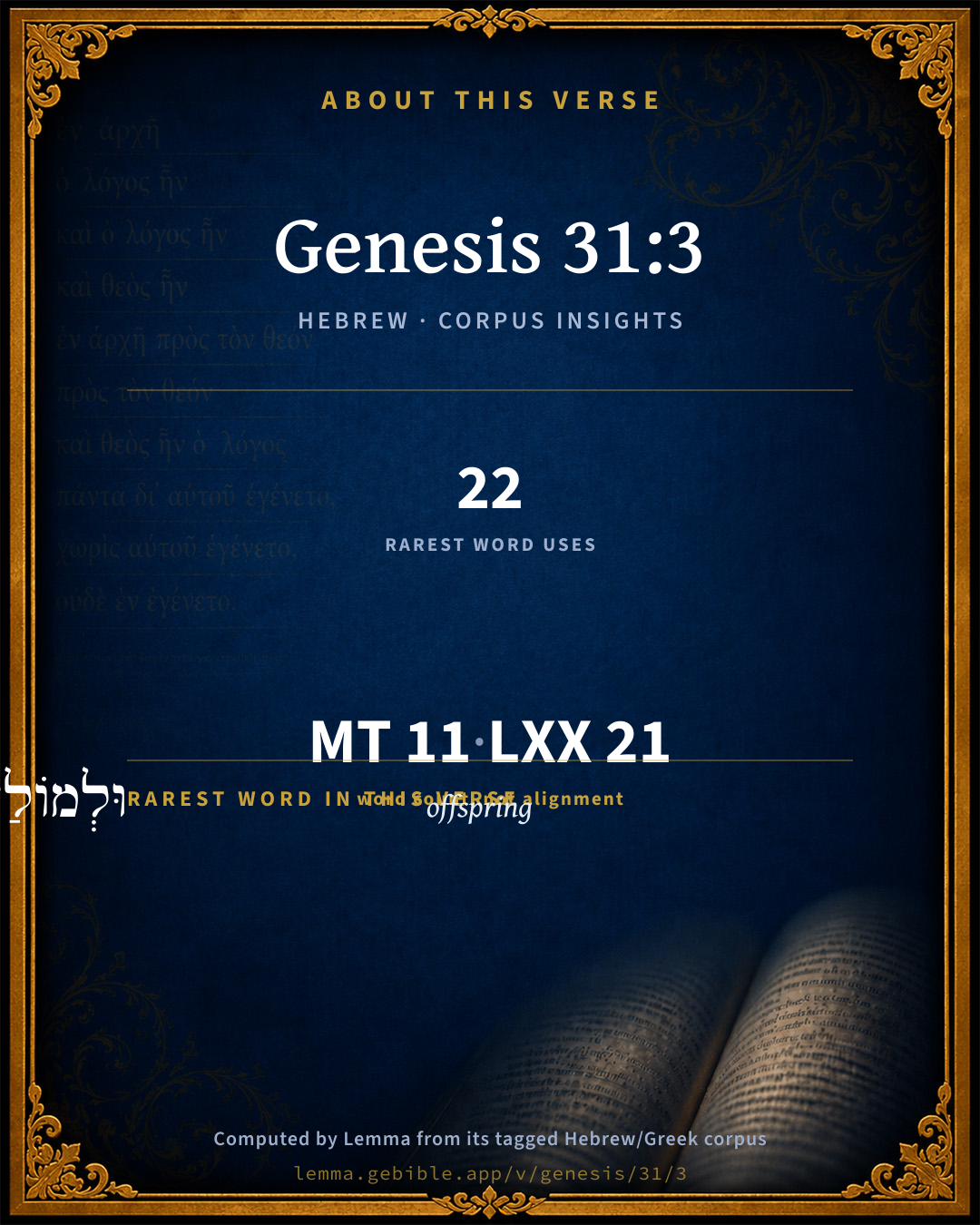
The rarest word here is וּלְמוֹלַדְתֶּ֑ךָ offspring H4138 — appearing just 22 times in the whole Hebrew Bible.

Shared distinctive vocabulary

וּלְמוֹלַדְתֶּ֑ךָ offspring H4138 occurs in 21 verses of the Hebrew Bible. Also found in:

Grammatical profile

  • 3 verbs
  • 5 nouns
  • 3 prepositions

Verb forms

  • וַיֹּ֤אמֶר Qal · Sequential Imperfect
  • שׁ֛וּב Qal · Imperative
  • וְאֶֽהְיֶ֖ה Qal · Imperfect

Repetition

A word recurs within this verse — often emphatic in Hebrew:

  • אֶֽל to H413 ×2

Hebrew & Septuagint length

In English translation the verse runs 21 words from the Hebrew and 23 from the Septuagint (LXX English) — closely comparable.

A rough comparison of the two English renderings, which tokenize alike — not a word-level alignment.

Word counts can differ between the Hebrew and the Greek without any difference in meaning — e.g. the Hebrew direct-object marker אֵת has no separate Greek word, and Greek often adds the article ὁ.

In the original languages it is 11 Hebrew tokens and 21 Greek tokens — but the two are counted differently (Hebrew bundles its prefixes and suffixes into one token; the Greek is in lemma form), so that isn’t a like-for-like length.

Cross-references

20

Topical passages linked to Genesis 31:3 in the Treasury of Scripture Knowledge — connected by theme and wording, ordered by reader-vote popularity; previews shown in the World English Bible.

  • Genesis 28:15 Behold, I am with you, and will keep you, wherever you go, and will bring you again into this land. For I will not leave you, until I have done that which I have spoken of to you."
  • Genesis 32:9 Jacob said, "God of my father Abraham, and God of my father Isaac, Yahweh, who said to me, 'Return to your country, and to your relatives, and I will do you good.'
  • Hebrews 13:5 Be free from the love of money, content with such things as you have, for he has said, "I will in no way leave you, neither will I in any way forsake you."
  • Genesis 31:13 I am the God of Bethel, where you anointed a pillar, where you vowed a vow to me. Now arise, get out from this land, and return to the land of your birth."
  • Psalms 50:15 Call on me in the day of trouble. I will deliver you, and you will honor me."
  • Isaiah 41:10 Don't you be afraid, for I am with you; don't be dismayed, for I am your God; I will strengthen you; yes, I will help you; yes, I will uphold you with the right hand of my righteousness.
  • Genesis 21:22 It happened at that time, that Abimelech and Phicol the captain of his host spoke to Abraham, saying, "God is with you in all that you do.
  • Genesis 13:15 for all the land which you see, I will give to you, and to your offspring forever.
  • Genesis 26:3–5 Sojourn in this land, and I will be with you, and will bless you. For to you, and to your seed, I will give all these lands, and I will establish the oath which I swore to Abraham your father.
  • Genesis 26:24 Yahweh appeared to him the same night, and said, "I am the God of Abraham your father. Don't be afraid, for I am with you, and will bless you, and multiply your seed for my servant Abraham's sake."
  • Genesis 28:4 and give you the blessing of Abraham, to you, and to your seed with you, that you may inherit the land where you travel, which God gave to Abraham."
  • Genesis 28:13 Behold, Yahweh stood above it, and said, "I am Yahweh, the God of Abraham your father, and the God of Isaac. The land whereon you lie, to you will I give it, and to your seed.
  • Genesis 28:20–22 Jacob vowed a vow, saying, "If God will be with me, and will keep me in this way that I go, and will give me bread to eat, and clothing to put on,
  • Genesis 30:25 It happened, when Rachel had borne Joseph, that Jacob said to Laban, "Send me away, that I may go to my own place, and to my country.
  • Genesis 31:18 and he carried away all his cattle, and all his substance which he had gathered, the cattle of his getting, which he had gathered in Paddan Aram, to go to Isaac his father to the land of Canaan.
  • Genesis 35:1 God said to Jacob, "Arise, go up to Bethel, and live there. Make there an altar to God, who appeared to you when you fled from the face of Esau your brother."
  • Genesis 46:2–3 God spoke to Israel in the visions of the night, and said, "Jacob, Jacob!" He said, "Here I am."
  • Psalms 46:1 God is our refuge and strength, A very present help in trouble.
  • Genesis 50:24 Joseph said to his brothers, "I am dying, but God will surely visit you, and bring you up out of this land to the land which he swore to Abraham, to Isaac, and to Jacob."
  • Psalms 90:15 Make us glad for as many days as you have afflicted us, For as many years as we have seen evil.

Cross-references courtesy of OpenBible.info (CC BY 4.0).

Hebrew and Greek witnesses Masoretic Hebrew ↔ Greek Septuagint

The same verse in the two great witnesses to the Old Testament, shown verse-for-verse.

These are two independent witnesses, not word-aligned to each other, and the Septuagint is shown in lemma (dictionary) form.

Hebrew Genesis 31:3 Masoretic · Westminster Leningrad Codex

וַיֹּ֤אמֶר יְהוָה֙ אֶֽל יַעֲקֹ֔ב שׁ֛וּב אֶל אֶ֥רֶץ אֲבוֹתֶ֖יךָ וּלְמוֹלַדְתֶּ֑ךָ וְאֶֽהְיֶ֖ה עִמָּֽךְ

Yahweh said to Jacob, "Return to the land of your fathers, and to your relatives, and I will be with you."

World English Bible · Public Domain

Greek LXX Genesis 31:3 Septuagint · lemma form

εἶπον δέ κύριος πρός ἰακώβ ἀποστρέφω εἰς ὁ γῆ ὁ πατήρ σύ καί εἰς ὁ γενεά σύ καί εἰμί μετά σύ

And the Lord said to Jacob, Return to the land of your father, and to your family, and I will be with you.

LXX2012 (modern English Septuagint) · Public Domain

Hebrew: Westminster Leningrad Codex (CC BY 4.0). Greek: Septuagint (public domain); English from LXX2012 (modern English Septuagint) (Public Domain). How the Septuagint differs from the Hebrew →

Targum (Aramaic paraphrase)

2

The Targum is the ancient Jewish Aramaic paraphrase of the Hebrew Scriptures — an interpretive translation, not the Hebrew text itself. Onkelos (literal) and Pseudo-Jonathan (expansive) render the Torah, and Jonathan the Prophets. Coverage is partial: where no permissively-licensed English translation exists for a verse, only the Aramaic is shown. This is verse-level text, not a word-by-word alignment to the Hebrew.

  1. Targum Onkelos Torah (Genesis–Deuteronomy)
    וַאֲמַר יְיָ לְיַעֲקֹב תּוּב לְאַרְעָא דַּאֲבָהָתָךְ וּלְיַלָּדֻתָךְ וִיהֵי מֵימְרִי בְּסַעְדָּךְ

    (no public-domain English translation for this verse)

    Targum Onkelos — Aramaic: “Onkelos Genesis” (public domain); “Onkelos Exodus” (public domain); “Onkelos Leviticus” (public domain); “Onkelos Numbers” (public domain); “Onkelos Deuteronomy” (public domain). English: “Sefaria Community Translation” (CC0 1.0 (public-domain dedication)); “J.W. Etheridge. The Targums of Onkelos and Jonathan Ben Uzziel on the Pentateuch. London: Longmans, Green, 1862” (public domain). Text via Sefaria.

  2. Targum Pseudo-Jonathan Torah (Genesis–Deuteronomy)
    וַאֲמַר יְיָ לְיַעֲקב תּוּב לְאַרַע אֲבָהָתָךְ וּלְיַלְדוּתָךְ וִיהֵי מֵימְרִי בְּסַעֲדָךְ

    And the Lord said to Jakob, Return to the land of thy fathers, and to thy native place; and My Word shall be for thy help.

    Targum Pseudo-Jonathan — Aramaic: “Targum Jonathan on Genesis” (public domain); “Targum Jonathan on Exodus” (public domain); “Targum Jonathan on Leviticus” (public domain); “Targum Jonathan on Numbers” (public domain); “Targum Jonathan on Deuteronomy” (public domain). English: “The Targum of Jonathan ben Uzziel, trans. J. W. Etheridge, London, 1862” (public domain). Text via Sefaria.

Commentary

Notes on Genesis 31:3 from classic Christian and Jewish commentators (each source and its license shown beneath its notes). The classic Christian expositions comment on the surrounding passage and are grouped to its opening verse, so a note may address several verses; the Jewish commentaries on the Tanakh (Rashi and others) are per-verse, so they appear only where the commentator wrote on this verse.

Lemma curates 59 commentaries, every one of them public domain or Creative Commons licensed, each selected and text-cleaned for this edition rather than reprinted as found. About our sources →

Trapp's Complete Commentary

John Trapp

Gen 31:3 And the LORD said unto Jacob, Return unto the land of thy fathers, and to thy kindred; and I will be with thee.

Ver. 3. Return unto the land of thy fathers.] Laban’s frowns were a grief to Jacob; the Lord calls upon him therefore to look homeward. Let the world’s affronts, and the change of men’s countenances, drive us to him who changeth not, and mind us of heaven, where is a perpetual serenity and sweetness.

John Trapp, A Commentary or Exposition upon All the Books of the Old and New Testament (1647–1656) — public domain. Text from a community e-Sword module.

Joseph Benson's Commentary

Gen 31:3-4. The Lord said unto Jacob, Return — God, who orders all things aright, having blessed Jacob with greater substance in the house of Laban than he could have obtained in his father’s house, without great inconveniences, perhaps irreconcilable, fatal hatred between him and his brother Esau, now orders him to return. For, though Jacob had met with very hard usage, yet he would not quit his place till God bid him. The direction he had from Heaven is more fully related to his wives afterward. Unto the land of thy fathers — Not which was properly theirs, but only that in which they had sojourned, and which was promised to them in their seed. And, as Jacob was an inheritor of the promise, it was proper that he should sojourn in the land, to keep alive the hopes of it in his posterity. Jacob sent for Rachel and Leah to the field — That he might discourse with them more privately.

Joseph Benson's Commentary on the Old and New Testaments (1811–1818) — public domain. Text from a community e-Sword module.

Tyndale Open Study Notes

Tyndale Open Resources

31:3 The land of your father and grandfather was the land of Canaan, to which Abraham had previously been called (12:1-7; 17:8). • Return . . . I will be with you: See study notes on 26:2-5; 28:12-15. God protected Jacob (“Israel,” 32:28) as he brought his family back to the land that was promised to them. God later brought Israel back to Canaan after long years of service in Egypt. That great return had many elements similar to this passage: God defeated foreign gods and beliefs, used dreams for rescue and protection, gave victory over those who threatened them, and established boundaries between nations and tribes (see Deut 32:8).

Tyndale Open Study Notes — © Tyndale Open Resources, licensed CC BY-SA 4.0. Text via the HelloAO Bible API.

Jamieson, Fausset & Brown

Robert Jamieson, A. R. Fausset & David Brown

the Lord said . . . Return unto the land of thy fathers--Notwithstanding the ill usage he had received, Jacob might not have deemed himself at liberty to quit his present sphere, under the impulse of passionate fretfulness and discontent. Having been conducted to Haran by God (Gen 28:15) and having got a promise that the same heavenly Guardian would bring him again into the land of Canaan, he might have thought he ought not to leave it, without being clearly persuaded as to the path of duty. So ought we to set the Lord before us, and to acknowledge Him in all our ways, our journeys, our settlements, and plans in life.

Jamieson, Fausset & Brown — Commentary Critical and Explanatory on the Whole Bible (1871) — public domain (CC PDM 1.0). Text via the HelloAO Bible API.

Adam Clarke's Commentary

Verse 3. And the Lord said unto Jacob, Return - and I will be with thee.] I will take the same care of thee in thy return, as I took of thee on thy way to this place. The Targum reads, My WORD shall be for thy help, see Ge 15:1. A promise of this kind was essentially necessary for the encouragement of Jacob, especially at this time; and no doubt it was a powerful means of support to him through the whole journey; and it was particularly so when he heard that his brother was coming to meet him, with four hundred men in his retinue, Ge 32:6. At that time he went and pleaded the very words of this promise with God, Ge 32:9.

Adam Clarke's Commentary on the Bible (1810–1826) — public domain. Text from a community e-Sword/MySword module.

John Calvin's Commentaries

3. And the Lord said unto Jacob. The timidity of the holy man is here more plainly seen; for he, perceiving that evil was designed against him by his father-in-law, still dared not to move a foot, unless encouraged by a new oracle. But the Lord, who, by facts, had shown him already that no longer delay was to be made, now also urges him by words. Let us learn from this example, that although the Lord may incite us to duty by adversity, yet we shall thereby profit little, unless the stimulus of the word be added. And we see what will happen to the reprobate; for either they become stupefied in their wickedness, or they break out into fury. Wherefore, that the instruction conveyed by outward things may profit us, we must ask the Lord to shine upon us in his own word. The design, however, of Moses chiefly refers to this point, that we may know that Jacob returned to his own country, under the special guidance of God. Now the land of Canaan is called the land of Abraham and Isaac, not because they had sprung from it; but because it had been divinely promised to them as their inheritance. Wherefore, by this voice the holy man was admonished, that although Isaac had been a stranger, yet, in the sight of God, he was the heir and lord of that land, in which he possessed nothing but a sepulcher.

John Calvin's Commentaries (1540-1563) — public domain. Text from the Calvin Translation Society English edition (1840s-50s) via the Christian Classics Ethereal Library (ccel.org). Calvin's coverage is partial (roughly two-thirds of the Bible); uncommented books and verses are honest gaps, never fabricated. The 19th-century editor's footnotes and remarks are omitted so the notes are faithfully Calvin's own voice.

Ellicott's Commentary for English Readers

(3) The Lord said unto Jacob.—This is probably the revelation, more exactly described in Gen_31:10-13, as given to Jacob in a dream. It is there ascribed to Elohim, but here to Jehovah. The narrator’s purpose in this, probably, is to show that while Jacob regarded the providence that watched over him as the act of Elohim, it was really in His character of Jehovah, the covenant-God, that He thus guarded him. (See Note on Gen_26:29.)

Thy kindred.—Heb., thy birthplace, as in Gen_12:1; Gen_24:4; Gen_24:7, &c.

A Bible Commentary for English Readers, edited by Charles John Ellicott (1878–1897) — public domain. Text from a community e-Sword module.

The Cambridge Bible for Schools and Colleges

gen. ed. J. J. S. Perowne

3. And the Lord said] In a dream; cf. Gen_31:11.

the land of thy fathers] i.e. Canaan, as the country of Abraham and Isaac.

I will be with thee] The renewal of the promise of the Divine Presence made to Jacob in Gen_28:15; cf. Gen_21:22, Gen_26:24.

The Cambridge Bible for Schools and Colleges (gen. ed. J. J. S. Perowne; Cambridge University Press, 1878–1918) — public domain. Text from a community e-Sword module.

John Gill's Exposition

And the Lord said unto Jacob,.... In answer to a prayer of his; or seeing what difficulties and discouragements Jacob laboured under, he appeared unto him for his encouragement and instruction how to proceed:

return unto the land of thy fathers; the land of Canaan, given to Abraham and Isaac by promise:

and to thy kindred: his father and mother, and brother, who all dwelt in the land of Canaan at this time, or as many as were living: or "to thy nativity" (w), the place where he was born, and to which he must have a natural desire to return: and

I will be with thee; to protect him from any injury that might be attempted to be done unto him, either by Laban or Esau.

(w) "ad natale solum", Tigurine version; "ad nativitatem tuam", Vatablus, Drusius.

John Gill's Exposition of the Whole Bible (1746–1763) — public domain (CC PDM 1.0). Text via the HelloAO Bible API.

Whedon's Commentary on the Bible

Daniel D. Whedon

3. Return — This word of Jehovah was as truly a divine call as that which led Abraham from Ur of the Chaldees. It came to him in the field and evidently made a deep impression on Jacob, so that he at once sent for his two wives, and told them all.

Daniel D. Whedon (gen. ed.), Commentary on the Old and New Testaments (1874–1909) — public domain. Text from a community e-Sword module.

The Pulpit Commentary

And the Lord Jehovah; since the entire journey to Padanaram had been conducted under his special care, (vide, Gen_28:15) (Hengstenberg) and not because the first three verses of this chapter have been inserted or modified by the Jehovist (Tuch, Block, et al.)said unto Jacob, probably in a dream (cf. vers. 5, 10, 11). Return unto the land of thy fathers (i.e. Canaan), and to thy kindred; and I will be with thee. So Jehovah had promised at Bethel twenty years before. (Gen_28:15)

The Pulpit Commentary (1880–1919), ed. H.D.M. Spence-Jones & Joseph S. Exell — public domain. Text from a community e-Sword module.

John Wesley's Explanatory Notes

The Lord said unto Jacob, Return and I will be with thee - though Jacob had met with very hard usage, yet he would not quit his place 'till God bid him. He came thither by orders from heaven, and there he would slay 'till he was ordered back. The direction he had from heaven is more fully related in the account he gives of it to his wives, where he tells them of the dream he had about the cattle, and the wonderful increase of those of his colour; and how the angel of God in that dream instructed him that it was not by chance, nor by his own policy, that he obtained that great advantage but by the providence of God, who had taken notice of the hardships Laban had put upon him, and in performance of his promise.

John Wesley, Explanatory Notes Upon the Whole Bible (1754–1765) — public domain. Text via the GEBible commentary corpus.

Rashi

Rabbi Shlomo Yitzchaki (Rashi)

שוב אל ארץ אבותיך RETURN UNTO THE LAND OF THY FATHERS — and there I will be with thee; but as long as you are associated with the unclean Laban it is impossible to make my Divine Presence (Shechina) rest upon you (Midrash Tanchuma, Vayetzei 10).

Rashi on the Tanakh — English translations: “The Judaica Press complete Tanach with Rashi, translated by A. J. Rosenberg” (CC BY 4.0); “Pentateuch with Rashi's commentary by M. Rosenbaum and A.M. Silbermann, 1929-1934” (public domain); “The Metsudah Tanach series, Lakewood, N.J” (CC BY 4.0); and “The Book of Joshua, Metsudah Publications, 1997” (CC BY 4.0). Text via Sefaria.

Radak

Rabbi David Kimhi (Radak)

'ויאמר ה, the angel is called by the name of his Master, i.e. G’d. The reason is that he delivers his message in the name of his Sender, i.e. in the name of G’d.

Radak on the Tanakh — English translations: “Sefaria Community Translation” (CC0 1.0 (public-domain dedication)); “Eliyahu Munk, HaChut Hameshulash” (CC BY 4.0); “Rabbi Mike Feuer, Jerusalem Anthology” (CC BY 4.0); and “R. David Kimhi on the first book of Psalms, Translated by R.G. Finch, London, 1919” (public domain). Text via Sefaria.

Lesson kit

Teaching starters — assembled from the data on this page, not authored interpretation. Every prompt links to the verse data it draws on. Edit before teaching.

Genesis, in the Pentateuch, opens this verse with 11 words (10 distinct Hebrew lemmas). Its most distinctive word is môwledeth (“offspring”). A historical commentator’s framing appears above. Read the whole chapter for the surrounding context.

Discussion questions

  1. What does “offspring” (môwledeth) contribute to the verse as a whole?
  2. How does Genesis 11:28, which shares the word «offspring», read alongside this verse?
  3. What does the repetition of “to” (2× in this one verse) do in this verse?
  4. The translations on this page render this verse differently — a whole-verse word diff, not a word-by-word alignment. What might account for the different wordings?
  5. «וַיֹּ֤אמֶר» is a Qal Sequential Imperfect verb. How does that grammatical form shape the action described?
  6. Compare how Trapp's Complete Commentary and Joseph Benson's Commentary read this verse. Where do they agree or differ?

Things to notice

Reading settings

Reading text

Shown beneath each verse's original-language words.

Old Testament
Old Testament edition

Read the OT as the Masoretic Hebrew (MT) or the Greek Septuagint (LXX).

English shown for the Greek Septuagint (in the Hebrew ↔ Greek comparison).

Comparing translations? Open the Compare panel on any verse page to stack up to four side by side.