
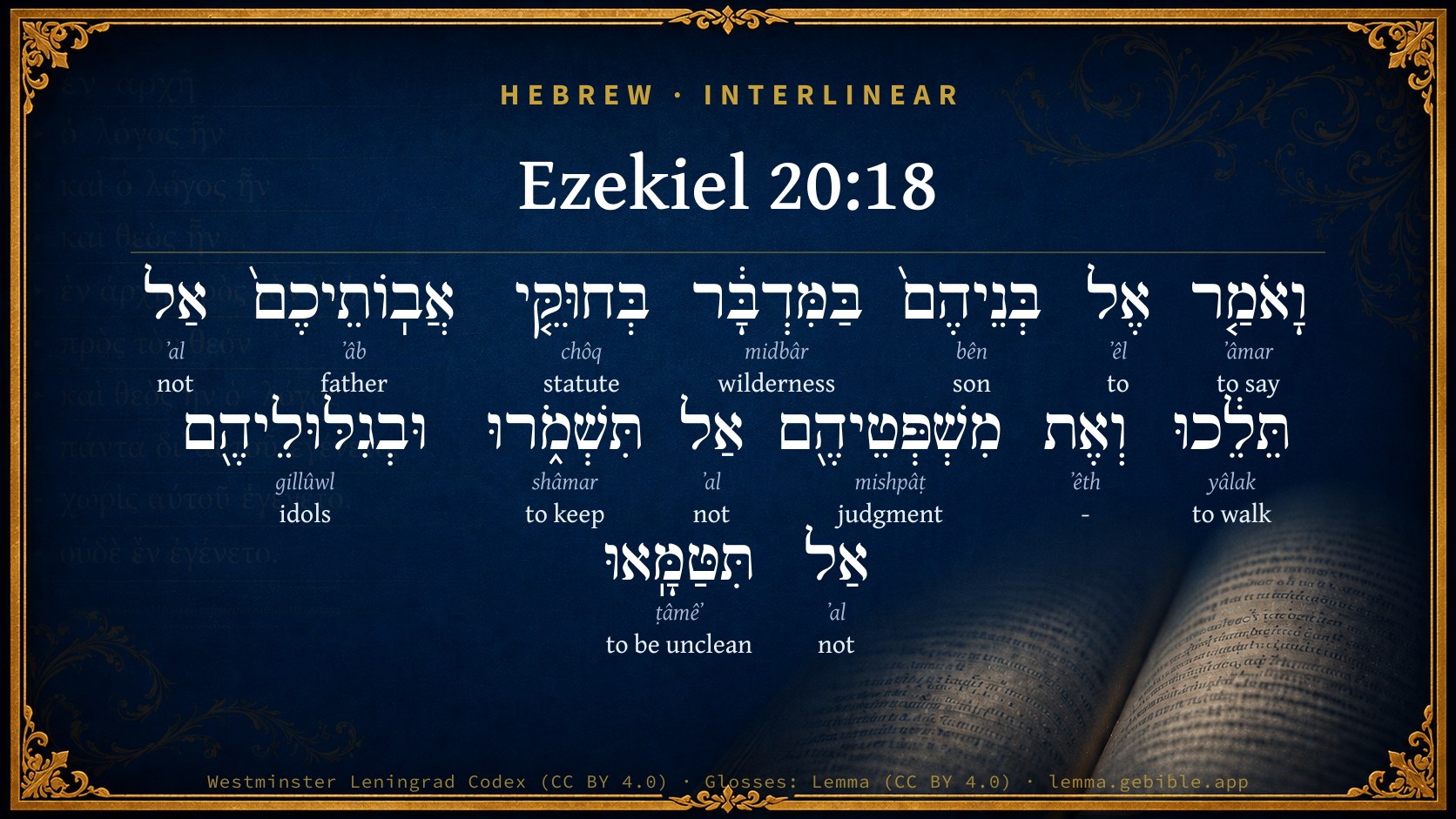
Ezekiel 20:18

Hebrew (Westminster Leningrad Codex) Ezekiel 20:18 appears in the Hebrew Old Testament. The text above is from the Westminster Leningrad Codex. Each word links to its Strong’s number, a concise gloss, and parsing drawn from the Open Scriptures Hebrew Bible morphology. Click any word for its full Brown-Driver-Briggs (BDB) entry.
Download image
Cite this verse

Ezekiel 20:18 (World English Bible). Public Domain. Lemma interlinear Bible study tool, https://lemma.gebible.app/v/ezekiel/20/18.

Show BibTeX & RIS
BibTeX
RIS
English Translation
I said to their children in the wilderness, Don't you walk in the statutes of your fathers, neither observe their ordinances, nor defile yourselves with their idols.
World English Bible · Public Domain
Download a study sheet

One document with this verse’s original text, its word-by-word gloss line, the meaning frame, cross-references with their text, attributed commentary, and full source and license credits — printable, and it pastes into notes with its structure intact.

This verse Autodidact and up

Study sheet (.html) Plain text (.txt)

A passage Seminary Student

Up to 50 verses in one chapter. A passage sheet keeps up to 6 commentary sources and 12 cross-references per verse, in the order this page ranks them, and says so on the sheet whenever that leaves anything out. Ask for a single verse and you get the Autodidact verse sheet above.

Everything on this page stays free to read, with no account — the sheet is a download of what is already on screen, not access to it.

Want to remove ads? Support Godless Engineer
Compare translations 3

The same verse in 3 English versions, stacked beneath the original-language interlinear above. Click any original word for its lexicon entry.

Each is an independent rendering of the whole verse — the interlinear is not word-aligned to these translations.

Highlighted words mark where these versions differ — a whole-verse word diff, not a word-by-word alignment.

  • World English Bible Public Domain
    I said to their children in the wilderness, Don't you walk in the statutes of your fathers, neither observe their ordinances, nor defile yourselves with their idols.
  • King James Version Public Domain
    But I said unto their children in the wilderness, Walk ye not in the statutes of your fathers, neither observe their judgments, nor defile yourselves with their idols:
  • unfoldingWord Literal Text CC BY-SA 4.0
    I said to their children in the wilderness, “Do not walk in the statutes of your fathers, or keep their rules, or defile yourselves with their idols.

unfoldingWord Literal Text — © unfoldingWord, licensed CC BY-SA 4.0. Word-aligned USFM3 via Door43 (git.door43.org/unfoldingWord/en_ult).

Versions to compare (up to 4)

3 of 4 selected

Show all 18 translations

Every available English version of this verse, each an independent rendering of the whole verse.

  • World English Bible Public Domain
    I said to their children in the wilderness, Don't you walk in the statutes of your fathers, neither observe their ordinances, nor defile yourselves with their idols.
  • Berean Standard Bible Public Domain
    In the wilderness I said to their children: ‘Do not walk in the statutes of your fathers or keep their ordinances or defile yourselves with their idols.
  • Majority Standard Bible Public Domain
    In the wilderness I said to their children: ‘Do not walk in the statutes of your fathers or keep their ordinances or defile yourselves with their idols.
  • King James Version Public Domain
    But I said unto their children in the wilderness, Walk ye not in the statutes of your fathers, neither observe their judgments, nor defile yourselves with their idols:
  • American Standard Version (1901) Public Domain
    And I said unto their children in the wilderness, Walk ye not in the statutes of your fathers, neither observe their ordinances, nor defile yourselves with their idols.
  • Revised Version (1885) Public Domain
    And I said unto their children in the wilderness, Walk ye not in the statutes of your fathers, neither observe their judgments, nor defile yourselves with their idols:
  • Geneva Bible (1599) Public Domain
    But I said vnto their children in the wildernes, Walke ye not in the ordinances of your fathers, neither obserue their maners, nor defile your selues with their idoles.
  • Douay-Rheims (1899) Public Domain
    And I said to their children in the wilderness: Walk not in the statutes of your fathers, and observe not their judgments, nor be ye defiled with their idols:
  • Young's Literal Translation Public Domain
    And I say to their sons in the wilderness: In the statutes of your fathers ye walk not, And their judgments ye do not observe, And with their idols ye are not defiled.
  • Literal Standard Version CC BY-SA 4.0
    And I say to their sons in the wilderness: Do not walk in the statutes of your fathers, || And do not observe their judgments, || And do not defile yourselves with their idols.
  • Unlocked Literal Bible CC BY-SA 4.0
    I said to their children in the wilderness, “Do not walk in the statutes of your fathers, or keep their rules, or defile yourselves with their idols.
  • unfoldingWord Literal Text CC BY-SA 4.0
    I said to their children in the wilderness, “Do not walk in the statutes of your fathers, or keep their rules, or defile yourselves with their idols.
  • Darby Bible Public Domain
    And I said unto their children in the wilderness, Walk not in the statutes of your fathers, neither keep their ordinances, nor defile yourselves with their idols.
  • World Messianic Bible Public Domain
    I said to their children in the wilderness, ‘Don’t walk in the statutes of your fathers. Don’t observe their ordinances or defile yourselves with their idols.
  • Webster's Bible Public Domain
    But I said to their children in the wilderness, Walk ye not in the statutes of your fathers, neither observe their judgments, nor defile yourselves with their idols:
  • Free Bible Version CC BY-SA 4.0
    I told their children in the desert: ‘Don't do what your fathers told you to do. Don't follow their practices. Don't make yourselves unclean by worshiping their idols.
  • Bible in Basic English Public Domain
    And I said to their children in the waste land, Do not be guided by the rules of your fathers or keep their orders or make yourselves unclean with their images:
  • JPS Tanakh (1917) Public Domain
    And I said unto their children in the wilderness: Walk ye not in the statutes of your fathers, neither observe their ordinances, nor defile yourselves with their idols;

Literal Standard Version (2020), Covenant Press — licensed CC BY-SA 4.0. Text via the HelloAO Bible API (eBible.org). Unlocked Literal Bible (unfoldingWord) — licensed CC BY-SA 4.0. Text via the HelloAO Bible API (eBible.org). unfoldingWord Literal Text — © unfoldingWord, licensed CC BY-SA 4.0. Word-aligned USFM3 via Door43 (git.door43.org/unfoldingWord/en_ult). Free Bible Version, Dr. Jonathan Gallagher — licensed CC BY-SA 4.0. Text via the HelloAO Bible API (eBible.org).

Word by word

More ways to search: Search by grammar → Find every occurrence → Compare this word →

Practice this passage: Drill this verse → Learn its vocabulary →

וּבְגִלּוּלֵיהֶ֖ם
gillûwl
H1544
“and · in/at · idols · their”
Conjunction + Preposition + Noun, Common, Masculine, Plural, Construct + Suffix, Personal, 3rd Person, Masculine, Plural
Part of Speech
Conjunction + Preposition + Noun
Type
Common
Gender
Masculine
Number
Plural
State
Construct
Full BDB Definition

Origin: from H1556

TWOT: 353h

idols
  1. וָאֹמַ֤ר ʼâmar H559 “and · to say” Conjunction + Verb, Qal, Sequential Imperfect, 1st Person, Common, Singular
  2. אֶל ʼêl H413 “to” Preposition
  3. בְּנֵיהֶם֙ bên H1121 “sons · their” Noun, Common, Masculine, Plural, Construct + Suffix, Personal, 3rd Person, Masculine, Plural
  4. בַּמִּדְבָּ֔ר midbâr H4057 “in/at the · wilderness” Preposition, Determined + Noun, Common, Masculine, Singular, Absolute
  5. בְּחוּקֵּ֤י chôq H2706 “in/at · statutes of” Preposition + Noun, Common, Masculine, Plural, Construct
  6. אֲבֽוֹתֵיכֶם֙ ʼâb H1 “fathers · your” Noun, Common, Masculine, Plural, Construct + Suffix, Personal, 2nd Person, Masculine, Plural
  7. אַל ʼal H408 “not” Particle, Negative
  8. תֵּלֵ֔כוּ yâlak H3212 “to walk” Verb, Qal, Jussive, 2nd Person, Masculine, Plural
  9. וְאֶת ʼêth H853 “and · -” Conjunction + Particle, Direct Object
  10. מִשְׁפְּטֵיהֶ֖ם mishpâṭ H4941 “judgments · their” Noun, Common, Masculine, Plural, Construct + Suffix, Personal, 3rd Person, Masculine, Plural
  11. אַל ʼal H408 “not” Particle, Negative
  12. תִּשְׁמֹ֑רוּ shâmar H8104 “to keep” Verb, Qal, Jussive, 2nd Person, Masculine, Plural
  13. אַל ʼal H408 “not” Particle, Negative
  14. תִּטַּמָּֽאוּ ṭâmêʼ H2930 “to be unclean” Verb, Hithpael, Jussive, 2nd Person, Masculine, Plural

About this verse

These counts appear in no published source. They are computed here, from the morphology-tagged text and Lemma’s own curated glosses. What Lemma adds →

15
words
13
distinct lemmas
Prophets
section

Shared distinctive vocabulary

וּבְגִלּוּלֵיהֶ֖ם idols H1544 occurs in 45 verses of the Hebrew Bible. Also found in:

Grammatical profile

  • 4 verbs
  • 6 nouns
  • 1 preposition
  • 4 particles

Verb forms

  • וָאֹמַ֤ר Qal · Sequential Imperfect
  • תֵּלֵ֔כוּ Qal · Jussive
  • תִּשְׁמֹ֑רוּ Qal · Jussive
  • תִּטַּמָּֽאוּ Hithpael · Jussive

Repetition

A word recurs within this verse — often emphatic in Hebrew:

  • אַל not H408 ×3

Hebrew & Septuagint length

In English translation the verse runs 27 words from the Hebrew and 35 from the Septuagint (LXX English) — closely comparable.

A rough comparison of the two English renderings, which tokenize alike — not a word-level alignment.

Word counts can differ between the Hebrew and the Greek without any difference in meaning — e.g. the Hebrew direct-object marker אֵת has no separate Greek word, and Greek often adds the article ὁ.

Cross-references

11

Topical passages linked to Ezekiel 20:18 in the Treasury of Scripture Knowledge — connected by theme and wording, ordered by reader-vote popularity; previews shown in the World English Bible.

  • Deuteronomy 4:3–6 Your eyes have seen what Yahweh did because of Baal Peor; for all the men who followed Baal Peor, Yahweh your God has destroyed them from the midst of you.
  • Psalms 78:6–8 That the generation to come might know, even the children who should be born; Who should arise and tell their children,
  • Ezekiel 20:7 I said to them, Cast you away every man the abominations of his eyes, and don't defile yourselves with the idols of Egypt; I am Yahweh your God.
  • Zechariah 1:2–4 "Yahweh was very displeased with your fathers.
  • Acts 7:51 "You stiff-necked and uncircumcised in heart and ears, you always resist the Holy Spirit! As your fathers did, so you do.
  • 1 Peter 1:18 knowing that you were redeemed, not with corruptible things, with silver or gold, from the useless way of life handed down from your fathers,
  • Numbers 14:32–33 But as for you, your dead bodies shall fall in this wilderness.
  • Numbers 32:13–15 Yahweh's anger was kindled against Israel, and he made them wander back and forth in the wilderness forty years, until all the generation, who had done evil in the sight of Yahweh, was consumed.
  • Jeremiah 2:7 I brought you into a plentiful land, to eat the fruit of it and the goodness of it; but when you entered, you defiled my land, and made my heritage an abomination.
  • Jeremiah 3:9 It happened through the lightness of her prostitution, that the land was polluted, and she committed adultery with stones and with stocks.
  • Luke 11:47–48 Woe to you! For you build the tombs of the prophets, and your fathers killed them.

Cross-references courtesy of OpenBible.info (CC BY 4.0).

Hebrew and Greek witnesses Masoretic Hebrew ↔ Greek Septuagint

The same verse in the two great witnesses to the Old Testament, shown verse-for-verse.

These are two independent witnesses, not word-aligned to each other, and the Septuagint is shown in lemma (dictionary) form.

Hebrew Ezekiel 20:18 Masoretic · Westminster Leningrad Codex

וָאֹמַ֤ר אֶל בְּנֵיהֶם֙ בַּמִּדְבָּ֔ר בְּחוּקֵּ֤י אֲבֽוֹתֵיכֶם֙ אַל תֵּלֵ֔כוּ וְאֶת מִשְׁפְּטֵיהֶ֖ם אַל תִּשְׁמֹ֑רוּ וּבְגִלּוּלֵיהֶ֖ם אַל תִּטַּמָּֽאוּ

I said to their children in the wilderness, Don't you walk in the statutes of your fathers, neither observe their ordinances, nor defile yourselves with their idols.

World English Bible · Public Domain

Greek LXX Ezekiel 20:18 Septuagint · lemma form

καί εἶπον πρός ὁ τέκνον αὐτός ἐν ὁ ἔρημος ἐν ὁ νόμιμος ὁ πατήρ σύ μή πορεύομαι καί ὁ δικαίωμα αὐτός μή φυλάσσω καί ἐν ὁ ἐπιτήδευμα αὐτός μή συν ἀναμίσγω καί μή μιαίνω

And I said to their children in the wilderness, Walk not you⌃ in the customs of your fathers, and keep not their ordinances, and have no fellowship with their practices, nor defile yourselves with them.

LXX2012 (modern English Septuagint) · Public Domain

Hebrew: Westminster Leningrad Codex (CC BY 4.0). Greek: Septuagint (public domain); English from LXX2012 (modern English Septuagint) (Public Domain). How the Septuagint differs from the Hebrew →

Targum (Aramaic paraphrase)

1

The Targum is the ancient Jewish Aramaic paraphrase of the Hebrew Scriptures — an interpretive translation, not the Hebrew text itself. Onkelos (literal) and Pseudo-Jonathan (expansive) render the Torah, and Jonathan the Prophets. Coverage is partial: where no permissively-licensed English translation exists for a verse, only the Aramaic is shown. This is verse-level text, not a word-by-word alignment to the Hebrew.

  1. Targum Jonathan Prophets (Joshua–Malachi)
    וַאֲמָרֵית לִבְנֵיהוֹן בְּמַדְבְּרָא בִּגְזֵירַת אֲבָהַתְכוֹן לָא תְהָכוּן וְיַת נִימוּסֵיהוֹן לָא תִטְרוּן וּבְפוּלְחַן טַעֲוָתְהוֹן לָא תִסְתַּאֲבוּן:

    (no public-domain English translation for this verse)

    Targum Jonathan — Aramaic: “Mikraot Gedolot” (public domain). English: “Sefaria Community Translation” (CC0 1.0 (public-domain dedication)); “London "Chaldee Paraphrase," 1871” (public domain). Text via Sefaria.

Commentary

Notes on Ezekiel 20:18 from classic Christian and Jewish commentators (each source and its license shown beneath its notes). The classic Christian expositions comment on the surrounding passage and are grouped to its opening verse, so a note may address several verses; the Jewish commentaries on the Tanakh (Rashi and others) are per-verse, so they appear only where the commentator wrote on this verse.

Lemma curates 59 commentaries, every one of them public domain or Creative Commons licensed, each selected and text-cleaned for this edition rather than reprinted as found. About our sources →

Ellicott's Commentary for English Readers

(18) Unto their children.—The prophet comes now to the third part of his historical retrospect (Eze_20:18-26)—the generation which grew up in the free air of the wilderness, and under the influence of the legislation and institutions given at Sinai. At the same time, it would be a mistake to confine what he says exclusively to that generation. In this, as in the other parts of the discourse, he regards Israel as a whole, and while speaking of one period of their history especially, yet treats of national characteristics which may have come to their most marked development only at a later time. This generation was very earnestly warned against the sins of their fathers, and exhorted to obedience to the Divine law. The whole Book of Deuteronomy is the comment on Eze_20:18-20.

A Bible Commentary for English Readers, edited by Charles John Ellicott (1878–1897) — public domain. Text from a community e-Sword module.

Trapp's Complete Commentary

John Trapp

Eze 20:18 But I said unto their children in the wilderness, Walk ye not in the statutes of your fathers, neither observe their judgments, nor defile yourselves with their idols:

Ver. 18. Walk ye not in the statutes of your fathers.] With this text Frederick IV, prince palatine, answered another prince, who pressed him to be of his late noble father’s religion. Laban swore by the god of Nahor, or Abram, and of their idolatrous fathers; but Jacob sware by the "fear of his father Isaac," his immediate father more right in religion. {Gen 31:53} Joshua would not follow the footsteps of his forefathers, {Jos 24:15} but a better precedent. Christ saith, Ego sum veritas, non vetustas; I am the truth not antiquity, and contradicteth that which was said of old by those Kadmonim, who had corrupted the letter of the law by their false glosses. {Mat 5:21} Antiquity must have no more authority than it can maintain.

John Trapp, A Commentary or Exposition upon All the Books of the Old and New Testament (1647–1656) — public domain. Text from a community e-Sword module.

Joseph Benson's Commentary

Eze 20:18-24. But I said unto their children in the wilderness — In the plains of Moab; Walk ye not in the statutes of your fathers — Imitate not their superstitious usages, nor retain their foolish and wicked customs, but walk in the statutes of your God. This refers to the many pathetical exhortations contained in the book of Deuteronomy, particularly those in chapters twenty-ninth to the thirty-second, which were uttered after that rebellious generation were all consumed, according as God had threatened them. Notwithstanding, the children rebelled against me — Even that generation which I afterward permitted to enter Canaan, and which I rendered victorious over all the inhabitants of that land, was guilty of many instances of disobedience and rebellion. The chief instance of that generation’s contumacy and inclination to idolatry, was the iniquity of Peor, (Num 25:3,) as that of their fathers was the golden calf. Then the anger of the Lord was kindled against Israel: then there was a plague in the congregation of the Lord, which, if it had not been seasonably stayed by Phinehas’s zeal, had cut them all off; and yet they owned in Joshua’s time that they were not cleansed from that iniquity unto that day, Jos 22:17. Then it was that God said he would pour out his fury upon them, Eze 20:21; that he lifted up his hand, &c., in the wilderness — When they were a second time just ready to enter into Canaan; that he would scatter them among the heathen — This very thing he said to them by Moses in his parting song, (Deu 32:20; Deu 32:26-27,) which explains this passage.

Joseph Benson's Commentary on the Old and New Testaments (1811–1818) — public domain. Text from a community e-Sword module.

The Preacher's Complete Homiletical Commentary

Joseph S. Exell (gen. ed.)

(Eze_20:18-26.)

EXEGETICAL NOTES.—The prophet describes the sins of the generation that grew up in the desert.

Eze_20:18. “But I said unto their children.” The second generation of the children of Israel in the wilderness. “To the ‘children’ belongs, among other things, the whole second lawgiving, with its impressive admonitions, as it was promulgated in Arboth-Moab, and is recorded in Deuteronomy” (Hengstenberg). “Walk ye not in the statutes of your fathers.” “The ‘fathers’ in question are represented in their constant disobedience to the laws which Jehovah gave (which even necessitated their repetition and renewal in Deuteronomy), as in some sort law-givers according to their own ideas and on their own authority.”—(Lange.)

Eze_20:21. “Notwithstanding the children rebelled against Me.” “The sons acted like their fathers in the wilderness. Historical proofs of this are furnished by the accounts of the Sabbath-breaker (Num_15:32, etc.), of the rebellion of the company of Korah, and of the murmuring of the whole congregation against Moses and Aaron after the destruction of Korah’s company (Numbers 16, 17). In the last two cases God threatened that He would destroy the whole congregation (Num_16:21; Num_17:9-10), and on both occasions the Lord drew ba His hand at the intercession of Moses, and his actual intervention (Num_16:22; Num_17:11), and did not destroy the whole nation for His name’s sake. The statements in Eze_20:21-22 rest upon these facts” (Keil.) God’s justice was slow to punish; for from the murmuring at Kadesh (B.C. 1453) to the date of this chapter (B.C. 593) was 860 years; being two cycles of 430 years.

Eze_20:23. “Scatter them among the heathen.” Dispersion among the heathen is threatened to apostate Israel (Lev_26:33; Deu_28:64). Nearly nine centuries had elapsed before this penalty was actually inflicted.

Eze_20:24. “Their father’s idols.” They had been warned against these (Eze_20:18). The vain traditions of their fathers had more authority with them than God’s own word (1Pe_1:18.)

Eze_20:25. “Wherefore I gave them also statutes that were not good, and judgments whereby they should not live.” This was a second retribution. We may compare here Rom_1:24, according to which God, in just retribution for their revolt, gave over the heathen to vile affections; Act_7:42, where it is traced back to God, that the heathen served the host of heaven; and 2Th_2:11, where God sends the apostates strong delusions. Grotius writes: “I have taken from them the understanding, that in despising my laws they may make for themselves hard and death-bearing laws.” (Hengstenberg.) “Various attempts have been made to get rid of the apparent incongruity of the language here employed by the Divine Being. Taken absolutely it would be flatly contradictory of the purity and rectitude of His character, as well as that of the laws which He actually gave to the Israelites (Deu_4:8; Neh_9:13; Rom_7:12). The solution of the difficulty proposed by Manesseh Ben Israel, that the words should be read interrogatively, is altogether unsupported by the structure of the sentence, and is otherwise not borne out by Hebrew usage. I agree with those interpreters who are of opinion that the reference is to the idolatrous enactments of the heathen, and that the language may be best illustrated by comparison with Psa_81:12; Hos_8:11; Act_7:42; Rom_1:24; 2Th_2:11. Because the Hebrews cherished a propensity to indulge in idolatrous practices, God in His holy providence brought them into circumstances in which this propensity might be fully gratified, without His in any way imposing upon them the statutes of the Pagan ritual. On the contrary, He did all that was calculated in the way of moral influence to deter them from idolatry. Preferring, however, the rites and ceremonies of the heathen to His holy and righteous ordinances, they experienced not only that they were not good, but, as the language by meiosis imports, that they were most pernicious.”—(Henderson.)

Eze_20:26. “And I polluted them in their own gifts.” “The language of this verse is quite in accordance with that of the preceding. The Holy One did not actually pollute the people; He only permitted them to pollute themselves, and pronounced them polluted when they had rendered themselves such. In the language of the Hebrews, and of the Orientials in general, God is frequently said to do that which He permits to be done.”—(Henderson.) “They caused to pass through the fire all that openeth the womb.” They followed the custom of the Canaanites in sacrificing their children to Moloch, in whose fiery arms they were destroyed. This was an awful perversion of God’s law which bade them consecrate their firstborn to Him as “living sacrifices” (Exo_13:2), so that the whole nation might thereby be hallowed. They preferred to serve an imaginary malignant deity, whose commands were unnatural and cruel, to the one true God who gave them a righteous law. This was a sin which brought its own punishment in doing violence to the most sacred feelings of human nature. The repeated prohibition against offering children through the fire to Moloch is an evidence that this custom made its way among the Israelites (Lev_18:21; Deu_18:10). “To the end that they might know that I am the Lord.” “By which they might learn that their paternal God, whom they set at nought, is God in the full sense, whom to forsake is at once to fall into misery.”—(Hengstenberg.)

HOMILETICS

THE SIN OF THE SECOND GENERATION OF THE CHILDREN OF ISRAEL IN THE WILDERNESS. (Eze_20:18-26)

I. They sinned after many warning examples. Their fathers had forsaken God’s ordinances and turned to their idols. The children are warned against their evil example (Eze_20:18); yet though they saw the sad effects of transgression against God, they sinned after the same manner. They rebelled at Kadesh (Num_20:2); by the Gulf of Akaba (Num_21:5); and at Shittim, (Num_25:2-3). They had seen by sad experiment how rebellion against God must end, and yet they persisted in eating the grapes which had already set their father’s teeth on edge. They disregarded the lessons of history. Thus there was less excuse for them than for the first generation.

II. They sinned after renewed precepts.

1. Their relation to God was restated. “I am the Lord vour God” (Eze_20:19).

2. Obedience was again commanded. They were ordered to walk in God’s statutes, to keep His judgments, and to observe the ordinance of the Sabbaths (Eze_20:19).

III. Their punishment. They were to be scattered among the heathen, and dispersed through the countries (Eze_20:23). A retributive providence was at work to bring this terrible infliction upon them.

1. God abandoned them to their own devices. “Wherefore I gave them statutes that were not good, and judgments whereby they should not live” (Eze_20:25). These were the statutes of their fathers (Eze_20:18). The meaning is, that God withdrew His providential restraint and permitted them to have what they were bent upon (Psa_71:12; Act_7:42; Rom_1:24). The parable of the prodigal son teaches us, that if a man thinks he can better himself elsewhere, God allows him to make the choice. It is a sad evil when the sinner is left to his own devices, when he casts off the authority of God and becomes his own master; “Lord of himself, that heritage of woe.”

2. God allowed their inward corruption to show itself. “And I polluted them in their own gifts” (Eze_20:26). They felt that they must offer gifts to some invisible Power of which they were afraid. For they were conscious of impurity within; they felt the burden of sin, but they sought relief in will-worship until they became the victims of that awful infatuation which led them to offer up the fruit of their body for the sin of their soul (Mic_6:16). It is the saddest punishment when a man’s inward corruption is allowed to spread and grow unchecked.

3. Yet there was mercy in their punishment:—

1.—It was long delayed. In order that they might have space for repentance. They had been threatened long before with dispersion among the heathen (Lev_26:33), but nearly nine centuries had elapsed before that sentence was actually inflicted.

2.—It was for a gracious end. “To the end that they might know that I am the Lord” (Eze_20:26). In the worst punishments of sinners God has a gracious end in view. Mercy, at length, rejoices over judgment.

IV. The lessons to be derived from their sin and punishment.

1. That the standard to which we ought to conform our lives should be the Word of God. This second generation of Israel in the wilderness forsook the direct commands of God and followed the vain traditions of their fathers. They received for doctrines the commandments of men. The truly righteous man looks to his God alone, and is governed not by human opinion, or by ancient custom, but by the revealed Word (Psa_119:105).

2. That even Godlessness may become a law unto men. They had “statutes that were not good, and judgments whereby they should not live” (Eze_20:25). Thus the world and the devil have also their statutes and ordinances.

3. That God punishes men through the very instruments of their sin. They had copied the heathen around them, had followed man’s doctrine, and it had brought them no rest or peace, nothing but sorrow and death.

4. That even the very errors of the heathen show man’s need of a religion. The fact that Israel sacrificed their children to a malignant deity shows that they felt the burden of sin and the need of forgiveness.

5. That the true reform of the Church of God must begin with youth. The law of God as to His statutes and ordinances was repeated unto “their children in the wilderness” (Eze_20:18). When the Church is greatly polluted the only hope lies in the careful instruction of the younger generation.

The Preacher's Complete Homiletical Commentary (gen. ed. Joseph S. Exell; Funk & Wagnalls, c. 1892) — public domain (pre-1929). A full-Bible homiletical/sermon-outline anthology covering 65 of 66 books (2 John is absent from the source module). Text from a community e-Sword module.

Keil & Delitzsch

C. F. Keil & F. Delitzsch

The Generation that Grew Up in the Desert

Eze 20:18. And I spake to their sons in the desert, Walk not in the statutes of your fathers, and keep not their rights, and do not defile yourselves with their idols. Eze 20:19. I am Jehovah your God; walk in my statutes, and keep my rights, and do them, Eze 20:20. And sanctify my Sabbaths, that they may be for a sign between me and you, that ye may know that I am Jehovah your God. Eze 20:21. But the sons were rebellious against me; they walked not in my statutes, and did not keep my rights, to do them, which man should do that he may live through them; they profaned my Sabbaths. Then I thought to pour out my wrath upon them, to accomplish my anger upon them in the desert. Eze 20:22. But I turned back my hand and did it for my name's sake, that it might not be profaned before the eyes of the nations, before whose eyes I had them out. Eze 20:23. I also lifted my hand to them in the desert, to scatter them among the nations, and to disperse them in the lands; Eze 20:24. Because they did not my rights, and despised my statutes, profaned my Sabbaths, and their eyes were after the idols of their fathers. Eze 20:25. And I also gave them statutes, which were not good, and rights, through which they did not live; Eze 20:26. And defiled them in their sacrificial gifts, in that they caused all that openeth the womb to pass through, that I might fill them with horror, that they might know that I am Jehovah. - The sons acted like their fathers in the wilderness. Historical proofs of this are furnished by the accounts of the Sabbath-breaker (Num 15:32.), of the rebellion of the company of Korah, and of the murmuring of the whole congregation against Moses and Aaron after the destruction of Korah's company (Num 16 and Num 17:1-13). In the last two cases God threatened that He would destroy the whole congregation (cf. Num 16:21 and Num 17:9-10); and on both occasions the Lord drew back His hand at the intercession of Moses, and his actual intervention (Num 16:22 and Num 17:11.), and did not destroy the whole nation for His name's sake. The statements in Eze 20:21 and Eze 20:22 rest upon these facts. The words of Eze 20:23 concerning the oath of God, that He would scatter the transgressors among the heathen, are also founded upon the Pentateuch, and not upon an independent tradition, or any special revelation from God. Dispersion among the heathen is threatened in Lev 26:33 and Deu 28:64, and there is no force in Kliefoth's argument that "these threats do not refer to the generation in the wilderness, but to a later age." For in both chapters the blessings and curses of the law are set before the people who were then in the desert; and there is not a single word to intimate that either blessing or curse would only be fulfilled upon the generations of later times.

On the contrary, when Moses addressed to the people assembled before him his last discourse concerning the renewal of the covenant (Deut 29 and 30), he called upon them to enter into the covenant, "which Jehovah maketh with thee this day" (Deu 29:12), and to keep all the words of this covenant and do them. It is upon this same discourse, in which Moses calls the threatenings of the law אלה, an oath (Deu 29:13), that "the lifting of the hand of God to swear," mentioned in Eze 20:23 of this chapter, is also founded. Moreover, it is not stated in this verse that God lifted His hand to scatter among the heathen the generation which had grown up in the wilderness, and to disperse them in the lands before their entrance into the land promised to the fathers; but simply that He had lifted His hand in the wilderness to threaten the people with dispersion among the heathen, without in any way defining the period of dispersion. In the blessings and threatenings of the law contained in Lev 26 and Deut 28-30, the nation is regarded as a united whole; so that no distinction is made between the successive generations, for the purpose of announcing this particular blessing or punishment to either one or the other. And Ezekiel acts in precisely the same way. It is true that he distinguishes the generation which came out of Egypt and was sentenced by God to die in the wilderness from the sons, i.e., the generation which grew up in the wilderness; but the latter, or the sons of those who had fallen, the generation which was brought into the land of Canaan, he regards as one with all the successive generations, and embraces the whole under the common name of "fathers" to the generation living in his day ("your fathers" Eze 20:27), as we may clearly see from the turn given to the sentence which describes the apostasy of those who came into the land of Canaan ('עוד זאת ). In thus embracing the generation which grew up in the wilderness and was led into Canaan, along with the generations which followed and lived in Canaan, Ezekiel adheres very closely to the view prevailing in the Pentateuch, where the nation in all its successive generations is regarded as one united whole. The threat of dispersion among the heathen, which the Lord uttered in the wilderness to the sons of those who were not to see the land, is also not mentioned by Ezekiel as one which God designed to execute upon the people who were wandering in the desert at the time. For if he had understood it in this sense, he would have mentioned its non-fulfilment also, and would have added a 'ואעשׂ למען שׁמי וגו, as he has done in the case of the previous threats (cf. Eze 20:22, Eze 20:14, and Eze 20:9). But we do not find this either in Eze 20:24 or Eze 20:26. The omission of this turn clearly shows that Eze 20:23 does not refer to a punishment which God designed to inflict, but did not execute for His name's sake; but that the dispersion among the heathen, with which the transgressors of His commandments were threatened by God when in the wilderness, is simply mentioned as a proof that even in the wilderness the people, whom God had determined to lead into Canaan, were threatened with that very punishment which had now actually commenced, because rebellious Israel had obstinately resisted the commandments and rights of its God.

These remarks are equally applicable to Eze 20:25 and Eze 20:26. These verses are not to be restricted to the generation which was born in the wilderness and gathered to its fathers not long after its entrance into Canaan, but refer to their descendants also, that is to say, to the fathers of our prophet's contemporaries, who were born and had died in Canaan. God gave them statutes which were not good, and rights which did not bring them life. It is perfectly self-evident that we are not to understand by these statutes and rights, which were not good, either the Mosaic commandments of the ceremonial law, as some of the Fathers and earlier Protestant commentators supposed, or the threatenings contained in the law; so that this needs no elaborate proof. The ceremonial commandments given by God were good, and had the promise attached to them, that obedience to them would give life; whilst the threats of punishment contained in the law are never called חקּים and משׁפּטים. Those statutes only are called "not good" the fulfilment of which did not bring life or blessings and salvation. The second clause serves as an explanation of the first. The examples quoted in Eze 20:26 show what the words really mean. The defiling in their sacrificial gifts (Eze 20:26), for example, consisted in their causing that which opened the womb to pass through, i.e., in the sacrifice of the first-born. העביר כּל־פּטר points back to Exo 13:12; only ליהוה, which occurs in that passage, is omitted, because the allusion is not to the commandment given there, but to its perversion into idolatry. This formula is used in the book of Exodus (l.c.) to denote the dedication of the first-born to Jehovah; but in Eze 20:13 this limitation is introduced, that the first-born of man is to be redeemed. העביר signifies a dedication through fire (= העביר בּאשׁ, Eze 20:31), and is adopted in the book of Exodus, where it is joined to ליהוה, in marked opposition to the Canaanitish custom of dedicating children of Moloch by februation in fire (see the comm. on ex. Eze 13:12). The prophet refers to this Canaanitish custom, and cites it as a striking example of the defilement of the Israelites in their sacrificial gifts (טמּא, to make unclean, not to declare unclean, or treat as unclean). That this custom also made its way among the Israelites, is evident from the repeated prohibition against offering children through the fire to Moloch (Lev 18:21 and Deu 18:10). When, therefore, it is affirmed with regard to a statute so sternly prohibited in the law of God, that Jehovah gave it to the Israelites in the wilderness, the word נתן (give) can only be used in the sense of a judicial sentence, and must not be taken merely as indicating divine permission; in other words, it is to be understood, like Th2 2:11 ("God sends them strong delusion") and Act 7:42 ("God turned, and gave them up to worship the host of heaven"), in the sense of hardening, whereby whoever will not renounce idolatry is so given up to its power, that it draws him deeper and deeper in. This is in perfect keeping with the statement in Eze 20:26 as the design of God in doing this: "that I might fill them with horror;" i.e., might excite such horror and amazement in their minds, that if possible they might be brought to reflect and to return to Jehovah their God.

Keil & Delitzsch — Biblical Commentary on the Old Testament (1861–1891) — public domain (CC PDM 1.0). Text via the HelloAO Bible API. (Old Testament only.)

Geneva Bible (1599)

Geneva Bible translators

Whereby the holy Ghost confuteth them that say that they will follow the religion and example of their fathers, and not measure their doings by God’s word whether they be approvable thereby or no.

Geneva Bible (1599) marginal notes — public domain. Text via Bolls.life.

Jamieson, Fausset & Brown

Robert Jamieson, A. R. Fausset & David Brown

I said unto their children--being unwilling to speak any more to the fathers as being incorrigible.

Walk ye not in . . . statutes of . . . fathers--The traditions of the fathers are to be carefully weighed, not indiscriminately followed. He forbids the imitation of not only their gross sins, but even their plausible statutes [CALVIN].

Jamieson, Fausset & Brown — Commentary Critical and Explanatory on the Whole Bible (1871) — public domain (CC PDM 1.0). Text via the HelloAO Bible API.

Adam Clarke's Commentary

Verse 18. But I said unto their children] These I chose in their fathers' stead; and to them I purposed to give the inheritance which their fathers by disobedience lost.

Adam Clarke's Commentary on the Bible (1810–1826) — public domain. Text from a community e-Sword/MySword module.

John Calvin's Commentaries

After God has shown that the obstinate wickedness of the people was such that they profited by neither rigor nor clemency, he now says that the sons were altogether like their fathers. For when he says that he turned his discourse to their sons, he obliquely indicates that he was so broken down by their disgust, that he is unwilling to address the deaf. I said, therefore, to their sons: why not to themselves? because they had become obdurate in their impiety, and gave no hope of repentance. Since then God had experienced their utmost obstinacy, he says that he turned his discourse to their sons; Do not walk in the statutes of your fathers, and do not observe their judgments. Here God does not speak of bad examples and of plain and palpable crimes, but he uses words seemingly favorable — judgments and statutes. If he had simply said that their fathers were wicked, and hence the sons must take care not to imitate them, that would have been ordinary teaching; but by adaptation he uses honorable expressions, namely, my statutes and judgments. Meanwhile he forbids their posterity to conform to the statutes and laws of their fathers, meaning to their ceremonies and rites. Lest any should object that those statutes were to be observed which tend to a right end, he adds, that you pollute not yourselves with their filth and defilements. Here the former language of accommodation is removed, and God as it were wipes away the coloring, that it may be clearly apparent that those statutes and precepts differed in nothing from thefts, robberies, and adulteries: this is the Prophet’s meaning.

Besides, this passage is worthy of notice, because we may learn from it how frivolous is the excuse of those who boast of their fathers, and arrogantly predict that they will be pardoned if they conform themselves to their example. For God not only forbids us to imitate the gross and open wickedness of our parents, but their laws, statutes, and ceremonies, and whatever is apparently plausible, and seems to the common sense of mankind worthy of praise. And thus the foolishness of the papists is detected, who think that they lie safely concealed under the shield of Ajax, when they boast to us of the examples of their fathers, and the value of antiquity: we clearly see how plainly God’s Spirit refutes them when he pronounces that they must obey his statutes and precepts, and not listen to open wickedness only, but not even to good intentions, as they say, and devotions, and the traditions of the fathers. But what is the worship of God in the papacy in these days but a confused jumble, which they have thrown together from numberless fictions? for whoever will examine all their trifling, will find them fabricated by the will of man; and they are not ashamed to oppose the traditions of their fathers to the word of God. Now, therefore, we see the whole papacy laid prostrate, and all the remarkable traditions of the fathers in which they boast, when the Prophet says, walk you not in the statutes of your fathers. But since antiquity deserves some reverence, it would be gross and barbarous promiscuously to reject all the examples of the fathers: hence we need prudence and selection here, and God’s Spirit suggests this to us when he adds pollution’s or idols. Hence the traditions of the fathers must be examined; and it is a mark of prudent discretion to observe what they contain, and whence they proceed. If we discover that they have no other tendency than to the pure worship of God, we may embrace them; but if they draw us away from the pure and simple worship of God, if they infect true and sincere religion by their own mixtures, we must utterly reject them.

John Calvin's Commentaries (1540-1563) — public domain. Text from the Calvin Translation Society English edition (1840s-50s) via the Christian Classics Ethereal Library (ccel.org). Calvin's coverage is partial (roughly two-thirds of the Bible); uncommented books and verses are honest gaps, never fabricated. The 19th-century editor's footnotes and remarks are omitted so the notes are faithfully Calvin's own voice.

The Cambridge Bible for Schools and Colleges

gen. ed. J. J. S. Perowne

18–26. The second generation in the wilderness. These only imitated the sins of their fathers, Num_25:1-2; Deu_9:23-24; Deu_31:27.

The Cambridge Bible for Schools and Colleges (gen. ed. J. J. S. Perowne; Cambridge University Press, 1878–1918) — public domain. Text from a community e-Sword module.

John Gill's Exposition

But I said unto their children in the wilderness,.... Or, "then I said" (k); his judgments and statutes being neglected and despised by them, and good instructions and kind providences being of no use unto them, the Lord turns to their posterity while yet in the wilderness: what follows seems to refer to those directions, instructions, and exhortations given in the book of Deuteronomy by Moses, in the plains of Moab, a little before the children of Israel went over Jordan into the land of Canaan:

walk ye not in the statutes of your fathers, neither observe their judgments; they were not only not to imitate their parents in their open sins and transgressions of God's law; but they were not to follow them in the observance of such rules of worship, which were of their own devising, and they had formed into a law: this makes greatly against such who think it a very heinous sin to relinquish the religion of their ancestors, or that in which they were brought up; but if this does not appear to be according to the word of God, the statutes and judgments of our fathers should stand for nothing, yea, should be rejected:

nor defile yourselves with their idols; idolatry, as it is abominable to God, is defiling to men, and renders them loathsome to him; and it being what their fathers practised will not excuse them; for, as it was defiling to their fathers, it is no less so to their children.

(k) "postea dixi", Piscator.

John Gill's Exposition of the Whole Bible (1746–1763) — public domain (CC PDM 1.0). Text via the HelloAO Bible API.

Matthew Poole's English Annotations

But, and, or then

I said. The fathers were refractory, and deaf, would not hearken, therefore God turns his advice to children. Though the particular place is not specified, yet among the calamities of that mournful age, and at the funerals of so many as then died, there were some that had piety, zeal, and courage enough to warn the survivors, and Psa 90:7-11 affords us ground enough to believe Moses did warn and advise. In the wilderness; in that part of it where their fathers murmured, and where some were cut off by the hand of God, and in other parts through which they travelled and suffered.

Walk ye not: it is both counsel, as from love, and a command, as from power;

Live not as your fathers, for they walked contrary to reason, religion, and their own good, as much as they walked contrary to me.

Your fathers; though fathers, they may not command contrary to God’s command, nor be imitated in what they do contrary to God’s law.

Their judgments; it is observable, the prophet forbids them to imitate the customs, rites, and usages of their fathers, included in judgments, and thence passeth to forbid their imitating their fathers in their idolatry. Idolatry is fruitful when it so multiplied in Egyptian bondage, and in the desolate state of a people in the wilderness.

Matthew Poole's English Annotations on the Holy Bible (1683–1685) — public domain. Text from a community e-Sword/MySword module.

The Pulpit Commentary

I said unto their children, etc. The words can refer to nothing but the great utterance of the Book of Deuteronomy as addressed to the children of those who had perished in the wilderness. That utterance also, it is implied, as indeed the Baal-peor history at the close of the forty years showed, fell on deaf ears. Then also there was, once again, in the inevitable anthropomorphic language, a change of purpose, from that of a rigorous judgment to the mercy which prevailed against it.

Vers. 18-26. The memory of the wilderness of the wanderings.

At this point the transition is made from the generation who received the Law at Sinai to the generation which followed, and to whom another probation was afforded.

I THE DIVINE LAW WAS REPUBLISHED.

II THE REBELLION AND IDOLATRY OF THE PEOPLE WERE RENEWED.

III THE MOST FLAGRANT FORMS OF IDOLATROUS PRACTICE WERE ADDED TO WHAT HAD PRECEDED, In ver. 26 mention is made of the causing the firstborn to pass through the fire in the service of Moloch.

IV ADDITIONAL AND SEVERER THREATS WERE UTTERED. In ver. 23 threats of scattering and dispersion among the heathen were added to the more general denunciations.

V STATUTES AND JUDGMENTS WERE TURNED TO THE CONDEMNATION OF THE REBELLIOUS.

VI SPARING MERCY WAS AGAIN EXERCISED TO PRESERVE THE NATION FROM DESTRUCTION.

APPLICATION. The lesson is very impressively taught in this passage that repentance and amendment by no means follow as a matter of course upon either punishment or forbearance. The discipline through which Israel passed partook of both characters; yet it left the people, as a people, still disposed to rebellion against God, and to contempt of his Law. It is the spirit in which God"s dealings with us are received which determines whether or not they shall issue in our highest good. T.

The Pulpit Commentary (1880–1919), ed. H.D.M. Spence-Jones & Joseph S. Exell — public domain. Text from a community e-Sword module.

John Wesley's Explanatory Notes

Walk ye not - Live not as your fathers did.

John Wesley, Explanatory Notes Upon the Whole Bible (1754–1765) — public domain. Text via the GEBible commentary corpus.

unfoldingWord translationNotes

Door43 World Missions Community

General Information:

Yahweh continues giving Ezekiel his message to the elders of Israel.

Do not walk in the statutes of your fathers, ... walk in my statutes

Yahweh speaks of a person obeying statutes as if the statutes were paths along with a person walks. AT: "Do not obey the statutes of your parents ... obey my statutes" (See: Metaphor)

keep my decrees and obey them

To "keep" Yahweh's decrees is the same as to "obey them." (See: Doublet)

translationWords

desert

walk

statute

decree

profane

false god

Sabbath

holy

sign

unfoldingWord translationNotes — © Distant Shores Media and the Door43 World Missions Community, licensed CC BY-SA 4.0. Source: git.door43.org/Door43/en_tn.

Lesson kit

Teaching starters — assembled from the data on this page, not authored interpretation. Every prompt links to the verse data it draws on. Edit before teaching.

Ezekiel, in the Prophets, opens this verse with 15 words (13 distinct Hebrew lemmas). Its most distinctive word is gillûwl (“idols”). A historical commentator’s framing appears above. Read the whole chapter for the surrounding context.

Discussion questions

  1. How does “idols” (gillûwl) shape what this verse is saying?
  2. Leviticus 26:30 shares the word «idols» with this verse. How do the two illuminate each other?
  3. “not” occurs 3× in this one verse. What is the effect of the repetition?
  4. These translations render this verse differently; the difference is in the English rendering, not the original. What questions does that raise?
  5. The verb «וָאֹמַ֤ר» is Qal Sequential Imperfect. How does its form color the action?
  6. Reading how Ellicott's Commentary for English Readers and Trapp's Complete Commentary read this verse, where do the two commentators agree and where do they part?

Things to notice

Reading settings

Reading text

Shown beneath each verse's original-language words.

Old Testament
Old Testament edition

Read the OT as the Masoretic Hebrew (MT) or the Greek Septuagint (LXX).

English shown for the Greek Septuagint (in the Hebrew ↔ Greek comparison).

Comparing translations? Open the Compare panel on any verse page to stack up to four side by side.